
Office of Science and Technology Policy Blog
Introducing Alpha.Data.gov
Posted by on January 28, 2013 at 12:43 PM ESTWhen the White House Office of Science and Technology Policy announced its call for 18 Presidential Innovation Fellows last summer, US Chief Technology Officer Todd Park also asked folks across the country to support these Fellows with great ideas and valuable feedback.
Over the past few months, through video chats, conference calls, and in-person meetings, thousands of Americans have connected with us to learn and share ideas about our work—and this Administration’s commitment—to unleash data from the vaults of the government as fuel for innovation. Time and again, we were asked why more people weren’t aware of these “Open Data” efforts, their numerous benefits for Americans, and how to get engaged.
After hearing this feedback, we had an idea: create an online showcase, highlighting the very best Open Data resources and how they are already being used by private-sector entrepreneurs and innovators to create new products and services that benefit people in all kinds of ways—from empowering patients to find the best healthcare right when they need it; to helping consumers detect credit card fraud; to keeping kids safe by notifying parents when products in their home are recalled.
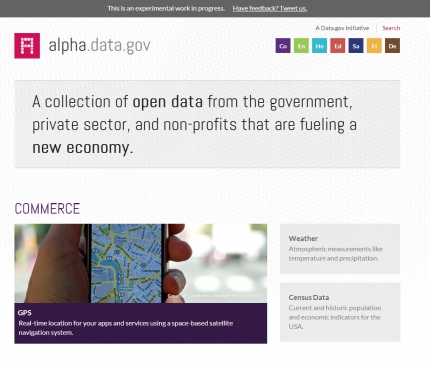
Screenshot from the new alpha.data.gov experimental website, created by the 2012 Presidential Innovation Fellows.
Learn more about , TechnologyHelp NASA Power the International Space Station
Posted by on January 25, 2013 at 12:24 PM ESTLast week, NASA launched the ISS Longeron Shadowing Optimization Challenge—a $30,000 competition that challenges citizen solvers to develop software algorithms that make solar panels on the International Space Station (ISS) more efficient. NASA is seeking solutions that reduce or eliminate the shadows the station casts upon itself at various points during its orbits of Earth. Ultimately, winning algorithms will help add power to the space station and expand the number and types of science experiments that can performed onboard.
NASA’s Center of Excellence for Collaborative Innovation and its Vehicle Integrated Performance, Environments and Resources (VIPER) office at Johnson Space Center are using the challenge to enlist citizen innovators in the hunt for optimal positions for solar collectors fastened to the space station so that that they generate as much power as possible on the spacecraft. This power is essential to performing science activities on the world class orbiting laboratory.
The energy used to power the space station is generated by eight sets of solar cells, or arrays, held to the station by longerons, long arms that are very sensitive to temperature changes—expanding when hot, and contracting when cold. Uneven shadows on longerons can cause solar array masts to buckle and create a hazard to the space station. In addition to maximizing the energy produced on the space station, winning algorithms must also minimize shadows on the longerons to help ensure no longerons fail.
Learn more about Innovations, TechnologyRoll Up Your Sleeves, Get Involved, and Get Civic-Hacking
Posted by on January 22, 2013 at 1:39 PM ESTThis summer, on June 1-2, 2013, citizens in cities across the Nation will join together to improve their communities and governments as part of the National Day of Civic Hacking.
Civic Hacking Day is an opportunity for software developers, technologists, and entrepreneurs to unleash their can-do American spirit by collaboratively harnessing publicly-released data and code to create innovative solutions for problems that affect Americans. While civic hacking communities have long worked to improve our country and the world, this summer will mark the first time local developers from across the Nation unite around the shared mission of addressing and solving challenges relevant to OUR blocks, OUR neighborhoods, OUR cities, OUR states, and OUR country.
National Day of Civic Hacking is a call to action for anyone who wants to make a positive impact on their town, city, and country. A coalition of leading organizations, companies, and government agencies have banded together to issue this challenge with the goal of promoting transparency, participation, and collaboration among governments, startups, and citizens. These partners will support Civic Hacking Day by hosting activities across the country that invite anyone to become part of the civic hacker community—whether you’re a newbie or an expert—and by connecting people in person or online during the weekend celebration.
Learn more about TechnologyPCAST Updates Assessment of Networking and InfoTech R&D
Posted by on January 17, 2013 at 5:43 PM ESTToday, the President’s Council of Advisors on Science and Technology (PCAST) released its latest report to the President and Congress, Designing a Digital Future: Federally Funded Research and Development in Networking and Information Technology. The report is a Congressionally mandated assessment of the Federal Networking and Information Technology Research and Development (NITRD) Program, which coordinates the Nation’s federally-funded research and development (R&D) in areas such as supercomputing, high-speed networking, cybersecurity, software technology, and information management. The report is an update on progress since the last such assessment was conducted in 2010.
The United States is a world leader in R&D for networking and information technology (NIT)—a sector that touches virtually every human endeavor and fuels economic growth, national security, and enhanced quality of life. NIT capabilities are at the core of our Nation’s infrastructure—underpinning and enabling diverse functions ranging from communication and commerce to defense and manufacturing. New NIT insights and discoveries ensure that the Nation remains a safe and healthy place where Americans can continue to succeed and thrive.
Learn more about TechnologyBuilding Apps and Services for Financial Empowerment
Posted by on January 17, 2013 at 1:44 PM EST(This article is cross-posted on the Treasury Notes blog)
Treasury recently hosted a Finance Data Working Session to brainstorm new uses and applications of government data that would help empower consumers. At the session, which was convened as part of Treasury’s broader Finance Data Initiative, over 50 entrepreneurs discussed dozens of ideas for new features, products, services, and apps that use government data to help American consumers make informed choices. By the end of the day, workshop participants narrowed down these ideas to a set of nine projects that show promise for helping Americans manage their finances, plan for retirement, and make more effective financial decisions.
At the working session, entrepreneurs and software developers volunteered to build the following ideas into prototypes and working applications in the coming months:
Learn more about Innovations, , TechnologyNASA Launches Second Annual International Space Apps Challenge
Posted by on January 15, 2013 at 6:40 PM ESTLast week, NASA announced that it will host a second annual International Space Apps Challenge on April 20-21, 2013. The event is a follow-up to last year’s highly successful Space Apps event, which brought together thousands of members of the tech and space community from 25 cities in 17 countries on all 7 continents (including participants in space!) to develop more than 100 unique open-source solutions to improve life on Earth and in space.
The event, which is part of the global Open Government Partnership, encourages collaboration between government agencies and civil society organizations around the world to promote technology development and innovation based on the principles of transparency, participation, and collaboration that are at the core of citizen science. This inclusive approach leverages the expertise and entrepreneurial spirit of citizen explorers to find solutions to key global challenges.
Learn more about Technology
- &lsaquo previous
- …
- 70
- 71
- 72
- 73
- 74
- 75
- 76
- 77
- 78
- …
- next &rsaquo


White House Blogs
- The White House Blog
- Middle Class Task Force
- Council of Economic Advisers
- Council on Environmental Quality
- Council on Women and Girls
- Office of Intergovernmental Affairs
- Office of Management and Budget
- Office of Public Engagement
- Office of Science & Tech Policy
- Office of Urban Affairs
- Open Government
- Faith and Neighborhood Partnerships
- Social Innovation and Civic Participation
- US Trade Representative
- Office National Drug Control Policy
categories
- AIDS Policy
- Alaska
- Blueprint for an America Built to Last
- Budget
- Civil Rights
- Defense
- Disabilities
- Economy
- Education
- Energy and Environment
- Equal Pay
- Ethics
- Faith Based
- Fiscal Responsibility
- Foreign Policy
- Grab Bag
- Health Care
- Homeland Security
- Immigration
- Innovation Fellows
- Inside the White House
- Middle Class Security
- Open Government
- Poverty
- Rural
- Seniors and Social Security
- Service
- Social Innovation
- State of the Union
- Taxes
- Technology
- Urban Policy
- Veterans
- Violence Prevention
- White House Internships
- Women
- Working Families
- Additional Issues