
Office of Science and Technology Policy Blog
PCAST Releases New Climate Report
Posted by on March 22, 2013 at 12:53 PM ESTToday the President’s Council of Advisors on Science and Technology (PCAST) released a letter to the President describing six key components the advisory group believes should be central to the Administration’s strategy for addressing climate change.
The 9-page “letter report” responds to a November request from the President for advice as the Administration prepares new initiatives to tackle the challenges posed by Earth’s changing climate. The letter calls for a dual focus on mitigation—reducing the pace and magnitude of climate-related changes—and adaptation—minimizing the unavoidable damage that can be expected to result from climate change.
“Both approaches are essential parts of an integrated strategy for dealing with climate change,” the letter states. “Mitigation is needed to avoid a degree of climate change that would be unmanageable despite efforts to adapt. Adaptation is needed because the climate is already changing and some further change is inevitable regardless of what is done to reduce its pace and magnitude.”
Learn more about Energy and EnvironmentAdministration Drives Release of Car Safety Data
Posted by on March 21, 2013 at 9:33 AM ESTThis article is cross-posted on the Dept. of Transportation blog.
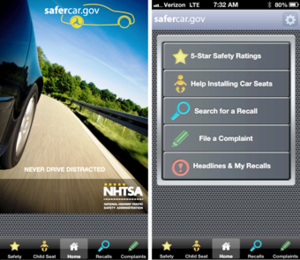 This morning, we're proud to join the National Highway Traffic Safety Administration in announcing a "SaferCar" app for iPhones, iPad, and iPod Touch devices. This new app puts the power of NHTSA's tremendous volume of vehicle safety data, including real-time vehicle safety information from NHTSA’s SaferCar.gov site, at the fingertips of American consumers. NHTSA’s SaferCar app allows users to search its 5-Star Safety Ratings for vehicles by make and model, locate car seat installation help, file a vehicle safety complaint, find recall information, and subscribe to automatic notices about vehicle recalls.
As a key partner in the White House Safety Data Initiative, the Department of Transportation (DOT) made a commitment at the Safety Datapalooza last September not only to make car safety data available through an easy-to-use app but also to give developers and entrepreneurs real-time access to the underlying government data through Application Programming Interfaces (API), so they can integrate these data into new and existing apps to further empower consumers. These APIs are now available, and developers can learn more about them at Safety.Data.Gov. NHTSA is also planning to publish an online course that teaches developers how to build safety tools using these APIs.
Learn more about Innovations, TechnologyThe Road to Cutting-Edge Robots
Posted by on March 20, 2013 at 12:33 PM ESTToday, at a briefing for the Congressional Robotics Caucus, leaders from academia and industry unveiled A Roadmap for US Robotics: From Internet to Robotics—a new report on robotics research, development, and education in the United States. The Roadmap, funded in part by Federal grants, highlights recent American innovations in robotics and the critical role of robotics in manufacturing and healthcare in the United States. It also describes areas of opportunity in the robotics domain to create new markets and new jobs, and to improve the quality of our lives.
Rethink Robotics’ new robot “Baxter” is designed to work alongside humans. (Photo by Rethink Robotics)
The new Roadmap is an update to an earlier version released in 2009 and builds on President Obama’s June 2011 announcement of the National Robotics Initiative (NRI)—a broad effort to develop robots that can work with humans to extend and augment human skills.
Learn more about Innovations, TechnologyWinning Cities in Mayors Challenge Receive Prizes to Implement Innovative Ideas
Posted by on March 19, 2013 at 5:56 PM ESTLast week, Bloomberg Philanthropies announced the winners of the Mayors Challenge, a competition designed to encourage American cities to generate innovative ideas that solve tough problems and improve life in the city.
Proving that there is plenty of room for big ideas in a small state, Providence, RI, won the Mayors Challenge Grand Prize for Innovation and will receive a $5 million implementation award for its cutting-edge early education initiative.
Learn more about InnovationsNew Steps to Meet the President’s Goal of Preparing 100,000 STEM Teachers
Posted by on March 18, 2013 at 4:57 PM ESTOSTP Director John P. Holdren hosted a roundtable today of more than 30 professionals from inside and outside government committed to the cause of improving the Nation’s corps of K-12 science, engineering, and math teachers. The discussion, in the Eisenhower Executive Office Building, came on the heels of this morning’s announcement by the Howard Hughes Medical Institute (HHMI) that it would donate $22.5 million to the National Math and Science Initiative to accelerate the scale-up of the UTeach program in American universities.
At a roundtable discussion on STEM teachers on March 18, 2013, OSTP Director John P. Holdren was flanked by Sean Carroll, Vice President for Science Sducation at HHMI and Sara Martinez-Tucker, CEO of NMSI. (Photo by Shealah Craighead)
UTeach, developed at the University of Texas-Austin, is a program that allows undergraduates to earn simultaneously a teaching certificate and a Bachelor’s degree in a science, technology, engineering, or math (STEM) field. The effort reflects a conclusion by the President’s Council of Advisors on Science and Technology that the best STEM teachers are those who have both depth of knowledge in the field they are teaching and pedagogical training and experience. Along with other initiatives such as 100Kin10, NMSI and UTeach are helping to achieve President Obama’s goal of training 100,000 excellent STEM teachers in the next decade.
Learn more about EducationSharing Ideas that Work: How Technology can Improve Education
Posted by on March 15, 2013 at 10:27 AM ESTThis week, school leaders, researchers, entrepreneurs, and leading educational thinkers gathered in New York City to share and cultivate innovative ideas about how technology can improve education. The gathering is being led by the Digital Promise League of Innovative Schools—a national center created by Congress and launched at the White House in 2011 to advance technologies to transform teaching and learning.
Digital Promise site visit to Olympus Academy in Canarsie, Brooklyn. (Photo by Digital Promise)
Below, Sara Shapiro, Digital Promise’s Director of the League of Innovative Schools, answers questions about this week’s meeting and next steps for Digital Promise.
What is Digital Promise and the League of Innovative Schools?
Digital Promise is a national, bipartisan, nonprofit center based in Washington, D.C. Chartered by Congress and launched in late 2011 by President Obama, Digital Promise is dedicated to advancing breakthrough educational technology through research, rapid evaluation, and knowledge sharing. The Digital Promise League of Innovative Schools is borne out of that last component—knowledge sharing. With 32 members representing 2.5 million students in 21 states nationwide, the League is a way for school districts to share ideas, results, and even resources as they tackle contemporary and future challenges in education. You can learn more about Digital Promise in our recently released annual report.
- &lsaquo previous
- …
- 66
- 67
- 68
- 69
- 70
- 71
- 72
- 73
- 74
- …
- next &rsaquo


White House Blogs
- The White House Blog
- Middle Class Task Force
- Council of Economic Advisers
- Council on Environmental Quality
- Council on Women and Girls
- Office of Intergovernmental Affairs
- Office of Management and Budget
- Office of Public Engagement
- Office of Science & Tech Policy
- Office of Urban Affairs
- Open Government
- Faith and Neighborhood Partnerships
- Social Innovation and Civic Participation
- US Trade Representative
- Office National Drug Control Policy
categories
- AIDS Policy
- Alaska
- Blueprint for an America Built to Last
- Budget
- Civil Rights
- Defense
- Disabilities
- Economy
- Education
- Energy and Environment
- Equal Pay
- Ethics
- Faith Based
- Fiscal Responsibility
- Foreign Policy
- Grab Bag
- Health Care
- Homeland Security
- Immigration
- Innovation Fellows
- Inside the White House
- Middle Class Security
- Open Government
- Poverty
- Rural
- Seniors and Social Security
- Service
- Social Innovation
- State of the Union
- Taxes
- Technology
- Urban Policy
- Veterans
- Violence Prevention
- White House Internships
- Women
- Working Families
- Additional Issues