
On the Employment Situation in March
Today’s employment report shows continued signs of gradual labor market healing. Payroll employment rose significantly in March, and the unemployment rate remained constant despite a substantial increase in the labor force.
Payroll employment increased 162,000. Even after adjusting for the 48,000 temporary Census workers hired and a rebound effect from the February snowstorms, this number suggests an increase in underlying payroll employment. Moreover, revised estimates now show a small job gain in January and a smaller job loss in February than previously reported. As a result, for the first quarter of 2010 as a whole, job growth averaged 54,000 per month. This is a dramatic change from the first quarter of 2009, when average job loss was 753,000 per month.
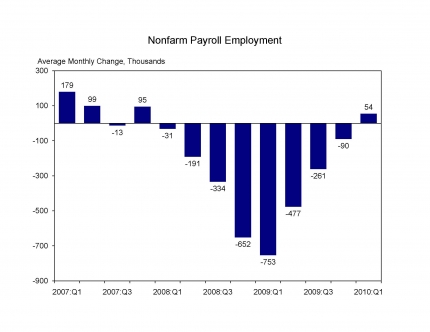
Download this data as a CSV file. April 2, 2010.
The unemployment rate remained constant at 9.7 percent. This stability reflects roughly proportional rises in the labor force and employment, as measured by the household survey. This pattern of rising labor force and household employment has been repeated in each of the last three months. Indeed, according to the household survey, the labor force has increased by 1.1 million since December 2009 and employment has increased by 1.4 million.*
At the same time that we welcome today’s encouraging labor market news, it is obvious that the American labor market remains severely distressed. More than eight million Americans have lost their jobs since the start of the recession in December 2007. It will take sustained, robust employment growth to bring the unemployment rate down. Further targeted actions to spur private sector job creation are critically needed to ensure a more rapid, widespread recovery.
While this is the most positive jobs report we have had in three years, there will likely be bumps in the road ahead. The monthly employment and unemployment numbers are volatile and subject to substantial revision. Therefore, it is important not to read too much into any one monthly report, positive or negative. It is essential that we continue our efforts to move in the right direction and generate steady, strong job gains.
Christina Romer is Chair of the Council of Economic Advisers
* The reported numbers are adjusted to remove the impact of revised population controls that the Bureau of Labor Statistics introduced in January 2010. Without this adjustment the labor force increased by 851,000 and employment increased by 1.11 million.

White House Blogs
- The White House Blog
- Middle Class Task Force
- Council of Economic Advisers
- Council on Environmental Quality
- Council on Women and Girls
- Office of Intergovernmental Affairs
- Office of Management and Budget
- Office of Public Engagement
- Office of Science & Tech Policy
- Office of Urban Affairs
- Open Government
- Faith and Neighborhood Partnerships
- Social Innovation and Civic Participation
- US Trade Representative
- Office National Drug Control Policy
categories
- AIDS Policy
- Alaska
- Blueprint for an America Built to Last
- Budget
- Civil Rights
- Defense
- Disabilities
- Economy
- Education
- Energy and Environment
- Equal Pay
- Ethics
- Faith Based
- Fiscal Responsibility
- Foreign Policy
- Grab Bag
- Health Care
- Homeland Security
- Immigration
- Innovation Fellows
- Inside the White House
- Middle Class Security
- Open Government
- Poverty
- Rural
- Seniors and Social Security
- Service
- Social Innovation
- State of the Union
- Taxes
- Technology
- Urban Policy
- Veterans
- Violence Prevention
- White House Internships
- Women
- Working Families
- Additional Issues