
The Employment Situation in April
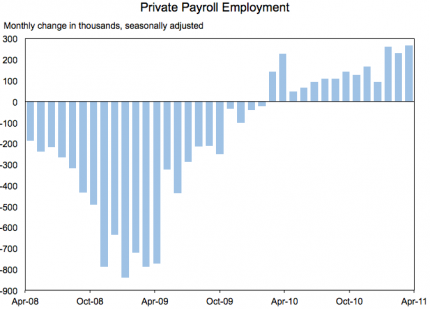
Today’s employment report shows that private sector payrolls increased by 268,000 in April, the strongest monthly growth in five years. The economy has added 2.1 million private sector jobs over 14 consecutive months, including more than 800,000 jobs since the beginning of the year. The unemployment rate rose to 9.0 percent, but remains 0.8 percentage point below its November level.
Despite headwinds from high energy prices and disruptions from the disaster in Japan, the last three months of private job gains have been the strongest in five years.While the solid pace of employment growth in recent months is encouraging, faster growth is needed to replace the jobs lost in the downturn. We are seeing signs that the initiatives put in place by this Administration – such as the payroll tax cut and business incentives for investment – are creating the conditions for companies to add new jobs and foster the industries of the future. We will continue to work with Congress to find ways to reduce spending, so that we can live within our means without neglecting the investments in education, infrastructure, and clean energy that will strengthen our economy.
In addition to the increases last month, payroll survey estimates of private sector job growth for February (now +261,000) and March (now +231,000) were revised up. Overall payroll employment rose by 244,000 in April, well above market expectations. Payroll employment grew in almost every sector. Solid employment increases occurred in retail trade (+57,100), professional and business services (+51,000), education and health services (+49,000), leisure and hospitality (+46,000), and manufacturing (+29,000). Manufacturing has added 244,000 jobs in the last 14 months, the best period of manufacturing job growth in 13 years. State and local government experienced a decline of 22,000; this sector has shed 289,000 jobs in the past 14 months, mostly in local government.
The unemployment reading in April showed a partial reversal of the 1.0 percentage point decline over the previous four months. Employment measured in the household survey dipped in April and the labor force participation rate was unchanged. The unemployment rate data derive from a separate household survey. The payroll and household surveys can differ on a monthly basis; the household survey is more volatile, but the two surveys typically show similar long-run trends in employment.
The overall trajectory of the economy has improved dramatically over the past two years, but there will surely be bumps in the road ahead. The monthly employment and unemployment numbers are volatile and employment estimates are subject to substantial revision. Therefore, as the Administration always stresses, it is important not to read too much into any one monthly report.
Austan Goolsbee is Chairman of the Council of Economic Advisers

White House Blogs
- The White House Blog
- Middle Class Task Force
- Council of Economic Advisers
- Council on Environmental Quality
- Council on Women and Girls
- Office of Intergovernmental Affairs
- Office of Management and Budget
- Office of Public Engagement
- Office of Science & Tech Policy
- Office of Urban Affairs
- Open Government
- Faith and Neighborhood Partnerships
- Social Innovation and Civic Participation
- US Trade Representative
- Office National Drug Control Policy
categories
- AIDS Policy
- Alaska
- Blueprint for an America Built to Last
- Budget
- Civil Rights
- Defense
- Disabilities
- Economy
- Education
- Energy and Environment
- Equal Pay
- Ethics
- Faith Based
- Fiscal Responsibility
- Foreign Policy
- Grab Bag
- Health Care
- Homeland Security
- Immigration
- Innovation Fellows
- Inside the White House
- Middle Class Security
- Open Government
- Poverty
- Rural
- Seniors and Social Security
- Service
- Social Innovation
- State of the Union
- Taxes
- Technology
- Urban Policy
- Veterans
- Violence Prevention
- White House Internships
- Women
- Working Families
- Additional Issues