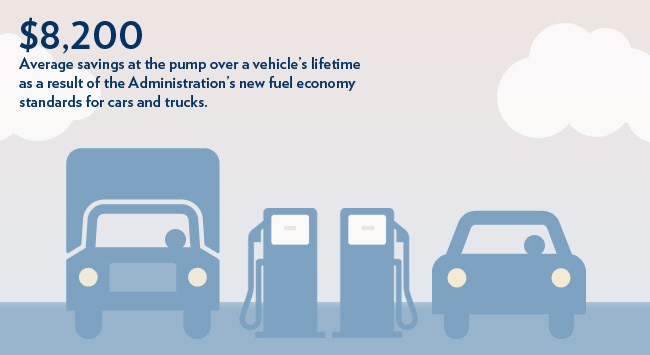
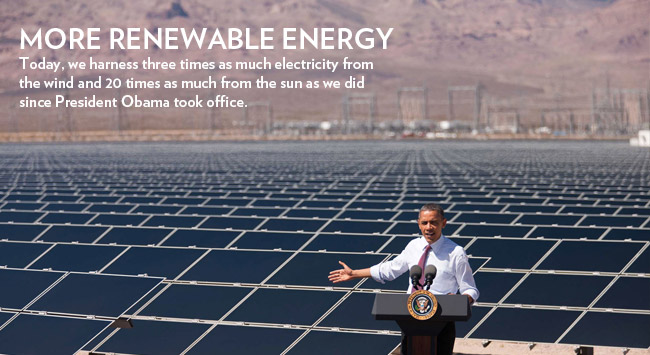
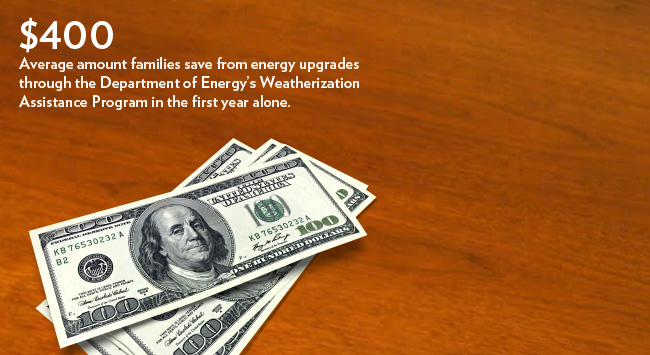
Energy and Environment Latest News
Taking the Lead on Climate Change for the First Time
Posted by on September 22, 2009 at 3:36 PM ESTToday, I joined the President on his trip to the United Nations Climate Change Summit, where President Obama called on leaders from around the world to come together in pursuing policies that allow economies to grow without endangering out planet. The President delivered a message of international unity because no nation – regardless of size or wealth – can escape the impacts of climate change. As President Obama said today, rising sea levels threaten every coastline; threats like more powerful storms and floods, more frequent droughts and hunger are challenges that know no borders.It was an honor to join President Obama today at this historic UN Summit. And it was inspiring to see the many faces of the United Nations joined together to tackle this challenge. (President Barack Obama addresses the Climate Change Summit at the UN General Assembly in New York, New York on Tuesday September 22, 2009. Official White House photo by Samantha Appleton)The time we have to reverse this tide is running out. But I am confident that we can reverse it.And no administration in the history of the United States has done more to promote clean energy and reduce greenhouse gas emissions in eight months than this one. From making the largest-ever investment in renewable energy to investing billions to cut energy waste, and proposing for the first time ever a new national standard aimed at both increasing fuel economy and reducing greenhouse gas pollution for all new cars and trucks. And most importantly, the House of Representatives passed an energy and climate bill in June that would finally make clean energy the profitable kind of energy for American businesses and dramatically reduce greenhouse gas emissions. We are looking forward to engaging with the Senate as they craft their legislation.Still, despite bold action from many of the nations seated before the UN, we know that much work remains to be done. And the President highlighted this point in his speech when he said, "We came [to the UN] because there’s so much more progress to be made." And there is progress to be made on all sides. Both developed nations that have caused much of the damage to our climate over the last century and developing nations that will produce nearly all the growth in carbon emissions in the decades ahead must do their parts.As we continue down this path of progress, we know we must also energize our efforts to put other developing nations – especially the poorest and most vulnerable – on a path to sustainable growth. Today the United States sat among these countries and pledged our to live up to our responsibility to provide the financial and technical assistance needed to help these nations adapt to the impacts of climate change and pursue low-carbon development. Today we called on all nations to not simply seek an agreement to limit greenhouse gas emissions, but to seek an agreement that will allow all nations to grow and raise living standards without endangering our planet.This great challenge has come to the fore among all nations of the world today – and from the floor of the UN General Assembly, for the first time, it was the United Stands that stood up to take the lead.Carol Browner is Assistant to the President for Energy and Climate ChangeLearn more about Energy and Environment
Sneak Peak at "America's Best Idea"
Posted by on September 17, 2009 at 12:58 PM ESTWith memories of his family's recent visit to the Grand Canyon and Yellowstone National Park still fresh in his mind, President Barack Obama watched a special preview of The National Parks: America’s Best Idea, a new documentary by Ken Burns that will premiere on PBS September 27.While our nation boasts many great ideas, writer and historian Wallace Stegner calls our national parks "the best idea we ever had. Absolutely American, absolutely democratic, they reflect us at our best rather than our worst." In 1872, Yellowstone National Park became the first national park in the world, its creation spawning a worldwide national parks movement.The National Park Service, on behalf of all Americans, cares for our country’s most treasured places – ones of seemingly impossible natural beauty and those that move us to remember our heroes and battles for freedom, preserve the icons of our shared heritage, honor our nation’s diverse cultures, and celebrate the triumphs of individual spirit over adversity. In addition to caring for nearly 400 national parks, the National Park Service works in communities, by providing grants and expertise, to help neighbors preserve local history and create green spaces for healthy, outdoor family fun.The best thing about national parks is that they belong to each one of us – to visit and enjoy; to care for and preserve for our children and grandchildren. To celebrate this wonderful inheritance, we are working together to make America’s Best Idea even better! On September 26, please join the National Park Service and the National Park Foundation in national parks across the country for a National Day of Service and Celebration – there will be no entrance fees, and you can volunteer and celebrate by seeing the same special preview the President saw today.Learn more about the exciting things the National Park Service is doing and how you can be a part of it at a special website launched today – America’s Best Idea just keeps getting better.You can also join the conversation on Facebook. Tell us your ideas for making our National Parks even better on the National Park Service Facebook page, or check out the National Park Service Facebook app and send a postcard from your favorite park to your friends. And, of course, you can always follow the NPS Twitter feed.Viewing this video requires Adobe Flash Player 8 or higher. Download the free player.Dan Wenk is Acting Director of the National Park Service
Learn more about Energy and EnvironmentStreaming Now: Windows into the Clean Energy Economy
Posted by on September 17, 2009 at 8:24 AM ESTThis morning on a factory floor Bensalem, PA (just outside of Philadelphia), the topic will be windows – and a window into the jobs being created in the Clean Energy Economy.Pennsylvania Governor Ed Rendell and Delaware Governor Jack Markell are hosting the third of a series of regional Clean Energy Economy Forums. Secretary of Energy Steven Chu will be joining the Governors, along with Senior Counselor for Manufacturing Policy Ron Bloom and Deputy Assistant Secretary of Defense for Strategy Amanda Dory. Watch the event live.The Forum is being held at Accu-Weld, a family owned business based in Bensalem, PA for nearly three decades. The company is currently producing and manufacturing high-energy efficient windows and doors for the residential home market. Despite the economic downturn, Accu-Weld recently announced it would save 140 local jobs as a result of new demand in the home weatherization market, and is growing at annual rate of approximately 20 percent.Windows will be just one of the stories that will be discussed this morning. The audience includes dairy farmers, who will talk about how the installation of a digester has helped turn their farm into an energy producer. It includes workers and executives from Pennsylvania companies that make parts for solar and wind energy. And it includes a group of recent veterans who have been speaking out about the first-hand experiences they have, and the need to address comprehensive energy and climate legislation to lesson our dependence on foreign oil. These are the stories of the Clean Energy Economy.The forum will be webcast in full at www.pa.gov.Greg Nelson is an Associate Director of the White House Office of Public EngagementLearn more about Energy and EnvironmentA Green Vision... A Bright Future
Posted by on September 14, 2009 at 2:45 PM ESTLast week I toured the Ivanhoe neighborhood in Kansas City, MO with colleagues from the federal government. The stories I heard from folks in the neighborhood and the places I saw reminded me of the untapped potential of so many similar communities across the country. This is a place that had been overlooked and underserved for decades, and was held together by neighborhood residents who refused to give up.Our visit to Kansas City is part of the White House Office of Urban Affairs’ tour called the National Conversation on the Future of Cities and Metros. At this stop we explored a "place based initiative" called the Green Impact Zone — an ambitious plan to invest in a specific area to address a variety of challenges. Over the last year, a public-private partnership led by Congressman Emanuel Cleaver, that included neighborhood leaders, the Mid America Regional Council (MARC), Kansas City Power & Light and the Kansas City Area Transportation Authority, designed an innovative plan to weatherize every home in a 150-block area, train local residents in green jobs, deploy a "smart" electricity grid in the Zone, and develop a green bus-rapid-transit system to connect this community to opportunities in the city and region.
HUD Secretary Donovan and Transportation Deputy Secretary Porcari joined our White House delegation to learn more about the challenges these partners overcame to plan for the Green Impact Zone, and the critical catalytic role the American Recovery and Reinvestment Act played in spurring this on. The Zone is comprised of six neighborhoods and is known as the area "East of Troost Avenue." It has historically been plagued by high rates of unemployment and poverty. A major element of the Green Impact Zone plan is to link residents to resources like the jobs that will be created through the home weatherization efforts.
 We had the opportunity to tour the Zone with Margaret May, Director of the Ivanhoe Neighborhood Community Center and David Warm, Executive Director of the Mid-America Regional Council (MARC). We stopped at the home of Ida Dockery whose home was recently weatherized. Ida was very happy to know she will save a lot on her utilities. She spoke about the transformation of the neighborhood that began with a few neighbors getting together to clean up their blocks and enlisting many neighbors and finally the help of the city.
Right after the neighborhood tour, we helped to cut the ribbon at the grand opening of the Green Impact Zone Community Assistance Center. Led by Anita Maltbia, Director of the new center, this office will deploy organizers to work with the community on green projects and serve as a one-stop-shop for accessing federal resources to redevelop the Zone.
When you visit Kansas City you must have lunch at Gates BBQ. Folks in Kansas City are rightfully proud of their barbecue culinary tradition. So, in keeping with local tradition we had a great lunch at Gates BBQ, while we engaged in a rigorous policy discussion on the elements of the Green Impact Zone and how it might be replicated around the country. Make sure you follow your lunch with coffe if you intend to continue a day of work, as we did.
The stakeholders who were part of this discussion agreed to help the federal government identify barriers (statutory and regulatory) to smart investments and innovations that serve communities. Mark Huffer of the Kansas City Area Transit Authority explained that one barrier to transit development is finding qualified transit operators. He urged that we develop opportunities for training prospective operators in the urban core. Deputy Secretary John Porcari noted that the Department of Transportation has to "beat to fit"that is, "beat federal policy to fit the needs of the communities we serve." DOT, as well as all federal agencies, are working with us to explore methods of providing more flexibility in funding to help local leaders better address the needs of their communities.
Our day ended with a robust discussion about the future of Kansas City and the Green Impact Zone with local leaders and members of the community. Manheim Neighborhood Association President Rodney Knott shared his vision for building more green homes and training neighborhood folks in construction, so they are able to rehabilitate abandoned properties in the area. Mr. Knott said, "A great man once called on us and challenged the nation to put a man on the moon, and we did, another great man has challenged us to realize energy independence and invest in human capital. The Green Impact Zone is evidence that we can meet this challenge." HUD Secretary Shaun Donovan applauded Knott’s efforts and noted that HUD has proposed to set aside $150 million in funding for sustainable development at the regional, city and neighborhood levels.
I believe the smart investment being made in Kansas City’s Green Impact Zone will prove to be a ground-breaking approach to neighborhood revitalization. This is the kind of inter-agency, interdisciplinary strategy we need to apply in hundreds of communities around the country. As I told the crowd gathered, "national policy should be driven by smart local plans."
Bravo Kansas City!
For questions or ideas for the Urban Tour, please feel free to send a message to urbanaffairs@who.eop.gov.
Adolfo Carrión, Jr. is Director of the White House Office of Urban Affairs and Deputy Assistant to the President
Learn more about Energy and EnvironmentEPA Lead Poisoning Prevention Video Contest
Posted by on August 28, 2009 at 12:45 PM ESTGrab your video camera and get the lead out!The dangers of lead poisoning are very serious, and health problems caused by lead can impact a child for a lifetime.We want you to help us get the word out about lead poisoning prevention, by creating videos to educate people on what they can do to prevent lead poisoning. We’re looking for 30-60 second video on anything from the dangers of lead poisoning; how to get rid of lead hazards in homes; or the importance of children being tested for harmful levels of lead in their blood.Entries will be accepted until October 1st.We’ll post the best videos on the EPA, HUD and CDC web sites to get the message out about lead poisoning. The best video will receive a $2,500 First Prize.Most importantly, you’ll be helping us get the word out on an important health issue.In young children, lead exposure can cause learning disabilities, decreased intelligence, as well as speech, language, and behavioral problems. In older children and adults, brain and nervous system disorders, high blood pressure, and reproductive problems have all been associated with lead exposure.EPA is taking action on a number of fronts to protect children from the lead dangers. We’ll be proposing new requirements to protect children from lead-based paint poisoning including requiring more buildings to use lead-safe work practices during renovation projects, and requiring tests to ensure the renovation cleanup work meets EPA lead dust standards.We’re also working to address lead exposures associated with the manufacture of lead wheel weights used to balance tires. That will help prevent more than 2,000 tons of lead from being released into the environment from tire weights that fall off of automobiles.But we need your help in getting the word out. Please send us your best, most creative video to help to inspire individuals, businesses, communities, and everyone else to avoid dangerous exposure to lead.Remember: all entries are due October 1st, and First Prize is $2500.Read the details at here.We look forward to seeing your video and thanks for helping to protect kids from lead poisoning.Steve Owens is EPA Assistant Administrator for Prevention, Pesticides and Toxic SubstancesLearn more about Energy and EnvironmentTouring the Arctic
Posted by on August 18, 2009 at 2:07 PM ESTThis week I have joined other Administration officials for an Arctic Observance tour to learn more about how climate change is affecting the Arctic region. We left Washington, DC early Monday morning with our team, which includes Under Secretary of Commerce for Oceans and Atmosphere and NOAA Administrator Dr. Jane Lubchenco, U.S. Coast Guard Commandant Admiral Thad Allen, Deputy Assistant to the President on Energy and Climate Change Heather Zichal, and DOI Deputy Secretary David Hayes, and received a detailed briefing about the specifics of our trip to Alaska and what to expect in the coming days.
Upon our arrival in Nome, we were greeted by local officials, citizens and members of our armed forces. Immediately following, we met with local scientists on coastal erosion affecting the region.
Today we flew to Fairbanks and went to the University of Alaska, Fairbanks, for presentations on the diversity of the Arctic Ocean and how climate change is impacting the region. Later today we will travel to the Permafrost Tunnel, a unique research facility that allows scientists to study the composition and behavior of ice structures and frozen bioorganics dating over 40,000 years old! Over the next three days we will continue our journey andmeet with local leaders, citizens and scientists who will share their knowledge on these issues.Our outreach in Alaska will culminate on Friday August 21st with the first in a series of Ocean Policy Task Force Public Meetings in Anchorage. The President has charged the Interagency Ocean Policy Task Force with developing a recommendation for a national policy that ensures protection, maintenance, and restoration of oceans, our coasts and the Great Lakes. It will also recommend a framework for improved stewardship, implementation options, and effective coastal and marine spatial planning. These public forums are a key component to establishing a comprehensive ocean policy.
You can find more information on the Ocean Policy Task Force Public Meeting in Anchorage here.
You can also follow the Coast Guard’s blog, photos, Twitters, Facebook, and YouTube videos about our trip.Nancy Sutley is the Chair of the Council on Environmental Quality.
Learn more about Energy and Environment
- &lsaquo previous
- …
- 194
- 195
- 196
- 197
- 198
- 199
- 200
- 201
- 202
- …
- next &rsaquo
Related Videos
-
 May 09, 2014 8:21 AM
Inside the White House: Solar Panels
-
 September 01, 2016 8:25 PM
President Obama Delivers a Statement to the Press
White House Blogs
- The White House Blog
- Middle Class Task Force
- Council of Economic Advisers
- Council on Environmental Quality
- Council on Women and Girls
- Office of Intergovernmental Affairs
- Office of Management and Budget
- Office of Public Engagement
- Office of Science & Tech Policy
- Office of Urban Affairs
- Open Government
- Faith and Neighborhood Partnerships
- Social Innovation and Civic Participation
- US Trade Representative
- Office National Drug Control Policy