

Latest News
White House Rural Council Hosts Native American Food and Agriculture Roundtable Discussion
Posted by on April 6, 2012 at 2:04 PM ESTplayWhite House Rural Council Hosts Native American Food and Agriculture Roundtable Discussion
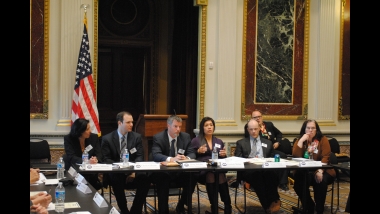
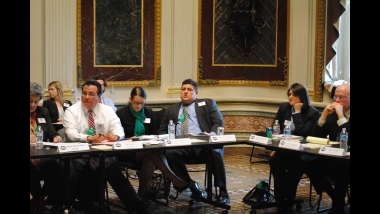
Tribal Leaders meet with the White House Rural Council in the Indian Treaty Room
1 of 5Yesterday, the White House Rural Council hosted a Native American Food and Agriculture Roundtable Discussion, bringing together tribal leaders and experts on Native American agricultural economic development with Administration officials from the White House Domestic Policy Council, National Economic Council, Office of Intergovernmental Affairs, Office of Management and Budget, Council on Environmental Quality, and federal agency partners including the Departments of Agriculture, Interior, Commerce, Treasury, and the Small Business Administration.
The White House Rural Council was established by an Executive Order of President Obama in June 2011. The Rural Council, chaired by Secretary of Agriculture Tom Vilsack, is dedicated to creating jobs and fostering economic development in Rural America. This is an all hands on deck approach - to accomplish this goal of growing the rural economy, the President appointed 14 Cabinet Members to the Council. In August 2011, the Council hosted the White House Native American Business Leaders Roundtable, which provided officials an opportunity to hear from Native American business leaders and policy experts about ways we can work together to improve economic conditions and create jobs in tribal communities.
The Native American Agriculture and Food Roundtable served as a forum for leaders and experts to contribute ideas for fostering community and agricultural economic development with a particular focus on Leasing, Technical Assistance, Strategic Business Planning and Access to Capital, Credit and other Financial Resources. These topics were chosen because of their importance for agricultural economic growth in Rural America and Indian Country. The White House Rural Council convened this roundtable to gather information and ideas to help us identify administrative barriers and explore opportunities to foster food and agricultural opportunities in Indian Country.
Recipe in Spotlight - Not-Chicken Matzoh Ball Soup
Posted by on April 6, 2012 at 10:30 AM ESTEditor's note: This post is part of a series spotlighting different family recipes used by members of the Obama Administration for Passover.
I’m helping to host a Seder this year – since it will be my first vegetarian Seder experience, I’m looking forward to making Not-Chicken Matzoh Ball Soup for the first time. Thanks to the Katch family for sharing their traditional recipe!
Recipe in Spotlight - Passover Chocolate Chip Mandel Broit
Posted by on April 6, 2012 at 10:25 AM ESTEditor's note: This post is part of a series spotlighting different family recipes used by members of the Obama Administration for Passover.
This is my mother’s recipe, and it was given to her by my preschool teacher when I was two years old. She has been making them ever since. The best part is that you can make a number of variations on this recipe. I make it using either raisins or dried cranberries, instead of the chocolate chips.
Becoming the Best Possibility for Change
Posted by on April 5, 2012 at 11:50 AM EST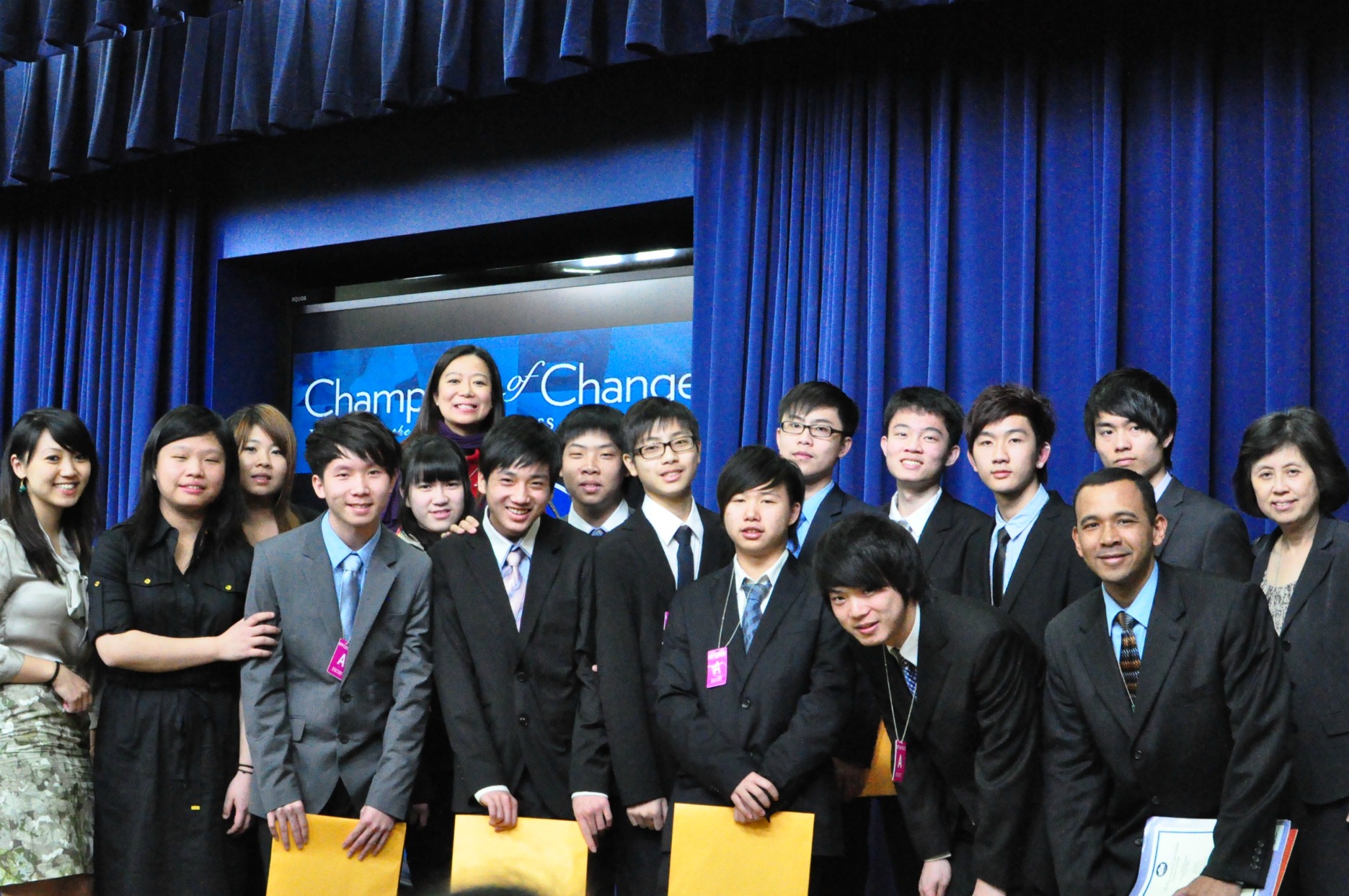
We are very humbled that the Chinese Immigrant Student Leadership (ChISL) program is being honored as a “Champion of Change” by the White House Initiative on Asian Americans and Pacific Islanders. ChISL is in its pilot year and is a partnership program between Charlestown High School in Boston, MA and the Boston Chinatown Neighborhood Center, a non-profit community-based organization. The “My Voice – Their Stories” video features ChISL youth that shared their experiences transitioning to life in the United States.
In fact, the idea for ChISL first started with the observation that there were very few opportunities for immigrant youth to have a voice of their own and share such experiences. The Chinese immigrant youth in ChISL are all enrolled in the Sheltered English Instruction (SEI) program at Charlestown and everyday they work hard at school to learn and master (academic) English, while struggling equally hard outside of school to navigate a completely new country and adapt to a new culture. All too often, they have little to no opportunities to challenge themselves beyond such daily struggles to develop their inner leadership skills or to think about how they can be part of creating positive social change. ChISL brings these future youth leaders together and gives the youth a safe space to not only talk about these struggles, but to consider how they can contribute to the community and advocate on behalf of others facing the same sort of struggles.
Finding Purpose in Obedience: Seeking to Do My Part
Posted by on April 5, 2012 at 11:42 AM EST
Out of thousands of worthy individuals who serve others I am truly humbled to be recognized as a White House Champion of Change. I have benefited greatly as a participant who received much in terms of mentorship, training and counsel. I continue to receive much inspiration and encouragement even today as I seek to serve others.
The Suns originated as a neighborhood sports organization which competed with similar AAPI organizations across the United States and Canada. The Suns' athletic programs have taught the fundamentals of sports, while instilling applicable life values. I was a youth who grew up in the program. Since I began leading the Philadelphia Suns, I have maintained its athletic pursuits and expanded the program to encompass other areas, such as: intentional mentorship, cultural education and service to the community. Much of what we focus on is the development of character qualities that make a difference in any community. Since its founding, the Suns have empowered youth to participate in civic engagement by hosting, serving and supporting area events, such as the Martin Luther King Jr. Day of Service and our bi-annual community cleanup. Also, each year we award college scholarships to deserving members of our community.
Making A Difference Starts With Acceptance and Understanding
Posted by on April 5, 2012 at 11:36 AM EST
It is a great honor to be selected as a "Champion of Change" through the White House Initiative on Asian Americans and Pacific Islanders. As a doctoral student, studying to be a clinical psychologist, I would like to take this opportunity to continue the dialogue about reducing the stigma associated with mental health concerns. Generally, when someone announces that he or she has been diagnosed with cancer or another health condition, that person is met with sympathy and concern. Yet, if the same person proclaims that he or she has a mental illness such as schizophrenia, the audience may tense up and eyes start to wander about uncomfortably. That person often ends up feeling ashamed, confused and loneley, without comfort and unwavering support from loved ones. I believe the stigma associated with mental health diagnoses and with seeking service is acutely profound in the Asian American and Pacific Islander (AAPI) community.
Everyone has a story to share. Once we start sharing our stories with one another, we may find that we have more in common that we thought. We may realize that we are not alone and that we are a part of a community. Our stories are personal, and mine includes my family. When I recently asked my father what made it difficult for him to talk about mental illness with me, he responded that it was because he could not see “it.” He stated that if I had a pimple or a health condition, he could see it visually or through test results. With cyclothymia, a mood disorder, my father said it was “in my head,” and he felt powerless to help me. He said that by not talking about it, he had hoped that it would go away in time. Has it gone away? I do not know. I do know, however, that I am successfully going through my doctoral program, advocating for mental health parity at conferences and volunteering at a program called Standing Against Global Exploitation Project (SAGE), which intervenes in the exploitation of women. I am also a dedicated volunteer at the Richmond Area Multi-Services (RAMS, Inc), a multi-ethnic, multilingual community mental health program, and Santa Clara County’s Ethnic and Cultural Community Advisory Committees (ECCAC). I may not have an ongoing condition of cyclothymia, but even if I do, it is only one of my many life experiences. It does not own me or define who I am.
Once a Sun, Always a Sun
Posted by on April 5, 2012 at 11:28 AM EST
My commitment to the Philadelphia Suns is powered by my relationships with those in the organization. Harry Leong, the patriarch of the Suns, first drew me in when he said, "Sure, as long as you can get enough girls to come." His conditional agreement to my desire to start a ladies' basketball team sparked what would become 10 years of his mentorship and my leadership. By handing me the freedom to create, Harry empowered me to make things happen.
The Suns aims to: teach personal responsibility; instill values of teamwork, commitment and integrity; and provide a safe place to try, fail and try again. The organization is now in it's 40th year and serves more than 500 youth and young adults annually. Through a powerful combination of community-building and goal-setting from a committed volunteer network, the Suns have been able to foster a home for the Asian American youth of Philadelphia to grow into passionate individuals and future leaders.
I didn't discover the Suns until late high school when I reconnected with my Chinatown neighborhood. What I found in the Suns was an organized avenue for Asian American youth to partake in sports. Such an organization is significant, especially in the tough urban public school system of Philadelphia -- Asian boys often discount themselves from their high school tryouts and Asian girls sideline themselves as spectators. Unsure of their athletic adequacy, they simply choose not to play.
Let All Who Are Hungry Come and Eat: A Food and Justice Seder at USDA
Posted by on April 5, 2012 at 11:14 AM EST
Agriculture Secretary Tom Vilsack speaks at the Food and Justice Passover Seder at the U.S. Department of Agriculture in Washington, D.C., April 4, 2012. (Photo courtesy of Lance Cheung, USDA)
This post originally appeared on the USDA blog.
Just ahead of the official start of Passover this Friday at sunset, the U.S. Department of Agriculture hosted its second Food and Justice Passover Seder. The traditional Jewish seder commemorates the Passover holiday and the Exodus of the Israelites from Egypt. USDA’s symbolic seder, held in partnership with Bend the Arc: A Jewish Partnership for Justice, highlighted the intersection of food and justice issues in the modern world. This year’s event centered on the themes of hunger, access to healthy food, sustainable food production, and fair treatment for farm workers.
Learn more about Additional Issues
Twitter