Health Care Blog
A New Generation of Nurses
Posted by on February 23, 2012 at 10:34 AM EST
Secretary of Labor Hilda L. Solis and Dr. Jill Biden start the Community College to Career Tour (CC2C) stopping at locations in Ohio, Kentucky, Tennessee, Virginia, and North Carolina to highlight the importance of community colleges in fostering careers. The stop to the Cincinnati State Technical and Community College was to take part in the "Cincinnati State Health Professions Consortium Pathway to Employment" panel discussion February 23, 2012. (by Department of Labor)
Dr. Jill Biden and Labor Secretary Hilda Solis kicked off a three-day “Community College to Career” bus tour yesterday to highlight the unique role community colleges play in developing a flexible, highly-skilled 21st-century workforce to meet emerging regional business needs. Secretary Solis is writing updates on the trip from the road.
We just saw the great things happening in Cincinnati to train up our next generation of nurses. The average age of the registered nurse is climbing. There are more nurses in their 50s right now than any other age range. They account for almost one-quarter of our nursing workforce. So it’s critical that we prepare for these retirements and train up our next generation of nurses.
Many schools across the country have struggled to meet the rising need for more nursing professionals. With the passage of the Affordable Care Act, more than 32 million Americans will soon gain access to healthcare services, including access to care provided by registered nurses.
The American Association of Colleges of Nursing found that nursing schools turned away more than 67,000 qualified applicants in 2010 due to insufficient number of faculty, clinical sites, classroom space, and budget constraints. Nine years ago, in response to the urgent nursing shortage, Cincinnati State Technical and Community College began a health careers collaborative with local hospitals. The goal was to train up local workers for entry-level health care jobs like office assistants and medical coders—and help incumbent workers who wanted to continue their education and perhaps become nurses.
Improving the Health Care System through Innovation
Posted by on February 22, 2012 at 7:44 PM ESTThis week, I joined my colleagues, including White House Cabinet Secretary and Initiative Co-Chair Chris Lu, in Jacksonville, Florida to engage with Asian American and Pacific Islander (AAPI) business leaders about the Obama Administration’s policies and programs to support aspiring entrepreneurs and start-ups, resources for small businesses wanting to go global, and innovation opportunities for entrepreneurs, including health IT.
Throughout American history, AAPI communities have played a pivotal role in helping to build the infrastructure that supports our great nation. As our economy continues to improve, the contributions of the AAPI community will lead the way in building and improving our health care infrastructure in An America Built to Last.
Learn more about Health CareGiving Doctors and Hospitals the Tools They Need to Provide Better Care
Posted by on February 21, 2012 at 5:48 PM ESTEd. note: This blog is cross-posted from HHS
Last week, I visited the Metropolitan Community College where I toured the Virtual Hospital and Patient Simulation Lab. This facility is a great example of how Community Colleges are training the skilled workforce that is so critical to creating and running successful Health IT systems.
When doctors and hospitals use Health IT, it reduces errors, cuts paperwork, and lowers costs. Over the past 3 years, the Obama Administration has made it a top priority to make it easier for doctors and hospitals to adopt Health IT.
We’re providing incentive payments to hospitals and eligible providers to adopt electronic health records and use them to improve patient care. We created 62 Health IT Regional Extension Centers around the country to help health care providers take advantage of those incentives. Already, more than 120,000 primary care providers, including over 70% of rural primary care providers in small practices, have registered to use those incentives.
At community colleges we’re training the skilled workforce that is essential to sustaining this investment. More than 9,000 community college students have already completed Health IT training through federally supported workforce programs, with thousands more enrolled.
And last week, we announced that these investments are already making a difference. New data shows that nearly 2,000 hospitals and more than 41,000 doctors have received $3.1 billion in incentive payments for meaningful use of Health IT, particularly certified Electronic Health Records (EHR). Meaningful use requires doctors to give their patients a summary of their office visit. Like a receipt, this clearly explains at a glance the care the patient received and the next steps for both the patient and provider.
Learn more about Health Care, RuralWe Can’t Wait Update: Preventing Prescription Drug Shortages
Posted by on February 21, 2012 at 9:18 AM ESTOn October 31, 2011 President Obama signed an Executive Order directing the Food and Drug Administration (FDA) to take action to help further prevent and reduce prescription drug shortages, protect consumers and prevent price gouging. Nearly four months later, it’s clear that the President’s Executive Order and the good work of the FDA are making a difference for the American people.
Since President Obama signed his Executive Order, FDA has prevented 114 drug shortages. In part, this resulted from the Administration’s call for voluntarily notification to the FDA of potential shortages. Notification of a potential shortage is crucial: with enough advance warning, FDA can take action to help stop a potential drug shortage. And since President Obama signed his Executive Order, voluntary notifications have increased six-fold.
Today, the FDA is announcing the steps it has taken to end the shortage of two important drugs that fight cancer:
- To avert an impending shortage of methotrexate, a drug used to treat children with leukemia, the FDA has worked with manufacturers to help ramp up production and has approved a new application to produce the version of the drug that is most needed , which will further bolster supply and ensure patients have access to this lifesaving medicine.
- To end the shortage of the cancer drug Doxil, the FDA will allow the temporary importation of a replacement drug. This action should address patient needs and end this drug shortage.
The FDA is also responding to President Obama’s Executive Order by releasing new draft guidance for the drug industry on requirements for both mandatory and voluntary notification to FDA of issues that could result in a drug shortage.
Learn more about Health CareThe Doc Fix
Posted by on February 18, 2012 at 10:47 AM ESTThe agreement reached in Congress yesterday is an important step that will prevent a tax hike on 160 million hardworking Americans who are still recovering from the worst economic downturn since the Great Depression, and continue essential support for millions of unemployed Americans struggling to find jobs. The agreement is also important because it prevents doctors who treat Medicare patients from taking a nearly 30 percent pay cut. That kind of cut would harm physicians and jeopardize seniors’ access to the doctor they know and trust.
Some have argued that this legislation hurts the Affordable Care Act. This claim is false. Most of the policies in this bill that help prevent doctors from taking a pay cut are in the President’s budget. Others were the product of a tough negotiation. And none harm the implementation of health insurance premium tax credits as did the House Republican plan from December.
Let’s look more closely at what is actually in the agreement:
Learn more about Economy, Health CareLast Year, 54 Million Americans Received Free Preventive Services Thanks to Health Care Reform
Posted by on February 16, 2012 at 3:00 PM ESTEach day, more and more Americans are taking advantage of the new free preventive services provided through the health care law. People of all ages can now get the preventive services they need, like mammograms and the new Annual Wellness Visit, free of charge. With more people taking advantage of these benefits, more lives can be saved, and costly, and often burdensome, chronic diseases can be prevented or caught earlier.
A new report shows that approximately 54 million Americans were provided with at least one new free preventive service in 2011 through their private health insurance plans, thanks to the Affordable Care Act. And an estimated 32.5 million people with Medicare received at least one free preventive benefit in 2011, including the new Annual Wellness Visit, since the health reform law was enacted in 2010.
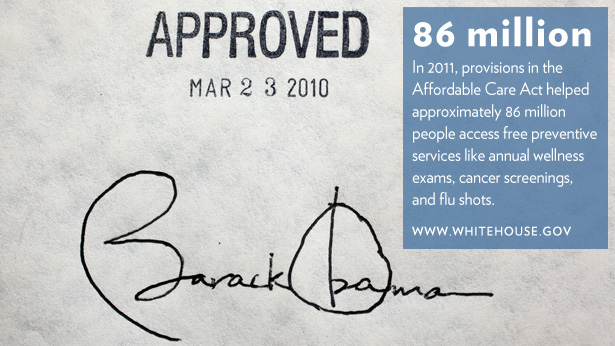
Together, this means an estimated 86 million Americans have already been helped by the health care law’s prevention coverage improvements.
What’s more, many minority populations are also receiving expanded preventive benefits as a result of the law, including an estimated 6.1 million Latinos, 5.5 million Blacks, 2.7 million Asian Americans and 300,000 Native Americans with private insurance. These benefits are particularly important for these Americans who often see higher rates of disease and reduced access to care. Better access to preventive services can help reduce these health disparities.
Learn more about Economy, Health Care
From the Press Office
Related Videos
-
 December 13, 2016 5:04 PM
Signing Ceremony for the 21st Century Cures Act
-
 December 10, 2016 5:00 AM
Weekly Address: It’s Time to Get Covered on the Health Insurance Marketplace