
Joining Forces Blog
NCAA Will Celebrate Military Families At More Than 600 Events in 2012
Posted by on January 6, 2012 at 7:34 PM EDTThe National Collegiate Athletic Association (NCAA) is joining forces with First Lady Michelle Obama to recognize, honor and support our troops and their families. Throughout 2012, the NCAA will highlight the sacrifices made by service members and their families across its 89 championship events that span 23 sports.
“Our nation’s service members demonstrate the kind of example we should all try to set for young people, and we at the NCAA are honored to recognize military members and families across the 89 championship events we host every year,” said NCAA President Emmert. “As student-athletes learn in practice every day, each of us must rely on others to succeed; from here on in, military members and their families can look to the NCAA for the recognition and thanks they so richly deserve.”
That recognition will include public address announcements at all finals sites as well as at approximately 600 preliminary round sites; access to youth clinics for children of military families (Men’s and Women’s Final Four and other NCAA-sponsored clinics; designated seating areas at select special events for military families; inviting military personnel to serve as honorary team or game captains; and behind-the-scenes tours prior to select championship competitions for families of military personnel
A new video featuring the First Lady and NCAA President Mark Emmert will air for the first time on Saturday, January 77th at the Football Championship Subdivision (FCS) title game -- but you can see it here first.
Watch Joining Forces with the NCAA, here.
Learn more about VeteransConnecting Military Families through Operation Homelink
Posted by on January 3, 2012 at 12:05 PM EDT
Spouses of soldiers stationed at Fort Bragg, NC received 100 donated laptops today at the Yntema Club at Fort Bragg, NC. The computers were donated by the Raytheon Company and bring to 4,500, the number of computers that non-profit Operation Homelink has distributed to military families across the U.S. since 2003 . (Photo by Operation Homelink)
Marquis Bloodworth, a specialist assigned to the 122nd Aviation Brigade, is not the only Soldier in the family. His wife, Angel, is assigned to the 1st Battalion, 82nd Combat Aviation Brigade, and is currently stationed in Afghanistan.
The Bloodworths became two of the latest 100 recipients of refurbished computers issued by Operation Homelink. This is a nonprofit organization dedicated to providing computers to families of deployed Soldiers, enabling them to keep in touch by webcams, chat, and email.
By the time Marquis picked up the Dell laptops at Fort Bragg's Yntema Club, he had not yet communicated the news to Angel, and therein, lies the significance of the gift.
The computers will help bridge the physical divide between the Bloodworths and link them, although they are stationed more than 7,000 miles apart.
Spc. Brian Wallen, of the 504th Parachute Infantry Regiment, also received a laptop and webcam. “It feels pretty good. I can use it when I’m deployed and communicate with my wife,” he said.
“It’s going to help me deal with him being away,” said Angelia, Wallen’s wife, who is expecting the birth of their child in June.
“I might not be able to be there for the birth, but I can see the child on the computer,” Wallen said.
For Spc. Rustam Nafikov, of the 528th Sustainment Brigade, the computer will serve yet another purpose. Nafikov said he plans to use the computer for his accounting studies at Campbell University.
Nafikov was accompanied by his supervisor, Staff Sgt. Dwayne Barrett, who said he showed up to offer moral support.
The computers will go a long way in helping Soldiers, who can’t always afford to buy their own computers, so it’s good for lower enlisted, Barrett said.
Operation Homelink was founded by Dan Shannon, a father of four, who said he was inspired to start the organization post 9/11 after seeing images of fathers being deployed to serve their country.
The computers that were distributed Dec. 8 were donated by Raytheon (a defense and aerospace systems company) that has become Operation Homelink’s biggest donor, said Shannon, who told the crowd of Soldiers that the computers were not free.
“These computers were earned when each of you signed up,” he said. “They’re earned every morning when you strap on those boots to do the heavy lifting for the other 99 percent.”
Learn more about VeteransJoining Forces with NASCAR to Say Thanks to our Troops and their Families
Posted by on December 30, 2011 at 4:30 PM EDTWatch Joining Forces with NASCAR, here.
Joining Forces was launched earlier this year with one simple goal: Letting the men and women who serve our country – and their families -- know, as First Lady Michelle Obama says, “People care about you, they care about what you have done.”
The response to this initiative has been tremendous, with individuals and organizations from across the country joining in to say “thank you” – with commitments around hiring veterans, with commitments to increase access to wellness opportunities and with invitations for our active and retired servicemen and women – and their families – to participate in special events.
Recently, the First Lady and Dr. Jill Biden joined some of those families at a NASCAR race in Miami, Florida. It was a once in a lifetime experience for everyone who was there, but as Dr. Biden points out, making a difference isn’t that difficult, especially around the holidays. “Reach out to a military family and say, come on over and have dinner with us. This is the perfect time to extend an act of kindness.”
NJ Teacher Wins National Award for her Work Supporting Military Children
Posted by on December 30, 2011 at 4:15 PM EDT
Ryan Barron, Laura Dougherty, Thomas Dougherty (Chief Petty Officer USCG Retired), Terry Dougherty, Tom Dougherty at the White House
Mrs. Terry Dougherty is a third grader teacher at Roland Rogers Elementary School in Galloway Township, New Jersey and the national winner in the teaching challenge The Great American Teach Off sponsored by GOOD and The University of Phoenix. She was nominated by the Rotary Club of Absecon/Galloway NJ for the program she created three years ago, Free Military ChildTutoring: They are Heroes Too!
As a mother and a military spouse of thirty years, Mrs. Dougherty understands the separation and transition issues that these resilient children face and is making a difference by offering free tutoring services. This tutoring program gives military children of all branches of our Armed Forces the opportunity for one-on-one instruction in advanced lessons or remedial needs, which enables the children to experience success and a smooth transition in their new schools.
Her work brings attention to the unique needs and sacrifices that the children of our military personnel endure for our country. As Mrs. Dougherty said, “One of my goals through the whole process was to bring awareness that our military personnel are no longer only attached to large bases, especially as the Guard and Reserve are being activated. They are in our communities, they are our neighbors, and their children take a different path in life. I feel like I was able to give them a voice. We can never forget the sacrifices they are making.”
Dr. Biden’s Children’s Holiday Party Focuses on Support for Military Families
Posted by on December 13, 2011 at 6:50 PM EDT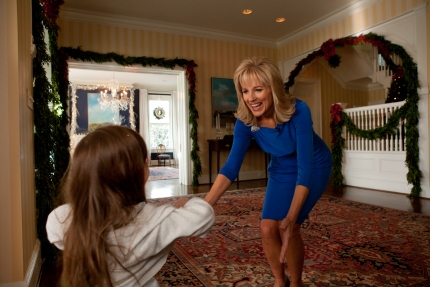
Dr. Jill Biden greets a student arriving at the Vice President’s Residence for a holiday party December 12, 2011. (Official White House Photo by David Lienemann)
The mood was merry when Dr. Jill Biden hosted a fourth-grade class from White Oaks Elementary School in Burke, Virginia at the Vice President’s Residence on Monday, Dec. 12. The festive event focused on helping children understand the challenges faced by military families during the holiday season.
Dr. Biden talked to students about the importance of supporting classmates whose parents are serving in the military, particularly around the holidays. After describing her own experience as a military mom when her son, Army Major Beau Biden of the Delaware National Guard, was deployed in Iraq for a year, Dr. Biden introduced Army Colonel Rebecca Porter, who talked about the impact deployment has on military families.

Colonel Rebecca Porter talks to students about what it’s like to have a family member deployed and about what students can do to support military families December 12, 2011. (Official White House Photo by David Lienemann)
The students then moved to the library where they heard from Major James Blain – the father of classmate Jimmy Blain – who is currently deployed in Afghanistan. Working with a program called United Through Reading, Major Blain read Mickey’s Christmas Carol to the class, via a pre-recorded DVD. Major Blain’s wife, Tina, brought their other three children – Josephine, Anna Mae and Matthew – to the event. Mrs Blaine said the recordings created through United Through Reading were an important way for families to stay in touch during deployments. When Major Blain appeared on screen, Matthew immediately called out, “Daddy! Daddy!”

Students listen to Major James Blain – the father of Jimmy Blain – read Mickey’s Christmas Carol. December 12, 2011. (Official White House Photo by David Lienemann)
As part of its support for First Lady Michelle Obama and Dr. Biden’s Joining Forces Initiative, United Through Reading last week announced a pledge to double its commitment to U.S. Army and National Guard families in the next two years.
After the story, students made cards for military service members and enjoyed a surprise visit from Santa.
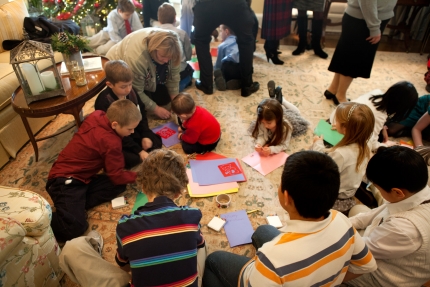
Through the American Red Cross’ Holiday Mail for Heroes program, students write cards for military service members December 12, 2011. (Official White House Photo by David Lienemann)
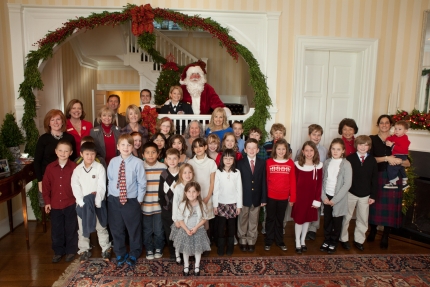
Students from White Oaks Elementary School and Major Blain’s family take a picture with Santa, Dr. Jill Biden, Mrs. Patty Shinseki, Colonel Rebecca Porter and United Through Reading. December 12, 2011. (Official White House Photo by David Lienemann)
Learn more about Veterans, Working FamiliesThe Scientific Study of the Military Child
Posted by on December 12, 2011 at 5:00 PM EDTEd note: This guest post was written by Kathy Roth-Douquet, who is the CEO of Blue Star Families
When the First Lady cares about something, it inspires action – and within the past few weeks, the First Lady’s Joining Forces initiative inspired child development researchers to gather together and consider something very close to my heart, military children. It's easy for people to forget about military children – the image most people have of “the military” tends to be of young fighting men. But as a military spouse, I know that more than ever before we have an older, married military – more than half of those in uniform have children. More than 2 million children have sent a parent to war over the past ten years, according to the Defense Department. That’s an enormous number – more than the number of people who have fought in many of our wars. And yet we know very little scientifically about how this experience has affected them, what are the implications for child development, and more urgently, to those of us who parent military kids – what can we do to help our children meet the challenges?
Even after ten years of war, we know relatively little, there is relatively little programming for military children, and many programs aren’t based on research. I was thrilled when prominent researchers at the DC-based think-tank, CNA, proposed putting together a workshop on ‘The Scientific Study of Military Children.’ It was the first of its kind, bringing together leading researchers on children’s behavioral health – who may not have ever considered military children – together with researchers from the military community, then, importantly, adding policy makers (to make sure something comes of the conference) and real military families and children as speakers, to keep it real. Joining Forces co-sponsored the conference. I was proud to have my organization, Blue Star Families, involved, and to work with Military Child Education Coalition on the program, as well as with researchers from major research institutions. The workshop met for two-and-a-half days in late November.
What did we learn from this conference? Things that ring true: that the challenges of military life play out over time, that military children can develop character strengths and resilience from the pride that they feel in their lifestyle and their recognition that the work of their parents is important. We also learned that parents’ psychological health is important for the functioning of their children.
But more importantly, what do we still need to learn? Conference organizer Dr. Sarah L. Friedman summarized that we come away from the workshop with an explicit research agenda, that requires policy support: we need to learn more how to reduce the experience of stress, and to learn more about what conditions increase resilience in families and in children of different ages, temperament and pre-existing conditions. Some specific items:
- Again and again speakers asserted the effects of deployment and its aftermath may emerge over time or diminish over time, so we need research that tracks children over time.
- Much of the research regarding military children is based on samples of convenience. For the conclusions of research on military children to be valid, we need to recruit families and children that are representative.
- We need to evaluate existing programs for the extent that they support attachments to key figures in the child’s life, reduce stress and increase coping skills. Interventions that do not do that may not be useful or effective. They may not help children thrive despite the challenges of parental deployment, injury and death.
And most importantly, something my group, Blue Star Families has focused on is the fact that in the military, the family is an important unit for understanding the individual, and for health and well-being. As Dr. Friedman said, “Since the family is perhaps the most important factor in determining the success of children’s development over time, we need to understand how military families function and what makes them healthy and strong. There is a need for research that will inform us about how to (a) best support families with children and (b) reduce conflict and abuse in the context of the family.”
Research agendas are very important – science-based research is how we make sure we are doing work that really helps. But in the meantime – what about me and my children? I asked Dr. Friedman, what are the take-aways for military parents – or those who care about military children? Here’s what she told me:
I think it would be helpful to tell families that the children of deployed parents, injured parents and parents who give their life to defend US interests abroad do best when they are part of loving families and caring communities. The specific manifestation of the love and the care that the children need in order to thrive depend on their age and their special characteristics, including temperament. In order to advise parents, child care providers and teachers how to nurture military children of different ages, temperaments and pre-existing health issues—we need to do research. To do such research, families and children need to allow researchers into their lives. They need to agree to share information about themselves. We hope that families and children will be generous and agree to participate in research that will benefit many other children in the future.
A few days after I got back from the conference, my husband and I walked our little dog in the hilly park near our new home – new duty station – in Germany. We were talking about how our children were adjusting to this latest move, the newest school – the 8th school for my 7th grader. And I found myself telling my husband about the conference. There were a couple things that gave me structure, and focus for thinking about my parenting, and about our family. First and most important was the piece about secure attachment. It’s hard for us to always know how our actions, our choices, affect our kids. The moves, the deployments – too much discipline, not enough? But we can love our kids, and let them feel we understand their needs, respond to those needs, provide support and truly care for them, and feel some confidence that that in itself makes a difference. Secondly, I thought about the finding that our mental health – we the parents – matter. So we need to keep our own stress in check, or shape it for our kids. If we think the deployment, the move is terrible, that’s what the kids will think too. Instead, I can say, ‘I really hate unpacking too, it’s hard when you haven’t made friends yet, but in a few months, this will be behind us –we just need to get through it.’ And we need to make the time, take the steps we need to manage our stress – whether that’s exercise, yoga, counseling, or getting enough sleep. And finally, remember that all these experiences play out over time, particularly the experience of being so close to war, whether we’re the service member or the family member. We need to have patience and let them play out, and not insist that “it’s over now, let’s just move on.”
The conference was a relief for me. It’s a relief to have smart, inclusive thinking applied to the problems facing the military community, military families in particular. I am gratified that the country, through Joining Forces, is helping my small community with these issues. After all, these kids are serving the country in their own way. And it’s good to feel that the country cares.
Learn more about Veterans
- &lsaquo previous
- …
- 47
- 48
- 49
- 50
- 51
- 52
- 53
- 54
- 55
- …
- next &rsaquo

White House Blogs
- The White House Blog
- Middle Class Task Force
- Council of Economic Advisers
- Council on Environmental Quality
- Council on Women and Girls
- Office of Intergovernmental Affairs
- Office of Management and Budget
- Office of Public Engagement
- Office of Science & Tech Policy
- Office of Urban Affairs
- Open Government
- Faith and Neighborhood Partnerships
- Social Innovation and Civic Participation
- US Trade Representative
- Office National Drug Control Policy
categories
- AIDS Policy
- Alaska
- Blueprint for an America Built to Last
- Budget
- Civil Rights
- Defense
- Disabilities
- Economy
- Education
- Energy and Environment
- Equal Pay
- Ethics
- Faith Based
- Fiscal Responsibility
- Foreign Policy
- Grab Bag
- Health Care
- Homeland Security
- Immigration
- Innovation Fellows
- Inside the White House
- Middle Class Security
- Open Government
- Poverty
- Rural
- Seniors and Social Security
- Service
- Social Innovation
- State of the Union
- Taxes
- Technology
- Urban Policy
- Veterans
- Violence Prevention
- White House Internships
- Women
- Working Families
- Additional Issues