Orlando Goes Green

Earlier this week I had the opportunity to visit Orlando to see first-hand some of the sustainability initiatives the city has underway through the Green Works Orlando program. Green Works Orlando is a citywide plan to promote environmental conservation and stewardship, energy efficiency in homes and businesses, and outdoor green spaces. Like Orlando, cities across the country are doing exciting and innovative things to make their communities greener and more sustainable.

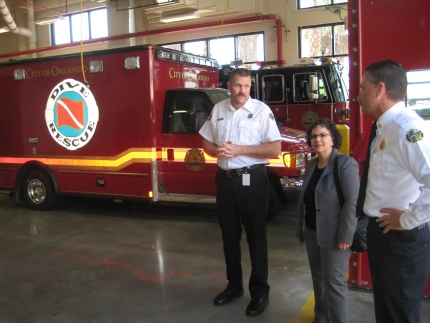
My first stop was at one of Orlando's six LEED (Leadership in Energy and Environmental Design) certified fire stations. With a focus on energy efficiency and sustainability, the fire station has employed innovative techniques to save energy and conserve water. For example, the lighting and hot water are powered through rooftop solar panels, a cistern system collects rain water for use in the station's toilets, and native plant species, which require less water, are planted around the fire station -- including on the green roof.

Nancy Sutley Orlando Fire Station

Nancy Sutley visits Fire Station 1, one of Orlando's six LEED certified fire stations. April 5, 2010.

In the afternoon, I toured the Iron Bridge Regional Water Reclamation Facility, where the city is testing technology for an innovative process to reuse water. It also creates byproducts, such as clean sand and recovered metals, which can then possibly be sold in established markets. Additionally, the process generates a significant amount of heat energy, which can be captured and used to generate electricity.

Good ideas about sustainability are popping up everywhere, and the Federal Government must do its part and lead by example. As the owner or occupier of 500,000 buildings, operating more than 600,000 vehicles, employing more than 1.8 million civilians, and purchasing more than $500 billion per year in goods and services, we have a lot of work ahead!
 

Under President Obama's Executive Order 13514 on Federal Leadership in Environmental, Energy, and Economic Performance, we will improve energy efficiency, conserve water, reduce waste, use less petroleum in our vehicle fleets, and leverage Federal purchasing power to promote environmentally-responsible products and technologies.

Over the past 15 months, I've had the chance to travel coast to coast seeing first-hand how the United States is building a greener future. Communities across the nation are planting the seeds of a new prosperity -- one that is based on the promise of good, high-paying, American clean energy jobs. Together, with the hard work and innovation that have always defined Americans, we are on our way to a healthier, more prosperous future.

Nancy Sutley is the Chair of the White House Council on Environmental Quality

President Obama to Visit Charlotte, NC

April 01, 2010 | 2:23 | Public Domain

Learn about the North Carolina company President Obama will on April 4th, 2010. Celgard (a subsidiary of Polypore International, Inc.) in Charlotte produces components for lithium-ion batteries and is a recent Recovery Act grant recipient.

Download mp4 (58MB) | ()

The White House

Office of the Press Secretary

Gobierno del Presidente Obama anuncia estrategia integral de seguridad energética

Medidas expanden producción nacional y promueven eficiencia
 

Washington D.C. --- Como parte de la estrategia integral de energía de su gobierno, el Presidente Barack Obama y el secretario del Interior Ken Salazar anunciaron hoy más detalles de los esfuerzos del gobierno del Presidente Obama para fortalecer nuestra seguridad energética. El Presidente Obama y el secretario Salazar anunciaron que el gobierno expandirá proyectos de desarrollo y exploración petrolera y gas en la Plataforma Continental Exterior (Outer Continental Shelf u OCS) de Estados Unidos, para que nuestra nación sea más independiente en materia de energía y, al mismo tiempo, protejamos la pesca, el turismo y zonas marítimas estadounidenses que no son apropiadas para estos proyectos. El anuncio también incluyó estándares históricos para el consumo de combustible de autos y camiones, esfuerzos clave que se están realizando en el Departamento de Defensa para mejorar la seguridad energética y un esfuerzo para que la flota de vehículos federales sean más ecológicos. Los detalles están a continuación.
 

“Quiero enfatizar que este anuncio es parte de una estrategia más amplia que nos llevará de una economía basada en combustibles fósiles y petróleo extranjero, a una basada en combustible de producción nacional y energía limpia. Y la única manera de que esta transición triunfe es si fortalece nuestra economía en el corto plazo y largo plazo. Sería un error no reconocer esta realidad”, dijo el Presidente Obama.
 
El año pasado, bajo el liderazgo del secretario Salazar, el gobierno trabajó para reevaluar decisiones previas en un esfuerzo por determinar la política relativa a la perforación petrolera y de gas en la OCS, que ayude a reducir nuestra dependencia de petróleo extranjero, genere empleo y tome en cuenta los riesgos y responsabilidades.
 
“Con una expansión responsable de proyectos de desarrollo y exploración de energía convencional en nuestro país, podemos fortalecer nuestra seguridad energética, generar empleo y ayudar a la recuperación de nuestra economía”, dijo Salazar. “Nuestra estrategia considera proyectos de desarrollo en nuevas zonas mar adentro, la exploración de áreas fuera de fronteras nacionales y la protección de toda perforación en zonas que son muy especiales. Al establecer un orden y certidumbre para proyectos de desarrollo y exploración mar adentro, nos aseguramos de que se perforará de la manera correcta y en los lugares correctos. Estamos abriendo un nuevo capítulo para que los proyectos de desarrollo petrolero y gas en nuestro país sean responsables y equilibrados”.
 
El Presidente destacó medidas clave adicionales que promoverán la producción nacional de energía, diversificará el portafolio energético de Estados Unidos y estimulará la innovación en energía limpia.
 
Información de trasfondo sobre los anuncios de hoy:

Más producción nacional– Licitación de la plataforma continental exterior para perforación petrolera y de gas:  La estrategia del gobierno requiere el desarrollo de recursos petroleros y gas en nuevas zonas, como el este del Golfo de México; el incremento de exploración petrolera y de gas en zonas fuera de fronteras nacionales en el Océano Ártico y el Atlántico; la protección contra toda perforación en zonas marítimas especiales, como la Bahía Bristol de Alaska. La estrategia establecerá los lineamientos del actual programa 2007-2012 de licitación petrolera y gas, así como el nuevo programa 2007-2012 que este gobierno propondrá. Para detalles específicos de este plan visite www.doi.gov.
 
Estándares históricos para el consumo de combustible de autos y camiones – Determinaron los estándares para la emisión de gases de invernadero y los de EPA/DOT CAFE:  El 1° de abril, la Agencia de Protección Ambiental (EPA por sus siglas en inglés) y el Departamento de Transporte (DOT por sus siglas en inglés) pondrán en vigor una norma conjunta que determinará los estándares para la emisión de gases de invernadero y para el millaje de vehículos ligeros (Corporate Average Fuel Economy o CAFE) propiedad de empresas en modelos del 2012 al 2016.  En mayo pasado se anunció que la norma es producto de un acuerdo histórico entre el gobierno del Presidente Obama, el estado de California y los fabricantes de automóviles para llevar certidumbre normativa al mercado automotor, y al mismo tiempo, mejorar el consumo de combustible de los autos, reducir las emisiones de gases de invernadero en el sector transporte y asegurar que los consumidores tengan opciones y gastar menos. Se espera que esta medida ahorre 1,800 millones de barriles de petróleo durante la vida del programa.
 
Liderar con el ejemplo – Una flota federal más ecológica:  El año pasado, el Presidente Obama puso en vigor el Decreto Ejecutivo 13514 que solicitaba que las agencias federales sentaran el ejemplo de una economía de energía limpia. La Dirección de Servicios Generales (General Services Administration o GSA) y el Departamento de Energía están haciendo precisamente eso. Como resultado de sus esfuerzos combinados hemos aumentado al doble los vehículos híbridos en la flota federal y para fines de año habremos adquirido los primeros 100 vehículos eléctricos ensamblados en Estados Unidos. Asimismo, las agencias están adquiriendo vehículos híbridos en lugar de autos y camiones convencionales que consumen más combustible; están disminuyendo la cantidad de vehículos en la flota y están requiriendo estaciones de recarga eléctrica en todas las nuevas instalaciones y en las remodelaciones sustanciales.
 
Énfasis estratégico del Departamento de Defensa en seguridad energética:  El Reporte Tetranual de Defensa, dado a conocer recientemente, pone en relieve que la formulación de un enfoque estratégico es una de las principales prioridades del Departamento de Defensa. Esto refleja, sobre todo, consideraciones acerca de la misión. El análisis hecho por el propio Departamento confirma lo que los expertos independientes venían advirtiendo desde hace años: que nuestras fuerzas armadas dependen excesivamente de hidrocarburos, lo cual crea costos y riesgos significativos tanto a nivel táctico como estratégico.  El Departamento de Defensa está procurando activamente poner en vigor programas estratégicos para fortalecer la independencia y seguridad energéticas, y reducir las emisiones nocivas, lo cual incluye el desarrollo y uso de biocombustibles avanzados producidos en el país. Para mayor información acerca de los programas de energía del Departamento de Defensa presione AQUI.

###
 

Energy Security and Independence

March 31, 2010 | 13:38 | Public Domain

President Obama announces plans to open new offshore areas for oil and gas development in ways that protect the environment and as part of a larger strategy to ensure energy security and independence.

Download mp4 (273MB) | mp3 (13MB)

Read the Transcript

Remarks by The President on Energy Security at Andrews Air Force Base, 3/31/2010

11:18 A.M. EDT

THE PRESIDENT:  Thank you, everybody.  Thank you so much.  (Applause.)  Please have a seat.  I've got a few introductions that I want to make very quickly before I start my remarks.  First of all, I think that by the end of his tenure we're going to know that Ken Salazar is one of the finest Secretaries of Interior we've ever had.  So please give him a big round of applause.  (Applause.)

Other members of what we call our green team are here:  Steven Chu, our Secretary of Energy; Martha Johnson, the Administrator of the GSA; Nancy Sutley, the CEQ Chair.  We've got Carol Browner, who’s the White House Energy and Climate Change Director.  Please give them a big round of applause.  They put in a lot of work.  (Applause.)

Governor Martin O’Malley is here, governor of Maryland.  (Applause.)  Ray Mabus, Secretary of the Navy, is here.  (Applause.) Admiral Gary Roughead, Chief of Naval Operations, is here, and we appreciate his outstanding service.  Thank you, Gar. (Applause.)

I want to thank Steven Shepro, the base commander here at Andrews, and the leadership that's present from the Air Force, the Marine Corps, and the Coast Guard.

Ken and I were colleagues in the Senate, and I appointed him because I knew that he would be a faithful and pragmatic steward of our natural resources.  And as Secretary, he is changing the way that the Interior Department does business so that we’re responsibly developing traditional sources of energy and renewable sources of energy, from the wind on the high plains to the suns in the desert to the waves off our coasts.  And so I'm very grateful to the work that he’s done in culminating in one of the announcements that we’re making today.

It’s also good to see so many members of our Armed Forces here today.  Andrews is the home of Air Force One, and I appreciate everything that you do for me and my family.  I should point out that you’ve got a 100-percent on-time departure record. (Laughter.)  You don’t charge for luggage -- (laughter) -- so it’s a pretty good deal.  And I want to thank you not only for the support that you provide me, but also for the service that you perform to keep our country safe each and every day.  So I'm very grateful to all of you.

We’re here to talk about America’s energy security, an issue that’s been a priority for my administration since the day I took office.  Already, we’ve made the largest investment in clean energy in our nation’s history.  It’s an investment that’s expected to create or save more than 700,000 jobs across America -- jobs manufacturing advanced batteries for more efficient vehicles; upgrading the power grid so that it’s smarter and it’s stronger; doubling our nation’s capacity to generate renewable electricity from sources like the wind and the sun.

And just a few months after taking office, I also gathered the leaders of the world’s largest automakers, the heads of labor unions, environmental advocates, and public officials from California and across the country to reach a historic agreement to raise fuel economy standards in cars and trucks.  And tomorrow, after decades in which we have done little to increase auto efficiency, those new standards will be finalized, which will reduce our dependence on oil while helping folks spend a little less at the pump.

So my administration is upholding its end of the deal, and we expect all parties to do the same.  And I’d also point out this rule that we’re going to be announcing about increased mileage standards will save 1.8 billion -- billion barrels of oil overall -- 1.8 billion barrels of oil.  And that’s like taking 58 million cars off the road for an entire year.

Today, we’re also going to go one step further.  In order to save energy and taxpayer dollars, my administration -- led by Secretary Chu at Energy, as well as Administrator Johnson at GSA -- is doubling the number of hybrid vehicles in the federal fleet, even as we seek to reduce the number of cars and trucks used by our government overall.  So we’re going to lead by example and practice what we preach:  cutting waste, saving energy, and reducing our reliance on foreign oil.

But we have to do more.  We need to make continued investments in clean coal technologies and advanced biofuels.  A few weeks ago, I announced loan guarantees to break ground on America’s first new nuclear facility in three decades, a project that will create thousands of jobs.  And in the short term, as we transition to cleaner energy sources, we’ve still got to make some tough decisions about opening new offshore areas for oil and gas development in ways that protect communities and protect coastlines.

This is not a decision that I’ve made lightly.  It’s one that Ken and I -- as well as Carol Browner, my energy advisor, and others in my administration -- looked at closely for more than a year.  But the bottom line is this:  Given our energy needs, in order to sustain economic growth and produce jobs, and keep our businesses competitive, we are going to need to harness traditional sources of fuel even as we ramp up production of new sources of renewable, homegrown energy.

So today we’re announcing the expansion of offshore oil and gas exploration, but in ways that balance the need to harness domestic energy resources and the need to protect America’s natural resources.  Under the leadership of Secretary Salazar, we’ll employ new technologies that reduce the impact of oil exploration.  We’ll protect areas that are vital to tourism, the environment, and our national security.  And we’ll be guided not by political ideology, but by scientific evidence.

That's why my administration will consider potential areas for development in the mid and south Atlantic and the Gulf of Mexico, while studying and protecting sensitive areas in the Arctic.  That’s why we’ll continue to support development of leased areas off the North Slope of Alaska, while protecting Alaska’s Bristol Bay.

There will be those who strongly disagree with this decision, including those who say we should not open any new areas to drilling.  But what I want to emphasize is that this announcement is part of a broader strategy that will move us from an economy that runs on fossil fuels and foreign oil to one that relies more on homegrown fuels and clean energy.  And the only way this transition will succeed is if it strengthens our economy in the short term and the long run.  To fail to recognize this reality would be a mistake.

On the other side, there are going to be some who argue that we don’t go nearly far enough; who suggest we should open all our waters to energy exploration without any restriction or regard for the broader environmental and economic impact.  And to those folks I’ve got to say this:  We have less than 2 percent of the world’s oil reserves; we consume more than 20 percent of the world’s oil.  And what that means is that drilling alone can’t come close to meeting our long-term energy needs.  And for the sake of our planet and our energy independence, we need to begin the transition to cleaner fuels now.

So the answer is not drilling everywhere all the time.  But the answer is not, also, for us to ignore the fact that we are going to need vital energy sources to maintain our economic growth and our security.  Ultimately, we need to move beyond the tired debates of the left and the right, between business leaders and environmentalists, between those who would claim drilling is a cure all and those who would claim it has no place.  Because this issue is just too important to allow our progress to languish while we fight the same old battles over and over again.

For decades we’ve talked about how our dependence on foreign oil threatens our economy -– yet our will to act rises and falls with the price of a barrel of oil.  When gas gets expensive at the pump, suddenly everybody is an energy expert.  And when it goes back down, everybody is back to their old habits.

For decades we’ve talked about the threat to future generations posed by our current system of energy –- even as we can see the mounting evidence of climate change from the Arctic Circle to the Gulf Coast.  And this is particularly relevant to all of you who are serving in uniform:  For decades, we’ve talked about the risks to our security created by dependence on foreign oil, but that dependence has actually grown year after year after year after year.

And while our politics has remained entrenched along these worn divides, the ground has shifted beneath our feet.  Around the world, countries are seeking an edge in the global marketplace by investing in new ways of producing and saving energy.  From China to Germany, these nations recognize that the nation that leads the clean energy economy will be the country that leads the global economy.  And meanwhile, here at home, as politicians in Washington debate endlessly about whether to act, our own military has determined that we can no longer afford not to.

Some of the press may be wondering why we are announcing offshore drilling in a hangar at Andrews Air Force Base.  Well, if there’s any doubt about the leadership that our military is showing, you just need to look at this F-18 fighter and the light-armored vehicle behind me.  The Army and Marine Corps have been testing this vehicle on a mixture of biofuels.  And this Navy fighter jet -- appropriately called the Green Hornet -- will be flown for the first time in just a few days, on Earth Day.  If tests go as planned, it will be the first plane ever to fly faster than the speed of sound on a fuel mix that is half biomass.  The Air Force is also testing jet engines using biofuels and had the first successful biofuel-powered test flight just last week.  I don’t want to drum up any kind of rivalry here, but -- (laughter.)

Now, the Pentagon isn’t seeking these alternative fuels just to protect our environment; they’re pursuing these homegrown energy sources to protect our national security.  Our military leaders recognize the security imperative of increasing the use of alternative fuels, decreasing energy use, reducing our reliance on imported oil, making ourselves more energy-efficient. That’s why the Navy, led by Secretary Mabus, who’s here today, has set a goal of using 50-percent alternative fuels in all planes, vehicles, and ships in the next 10 years.  That’s why the Defense Department has invested $2.7 billion this year alone to improve energy efficiency.

So moving towards clean energy is about our security.  It’s also about our economy.  And it’s about the future of our planet. And what I hope is, is the policies that we’ve laid out -- from hybrid fleets to offshore drilling, from nuclear energy to wind energy -- underscores the seriousness with which my administration takes this challenge.  It’s a challenge that requires us to break out of the old ways of thinking, to think and act anew.  And it requires each of us, regardless of whether we’re in the private sector or the public sector, whether we’re in the military or in the civilian side of government, to think about how could we be doing things better, how could we be doing things smarter -- so that we are no longer tethered to the whims of what happens somewhere in the Middle East or with other major oil-producing nations.

So I’m open to proposals from my Democratic friends and my Republican friends.  I think that we can break out of the broken politics of the past when it comes to our energy policy.  I know that we can come together to pass comprehensive energy and climate legislation that’s going to foster new energy -- new industries, create millions of new jobs, protect our planet, and help us become more energy independent.  That’s what we can do.  That is what we must do.  And I’m confident that is what we will do.

So thank you very much.  And thanks, again, to all of you who are serving in our Armed Services.  You are making an enormous contribution, and this is just one example of the leadership that you’re showing.

Thank you very much.  (Applause.)

END
11:33 A.M. EDT
Close Transcript

The White House

Office of the Press Secretary

Remarks by The President on Energy Security at Andrews Air Force Base, 3/31/2010

11:18 A.M. EDT

THE PRESIDENT:  Thank you, everybody.  Thank you so much.  (Applause.)  Please have a seat.  I've got a few introductions that I want to make very quickly before I start my remarks.  First of all, I think that by the end of his tenure we're going to know that Ken Salazar is one of the finest Secretaries of Interior we've ever had.  So please give him a big round of applause.  (Applause.)

Other members of what we call our green team are here:  Steven Chu, our Secretary of Energy; Martha Johnson, the Administrator of the GSA; Nancy Sutley, the CEQ Chair.  We've got Carol Browner, who’s the White House Energy and Climate Change Director.  Please give them a big round of applause.  They put in a lot of work.  (Applause.)

Governor Martin O’Malley is here, governor of Maryland.  (Applause.)  Ray Mabus, Secretary of the Navy, is here.  (Applause.) Admiral Gary Roughead, Chief of Naval Operations, is here, and we appreciate his outstanding service.  Thank you, Gar. (Applause.)

I want to thank Steven Shepro, the base commander here at Andrews, and the leadership that's present from the Air Force, the Marine Corps, and the Coast Guard.

Ken and I were colleagues in the Senate, and I appointed him because I knew that he would be a faithful and pragmatic steward of our natural resources.  And as Secretary, he is changing the way that the Interior Department does business so that we’re responsibly developing traditional sources of energy and renewable sources of energy, from the wind on the high plains to the suns in the desert to the waves off our coasts.  And so I'm very grateful to the work that he’s done in culminating in one of the announcements that we’re making today.

It’s also good to see so many members of our Armed Forces here today.  Andrews is the home of Air Force One, and I appreciate everything that you do for me and my family.  I should point out that you’ve got a 100-percent on-time departure record. (Laughter.)  You don’t charge for luggage -- (laughter) -- so it’s a pretty good deal.  And I want to thank you not only for the support that you provide me, but also for the service that you perform to keep our country safe each and every day.  So I'm very grateful to all of you.

We’re here to talk about America’s energy security, an issue that’s been a priority for my administration since the day I took office.  Already, we’ve made the largest investment in clean energy in our nation’s history.  It’s an investment that’s expected to create or save more than 700,000 jobs across America -- jobs manufacturing advanced batteries for more efficient vehicles; upgrading the power grid so that it’s smarter and it’s stronger; doubling our nation’s capacity to generate renewable electricity from sources like the wind and the sun.

And just a few months after taking office, I also gathered the leaders of the world’s largest automakers, the heads of labor unions, environmental advocates, and public officials from California and across the country to reach a historic agreement to raise fuel economy standards in cars and trucks.  And tomorrow, after decades in which we have done little to increase auto efficiency, those new standards will be finalized, which will reduce our dependence on oil while helping folks spend a little less at the pump.

So my administration is upholding its end of the deal, and we expect all parties to do the same.  And I’d also point out this rule that we’re going to be announcing about increased mileage standards will save 1.8 billion -- billion barrels of oil overall -- 1.8 billion barrels of oil.  And that’s like taking 58 million cars off the road for an entire year.

Today, we’re also going to go one step further.  In order to save energy and taxpayer dollars, my administration -- led by Secretary Chu at Energy, as well as Administrator Johnson at GSA -- is doubling the number of hybrid vehicles in the federal fleet, even as we seek to reduce the number of cars and trucks used by our government overall.  So we’re going to lead by example and practice what we preach:  cutting waste, saving energy, and reducing our reliance on foreign oil.

But we have to do more.  We need to make continued investments in clean coal technologies and advanced biofuels.  A few weeks ago, I announced loan guarantees to break ground on America’s first new nuclear facility in three decades, a project that will create thousands of jobs.  And in the short term, as we transition to cleaner energy sources, we’ve still got to make some tough decisions about opening new offshore areas for oil and gas development in ways that protect communities and protect coastlines.

This is not a decision that I’ve made lightly.  It’s one that Ken and I -- as well as Carol Browner, my energy advisor, and others in my administration -- looked at closely for more than a year.  But the bottom line is this:  Given our energy needs, in order to sustain economic growth and produce jobs, and keep our businesses competitive, we are going to need to harness traditional sources of fuel even as we ramp up production of new sources of renewable, homegrown energy.

So today we’re announcing the expansion of offshore oil and gas exploration, but in ways that balance the need to harness domestic energy resources and the need to protect America’s natural resources.  Under the leadership of Secretary Salazar, we’ll employ new technologies that reduce the impact of oil exploration.  We’ll protect areas that are vital to tourism, the environment, and our national security.  And we’ll be guided not by political ideology, but by scientific evidence.

That's why my administration will consider potential areas for development in the mid and south Atlantic and the Gulf of Mexico, while studying and protecting sensitive areas in the Arctic.  That’s why we’ll continue to support development of leased areas off the North Slope of Alaska, while protecting Alaska’s Bristol Bay.

There will be those who strongly disagree with this decision, including those who say we should not open any new areas to drilling.  But what I want to emphasize is that this announcement is part of a broader strategy that will move us from an economy that runs on fossil fuels and foreign oil to one that relies more on homegrown fuels and clean energy.  And the only way this transition will succeed is if it strengthens our economy in the short term and the long run.  To fail to recognize this reality would be a mistake.

On the other side, there are going to be some who argue that we don’t go nearly far enough; who suggest we should open all our waters to energy exploration without any restriction or regard for the broader environmental and economic impact.  And to those folks I’ve got to say this:  We have less than 2 percent of the world’s oil reserves; we consume more than 20 percent of the world’s oil.  And what that means is that drilling alone can’t come close to meeting our long-term energy needs.  And for the sake of our planet and our energy independence, we need to begin the transition to cleaner fuels now.

So the answer is not drilling everywhere all the time.  But the answer is not, also, for us to ignore the fact that we are going to need vital energy sources to maintain our economic growth and our security.  Ultimately, we need to move beyond the tired debates of the left and the right, between business leaders and environmentalists, between those who would claim drilling is a cure all and those who would claim it has no place.  Because this issue is just too important to allow our progress to languish while we fight the same old battles over and over again.

For decades we’ve talked about how our dependence on foreign oil threatens our economy -– yet our will to act rises and falls with the price of a barrel of oil.  When gas gets expensive at the pump, suddenly everybody is an energy expert.  And when it goes back down, everybody is back to their old habits.

For decades we’ve talked about the threat to future generations posed by our current system of energy –- even as we can see the mounting evidence of climate change from the Arctic Circle to the Gulf Coast.  And this is particularly relevant to all of you who are serving in uniform:  For decades, we’ve talked about the risks to our security created by dependence on foreign oil, but that dependence has actually grown year after year after year after year.

And while our politics has remained entrenched along these worn divides, the ground has shifted beneath our feet.  Around the world, countries are seeking an edge in the global marketplace by investing in new ways of producing and saving energy.  From China to Germany, these nations recognize that the nation that leads the clean energy economy will be the country that leads the global economy.  And meanwhile, here at home, as politicians in Washington debate endlessly about whether to act, our own military has determined that we can no longer afford not to.

Some of the press may be wondering why we are announcing offshore drilling in a hangar at Andrews Air Force Base.  Well, if there’s any doubt about the leadership that our military is showing, you just need to look at this F-18 fighter and the light-armored vehicle behind me.  The Army and Marine Corps have been testing this vehicle on a mixture of biofuels.  And this Navy fighter jet -- appropriately called the Green Hornet -- will be flown for the first time in just a few days, on Earth Day.  If tests go as planned, it will be the first plane ever to fly faster than the speed of sound on a fuel mix that is half biomass.  The Air Force is also testing jet engines using biofuels and had the first successful biofuel-powered test flight just last week.  I don’t want to drum up any kind of rivalry here, but -- (laughter.)

Now, the Pentagon isn’t seeking these alternative fuels just to protect our environment; they’re pursuing these homegrown energy sources to protect our national security.  Our military leaders recognize the security imperative of increasing the use of alternative fuels, decreasing energy use, reducing our reliance on imported oil, making ourselves more energy-efficient. That’s why the Navy, led by Secretary Mabus, who’s here today, has set a goal of using 50-percent alternative fuels in all planes, vehicles, and ships in the next 10 years.  That’s why the Defense Department has invested $2.7 billion this year alone to improve energy efficiency.

So moving towards clean energy is about our security.  It’s also about our economy.  And it’s about the future of our planet. And what I hope is, is the policies that we’ve laid out -- from hybrid fleets to offshore drilling, from nuclear energy to wind energy -- underscores the seriousness with which my administration takes this challenge.  It’s a challenge that requires us to break out of the old ways of thinking, to think and act anew.  And it requires each of us, regardless of whether we’re in the private sector or the public sector, whether we’re in the military or in the civilian side of government, to think about how could we be doing things better, how could we be doing things smarter -- so that we are no longer tethered to the whims of what happens somewhere in the Middle East or with other major oil-producing nations.

So I’m open to proposals from my Democratic friends and my Republican friends.  I think that we can break out of the broken politics of the past when it comes to our energy policy.  I know that we can come together to pass comprehensive energy and climate legislation that’s going to foster new energy -- new industries, create millions of new jobs, protect our planet, and help us become more energy independent.  That’s what we can do.  That is what we must do.  And I’m confident that is what we will do.

So thank you very much.  And thanks, again, to all of you who are serving in our Armed Services.  You are making an enormous contribution, and this is just one example of the leadership that you’re showing.

Thank you very much.  (Applause.)

END
11:33 A.M. EDT

The White House

Office of the Press Secretary

Obama Administration Announces Comprehensive Strategy for Energy Security

Decisions expand domestic production, promote efficiency

Washington D.C. --- As part of the Administration’s comprehensive energy strategy President Barack Obama and Secretary of the Interior Ken Salazar today announced more details of the Obama Administration’s efforts to strengthen our energy security.  President Obama and Secretary Salazar announced that the Administration will expand oil and gas development and exploration on the U.S. Outer Continental Shelf (OCS) to enhance our nation’s energy independence while protecting fisheries, tourism, and places off U.S. coasts that are not appropriate for development.  Also included in the announcement are landmark car and truck fuel standards, key efforts being carried out by the Department of Defense to enhance energy security, and an effort to green the federal vehicle fleet.  Details are below.

“I want to emphasize that this announcement is part of a broader strategy that will move us from an economy that runs on fossil fuels and foreign oil to one that relies on homegrown fuels and clean energy.  And the only way this transition will succeed is if it strengthens our economy in the short term and the long term.  To fail to recognize this reality would be a mistake,” said President Obama.

Over the last year, under the leadership of Secretary Salazar, the Administration has worked to reevaluate previous decisions in an effort to set oil and gas drilling policies on the Outer Continental Shelf (OCS) that will help reduce our dependence on foreign oil, create jobs, and take environmental risks and responsibilities into account. 

“By responsibly expanding conventional energy development and exploration here at home we can strengthen our energy security, create jobs, and help rebuild our economy,” said Salazar. “Our strategy calls for developing new areas offshore, exploring frontier areas, and protecting places that are too special to drill.  By providing order and certainty to offshore exploration and development and ensuring we are drilling in the right ways and the right places, we are opening a new chapter for balanced and responsible oil and gas development here at home.”

The President will highlight today additional key measures that will boost domestic energy production, diversify America’s energy portfolio and promote clean energy innovation.

Background on Today’s Announcements:
More Domestic Production – Outer Continental Shelf Oil and Gas Leasing:
  The Administration’s strategy calls for developing oil and gas resources in new areas, such as the Eastern Gulf of Mexico; increasing oil and gas exploration in frontier areas, such as parts of the Arctic and Atlantic Oceans; and protecting ocean areas that are simply too special to drill, such as Alaska’s Bristol Bay.  The strategy will guide the current 2007-2012 offshore oil and gas leasing program, as well as the new 2012-2017 program that this administration will propose.  More specific details on this plan are available at www.doi.gov.

Landmark Car and Truck Fuel Standards – Finalized EPA/DOT CAFE and Greenhouse Gas Emissions Standards:  On April 1st, EPA and DOT will sign a joint final rule establishing greenhouse gas emission standards and corporate average fuel economy standards for light-duty vehicles for model years 2012-2016.    Announced last May, the rule is a product of a historic deal between the Obama Administration, the State of California, and automakers to bring regulatory certainty to the automotive market while increasing fuel efficiency, reducing greenhouse gas emissions from the transportation sector, and ensuring consumer choice and savings.  This measure is expected to save 1.8 billion barrels of oil over the life of the program.

Leading by Example – Greening the Federal Fleet:  Last year, President Obama issued Executive Order 13514 asking Federal agencies to lead by example towards a clean energy economy.  GSA and DOE are doing just that.  As a result of their combined efforts we have doubled the Federal hybrid vehicle fleet and before the end of the year we’ll purchase the first 100 plug-in electric vehicles to roll off American assembly lines.  Additionally, agencies are: Purchasing hybrid instead of conventional cars and trucks that use more fuel; Downsizing vehicle fleets overall; and requiring plug-in electric charging stations for all new facilities and for major retrofits.

Department of Defense Energy Security Strategic Emphasis:  The recently released Quadrennial Defense Review makes clear that crafting a strategic approach to energy and climate change is a high priority for the Department of Defense (DoD).  This reflects mission considerations above all. The Department’s own analysis confirms what outside experts have long warned: our military’s heavy reliance on fossil fuels creates significant risks and costs at a tactical as well as a strategic level.  The DoD is actively pursuing strategic initiatives to enhance energy security and independence and reduce harmful emissions, including encouraging the development and use of domestically produced advanced biofuels.  You can learn more about DoD’s energy initiatives here.

Interagency Climate Change Adaptation Task Force Interim Report

Today, the Council on Environmental Quality (CEQ), the Office of Science and Technology Policy (OSTP) and the National Oceanic and Atmospheric Administration (NOAA) released an interim progress report of the Interagency Climate Change Adaptation Task Force.   The report outlines the Task Force’s progress to date and recommends key components to include in a national strategy on climate change adaptation.   The components include: integration of science into adaptation decisions and policy; communications and capacity building; coordination and collaboration; prioritization; a flexible framework for Agencies; and evaluation.  View the press release.

Nancy Sutley is the Chair of the White House Council on Environmental Quality

Creating New Jobs in a Clean Energy Economy

March 05, 2010 | 7:57 | Public Domain

President Obama speaks on how encouraging a clean energy economy can create new jobs as he visits OPower, an Arlington, VA company that developers energy efficiency software.

Download mp4 (160MB) | mp3 (7MB)

Read the Transcript

Remarks by the President on Clean Energy Jobs

11:43 A.M. EST

THE PRESIDENT:  Good morning, everybody.  It is great to be here at OPOWER.  And just looking around, this looks like a fun place to work.  (Laughter.)  The work you do here, as we just heard, is making homes more energy efficient, it's saving people money, it's generating jobs and it's putting America on the path to a clean energy future.  And I understand last year that you doubled your workforce thanks to Bonnie -- (applause) -- you’re hoping to hire another hundred workers this year.  And so this is a model of what we want to be seeing all across the country.  Our goal for the economy is to show similar job growth in the months ahead.

This morning we learned that in February our economy lost an additional 36,000 jobs.  Now, this is actually better than expected, considering the severe storms all along the East Coast are estimated to have had a depressing effect on the numbers.  And it shows that the measures that we’re taking to turn our economy around are having some impact.  But even though it's better than expected, it's more than we should tolerate.

Far too many Americans remain out of work.  Far too many families are still struggling in these difficult economic times.  And that's why I'm not going to rest, and my administration is not going to rest, in our efforts to help people who are looking to find a job; to help business owners who want to expand feel comfortable hiring again.  And we're not going to rest until our economy is working again for the middle class, and for all Americans.

And that's why my immediate priority is not only providing relief to people who are out of work, but also to help the private sector create jobs and put America back to work.  Earlier this week, after breaking through a political logjam that some of you probably saw if you were watching TV, Congress passed and I signed into law a bill that extends unemployment insurance to help people who've been laid off get through these hard times.  It also extended COBRA so that folks who've lost their jobs don't lose their health insurance, and it extended financing for small businesses, and makes it possible for 2,000 furloughed transportation workers to go back to work.

So signing this bill and getting relief out the door swiftly is absolutely essential.  But it's only a temporary step.  The relief I signed into law will last about a month.  And that's why I'm calling [on] Congress to extend this relief through the end of the year.  And because the best form of economic relief is a quality job, I'm also calling on Congress to pass jobs measures that cut taxes, increase lending, incentivize expansion for businesses both large and small.

Now, both the House and the Senate have passed a bill that would give businesses a payroll tax refund for every person hired this year.  And for companies that are considering expanding, this credit could help them decide to bring an extra employee or two this year.  So for companies like OPOWER that are doing pretty well and already expanding, the tax credit may help them decide to hire even more workers more quickly.  So instead of a hundred, maybe we get 110, 115.  We'll see.  (Applause.)

This bill would also encourage small companies to expand by permitting them to write off expenses for new equipment.  And while it's by no means enough, this legislation is an important step on the road to recovery, and I look forward to signing it into law.

Now, even as we fight to help the private sector create more jobs, and even as we fight to bring about a full economic recovery, we know that there have been success stories all across America.  OPOWER is one of those success stories.  This is a company that works with utilities to help folks understand their energy costs and how they can save money on their energy bills.  And for the press, if you weren't able to hear, this board testifies to the number of kilowatt hours that have been saved, the amount of money that's gone back into consumers' pockets, and the amount of carbon that has been taken out of the atmosphere as a consequence of the great work that these people at OPOWER are doing.

Now, part of the reason I suspect you're growing is that you're doing your jobs well.  But I also know that a big part of the reason is that you're seizing the opportunities of the future.  The jobs of tomorrow will be jobs in the clean energy sector, and this company is a great emblem for that.  That's why my administration is taking steps to support a thriving clean energy industry across this country -- an industry that's making solar panels, and building wind turbines, producing cutting-edge batteries for fuel-efficient cars and trucks, and helping consumers get more control over their energy bills.

And that's also why earlier this week I urged Congress to enact a new initiative we're calling Homestar that would offer homeowners rebates for making their homes more energy-efficient -- rebates worth up to $1,500 for individual home upgrades and up to $3,000 for retrofitting their entire home.  So if they're getting this good information from OPOWER and they see that, boy, that drafty window is costing me a couple of hundred bucks a year, they're now going to have an incentive to go to Home Depots or go to Lowes to hire a certified contractor and make the changes that will ultimately pay for themselves, improve our environment, and improve our economy.

I want to thank, by the way, your home state senator, Mark Warner, for his great work on Homestar in the Senate.

Think about the way that the rebates we're talking about could help spur private sector job growth.  It could not only help businesses like OPOWER to help consumers make their homes more energy efficient, it's also going to create business for the local contractors and the companies hired to upgrade homes.  These companies then, in turn, have to purchase supplies and that creates business for retailers.  These retailers would need to restock their shelves, and that creates business for manufacturers.  And almost all the goods that are required to make homes more energy efficient are actually produced right here in the United States of America.  It's very hard to ship an energy-efficient window across an ocean.

So, yes, people who are out of work right now need some immediate relief.  Yes, we need to extend unemployment insurance and COBRA to help Americans weather these tough times.  And, yes, we've got to do everything we can to help the private sector create jobs right now.

But even as we do, we also need to replicate the success of clean energy companies like OPOWER.  We need to invest in the jobs of the future and in the industries of the future, because the country that leads in clean energy and energy efficiency today, I'm absolutely convinced, is going to lead the global economy tomorrow.  I want that country to be the United States of America.  I want companies like OPOWER to be expanding and thriving all across America.  It's good for consumers.  It's good for our economy.  It's good for our environment.

It's wonderfully exciting to be here.  And I think when you look at this group that's gathered here, you can see the future in this company.  So thanks for the great work you guys are doing.  Let's see if we can replicate your success all across the country.

Thank you very much, everybody.  (Applause.)

END
11:52 A.M. EST

Close Transcript

The White House

Office of the Press Secretary

Remarks by the President on Clean Energy Jobs

OPOWER, Arlington, Virginia

11:43 A.M. EST

THE PRESIDENT:  Good morning, everybody.  It is great to be here at OPOWER.  And just looking around, this looks like a fun place to work.  (Laughter.)  The work you do here, as we just heard, is making homes more energy efficient, it's saving people money, it's generating jobs and it's putting America on the path to a clean energy future.  And I understand last year that you doubled your workforce thanks to Bonnie -- (applause) -- you’re hoping to hire another hundred workers this year.  And so this is a model of what we want to be seeing all across the country.  Our goal for the economy is to show similar job growth in the months ahead.

This morning we learned that in February our economy lost an additional 36,000 jobs.  Now, this is actually better than expected, considering the severe storms all along the East Coast are estimated to have had a depressing effect on the numbers.  And it shows that the measures that we’re taking to turn our economy around are having some impact.  But even though it's better than expected, it's more than we should tolerate.

Far too many Americans remain out of work.  Far too many families are still struggling in these difficult economic times.  And that's why I'm not going to rest, and my administration is not going to rest, in our efforts to help people who are looking to find a job; to help business owners who want to expand feel comfortable hiring again.  And we're not going to rest until our economy is working again for the middle class, and for all Americans.

And that's why my immediate priority is not only providing relief to people who are out of work, but also to help the private sector create jobs and put America back to work.  Earlier this week, after breaking through a political logjam that some of you probably saw if you were watching TV, Congress passed and I signed into law a bill that extends unemployment insurance to help people who've been laid off get through these hard times.  It also extended COBRA so that folks who've lost their jobs don't lose their health insurance, and it extended financing for small businesses, and makes it possible for 2,000 furloughed transportation workers to go back to work.

So signing this bill and getting relief out the door swiftly is absolutely essential.  But it's only a temporary step.  The relief I signed into law will last about a month.  And that's why I'm calling [on] Congress to extend this relief through the end of the year.  And because the best form of economic relief is a quality job, I'm also calling on Congress to pass jobs measures that cut taxes, increase lending, incentivize expansion for businesses both large and small.

Now, both the House and the Senate have passed a bill that would give businesses a payroll tax refund for every person hired this year.  And for companies that are considering expanding, this credit could help them decide to bring an extra employee or two this year.  So for companies like OPOWER that are doing pretty well and already expanding, the tax credit may help them decide to hire even more workers more quickly.  So instead of a hundred, maybe we get 110, 115.  We'll see.  (Applause.)

This bill would also encourage small companies to expand by permitting them to write off expenses for new equipment.  And while it's by no means enough, this legislation is an important step on the road to recovery, and I look forward to signing it into law.

Now, even as we fight to help the private sector create more jobs, and even as we fight to bring about a full economic recovery, we know that there have been success stories all across America.  OPOWER is one of those success stories.  This is a company that works with utilities to help folks understand their energy costs and how they can save money on their energy bills.  And for the press, if you weren't able to hear, this board testifies to the number of kilowatt hours that have been saved, the amount of money that's gone back into consumers' pockets, and the amount of carbon that has been taken out of the atmosphere as a consequence of the great work that these people at OPOWER are doing.

Now, part of the reason I suspect you're growing is that you're doing your jobs well.  But I also know that a big part of the reason is that you're seizing the opportunities of the future.  The jobs of tomorrow will be jobs in the clean energy sector, and this company is a great emblem for that.  That's why my administration is taking steps to support a thriving clean energy industry across this country -- an industry that's making solar panels, and building wind turbines, producing cutting-edge batteries for fuel-efficient cars and trucks, and helping consumers get more control over their energy bills.

And that's also why earlier this week I urged Congress to enact a new initiative we're calling Homestar that would offer homeowners rebates for making their homes more energy-efficient -- rebates worth up to $1,500 for individual home upgrades and up to $3,000 for retrofitting their entire home.  So if they're getting this good information from OPOWER and they see that, boy, that drafty window is costing me a couple of hundred bucks a year, they're now going to have an incentive to go to Home Depots or go to Lowes to hire a certified contractor and make the changes that will ultimately pay for themselves, improve our environment, and improve our economy.

I want to thank, by the way, your home state senator, Mark Warner, for his great work on Homestar in the Senate.

Think about the way that the rebates we're talking about could help spur private sector job growth.  It could not only help businesses like OPOWER to help consumers make their homes more energy efficient, it's also going to create business for the local contractors and the companies hired to upgrade homes.  These companies then, in turn, have to purchase supplies and that creates business for retailers.  These retailers would need to restock their shelves, and that creates business for manufacturers.  And almost all the goods that are required to make homes more energy efficient are actually produced right here in the United States of America.  It's very hard to ship an energy-efficient window across an ocean.

So, yes, people who are out of work right now need some immediate relief.  Yes, we need to extend unemployment insurance and COBRA to help Americans weather these tough times.  And, yes, we've got to do everything we can to help the private sector create jobs right now.

But even as we do, we also need to replicate the success of clean energy companies like OPOWER.  We need to invest in the jobs of the future and in the industries of the future, because the country that leads in clean energy and energy efficiency today, I'm absolutely convinced, is going to lead the global economy tomorrow.  I want that country to be the United States of America.  I want companies like OPOWER to be expanding and thriving all across America.  It's good for consumers.  It's good for our economy.  It's good for our environment.

It's wonderfully exciting to be here.  And I think when you look at this group that's gathered here, you can see the future in this company.  So thanks for the great work you guys are doing.  Let's see if we can replicate your success all across the country.

Thank you very much, everybody.  (Applause.)

END
11:52 A.M. EST

President Obama on Jobs, Energy & Strengthening the Economy

March 02, 2010 | 15:58 | Public Domain

The next stop on the Whte House to Main Street tour was to Savannah, GA where the President spoke on creating jobs and strengthening the economy through energy efficiency initiatives.

Download mp4 (319MB) | mp3 (15MB)

Read the Transcript

Remarks by the President on Energy Efficiency in Savannah, Georgia

12:31 P.M. EST

THE PRESIDENT:  Hello, everybody.  (Applause.)  Well, thank you so much.  Everybody please have a seat, have a seat.  Thank you.  (Applause.)  It is good to be back in Georgia.  It is good to be back in Georgia -- although where’s the sun, guys?  (Laughter.)  I was looking forward to --

AUDIENCE MEMBER:  Fired up!

THE PRESIDENT:  I'm still fired up, but we've been getting a lot of snow in Washington, D.C., so I was looking forward to maybe 60, 70 degrees.  (Laughter.)  But I guess I'll take 50.

I want to, first of all, just make some acknowledgments of some wonderful leaders who are here.  First of all, I want to thank President Kathy Love and the entire Savannah Tech community for their hospitality.  (Applause.)  I want to thank your governor, who I just had a chance to see recently, host him in the White House with the other governors -- Mr. Sonny Perdue.  (Applause.)  Your mayor, Otis Johnson, is in the house.  (Applause.)  Congressman John Barrow -- you're in his district.  (Applause.)  That's right.  Congressman Jack Kingston -- (applause) -- Congressman Sanford Bishop -- (applause) -- and Congressman Hank Johnson are all in the house.  (Applause.)     

Well, thank you so much for taking the time to be here today.  I really appreciate the opportunity to visit here at Savannah Tech.  And I just took a brief tour of some of the classrooms where students are learning about clean energy.  They’re learning about solar cells; they’re learning about efficient heating and cooling systems.  You’ve got young people here who, through the YouthBuild program, are gaining job skills that will help them the rest of their lives.  And by the way, they’re building a house right now while they’re at it.  (Applause.) 

From the instructors to the students, you saw just an incredible enthusiasm for America’s future.  And I was just talking to President Love about the focus of Savannah Tech on clean energy, the idea that this can be a real model for green energy as a way of linking students to the enormous job opportunities and business opportunities that exist in the future.  These are the skills that will help our country transform the way we produce and use energy. 

And that's so important –- especially as families in Georgia and across America continue to experience the painful consequences of the worst economic crisis that we've had in generations. 

I had also had a chance to meet with some business owners who told me what I've heard time and again, that it's tough out there.  Unemployment in Georgia is still above 10 percent.  That doesn't include folks who have had to accept part-time jobs or, in some cases, have given up finding a job altogether.  And when it comes to domestic policy, I have no more important a job as President than seeing to it that every American who wants to work and is able to work can find a job -- and a job that pays a living wage.  (Applause.)  That was my focus last year and that is my focus this year:  to lay a foundation for economic growth that will create jobs, that raises incomes, that will foster a secure economic future for middle class families.

This depends on not just spurring hiring, but doing so in the areas that will create lasting opportunities and prosperity. That's why we've invested in roads and railways so that our economy has room to grow and we're laying the infrastructure for the future.  In fact, because of the Recovery Act, there are more than 300 transportation projects underway in Georgia right now.  (Applause.)

That's why we invested in schools and prevented layoffs of hundreds of thousands of teachers and public school workers, including thousands of educators in this state -- because we know we will not be able to compete in new industries unless we've got workers ready to fill jobs in those industries.  And I'd also point out that I've proposed the largest-ever investment in community colleges and technical schools like this one, to produce millions more graduates who are ready to meet the demands of a 21st century economy.  (Applause.)

And to spur hiring and sustain growth we've placed a big emphasis on energy.  Just a few weeks ago, I announced a loan guarantee to break ground on the first new nuclear power plant in our country in nearly three decades -– a project right here in Georgia -- (applause) -- right here in Georgia -- a project that's going to create more than 3,000 construction jobs in the next few years and ultimately 800 permanent jobs operating the plant.  We're on track to create 700,000 jobs across America building advanced batteries for hybrid cars, and modernizing our electric grid, and doubling our capacity to generate clean energy.

And, in fact, here at Savannah Tech, the Recovery Act provided a grant to YouthBuild to help provide training in these very fields.  (Applause.)  Because I'm convinced that the country that leads in clean energy is also going to be the country that leads in the global economy.  And I want America to be that nation.  I don't want us to be second place or third place or fourth place when it comes to the new energy technologies; I want us to be in first.  (Applause.)

So we have the potential to create millions of jobs in this sector.  These are jobs building more fuel-efficient cars and trucks to make us energy independent.  These are jobs producing solar panels and erecting wind turbines.  These are jobs designing and manufacturing and selling and installing more efficient building materials -– because 40 percent of the energy we use is used by our homes and buildings.  Think about that.  All of us know that we use a lot of gas in our cars.  But in terms of energy usage, 40 percent of it goes to our homes and our buildings.

So as we're looking for additional initiatives to spur hiring, I think we ought to embrace what's happening on this campus.  I think we ought to continue to embrace the incredible potential that awaits us across America in clean energy.  So in my State of the Union address, I called on Congress to pass a set of initiatives for homeowners who make their homes more energy-efficient -– to continue the energy transformation that's already begun.  So today I want to explain the details of this program.  And I also want to thank the members of the House and the Senate who are helping to usher this proposal through Congress.

Now, many of you have heard of “Energy Star” -- how many people have heard of “Energy Star”?  You've seen that “Energy Star” sticker on a computer or on a microwave?  The Energy Star program was created to promote energy efficiency by letting consumers know which appliances, which electronics would save electricity and, therefore, would save them money over time.  The program I’m describing today applies this concept not to the appliances, but to the home itself –- and it takes it further.  So we're going to call it “Homestar,” just to make it easy to remember.  (Applause.)

Here’s how it would work.  We’d identify the kinds of building supplies and systems that would save folks energy over time.  And here's one of the best things about energy efficiency -- it turns out that energy-efficient windows or insulation, those things are products that are almost exclusively manufactured right here in the United States of America.  (Applause.)  It's very hard to ship windows from China.  (Laughter.)  So a lot of these materials are made right here in America. 

So we take these materials, and if a homeowner decides to do work on his or her house -- to put in new windows, to replace a heating unit, to insulate an attic, to redo a roof -– the homeowner would be eligible for a rebate from the store or the contractor for 50 percent of the cost of each upgrade up to $1,500.  Now, if you decided to retrofit your whole house to greatly reduce your energy use, you'd be eligible for a rebate of up to $3,000. 

Now, these are big incentives.  And you'd get these rebates instantly from the hardware store or the contractor.  So if you went to Lowe's or Home Depot or wherever you went, right there when you paid at the cash register you'd get that money.  You wouldn't have to mail in a long form, wait for a check to arrive months later.  (Applause.)

Now, we know this will save families as much as several hundred dollars on their utilities.  We know it will make our economy less dependent on fossil fuels, helping to protect the planet for future generations.  But I want to emphasize that Homestar will also create business and spur hiring up and down the economy. 

I was just meeting with a number of business leaders in different segments of this industry.  We've got some manufacturers making insulation and windows and other products; we've got folks who are contractors.  So -- stand up, guys -- the guys I just met with.  See, they're already -- they're ready to work.  They're ready to go.  (Applause.)  So we were just talking about how they are geared up and they've got the capacity to guarantee a homeowner that if they're willing to do this work on their house, they will get their money back -- not just through the rebate but in the energy savings that you're seeing each year.

Let's say you decide to use this rebate to seal up and insulate your attic -- because you want to save electricity, but also because you're tired of a drafty house.  Think about all the ways in which that will stimulate jobs and growth.  If you really knew what you were doing, you might do it yourself, but you're probably going to have somebody come to the house to carry out the installation work -– (laughter) -- because you did the smart thing and you refused to let your husband do it himself.  (Laughter.)  That's the smart thing.  (Applause.)  He'll be stubborn.  He'll tell you he can do it -- (laughter) -- but don't listen to him. 

So that creates work for small businesses and contractors like some of the folks who are here today.  And obviously construction work is -- that's been as hard hit as anything during this recession, so you’ve got a lot of skilled contractors ready to go.  And that, in turn, means that the contractors start hiring some of these folks who may have been laid off -- some of them may have been trained right here at Savannah Tech.  Now, you also have to buy the insulation and the other materials, and that means you're producing business for your local retailer.  And that retailer has to purchase those supplies from manufacturers  –- as I said, most of them located right here in the United States of America.  And I mentioned these domestic manufacturers who are in the crowd, they would benefit -- they would benefit from this program.  And then there’s this huge amount of capacity -- excess capacity -- in construction and related industries to meet any surge in demand that was out there. 

So the fact is that there’s nearly 25 percent unemployment in the construction industry so far, so construction companies, hardware stores, contractors, manufacturers -- they faced a rapid decline in demand in the wake of the mortgage crisis.  And to make matters worse, these businesses have seen the same decline in credit that has hurt every sector of our economy.

So these are companies ready to take on new customers; they’re workers eager to do new installations and renovations; factories ready to produce new building supplies.  All we’ve got to do is create the incentives to make it happen.  And this is not a Democratic idea or a Republican idea; this is a common-sense approach that will help jumpstart job creation while making our economy stronger.  (Applause.)  

Ultimately, that’s what we’re called to do.  Just like a responsible homeowner will invest in their homes in the near term to fortify their economic security in the long term, we’ve got to do the same as a country.  It will have some costs on the front end -- you buy a new boiler, or you get some insulation, or you get some new windows, that's going to have an initial cost, and the same is true from a government perspective.  And it’s going to be politically difficult to do some of this, but it’s what’s right to plan for our future. 

The same is true when it comes to reforming our education system.  The same is true when it comes to trying to make our health care system more affordable.  The same is true when it comes to energy.  Each of these things are hard; some of them have some costs on the front end, and working stuff through Congress is more than a notion.  (Laughter and applause.)  But by taking these steps we’ll help foster the kind of broadly shared growth that will serve us in the years and the decades to come. 

That’s how we’ll create the conditions for businesses to expand and hire.  That’s how we’ll truly grow our middle class again.  That’s how we’ll not only rebuild our economy but we'll  rebuild it stronger than it was before this crisis.

I am confident that we can do it.  Savannah Tech is leading the way; a whole bunch of folks in this room are leading the way; and I just hope that Washington stands alongside you in making sure that we've got the kind of energy future that we need.

Thank you very much, everybody.  God bless you.  God bless the United States of America.  (Applause.) 

END
12:48 P.M. EST

Close Transcript