The White House

Office of the Press Secretary

Weekly Address: President Obama Touts Nearly $2 Billion in New Investments to Help Build a Clean Energy Economy

WASHINGTON – In this week’s address, President Barack Obama announced that the Department of Energy is awarding nearly $2 billion in conditional commitments from the Recovery Act to two solar companies. Abengoa Solar has agreed to build one of the largest solar plants in the world in Arizona, which will create about 1,600 construction jobs with over 70 percent of the construction components and products manufactured here in the USA.  When completed, this plant will provide enough clean energy to power 70,000 homes.  And, Abound Solar Manufacturing is building two new plants, one in Colorado and one in Indiana.  These projects will create more than 2,000 construction jobs, and over 1,500 permanent jobs as the plants produce millions of state of the art solar panels each year. 

The full audio of the address is HERE and a fact sheet HERE. The video can be viewed online at www.whitehouse.gov


Remarks of President Barack Obama
Saturday, July 3, 2010
Weekly Address
Washington, DC

This week, I spent some time in Racine, Wisconsin, talking with folks who are doing their best to cope with the aftermath of a brutal recession.

And while I was there, a young woman asked me a question I hear all the time: “What are we doing as a nation to bring jobs back to this country?”

Well, on Friday, we learned that after 22 straight months of job loss, our economy has now created jobs in the private sector for 6 months in a row.  That’s a positive sign.  But the truth is, the recession from which we’re emerging has left us in a hole that’s about 8 million jobs deep.  And as I’ve said from the day I took office, it’s going to take months, even years, to dig our way out – and it’s going to require an all-hands-on-deck effort.

In the short term, we’re fighting to speed up this recovery and keep the economy growing by all means possible.  That means extending unemployment insurance for workers who lost their job.  That means getting small businesses the loans they need to keep their doors open and hire new workers.  And that means sending relief to states so they don’t have to lay off thousands of teachers and firefighters and police officers. 

Still, at a time when millions of Americans feel a deep sense of urgency in their own lives, Republican leaders in Washington just don’t get it.  While a majority of Senators support taking these steps to help the American people, some are playing the same old Washington games and using their power to hold this relief hostage – a move that only ends up holding back our recovery.  It doesn’t make sense.

But I promised those folks in Wisconsin – and I promise all of you – that we won’t back down.  We’re going to keep fighting to advance our recovery.  And we’re going to keep competing aggressively to make sure the jobs and industries of the future are taking root right here in America.

That’s one of the reasons why we’re accelerating the transition to a clean energy economy and doubling our use of renewable energy sources like wind and solar power – steps that have the potential to create whole new industries and hundreds of thousands of new jobs in America.

In fact, today, I’m announcing that the Department of Energy is awarding nearly $2 billion in conditional commitments to two solar companies.

The first is Abengoa Solar, a company that has agreed to build one of the largest solar plants in the world right here in the United States.  After years of watching companies build things and create jobs overseas, it’s good news that we’ve attracted a company to our shores to build a plant and create jobs right here in America.  In the short term, construction will create approximately 1,600 jobs in Arizona.  What’s more, over 70 percent of the components and products used in construction will be manufactured in the USA, boosting jobs and communities in states up and down the supply chain.  Once completed, this plant will be the first large-scale solar plant in the U.S. to actually store the energy it generates for later use – even at night.  And it will generate enough clean, renewable energy to power 70,000 homes.

The second company is Abound Solar Manufacturing, which will manufacture advanced solar panels at two new plants, creating more than 2,000 construction jobs and 1,500 permanent jobs.  A Colorado plant is already underway, and an Indiana plant will be built in what’s now an empty Chrysler factory.  When fully operational, these plants will produce millions of state-of-the-art solar panels each year.

These are just two of the many clean energy investments in the Recovery Act.  Already, I’ve seen the payoff from these investments.  I’ve seen once-shuttered factories humming with new workers who are building solar panels and wind turbines; rolling up their sleeves to help America win the race for the clean energy economy.

So that’s some of what we’re doing.  But the truth is, steps like these won’t replace all the jobs we’ve lost overnight.  I know folks are struggling.  I know this Fourth of July weekend finds many Americans wishing things were a bit easier right now.  I do too.

But what this weekend reminds us, more than any other, is that we are a nation that has always risen to the challenges before it. We are a nation that, 234 years ago, declared our independence from one of the greatest empires the world had ever known.  We are a nation that mustered a sense of common purpose to overcome Depression and fear itself.  We are a nation that embraced a call to greatness and saved the world from tyranny.  That is who we are – a nation that turns times of trial into times of triumph – and I know America will write our own destiny once more.

I wish every American a safe and happy Fourth of July.  And to all our troops serving in harm’s way, I want you to know you have the support of a grateful nation and a proud Commander-in-Chief.  Thank you, God Bless You, and God Bless the United States of America.

President Obama on June Jobs Numbers

July 02, 2010 | 4:05 | Public Domain

The President comments on the release of employment numbers for June, noting that the economy has created nearly 600,000 private sector jobs this year.

Download mp4 (39MB) | mp3 (4MB)

Read the Transcript

Remarks by the President on Monthly Employment Numbers

9:38 A.M. EDT

THE PRESIDENT:  Good morning, everybody.  Before I depart, I’d like to say a quick word about the state of our economy.

This morning, we received the June employment report.  It reflected the planned phase out of 225,000 temporary Census jobs.  But it also showed the sixth straight month of job growth in the private sector.  All told, our economy has created nearly 600,000 private sector jobs this year.  That’s a stark turnaround from the first six months of last year, when we lost 3.7 million jobs at the height of the recession. 

Now, make no mistake:  We are headed in the right direction.  But as I was reminded on a trip to Racine, Wisconsin, earlier this week, we’re not headed there fast enough for a lot of Americans.  We’re not headed there fast enough for me, either.  The recession dug us a hole of about 8 million jobs deep.  And we continue to fight headwinds from volatile global markets.  So we still have a great deal of work to do to repair the economy and get the American people back to work.

That’s why we’re continuing a relentless effort across multiple fronts to keep this recovery moving.  And today, I’d like to make a quick announcement regarding new infrastructure investments under the Recovery Act -– investments that will create private sector jobs and make America more competitive.

Secretary Locke and Secretary Vilsack have joined me here today to announce that the Departments of Commerce and Agriculture will invest in 66 new projects across America that will finally bring reliable broadband Internet service to communities that currently have little or no access.

In the short term, we expect these projects to create about 5,000 construction and installation jobs around the country.  And once we emerge from the immediate crisis, the long-term economic gains to communities that have been left behind in the digital age will be immeasurable.

All told, these investments will benefit tens of millions of Americans -- more than 685,000 businesses, 900 health care facilities, and 2,400 schools around the -- across the country.  And studies have shown that when communities adopt broadband access, it can lead to hundreds of thousands of new jobs.  Broadband can remove geographic barriers between patients and their doctors.  It can connect our kids to the digital skills and 21st century education required for the jobs of the future.  And it can prepare America to run on clean energy by helping us upgrade to a smarter, stronger, more secure electrical grid.

So we’re investing in our people and we’re investing in their future.  We’re competing aggressively to make sure that jobs and industries and the markets of tomorrow take root right here in the United States.  We’re moving forward.  And to every American who is looking for work, I promise you we are going to keep on doing everything that we can -- I will do everything in my power to help our economy create jobs and opportunity for all people.

Now, Sunday is the Fourth of July.  And if that date reminds us of anything, it’s that America has never backed down from a challenge.  We’ve faced our share of tough times before.  But in such moments, we don’t flinch.  We dig deeper, we innovate, we compete and we win.  That's in our DNA.  And it’s going to be what brings us through these tough times towards a brighter day.

So I want to say happy Fourth of July to everybody.  I want our troops overseas to know that we are thinking of your bravery and grateful for your service.

Thank you very much, everybody.

END
9:42 A.M. EDT

Close Transcript

The White House

Office of the Press Secretary

Información de Trasfondo sobre el anuncio del Presidente sobre la Ley para la Recuperación

El viernes, el Presidente Obama anunció una inversión en sesenta y seis nuevos proyectos de banda ancha en todo el país con la Ley para la Recuperación (Recovery Act) que, según los beneficiados, no sólo generarán aproximadamente 5,000 empleos inicialmente, sino que también ayudarán a impulsar el desarrollo económico en algunas de las comunidades más afectadas del país, lo que ayudará a generar empleo durante varios años. En total, decenas de millones de estadounidenses y más de 685,000 empresas, 900 instalaciones de cuidado de salud y 2,400 escuelas en todos los 50 estados podrán beneficiarse de los fondos. Los préstamos y subvenciones por $795 millones por medio de los departamentos de Comercio y Agricultura han recibido fondos de contrapartida por más de $200 millones en inversiones externas, lo que representa una inversión total por el sector público y privado de más de $1,000 millones para llevar servicios de banda ancha a dichas comunidades, la mayoría de las cuales actualmente tienen poco acceso o acceso limitado, para ayudarlas a ser más competitivas y hacer negocios en el mercado mundial.

Impacto de la banda ancha
Según un análisis que el Consejo Económico Nacional (National Economic Council) dio a conocer el año pasado, se tiene previsto que, en total, las inversiones en banda ancha de la ley generen decenas de miles de empleos a corto plazo y aumenten las oportunidades de desarrollo económico y empleo en las comunidades que de otra manera quedarían rezagadas en la nueva economía basada en los conocimientos. Los proyectos de banda ancha de la Ley para la Recuperación ayudan a reducir el costo de inversiones privadas, atraer a proveedores de servicio de Internet a nuevas regiones, mejorar los conocimientos digitales de los estudiantes y trabajadores, y crear nuevas oportunidades comerciales, de empleo y educación al conectar a residencias y empresas. Con nuevo o mayor acceso de banda ancha, las comunidades pueden competir en condiciones equitativas para atraer nuevas empresas, las escuelas pueden ofrecer oportunidades de aprendizaje a distancia, los profesionales médicos pueden hacer diagnósticos y prestar atención a menor costo, y los dueños de empresas pueden ampliar el mercado para sus productos más allá de sus vecindarios a fin de poder competir en la economía mundial.

Banda ancha y la Ley para la Recuperación

Los préstamos y subvenciones son parte de una inversión general de $7,200 millones con la Ley para la Recuperación con el propósito de aumentar el acceso a banda ancha en todo el país: $4,700 millones por medio del Departamento de Comercio y $2,500 millones por medio del Departamento de Agricultura. Con los fondos que se anunciaron, se habrán otorgado más de $2,700 millones en préstamos y subvenciones para banda ancha con la Ley para la Recuperación para más de 260 proyectos en todo el país desde diciembre del 2009. En general, la Ley para la Recuperación está haciendo una inversión de $100,000 millones en ciencias, innovación y tecnología que no sólo está generando empleo, sino que está sentando las bases para el crecimiento económico durante muchos años.

Fondos que se anunciaron
Se anunciaron dos tipos de fondos:
• Infraestructura – Los fondos de milla intermedia establecen y mejoran conexiones de la milla intermedia a comunidades que carecen de suficiente acceso a banda ancha, y los fondos de última milla conectan a usuarios finales como residencias, hospitales y escuelas a la infraestructura de banda ancha (milla intermedia).
• Centros públicos de computación – Aumentan la capacidad de centros de computación para su uso por el público en bibliotecas, instituciones secundarias de enseñanza superior y otros lugares públicos.

Se adjunta una lista de los proyectos de banda ancha que el Presidente anunció AQUI.

###
 

The White House

Office of the Press Secretary

Declaraciones del Presidente Sobre las Cifras Laborales de Junio

Base Aérea Andrews

9:38 A.M. EDT
 
   EL PRESIDENTE: Buenos días a todos. Antes de partir, me gustaría decir unas cuantas palabras sobre el estado de nuestra economía.
 
   Esta mañana, recibí el informe sobre el empleo correspondiente a junio. Reflejó el plan para la eliminación paulatina de 225,000 empleos temporales con el Censo. Pero también reflejó el sexto mes consecutivo de crecimiento laboral en el sector privado. En total, la economía ha creado casi 600,000 empleos en el sector privado este año. Ése es un marcado cambio con relación a los primeros seis meses del año pasado, cuando perdimos 3.7 millones de empleos en lo peor de la recesión.
 
   Ahora bien, no hay duda de que vamos por el camino correcto. Pero como me recordaron en un viaje a Racine, Wisconsin, esta semana, para muchos estadounidenses, no lo estamos haciendo suficientemente rápido. Y yo coincido en que no lo estamos haciendo suficientemente rápido. La recesión nos metió en un hoyo con una profundidad de aproximadamente 8 millones de empleos. Y continuamos combatiendo vientos contrarios de los volátiles mercados internacionales. Por lo tanto, todavía nos queda mucho trabajo por hacer para solucionar los problemas de la economía y volver a poner al pueblo estadounidense a trabajar.
 
   Por eso estamos continuando un esfuerzo infatigable en frentes múltiples para hacer que esta recuperación continúe. Y hoy, me gustaría hacer un anuncio rápido sobre las nuevas inversiones en infraestructura con la Ley para la Recuperación, inversiones que crearán empleos del sector privado y harán a Estados Unidos más competitivo.
 
   El secretario Locke y el secretario Vilsack se han sumado a mí hoy aquí para anunciar que los departamentos de Comercio y Agricultura invertirán en 66 nuevos proyectos en todo Estados Unidos que finalmente llevarán servicio seguro de Internet por banda ancha a comunidades que actualmente tienen acceso limitado o no tienen acceso.
 
   A corto plazo, esperamos que estos proyectos generen aproximadamente 5,000 empleos de construcción e instalación en todo el país. Y una vez que salgamos de la crisis inmediata, serán inconmensurables los beneficios económicos a largo plazo para las comunidades que han quedado rezagadas en la era digital.
 
   A fin de cuentas, estas inversiones beneficiarán a decenas de millones de estadounidenses… más de 685,000 empresas, 900 instalaciones de cuidado de salud y 2,400 escuelas en todo… en todo el país. Y los estudios han indicado que cuando las comunidades adoptan acceso de banda ancha, pueden generarse cientos de miles de nuevos empleos. La banda ancha elimina barreras geográficas entre pacientes y sus médicos. Puede darles a nuestros niños a las aptitudes digitales y educación del siglo XXI necesarias para los empleos del futuro. Y puede preparar a Estados Unidos para consumir energía limpia al ayudarnos a actualizar nuestra red a fin de que sea más inteligente, mejor y segura.
 
   Entonces, estamos invirtiendo en nuestra gente y estamos invirtiendo en su futuro. Estamos compitiendo enérgicamente para asegurarnos de que los empleos y las industrias y los mercados del mañana echen raíces aquí en Estados Unidos. Estamos avanzando. Y a todo estadounidense que busca trabajo, le prometo que vamos a seguir haciendo todo lo que podamos… haré todo lo que esté en mis manos para contribuir a que nuestra economía genere empleos y cree oportunidades para todos.
 
   Ahora, este domingo es el Cuatro de Julio. Y si esa fecha nos recuerda de algo, es que Estados Unidos nunca le ha temido a un desafío. Hemos enfrentado muchos momentos difíciles. Pero en esos momentos, no nos echamos atrás. Nos esforzamos más, innovamos, competimos y vencemos. Está en nuestro ADN. Y es lo que nos permitirá sobrellevar estos tiempos difíciles hasta que vengan días mejores.
 
   Entonces, quiero desearles un feliz Cuatro de Julio a todos. Quiero que nuestros soldados en el extranjero sepan que estamos pensando sobre su valentía y que estamos agradecidos por su servicio.
 
Muchas gracias, a todos.
 
FIN      9:42 A.M. EDT
 

The White House

Office of the Press Secretary

Remarks by the President on Monthly Employment Numbers

Andrews Air Force Base

9:38 A.M. EDT

THE PRESIDENT:  Good morning, everybody.  Before I depart, I’d like to say a quick word about the state of our economy.

This morning, we received the June employment report.  It reflected the planned phase out of 225,000 temporary Census jobs.  But it also showed the sixth straight month of job growth in the private sector.  All told, our economy has created nearly 600,000 private sector jobs this year.  That’s a stark turnaround from the first six months of last year, when we lost 3.7 million jobs at the height of the recession. 

Now, make no mistake:  We are headed in the right direction.  But as I was reminded on a trip to Racine, Wisconsin, earlier this week, we’re not headed there fast enough for a lot of Americans.  We’re not headed there fast enough for me, either.  The recession dug us a hole of about 8 million jobs deep.  And we continue to fight headwinds from volatile global markets.  So we still have a great deal of work to do to repair the economy and get the American people back to work.

That’s why we’re continuing a relentless effort across multiple fronts to keep this recovery moving.  And today, I’d like to make a quick announcement regarding new infrastructure investments under the Recovery Act -– investments that will create private sector jobs and make America more competitive.

Secretary Locke and Secretary Vilsack have joined me here today to announce that the Departments of Commerce and Agriculture will invest in 66 new projects across America that will finally bring reliable broadband Internet service to communities that currently have little or no access.

In the short term, we expect these projects to create about 5,000 construction and installation jobs around the country.  And once we emerge from the immediate crisis, the long-term economic gains to communities that have been left behind in the digital age will be immeasurable.

All told, these investments will benefit tens of millions of Americans -- more than 685,000 businesses, 900 health care facilities, and 2,400 schools around the -- across the country.  And studies have shown that when communities adopt broadband access, it can lead to hundreds of thousands of new jobs.  Broadband can remove geographic barriers between patients and their doctors.  It can connect our kids to the digital skills and 21st century education required for the jobs of the future.  And it can prepare America to run on clean energy by helping us upgrade to a smarter, stronger, more secure electrical grid.

So we’re investing in our people and we’re investing in their future.  We’re competing aggressively to make sure that jobs and industries and the markets of tomorrow take root right here in the United States.  We’re moving forward.  And to every American who is looking for work, I promise you we are going to keep on doing everything that we can -- I will do everything in my power to help our economy create jobs and opportunity for all people.

Now, Sunday is the Fourth of July.  And if that date reminds us of anything, it’s that America has never backed down from a challenge.  We’ve faced our share of tough times before.  But in such moments, we don’t flinch.  We dig deeper, we innovate, we compete and we win.  That's in our DNA.  And it’s going to be what brings us through these tough times towards a brighter day.

So I want to say happy Fourth of July to everybody.  I want our troops overseas to know that we are thinking of your bravery and grateful for your service.

Thank you very much, everybody.

END
9:42 A.M. EDT

The Employment Situation in June

Today’s employment report shows continued signs of gradual labor market recovery.  Private nonfarm payroll employment increased by 83,000 in June and the unemployment rate fell two-tenths of a percentage point to 9.5%.  June marks the sixth month in a row that private sector employment has increased.  These continued signs of healing are important, particularly given the recent volatility in world markets and the mixed behavior of other recent economic indicators.  However, much stronger job gains are needed to repair the damage caused by the financial crisis and put the millions of unemployed Americans back to work.

Payroll Employment

Total payroll employment fell 125,000 in June.  This decline had been widely anticipated because some of the temporary employment related to the Census began to wind down last month.  Temporary Census employment dropped 225,000 in June.  Non-Census employment rose 100,000, reflecting a rise in private employment of 83,000 and a rise in other types of Federal employment.  Private employment rose at an average monthly rate of 119,000 in the second quarter of 2010, up from 79,000 in the first quarter, and up dramatically from the average decline of 752,000 in the first quarter of 2009.  Private employment has increased 593,000 since its low point in December 2009.

Employment gains were spread broadly across industries.  The biggest gains were in professional and business services (including an increase of 20,500 in temporary help services), leisure and hospitality, and education and health.  Manufacturing also added employment for the sixth month in a row.  Besides the decline in Federal employment related to the Census, the industries losing jobs were construction, finance, information, and state and local government.  Average weekly hours for all employees on private nonfarm payrolls also declined one-tenth of an hour in June.  Hours, however, are still up four-tenths from their low in October 2009.

Unemployment

The unemployment rate fell two-tenths of a percentage point for the second month in a row.  At 9.5%, the unemployment rate is now six-tenths of a percentage point below its high last year.  However, the drop in the unemployment rate was driven in large part by a substantial decline in the labor force, which we expect to be reversed as employment prospects continue to improve.  The household survey also found that the number of workers working part-time for economic reasons declined substantially for the second month in a row.  The number of such workers has fallen 525,000 over the past two months.

While this report suggests a continuation of gradual labor market repair, it is important to emphasize the magnitude of the damage that remains from the recession.  Payroll employment is still down 7.5 million from its pre-recession peak and the unemployment rate is more than 5 percentage points above its pre-recession low.  It is essential that we focus on accelerating job growth.  That is why the President continues to work with the Congress to pass targeted jobs measures such as an extension of emergency unemployment insurance, a program for small business lending that will enable small firms to get the credit they need to expand and create jobs, and more aid for troubled state and local governments to prevent layoffs of teachers, firefighters, and police.  These are fiscally responsible measures that would have a substantial impact on the rate of job growth.

As always, it is important not to read too much into any one monthly report, positive or negative. The monthly employment and unemployment numbers are volatile and subject to substantial revision. Emphasis should be placed on persistent trends rather than month-to-month fluctuations.

CEA 7.2.10 Jobs Chart 1

CEA 7.2.10 Jobs Chart 2

Christina Romer is the Chair of the Council of Economic Advisers


The White House

Office of the Press Secretary

Declaraciones del Secretario de Prensa sobre la Aprobación de la Extensión de Beneficios para Desempleados en la Cámara de Representantes

Hoy, la Cámara de Representantes procedió con la extensión de los beneficios para los estadounidenses que están buscando empleo y el Presidente exhorta a los líderes republicanos en el Senado que den fin a su obstrucción de esta ayuda crucial. Los intentos de la mayoría de republicanos en el Senado de jugar a la política con este tema no sólo han puesto en peligro el sustento de miles de familias estadounidenses, sino que también cortaron una importante fuente de ingresos durante nuestra frágil recuperación económica. Conseguir que el pueblo estadounidense vuelva a trabajar es la principal prioridad económica del Presidente, y por eso debemos hacer más a fin de no sólo aprobar ayuda para los gobiernos locales y estatales, y recortes tributarios para los negocios, sino también impulsar el crecimiento laboral en el sector privado. El Presidente seguirá ejerciendo presión en el Congreso para luchar por leyes laborales de sentido común durante estos momentos críticos de nuestra recuperación económica.

The White House

Office of the Press Secretary

Background on the President's Recovery Act Announcement Tomorrow

Tomorrow, President Obama will announce investment in sixty-six new Recovery Act broadband projects nationwide that, according to the grantees, will not only directly create approximately 5,000 jobs up front, but will also help spur economic development in some of the nation’s hardest-hit communities, helping create jobs for years to come.  In total, tens of millions of Americans and over 685,000 businesses, 900 healthcare facilities and 2,400 schools in all fifty states stand to benefit from the awards.  The $795 million in grants and loans through the Departments of Commerce and Agriculture have been matched by over $200 million in outside investment, for a total public-private investment of more than $1 billion in bringing broadband service to these communities, most of which currently have little or no access, to help them better compete and do business in the global marketplace.

Broadband Impact
According to analysis released by the National Economic Council last year, overall Recovery Act investments in broadband are expected to create tens of thousands of jobs in the near term and expand economic development and job opportunities in communities that would otherwise be left behind in the new knowledge-based economy.  Recovery Act broadband projects help bring down the cost of private investment, attract Internet service providers to new areas, improve digital literacy among students and workers, and help create new opportunities in employment, education, and entrepreneurship by wiring homes and businesses.  With new or increased broadband access, communities can compete on a level playing field to attract new businesses, schools can create distance learning opportunities, medical professionals can provide cost-efficient remote diagnoses and care, and business owners can expand the market for their products beyond their neighborhoods to better compete in the global economy.

Broadband and the Recovery Act
The grants and loans are part of an overall $7.2 billion investment the Recovery Act makes in expanding broadband access nationwide – $4.7 billion through the Commerce Department and $2.5 billion funded through the Department of Agriculture.  With the awards being announced tomorrow, more than $2.7 billion in Recovery Act broadband grants and loans will have been awarded to more than 260 projects across the country since December 2009.  Overall, the Recovery Act is making a $100 billion investment in science, innovation and technology that is not only creating jobs today, but laying a foundation for economic growth for years to come. 

Tomorrow’s Awards
There are two types of awards being announced tomorrow:

  • Infrastructure – Middle mile awards build and improve middle mile connections to communities lacking sufficient broadband access and last mile awards connect end users like homes, hospitals and schools to their community’s broadband infrastructure (the middle mile).
  • Public Computing Centers - Expand computer center capacity for public use in libraries, community colleges and other public venues.

A roster of the broadband awards being announced by the President tomorrow are attached.
 

The White House

Office of the Press Secretary

Statement by the Press Secretary on House Passage of Extension of Unemployment Insurance Benefits

Today the House of Representatives moved to extend benefits for Americans looking for work, and the President urges the Republican leadership in the Senate to end their obstruction of this critical aid.  The attempts by the majority of Republicans in the Senate to play politics with this issue have not only put the livelihoods of thousands of American families at risk, but also has cut off an important source of revenue during our very fragile economic recovery.  Getting the American people back to work is the President’s top economic priority, and that’s why we must do more to not only pass aid for state and local governments and tax cuts for businesses, but also to spur private sector job growth.  The President will keep pressing Congress to fight for common-sense jobs legislation during this critical time for our economic recovery.

The President in Wisconsin: Who's Helping and Who's Hurting on the Economy

Read the Transcript  |  Download Video: mp4 (648MB) | mp3 (62MB)

“I know that towns like Racine are still hurting from this recession,” said the President at a town hall in Wisconsin today.  “This city has the second-highest unemployment rate in the state, and I can only imagine how much pain that’s caused and how many lives have been upended.”  It was something he hears about all the time, he said, and something he still thinks about when he’s not hearing about it.

He made clear though the Recovery Act saved or created as many as 2.8 million jobs, and even though the economy is growing again, that’s little comfort for those still hurting and that’s no reason for him to rest:

And that’s why I’ve been fighting, in addition to everything we’ve done, for additional steps to speed up this recovery and keep the economy growing.  We want an extension of unemployment benefits for workers who lost their job through no fault of their own.  (Applause.)  We want to help small business owners get the loans they need to keep their doors open and hire more workers.  (Applause.)  We want relief for struggling states so they don’t have to lay off thousands of teachers and firefighters and police officers.  (Applause.)


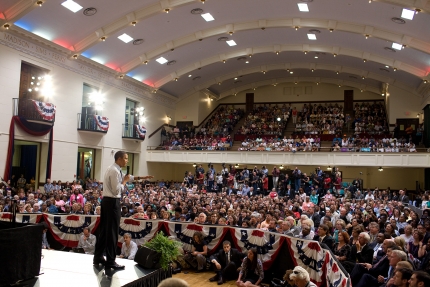
President Obama Speaks at a Town Hall in Racine, Wisconsin

President Barack Obama delivers remarks during a town hall meeting on the economy at Racine Memorial Hall in Racine, Wisconsin June 30, 2010. (Official White House Photo by Pete Souza)

He went on to put the truth on the table about who’s been helping, and who’s been hurting in the effort to get our economy right:

Related Topics: Economy, Wisconsin