The White House

Office of the Press Secretary

Background on the President's Event Today in Wisconsin

The President will be greeted upon arrival at General Mitchell International Airport in Milwaukee, Wisconsin by the following individuals:

Governor Jim Doyle
Jessica Doyle, First Lady of Wisconsin
Mayor Thomas Barrett, Milwaukee

TOWN HALL
Racine Memorial Hall

The President will hold a town hall meeting on the economy at Racine Memorial Hall in Racine, Wisconsin.   There will be approximately 1,300 people in the audience – 70% of the tickets were made available to the general public on a first-come, first-served basis, the other 30% were distributed by the White House to elected officials, community leaders, etc.

PRE-PROGRAM PARTICIPANTS

Bishop Darrell Hines will deliver the Invocation.
Bishop Darrell Hines and his wife, Pastor Pamela Hines, are the founders of the Christian Faith Fellowship Church of Milwaukee, Wisconsin.

Justine Boerger will lead the Pledge of Allegiance.
Justine Boerger will begin her senior year at Horlick High School in Racine, Wisconsin in the fall. 

SSG Emily Russell of the Wisconsin National Guard will sing the National Anthem.

ELECTED OFFICIALS EXPECTED TO ATTEND

Governor Jim Doyle
Jessica Doyle, First Lady of Wisconsin
Mayor Thomas Barrett, Milwaukee
Mayor John Dickert, Racine
State Treasurer Dawn Marie Sass
State Superintendent of Public Instruction Tony Evers
Speaker Michael Sheridan
State Rep. Cory Mason
State Rep. Rob Turner
State Senator John Lehman

RECOVERY ACT IN WISCONSIN

Total Jobs & Spending

  • JOBS CREATED AND SAVED – CEA estimates that 59,000 jobs were created or saved by the Recovery Act in Wisconsin through March, 2010.
  • TOTAL SPENDING – More than $6.4 billion in Recovery funds has been made available to Wisconsin – and more than $4.1 billion has already been spent.

Investing in Infrastructure
         

  • CONSTRUCTION457 transportation projects have been obligated in Wisconsin, totaling more than $643 million.
  • SMALL BUSINESS2,356 Recovery Act-backed small business loans have been given to Wisconsin small businesses, supporting more than $931 million in lending.

Relief to Individuals

  • TAX RELIEF – Because of the Making Work Pay tax credit, 2.2 million Wisconsin working families will collectively receive $1.2 billion in tax relief.
  • UNEMPLOYMENT BENEFITS – More than 730,000 Wisconsin residents have expanded unemployment benefits because of the Recovery Act.
  • STIMULUS PAYMENTS – More than 1 million Wisconsin seniors, veterans and other high-need residents have received one-time economic relief payments of $250, totaling more than $254 million.

Helping States

  • TEACHERS – Close to 5,100 education positions were reported as funded by the Recovery Act in Q1 2010 in Wisconsin – which has received more than $876 million in State Fiscal Stabilization Funds (SFSF).
  • MEDICAID – The Recovery Act has already made more than $1.1 billion available to help prevent additional Medicaid cuts in Wisconsin.  The state of Wisconsin has spent more than $1 billion of the available funds.

RECOVERY ACT FUNDING IN RACINE

The city of Racine has received approximately $22.5 million in Recovery Act funding. Beyond that $22.5 million, an additional $30 million was provided to Racine County through the Department of Transportation for highway funding. Other Recovery Act highlights included below:

  • The Small Business Administration supported over $16 million in small business lending – 42 loans as of June 25.  Examples of Racine SBA guaranteed Loan recipients include Motovend, LLC, Inc (which received $72,000), and Bright Star Healthcare (which received $156,000).
  • The Department of Agriculture provided over $6 million to Johnson Outdoors Watercraft, Inc.
  • The Department of Housing and Urban Development provided over $1.3 million to the City of Racine
    • A grant of over $500,000 was provided for the City of Racine from HUD’s Community Development Fund
    • Over $800,000 was granted for Homelessness Prevention and Rapid Re-Housing in the Racine Area
  • The City and County of Racine received over $1.2 million in Energy Efficiency and Conservation Block Grants.  Approximately $457,000 was provided for Racine County while nearly $800,000 was sent to the City of Racine
  • Law enforcement agencies in Wisconsin received over $12.1 million in funding to support 58 police officers’ salaries and benefits for three years from the Department of Justice. The city of Racine received over $813,000 to support three additional police officers.
Bringing Green Manufacturing Back Home

We talk a lot about the need for America to lead the world in green manufacturing, and with good reason: a strong green manufacturing sector will create good, domestic jobs and boost exports, all while helping us reduce carbon emissions and break our dependence on foreign oil.

But it’s not just talk. We’re taking action to re-establish that leadership, and what’s happening today, down in Louisville, Kentucky, is a perfect example of how we’re going to do it.

Vice President Biden was in Louisville today to visit a General Electric facility called Appliance Park, where GE is investing $600 million to expand their manufacturing of energy-efficient appliances. But they’re not doing it alone – their investment is being supported by $24.8 million in Recovery Act funds through a program called the Section 48C Advanced Energy Manufacturing Tax Credit, or “48C” for short.

The White House

Office of the Press Secretary

Administration Officials Continue Travel Across the Country for "Recovery Summer" Events, Project Site Visits

Vice President Biden Talks Recovery Manufacturing Jobs at GE, Groundbreaking for First TIGER Grant Project Slated for Thursday

WASHINGTON, DC – This week, Vice President Joe Biden and other administration officials are continuing to hold “Recovery Summer” events and visit Recovery Act project sites as part of the six-week-long focus on the surge in Recovery Act projects underway across the country this summer.  The Recovery Act had already funded tens of thousands of projects and put about 2.5 million Americans to work, but this summer is the most active Recovery Act season yet, with thousands of new projects breaking ground that are helping to create more jobs for American workers and economic growth for businesses, large and small. 

This Week:

Monday, June 28

Vice President Biden
Vice President Biden visited the headquarters of GE Consumer & Industrial in Louisville, KY with Governor Steve Beshear and Congressman John Yarmuth to discuss how the facility is adding three new energy-efficient appliance product lines and creating hundreds of jobs because of Recovery Act EnergyStar rebates and 48C Advanced Energy Manufacturing Tax Credits.  Click HERE for a dispatch from the road and photos of the event.

Department of Agriculture
Deputy Under Secretary for Natural Resources and Environment Jay Jensen visited the Smith Lake Fuels Reduction project in the Montana Forest, which is putting 16 different logging, forest treatment and trucking companies to work reducing wildfire fuel loads on small non-industrial parcels and forested subdivision lands near Smith Lake, MT.

Wednesday, June 30

Department of Transportation
Federal Highway Administrator Victor Mendez
will visit the M-59 East Crooks-Ryan Road Project in Detroit, MI where a $50 million Recovery Act grant is upgrading infrastructure, creating jobs, and stimulating local economic activity.

Thursday, July 1

Department of Transportation
Federal Highway Deputy Administrator Greg Nadeau will attend the groundbreaking for the first Recovery Act TIGER grant project in the nation to get underway.  The $10 million Recovery Act award will be used for reconstruction and improvements to a 15.6 mile segment of US-18 highway in Pine Ridge, South Dakota that currently has deteriorated pavement and no shoulders.  The Transportation Investment Generating Economic Recovery (TIGER) grant awards were first announced on February 17th.

Friday, July 2

Department of Transportation
Federal Highway Administrator Victor Mendez will visit the groundbreaking of SR 9B new road construction in Jacksonville, Florida where a $71 million Recovery Act grant is upgrading infrastructure, creating jobs, and stimulating local economic activity.

Recent Events:

Small Business Administration
Last Friday, June 25th, Small Business Administrator Karen Mills visited Mud Bay, a Seattle-area pet store, that has opened a new location and created eight new jobs thanks to a $200,000 Recovery Act small business loan the company received last year.  Since 1999, the local pet store chain has grown to $24 million in sales and 165 workers with the help of four SBA-guaranteed loans totaling almost $2 million – including the Recovery Act loan the Administrator highlighted.  Overall, the Small Business Administration has supported nearly $30 billion in loans to over 65,000 small businesses through the Recovery Act.

Department of Labor
Secretary of Labor Hilda Solis announced $75 million in Recovery Act funds for On-the-Job Training, National Emergency Grants to 41 states, the District of Columbia and three federally recognized Native American tribes as part of a visit to Denver, CO last Friday, June 25th. The grants will be used to help Americans get back to work, especially in geographic areas disproportionately impacted by the recession.  More information on the grants is available HERE.

GE and the Recovery Act

Yesterday Vice President Biden travelled to Louisville, Kentucky where he visited the headquarters of GE Appliances to discuss how Recovery Act investments are creating jobs and laying a new foundation for long-term economic growth in the state.

Appliance Park is a huge industrial campus, covering more than 900 acres, employing 3,600 people, and producing approximately 3 million units a year.  You can tell that people in the community take pride in the company and the products that it makes. 

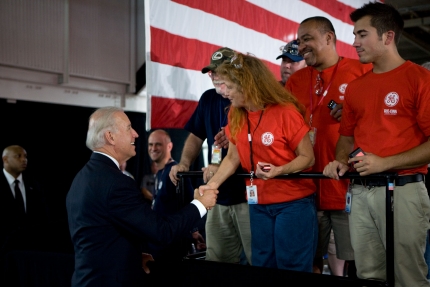
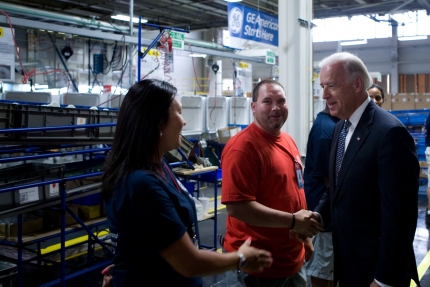
Vice President Biden Greets Workers at GE Appliances & Lighting in Louisville, Kentucky

Vice President Joe Biden greets workers during a visit to the headquarters of GE Appliances & Lighting to talk about how Recovery Act investments are creating jobs and laying the foundation for long- term economic growth in Kentucky and Indiana, in Louisville, Kentucky, June 28, 2010. (Official White House Photo by David Lienemann)

We saw it firsthand when we walked into Building 3, where they manufacture energy efficient dishwashers. The manufacturing floor was still hot from recent production and enthusiastic GE employees in their matching red and blue shirts filled the room to welcome Vice President Biden and share the good news about how business is doing. People were excited and undeniably optimistic.

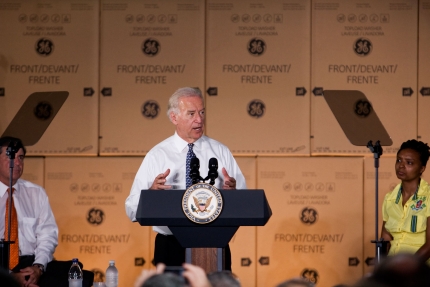
Vice President Biden Speaks at GE Appliances & Lighting in Louisville, Kentucky

Vice President Joe Biden visits the headquarters of GE Appliances & Lighting to talk about how recovery act investments are creating jobs and laying the foundation for long-term economic growth in Kentucky and Indiana, in Louisville, Kentucky, June 28, 2010. (Official White House Photo by David Lienemann)

It’s hard to imagine that in 2008 GE Appliances was up for sale and facing a financial crisis. For many workers, the future was uncertain. And yet, less than two years later, GE has experienced a dramatic turnaround thanks to their innovative spirit, local, state, and federal support, and a strengthened partnership with the union.

GE is now investing $600 million to expand manufacturing production at Appliance Park.  The investment is supported by $24.8 million in 48C Advanced Energy Manufacturing Tax Credits that GE received under the Recovery Act to retrofit and re-tool the Appliance Park facility for the manufacturing of three energy-efficient product lines:  dishwashers, clothes dryers, water heaters. With the addition of the three new product lines, they plan to add over 800 new jobs through 2013.

And these product lines are state-of-art: the water heater uses 62 percent less energy than conventional water heaters and saves the average family $320 a year. It’s also the first new product line manufactured at Appliance Park in 50 years.

The Recovery Act also included consumer incentives for energy efficient appliances, and these rebates have boosted sales of high efficiency appliances. Sales of the dishwashers being built in Building 3 have increased by 20 percent as a result of the Recovery Act consumer rebates. And sales of the clothes washers manufactured in Building 1 are up more than 100 percent. GE even had to add a second shift and hire 137 new employees to handle the increased demand.

Vice President Biden Greets Workers at GE Appliances & Lighting in Louisville, Kentucky

Vice President Joe Biden greets workers during a visit to the headquarters of GE Appliances & Lighting to talk about how Recovery Act investments are creating jobs and laying the foundation for long- term economic growth in Kentucky and Indiana, in Louisville, Kentucky, June 28, 2010. (Official White House Photo by David Lienemann)

Help Now Available for Employers Offering Early Retiree Health Insurance

Today, the Department of Health and Human Services began accepting applications for a program that provides much needed financial relief for employers – as well as unions and state and local governments – providing coverage to early retirees.

The Early Retiree Reinsurance Program will provide $5 billion in financial assistance to help maintain coverage for early retirees age 55 and older who are not yet eligible for Medicare - another example of how health care reform is, and will continue to be, good for business.

Related Topics:

The President's Plan to Increase Spectrum - Technology & the Economy

Lawrence Summers, Director of the National Economic Council, spoke today on technology policy, job creation, and economic growth – in particular the President’s move to dramatically increase the amount of federal and commercial spectrum available for smartphones and wireless Internet devices.

As our fact sheet explained, "In recent years, the amount of information flowing over some wireless networks has grown at over 250 percent per year, with some estimates indicating that the next five years will see an increase in wireless data of between 20 and 45 times 2009 levels, reflecting the increasing use of smartphones, netbooks, and other wireless devices. As the revolution in mobile broadband and related technologies unfolds, the demand for spectrum will continue to increase – leading to increasing fears of a 'spectrum crunch.'"

Summers put the move into historical perspective:

Related Topics: Technology

The White House

Office of the Press Secretary

Statement by the Press Secretary on Republican Obstruction of Jobless Benefits and State Aid

Today, Republicans in the Senate for the second time blocked a bill that includes critical aid for states and American families.  This legislation extends benefits for Americans looking for work and would save the jobs of thousands of teachers, firefighters and police officers by providing relief to states struggling with budget shortfalls.  And it includes tax cuts for businesses that keep research and development jobs here in the United States.  By blocking an up or down vote on this legislation, Republicans in the Senate obstructed a common-sense package that would save jobs, extend tax cuts for businesses and provide relief for American families who have suffered through the worst economic downfall since the Great Depression, even after Democrats offered multiple compromises to gain Republican support for the bill.  The President has been clear: Americans should not fall victim to Republican obstruction at a time of great economic challenge for our nation’s families. The President will continue to press Congress to pass this bill and bring this relief that’s critical to our economic recovery.

The White House

Office of the Press Secretary

Remarks by the President after Cabinet Meeting

Cabinet Room

5:22 P.M. EDT

THE PRESIDENT:  Well, we just finished up a Cabinet meeting with obviously a very wide-ranging agenda.  One of the first things we talked about was the progress that we’re making in terms of growing the economy again.  We’ve now seen five straight months of job growth and economic growth.  Over half a million private sector jobs have been created since the beginning of the year.  But we also know that it is not moving as fast as we want, that there’s still millions of Americans out there who are looking for work, or looking for more hours, or are behind on their payments because they experienced unemployment very recently.

And so we discussed how all of us, working together, agency by agency, are going to be working to encourage job growth.  And we discussed the need for progress to continue to move forward on an agenda of targeted measures that can help small businesses invest, that can make sure that unemployed workers are getting hired, that continue to add to the momentum of job growth and economic growth that is needed so badly after the damage that's been done over the last couple of years.

We also got a full briefing from our national security team as well as Vice President Biden on Iraq.  It hasn’t received a lot of attention lately, but we are on pace to meet every target that we set at the beginning of this administration, to have our combat troops out and to transfer security responsibilities to the Iraqis.  And we had a discussion about the progress that's been made in terms of government formation there.

We also discussed the importance of the transition from a Defense-weighted U.S. approach to a more State Department-weighted approach, and the need to make sure that we are adequately funding and supporting all the diplomatic measures that are going to be necessary so that we can partner effectively with a new Iraqi government over the long haul.

We had a discussion about the oil spill in the Gulf and the important measures that are being taken both in capping the well, in making sure that we are dealing with the consequences on the shorelines and estuaries and bays across the Gulf, and also making sure that ordinary Americans who are being devastated economically are compensated properly.

Ken Feinberg has already traveled to the Gulf, and he is meeting with governors and local officials with the $20 billion fund that has been set up.  We want to make sure that that money is moving out as quickly as possible, as fairly as possible, and that some of the people who I’ve had a chance to talk to down in the Gulf who are just desperate for relief are getting help as quickly as possible. 

And Secretary Napolitano also briefed us on the range of measures that are being taken to ensure that we are coordinating as effectively as possible when it comes to skimming the oil as it’s coming forward, initiating the burns, trying to make sure that we’re capturing all the oil that we can.

And finally, we talked about energy.  In the context of the oil spill, as I said last week during my Oval Office address, this has to be a wakeup call to the country that we are prepared and ready to move forward on a new energy strategy that the American people desperately want but for which there’s been insufficient political will.  It is time for us to move to a clean energy future.  I think the American people understand that it is a jobs creator, that it is a national security enhancer, that it is what is needed environmentally. 

And we have the opportunity to build on actions that have already been taken in the House of Representatives.  The Senate has an opportunity before the August recess and the elections to stand up and move forward on something that could have enormous, positive consequences for generations to come.  And the entire Cabinet here recognizes, with all the other stuff that they’re doing, that if we get energy right, that an awful lot of things can happen as a consequence.

So we are mindful that we have a lot of work to do, but we are very pleased with the progress that has been made by each of these Cabinet members, and we are looking forward to redoubling our efforts in the months to come.

All right.  Thank you.

Q    Mr. President, are you going to fire Mr. McChrystal?

THE PRESIDENT:  General McChrystal is on his way here and I am going to meet with him.  Secretary Gates will be meeting with him, as well.  I think it’s clear that the article in which he and his team appeared showed a poor -- showed poor judgment.  And -- but I also want to make sure that I talk to him directly before I make any final decisions.

All right.  Let me -- actually, let me make one last point about this.  Even as General McChrystal is on his way here, I want everybody to keep in mind what our central focus is, and that is success in making sure that al Qaeda and its affiliates cannot attack the United States and its allies.  And we’ve got young men and women there who are making enormous sacrifices, families back home who are making enormous sacrifices.  And so whatever decision that I make with respect to General McChrystal or any other aspect of Afghan policy is determined entirely on how I can make sure that we have a strategy that justifies the enormous courage and sacrifice that those men and women are making over there, and that ultimately makes this country safer. I know Secretary Gates feels the exact same way.

All right.  Thank you.

END
5:28 P.M. EDT

Groundbreaking Another Example of Recovery Act at Work

Yesterday, Vice President Biden and the Energy Department’s Assistant Secretary Cathy Zoi were in Midland, MI, to celebrate the groundbreaking of Dow Kokam's 800,000 square foot battery manufacturing factory.  This is part of the Summer of Recovery, demonstrating successful Recovery Act projects that are putting Americans back to work in the short term and investing in a clean energy economy.  Dow Kokam estimates its project has already created or preserved approximately 100 construction jobs – this will rise to 1,000 jobs at the peak of construction.  The bulk of the estimated 800 full time jobs will come in the second half of 2011, when Dow will begin hiring and training permanent employees. 

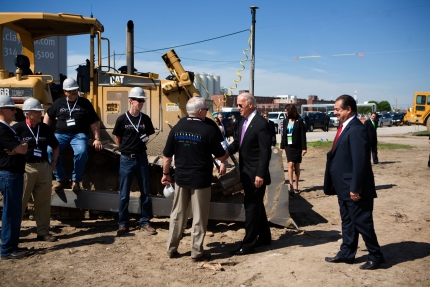
Vice President Biden Greets Workers at Dow Kokam Advanced Battery Plant

Vice President Joe Biden greets construction workers at the site of a new Dow Kokam advanced battery plant which was in part by the American Recovery and Reinvestment Act, in Midland, Michigan, June 21, 2010. (Official White House Photo by David Lienemann)

The Dow plant is part of the Recovery Act’s $2 billion investments in advanced battery manufacturing, supporting 20 battery and 10 component manufacturing factories.  These include several other Michigan factories including A123, Compact Power, GM, and Johnson Controls.  At full scale, the Obama Administration’s investments will support factories with the capacity to supply more than 500,000 plug-in hybrid and electric drive vehicles.  Dow will build enough batteries to supply 60,000 electric-drive vehicles, scaling up a proven process to build lithium-ion batteries. 

These factories, supported by the Recovery Act, are helping build an important domestic industry – the US produced less than 2 percent of the world’s batteries for advanced vehicles in 2008.  By the end of 2012, the US is estimated to have the capacity to produce 20 percent of the world’s lithium-ion batteries for vehicles.  By 2015, this could be even higher. 

Vice President Biden Speaks at Dow Kokam Advanced Battery Plant

Vice President Joe Biden speaks at a groundbreaking ceremony for a new Dow Kokam advanced battery plant which was funded in part by the American Recovery and Reinvestment Act, in Midland, Michigan, June 21, 2010. (Official White House Photo by David Lienemann)

The Recovery Act's battery factories are scaling up production, and also lowering costs.  By 2013, these factories will help cut battery costs in half – making electric drive vehicles much more affordable for Americans.  Additional Administration investments in cutting edge research projects, led by the Energy Department, will continue this type of innovation well beyond 2015, providing a long-term path for a competitive industry.

Matt Rogers is Senior Advisor to Secretary of Energy Steven Chu for Recovery Act Implementation

Building Regional Energy Innovation Clusters

The Administration is working to empower scientists, business leaders, investors, government leaders, and entrepreneurs to harness American ingenuity to create affordable clean energy and high-paying jobs.  In President Barack Obama’s most recent address to the nation, he called for a national mission to “unleash America’s innovation” to create a clean energy economy.  Unleashing America’s innovation requires a critical mass of scientists and researchers, working together in an entrepreneurial ecosystem to bring these technologies to market and investors to take them to scale.  Through a series of energy conferences, and by fostering Regional Energy Innovation Clusters the Administration is bringing these key players together to create a critical mass of information, human capital, and financial resources.  These clusters are organic communities of entrepreneurs, investors, scientists and engineers, able to work in a spirit of collaboration to create new technologies, and make them an everyday reality. 

Last week the path to clean energy and oil independence ran through the American heartland.  Entrepreneurs, business leaders, investors, university researchers, non-profits, along with local government and White House officials met together in Omaha, Nebraska for the first of three regional Energy Innovation Conferences.  Throughout the day, over two hundred attendees gathered in Omaha to discuss energy challenges, share approaches to address these challenges, and begin to coordinate solutions.  Participants also made invaluable connections with one another to increase collaboration among various sectors of the economy necessary for building Regional Energy Innovation Clusters and a clean energy economy. 

The Administration has also stepped up to help innovators and entrepreneurs in the Midwest to spur a successful Regional Innovation Cluster.  The Administration highlighted over $30 million dollars in funding for Nebraska, Iowa and Missouri for worker training in green jobs, in order to create the workforce necessary to fuel the region’s Innovation Cluster.  The Department of Energy is also working with businesses to provide badly needed capital for new ventures to supplement the millions of dollars already invested by DOE in the Midwest.  The Department of Labor is working to address critical human development and leadership capital gaps.  And the Department of Agriculture recently issued $2.7 million of new funding for projects in rural areas that generate renewable energy or increase access to capital for innovative businesses and farmers.

These conferences are a key first step to connecting the dots that build the network that lead to Regional Energy Innovation Clusters across the country to spur new technologies and bring them to the marketplace. The Administration is confident that the ties created in Omaha, along with continued support for job training and seed capital, will foster collaboration across the business, government and research communities, encourage innovation, and apply it in the future clean energy economy. 

Ginger Lew is Senior Counselor to the White House National Economic Council and the Small Business Administration