The White House

Office of the Press Secretary

Readout of President Obama’s Video Conference with President Karzai

Earlier today, the President held a video conference with President Karzai of Afghanistan, as a part of their regular consultations.  President Karzai updated the President on the security situation in Afghanistan, which has calmed since the events of recent weeks.  The two Presidents discussed a range of issues of mutual interest, including U.S.-Afghan Strategic Partnership negotiations, Afghan-led reconciliation, and regional matters.  The leaders noted progress toward concluding a Strategic Partnership that reinforces Afghan sovereignty while addressing the practical requirements of transition.  President Karzai updated the President on developments toward Afghan-led reconciliation talks.  Finally, the President and President Karzai agreed that it is in both our interests to continue a partnership that is based on mutual respect, and agreed to stay in close touch in the lead up to the NATO Summit in Chicago.

Libyan Prime Minister ElKeib Visits the White House

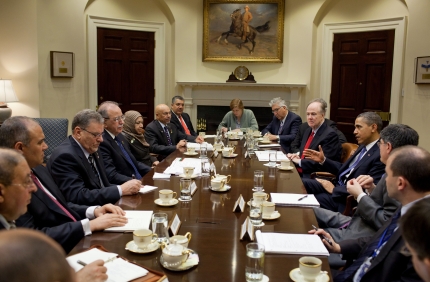
President Barack Obama meets with Prime Minister Dr. Abdurrahim ElKeib of Libya in the Roosevelt Room of the White House

President Barack Obama meets with Prime Minister Dr. Abdurrahim ElKeib of Libya in the Roosevelt Room of the White House March 7, 2012. (Official White House Photo by Pete Souza)

Yesterday, President Obama welcomed Prime Minister Abdurrahim ElKeib of Libya to the White House, kicking off three days of meetings for the Libyan leader in New York and Washington  with U.S. officials, members of Congress, and business and policy leaders.  Dr. ElKeib was the first Libyan prime minister to visit the White House in nearly 60 years, indicating a new era of friendship between the United States and Libya. 

During yesterday’s meeting President Obama applauded Dr. ElKeib’s leadership and encouraged his government to make continued progress with the country’s democratic transition. He pledged the support of the United States to the people of Libya as they work to hold the country’s first free and fair national elections later this summer. Rebuilding their country and establishing security will take time, and the President encouraged Prime Minister ElKeib to take full advantage of American and international expertise as the Libyan people address the challenges of the days ahead.   

Benjamin Fishman is the Director for Libya at the National Security Staff.

President Obama Announces $1 Billion Fund to Promote Energy Efficient Vehicles

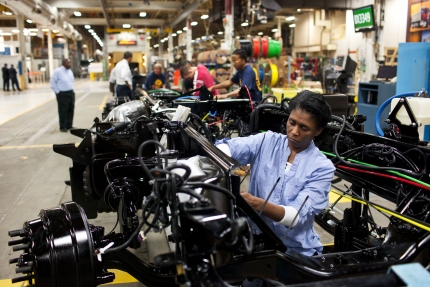
President Barack Obama tours a Daimler Trucks North America plant (March 7, 2012)

President Barack Obama tours Daimler Trucks North America Mt. Holly Truck Manufacturing Plant in Mount Holly, North Carolina, March 7, 2012. On this part of the tour the President saw the Chassis Airing Station where multi-colored nylon air lines are installed for the brake system. (Official White House Photo by Pete Souza)

Today, President Obama made a trip to a manufacturing plant for Daimler Trucks North America in Mount Holly, North Carolina. He was in the Tar Heel state to discuss more ways his administration is taking an all-of-the-above approach to American energy. 

He talked about how his administration is pursuing new domestic energy sources, expanding oil and gas production, and reducing our overall reliance on oil through development of renewable energy. 

But at a place where workers are busy assembling trucks that run on natural gas, the President also announced a new $1 billion National Community Deployment Challenge to help boost the deployment of clean, advanced vehicles all over America:

To cities and towns all across the country, what we’re going to say is, if you make a commitment to buy more advanced vehicles for your community -- whether they run on electricity or biofuels or natural gas -- we’ll help you cut through the red tape and build fueling stations nearby. And we’ll offer tax breaks to families that buy these cars, companies that buy alternative fuel trucks like the ones that are made right here at Mount Holly. So we’re going to give communities across the country more of an incentive to make the shift to more energy-efficient cars.

Have questions about President Obama's Blueprint for American-Made Energy? Learn more here.


Welcoming the Press: President Obama Holds First 2012 News Conference

President Obama welcomed questions from the press Wednesday, in his first news conference of the new year, just days after the AIPAC Policy Conference and a meeting with Israeli Prime Minister Benjamin Netanyahu.

Before taking questions, the President announced a series of reformative housing steps aimed at American service members, veterans and their families.

Watch footage from the entire news conference or jump to specific questions posed by reporters:

Download Video: mp4 (1536MB) | mp3 (40MB)

President Obama Speaks on American Energy

March 07, 2012 | 20:12 | Public Domain

President Obama talks about an all-of-the-above American energy strategy at a Daimler manufacturing plant in North Carolina that’s making trucks that run on natural gas.

Download mp4 (193MB) | mp3 (19MB)

Read the Transcript

Remarks by the President on Energy -- Mount Holly, NC

Daimler Truck Manufacturing Plant
Mount Holly, North Carolina

12:50 P.M. EST

THE PRESIDENT:  Hello, North Carolina!  (Applause.)  Hello, Mount Holly!  (Applause.)  Thank you, Juan, for that introduction.  I did not know he was a preacher.  (Laughter.)  He must be at least a deacon.  (Laughter.)  I was hearing -- "Welll" -- (Laughter.)  He was starting to get the spirit up here.  I'm going to take Juan on the road to introduce me everywhere.  (Laughter.)  Can I hear an "amen"? 

AUDIENCE:  Amen!

THE PRESIDENT:  Amen. 

I want to thank Mark Hernandez, Ricky McDowell -- (applause) -- and Martin Daum for hosting us and being such great tour guides.  Thank you so much, everybody.  Give them a big round of applause.  (Applause.) 

We've got a few outstanding North Carolinians in the house.  You've got your Governor, Bev Perdue, is here.  (Applause.)  Your mayors, Bryan Hough and Anthony Foxx are here.  (Applause.)  Two outstanding Congressmen, Mel Watt and Heath Shuler are here.  (Applause.)  Thank you all for being here.

It is good to be in North Carolina.  Anthony Foxx pointed out that I decided to wear a tie that could be a Tar Heel -- (applause) -- but it's got a little Duke color in there, too. 

AUDIENCE:  Booo --

THE PRESIDENT:  I didn’t want to get in trouble with anybody, so I was hedging my bets.  (Laughter.) 

I always tell people I am one of the best advertisers for North Carolina.  I love this state.  (Applause.)  Love this state.  Everybody here is so nice, so welcoming.  Even the folks who don't vote for me, they're nice to me.  They usually wave five fingers.  (Laughter.)  So it's just a great pleasure.

And I just had a chance to see some of the folks who are doing the work here today.  I couldn't be more impressed.  Some people have been here -- like Juan -- 32 years, 25 years.  Some folks have been here for four months, or six months, have just gotten hired.  But everybody had such pride in their work.

And the Freighterline trucks that you’re making here at this plant run on natural gas, and that makes them quieter, it makes them better for the environment, it makes them cheaper to fill up than they would be with diesel.  I hear you sold your 1,000th natural gas truck last November -– (applause) -- the first company to reach that milestone.  And it was made right here in Mount Holly.  (Applause.)  And last year, this plant added more than 1,000 workers, hiring back a lot of folks who were laid off during the recession.  (Applause.)  That is something to be proud of.

Now, here at Daimler, you're not just building trucks.  You're building better trucks.

AUDIENCE:  That’s right.

THE PRESIDENT:  You're building trucks that use less oil.  And you know that’s especially important right now because most of you have probably filled up your gas tank a time or two in the last week, and you've seen how quickly the price of gas is going up.  A lot of you may have to drive a distance to work.  Higher gas prices are like a tax straight out of your paycheck. 
And for companies that operate a whole fleet of trucks, the higher costs can make a big difference in terms of the profitability of the company. 

Now, here's the thing, though -- this is not the first time we've seen gas prices spike.  It's been happening for years.  Every year, about this time, gas starts spiking up, and everybody starts wondering, how high is it going to go?  And every year, politicians start talking when gas prices go up.  They get out on the campaign trail -- and you and I both know there are no quick fixes to this problem -- but listening to them, you'd think there were.

As a country that has 2 percent of the world's oil reserves, but uses 20 percent of the world's oil -- I'm going to repeat that -- we've got 2 percent of the world oil reserves; we use 20 percent.  What that means is, as much as we're doing to increase oil production, we're not going to be able to just drill our way out of the problem of high gas prices.  Anybody who tells you otherwise either doesn’t know what they’re talking about or they aren’t telling you the truth. 

Here is the truth.  If we are going to control our energy future, then we’ve got to have an all-of-the-above strategy.  We’ve got to develop every source of American energy -- not just oil and gas, but wind power and solar power, nuclear power, biofuels.  We need to invest in the technology that will help us use less oil in our cars and our trucks, in our buildings, in our factories.  That’s the only solution to the challenge. Because as we start using less, that lowers the demand, prices come down.  It's pretty straightforward.  That’s the only solution to this challenge. 

And that’s the strategy that we’ve now been pursuing for the last three years.  And I’m proud to say we’ve made progress.
Since I took office, America’s dependence on foreign oil has gone down every single year.  In fact, in 2010, it went under 50 percent for the first time in 13 years. 

You wouldn’t know it from listening to some of these folks out here -- (laughter) -- some of these folks -- (laughter) -- but a key part of our energy strategy has been to increase safe, responsible oil production here at home.  Under my administration, America is producing more oil today than any time in the last eight years.  Under my administration, we’ve quadrupled the number of operating oilrigs to a record high.  We’ve got more oilrigs operating now than we’ve ever seen.  We’ve opened up millions of new acres for oil and gas exploration.  We’ve approved more than 400 drilling permits that follow new safety standards after we had that mess down in the Gulf.

We’re approving dozens of new pipelines.  We just announced that we’ll do whatever we can to speed up construction of a pipeline in Oklahoma that’s going to relieve a bottleneck and get more oil to the Gulf -- to the refineries down there -- and that’s going to help create jobs, encourage more production. 

So these are the facts on oil production.  If somebody tells you we’re not producing enough oil, they just don’t know the facts. 

But how much oil we produce here at home, because we only have 2 percent and we use 20, that’s not going to set the price of gas worldwide, or here in the United States.  Oil is bought and sold on the world market.  And the biggest thing that’s causing the price of oil to rise right now is instability in the Middle East.  You guys have been hearing about what’s happening with Iran; there are other oil producers that are having problems.  And so people have gotten uncertain.  And when uncertainty increases, then sometimes you see speculation on Wall Street that drives up gas prices even more. 

But here's the thing.  Over the long term, the biggest reason oil prices will go up is there's just growing demand in countries like China and India and Brazil.  There are a lot of people there.  In 2010 alone, China added nearly 10 million cars on its roads.  Think about that -- 2010, 10 million new cars.  People in China, folks in India, folks in Brazil -- they're going to want cars, too, as their standard of living goes up, and that means more demand for oil, and that's going to kick up the price of oil worldwide.  Those numbers are only going to get bigger over time. 

So what does that mean for us?  It means we can't just keep on relying on the old ways of doing business.  We can't just rely on fossil fuels from the last century.  We've got to continually develop new sources of energy. 

And that’s why we've made investments that have nearly doubled the use of clean, renewable energies in this country.  And thousands of Americans have jobs because of it.  It also means we’ve got to develop the resources that we have that are untapped, like natural gas.  We're developing a near hundred-year supply of natural gas -– and that's something that we expect could support more than 600,000 jobs by the end of the decade. 

And that’s why we've worked with the private sector to develop a high-tech car battery that costs half as much as other batteries and can go up to 300 miles on a single charge.  Think about that.  That will save you some money at the pump.  And that is why we are helping companies like this one right here and plants like this one right here to make more cars and trucks that use less oil.

When I ran for office, I went to Detroit and I gave a speech to automakers where I promised that I was going to raise fuel standards on our cars, so that they’d go further on a gallon of gas.  I said we should do the same thing on trucks.  I have to tell you, when I said it, I didn't get a lot of applause in the room, because there was a time when automakers were resisting higher fuel standards -- because change isn't easy.  But you know what, after three decades of not doing anything, we got together with the oil companies, we got together with the unions, we got together with folks who usually do not see eye to eye, and we negotiated new fuel economy standards that are going to make sure our cars average nearly 55 miles per gallon by the middle of the next decade.  That's nearly double what they get today -- nearly double.  (Applause.)

Now, because of these new standards for cars and trucks, they're going to -- all going to be able to go further and use less fuel every year.  And that means pretty soon you’ll be able to fill up your car every two weeks instead of every week -– and, over time, that saves you, a typical family, about $8,000 a year. 

AUDIENCE MEMBER:  We like that.

THE PRESIDENT:  You like that, don't you? 

AUDIENCE:  Yes!  (Applause.)

THE PRESIDENT:  Eight thousand dollars -- that's no joke.  We can reduce our oil consumption by more than 12 billion barrels.  And thanks to the SuperTruck program that we’ve started with companies like this one, trucks will be able to save more than $15,000 in fuel costs every year.  Think about that, $15,000.

It looks like somebody might have fainted up here.  Have we got some of the EMS, somebody.  Don’t worry about -- folks do this all the time in my meetings.  (Laughter.)  You’ve always got to eat before you stand for a long time.  That’s a little tip.  But they'll be okay.  Just make sure that -- give them a little room.  All right, everybody all right?  Okay. 

So these trucks can save $15,000 every year.  I want people to think about what that means for businesses, what it means for consumers.  It is real progress.  And it's happening because of American workers and American know-how.  It's happening because of you.  It's happening because of you.

We’re also making it easier for big companies -- some of your customers, like UPS and FedEx -- to make the shift to fuel-efficient cars and trucks.  We call it the National Clean Fleets Partnership.  And since we announced it last year, the number of companies that are taking part in it has tripled.  And that means more customers for your trucks.  (Applause.)  We're creating more customers for your trucks. 

And I am proud to say that the federal government is leading by example.  One thing the federal government has a lot of is cars and trucks.  We got a lot of cars and we got a lot of trucks.  And so what I did was I directed every department, every agency in the federal government, to make sure that by 2015, 100 percent of the vehicles we buy run on alternative fuels -- 100 percent.  (Applause.) 

So we’re one of the biggest customers in the world for cars and trucks and we want to set that bar high.  We want to set a standard that says by 2015, 100 percent of cars, alternative fuels. 

So we’re making progress, Mount Holly.  But at the end of the day, it doesn’t matter how much natural gas, or flex-fuel or electric vehicles you have if there’s no place to charge them up or fill them up.  So that’s why I’m announcing today a program that will put our communities on the cutting edge of what clean energy can do. 

To cities and towns all across the country, what we’re going to say is, if you make a commitment to buy more advanced vehicles for your community -- whether they run on electricity or biofuels or natural gas -- we’ll help you cut through the red tape and build fueling stations nearby.  (Applause.)  And we’ll offer tax breaks to families that buy these cars, companies that buy alternative fuel trucks like the ones that are made right here at Mount Holly.  (Applause.)  So we’re going to give communities across the country more of an incentive to make the shift to more energy-efficient cars. 

In fact, when I was up in New Hampshire, in Nashua, they had already converted all their dump trucks -- they were in a process because of this program -- they were converting it to natural gas-driven trucks. 

This is something that we did in education -- we called it Race to the Top.  We said we’ll put in more money but we want you to reform.  We’re going to give you an incentive to do things in a different way.  And if we do the same thing with clean energy, we can save consumers money and we can make sure the economy is more secure.  So we’ve got to keep investing in American-made energy and we’ve got to keep investing in the vehicles that run on it.  That’s where our future is. 

And in order to continue this progress, we’re going to have to make a choice.  We’ve got to decide where our priorities are as a country.  And that’s up to all of you.  And I’ll give you an example.  Right now, $4 billion of your tax dollars goes straight to the oil industry every year -- $4 billion in subsidies that other companies don’t get.  Now, keep in mind, these are some of the same companies that are making record profits every time you fill up your gas tank.  We’re giving them extra billions of dollars on top of near-record profits that they’re already making.  Anybody think that’s a good idea?

AUDIENCE  No!

THE PRESIDENT:  Me, neither.  (Laughter.)  It doesn’t make any sense.  The American people have subsidized the oil industry long enough -- they don’t need the subsidies.  It’s time to end that taxpayer giveaway to an industry that's never been more profitable, invest in clean energy that's never been more promising.  (Applause.)

So I called on Congress, eliminate these subsidies right away.  There’s no excuse to wait any longer.

AUDIENCE:  That's right!

THE PRESIDENT:  And we should put every member of Congress on record:  They can stand up for the oil companies or they can stand up for the American people and this new energy future.  (Applause.)  We can place our bets on the fuel of the past, or we can place our bets on American know-how and American ingenuity and American workers like the ones here at Daimler.  (Applause.)  That’s the choice we face.  That’s what’s at stake right now. 

So, in between shifts, get on the phone or email or send a letter or tweet -- (laughter) -- your member of Congress; ask them where they stand on this -- because it will make a difference.  And you’ll know where I stand on this.  Let’s make sure our voices are heard.  The next time you hear some politician trotting out some 3-point plan for $2 gas -- (laughter) -- you let them know, we know better.

AUDIENCE:  Yes!

THE PRESIDENT:  Tell them we’re tired of hearing phony election-year promises that never come about.  What we need is a serious, sustained, all-of-the-above strategy for American-made energy, American-made efficiency, American innovation, American fuel-efficient trucks, American fuel-efficient cars.  We may not get there in one term --

AUDIENCE:  Four more years!  (Applause.)

THE PRESIDENT:  It's going to take us a while to wean ourselves off of the old and grab the new.  But we're going to meet this challenge because we are Americans.  Our destiny is not written for us; it is written by us.  We decide what that next chapter is going to be.

AUDIENCE:  Yes!

THE PRESIDENT:  And I'm confident, working with folks like you, the outstanding working people of Mount Holly, of this plant, of North Carolina, of states all across the country, we can pull together, and remind everybody around the world just why it is that the United States of America is the greatest nation on Earth.

Thank you very much, everybody.  God bless you.  God bless the United States of America.  (Applause.)

END 
1:11 P.M. EST
Close Transcript

The White House

Office of the Press Secretary

Remarks by the President on Energy -- Mount Holly, NC

Daimler Truck Manufacturing Plant
Mount Holly, North Carolina

12:50 P.M. EST

THE PRESIDENT:  Hello, North Carolina!  (Applause.)  Hello, Mount Holly!  (Applause.)  Thank you, Juan, for that introduction.  I did not know he was a preacher.  (Laughter.)  He must be at least a deacon.  (Laughter.)  I was hearing -- "Welll" -- (Laughter.)  He was starting to get the spirit up here.  I'm going to take Juan on the road to introduce me everywhere.  (Laughter.)  Can I hear an "amen"? 

AUDIENCE:  Amen!

THE PRESIDENT:  Amen. 

I want to thank Mark Hernandez, Ricky McDowell -- (applause) -- and Martin Daum for hosting us and being such great tour guides.  Thank you so much, everybody.  Give them a big round of applause.  (Applause.) 

We've got a few outstanding North Carolinians in the house.  You've got your Governor, Bev Perdue, is here.  (Applause.)  Your mayors, Bryan Hough and Anthony Foxx are here.  (Applause.)  Two outstanding Congressmen, Mel Watt and Heath Shuler are here.  (Applause.)  Thank you all for being here.

It is good to be in North Carolina.  Anthony Foxx pointed out that I decided to wear a tie that could be a Tar Heel -- (applause) -- but it's got a little Duke color in there, too. 

AUDIENCE:  Booo --

THE PRESIDENT:  I didn’t want to get in trouble with anybody, so I was hedging my bets.  (Laughter.) 

I always tell people I am one of the best advertisers for North Carolina.  I love this state.  (Applause.)  Love this state.  Everybody here is so nice, so welcoming.  Even the folks who don't vote for me, they're nice to me.  They usually wave five fingers.  (Laughter.)  So it's just a great pleasure.

And I just had a chance to see some of the folks who are doing the work here today.  I couldn't be more impressed.  Some people have been here -- like Juan -- 32 years, 25 years.  Some folks have been here for four months, or six months, have just gotten hired.  But everybody had such pride in their work.

And the Freighterline trucks that you’re making here at this plant run on natural gas, and that makes them quieter, it makes them better for the environment, it makes them cheaper to fill up than they would be with diesel.  I hear you sold your 1,000th natural gas truck last November -– (applause) -- the first company to reach that milestone.  And it was made right here in Mount Holly.  (Applause.)  And last year, this plant added more than 1,000 workers, hiring back a lot of folks who were laid off during the recession.  (Applause.)  That is something to be proud of.

Now, here at Daimler, you're not just building trucks.  You're building better trucks.

AUDIENCE:  That’s right.

THE PRESIDENT:  You're building trucks that use less oil.  And you know that’s especially important right now because most of you have probably filled up your gas tank a time or two in the last week, and you've seen how quickly the price of gas is going up.  A lot of you may have to drive a distance to work.  Higher gas prices are like a tax straight out of your paycheck. 
And for companies that operate a whole fleet of trucks, the higher costs can make a big difference in terms of the profitability of the company. 

Now, here's the thing, though -- this is not the first time we've seen gas prices spike.  It's been happening for years.  Every year, about this time, gas starts spiking up, and everybody starts wondering, how high is it going to go?  And every year, politicians start talking when gas prices go up.  They get out on the campaign trail -- and you and I both know there are no quick fixes to this problem -- but listening to them, you'd think there were.

As a country that has 2 percent of the world's oil reserves, but uses 20 percent of the world's oil -- I'm going to repeat that -- we've got 2 percent of the world oil reserves; we use 20 percent.  What that means is, as much as we're doing to increase oil production, we're not going to be able to just drill our way out of the problem of high gas prices.  Anybody who tells you otherwise either doesn’t know what they’re talking about or they aren’t telling you the truth. 

Here is the truth.  If we are going to control our energy future, then we’ve got to have an all-of-the-above strategy.  We’ve got to develop every source of American energy -- not just oil and gas, but wind power and solar power, nuclear power, biofuels.  We need to invest in the technology that will help us use less oil in our cars and our trucks, in our buildings, in our factories.  That’s the only solution to the challenge. Because as we start using less, that lowers the demand, prices come down.  It's pretty straightforward.  That’s the only solution to this challenge. 

And that’s the strategy that we’ve now been pursuing for the last three years.  And I’m proud to say we’ve made progress.
Since I took office, America’s dependence on foreign oil has gone down every single year.  In fact, in 2010, it went under 50 percent for the first time in 13 years. 

You wouldn’t know it from listening to some of these folks out here -- (laughter) -- some of these folks -- (laughter) -- but a key part of our energy strategy has been to increase safe, responsible oil production here at home.  Under my administration, America is producing more oil today than any time in the last eight years.  Under my administration, we’ve quadrupled the number of operating oilrigs to a record high.  We’ve got more oilrigs operating now than we’ve ever seen.  We’ve opened up millions of new acres for oil and gas exploration.  We’ve approved more than 400 drilling permits that follow new safety standards after we had that mess down in the Gulf.

We’re approving dozens of new pipelines.  We just announced that we’ll do whatever we can to speed up construction of a pipeline in Oklahoma that’s going to relieve a bottleneck and get more oil to the Gulf -- to the refineries down there -- and that’s going to help create jobs, encourage more production. 

So these are the facts on oil production.  If somebody tells you we’re not producing enough oil, they just don’t know the facts. 

But how much oil we produce here at home, because we only have 2 percent and we use 20, that’s not going to set the price of gas worldwide, or here in the United States.  Oil is bought and sold on the world market.  And the biggest thing that’s causing the price of oil to rise right now is instability in the Middle East.  You guys have been hearing about what’s happening with Iran; there are other oil producers that are having problems.  And so people have gotten uncertain.  And when uncertainty increases, then sometimes you see speculation on Wall Street that drives up gas prices even more. 

But here's the thing.  Over the long term, the biggest reason oil prices will go up is there's just growing demand in countries like China and India and Brazil.  There are a lot of people there.  In 2010 alone, China added nearly 10 million cars on its roads.  Think about that -- 2010, 10 million new cars.  People in China, folks in India, folks in Brazil -- they're going to want cars, too, as their standard of living goes up, and that means more demand for oil, and that's going to kick up the price of oil worldwide.  Those numbers are only going to get bigger over time. 

So what does that mean for us?  It means we can't just keep on relying on the old ways of doing business.  We can't just rely on fossil fuels from the last century.  We've got to continually develop new sources of energy. 

And that’s why we've made investments that have nearly doubled the use of clean, renewable energies in this country.  And thousands of Americans have jobs because of it.  It also means we’ve got to develop the resources that we have that are untapped, like natural gas.  We're developing a near hundred-year supply of natural gas -– and that's something that we expect could support more than 600,000 jobs by the end of the decade. 

And that’s why we've worked with the private sector to develop a high-tech car battery that costs half as much as other batteries and can go up to 300 miles on a single charge.  Think about that.  That will save you some money at the pump.  And that is why we are helping companies like this one right here and plants like this one right here to make more cars and trucks that use less oil.

When I ran for office, I went to Detroit and I gave a speech to automakers where I promised that I was going to raise fuel standards on our cars, so that they’d go further on a gallon of gas.  I said we should do the same thing on trucks.  I have to tell you, when I said it, I didn't get a lot of applause in the room, because there was a time when automakers were resisting higher fuel standards -- because change isn't easy.  But you know what, after three decades of not doing anything, we got together with the oil companies, we got together with the unions, we got together with folks who usually do not see eye to eye, and we negotiated new fuel economy standards that are going to make sure our cars average nearly 55 miles per gallon by the middle of the next decade.  That's nearly double what they get today -- nearly double.  (Applause.)

Now, because of these new standards for cars and trucks, they're going to -- all going to be able to go further and use less fuel every year.  And that means pretty soon you’ll be able to fill up your car every two weeks instead of every week -– and, over time, that saves you, a typical family, about $8,000 a year. 

AUDIENCE MEMBER:  We like that.

THE PRESIDENT:  You like that, don't you? 

AUDIENCE:  Yes!  (Applause.)

THE PRESIDENT:  Eight thousand dollars -- that's no joke.  We can reduce our oil consumption by more than 12 billion barrels.  And thanks to the SuperTruck program that we’ve started with companies like this one, trucks will be able to save more than $15,000 in fuel costs every year.  Think about that, $15,000.

It looks like somebody might have fainted up here.  Have we got some of the EMS, somebody.  Don’t worry about -- folks do this all the time in my meetings.  (Laughter.)  You’ve always got to eat before you stand for a long time.  That’s a little tip.  But they'll be okay.  Just make sure that -- give them a little room.  All right, everybody all right?  Okay. 

So these trucks can save $15,000 every year.  I want people to think about what that means for businesses, what it means for consumers.  It is real progress.  And it's happening because of American workers and American know-how.  It's happening because of you.  It's happening because of you.

We’re also making it easier for big companies -- some of your customers, like UPS and FedEx -- to make the shift to fuel-efficient cars and trucks.  We call it the National Clean Fleets Partnership.  And since we announced it last year, the number of companies that are taking part in it has tripled.  And that means more customers for your trucks.  (Applause.)  We're creating more customers for your trucks. 

And I am proud to say that the federal government is leading by example.  One thing the federal government has a lot of is cars and trucks.  We got a lot of cars and we got a lot of trucks.  And so what I did was I directed every department, every agency in the federal government, to make sure that by 2015, 100 percent of the vehicles we buy run on alternative fuels -- 100 percent.  (Applause.) 

So we’re one of the biggest customers in the world for cars and trucks and we want to set that bar high.  We want to set a standard that says by 2015, 100 percent of cars, alternative fuels. 

So we’re making progress, Mount Holly.  But at the end of the day, it doesn’t matter how much natural gas, or flex-fuel or electric vehicles you have if there’s no place to charge them up or fill them up.  So that’s why I’m announcing today a program that will put our communities on the cutting edge of what clean energy can do. 

To cities and towns all across the country, what we’re going to say is, if you make a commitment to buy more advanced vehicles for your community -- whether they run on electricity or biofuels or natural gas -- we’ll help you cut through the red tape and build fueling stations nearby.  (Applause.)  And we’ll offer tax breaks to families that buy these cars, companies that buy alternative fuel trucks like the ones that are made right here at Mount Holly.  (Applause.)  So we’re going to give communities across the country more of an incentive to make the shift to more energy-efficient cars. 

In fact, when I was up in New Hampshire, in Nashua, they had already converted all their dump trucks -- they were in a process because of this program -- they were converting it to natural gas-driven trucks. 

This is something that we did in education -- we called it Race to the Top.  We said we’ll put in more money but we want you to reform.  We’re going to give you an incentive to do things in a different way.  And if we do the same thing with clean energy, we can save consumers money and we can make sure the economy is more secure.  So we’ve got to keep investing in American-made energy and we’ve got to keep investing in the vehicles that run on it.  That’s where our future is. 

And in order to continue this progress, we’re going to have to make a choice.  We’ve got to decide where our priorities are as a country.  And that’s up to all of you.  And I’ll give you an example.  Right now, $4 billion of your tax dollars goes straight to the oil industry every year -- $4 billion in subsidies that other companies don’t get.  Now, keep in mind, these are some of the same companies that are making record profits every time you fill up your gas tank.  We’re giving them extra billions of dollars on top of near-record profits that they’re already making.  Anybody think that’s a good idea?

AUDIENCE  No!

THE PRESIDENT:  Me, neither.  (Laughter.)  It doesn’t make any sense.  The American people have subsidized the oil industry long enough -- they don’t need the subsidies.  It’s time to end that taxpayer giveaway to an industry that's never been more profitable, invest in clean energy that's never been more promising.  (Applause.)

So I called on Congress, eliminate these subsidies right away.  There’s no excuse to wait any longer.

AUDIENCE:  That's right!

THE PRESIDENT:  And we should put every member of Congress on record:  They can stand up for the oil companies or they can stand up for the American people and this new energy future.  (Applause.)  We can place our bets on the fuel of the past, or we can place our bets on American know-how and American ingenuity and American workers like the ones here at Daimler.  (Applause.)  That’s the choice we face.  That’s what’s at stake right now. 

So, in between shifts, get on the phone or email or send a letter or tweet -- (laughter) -- your member of Congress; ask them where they stand on this -- because it will make a difference.  And you’ll know where I stand on this.  Let’s make sure our voices are heard.  The next time you hear some politician trotting out some 3-point plan for $2 gas -- (laughter) -- you let them know, we know better.

AUDIENCE:  Yes!

THE PRESIDENT:  Tell them we’re tired of hearing phony election-year promises that never come about.  What we need is a serious, sustained, all-of-the-above strategy for American-made energy, American-made efficiency, American innovation, American fuel-efficient trucks, American fuel-efficient cars.  We may not get there in one term --

AUDIENCE:  Four more years!  (Applause.)

THE PRESIDENT:  It's going to take us a while to wean ourselves off of the old and grab the new.  But we're going to meet this challenge because we are Americans.  Our destiny is not written for us; it is written by us.  We decide what that next chapter is going to be.

AUDIENCE:  Yes!

THE PRESIDENT:  And I'm confident, working with folks like you, the outstanding working people of Mount Holly, of this plant, of North Carolina, of states all across the country, we can pull together, and remind everybody around the world just why it is that the United States of America is the greatest nation on Earth.

Thank you very much, everybody.  God bless you.  God bless the United States of America.  (Applause.)

END 
1:11 P.M. EST

The White House

Office of the Press Secretary

Press Gaggle by Press Secretary Jay Carney en route Charlotte, North Carolina, 3/7/2012

Aboard Air Force One
En Route Charlotte, North Carolina   

10:52 A.M. EST

MR. CARNEY:  Welcome aboard Air Force One for our flight to North Carolina.  The President today, as you know, is visiting Mount Holly because he laid out a blueprint for a new era of American energy in his State of the Union address, an economy fueled by homegrown and alternative energy sources that will be designed in America and produced by American workers.

Today the President will visit Daimler Trucks North America Mount Holly Truck Manufacturing plant in Mount Holly, North Carolina, to deliver remarks on American energy.  He'll talk about the need to take a sustained, all-of-the-above approach on energy, responsibly expanding domestic production of natural gas and oil, improving the efficiency of our cars and trucks, and making the long-term investments in alternatives to oil to provide American families the choices we all deserve.  It's a strategy that is a win for the economy, a win for energy security and a win for national security.

In Mount Holly, the President will announce a new $1 billion National Community Deployment Challenge to spur deployment of clean, advanced vehicles in communities around the country.  The President will also announce a set of incentives to help consumers and businesses purchase new advanced trucks and cars, including increasing and expanding the current tax credit for advanced vehicles from the $7,500 credit that currently exists up to $10,000, allowing the credit to be applied to the different types of technologies not currently covered.

In addition, the President is announcing a new research challenge that invests in breakthrough technologies to make electric vehicles as affordable and convenient to own and operate as gasoline-powered vehicles are by the end of the decade. 

Q    Jay, does the President think that Mitt Romney is inevitable as his opponent in November this morning?  What is his message to Mitt Romney?  Does your message change at all today?

MR. CARNEY:  Well, we don't have a -- and the President doesn’t have a message for any particular candidate running for this office, and we don't presume to know who the nominee in the Republican Party will be.  That's up to the voters in the various states across the country who will be participating in Republican primaries. 

As I've pointed out in the past, the President is grateful for the support within his own party, the breadth and depth of which allows him in this primary season not to have an opponent, which means he can focus his energies on his job as President -- working to take the right actions to help our economy grow, to have an -- increase job creation, and to ensure the national security of Americans as well as of our allies.

Q    Jay, with the President going in today to North Carolina and Friday to Texas, why no stops to visit, tour the  tornado victims?  I know North Carolina was hit by some of the tornadoes -- not as devastating maybe as some other states -- but he'll also be flying over some other states that got hit fairly hard.

MR. CARNEY:  Well, as you know, the President has spoken with the governors of all the states that have been affected by the terrible storms of the last week or so, and he has instructed his FEMA Director to ensure that FEMA is positioned and prepared to provide whatever assistance is necessary and requested by the states that have been affected by these terrible storms.  The President has expressed his condolences to the families of the victims of these storms and will certainly instruct his administration to work with the states as they rebuild after the damage that was caused.

Q    Jay, Iran's return to the negotiating table -- of the P5-plus-1, what kind of demands are going to be made of Iran?

MR. CARNEY:  We will demand that Iran live up to its international obligations; that it provide verifiable assurances it is not pursuing a nuclear weapon.  I think it's important to reemphasize what the President made clear yesterday, that part of our dual-track approach here is to engage in talks with the Iranians, with the P5-plus-1, but to do it fully aware of the approach that, unfortunately, the Iranians have taken in the past.  We are very clear-eyed about the way that Iran has approached negotiations in the past, and we will not relent in our efforts through sanctions and other measures to isolate and pressure Iran. 

Actions are what matters -- actions are what matter here, and we will judge Iran by its actions.

Q    GM had to suspend their Volt production because of low sales.  Is the President sort of bucking consumer demand with these new incentives for alternative-fuel vehicles?

MR. CARNEY:  I have a great deal of data here that I can provide to you about the enormous benefits of, and significant demand for, the kind of fuel-efficient trucks and cars that the President's visit today will highlight.  With regards to heavy trucks and the -- I think there's something like -- they account for 5 percent of the traffic on our roads and 20 percent of our oil consumption or gas consumption nationally.  Those are rough stats.  I can get you the specifics.

And it is simply a fact that these technologies are going to be developed somewhere, and where they are developed there will be good jobs associated with the development of those technologies.  The countries that best develop these technologies and utilize them will enhance their energy independence.  And the President is absolutely committed, as part of his sustained, all-of-the-above approach to energy, to ensuring that we do not, in the United States of America, simply throw up our hands and cede the industries of the future to other countries, our competitors around the globe, including China, India, Spain, other European countries, Brazil. 

The President believes that for our economy to flourish in the 21st century, we need to be leaders in the alternative energy field, and that's part of what this visit will highlight. 

Q    The $10,000 is for passenger cars as well as heavy trucks?

MR. CARNEY:  I’m sure we’ll get paper to you.  It’s the current tax credit for advanced vehicles, so that would be, I believe, both cars and trucks.  I’ll make sure we get the specifics for you.

Q    Jay, back to Iran, the President spoke about the drumbeat of war.  What impact will the resumption of talks have on that?  Do you expect this sort of to discourage speculation that any sort of military action against Iran is imminent?

MR. CARNEY:  We’ll have to see how those who beat the drums of war proceed in reaction to the President’s remarks and in reaction to developments.  I want to reiterate that simply by responding to the letter from Lady Ashton and engaging in the P5-plus-1 talks, Iran has not by any means satisfied its obligations.  And it is only by satisfying its international obligations and assuring in a verifiable way that it is not pursuing nuclear weapons that they can rejoin the international community and get some relief from the sanctions -- the economic sanctions and the isolation that they’ve been enduring as a result of U.S. leadership on this effort. 

But the President, I think -- the point the President was making was I think vividly clear, which is that there is a great deal of discussion about approaches to Iran as part of the political debate in the United States, but if you look at what is actually being proposed, the President is doing all of those things and leading the effort for three years.  And all that remains, the implication is, is the launching of a war.  And as the President said yesterday, if the folks out there who are beating the drums of war are seriously calling for that kind of engagement, they ought to make it clear to the American people and they ought to explain why, why now, and what the consequences of that action would be.

Q    What about Prime Minister Netanyahu also not maybe getting as far as some of the Republican candidates but certainly expressing severe concern about Iran --

MR. CARNEY:  The President was referring to the --

Q    I know he was referring to the Republicans.

MR. CARNEY:  I’m not sure what your point is.  The President made clear in his discussions with Prime Minister Netanyahu, in his speech to AIPAC, in his press conference yesterday, that he is -- he absolutely shares the concern that the Israeli government, the Prime Minister, have about Iran’s nuclear ambitions.  We coordinate at a greater level than any other previous administration with Israel -- Israeli military and Israeli intelligence -- and we do not -- we see eye-to-eye on what’s happening in Iran and what the threat is. 

The fact of the matter is, as the President has made clear on a number of occasions, the surest way to be confident that Iran will not develop a nuclear weapon is through a diplomatic solution to this problem.  It is through Iran -- because of the pressure of the international community, the pressure of economic sanctions, the isolation that it is enduring -- makes a decision to give up those ambitions.

Q    After these meetings do you still think the Israelis have not made a decision on whether to launch a military strike?

MR. CARNEY:  The Israelis themselves said so.  So, yes. 

Q    Did the President stay up for Ohio results?

MR. CARNEY:  I don’t believe he did, since -- no, I don’t believe he did.  Based on our conversation on Marine One he was not up.  As you know, he had events last night, so he wasn't paying very close attention.

Q    Jay, on Syria.  Dempsey was before the Senate this morning.  He said that -- he says a no-fly zone is possible over Syria.  Is there military planning toward that end?

MR. CARNEY:  I would refer you to the Defense Department.  My sense, based on what you just described and my understanding of what he said, is that was a statement of logistical possibilities, not a statement of the policy we're currently pursuing.

Q    Is there a reaction to the Department of Education report yesterday that black and Hispanic kids are three times more likely to get expelled from school and overall face a disproportionate amount of punishment in schools than white --

MR. CARNEY:  I'm afraid I didn’t see that report, and I haven't heard anyone discuss it in the White House.  My guess is the Department of Education would be a good place to start for a reaction to that. 

Q    Any reaction on the ADP numbers this morning, 216,000?

MR. CARNEY:  What we look at, Roger, as you know, is not any individual number in the data that comes out regularly about our economy.  What we look at are trends.  And it certainly represents another indication that we're moving in the right direction, that the economy is creating jobs, that it's continuing to grow.

But we don’t put much stock in any individual figure.  We look at the overall progress we're making.  And so when we have a really good number we don’t over-interpret it, and when a number is disappointing we don’t overreact to it.  We look at what we can do to help the economy grow, the actions we can take around the things that we can control, working either administratively or with Congress, to make sure this recovery continues, and to insulate ourselves from some of the factors that we can't control in the global economy.  So that’s the approach we'll continue to take.

Q    Jay, the billion-dollar community program, is that administrative or is that something that needs congressional action?

MR. CARNEY:  I'll have to get back to you.  I believe it's administrative.  Hold on one second.  Yes, let me get back to you.  Sorry, I should have come more prepared on this subject.  I'm glad you're interested, though.

Q    You haven't gotten the fact sheet yet either.  (Laughter.) 

Q    Do any of the other -- need congressional approval?

MR. CARNEY:  I think that’s what he just asked.  Let me check on the specifics.  I apologize for not having more, but we'll get you more information on it. 

Q    Is the President interested in this new iPad that’s coming out today?  Does he want one?  Is he paying attention to the announcement?

MR. CARNEY:  I haven't had a discussion with him about the announcement today, the iPad announcement today.  He is, as I think is now well known, an avid user of his iPad.

Q    Did he get an advanced copy?

Q    Yes, like he did the last one?

MR. CARNEY:  I don’t believe so.  But he thinks, as I think a lot of users do, that the iPad is a great product, and I'm sure would -- like a lot of us, he looks forward to seeing what the new one has to offer, assuming there is a new one.  I don’t have any inside information.  (Laughter.)

All right.  Thanks, guys.

Q    Thanks, Jay.

END
11:08 A.M. EST

President Obama Meets with the Business Roundtable

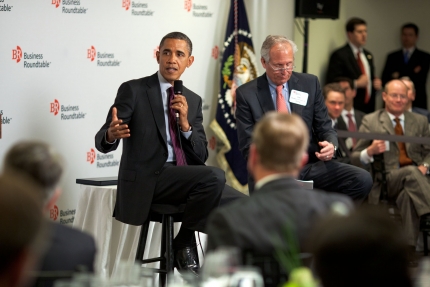
President Barack Obama at the Business Roundtable Quarterly Meeting

President Barack Obama takes questions following the Business Roundtable Quarterly Meeting held at the Newseum in Washington, D.C., March 6, 2012. BRT Chairman James McNerney is seated with the President. (Official White House Photo by Pete Souza)

President Obama met with top business leaders on Tuesday night and he talked about the need to focus on our core strengths in order to grow the American economy: American manufacturing; American energy; American innovation; and ensuring American workers have the best skills and education.

The association, whose members include top executives from some of the largest corporations in the country, gathered in Washington, DC to discuss a report it is releasing today called “Taking Action for America: A CEO Plan for Jobs and Economic Growth.” It had been two years since the President last met with the group, and he highlighted many of the gains the economy has made in that time, including the addition of more than 3.7 million new jobs in the private sector and the resurgence of the American auto industry. President Obama also discussed the need to do more than restore our economy to pre-crisis levels -- we need to position ourselves to be competitive in this 21st century economy over the long term and create an economy built to last:

We’re also going to have to make significant investments in American energy.  I am very proud of the fact that American energy output is reaching record levels.  We are seeing the highest oil production in the last eight years.  At the same time, because so many of your companies have become more efficient, we’re actually seeing a reduction in imports -- in fact, below 50 percent for the first time back in 2010, the first time in a decade. 

But we’ve got more work to do, and it’s going to require an all-of-the-above strategy.  Obviously, folks are getting killed right now with gas prices.  And that has an impact on all of your companies, because consumers are more price sensitive when it comes to filling up their gas tank than just about anything else.  That means, yes, we’ve got to produce more oil and more natural gas, and we are game for that.  It also means, though, we’ve got to invest in the energy sources of the future. 


Related Topics: Economy

The White House

Office of the Press Secretary

Readout of the President’s Meeting with Libyan Prime Minister ElKeib

This morning President Obama welcomed Libyan Prime Minister Abdurrahim ElKeib to the White House—the first of several meetings the Prime Minister will hold with U.S. officials this week.  During the meeting the President pledged continued support to the Libyan people and noted the contributions made by American service members and civilians to securing Libya’s freedom.  The President applauded the Prime Minister for his leadership during Libya’s democratic transition and his government’s efforts to rebuild the country.  The President encouraged the Prime Minister to continue plans to hold national elections in June and stressed the importance of transparency and engagement with Libya’s newly energized civil society as the government develops accountable institutions.  The leaders also discussed a range of security issues and increased cooperation on border management, weapons security, and regional counterterrorism concerns. The President said he looks forward to a close partnership between the United States and Libya going forward.

The White House

Office of the Press Secretary

Fact Sheet: All-of-the-Above Approach to American Energy

President Obama Announces $1 billion National Community Deployment Challenge to spur deployment of clean, advanced vehicles and expansion of advanced vehicle tax credit

During the State of the Union Address, the President laid out a blueprint for a new era of American energy – an economy fueled by homegrown and alternative energy sources that will be designed in America and produced by American workers. Today, the President will visit Daimler Trucks North America Mt. Holly Truck Manufacturing Plant in Mt. Holly, NC to deliver remarks on American energy.  While at the Daimler Plant, the President will tour the assembly line, see several of the alternative fuel models built there, and discuss the importance of taking a sustained, all-of-the-above approach on energy, responsibly expanding domestic production of natural gas and oil, which is currently at an eight year high, improving the efficiency of our cars and trucks, and making the long-term investments in alternatives to oil to provide American families the choices we all deserve. This strategy is a win for the economy, a win for energy security, and a win for national security.

In Mt. Holly, the President will announce a new $1 billion National Community Deployment Challenge to spur deployment of clean, advanced vehicles in communities around the country.  The President will also announce a set of incentives to help consumers and businesses purchase new, advanced cars and trucks, including increasing and expanding the current tax credit for advanced vehicles, from the $7,500 credit that currently exists up to $10,000, while allowing the credit to be applied to additional types of technologies, not currently covered. In addition, the President is announcing a new research challenge that invests in breakthrough technologies to make electric vehicles as affordable and convenient to own and operate as gasoline-powered vehicles by the end of the decade.

Today the President will also highlight Daimler’s commitment to increasing fuel economy standards and manufacturing vehicles that will increase fuel economy and reduce oil consumption. Taken together, the Obama Administration’s standards for cars and light-duty trucks span model years 2011 to 2025 and represent the first meaningful update in over three decades. Under this program, average fuel efficiency will reach a performance equivalent of 54.5 miles per gallon by 2025 and will save consumers $1.7 trillion at the pump overtime – or roughly $8,200 per vehicle and slash oil consumption by 2.2 million barrels a day by 2025. The Administration has also finalized the first-ever national fuel efficiency and greenhouse gas (GHG) emission standards for heavy-duty trucks, vans, and buses spanning model years 2014-2018, which will reduce oil consumption by over 500 million barrels, and save truck owners and operators more than $50 billion in fuel costs.

Daimler Trucks North America is a partner in the Energy Department’s SuperTruck initiative, which is focused on increasing the fuel efficiency of long haul trucks, or 18-wheelers, by 50 percent by 2015. While long-haul trucks represent only 4 percent of the on-road vehicles in America, they are responsible for almost 20 percent of the country’s on-road fuel consumption, with this class of vehicle currently consuming more than 30 billion gallons of gasoline a year. To achieve this goal, companies like Daimler are developing and improving vehicle technologies in engine efficiency, aerodynamics, waste heat recovery, and hybridization, among other approaches.  Through these types of improvements, the Energy Department estimates fuel economy increases could save long-haul truckers more than $15,000 per truck per year in fuel costs.

The President’s New Initiatives to Support Advanced Vehicles

Launching a “Race to the Top” challenge for communities to encourage advanced vehicle adoption:  The President is announcing a new $1 billion National Community Deployment Challenge to catalyze up to 10 to 15 model communities to invest in the necessary infrastructure, remove the regulatory barriers, and create the local incentives to support deployment of advanced vehicles at critical mass.  This proposal embraces a strategy similar to that outlined by Senators Merkley and Alexander in their Promoting Electric Vehicles legislation.  This proposal, however, would be ‘fuel neutral’, allowing communities to determine if electrification, natural gas, or other alternative fuels would be the best fit.  Deployment Communities would serve as real-world laboratories, leveraging limited federal resources to develop different models to deploy advanced vehicles at scale.  The program would also support the development of up to 5 regional Liquefied Natural Gas (LNG) corridors where alternative fuel trucks can transport goods without using a drop of oil. 

Making advanced vehicles more affordable: The President proposes to improve the current tax credit for electric vehicles by
o Expanding eligibility for the credit to a broader range of advanced vehicle technologies;
o Increasing the amount from $7,500, making it scalable up to $10,000;
o Reforming the credit to make it available at the point-of-sale by making it transferable to the dealer or financier, allowing consumers to benefit when they purchase a vehicle rather than when they file their taxes; and
o Removing the cap on the number of vehicles per manufacturer eligible for the credit and, instead, ramping down and eventually eliminating the credit at the end of the decade.

Accelerating deployment of alternative-fuel trucks: The President is proposing a new tax incentive for commercial trucks that provides a credit for 50% of the incremental cost of a dedicated alternative-fuel truck, including trucks powered by natural gas or electricity, for a five-year period.  This incentive – paired with support through programs like the Energy Department’s National Clean Fleets Partnership, which provides technical assistance to large company fleets interested in moving toward vehicles that rely on little or no oil – will not only drive down domestic demand for oil, but also drive up demand for the sorts of vehicles built at Freightliner’s Mt. Holly Plant and, in turn, spur job creation in the American manufacturing sector.

Launching ‘EV Everywhere’, a clean energy grand challenge to make electric-powered vehicles as affordable and convenient as gasoline-powered vehicles for the average American family within a decade:    This national effort is the second in a series of Clean Energy Grand Challenges designed by the Department of Energy to bring together America’s best and brightest scientists, engineers, and businesses to work together to solve the most pressing energy technology challenges of our time.  EV Everywhere will enable companies in the U.S. to produce electric vehicles at lower cost, with an improved vehicle range and an increased fast-charging ability, so average American families will be able to own and drive an electric vehicle as affordable and convenient as today’s gasoline-powered vehicles.  The savings from using lower-cost electricity instead of gasoline, roughly $100 per month for the average driver, combined with the reduction of upfront vehicle cost, will lower energy costs for American consumers and businesses.  The President’s FY13 Budget includes $650 million to advance vehicle and battery technologies at the Energy Department, including investments that support this new grand challenge.  EV Everywhere will invest in breakthrough R&D for advanced batteries, electric drivetrain technologies, lightweight vehicle structures, and fast charging technology.