The White House

Office of the Press Secretary

Remarks by the President at a Campaign Event

ABC Home and Carpet
New York, New York

8:45 P.M. EST
 
THE PRESIDENT:  Hello, New York!  (Applause.)  Oh, it is good to be back in New York City.  (Applause.) 
 
We've got some folks here that I want to acknowledge.  First of all, the event co-chairs Deepak Chopra, thank you.  Paulette Cole, thank you.  (Applause.)  Reshma Saujani thank you.  (Applause.)  Russell Simmons, thank you.  (Applause.)
 
Got a couple of elected officials who are here -- Congresswoman Carolyn Maloney is here, and public advocate Bill de Blasio is here.  (Applause.)  I want to thank all the talent who participated -- Ben Folds, Ingrid Michaelson.  The Roots are always in the house.  (Applause.)  And Aziz Ansari.  (Applause.)
 
Now, this is big because Malia is a big Parks and Recreation fan.  (Applause.)  So having Aziz here is like the only thing she thinks is worth me doing.  (Laughter.)  I want to thank him for what he said earlier.  I know he's backstage, but I just want to remind him I've got more Twitter followers than you, man.  (Laughter.)  I just want to keep him humble and hungry.  (Laughter.)  We all need somebody who does that.  Fortunately, I have Michelle.  (Laughter and applause.)
 
Now, this is an incredible tapestry of what New York is all about.  But I also want to thank all the Asian American and Pacific Islanders who helped get this program off the ground.  It is an incredible reminder of my roots back in Hawaii -- (applause) -- and the incredible visit that we made to India just over a year ago.  Although it was a little discouraging because the day after our first visit, I opened up the papers -- there were two headlines:  President Obama Visits India, and then there was:  Michelle Obama Rocks India.  (Laughter.)  So this is kind of my life.  Keeps me humble.
 
I am here today not just because I need your help, although I do.  But I'm here because your country needs your help.  (Applause.)  There was a reason why so many of you worked your hearts out in 2008 -- and I see some friends out here who were active in that campaign.  And you got involved not because you thought it was going to be easy.  I mean, think about it.  You supported a candidate named Barack Hussein Obama -- (laughter and applause) -- for President of the United States.  (Applause.)  You did not need a poll to know that was not going to be a sure thing.  (Laughter.)
 
And besides, you didn’t join the campaign because of me.  It was not about one person.  It was because of a shared vision that we had for America.  It was because of your commitments to each other.  It’s not a vision of America where everybody is left to fend for themselves.  It’s a vision of America where everybody works together and everybody who works hard has a chance to get ahead, not just those at the very top.
 
That’s the vision we share.  That’s the change we believed in, that no matter who you are, no matter where you come from, no matter what you look like, no matter what your name is, that in this country you can make it if you try.  (Applause.)  That was the change we believed in. 
 
And we knew it wasn’t going to come easy.  We knew it wouldn’t come quickly.  But I want you to think about what we have done in just three years because of what you did in 2008.  Think about it.  Think about what change looks like.  Change is the first bill I signed into law, a pretty simple law.  It says women deserve an equal day’s pay for an equal day’s work -- (applause) -- because we want -- because I want my daughters to have the same opportunity as someone’s sons.  That happened because of you.
 
Change is the decision we made to rescue the American auto industry from collapse, even when there were some politicians who were saying let’s let Detroit go bankrupt.  And with one million jobs on the line, we weren’t going to let that happen.  And today, GM is back on top as the world’s number-one automaker, just reported the highest profits in 100 years.  (Applause.)  With 200,000 new jobs created in the last two and a half years, the American auto industry is back.  That happened because of you. 
 
Change is the decision we made to stop just waiting for Congress to do something about our addiction to oil and finally raise our fuel-efficiency standards.  And by the next decade, we will be driving American-made cars that get almost 55 miles to the gallon.  And that will save the typical family $8,000 at the pump and reduce our dependence on foreign oil, and start actually giving us some independence from these gas prices that have been going up.  That’s what change is.  That’s what you did.  (Applause.)
 
Change is the fight we won to stop handing $60 billion in taxpayer subsidies to banks to process student loans and give that money directly to students and families who need it, so that millions of young people around the country are able to afford college just a little bit better.  (Applause.)
 
Change is health care reform that we passed after a century of trying -- (applause) -- a reform that ensures that in the United States of America, nobody will go bankrupt just because they get sick.  (Applause.)  And already, 2.5 million young people have health insurance today because this law let them stay on their parent’s plan.  And every American can no longer be denied or dropped by their insurance company when they need care the most.  That happened because of you, because of what you were willing to fight for back in 2008.
 
Change is the fact that for the first time in history you don’t have to hide who you love to serve the country you love, because we got rid of "don't ask, don't tell."   (Applause.)  And change is keeping another promise I made in 2008:  For the first time in nine years there are no Americans fighting in Iraq.  (Applause.)  We put that war to an end and we refocused our efforts on the terrorists who actually attacked us on 9/11.  And thanks to the incredible men and women in uniform, al Qaeda is weaker than it has ever been, and Osama bin Laden will never again walk the face of this Earth.  (Applause.)
 
We’ve restored respect for America around the world, made clear that America will abide by those core values that made us a great country.  We ended torture.  We promoted human rights.  We made it clear that America is a Pacific power.  We demonstrated that if countries like Burma travel down the road of democratic reform, they will find a new relationship with the United States.  And we are leading, again, by the power of our moral example.  That’s what change is.
 
AUDIENCE MEMBER:  No more war!
 
THE PRESIDENT:  None of this -- nobody has announced a war, young lady.  (Applause.)  But we appreciate your sentiment.  (Applause.)  You're jumping the gun a little bit there.  (Applause.)  
 
None of this change has been easy.  And we've got a lot more work to do.  There are still too many Americans out there looking for work.  There are too many families out there who are having a tough time paying their bills or making their mortgage, or their house is underwater.  They're still recovering from the worst economic storm in our lifetimes, in generations.
 
But over the last two years, businesses have added about 3.7 million new jobs.  Our manufacturing sector is creating jobs again for the very first time since the 1990s.  Our economy is getting stronger.  The recovery is accelerating.  America is coming back. 
 
And the last thing we can afford to do right now is to go back to the very same policies that got us into this mess in the first place.  (Applause.)  But, you know, that is exactly what the other folks for this office -- who are running for this office want to do. 
 
I don’t know if you’ve been paying attention -- (laughter) -- but they make no secret about their agenda.  They want to go back to the days when Wall Street played by its own rules.  They want to go back to the days when insurance companies could deny coverage or jack up your premiums without a reason.  They want to spend a trillion dollars more on tax breaks for the wealthiest individuals, even if it means adding to our deficit, or gutting education, or gutting our investment in clean energy, or making it tougher for seniors who are on Medicare.  And their philosophy is simple:  We are better off when everybody is left to fend for themselves, the most powerful can play by their own rules. 
 
We’re at a crossroads here.  We’ve got as stark a choice as we’ve seen in a very long time.  And their vision of America is fundamentally wrong, because in the United States of America we are greater together than we are on our own.  We’re better off  -- (applause) -- we are better off when we keep to that basic American promise that if you work hard, you can do well enough to raise a family and own a home, send your kids to college and let them dream bigger than you ever imagined.  Maybe you can retire with some dignity and respect and put a little bit away after a lifetime of labor.  If you have a good idea to start a business, you can go out there and start one.  If you want to serve, then there’s a place for you teaching, helping kids who are having a tough time.  That’s the choice in this election. 
 
This is not just another political debate.  What’s at stake is the defining issue of our time, because middle-class Americans but also those striving to get in the middle class, those of us who know we would not be here had it not been for the opportunities given our parents and our grandparents and our great grandparents, some of us immigrants, some of us who are here because of that basic American promise -- that’s what we’re fighting for.  They are in a make-or-break moment.
 
We can go back to an economy that’s built on outsourcing and phony debt and phony financial profits, or we can fight for an economy that works for everybody.  An economy that’s built to last, that’s built on American manufacturing and American energy and education and skills for our workers, and the values that made us great -- hard work and fair play and shared responsibility.  (Applause.)  That’s the vision of America that I believe in.  That’s the vision of America you believe in.  That’s what’s at stake in this election.  (Applause.)
 
I want an America where we are still attracting the best and the brightest from around the world.  I want an America where the next generation of manufacturing is taking root here in the factories of Detroit and Pittsburgh and Cleveland.  I don’t want this nation to just be known for how much we buy and consume.  I want us to be inventing products and building products and selling products all around the world.  (Applause.)
 
And we’ve got to have a tax code that incentivizes people to invest here, not just rewarding companies that are sending jobs overseas.  We want capital and talent here, creating here in America.
 
We need to make our schools the envy of the world.  (Applause.)  And that starts with the man or woman at the front of the classroom.  Because a good teacher -- a recent study showed a good teacher can increase the lifetime earnings of just one class by over $250,000.  (Applause.)  So I don’t want to hear folks in Washington bashing teachers; I don’t want them defending the status quo.  Let's give schools the resources they need to keep good teachers on the job and reward the best teachers.  (Applause.)  Let's grant schools flexibility to teach with creativity and passion, and stop teaching to the test, even as -- and demanding accountability, and replacing teachers who aren't helping kids learn, but making sure that teachers who love to teach, that they're supported.
 
And when kids graduate, the most daunting challenge is, how do they afford college.  Right now, we've got more tuition debt than credit card debt in America.  Now, there's some immediate things we need to do.  Congress needs to stop the interest rates on student loans from doubling in July.  (Applause.)  That’s coming up.  Colleges and universities have to do their part to be more affordable.  If they can't stop tuition from going up, the funding they get from taxpayers should go down.  Because higher education can't be a luxury, it's an economic imperative that every American family should be able to afford. 
 
We've got to invest in our people.  That’s what will determine who can compete in the 21st century.  And other countries are -- they understand this.  They're catching up.  They're making the investments.  Why aren't we?  Why are we seeing teachers laid off all across the country?  Why are we seeing it harder for young people to get a college education?  Our priorities have gotten a little skewed.
 
An economy built to last is one where we're supporting scientists and researchers trying to make sure that the next breakthrough in clean energy happens right here in the United States of America.  We've subsidized oil companies for over 100 years.  It's time to end those taxpayer giveaways to an oil industry that’s rarely been more profitable, and let's double that on clean energy that has never been more promising -- solar, wind and biofuels.  (Applause.)
 
We need to rebuild America.  I'm a chauvinist when it comes to -- I want America to have the best stuff.  I want us to have the best roads and the best airports and the fastest railroads and Internet access.  It's time to take the money that we're no longer spending at war, use half of it to pay down the debt, use the other half for some nation-building here at home.  (Applause.)  Let's put people back to work rebuilding America. 
 
And in order to create this economy built to last, we've got to make sure that we've got a tax system that reflects everybody doing their fair share.  That’s why I've said we should follow the Buffett Rule:  If you make more than a million dollars a year, you should not pay a lower tax rate than your secretary.  (Applause.)  Now, if you make less than $250,000 a year, which is 98 percent of Americans, your taxes shouldn’t go up.  You're already challenged right now.
 
When I lay this out, I try to remind folks this is not class warfare.  This isn't about envy.  This is about basic math.  Because if somebody like me gets a tax break I don’t need and that the country cannot afford, then one of two things has to happen -- either that’s going to add to the deficit, it's a tax cut that’s not paid for, and we've just gone through a decade of that -- or, alternatively, we're going to reduce the deficit on the backs of folks who can't afford it -- the student who has to pay more for their student loans, or the senior who suddenly has to pay more for their Medicare, or a family that’s trying to get by.  That’s not fair.  It's not right.  It's not who we are.
 
You hear a lot about values during election season -- politicians love to talk about values.  And I think back, when I hear some of this talk, about the values my mother, my grandparents taught me when I was growing up.  Hard work -- that’s a value.  Looking out for one another, compassion -- that’s a value.  The idea that we're all in this together, and that we're -- that we trust and care for one another, that I am my brother's keeper, I am my sister's keeper -- that's a value. 
 
Each of us is here because somewhere, somebody took responsibility not just for themselves but also for the future  -- for their family, for their community, for their nation.  The American story has never been about what we do alone.  It's what we do together.  And we won't win the race for new jobs and businesses and security for middle-class families with the same old "you're on your own" economics that the other side is peddling.  It doesn’t work.
 
It never worked.  It didn’t work when we tried it back in the decade before the Great Depression.  It didn’t work when we tried it in the last decade.  And it won't work now.  (Applause.)  It will not work. 
 
And what everybody here understands instinctively is if we attract an outstanding teacher to the profession by giving her the pay that she deserves, and that teacher goes on to educate the next Steve Jobs, we all benefit.  If we provide faster Internet to rural America so a storeowner could suddenly sell his goods around the world, or the next Russell Simmons, entrepreneur, can start promoting -- (applause) -- some unbelievable music, even though you don't have a lot of capital -- that benefits all of us.
 
If we build a new bridge that saves shipping companies time and money, or make airports work a little bit better so everybody saves a couple hours when you have to fly somewhere -- we all do better.  Businesses, workers, customers -- America. 
 
And this has never been a Democratic or a Republican idea.  The first Republican President, Abraham Lincoln, launched the Transcontinental Railroad, the National Academy of Sciences, the first land-grant colleges in the middle of a civil war -- because he understood those investments will pay dividends for decades to come.  Teddy Roosevelt, Republican, called for a progressive income tax because he understood that we don't want a system in which barriers are created for the majority of people to be able to succeed.
 
Dwight Eisenhower, Republican, built the Interstate Highway System, stitching us together as one nation.  Republicans in Congress supported FDR when he gave millions of returning heroes, including my grandfather, a chance to go to college on the G.I. Bill. 
 
This is not a left/right idea.  This is an American idea.  And that same sense of common purpose, it still exists.  Not always in Washington.  But out in America, it's there.  You go to a Main Street, you go to a town hall, you go to a VFW hall, you go to a diner, you go to a small business, you talk to the members of our Armed Forces, you go to a synagogue or a mosque or a church, a temple -- our politics may be divided, but Americans, they know we have a stake in each other.  They know no matter who you are, where you come from, we rise or fall as one nation, as one people.  And that’s what’s at stake right now.  That’s what this election is about.  (Applause.)
 
So let me say this, New York.  I know it’s been a tough few years for America.  We’ve taken some shots.  The change we fought for in 2008 hasn’t always happened as fast as we would have liked.  After all, that’s -- after all that’s happened in Washington, sometimes you look and you just see the mess -- (laughter) -- and it’s tempting to sometimes say, you know what, maybe change isn't possible.  Maybe that spirit that we had, maybe we were naïve. 
 
I know it’s tempting to believe that.  But remember what I always used to say during the last campaign -- including that night at Grant Park.  I said, real change, big change, is always hard.  It’s always hard.  The civil rights movement was hard.  Winning the vote for women was hard.  Making sure that workers had some basic protections was hard.  Around the world -- Gandhi, Nelson Mandela -- what they did was hard.  It takes time.  It takes more than a single term.  It takes more than a single President.  It takes more than a single individual.  What it takes is ordinary citizens who keep believing, who are committed to fighting and pushing and inching this country closer and closer to our highest ideals.  (Applause.)  
 
And I said in 2008 that I am not a perfect man and I will not be a perfect President.  But I promised you, I promised you back then that I would always tell you what I believed, I would always tell you where I stood, and that I would wake up every single day thinking about you and fight for you as hard as I could, and do everything possible to make sure that this country that has given me and Michelle and our kids so much, that that country is there for everybody.  And you know what?  I have kept that promise.  (Applause.)
 
So if you’re willing to work with me, and push through the obstacles, and push through the setbacks, and get back up when we get knocked down, and if you’re willing to hold that vision that we have for America in your hearts, then I promise you change will come.  (Applause.)  And if you’re willing to work as hard as you did in the last election in this election, then we will finish what we started, and remind the world just why it is that America is the greatest nation on Earth. 
 
God bless you, everybody.  (Applause.)  God bless the United States of America.  Thank you.  (Applause.)
 
END   
9:13 P.M. EST

The White House

Office of the Press Secretary

Remarks by the President at a Campaign Event

ABC Kitchen
New York, New York

6:04 P.M. EST

THE PRESIDENT:  (In progress.)  First of all, your outstanding congresswoman of this district, Carolyn Maloney, is here, and we want to give her a big round of applause.  (Applause.)  And my understanding is we also have the chairman of our convention effort in Charlotte, North Carolina, Jim Rogers.  Where’s Jim?  (Applause.)  Where is he?  Jim Rogers, right here.  (Applause.)  Thank you, Jim.  Here is working hard to make sure that is a good event and we’re going to make sure that North Carolina is blue again.  (Applause.)

So I’m not going to be long at the top.  I’m just going to make a few brief remarks, and then what I want to do is save as much time as possible for us to have a conversation and to take questions.

Four years ago, we were losing 800,000 jobs a month; last month, we gained 250,000 jobs.  (Applause.)  Three years ago, the banking system had frozen up completely; today, credit is flowing again.  Three years ago, the auto industry was on the verge of liquidation; today, GM not only is the number-one automaker in the world again, but also saw the highest profits in its entire history.  Over the last two years, we’ve created 3.7 million jobs in the private sector.  Manufacturing is the strongest it’s been since the 1990s. 

None of this argues that we’re out of the woods.  Many of you are in business and you know better than I do that there are a lot of folks out there who are still having a tough time.  There are a lot of small businesses that still have trouble getting credit.  The unemployment rate remains too high.  We still have enormous challenges to make sure that we are the most competitive, most productive economy in the world in the 21st century.  But the trend lines are good.  The economy is stronger, we are more productive, and we are poised to be able to take advantage of a moment where all the things that we're good at -- innovation, dynamism, entrepreneurship -- all those things are going to be at a greater premium than ever before. 

And the question then becomes, do we continue down the path that allows us to compete and create good jobs with good wages, and ensures that the essence of the American Dream -- which is everybody gets a fair shot, no matter where you come from, no matter what you look like; if you work hard and you've got a good idea, you're able to succeed; that everybody does their fair share so that, in addition to this incredible individualism and enterprise that we rightly are proud of, we also are looking out for one another; and everybody is playing by the same set of rules, that the notion of fair play exists in all sectors of our economy -- the question is, is that going to be the vision that guides us over the next 10, 20, 50 years?  Or are we going to pursue a vision that says it's okay for a few of us to do really well while the rest of America is struggling? 

And this election is going to give us a starker choice than we have had in my lifetime.  Now, if you agree with me that it's good for all of us to ensure everybody has a fair shot, everybody is doing their fair share and fair play reigns, then that has to translate into some concrete policy.  It means that we continue to make investments in education, and we follow the path that we've been following over the last three years, which is, yes, we put more money into education, but we also demand more reform. 

It means we continue to make investments in American-made energy.  But that doesn’t just include oil production and gas production -- as much as we're promoting that.  It also includes us preparing for the future by investing in clean energy.

It means we're investing in science and technology, recognizing that that’s how we got here -- was we invented more stuff, and operationalized it and commercialized it better than anybody else in the world.  And the federal government, historically, has had a role in that.  It means we rebuild our infrastructure so that we can compete and move goods and services around the world better than anybody else can. 

And it means that even as we are getting our fiscal house in order, that we're doing so in a way that doesn’t just put the burden on the senior citizen on Medicare, or the student who is trying to finance their way through college, but those of us that have been incredibly blessed by this society, that we're doing our part as well. 

Now, the proposals that I've put forward in terms of balancing our budget, making our government more efficient but making sure that it's still creating ladders of opportunity, making sure that we're still investing in those things that help us succeed economically, that made us an engine of economic growth and created this incredible middle class, that we have -- all those things that we’ve done are ideas that, traditionally, received Democratic and Republican support. 

It’s only in this environment that we’ve seen the other party suddenly say that that’s socialism, that that, somehow, is un-American.  That somehow the critical role that government has played as a partner with the marketplace to create opportunity for everybody, that somehow there’s something wrong with that.  I reject that vision, and I think the American people do, too. 

Now, they’ve gone three tough years and so this is going to be a close election.  Nobody is under any illusion that this isn’t going to be a tight race for us.  But as I travel around the country and I talk to folks, including people who don’t support me, when you break down the individual items that are being debated right now -- how do we balance this budget, what our tax policy should be, should we be investing in education, should we make sure that science and basic research continue to be paramount in our economy, do we have an obligation to make sure that our seniors can retire with dignity and respect -- we win that argument every time. 

And when it comes to foreign policy, I’m actually finding it very interesting.  The other side, traditionally, seems to feel that Democrats are somehow weak on defense, and they’ve had a little trouble making that argument this year.  (Applause.)  Because I think that what we’ve shown is there’s no contradiction between being tough and strong and protecting the American people, but also abiding by those values that make America great, and believing in diplomacy and believing in engagement and believing that it’s not a sign of weakness when we try to resolve issues peacefully, even as we’re prepared, when we need to for our own security, to act militarily.

So let me just close by saying this.  So many people in this room were active in 2008.  So many of you have had to defend me from your coworkers over the last three years.  (Laughter.)  And it’s true that over the last three years I’m a little grayer than I was.  Being an Obama supporter is not as trendy as it was.  (Laughter.)  Those old “Hope” posters that we had -- they’re a little dog-eared.  (Laughter.)  But I am more determined and more confident than I have ever been that if we keep at it, that America is poised to be stronger, more unified, more competitive, bolder, more generous than we ever have been before. 

And you will see me working harder and making those arguments as passionately as anything that I did in 2008.  And if you guys are with me, then I’m pretty confident not only are we going to win, but more importantly, America is going to be in good stead for years to come. 

Thank you very much, everybody.  Thank you.  (Applause.)  

END
6:15 P.M. EST

The White House

Office of the Press Secretary

Remarks by the President at a Campaign Event

Private Residence
New York, New York

5:00 P.M. EST

THE PRESIDENT:  Thank you.  Thank you, everybody.  (Applause.)  Thank you.  Thank you so much.  Thank you.  Thank you.  Wow, you are making me blush.  (Laughter.) 

It is just wonderful to be here.  And I want to thank Victor and Sarah for opening up their extraordinary home.  Although, I will say they have some pictures of me before I had gray hair -- (laughter) -- which is a little troubling.  They should have put the photo down.  (Laughter.)  But it’s a testimony to how long the two of them have been friends and supporters.  And those of you who know them know the passion and the extraordinary energy that they bring to issues of social justice and democratic politics.

I’m grateful for all you being here.  I’m going to keep my remarks at the top relatively brief, so that we can have more of an exchange of ideas, and I can answer questions and you guys can give me good advice.

But I’ll tell you -- obviously we’ve gone through three of the toughest years that America has gone through in our lifetimes.  And when I think back to those early months -- at a time when we were losing 800,000 jobs a month, and the banking sector had completely locked up, and the auto industry was on the verge of liquidation here in the United States, and, globally, no one was sure whether the center would hold -- the thing that gave me confidence was the incredible resilience and energy and hopefulness that I had seen during my travels as a presidential candidate.  And so as scary as those moments were, I had confidence that America could bounce back. 

Now, we’re not all the way back.  There is still a lot of hardship out there.  There are a lot of folks who still are looking for a job, or if they’re employed, are still just barely getting by.  There are millions of Americans who have seen their homes decline in value and they’re underwater, and they’re wondering whether they’re going to be able to retire as they had planned, or send their kid to college.

We still have an enormous amount of work to do.  But the good news is that here in the United States, the trend lines are good.  Last month, we saw 250,000 jobs created.  We’ve created 3.7 million jobs over the last two years.  We’ve seen the highest growth in manufacturing jobs since the 1990s.  Unemployment is still high, but it’s been moving in the right direction. 

And across the country what you’re seeing are businesses -- small and large -- saying to themselves, you know what, investing in America makes sense, because for all of our challenges, there's still no country that other folks would rather be because they understand that there is something about this place; that there's a set of values that are core to who we are, that are woven into our DNA, that allow you to make it if you try.

Now, the challenge is that for a lot of folks that essential American Dream that brought a lot of our forebears here to the United States has been slipping away.  And so even as we’ve tried to right the ship of the economy, even as we saved the auto industry, even as we stayed focused on putting people back to work, we were also looking at what are the fundamentals that ensure that everybody is going to get a fair shot, everybody is going to do their fair share, everybody is going to play by the same set of rules.

And that’s why, over the last three years, we've focused on making sure that you don’t go bankrupt if you get sick, and that 30 million people will have health insurance that didn’t have it before, and insurance companies can't deny you coverage at a time when you need it most.  (Applause.) 

It's the reason we've put such an emphasis on education -- not just through reform of the K-12 system, so every kid, no matter what their circumstances, can move ahead, but also, that once they graduate from high school, they can actually afford to go to college.  And we've made a bigger commitment at the federal level to education than any administration in recent history.  And our basic argument has been, not only are we going to put more money in, but we're also going to reform the system, and raise standards and infuse school districts with the kind of creativity and passion that’s required to make sure that kids can learn.

It's the reason why, on the environmental front, we've doubled fuel-efficiency standards on cars, so that we know that a decade from now your average vehicle will get 55 miles a gallon -- which is part of the reason why we're starting to see our dependence on foreign oil decline -- and having an energy policy that is not just drill, drill, drill, but is also investing in clean energy and advanced battery technologies and making sure that we're using energy more efficiently.  That’s going to be one of the foundations for making sure that we can succeed over the long term.

So, in addition to just saving the economy, what we've been trying to do is make sure that we provide a better foundation for long-term economic growth.  And we're poised to make that happen. 

Of course, over the last three years, I haven't just been able to worry about what happened here in this country, we've also had to do a little bit of worrying about what happened around the world.  The first promise I made as a presidential candidate was that I would end the war in Iraq.  Last night, I had the great honor of hosting a representative sample of the incredible young men and women -- and some not so young men and women -- in uniform who helped allow us to stabilize Iraq.  And that war is now over.  (Applause.) 

We're in the process of transitioning in Afghanistan, so that, increasingly, Afghans can take a lead for their own security and we can start bringing our troops home.  And we've been able to do all this while focusing attention on those who actually perpetrated 9/11.  And al Qaeda is weaker than it's ever been, and bin Laden is no more.  (Applause.)  Which goes to show that there's no contradiction between having a smart foreign policy, a foreign policy that is consistent with our values, but also being tough and looking out for America's national security.

Now, just as there's a lot more work to do here in the United States, there's a lot more work that we have to do internationally.  What's happening in the Middle East and North Africa right now is as profound, as transformative as what happened when the Berlin Wall fell, and the jury is still out in terms of the direction that it will go.  And my administration's commitment has been to say that we will continue to affirm our values, the things we believe in; that we will, where we can, defend people from brutality of their own governments; that we will stand up for human rights, we will stand up for free speech, we will stand up for women's rights.  (Applause.)  We will oppose torture.  We will oppose the kind of oppressiveness that, unfortunately, had been too common in too many countries in that region.

And one of our long-term goals in that region is to make sure that the sacrosanct commitment that we make to Israel’s security is not only a matter of providing them the military capabilities they need, not only providing the sort of qualitative military edge that they need in a very tough neighborhood, but also that we are a partner with them to try to bring about a peace in the region that can be lasting.  (Applause.)  And that is a challenge. 

What we’re seeing around that region is, is it used to be easier just to deal with one person who was an autocrat when it came to knowing who you could strike a deal with.  Part of what happens as a consequence of these regimes dissolving is that we’re going to have to take into account the politics and the attitudes of people in this region.  And that’s going to be challenging because there have been years of venom and anti-Semitism and anti-Israeli rhetoric that had been floating around for a long time.

At the same time, one of the things that I’m absolutely convinced of is that for Israel’s long-term security, it is going to be necessary for us -- even as we draw sharp lines in terms of Israel’s security -- to also continue to reach out to people of goodwill on the other side and try to shape -- (applause) -- and try to shape the kind of lasting, two-state solution that will allow Israel not only to preserve its security, but also to preserve its essence as a democratic, Jewish state.  (Applause.) 

And so as I look out over the next several years, America has probably had -- never had a clearer choice about where we go next, because the other side has a very different vision across the board about who we are and what’s important.  On the domestic front, their basic vision is if a very few people at the top are doing well and everybody else is struggling to get by, that’s okay.  On the foreign policy side, their view is, is that as long as we are flexing our muscles militarily, the need for engagement and diplomacy is a sign of weakness rather than strength. 

And so this election has huge consequences.  And what I’ve been saying to folks as I travel around the country -- a lot of supporters back in 2008 -- it was so much fun and so fresh to support this young guy who nobody could pronounce his name, and there were those posters there and -- there’s a little bit of revisionist history.  People remember that campaign as being flawless and so much fun.  I don’t remember it that way.  (Laughter.)  I remember us screwing up all the time. 

And so I acknowledge, yes, I’ve got a little more gray hair now.  And the last three years, despite, I think, the extraordinary work that my team has done, that we've got some dings and some nicks and some cuts from the battles we’ve had to fight.  But I am as determined as I ever was, and I believe as deeply as I ever have, about the core decency of the American people and the importance of a government that reflects those values. 

And that’s what we’re going to be fighting for over the next year.  And I’m going to need your help.  So I hope you’re ready, and I hope you will be just as determined, just as fired up, just as ready to go as you were in 2008.  (Applause.) 

Thank you very much, everybody.  Thank you.

END
5:12 P.M. EST

President Obama on Gas Prices and Oil Subsidies

President Obama delivers remarks on energy from Nashua, New Hampshire (March 1, 2012)

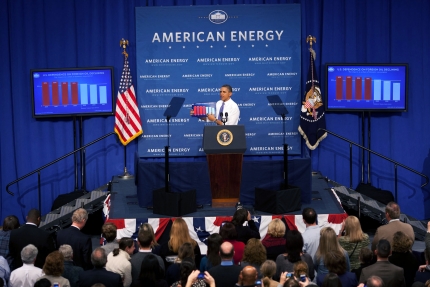
President Barack Obama delivers remarks on the economy at Nashua Community College in Nashua, N.H., March 1, 2012. The president used a diagram to illustrate the decline in U.S. dependence on foreign oil. (Official White House Photo by Pete Souza)

Today in New Hampshire, President Obama renewed his call to repeal the $4 billion in subsidies that taxpayers provide the oil industry each year and said there's only one real path forward for America's future -- an all of the above approach that develops every source of energy available to us.

He also addressed the idea that we'll be able to drill our way to lower gas prices and energy independence:

So when it comes to oil production, under my administration, America is producing more oil today than at any time in the last eight years. That is a fact ... Under my administration, we have a near-record number of oil rigs operating right now -- more working oil and gas rigs than the rest of the world combined. Think about that.

The President is directing the federal government to address a range of issues that are having a real impact on what each of us pays at the pump. For starters, he's working to prevent speculators from taking advantage of uncertainties in the commodities market and trying to reduce bottlenecks in the supply chain.

And the President is making a real push to eliminate the tax breaks that we provide to one of the most profitable industries in the world:

[Oil] companies are making record profits right now -- tens of billions of dollars a year. Every time you go to the gas tank or fill up your gas tank, they’re making money.  Every time. Now, does anyone really think that Congress should give them another $4 billion this year? Of course not. It’s outrageous. It’s inexcusable. And I am asking Congress -- eliminate this oil industry giveaway right away. I want them to vote on this in the next few weeks.

For more information about America’s decreasing dependence on foreign oil, check out our post from earlier today.

The White House

Office of the Press Secretary

Remarks by the President on American Energy

Nashua Community College
Nashua, New Hampshire

1:28 P.M. EST

THE PRESIDENT:  Hello, Nashua!  (Applause.)  It is good to be back in New Hampshire!  (Applause.) 

Thank you, Mike, for that wonderful introduction and for your service to our country.  I want to thank the president of Nashua Community College, Lucille Jordan, for hosting us here today.  Give Lucille a big round of applause.  (Applause.)  We’ve got Professor Paul Wunderlich, who gave me a great tour.  Where’s Paul?  Where is he?  He’s got a beard -- you can see him.  (Laughter.)  There he is.  And I want to thank your Mayor, Donnalee Lozeau, for joining us here today.  (Applause.)  Where’s Donnalee?  Right over there -- there.  Right in there. 

AUDIENCE MEMBER:  We love you!

THE PRESIDENT:  I love you back.  It is good to be back in New Hampshire. 

AUDIENCE MEMBER:  (Inaudible) 911! 911!  Somebody’s down!

THE PRESIDENT:  Okay, we’ll be all right.  They probably were just standing too long.  Just give them a little space.  Where’s our EMS folks?  They’ll be okay.  Just give him a little space.  This happens sometimes.  You guys been here a while after the magging?

AUDIENCE:  Yes.

THE PRESIDENT:  Well, no, you have to eat ahead of time.  (Laughter.)  Keep your blood sugar high.  We got somebody over there?  Jordan, right in the middle.  There we go.  Here’s our guy.  Make a little room, everybody.  All right, let’s make sure everybody is okay.  You all right?  All good?  Okay.  I think you’re going to be all right.  Okay.  (Applause.)  So remember, eat before you come to a presidential event.  (Laughter.)

Now, I am from Chicago, so you know a little snow was not going to keep me away -- (applause) -- which is why I can relate to New Hampshireites, because this is just like a dusting.  (Laughter.)  What’s the big deal?  There’s no big deal.  When Air Force One landed there were like 50 people waiting to shake my hand -- they got icicles on their eyebrows.  (Laughter.)  I was like, hey, great weather.  (Laughter.)  So I want to thank all of you for making the trek out here. I really appreciate it.

I just had a chance to look at some of the cutting-edge work that’s being done here at the auto shop.  Earlier this week, I gave a speech to American autoworkers where I said that one reason this country has an auto industry today is because we’re not just building cars again -- (applause) -- we’re building cars that use less oil, cars that go further on a gallon of gas.  And in part, that’s because of what’s happening in places like this community college.  It’s because of so many of you. 

I don’t need to tell you why fuel efficiency is so important, especially right now.  Most of you filled up your gas tanks in the last week or two, am I right?

AUDIENCE:  Yes.

THE PRESIDENT:  It hasn’t been a happy experience.  You’ve see the prices go up almost every day and you’ve already felt the pinch, whether you own a car or maybe you own a small business that uses energy.  Some of you have no choice but to drive a long way to work.  And higher gas prices are like a tax straight out of your paycheck.  And in the winter, the rising price of oil is also making it more expensive to heat your homes.

Now, I know this is hard to believe, but some politicians are seeing higher gas prices as a political opportunity.  You’re shocked, I know.  (Laughter.)  But it’s true -- right in the middle of an election year.  Who would have thought?  (Laughter.) So recently, the lead in one news story said -- and I’m quoting here -- “Gasoline prices are on the rise and Republicans are licking their chops.”  Licking their chops.  Now, let me tell you, only in politics do people respond to bad news with such enthusiasm.  (Laughter.)  That doesn’t happen anywhere else. 

And so, as a consequence, you can anticipate we’re going to be hearing a lot about how people have these magic 3-point plans to make sure that you’re only paying $2-a-gallon gas.  Just like we heard about it in the last election, just like we’ve heard about it for the last 30 years.  And you know what the essence of their plan is going to be, which is:  Step one, drill.  Step two, drill.  Step three, keep drilling.  And by the way, we’ll drill in your backyard.  Wherever it is, we’re just going to put up more rigs. 

Now, if there’s one thing I know about New Hampshire, it’s that your political bull detector is pretty keen.  It’s pretty sharp.  (Applause.)  You know that we can’t just drill our way to lower gas prices.  There are no quick fixes or silver bullets.  If somebody tells you there are, they're not telling you the truth. 

If we’re going to take control of our energy future -- which we have to do -- if we’re going to avoid high gas prices every single year, with a lot of politicians talking every single year but nothing happening -- if we're going to avoid that, then we've got to have an all-of-the-above strategy that develops every single source of American energy.  Not just oil and gas, but also wind and solar and biofuels.  (Applause.)  We've got to keep developing the technology that allows us to use less oil in our cars and trucks, less oil in our buildings and our factories.  And that’s the strategy we’ve been pursuing for the last three years, and it's the only real solution to this challenge. 

Now, here's the good news.  We're making progress.  And you can see it in this chart.  There's a chart behind me right here  -- we're using visual aids today.  (Laughter.)  The bar on the left shows that six years ago, 60 percent of the oil we used was imported.  Since I took office, America’s dependence on foreign oil has gone down every single year.  Every single year.  (Applause.)  In fact, in 2010, it was under 50 percent for the first time in 13 years -- for the first time.  (Applause.) 

And we gave one of these handy charts to everybody who came today, so you can impress your family and friends with your knowledge.  (Laughter.)  It makes a great conversation piece at parties.  (Laughter.)

Now, one of the reasons our oil -- our dependence on foreign oil is down is because of policies put in place by our administration, but also our predecessor’s administration.  And whoever succeeds me is going to have to keep it up.  This is not going to be solved by one party; it's not going to be solved by one administration; it's not going to be solved by slogans; it's not going to be solved by phony rhetoric.  It's going to be solved by a sustained, all-of-the-above energy strategy. 

And no matter what you hear from some folks in an election year, the key part of this strategy over the last three years has been to increase safe, responsible oil production here at home while also pursuing clean energy for the future.  We don’t have to choose between one or the other, we've got to do both.  (Applause.)  

So when it comes to oil production, under my administration, America is producing more oil today than at any time in the last eight years.  That is a fact.  That’s a fact.  (Applause.)    Under my administration, we have a near-record number of oil rigs operating right now -- more working oil and gas rigs than the rest of the world combined.  Think about that.  That’s a fact.  (Applause.)  

We've opened up millions of new acres for oil and gas exploration where appropriate and where it is done safely, and we've approved more than 400 drilling permits since we put in place new safety standards to make sure that we don’t have the same kind of spill that we had down in the Gulf a couple of years ago.  (Applause.) 

And we've approved dozens of new pipelines to move oil around, including from Canada.  Just this week, we announced that we’ll do whatever we can to help speed the construction of a pipeline in Oklahoma that will relieve a bottleneck for oil that needs to get to the Gulf.  And that’s going to help create jobs and encourage production.

So we’re focused on American oil production.  We are doing all that we can in a safe, responsible way to make sure that American oil production and gas production is high.  But here’s the thing.  The amount of oil that we drill at home doesn’t set the price of gas on its own.  And the reason is, is because oil is bought and sold on the world energy market.  And just like last year, the biggest thing that’s causing the price of oil to rise right now is instability in the Middle East.  This time it's Iran.  But a lot of folks are nervous about what might happen there, and so they're anticipating there might be a big disruption in terms of flow.  And when uncertainty increases, speculation on Wall Street can drive up prices even more.  Those are the short-term factors at work here.

So when you start hearing a bunch of folks saying somehow that there's some simple solution, you can turn a nozzle and suddenly we're going to be getting a lot more oil, that’s not just how it works.  Over the long term, the biggest reason oil prices will rise is because of growing demand in countries like China and India and Brazil. 

Just think about this.  In five years, the number of cars on the road in China more than tripled.  Over the last five years, the number of cars tripled.  Nearly 10 million cars were added in China alone in 2010 -- 10 million cars just in one country in one year.  So that’s using up a lot of oil.  And those numbers are only going to get bigger over time.  As places like China and India get wealthier, they're going to want to buy cars like we do, and they're going to want to fill them up like we do, and that’s going to drive up demand.

So what does this mean for us?  What does this mean for America?  It means that anybody who tells you that we can just drill our way out of this problem does not know what they’re talking about or they're not telling you the truth.  (Applause.) One or the other. 

Here's another way to think about it.  The United States consumes more than 20 percent of the world’s oil, but we only have 2 percent of the world’s oil reserves -- 20 percent we use; we only produce 2 percent.  And no matter what we do, it's not going to get much above 3 percent.  So we're still going to have this huge shortfall.  That's why if we really want energy security and energy independence, we've got to start looking at how we use less oil, and use other energy sources that we can renew and that we can control, so we are not subject to the whims of what's happening in other countries.  (Applause.)

We have to keep developing new technology that helps us use less energy.  We've got to keep relying on American know-how and ingenuity that comes from places like this one, Nashua Community College.  That’s our future.  (Applause.)  And that’s exactly the path that we've been taking these last three years.  Because of the investments we’ve made, the use of clean, renewable energy in this country has nearly doubled -- and thousands of Americans have jobs because of it. 

We’re taking every possible action to develop a near 100-year supply of natural gas, which releases fewer carbons.  Now that’s something that experts believe will support more than 600,000 jobs by the end of the decade.  Our cooperation with the private sector has positioned this country to be the world’s leading manufacturer of high-tech batteries that will power the next generation of American cars.  (Applause.)

And after three decades of doing nothing, we put in place fuel economy standards that will make sure our cars average nearly 55 miles per gallon by the middle of the next decade.  That’s nearly double what we have today.  (Applause.)  And that, by the way, applies not just to cars -- it applies to light trucks, and now it’s going to apply to heavy trucks as well. 

So that means that every time you fill up, you can think to yourself, you know what, I won’t have to fill up again for two weeks instead of one week.  That’s worth applauding.  (Applause.) Because what that means is that will save the typical family more than $8,000 at the pump.  And it means that this country will reduce our oil consumption by more than 2 million barrels a day, which means we can continue to see a decline in how much imported oil we need.  (Applause.)  And that’s good for our national security, that’s good for our economy, and it’s good for our environment.  (Applause.)

So that’s the strategy we’ve got to pursue.  But we’ve got to do more, and we’ve got to do more even faster.  We’ve got to keep investing in developing every available type of American-made energy.  And this means that we’ve got to set some priorities.  We’ve got to make some choices. 

First, while there are no short-term silver bullets when it comes to gas prices, I’ve directed my administration to look for every single area where we can make an impact and help consumers -- from helping to relieve bottlenecks in the places like the one we’ve got in Oklahoma, to making sure speculators aren’t taking advantage of what’s going on in the oil markets.  And we’re just going to keep on announcing steps in the coming weeks; every time we find something that can provide a little bit of relief right now, we’re going to do it.  (Applause.)

But over the long term, an all-of-the-above strategy requires the right incentives.  And here’s one of the best examples.  Right now, $4 billion of your tax dollars -- $4 billion -- subsidizes the oil industry every year. 

AUDIENCE:  Booo --

THE PRESIDENT:  Four billion dollars.  Now, these companies are making record profits right now -- tens of billions of dollars a year.  Every time you go to the gas tank or fill up your gas tank, they’re making money.  Every time.  Now, does anyone really think that Congress should give them another $4 billion this year?

AUDIENCE:  No!

THE PRESIDENT:  Of course not.  It’s outrageous.  It’s inexcusable.  And I am asking Congress -- eliminate this oil industry giveaway right away.  I want them to vote on this in the next few weeks.  (Applause.)  Let’s put every single member of Congress on record:  You can stand with the oil companies, or you can stand up for the American people.  You can keep subsidizing a fossil fuel that’s been getting taxpayer dollars for a century, or you can place your bets on a clean-energy future. 

So I’m asking everybody here today, anybody who is watching at home, let your member of Congress know where you stand.  Will you do that?  (Applause.)  Because I know where I stand, New Hampshire.  I know where I stand on this.  We want to have successful oil companies that are able to get the oil that we have in our country, but we also understand that our future requires us to make investments in clean, renewable energies.  And that has to start now.  We can’t wait.  We can’t wait until gas has skyrocketed more and people are desperate.  We need to start making those investments now.

And most of you guys agree.  (Applause.)  That’s why you’re putting your time -- that’s why folks here at this community college are learning about building cars and repairing cars that use less oil -- cars that are powered with alternative fuels, like natural gas.  That’s why the city of Nashua is purchasing a new fleet of trash trucks that run on natural gas.  (Applause.)  They’re going to go cleaner; they’re going to last longer; they’re going to be cheaper to fill up.  (Applause.)  

I saw one of them.  It was a good-looking truck.  And it put a smile on the Mayor’s face, because she knows she’s saving money -- she’s saving taxpayer money.  Good job, Mayor.  (Applause.)

So that’s part of what that $4 billion is going to the oil companies right now, that’s where it could be going -- to help cities like this one convert their fleets to fuel-efficient cars and trucks, to help private sector companies -- big companies like UPS or Federal Express -- convert their fleets.  That can save us money.  In fact, since we announced the National Clean Fleets Partnership last year, the companies interested in transitioning their fleets have tripled.  And that's part of why this chart is going down. 

And I’m proud to say that the federal government is leading by example.  One thing the federal government has a lot of is cars.  I don't know if you guys are aware of this, but we have a lot of cars.  (Laughter.)  And I’ve directed every department, every agency -- every single one -- to make sure that by 2015, 100 percent of the vehicles that the federal government buys are fuel-efficient cars and trucks.  (Applause.)  Let's save us money. 

So this is our future.  This is the ultimate solution to our energy challenge.  It's not going to be a smooth, easy ride.  Some of the clean-energy technologies that are discovered, they won’t pan out.  Some companies will fail.  There's going to be experiments and research that take time.  But as long as I’m President, I will not walk away from the promise of clean energy, because our future depends on it.  (Applause.)  I'm not going to cede the wind or the solar or the battery industry to China or Germany because some politicians in Washington refused to make the same commitment here in the United States of America.  (Applause.)  

With or without this Congress, I'm going to continue to do whatever I can to develop every source of American energy -- to make sure that three years from now our dependence on foreign oil is even lower, to make sure that our future is not controlled by events on the other side of the world. 

We may not have a silver bullet to bring down gas prices tomorrow, or reduce our dependence on foreign oil overnight.  But what we do have in this country are limitless sources of energy, and a boundless supply of ingenuity and imagination and talent that we can put to work to develop the energy of the future.  (Applause.)  We’ve got you. We’ve got you.  (Applause.)

The easiest thing in the world is to make phony election-year promises about lowering gas prices.  But what’s harder is to make a serious, sustained commitment to tackle a problem that we’ve been talking about for 30 years and has not been tackled, has not been solved.  It’s not going to be solved in one year or one term -- maybe not completely even in one decade.  But that’s the kind of commitment that we need right now.  That’s what this moment requires. 

And so when I see all the young people who are here today -- or the young at heart -- (laughter) -- we need you guys to keep at it.  This is your future at stake.  We need you to work hard. We need you to dream big.  We need you to summon the same spirit of unbridled optimism, that bold willingness to tackle tough problems that led previous generations to meet the challenges of their time -- to power a nation from coast to coast, to touch the moon, to connect an entire world with our own science and imagination.  That’s what America is capable of doing. 

And it’s that history that teaches us that all of our challenges -- all of them -- are within our power, within our grasp to solve.  (Applause.)  This one is no different.  This one is no different.  It will require our brightest scientists, our most creative companies, but it’s also going to require all of us -- Democrats, Republicans, everybody in between -– to do our part.  That’s what this moment requires. 

And I know we can do it.  And when we do, we’ll remind the world once again just why it is that the United States of America is the greatest nation on Earth. 

Thank you, everybody.  God bless you.  (Applause.)  God bless the United States of America.  (Applause.) 

END
1:55 P.M. EST

President Obama Speaks on American Energy

March 01, 2012 | 25:16 | Public Domain

President Obama discusses an all-of-the-above strategy to take control of our energy future by developing every single source of American energy, from oil and gas, to wind and solar, to new technologies that allow us to use less oil in our cars and trucks, and less oil in our buildings and our factories.

Download mp4 (239MB) | mp3 (23MB)

Read the Transcript

Remarks by the President on American Energy

Nashua Community College
Nashua, New Hampshire

1:28 P.M. EST

THE PRESIDENT:  Hello, Nashua!  (Applause.)  It is good to be back in New Hampshire!  (Applause.) 

Thank you, Mike, for that wonderful introduction and for your service to our country.  I want to thank the president of Nashua Community College, Lucille Jordan, for hosting us here today.  Give Lucille a big round of applause.  (Applause.)  We’ve got Professor Paul Wunderlich, who gave me a great tour.  Where’s Paul?  Where is he?  He’s got a beard -- you can see him.  (Laughter.)  There he is.  And I want to thank your Mayor, Donnalee Lozeau, for joining us here today.  (Applause.)  Where’s Donnalee?  Right over there -- there.  Right in there. 

AUDIENCE MEMBER:  We love you!

THE PRESIDENT:  I love you back.  It is good to be back in New Hampshire. 

AUDIENCE MEMBER:  (Inaudible) 911! 911!  Somebody’s down!

THE PRESIDENT:  Okay, we’ll be all right.  They probably were just standing too long.  Just give them a little space.  Where’s our EMS folks?  They’ll be okay.  Just give him a little space.  This happens sometimes.  You guys been here a while after the magging?

AUDIENCE:  Yes.

THE PRESIDENT:  Well, no, you have to eat ahead of time.  (Laughter.)  Keep your blood sugar high.  We got somebody over there?  Jordan, right in the middle.  There we go.  Here’s our guy.  Make a little room, everybody.  All right, let’s make sure everybody is okay.  You all right?  All good?  Okay.  I think you’re going to be all right.  Okay.  (Applause.)  So remember, eat before you come to a presidential event.  (Laughter.)

Now, I am from Chicago, so you know a little snow was not going to keep me away -- (applause) -- which is why I can relate to New Hampshireites, because this is just like a dusting.  (Laughter.)  What’s the big deal?  There’s no big deal.  When Air Force One landed there were like 50 people waiting to shake my hand -- they got icicles on their eyebrows.  (Laughter.)  I was like, hey, great weather.  (Laughter.)  So I want to thank all of you for making the trek out here. I really appreciate it.

I just had a chance to look at some of the cutting-edge work that’s being done here at the auto shop.  Earlier this week, I gave a speech to American autoworkers where I said that one reason this country has an auto industry today is because we’re not just building cars again -- (applause) -- we’re building cars that use less oil, cars that go further on a gallon of gas.  And in part, that’s because of what’s happening in places like this community college.  It’s because of so many of you. 

I don’t need to tell you why fuel efficiency is so important, especially right now.  Most of you filled up your gas tanks in the last week or two, am I right?

AUDIENCE:  Yes.

THE PRESIDENT:  It hasn’t been a happy experience.  You’ve see the prices go up almost every day and you’ve already felt the pinch, whether you own a car or maybe you own a small business that uses energy.  Some of you have no choice but to drive a long way to work.  And higher gas prices are like a tax straight out of your paycheck.  And in the winter, the rising price of oil is also making it more expensive to heat your homes.

Now, I know this is hard to believe, but some politicians are seeing higher gas prices as a political opportunity.  You’re shocked, I know.  (Laughter.)  But it’s true -- right in the middle of an election year.  Who would have thought?  (Laughter.) So recently, the lead in one news story said -- and I’m quoting here -- “Gasoline prices are on the rise and Republicans are licking their chops.”  Licking their chops.  Now, let me tell you, only in politics do people respond to bad news with such enthusiasm.  (Laughter.)  That doesn’t happen anywhere else. 

And so, as a consequence, you can anticipate we’re going to be hearing a lot about how people have these magic 3-point plans to make sure that you’re only paying $2-a-gallon gas.  Just like we heard about it in the last election, just like we’ve heard about it for the last 30 years.  And you know what the essence of their plan is going to be, which is:  Step one, drill.  Step two, drill.  Step three, keep drilling.  And by the way, we’ll drill in your backyard.  Wherever it is, we’re just going to put up more rigs. 

Now, if there’s one thing I know about New Hampshire, it’s that your political bull detector is pretty keen.  It’s pretty sharp.  (Applause.)  You know that we can’t just drill our way to lower gas prices.  There are no quick fixes or silver bullets.  If somebody tells you there are, they're not telling you the truth. 

If we’re going to take control of our energy future -- which we have to do -- if we’re going to avoid high gas prices every single year, with a lot of politicians talking every single year but nothing happening -- if we're going to avoid that, then we've got to have an all-of-the-above strategy that develops every single source of American energy.  Not just oil and gas, but also wind and solar and biofuels.  (Applause.)  We've got to keep developing the technology that allows us to use less oil in our cars and trucks, less oil in our buildings and our factories.  And that’s the strategy we’ve been pursuing for the last three years, and it's the only real solution to this challenge. 

Now, here's the good news.  We're making progress.  And you can see it in this chart.  There's a chart behind me right here  -- we're using visual aids today.  (Laughter.)  The bar on the left shows that six years ago, 60 percent of the oil we used was imported.  Since I took office, America’s dependence on foreign oil has gone down every single year.  Every single year.  (Applause.)  In fact, in 2010, it was under 50 percent for the first time in 13 years -- for the first time.  (Applause.) 

And we gave one of these handy charts to everybody who came today, so you can impress your family and friends with your knowledge.  (Laughter.)  It makes a great conversation piece at parties.  (Laughter.)

Now, one of the reasons our oil -- our dependence on foreign oil is down is because of policies put in place by our administration, but also our predecessor’s administration.  And whoever succeeds me is going to have to keep it up.  This is not going to be solved by one party; it's not going to be solved by one administration; it's not going to be solved by slogans; it's not going to be solved by phony rhetoric.  It's going to be solved by a sustained, all-of-the-above energy strategy. 

And no matter what you hear from some folks in an election year, the key part of this strategy over the last three years has been to increase safe, responsible oil production here at home while also pursuing clean energy for the future.  We don’t have to choose between one or the other, we've got to do both.  (Applause.)  

So when it comes to oil production, under my administration, America is producing more oil today than at any time in the last eight years.  That is a fact.  That’s a fact.  (Applause.)    Under my administration, we have a near-record number of oil rigs operating right now -- more working oil and gas rigs than the rest of the world combined.  Think about that.  That’s a fact.  (Applause.)  

We've opened up millions of new acres for oil and gas exploration where appropriate and where it is done safely, and we've approved more than 400 drilling permits since we put in place new safety standards to make sure that we don’t have the same kind of spill that we had down in the Gulf a couple of years ago.  (Applause.) 

And we've approved dozens of new pipelines to move oil around, including from Canada.  Just this week, we announced that we’ll do whatever we can to help speed the construction of a pipeline in Oklahoma that will relieve a bottleneck for oil that needs to get to the Gulf.  And that’s going to help create jobs and encourage production.

So we’re focused on American oil production.  We are doing all that we can in a safe, responsible way to make sure that American oil production and gas production is high.  But here’s the thing.  The amount of oil that we drill at home doesn’t set the price of gas on its own.  And the reason is, is because oil is bought and sold on the world energy market.  And just like last year, the biggest thing that’s causing the price of oil to rise right now is instability in the Middle East.  This time it's Iran.  But a lot of folks are nervous about what might happen there, and so they're anticipating there might be a big disruption in terms of flow.  And when uncertainty increases, speculation on Wall Street can drive up prices even more.  Those are the short-term factors at work here.

So when you start hearing a bunch of folks saying somehow that there's some simple solution, you can turn a nozzle and suddenly we're going to be getting a lot more oil, that’s not just how it works.  Over the long term, the biggest reason oil prices will rise is because of growing demand in countries like China and India and Brazil. 

Just think about this.  In five years, the number of cars on the road in China more than tripled.  Over the last five years, the number of cars tripled.  Nearly 10 million cars were added in China alone in 2010 -- 10 million cars just in one country in one year.  So that’s using up a lot of oil.  And those numbers are only going to get bigger over time.  As places like China and India get wealthier, they're going to want to buy cars like we do, and they're going to want to fill them up like we do, and that’s going to drive up demand.

So what does this mean for us?  What does this mean for America?  It means that anybody who tells you that we can just drill our way out of this problem does not know what they’re talking about or they're not telling you the truth.  (Applause.) One or the other. 

Here's another way to think about it.  The United States consumes more than 20 percent of the world’s oil, but we only have 2 percent of the world’s oil reserves -- 20 percent we use; we only produce 2 percent.  And no matter what we do, it's not going to get much above 3 percent.  So we're still going to have this huge shortfall.  That's why if we really want energy security and energy independence, we've got to start looking at how we use less oil, and use other energy sources that we can renew and that we can control, so we are not subject to the whims of what's happening in other countries.  (Applause.)

We have to keep developing new technology that helps us use less energy.  We've got to keep relying on American know-how and ingenuity that comes from places like this one, Nashua Community College.  That’s our future.  (Applause.)  And that’s exactly the path that we've been taking these last three years.  Because of the investments we’ve made, the use of clean, renewable energy in this country has nearly doubled -- and thousands of Americans have jobs because of it. 

We’re taking every possible action to develop a near 100-year supply of natural gas, which releases fewer carbons.  Now that’s something that experts believe will support more than 600,000 jobs by the end of the decade.  Our cooperation with the private sector has positioned this country to be the world’s leading manufacturer of high-tech batteries that will power the next generation of American cars.  (Applause.)

And after three decades of doing nothing, we put in place fuel economy standards that will make sure our cars average nearly 55 miles per gallon by the middle of the next decade.  That’s nearly double what we have today.  (Applause.)  And that, by the way, applies not just to cars -- it applies to light trucks, and now it’s going to apply to heavy trucks as well. 

So that means that every time you fill up, you can think to yourself, you know what, I won’t have to fill up again for two weeks instead of one week.  That’s worth applauding.  (Applause.) Because what that means is that will save the typical family more than $8,000 at the pump.  And it means that this country will reduce our oil consumption by more than 2 million barrels a day, which means we can continue to see a decline in how much imported oil we need.  (Applause.)  And that’s good for our national security, that’s good for our economy, and it’s good for our environment.  (Applause.)

So that’s the strategy we’ve got to pursue.  But we’ve got to do more, and we’ve got to do more even faster.  We’ve got to keep investing in developing every available type of American-made energy.  And this means that we’ve got to set some priorities.  We’ve got to make some choices. 

First, while there are no short-term silver bullets when it comes to gas prices, I’ve directed my administration to look for every single area where we can make an impact and help consumers -- from helping to relieve bottlenecks in the places like the one we’ve got in Oklahoma, to making sure speculators aren’t taking advantage of what’s going on in the oil markets.  And we’re just going to keep on announcing steps in the coming weeks; every time we find something that can provide a little bit of relief right now, we’re going to do it.  (Applause.)

But over the long term, an all-of-the-above strategy requires the right incentives.  And here’s one of the best examples.  Right now, $4 billion of your tax dollars -- $4 billion -- subsidizes the oil industry every year. 

AUDIENCE:  Booo --

THE PRESIDENT:  Four billion dollars.  Now, these companies are making record profits right now -- tens of billions of dollars a year.  Every time you go to the gas tank or fill up your gas tank, they’re making money.  Every time.  Now, does anyone really think that Congress should give them another $4 billion this year?

AUDIENCE:  No!

THE PRESIDENT:  Of course not.  It’s outrageous.  It’s inexcusable.  And I am asking Congress -- eliminate this oil industry giveaway right away.  I want them to vote on this in the next few weeks.  (Applause.)  Let’s put every single member of Congress on record:  You can stand with the oil companies, or you can stand up for the American people.  You can keep subsidizing a fossil fuel that’s been getting taxpayer dollars for a century, or you can place your bets on a clean-energy future. 

So I’m asking everybody here today, anybody who is watching at home, let your member of Congress know where you stand.  Will you do that?  (Applause.)  Because I know where I stand, New Hampshire.  I know where I stand on this.  We want to have successful oil companies that are able to get the oil that we have in our country, but we also understand that our future requires us to make investments in clean, renewable energies.  And that has to start now.  We can’t wait.  We can’t wait until gas has skyrocketed more and people are desperate.  We need to start making those investments now.

And most of you guys agree.  (Applause.)  That’s why you’re putting your time -- that’s why folks here at this community college are learning about building cars and repairing cars that use less oil -- cars that are powered with alternative fuels, like natural gas.  That’s why the city of Nashua is purchasing a new fleet of trash trucks that run on natural gas.  (Applause.)  They’re going to go cleaner; they’re going to last longer; they’re going to be cheaper to fill up.  (Applause.)  

I saw one of them.  It was a good-looking truck.  And it put a smile on the Mayor’s face, because she knows she’s saving money -- she’s saving taxpayer money.  Good job, Mayor.  (Applause.)

So that’s part of what that $4 billion is going to the oil companies right now, that’s where it could be going -- to help cities like this one convert their fleets to fuel-efficient cars and trucks, to help private sector companies -- big companies like UPS or Federal Express -- convert their fleets.  That can save us money.  In fact, since we announced the National Clean Fleets Partnership last year, the companies interested in transitioning their fleets have tripled.  And that's part of why this chart is going down. 

And I’m proud to say that the federal government is leading by example.  One thing the federal government has a lot of is cars.  I don't know if you guys are aware of this, but we have a lot of cars.  (Laughter.)  And I’ve directed every department, every agency -- every single one -- to make sure that by 2015, 100 percent of the vehicles that the federal government buys are fuel-efficient cars and trucks.  (Applause.)  Let's save us money. 

So this is our future.  This is the ultimate solution to our energy challenge.  It's not going to be a smooth, easy ride.  Some of the clean-energy technologies that are discovered, they won’t pan out.  Some companies will fail.  There's going to be experiments and research that take time.  But as long as I’m President, I will not walk away from the promise of clean energy, because our future depends on it.  (Applause.)  I'm not going to cede the wind or the solar or the battery industry to China or Germany because some politicians in Washington refused to make the same commitment here in the United States of America.  (Applause.)  

With or without this Congress, I'm going to continue to do whatever I can to develop every source of American energy -- to make sure that three years from now our dependence on foreign oil is even lower, to make sure that our future is not controlled by events on the other side of the world. 

We may not have a silver bullet to bring down gas prices tomorrow, or reduce our dependence on foreign oil overnight.  But what we do have in this country are limitless sources of energy, and a boundless supply of ingenuity and imagination and talent that we can put to work to develop the energy of the future.  (Applause.)  We’ve got you. We’ve got you.  (Applause.)

The easiest thing in the world is to make phony election-year promises about lowering gas prices.  But what’s harder is to make a serious, sustained commitment to tackle a problem that we’ve been talking about for 30 years and has not been tackled, has not been solved.  It’s not going to be solved in one year or one term -- maybe not completely even in one decade.  But that’s the kind of commitment that we need right now.  That’s what this moment requires. 

And so when I see all the young people who are here today -- or the young at heart -- (laughter) -- we need you guys to keep at it.  This is your future at stake.  We need you to work hard. We need you to dream big.  We need you to summon the same spirit of unbridled optimism, that bold willingness to tackle tough problems that led previous generations to meet the challenges of their time -- to power a nation from coast to coast, to touch the moon, to connect an entire world with our own science and imagination.  That’s what America is capable of doing. 

And it’s that history that teaches us that all of our challenges -- all of them -- are within our power, within our grasp to solve.  (Applause.)  This one is no different.  This one is no different.  It will require our brightest scientists, our most creative companies, but it’s also going to require all of us -- Democrats, Republicans, everybody in between -– to do our part.  That’s what this moment requires. 

And I know we can do it.  And when we do, we’ll remind the world once again just why it is that the United States of America is the greatest nation on Earth. 

Thank you, everybody.  God bless you.  (Applause.)  God bless the United States of America.  (Applause.) 

END
1:55 P.M. EST

Close Transcript

The White House

Office of the Press Secretary

Press Gaggle by Press Secretary Jay Carney en route Nashua, New Hampshire, 3/1/12

Aboard Air Force One
En Route Nashua, New Hampshire   

11:23 A.M. EST


MR. CARNEY:  Well, welcome aboard Air Force One as we make our way from sunny, warm Washington, D.C. to snowy, cold Nashua, New Hampshire. 

The President looks forward to the event today where he will discuss again his all-of-the-above approach to our energy security.  And I'll save the specifics for the speech itself, but he will talk about what's been accomplished so far in increasing our production of fossil fuels in the United States, reducing our dependency on foreign imports, diversifying our sources of energy, and investing in alternative energy sources.  He will also call on Congress to take action on energy policy. 

And with that, I will take your questions.

Q    How is this going to be different from what he did in Florida?  Are there going to be any new initiatives that the President is going to be unveiling today?

MR. CARNEY:  There will be a new element to the speech today, certainly.  But I'll let you listen and decide when you hear it.

Q    Is the President considering taking that $4 billion that he's proposed, that you take away the credits for oil and gas companies -- providing it as a direct rebate to consumers?

MR. CARNEY:  Again, I don't have any pre-announcements to make about what the President will say today.  You do bring up an interesting point, which is that despite the fact that we have very high prices at the pump that are very difficult for Americans, despite the fact that oil companies are enjoying again near-record profits, we are still subsidizing oil companies to the tune of $4 billion annually.  The President has longed believed that that is unnecessary and something we can't afford.

Q    So no plans to take that $4 billion and direct it --

MR. CARNEY:  Again, I will leave announcements to the President.

Q    Jay, the President said last night that his apology to Karzai over the Koran burning had calmed the situation in Afghanistan down, and yet today we see two more Americans killed. Does he feel like that assertion last night was premature?

MR. CARNEY:  Well, the President said what the commanding general in Afghanistan and others have said, which certainly that the statements by U.S. leaders had helped calm the situation down.  But nobody has suggested that violence has ended in Afghanistan in general or in reaction to the unfortunate incident involving the inadvertent, unintentional burning of religious materials. 

The loss of ISAF servicemen is obviously a terrible thing.  And for more details on that I would refer you to ISAF and the Department of Defense.

Q    Back to oil.  One of the things that the President has in his power is a distribution from the Strategic Petroleum Reserve.  Can you talk about the considerations that he's going to weigh as he reviews that option with oil prices high and gas prices rising?

MR. CARNEY:  No.

Q    So, okay.  Staying with oil, staying with energy -- the Republicans complained that the President's call to repeal the tax subsidies for oil companies raises taxes on them and is not going to help reduce gas prices.  Are they wrong?

MR. CARNEY:  They are welcome to make the argument to Americans who are paying very high prices at gas stations across the United States that oil companies should continue to receive preferential tax treatment and subsidies that they have been receiving for 100 years.  I would simply suggest that we cannot afford to continue to subsidize oil and gas companies, and we do not need to subsidize oil and gas companies when they are enjoying, again, near-record profits as a result of the very high price of oil on the global market. 

And I would say that if oil and gas subsidies were the answer to our energy challenges, they haven't worked.  I mean, if anybody would suggest that they are the answer to our energy challenges, we've had them for 100 years and we're seeing spikes in the price of oil.  They are not the answer.  An all-of-the-above approach to our long-term energy policy is the answer.  And that’s the approach the President is taking.

Q    But raising taxes on oil companies is going to drive down the price of gasoline?

MR. CARNEY:  Removing preferential tax treatment that the oil companies do not deserve, do not need, when they're making near-record profits is not wise policy.  We don’t have an unlimited amount of money.  We have to make choices in our taxing and spending.  And the fact of the matter is, as the President has long believed, these subsidies are not necessary.  Certainly, oil and gas companies are doing quite well.  It doesn’t make sense for the taxpayer to cushion their already very robust bottom lines.

Q    -- having a little bit of a disconnect understanding, because right now everybody is really concerned about the specter of oil -- gas prices going up to $5 a gallon, particularly this summer.  How concerned is the President about that?  And I don’t see -- there's no -- I understand you're saying there's no connection between eliminating tax subsidies for gas companies.  It sounds to me, though, that that would send the price of gas even further up. 

MR. CARNEY:  Well, what the President has said is he is very concerned about and focused on the impact that a spike in the price of oil on the global market has on American families.  It is one reason why it was so important to extend the payroll tax cut, because the added $40 on average in every paycheck that Americans will receive because of that payroll tax cut will help them deal with the higher-priced gasoline, and that is important.

The President has made clear that there are no quick fixes or silver bullets to the price of oil in the global market.  We need to take an all-of-the-above approach that addresses our long-term energy needs, that reduces our dependence on foreign oil, so that in the future we are less vulnerable to spikes in the oil market and more reliant on domestic sources of energy, both fossil fuels and renewables and other forms of alternative energy.

What you haven’t heard is a plan from anyone else that would have any impact on the prices that Americans are paying at the pump.  The suggestion that we should drill more may sound good, but it will not reduce the price of oil -- the price of gas at gas stations across the country.  If it would, then why has the  -- if that were the effect that more drilling would have, then the price would be lower because, as you know, over the last three years we have increased our output of domestic oil and gas. We have reduced our reliance on foreign oil, and we need to continue that as part of a long-term energy policy.

Q    Is the President concerned, though, that the spike in gas prices will be a drag on the recovery?

MR. CARNEY:  The President is concerned about the pressure that the high cost of gasoline puts on American families.  One of the reasons why, in terms of -- one of the reasons why the payroll tax cut extension was so important is because it puts more money in Americans' pockets, allows them to deal with higher prices at the pump, and that, in turn, has a positive impact on the economy.

As we said all along, you have to take action on the things you can control, to insulate yourself from the things you can't. And that's certainly the President’s approach when it comes to energy policy.

Q    The charts that you guys are circulating today, showing the dependence on foreign oil declining since 2005 -- it’s also apparently going to be a slide, we’re hearing, at the President’s speech in Nashua.  And there it is.

MR. CARNEY:  You're welcome to have one here, ladies and gentlemen.  I’m glad you mentioned it.  Multicolored.   

Q    How much credit does the President take for that?  This trend started in 2005 --

MR. CARNEY:  We have made clear that the fact that the production of domestic oil has increased and the reliance on foreign oil has decreased as a result of policies of the previous administration and this administration.  What is demonstrably false -- or what are demonstrably false are the accusations by some critics that the President has blocked or stunted or halted in any way domestic production of oil and gas.  The facts prove otherwise.  It is a simple fact we have increased the private oil -- I mean, increased the production of oil.  We have increased the production of natural gas.  We have increased the number of oilrigs operating in this country.  We have increased the number of leases being sold. 

And the President has been very aggressive in that because he believes, even in the wake of the Gulf oil spill, that if proper safeguards are taken we can continue to explore -- exploit and produce domestic oil and gas.

Q    Has the President made a decision on who to put forward for the World Bank job?

MR. CARNEY:  I have no information on that for you.

Q    On Syria -- when you with the other officials try to lay out the differences between Libya and Syria, you often cite Qaddafi's threat to attack and kill people in Benghazi.  Now we have Syrian officials threatening to cleanse Homs of the rebels. Isn’t that fairly similar to what Qaddafi said, and does that in any way change the administration’s calculation in terms of stepping up possible military action in Syria or arming the rebels?

MR. CARNEY:  I appreciate the question.  I think that you’re right that that is -- when people ask about why isn’t Syria the same as Libya, that that is one point that is important to make about the military situation on the ground.  Large portions of Libya had been liberated by the opposition.  Benghazi was a free city not under the control -- the entire city not under the control of Qaddafi.  Qaddafi was marching on Benghazi, threatening to kill everyone in the city, if necessary.  And the United States with its allies and partners, with the sanction of the United Nations Security Council and with the support of the Arab League and countries in the region, was able to participate in a coalition to help prevent that from happening and saved thousands and thousands of lives. 

So even the situation on the ground militarily between Benghazi and Homs is different.  But it is one of several factors here that make Syria and Libya different -- one being the obvious fact that there was a United Nations Security Council resolution authorizing the action that was taken by NATO and other allies.

Q    But given that Syrian officials are now saying that they want to cleanse this city of the opposition, does that increase the U.S. desire to try to get a U.N. -- a similar U.N. Security Council resolution to --

MR. CARNEY:  We will continue to work with our allies, partners, and other "Friends of Syria" to mobilize the international community to take action to force Assad aside, to provide the Syria people the peaceful and democratic future that they so clearly desire and deserve.

The fact of the matter is China and Russia vetoed a resolution at the Security Council that did not call for authorizing military force, but simply went after the Assad regime.  And we will continue to work with other members of the United Nations Security Council.  We'll continue to consult with the Russians and the Chinese.  We’ll continue to work through the "Friends of Syria" to provide humanitarian assistance, to pressure Assad, to further sanction the regime -- to do the things that we can do, working with our partners, to change the situation in that country.

Q    Jay, 12 Americans are dead across seven states after the storms of the past 36 hours.  Has the President been following this at all, been in touch with FEMA or any other members of his Cabinet about responding to this?

MR. CARNEY:  Well, he certainly has.  He’s been briefed on it.  We were discussing it this morning on Marine One.  And our thoughts and prayers go out to the victims of these terrible storms, the families of those who lost loved ones. 

FEMA has regional offices that are working with the states that are affected and will take all necessary action as required by the situation on the ground.  And I would refer you to FEMA for more details.  But the President is very aware of the situation.

Q    Does he still think he’s the underdog in this race?

MR. CARNEY:  I have no update on that.

Q    It seems twice in the last two days the President talked about things in five years.  He talked about the Volt.  He’s talking about welcoming the Bulls in his next five years.  It seems a little incongruous to me that he’s so confident that he’s going to be here for five years if he’s actually the underdog.

MR. CARNEY:  Well, I think that the President believes that his record and his vision for the future is the -- will be judged by voters positively come November, and that he will win reelection.  But neither he, nor anyone who works for him either at the White House or at the campaign, is under any illusion that -- this will be a tough election.

Q    You haven’t heard him talk about his underdog status recently?

MR. CARNEY:  I have no private conversations to report to you.  But, look, it’s going to be hard.  And you know it.  Everybody who covers elections understands that it's the nature of our democracy and the nature of our political dynamic in the early part of the 21st century that elections are bound to be close -- national elections -- and this one will be no exception.

Q    Is he going to win New Hampshire?

MR. CARNEY:  I refer you to the campaign for strategies for the individual states.

Q    Why are we going to New Hampshire?  I mean, the speech is marginally different.  You guys have not indicated that there’s a whole lot of news in this.  Why are we going to New Hampshire?

MR. CARNEY:  Well, I would wait for the speech to make judgments about what --

Q    On a scale of one to 10, how newsy is this speech going to be?

MR. CARNEY:  I’ll let you make the judgments about how newsy the speech is going to be.

Q    If it’s not newsy, can I assume that it’s a political trip?

MR. CARNEY:  You can make judgments that you like and assumptions that you like.  This is an official trip, the New Hampshire portion of it, where he will highlight important policy initiatives that he has put forward and the importance of --

Q    (Inaudible.)

MR. CARNEY:  We can engage in this for as long as you want, but --

Q    We could, yes.

MR. CARNEY:  -- I’m not going to pre-announce anything the President might have to say in his speech.  The fact that he’s going to New Hampshire, as you know, it’s one of the 50 states in the country that he represents as President of the United States. We travel all around the country to different states.  And as I think I’ve said -- I’ll anticipate a potential question -- if the incumbent President of the United States were somehow not permitted to travel to all states deemed by the press as battlegrounds or swing states, that would eliminate practically half the country.

The President should -- any President of any party -- should be able to, and should and will, travel around the country meeting with Americans from different states to talk about his agenda.  And he’ll be doing that --

Q    So after the speech, we can all have a little conclave here on how newsy it was and why we went to New Hampshire.  We can talk about it in the briefing tomorrow.

MR. CARNEY:  -- amongst yourselves.

Yes.

Q    A federal judge in Montana is apologizing for sending out a racist email about the President.  Is the President aware of this, and do you have any thoughts on it?

MR. CARNEY:  I saw that report.  I don’t -- I haven't got anything really to say about it. 

Q    Did the President see it?

MR. CARNEY:  I don’t know.

Q    And I have one question on Iran.  Yesterday, when you were asked about the red lines, you said pretty clearly that the red line is development of a nuclear weapon, not nuclear weapon capability.  But in testimony in the House yesterday, Secretary Clinton seemed to say just the opposite -- nuclear weapon capability a few times.  Is that a mistake?  Is there some reason why this isn't clear?

MR. CARNEY:  No, I think we're talking about precise language here.  Our policy is to do everything we can to prevent Iran from acquiring a nuclear weapon.  And obviously, its pursuit of nuclear technology in a way that flouts its international obligations and thwarts the efforts of the international community to divine Iran's true intentions is a huge concern for the President and for a broad coalition of nations around the world who have united with the President in his policy of isolating and sanctioning Iran for its failure to live up to its obligations. 

He takes this extremely seriously and does not take any option off the table, as I've made clear and he's made clear.  The option that he is pursuing, because there is still time and space for the diplomatic path to produce the desired result, is the right way to go, precisely because the best way to be sure that Iran does not acquire a nuclear weapon is for Iran to forsake its nuclear weapons ambitions.  And that is the policy that we're pursuing.

Q    Is the President really taking credit for Blake Griffin's improved jump shot?

MR. CARNEY:  I know the interview you're referring to.  He didn’t take credit for it.  He made an observation about Mr. Griffin's jump shot.

Q    And after he made the call and offered advice the jump shot improved.  And that’s not causation?

MR. CARNEY:  Well, I think Mr. Griffin and others will be the judge of that.  The President is a tremendous fan of basketball and a very knowledgeable fan, as well as somebody who likes to play and plays well, and offered an opinion.  But I think Blake Griffin's a pretty good basketball player. 

Q    Can you go up and get some clarity on that for us, whether or not he's taking credit for it?

MR. CARNEY:  I'll see what I can do.

Q    I mean, he could be.  You know, he coaches.

MR. CARNEY:  I think it's your interpretation.  It's not evident in the interview itself that he's taking credit for it.

Q    No, it's a fair and honest interpretation of the interview.  The President made a call -- he's claiming credit. 

Q    What are you talking about?  (Laughter.)

Q    There's a podcast where the President is rather robust in his confidence about giving basketball --

MR. CARNEY:  He gave an interview to Bill Simmons yesterday, and they talked sports.

Q    Thank you.

MR. CARNEY:  Always a pleasure.

Q    Thank you, Jay.
   
END   
11:45 A.M. EST

A Field Trip with the President

Orchard Gardens Students Meet President

President Barack Obama and Massachusetts Governor Deval Patrick listen as Orchard Gardens Elementary School students recite Dr. Martin Luther King, Jr.'s “I Have a Dream" speech in the Diplomatic Reception Room of the White House, Feb. 28, 2012. (Official White House Photo by Pete Souza)

On a cold Tuesday morning, Mrs. Darlene White-Dottin’s first grade class arrived at school at 4:30 in the morning.  However, these students from Orchard Gardens School in Boston, MA weren’t arriving early to hit the books; they were about to begin an once-in-a-lifetime field trip to Washington, D.C.  The class was going to recite Dr. Martin Luther King Jr.’s “I Have a Dream” speech for President Obama and Massachusetts Governor Deval Patrick at the White House. 

Showing no signs of exhaustion, the students enthusiastically recited Dr. King’s speech and conveyed the powerful meaning of his teachings by describing to the President what the words meant to them. 

The White House

Office of the Press Secretary

Presidential Proclamation -- Irish-American Heritage Month, 2012

IRISH-AMERICAN HERITAGE MONTH, 2012

- - - - - - -

BY THE PRESIDENT OF THE UNITED STATES OF AMERICA

A PROCLAMATION

For centuries, America and Ireland have built a proud and enduring partnership cemented by mutual values and a common history. Generations of Irish have crossed the Atlantic in pursuit of prosperity, and today nearly 40 million of their proud descendants continue to make their indelible mark on the United States of America. Their stories, as varied as our Nation's people, humble us and inspire our children to reach for the opportunities dreamed about by our forebears.

Over hundreds of years, Irish men, women, and children left the homes of their ancestors, watching the coasts of Donegal and the cliffs of Dingle fade behind them. Boarding overcrowded ships and navigating dangerous seas, these resilient travelers looked to the horizon with hope in their hearts. Many left any valuables, land, or stability they had behind, but they came instead with the true treasures of their homeland -- song and literature, humor and tradition, faith and family. And when they landed on our shores, they shared their gifts generously, adding immeasurable value to towns, cities, and communities throughout our Nation.

Today, we draw on the indomitable spirit of those Irish Americans whose strength helped build countless miles of canals and railroads; whose brogues echoed in mills, police stations, and fire halls across our country; and whose blood spilled to defend a Nation and a way of life they helped define. Defying famine, poverty, and discrimination, these sons and daughters of Erin demonstrated extraordinary strength and unshakable faith as they gave their all to help build an America worthy of the journey they and so many others have taken. During Irish-American Heritage Month, we recall their legacy of hard work and perseverance, and we carry forward that singular dedication to forging a more prosperous future for all Americans.

NOW, THEREFORE, I, BARACK OBAMA, President of the United States of America, by virtue of the authority vested in me by the Constitution and the laws of the United States, do hereby proclaim March 2012 as Irish-American Heritage Month. I call upon all Americans to observe this month by celebrating the contributions of Irish Americans to our Nation.

IN WITNESS WHEREOF, I have hereunto set my hand this first day of March, in the year of our Lord two thousand twelve, and of the Independence of the United States of America the two hundred and thirty-sixth.

BARACK OBAMA

The White House

Office of the Press Secretary

Presidential Proclamation -- Women’s History Month, 2012

WOMEN'S HISTORY MONTH, 2012

- - - - - - -

BY THE PRESIDENT OF THE UNITED STATES OF AMERICA

A PROCLAMATION

As Americans, ours is a legacy of bold independence and passionate belief in fairness and justice for all. For generations, this intrepid spirit has driven women pioneers to challenge injustices and shatter ceilings in pursuit of full and enduring equality. During Women's History Month, we commemorate their struggles, celebrate centuries of progress, and reaffirm our steadfast commitment to the rights, security, and dignity of women in America and around the world.

We see the arc of the American story in the dynamic women who shaped our present and the groundbreaking girls who will steer our future. Fifty-one years ago, when former First Lady Eleanor Roosevelt confronted President John F. Kennedy about the lack of women in government, he appointed her the head of a commission to address the status of women in America and the discrimination they routinely faced. Though the former First Lady passed away before the commission finished its work, its report would spur action across our country and galvanize a movement toward true gender parity. Our Nation stands stronger for that righteous struggle, and last March my Administration was proud to release the first comprehensive Federal report on the status of American women since President Kennedy's commission in 1963. Today, women serve as leaders throughout industry, civil society, and government, and their outstanding achievements affirm to our daughters and sons that no dream is beyond their reach.

While we have made great strides toward equality, we cannot rest until our mothers, sisters, and daughters assume their rightful place as full participants in a secure, prosperous, and just society. With the leadership of the White House Council on Women and Girls, my Administration is advancing gender equality by promoting workplace flexibility, striving to bring more women into math and science professions, and fighting for equal pay for equal work. We are combating violence against women by revising an antiquated definition of rape and harnessing the latest technology to prevent dating violence, domestic violence, and sexual assault. From securing women's health and safety to leveling the playing field and ensuring women have full and fair access to opportunity in the 21st century, we are making deep and lasting investments in the future of all Americans.

Because the peace and security of nations around the globe depend upon the education and advancement of women and girls, my Administration has placed their perspectives and needs at the heart of our foreign policy. Last December, I released the first United States National Action Plan on Women, Peace, and Security to help ensure women play an equal role in peace-building worldwide. By fully integrating women's voices into peace processes and our work to prevent conflict, protect civilians, and deliver humanitarian assistance, the United States is bringing effective support to women in areas of conflict and improving the chances for lasting peace. In the months ahead, my Administration will continue to collaborate with domestic and international partners on new initiatives to bring economic and political opportunity to women at home and abroad.

During Women's History Month, we recall that the pioneering legacy of our grandmothers and great-grandmothers is revealed not only in our museums and history books, but also in the fierce determination and limitless potential of our daughters and granddaughters. As we make headway on the crucial issues of our time, let the courageous vision championed by women of past generations inspire us to defend the dreams and opportunities of those to come.

NOW, THEREFORE, I, BARACK OBAMA, President of the United States of America, by virtue of the authority vested in me by the Constitution and the laws of the United States, do hereby proclaim March 2012 as Women's History Month. I call upon all Americans to observe this month and to celebrate International Women's Day on March 8, 2012, with appropriate programs, ceremonies, and activities that honor the history, accomplishments, and contributions of American women. I also invite all Americans to visit www.WomensHistoryMonth.gov to learn more about the generations of women who have shaped our history.

IN WITNESS WHEREOF, I have hereunto set my hand this first day of March, in the year of our Lord two thousand twelve, and of the Independence of the United States of America the two hundred and thirty-sixth.

BARACK OBAMA