President Obama Speaks at National Governors Association Meeting

February 27, 2012 | 22:24 | Public Domain

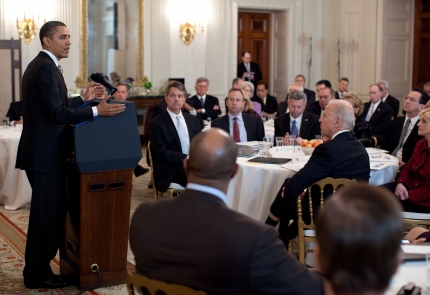
President Obama addresses governors at the annual meeting of the National Governors Association, and calls on leaders to invest more in education and make sure all students get the education they need to compete for the jobs of tomorrow as well as the jobs of today.

Download mp4 (214MB) | mp3 (21MB)

Read the Transcript

Remarks by the President at National Governors Association Meeting

State Dining Room

11:30 A.M. EST

THE PRESIDENT:  Thank you, everybody.  (Applause.)  Thank you so much.  Please, everybody have a seat.  Have a seat.   

Thank you, Joe, for the outstanding work you’re doing on behalf of the American people every day.  I want to thank all the members of my Cabinet and administration who are here today.  I want to thank Dave Heineman and Jack Markell for the outstanding leadership that they’ve shown as they’ve chaired and co-chaired the NGA. 

I’m glad to see that everybody has recovered from the wild time we had last night.  (Laughter.)  It was wonderful to have all of you here. 

And I always look forward to this event because governors are at the front line of America’s recovery. You see up close what’s working, what’s not working, and where we can take it.  And the thing that connects all of us -- and no matter what part of the country we’re from and certainly no matter what party we belong to -- is that we know what it means to govern, what it means to make tough choices during tough times, and hopefully to forge some common ground.  We’ve all felt the weight of big decisions and the impact that those decisions have on the people that we represent. 

I first addressed this group three years ago and it was the moment, as Joe mentioned, when the economy was in a freefall.  Some of you were just coming into office at that time as well.  Hundreds of thousands of Americans were losing their jobs or their homes every month.  Businesses were closing their doors at a heartbreaking pace.  Our entire auto industry was on the verge of collapse and, all told, the prospects of us going into a full-blown depression were very real.

Today there's no doubt that enormous challenges remain.  But the fact of the matter is that over the last two years American businesses have created 3.7 million new jobs.  Manufacturers are hiring for the first time since the 1990s.  The auto industry is back.  Our recovery is gaining speed and the economy is getting strong.  And we’ve got to do everything we can to make sure that we sustain this progress. 

That means we’ve got to strengthen American manufacturing so that more and more good jobs and products are made here in America.  It means that we’ve got to develop new sources of American energy so that we’re less dependent on foreign oil and yearly spikes in gas prices.  And it means that we’ve got to make sure that every American is equipped with the skills, with the education that they need to compete for the jobs of tomorrow as well as the jobs of today.  And that’s what I want to talk to these governors a little bit about. 

No issue will have a bigger impact on the future performance of our economy than education.  In the long run it’s going to depend -- determine whether businesses stay here.  It will determine whether businesses are created here, whether businesses are hiring here.  And it will determine whether there's going to be an abundance of good middle-class jobs in America. 

Today, the unemployment rate for Americans with at least a college degree is about half the national average.  Their incomes are about twice as high as those who only have a high school diploma.  So this is what we should be focused on as a nation.  This is what we should be talking about and debating.  The countries who out-educate us today will out-compete us tomorrow.  That’s a simple fact.  And if we want America to continue to be number one and stay number one, we’ve got some work to do. 

Now, in the last three years, the good news is we’ve made some important progress, working together.  We’ve broken through the traditional stalemate between left and right by launching a national competition to improve our schools.  And I think Arne has done an outstanding job of saying we've got to get past the old dogmas -- whether it's the dogmas on the liberal side or the conservative side -- and figure out what works.  We've invested, but we've invested in reform.  And for less than one percent of what our nation spends on education each year, almost all of you have agreed to raise standards for teaching and learning.  And that's the first time that’s happened in a generation. 

We’ve also worked with all of you –- Democrats and Republicans –- to try to fix No Child Left Behind.  We said that if you’re willing to set higher, more honest standards then we will give you more flexibility to meet those standards.  Earlier this month I announced the first 11 states to get a waiver from No Child Left Behind, and I hope that we are going to be adding more states soon.

I believe education is an issue that is best addressed at the state level.  And governors are in the best position to have the biggest impact.  I realize that everybody is dealing with limited resources.  Trust me, I know something about trying to deal with tight budgets.  We’ve all faced some stark choices over the past several years.  But that is no excuse to lose sight of what matters most.  And the fact is that too many states are making cuts to education that I believe are simply too big. 

Nothing more clearly signals what you value as a state than the decisions you make about where to invest.  Budgets are about choices.  So today I’m calling on all of you:  Invest more in education.  Invest more in our children and in our future.  That does not mean you’ve got to invest in things that aren’t working.  That doesn’t mean that it doesn’t make sense to break some china and move aggressively on reform.  But the fact of the matter is we don’t have to choose between resources and reform; we need resources and reform.

Now, there are two areas in education that demand our immediate focus.  First, we’ve just got to get more teachers into our classrooms.  Over the past four years, school districts across America have lost over 250,000 educators -- 250,000 teachers, educators have been lost.  Think about that.  A quarter-million educators, responsible for millions of our students, all laid off when America has never needed them more. 

Other countries are doubling down on education and their investment in teachers -- and we should, too.  And each of us is here only because at some point in our lives a teacher changed our life trajectory.  The impact is often much bigger than even we realize.  One study found that a good teacher can increase the lifetime income of a classroom by over $250,000.  One teacher, one classroom.  And a great teacher offers potentially an escape for a child who is dreaming beyond his circumstances.  The point is, teachers matter, and all of us have to recognize that, and we’ve got to put our money behind that.

Now, we want to help you everyplace that we can.  At the federal level, we’ve already provided billions of dollars in funding to help keep hundreds of thousands of teachers in the classroom.  And a cornerstone of the jobs plan that I put forward in September -- a chunk of which has gotten done, but a chunk of which remains undone -- was to provide even more funding, so that you could prevent further layoffs and rehire teachers that had lost their jobs.  And I’d like to thank those of you in this room who voiced support for that effort. 

Congress still is in a position to do the right thing.  They can keep more teachers in the classroom, but you’ve got to keep the pressure up on them to get this done.

The second area where we have to bring greater focus is higher education.  The jobs of the future are increasingly going to those with more than a high school degree.  And I have to make a point here.  When I speak about higher education we’re not just talking about a four-year degree.  We’re talking about somebody going to a community college and getting trained for that manufacturing job that now is requiring somebody walking through the door, handling a million-dollar piece of equipment.  And they can’t go in there unless they’ve got some basic training beyond what they received in high school.

We all want Americans getting those jobs of the future.  So we’re going to have to make sure that they’re getting the education that they need.  It starts, by the way, with just what kinds of expectation and ground rules we’re setting for kids in high school.  Right now, 21 states require students to stay in high school until they graduate or turn 18 -- 21 states.  That means 29 don’t.   I believe that’s the right thing to do, for us to make sure to send a message to our young people -- you graduate from high school, at a minimum.  And I urge others to follow suit of those 21 states.

Now, for students that are ready for college, we've got to make sure that college is affordable.  Today, graduates who take out loans leave college owing an average of $25,000.  That’s a staggering amount for young people.  Americans now owe more in student loan debt than they do in credit card debt.  There's so many Americans out there with so much to offer who are saddled with debt before they even start out in life.  And the very idea of owing that much money puts college out of reach for far too many families. 

So this is a major problem that must be fixed.  I addressed it at the State of the Union.  We have a role to play here.  My grandfather got a chance to go to college because Americans and Congress decided that every returning veteran from World War II should be able to afford it.  My mother was able to raise two kids by herself while still going to college and getting an advanced degree because she was able to get grants and work-study while she was in school.  Michelle and I are only here today because of scholarships and student loans that gave us a good shot at a great education.  And it wasn't easy to pay off these loans, but it sure wasn't as hard as it is for a lot of kids today.

So my administration has tried to do our part by making sure that the student loan program puts students before banks, by increasing aid like the Pell grants for millions of students and their families, and by allowing students to cap their monthly loan payments at 10 percent of their income, which means that their repayment schedule is manageable. 

Congress still needs to do its part by, first of all, keeping student interest rates low.  Right now, they are scheduled to double at the end of July if Congress does not act.  And that would be a real tragedy for an awful lot of families around the country.  They also need to extend the tuition tax credit for the middle class, protect Pell grants, and expand work-study programs.

But it's not enough to just focus on student aid.  We can't just keep on, at the federal level, subsidizing skyrocketing tuition.  If tuition is going up faster than inflation -- faster, actually, than healthcare costs -- then no matter how much we subsidize it, sooner or later we are going to run out of money.  So everybody else is going to have to do their part as well.  This is not just a matter of the federal government coming up with more and more money. 

That means colleges and universities are going to have to help to make their tuition more affordable.  And I’ve put them on notice -- if they are not taking some concrete steps to prevent tuition from going up, then federal funding from taxpayers is going to go down.  We’ve got to incentivize better practices in terms of keeping costs under control.  And all of you have a role to play by making higher education a higher priority in your budgets. 

Over two-thirds of students attend public colleges and universities where, traditionally, tuition has been affordable because of state investments.  And that’s something that every state takes pride in.  That’s the crown jewel, in fact, of our economic system -- is, by far, we’ve got the best network of colleges, universities and community colleges in the world. 

But more than 40 states have cut funding for higher education over the past year.  And this is just the peak of what has been a long-term trend in reduced state support for higher education.  And state budget cuts have been among the largest factor in tuition hikes at public colleges over the past decade. 

So my administration can do more, Congress can do more, colleges have to do more.  But unless all of you also do more, this problem will not get solved.  It can be done, though. 

Jack O’Malley -- where’s Jack -- Martin.  Where’s Martin?  Sorry.  I was --

GOVERNOR O'MALLEY:  I thought my son was right here.  (Laughter.) 

THE PRESIDENT:  Right, right, right.

Martin in Maryland is doing some outstanding work on this front.  He worked with the legislature to keep tuition down by controlling costs and cutting spending on college campuses, and you’re seeing a real impact -- from the flagship University of Maryland all the way down.  And a lot of you are starting to experiment with this as well. 

We can’t allow higher education to be a luxury in this country.  It’s an economic imperative that every family in America has to be able to afford.  And frankly, I don’t think any of this should be a partisan issue.  All of us should be about giving every American who wants a chance to succeed that chance.  (Applause.)

So let me wrap up by saying a few weeks ago I held, right here in this room and in the adjoining room, one of my favorite events and that is the White House Science Fair.  We invited students from a lot of your states and they showcased projects that covered the full range of scientific discovery. 

We had a group of kids from Texas, young Latino women, who came from the poorest section of Texas and yet were winning rocket competitions.  And they were so good because they could only afford one rocket, so they couldn’t test them and they had to get it just right.  (Laughter.)  And their parents ran bake sales just so they could travel to these events. 

You had a young woman who was from Long Island, had been studying mussels and wanted to be an oceanographer, and won the Intel Science Award while she was homeless.  Her family had lost their home and she was living out of a car and out of her family’s -- on her family’s couch, and yet still was able to stay focused and achieve what was just remarkable. 

There was a kid -- the kid who actually got the most attention was a young man named Joey Hudy of Arizona.  That’s because Joey let me fire off a extreme marshmallow canon.  (Laughter.)  We did it right here in this room.  We shot it from here.  We pumped it up -- it almost hit that light.  (Laughter.)  I thought it was a lot of fun.  (Laughter.)  And while the canon was impressive, Joey left a bigger impression because he had already printed out his own business cards -- he was 14-years-old.  And he was handing them out to everybody, including me.  (Laughter.)  He’s on our short list for a Cabinet post.  (Laughter.)   

Under his name on each card was a simple motto:  “Don’t be bored, do something.”  Don’t be bored, do something.  Don’t be bored, make something. 

All across this country there are kids like Joey who are dreaming big, and are doing things and making things.  And we want them to reach those heights.  They're willing to work hard.  They are willing to dig deep to achieve.  And we’ve got a responsibility to give them a fair shot.  If we do, then I’m absolutely convinced that our future is going to be as bright as all of us want. 

So this is going to be something that I want to collaborate with all of you on.  If you’ve got ideas about how we can make our education system work better, I want to hear them today, and Arne Duncan is going to want to hear them for the rest of the time that he’s Education Secretary and the rest of the time I’m President.

Thank you very much, everybody.  (Applause.)

END                                                      
11:47 A.M. EST
Close Transcript

Behind the Scenes: Red White and Blues

February 27, 2012 | 4:28 | Public Domain

BB King, Mick Jagger, Buddy Guy, Jeff Beck, Keb Mo and many others come to the White House in a celebration of the blues. Take a look inside the rehearsals and hear what artists had to say about being at the White House and the magis that is blues music. As President Obama said, "this music speaks to something universal. No one goes through life without both joy and pain, triumph and sorrow. The blues gets all of that, sometimes with just one lyric or one note.
(additional footage courtesy of WETA)

Download mp4 (105MB)

President Obama Challenges Governors to Invest in Education

President Obama meets with NGA (February 27, 2012)

President Barack Obama and Vice President Joe Biden meet with the National Governors Association in the State Dining Room of the White House, Feb. 27, 2012. (Official White House Photo by Pete Souza)

Today, President Obama challenged state governors to make sure all students in their schools today get the education and skills they need to compete for the jobs of tomorrow.

A majority of states will spend less on elementary and secondary schools in 2012 than they did last year, and more than 40 states cut higher education spending in 2011 — cuts that lead to higher tuition prices in our public colleges and universities.

But when our economy is struggling, the last place to make cuts is in education. Making sure that every student in our country graduates from high school prepared for college and a successful career is central to rebuilding our economy and securing a brighter future. And when students go on to pursue higher education, we should make sure they are able to pay for it.

“Nothing more clearly signals what you value as a state as the decisions you make about where to invest,” President Obama told governors. “Budgets are about choices, so today I’m calling on you to choose to invest more in teachers, invest more in education, and invest more in our children and their future.”

Read the rest

The White House

Office of the Press Secretary

Presidential Memorandum -- Delegation of Reporting Function Specified in Section 1043 of the National Defense Authorization Act for Fiscal Year 2012

SUBJECT: Delegation of Reporting Function Specified in Section 1043 of the National Defense Authorization Act for Fiscal Year 2012

By the authority vested in me as President by the Constitution and the laws of the United States of America, including section 301 of title 3 of the United States Code, I hereby delegate to you the reporting function conferred upon the President by section 1043 of the National Defense Authorization Act for Fiscal Year 2012 (Public Law 112-81).

The Secretary of Defense is authorized and directed to publish this memorandum in the Federal Register.

BARACK OBAMA

The White House

Office of the Press Secretary

Remarks by the President at National Governors Association Meeting

State Dining Room

11:30 A.M. EST

THE PRESIDENT:  Thank you, everybody.  (Applause.)  Thank you so much.  Please, everybody have a seat.  Have a seat.   

Thank you, Joe, for the outstanding work you’re doing on behalf of the American people every day.  I want to thank all the members of my Cabinet and administration who are here today.  I want to thank Dave Heineman and Jack Markell for the outstanding leadership that they’ve shown as they’ve chaired and co-chaired the NGA. 

I’m glad to see that everybody has recovered from the wild time we had last night.  (Laughter.)  It was wonderful to have all of you here. 

And I always look forward to this event because governors are at the front line of America’s recovery. You see up close what’s working, what’s not working, and where we can take it.  And the thing that connects all of us -- and no matter what part of the country we’re from and certainly no matter what party we belong to -- is that we know what it means to govern, what it means to make tough choices during tough times, and hopefully to forge some common ground.  We’ve all felt the weight of big decisions and the impact that those decisions have on the people that we represent. 

I first addressed this group three years ago and it was the moment, as Joe mentioned, when the economy was in a freefall.  Some of you were just coming into office at that time as well.  Hundreds of thousands of Americans were losing their jobs or their homes every month.  Businesses were closing their doors at a heartbreaking pace.  Our entire auto industry was on the verge of collapse and, all told, the prospects of us going into a full-blown depression were very real.

Today there's no doubt that enormous challenges remain.  But the fact of the matter is that over the last two years American businesses have created 3.7 million new jobs.  Manufacturers are hiring for the first time since the 1990s.  The auto industry is back.  Our recovery is gaining speed and the economy is getting strong.  And we’ve got to do everything we can to make sure that we sustain this progress. 

That means we’ve got to strengthen American manufacturing so that more and more good jobs and products are made here in America.  It means that we’ve got to develop new sources of American energy so that we’re less dependent on foreign oil and yearly spikes in gas prices.  And it means that we’ve got to make sure that every American is equipped with the skills, with the education that they need to compete for the jobs of tomorrow as well as the jobs of today.  And that’s what I want to talk to these governors a little bit about. 

No issue will have a bigger impact on the future performance of our economy than education.  In the long run it’s going to depend -- determine whether businesses stay here.  It will determine whether businesses are created here, whether businesses are hiring here.  And it will determine whether there's going to be an abundance of good middle-class jobs in America. 

Today, the unemployment rate for Americans with at least a college degree is about half the national average.  Their incomes are about twice as high as those who only have a high school diploma.  So this is what we should be focused on as a nation.  This is what we should be talking about and debating.  The countries who out-educate us today will out-compete us tomorrow.  That’s a simple fact.  And if we want America to continue to be number one and stay number one, we’ve got some work to do. 

Now, in the last three years, the good news is we’ve made some important progress, working together.  We’ve broken through the traditional stalemate between left and right by launching a national competition to improve our schools.  And I think Arne has done an outstanding job of saying we've got to get past the old dogmas -- whether it's the dogmas on the liberal side or the conservative side -- and figure out what works.  We've invested, but we've invested in reform.  And for less than one percent of what our nation spends on education each year, almost all of you have agreed to raise standards for teaching and learning.  And that's the first time that’s happened in a generation. 

We’ve also worked with all of you –- Democrats and Republicans –- to try to fix No Child Left Behind.  We said that if you’re willing to set higher, more honest standards then we will give you more flexibility to meet those standards.  Earlier this month I announced the first 11 states to get a waiver from No Child Left Behind, and I hope that we are going to be adding more states soon.

I believe education is an issue that is best addressed at the state level.  And governors are in the best position to have the biggest impact.  I realize that everybody is dealing with limited resources.  Trust me, I know something about trying to deal with tight budgets.  We’ve all faced some stark choices over the past several years.  But that is no excuse to lose sight of what matters most.  And the fact is that too many states are making cuts to education that I believe are simply too big. 

Nothing more clearly signals what you value as a state than the decisions you make about where to invest.  Budgets are about choices.  So today I’m calling on all of you:  Invest more in education.  Invest more in our children and in our future.  That does not mean you’ve got to invest in things that aren’t working.  That doesn’t mean that it doesn’t make sense to break some china and move aggressively on reform.  But the fact of the matter is we don’t have to choose between resources and reform; we need resources and reform.

Now, there are two areas in education that demand our immediate focus.  First, we’ve just got to get more teachers into our classrooms.  Over the past four years, school districts across America have lost over 250,000 educators -- 250,000 teachers, educators have been lost.  Think about that.  A quarter-million educators, responsible for millions of our students, all laid off when America has never needed them more. 

Other countries are doubling down on education and their investment in teachers -- and we should, too.  And each of us is here only because at some point in our lives a teacher changed our life trajectory.  The impact is often much bigger than even we realize.  One study found that a good teacher can increase the lifetime income of a classroom by over $250,000.  One teacher, one classroom.  And a great teacher offers potentially an escape for a child who is dreaming beyond his circumstances.  The point is, teachers matter, and all of us have to recognize that, and we’ve got to put our money behind that.

Now, we want to help you everyplace that we can.  At the federal level, we’ve already provided billions of dollars in funding to help keep hundreds of thousands of teachers in the classroom.  And a cornerstone of the jobs plan that I put forward in September -- a chunk of which has gotten done, but a chunk of which remains undone -- was to provide even more funding, so that you could prevent further layoffs and rehire teachers that had lost their jobs.  And I’d like to thank those of you in this room who voiced support for that effort. 

Congress still is in a position to do the right thing.  They can keep more teachers in the classroom, but you’ve got to keep the pressure up on them to get this done.

The second area where we have to bring greater focus is higher education.  The jobs of the future are increasingly going to those with more than a high school degree.  And I have to make a point here.  When I speak about higher education we’re not just talking about a four-year degree.  We’re talking about somebody going to a community college and getting trained for that manufacturing job that now is requiring somebody walking through the door, handling a million-dollar piece of equipment.  And they can’t go in there unless they’ve got some basic training beyond what they received in high school.

We all want Americans getting those jobs of the future.  So we’re going to have to make sure that they’re getting the education that they need.  It starts, by the way, with just what kinds of expectation and ground rules we’re setting for kids in high school.  Right now, 21 states require students to stay in high school until they graduate or turn 18 -- 21 states.  That means 29 don’t.   I believe that’s the right thing to do, for us to make sure to send a message to our young people -- you graduate from high school, at a minimum.  And I urge others to follow suit of those 21 states.

Now, for students that are ready for college, we've got to make sure that college is affordable.  Today, graduates who take out loans leave college owing an average of $25,000.  That’s a staggering amount for young people.  Americans now owe more in student loan debt than they do in credit card debt.  There's so many Americans out there with so much to offer who are saddled with debt before they even start out in life.  And the very idea of owing that much money puts college out of reach for far too many families. 

So this is a major problem that must be fixed.  I addressed it at the State of the Union.  We have a role to play here.  My grandfather got a chance to go to college because Americans and Congress decided that every returning veteran from World War II should be able to afford it.  My mother was able to raise two kids by herself while still going to college and getting an advanced degree because she was able to get grants and work-study while she was in school.  Michelle and I are only here today because of scholarships and student loans that gave us a good shot at a great education.  And it wasn't easy to pay off these loans, but it sure wasn't as hard as it is for a lot of kids today.

So my administration has tried to do our part by making sure that the student loan program puts students before banks, by increasing aid like the Pell grants for millions of students and their families, and by allowing students to cap their monthly loan payments at 10 percent of their income, which means that their repayment schedule is manageable. 

Congress still needs to do its part by, first of all, keeping student interest rates low.  Right now, they are scheduled to double at the end of July if Congress does not act.  And that would be a real tragedy for an awful lot of families around the country.  They also need to extend the tuition tax credit for the middle class, protect Pell grants, and expand work-study programs.

But it's not enough to just focus on student aid.  We can't just keep on, at the federal level, subsidizing skyrocketing tuition.  If tuition is going up faster than inflation -- faster, actually, than healthcare costs -- then no matter how much we subsidize it, sooner or later we are going to run out of money.  So everybody else is going to have to do their part as well.  This is not just a matter of the federal government coming up with more and more money. 

That means colleges and universities are going to have to help to make their tuition more affordable.  And I’ve put them on notice -- if they are not taking some concrete steps to prevent tuition from going up, then federal funding from taxpayers is going to go down.  We’ve got to incentivize better practices in terms of keeping costs under control.  And all of you have a role to play by making higher education a higher priority in your budgets. 

Over two-thirds of students attend public colleges and universities where, traditionally, tuition has been affordable because of state investments.  And that’s something that every state takes pride in.  That’s the crown jewel, in fact, of our economic system -- is, by far, we’ve got the best network of colleges, universities and community colleges in the world. 

But more than 40 states have cut funding for higher education over the past year.  And this is just the peak of what has been a long-term trend in reduced state support for higher education.  And state budget cuts have been among the largest factor in tuition hikes at public colleges over the past decade. 

So my administration can do more, Congress can do more, colleges have to do more.  But unless all of you also do more, this problem will not get solved.  It can be done, though. 

Jack O’Malley -- where’s Jack -- Martin.  Where’s Martin?  Sorry.  I was --

GOVERNOR O'MALLEY:  I thought my son was right here.  (Laughter.) 

THE PRESIDENT:  Right, right, right.

Martin in Maryland is doing some outstanding work on this front.  He worked with the legislature to keep tuition down by controlling costs and cutting spending on college campuses, and you’re seeing a real impact -- from the flagship University of Maryland all the way down.  And a lot of you are starting to experiment with this as well. 

We can’t allow higher education to be a luxury in this country.  It’s an economic imperative that every family in America has to be able to afford.  And frankly, I don’t think any of this should be a partisan issue.  All of us should be about giving every American who wants a chance to succeed that chance.  (Applause.)

So let me wrap up by saying a few weeks ago I held, right here in this room and in the adjoining room, one of my favorite events and that is the White House Science Fair.  We invited students from a lot of your states and they showcased projects that covered the full range of scientific discovery. 

We had a group of kids from Texas, young Latino women, who came from the poorest section of Texas and yet were winning rocket competitions.  And they were so good because they could only afford one rocket, so they couldn’t test them and they had to get it just right.  (Laughter.)  And their parents ran bake sales just so they could travel to these events. 

You had a young woman who was from Long Island, had been studying mussels and wanted to be an oceanographer, and won the Intel Science Award while she was homeless.  Her family had lost their home and she was living out of a car and out of her family’s -- on her family’s couch, and yet still was able to stay focused and achieve what was just remarkable. 

There was a kid -- the kid who actually got the most attention was a young man named Joey Hudy of Arizona.  That’s because Joey let me fire off a extreme marshmallow canon.  (Laughter.)  We did it right here in this room.  We shot it from here.  We pumped it up -- it almost hit that light.  (Laughter.)  I thought it was a lot of fun.  (Laughter.)  And while the canon was impressive, Joey left a bigger impression because he had already printed out his own business cards -- he was 14-years-old.  And he was handing them out to everybody, including me.  (Laughter.)  He’s on our short list for a Cabinet post.  (Laughter.)   

Under his name on each card was a simple motto:  “Don’t be bored, do something.”  Don’t be bored, do something.  Don’t be bored, make something. 

All across this country there are kids like Joey who are dreaming big, and are doing things and making things.  And we want them to reach those heights.  They're willing to work hard.  They are willing to dig deep to achieve.  And we’ve got a responsibility to give them a fair shot.  If we do, then I’m absolutely convinced that our future is going to be as bright as all of us want. 

So this is going to be something that I want to collaborate with all of you on.  If you’ve got ideas about how we can make our education system work better, I want to hear them today, and Arne Duncan is going to want to hear them for the rest of the time that he’s Education Secretary and the rest of the time I’m President.

Thank you very much, everybody.  (Applause.)

END                                                      
11:47 A.M. EST

The White House

Office of the Press Secretary

President Obama Challenges Governors to Invest in Education

White House Releases Education Blueprint: An Economy Built to Last

Today, President Obama delivered remarks to the National Governors Association (NGA) where he challenged governors across the nation to do their part to ensure American students and workers have the education and training they need so that we have a workforce prepared for the jobs of the 21st century.  The President believes that in order to create an economy that’s built to last, we must invest in education and provide every American the opportunity to develop the skills needed to compete for the jobs of today and tomorrow.

“Nothing more clearly signals what you value as a state as the decisions you make about where to invest,” President Obama told governors. “Budgets are about choices, so today I’m calling on you to choose to invest more in teachers, invest more in education, and invest more in our children and their future.”

Education Blueprint: An Economy Built to Last

The White House today released an Education Blueprint: An Economy Built to Last. In addition to documenting the Administration’s education efforts, the report shows that last year, more than 40 states cut higher education spending; these state budget cuts have been the largest factor in tuition increases at public colleges over the past decade. It also finds that the majority of states provided less funding for elementary and secondary schools in 2012 than in 2011. 

As the report notes, over the past 23 months, American businesses have created 3.7 million jobs and last year businesses added the most private sector jobs since 2005. American manufacturing is creating jobs for the first time since the late 1990s. The strength of the American economy is inextricably linked to the strength of America’s education system.  Particularly in times of economic challenge – times like today – the American economy needs a workforce that is skilled, adaptable, creative, and equipped for success in the global marketplace.

The President believes that educating our way to an economy built to last requires shared commitment. In addition to challenging governors to do their part, the President asked them to keep up pressure on Congress to pass his proposal to prevent further layoffs and rehire teachers who had lost their jobs.   Additionally, the President will continue to urge Congress to take critical measures to make college more affordable, including preventing student loan interest rates from doubling this summer, making the American Opportunity Tax Credit he signed—worth up to $10,000 to help families cover the cost of tuition—permanent, securing funding for Pell Grants, and taking steps to double the number of work-study jobs over the next 5 years to better assist college students who are working their way through school.

In addition to these important measures, the President believes we must make critical investments in our nation’s education system. He has proposed funding to promote partnerships between community colleges and businesses to train 2 million workers, to continue giving states, districts and schools the funding and flexibility they need to put a great teacher in every classroom and build on the successes of the Race to the Top program, to improve early childhood education, and to create incentives for innovative reforms to keep college affordable.

The President believes this is a make or break moment for the middle class and those trying to reach it. In order to create an economy that’s built to last -- where everyone gets a fair shot, everyone pays their fair share, and everyone plays by the same set of rules -- we must make critical investments in our students and workers and build a foundation to compete for the jobs of the 21st century. 

The White House

Office of the Press Secretary

Statement by the Press Secretary

The President welcomes today’s news that TransCanada plans to build a pipeline to bring crude oil from Cushing, Oklahoma, to the Gulf of Mexico. As the President made clear in January, we support the company’s interest in proceeding with this project, which will help address the bottleneck of oil in Cushing that has resulted in large part from increased domestic oil production, currently at an eight year high. Moving oil from the Midwest to the world-class, state-of-the-art refineries on the Gulf Coast will modernize our infrastructure, create jobs, and encourage American energy production. We look forward to working with TransCanada to ensure that it is built in a safe, responsible and timely manner, and we commit to take every step possible to expedite the necessary Federal permits.

Separately, TransCanada gave the State Department advance notice of its intention to submit a new application for the cross-border segment of the Keystone XL pipeline, from Canada to Steele City, Nebraska, once a route through Nebraska has been identified. House Republicans forced a rejection of the company’s earlier application in January, by not allowing sufficient time for important review or even the identification of a complete pipeline route. But as we made clear, the President’s decision in January in no way prejudged future applications. We will ensure any project receives the important assessment it deserves, and will base a decision to provide a permit on the completion of that review.

President Obama Challenges Governors to Invest in Education

President Obama meets with NGA (February 27, 2012)

President Barack Obama and Vice President Joe Biden meet with the National Governors Association in the State Dining Room of the White House, Feb. 27, 2012. (Official White House Photo by Pete Souza)

Today, President Obama challenged state governors to make sure all students in their schools today get the education and skills they need to compete for the jobs of tomorrow.

A majority of states will spend less on elementary and secondary schools in 2012 than they did last year, and more than 40 states cut higher education spending in 2011 — cuts that lead to higher tuition prices in our public colleges and universities.

But when our economy is struggling, the last place to make cuts is in education. Making sure that every student in our country graduates from high school prepared for college and a successful career is central to rebuilding our economy and securing a brighter future. And when students go on to pursue higher education, we should make sure they are able to pay for it.

“Nothing more clearly signals what you value as a state as the decisions you make about where to invest,” President Obama told governors. “Budgets are about choices, so today I’m calling on you to choose to invest more in teachers, invest more in education, and invest more in our children and their future.”

Related Topics: Economy, Education

The White House

Office of the Press Secretary

Remarks by the President and Governor Dave Heineman of Nebraska in an Exchange of Toasts at the 2012 Governors' Dinner

State Dining Room

7:18 P.M. EST
 
 THE PRESIDENT:  Good evening, everybody.  Welcome to the White House.  (Laughter.)  Did I hear an “aloha” back there?  Yes.  (Laughter.)  All right, Neil.  (Laughter.)
 
Let me begin by acknowledging your outstanding chair, Dave Heineman, who’s doing an outstanding job in the great state of Nebraska, as well as your vice chair, Jack Markell, of the great state of Delaware, for their hard work.
 
I have heard that you’ve had some very productive meetings this weekend.  I’m looking forward to having you back tomorrow.  We’ll be able to discuss a wide range of policy.
 
But tonight it’s about having some fun.  We’ve got the help of the great Dianne Reeves, who is going to be here, and we’ll be hearing from later on.  (Applause.)  So I’m going to be brief, because although some may disagree, she has a better voice than I do.  (Laughter.)
 
I’ve always said that governors have one of the best but also one of the toughest jobs around.  On the one hand, you guys are in charge, which means that folks know where you live and they know how to find you if something doesn’t work.  (Laughter.)  They expect you to deliver when times are tough.  But you’re also in a position to make real and lasting change every single day.  You’re where rubber hits the road.  And as a consequence, you can see your streets safer, your schools doing better by our children, our businesses growing faster, and our communities growing stronger because of the work that you do each and every day.
 
In recent months, I’ve had the privilege of seeing first-hand some of the outstanding work that you’re doing in your respective states.  I’ve seen the kinds of businesses that are growing in states like Iowa and Washington.  I’ve seen states like Florida who are really doing great work increasing tourism and developing renewable energies.   I often get a chance to go to Virginia and Maryland and states in the vicinity, where community colleges are doing a wonderful job retraining our people for the jobs of the future.
 
So every time I get a sense of what’s happening in your states, I’m reminded that progress is possible.  And I want you to know that you’ve got a partner here in the White House.  We’re not going to agree on every single issue, every single day.  But the thing about governors is that by nature, and if not by nature then by virtue of the position, you end up having to be pragmatic, because you have to figure out what works.  And that’s why I’m confident that we’re going to be able to find more and more common ground going forward.  (Applause.)
 
So I want everybody to have a great time tonight.  By the way, you all look fabulous.  (Laughter.)  You clean up very well.  This house has actually seen its share of good times.  The story goes that after the inauguration, Andrew Jackson opened the White House to the public and was nearly crushed by the crowd.  As things started getting out of hand, the staff decided to pass barrels of ice cream and whiskey out the window  -- (laughter) -- to get people out on the lawn, so they wouldn’t cause damage and break the chandeliers and the furniture.
 
So I just want you to know, in case things get rowdy, we also have a barrel standing by.  (Laughter.)
 
But now I’d like to propose a toast –- to all the governors for your outstanding work, but especially to all the spouses who put up with us.  Cheers.  Thank you so much.
   
Cheers, everybody.  All right.  I hope you guys have a wonderful time.  Let’s serve it up.  (Laughter and applause.)
 
MR. HEINEMAN:  Mr. President, thank you very much.  Now, I want you to know this is not a rowdy group.  They’re on their best behavior tonight.  (Laughter.)
 
On behalf of the nation’s governors and our guests here tonight, we are delighted to be with you.  We appreciate the opportunity to join you and the First Lady.
 
We look forward to seeing you again tomorrow to discuss the important issues we face as a nation.  However, as you said, tonight is an opportunity to enjoy each other’s company and to celebrate how fortunate we are to live in the United States of America.  (Applause.)
 
America is the land of opportunity, and each of us are grateful for the opportunity to lead our states.  And I can say personally, as a young man growing up in Wahoo, Nebraska, I never dreamed that I’d be here in the White House tonight.
 
We believe in public service, and Mr. President, we want to thank you and the First Lady for your service to our country.  (Applause.)  For you and for us, it is an honor and privilege to serve the citizens of this great country.
 
And now I’d like to propose a toast.  Ladies and gentlemen, on behalf of the nation’s governors, I propose a toast to the President of the United States and the First Lady.
 
END
7:23 P.M. EST
 

Toasting the Nation's Governors

February 26, 2012 | 4:21 | Public Domain

President Obama toasts the nation's governors in the State Dining Room of the White House.

Download mp4 (42MB) | mp3 (4MB)

Read the Transcript

Remarks by the President and Governor Dave Heineman of Nebraska in an Exchange of Toasts at the 2012 Governors' Dinner

State Dining Room

7:18 P.M. EST
 
 THE PRESIDENT:  Good evening, everybody.  Welcome to the White House.  (Laughter.)  Did I hear an “aloha” back there?  Yes.  (Laughter.)  All right, Neil.  (Laughter.)
 
Let me begin by acknowledging your outstanding chair, Dave Heineman, who’s doing an outstanding job in the great state of Nebraska, as well as your vice chair, Jack Markell, of the great state of Delaware, for their hard work.
 
I have heard that you’ve had some very productive meetings this weekend.  I’m looking forward to having you back tomorrow.  We’ll be able to discuss a wide range of policy.
 
But tonight it’s about having some fun.  We’ve got the help of the great Dianne Reeves, who is going to be here, and we’ll be hearing from later on.  (Applause.)  So I’m going to be brief, because although some may disagree, she has a better voice than I do.  (Laughter.)
 
I’ve always said that governors have one of the best but also one of the toughest jobs around.  On the one hand, you guys are in charge, which means that folks know where you live and they know how to find you if something doesn’t work.  (Laughter.)  They expect you to deliver when times are tough.  But you’re also in a position to make real and lasting change every single day.  You’re where rubber hits the road.  And as a consequence, you can see your streets safer, your schools doing better by our children, our businesses growing faster, and our communities growing stronger because of the work that you do each and every day.
 
In recent months, I’ve had the privilege of seeing first-hand some of the outstanding work that you’re doing in your respective states.  I’ve seen the kinds of businesses that are growing in states like Iowa and Washington.  I’ve seen states like Florida who are really doing great work increasing tourism and developing renewable energies.   I often get a chance to go to Virginia and Maryland and states in the vicinity, where community colleges are doing a wonderful job retraining our people for the jobs of the future.
 
So every time I get a sense of what’s happening in your states, I’m reminded that progress is possible.  And I want you to know that you’ve got a partner here in the White House.  We’re not going to agree on every single issue, every single day.  But the thing about governors is that by nature, and if not by nature then by virtue of the position, you end up having to be pragmatic, because you have to figure out what works.  And that’s why I’m confident that we’re going to be able to find more and more common ground going forward.  (Applause.)
 
So I want everybody to have a great time tonight.  By the way, you all look fabulous.  (Laughter.)  You clean up very well.  This house has actually seen its share of good times.  The story goes that after the inauguration, Andrew Jackson opened the White House to the public and was nearly crushed by the crowd.  As things started getting out of hand, the staff decided to pass barrels of ice cream and whiskey out the window  -- (laughter) -- to get people out on the lawn, so they wouldn’t cause damage and break the chandeliers and the furniture.
 
So I just want you to know, in case things get rowdy, we also have a barrel standing by.  (Laughter.)
 
But now I’d like to propose a toast –- to all the governors for your outstanding work, but especially to all the spouses who put up with us.  Cheers.  Thank you so much.
   
Cheers, everybody.  All right.  I hope you guys have a wonderful time.  Let’s serve it up.  (Laughter and applause.)
 
MR. HEINEMAN:  Mr. President, thank you very much.  Now, I want you to know this is not a rowdy group.  They’re on their best behavior tonight.  (Laughter.)
 
On behalf of the nation’s governors and our guests here tonight, we are delighted to be with you.  We appreciate the opportunity to join you and the First Lady.
 
We look forward to seeing you again tomorrow to discuss the important issues we face as a nation.  However, as you said, tonight is an opportunity to enjoy each other’s company and to celebrate how fortunate we are to live in the United States of America.  (Applause.)
 
America is the land of opportunity, and each of us are grateful for the opportunity to lead our states.  And I can say personally, as a young man growing up in Wahoo, Nebraska, I never dreamed that I’d be here in the White House tonight.
 
We believe in public service, and Mr. President, we want to thank you and the First Lady for your service to our country.  (Applause.)  For you and for us, it is an honor and privilege to serve the citizens of this great country.
 
And now I’d like to propose a toast.  Ladies and gentlemen, on behalf of the nation’s governors, I propose a toast to the President of the United States and the First Lady.
 
END
7:23 P.M. EST
 

Close Transcript