The White House

Office of the Press Secretary

President Obama Announces New White House Director of Intergovernmental Affairs David Agnew

WASHINGTON, DC – Today, the White House announced that current Deputy Director of Intergovernmental Affairs David Agnew will now serve as the Deputy Assistant to the President and Director of Intergovernmental Affairs.  Mr. Agnew will oversee the Obama Administration’s relationship with state, county, local, and tribal officials across the country.

“I’m pleased to announce David Agnew as the new Director of Intergovernmental Affairs.  A strong nation requires strong partnerships with our state, local, and tribal officials and I am confident that David will bring their voices and the voices of the people they represent into the White House,” said President Obama.

Since January 2009, Mr. Agnew served as Deputy Director of Intergovernmental Affairs, working to strengthen the partnership with our nation’s mayors, county leaders, and other local officials.

Prior to joining the White House, Agnew was a businessman and community leader in Charleston, South Carolina.  He has served as a top deputy to Charleston Mayor Joseph P. Riley Jr., a Special Assistant in the Office of U.S. Secretary of Labor Robert Reich, and a management consultant at Price Waterhouse.  Mr. Agnew has been active in public affairs and urban policy throughout his career, and has served in leadership roles for numerous non-profit organizations, including the South Carolina Trust for Public Land, the Charleston Parks Conservancy, and the College of Charleston Riley Center.  Mr. Agnew received his Master’s Degree in Public Policy from Harvard University’s Kennedy School of Government.  He is a Harry S. Truman Scholar, a European Union Visiting Fellow, and a Liberty Fellow.

President Obama Highlights Smart Energy Training at University of Miami

Ed note: this post originally appeared on energy.gov

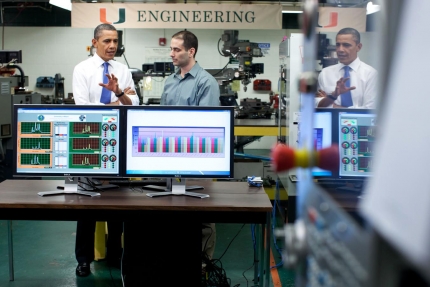
During his visit to Florida yesterday, President Obama highlighted the University of Miami's Industrial Assessment Center (IAC) as a smart and important piece of the administration's "all-of-the-above" approach to domestic energy sources.

In September of last year, the Energy Department gave 24 universities a total of $30M in grants to help train the next generation of industrial energy-efficiency experts. Each school will receive $200,000 to $300,000 per year for up to 5 years to train students on core energy management concepts. The teams conduct energy assessments in a broad range of manufacturing facilities, which prepare students to compete in today's economy while helping local companies and factories reduce energy waste, save money, and become more competitive.

As President Obama said yesterday, "We're taking a step that will make it easier for companies to save money by investing in energy solutions that have been proven here at the University of Miami -- new lighting systems; advanced heating and cooling systems that can lower a company's energy bills and make them more competitive."  

Since the Industrial Assessment Center program began in 1976, university teams have conducted more than 15,000 energy assessments at U.S. manufacturing plants nationwide. To date, more than 3,000 students have graduated from the Industrial Assessment Center program, with more than 60 percent going on to careers in the energy industry. Critically, these assessments have helped save over 530 trillion BTUs of energy -- enough to meet the energy needs of 5.5 million American homes -- and have helped participating manufacturers save more than $5.6 billion in energy costs.

Ginny Simmons is the Managing Editor, Energy.gov

West Wing Week: 2/24/12 or "West Wing Week 100!"

February 24, 2012 | 5:23 | Public Domain

Welcome to the 100th episode of West Wing Week, your guide to everything that's happening at 1600 Pennsylvania Ave. It's hard to believe that when West Wing Week was born Don't Ask Don't tell was still around, American troops were still fighting in Iraq, the American Auto Industry was on the brink of collapse, and nobody knew The President could sing? Wow! what a difference 694 days makes. We've got a great week for you - BB King is here, the Boeing Dreamliner, the extension of the Payroll Tax Cut, and musical guest Keb Mo. That's February 17th to February 23rd or West Wing Week 100!

Download mp4

West Wing Week: 2/24/12 or West Wing Week 100!

It's hard to believe that when West Wing Week was born, "Don't Ask Don't Tell" was still around, American troops were still fighting in Iraq, the American auto industry was on the brink of collapse, and nobody knew that President Obama could sing -- what a difference 694 days makes. We've got a great week for you -- featuring BB King, the Boeing Dreamliner, a speech about American energy, a payroll tax cut extension, and special musical guest Keb Mo.

The White House

Office of the Press Secretary

Remarks by the President at a Campaign Event

Private Residence

9:00 P.M. EST

THE PRESIDENT:  Thank you, everybody.  Everybody, please have a seat.  Have a seat.  First of all, I just want to thank Vince and the whole family for setting up this unbelievable event.  This is a nice gym.  (Laughter.)  So Vince said that he left the other side open in case I wanted to get in a dunk contest with him.  But I told him I didn’t bring my sneakers, so not tonight.  (Laughter.) 

But Vince has been so generous, along with his mom and the whole family, for the last couple of years.  And it's a huge treat for me because I'm such a fan of his ever since he was playing for the Tar Heels.  I know Reggie Love is not here so I can praise the Tar Heels.  (Laughter.)  But always conducting himself with such dignity and class, and now doing such great work with the Mavericks.  I know that Mark Cuban is pretty happy about having Vince around.  (Applause.)

I see a lot of other friends in the room.  Alonzo and Tracy have been there for me every time I've come to Florida.  I could not be more grateful for that.  Magic and Cookie, wherever I go in California they're there for us.  Chris is helping out on our Fitness Council and allowed me to cross over on him when we played during my birthday.  (Laughter.)  He insists that he could have stolen the ball at any time.  (Laughter.)  But I'm going to still claim it. 

In addition, I want to make sure that I acknowledge, first of all, the Mayor of Orlando, Buddy Dyer is here.  (Applause.) An outstanding senator for Florida, but also just a great senator for the country -- Bill Nelson is here.  (Applause.)  And I always have to remind people Bill was an astronaut before he was a senator.  So being a senator is cool.  Being an astronaut is cooler.  (Laughter.)  And his lovely wife, Grace -- it's wonderful to see you.

And the chair of the Democratic National Committee, Debbie Wasserman Schultz is here.  (Applause.)  So we love Debbie.

I also understand that Commissioner Stern is here.  And I just want to say that -- (applause) -- thank you so much for settling the lockout.  (Laughter.)  Because I don't know what I would be doing with myself if I didn’t at least have some basketball games around.  And obviously we're looking forward to the All-Star game.  The game down in Miami is tight, by the way. I just -- I was checking on the score as I was flying up.

We've gone through three of the toughest years this country has gone through in my lifetime.  And there are a lot of people who are still hurting all across the country -- a lot of people here in Florida, a lot of people everywhere.  There are still folks whose homes are underwater because the housing market collapsed.  There are people who are still struggling because they can't find a job.  There are folks who are just barely able to make ends meet.  And obviously those of us who are here, we've been incredibly blessed.  But one of the great things about America and one of the great things about those who are in professional sports is we've all got cousins, uncles, family members who are still struggling and are a reminder that we have a lot more work to do.

The good news is that the country has begun to move in the right direction.  So when I took office we were losing 750,000 jobs a month; last month we gained 250,000.  (Applause.)  We stabilized the financial system.  We've now created 3.7 million jobs over the last two years.  Businesses are starting to invest again.  Consumer confidence is up.  People are buying tickets to the games.  And there's a general sense that we may have weathered the worst of the storm.

That's the good news.  The challenge, though, is when I ran in 2008, it wasn’t just to tread water, it wasn’t just to avert a Great Depression and then get back to where we were in 2007 and 2008, because people were already struggling then.  There were too many communities where if a child was born in poverty, they didn’t have any ladders to get out; where middle-class families were struggling to get by, even though now you had both mom and dad working and they still didn’t have enough in their paychecks to be able to make ends meet.

A few people were doing very well.  And what used to be the core of America's middle class felt like it was falling behind.  And so, as a consequence, even as we've made sure to do everything we can to dig ourselves out of this incredible hole that I inherited, even as we have strengthened the economy and focused like a laser on how do we put people back to work, we've also tried to say, how do we rebuild America in a way where everybody has got a fair shot, everybody is doing their fair share, everybody is playing by the same set of rules, everybody who is willing to take responsibility and work hard, they can get ahead?  And that's been our challenge.

And so, in addition to the stuff that we've done to make sure that folks are getting back to work, we've also said nobody should go bankrupt because they get sick in this country, and we were able to pass a health care bill that is already providing 2.5 million young people insurance who didn’t have it before, and by the time it's fully implemented, will give 30 million people health insurance -- the kind of security that we take for granted where if our child gets sick or a family member falls ill, that they know that they're going to be able to get well without having to lose their home.

That's why we focused on education, and we've said that not only do we want to improve K through 12 so that every child is getting the basics -- math and science and English -- but we want everybody to be able to go to college.  And we took $60 billion that was going to -- that was being channeled to the banks as subsidies through the student loan program and we said let’s take that money and give it directly to students so that we could expand Pell grants and we could make sure that every -- young people who want to go to college can afford to do so.  Because right now, actually, student loan debt is higher than credit card debt in this country.  And it’s a huge burden on the next generation and we have to start relieving it.
 
We said, we’ve got to have an energy policy that makes sense and that includes developing oil and gas resources in this country, but it also means focusing on clean energy.  And here in Florida, we’ve seen enormous progress on things like solar and wind and biodiesel.  But we’ve got to do more -- making sure that our cars are more energy efficient, making sure that we’re not prey to every year right around this time oil spiking because something is going on in the Middle East, and our whole economy is suddenly vulnerable.
 
And we focused on making sure that our tax system is fair.  What I’ve said consistently is, look, I don’t like paying taxes any more than anybody else does and I’m the President.  Now, here’s the thing about being President, you pay every dime.  You don’t take advantage of any loopholes -- (laughter) -- because everybody sees your income tax returns.  So I’m probably in the top bracket in every category.
 
But what I’ve said is Michelle and I have been so blessed, we can afford to do a little bit more to make sure that the next generation is able to come back up, is able to achieve their dreams the same way Michelle and I did.  Because we think about our stories.  I was raised by a single mom.  Michelle was raised by a blue-collar worker and a secretary.  My mother-in-law, even though she lives with us now, she's kept her home back in Chicago.  It’s now her house, but when they were growing up it was actually my mother-in-law’s sister’s house and Michelle’s family lived on the top floor, the second floor of this bungalow. It couldn’t have been more than 600 square feet where four people grew up.
 
And yet, she was able to go to a quality public school, go to Princeton, go to Harvard Law School, because somebody made an investment in her.  Somebody said, you know what, we want to make sure everybody has opportunity.  And that’s the same way I was able to get ahead, is because somebody made an investment in me. 

And so what I’ve said is, as President, we welcome success. We want somebody like a Vince Carter to be able to build a house like this.  But we want to make sure that that next generation is able to do just as well, because they’re young people just as -- they might not have the same vertical as Vince -- (laughter) -- but they’ve got the same talents in something else -- maybe in science, maybe in the arts, maybe in engineering, maybe they could be a doctor or a lawyer.  And I don’t want to pull up the ladder behind me.  And I don’t think anybody here does either.
 
And that’s what’s at stake in this election.  What’s at stake in this election is whether we as a country are going to continue to look out for one another and be able to say that it doesn’t matter what you look like, where you come from, what your name is, that if you’re willing to work hard you can get ahead. 

And that is an experience that is true for everybody in this room at some level.  Somewhere in your past you had an immigrant mother or grandmother or great-grandmother or great-grandfather who came to this country with not much and was able to create a life for themselves.  And in the debate that’s going to be unfolding over the next several months, you seem to see a philosophy on the other side that says basically, you know what, it’s fine if a few of us do well and everybody else is struggling. 

And that’s not how America got built.  That’s not what makes America strong.  The reason we were the envy of the world is because we had this massive middle class, and you could get rich here in America, but there was also the possibility of everybody getting ahead.

I love looking at Magic’s story, for example.  His dad, when you talk about basketball, you learned your work ethic from your dad, right, working every day driving a truck, right?  Well, you know what, that was a life of dignity and respect.  You weren’t a celebrity.  You might not make millions of dollars, but you could raise a family and have a home and pass on to your son those same values.

And that’s what we’re fighting for here.  That’s the struggle.  It has to do with our values and who we are as Americans.  So the good news is as I travel around the country, most Americans agree with me.
 
One of the things about being President is when things are going tough everybody looks to you and says, why haven’t you fixed it yet?  And that’s okay.  That’s what you sign up for.  As Michelle always reminds me, you volunteered for this.  (Laughter.) 

But no matter where I go around the country, whether it’s in a big city or a rural community -- north, south, east, west -- I meet the most incredible people and they still have confidence and optimism in America’s possibilities.   They get frustrated with Washington, but they still believe in what we can accomplish as a country when we work together.

And that’s what we’re going to continue to strive for over the next several months.  And that’s what we’re going to continue to strive for over the next five years with your help. 

So thank you very much, everybody, for being here.  I appreciate it.  (Applause.)
 
END
9:15 P.M. EST

The White House

Office of the Press Secretary

Remarks by the President at a Campaign Event -- Private Residence, Coral Gables, FL

Private Residence
Coral Gables, Florida

5:35 P.M. EST

THE PRESIDENT:  Thank you.  Well, good afternoon, everybody. What a spectacular setting and a beautiful evening.  I want to thank Chris and Irene and the whole Korge family.  You guys have been great friends for a really long time.  So please give them a big round of applause.  (Applause.)

You have one of the finest senators in the country, Bill Nelson.  I expect you to send him back to Washington.  (Applause.) Plus he's an astronaut.  I always say this.  (Laughter.)  You know, there are a lot of folks who are senators; there aren’t that many astronauts.  So we are so proud of him.  And what can I say about Debbie Wasserman Schultz.  She is tireless.  She is smart.  And she is just fearless.  And so we could not have a better person to help lead the party.  (Applause.)

And to so many of you who have been supportive for so long, all the people that Chris mentioned, but a lot of folks who are here who have worked tirelessly not only on behalf of my campaign, but on behalf of good causes here in Florida and around the country -- I am grateful to all of you.

I just noticed, by the way, we've got one other person that needs to be acknowledged because some of you will be spending some time with him in September, and that is the Mayor of Charlotte, North Carolina, our host for the Democratic National Convention, Anthony Foxx is in the house.  (Applause.)

Now, in settings like this where I'm among friends I try to not speak long at the top because I want to spend most of my time in a conversation with you, in answering questions and getting ideas and comments from you.  And part of the reason I don't have to speak long at the top is because Chris stole a bunch of my lines.  (Laughter.) 

Think about where we were in 2008.  And sometimes people forget.  The stock market was in a freefall.  We were losing 750,000 jobs a month.  The bottom had fallen off of the housing market.  The entire financial system was locked up.  Blue-chip companies couldn't borrow money.  And people weren't certain whether we were going to spiral into a Great Depression.

Three years later, instead of losing 750,000 jobs a month, we created 250,000 last month.  (Applause.)  Over the last two years, we've created 3.7 million jobs in the private sector.  And we've actually seen manufacturing job growth for the first time since the 1990s.  So the economy is moving in the right direction.  We've got some headwinds -- Europe is still weak, gas prices are a huge burden on families.  But overall, considering where we were and where we could have been, I think most Americans recognize that things have stabilized and we're moving in a better direction.

The challenge we have is we don't want to just get back to where we were -- because part of what led me to run in the first place was the recognition that for too many families, the middle-class idea, the American Dream was slipping away.  Wages were stagnant.  A few of us were doing very well, including most of us who are here today.  But there were a whole bunch of folks who were having trouble just hanging on to their home, hanging on to the idea of sending their kids to college; and those who wanted to get in the middle class, who wanted to follow the same path that so many of our families, our parents, our grandparents followed -- working hard, playing by the rules, dreaming big dreams -- those ladders were being taken away from too many people.

So what we've done, even as we focused on the economy, was also to say, what are those ingredients that are going to make sure that America has an economy that's built to last over the long term?  And that means resuscitating -- reviving American manufacturing, which is why I am so proud of what's happened in the auto industry because it's an example of what can happen in manufacturing across the board.  (Applause.)  We had some folks who said let's let that die.  Instead, GM is back to number one, seeing the greatest profits that it's seen in its history; hired back tens of thousands of workers.  And that's true across the U.S. auto industry.

We said that we've got to start developing American energy. We've doubled clean energy since I've been President.  And even as we've increased production of oil, we've recognized we've got to transition so that our kids and our grandkids are able to enjoy not only economic growth and not be dependent on what's happening in the Middle East or someplace else, but also we're able to protect the planet. 

We said that we’ve got to focus on American skills and education.  And we now have 40 states that have initiated reforms because of what we did.  And college is more accessible to more young people -- millions of young people -- because of policies that we put forward. 

And at the same time we said we’ve got to make sure that America is fair, that everybody gets a fair shot -- which means that you don’t have to worry about who you love to serve the country that you love, and we ended "don't ask, don't tell."  (Applause.)  It means that the first bill I signed into law said equal pay for equal work.  I want my daughters paid the same as your sons when they get a job. 

And it means that we have a tax system that encourages economic growth, that helps to bring down our deficit, that pays for the investments that we need, and says folks like me can afford to do a little bit more -- that it doesn’t make sense to give me tax breaks I don’t need if it means making some senior citizen pay more for her Medicare, or making a student pay more for their student load, or a veteran maybe doesn’t get the kind of help that they need coming home and they’ve got Post Traumatic Stress Disorder. 

Internationally, I promised to end one war; it's ended.  (Applause.)  We’re transitioning to end another one.  We’ve restored respect for the United States around the world.  And don’t take my word for it -- if any of you do international business, they will tell you that the attitude about America is fundamentally different now than it was when we first took office.  And that makes us safer.  And we’ve been able to do that without lessening the pressure -- in fact, increasing the pressure -- on those who carried out 9/11 and threatened to do us the most harm, which is why al Qaeda is on the ropes and bin Laden is no more.  (Applause.)

So we’ve got a good story to tell about the last three years but I’m not done yet.  I need five more years.  (Applause.)  We need five more years to reform an immigration system that doesn’t work and make sure that we are a nation of laws and a nation of immigrants.  We need five more years because we still have to implement energy policies that work for everybody.  And that means continuing to push on clean energy and energy efficiency. 

I was over at the University of Miami, where these amazing engineering students are helping businesses right now save millions of dollars just by making their physical plants and equipment more energy-efficient. 

That’s more work to do.  We’ve got to follow through and implement health care reform legislation so that 30 million people have health insurance who wouldn’t otherwise have it.  And to make sure that 2.5 million young people who already have health care because of that health care bill -- because they can stay on their parent's health insurance -- that they don’t lose it. 

We’re going to have to make sure that we effectively implement Wall Street reform.  I want our financial sector to be the most vibrant in the world, but I also want it to not engage in the kind of recklessness that may lead to another big bailout. We can’t afford it. 

And we’re going to have to continue to invest in our infrastructure -- the Port of Miami -- all across the country -- roads, bridges, airports, school buildings, science labs. 

There’s so much more that we’ve got to do, and I’m only going to be able to do it because of you.  You are going to have to send back Bill Nelson.  (Applause.)  You’re going to have to elect Mr. Murphy.  We’re going to need strong partners in Congress but -- well, Debbie is probably -- I don’t know what are you, 30 in the polls?  (Laughter.)   

But the most important thing I’m going to need is all of you sustaining that same sense of hope and vision for the future that led you to get involved in that campaign back in 2008.  And if you do that, we can’t lose.  Because the American people, they have deep in their core, deep in their gut, a belief that we are all in this together, that we look out for one another, that our country is at its best when everybody, regardless of what you look like, where you come from, what your last name is, what your sexual orientation is -- regardless of who you are, you deserve a fair shot in life. 

That’s what America is about.  That’s what we’re fighting for.  That’s what this election is going to be about.  And that’s why I’m grateful for your help.

Thanks, everybody.  (Applause.)  And thank you to the staff back there for all the great help.  I appreciate you.

END
5:47 P.M. EST

President Obama Describes an All-of-the-Above Strategy for Energy

President Barack Obama tours the University of Miami Industrial Assessment Center (February 23, 2012)

President Barack Obama tours the University of Miami Industrial Assessment Center in Miami, Florida, Feb. 23, 2012. The IAC is where students learn how to become industrial energy-efficiency experts as they help small to mid-sized manufacturers reduce their energy costs. (Official White House Photo by Chuck Kennedy)

President Obama was in Miami today to talk about securing a future for America built on home-grown energy -- and his blueprint to help us get there.

Part of the conversation focused on fuel prices -- and the fact that they're increasing. It's a real problem for people all over the country, which the President said required a real solution, not a slogan from a bumper sticker.

You know there are no quick fixes to this problem. You know we can’t just drill our way to lower gas prices. If we’re going to take control of our energy future and can start avoiding these annual gas price spikes that happen every year -- when the economy starts getting better, world demand starts increasing, turmoil in the Middle East or some other parts of the world -- if we’re going to avoid being at the mercy of these world events, we’ve got to have a sustained, all-of-the-above strategy that develops every available source of American energy. Yes, oil and gas, but also wind and solar and nuclear and biofuels, and more.

As President Obama pointed out, that's a vision toward which we are making progress:

In 2010, our dependence on foreign oil was under 50 percent for the first time in over a decade. We were less reliant on foreign oil than we had been. In 2011, the United States relied less on foreign oil than in any of the last 16 years. That's the good news. And because of the investments we’ve made, the use of clean, renewable energy in this country has nearly doubled -– and thousands of American jobs have been created as a consequence.

But there is still much more that needs to be done. The President is fighting to roll back the $4 billion in tax subsidies that the oil industry receives every year. And in the weeks and months ahead, the President will continue to finding ways to invest in clean energy technologies and innovation.

Want more details about the President's blueprint? Here's everything you need to know.

Read the Transcript  |  Download Video: mp4 (222MB) | mp3 (21MB)

The White House

Office of the Press Secretary

Remarks by the President at a Campaign Event

Biltmore Hotel
Coral Gables, Florida

4:03 P.M. EST

THE PRESIDENT: Hello, Miami! (Applause.) It is good to see all of you. Thank you so much. Everybody, please have a seat. Thank you.

First of all, I just want you to know that I am resentful I'm not going to the game tonight. (Laughter.) I am mad about that. It's not right. It's not fair. (Laughter.) But I wish you guys all the best.

I want to, first of all, acknowledge a couple of people who are in the audience. First of all, you just heard from somebody who I don't know where she gets her energy from -- (laughter) -- but is just doing a remarkable job as our DNC chair -- Debbie Wasserman Schultz. Give her a big round of applause. (Applause.) Your senior senator who I expect you will send back to Washington, Bill Nelson is in the house. (Applause.) And my great friend and Florida finance chair, Kirk Wager is here. (Applause.)

And of course, all of you are here. And this is a good-looking crowd. (Laughter.) You, especially. (Laughter.) You're all raising your hand -- "yeah, that's me." (Laughter.)

Miami, I am here today not just because I need your help, although I do. But I'm here because your country needs your help. There was a reason that so many of you got involved in the campaign back in 2008 -- and it wasn’t because Barack Obama was a sure thing in the campaign. When you're named Barack Hussein Obama the odds are not in your favor in any election campaign. (Laughter.) The reason you got involved was not because of me.

The reason you got involved was because we had a shared vision about what America could be, what America should be. We had an idea of a shared vision of an America in which everybody who works hard, everybody who has a vision of where they want to take their life, they can succeed. It doesn’t matter where you come from, it doesn’t matter what you look like, doesn’t matter what your name is. That idea that if you worked hard and took responsibility, that you could buy a home, and send your kids to college, and retire with dignity and respect, put a little bit away -- that core American Dream felt like it was slipping away for too many people all across the country.

And we shared a vision in which we started making good decisions about energy and health care and education. And instead of trying to divide the country, we tried to bring it together -- and that we could assure that America for the next generation and generations to come. That's why you got involved, because of that shared vision we had for America.

Now, three years later, I'm a little grayer -- (laughter) -- I'm a little dinged up here and there. But the message I have for you is that, because of you, that change that you believed in has begun to happen. As tough as these last three years have been, think about everything that we've accomplished together.

Because of you, we averted a Great Depression. When I took office, 750,000 jobs were being lost every month. Last month we gained 250,000 jobs. We are moving the economy in the right direction. (Applause.) That's because of you.

Because of you, there are millions of people around the country who didn’t have health care and either already have health care or will soon have health care, and will never again have to think about going bankrupt just because they get sick. That happened because of you. (Applause.)

Because of you, we were able to take $60 billion that was going to subsidize banks in the student loan program, and we said why aren’t we sending that money directly to students? And as a consequence, we now have millions of young people all across the country who are getting higher Pell grants, or are eligible for Pell grants for the first time, or are seeing their student loan interest rates lower, have access to college and the keys to the American Dream. That happened because of you. (Applause.) That's what change is.

Change is the decision to rescue the American auto industry from collapse. (Applause.) You remember there were a lot of people who didn’t believe in that. Even when some politicians said we should just let Detroit go bankrupt, we stepped up. And as a consequence, probably a million jobs were saved, and the American auto industry has come roaring back, and GM is now once again the number-one automaker in the world. (Applause.) That happened because of you.

Change is the decision we made to start doing something about our oil addiction -- not waiting for Congress. And so, in a historic step even without legislation, we doubled fuel-efficiency standards on cars, applied them to light trucks, heavy trucks for the first time. It will save consumers billions of dollars. It will help our environment. It puts us at the forefront of the electric car industry, at the forefront of the clean-energy industry. That all happened because of you.

Because of you, people across the country are going to still be able to serve the country they love, regardless of whom they love -- "don't ask, don't tell" is history. That happened because of you. (Applause.)

Change is keeping another promise that I made back in 2008. For the first time in nine years, there are no Americans fighting in Iraq. We have refocused our efforts on those who carried out 9/11. Al Qaeda is being dismantled and Osama bin Laden will never again walk the face of the Earth. And that happened because of you. (Applause.)

So a lot has happened in three years. And none of this has been easy. None of this was automatic. Oftentimes we face enormous opposition. And obviously we’re still recovering from the worst recession that we’ve had in our lifetimes. So we’ve got so much more work to do. But as I said, the good news is we’re moving in the right direction.

Over the last two years, the private sector has created about 3.7 million new jobs -- 3.7 million new jobs. (Applause.) Our manufacturers are creating jobs for the first time since the 1990s. Our economy is getting stronger. The recovery is accelerating. America is coming back -- which means the last thing we can afford to do is to go back to the same policies that got us into this mess in the first place. (Applause.) That’s what we can’t afford. (Applause.)

Now, that’s what the other candidates want to do. I don’t know if you guys have been watching the Republican primary debates, in case you need an incentive. (Laughter.) They make no secret about what they want to do. They want to go back to the days when Wall Street played by its own rules. They want to go back to the days when insurance companies could deny you coverage or jack up your premiums without reason. They want to spend trillions more on tax breaks for the wealthiest individuals, for people like me, who don’t need it, weren’t even asking for it -- even if it means adding to the deficit, even if it means gutting our investments in education or clean energy, or making it harder for seniors on Medicare. Their philosophy is simple: We are better off when everybody is left to fend for themselves, everybody makes their own rules, a few do very well at the top and everybody else is struggling to get by. That’s their core vision for America.

We’ve got a different vision. We see America as a bigger, bolder place. I’m here to tell them they are wrong about America. Because in America, we understand, yes, we’re rugged individuals, yes, we don’t expect a handout, we are going to do everything we can to make it and fulfill our dreams -- but we also understand we are greater together than we are on our own. We’re better off when we keep that basic American promise that if you work hard, you can do well, you can succeed, that you can own that home and send your kids to college and put away something for retirement.

And that’s the choice in this election. This is not just a political debate. This goes to who we are as a people, because we are in a make-or-break moment for the middle class and people who are trying to get in the middle class. We can go back to an economy that is built on outsourcing and bad debt and phony financial profits. Or we can build an economy that lasts. An economy that’s built on American manufacturing, skills and education for American workers, and American-made energy, and, most importantly, the values that have always made America great: Hard work, fair play, shared responsibility.

We’ve got to make sure that the next generation of manufacturing ideas take place right here in the United States of America. Not in factories in Europe or China, but in Detroit, and Pittsburgh and Cleveland. I don’t want this nation to be known just for buying and consuming things. I want us to be selling our products and making our products, inventing products, all around the world. That’s who we are. (Applause.) It’s time for us to stop rewarding businesses that ship jobs overseas. We need to reward companies that are investing and hiring right here in the United States of America. (Applause.)

We need to make our schools the envy of the world. And that starts with the man or woman at the front of the classroom. (Applause.) A study recently showed a good teacher can increase the lifetime income of a classroom by $250,000. A great teacher can help a child escape poor circumstances and achieve their dreams.

So I don't want to hear folks in Washington bash teachers, I don't want them defending the status quo. I want to give schools the resources they need to keep good teachers on the job. Reward the best ones, give schools flexibility to teach with creativity, stop teaching to the test. (Applause.) Replace teachers who aren’t helping our kids. We can do those things. (Applause.) We got some teachers in the house. (Applause.)

When kids graduate, I want them to be able to afford to go to college. If they've been working hard, if they've gotten the grades to go to college, I don't want them to cut their dreams short because they don't think they can afford it.

Right now Americans owe more in tuition debt than they do in credit card debt. And that means Congress is going to have to stop the interest rates on student loans from going up. They're scheduled to go up in July right now. Colleges and universities are going to have to do their part. I've said to them -- and I've met with university and college presidents -- we're going to keep on helping students afford to go to college. You've got to do your job in terms of keeping tuition down, because taxpayers can't fund this stuff forever. Higher education can't be a luxury; it's an economic necessity, an economic imperative for every family in America. And they should be able to afford it. (Applause.)

An America built to last is one where we're supporting scientists and researchers trying to find the next breakthrough in clean energy, making sure that happens right here in the United States. You know, we've subsidized oil companies for a century. It's time to end a hundred years of subsidies for an industry that's rarely been more profitable, and make sure that we're doubling down on clean energy that's never been more promising -- solar power and wind power, biofuels. (Applause.) They can break our addiction to foreign oil, create jobs here in America. And it's good for our national security, it's good for our economy, it's good for your pocketbook.

We need to build our infrastructure. I'm a chauvinist. I want America to have the best stuff. I want us to have the best airports and the best roads and the best ports right here in Miami that can create more jobs. (Applause.)

So what I've said is, let's take the money we're no longer spending on war, let's use half of it to reduce the deficit, let's spend the other half to do some nation-building right here at home. (Applause.) Let's put folks to work.

And we've got to make sure that everybody is doing their fair share. Everybody needs a fair shot; everybody has got to play by the same set of rules; everybody has got to do their fair share.

And when it comes to paying for our government and making sure the investments are there so that future generations can succeed, everybody has got to do their part. Which is why I put forward the Buffett Rule: If you make more than a million dollars a year you should not pay a lower tax rate than your secretary. (Applause.) That's common sense. We've said if you make $250,000 a year or less, you don't need your taxes going up right now. But folks like me, we can afford to do a little bit more.

That's not class warfare. That's not envy. It has to do with simple math. If somebody like me gets a tax break that the country can't afford, then one of two things happen: Either the deficit goes up, which is irresponsible -- or we're taking it out of somebody else -- that student who is now suddenly having to pay a higher student loan rate, or that senior who's having to pay more for Medicare, or that veteran who's not getting the help they need after having served our country.

That's not right. That's not who we are. Everybody in this room, we are here, successful, because somebody down the road was not just thinking about themselves, they were taking responsibility for the country as a whole. They we're thinking about their future. The American story has never been about what we just do by ourselves; it's about what we do together. We're not going to win the race for new jobs and new businesses and middle-class security if we're responding to today's challenges with the same old, tired, worn-out, "you're on your own" economics that hasn’t worked.

What these other guys are peddling has not worked. It didn’t work in the decade before the Great Depression. It did not work in the decade before I became President. It will not work now. (Applause.)

And this is not just a matter of economics. Look, we all have a stake in everybody's success. If we attract an outstanding teacher by giving her the pay that she deserves and giving her the training that she needs, and she goes on to teach the next Steve Jobs, we all benefit. If we provide faster Internet service so that some storeowner in rural America suddenly can sell their products all around the world, or if we build a new bridge that saves a shipping company time and money, workers, consumers, all of us benefit. We all do better.

This has never been a Democratic or Republican idea. This is an American idea. It was the first Republican President, Abraham Lincoln, who launched a Transcontinental Railroad, the National Academy of Sciences, the first land-grant colleges, all in the middle of the Civil War. Think about that. I'm sure there were some folks at the time who were saying, "Why are we doing all that? I don't want to pay for that." But that laid the groundwork for a national economy.

A Republican, Teddy Roosevelt, called for a progressive income tax. Dwight Eisenhower built the Interstate Highway System. Republicans supported FDR when he gave millions of returning heroes, including my grandfather, the chance to go to college on the G.I. Bill.

Everybody here has a similar story. I mean, think about Florida, think about Miami -- it’s a microcosm of the country, people from all over the world coming here, seeking opportunity. And the reason people came here, the reason people continue to come to America, is because there is a recognition that in America we will create the platform for people to succeed if they work hard. That’s what is at stake in this election.
 
And I have to tell you that that sense of common purpose that binds us together regardless of our backgrounds, that still exists today. It may not exist in Washington, but out in the country it’s there. You talk to folks on Main Streets, town hall meetings, you go to a VFW hall, you go to a coffee shop -- it’s there. You talk to the incredible members of our Armed Forces, the men and women in uniform -- it’s there. If you go to places of worship, that sense of a bond to something larger -- it’s there.

So our politics may be divided -- and, obviously, the media loves to portray conflict -- but most Americans, they understand that we’re in this together; that no matter who we are, where we come from -- whether you are black or white or Latino or Asian or Native American, gay, straight, disabled or not -- that we rise or fall as one nation, as one people. And that’s what’s at stake right now. That’s what we are fighting for. That’s what we’ve been fighting for, for the last three years.
 
And so the main message I have to all of you is, as tough as these last three years have been, that that vision you had that led you to get involved, you’re not alone in that vision.

I know the changes we fought for in 2008 sometimes hasn’t come as fast as we want it. There have been setbacks. There have been controversies. And with everything that’s happened in Washington, sometimes it’s tempting to believe that, well, maybe that change we hoped for isn’t completely possible. But remember what I said during the last campaign. People don’t remember. People have a revisionist history. They remember the time from Grant Park until the inauguration. They don’t remember how hard it was to get to Grant Park. (Laughter.)

But I told you then, I said real change, big change is hard and it’s going to take time. It takes more than a single term. It takes more than a single President. Most of all, what it requires is individual citizens like you who are committed to keeping up the fight, to pushing and struggling and nudging the country so that it slowly inches closer and closer and closer to our highest ideals.
 
The other thing I told you in 2008 was I’m not a perfect man. If you hadn’t talked to Michelle -- (laughter) -- in the interest of full disclosure, I told you I’m not perfect and I won’t be a perfect President. But you know what I promised? I said I’d always tell you what I thought, I’d always tell you where I stood, and I’d wake up every single day fighting as hard as I can for you. (Applause.) I’ve kept that promise. I've kept that promise. (Applause.)
 
So if you’re willing to keep pushing with me, if you’re willing to keep struggling with me, if you’re continuing to reach out for that vision of America that we all share, I promise you change will come. (Applause.) If you are willing to get just as involved and engaged and motivated in 2012 as you were in 2008, I promise you we’re going to finish what we started. (Applause.) If you stick with me, if you press with me, we will remind the world once again just why it is that America is the greatest country on Earth.
 
Thank you, everybody. God bless you. (Applause.) Thank you. God bless America.
 
END
4:28 P.M. EST

President Obama at the University of Miami

February 23, 2012 | 23:14 | Public Domain

President Obama talks about his blueprint for a new era of American energy.

Download mp4 (222MB) | mp3 (21MB)

Read the Transcript

Remarks by the President on Energy

University of Miami
Miami, Florida

2:26 P.M. EST

THE PRESIDENT:  Hello, Miami!  (Applause.)  The U!   (Applause.)  It is good to see all of you here today.  (Applause.)  

I want to thank Erica for that outstanding introduction.  She said her parents were tweeting.  (Laughter.)  We’re so proud of you, Erica. 

I also want to thank your president, this country’s former Secretary of Health and Human Services, Donna Shalala.  (Applause.)  Senator Bill Nelson is here.  Give him a big round of applause.  (Applause.)  Former astronaut -- that’s too cool.  (Laughter.)  And my outstanding friend, Congresswoman Debbie Wasserman Schultz, is in the house.  (Applause.)
 
It is good to be back in sunny Florida.  (Applause.)  I must say I don’t know how you guys go to class.  (Laughter.)  I’m assuming you do go to class.  (Laughter.)  It’s just too nice outside.  But in another life, I would be staying for the Knicks-Heat game tonight -- (applause) -- then go up to Orlando for NBA All-Star Weekend.  (Applause.)  But these days, I’ve got a few other things on my plate.  (Laughter.)  Just a few.
  
I just got a fascinating demonstration of the work that some of you are doing at the College of Engineering.  (Applause.)  And let me say at the outset, we need more engineers.  So I could not be prouder of those of you who are studying engineering. 

It was fascinating stuff.  I understood about 10 percent of what they told me.  (Laughter.)  But it was very impressive.  (Laughter.)  And the work couldn’t be more important, because what they were doing was figuring out how our buildings, our manufacturers, our businesses can waste less energy.  And that’s one of the fastest, easiest ways to reduce our dependence on oil, and save a lot of money in the process and make our economy stronger.

So some cutting-edge stuff is being done right here at the U.  (Applause.)  Now, that’s what I’m here to talk about today.  In the State of the Union, I laid out three areas where we need to focus if we want to build an economy that lasts and is good for the next generation, all of you.  (Applause.)  We need new American manufacturing.  We’ve got to have new skills and education for America’s workers, and we need new sources of American-made energy.

Now, right now we are experiencing just another painful reminder of why developing new energy is so critical to our future.  Just like last year, gas prices are climbing across the country.  This time, it’s happening even earlier.  And when gas prices go up, it hurts everybody -- everybody who owns a car, everybody who owns a business.  It means you’ve got to stretch a paycheck even further.  It means you’ve got to find even more room in a budget that was already really tight.  And some folks have no choice but to drive a long way to work, and high gas prices are like a tax straight out of your paycheck.

I got a letter last night -- I get these letters, 10 letters every night that I read out of the 40,000 that are sent to me.  And at least two of them said, I’m not sure I’m going to be able to keep my job if gas prices keep on going up so high, because it’s just hard to manage the budget and fill up the tank.  A lot of folks are going through tough times as a consequence.
 
Now, some politicians they see this as a political opportunity.  I know you’re shocked by that.  (Laughter.)  Last week, the lead story in one newspaper said, “Gasoline prices are on the rise and Republicans are licking their chops.”  (Laughter.)  That’s a quote.  That was the lead.  "Licking their chops."  Only in politics do people root for bad news, do they greet bad news so enthusiastically.  You pay more; they’re licking their chops. 

You can bet that since it’s an election year, they’re already dusting off their 3-point plan for $2 gas.  And I’ll save you the suspense.  Step one is to drill and step two is to drill. And then step three is to keep drilling.  (Laughter.)  We heard the same line in 2007 when I was running for President.  We hear the same thing every year.  We’ve heard the same thing for 30 years. 

Well, the American people aren’t stupid.  They know that’s not a plan, especially since we’re already drilling.  That’s a bumper sticker.  It’s not a strategy to solve our energy challenge.  (Applause.)  That’s a strategy to get politicians through an election.

You know there are no quick fixes to this problem.  You know we can’t just drill our way to lower gas prices.  If we’re going to take control of our energy future and can start avoiding these annual gas price spikes that happen every year -- when the economy starts getting better, world demand starts increasing, turmoil in the Middle East or some other parts of the world -- if we’re going to avoid being at the mercy of these world events, we’ve got to have a sustained, all-of-the-above strategy that develops every available source of American energy.  Yes, oil and gas, but also wind and solar and nuclear and biofuels, and more. (Applause.)

We need to keep developing the technology that allows us to use less oil in our cars and trucks, less energy for our buildings and our plants and our factories -- that’s the strategy we’re pursuing.  And that’s the only real solution to this challenge.

Now, it starts with the need for safe, responsible oil production here in America.  We’re not going to transition out of oil anytime soon.  And that’s why under my administration, America is producing more oil today than at any time in the last eight years.  That’s why we have a record number of oilrigs operating right now -- more working oil and gas rigs than the rest of the world combined. 

Over the last three years my administration has approved dozens of new pipelines, including from Canada.  And we’ve opened millions of acres for oil and gas exploration.  All told we plan to make available more than 75 percent of our potential offshore oil and gas resources from Alaska to the Gulf of Mexico.

Last week, we announced the next steps towards further energy exploration in the Arctic.  Earlier this week, we joined Mexico in an agreement that will make more than 1.5 million acres in the Gulf available for exploration and production, which contains an estimated 172 million barrels of oil and 304 billion cubic feet of natural gas.

So we’re focused on production.  That's not the issue.  And we’ll keep on producing more homegrown energy.  But here’s the thing -- it’s not enough.  The amount of oil that we drill at home doesn’t set the price of gas by itself.  The oil market is global; oil is bought and sold in a world market.  And just like last year, the single biggest thing that’s causing the price of oil to spike right now is instability in the Middle East -– this time around Iran.  When uncertainty increases, speculative trading on Wall Street increases, and that drives prices up even more. 

So those are the biggest short-term factors at work here. 
Over the long term, the biggest reason oil prices will probably keep going up is growing demand in countries like China and India and Brazil.  I want you to all think about this.  In five years, the number of cars on the road in China more than tripled -- just in the last five years.  Nearly 10 million cars were added in China in 2010 alone -- 10 million cars in one year in one country.  Think about how much oil that requires.  And as folks in China and India and Brazil, they aspire to buy a car just like Americans do, those numbers are only going to get bigger. 

So what does this mean for us?  It means that anybody who tells you that we can drill our way out of this problem doesn’t know what they’re talking about, or just isn’t telling you the truth.  (Applause.) 

And young people especially understand this, because I think -- it's interesting, when I talk to Malia and Sasha -- you guys are so much more aware than I was of conserving our natural resources and thinking about the planet.  The United States consumes more than a fifth of the world’s oil -- more than 20 percent of the world's oil -- just us.  We only have 2 percent of the world's oil reserves.  We consume 20; we've got 2. 

And that means we can’t just rely on fossil fuels from the last century.  We can’t just allow ourselves to be held hostage to the ups and downs of the world oil market.  We've got to keep developing new sources of energy.  We've got to develop new technology that helps us use less energy, and use energy smarter. We've got to rely on American know-how and young engineers right here at the U who are focused on energy.  (Applause.)  That is our future.  And that’s exactly the path that my administration has been trying to take these past three years. 

And we’re making progress.  That's the good news.  In 2010, our dependence on foreign oil was under 50 percent for the first time in over a decade.  We were less reliant on foreign oil than we had been.  In 2011, the United States relied less on foreign oil than in any of the last 16 years.  That's the good news.  And because of the investments we’ve made, the use of clean, renewable energy in this country has nearly doubled -– and thousands of American jobs have been created as a consequence. 

We’re taking every possible action to develop, safely, a near hundred-year supply of natural gas in this country -- something that experts believe will support more than 600,000 jobs by the end of the decade.  We supported the first new nuclear power plant in three decades.  Our cooperation with the private sector has positioned this country to be the world’s leading manufacturer of high-tech batteries that will power the next generation of American cars -- that use less oil; maybe don't use any oil at all. 

And after three decades of inaction, we put in place the toughest fuel economy standards in history for our cars and pickup trucks -– and the first standards ever for heavy-duty trucks.  And because we did this, our cars will average nearly 55 miles per gallon by the middle of the next decade.  That's nearly double what they get today.  (Applause.) 

Now, I remember what it was like being a student.  You guys probably have one of those old beaters.  Who knows what kind of mileage you guys get.  (Laughter.)  I can tell you some stories about the cars I had.  I bought one for $500.  (Applause.)  But by the middle of the next decade, you guys are going to be buying some new cars -- hopefully sooner than that.  And that means you’ll be able to fill up your car every two weeks instead of every week -– something that, over time, will save the typical family more than $8,000 at the pump. 

And it means this country will reduce our oil consumption by more than 2 million barrels a day.  That's not only good for your pocketbook, that's good for the environment.  (Applause.)

All right, but here's the thing -- we've got to do more.  We've got to act even faster.  We have to keep investing in the development of every available source of American-made energy.  And this is a question of where our priorities are.  This is a choice that we face.

First of all, while there are no silver bullets short term when it comes to gas prices -- and anybody who says otherwise isn't telling the truth -- I have directed my administration to look for every single area where we can make an impact and help consumers in the months ahead, from permitting to delivery bottlenecks to what’s going on in the oil markets.  We're going to look at every single aspect of gas prices, because we know the burden that it's putting on consumers.  And we will keep taking as many steps as we can in the coming weeks. 

That's short term.  But over the long term, an all-of-the-above energy strategy requires us having the right priorities.  We've got to have the right incentives in place.  I'll give you an example.  Right now, $4 billion of your tax dollars subsidize the oil industry every year -- $4 billion.  They don't need a subsidy.  They're making near-record profits.  These are the same oil companies that have been making record profits off the money you spend at the pump for several years now.  How do they deserve another $4 billion from taxpayers and subsidies? 

AUDIENCE MEMBER:  Preach it, Mr. President!  (Applause.)

THE PRESIDENT:  It’s outrageous.  It’s inexcusable.  (Applause.)  And every politician who’s been fighting to keep those subsidies in place should explain to the American people why the oil industry needs more of their money -- especially at a time like this.  (Applause.)  

I said this at the State of the Union -- a century of subsidies to the oil companies is long enough.  (Applause.)  It’s time to end taxpayer giveaways to an industry that has never been more profitable; double down on clean energy industries that have never been more promising -- that's what we need to do.  (Applause.)  This Congress needs to renew the clean energy tax credits that will lead to more jobs and less dependence on foreign oil. 

The potential of a sustained, all-of-the-above energy strategy is all around us.  Here in Miami, 2008, Miami became the first major American city to power its city hall entirely with solar and renewable energy.  Right here in Miami.  (Applause.)  The modernization of your power grid so that it wastes less energy is one of the largest projects of its kind in the country. On a typical day, the wind turbine at the Miami-Dade Museum can meet about 10 percent of the energy needs in a South Florida home, and the largest wind producer in the country is over at Juno Beach.  Right here at this university, your work is helping manufacturers save millions of dollars in energy bills by making their facilities more energy efficient.  (Applause.)

So a lot of work is already being done right here, just in this area.  And the role of the federal government isn’t to supplant this work, take over this work, direct this research.  It is to support these discoveries.  Our job is to help outstanding work that’s being done in universities, in labs, and to help businesses get new energy ideas off the ground -- because it was public dollars, public research dollars, that over the years helped develop the technologies that companies are right now using to extract all this natural gas out of shale rock. 

The payoff on these public investments, they don’t always come right away, and some technologies don’t pan out, and some companies will fail.  But as long as I’m President, I will not walk away from the promise of clean energy.  Your future is too important.  I will not -- (applause) -- I will not cede, I will not give up, I will not cede the wind or the solar or the battery industry to China or Germany because some politicians in Washington have refused to make the same commitment here in America. 

With or without this Congress, I will continue to do whatever I can to develop every source of American energy so our future isn’t controlled by events on the other side of the world. (Applause.)

Today we’re taking a step that will make it easier for companies to save money by investing in energy solutions that have been proven here in the University of Miami -- new lighting systems, advanced heating and cooling systems that can lower a company's energy bills and make them more competitive. 

We’re launching a program that will bring together the nation’s best scientists and engineers and entrepreneurs to figure out how more cars can be powered by natural gas, a fuel that’s cleaner and cheaper and more abundant than oil.  We’ve got more of that.  We don’t have to import it.  We may be exporting it soon. 

We’re making new investments in the development of gasoline and diesel and jet fuel that’s actually made from a plant-like substance -- algae.  You’ve got a bunch of algae out here, right? (Laughter.)  If we can figure out how to make energy out of that, we’ll be doing all right. 

Believe it or not, we could replace up to 17 percent of the oil we import for transportation with this fuel that we can grow right here in the United States.  And that means greater energy security.  That means lower costs.  It means more jobs.  It means a stronger economy. 

Now, none of the steps that I’ve talked about today is going to be a silver bullet.  It’s not going to bring down gas prices tomorrow.  Remember, if anybody says they got a plan for that -- what?

AUDIENCE:  They're lying. 

THE PRESIDENT:  I’m just saying.  (Applause.)  We’re not going to, overnight, solve the problem of world oil markets.  There is no silver bullet.  There never has been. 

And part of the problem is, is when politicians pretend that there is, then we put off making the tough choices to develop new energy sources and become more energy efficient.  We got to stop doing that.  We don't have the luxury of pretending.  We got to look at the facts, look at the science, figure out what we need to do.

We may not have a silver bullet, but we do have in this country limitless sources of energy, a boundless supply of ingenuity, huge imagination, amazing young people like you -- (applause) -- all of which can put -- all of which we can put to work to develop this new energy source. 

Now, it’s the easiest thing in the world to make phony election-year promises about lower gas prices.  What’s harder is to make a serious, sustained commitment to tackle a problem.  (Applause.)  And it won’t be solved in one year; it won’t be solved in one term; it may not be completely solved in one decade.  But that’s the kind of commitment we need right now.  That’s what this moment requires. 

So I need all of you to keep at it.  I need you guys to work hard.  I need you guys to dream big.  I need those of you who are a lot smarter than me to figure out how we’re going to be able to tap into new energy sources.  We’ve got to summon the spirit of optimism and that willingness to tackle tough problems that led previous generations to meet the challenges of their times -– to power a nation from coast to coast, to send a man to the moon, to connect an entire world with our own science and our own imagination. 

That’s what America is capable of.  That's what this country is about.  And that history teaches us that whatever our challenges -– all of them -– whatever, whatever we face, we always have the power to solve them. 

This is going to be one of the major challenges for your generation.  Solving it is going to take time; it’s going to take effort.  It’s going to require our brightest scientists, our most creative companies.  But it’s going to also require all of us as citizens -- Democrats, Republicans, everybody in between –- all of us are going to have to do our part.

If we do, the solution is within our reach.  And I know we can do it.  We have done it before.  And when we do, we will remind the world once again just why it is that the United States of America is the greatest country on Earth.  (Applause.)  

Thank you, everybody.  God bless you.  God bless America.   (Applause.)

END  
2:49 P.M. EST

Close Transcript

The White House

Office of the Press Secretary

Remarks by the President on Energy

University of Miami
Miami, Florida

2:26 P.M. EST

THE PRESIDENT:  Hello, Miami!  (Applause.)  The U!   (Applause.)  It is good to see all of you here today.  (Applause.)  

I want to thank Erica for that outstanding introduction.  She said her parents were tweeting.  (Laughter.)  We’re so proud of you, Erica. 

I also want to thank your president, this country’s former Secretary of Health and Human Services, Donna Shalala.  (Applause.)  Senator Bill Nelson is here.  Give him a big round of applause.  (Applause.)  Former astronaut -- that’s too cool.  (Laughter.)  And my outstanding friend, Congresswoman Debbie Wasserman Schultz, is in the house.  (Applause.)
 
It is good to be back in sunny Florida.  (Applause.)  I must say I don’t know how you guys go to class.  (Laughter.)  I’m assuming you do go to class.  (Laughter.)  It’s just too nice outside.  But in another life, I would be staying for the Knicks-Heat game tonight -- (applause) -- then go up to Orlando for NBA All-Star Weekend.  (Applause.)  But these days, I’ve got a few other things on my plate.  (Laughter.)  Just a few.
  
I just got a fascinating demonstration of the work that some of you are doing at the College of Engineering.  (Applause.)  And let me say at the outset, we need more engineers.  So I could not be prouder of those of you who are studying engineering. 

It was fascinating stuff.  I understood about 10 percent of what they told me.  (Laughter.)  But it was very impressive.  (Laughter.)  And the work couldn’t be more important, because what they were doing was figuring out how our buildings, our manufacturers, our businesses can waste less energy.  And that’s one of the fastest, easiest ways to reduce our dependence on oil, and save a lot of money in the process and make our economy stronger.

So some cutting-edge stuff is being done right here at the U.  (Applause.)  Now, that’s what I’m here to talk about today.  In the State of the Union, I laid out three areas where we need to focus if we want to build an economy that lasts and is good for the next generation, all of you.  (Applause.)  We need new American manufacturing.  We’ve got to have new skills and education for America’s workers, and we need new sources of American-made energy.

Now, right now we are experiencing just another painful reminder of why developing new energy is so critical to our future.  Just like last year, gas prices are climbing across the country.  This time, it’s happening even earlier.  And when gas prices go up, it hurts everybody -- everybody who owns a car, everybody who owns a business.  It means you’ve got to stretch a paycheck even further.  It means you’ve got to find even more room in a budget that was already really tight.  And some folks have no choice but to drive a long way to work, and high gas prices are like a tax straight out of your paycheck.

I got a letter last night -- I get these letters, 10 letters every night that I read out of the 40,000 that are sent to me.  And at least two of them said, I’m not sure I’m going to be able to keep my job if gas prices keep on going up so high, because it’s just hard to manage the budget and fill up the tank.  A lot of folks are going through tough times as a consequence.
 
Now, some politicians they see this as a political opportunity.  I know you’re shocked by that.  (Laughter.)  Last week, the lead story in one newspaper said, “Gasoline prices are on the rise and Republicans are licking their chops.”  (Laughter.)  That’s a quote.  That was the lead.  "Licking their chops."  Only in politics do people root for bad news, do they greet bad news so enthusiastically.  You pay more; they’re licking their chops. 

You can bet that since it’s an election year, they’re already dusting off their 3-point plan for $2 gas.  And I’ll save you the suspense.  Step one is to drill and step two is to drill. And then step three is to keep drilling.  (Laughter.)  We heard the same line in 2007 when I was running for President.  We hear the same thing every year.  We’ve heard the same thing for 30 years. 

Well, the American people aren’t stupid.  They know that’s not a plan, especially since we’re already drilling.  That’s a bumper sticker.  It’s not a strategy to solve our energy challenge.  (Applause.)  That’s a strategy to get politicians through an election.

You know there are no quick fixes to this problem.  You know we can’t just drill our way to lower gas prices.  If we’re going to take control of our energy future and can start avoiding these annual gas price spikes that happen every year -- when the economy starts getting better, world demand starts increasing, turmoil in the Middle East or some other parts of the world -- if we’re going to avoid being at the mercy of these world events, we’ve got to have a sustained, all-of-the-above strategy that develops every available source of American energy.  Yes, oil and gas, but also wind and solar and nuclear and biofuels, and more. (Applause.)

We need to keep developing the technology that allows us to use less oil in our cars and trucks, less energy for our buildings and our plants and our factories -- that’s the strategy we’re pursuing.  And that’s the only real solution to this challenge.

Now, it starts with the need for safe, responsible oil production here in America.  We’re not going to transition out of oil anytime soon.  And that’s why under my administration, America is producing more oil today than at any time in the last eight years.  That’s why we have a record number of oilrigs operating right now -- more working oil and gas rigs than the rest of the world combined. 

Over the last three years my administration has approved dozens of new pipelines, including from Canada.  And we’ve opened millions of acres for oil and gas exploration.  All told we plan to make available more than 75 percent of our potential offshore oil and gas resources from Alaska to the Gulf of Mexico.

Last week, we announced the next steps towards further energy exploration in the Arctic.  Earlier this week, we joined Mexico in an agreement that will make more than 1.5 million acres in the Gulf available for exploration and production, which contains an estimated 172 million barrels of oil and 304 billion cubic feet of natural gas.

So we’re focused on production.  That's not the issue.  And we’ll keep on producing more homegrown energy.  But here’s the thing -- it’s not enough.  The amount of oil that we drill at home doesn’t set the price of gas by itself.  The oil market is global; oil is bought and sold in a world market.  And just like last year, the single biggest thing that’s causing the price of oil to spike right now is instability in the Middle East -– this time around Iran.  When uncertainty increases, speculative trading on Wall Street increases, and that drives prices up even more. 

So those are the biggest short-term factors at work here. 
Over the long term, the biggest reason oil prices will probably keep going up is growing demand in countries like China and India and Brazil.  I want you to all think about this.  In five years, the number of cars on the road in China more than tripled -- just in the last five years.  Nearly 10 million cars were added in China in 2010 alone -- 10 million cars in one year in one country.  Think about how much oil that requires.  And as folks in China and India and Brazil, they aspire to buy a car just like Americans do, those numbers are only going to get bigger. 

So what does this mean for us?  It means that anybody who tells you that we can drill our way out of this problem doesn’t know what they’re talking about, or just isn’t telling you the truth.  (Applause.) 

And young people especially understand this, because I think -- it's interesting, when I talk to Malia and Sasha -- you guys are so much more aware than I was of conserving our natural resources and thinking about the planet.  The United States consumes more than a fifth of the world’s oil -- more than 20 percent of the world's oil -- just us.  We only have 2 percent of the world's oil reserves.  We consume 20; we've got 2. 

And that means we can’t just rely on fossil fuels from the last century.  We can’t just allow ourselves to be held hostage to the ups and downs of the world oil market.  We've got to keep developing new sources of energy.  We've got to develop new technology that helps us use less energy, and use energy smarter. We've got to rely on American know-how and young engineers right here at the U who are focused on energy.  (Applause.)  That is our future.  And that’s exactly the path that my administration has been trying to take these past three years. 

And we’re making progress.  That's the good news.  In 2010, our dependence on foreign oil was under 50 percent for the first time in over a decade.  We were less reliant on foreign oil than we had been.  In 2011, the United States relied less on foreign oil than in any of the last 16 years.  That's the good news.  And because of the investments we’ve made, the use of clean, renewable energy in this country has nearly doubled -– and thousands of American jobs have been created as a consequence. 

We’re taking every possible action to develop, safely, a near hundred-year supply of natural gas in this country -- something that experts believe will support more than 600,000 jobs by the end of the decade.  We supported the first new nuclear power plant in three decades.  Our cooperation with the private sector has positioned this country to be the world’s leading manufacturer of high-tech batteries that will power the next generation of American cars -- that use less oil; maybe don't use any oil at all. 

And after three decades of inaction, we put in place the toughest fuel economy standards in history for our cars and pickup trucks -– and the first standards ever for heavy-duty trucks.  And because we did this, our cars will average nearly 55 miles per gallon by the middle of the next decade.  That's nearly double what they get today.  (Applause.) 

Now, I remember what it was like being a student.  You guys probably have one of those old beaters.  Who knows what kind of mileage you guys get.  (Laughter.)  I can tell you some stories about the cars I had.  I bought one for $500.  (Applause.)  But by the middle of the next decade, you guys are going to be buying some new cars -- hopefully sooner than that.  And that means you’ll be able to fill up your car every two weeks instead of every week -– something that, over time, will save the typical family more than $8,000 at the pump. 

And it means this country will reduce our oil consumption by more than 2 million barrels a day.  That's not only good for your pocketbook, that's good for the environment.  (Applause.)

All right, but here's the thing -- we've got to do more.  We've got to act even faster.  We have to keep investing in the development of every available source of American-made energy.  And this is a question of where our priorities are.  This is a choice that we face.

First of all, while there are no silver bullets short term when it comes to gas prices -- and anybody who says otherwise isn't telling the truth -- I have directed my administration to look for every single area where we can make an impact and help consumers in the months ahead, from permitting to delivery bottlenecks to what’s going on in the oil markets.  We're going to look at every single aspect of gas prices, because we know the burden that it's putting on consumers.  And we will keep taking as many steps as we can in the coming weeks. 

That's short term.  But over the long term, an all-of-the-above energy strategy requires us having the right priorities.  We've got to have the right incentives in place.  I'll give you an example.  Right now, $4 billion of your tax dollars subsidize the oil industry every year -- $4 billion.  They don't need a subsidy.  They're making near-record profits.  These are the same oil companies that have been making record profits off the money you spend at the pump for several years now.  How do they deserve another $4 billion from taxpayers and subsidies? 

AUDIENCE MEMBER:  Preach it, Mr. President!  (Applause.)

THE PRESIDENT:  It’s outrageous.  It’s inexcusable.  (Applause.)  And every politician who’s been fighting to keep those subsidies in place should explain to the American people why the oil industry needs more of their money -- especially at a time like this.  (Applause.)  

I said this at the State of the Union -- a century of subsidies to the oil companies is long enough.  (Applause.)  It’s time to end taxpayer giveaways to an industry that has never been more profitable; double down on clean energy industries that have never been more promising -- that's what we need to do.  (Applause.)  This Congress needs to renew the clean energy tax credits that will lead to more jobs and less dependence on foreign oil. 

The potential of a sustained, all-of-the-above energy strategy is all around us.  Here in Miami, 2008, Miami became the first major American city to power its city hall entirely with solar and renewable energy.  Right here in Miami.  (Applause.)  The modernization of your power grid so that it wastes less energy is one of the largest projects of its kind in the country. On a typical day, the wind turbine at the Miami-Dade Museum can meet about 10 percent of the energy needs in a South Florida home, and the largest wind producer in the country is over at Juno Beach.  Right here at this university, your work is helping manufacturers save millions of dollars in energy bills by making their facilities more energy efficient.  (Applause.)

So a lot of work is already being done right here, just in this area.  And the role of the federal government isn’t to supplant this work, take over this work, direct this research.  It is to support these discoveries.  Our job is to help outstanding work that’s being done in universities, in labs, and to help businesses get new energy ideas off the ground -- because it was public dollars, public research dollars, that over the years helped develop the technologies that companies are right now using to extract all this natural gas out of shale rock. 

The payoff on these public investments, they don’t always come right away, and some technologies don’t pan out, and some companies will fail.  But as long as I’m President, I will not walk away from the promise of clean energy.  Your future is too important.  I will not -- (applause) -- I will not cede, I will not give up, I will not cede the wind or the solar or the battery industry to China or Germany because some politicians in Washington have refused to make the same commitment here in America. 

With or without this Congress, I will continue to do whatever I can to develop every source of American energy so our future isn’t controlled by events on the other side of the world. (Applause.)

Today we’re taking a step that will make it easier for companies to save money by investing in energy solutions that have been proven here in the University of Miami -- new lighting systems, advanced heating and cooling systems that can lower a company's energy bills and make them more competitive. 

We’re launching a program that will bring together the nation’s best scientists and engineers and entrepreneurs to figure out how more cars can be powered by natural gas, a fuel that’s cleaner and cheaper and more abundant than oil.  We’ve got more of that.  We don’t have to import it.  We may be exporting it soon. 

We’re making new investments in the development of gasoline and diesel and jet fuel that’s actually made from a plant-like substance -- algae.  You’ve got a bunch of algae out here, right? (Laughter.)  If we can figure out how to make energy out of that, we’ll be doing all right. 

Believe it or not, we could replace up to 17 percent of the oil we import for transportation with this fuel that we can grow right here in the United States.  And that means greater energy security.  That means lower costs.  It means more jobs.  It means a stronger economy. 

Now, none of the steps that I’ve talked about today is going to be a silver bullet.  It’s not going to bring down gas prices tomorrow.  Remember, if anybody says they got a plan for that -- what?

AUDIENCE:  They're lying. 

THE PRESIDENT:  I’m just saying.  (Applause.)  We’re not going to, overnight, solve the problem of world oil markets.  There is no silver bullet.  There never has been. 

And part of the problem is, is when politicians pretend that there is, then we put off making the tough choices to develop new energy sources and become more energy efficient.  We got to stop doing that.  We don't have the luxury of pretending.  We got to look at the facts, look at the science, figure out what we need to do.

We may not have a silver bullet, but we do have in this country limitless sources of energy, a boundless supply of ingenuity, huge imagination, amazing young people like you -- (applause) -- all of which can put -- all of which we can put to work to develop this new energy source. 

Now, it’s the easiest thing in the world to make phony election-year promises about lower gas prices.  What’s harder is to make a serious, sustained commitment to tackle a problem.  (Applause.)  And it won’t be solved in one year; it won’t be solved in one term; it may not be completely solved in one decade.  But that’s the kind of commitment we need right now.  That’s what this moment requires. 

So I need all of you to keep at it.  I need you guys to work hard.  I need you guys to dream big.  I need those of you who are a lot smarter than me to figure out how we’re going to be able to tap into new energy sources.  We’ve got to summon the spirit of optimism and that willingness to tackle tough problems that led previous generations to meet the challenges of their times -– to power a nation from coast to coast, to send a man to the moon, to connect an entire world with our own science and our own imagination. 

That’s what America is capable of.  That's what this country is about.  And that history teaches us that whatever our challenges -– all of them -– whatever, whatever we face, we always have the power to solve them. 

This is going to be one of the major challenges for your generation.  Solving it is going to take time; it’s going to take effort.  It’s going to require our brightest scientists, our most creative companies.  But it’s going to also require all of us as citizens -- Democrats, Republicans, everybody in between –- all of us are going to have to do our part.

If we do, the solution is within our reach.  And I know we can do it.  We have done it before.  And when we do, we will remind the world once again just why it is that the United States of America is the greatest country on Earth.  (Applause.)  

Thank you, everybody.  God bless you.  God bless America.   (Applause.)

END  
2:49 P.M. EST