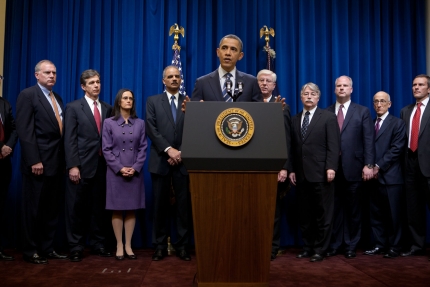
President Obama Speaks on No Child Left Behind Reform

February 09, 2012 | 8:59 | Public Domain

The President announces that 10 states will receive flexibility to implement reforms that raise standards for student achievement without being required to meet certain parts of No Child Left Behind.

Download mp4 (86MB) | mp3 (8MB)

Read the Transcript

Remarks by the President on No Child Left Behind Flexibility

East Room

1:57 P.M. EST

THE PRESIDENT:  Please have a seat, have a seat.  Thank you so much.  Well, hello, everybody, and welcome to the White House.

I want to start by thanking all the chief state school officers who have made the trip from all over the country.  Why don’t you all stand up just so we can see you all, right here.  (Applause.)  It’s a great group, right here.  Thank you.  And I want to recognize someone who is doing a pretty good job right here in Washington, D.C., and that is my Secretary of Education Arne Duncan.  Love Arne.  (Applause.)

We’ve also got some outstanding members of Congress who are here who have always been on the front lines when it comes to education reform.  But above all, I want to thank all the teachers who are here today.  Where are the teachers?  Come on, stand up, teachers.  (Applause.)  There you go.  We got some teachers here.

Earlier this week, we hosted our second White House science fair.  Some of you may have seen this on TV.  I got a chance to shoot a marshmallow out of an air cannon, which I don’t usually get to do.  (Laughter.)  But I met these incredibly talented young people -- kids who are working on everything from portable housing for disaster victims to technology that can detect smuggled uranium before it became a threat; this young man had built a prototype.  And I asked him how he came up with this idea, and he said, “I’ve always just been really interested in nuclear materials, and I collect samples.”  (Laughter.)  And I asked him, “How does your mom feel about this?”  (Laughter.)  He said she wasn’t that happy about it.

But just unbelievable young people.  It was extraordinary.  And before they left, I gave them some homework.  I told them go find a teacher who helped them make it here and say thank you, because every single one of us can point to a teacher who in some way changed the course of our lives.  I certainly can; I know Arne can.  And the impact is often much bigger than we realize.

One study found that a single good teacher can increase the lifetime earnings of a classroom by $250,000 -- single teacher.  A great teacher can help a young person escape poverty, allow them to dream beyond their circumstances. 

So teachers matter.  And in an economy where employers are looking for the most skilled, educated workers, few people are going to have a bigger impact on that than the men and women who are in our classrooms.  And that ultimately is why we’re here today.  It’s about our classrooms, and our children, and what’s happening to them and how they can perform.

In September, after waiting far too long for Congress to act, I announced that my administration would take steps to reform No Child Left Behind on our own.  This was one of the first and the biggest “We Can’t Wait” announcements that we’ve made, because our kids and our schools can’t be held back by inaction.

I want to point out, by the way, the members of Congress who are here, they’re ready to act, but we haven’t been able to get the entire House and Senate to move on this. 

I said back then the goals of No Child Left Behind were the right ones.  Standards and accountability -- those are the right goals.  Closing the achievement gap, that’s a good goal.  That’s the right goal.  We’ve got to stay focused on those goals.  But we’ve got to do it in a way that doesn’t force teachers to teach to the test, or encourage schools to lower their standards to avoid being labeled as failures.  That doesn’t help anybody.  It certainly doesn’t help our children in the classroom.

So we determined we need a different approach.  And I’ve always believed that each of us has a role to play when it comes to our children’s education.  As parents, we’ve got a responsibility to make sure homework gets done, but also to instill a love of learning from the very start.  As a nation, we’ve got a responsibility to give our students the resources they need -- from the highest-quality schools to the latest textbooks to science labs that actually work.

In return, we should demand better performance.  We should demand reform.  And that was the idea behind Race to the Top.  For less than 1 percent of what our nation spends on education each year, we’ve gotten almost every state in the nation to raise their standards for teaching and learning.  And that’s the first time that’s happened in a generation.

So when it comes to fixing what’s wrong with No Child Left Behind, we’ve offered every state the same deal.  We’ve said, if you’re willing to set higher, more honest standards than the ones that were set by No Child Left Behind, then we’re going to give you the flexibility to meet those standards.  We want high standards, and we’ll give you flexibility in return.  We combine greater freedom with greater accountability.  Because what might work in Minnesota may not work in Kentucky -- but every student should have the same opportunity to reach their potential.

So over the last five months, 39 states have told us that they were interested.  Some have already applied.  And today, I am pleased to announce that we are giving 10 states, the first 10 states the green light to continue making the reforms that are best for them. 

Each of these states has set higher benchmarks for student achievement.  They’ve come up with ways to evaluate and support teachers fairly, based on more than just a set of test scores.  And along with promoting best practices for all of our children, they’re also going to be focusing on low-income students, and English language learners, and students with disabilities -- not just to make sure that those children don’t fall through the cracks, but to make sure they have every opportunity to go as far as their talents will take them.

So Massachusetts, for example, has set a goal to cut the number of underperforming students in half over the next six years.  I like that goal. 

Colorado has launched a website that will allow teachers and parents to see exactly how much progress students are making, and how different schools are measuring up.  So nothing creates more accountability than when parents are out there taking a look and seeing what’s going on.

New Jersey is developing an early warning system to reduce the number of dropouts.  Tennessee is creating a statewide school district to aggressively tackle its lowest-performing schools.  And Florida has set a goal to have their test scores rank among the top five states in the country, and the top 10 countries in the world.  I like that ambition.

This is good news for our kids; it’s good news for our country.  And I’m confident that we’re going to see even more states come forward in the months ahead.  Because if we’re serious about helping our children reach their full potential, the best ideas aren’t going to just come from here in Washington.  They’re going to come from cities and towns from all across America.  They’re going to come from teachers and principals and parents.  They’re going to come from you who have a sense of what works and what doesn’t.

And our job is to harness those ideas, to lift up best practices, to hold states and schools accountable for making them work.  That’s how we’re going to make sure that every child in America has the skills and the education they need to compete for the jobs of the future and to be great citizens.  And that’s how we’re going to build an economy that lasts.

So to all the educators who are in the room, thank you for what you do every day.  We are very proud of your efforts.  We know it’s not easy.  We’re proud of you.  And working together, I am absolutely confident that year after year we’re going to see steady improvement. 

I told the superintendents that I met backstage before I came out here, this is not a one-year project.  This isn’t a two-year project.  This is going to take some time.  But we can get it done with the kind of determination and the kind of commitment that so many of you have shown.

So I’m proud of you.  I’m proud of Arne Duncan.  Let’s make this happen.

Thank you very much, everybody.  

END               
2:07 P.M. EST

Close Transcript

The White House

Office of the Press Secretary

Remarks by the President on No Child Left Behind Flexibility

East Room

1:57 P.M. EST

THE PRESIDENT:  Please have a seat, have a seat.  Thank you so much.  Well, hello, everybody, and welcome to the White House.

I want to start by thanking all the chief state school officers who have made the trip from all over the country.  Why don’t you all stand up just so we can see you all, right here.  (Applause.)  It’s a great group, right here.  Thank you.  And I want to recognize someone who is doing a pretty good job right here in Washington, D.C., and that is my Secretary of Education Arne Duncan.  Love Arne.  (Applause.)

We’ve also got some outstanding members of Congress who are here who have always been on the front lines when it comes to education reform.  But above all, I want to thank all the teachers who are here today.  Where are the teachers?  Come on, stand up, teachers.  (Applause.)  There you go.  We got some teachers here.

Earlier this week, we hosted our second White House science fair.  Some of you may have seen this on TV.  I got a chance to shoot a marshmallow out of an air cannon, which I don’t usually get to do.  (Laughter.)  But I met these incredibly talented young people -- kids who are working on everything from portable housing for disaster victims to technology that can detect smuggled uranium before it became a threat; this young man had built a prototype.  And I asked him how he came up with this idea, and he said, “I’ve always just been really interested in nuclear materials, and I collect samples.”  (Laughter.)  And I asked him, “How does your mom feel about this?”  (Laughter.)  He said she wasn’t that happy about it.

But just unbelievable young people.  It was extraordinary.  And before they left, I gave them some homework.  I told them go find a teacher who helped them make it here and say thank you, because every single one of us can point to a teacher who in some way changed the course of our lives.  I certainly can; I know Arne can.  And the impact is often much bigger than we realize.

One study found that a single good teacher can increase the lifetime earnings of a classroom by $250,000 -- single teacher.  A great teacher can help a young person escape poverty, allow them to dream beyond their circumstances. 

So teachers matter.  And in an economy where employers are looking for the most skilled, educated workers, few people are going to have a bigger impact on that than the men and women who are in our classrooms.  And that ultimately is why we’re here today.  It’s about our classrooms, and our children, and what’s happening to them and how they can perform.

In September, after waiting far too long for Congress to act, I announced that my administration would take steps to reform No Child Left Behind on our own.  This was one of the first and the biggest “We Can’t Wait” announcements that we’ve made, because our kids and our schools can’t be held back by inaction.

I want to point out, by the way, the members of Congress who are here, they’re ready to act, but we haven’t been able to get the entire House and Senate to move on this. 

I said back then the goals of No Child Left Behind were the right ones.  Standards and accountability -- those are the right goals.  Closing the achievement gap, that’s a good goal.  That’s the right goal.  We’ve got to stay focused on those goals.  But we’ve got to do it in a way that doesn’t force teachers to teach to the test, or encourage schools to lower their standards to avoid being labeled as failures.  That doesn’t help anybody.  It certainly doesn’t help our children in the classroom.

So we determined we need a different approach.  And I’ve always believed that each of us has a role to play when it comes to our children’s education.  As parents, we’ve got a responsibility to make sure homework gets done, but also to instill a love of learning from the very start.  As a nation, we’ve got a responsibility to give our students the resources they need -- from the highest-quality schools to the latest textbooks to science labs that actually work.

In return, we should demand better performance.  We should demand reform.  And that was the idea behind Race to the Top.  For less than 1 percent of what our nation spends on education each year, we’ve gotten almost every state in the nation to raise their standards for teaching and learning.  And that’s the first time that’s happened in a generation.

So when it comes to fixing what’s wrong with No Child Left Behind, we’ve offered every state the same deal.  We’ve said, if you’re willing to set higher, more honest standards than the ones that were set by No Child Left Behind, then we’re going to give you the flexibility to meet those standards.  We want high standards, and we’ll give you flexibility in return.  We combine greater freedom with greater accountability.  Because what might work in Minnesota may not work in Kentucky -- but every student should have the same opportunity to reach their potential.

So over the last five months, 39 states have told us that they were interested.  Some have already applied.  And today, I am pleased to announce that we are giving 10 states, the first 10 states the green light to continue making the reforms that are best for them. 

Each of these states has set higher benchmarks for student achievement.  They’ve come up with ways to evaluate and support teachers fairly, based on more than just a set of test scores.  And along with promoting best practices for all of our children, they’re also going to be focusing on low-income students, and English language learners, and students with disabilities -- not just to make sure that those children don’t fall through the cracks, but to make sure they have every opportunity to go as far as their talents will take them.

So Massachusetts, for example, has set a goal to cut the number of underperforming students in half over the next six years.  I like that goal. 

Colorado has launched a website that will allow teachers and parents to see exactly how much progress students are making, and how different schools are measuring up.  So nothing creates more accountability than when parents are out there taking a look and seeing what’s going on.

New Jersey is developing an early warning system to reduce the number of dropouts.  Tennessee is creating a statewide school district to aggressively tackle its lowest-performing schools.  And Florida has set a goal to have their test scores rank among the top five states in the country, and the top 10 countries in the world.  I like that ambition.

This is good news for our kids; it’s good news for our country.  And I’m confident that we’re going to see even more states come forward in the months ahead.  Because if we’re serious about helping our children reach their full potential, the best ideas aren’t going to just come from here in Washington.  They’re going to come from cities and towns from all across America.  They’re going to come from teachers and principals and parents.  They’re going to come from you who have a sense of what works and what doesn’t.

And our job is to harness those ideas, to lift up best practices, to hold states and schools accountable for making them work.  That’s how we’re going to make sure that every child in America has the skills and the education they need to compete for the jobs of the future and to be great citizens.  And that’s how we’re going to build an economy that lasts.

So to all the educators who are in the room, thank you for what you do every day.  We are very proud of your efforts.  We know it’s not easy.  We’re proud of you.  And working together, I am absolutely confident that year after year we’re going to see steady improvement. 

I told the superintendents that I met backstage before I came out here, this is not a one-year project.  This isn’t a two-year project.  This is going to take some time.  But we can get it done with the kind of determination and the kind of commitment that so many of you have shown.

So I’m proud of you.  I’m proud of Arne Duncan.  Let’s make this happen.

Thank you very much, everybody.  

END               
2:07 P.M. EST

President Obama Hails the Housing Agreement

President Barack Obama delivers remark on a landmark housing agreement (February 9, 2012)

President Barack Obama delivers remarks announcing the finalization of a $26 billion settlement between mortgage providers, state attorneys general and the Justice Department, in the Eisenhower Executive Office Building of the White House, Feb. 9, 2012. (Official White House Photo by Lawrence Jackson)

This morning, the federal government and the attorneys general of 49 states announced an agreement with the nation’s five largest mortgage providers -- Ally Financial, Bank of America, Citigroup, JP Morgan, and Wells Fargo.

Because of that agreement, the financial institutions will provide at least $25 billion to address mortgage loan servicing and foreclosure abuses. It will not only help thousands of working families now, it will establish new protections for homeowners going forward. Read more about the National Mortgage Settlement here.

Earlier, President Obama spoke about what he called a "landmark settlement." He discussed the irresponsible practices from lenders that created the housing crisis and said:

Under the terms of this settlement, America’s biggest banks -- banks that were rescued by taxpayer dollars -- will be required to right these wrongs.  That means more than just paying a fee.  These banks will put billions of dollars towards relief for families across the nation.  They’ll provide refinancing for borrowers that are stuck in high interest rate mortgages.  They’ll reduce loans for families who owe more on their homes than they’re worth.  And they will deliver some measure of justice for families that have already been victims of abusive practices.

All told, this isn’t just good for those families -- it’s good for their neighborhoods, it's good for their communities, and it's good for our economy.

Related Topics: Economy, Financial Reform

President Obama Speaks on Landmark Housing Settlement with Banks

February 09, 2012 | 8:59 | Public Domain

The President announces a landmark settlement between the government and the nation’s largest banks that will speed relief to the hardest-hit homeowners, end some of the most abusive practices of the mortgage industry, and begin to turn the page on an era of recklessness that has left so much damage in its wake.

Download mp4 (86MB) | mp3 (8MB)

Read the Transcript

Remarks by the President on the Housing Settlement

Room 430
Eisenhower Executive Office Building

12:28 P.M. E

THE PRESIDENT:  All right, good afternoon, everybody.  Before I start, I just want to introduce the folks on stage here, because the extraordinary work that they did is the reason that a lot of families are going to be helped all across the country.

First of all, our Attorney General Eric Holder; Secretary of Housing and Urban Development Shaun Donovan; Associate Attorney General -- and former classmate of mine -- Tom Perrelli.  We've got Attorney General George Jepsen from Connecticut; Roy Cooper, Attorney General from North Carolina; Lisa Madigan from my home state of Illinois, and former seatmate of mine when we were in the state legislature together; Dustin McDaniel from Arkansas; Gregory Zoeller from Indiana; and Tom Miller from Iowa.  And I also want to acknowledge Bob Ryan, who worked with Shaun Donovan extensively on this issue, as well as Tim Massad of Treasury.  And I'm going to acknowledge also Gene Sperling, who doesn't always get the credit he deserves for doing outstanding work.

The housing bubble that burst nearly six years ago triggered, as we all know, the worst economic crisis of our lifetimes.  It cost millions of innocent Americans their jobs and their homes.  And it remains one of the biggest drags on our economy.

Last fall, my administration unveiled a series of steps to help responsible homeowners refinance their mortgages to take advantage of historically low rates.  And last week, I urged Congress to pass a plan that would help millions more Americans refinance and stay in their homes.  And I indicated that the American people need Congress to act on this piece of legislation.

But in the meantime, we can't wait to get things done and to provide relief to America's homeowners.  We need to keep doing everything we can to help homeowners and our economy.  And today, with the help of Democratic and Republican attorney generals from nearly every state in the country, we are about to take a major step on our own.   

We have reached a landmark settlement with the nation’s largest banks that will speed relief to the hardest-hit homeowners, end some of the most abusive practices of the mortgage industry, and begin to turn the page on an era of recklessness that has left so much damage in its wake.

By now, it’s well known that millions of Americans who did the right thing and the responsible thing -- shopped for a house, secured a mortgage that they could afford, made their payments on time -- were, nevertheless, hurt badly by the irresponsible actions of others:  by lenders who sold loans to people who couldn’t afford them; by buyers who knew they couldn’t afford them; by speculators who were looking to make a quick buck; by banks that took risky mortgages, packaged them up, and traded them off for large profits.

It was wrong.  And it cost more than 4 million families their homes to foreclosure.

Even worse, many companies that handled these foreclosures didn’t give people a fighting chance to hold onto their homes.  In many cases, they didn’t even verify that these foreclosures were actually legitimate.  Some of the people they hired to process foreclosures used fake signatures to -- on fake documents to speed up the foreclosure process.  Some of them didn’t read what they were signing at all.

We've got to think about that.  You work and you save your entire life to buy a home.  That's where you raise your family.  That's where your kids' memories are formed.  That's your stake, your claim on the American Dream.  And the person signing the document couldn’t take enough time to even make sure that the foreclosure was legitimate. 

These practices were plainly irresponsible.  And we refused to let them go unanswered.  So about a year ago, our federal law enforcement agencies teamed up with state attorneys general to get to the bottom of these abuses.  The settlement we’ve reached today, thanks to the work of some of the folks who are on this stage -- this is the largest joint federal-state settlement in our nation’s history -- is the result of that extraordinary cooperation. 

Under the terms of this settlement, America’s biggest banks -- banks that were rescued by taxpayer dollars -- will be required to right these wrongs.  That means more than just paying a fee.  These banks will put billions of dollars towards relief for families across the nation.  They’ll provide refinancing for borrowers that are stuck in high interest rate mortgages.  They’ll reduce loans for families who owe more on their homes than they’re worth.  And they will deliver some measure of justice for families that have already been victims of abusive practices. 

All told, this isn’t just good for those families -- it’s good for their neighborhoods, it's good for their communities, and it's good for our economy.

This settlement also protects our ability to further investigate the practices that caused this mess.  And this is important.  The mortgage fraud task force I announced in my State of the Union address retains its full authority to aggressively investigate the packaging and selling of risky mortgages that led to this crisis.  This investigation is already well underway.  And working closely with state attorneys general, we're going to keep at it until we hold those who broke the law fully accountable.

Now, I want to be clear.  No compensation, no amount of money, no measure of justice is enough to make it right for a family who's had their piece of the American Dream wrongly taken from them.  And no action, no matter how meaningful, is going to, by itself, entirely heal the housing market.  But this settlement is a start.  And we're going to make sure that the banks live up to their end of the bargain.  If they don’t, we've set up an independent inspector, a monitor, that has the power to make sure they pay exactly what they agreed to pay, plus a penalty if they fail to act in accordance with this agreement.  So this will be a big help. 

Of course, even with this settlement, there's still millions of responsible homeowners who are out there doing their best.  And they need us to do more to help them get back on their feet. We've still got to stoke the fires of our economic recovery.  So now is not the time to pull back.

To build on this settlement, Congress still needs to send me the bill I've proposed that gives every responsible homeowner in America the chance to refinance their mortgage and save about $3,000 a year.  It would help millions of homeowners who make their payments on time save hundreds of dollars a month, and it can broaden the impact building off this settlement. 

That’s money that can be put back into the homes of those folks who are saving money on the refinancing, helping to build their equity back up.  They may decide to spend that money on local businesses.  Either way, it's good for families, and it's good for our economy.  But it's only going to happen if Congress musters the will to act.  And I ask every American to raise your voice and demand that they do.

Because there really is no excuse for inaction.  There's no excuse for doing nothing to help more families avoid foreclosure. That’s not who we are.  We are Americans, and we look out for one another; we get each other's backs.  That’s not a Democratic issue, that’s not a Republican issue.  That’s who we are as Americans. 

And the bipartisan nature of this settlement and the outstanding work that these state attorneys general did is a testament to what happens when everybody is pulling in the same direction.  And that’s what today's settlement is all about -- standing up for the American people, holding those who broke the law accountable, restoring confidence in our housing market and our financial sector, getting things moving.  And we're going to keep on at it until everyone shares in America's comeback.

So, ladies and gentlemen, thank you for your outstanding efforts.  We are very, very proud of you.  And we look forward to seeing this settlement lead to some small measure of relief to a lot of families out there that need help.  And that’s going to strengthen the American economy overall. 

So thank you very much.

END                 
12:37 P.M EST

Close Transcript

The White House

Office of the Press Secretary

Remarks by the President on the Housing Settlement

Room 430
Eisenhower Executive Office Building

12:28 P.M. E

THE PRESIDENT:  All right, good afternoon, everybody.  Before I start, I just want to introduce the folks on stage here, because the extraordinary work that they did is the reason that a lot of families are going to be helped all across the country.

First of all, our Attorney General Eric Holder; Secretary of Housing and Urban Development Shaun Donovan; Associate Attorney General -- and former classmate of mine -- Tom Perrelli.  We've got Attorney General George Jepsen from Connecticut; Roy Cooper, Attorney General from North Carolina; Lisa Madigan from my home state of Illinois, and former seatmate of mine when we were in the state legislature together; Dustin McDaniel from Arkansas; Gregory Zoeller from Indiana; and Tom Miller from Iowa.  And I also want to acknowledge Bob Ryan, who worked with Shaun Donovan extensively on this issue, as well as Tim Massad of Treasury.  And I'm going to acknowledge also Gene Sperling, who doesn't always get the credit he deserves for doing outstanding work.

The housing bubble that burst nearly six years ago triggered, as we all know, the worst economic crisis of our lifetimes.  It cost millions of innocent Americans their jobs and their homes.  And it remains one of the biggest drags on our economy.

Last fall, my administration unveiled a series of steps to help responsible homeowners refinance their mortgages to take advantage of historically low rates.  And last week, I urged Congress to pass a plan that would help millions more Americans refinance and stay in their homes.  And I indicated that the American people need Congress to act on this piece of legislation.

But in the meantime, we can't wait to get things done and to provide relief to America's homeowners.  We need to keep doing everything we can to help homeowners and our economy.  And today, with the help of Democratic and Republican attorney generals from nearly every state in the country, we are about to take a major step on our own.   

We have reached a landmark settlement with the nation’s largest banks that will speed relief to the hardest-hit homeowners, end some of the most abusive practices of the mortgage industry, and begin to turn the page on an era of recklessness that has left so much damage in its wake.

By now, it’s well known that millions of Americans who did the right thing and the responsible thing -- shopped for a house, secured a mortgage that they could afford, made their payments on time -- were, nevertheless, hurt badly by the irresponsible actions of others:  by lenders who sold loans to people who couldn’t afford them; by buyers who knew they couldn’t afford them; by speculators who were looking to make a quick buck; by banks that took risky mortgages, packaged them up, and traded them off for large profits.

It was wrong.  And it cost more than 4 million families their homes to foreclosure.

Even worse, many companies that handled these foreclosures didn’t give people a fighting chance to hold onto their homes.  In many cases, they didn’t even verify that these foreclosures were actually legitimate.  Some of the people they hired to process foreclosures used fake signatures to -- on fake documents to speed up the foreclosure process.  Some of them didn’t read what they were signing at all.

We've got to think about that.  You work and you save your entire life to buy a home.  That's where you raise your family.  That's where your kids' memories are formed.  That's your stake, your claim on the American Dream.  And the person signing the document couldn’t take enough time to even make sure that the foreclosure was legitimate. 

These practices were plainly irresponsible.  And we refused to let them go unanswered.  So about a year ago, our federal law enforcement agencies teamed up with state attorneys general to get to the bottom of these abuses.  The settlement we’ve reached today, thanks to the work of some of the folks who are on this stage -- this is the largest joint federal-state settlement in our nation’s history -- is the result of that extraordinary cooperation. 

Under the terms of this settlement, America’s biggest banks -- banks that were rescued by taxpayer dollars -- will be required to right these wrongs.  That means more than just paying a fee.  These banks will put billions of dollars towards relief for families across the nation.  They’ll provide refinancing for borrowers that are stuck in high interest rate mortgages.  They’ll reduce loans for families who owe more on their homes than they’re worth.  And they will deliver some measure of justice for families that have already been victims of abusive practices. 

All told, this isn’t just good for those families -- it’s good for their neighborhoods, it's good for their communities, and it's good for our economy.

This settlement also protects our ability to further investigate the practices that caused this mess.  And this is important.  The mortgage fraud task force I announced in my State of the Union address retains its full authority to aggressively investigate the packaging and selling of risky mortgages that led to this crisis.  This investigation is already well underway.  And working closely with state attorneys general, we're going to keep at it until we hold those who broke the law fully accountable.

Now, I want to be clear.  No compensation, no amount of money, no measure of justice is enough to make it right for a family who's had their piece of the American Dream wrongly taken from them.  And no action, no matter how meaningful, is going to, by itself, entirely heal the housing market.  But this settlement is a start.  And we're going to make sure that the banks live up to their end of the bargain.  If they don’t, we've set up an independent inspector, a monitor, that has the power to make sure they pay exactly what they agreed to pay, plus a penalty if they fail to act in accordance with this agreement.  So this will be a big help. 

Of course, even with this settlement, there's still millions of responsible homeowners who are out there doing their best.  And they need us to do more to help them get back on their feet. We've still got to stoke the fires of our economic recovery.  So now is not the time to pull back.

To build on this settlement, Congress still needs to send me the bill I've proposed that gives every responsible homeowner in America the chance to refinance their mortgage and save about $3,000 a year.  It would help millions of homeowners who make their payments on time save hundreds of dollars a month, and it can broaden the impact building off this settlement. 

That’s money that can be put back into the homes of those folks who are saving money on the refinancing, helping to build their equity back up.  They may decide to spend that money on local businesses.  Either way, it's good for families, and it's good for our economy.  But it's only going to happen if Congress musters the will to act.  And I ask every American to raise your voice and demand that they do.

Because there really is no excuse for inaction.  There's no excuse for doing nothing to help more families avoid foreclosure. That’s not who we are.  We are Americans, and we look out for one another; we get each other's backs.  That’s not a Democratic issue, that’s not a Republican issue.  That’s who we are as Americans. 

And the bipartisan nature of this settlement and the outstanding work that these state attorneys general did is a testament to what happens when everybody is pulling in the same direction.  And that’s what today's settlement is all about -- standing up for the American people, holding those who broke the law accountable, restoring confidence in our housing market and our financial sector, getting things moving.  And we're going to keep on at it until everyone shares in America's comeback.

So, ladies and gentlemen, thank you for your outstanding efforts.  We are very, very proud of you.  And we look forward to seeing this settlement lead to some small measure of relief to a lot of families out there that need help.  And that’s going to strengthen the American economy overall. 

So thank you very much.

END                 
12:37 P.M EST

The White House

Office of the Press Secretary

White House to Host The Arc as part of the Community Leaders Briefing Series

WASHINGTON, DC – Tomorrow, February 10th, the White House Office of Public Engagement will host 150 of The Arc’s leaders, members, advocates, and staff from across the country as part of the White House Community Leaders Briefing Series. The Arc is one of the largest national community-based organizations advocating for and serving people with intellectual and developmental disabilities and their families.

The White House Community Leaders Briefing Series, a weekly program that began in the summer of 2011, is a unique opportunity for grassroots leaders to start a two-way dialogue with the White House about issues that are affecting their communities and to ensure that they are well-informed about government policies and programs and how they can use or maximize these resources.

“The Arc, as one of the largest organizations working with people with intellectual and developmental disabilities, brings a wealth of experience and insight to discuss today’s most important concerns facing persons with intellectual and developmental disabilities, said Director of the White House Office of Public Engagement Jon Carson. “We’re looking forward to having them here at the White House to deepen our partnership, and to discuss the issues we care about most.”

To watch this event live, visit www.whitehouse.gov/live from 8:00 to 11:00 AM ET on Friday, February 10.

The following individuals will be participants at the Community Leaders Briefing tomorrow:

Matthew Grafton, Alabama
Matthew was born in Mobile, Alabama and currently resides in Jackson, where he is active in his community. He graduated from Jackson High School in 2005 and now has his own apartment with 24-hour live in staff who help him with household chores and other daily tasks. His support services are paid for by Medicaid and are what makes it possible for Matthew to live at home.

Matthew remains active with his local chapter of The Arc where he serves as a member of the Board of Directors, Human Rights Committee, and Quality Empowerment Committee. He has also been participating in “meet and greets” throughout Alabama, where he speaks publicly about his services and what they mean to him. During these events, Matthew has spoken to hundreds of people, including elected officials, about the importance of his services and how without them he would have to give up his independence.

Bruce Hulick and Joe Hulick, Pennsylvania
Bruce Hulick is the executive director of The Arc of Philadelphia, and his son Joe Hulick, 29, will join him in Washington. Joe has down syndrome and until recently, he worked at three different retail jobs. In these tough economic times, Joe was laid off from two of those jobs.

Bruce served in the Marine Corps and the Hulick family moved around a lot when Joe was growing up. The Hulicks usually lived off base and Joe went to public school. That meant having to start over each time to try to get the education services Joe needed. The Hulicks also started chapters of The Arc in places where they didn’t exist at the time, in South Carolina and in Orange County, California, so that there would be a network for families.

Van Winkle family, Ohio
Mary, Mark and Sarah Van Winkle are from Tallmadge, Ohio and are members of The Arc of Summit and Portage Counties. The Van Winkles moved from Pennsylvania in 2001, where Mark was the board president of a local chapter of The Arc. Currently, Mark is the board president of The Arc of Summit and Portage Counties. His daughter, Sarah, also serves on the board.

Sarah Van Winkle is 29 years old and has Noonan syndrome. She also is legally blind.

Sarah and her family started looking for employment for her when she was still in high school. She has worked at McDonald’s for the past 7 years, under 6 different managers, who all have been impressed with Sarah’s skills.

Sarah lives in an apartment complex and is supported three hours a day by an aide – paid for by Medicaid – who helps her with her shopping and cleaning. Sarah does her own laundry and cooking.

The White House

Office of the Press Secretary

Readout of the Vice President’s Meeting on Human Rights and Reform in China

The Vice President and senior Administration officials met yesterday with four experts and advocates on human rights and legal reform in China: Dr. Xiaorong Li, Professor Benjamin Liebman, Mr. Kenneth Roth and Ms. Jianying Zha.  They discussed the deterioration of China’s human rights situation, prospects for reform, and recommendations for U.S. policy.  The Vice President underscored the Administration’s belief in the universality of human rights and its commitment to human rights as a fundamental part of our foreign policy.  He reiterated his view that greater openness and protection of universal rights is the best way to promote innovation, prosperity, and stability in all countries, including China.

The White House

Office of the Press Secretary

President Obama: Our Children Can’t Wait for Congress to Fix No Child Left Behind, Announces Flexibility in Exchange for Reform for Ten States

Additional States Expected to Request Flexibility in the Coming Weeks

WASHINGTON, DC — President Barack Obama will announce today that ten states that have agreed to implement bold reforms around standards and accountability will receive flexibility from the burdensome mandates of the federal education law known as No Child Left Behind (NCLB).  In exchange for this flexibility, these states have agreed to raise standards, improve accountability, and undertake essential reforms to improve teacher effectiveness. The ten states approved for flexibility are Colorado, Florida, Georgia, Indiana, Kentucky, Massachusetts, Minnesota, New Jersey, Oklahoma, and Tennessee.

In a White House announcement attended by state education officials, teachers, civil rights, and business leaders, the President will say that NCLB, which is five years overdue for a rewrite, is driving the wrong behaviors, from teaching to the test to federally determined, one-size-fits-all interventions.  The President will call on Congress to work across the aisle to fix the law even as his administration offers solutions for states to help prepare all students for college and career readiness.

“After waiting far too long for Congress to reform No Child Left Behind, my Administration is giving states the opportunity to set higher, more honest standards in exchange for more flexibility,”  said President Obama. “Today, we’re giving 10 states the green light to continue making reforms that are best for them.  Because if we’re serious about helping our children reach their potential, the best ideas aren’t going to come from Washington alone.  Our job is to harness those ideas, and to hold states and schools accountable for making them work.”

The administration is continuing to work closely with New Mexico, the eleventh state that requested flexibility in the first round.  Twenty-eight other states along with D.C. and Puerto Rico have indicated their intent to seek waivers.

The administration’s decision to provide waivers followed extensive efforts to work with Congress to rewrite NCLB.  In March 2010, the administration submitted a “blueprint for reform” to Congress and has met extensively with Republican and Democratic legislators.

Education Secretary Arne Duncan said that current law drives down standards, weakens accountability, causes narrowing of the curriculum and labels too many schools as failing.  Moreover, the law mandates unworkable remedies at the federal level instead of allowing local educators to make spending decisions.

“Rather than dictating educational decisions from Washington, we want state and local educators to decide how to best meet the individual needs of students,” said Duncan.

To get flexibility from NCLB, states must adopt and have a plan to implement college and career-ready standards.  They must also create comprehensive systems of teacher and principal development, evaluation and support that include factors beyond test scores, such as principal observation, peer review, student work, or parent and student feedback.

States receiving waivers no longer have to meet 2014 targets set by NCLB but they must set new performance targets for improving student achievement and closing achievement gaps.  They also must have accountability systems that recognize and reward high-performing schools and those that are making significant gains, while targeting rigorous and comprehensive interventions for the lowest-performing schools.  Under the state-developed plans, all schools will develop and implement plans for improving educational outcomes for underperforming subgroups of students.  State plans will require continued transparency around achievement gaps, but will provide schools and districts greater flexibility in how they spend Title I federal dollars.

The White House

Office of the Press Secretary

Readout of the President’s Meeting on Afghanistan and Pakistan

President Obama met today with his national security team as a part of his regular meetings on Afghanistan and Pakistan. The President received an update on our engagement with the Pakistani Government on a range of issues of mutual interest, including efforts to strengthen cooperation along the Afghanistan-Pakistan border. The President also received an update on Afghanistan, including the building of capable Afghan security forces, our support for an Afghan-led reconciliation process, and our efforts to build a long-term, strategic partnership between the United States and Afghanistan. Finally, the President received an update on preparations for the NATO Summit in Chicago, where we will further define the ongoing transition to Afghan-lead security and NATO’s commitment to the future of Afghanistan as agreed to at the 2010 NATO Summit in Lisbon.

The White House

Office of the Press Secretary

Press Briefing by Press Secretary Jay Carney, 2/8/12

James S. Brady Press Briefing Room

1:11 P.M. EST
 
 MR. CARNEY:  Hello, everyone.  Good afternoon.  Thanks for being here.  Before I take your questions, just a couple of things.  First of all, the President, earlier today, hosted -- or rather chaired one of his regular Afghanistan/Pakistan meetings with his National Security Council team -- national security team in the Situation Room.
 
Secondly, I wanted to mention that in the State of the Union address, the President laid out a blueprint to return to America's values, including reducing the influence of money and lobbyists in Washington.  Last week, Congress was on track to take the right first step by doing something they should have done long ago, banning insider trading by members of Congress.  The Senate, in an admirable show of bipartisanship, came together to pass the STOCK Act, because it was the right thing to do.  The bill passed 96 to 3, and that doesn’t happen very often, as you know.
 
Now, this morning, very early when it was still dark out and I was sitting at my kitchen table reading the newspaper, I was shocked to see that even this simple bill would ensure that -- that would ensure, rather, that everyone plays by the rules is being weakened, behind closed doors, by House Republicans, who seem to be caving to pressure from Wall Street lobbyists.
 
We hope that's not what's happening.  This should not be a partisan issue.  After all, one of the amendments on registration requirements that, according to these press reports, is being stripped out of the bill by House Republicans was inserted into the bill by a Senate Republican.  The anti-corruption amendment stripped out was offered by both Senator Leahy, a Democrat, and Senator Cornyn, a Republican.
 
This is something that Democrats and Republicans in the Senate worked together to write and pass.  It would be a shame if House Republicans, led by the Majority Leader, at the urging of Wall Street interests and other inside-the-Beltway forces, watered down the tough but common-sense measures supported by Republicans and Democrats alike.  The President has said that now is the time to take bold steps to fix the corrosive influence of money in politics, and this is something that Congress should take action on right away.
 
With that, I will move to your questions.  Ben.
 
Q    Thanks, Jay.  On the Af/Pak meeting you mentioned, any announcements to make on the --
 
MR. CARNEY:  No, I have no announcements.  I just know that there is interest in general if the President oversees these meetings and wanted to let you know that it's happened.  We may have more of a readout -- it ended not long ago.
 
Q    Okay.  On the contraception issue, Speaker Boehner is promising to repeal the rule through legislation.  Senator McConnell has talked about the same.  I'm curious about your reaction to that.  And if that were to happen, is that the kind of measure that the President would veto?  Does he feel that strongly?
 
MR. CARNEY:  Well, I think that's -- there's a lot of speculation embedded in that question, and I’m not going to go there.
 
I think on this issue, from the very beginning we have said that we will listen and work with individuals who have concerns as we work to implement the law.  As I said yesterday, on January 20th, when this decision was announced, Secretary Sebelius said:  “We will continue to work closely with religious groups during this transitional period to discuss their concerns.” 
 
And I would note that 28 states have similar contraception coverage requirements, and eight states, as I’ve mentioned before, do not even have the exemption that this provision requires for churches and houses of worship.
 
We want to work with all these organizations to implement this policy in a way that is as sensitive to their concerns as possible.  But let’s be clear.  We are committed -- the President is committed -- to ensuring that women have access to contraception without paying any extra costs no matter where they work.
 
Q    So while you’re pledging to work with groups who have concerns, the Congress -- or at least the House right now is pledging to undo the rule.  What is your reaction to that part of it?
 
MR. CARNEY:  Right now I think we are focused on the implementation of this rule and doing what we said back on January 20th when Secretary Sebelius announced it, which was work with those who have concerns to see if there’s a way to implement this policy to ensure that women everywhere have the same level of health care coverage and the same access to preventive services, but to do it in a way that might allay some of the concerns that have been expressed. 
 
This President has -- as you know, in his past, he has worked with when he -- his first job in Chicago with churches and organizations that do a lot of good work.  He is very sensitive to concerns like these and he wants to find a way to implement this important rule because he is committed to making sure that women have access to this coverage -- he wants to find a way to implement it that can allay some of the concerns that have been expressed.  And that is why the transition period was announced at the same time that the rule was announced.
 
Q    One more on this -- it’s about that transition period. They have until -- the organizations have until August of 2013.  Is the White House hopeful at having some sort of solution in place, the allaying of concerns before then?
 
MR. CARNEY:  Well, I wouldn’t want to predict a date by which this process might produce a result.  I think it’s best to let that process take place.  There are ways -- and I think people in the broader community here who have been looking at this issue have been talking about the fact that there are ways to approach this that would ensure the rule is implemented so that women have access to these important health care services no matter where they work, but also that hopefully would allay some of the concerns expressed.  I don’t want to get into whether this approach might work or that one or who might feel better about it if this solution were put forward.  We’re not at that point in the process.
 
Q    One last one on a different topic -- the payroll tax.  The negotiations seem bogged down.  I know the President wants this tax cut extended.  But I’m curious what the White House’s take is about the state of play right now.  Are you confident that it will get extended, or is there a genuine nervousness that this might expire at the end of the month?
 
MR. CARNEY:  We continue to be confident that Congress will pass the extension of the payroll tax cut for the rest of the calendar year.  It is still inconceivable to us that Congress would want to raise taxes on 160 million Americans on March 1st at a time when hardworking Americans need that extra money to pay their bills, to make ends meet.
 
There is an element of déjà vu to this process.  I think that it was clear by the end of December why this needed to get done.  It is clear from the economic reports that we’ve had in the last several months that the economy is growing and producing jobs, and that we are moving in the right direction, and Congress should not muck that up.  And the President believes, as he has said in the past, that folks on the Hill need to act without delay and without drama to get this done. 
 
Again, this is a case where everyone says -- Republicans on the Hill, leaders on the Hill, by and large, say now that they believe extending the payroll tax cut through the end of the year is the right thing to do.  It's good policy.  It’s good for the economy.  It’s the right thing to do for hardworking Americans.
Democrats obviously agree.  The President strongly agrees, and we ought to get this done.  So we still have time to work on this, and we hope Congress focuses and gets its work done.
 
I’m going to mix it up.  Brianna.
 
Q    On contraception, it’s not just the Speaker and Mitch McConnell and other Senate Republicans, but the candidates have all seized on it on the campaign trail, including Mitt Romney.  They obviously see an opportunity to not only drive a wedge in the support of some Democrats for the President, but also trying to rally their base.  Does the President feel that he’s vulnerable to that?
 
MR. CARNEY:  Well, the President is focused on putting in place the right policies for women across the country.  He’s focused on finding a balance that is sensitive to the concerns expressed by some religious groups. 
 
The former governor of Massachusetts is an odd messenger on this given that the services that this rule would provide for women around the country are the same that are provided in Massachusetts and were provided when he was governor, including contraception, including covered with no co-pay or deductible, and a religious exemption for houses of worship and churches and church-controlled organizations such as parochial schools, but not to universities and hospitals.  I mean, this is, I think, ironic that Mitt Romney is expressing -- criticizing the President for pursing a policy that's virtually identical to the one that was in place when he was governor of Massachusetts. 
 
Q    So does the President agree with Rick Santorum on the issue then?  (Laughter.)
 
MR. CARNEY:  I haven’t heard what Senator Santorum has said on the issue.
 
Q    And then one other question on this, sort of speaking to the evangelical support for Catholics who are opposed to this, Rick Warren tweeted that he stands in solidarity with Catholics. He said, "I’d go to jail rather than cave in to a government mandate that violates what God commands us to do.  Would you?"  As you know he has a lot of Twitter followers, and tons of people who are interested in what he’s saying.  Are you worried that that rallies the Republican base?
 
MR. CARNEY:  Well, we’re not worried about Republicans or Democrats, the political component of this.  We’re concerned about making sure that women get access to these important services; that women are treated equally around the country, regardless of where they work.  But we are very sensitive to and understand some of the concerns that have been expressed, and that is why as part of the original announcement of this by Secretary Sebelius we put in place a process where further discussions could be had that would address, hopefully, some of these concerns and maybe allay some of them.
 
I can’t sort of itemize or give great detail on what those discussions will look like.  I mean, as I think Ben noted, the full implementation of this policy doesn’t take place until August of 2013, and this conversation is only just underway.  But I think it’s important to note that the President takes those concerns very seriously, and he also takes -- takes seriously and is committed to the policy.  And we will press forward with these discussions to see if there’s a way to proceed, to move forward in implementing this policy that allays some of these concerns.
 
Q    Can I follow on that?
 
MR. CARNEY:  Let me --
 
Q    You could just say yes.  (Laughter.)
 
MR. CARNEY:  I want to get out of the front row and then come back, do my -- yes, Mr. Wolf.
 
Q    What has been -- thanks, Jay -- what has been the President’s reaction to this reaction on the contraception issue since the 20th?  Is he surprised by the reaction, either political or religious?
 
MR. CARNEY:  I think, as I’ve been saying, the President understands these concerns.  That’s why he agreed with the approach that Secretary Sebelius took, which sought that appropriate balance, which ensured that there was an exemption for churches and houses of worship, unlike in some states in the country, and why he supported the part of this that included a process by which further discussion could be had that would see if there was a way of implementing this for institutions and groups that had expressed concerns that might allay or resolve some of those concerns.
 
So I don’t think -- I mean, I think he understands, and understood from the beginning why this is a sensitive issue and why -- and it informs his decision to proceed in the way that he has and to try to seek this balance.
 
Q    Just at the very earliest stage, is there any sense of how discussions would take place?  I mean, in one case you have 18 months, but is there any sense here of who would talk to who in terms of trying to -- whether HHS would be involved, the White House -- trying to come up with some sort of a resolution?
 
MR. CARNEY:  I don’t have a roster of individuals involved in those kinds of discussion.  Issues involving health care policy would normally include folks who do health care policy, both -- in a variety of places in the administration.  So those are the kinds of conversations that would take place in terms of the policy side of this.
 
Yes, Wendell.
 
Q    There was reporting yesterday that your assertion that the next year and a half, the next year we spent looking for a way to implement the policy was a sign that you're looking to compromise.  And you pushed back strongly on those reports.  Tell me why that shouldn’t be seen as an attempt to find a compromise?
 
MR. CARNEY:  Well, I just wanted to be clear, as I'm trying to be again today, that the President is committed to implementing a policy that will ensure that women across the country, no matter where they work, will have access to the same health care coverage and the same preventive care services, including contraception. 
 
It is also true, and has been true since the day that this was announced, that we intend as an administration, as Secretary Sebelius said, to work with religious groups that have concerns about this to see if there's a way to implement that policy that eases some of those concerns.  And both are true.  But I wanted to be clear yesterday and I want to be clear today that the commitment to ensuring that women have access to this important  -- to these important health care services remains very strong.  
Q    So it's not a compromise because you won't walk back from access without a co-pay?
 
MR. CARNEY:  Correct. 
 
Q    There's also difficulty within the Pentagon on this.  The Army's chief of chaplains suggesting priests not read a letter from an archbishop he felt might lead to disobedience, frankly.
 
MR. CARNEY:  Well, my understanding -- and I'll refer you for specifics to the Pentagon, obviously -- but my understanding is chaplains were absolutely free to express their opinions about this and did. 
 
Q    But he didn’t want them to read a sentence of the letter from the archbishop.
 
MR. CARNEY:  I would refer you to the Defense Department.  But I would certainly hope that in reporting on this you noted that chaplains were absolutely free to express, as they should be, their opinion on this matter.
 
Norah.
 
Q    Can you confirm that the President's former chief of staff, Bill Daley, along with the Vice President, encouraged the President not to make this decision, but then the President then sided with some of his female advisors, including the HHS Secretary?
 
MR. CARNEY:  I'm not going to get into internal deliberations and who was on which side of discussions and debates internally.  I will say that, broadly speaking, the reports that line certain people up in some ways on this issue were inaccurate, both broadly and specifically in terms of some of the individuals.  But I’m not going to engage in a guessing game about who thought which way on which issue.
 
Q    And then on Iran.  Iran’s ambassador to Moscow said today that Iran is capable of carrying out military strikes on U.S. interests all around the world if Iran is attacked.  Is that a concern?
 
MR. CARNEY:  Well, I’m not going to engage in a back-and-forth with this particular official, but rest assured we’re extremely confident in our military’s ability to do their job, and also rest assured that force protection for those Americans deployed overseas is our top priority.
 
Q    And then just on Syria, if I could.  I know you’ve addressed this before but I want to ask you again.  Senator McCain and others are talking about whether we should arm the opposition in Syria.  Has that been completely ruled out?
 
MR. CARNEY:  We are pursuing a political path in an attempt to resolve, with our international partners, the situation in Syria -- or rather, to help the process move towards a peaceful political transition, democratic transition in Syria, working with friends of Syria all around the globe.  We believe that a political solution is the right way to go. 
 
Now, we never rule anything out in a situation like this, but we are pursuing a path that includes isolating and pressuring the Assad regime so that it stops its heinous slaughtering of its own people, and that in the coming days we will continue our very active discussions with friends and allies who support the Syrian people, along with the opposition Syrian National Council, to crystalize the international community’s next steps in that effort to halt the slaughter of the Syrian people and to pursue that transition to democracy.
 
Q    And how would humanitarian assistance be delivered?  How much are we talking about?  Has there been a dollar figure put on it?
 
MR. CARNEY:  No, I appreciate the question, and I know I raised this yesterday.  We are, of course, looking at humanitarian assistance to the Syrian people, and we have for some time.  We’re consulting with our international partners, and we anticipate this being one of the focuses of the discussions that we’ll have with friends of Syria in a friends-of-Syria meeting that may be held in the near future -- because there is near universal concern about the plight of the Syrian people as they are subjected to this brutal assault by the Assad regime. 
 
But I don’t have specifics about content or delivery.  I mean, these are just discussions that we anticipate having with our international partners.
 
Kristen.
 
Q    Thanks, Jay.  In the past, the administration has put forth names of officials who supported your policy decisions.  For example, during the American Jobs Act, when the President first rolled that out, we heard from a number of mayors.  Why not release names of religious leaders who support the HHS decision?
 
MR. CARNEY:  Well, I’m not sure I -- anybody who supports the decision to -- and the general approach to providing important health care services to women across the country is certainly welcome to express that opinion.  This is not -- again, this is -- I think that we’re engaged in a process that seeks to find a balance between a policy that ensures that women get access to these important services and that -- no matter where they work, and also deals with the understandable concerns of some religious groups.  And we’re in the process of doing that.
 
Q    Would it bolster your argument to be able to put forward a list of religious leaders who --
 
MR. CARNEY:  We’re not trying to win an argument here.  We’re trying to implement a policy that will affect millions of women -- well, all women in this country -- and also to do so in a way that's sensitive to people’s religious beliefs.  And that reflects the approach the President takes, and it reflects the approach that Secretary Sebelius has taken.
 
Q    And on the payroll tax cut discussions that are going on right now, there have been some rumblings that they might be considering a short-term deal again.  Is this something that the President would sign off on?  Would he support this?  Or would he only accept a yearlong extension?
 
MR. CARNEY:  It is, like I said, inconceivable that the same folks in Congress who almost prevented the payroll tax cut from being extended for two months would want to go through that again.  So we believe that there is consensus on Capitol Hill among Democrats and Republicans that we need to do this, and we need to do it for the full calendar year. 
 
I mean, we just need only point to the recent economic growth and the unemployment figures to note that the economy, while growing and creating jobs, needs this action to be taken to continue along the road to recovery.
 
I just can't imagine that folks in Congress are going to want to explain to their constituents that they blocked the extension of this tax cut, ensuring that taxes were raised on most of their constituents, because they couldn't sort out some easily resolvable issues with their fellow members of Congress.  We think that this can be done.  We absolutely think it should be done for the remainder of the calendar year.
 
Q    And just one more on Syria.  You’ve said in the past that you do think Assad’s fall is imminent.  Given the fact that there’s been increased violence over the weekend, last night, do you still see the situation in that light?
 
MR. CARNEY:  There’s no question that President Assad has lost control over parts of his country.  There’s no question that he’s certainly lost the support of his people long ago, thanks to his brutality and his refusal to participate in the kinds of reforms that would have led to a democratic transition in Syria. There’s no question that because of the efforts of the international community to put the squeeze on the regime financially that his assets and his capacities are dwindling.  And there’s no question that those around him within the military and governmental leadership are beginning to doubt the wisdom of sticking by him.  So, yes, we believe that his days are numbered.
 
And that's why we find it disappointing, to say the least, that votes were taken in the United Nations Security Council to block that important resolution.  It is simply a mistake to side with a regime that is going to go down in history as a brutal repressor of its own people.  It is a mistake to side with a regime whose days are numbered, to isolate yourself from the Syria people.  That's the wrong action to take.  The right place to be is with and in support of the Syrian people who are insisting on a peaceful transition to democracy. 
 
Karen, then Jake. 
 
Q    Thanks, Jay.
 
MR. CARNEY:  And then I’ll move back, I know it’s been -- go ahead.
 
Q    You talked about the administration’s commitment to reaching out to religious groups and getting their views.  Is the President himself going to be involved in that process?  Has he done any kind of outreach on that yet?
 
MR. CARNEY:  Well, I think there’s been some reporting about some of the conversations the President has had, but I don't have any scheduling or any calls or meetings to announce from here that he may have in the future.
 
Q    Does he want to be personally involved in that?
 
MR. CARNEY:  I think the President is very aware of and engaged in this issue.  But I don't have any, again, meetings to preview for you or conversations to announce.
 
Q    And when you’re emphasizing the effort to find a balance, isn’t that the same thing as finding a compromise?  And what is the timeframe on this?
 
MR. CARNEY:  I just want to be clear.  The language that is used to describe it is up to you guys.  What I am only trying to be clear about is that the commitment to make sure that all American women, no matter where they work, have access to the same health care coverage and the same preventive care services including contraception is absolutely firm.  That's the President’s commitment.  That is explicit in the policy proposal.
 
The discussion -- and it’s an important one, but the discussion is how can we, in implementing this policy, try to allay some of the concerns that have been expressed.  And the President is very sensitive to that, as is Secretary Sebelius and others.  But that's the issue.  So, describe that as you will, but there is no change in the commitment to ensuring that women have access to these important services.
 
Q    And can that goal be achieved with some exceptions?  And if you’re looking at finding a balance, what is the timeframe on that?
 
MR. CARNEY:  Well, let’s be clear that there is -- there are exemptions within the rule as it exists, including churches and houses of worship.
 
Q    But maybe further exemptions?
 
MR. CARNEY:  Well, I don't want to negotiate or speculate about what discussions may be had and what policy proposals may be contained within them.  What I will say is that the President is committed to ensuring that women have access to these services no matter where they work, and that all women are treated equally in regard to this in terms of no co-pays and no costs for the services provided.
 
Q    And what is the timeframe on that discussion about finding a balance?  Do you think that you might be able --
 
MR. CARNEY:  Well, I was asked that earlier.  I don’t have a timeframe to provide to you.  Within the announcement that Secretary Sebelius made, she described it as a transition period of a year.  So I would say some amount of time between one day and a year is when this will evolve.
 
Jake.  And then Jackie.
 
Q    President Obama is going to be introducing his outline for a budget.  Fed Chair Bernanke has said the lack of a budget having been passed by the Senate has had an adverse effect on growth because it’s created uncertainty.  Harry Reid has said that he doesn’t think there’s a need to introduce a budget this year.  Who does the President think is right, Harry Reid or Ben Bernanke?
 
MR. CARNEY:  Well, I think the President, as you noted, will be presenting his budget.  That budget, it’s important to remember -- and you all covered it -- has spending caps set based on the Budget Control Act that was signed into law by this President last August.  That spending -- those spending levels represent significant cuts agreed to by Democrats and Republicans, and by this President.  And his budget will reflect the need for that -- will reflect those cuts, but also reflect the priorities that he thinks are very important, and I think the priorities that -- to wrap in part of your question here -- that Senator Reid believes are important as well, as do many members of the Senate and the House.
 
Q    So, therefore, the Senate should pass a budget as well?
 
MR. CARNEY:  I don’t have a -- well, I don’t have an opinion to express on how the Senate does its business with regards to this issue.  The fact is, because of the negotiations over the debt ceiling that resulted in the Budget Control Act, we have an unusual situation here in that the top lines for the budget going forward have already been set and agreed to by Republicans and Democrats alike.
 
Q    I’m not actually asking your opinion, but the White House’s opinion.  The position of the White House is that --
 
MR. CARNEY:  I don’t have a --
 
Q    The White House has no opinion about whether or not the Senate should pass a budget?  The President is going to introduce one.  The Fed Chair says not having one is bad for growth, but the White House has no opinion about whether --
 
MR. CARNEY:  I have no opinion; the White House has no opinion on Chairman Bernanke’s assessment of how the Senate ought to do its business.  What the President believes is important is that the Budget Control Act that was signed into law by him last year provides the top-line spending caps for the coming budget. And he will obviously meet those in the budget proposal he puts forward.  And he looks forward to the Senate acting on the policy initiatives contained within his budget that will reflect the priorities he laid out in the State of the Union, and also will reflect the priorities he laid out when he put forward his deficit and debt reduction proposal back in September. 
 
So I don’t think there is any -- there will be, nor is there now, any doubt about the President’s view on where we ought to move with the budget.
 
Q    And just to follow up on the Syria question earlier from Norah.  There have been reports that because of all that’s going on in I think it’s Homs, there was a hospital that lost power and a number of premature babies died as a result.  I don’t know if that’s a true story or not.  Obviously in situations like this there are a lot of rumors.  Does the White House know anything about the extent of the violence, factually, what’s going on?  I assume we have people on the ground there to a degree or another.  Are we monitoring exactly what is happening?
 
MR. CARNEY:  Well, I can say that we have all here seen the reporting and some of the horrific video images of the escalation of violence that’s taking place in Syria over the last few days, and it’s clearly resulted in the deaths of hundreds of civilians, and been accompanied by troubling statements from senior regime officials who have pledged “to cleanse the country of renegades and outlaws.”  That is hardly reassuring, and only reinforces the fact that the Assad regime is engaged in a brutal campaign to slaughter its own people -- a people that has -- this process began when the Syrian people peacefully demonstrated in support of reform and transition to democracy.
 
So I don’t have any details to impart to you on the kinds of information we might have with regards to what’s happening in Syria beyond the news reports, but the news reports are bad enough.
 
Q    Thank you.
 
MR. CARNEY:  Jackie.
 
Q    Jay, staying on Syria.  You had said earlier that you were discussing with international partners the subject of humanitarian aid.  Are you ruling out the U.S. providing humanitarian aid unilaterally?
 
MR. CARNEY:  I’m not ruling that out, but we’re working with our partners.  There is a broad coalition of friends of Syria that extends around the globe and includes nations in the region. So we have -- as we have from the beginning, we will continue to work with our allies and partners on this issue and with nations that are as concerned as we are about the brutality that’s taking place in Syria.
 
Q    And in the wake of the Russian Foreign Minister’s trip to Damascus, do you have any reaction from the White House about Russia’s call for the Western world to have the government there, the Assad government, engaged in “dialogue” with the opposition? Do you see that as at all realistic or potentially meaningful?
 
MR. CARNEY:  I think, as you may recall from the earlier days of this situation in Syria, there was an opportunity for the Assad regime to engage in dialogue with the opposition, with the Syrian people who were demanding peaceful transition.  Rather than take that opportunity, Assad brutally cracked down on his own people, and that crackdown continues to this day.
 
We don’t think that that opportunity is available anymore.  It’s clear that Assad has chosen a path and that choice has resulted in deaths of many, many Syrians, including innocent children, and it’s a horrific result of that choice.
 
So I don’t -- as we’ve said before, as I said yesterday, I believe, regarding the Foreign Minister’s visit to Syria, it’s not clear what the purpose was.  What is clear is that siding with the Assad regime at this stage will not get Russia anything except for the alienation of the Syrian people.
 
Alexis, and then Laura.
 
Q    Jay, there are members of the President’s party who say that they’re mystified why the White House would want the contraception issue to continue percolating like this day after day; if his concept is trying to communicate his support for women and their health, et cetera, that that is getting drowned out perhaps by the concerns that he’s trying to allay.  So I’m just trying to get at this idea between a day and 18 months.  Could we expect the President soon to speak himself about this, to try to communicate better about what it is that he’s trying to do?
 
MR. CARNEY:  Alexis, I appreciate the question, but I don’t have any announcements to make about presidential statements of news conferences or --
 
Q    Like maybe next week in the budget?
 
MR. CARNEY:  -- or anything of that nature.  And my point about -- which I concede was delivered somewhat glibly about the timeframe here, is that I don’t -- I’m not going to set an artificial deadline.  The policy that was put forward and announced by Secretary Sebelius makes clear that the period of transition is there for a reason.  And as these conversations and this dialogue continues, we’ll have a better sense of timing on it.  But I don’t have any to predict to you today.
 
Q    But I just want to ask, would you agree that the idea that as this conversation continues is the thing that has the President on the ropes?
 
MR. CARNEY:  Well, your assessment here is not one that I agree with you -- agree with.  Are you asking --
 
Q    The White House does not agree that the President is on the ropes because of the concept of this conversation continuing?
 
MR. CARNEY:  No, I don't agree with any of the phrases within that sentence or question.  (Laughter.)  He’s concerned here about getting a policy right and its implementation right, and being sensitive, as he always is, to the concerns of religious groups about religious freedom and the convictions they hold. 
 
So that's the approach that was taken in the development of this policy.  It is the approach that is being taken in the conversations that will continue in an effort to implement it in a way that allays some of the concerns that have been expressed.
 
Laura and then Mara.
 
Q    Thank you.  I have two questions.
 
MR. CARNEY:  Mara and Laura.
 
Q    I have two questions about the STOCK Act.  The first is I understand the objections that you expressed at the top, but notwithstanding those, if that bill were presented, would the President sign it?
 
MR. CARNEY:  If which bill were presented, the Senate bill?
 
Q    The House bill -- the House bill.
 
MR. CARNEY:  Well, has the Senate voted on -- I mean, the House hasn’t voted on the bill.
 
Q    Oh, I know, but I’m trying to --
 
MR. CARNEY:  And I’m hoping that the House doesn't do what the reports suggest it's doing, the House Republicans.  I think  -- try explaining that to your constituents, that you watered down this legislation to give -- because Wall Street and hedge funds and others didn't like it.  We just think that's a terrible idea.
 
And this should be -- this was an example of, in the Senate, of broad bipartisan support.  The provisions that the House Republicans are seeking to remove are ones that were put forward by Republicans in the Senate.  So it’s just -- this is an opportunity to do something that's right, that will send a signal to the American people that Congress agrees with them that there needs to be transparency and political reform in Congress. 
 
It seemed like for a while that there was broad consensus, bipartisan consensus to get this done.  And unfortunately, based on my early-morning reading, that may not be the case.  So we urge Congress, and the House in particular -- House Republicans in particular, to abandon the effort to water it down and instead focus on getting it done.
 
Q    I mean, Nancy Pelosi has said that she’s going to support it and urged people to support it.  So I’m trying to understand -- and maybe you’re not prepared to say whether those concerns are serious enough to prevent a signature.
 
MR. CARNEY:  I'm not sure that Leader Pelosi has said that she would support something that hasn’t even emerged yet from the backrooms of the House Republican leadership meeting.  So I think that -- and then there’s a question, obviously, as is the case in all these things, that if the House dramatically changes the bill, then what happens in terms of reconciliation.
 
We support the bill, the proposal, as the President said in his State of the Union address, that would ban insider trading among members of Congress.  We support the bill as it emerged from the Senate by a vote of 96 to 3, including amendments put forward by Senators Grassley and Cornyn.  We hope that House Republicans will do the same.
 
Q    And what is your -- what is the White House’s view on extending these provisions to the executive branch?
 
MR. CARNEY:  I understand that there’s been a furtive -- I mean, not a furtive, that’s the wrong word -- a very public, although humorous, attempt by some among the House Republicans to suggest that that’s an issue, when the absolute fact is that there are far more stringent rules and restrictions on the executive branch already in place, as I’m sure they know. 
 
And I would quote from an article on a slightly separate issue today in I think The Washington Post.  Public Citizen, as you know, is a government watchdog group.  Craig Holman said, “The executive branch has far stricter ethics standards than Congress does.  And Congress has set these standards.  The executive branch can’t steer contracts or work to businesses where family members work.  They can’t even own stock in industries that they oversee -- unlike Congress.  It’s complete hypocrisy.”
 
So, again, we are fine with the STOCK Act as it emerged from the Senate.  We certainly look forward to the House taking action, as it, appropriately, should on this bipartisan measure. And the President will sign it into law.  I am just struck by the effort to water it down behind closed doors, presumably because of objections by financial institutions and their lobbyists.
 
Q    A follow-up on Laura’s.
 
MR. CARNEY:  Yes.
 
Q    There’s been a little bit of confusion about this insider trading.  Is insider trading currently legal for members of Congress?  It sounds like something that’s already --
 
MR. CARNEY:  I believe it is not banned.  That’s the point of the legislation. 
 
Q    It’s not banned, even though insider trading, by definition, is something that’s not legal?  I’m just wondering if there’s something that will be made illegal by this legislation that isn’t --
 
MR. CARNEY:  I think it explicitly bans insider trading as well as does a number of other things that are included in the bill.  I would address your --
 
Q    So your understanding is right now insider trading is not illegal for members of Congress?
 
MR. CARNEY:  Well, it’s certainly not explicitly banned.  And I would point you to the authors of the legislation.
 
Q    Okay.  And my second question just about contraception -- which I’ve tried to stay away from at least for 48 hours --
 
MR. CARNEY:  Okay.  (Laughter.)
 
Q    -- is do you feel that this -- I mean, this has gotten a tremendous amount of questions, obviously, taken up a lot of time here.  Do you feel that this is a controversy that is a press-driven controversy, as many things can be?  Or is this a real debate that’s really gripped a lot of people?  Or do you think this is one of those things that we are ginning up?
 
MR. CARNEY:  No, look, I think, and more importantly, the President thinks that the concerns expressed by some religious groups and religious individuals are understandable.  And that’s why, even prior to those concerns being expressed, the policy included a transition period where discussions would be had -- would take place around an effort to implement the policy in a way that allayed those concerns.
 
So I think that it’s important in terms of our actions and reactions here to note that from the beginning we understood the sensitivity of this.  That is why we sought the balance that we did in the policy itself, why churches and houses of worship are exempted, and why this transition period was a part of the rule and why we’re having these conversations.
 
So obviously in a case like this, sometimes folks try to make political hay out of it, and that's the way the system works and the process works.  But the President believes and we believe that there are legitimate concerns out there, and that's why the policy was written the way it was.
 
Q    But, Jay, you haven't reached out to the Catholic bishops.  I called them just yesterday.  They said they haven’t gotten a call.  They're the most outspoken on this topic.  If you’re starting a conversation, who are you conversing with?
 
MR. CARNEY:  Well, again, the policy was announced -- first of all, I think -- I’m not going to dispute your reporting, but I think that there have been a lot of conversations in the process that led up to the announcements of this, and there were -- there are and will be conversations going forward.  Certain individuals may say they haven't had a call, but others have been engaged in this conversation and will be engaged.  So I think that's been amply reported -- in some cases, unfortunately.
 
Q    Jay, the President is about to leave for the Nats Park, or has already left.  Could you tell us what his agenda is, what he will --
 
MR. CARNEY:  He looks forward to meeting with Senate Democrats to talk about the agenda going forward, to talk about the budget that he’ll put forward soon, to talk about the absolute need to ensure that the payroll tax cut is extended for the calendar year to make sure 160 million Americans don't have their taxes go up.  He’ll talk about the other actions that he hopes to work with them on that will continue to move this economy forward, promote growth and job creation -- the usual topics. 
 
Q    Why is Jim Messina along with him?
 
MR. CARNEY:  I assume to engage in that conversation as well.  But I’ll have to take the question -- or maybe you can ask the campaign.
 
Chris.
 
Q    Last week --
 
MR. CARNEY:  Who’s louder?  (Laughter.)   
 
Q    Yesterday, regarding the President’s position on the right of same-sex couples to marry, you said that this is a process that involves his faith.  What other decisions about providing protections and civil responsibilities has the President based upon a decision on his faith?
 
MR. CARNEY:  I want to be clear -- and I appreciate the question -- that I was simply referring to statements the President had made in the past about this issue.  And it’s not about -- I don't want to -- I am in no way going further than anything the President himself has said about his views on this issue.  And I want to be clear, and thank you for the opportunity to be clear on this.
 
What I want to add about yesterday is that, as you know, the President has long opposed divisive and discriminatory efforts to deny rights and benefits to same-sex couples.  He believes strongly that protections should not be taken away from committed gay and lesbian couples who want to take care of their families.
 
And while we don't comment on specific litigation, that is his general position on this, as I think you know and have reported on.
 
Last one.
 
Q    Jay, you mentioned conversations that are underway on this contraceptive policy, conversations that are underway allaying concerns, a period of transition.  Do you think the Boehner is jumping the gun when he talks about repealing this, since you believe that this is all still in progress?
 
MR. CARNEY:  We’re just going to focus on the effort we have underway.  The President is committed, as I’ve tried to make clear, to ensuring that this policy is implemented so that all Americans have -- all American women have access to the same level of health care coverage, and doing that in a way that hopefully allays some of the concerns that have been expressed. 
 
We’ll leave comments that you mentioned and others -- we note them, but we’re focused on trying to get the policy implementation done in the right way.
 
Thanks, very much.
 
Q    Can I just clarify something about the STOCK Act?  Are you saying that you favor, oppose, or you don't care about whether or not the executive branch is covered?
 
MR. CARNEY:  I’m saying I don't -- redundancies are fine in the --
 
Q    It’s okay with you.  It’s just not necessary?
 
MR. CARNEY:  Right.  As everyone who knows the policies that are in place and that apply to the executive branch knows this is a complete --
 
Q    Gorilla dust.
 
MR. CARNEY:  Yes, a barrel full of gorilla dust.
 
Q    Okay, but you don't oppose it if it’s in the bill?
 
MR. CARNEY:  I do not.
 
Q    Okay.
 
MR. CARNEY:  Thanks.

END 
2:01 P.M. EST