The White House

Office of the Press Secretary

FRIDAY: President Obama to Sign Ultralight Aircraft Smuggling Prevention Act of 2012

WASHINGTON, DC – On Friday, February 10, President Obama will sign H.R. 3801, the Ultralight Aircraft Smuggling Prevention Act of 2012. This bill is the last piece of legislation that former Representative Gabrielle Giffords sponsored and voted on in the U.S. House of Representatives. The President will be joined in the Oval Office by the Vice President, former Representative Giffords and her husband, Mark Kelly.

Congresswoman Giffords’ bill gives law enforcement greater authority to combat illicit drug trafficking on the borders between the United States and Mexico and the United States and Canada.  It passed by a vote of 408-0 in the House of Representatives and by voice vote in the Senate. More details, including press coverage information, will be released as they are available.

The White House

Office of the Press Secretary

FACT SHEET: Harnessing Innovation for Global Development

“We’re expanding scientific collaboration with other countries and investing in game-changing science and technology to help spark historic leaps in development.”
– President Obama, September 2010

President Obama’s Global Development Policy, released in Fall 2010, calls for investments in game-changing innovation to accelerate progress toward development goals in health, food security, climate change, energy and environmental sustainability, and broad-based economic growth.  Focusing on innovation utilizes the U.S. comparative advantages in research and innovation, making our efforts more effective and efficient. 

Today, government and private sector leaders gathered at the White House to highlight progress in answering President Obama’s call to use science, technology and innovation to promote global development.  At this event, several new public and private sector efforts were announced that will:

• Harness the energy, idealism, and expertise of university students and faculty to generate, implement, and evaluate new solutions to critical development challenges;

• Make the greatest use of scientific breakthroughs by expediting commercialization of inventions for humanitarian purposes and rewarding companies that use their patented technologies to solve societal challenges; and

• Leverage advances in Internet and communication technologies to accelerate research and scale innovations – such as financial services for the unbanked– faster, further, and more efficiently.

“A core part of my global development strategy is harnessing the creativity and innovation of all sectors of our society to make progress that none of us can achieve alone,” said President Obama.  “The new collaborations we’re launching today will help save lives from hunger and disease, lift people from poverty and reaffirm America’s enduring commitment to the dignity and potential of every human being.”
From the Green Revolution to the historic scientific achievements that have marked the “Beginning of the End of AIDS,” the United States has played a leading role in driving innovation for dramatic and lasting impact on the lives of millions in the developing world.  Today’s event called for an “all-hands-on-deck” approach, asking public and private sector partners alike to bring their expertise to address today’s global challenges.  New public and private sector efforts include:

Engaging University Students and Faculty

• A new U.S. Agency for International Development (USAID) partnership with universities to define and solve large development challenges:  The program will focus the next generation of problem solvers on development’s most vexing challenges, and harness the energy and idealism that exists in universities across America and the developing world.  These novel partnerships with universities will strengthen the understanding of potential problems and the range of solutions, support multidisciplinary approaches to development and encourage innovation to improve the efficacy of our development interventions and to reduce costs to U.S. taxpayers.  USAID will fund awards for single university centers and consortia centers and will request that applying universities provide matching funding to leverage USAID’s investment.

• University of California at Berkeley facilitates technology commercialization for global good:  The University of California at Berkeley will adopt the National Institutes of Health model term sheet for non-profits for licensing technologies that can diagnose, prevent or treat neglected tropical diseases, malaria, tuberculosis and AIDS.  Pre-negotiated license terms reduce transaction costs and promote collaboration among universities, industry and the global nonprofit sector.  Partnerships and contracts under Berkeley’s Socially Responsible Licensing program currently target therapeutic, diagnostic, vaccine, sanitation, and agricultural biotechnology solutions for use in developing countries. 

• Technology and innovation for sustainable development: Just last week, a “Rio 2.0 Conference” was hosted by the State Department and Stanford University.  At the conference, a variety of Silicon Valley tech firms and students joined officials from across the world to participate in an innovation “unconference” to lay the foundations for broader cooperation on sustainable development in anticipation of Rio+20 in June 2012.  This conference demonstrated the value of modernizing global participation and the potential of new networks, technologies and coalitions to develop solutions to sustainable development challenges.

Making the Greatest Use of Scientific Breakthroughs

• U.S. Patent and Trademark Office Patents for Humanity Program rewards companies that use patented technologies for humanitarian endeavors:  Patents for Humanity will be run as a prize competition, awarding applicants who demonstrate how their patented technology advances solutions to pressing challenges we face as a planet. Winning participants will receive vouchers for accelerated processing for select matters in front of the USPTO. The program will seek to recognize laudable humanitarian endeavors from entities of all sizes, enabling small businesses to effectively participate.

• New model licensing agreements from the National Institutes of Health and Department of EnergyThe National Institutes of Health will expedite licenses to not-for-profit institutions such as Product Development Partnerships (PDPs) with a demonstrated commitment to diligence in providing broad global access to technologies.  This model agreement, with terms generally accepted by non-profits, will reduce transaction costs and encourage the transfer of more government owned technologies to promote global public health goals.  Previous technology transfers include a meningitis vaccine saving lives in sub-Saharan Africa, and vaccines for dengue and typhoid fever, currently in clinical development.   The Department of Energy (DOE) will offer a license to not-for-profit organizations with a demonstrated commitment to providing global access to clean technologies and services. Licensees will pay a reduced fee and a nominal royalty.   These organizations will have access to the unlicensed patents held at DOE Headquarters for clean energy technologies.

• Lawrence Berkeley National Laboratory partners to encourage use of breakthroughs in the developing world: The Lawrence Berkeley National Laboratory is creating the Institute for Globally Transformative Technologies, established to foster the discovery, development and deployment of technologies that will advance sustainable methods of fighting global poverty and related social ills. Working with existing partners such as Oxfam America, WaterHealth International, and Darfur Stoves Project, the Institute will create a pipeline for demand-driven technologies by matching Berkeley Lab’s advanced research capabilities in affordable, low-carbon solutions with the needs of developing countries, particularly those in sub-Saharan Africa and South Asia.

• Training lawyers on how to include humanitarian use in technology contracts:  Global Access in Action, with pro bono support from the law firm Baker & McKenzie, will develop and implement a program to educate patent holders and their lawyers about humanitarian use licenses for life-saving intellectual property.  Additionally, the American Bar Association will orient its members on USPTO’s Patents for Humanity program.

• A new center for market-based adoption of global health technologies: The USAID Center for Accelerating Innovation and Impact has been launched to promote and reinforce innovative, business-minded approaches and market-based solutions to address the key bottlenecks in development, introduction and scale-up and to accelerate impact for some of the world’s most important health challenges.  The Center will develop best practices and seek cross-cutting opportunities to improve the health and efficiency of the marketplace; align investments in existing and new innovations and interventions with the USAID’s global health priorities; catalyze innovation and partnerships; and support rapid introduction of and/or access to priority interventions.

Leveraging technology to accelerate research and scale innovations 

• Utilizing electronic and mobile payments to save on costs and increase financial access: The U.S. Government has long been a leader in utilizing electronic payments, including by cards and mobile payments when possible. USAID will increase the use of electronic payments in programs administered by USAID Missions and their implementing partners wherever appropriate alternatives to cash exist.  Based on evidence from pilot programs, electronic payments have the potential to increase the productivity of development projects by up to 15 percent. Wherever feasible, electronic payments and mobile money will be used to extend the reach of USAID and partner services, in support of greater gender and financial inclusion.

• New information sources for a network of mobile internet-connected “Plant Doctors” to make agricultural knowledge more broadly available: The U.S. Department of Agriculture (USDA) is partnering with CABI Plantwise to increase food security by decreasing crop losses in 19 countries.  USDA will be a content provider to the Plantwise global knowledge bank which brings together diagnostic, treatment and distribution information crops, pests and diseases.  The knowledge bank supports CABI “Plant doctors” who work as local extension agents at more than 180 plant clinics globally and connect with researchers, regulators, and input-providers.  This partnership brings the best worldwide data on crops, pests and diseases – both their distribution as well as information on how to control pests and diseases – to local farmers in the developing world. 

• A new “app store” for development to spur humanitarian apps and software: USAID has joined forces with today’s leading technology companies to build an “app store” for development-oriented software.  The platform will enable public and private technology interventions to be scaled and replicated across multiple countries, programs, and implementers while creating a marketplace of ideas and applications.   This partnership will take advantage of the knowledge of “cloud computing experts” from major technology companies such as HP, Cisco, Accenture, and ESRI to increase the productivity and efficiency of USAID’s development assistance.

• A new prize to reduce the cost of micronutrient powders: Scientists Without Borders and PepsiCo are partnering to advance the winning solution from the 2010 Maternal Health and Nutrition Challenge, which generated novel ideas from 300,000 people in 22 countries.  This Spring, Scientists Without Borders, the Sackler Institute at the New York Academy of Sciences, DSM, and its humanitarian arm Sight and Life, will issue a prize to reinvent the packaging for widely-distributed micronutrient powders.  Current packaging creates significant waste and accounts for 2/3 of the total production cost of this critical nutrition intervention. 

• A Digital Development Leadership Program to provide cost-effective telecommunications assistance:  Harnessing the human capital and expertise throughout the United States government to assist with telecommunications issues in development, USAID will partner with six agencies to deploy the government’s foremost telecommunications experts. U.S. government legal and technical experts will assist in areas from strengthening responses to natural disasters to developing regulatory capacity for host country governments.  Participating U.S. agencies include the Department of State, the Federal Communications Commission, Department of Commerce through the National Telecommunications and Information Administration, and the International Broadcasting Corporation.

• New web tools to facilitate research on food crops and neglected diseases:  The U.S. Department of Agriculture, in collaboration with Bioversity International and the Global Crop Diversity Trust, recently launched GRIN-Global, a plant genebank information management system that enables researchers to more efficiently source crop breeding material with specific traits.  The National Institutes of Health is developing Global Health Connect, a free online database of disease data and information, with BIO Ventures for Global Health, TropIKA supported by World Health Organization Tropical Disease Research, and Thomson Reuters IP and Science Group--Discovery Logic, Inc.  By bringing disparate databases and research together and suggesting new insights for old problems, this resource will accelerate the development of lifesaving treatments and combat the neglected tropical diseases that afflict the world's poorest people. 

• Education technology partnerships to increase literacy: USAID is organizing a new international alliance to explore and catalyze the use of mobile devices to accelerate quality educational outcomes. The partners in this mEducation Alliance include the U.S. Department of State, U.S. Department of Education, Peace Corps, World Bank, IDB, UNICEF, UNESCO, British Council, World Vision, the International Society for Technology in Education, Web Foundation, Lucent-Alcatel, Mastercard Foundation, and GSMA. A lead working group of this initiative is Mobiles for Reading, which is also part of the recently launched All Children Reading Grand Challenge for Development competition to spur game-changing innovations for early grade reading.

President Obama Launches a Marshmallow Cannon

Who says science can’t be fun?

At today’s White House Science Fair, President Obama got the chance to shoot a marshmallow across the State Dining Room using 14-year-old inventor Joey Hudy’s “Extreme Marshmallow Cannon.” Hudy designed and built the machine, which can launch the fluffy white confections up to 175 feet away using pressurized air.

Check out the video above to watch the President and Joey put the cannon to the test.


For more on the White House Science Fair, see:

Related Topics: Education

Marshmallow Launch at the White House Science Fair

February 07, 2012 | 3:01

The President meets an 8th grader named Joey from Phoenix, AZ at the White House Science Fair and the two launch a marshmallow across the state dining room with Joey's science project - an air cannon.

Download mp4 (72MB)

Press Briefing

February 07, 2012 | 49:21 | Public Domain

White House Press Briefings are conducted most weekdays from the James S. Brady Press Briefing Room in the West Wing.

Download mp4 (471MB) | mp3 (45MB)

President Obama Hosts the White House Science Fair

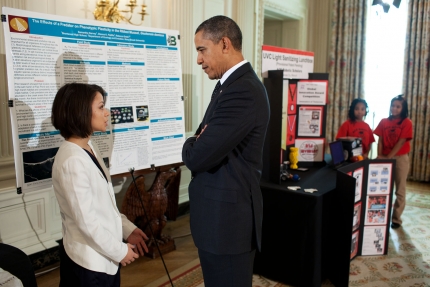
President Obama Speaks to Samantha Garvey

President Barack Obama hosts the second White House Science Fair celebrating the student winners of a broad range of science, technology, engineering and math (STEM) competitions from across the country. The President talked with Samantha Garvey, 18, of Bay Shore, N.Y., about her environmental sciences project examining the effect of physical environment and predators on a specific species of mussel, in the State Dining Room of the White House, Feb. 7, 2012. (Official White House Photo by Pete Souza)

Today, President Obama hosted the second-ever White House Science Fair, featuring research and inventions from more than 100 students representing 30 student teams. From robots in the Blue Room to rockets in the Red Room to marshmallow cannons in the State Dining Room, projects showcased the talents of America’s next generation of scientists, engineers, inventors, and innovators.

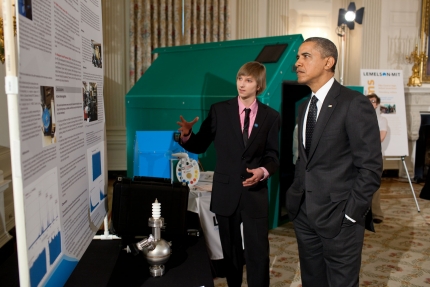
President Obama Speaks to Taylor Wilson

President Barack Obama hosts the second White House Science Fair celebrating the student winners of a broad range of science, technology, engineering and math (STEM) competitions from across the country, in the State Dining Room of the White House, Feb. 7, 2012. Taylor Wilson, 17, of Reno, Nevada conducted research on novel techniques for detecting nuclear threats and developed an environmentally friendly, cost-effective, and highly sensitive system capable of detecting small quantities of nuclear material. (Official White House Photo by Pete Souza)

After viewing some of the displays and talking with students about their work, the President addressed students, parents, and teachers in the East Room.

“When students excel in math and science, they help America compete for the jobs and industries of the future,” said President Obama. “That’s why I’m proud to celebrate outstanding students at the White House Science Fair, and to announce new steps my Administration and its partners are taking to help more young people succeed in these critical subjects."

Related Topics: Education, Technology, Nevada, New York

President Obama Speaks at White House Science Fair

February 07, 2012 | 13:22 | Public Domain

President Obama honors the hard work and extraordinary talent of students participating in the second White House Science Fair.

Download mp4 (128MB) | mp3 (12MB)

Read the Transcript

Remarks by the President at the White House Science Fair

East Room

11:53 A.M. EST

THE PRESIDENT:  Thank you.  (Applause.)  Thank you so much.  Thank you, everybody.  Everybody have a seat.

Well, welcome to the White House Science Fair.  (Applause.)  It is -- I just spent some time checking out some of the projects that were brought here today, and I’ve got to say, this is fun.  It’s not every day that you have robots running all over your house.  (Laughter.)  I am trying to figure out how you got through the metal detectors.  I also shot a marshmallow through a air gun, which was very exciting.  (Laughter.)

Science is what got several of our guests where they are today, so I just want to make a couple of introductions.  We’ve got a real-life astronaut and the head of NASA, Charles Bolden, in the house.  (Applause.)  We have the Administrator of the EPA, Lisa Jackson is here.  (Applause.)  The Director of the National Science Foundation Subra Suresh is here.  (Applause.)  My science -- there’s Subra, over here -- my science advisor, John Holdren, is in the house.  (Applause.)  We’ve got a couple of people who’ve dedicated themselves to making science cool for young people.  We’ve got Neil deGrasse Tyson and Bill Nye the Science Guy.  (Applause.)

Now, it is fitting that this year’s fair is happening just two days after the Super Bowl.  I want to congratulate the New York Giants and all their fans.  (Applause.)  I just talked to Coach Coughlin; I’m looking forward to having the Giants here at the White House so we can celebrate their achievements.  But what I’ve also said -- I’ve said this many times -- is if we are recognizing athletic achievement, then we should also be recognizing academic achievement and science achievement.  If we invite the team that wins the Super Bowl to the White House, then we need to invite some science fair winners to the White House as well.  (Applause.)

Now I’m going to talk about how great all of you are in a second.  But before I do, I want to give the parents a big round of applause because they work hard to help you succeed, and I know this is their day.  They’re really proud of you.  As a parent, I know that seeing your kids do extraordinary things brings the greatest happiness that a parent can have.  So congratulations to all the parents of all these incredible young people.  (Applause.)

But parents aren’t the only ones who helped you get this far.  Every one of you can think of a teacher, or maybe a couple of teachers, without whom you would not be here.  So I want you to promise that the next time you see those teachers, that you give them a big thank you, not just for yourselves but also from me.  Because teachers matter.  They deserve our support.  And I want to make sure that we are constantly lifting up how important teachers are to making sure that not only you succeed, but this country succeeds.  So give teachers a big round of applause.  (Applause.)

Now, as I was walking around the science fair, I was thinking back to when I was your age.  And basically, you guys put me to shame.  (Laughter.)  What impresses me so much is not just how smart you are, but it’s the fact that you recognize you’ve got a responsibility to use your talents in service of something bigger than yourselves. 

Some of you, that means developing new products that will change the way we live.  So Hayley Hoverter -- where’s Hayley?  There she is, right over here -- invented a new type of sugar packet that dissolves in hot water.  It’s flavorless, it’s colorless, and potentially could save up to 2 million pounds of trash each year -- and that’s just at Starbucks.  (Laughter.)   So MasterCard has already awarded her $10,000 to help turn her idea into a business.

Some of you are here because you saw a problem in your community and you’re trying to do something to solve it.  Benjamin Hylak -- where’s Benjamin?  There’s Benjamin right here -- was worried that folks at his grandmother’s senior center were getting lonely.  So he built a robot with a monitor and a video camera, so it’s like a moving Skype.  And it moves around the center, and it allows seniors to talk to their kids and their grandkids, even when they can’t visit in person.  So inventions like Benjamin’s could make life better for millions of families.

For some of you, the journey you took to get here is just as inspiring as the work that you brought with you today.  There’s a rocketry team from Presidio, Texas -- where’s my team here?  Where are you?  Stand up, guys.  Stand up.  This is part of the fourth-poorest school district in the state of Texas.  And I was told that teachers cooked food to sell after church, supporters drove 200 miles to pick up donuts for bake sales, they even raffled off a goat -- (laughter) -- is that right?  Just so they could raise enough money for the rocketry team to compete.  And the majority of the kids at the school are ESL, English as a second language.  And the presentation they made could not make you prouder.  So way to go.  (Applause.)

There’s a group of young engineers from Paul Robeson-Malcolm X Academy.  And nobody needs to tell them the kinds of challenges that Detroit still faces.  Where’s my team from Detroit?  In the house -- there they are.  Stand up.  (Applause.)  They believe in their city, and they’re coming up with new ideas to keep Detroit’s comeback going.

And there’s Samantha Garvey -- where’s Samantha?  Just saw Samantha.  There she is.  Stand up, Samantha.  (Applause.)  Samantha spent years studying mussel populations in the Long Island Sound.  And when she learned that she was a semifinalist for the Intel Science Talent Search, when she found this out her family was living in a homeless shelter.  So think about what she’s overcome.  She wants to, by the way, work maybe for NOAA or EPA.  So this is Dr. Lubchenco, she’s the head of NOAA.  (Laughter.)  Lisa Jackson, right there, head of EPA.  (Laughter.)  You might just want to hook up with them before you leave.  (Laughter and applause.)

The young people I met today, the young people behind me -- you guys inspire me.  It’s young people like you that make me so confident that America’s best days are still to come.  When you work and study and excel at what you’re doing in math and science, when you compete in something like this, you’re not just trying to win a prize today.  You’re getting America in shape to win the future.  You’re making sure we have the best, smartest, most skilled workers in the world, so that the jobs and industries of tomorrow take root right here.  You’re making sure we’ll always be home to the most creative entrepreneurs, the most advanced science labs and universities.  You’re making sure America will win the race to the future. 

So as an American, I’m proud of you.  As your President, I think we need to make sure your success stories are happening all across our country.

And that’s why when I took office, I called for an all-hands-on-deck approach to science, math, technology and engineering.  Let’s train more teachers.  Let’s get more kids studying these subjects.  Let’s make sure these fields get the respect and attention that they deserve.

But it’s not just a government effort.  I’m happy to say that the private sector has answered that call as well.  They understand how important it is to their future.  So today, led by the Carnegie Corporation, a group of businesses and foundations is announcing a $22 million fund to help train 100,000 new science and math teachers.  A coalition of more than 100 CEOs is expanding innovative math and science programs to 130 sites across the country.  And other companies are partnering from -- everybody from Will.i.am to Dean Kamen -- to make sure we celebrate young scientists and inventors and engineers, not just at the White House, but in every city and every town all across America.

And many of these leaders are here today, and I want to thank them for doing their part.  We’re going to do everything we can to partner to help you succeed in your projects.  And I’m proud to announce that the budget I unveil next week will include programs to help prepare new math and science teachers, and to meet an ambitious goal, which is 1 million more American graduates in science, technology, engineering and math over the next 10 years.  That is a goal we can achieve.  (Applause.)  That’s a goal we can achieve.

Now, in a lot of ways, today is a celebration of the new.  But the belief that we belong on the cutting edge of innovation -- that’s an idea as old as America itself.  I mean, we’re a nation of tinkerers and dreamers and believers in a better tomorrow.  You think about our Founding Fathers -- they were all out there doing experiments -- and folks like Benjamin Franklin and Thomas Jefferson, they were constantly curious about the world around them and trying to figure out how can we help shape that environment so that people’s lives are better.

It’s in our DNA.  We know that innovation has helped each generation pass down that basic American promise, which is no matter who you are, no matter where you come from, you can make it if you try.  So there’s nothing more important than keeping that promise alive for the next generation.  There’s no priority I have that’s higher than President -- as President than this.

And I can’t think of a better way to spend a morning than with the young people who are here doing their part and creating some unbelievable stuff in the process.  So I’m proud of you.  I want you to keep up your good work.

I’m going to make a special plea to the press -- not just the folks who are here, but also your editors -- give this some attention.  I mean, this is the kind of stuff, what these young people are doing, that’s going to make a bigger difference in the life of our country over the long term than just about anything.  And it doesn’t belong just on the back pages of a newspaper; we’ve got to lift this up.  We’ve got to emphasize how important this is and recognize these incredible young people who are doing things that I couldn’t even imagine thinking about at 5th grade or 8th grade or in high school.

And so pay attention to this.  This is important.  This is what’s going to make a difference in this country over the long haul.  This is what inspires me and gets me up every day.  This is what we should be focusing on in our public debates.

And as for all the folks who are here, don’t let your robots wander off anywhere.  (Laughter.)   All right?

Thank you, everybody.  Appreciate it.  Congratulations.  (Applause.)

END
12:07 P.M. EST

Close Transcript

The White House

Office of the Press Secretary

Readout of the President’s Call with Coach Coughlin of the New York Giants

This morning, President Obama called New York Giants head coach Tom Coughlin to congratulate him and the rest of the team on their recent Super Bowl victory.  The President said that the team’s victory was a testament to Coach Coughlin’s leadership and that his team came across with true grit and determination.   President Obama told Coach Coughlin that he looks forward to shaking his hand and congratulating the team in person when they visit the White House.

The White House

Office of the Press Secretary

Statement by the Press Secretary on the Visit of Brazilian President Rousseff

On April 9, President Obama will host President Dilma Rousseff of Brazil for meetings at the White House as part of the Leaders’ on-going dialogue regarding the growing partnership between the United States and Brazil across a wide range of issues.  The Presidents will have the opportunity to follow up on progress made under the three presidential dialogues launched during President Obama’s March 2011 visit to Brazil – the Strategic Energy Dialogue, the Economic and Financial Dialogue, and the Global Partnership Dialogue.  These meetings will also provide the two Leaders the opportunity to again meet with the U.S.-Brazil CEO Forum and continue efforts to grow commercial, economic, education, and innovation ties between our two countries.

President Obama looks forward to discussing cooperation on a host of other bilateral, regional, and multilateral issues, especially as he looks towards his participation in the Summit of the Americas in Colombia in April and the G-20 in Mexico in June.

The White House

Office of the Press Secretary

Remarks by the President at the White House Science Fair

East Room

11:53 A.M. EST

THE PRESIDENT:  Thank you.  (Applause.)  Thank you so much.  Thank you, everybody.  Everybody have a seat.

Well, welcome to the White House Science Fair.  (Applause.)  It is -- I just spent some time checking out some of the projects that were brought here today, and I’ve got to say, this is fun.  It’s not every day that you have robots running all over your house.  (Laughter.)  I am trying to figure out how you got through the metal detectors.  I also shot a marshmallow through a air gun, which was very exciting.  (Laughter.)

Science is what got several of our guests where they are today, so I just want to make a couple of introductions.  We’ve got a real-life astronaut and the head of NASA, Charles Bolden, in the house.  (Applause.)  We have the Administrator of the EPA, Lisa Jackson is here.  (Applause.)  The Director of the National Science Foundation Subra Suresh is here.  (Applause.)  My science -- there’s Subra, over here -- my science advisor, John Holdren, is in the house.  (Applause.)  We’ve got a couple of people who’ve dedicated themselves to making science cool for young people.  We’ve got Neil deGrasse Tyson and Bill Nye the Science Guy.  (Applause.)

Now, it is fitting that this year’s fair is happening just two days after the Super Bowl.  I want to congratulate the New York Giants and all their fans.  (Applause.)  I just talked to Coach Coughlin; I’m looking forward to having the Giants here at the White House so we can celebrate their achievements.  But what I’ve also said -- I’ve said this many times -- is if we are recognizing athletic achievement, then we should also be recognizing academic achievement and science achievement.  If we invite the team that wins the Super Bowl to the White House, then we need to invite some science fair winners to the White House as well.  (Applause.)

Now I’m going to talk about how great all of you are in a second.  But before I do, I want to give the parents a big round of applause because they work hard to help you succeed, and I know this is their day.  They’re really proud of you.  As a parent, I know that seeing your kids do extraordinary things brings the greatest happiness that a parent can have.  So congratulations to all the parents of all these incredible young people.  (Applause.)

But parents aren’t the only ones who helped you get this far.  Every one of you can think of a teacher, or maybe a couple of teachers, without whom you would not be here.  So I want you to promise that the next time you see those teachers, that you give them a big thank you, not just for yourselves but also from me.  Because teachers matter.  They deserve our support.  And I want to make sure that we are constantly lifting up how important teachers are to making sure that not only you succeed, but this country succeeds.  So give teachers a big round of applause.  (Applause.)

Now, as I was walking around the science fair, I was thinking back to when I was your age.  And basically, you guys put me to shame.  (Laughter.)  What impresses me so much is not just how smart you are, but it’s the fact that you recognize you’ve got a responsibility to use your talents in service of something bigger than yourselves. 

Some of you, that means developing new products that will change the way we live.  So Hayley Hoverter -- where’s Hayley?  There she is, right over here -- invented a new type of sugar packet that dissolves in hot water.  It’s flavorless, it’s colorless, and potentially could save up to 2 million pounds of trash each year -- and that’s just at Starbucks.  (Laughter.)   So MasterCard has already awarded her $10,000 to help turn her idea into a business.

Some of you are here because you saw a problem in your community and you’re trying to do something to solve it.  Benjamin Hylak -- where’s Benjamin?  There’s Benjamin right here -- was worried that folks at his grandmother’s senior center were getting lonely.  So he built a robot with a monitor and a video camera, so it’s like a moving Skype.  And it moves around the center, and it allows seniors to talk to their kids and their grandkids, even when they can’t visit in person.  So inventions like Benjamin’s could make life better for millions of families.

For some of you, the journey you took to get here is just as inspiring as the work that you brought with you today.  There’s a rocketry team from Presidio, Texas -- where’s my team here?  Where are you?  Stand up, guys.  Stand up.  This is part of the fourth-poorest school district in the state of Texas.  And I was told that teachers cooked food to sell after church, supporters drove 200 miles to pick up donuts for bake sales, they even raffled off a goat -- (laughter) -- is that right?  Just so they could raise enough money for the rocketry team to compete.  And the majority of the kids at the school are ESL, English as a second language.  And the presentation they made could not make you prouder.  So way to go.  (Applause.)

There’s a group of young engineers from Paul Robeson-Malcolm X Academy.  And nobody needs to tell them the kinds of challenges that Detroit still faces.  Where’s my team from Detroit?  In the house -- there they are.  Stand up.  (Applause.)  They believe in their city, and they’re coming up with new ideas to keep Detroit’s comeback going.

And there’s Samantha Garvey -- where’s Samantha?  Just saw Samantha.  There she is.  Stand up, Samantha.  (Applause.)  Samantha spent years studying mussel populations in the Long Island Sound.  And when she learned that she was a semifinalist for the Intel Science Talent Search, when she found this out her family was living in a homeless shelter.  So think about what she’s overcome.  She wants to, by the way, work maybe for NOAA or EPA.  So this is Dr. Lubchenco, she’s the head of NOAA.  (Laughter.)  Lisa Jackson, right there, head of EPA.  (Laughter.)  You might just want to hook up with them before you leave.  (Laughter and applause.)

The young people I met today, the young people behind me -- you guys inspire me.  It’s young people like you that make me so confident that America’s best days are still to come.  When you work and study and excel at what you’re doing in math and science, when you compete in something like this, you’re not just trying to win a prize today.  You’re getting America in shape to win the future.  You’re making sure we have the best, smartest, most skilled workers in the world, so that the jobs and industries of tomorrow take root right here.  You’re making sure we’ll always be home to the most creative entrepreneurs, the most advanced science labs and universities.  You’re making sure America will win the race to the future. 

So as an American, I’m proud of you.  As your President, I think we need to make sure your success stories are happening all across our country.

And that’s why when I took office, I called for an all-hands-on-deck approach to science, math, technology and engineering.  Let’s train more teachers.  Let’s get more kids studying these subjects.  Let’s make sure these fields get the respect and attention that they deserve.

But it’s not just a government effort.  I’m happy to say that the private sector has answered that call as well.  They understand how important it is to their future.  So today, led by the Carnegie Corporation, a group of businesses and foundations is announcing a $22 million fund to help train 100,000 new science and math teachers.  A coalition of more than 100 CEOs is expanding innovative math and science programs to 130 sites across the country.  And other companies are partnering from -- everybody from Will.i.am to Dean Kamen -- to make sure we celebrate young scientists and inventors and engineers, not just at the White House, but in every city and every town all across America.

And many of these leaders are here today, and I want to thank them for doing their part.  We’re going to do everything we can to partner to help you succeed in your projects.  And I’m proud to announce that the budget I unveil next week will include programs to help prepare new math and science teachers, and to meet an ambitious goal, which is 1 million more American graduates in science, technology, engineering and math over the next 10 years.  That is a goal we can achieve.  (Applause.)  That’s a goal we can achieve.

Now, in a lot of ways, today is a celebration of the new.  But the belief that we belong on the cutting edge of innovation -- that’s an idea as old as America itself.  I mean, we’re a nation of tinkerers and dreamers and believers in a better tomorrow.  You think about our Founding Fathers -- they were all out there doing experiments -- and folks like Benjamin Franklin and Thomas Jefferson, they were constantly curious about the world around them and trying to figure out how can we help shape that environment so that people’s lives are better.

It’s in our DNA.  We know that innovation has helped each generation pass down that basic American promise, which is no matter who you are, no matter where you come from, you can make it if you try.  So there’s nothing more important than keeping that promise alive for the next generation.  There’s no priority I have that’s higher than President -- as President than this.

And I can’t think of a better way to spend a morning than with the young people who are here doing their part and creating some unbelievable stuff in the process.  So I’m proud of you.  I want you to keep up your good work.

I’m going to make a special plea to the press -- not just the folks who are here, but also your editors -- give this some attention.  I mean, this is the kind of stuff, what these young people are doing, that’s going to make a bigger difference in the life of our country over the long term than just about anything.  And it doesn’t belong just on the back pages of a newspaper; we’ve got to lift this up.  We’ve got to emphasize how important this is and recognize these incredible young people who are doing things that I couldn’t even imagine thinking about at 5th grade or 8th grade or in high school.

And so pay attention to this.  This is important.  This is what’s going to make a difference in this country over the long haul.  This is what inspires me and gets me up every day.  This is what we should be focusing on in our public debates.

And as for all the folks who are here, don’t let your robots wander off anywhere.  (Laughter.)   All right?

Thank you, everybody.  Appreciate it.  Congratulations.  (Applause.)

END
12:07 P.M. EST