The White House

Office of the Press Secretary

Statement by the Press Secretary on the Visit of British Prime Minister Cameron

President Obama and the First Lady will welcome Prime Minister David Cameron of the United Kingdom of Great Britain and Northern Ireland and his wife, Samantha Cameron, to the White House for an Official Visit with a State Dinner on March 13-14, 2012. The visit will highlight the fundamental importance of the U.S.-UK special relationship and the depth of the friendship between the American people and the people of the United Kingdom, as well as the strong personal bond that has developed between the two leaders and their families.  It will also be an opportunity to recall the valor and sacrifice of the U.S. and British armed forces and their long tradition of standing shoulder-to-shoulder beside each other in defense of our liberties and shared values.  The visit will underscore the strength of our economic links, which contribute to millions of jobs on both sides of the Atlantic.  The Prime Minister’s visit will reciprocate the gracious hospitality shown to the President and Mrs. Obama by Her Majesty Queen Elizabeth II, Mr. and Mrs. Cameron, and the British people during the State Visit that was hosted by Queen Elizabeth II in May 2011.

During the visit, the President and the Prime Minister are expected to discuss the upcoming NATO and G-8 summits, as well as the broad array of global issues on which the United States and the United Kingdom cooperate closely in order to advance our common values and shared interests, including: Afghanistan, the Middle East, Iran, human rights, and global economic stability and growth.  They will also review progress in the implementation of the various initiatives launched during the President’s State Visit to the UK last year.

Tuskegee Airmen visit the White House

February 02, 2012 | 2:29 | Public Domain

The President and the First Lady host Tuskegee Airmen along with cast and crew members of the movie Red Tails for a screening at the White House.

Download mp4 (60MB)

The White House

Office of the Press Secretary

Remarks by the President at the National Prayer Breakfast

Washington Hilton
Washington, D.C.

9:10 A.M. EST

THE PRESIDENT:  Thank you.  Please, please, everybody have a seat.  Well, good morning, everybody.  It is good to be with so many friends united in prayer.  And I begin by giving all praise and honor to God for bringing us together here today.

I want to thank our co-chairs Mark and Jeff; to my dear friend, the guy who always has my back, Vice President Biden.  (Applause.)  All the members of Congress –- Joe deserves a hand –- all the members of Congress and my Cabinet who are here today; all the distinguished guests who’ve traveled a long way to be part of this.  I’m not going to be as funny as Eric -- (laughter) -- but I’m grateful that he shared his message with us.  Michelle and I feel truly blessed to be here.

This is my third year coming to this prayer breakfast as President.  As Jeff mentioned, before that, I came as senator.  I have to say, it’s easier coming as President.  (Laughter.)  I don’t have to get here quite as early.  But it’s always been an opportunity that I’ve cherished.  And it’s a chance to step back for a moment, for us to come together as brothers and sisters and seek God’s face together.  At a time when it’s easy to lose ourselves in the rush and clamor of our own lives, or get caught up in the noise and rancor that too often passes as politics today, these moments of prayer slow us down.  They humble us.  They remind us that no matter how much responsibility we have, how fancy our titles, how much power we think we hold, we are imperfect vessels.  We can all benefit from turning to our Creator, listening to Him.  Avoiding phony religiosity, listening to Him.  
    
This is especially important right now, when we’re facing some big challenges as a nation.  Our economy is making progress as we recover from the worst crisis in three generations, but far too many families are still struggling to find work or make the mortgage, pay for college, or, in some cases, even buy food.  Our men and women in uniform have made us safer and more secure, and we were eternally grateful to them, but war and suffering and hardship still remain in too many corners of the globe.  And a lot of those men and women who we celebrate on Veterans Day and Memorial Day come back and find that, when it comes to finding a job or getting the kind of care that they need, we’re not always there the way we need to be.

It’s absolutely true that meeting these challenges requires sound decision-making, requires smart policies.  We know that part of living in a pluralistic society means that our personal religious beliefs alone can’t dictate our response to every challenge we face. 

But in my moments of prayer, I’m reminded that faith and values play an enormous role in motivating us to solve some of our most urgent problems, in keeping us going when we suffer setbacks, and opening our minds and our hearts to the needs of others. 

We can’t leave our values at the door.  If we leave our values at the door, we abandon much of the moral glue that has held our nation together for centuries, and allowed us to become somewhat more perfect a union.  Frederick Douglass, Abraham Lincoln, Jane Addams, Martin Luther King, Jr., Dorothy Day, Abraham Heschel -- the majority of great reformers in American history did their work not just because it was sound policy, or they had done good analysis, or understood how to exercise good politics, but because their faith and their values dictated it, and called for bold action -- sometimes in the face of indifference, sometimes in the face of resistance.

This is no different today for millions of Americans, and it’s certainly not for me.

I wake up each morning and I say a brief prayer, and I spend a little time in scripture and devotion.  And from time to time, friends of mine, some of who are here today, friends like Joel Hunter or T.D. Jakes, will come by the Oval Office or they’ll call on the phone or they’ll send me a email, and we’ll pray together, and they’ll pray for me and my family, and for our country.

But I don’t stop there.  I’d be remiss if I stopped there; if my values were limited to personal moments of prayer or private conversations with pastors or friends.  So instead, I must try -- imperfectly, but I must try -- to make sure those values motivate me as one leader of this great nation.

And so when I talk about our financial institutions playing by the same rules as folks on Main Street, when I talk about making sure insurance companies aren’t discriminating against those who are already sick, or making sure that unscrupulous lenders aren’t taking advantage of the most vulnerable among us, I do so because I genuinely believe it will make the economy stronger for everybody.  But I also do it because I know that far too many neighbors in our country have been hurt and treated unfairly over the last few years, and I believe in God’s command to “love thy neighbor as thyself.”  I know the version of that Golden Rule is found in every major religion and every set of beliefs -– from Hinduism to Islam to Judaism to the writings of Plato. 

And when I talk about shared responsibility, it’s because I genuinely believe that in a time when many folks are struggling, at a time when we have enormous deficits, it’s hard for me to ask seniors on a fixed income, or young people with student loans, or middle-class families who can barely pay the bills to shoulder the burden alone.  And I think to myself, if I’m willing to give something up as somebody who’s been extraordinarily blessed, and give up some of the tax breaks that I enjoy, I actually think that’s going to make economic sense.

But for me as a Christian, it also coincides with Jesus’s teaching that “for unto whom much is given, much shall be required.”  It mirrors the Islamic belief that those who’ve been blessed have an obligation to use those blessings to help others, or the Jewish doctrine of moderation and consideration for others.

When I talk about giving every American a fair shot at opportunity, it’s because I believe that when a young person can afford a college education, or someone who’s been unemployed suddenly has a chance to retrain for a job and regain that sense of dignity and pride, and contributing to the community as well as supporting their families -- that helps us all prosper. 

It means maybe that research lab on the cusp of a lifesaving discovery, or the company looking for skilled workers is going to do a little bit better, and we’ll all do better as a consequence.  It makes economic sense.  But part of that belief comes from my faith in the idea that I am my brother’s keeper and I am my sister’s keeper; that as a country, we rise and fall together.  I’m not an island.  I’m not alone in my success.  I succeed because others succeed with me.

And when I decide to stand up for foreign aid, or prevent atrocities in places like Uganda, or take on issues like human trafficking, it’s not just about strengthening alliances, or promoting democratic values, or projecting American leadership around the world, although it does all those things and it will make us safer and more secure.  It’s also about the biblical call to care for the least of these –- for the poor; for those at the margins of our society. 

To answer the responsibility we’re given in Proverbs to “Speak up for those who cannot speak for themselves, for the rights of all who are destitute.”  And for others, it may reflect the Jewish belief that the highest form of charity is to do our part to help others stand on their own. 

Treating others as you want to be treated.  Requiring much from those who have been given so much.  Living by the principle that we are our brother’s keeper.  Caring for the poor and those in need.  These values are old.  They can be found in many denominations and many faiths, among many believers and among many non-believers.  And they are values that have always made this country great -- when we live up to them; when we don’t just give lip service to them; when we don’t just talk about them one day a year.  And they’re the ones that have defined my own faith journey. 

And today, with as many challenges as we face, these are the values I believe we’re going to have to return to in the hopes that God will buttress our efforts.

Now, we can earnestly seek to see these values lived out in our politics and our policies, and we can earnestly disagree on the best way to achieve these values.  In the words of C.S. Lewis, “Christianity has not, and does not profess to have a detailed political program.  It is meant for all men at all times, and the particular program which suited one place or time would not suit another.” 

Our goal should not be to declare our policies as biblical.  It is God who is infallible, not us.  Michelle reminds me of this often.  (Laughter.)  So instead, it is our hope that people of goodwill can pursue their values and common ground and the common good as best they know how, with respect for each other.  And I have to say that sometimes we talk about respect, but we don’t act with respect towards each other during the course of these debates.

But each and every day, for many in this room, the biblical injunctions are not just words, they are also deeds.  Every single day, in different ways, so many of you are living out your faith in service to others. 

Just last month, it was inspiring to see thousands of young Christians filling the Georgia Dome at the Passion Conference, to worship the God who sets the captives free and work to end modern slavery.  Since we’ve expanded and strengthened the White House faith-based initiative, we’ve partnered with Catholic Charities to help Americans who are struggling with poverty; worked with organizations like World Vision and American Jewish World Service and Islamic Relief to bring hope to those suffering around the world.  

Colleges across the country have answered our Interfaith Campus Challenge, and students are joined together across religious lines in service to others.  From promoting responsible fatherhood to strengthening adoption, from helping people find jobs to serving our veterans, we’re linking arms with faith-based groups all across the country. 

I think we all understand that these values cannot truly find voice in our politics and our policies unless they find a place in our hearts.  The Bible teaches us to “be doers of the word and not merely hearers.”  We’re required to have a living, breathing, active faith in our own lives.  And each of us is called on to give something of ourselves for the betterment of others -- and to live the truth of our faith not just with words, but with deeds.  

So even as we join the great debates of our age -- how we best put people back to work, how we ensure opportunity for every child, the role of government in protecting this extraordinary planet that God has made for us, how we lessen the occasions of war -- even as we debate these great issues, we must be reminded of the difference that we can make each day in our small interactions, in our personal lives.

As a loving husband, or a supportive parent, or a good neighbor, or a helpful colleague -- in each of these roles, we help bring His kingdom to Earth.  And as important as government policy may be in shaping our world, we are reminded that it’s the cumulative acts of kindness and courage and charity and love, it’s the respect we show each other and the generosity that we share with each other that in our everyday lives will somehow sustain us during these challenging times.  John tells us that, “If anyone has material possessions and sees his brother in need but has no pity on him, how can the love of God be in him?  Dear children, let us not love with words or tongue but with actions and in truth.”

Mark read a letter from Billy Graham, and it took me back to one of the great honors of my life, which was visiting Reverend Graham at his mountaintop retreat in North Carolina, when I was on vacation with my family at a hotel not far away.

And I can still remember winding up the path up a mountain to his home.  Ninety-one years old at the time, facing various health challenges, he welcomed me as he would welcome a family member or a close friend.  This man who had prayed great prayers that inspired a nation, this man who seemed larger than life, greeted me and was as kind and as gentle as could be.

And we had a wonderful conversation.  Before I left, Reverend Graham started praying for me, as he had prayed for so many Presidents before me.  And when he finished praying, I felt the urge to pray for him.  I didn’t really know what to say.  What do you pray for when it comes to the man who has prayed for so many?  But like that verse in Romans, the Holy Spirit interceded when I didn’t know quite what to say.

And so I prayed -- briefly, but I prayed from the heart.  I don’t have the intellectual capacity or the lung capacity of some of my great preacher friends here that have prayed for a long time.  (Laughter.)  But I prayed.  And we ended with an embrace and a warm goodbye.

And I thought about that moment all the way down the mountain, and I’ve thought about it in the many days since.  Because I thought about my own spiritual journey –- growing up in a household that wasn’t particularly religious; going through my own period of doubt and confusion; finding Christ when I wasn’t even looking for him so many years ago; possessing so many shortcomings that have been overcome by the simple grace of God.  And the fact that I would ever be on top of a mountain, saying a prayer for Billy Graham –- a man whose faith had changed the world and that had sustained him through triumphs and tragedies, and movements and milestones –- that simple fact humbled me to my core.

I have fallen on my knees with great regularity since that moment -- asking God for guidance not just in my personal life and my Christian walk, but in the life of this nation and in the values that hold us together and keep us strong.  I know that He will guide us.  He always has, and He always will.  And I pray his richest blessings on each of you in the days ahead.

Thank you very much.  (Applause.)

END              
9:30 A.M. EST

President Obama Talks About Ways to Help Homeowners

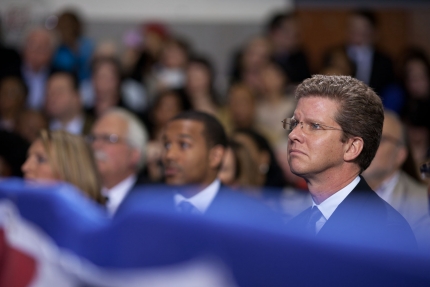
HUD Secretary Shaun Donovan listens as President Obama delivers remarks on housing (February 1, 2012)

Housing and Urban Development Secretary Shaun Donovan listens as President Barack Obama delivers remarks on housing and the Homeowners Bill of Rights at the James Lee Community Center in Falls Church, Va., Feb. 1, 2012. (Official White House Photo by Pete Souza)

Today, in Falls Church, Virginia, President Obama expanded on the ideas he first presented in the State of the Union on ways to help responsible homeowners refinance their mortgages.

Here are more details about that plan.

But the President also said that we can't wait on Congress to take action to help working families in this country:

Already, we’ve set up a special task force I asked my Attorney General to establish to investigate the kind of activity banks took when they packaged and sold risky mortgages.  And that task force is ramping up its work as we speak. We’re going to keep at it and hold people who broke the law accountable and help restore confidence in the market.  We’re going to speed assistance to homeowners. And we’re going to turn the page on an era of recklessness that hurt so many hardworking Americans. 

Read the full remarks here. Or watch the video to learn more.

Read the Transcript  |  Download Video: mp4 (183MB) | mp3 (18MB)
 

Learn more


Related Topics: Economy, Virginia

The White House

Office of the Press Secretary

Presidential Nominations and Withdrawals Sent to the Senate

NOMINATIONS SENT TO THE SENATE:

Michael A. Botticelli, of Massachusetts, to be Deputy Director of National Drug Control Policy, vice A. Thomas McLellan.

Christy L. Romero, of Virginia, to be Special Inspector General for the Troubled Asset Relief Program, vice Neil M. Barofsky, resigned.

WITHDRAWALS SENT TO THE SENATE:

Alan D. Bersin, of California, to be Commissioner of Customs, Department of Homeland Security, vice W. Ralph Basham, which was sent to the Senate on January 26, 2011.

John D. Podesta, of the District of Columbia, to be a Member of the Board of Directors of the Corporation for National and Community Service for a term expiring October 6, 2014, vice Alan D. Solomont, resigned, which was sent to the Senate on January 26, 2011.

The White House

Office of the Press Secretary

President Obama Signs Utah Disaster Declaration

The President today declared a major disaster exists in the State of Utah and ordered Federal aid to supplement state and local recovery efforts in the area affected by a severe storm during the period of November 30 to December 1, 2011.

Federal funding is available to state and eligible local governments and certain private nonprofit organizations on a cost-sharing basis for emergency work and the repair or replacement of facilities damaged by the severe storm in Davis County.

Federal funding is also available on a cost-sharing basis for hazard mitigation measures statewide.

W. Craig Fugate, Administrator, Federal Emergency Management Agency (FEMA), Department of Homeland Security, named Gary R. Stanley as the Federal Coordinating Officer for federal recovery operations in the affected area. 

FEMA said additional designations may be made at a later date if requested by the state and warranted by the results of further damage assessments.

The White House

Office of the Press Secretary

President Obama Signs Alabama Disaster Declaration

The President today declared a major disaster exists in the State of Alabama and ordered Federal aid to supplement state and local recovery efforts in the area affected by severe storms, tornadoes, straight-line winds, and flooding during the period of January 22-23, 2012.

The President's action makes federal funding available to affected individuals in Chilton and Jefferson Counties.

Assistance can include grants for temporary housing and home repairs, low-cost loans to cover uninsured property losses, and other programs to help individuals and business owners recover from the effects of the disaster.

Federal funding is also available on a cost-sharing basis for hazard mitigation measures statewide.

W. Craig Fugate, Administrator, Federal Emergency Management Agency (FEMA), Department of Homeland Security, named Joe M. Girot as the Federal Coordinating Officer for federal recovery operations in the affected area.

FEMA said that damage surveys are continuing in other areas, and more counties and additional forms of assistance may be designated after the assessments are fully completed.

FEMA said that residents and business owners who sustained losses in the designated counties can begin applying for assistance tomorrow by registering online at http://www.DisasterAssistance.gov or by calling 1-800-621-FEMA(3362) or 1-800-462-7585 (TTY) for the hearing and speech impaired.  The toll-free telephone numbers will operate from 7 a.m. to 10 p.m. (local time) seven days a week until further notice. 

The White House

Office of the Press Secretary

Statement by the Press Secretary on H.R. 3237

On Wednesday, February 1, 2012, the President signed into law:

H.R. 3237, the "SOAR Technical Corrections Act," which clarifies and makes technical corrections to provisions of the Scholarships for Opportunity and Results (SOAR) Act, which provides scholarships to certain students in District of Columbia schools.

President Obama Speaks on Helping Homeowners

February 01, 2012 | 19:09 | Public Domain

President Obama discusses a proposal to help more responsible homeowners refinance their mortgages at today’s historically low interest rates.

Download mp4 (183MB) | mp3 (18MB)

Read the Transcript

Remarks by the President on Housing

James Lee Community Center
Falls Church, Virginia

11:05 A.M. EST

THE PRESIDENT:  Hello, everybody!  (Applause.)  Thank you so much.  Thank you.  (Applause.)  Thank you so much.  Everybody please have a seat.  Have a seat.  It is great to be back in Falls Church.  (Applause.)  Thank you for having me. 

Last week, in my State of the Union, I laid out my blueprint for an economy that’s built to last.  And I want to assure you I am not going to go over the whole thing again this morning.  (Laughter.)  That was a long speech.  I'm not going to repeat the whole thing.  (Laughter.)  But I do want to talk about some of the issues that I discussed last week because the blueprint we put forward was one that focuses on restoring what have always been this country's greatest strengths -- American manufacturing, American energy, skills and education for American workers so that we can compete with anybody around the world in this 21st century economy, and most importantly, the American values of fairness and responsibility.  Fairness and responsibility.  (Applause.)

Now, we know what happens, because we've just seen it -- what happened when we stray from those values.  We saw what happened over the past decade when we strayed from those values  -- especially when it comes to the massive housing bubble that burst and hurt so many people.  Millions of families who did the right and the responsible thing, folks who shopped for a home that they could afford, secured a mortgage, made their payments each month -- they were hurt badly by the irresponsible actions of other people who weren’t playing by the same rules, weren’t taking the same care, weren’t acting as responsibly.  By lenders who sold loans to people who they knew couldn’t afford the mortgages; and buyers who bought homes they knew they couldn’t afford; and banks that packaged those mortgages up and traded them to reap phantom profits, knowing that they were building a house of cards. 

It was wrong.  It was wrong.  It triggered the worst economic crisis of our lifetimes.  And it has been the single biggest drag on our recovery from a terrible recession.  Crushing debt has kept millions of consumers from spending.  A lack of building demand has kept hundreds of thousands of construction workers idle.  Everybody involved in the home-building business  -- folks who make windows, folks who make carpets -- they've all been impacted.  The challenge is massive in size and in scope, because we've got a multitrillion-dollar housing industry.  And economists can tell you how it’s affected all sorts of statistics, from GDP to consumer confidence.

But what’s at stake is more than just statistics.  It’s personal.  I’ve been saying that this is a make-or-break moment for the middle class.  And this housing crisis struck right at the heart of what it means to be middle class in America:  our homes -- the place where we invest our nest egg, place where we raise our family, the place where we plant roots in a community, the place where we build memories. 

It’s personal.  It affects so much of how people feel about their lives, about their communities, about the country, about the economy.  We need to do everything in our power to repair the damage and make responsible families whole again.  Everything we can.  (Applause.) 

Now, the truth is it’s going to take more time than any of us would like for the housing market to fully recover from this crisis.  This was a big bubble, and when it burst it had a big effect.  Home prices started a pretty steady decline about five years ago.  And government certainly can’t fix the entire problem on its own.  But it is wrong for anybody to suggest that the only option for struggling, responsible homeowners is to sit and wait for the housing market to hit bottom.  (Applause.)  I refuse to accept that, and so do the American people.

There are more than 10 million homeowners across the country right now who, because of an unprecedented decline in home prices that is no fault of their own, owe more on their mortgage than their homes are worth.  It means your mortgage, your house is underwater. 

Here in Falls Church, home values have fallen by about a quarter from their peak.  In places like Las Vegas, more than half of all homeowners are underwater.  More than half.  So it’s going to take a while for those prices to rise again.  But there are actions we can take right now to provide some relief to folks who've been responsible, have done the right thing, and are making their payments on time. 

Already, thanks to the outstanding work, in part, of my Secretary of Housing and Urban Development, Shaun Donovan, who's here today -- (applause) -- yes, there he is, the good-looking guy in the front here.  (Laughter.)  The housing plan we launched a couple years ago has helped nearly 1 million responsible homeowners refinance their mortgages, and they’re saving an average of $300 on their payments each month -- $300 -- which is great.  (Applause.)  

But I’ll be honest -- the programs that we put forward haven’t worked at the scale that we hoped.  Not as many people have taken advantage of it as we wanted.  Mortgage rates are as low as they’ve been in half a century, and when that happens, usually homeowners flock to refinance their mortgages -- so a lot of people take advantage of it and save a lot of money.  But this time too many families haven’t been able to take advantage of the low rates, because falling prices lock them out of the market.  They were underwater; made it more difficult for them to refinance.

Then you’ve got all the fees involved in refinancing.  And a lot of people just said, you know what, even though I’d like to be, obviously, cutting down my monthly payment, the banks just aren’t being real encouraging.

So last year we took aggressive action that allowed more families to participate.  And today we’re doing even more.  This is the main reason I’m here today.  (Applause.)

As I indicated at the State of the Union last week, I am sending Congress a plan that will give every responsible homeowner in America the chance to save about $3,000 a year on their mortgage by refinancing at historically low rates.  (Applause.)  No more red tape.  No more runaround from the banks. And a small fee on the largest financial institutions will make sure it doesn’t add to our deficit.

I want to be clear:  This plan, like the other actions we’ve taken, will not help the neighbors down the street who bought a house they couldn’t afford, and then walked away and left a foreclosed home behind.  It’s not designed for those who’ve acted irresponsibly, but it can help those who’ve acted responsibly.  It’s not going to help those who bought multiple homes just to speculate and flip the house and make a quick buck, but it can help those who’ve acted responsibly.

What this plan will do is help millions of responsible homeowners who make their payments on time but find themselves trapped under falling home values or wrapped up in red tape. 

If you’re ineligible for refinancing just because you’re underwater on your mortgage, through no fault of your own, this plan changes that.  You’ll be able to refinance at a lower rate. You’ll be able to save hundreds of dollars a month that you can put back in your pocket.  Or you can choose those savings to rebuild equity in your homes, which will help most underwater homeowners come back up for air more quickly.

Now, to move this part of my plan, we’re going to need Congress to act.  We’re going to need Congress to act.  I hear some -- (laughter) -- murmuring in the audience here.  We need them to act.  But we’re not just going to wait for Congress.  We’re going to keep building a firewall to prevent the same kinds of abuses that led this crisis -- led to this crisis in the first place.  So there are things we can do administratively that are also going to help responsible homeowners.  (Applause.)

Already, we’ve set up a special task force I asked my Attorney General to establish to investigate the kind of activity banks took when they packaged and sold risky mortgages.  (Applause.)  And that task force is ramping up its work as we speak.  We’re going to keep at it and hold people who broke the law accountable and help restore confidence in the market.  We’re going to speed assistance to homeowners.  And we’re going to turn the page on an era of recklessness that hurt so many hardworking Americans.  (Applause.)

Today, I’m also proposing a Homeowners Bill of Rights -- one straightforward set of common-sense rules of the road that every family knows they can count on when they’re shopping for a mortgage.  No more hidden fees or conflicts of interest.  No more getting the runaround when you call about your loan.  No more fine print that you used to get families to take a deal that is not as good as the one they should have gotten.  New safeguards against inappropriate foreclosures.  New options to avoid foreclosure if you’ve fallen on hardship or a run of bad luck.  (Applause.)  And a new, simple, clear form for new buyers of a home.  (Applause.)

Now, think about it.  This is the most important purchase a family makes.  But how many of you have had to deal with overly complicated mortgage forms and hidden clauses and complex terms? I remember when Michelle and I bought our first condo -- and we're both lawyers.  (Laughter.)  And we’re looking through the forms and kind of holding it up -- (laughter) -- reading it again -- "What does this phrase mean?"  And that’s for two trained lawyers.  The forms, the confusion, the potential for abuse is too great just because the forms were too complicated.

So this is what a mortgage form should look like.  This is it.  (Applause.)  Now that our new consumer watchdog agency is finally running at full steam -- (applause) -- now that Richard Cordray is in as the Director of the Consumer Finance Protection Bureau -- (applause) -- they’re moving forward on important protections like this new, shorter mortgage form.  Simple, not complicated.  Informative, not confusing.  Terms are clear.  Fees are transparent. 

This, by the way, is what some of the folks in Congress are trying to roll back and prevent from happening.

AUDIENCE:  Booo --

THE PRESIDENT:  I guess they like complicated things that confuse consumers and allow them to be cheated.  I prefer actions that are taken to make things simpler and easier to understand for consumers -- (applause) -- so that they can get the best deal possible, especially on the biggest single investment that most people will ever make.  (Applause.) 

Americans making a down payment on their dreams shouldn’t be terrified by pages and pages of fine print.  They should be confident they’re making the right decision for their future. 

There’s more that we’re announcing today.  We’re working to turn more foreclosed homes into rental housing, because as we know and a lot of families know, that empty house or “for sale” sign down the block can bring down the price of homes across the neighborhood.  We’re working to make sure people don’t lose their homes just because they lose their jobs.  These are steps that can make a concrete difference in people’s lives right now.  (Applause.)

As I said earlier, no program or policy will solve all the problems in a multitrillion-dollar housing market.  The heights of the housing bubble reached before it burst, those were unsustainable, and it’s going to take time to fully recover.  That requires everybody to do their part.

As much as our economic challenges were born of eroding home values and portfolio values, they were also born of an erosion of some old-fashioned American values.  An economy that’s built to last, that’s on a firm foundation, so that middle-class families have a sense of security and those who want to get in the middle class can make it if they’re working hard -- that demands responsibility from everyone. 

Government must take responsibility for rules that are fair and fairly enforced.  (Applause.)  Banks and lenders must be held accountable for ending the practices that helped cause this crisis in the first place.  (Applause.)  And all of us have to take responsibility for our own actions -- or lack of action.  (Applause.) 

So I urge Congress to act.  Pass this plan.  Help more families keep their homes.  Help more neighborhoods remain vibrant.  Help keep more dreams defended and alive.  And I promise you that I’ll keep doing everything I can to make the future brighter for this community, for this commonwealth, for this country.

Thank you, everybody.  God bless you.  God bless the United States of America.  Thank you.  (Applause.)

END                                                          
11:24 A.M. EST

Close Transcript

The White House

Office of the Press Secretary

Remarks by the President on Housing

James Lee Community Center
Falls Church, Virginia

11:05 A.M. EST

THE PRESIDENT:  Hello, everybody!  (Applause.)  Thank you so much.  Thank you.  (Applause.)  Thank you so much.  Everybody please have a seat.  Have a seat.  It is great to be back in Falls Church.  (Applause.)  Thank you for having me. 

Last week, in my State of the Union, I laid out my blueprint for an economy that’s built to last.  And I want to assure you I am not going to go over the whole thing again this morning.  (Laughter.)  That was a long speech.  I'm not going to repeat the whole thing.  (Laughter.)  But I do want to talk about some of the issues that I discussed last week because the blueprint we put forward was one that focuses on restoring what have always been this country's greatest strengths -- American manufacturing, American energy, skills and education for American workers so that we can compete with anybody around the world in this 21st century economy, and most importantly, the American values of fairness and responsibility.  Fairness and responsibility.  (Applause.)

Now, we know what happens, because we've just seen it -- what happened when we stray from those values.  We saw what happened over the past decade when we strayed from those values  -- especially when it comes to the massive housing bubble that burst and hurt so many people.  Millions of families who did the right and the responsible thing, folks who shopped for a home that they could afford, secured a mortgage, made their payments each month -- they were hurt badly by the irresponsible actions of other people who weren’t playing by the same rules, weren’t taking the same care, weren’t acting as responsibly.  By lenders who sold loans to people who they knew couldn’t afford the mortgages; and buyers who bought homes they knew they couldn’t afford; and banks that packaged those mortgages up and traded them to reap phantom profits, knowing that they were building a house of cards. 

It was wrong.  It was wrong.  It triggered the worst economic crisis of our lifetimes.  And it has been the single biggest drag on our recovery from a terrible recession.  Crushing debt has kept millions of consumers from spending.  A lack of building demand has kept hundreds of thousands of construction workers idle.  Everybody involved in the home-building business  -- folks who make windows, folks who make carpets -- they've all been impacted.  The challenge is massive in size and in scope, because we've got a multitrillion-dollar housing industry.  And economists can tell you how it’s affected all sorts of statistics, from GDP to consumer confidence.

But what’s at stake is more than just statistics.  It’s personal.  I’ve been saying that this is a make-or-break moment for the middle class.  And this housing crisis struck right at the heart of what it means to be middle class in America:  our homes -- the place where we invest our nest egg, place where we raise our family, the place where we plant roots in a community, the place where we build memories. 

It’s personal.  It affects so much of how people feel about their lives, about their communities, about the country, about the economy.  We need to do everything in our power to repair the damage and make responsible families whole again.  Everything we can.  (Applause.) 

Now, the truth is it’s going to take more time than any of us would like for the housing market to fully recover from this crisis.  This was a big bubble, and when it burst it had a big effect.  Home prices started a pretty steady decline about five years ago.  And government certainly can’t fix the entire problem on its own.  But it is wrong for anybody to suggest that the only option for struggling, responsible homeowners is to sit and wait for the housing market to hit bottom.  (Applause.)  I refuse to accept that, and so do the American people.

There are more than 10 million homeowners across the country right now who, because of an unprecedented decline in home prices that is no fault of their own, owe more on their mortgage than their homes are worth.  It means your mortgage, your house is underwater. 

Here in Falls Church, home values have fallen by about a quarter from their peak.  In places like Las Vegas, more than half of all homeowners are underwater.  More than half.  So it’s going to take a while for those prices to rise again.  But there are actions we can take right now to provide some relief to folks who've been responsible, have done the right thing, and are making their payments on time. 

Already, thanks to the outstanding work, in part, of my Secretary of Housing and Urban Development, Shaun Donovan, who's here today -- (applause) -- yes, there he is, the good-looking guy in the front here.  (Laughter.)  The housing plan we launched a couple years ago has helped nearly 1 million responsible homeowners refinance their mortgages, and they’re saving an average of $300 on their payments each month -- $300 -- which is great.  (Applause.)  

But I’ll be honest -- the programs that we put forward haven’t worked at the scale that we hoped.  Not as many people have taken advantage of it as we wanted.  Mortgage rates are as low as they’ve been in half a century, and when that happens, usually homeowners flock to refinance their mortgages -- so a lot of people take advantage of it and save a lot of money.  But this time too many families haven’t been able to take advantage of the low rates, because falling prices lock them out of the market.  They were underwater; made it more difficult for them to refinance.

Then you’ve got all the fees involved in refinancing.  And a lot of people just said, you know what, even though I’d like to be, obviously, cutting down my monthly payment, the banks just aren’t being real encouraging.

So last year we took aggressive action that allowed more families to participate.  And today we’re doing even more.  This is the main reason I’m here today.  (Applause.)

As I indicated at the State of the Union last week, I am sending Congress a plan that will give every responsible homeowner in America the chance to save about $3,000 a year on their mortgage by refinancing at historically low rates.  (Applause.)  No more red tape.  No more runaround from the banks. And a small fee on the largest financial institutions will make sure it doesn’t add to our deficit.

I want to be clear:  This plan, like the other actions we’ve taken, will not help the neighbors down the street who bought a house they couldn’t afford, and then walked away and left a foreclosed home behind.  It’s not designed for those who’ve acted irresponsibly, but it can help those who’ve acted responsibly.  It’s not going to help those who bought multiple homes just to speculate and flip the house and make a quick buck, but it can help those who’ve acted responsibly.

What this plan will do is help millions of responsible homeowners who make their payments on time but find themselves trapped under falling home values or wrapped up in red tape. 

If you’re ineligible for refinancing just because you’re underwater on your mortgage, through no fault of your own, this plan changes that.  You’ll be able to refinance at a lower rate. You’ll be able to save hundreds of dollars a month that you can put back in your pocket.  Or you can choose those savings to rebuild equity in your homes, which will help most underwater homeowners come back up for air more quickly.

Now, to move this part of my plan, we’re going to need Congress to act.  We’re going to need Congress to act.  I hear some -- (laughter) -- murmuring in the audience here.  We need them to act.  But we’re not just going to wait for Congress.  We’re going to keep building a firewall to prevent the same kinds of abuses that led this crisis -- led to this crisis in the first place.  So there are things we can do administratively that are also going to help responsible homeowners.  (Applause.)

Already, we’ve set up a special task force I asked my Attorney General to establish to investigate the kind of activity banks took when they packaged and sold risky mortgages.  (Applause.)  And that task force is ramping up its work as we speak.  We’re going to keep at it and hold people who broke the law accountable and help restore confidence in the market.  We’re going to speed assistance to homeowners.  And we’re going to turn the page on an era of recklessness that hurt so many hardworking Americans.  (Applause.)

Today, I’m also proposing a Homeowners Bill of Rights -- one straightforward set of common-sense rules of the road that every family knows they can count on when they’re shopping for a mortgage.  No more hidden fees or conflicts of interest.  No more getting the runaround when you call about your loan.  No more fine print that you used to get families to take a deal that is not as good as the one they should have gotten.  New safeguards against inappropriate foreclosures.  New options to avoid foreclosure if you’ve fallen on hardship or a run of bad luck.  (Applause.)  And a new, simple, clear form for new buyers of a home.  (Applause.)

Now, think about it.  This is the most important purchase a family makes.  But how many of you have had to deal with overly complicated mortgage forms and hidden clauses and complex terms? I remember when Michelle and I bought our first condo -- and we're both lawyers.  (Laughter.)  And we’re looking through the forms and kind of holding it up -- (laughter) -- reading it again -- "What does this phrase mean?"  And that’s for two trained lawyers.  The forms, the confusion, the potential for abuse is too great just because the forms were too complicated.

So this is what a mortgage form should look like.  This is it.  (Applause.)  Now that our new consumer watchdog agency is finally running at full steam -- (applause) -- now that Richard Cordray is in as the Director of the Consumer Finance Protection Bureau -- (applause) -- they’re moving forward on important protections like this new, shorter mortgage form.  Simple, not complicated.  Informative, not confusing.  Terms are clear.  Fees are transparent. 

This, by the way, is what some of the folks in Congress are trying to roll back and prevent from happening.

AUDIENCE:  Booo --

THE PRESIDENT:  I guess they like complicated things that confuse consumers and allow them to be cheated.  I prefer actions that are taken to make things simpler and easier to understand for consumers -- (applause) -- so that they can get the best deal possible, especially on the biggest single investment that most people will ever make.  (Applause.) 

Americans making a down payment on their dreams shouldn’t be terrified by pages and pages of fine print.  They should be confident they’re making the right decision for their future. 

There’s more that we’re announcing today.  We’re working to turn more foreclosed homes into rental housing, because as we know and a lot of families know, that empty house or “for sale” sign down the block can bring down the price of homes across the neighborhood.  We’re working to make sure people don’t lose their homes just because they lose their jobs.  These are steps that can make a concrete difference in people’s lives right now.  (Applause.)

As I said earlier, no program or policy will solve all the problems in a multitrillion-dollar housing market.  The heights of the housing bubble reached before it burst, those were unsustainable, and it’s going to take time to fully recover.  That requires everybody to do their part.

As much as our economic challenges were born of eroding home values and portfolio values, they were also born of an erosion of some old-fashioned American values.  An economy that’s built to last, that’s on a firm foundation, so that middle-class families have a sense of security and those who want to get in the middle class can make it if they’re working hard -- that demands responsibility from everyone. 

Government must take responsibility for rules that are fair and fairly enforced.  (Applause.)  Banks and lenders must be held accountable for ending the practices that helped cause this crisis in the first place.  (Applause.)  And all of us have to take responsibility for our own actions -- or lack of action.  (Applause.) 

So I urge Congress to act.  Pass this plan.  Help more families keep their homes.  Help more neighborhoods remain vibrant.  Help keep more dreams defended and alive.  And I promise you that I’ll keep doing everything I can to make the future brighter for this community, for this commonwealth, for this country.

Thank you, everybody.  God bless you.  God bless the United States of America.  Thank you.  (Applause.)

END                                                          
11:24 A.M. EST