West Wing Week: 1/27/2012 or "The Special State of the Union Edition of 2012"

This week, the President prepared for and delivered his State of the Union Address, welcomed the Boston Bruins to the White House, and took his message West to Iowa, Arizona, Nevada, and Colorado.

West Wing Week: 1/27/12 or "The State of the Union Edition"

January 27, 2012 | 3:12 | Public Domain

Welcome to the West Wing Week, your guide to everything that's happening at 1600 Pennsylvania Ave. This week, the President prepared for and delivered his State of the Union Address, welcomed the Boston Bruins to the White House, and took his message West to Iowa, Arizona, Nevada, and Colorado. That's January 20th to January 26th or "The Special State of the Union Edition of 2012."

Download mp4 (76MB)

The White House

Office of the Press Secretary

Remarks by the President on American Energy, Aurora, Colorado

Buckley Air Force Base
Aurora, Colorado

3:34 P.M. MST

THE PRESIDENT:  Hello, everybody!  (Applause.)  Hello, Team Buckley!  (Applause.)  It is great to be here.  Everybody please have a seat, have a seat.

Al, thank you for that introduction and for your years of service.  I brought a few folks with me here today.  The Secretary of the Air Force, Michael Donley.  (Applause.)  The Secretary of the Navy Ray Mabus is here.  (Applause.)  Our Assistant Secretary of Defense for Energy Planning Sharon Burke is in the house.  (Applause.)  They are all doing great work with Secretary Panetta to keep our military the strongest in the world and to make our military more energy efficient.

I want to thank our host, Colonel Dant, for welcoming us here today.  (Applause.)  Lieutenant Governor Joe Garcia is here as well.  Give him a round of applause.  (Applause.)  And the mayor of the great city of Denver, Michael Hancock is here as well.  (Applause.)  You’ll notice they have the same hairdo.  (Laughter.)

And of course we’ve got some outstanding men and women in uniform from Buckley Air Force Base.  (Applause.)  And that includes the 460th Space Wing.  (Applause.)  To all of you, on behalf of a grateful nation, I want to thank you for your extraordinary service.

During a decade of war, these folks, so many of you, exhibited the very best of America:  courage, selflessness, teamwork.  As I said this past Tuesday, you’ve exceeded all expectations, because you focus on your mission.  You work together.  You get the job done. 

And so on Tuesday, I talked about the job we’ve got to get done as a nation, all of us -- the job of restoring the American promise, the idea that if you work hard, if you fulfill your responsibilities, then you can do well enough to raise a family and own a home, send your kids to college, put a little away for retirement, live out that American Dream.

That’s what most people are reaching for.  They don’t expect a handout.  They don’t expect anything to come easy.  But they do expect if they’re applying themselves, if they’re working hard, if they’re able to overcome setbacks and obstacles and they can cooperate with the folks they’re working with -- if they’re doing the right thing, then they should be able to achieve some security and some dignity in their lives.  Something very basic -- it’s a basic promise that we’ve got to restore.

So at the State of the Union, I tried to lay out my vision for how we would do that.  I laid out a blueprint for an economy that’s built to last.  It’s an economy built on American manufacturing, more good jobs and products made here in the United States that we’re selling all around the world.

It’s an economy built on American energy, fueled on homegrown and alternative energy sources that make us more secure and less dependent on foreign oil, which obviously is not just good for our prosperity but also for our security.  We all know that.  It’s an economy built on the skills of American workers -- getting people the education and the training that they need so that they’re prepared for the jobs of today and ready to compete for the jobs of tomorrow. 

And most importantly, it’s an economy that’s built on a renewal of American values:  hard work, responsibility, and the sense that the same rules apply to everybody, from Wall Street to Main Street.

That’s also part of what makes our military so strong.  Doesn’t matter if you’re a general, you’re a private.  There are some rules you got to follow.  That has to be our future.  That’s how we restore that basic American promise.

Now, today we’ve been focusing on American energy.  For all our lives, America has been talking about decreasing our dependence on foreign oil.  I’ve been hearing it -- I’m older than most of you guys -- (laughter) -- I’ve been hearing it all my life.  Well, my administration has actually tried to do something about it.

Over the last three years, we negotiated the toughest new efficiency standards for cars and trucks in history.  That will save us and consumers billions of gallons of gas and a lot of money.  We’ve opened millions of new acres for oil and gas exploration here in the United States.  Right now, American oil production is the highest it’s been in eight years.  Eight years.  (Applause.)

Last year we relied less on foreign oil than any time in the past 16 years.  Hasn’t gotten a lot of attention, but it’s important.  We’re moving in the right direction when it comes to oil and gas production.

But we’ve got to do more, because even if we tapped every drop of domestic oil, we’ve only got 2 percent of the world’s oil reserves.  We’ve got to have an all-out, all-of-the-above strategy, develop every available source of America energy, and it’s got to be a strategy that is cleaner and cheaper and will create all kinds of new jobs.

So this morning I was in Nevada talking about how natural gas is a enormous energy source for the United States.  We are the Saudi Arabia of oil -- or Saudi Arabia of natural gas.  We’ve just got to develop it, and if we do effectively, then we’re going to create jobs and it’s going to power trucks that are cleaner and cheaper and factories that are cleaner and cheaper. 

The same promise is true for clean energy.  Because of federal investments, renewable energy use -- sources like wind and solar -- has nearly doubled.  Thousands of Americans have jobs because of those efforts. 

So as I said on Tuesday, I’m not going to walk away from the promise of clean energy.  We’re not going to cede the wind industry or the solar industry or the battery industry to China or Germany because we’re too timid to make that same commitment here in the United States.  We subsidized oil for a very long time, long enough.  It’s time to stop giving taxpayer giveaways to an industry that’s never been more profitable.  We’ve got to double down on a clean energy industry that’s never been more promising, and Congress is going to need to act.  (Applause.)

They need to pass clean energy tax credits.  They need to set a clean energy standard so that we create a market for innovation.  These are the industries of the future, and they’re the jobs of the future.

So this is common sense.  But we’re not going to wait for Congress.  We’re also going to do some things administratively.  It’s why I’m directing my administration to allow the development of clean energy on enough public lands to power 3 million homes.  And the reason we’re at Buckley is because the military is doing its part.  (Applause.)  The military is doing its part, as usual.  As usual.  Now, it’s important for the military to do its part because we’re the largest -- our military is the largest energy consumer in the world.  So we can set a good example and help create an additional market for clean energy.  The Navy is going to purchase enough clean energy capacity to power a quarter of a million homes a year.  And it won’t cost taxpayers a dime.

What does it mean?  It means that the world’s largest consumer of energy -- the Department of Defense -- is making one of the largest commitments to clean energy in history.  That will grow this market, it will strengthen our energy security.  (Applause.) 

And I promise you, the Department of Defense is not just embracing clean energy because it feels good.  (Laughter.)  We got some tough-minded folks.  Our number-one priority is always the security of this nation.  But what our military understands is that if we’re smart on energy, that saves DOD budgets that allow them to do a whole bunch of other things.

Leading on this issue is the right thing to do.  Yes, it’s the right thing to do to prevent climate change.  (Applause.)  Yes, it’s the right thing to do in terms of reducing pollution.  But it’s also important for our national security.

Ray Mabus has said, “We wouldn’t allow some of the places that we buy fossil fuels from to build our ships or to build our aircrafts, to build our ground equipment.  We wouldn’t do that.  And yet we give them say on whether those ships sail, or whether those aircrafts fly or whether those vehicles run, because we buy fuel from them.”  Why would we do that if we don’t have to?   The less we depend on foreign oil, the more secure we become as a nation.  (Applause.) 

That’s why in December, the Navy made the single largest purchase of biofuel in government history.  This summer, that fuel will power ships and subs during the world’s largest naval exercise.  By the way, two years ago, I got a chance to see a Navy F-18 Green Hornet that flies on biofuel.  It was a pretty impressive sight.  They wouldn’t let me fly it.  (Laughter.)  But it was impressive to see.

The rest of the military -- including here at Buckley -- is doing its part as well.  In 2010, you started installing thousands of solar panels here on the base.  That same year, the Air Force flew an A-10 Thunderbolt entirely on alternative fuels, a first for the military.  Overall, the Air Force is on track to save $500 million in fuel costs over the next five years because you guys have changed the way you operate.  Think about that -- half a billion dollars.  (Applause.)  That’s worth clapping.

Reducing our dependence on oil is going to strengthen our national security.  It will make our environment cleaner for our kids.  It will make energy cheaper for our businesses and for our families.  And doubling down on a clean energy industry will create lots of jobs in the process.  (Applause.)

So we’re going to keep moving on American energy.  We’re going to stay focused on boosting American manufacturing.  We’re going to keep training our workers so that they are equipped for the high-skill jobs of tomorrow, including in the clean energy space.  And we’re going to restore those American values of fair play and responsibility that made us who we are. 

We’ve got to follow the lead of the members of our military who are here today.  You rise or fall as one unit, serving one nation.  You have each other’s backs.  That’s the same spirit that you’ll find in communities all over America.  Each of us is here only because somebody was looking out for us.  Not just our parents, but we had neighbors and communities and churches and synagogues, people who were coaching Little League.  And we had a country that was investing in community colleges and universities and research and caring for our vets.  Everybody was taking responsibility for each other and for our country, as well as for ourselves.

Somebody had our back.  Otherwise we wouldn’t have been successful.  Certainly I wouldn’t have been.  This country exists because generations of Americans worked together and looked out for each other.  Out of many, we came together as one.  These are the values we have to return to.  That’s how we’re going to create an economy that is built to last.  That’s how we’re going to make sure that we have the best energy policy in the world.  That’s how we’re going to put people back to work.  That’s how we’re going to continue to make sure we have the finest military in the history of the world.

If we work together in common purpose, nobody can stop us.  (Applause.)  We will rebuild this economy.  We will meet these challenges.  We’ll remind everybody why the United States is the greatest country on Earth.

Thank you, everybody.  God bless you.  God bless America.  (Applause.)

END
3:49 P.M. MST

President Obama Discusses the Blueprint for American-Made Energy

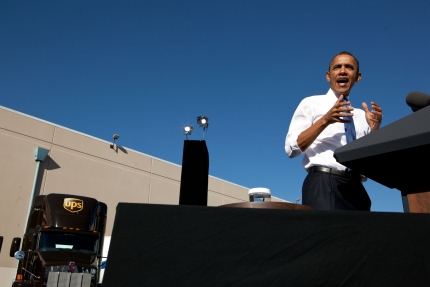
President Barack Obama delivers remarks on energy at UPS Las Vegas South

President Barack Obama delivers remarks on energy, at UPS Las Vegas South in Las Vegas, Nevada, Jan. 26, 2012.(Official White House Photo by Pete Souza)

President Obama toured a UPS facility in Las Vegas today to talk about the future of energy in America.

First, he discussed the progress we've already made:

For decades, Americans have been talking about how do we decrease our dependence on foreign oil. Well, my administration has actually begun to do something about it. 

Over the last three years, we negotiated the toughest new efficiency standards for cars and trucks in history. We’ve opened millions of new acres for oil and gas exploration.  Right now, American oil production is the highest that it’s been in eight years. Eight years. Last year, we relied less on foreign oil than in any of last 16 years. That hasn’t gotten a lot of attention, but that’s important. We’re moving in the right direction when it comes to oil and gas production.

The White House

Office of the Press Secretary

Statement by the President on the Retirement of Congressman Brad Miller

Brad Miller has served the people of North Carolina for two decades. In the House of Representatives, Brad helped lead the fight to protect families from abuses by the financial industry, and is a key reason why today we finally have a strong watchdog in place looking out for American consumers. Michelle and I thank Brad for his service, and wish him the very best in the future. 

The White House

Office of the Press Secretary

Statement by the President on the Retirement of Governor Bev Perdue

As the first woman to serve as North Carolina’s Lieutenant Governor and Governor, Bev Perdue has never been afraid to break barriers.  For over 25 years, she has fought for the people of the Tar Heel State – working to transform the state’s public schools, improve the health care system, protect and attract jobs for members of the military and their families, and create the jobs of the future.  Michelle and I want to congratulate Governor Perdue on her historic tenure, and we wish Bev and her family well in the future.

The White House

Office of the Press Secretary

Remarks by the President on American-Made Energy

UPS Las Vegas South
Las Vegas, Nevada

10:11 A.M. PST

THE PRESIDENT:  Hello, Nevada!  (Applause.)  It is great to be back in Las Vegas.  (Applause.) 

AUDIENCE MEMBER:  I love you!

THE PRESIDENT:  I love you back.  (Laughter.)  Although I always say, when we stay here for the night, I’ve got to watch my staff to make sure that they get on the plane when we leave.  (Laughter.)  Sometimes they conveniently miss the flight.  (Laughter.)

But everybody please have a seat, have a seat.  It is great to see you.  Joe, thanks for the introduction.  Scott, thank you and the folks at UPS for hosting us today.  I want to thank all of the elected officials and the tribal leaders who took the time to join us.

Before I get into the core of my remarks, I just want to mention something that I said to Scott and I said to Joe, and that is that UPS I think deserves just extraordinary credit for being the best in its space, one of the best businesses we have in the United States.  But the reason is because it’s got such outstanding workers -- (applause) -- and the relationship between its workforce and management, cooperating, constantly figuring out how to make things better is just an outstanding organization.  And so you guys all need to be congratulated for everything that you do.  (Applause.)

Now, I’m here to talk a little more about what I talked about at the State of the Union on Tuesday night.  And what I want to focus on is how we’re going to restore the basic promise of America, something that folks at UPS understand, which is, if you work hard, if you do the right thing, you should be able to do well enough to raise a family and own a home and send your kids to college and put a little away for retirement.  That’s the American Dream.  That’s what most people are looking for.

They don’t expect a handout.  They don’t expect anything to come easy.  They do expect, if they’re willing to work hard, to try to get ahead.  If they’re doing the right thing, then they can have a sense of security and dignity, and help make sure that their family is moving forward.  That’s what Americans are looking for.  That’s what Americans deserve. 

And today, three years after the worst economic storm in three generations, our economy is growing again.  Our businesses have created more than 3 million jobs.  (Applause.)  Last year, businesses created the most jobs since 2005.  American manufacturers are hiring again and creating jobs for the first time since the 1990s.
 
Now, we’ve got more work to do.  But what we can’t do is go back to the very same policies that got us into a mess in the first place.  We can’t go backwards.  We have to move forward.  I said on Tuesday, and I will repeat today, we will not -- we cannot -- go back to an economy weakened by outsourcing and bad debt and phony financial profits.  So on Tuesday, at the State of the Union, I laid out my vision for how we move forward.  I laid a blueprint for an economy that’s built to last, that has a firm foundation, where we’re making stuff and selling stuff and moving it around and UPS drivers are dropping things off everywhere.  (Applause.) 

That’s the economy we want, an economy built on American manufacturing with more good jobs and more products made here in the United States of America.  (Applause.)  An economy built on American energy, fueled by homegrown and alternative sources that make us more secure and less dependent on foreign oil.  (Applause.)  An economy built on the skills of American workers, getting people the education and the training they need to prepare for the jobs of today, but also to compete for the jobs of tomorrow.  (Applause.) 

And most importantly, I talked about an economy that’s built on a renewal of American values -- hard work, responsibility, and the same set of rules for everybody, from Wall Street to Main Street.  (Applause.)  That has to be our future.  That’s how we restore that basic American promise.

Now, part of my blueprint and what I want to focus on a little bit today is for an economy built to last with American energy.  That’s why we’re here.  For decades, Americans have been talking about how do we decrease our dependence on foreign oil.  Well, my administration has actually begun to do something about it. 

Over the last three years, we negotiated the toughest new efficiency standards for cars and trucks in history.  We’ve opened millions of new acres for oil and gas exploration.  Right now, American oil production is the highest that it’s been in eight years.  Eight years.  Last year, we relied less on foreign oil than in any of last 16 years.  That hasn’t gotten a lot of attention, but that’s important.  (Applause.)  We’re moving in the right direction when it comes to oil and gas production.

And today, I’m announcing that my administration will soon open up around 38 million acres in the Gulf of Mexico for additional exploration and development, which could result in a lot more production of domestic energy.  (Applause.)

But as I said on Tuesday, and as the folks here at UPS understand, even with all this oil production, we only have about 2 percent of the world’s oil reserves.  So we got to have an all-out, all-in, all-of-the-above strategy that develops every source of American energy –- a strategy that is cleaner and cheaper and full of new jobs.

Now, a great place to start is with natural gas.  Some of you may not have been following this, but because of new technologies, because we can now access natural gas that we couldn’t access before in an economic way, we’ve got a supply of natural gas under our feet that can last America nearly a hundred years.  Nearly a hundred years.  Now, when I say under our feet, I don’t know that there’s actually gas right here.  (Laughter.)  I mean in all the United States.

And developing it could power our cars and our homes and our factories in a cleaner and cheaper way.  The experts believe it could support more than 600,000 jobs by the end of the decade.  We, it turns out, are the Saudi Arabia of natural gas.  (Applause.)  We’ve got a lot of it.  We’ve got a lot of it.

Now, removing that natural gas obviously has to be done carefully.  And I know that there are families that are worried about the impact this could have on our environment and on the health of our communities.  And I share that concern.  So that’s why I’m requiring -- for the first time ever -- that all companies drilling for gas on public lands disclose the chemicals they use.  We want to make sure that this is done properly and safely.  (Applause.)  America will develop this resource without putting the health and safety of our citizens at risk.

But we’ve got to keep at it.  We’ve got to take advantage of this incredible natural resource.  And think about what could happen if we do.  Think about an America where more cars and trucks are running on domestic natural gas than on foreign oil.  Think about an America where our companies are leading the world in developing natural gas technology and creating a generation of new energy jobs; where our natural gas resources are helping make our manufacturers more competitive for decades.  We can do this.  And by the way, natural gas burns cleaner than oil does, so it’s also potentially good for our environment as we make this shift.

So last April, we issued a challenge to shipping companies like UPS.  We said if you upgrade your fleets to run on less oil or no oil at all, we’re going to help you succeed.  We want to help you with that experiment.  So we started out with five companies that accepted the challenge.  And of course, UPS was one of the first.  That’s how they roll.  (Laughter and applause.)

So less than a year later, we’ve got 14 companies on board, and together they represent 1 million vehicles on the road.   That’s a lot of trucks.

We should do more, though.  And that’s why we’re here today.  First, let’s get more of these natural gas vehicles on the road.  Let’s get more of them on the road.  (Applause.)  The federal fleet of cars is leading by example.  Turns out the federal government has a lot of cars.  (Laughter.)  We buy a lot of cars.  So we’ve got to help not only the federal government but also local governments upgrade their fleet.  If more of these brown trucks are going green, more city buses should, too.  There’s no reason why buses can’t go in the same direction. 

Second, let’s offer new tax incentives to help companies buy more clean trucks like these.  (Applause.)

Third, let’s make sure all these new trucks that are running on natural gas have places to refuel.  That’s one of the biggest impediments, is the technology.  We know how to make these trucks, but if they don’t have a place to pull in and fill up, they got problems.

So we’re going to keep working with the private sector to develop up to five natural gas corridors along our highways.  These are highways that have natural gas fueling stations between cities, just like the one that folks at UPS, South Coast Air and Clean Energy Fuels are opening today between Los Angeles and Salt Lake City.  That’s a great start.  (Applause.)  So now one of these trucks can go from Long Beach all the way to Salt Lake City.  And they’re going to be able to refuel along the way.

And finally, to keep America on the cutting edge of clean energy technology, I want my Energy Secretary, Steven Chu, to launch a new competition that encourages our country’s brightest scientists and engineers and entrepreneurs to discover new breakthroughs for natural gas vehicles.

So we’re going to keep moving on American energy.  We’re going to keep boosting American manufacturing.  We’re going to keep training our workers for these new jobs.  But an economy that’s built to last also means a renewal of the values that made us who we are:  hard work, fair play and shared responsibility.

Right now, that means, first of all, stopping a tax hike on 160 million working Americans at the end of next month.  (Applause.)  People cannot afford right now losing $40 out of each paycheck.  Your voices convinced Congress to extend this middle-class tax cut before.  I need your help to make sure they do it again.  No drama, no delay.  Let’s just get this done for the American people and for our economy as a whole.  (Applause.)  

But we’ve got a longer-run issue -- Scott and I were talking about this before we came out -- and that is how do we get America’s fiscal house in order.  And we’re going to have to make some choices.  The reason that we’ve got these debts and deficit is because we’re not making hard choices.  Right now, we’re supposed to spend nearly $1 trillion more on what was intended to be a temporary tax cut for the wealthiest 2 percent of Americans.  Supposed to be temporary.  Back in 2001.  (Laughter.)  That’s a long time ago.  (Laughter.)  A quarter of all millionaires pay lower tax rates than millions of middle-class households.  Warren Buffett pays a lower tax rate than his secretary.  I know because she was at the State of the Union.  (Laughter.)  She told me. 

Now, that’s not fair.  That doesn’t make sense.  And the reason it’s important for us to recognize that is, if we’re going to reduce our deficit, then we’ve got to have a balanced approach that has spending cuts -- and we’ve already agreed to $2 trillion worth of spending cuts.  We’ve got to get rid of programs that don’t work.  We’ve got to make government more efficient.  I have asked Congress for authority to consolidate some of these agencies to make them run better.  We’re going to have to be much more effective when it comes to government spending.  We all acknowledge that and we’re making progress on that front.

But that alone doesn’t do it.  So if we want to actually deal with the deficit, we’ve got to look at the other side of the ledger.  Do we want to keep these tax cuts for the wealthiest Americans?  Or do we want to keep investing in everything else -- like education, like clean energy -- (applause) -- like a strong military, like caring for our veterans who are coming home from Iraq and Afghanistan?  (Applause.)  We can’t do both.  We can’t do both. 

So what I’ve said is let’s follow the Buffett Rule:  If you make more than a million dollars a year, you should pay a tax rate of at least 30 percent -- (applause) -- which, by the way, is lower than you would have been paying under Ronald Reagan.  Nobody is talking about anything crazy here.  On the other hand, if you make less than $250,000 a year, which 98 percent of all Americans do, then your taxes shouldn’t go up.  (Applause.)  I think that’s a fair approach. 

And a lot of folks have been running around saying, well, that’s class warfare.  Asking a billionaire to pay at least as much as his secretary in taxes, that’s just common sense.  (Laughter.)  And I promise you, if we make this change, Warren Buffett will be doing fine.  (Laughter.)  I will be doing fine.  Scott will be doing fine.  (Applause.)  We don’t need more tax breaks.  You’re the ones who have seen your wages and your incomes stall while the cost of everything from groceries to college to health care have been going up.  You’re the ones who deserve a break.  (Applause.)  

And I want to make one last point:  We do not begrudge success in America.  We aspire to it.  We want everybody to succeed.  We want everybody to be rich.  We want everybody to be working hard, making their way, creating new products, creating new services, creating jobs -- that’s the American way.  We don’t shy away from financial success.  We don’t apologize for it. 

But what we do say is when this nation has done so much for us, shouldn’t we be thinking about the country as a whole?  When Americans talk about folks like me paying their fair share of taxes, it’s not because they envy the rich.  Just yesterday, Bill Gates said he agrees with me that Americans who can afford it should pay their fair share.  I promise you, Bill Gates does not envy the rich.  (Laughter.)  He doesn’t envy wealthy people. 

This has nothing to do with envy.  It has everything to do with math.  It’s what I talked about earlier.  We’ve got to make choices.  Americans understand if I get a tax break I don’t need and a tax break the country can’t afford, then one of two things are going to happen.  Either it’s going to add to our deficit or somebody else is going to have to make up the difference. 

A senior suddenly is going to have to start paying more for their Medicare, or a student is going to have to pay more for their student loan, or a family that’s trying to get by, they’re going to have to do with less.  And that’s not right.  That’s not who we are.  Each of us is only here because somebody somewhere felt a responsibility to each other and to our country and helped to create all this incredible opportunity that we call the United States of America. 

Now, it’s our turn to be responsible.  And it’s our turn to leave an America that is built to last for the next generation.  That’s our job and we can do it.  (Applause.)  We can do it.  We can do it.  And I know we can do it, because I’ve seen in states like Nevada and with people like you that I meet all across this country, you understand the history of this country, generations of Americans working together, looking out for each other, living by the idea that we rise or fall together.  Those are the values we have to return to. 

I mentioned praise for our military at the State of the Union and the incredible work that they do.  And the reason our military is so good, the reason why they’re so admired is because they -- it’s not like everybody in the military agrees on everything.  You got Democrats in the military.  You got Republicans in the military.  You’ve got folks who are conservative or liberal -- different races, different religions, different backgrounds -- but they figure out how to focus on the mission.  They figure out how to do their job.

And that sense of common purpose is what we’re going to need to build an economy that lasts.  And if we work together in common purpose, we can build that economy and we can meet the challenges of our times.  And we’ll remind the entire world once again just why it is that the United States is the greatest country on Earth. 

Thank you, everybody.  God bless you and God bless the United States of America.  (Applause.)

END               
10:33 A.M. PST

President Obama Discusses the Blueprint for American-Made Energy

January 26, 2012 | 21:20 | Public Domain

In Las Vegas, President Obama talked about a blueprint for boosting production of American-made clean energy.

Download mp4 (204MB) | mp3 (20MB)

Read the Transcript

Remarks by the President on American-Made Energy

UPS Las Vegas South
Las Vegas, Nevada

10:11 A.M. PST

THE PRESIDENT:  Hello, Nevada!  (Applause.)  It is great to be back in Las Vegas.  (Applause.) 

AUDIENCE MEMBER:  I love you!

THE PRESIDENT:  I love you back.  (Laughter.)  Although I always say, when we stay here for the night, I’ve got to watch my staff to make sure that they get on the plane when we leave.  (Laughter.)  Sometimes they conveniently miss the flight.  (Laughter.)

But everybody please have a seat, have a seat.  It is great to see you.  Joe, thanks for the introduction.  Scott, thank you and the folks at UPS for hosting us today.  I want to thank all of the elected officials and the tribal leaders who took the time to join us.

Before I get into the core of my remarks, I just want to mention something that I said to Scott and I said to Joe, and that is that UPS I think deserves just extraordinary credit for being the best in its space, one of the best businesses we have in the United States.  But the reason is because it’s got such outstanding workers -- (applause) -- and the relationship between its workforce and management, cooperating, constantly figuring out how to make things better is just an outstanding organization.  And so you guys all need to be congratulated for everything that you do.  (Applause.)

Now, I’m here to talk a little more about what I talked about at the State of the Union on Tuesday night.  And what I want to focus on is how we’re going to restore the basic promise of America, something that folks at UPS understand, which is, if you work hard, if you do the right thing, you should be able to do well enough to raise a family and own a home and send your kids to college and put a little away for retirement.  That’s the American Dream.  That’s what most people are looking for.

They don’t expect a handout.  They don’t expect anything to come easy.  They do expect, if they’re willing to work hard, to try to get ahead.  If they’re doing the right thing, then they can have a sense of security and dignity, and help make sure that their family is moving forward.  That’s what Americans are looking for.  That’s what Americans deserve. 

And today, three years after the worst economic storm in three generations, our economy is growing again.  Our businesses have created more than 3 million jobs.  (Applause.)  Last year, businesses created the most jobs since 2005.  American manufacturers are hiring again and creating jobs for the first time since the 1990s.
 
Now, we’ve got more work to do.  But what we can’t do is go back to the very same policies that got us into a mess in the first place.  We can’t go backwards.  We have to move forward.  I said on Tuesday, and I will repeat today, we will not -- we cannot -- go back to an economy weakened by outsourcing and bad debt and phony financial profits.  So on Tuesday, at the State of the Union, I laid out my vision for how we move forward.  I laid a blueprint for an economy that’s built to last, that has a firm foundation, where we’re making stuff and selling stuff and moving it around and UPS drivers are dropping things off everywhere.  (Applause.) 

That’s the economy we want, an economy built on American manufacturing with more good jobs and more products made here in the United States of America.  (Applause.)  An economy built on American energy, fueled by homegrown and alternative sources that make us more secure and less dependent on foreign oil.  (Applause.)  An economy built on the skills of American workers, getting people the education and the training they need to prepare for the jobs of today, but also to compete for the jobs of tomorrow.  (Applause.) 

And most importantly, I talked about an economy that’s built on a renewal of American values -- hard work, responsibility, and the same set of rules for everybody, from Wall Street to Main Street.  (Applause.)  That has to be our future.  That’s how we restore that basic American promise.

Now, part of my blueprint and what I want to focus on a little bit today is for an economy built to last with American energy.  That’s why we’re here.  For decades, Americans have been talking about how do we decrease our dependence on foreign oil.  Well, my administration has actually begun to do something about it. 

Over the last three years, we negotiated the toughest new efficiency standards for cars and trucks in history.  We’ve opened millions of new acres for oil and gas exploration.  Right now, American oil production is the highest that it’s been in eight years.  Eight years.  Last year, we relied less on foreign oil than in any of last 16 years.  That hasn’t gotten a lot of attention, but that’s important.  (Applause.)  We’re moving in the right direction when it comes to oil and gas production.

And today, I’m announcing that my administration will soon open up around 38 million acres in the Gulf of Mexico for additional exploration and development, which could result in a lot more production of domestic energy.  (Applause.)

But as I said on Tuesday, and as the folks here at UPS understand, even with all this oil production, we only have about 2 percent of the world’s oil reserves.  So we got to have an all-out, all-in, all-of-the-above strategy that develops every source of American energy –- a strategy that is cleaner and cheaper and full of new jobs.

Now, a great place to start is with natural gas.  Some of you may not have been following this, but because of new technologies, because we can now access natural gas that we couldn’t access before in an economic way, we’ve got a supply of natural gas under our feet that can last America nearly a hundred years.  Nearly a hundred years.  Now, when I say under our feet, I don’t know that there’s actually gas right here.  (Laughter.)  I mean in all the United States.

And developing it could power our cars and our homes and our factories in a cleaner and cheaper way.  The experts believe it could support more than 600,000 jobs by the end of the decade.  We, it turns out, are the Saudi Arabia of natural gas.  (Applause.)  We’ve got a lot of it.  We’ve got a lot of it.

Now, removing that natural gas obviously has to be done carefully.  And I know that there are families that are worried about the impact this could have on our environment and on the health of our communities.  And I share that concern.  So that’s why I’m requiring -- for the first time ever -- that all companies drilling for gas on public lands disclose the chemicals they use.  We want to make sure that this is done properly and safely.  (Applause.)  America will develop this resource without putting the health and safety of our citizens at risk.

But we’ve got to keep at it.  We’ve got to take advantage of this incredible natural resource.  And think about what could happen if we do.  Think about an America where more cars and trucks are running on domestic natural gas than on foreign oil.  Think about an America where our companies are leading the world in developing natural gas technology and creating a generation of new energy jobs; where our natural gas resources are helping make our manufacturers more competitive for decades.  We can do this.  And by the way, natural gas burns cleaner than oil does, so it’s also potentially good for our environment as we make this shift.

So last April, we issued a challenge to shipping companies like UPS.  We said if you upgrade your fleets to run on less oil or no oil at all, we’re going to help you succeed.  We want to help you with that experiment.  So we started out with five companies that accepted the challenge.  And of course, UPS was one of the first.  That’s how they roll.  (Laughter and applause.)

So less than a year later, we’ve got 14 companies on board, and together they represent 1 million vehicles on the road.   That’s a lot of trucks.

We should do more, though.  And that’s why we’re here today.  First, let’s get more of these natural gas vehicles on the road.  Let’s get more of them on the road.  (Applause.)  The federal fleet of cars is leading by example.  Turns out the federal government has a lot of cars.  (Laughter.)  We buy a lot of cars.  So we’ve got to help not only the federal government but also local governments upgrade their fleet.  If more of these brown trucks are going green, more city buses should, too.  There’s no reason why buses can’t go in the same direction. 

Second, let’s offer new tax incentives to help companies buy more clean trucks like these.  (Applause.)

Third, let’s make sure all these new trucks that are running on natural gas have places to refuel.  That’s one of the biggest impediments, is the technology.  We know how to make these trucks, but if they don’t have a place to pull in and fill up, they got problems.

So we’re going to keep working with the private sector to develop up to five natural gas corridors along our highways.  These are highways that have natural gas fueling stations between cities, just like the one that folks at UPS, South Coast Air and Clean Energy Fuels are opening today between Los Angeles and Salt Lake City.  That’s a great start.  (Applause.)  So now one of these trucks can go from Long Beach all the way to Salt Lake City.  And they’re going to be able to refuel along the way.

And finally, to keep America on the cutting edge of clean energy technology, I want my Energy Secretary, Steven Chu, to launch a new competition that encourages our country’s brightest scientists and engineers and entrepreneurs to discover new breakthroughs for natural gas vehicles.

So we’re going to keep moving on American energy.  We’re going to keep boosting American manufacturing.  We’re going to keep training our workers for these new jobs.  But an economy that’s built to last also means a renewal of the values that made us who we are:  hard work, fair play and shared responsibility.

Right now, that means, first of all, stopping a tax hike on 160 million working Americans at the end of next month.  (Applause.)  People cannot afford right now losing $40 out of each paycheck.  Your voices convinced Congress to extend this middle-class tax cut before.  I need your help to make sure they do it again.  No drama, no delay.  Let’s just get this done for the American people and for our economy as a whole.  (Applause.)  

But we’ve got a longer-run issue -- Scott and I were talking about this before we came out -- and that is how do we get America’s fiscal house in order.  And we’re going to have to make some choices.  The reason that we’ve got these debts and deficit is because we’re not making hard choices.  Right now, we’re supposed to spend nearly $1 trillion more on what was intended to be a temporary tax cut for the wealthiest 2 percent of Americans.  Supposed to be temporary.  Back in 2001.  (Laughter.)  That’s a long time ago.  (Laughter.)  A quarter of all millionaires pay lower tax rates than millions of middle-class households.  Warren Buffett pays a lower tax rate than his secretary.  I know because she was at the State of the Union.  (Laughter.)  She told me. 

Now, that’s not fair.  That doesn’t make sense.  And the reason it’s important for us to recognize that is, if we’re going to reduce our deficit, then we’ve got to have a balanced approach that has spending cuts -- and we’ve already agreed to $2 trillion worth of spending cuts.  We’ve got to get rid of programs that don’t work.  We’ve got to make government more efficient.  I have asked Congress for authority to consolidate some of these agencies to make them run better.  We’re going to have to be much more effective when it comes to government spending.  We all acknowledge that and we’re making progress on that front.

But that alone doesn’t do it.  So if we want to actually deal with the deficit, we’ve got to look at the other side of the ledger.  Do we want to keep these tax cuts for the wealthiest Americans?  Or do we want to keep investing in everything else -- like education, like clean energy -- (applause) -- like a strong military, like caring for our veterans who are coming home from Iraq and Afghanistan?  (Applause.)  We can’t do both.  We can’t do both. 

So what I’ve said is let’s follow the Buffett Rule:  If you make more than a million dollars a year, you should pay a tax rate of at least 30 percent -- (applause) -- which, by the way, is lower than you would have been paying under Ronald Reagan.  Nobody is talking about anything crazy here.  On the other hand, if you make less than $250,000 a year, which 98 percent of all Americans do, then your taxes shouldn’t go up.  (Applause.)  I think that’s a fair approach. 

And a lot of folks have been running around saying, well, that’s class warfare.  Asking a billionaire to pay at least as much as his secretary in taxes, that’s just common sense.  (Laughter.)  And I promise you, if we make this change, Warren Buffett will be doing fine.  (Laughter.)  I will be doing fine.  Scott will be doing fine.  (Applause.)  We don’t need more tax breaks.  You’re the ones who have seen your wages and your incomes stall while the cost of everything from groceries to college to health care have been going up.  You’re the ones who deserve a break.  (Applause.)  

And I want to make one last point:  We do not begrudge success in America.  We aspire to it.  We want everybody to succeed.  We want everybody to be rich.  We want everybody to be working hard, making their way, creating new products, creating new services, creating jobs -- that’s the American way.  We don’t shy away from financial success.  We don’t apologize for it. 

But what we do say is when this nation has done so much for us, shouldn’t we be thinking about the country as a whole?  When Americans talk about folks like me paying their fair share of taxes, it’s not because they envy the rich.  Just yesterday, Bill Gates said he agrees with me that Americans who can afford it should pay their fair share.  I promise you, Bill Gates does not envy the rich.  (Laughter.)  He doesn’t envy wealthy people. 

This has nothing to do with envy.  It has everything to do with math.  It’s what I talked about earlier.  We’ve got to make choices.  Americans understand if I get a tax break I don’t need and a tax break the country can’t afford, then one of two things are going to happen.  Either it’s going to add to our deficit or somebody else is going to have to make up the difference. 

A senior suddenly is going to have to start paying more for their Medicare, or a student is going to have to pay more for their student loan, or a family that’s trying to get by, they’re going to have to do with less.  And that’s not right.  That’s not who we are.  Each of us is only here because somebody somewhere felt a responsibility to each other and to our country and helped to create all this incredible opportunity that we call the United States of America. 

Now, it’s our turn to be responsible.  And it’s our turn to leave an America that is built to last for the next generation.  That’s our job and we can do it.  (Applause.)  We can do it.  We can do it.  And I know we can do it, because I’ve seen in states like Nevada and with people like you that I meet all across this country, you understand the history of this country, generations of Americans working together, looking out for each other, living by the idea that we rise or fall together.  Those are the values we have to return to. 

I mentioned praise for our military at the State of the Union and the incredible work that they do.  And the reason our military is so good, the reason why they’re so admired is because they -- it’s not like everybody in the military agrees on everything.  You got Democrats in the military.  You got Republicans in the military.  You’ve got folks who are conservative or liberal -- different races, different religions, different backgrounds -- but they figure out how to focus on the mission.  They figure out how to do their job.

And that sense of common purpose is what we’re going to need to build an economy that lasts.  And if we work together in common purpose, we can build that economy and we can meet the challenges of our times.  And we’ll remind the entire world once again just why it is that the United States is the greatest country on Earth. 

Thank you, everybody.  God bless you and God bless the United States of America.  (Applause.)

END               
10:33 A.M. PST
Close Transcript

President Obama Discusses Energy in Colorado

January 26, 2012 | 14:35 | Public Domain

From Buckley Air Force Base in Aurora, Colorado, President Obama discusses ways to promote clean energy produced in the United States -- and how the U.S. military is taking steps to lead on that effort. January 26, 2012.

Download mp4 (320MB) | mp3 (13.4MB)

Read the Transcript

President Obama Discusses the Blueprint for American-Made Energy

[[nid:115789]]

President Obama toured a UPS facility in Las Vegas today to talk about the future of energy in America.

First, he discussed the progress we've already made:

For decades, Americans have been talking about how do we decrease our dependence on foreign oil. Well, my administration has actually begun to do something about it. 

Over the last three years, we negotiated the toughest new efficiency standards for cars and trucks in history. We’ve opened millions of new acres for oil and gas exploration.  Right now, American oil production is the highest that it’s been in eight years. Eight years. Last year, we relied less on foreign oil than in any of last 16 years. That hasn’t gotten a lot of attention, but that’s important. We’re moving in the right direction when it comes to oil and gas production.

Then he discussed why a blueprint for American-made energy is so important:

[Even] with all this oil production, we only have about 2 percent of the world’s oil reserves.  So we got to have an all-out, all-in, all-of-the-above strategy that develops every source of American energy –- a strategy that is cleaner and cheaper and full of new jobs.

Want more details? Here's everything you need to know.

Related: Cast your vote to choose America's Next Top Energy Innovator

Close Transcript

The White House

Office of the Press Secretary

Letter from the President to the Speaker of the House of Representatives and the President Pro Tempore of the Senate Regarding the War Powers Act for Somalia

January 26, 2012

Dear Mr. Speaker: (Dear Mr. President:)

At my direction, on January 24, 2012, U.S. Special Operations Forces conducted an operation in Somalia to rescue Ms. Jessica Buchanan, a U.S. citizen. The operation was successfully completed. Ms. Buchanan was kidnapped in Galcayo, Somalia on October 25, 2011, by a group linked to Somali pirates and financiers. Also rescued in the course of the operation was a Danish national, Poul Hagen Thisted, who was kidnapped with Ms. Buchanan. The operation was undertaken by a small number of joint combat-equipped U.S. forces, after we received reliable intelligence indicating Ms. Buchanan's location in Somalia along with that of Mr. Thisted. These forces left Somalia on January 25, 2012.

I directed this action consistent with my responsibility to protect U.S. citizens both at home and abroad, and in furtherance of U.S. national security interests, pursuant to my constitutional authority to conduct U.S. foreign relations and as Commander in Chief and Chief Executive.
I am providing this report as part of my efforts to keep the Congress fully informed, consistent with the War Powers Resolution (Public Law 93-148). I appreciate the support of the Congress in this action.

Sincerely,

BARACK OBAMA