Press Briefing by Press Secretary Jay Carney, 1/31/12
James S. Brady Press Briefing Room
1:15 P.M. EST
MR. CARNEY: Ladies and gentlemen, thank you for being here on this glorious Tuesday afternoon.
As you probably saw in some paper that we put out today on the one-year anniversary of the Startup America initiative, the President is sending a detailed Startup America legislative agenda to Congress to expand tax relief and unlock capital for startups and small businesses that are creating jobs as well as important visa reforms that remove undue obstacles for high-skill immigrants and recent graduates that contribute to our economic competitiveness.
Small businesses, particularly young firms with high growth potential, create most of the net new jobs in our economy. Yet in the last several years, according to data from the Bureau of Labor Statistics, the number of new businesses launching annually has fallen by an unprecedented 23 percent.
Last week in the State of the Union address, the President noted -- rather, asked Congress for a bill that helps entrepreneurs succeed. Today he sent a legislative agenda to the Hill that includes cutting taxes for small businesses, building on the 17 small business tax cuts he has already signed into law. I’ll repeat, the 17 small business tax cuts he has already signed into law.
The President is proposing to expand and make permanent zero capital gains on small business investments to reward job creation with a 10 percent income tax credit on new small business payroll, permanently double the tax deduction for startup expenses, from $5,000 to $10,000, and extend 100 percent depreciation for qualified property through 2012.
The legislative agenda also includes initiatives to get capital to the companies that need it, growing small businesses, growing companies; also initiatives to relieve the backlog of employment-based immigrant visas, as I mentioned at the top, and several other initiatives. I think you’ve seen the paper on it; I just wanted to remind you of that.
And with that, Ben Feller.
Q Thanks, Jay. A couple topics, please. I wanted to follow up first on the exchange the President had yesterday during the Google+ town hall with Jennifer Wedel -- if I’m pronouncing her name correctly. He, at the end of that exchange, asked to get her husband’s résumé to help him out. Is this something that he plans to do now when he campaigns and hears people’s individual stories, to get down to that level of collecting résumés? Is that something that he thinks is part of the job of President?
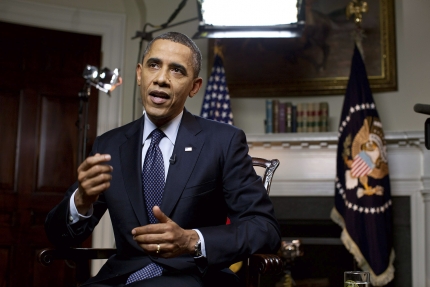
MR. CARNEY: Well, I think he very much enjoys and looks forward to talking to regular Americans out in the country. Yesterday’s interview was an opportunity to do that in a unique way here from the White House in a virtual gathering.
Much as he does when he reads the letters that are culled for him from Americans every night, he gets to experience the American economy through the eyes of folks out there who are living it, and that was the case in this exchange yesterday. So I think it just reflects his deep interest in the individual stories that Americans have about their lives, how they’re experiencing the economy in different parts of the country. And he will certainly have that kind of engagement, as he has in the past, going forward.
Q Do you think, though, in doing that engagement, is that the kind of strategy that can be effective, sort of one-on-one --
MR. CARNEY: It’s not a strategy. It’s not something we planned or anticipated yesterday. It obviously depends on when he meets folks out on a bus tour, for example, or in some other forum out in the country. Or through the interview yesterday, it depends on what the conversation is like, how it unfolds and what the concerns are, or the observations that the individual makes.
So there’s no strategy here. It’s more -- it’s very much about how he responds to and reacts to folks who tell him their stories.
Q The CBO has a report out today on the deficit and unemployment, and it projects unemployment to stay at 7 percent or higher through 2015. I know the administration has cited CBO often a fair scorekeeper. Does the White House think unemployment will remain that high three years out?
MR. CARNEY: Well, I will leave that to our economists to evaluate and judge, and I think we’ve put forward our own assessments. I would simply note that we are -- it’s important to look at trajectories and trends. And as you know, when the President was sworn into office on a much colder day three years ago, almost exactly, we were losing that month almost 800,000 jobs -- just in the month.
That pace was one that the country experienced for a sustained period of time. We’d lost 8 million jobs. And if you look at it -- you can find this in a lot of places, but a chart that shows unemployment -- or employment loss and employment growth from the six months before the President took office, and it hits its bottom right about when the President’s economic policies begin to take effect, some of the tough decisions he made on the automobile industry, the Recovery Act, dealing with our financial sector. And since then it’s gone like this.
The fact is this hole was so deep that we have a long way to go before we are where we need to be. But that’s the direction you want to be in, the 22 straight months of private sector job growth, the -- I always get it wrong -- eight quarters, seven quarters -- 10 quarters of economic growth -- very conservative in my analysis.
So I don’t know what, and would never, myself, predict what the unemployment rate would be in a year or two or three from now. I know that the economic policies that this President has put into place, working with Congress and then, when necessary, without Congress, have had the effect of reversing the most dramatic negative trend in employment since the Great Depression.
Yes, Reuters.
Q Thanks, Jay. One of the other forecasts that the CBO had was an estimate the deficit would remain above a trillion dollars in 2012, which would make it the fourth consecutive year of being above a trillion dollars. So as the President campaigns for reelection, what’s his message to voters on why they should have confidence in his ability to control the deficit over the next four years?
MR. CARNEY: Well, it will be very much what he said in the State of the Union; it will be what he has put forward on numerous occasions, including when he laid out his proposal last fall for a broad, balanced approach to deficit and debt reduction.
As you know, Alister, I won’t recite all the statistics about the economic freefall that this country was experiencing when the President took office, which came on top of a sustained period of growing deficits and debt after two wars that were unpaid for, an expansion of Medicare that was unpaid for, two enormous tax cuts that benefited overwhelmingly the wealthiest Americans that were unpaid for -- that resulted in an eight-year process that began with surpluses as far as the eye could see and ended with significant deficits. Add on top of that the recession -- the Great Recession, the near depression -- and you had a set of circumstances that had a negative impact on our deficit.
The President has put forward a very comprehensive proposal, a balanced approach to deficit and debt reduction. He worked very hard with the Speaker of the House to achieve a grand bargain that would have required tough choices from both Democrats and Republicans, but would have achieved a significant goal of long-term debt control.
Unfortunately, he was and Democratic leaders were willing to make those tough choices on their side and, unfortunately, on the other side the decision was made to walk away. But that deal remains available. The President hopes that Republicans will this year, even, decide to come together and work together towards a balanced approach, in keeping with the principles of the Simpson-Bowles commission, of the Domenici-Rivlin commission, of every bipartisan effort that’s looked at this, as well as the President’s proposal.
And also, I think it’s important to step back and remember that a lot of people talk about Simpson-Bowles, which was created because of the President’s initiative, would not exist without the President’s initiative because the Senate Republicans backed away from doing it legislatively, but let me point out, already this President has signed into law discretionary spending cuts that exceed those in Simpson-Bowles -- exceed the ones in Simpson-Bowles. Already he has demonstrated, as the members of the super committee can tell you, his willingness to do reforms to entitlements that are very significant. What has been lacking thus far is any willingness to deal with revenue in any meaningful way by the Republicans. And that is just not the approach that the broad base of the American public feels is the right way to go.
Donovan, how are you?
Q Thanks, Jay. I just want to ask about the photos of the raid on the Osama bin Laden compound. There have been reports that some of them may be released.
MR. CARNEY: Was that in the British media? (Laughter.)
Q No, that was actually in the Atlantic Wire -- thank you. The President had said previously that he does not favor the release of any of these photos. Couldn’t there be portions of the imagery that could or should be released without implicating national security?
MR. CARNEY: I honestly have not seen those reports. The President’s position on the release of images of Osama bin Laden, in particular, was very clearly stated at the time and has not changed. I would have to either refer you to the Defense Department on the broader question of other photos that may exist, and I can take that question as well.
Yes.
Q Jay, in the President’s Google+ video chat he acknowledged for the first time the classified drone program. Why did he do that?
MR. CARNEY: I’m sorry, can you be more specific?
Q He acknowledged the drone program for the first time.
MR. CARNEY: Well, I’ll tell you, since his first day in office, President Obama has directed that we use all tools of national power in an aggressive campaign to thwart the terrorist threat posed by al Qaeda and to degrade and ultimately destroy that organization. While al Qaeda has been significantly degraded as a result of our counterterrorism operations, the group continues to pose a serious threat to U.S. interests, including to the homeland. That is why we remain relentless in taking the fight to al Qaeda wherever they seek safe haven and support.
And I will also note that a hallmark of our counterterrorism efforts has been our ability to be exceptionally precise, exceptionally surgical and exceptionally targeted in the implementation of our counterterrorism operations. That was the point the President was making. This is something that President Obama has demanded. And all of our efforts, counterterrorism efforts, are designed with precision as an essential component.
Q Was it purposeful, what he said?
MR. CARNEY: Look, I would just refer you to what the President said and to note that the point he was making is that our counterterrorism efforts, by his order, include very concerted efforts to be targeted and surgical.
Q He doesn’t address whether it was purposeful or not. I mean, that’s what I’m asking, if he made a mistake.
MR. CARNEY: He’s the Commander-in-Chief of the armed forces of the United States. He’s the President of the United States. I would point you to his comments. I’m not going to discuss broadly or specifically supposed covert programs. I would just point you to what he said.
Q And can I ask you, is the transcript of the video chat going to be on whitheouse.gov?
MR. CARNEY: We don’t tend to release -- we don’t put out transcripts of interviews with --
Q You did the town hall, the Facebook and the Twitter town halls, I believe.
MR. CARNEY: Well, I’m just going to -- I’m sure we can make that available.
Yes, Ed.
Q Jay, two things. STOCK Act -- you put out a statement of administration policy yesterday supporting it. Senator McConnell and others on the Hill are talking about how the executive branch should also have tougher regulations on insider trading. Is that something the President supports?
MR. CARNEY: We support the STOCK Act. It’s moving through the Senate. I would point out that the legislation is designed to bring Congress up to the standards that are abided by and have been abided by by the executive branch for some time now, including presently.
So I suppose I understand the attempt to divert attention from the purpose of the legislation, but we’re glad that it has broad support; we support it. And I think it’s important to note, because I got a lot of questions from you all in the run-up to and the aftermath of the State of the Union address about how the ideas the President put forward in his State of the Union were -- simply couldn’t get through Congress. And I would note that here we are, just one week after that address, and one of his ideas is moving with great speed through the United States Senate.
Q Second topic -- the Catholic Church. It was a pretty extraordinary situation on Sunday in parishes all across the country, individual priests were reading letters from their bishops in that particular parish that were pretty much denouncing the Obama administration about these provisions dealing with contraception, Catholic hospitals and whatnot in connection with the Affordable Care Act. I guess my question would be, how does the administration justify having the federal government institute a law that basically forces people to violate their religious beliefs?
MR. CARNEY: Well, that misrepresents actually what the --
Q How so?
MR. CARNEY: -- decision about the implementation of the Affordable Care Act --
Q How does that misrepresent --
MR. CARNEY: Well, let me -- let me -- let me answer. The decision was made, as we have said in the past and Secretary Sebelius has said, after very careful consideration, and the administration believes that this proposal strikes the appropriate balance between respecting religious beliefs and increasing access to important preventive services. We will continue to work closely with religious groups during this transitional period to discuss their concerns.
It’s important -- to go to your point -- that this approach does not signal any change at all in the administration’s policy on conscience protections. The President and this administration have previously expressed strong support for existing conscience protections, including those relating to health care providers. That support continues.
I also would just note that our robust partnerships with the Catholic Church and other communities of faith will continue. The administration has provided over $2 billion to Catholic organizations over the past three years in addition to numerous nonfinancial partnerships that promote healthy communities and serve the common good.
Q The bishops are saying just the opposite. They’re saying that basically if somebody is working in a Catholic hospital and they don’t cover contraception for their employees, that they’re in violation of federal law. So I don’t understand how you’re saying that there are still conscience protections. They would violate the law, wouldn’t they?
MR. CARNEY: Well, this does not direct an individual to do anything, first of all. The new guidelines require most private health plans to cover preventive services, including contraception, for women without charging a copay, coinsurance or deductible.
The guidelines were recommended by the nonpartisan, independent Institute of Medicine. The administration also released a proposed regulation that allows nonprofit, religious employers that offer insurance to their employees the choice of whether or not to cover contraception services.
After reviewing comments from the public, the administration announced that the final rule on preventive health services will ensure that women with health insurance coverage will have access to the full range of recommended preventive services, including all FDA-approved forms of contraception.
And I would just note that we will work with religious groups during a transitional period to discuss their concerns. But this decision was made after careful consideration by Secretary Sebelius, and we believe that the proposal strikes the appropriate balance between religious beliefs on the one hand and the need to increase access to important preventive services for women.
Q Last thing on this. E.J. Dionne, though -- I mean, a lot of Republicans have attacked -- but a Democrat who’s Catholic, E.J. Dionne, wrote in The Washington Post yesterday that the President, in his words, “utterly botched this policy.” And he said he, “threw his progressive Catholic allies under the bus.” So despite everything you just read, you have Democratic Catholics saying that that’s not true.
MR. CARNEY: The idea that there are people who disagree -- well, Ed, all you’re pointing out is that there are people who disagree with the decision. We understand that not everyone agrees with it. All I can tell you is it was made after very careful consideration based on the need to balance those two issues and that the necessity to provide access to preventive services for women was an important consideration.
Q What about the constitutional right to freedom of religion? Is that still --
MR. CARNEY: I don’t believe there are any constitutional rights issues here, but I would refer you to others to discuss that. That’s not -- I understand that there’s controversy and we understand that and we will continue to work with religious groups to discuss their concerns. But on the other side of this was the important need to provide access to women to the preventive services that they require.
And the thing you just read to me was a political observation. This was a policy based on the merits.
Q Jay, if I could follow up on that --
MR. CARNEY: No, let me -- let me move around here.
Q The bishop of Phoenix said Catholics shouldn’t comply with this law. Will there be any consequences for not --
MR. CARNEY: I’m the wrong guy to ask.
Margaret.
Q Thanks. On Iran, DNI Clapper told Congress today that it appears that Iran or some officials in Iran are more willing to consider direct attacks on the U.S. right now, and what I wanted to ask you is, do you have any specific credible information about any such efforts? What is the President doing to stay aware of this? How is the administration responding? And would the U.S. support -- what did you call it -- drone program potentially applied to Iran as well or only to places with direct al Qaeda concerns?
MR. CARNEY: I would note that you began by quoting the head of the DNI, the Director of National Intelligence, who’s far more appropriate a resource for answering questions about our intelligence on Iran than I am. I can tell you that broadly Iran is an issue that this President is very focused on and receives regular briefings on from his national security team, including members of his -- of the intelligence community.
We are working very closely with our international partners and allies to put unprecedented pressure on the Iranian regime to convince it to abide by its international obligations and to abandon its nuclear weapons ambitions. That process continues.
We’re fully aware of the fact that Iran and elements within Iran have less-than-benevolent observations to make about the United States and our interests and allies. This is obviously and always has been a very serious issue, and this President takes it very seriously.
We are pursuing a course that because of the United States’ leadership has united the international community and isolated Iran; made clear to the world that it is Iranian behavior that is the issue here. And we will continue to work along that path, even as, as the President has noted, we will not remove any option from the table in dealing with this issue.
Q Can I ask you a quick one also about housing? The President indicated to us today that tomorrow he will be sharing some --
MR. CARNEY: You asked him a leading question.
Q And he grabbed it, and then let go. But -- so can you tell us any more about that? Is that going to be an FHA deal? Is he asking for legislation? Or is this purely stuff that the administration can do on its own, and will you preview some of it for us?
MR. CARNEY: I won’t preview any of it. I will simply point you to what the President said in the State of the Union about a proposal that he would elaborate on to make universal the potential for homeowners who are responsible and making their mortgage payments to be able to refinance their loans and save on average I believe $3,000 annually.
When he does speak to this issue, he’ll provide more details on that, as well as some of the other housing initiatives that he talked about in the State of the Union. But I’m not going to get ahead of the President.
Q But it would require congressional action?
MR. CARNEY: Well, it might, but I’ll let him describe it.
Ann.
Q Thanks, Jay. Back to the CBO numbers, the deficit projection for another year of trillion-dollar deficit is based on the idea that the law remain the same now and the Bush-era tax cuts not expire. Does the President still believe that for -- taxpayers under $250,000 a year should be able to continue to get the current income tax rates?
MR. CARNEY: Well, he does, and he also believes as he has for a long time that the Bush tax cuts for upper-income Americans should expire. They I believe cost $800 billion -- is that correct -- annually. And that’s a big figure when you talk about a trillion-dollar deficit.
So what the CBO numbers also don’t include are our policy initiatives that would significantly reduce the deficit further if implemented by Congress, including a balanced approach. And let me just say in terms of the Bush tax cuts and taxes in general that the President believes that we should have broader tax reform guided by the -- in part by the so-called Buffett Rule as a principle.
But in terms of the Bush tax cuts, yes, the President believes that Americans -- families making under $250,000 should not have their taxes go up, but that the upper-income tax cuts that Bush implemented and which were very, very costly and in this time of significant deficit should not -- as he has said in the past, should not be extended.
Q And on the jobs side, where the CBO projects that unemployment will actually go back up over 9 percent during 2013, does the President think that the -- that there is -- that the jobs ideas that he talked about or they’ve set up, haven’t several of those already gone through the House? The problem is the Senate?
MR. CARNEY: The ones he talked about today?
Q The ones that he sent today in terms of for the small business --
MR. CARNEY: I would have to take the question. I’m not sure specifically which pieces of legislation you’re --
Q Will it change the way he deals with Congress? They’ve been back for a week now. He’s done the State of the Union address. And there are some -- some of these ideas he keeps saying Republicans should agree. Will he just simply send things up? Will he change the way he will deal with the Republican and the Democrat --
MR. CARNEY: No, he’ll continue to try to work with members of both parties in Congress, leadership and rank and file, to reach a consensus on measures that -- like tax cuts for small businesses or investments in infrastructure that have traditionally enjoyed bipartisan support.
I mean, you are right that -- well, I mean, the holdup has often been the House Republicans, but there have been -- there has been obstructionism in both chambers.
I would note on the CBO projections that they do not include obviously this President’s policies for job creation and economic growth, which if implemented would -- as outside economists have made clear -- increase growth and increase job creation.
Bill.
Q Let me go back to the health insurance regulation for a second. You made the point that it was Secretary Sebelius’s decision. But isn’t it the President’s decision? And isn’t he the one responsible --
MR. CARNEY: Well, sure --
Q -- ultimately?
MR. CARNEY: It’s an HHS -- as I understand it, an HHS process, but we -- the President concurs in the decision and in the need to find an appropriate balance between religious beliefs and access to preventive services for women.
Q But it’s been pointed out by a number of people that it would have been easy to find a compromise that didn’t require Catholic hospitals to go against the beliefs of their faith in order to serve everybody.
MR. CARNEY: Well, I’m not sure that -- it’s easy to say that things are easy when you’re saying it from the outside. The balance here that was sought was found, an appropriate balance between religious beliefs and the need for access to preventive services.
Q It was quite clear that a lot of people don’t feel that there’s any balance here, that it is, in fact, an infringement of their ability to practice their faith.
MR. CARNEY: Well, again, Bill, I can keep telling you our view. I certainly appreciate that there are folks out there who disagree, but this was done with a full awareness of the concerns that have been expressed on both sides of this issue, and a decision that was made on the policy merits that also weighed the very issues that I described.
I think it’s fair to say that while there are those who take issue with the decision, millions and millions of Americans -- American women will have access to preventive services, as they should, appropriately, though the health care reform bill.
Kristen.
Q Jay, thanks. Going back to the drones, President Obama said that drone strikes have not inflicted huge civilian casualties. How can the administration be so certain that there hasn’t been a large civilian toll?
MR. CARNEY: Kristen, I’m going to attempt to forestall any further questions about potentially covert programs by saying that everything I can tell you about it is on this piece of paper, and I’m just not going to -- I’m not going to acknowledge or confirm any of that.
I will tell you that, as I said at the beginning, that our counterterrorism efforts, by the President’s direction, are very targeted, very surgical and precise, and this is the point the President was making about the fact that because that approach is taken there are limits to casualties and damages.
Q But if the President acknowledged the drones, why can’t you?
MR. CARNEY: Again, I’m just going to point you to what he said and not discuss further this issue.
Q But it’s a façade. It’s silly.
MR. CARNEY: Bill, I’m sorry.
Connie.
Q Thank you. Sorry if this has been asked already. On these horrible so-called honor killings among some Afghans in Canada and Afghanistan, how can the administration negotiate with the Taliban when these kind of things are permitted by Taliban members?
MR. CARNEY: Well, Connie, as you know very clearly that our conditions for reconciliation include a commitment to abide by the Afghan constitution, to lay down arms, to renounce association and fealty to al Qaeda -- the first part I think addressing the issue that you raise, which is abiding by and being governed by the Afghan constitution includes respecting minority rights and women’s rights.
So in the Afghan-led process of reconciliation, those are the conditions for Taliban reconciliation, participation in the process. Those elements of the Taliban who don’t abide by those conditions will not be reconciled.
Mark.
Q Thanks, Jay. I’m not sure whether this is going to fall into what you just laid out as your quarantined territory -- (laughter) -- but --
Q Give it a shot. (Laughter.)
Q During that interview yesterday, the President talked about in some detail places where these strikes were being carried out in Pakistan. And it’s also well known that part of the arrangement Pakistan and the U.S. have had over time on this is the U.S. doesn’t say much about this, if anything; Pakistanis don’t have to acknowledge publicly how much of it is actually happening. If the Commander-in-Chief comes out in a public forum in this kind of detail, discussing an operation in another country, isn’t there a risk that you’re going to make it much tougher to continue carrying out these operations?
MR. CARNEY: I appreciate the question, Mark. I will simply say that the point the President was making, in not very much detail, was that through a decision that he made and a directive that he gave, considered effort is made to be very surgical and precise in the implementation of our counterterrorism efforts, and that -- the purpose being to limit unintended casualties and damage in those efforts. But I’m not going to get any more specific than that. And I think it’s important to note that that is the point that the President was making in his comments yesterday.
Q Well, could that in fact have the opposite effect? Could it in fact be something that helps smooth over a tough situation with a foreign country?
MR. CARNEY: Again, I’m just -- I’m not going to elaborate beyond what the President said and beyond the general principle that I’ve stated.
Yes, sir -- and then David.
Q Getting back to Ben’s opening questions on this résumé conversation the President had yesterday. What exactly is going to happen to the résumé that -- from this guy? And what are you going to do about the inevitable tens of thousands of résumés that are going to be sent here because of that?
MR. CARNEY: Well, I can simply say that my understanding is the résumé has been sent and received, but the -- I don’t have any further guidance to give you on what might happen beyond reviewing it. And I think -- to go back to my discussion with Ben -- the exchange reflected the President’s sincere interest and concern in the experiences of folks out in the country and how they’re dealing with what remains a very tough economy, even as we continue the recovery that we’ve been engaged in now for 10 months, that there are a lot of folks out there who are looking for work. The high unemployment is proof positive of that. And this President’s energies are focused on doing everything he can to grow the economy and create jobs, to alleviate that kind of anxiety, that economic insecurity that this conversation reflected.
So it was a snapshot into the fact -- into the world that reflects that we have a lot more work to do. We have to continue to take action, to build the economy -- to grow the economy, to create jobs, to build the infrastructure necessary to have a foundation for further economic growth in the future. While we have made progress we still have a long way to go in what we --
Q Jay, who received this guy’s résumé? And again, did the White House --
MR. CARNEY: I don’t know who specifically received it.
Q Okay, but the wider question -- I mean, you guys already receive a lot of résumés here. What’s going to happen to the -- thousands of people are going to be sending résumés.
MR. CARNEY: Again, I don’t want -- I’m sure that’s true. I don’t -- I have received a few.
Q Labor Department? Small Business Administration? What’s happening?
MR. CARNEY: I just don’t have -- I don’t know. I don’t know at this point. I’m sure it will be reviewed, which is what the President said. And again, this person’s story reminds us that we need to keep focused on doing what we can to grow the economy and create jobs, because while we have created more than 3 million private sector jobs over the last 22 months, while the economy has created those jobs, the hole is quite deep. Eight million is a large number that was -- jobs lost caused by this recession.
So that’s why the President is going to keep at it. That’s why the President put the proposals forward that he did in the State of the Union address, and why you’ll hear more from him in the coming days and weeks and months about the things we should be doing to move the country forward.
David.
Q I just wanted to follow up on that same conversation the President had. The woman who talked about sending a résumé said that her husband was out of work -- and she blamed it on the fact that the administration -- rules regarding the H1B visa were too lenient and too many foreigners were taking the jobs that maybe her husband would be able to get.
Today the President, I think in his bill that he sent over to Congress, talked about maybe loosening the cap on immigration from certain countries to attract more skilled laborers. And I think his response to her indicated he believes, in fact, that in some fields there’s a shortage of qualified folks and we need to attract the skilled laborers from overseas.
My question, generally, is: Is the President concerned that there might be a feeling of xenophobia or something going on out there when the economy is this tight and there are some concerns that reflect in that question from the woman?
MR. CARNEY: No -- well, I haven’t talked to him about that specifically. But I think that the President’s position, which you state clearly, is that we need to make it more possible for highly qualified people who are being educated here, or coming from abroad to work here, build businesses here, grow the economy here, create jobs here -- that is a message that you hear from business leaders across the country, especially in the fields of technology and engineering and the like, so -- which doesn’t take away from this individual’s experience at all, but the broader picture is one of a need for more engineers, a need for more highly skilled, highly educated workers to help us grow those industries in the United States that will be the foundation for our economic future.
Q Thanks, Jay.
MR. CARNEY: Last one. Yes, ma’am.
Q Thank you, Jay. Will President Obama have any policy change toward North Korea this year?
MR. CARNEY: I’m sorry, will he what?
Q Will President Obama have any policy change toward North Korea this year?
MR. CARNEY: Policy change?
Q Yes.
MR. CARNEY: I don’t anticipate it. I took some questions about this, about North Korea during the leadership transition. But I wouldn’t -- obviously I can’t predict the future in terms of what might transpire on the Korean Peninsula and with North Korea, but there has been no policy change.
Thank you.
Q Is the President going to the auto show? There has been a lot of talk about it.
MR. CARNEY: I’ve seen those reports, and I guess I could say that if he were I wouldn’t acknowledge it from here. (Laughter.)
Thanks.
END
1:53 P.M. EST