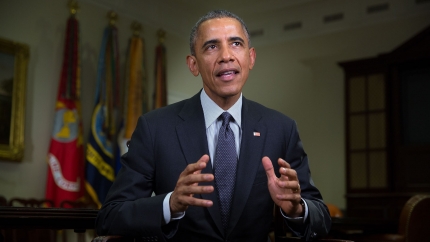
Weekly Address: Giving Every Child, Everywhere, a Fair Shot

President Obama Tapes the Weekly Address on January 30

President Barack Obama tapes the Weekly Address in the Roosevelt Room of the White House. January 30, 2015. (Official White House Photo by Lawrence Jackson)

In this week’s address, the President laid out his plan to ensure more children graduate from school fully prepared for college and a career.

Our elementary and secondary schools are doing better, as demonstrated by the news this past week that our high school graduation rate has hit an all-time high, but there is still more that can be done to ensure every child receives a quality education. That’s why the President wants to replace No Child Left Behind with a new law that addresses the overuse of standardized tests, makes a real investment in preschool, and gives every kid a fair shot at success.

He reminded everyone that when educating our kids, the future of our nation, we shouldn’t accept anything less than the best.

Transcript | mp4 | mp3

Related Topics: Higher Education, Education

Weekly Address: Giving Every Child, Everywhere, a Fair Shot

February 14, 2015 | 4:35 | Public Domain

In this week’s address, the President laid out his plan to ensure more children graduate from school fully prepared for college and a career.

Download mp4 (170MB) | mp3 (10MB)

The White House

Office of the Press Secretary

Remarks by the President at a DNC Fundraiser

Private Residence
San Francisco, California

4:30 P.M. PST

PRESIDENT OBAMA:  Thank you, everybody.  Well, first of all, let me just say, Sandy and Jeanne are some of my most longstanding stalwart supporters and I am so grateful to them.  They have been with me just about every step of the way, and I’m sure this shows their Illinois good sense -– (laughter) –- but I am truly grateful, and they arranged a spectacular setting for a spectacular event.  And I want to thank them both. 

I want to thank everybody who helped to co-host this.  There are a lot of friends here who’ve –- I’ve been in your houses, too.  (Laughter.)  And you’ve known me before I had any gray hair.  (Laughter.)  And before a lot of people could pronounce my name properly, and I’m grateful.  And for those of you who I’m meeting for the first time, thank you so much for being here.

I’m going to -– the way I usually do these is to make some very brief remarks on the frontend and then really I want to spend most of the time just in a conversation and answering questions or hearing ideas that you may have.  If you look at what happened last year –- and I talked about this in the State of the Union –- after a debilitating recession, worst financial crisis since the Great Depression, four or five hard years of rebuilding and retooling and recovery, last year ended up being really a breakout year for America, in which all that hard work began to show itself not just in the fact that we had the fastest drop in unemployment in 30 years; not only in the fastest job growth since the 1990s; not only in strong GDP growth, export growth; but also a whole series of structural changes that we had begun way back in 2009 that were beginning to really bear fruit. 

Doubling the production of clean energy.  Ten times more solar power than we had.  Three times more wind power than we had.  Cutting carbon emissions.  High school graduation rates at an all-time high.  For younger students, reading and math scores showing appreciable gains.  Highest college enrollment that we had seen in a very long time. 

All these issues that had affected a lot of people for a long time finally began to pay off.  And, obviously, one of the most striking examples was health care, where despite all the battles back and forth in Washington, after a year we’ve seen more than 10 million people have affordable health insurance –- high-quality health insurance for the first time, in some cases, in their lives.  (Applause.)

And so the question I posed at the State of the Union was, how do we sustain this momentum and drive it in such a way that the overall growth that we’re seeing, the aggregate GDP numbers, the improved stock market –- that all of that begins to now manifest itself in hard-working families feeling a little bit more secure, feeling a little bit more hopeful, seeing more ladders of opportunity for young people?  How do we make sure that our prosperity is broad-based?  How do we make sure that incomes and wages start going up for folks?  How do we make sure that a young family is able to manage child care costs and save for college and save for retirement?  And if somebody gets sick, are they able to stay home, or if their child is sick, without losing a day’s pay?  How do we make sure that minimum-wage workers are getting paid enough that they’re not in poverty if they’re working full-time?  How do we build on the progress that we’ve made around clean energy to actually tackle the global challenge of climate change, and do it in a way that produces jobs and spurs on economic development?  How do we keep ourselves safe while still being true to our values?

And the good news is, is that we actually have pretty good answers for all of these challenges.  They’re not easy.  In some cases, it requires sacrifice.  In some cases, it requires investments today that will pay off 10 years from now, or 20 years from now, or 50 years from now.  But we know what to do, and the question is, is our politics up to the task?  And that’s where all of you come in. 

We had a very challenging midterm, despite good news, in part because two-thirds almost of eligible voters didn’t vote.  And part of the challenge is that people have felt so cynical about government for so long, and the gridlock in Washington has been so fierce, that at a certain point, people just opt out.

And one of the things I am absolutely determined to do over the next two years is not just consolidate the gains that we’ve made, not just move forward on new initiatives like free community colleges for young people around the country who need to be trained for the 21st-century economy, but part of my goal is also to restore a sense of possibility in our politics and our government.  And in some cases, that means challenging folks who are practicing the worst kind of cynical politics, and a politics based on fear rather than hope.  In some cases, it’s going to be finding areas of cooperating with Republicans.  In either case, we’re going to need people like you to support these ongoing efforts. 

I’ve only got two years left, but two years is a long time.  And two years is also the time in which we’re going to be setting the stage for the next presidential election and the next 10 years of American policy.  And so I intend to run through the tape and work really hard, and squeeze every last little bit of change and improvement in the lives of ordinary Americans and middle-class families that I can.  But I can’t do it alone.  And that’s why your support for the DNC is so greatly appreciated.  And for those of you who have been there every step of the way, I just want to say thank you. 

Thanks, everybody.  (Applause.)

END
4:38 P.M. PST

The White House

Office of the Press Secretary

Statement by NSC Spokesperson Bernadette Meehan on Recent Attacks in West Africa

The United States strongly condemns the recent Boko Haram atrocities committed against innocent civilians in Nigeria as well as in Chad, Niger, and Cameroon.  We offer our deepest condolences to the victims, their families, and to those who have been displaced by these cruel acts, and we reiterate our support for these countries’ efforts to fight Boko Haram in a manner that respects human rights and the rule of law. We also applaud progress toward the establishment of a Multi-National Joint Task Force, which entails a promising regional approach to a regional challenge. We believe that swift action to support and operationalize such a task force will prove vital to protecting civilians and enhancing security throughout the region, and the United States will continue to support bilateral and multilateral initiatives to counter Boko Haram.

President Obama Speaks at the White House Summit on Cybersecurity and Consumer Protection

Watch on YouTube

Earlier this afternoon, the President visited Stanford University to speak at the White House Summit on Cybersecurity and Consumer Protection. Today's summit brought together leaders from a number of areas -- Congress, industry, tech companies, law enforcement, students, and others -- to work together and explore partnerships that will help develop the best ways to bolster our cybersecurity.

President Obama remarked that our nation is doing more business online than ever before, at the rate of trillions of dollars each year. And consumers are doing more online as well -- managing bank accounts, shopping, paying bills, handling medical records, just to name a few. But, these new opportunities and conveniences also bring a unique set of risks.

"When companies get hacked, Americans’ personal information, including their financial information, gets stolen," the President explained. "Identity theft can ruin your credit rating and turn your life upside down. In recent breaches, more than 100 million Americans had their personal data compromised, including, in some cases, credit card information."

Related Topics: Cybersecurity, Technology

President Obama Speaks at the Cybersecurity and Consumer Protection Summit

February 13, 2015 | 17:28 | Public Domain

On February 13, 2015, President Obama delivered remarks at Stanford University on the Administration’s cybersecurity efforts and principles.

Download mp4 (647MB) | mp3 (42MB)

The White House

Office of the Press Secretary

Remarks by the President at the Cybersecurity and Consumer Protection Summit

Stanford University
Stanford, California

11:33 A.M. PST

THE PRESIDENT:  Hello, Stanford!  (Applause.)  Thank you so much.  Thank you.  Thank you, everybody.  Have a seat.  Have a seat. 

AUDIENCE MEMBER:  Yes, we can!

THE PRESIDENT:  Yes, we can!  (Applause.) 

First of all, let me thank President Hennessy for not just the introduction but for your outstanding leadership at one of the great universities of the world.  (Applause.)  I’ve got to admit, like, I kind of want to go here.  (Laughter and applause.)  I was trying to figure out why it is that a really nice place like this is wasted on young people -- (laughter) -- who don’t fully appreciate what you got.  It’s really nice.  And everybody here is so friendly and smart, and it’s beautiful.  And what’s there not to like?

I want to thank you and everyone at Stanford for hosting this summit, especially Amy Zegart, George Triantis, and someone who served as a great advisor to me at the White House and as an outstanding ambassador to Russia before coming back to The Farm -- Mike McFaul.  (Applause.)

It is great to be here at Leland Stanford Junior University.  And I’m pleased to be joined by members of my team who bleed Cardinal red.  We’re infiltrated with Stanford people.  We’ve got Senior Advisor Valerie Jarrett, National Security Advisor Susan Rice, Secretary of Commerce Penny Pritzker.  (Applause.)  And, let’s face it, I like Stanford grads.  I noticed Steve Chu was around here, who helped lead our Energy Department for a while.  (Applause.)  And he’s now hanging out.  I’m also pleased to be joined by other members of my Cabinet -- our Secretary of Homeland Security Jeh Johnson is here, and our Small Business Administrator, Maria Contreras-Sweet.  And I want to acknowledge my tireless Homeland Security Advisor who helped, and continues to shape, our cybersecurity efforts -- Lisa Monaco.  (Applause.)  Thank you, Lisa.  

So I’d always heard about this campus, and everybody is riding bikes, and people hopping into fountains -- (laughter) -- and the current holder of The Axe.  (Applause.)  This is the place that made “nerd” cool.  (Laughter.)  I was thinking about wearing some black-rimmed glasses, some tape in the middle, but I guess that’s not what you do anymore.  Ambassador McFaul told me if I came to Stanford, you’d “talk nerdy to me.”  (Laughter.)   

But I’m not just here to enjoy myself.  As we gather here today, America is seeing incredible progress that we can all be proud of.  We just had the best year of job growth since the 1990s.  (Applause.)  Over the past 59 months, our businesses have created nearly 12 million new jobs, which is the longest streak of private sector job growth on record.  And in a hopeful sign for middle-class families, wages are beginning to rise again.

And, meanwhile, we’re doing more to prepare our young people for a competitive world.  Our high school graduation rate has hit an all-time high.  More Americans are finishing college than ever before.  Here at Stanford and across the country, we’ve got the best universities, we’ve got the best scientists, the best researchers in the world.  We’ve got the most dynamic economy in the world.  And no place represents that better than this region.  So make no mistake, more than any other nation on Earth, the United States is positioned to lead in the 21st century. 

And so much of our economic competitiveness is tied to what brings me here today, and that is America’s leadership in the digital economy.  It’s our ability -- almost unique across the planet -- our ability to innovate and to learn, and to discover, and to create, and build, and do business online, and stretch the boundaries of what’s possible.  That’s what drives us.  And so when we had to decide where to have this summit, the decision was easy, because so much of our Information Age began right here, at Stanford.   

It was here where two students, Bill Hewlett and Dave Packard, met and then, in a garage not far from here, started a company that eventually built one of the first personal computers, weighing in at 40 pounds.  (Laughter.)  It was from here, in 1968, where a researcher, Douglas Englebart, astonished an audience with two computers, connected “online,” and hypertext you could click on with something called a “mouse.” 

A year later, a computer here received the first message from another computer 350 miles away -- the beginnings of what would become the Internet.  And, by the way, it’s no secret that many of these innovations built on government-funded research is one of the reasons that if we want to maintain our economic leadership in the world, America has to keep investing in basic research in science and technology.  It's absolutely critical.  (Applause.)

So here at Stanford, pioneers developed the protocols and architecture of the Internet, DSL, the first webpage in America, innovations for cloud computing.  Student projects here became Yahoo and Google.  Those were pretty good student projects.  (Laughter.)  Your graduates have gone on to help create and build thousands of companies that have shaped our digital society -- from Cisco to Sun Microsystems, YouTube to Instagram, StubHub, Bonobos.  According to one study, if all the companies traced back to Stanford graduates formed their own nation, you’d be one the largest economies in the world and have a pretty good football team as well.  (Laughter and applause.)

And today, with your cutting-edge research programs and your new cyber initiatives, you’re helping us navigate some of the most complicated cyber challenges that we face as a nation.  And that’s why we’re here.  I want to thank all of you who have joined us today -- members of Congress, representatives from the private sector, government, academia, privacy and consumer groups, and especially the students who are here.  Just as we’re all connected like never before, we have to work together like never before, both to seize opportunities but also meet the challenges of this Information Age. 

And it’s one of the great paradoxes of our time that the very technologies that empower us to do great good can also be used to undermine us and inflict great harm.  The same information technologies that help make our military the most advanced in the world are targeted by hackers from China and Russia who go after our defense contractors and systems that are built for our troops.  The same social media we use in government to advocate for democracy and human rights around the world can also be used by terrorists to spread hateful ideologies.  So these cyber threats are a challenge to our national security. 

Much of our critical infrastructure -- our financial systems, our power grid, health systems -- run on networks connected to the Internet, which is hugely empowering but also dangerous, and creates new points of vulnerability that we didn’t have before.  Foreign governments and criminals are probing these systems every single day.  We only have to think of real-life examples -- an air traffic control system going down and disrupting flights, or blackouts that plunge cities into darkness -- to imagine what a set of systematic cyber attacks might do.  So this is also a matter of public safety.
 
As a nation, we do more business online than ever before -- trillions of dollars a year.  And high-tech industries, like those across the Valley, support millions of American jobs.  All this gives us an enormous competitive advantage in the global economy.  And for that very reason, American companies are being targeted, their trade secrets stolen, intellectual property ripped off.  The North Korean cyber attack on Sony Pictures destroyed data and disabled thousands of computers, and exposed the personal information of Sony employees.  And these attacks are hurting American companies and costing American jobs.  So this is also a threat to America’s economic security.

As consumers, we do more online than ever before.  We manage our bank accounts.  We shop.  We pay our bills.  We handle our medical records.  And as a country, one of our greatest resources are the young people who are here today --digitally fearless and unencumbered by convention, and uninterested in old debates.  And they’re remaking the world every day.  But it also means that this problem of how we secure this digital world is only going to increase. 

I want more Americans succeeding in our digital world.  I want young people like you to unleash the next waves of innovation, and launch the next startups, and give Americans the tools to create new jobs and new businesses, and to expand connectivity in places that we currently can't imagine, to help open up new world and new experiences and empower individuals in ways that would seem unimaginable 10, 15, 20 years ago. 

And that’s why we’re working to connect 99 percent of America’s students to high-speed Internet -- because when it comes to educating our children, we can’t afford any digital divides.  It’s why we’re helping more communities get across to the next generation of broadband faster, with cheaper Internet, so that students and entrepreneurs and small businesses across America, not just in pockets of America, have the same opportunities to learn and compete as you do here in the Valley.  It’s why I’ve come out so strongly and publicly for net neutrality, for an open and free Internet -- (applause) -- because we have to preserve one of the greatest engines for creativity and innovation in human history.

So our connectivity brings extraordinary benefits to our daily lives, but it also brings risks.  And when companies get hacked, Americans’ personal information, including their financial information, gets stolen.  Identity theft can ruin your credit rating and turn your life upside down.  In recent breaches, more than 100 million Americans had their personal data compromised, including, in some cases, credit card information.  We want our children to go online and explore the world, but we also want them to be safe and not have their privacy violated.  So this is a direct threat to the economic security of American families, not just the economy overall, and to the wellbeing of our children, which means we’ve got to put in place mechanisms to protect them.

So shortly after I took office, before I had gray hair -- (laughter) -- I said that these cyber threats were one of the most serious economic national security challenges that we face as a nation, and I made confronting them a priority.  And given the complexity of these threats, I believe we have to be guided by some basic principles.  So let me share those with you today.

First, this has to be a shared mission.  So much of our computer networks and critical infrastructure are in the private sector, which means government cannot do this alone.  But the fact is that the private sector can’t do it alone either, because it’s government that often has the latest information on new threats.  There’s only one way to defend America from these cyber threats, and that is through government and industry working together, sharing appropriate information as true partners.  

Second, we have to focus on our unique strengths.  Government has many capabilities, but it’s not appropriate or even possible for government to secure the computer networks of private businesses.  Many of the companies who are here today are cutting-edge, but the private sector doesn’t always have the capabilities needed during a cyber attack, the situational awareness, or the ability to warn other companies in real time, or the capacity to coordinate a response across companies and sectors.  So we’re going to have to be smart and efficient and focus on what each sector does best, and then do it together.

Third, we’re going to have to constantly evolve.  The first computer viruses hit personal computers in the early 1980s, and essentially, we’ve been in a cyber arms race ever since.  We design new defenses, and then hackers and criminals design new ways to penetrate them.  Whether it’s phishing or botnets, spyware or malware, and now ransomware, these attacks are getting more and more sophisticated every day.  So we’ve got to be just as fast and flexible and nimble in constantly evolving our defenses.  

And fourth, and most importantly, in all our work we have to make sure we are protecting the privacy and civil liberty of the American people.  And we grapple with these issues in government.  We’ve pursued important reforms to make sure we are respecting peoples’ privacy as well as ensuring our national security.  And the private sector wrestles with this as well.  When consumers share their personal information with companies, they deserve to know that it’s going to be protected.  When government and industry share information about cyber threats, we’ve got to do so in a way that safeguards your personal information.  When people go online, we shouldn’t have to forfeit the basic privacy we’re entitled to as Americans. 

In recent years, we’ve worked to put these principles into practice.  And as part of our comprehensive strategy, we’ve boosted our defenses in government, we’re sharing more information with the private sector to help those companies defend themselves, we’re working with industry to use what we call a Cybersecurity Framework to prevent, respond to, and recover from attacks when they happen.

And, by the way, I recently went to the National Cybersecurity Communications Integration Center, which is part of the Department of Homeland Security, where representatives from government and the private sector monitor cyber threats 24/7.  And so defending against cyber threats, just like terrorism or other threats, is one more reason that we are calling on Congress, not to engage in politics -- this is not a Republican or Democratic issue -- but work to make sure that our security is safeguarded and that we fully fund the Department of Homeland Security, because it has great responsibilities in this area.

So we’re making progress, and I’ve recently announced new actions to keep up this momentum.  We’ve called for a single national standard so Americans know within 30 days if your information has been stolen.  This month, we’ll be proposing legislation that we call a Consumer Privacy Bill of Rights to give Americans some baseline protections, like the right to decide what personal data companies collect from you, and the right to know how companies are using that information.  We’ve proposed the Student Digital Privacy Act, which is modeled on the landmark law here in California -- because today’s amazing educational technologies should be used to teach our students and not collect data for marketing to students.

And we’ve also taken new steps to strengthen our cybersecurity -- proposing new legislation to promote greater information sharing between government and the private sector, including liability protections for companies that share information about cyber threats.  Today, I’m once again calling on Congress to come together and get this done.

And this week, we announced the creation of our new Cyber Threat Intelligence Integration Center.  Just like we do with terrorist threats, we’re going to have a single entity that’s analyzing and integrating and quickly sharing intelligence about cyber threats across government so we can act on all those threats even faster.
 
And today, we’re taking an additional step -- which is why there’s a desk here.  You were wondering, I'm sure.  (Laughter.)  I’m signing a new executive order to promote even more information sharing about cyber threats, both within the private sector and between government and the private sector.  And it will encourage more companies and industries to set up organizations -- hubs -- so you can share information with each other.  It will call for a common set of standards, including protections for privacy and civil liberties, so that government can share threat information with these hubs more easily.  And it can help make it easier for companies to get the classified cybersecurity threat information that they need to protect their companies.

I want to acknowledge, by the way, that the companies who are represented here are stepping up as well.  The Cyber Threat Alliance, which includes companies like Palo Alto Networks and Symantec, are going to work with us to share more information under this new executive order.  You’ve got companies from Apple to Intel, from Bank of America to PG&E, who are going to use the Cybersecurity Framework to strengthen their own defenses.  As part of our BuySecure Initiative, Visa and MasterCard and American Express and others are going to make their transactions more secure.  Nationstar is joining companies that are giving their companies [customers] another weapon to battle identity theft, and that's free access to their credit scores. 
And more companies are moving to new, stronger technologies to authenticate user identities, like biometrics -- because it’s just too easy for hackers to figure out usernames and passwords, like “password.”  (Laughter.)  Or “12345 -- (laughter) -- 7.”  (Laughter.)  Those are some of my previous passwords.  (Laughter.)  I've changed them since then.  (Applause.)   

So this summit is an example of what we need more of -- all of us working together to do what none of us can achieve alone.  And it is difficult.  Some of the challenges I’ve described today have defied solutions for years.  And I want to say very clearly that, as somebody who is a former constitutional law teacher, and somebody who deeply values his privacy and his family’s privacy -- although I chose the wrong job for that -- (laughter) -- but will be a private citizen again, and cares deeply about this -- I have to tell you that grappling with how government protects the American people from adverse events while, at the same time, making sure that government itself is not abusing its capabilities is hard. 

The cyber world is sort of the wild, wild West.  And to some degree, we're asked to be the sheriff.  When something like Sony happens, people want to know what can government do about this.  If information is being shared by terrorists in the cyber world and an attack happens, people want to know are there ways of stopping that from happening.  By necessity, that means government has its own significant capabilities in the cyber world.  But then people, rightly, ask, well, what safeguards do we have against government intruding on our own privacy?  And it's hard, and it constantly evolves because the technology so often outstrips whatever rules and structures and standards have been put in place, which means that government has to be constantly self-critical and we have to be able to have an open debate about it.   

But we’re all here today because we know that we're going to have to break through some of these barriers that are holding us back if we are going to continue to thrive in this remarkable new world.  We all know what we need to do.  We have to build stronger defenses and disrupt more attacks.  We have to make cyberspace safer.  We have to improve cooperation across the board.  And, by the way, this is not just here in America, but internationally -- which also, by the way, makes things complicated because a lot of countries don't necessarily share our investment -- or our commitment to openness, and we have to try to navigate that.

But this should not be an ideological issue.  And that’s one thing I want to emphasize:  This is not a Democratic issue, or a Republican issue.  This is not a liberal or conservative issue.  Everybody is online, and everybody is vulnerable.  The business leaders here want their privacy and their children protected, just like the consumer and privacy advocates here want America to keep leading the world in technology and be safe from attacks.  So I’m hopeful that through this forum and the work that we do subsequently, that we're able to generate ideas and best practices, and that the work of this summit can help guide our planning and execution for years to come. 

After all, we are just getting started.  Think about it.  Tim Berners-Lee, from his lab in Switzerland, invented the World Wide Web in 1989, which was only 26 years ago.  The great epochs in human history -- the Bronze Age, Iron Age, Agricultural Revolution, Industrial Revolution -- they spanned centuries.  We’re only 26 years into this Internet Age.  We’ve only scratched the surface.  And as I guess they say at Google, “The future is awesome.”  (Laughter.)  We haven’t even begun to imagine the discoveries and innovations that are going to be unleashed in the decades to come.  But we know how we’ll get there. 

Reflecting on his work in the 1960s on ARPANET, the precursor of the Internet, the late Paul Baran said this:  “The process of technological developments is like building a cathedral.  Over the course of several hundred years, new people come along and each lays down a block on top of the old foundations, each saying, ‘I built the cathedral.’  And then comes along an historian who asks, ‘Well, who built the cathedral?’”  And Baran said, “If you’re not careful, you can con yourself into believing that you did the most important part.  But the reality is that each contribution has to follow on to previous work.  Everything is tied to everything else.”

Everything is tied to everything else.  The innovations that first appeared on this campus all those decades ago -- that first mouse, that first message -- helped lay a foundation.  And in the decades since, on campuses like this, in companies like those that are represented here, new people have come along, each laying down a block, one on top of the other.  And when future historians ask who built this Information Age, it won’t be any one of us who did the most important part alone.  The answer will be, “We all did, as Americans.” 

And I’m absolutely confident that if we keep at this, if we keep working together in a spirit of collaboration, like all those innovators before us, our work will endure, like a great cathedral, for centuries to come.  And that cathedral will not just be about technology, it will be about the values that we’ve embedded in the architecture of this system.  It will be about privacy, and it will be about community.  And it will be about connection.  What a magnificent cathedral that all of you have helped to build.  We want to be a part of that, and we look forward to working with you in the future.

Thank you for your partnership.  With that, I’m going to sign this executive order.  Thank you.  (Applause.) 

END
12:03 P.M. PST

The White House

Office of the Press Secretary

Executive Order -- Promoting Private Sector Cybersecurity Information Sharing

EXECUTIVE ORDER

- - - - - - -

PROMOTING PRIVATE SECTOR CYBERSECURITY INFORMATION SHARING

By the authority vested in me as President by the Constitution and the laws of the United States of America, it is hereby ordered as follows:

Section 1. Policy. In order to address cyber threats to public health and safety, national security, and economic security of the United States, private companies, nonprofit organizations, executive departments and agencies (agencies), and other entities must be able to share information related to cybersecurity risks and incidents and collaborate to respond in as close to real time as possible.

Organizations engaged in the sharing of information related to cybersecurity risks and incidents play an invaluable role in the collective cybersecurity of the United States. The purpose of this order is to encourage the voluntary formation of such organizations, to establish mechanisms to continually improve the capabilities and functions of these organizations, and to better allow these organizations to partner with the Federal Government on a voluntary basis.

Such information sharing must be conducted in a manner that protects the privacy and civil liberties of individuals, that preserves business confidentiality, that safeguards the information being shared, and that protects the ability of the Government to detect, investigate, prevent, and respond to cyber threats to the public health and safety, national security, and economic security of the United States.

This order builds upon the foundation established by Executive Order 13636 of February 12, 2013 (Improving Critical Infrastructure Cybersecurity), and Presidential Policy Directive-21 (PPD-21) of February 12, 2013 (Critical Infrastructure Security and Resilience).

Policy coordination, guidance, dispute resolution, and periodic in-progress reviews for the functions and programs described and assigned herein shall be provided through the interagency process established in Presidential Policy Directive-l (PPD-l) of February 13, 2009 (Organization of the National Security Council System), or any successor.

Sec. 2. Information Sharing and Analysis Organizations. (a) The Secretary of Homeland Security (Secretary) shall strongly encourage the development and formation of Information Sharing and Analysis Organizations (ISAOs).

(b) ISAOs may be organized on the basis of sector, sub-sector, region, or any other affinity, including in response to particular emerging threats or vulnerabilities. ISAO membership may be drawn from the public or private sectors, or consist of a combination of public and private sector organizations. ISAOs may be formed as for-profit or nonprofit entities.

(c) The National Cybersecurity and Communications Integration Center (NCCIC), established under section 226(b) of the Homeland Security Act of 2002 (the "Act"), shall engage in continuous, collaborative, and inclusive coordination with ISAOs on the sharing of information related to cybersecurity risks and incidents, addressing such risks and incidents, and strengthening information security systems consistent with sections 212 and 226 of the Act.

(d) In promoting the formation of ISAOs, the Secretary shall consult with other Federal entities responsible for conducting cybersecurity activities, including Sector-Specific Agencies, independent regulatory agencies at their discretion, and national security and law enforcement agencies.

Sec. 3. ISAO Standards Organization. (a) The Secretary, in consultation with other Federal entities responsible for conducting cybersecurity and related activities, shall, through an open and competitive process, enter into an agreement with a nongovernmental organization to serve as the ISAO Standards Organization (SO), which shall identify a common set of voluntary standards or guidelines for the creation and functioning of ISAOs under this order. The standards shall further the goal of creating robust information sharing related to cybersecurity risks and incidents with ISAOs and among ISAOs to create deeper and broader networks of information sharing nationally, and to foster the development and adoption of automated mechanisms for the sharing of information. The standards will address the baseline capabilities that ISAOs under this order should possess and be able to demonstrate. These standards shall address, but not be limited to, contractual agreements, business processes, operating procedures, technical means, and privacy protections, such as minimization, for ISAO operation and ISAO member participation.

(b) To be selected, the SO must demonstrate the ability to engage and work across the broad community of organizations engaged in sharing information related to cybersecurity risks and incidents, including ISAOs, and associations and private companies engaged in information sharing in support of their customers.

(c) The agreement referenced in section 3(a) shall require that the SO engage in an open public review and comment process for the development of the standards referenced above, soliciting the viewpoints of existing entities engaged in sharing information related to cybersecurity risks and incidents, owners and operators of critical infrastructure, relevant agencies, and other public and private sector stakeholders.

(d) The Secretary shall support the development of these standards and, in carrying out the requirements set forth in this section, shall consult with the Office of Management and Budget, the National Institute of Standards and Technology in the Department of Commerce, Department of Justice, the Information Security Oversight Office in the National Archives and Records Administration, the Office of the Director of National Intelligence, Sector-Specific Agencies, and other interested Federal entities. All standards shall be consistent with voluntary international standards when such international standards will advance the objectives of this order, and shall meet the requirements of the National Technology Transfer and Advancement Act of 1995 (Public Law 104-113), and OMB Circular A-119, as revised.

Sec. 4. Critical Infrastructure Protection Program. (a) Pursuant to sections 213 and 214(h) of the Critical Infrastructure Information Act of 2002, I hereby designate the NCCIC as a critical infrastructure protection program and delegate to it authority to enter into voluntary agreements with ISAOs in order to promote critical infrastructure security with respect to cybersecurity.

(b) Other Federal entities responsible for conducting cybersecurity and related activities to address threats to the public health and safety, national security, and economic security, consistent with the objectives of this order, may participate in activities under these agreements.

(c) The Secretary will determine the eligibility of ISAOs and their members for any necessary facility or personnel security clearances associated with voluntary agreements in accordance with Executive Order 13549 of August 18, 2010 (Classified National Security Information Programs for State, Local, Tribal, and Private Sector Entities), and Executive Order 12829 of January 6, 1993 (National Industrial Security Program), as amended, including as amended by this order.

Sec. 5. Privacy and Civil Liberties Protections. (a) Agencies shall coordinate their activities under this order with their senior agency officials for privacy and civil liberties and ensure that appropriate protections for privacy and civil liberties are incorporated into such activities. Such protections shall be based upon the Fair Information Practice Principles and other privacy and civil liberties policies, principles, and frameworks as they apply to each agency's activities.

(b) Senior privacy and civil liberties officials for agencies engaged in activities under this order shall conduct assessments of their agency's activities and provide those assessments to the Department of Homeland Security (DHS) Chief Privacy Officer and the DHS Office for Civil Rights and Civil Liberties for consideration and inclusion in the Privacy and Civil Liberties Assessment report required under Executive Order 13636.

Sec. 6. National Industrial Security Program. Executive Order 12829, as amended, is hereby further amended as follows:

(a) the second paragraph is amended by inserting "the Intelligence Reform and Terrorism Prevention Act of 2004," after "the National Security Act of 1947, as amended,";

(b) Sec. 101(b) is amended to read as follows: "The National Industrial Security Program shall provide for the protection of information classified pursuant to Executive Order 13526 of December 29, 2009, or any predecessor or successor order, and the Atomic Energy Act of 1954, as amended (42 U.S.C. 2011 et seq.).";

(c) Sec. 102(b) is amended by replacing the first paragraph with: "In consultation with the National Security Advisor, the Director of the Information Security Oversight Office, in accordance with Executive Order 13526 of December 29, 2009, shall be responsible for implementing and monitoring the National Industrial Security Program and shall:";

(d) Sec. 102(c) is amended to read as follows: "Nothing in this order shall be construed to supersede the authority of the Secretary of Energy or the Nuclear Regulatory Commission under the Atomic Energy Act of 1954, as amended (42 U.S.C. 2011 et seq.), or the authority of the Director of National Intelligence (or any Intelligence Community element) under the Intelligence Reform and Terrorism Prevention Act of 2004, the National Security Act of 1947, as amended, or Executive Order 12333 of December 8, 1981, as amended, or the authority of the Secretary of Homeland Security, as the Executive Agent for the Classified National Security Information Program established under Executive Order 13549 of August 18, 2010 (Classified National Security Information Program for State, Local, Tribal, and Private Sector Entities).";

(e) Sec. 201(a) is amended to read as follows: "The Secretary of Defense, in consultation with all affected agencies and with the concurrence of the Secretary of Energy, the Nuclear Regulatory Commission, the Director of National Intelligence, and the Secretary of Homeland Security, shall issue and maintain a National Industrial Security Program Operating Manual (Manual). The Secretary of Energy and the Nuclear Regulatory Commission shall prescribe and issue that portion of the Manual that pertains to information classified under the Atomic Energy Act of 1954, as amended (42 U.S.C. 2011 et seq.). The Director of National Intelligence shall prescribe and issue that portion of the Manual that pertains to intelligence sources and methods, including Sensitive Compartmented Information. The Secretary of Homeland Security shall prescribe and issue that portion of the Manual that pertains to classified information shared under a designated critical infrastructure protection program.";

(f) Sec. 201(f) is deleted in its entirety;

(g) Sec. 201(e) is redesignated Sec. 201(f) and revised by substituting "Executive Order 13526 of December 29, 2009, or any successor order," for "Executive Order No. 12356 of April 2, 1982.";

(h) Sec. 201(d) is redesignated Sec. 201(e) and revised by substituting "the Director of National Intelligence, and the Secretary of Homeland Security" for "and the Director of Central Intelligence.";

(i) a new Sec. 201(d) is inserted after Sec. 201(c) to read as follows: "The Manual shall also prescribe arrangements necessary to permit and enable secure sharing of classified information under a designated critical infrastructure protection program to such authorized individuals and organizations as determined by the Secretary of Homeland Security.";

(j) Sec. 202(b) is amended to read as follows: "The Director of National Intelligence retains authority over access to intelligence sources and methods, including Sensitive Compartmented Information. The Director of National Intelligence may inspect and monitor contractor, licensee, and grantee programs and facilities that involve access to such information or may enter into written agreements with the Secretary of Defense, as Executive Agent, or with the Director of the Central Intelligence Agency to inspect and monitor these programs or facilities, in whole or in part, on the Director's behalf.";

(k) Sec. 202(d) is redesignated as Sec. 202(e); and

(l) in Sec. 202 a new subsection (d) is inserted after subsection (c) to read as follows: "The Secretary of Homeland Security may determine the eligibility for access to Classified National Security Information of contractors, licensees, and grantees and their respective employees under a designated critical infrastructure protection program, including parties to agreements with such program; the Secretary of Homeland Security may inspect and monitor contractor, licensee, and grantee programs and facilities or may enter into written agreements with the Secretary of Defense, as Executive Agent, or with the Director of the Central Intelligence Agency, to inspect and monitor these programs or facilities in whole or in part, on behalf of the Secretary of Homeland Security."

Sec. 7. Definitions. (a) "Critical infrastructure information" has the meaning given the term in section 212(3) of the Critical Infrastructure Information Act of 2002.

(b) "Critical infrastructure protection program" has the meaning given the term in section 212(4) of the Critical Infrastructure Information Act of 2002.

(c) "Cybersecurity risk" has the meaning given the term in section 226(a)(1) of the Homeland Security Act of 2002 (as amended by the National Cybersecurity Protection Act of 2014).

(d) "Fair Information Practice Principles" means the eight principles set forth in Appendix A of the National Strategy for Trusted Identities in Cyberspace.

(e) "Incident" has the meaning given the term in section 226(a)(2) of the Homeland Security Act of 2002 (as amended by the National Cybersecurity Protection Act of 2014).

(f) "Information Sharing and Analysis Organization" has the meaning given the term in section 212(5) of the Critical Infrastrucure Information Act of 2002.

(g) "Sector-Specific Agency" has the meaning given the term in PPD-21, or any successor.

Sec. 8. General Provisions. (a) Nothing in this order shall be construed to impair or otherwise affect:

(i) the authority granted by law or Executive Order to an agency, or the head thereof; or

(ii) the functions of the Director of the Office of Management and Budget relating to budgetary, administrative, or legislative proposals.

(b) This order shall be implemented consistent with applicable law and subject to the availability of appropriations. Nothing in this order shall be construed to alter or limit any authority or responsibility of an agency under existing law including those activities conducted with the private sector relating to criminal and national security threats. Nothing in this order shall be construed to provide an agency with authority for regulating the security of critical infrastructure in addition to or to a greater extent than the authority the agency has under existing law.

(c) All actions taken pursuant to this order shall be consistent with requirements and authorities to protect intelligence and law enforcement sources and methods.

(d) This order is not intended to, and does not, create any right or benefit, substantive or procedural, enforceable at law or in equity by any party against the United States, its departments, agencies, or entities, its officers, employees, or agents, or any other person.

BARACK OBAMA

The White House

Office of the Press Secretary

G-7 Leaders Statement on Ukraine

We, the leaders of Canada, France, Germany, Italy, Japan, the United Kingdom, the United States, the President of the European Council and the President of the European Commission welcome the “Package of Measures for the Implementation of the Minsk Agreements” adopted by their original signatories on 12th February 2015 in Minsk. Implementation of the “Minsk Package” offers a way forward to a comprehensive, sustainable, and peaceful resolution to the crisis in eastern Ukraine.

However, the G7 remains concerned about the situation in Ukraine, in particular in view of the fighting around Debaltseve where Russian-backed separatist militias are operating beyond the line of contact agreed upon in the Minsk agreements of September 2014, causing numerous civilian casualties. We urge all sides to adhere strictly to the provisions of the Package and to carry out its measures without delay, starting with a ceasefire on the 15th of February. All parties should refrain from actions in the coming days that would hinder the start of the ceasefire. The G7 stands ready to adopt appropriate measures against those who violate the “Minsk package” and therefore intensify the costs for them, in particular against those who do not observe the agreed comprehensive ceasefire and withdrawal of heavy weapons.

We again condemn Russia's illegal annexation of Crimea which is in violation of international law.

The G7 welcomes the agreement in principle reached on the 12th of February by the IMF and the government of Ukraine on a new economic reform program that will be supported by an IMF Extended Fund Facility. The G7 members look forward to prompt consideration of the program by the IMF Executive Board. We are providing financial assistance to support Ukraine. This international assistance will help Ukraine in the ambitious economic reforms it is undertaking to restore economic growth and improve the living standards of the Ukrainian people. We commend the government of Ukraine for its commitment to implement this ambitious reform agenda with regard to economic, rule-of-law, and democratic reforms.

The White House

Office of the Press Secretary

Statement by the President

Yesterday, the FBI opened an inquiry into the brutal and outrageous murders of Yusor Mohammad Abu-Salha, Deah Shaddy Barakat, and Razan Mohammad Abu-Salha in Chapel Hill, North Carolina.  In addition to the ongoing investigation by local authorities, the FBI is taking steps to determine whether federal laws were violated.  No one in the United States of America should ever be targeted because of who they are, what they look like, or how they worship.  Michelle and I offer our condolences to the victims’ loved ones.  As we saw with the overwhelming presence at the funeral of these young Americans, we are all one American family.  Whenever anyone is taken from us before their time, we remember how they lived their lives – and the words of one of the victims should inspire the way we live ours. 

“Growing up in America has been such a blessing,” Yusor said recently.  “It doesn’t matter where you come from.  There’s so many different people from so many different places, of different backgrounds and religions – but here, we’re all one.”