President Obama awards Captain William Swenson, U.S. Army, the Medal of Honor

October 15, 2013 | 18:55 | Public Domain

President awards William Swenson, a former active duty Army Captain, the Medal of Honor for conspicuous gallantry. Captain Swenson received the Medal of Honor for his courageous actions while serving as an Embedded Trainer and Mentor of the Afghan National Security Forces with Afghan Border Police Mentor Team, 1st Battalion, 32nd Infantry Regiment, 3rd Brigade Combat Team, 10th Mountain Division, during combat operations in Kunar Province, Afghanistan on September 8, 2009.

Download mp4 (696MB) | mp3 (46MB)

President Obama Visits Martha’s Table to Thank Furloughed Workers

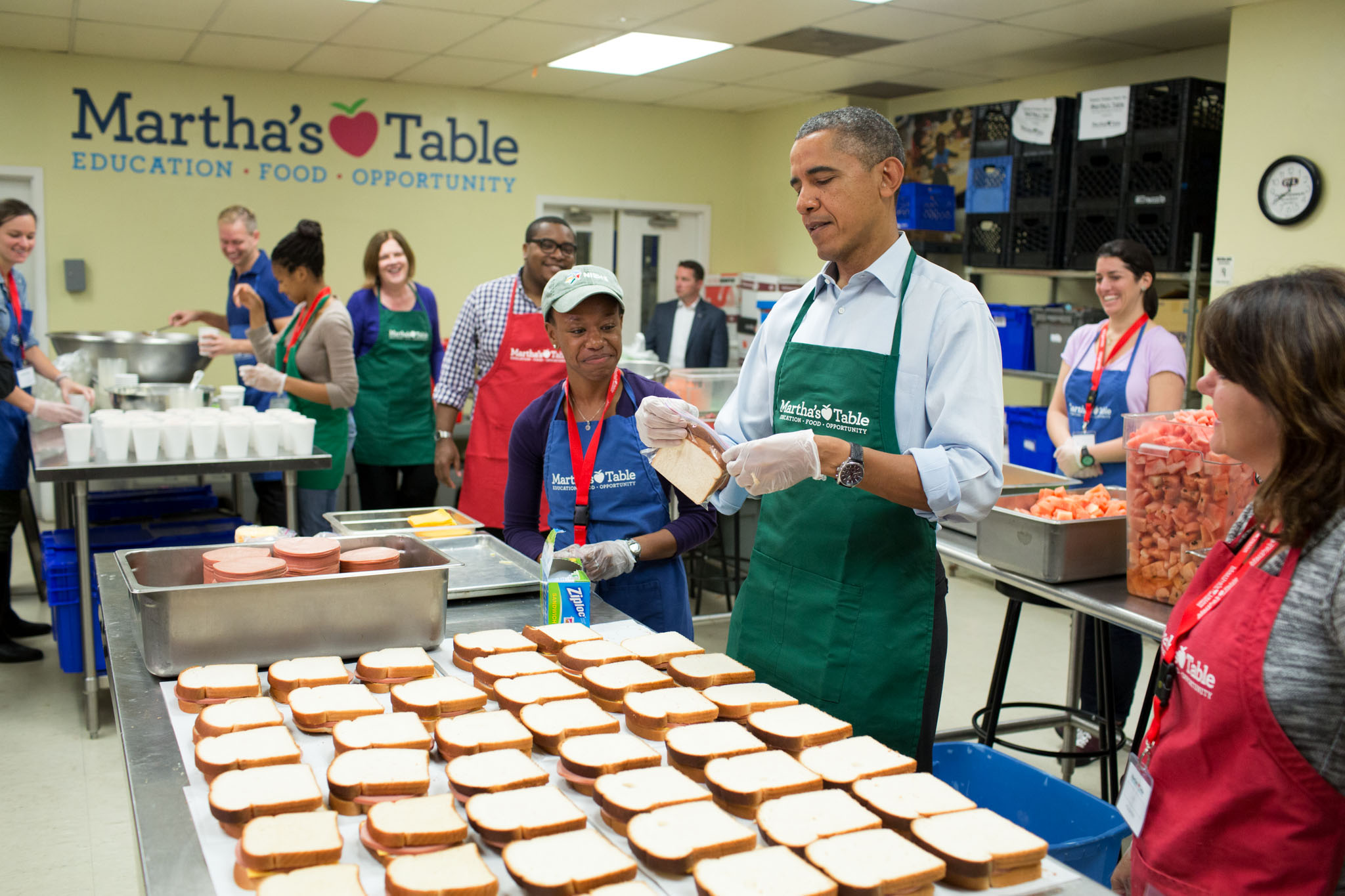
On Monday, the President traveled to Martha’s Table, a local food pantry, to thank the many furloughed federal employees who have spent time during the government shutdown volunteering for charities and non-profits. In a brief statement, he lauded their commitment to public service, noting: “They're here contributing and giving back to the community, and I think that shows the kind of spirit that we have among all kinds of federal workers all across the country -- people who dedicate their lives to public service.”

President Obama making sandwiches at Martha's Table

While there, the President joined volunteers and helped prepare food for the pantry. He spent some time with a few elementary school students working alongside furloughed federal employees, making peanut butter and jelly sandwiches for Americans who are in need of a helping hand.

With the shutdown dragging into its third week, it’s time to let these furloughed employees return to work. In the President’s words:

This week if we don’t start making some real progress, both the House and the Senate and if Republicans aren’t willing to set aside their partisan concerns in order to do what’s right for the country, we stand a good chance of defaulting and defaulting could have a potentially have a devastating effect on our economy.

Martha’s Table has been serving the DC community for over 30 years. The organization helps more than 1,100 people per day obtain healthy food and needed clothing, daycare and after-school programs, and other family support services. To learn more about them, you can visit their website at marthastable.org.

Related Topics: Economy, Service

The White House

Office of the Press Secretary

Fact Sheet: Announcing the Revised U.S. Export Control System

Today, the Administration reached the most significant milestone of the President’s Export Control Reform Initiative (ECR) with the nation’s first set of revised export control lists going into effect.  With these revisions in place, the Administration has successfully implemented the first parts of its new export control system in all four areas of the current export control system:  what we control, how we control it, and how we enforce and manage our controls. 

The changes to the U.S. Munitions List (USML) and the Commerce Control List (CCL) that become effective today pertain to controls on aircraft and gas turbine engines.  Taken together, these two control categories account for the largest volume of U.S. export licenses and represent the highest percentage of licensed exports from 43 states, with licensed shipments of almost $21 billion a year.  These two categories also account for the largest amount (75 percent) of USML export licenses approved solely for parts and components.

These changes are being made to address the increasing challenges posed by an outmoded export control system created during the Cold War.  This system did not prioritize controls, for example between end-items like an F-18 and its parts and components, resulting in a disproportionate focus on the least sensitive items such as nuts, bolts and screws instead of the most sensitive items.  These controls strained government resources by attempting to protect all items in a control category equally, and harmed interoperability with U.S. allies and partners by causing delays in exports of items that support allies and partners operating alongside U.S. forces.  These controls also have harmed the U.S. defense industrial base, because foreign manufacturers have increasingly sourced non-sensitive parts and components from outside the United States to avoid the licensing requirements of the U.S. munitions export control system.  The new controls effective today address these problems, while ensuring that the U.S. government’s process of reviewing export license applications will continue to consider the full spectrum of U.S. national security and foreign policy interests, from nonproliferation to human rights.
 

New Control Lists

The controls effective today are no longer overly broad generic controls that capture everything, but instead are detailed, enumerated lists that impose controls based on the sensitivity of the item and the destination.  For example, our most sensitive items – such as bombers, fighters, unmanned aerial vehicles, and their key subsystems, parts, and components – remain on the USML, while less sensitive items, mostly parts and components like cockpit gauges, steel brake wear pads and fuel filters, are now subject to the more flexible authorities of the CCL.  
 

New Licensing Policies

Items remaining on the USML continue to be subject to our most stringent controls.  Manufacturers, exporters, and brokers of USML-controlled items are subject to annual registration requirements and fees, export licenses are approved only with a valid purchase order provided by the exporter, and comparable requirements for all domestic- and foreign-made items that incorporate USML–items remain in place.

For the less sensitive items now on the CCL, such requirements are eliminated.  In addition, many of the items moved to the CCL are now eligible for export without specific licenses if intended for the ultimate end-use by the governments of 36 U.S. allies and partners (although such exports carry with them additional compliance requirements).  These changes will largely resolve the interoperability problem with these U.S. allies and partners.  They also will facilitate procurement of these items from U.S. firms, supporting our defense industrial base and helping to sustain production and employment in the United States to meet future U.S. needs.  All of the items that moved from the USML to the CCL, even those which are now eligible for export without specific licenses, remain controlled.  In addition, all these items on either list remain subject to the same U.S. arms embargoes.  Military items for aircraft and gas turbine engines that were moved to the CCL in the 1990s are now subject to the same arms embargoes as items controlled on the USML, which means we have tightened controls to those embargoed destinations. 
 

Enhanced Export Enforcement

The Department of Homeland Security (DHS) and the Federal Bureau of Investigations will continue their robust enforcement of U.S. export controls for items on both control lists.  As of today, the easing of export licensing requirements for many items moved to the CCL is balanced by the increased oversight from Department of Commerce Export Enforcement Special Agents and analysts dedicated exclusively to export enforcement for items on the CCL.  Enhanced export enforcement is a critical element of ECR, and includes the enhanced coordination of all export enforcement efforts by the multi-departmental Export Enforcement Coordination Center, which formally began operation in March 2012, and is administered by DHS.
 

New Information Technology (IT) Infrastructure

In July 2013 the Department of State successfully transferred its export licensing database and software platform to the one used by the Department of Defense (“USXports”), and the Department of Commerce is scheduled to begin using USXports in early 2014.  As a result, the three largest departments involved in export licensing will be on a single IT system, enabling them to better administer the licensing process and ensure that decisions made by the different departments are fully informed.

The changes effective today are the result of more than four years of extensive collaboration among the Administration, Congress, non-governmental organizations, and private industry.  Additional control list changes will be implemented throughout the remainder of 2013 and 2014, as the United States adopts a new export control system designed to address the current and anticipated national security and foreign policy challenges of the 21st century.  To follow developments in the President’s Export Control Reform Initiative, visit www.export.gov/ecr/.

The White House

Office of the Press Secretary

Statement by the President on Eid al-Adha

Michelle and I extend our best wishes for a joyous Eid al-Adha to Muslims around the world and congratulate those performing the Hajj this year.  As our Muslim neighbors and friends gather for Eid celebrations, Muslim Americans are among the more than three million pilgrims joining one of the world’s largest and most diverse gatherings, which serves as a reminder of the shared roots of the world’s Abrahamic faiths.

To commemorate Eid al-Adha, Muslims around the world are joining other faith communities in offering their assistance to those suffering from hunger, disease, and conflict.  Their service is a powerful example of the positive role that faith can play in motivating communities to work together to address shared challenges.

On behalf of the American people, we extend our warmest greetings during this Hajj season.  Eid Mubarak and Hajj Mabrour.

Remarks by President Obama at Martha's Table

October 14, 2013 | 5:40 | Public Domain

President Obama visited Martha's Table, which helps 1,100 people a day deal with the immediate effects of poverty and finds long-term solutions with education, nutrition and family support services. President Obama also addressed the government shutdown saying, "this afternoon I am going to once again urge them to open the government and urge them to make sure that the United States government is paying its bills."

Download mp4 (206MB) | mp3 (14MB)

The White House

Office of the Press Secretary

Readout of the President's Call with Leader Pelosi

This afternoon the President spoke with Leader Pelosi over the phone. The President and Leader Pelosi discussed the way forward on the pressing fiscal matters facing Congress today. They reinforced that there must be a clean debt limit increase that allows us to pay the bills we have incurred and avoid default, and that the House needs to pass the clean continuing resolution to open up the government and end the shutdown that is hurting middle class families and businesses across the country. The President and the Leader also discussed their willingness, once the debt limit is raised and the government reopened, to negotiate on a longer term budget solution that will grow our economy and create jobs. The President also thanked Leader Pelosi for her efforts to move forward with a clean CR and a one-year clean debt limit increase that would prevent a first-ever default of our nation's credit.

The White House

Office of the Press Secretary

POTUS Briefed on Shutdown Impacts

From a WH official:

Today, the President was briefed by Denis McDonough on the impacts of the lapse in appropriations on important research programs. 

The federal government’s research agencies have been largely shuttered, with scientists sent home and projects shelved.  There are five Nobel Prize-winning researchers currently working for the federal government, all of whom are world-renowned scientists and leaders in their field.  Four of them are currently furloughed and unable to conduct their federal research on behalf of the American public due to the government shutdown.

Additional details below:

•          Center for Disease Control: Two-thirds of CDC personnel have been sent home. CDC’s activities in influenza surveillance and monitoring have been cut back, just as we are moving into peak flu season.  While many flu vaccines are produced by private companies, CDC’s annual flu vaccination campaigns have been cut back and the weekly “Flu View” report that is relied upon by public-health authorities has been suspended.  CDC will continue to address any imminent threats to public health.

•          National Science Foundation: 98 percent of the National Science Foundation has been furloughed, and new scientific research grants are not being issued.

•          National Institute for Health: Currently, nearly three-quarters of NIH staff have been furloughed.  Although the NIH Clinical Center remains open for patients already enrolled in studies, most new patients have been turned away during the shutdown.  NIH will continue to monitor its admissions policy and adjust as necessary based on life and safety considerations, depending on the duration of the shutdown.

The White House

Office of the Press Secretary

Statement by the Press Secretary

Congress must do its job and raise the debt limit to pay the bills we have incurred and avoid default. It is unfortunate that the common sense, clean debt limit increase proposed by Senate Democrats was refused a yes or no vote today. This bill would have taken the threat of default off the table, and given our nation's businesses and the economy the certainty we need. With five days until the government runs out of borrowing authority, Congress needs to move forward with a solution that reopens the government and allows us to pay our bills so we can move on to the business of achieving a broader budget deal that creates jobs, grows the economy and strengthens the middle class.

Weekly Address: Let’s Get Back to the Work of the American People

In this week’s address, President Obama discussed his meetings with members of Congress of both parties and the ongoing effort to reopen the government and remove the danger of default from our economy. The President urged Congress to pass a budget, put people back to work, and end this shutdown. In his message, the President also called for paying our bills, and preventing an economic shutdown.

Transcript | Download mp4 | Download mp3

Weekly Address: Let’s Get Back to the Work of the American People

October 12, 2013 | 4:29 | Public Domain

In this week’s address, President Obama discussed his meetings with members of Congress of both parties and the ongoing effort to reopen the government and remove the danger of default from our economy. The President urged Congress to pass a budget, put people back to work, and end this shutdown. In his message, the President also called for paying our bills to prevent an economic shutdown.

Download mp4 (163MB) | mp3 (11MB)

Read the Transcript

Weekly Address: Let’s Get Back to the Work of the American People

WASHINGTON, DC— In this week’s address, President Obama discussed his meetings with members of Congress of both parties and the ongoing effort to reopen the government and remove the danger of default from our economy. The President urged Congress to pass a budget, put people back to work, and end this shutdown. In his message, the President also called for paying our bills, and preventing an economic shutdown. The audio of the address and video of the address will be available online at www.whitehouse.gov at 6:00 a.m. ET, October 12, 2013.

Remarks of President Barack Obama Weekly Address The White House October 12, 2013

Good morning. Over the past few days, I’ve met with Republicans and Democrats from both houses of Congress in an effort to reopen your government and remove the dangers of default from our economy. It’s a positive development that House Republicans have agreed on the need to avoid the economic consequences of not meeting our country’s commitments. Because once the debt ceiling is raised, and the shutdown is over, there’s a lot we can accomplish together. We’ve created seven and a half million new jobs in the past three and a half years. Now let’s create more. We’ve cut our deficits in half over the past four years. Now let’s do it in a smarter, balanced way that lets us afford to invest in the things we need to grow. The truth is, there’s a lot we can agree on. But one thing we have to agree on is that there is no good reason anyone should keep suffering through this shutdown. I met with some really innovative small business owners on Friday who’ve already lost contracts, lost customers, and put hiring on hold – because the pain of this Republican shutdown has trickled down to their bottom lines. It’s hurting the very citizens that our government exists to serve. That’s why a growing number of reasonable Republicans say it should end now. And it wouldn’t be wise, as some suggest, to just kick the debt ceiling can down the road for a couple months, and flirt with a first-ever intentional default right in the middle of the holiday shopping season. Because damage to America’s sterling credit rating wouldn’t just cause global markets to go haywire; it would become more expensive for everyone in America to borrow money. Students paying for college. Newlyweds buying a home. It would amount to a new tax – a Republican default tax – on every family and business in America. It doesn’t have to be this way. It’s not supposed to be this way. Manufacturing crises to extract massive concessions isn’t how our democracy works, and we have to stop it. Politics is a battle of ideas, but you advance those ideas through elections and legislation – not extortion. I know you’re frustrated by what you see in your nation’s capital right now. But because it’s easy to get lost in or give up on the political back-and-forth, I want you to remember: this is not normal. Our government is closed for the first time in 17 years. A political party is risking default for the first time since the 1700s. This is not normal. That’s why we have to put a stop to it. Not only because it’s dangerous, but because it saps everyone’s faith in our extraordinary system of self-government. And that hurts us all. Whether it’s the work of creating jobs, growing the economy, or getting our fiscal house in order for the long haul, we’ve got a lot of work to do – and constant brinksmanship doesn’t let us do it. It inflicts real pain on real people. It creates spasms of uncertainty for business owners. It threatens our nation’s credit and standing in the world. And the longer it goes on – the more frequently this brinksmanship is inflicted – the more we’ll see markets react, businesses put off plans to spend and hire, and unemployment claims tick up. The hundreds of thousands of hardworking civil servants who go even longer without pay will worry that they won’t be able to cover their bills, and that their own creditworthiness will be ruined for no good reason at all. And I want to thank all the neighbors and local business owners who’ve shown acts of kindness to these Americans who serve their country. I ask that same spirit of citizenship from lenders who do business with these folks. Because they’re being punished enough through no fault of their own. So let’s pass a budget, put people back to work, and end this Republican shutdown. Let’s pay our bills, and prevent an economic shutdown. Then let’s get back to the work of the American people. Because there is so much else we should be focusing our energies on right now. We’ve got to create more jobs, and kids to educate, and an immigration system to fix. We’ve got more troops to bring home, and a middle class to rebuild, and opportunity to restore. There’s so much America has going for it in this new century. And as always, this country works better when we work together. Thank you, and have a great weekend.

Close Transcript