The White House

Office of the Press Secretary

Readout of Vice President Biden’s Meeting with Prime Minister Victor Ponta of Romania

Vice President Biden met today with the Prime Minister of Romania, Victor Ponta.  The Vice President reaffirmed the enduring U.S. commitment to a strategic partnership with Romania and thanked the Prime Minister for Romania’s steadfast support on a range of regional challenges, including in Afghanistan and its hosting of a missile defense base in Deveselu in support of key NATO capabilities.  Both contributions demonstrate Romania’s unwavering dedication as a bilateral partner and NATO ally to strengthening regional and international security.  The two leaders also agreed on the importance of expanding trade and investment between our two countries, and welcomed support for the Transatlantic Trade and Investment Partnership negotiations, which has the potential to generate significant increases in the already substantial number of jobs supported by U.S.-EU trade and investment.  The Vice President underscored that Romania’s success as a democratic partner with strong rule of law is vital to nourishing a healthy business climate and remains profoundly in our shared interest.    

The White House

Office of the Press Secretary

Press Briefing by the Press Secretary, 10/21/2013

James S. Brady Press Briefing Room

12:50 P.M. EDT

MR. CARNEY:  Good afternoon, ladies and gentlemen.  Thank you for being here, as ever.  Happy Monday to you.  I'm sure you were able to hear the President’s remarks a little earlier about the Affordable Care Act.  Before I take your questions I had a couple of things I wanted to mention. 

First, on Friday, October 25th, President Obama will travel to New York to visit Pathways and Technology Early College High School -- otherwise known as P-Tech -- in Brooklyn, where he will discuss the importance of ensuring that the next generation of middle-class American workers and entrepreneurs has the skills they need to compete and win in a global economy. 

In his State of the Union address earlier this year, the President said, “Now at schools like P-Tech in Brooklyn, collaboration between New York public schools and City University of New York and IBM, students will graduate with a high school diploma and an associate’s degree in computers or engineering.  We need to give every American student opportunities like this.”

Further details about the President’s visit to P-Tech will be made in the coming days.  Later that evening, the President will deliver remarks at a DCCC event and attend a DNC event before returning to the White House that evening.

Also, if I could beg your indulgence to try to get me out of here by 1:35 p.m.  I have an appointment.  But that gives us plenty of time. 

Nedra.

Q    Just real quickly before we get to the speech today, there’s some breaking news of a school shooting out of Nevada.  Can you tell us whether the President has been briefed on that or anything he might have been told?

MR. CARNEY:  I can only tell you that the President is regularly briefed on matters like this.  I don't know that he’s specifically been briefed on this yet, although I suspect he has. We will find that out for you after the briefing.  We are, here, aware of this shooting and the limited information available about it at this time.  For more details we refer you at this point to local law enforcement.

Earlier today, the President was informed by Deputy Chief of Staff Alyssa Mastromonaco of this morning’s school shooting in Nevada.

Q    Okay.  And on to the speech.  We understand the President is frustrated, but what seemed to be missing today was any sort of explanation about what went wrong exactly.  What happened to cause all these problems? 

MR. CARNEY:  Well, I'd say a couple of things, Nedra.  We are focused on providing access to affordable health insurance to millions of Americans -- millions of Americans who prior to now have not had that access.  And as the President made clear in his remarks, the Affordable Care Act is much more than a website.  The website is a piece of a process that will provide access to these marketplaces.  And this is the important part of the Affordable Care Act that has launched this month, and that is the marketplace, which, on average, in states across the country, provides 50 different options of insurance plans for consumers -- for consumers who have not had access to affordable insurance or often have not had the kind of variety that drives down prices and provides insurance at the price points that they can afford.

So the fact of the matter is the President is frustrated, and he made that clear today, by the problems that we’ve seen with the website.  But already, because of the efforts underway at HHS and CMS, and the tech surge that they’ve launched, you’re seeing changes to the site that make it more clear to consumers about the variety of ways that they can get information about the health plans out there, shop around, if you will. 

They can now, for the first time -- if you look at the site today, it’s different from what it looked like yesterday -- you can easily compare and shop just by entering your ZIP code.  There’s also now on the homepage a direct link to a tax calculator that will help you estimate the tax credits you may be eligible for as part of purchasing insurance through the marketplaces. 

And also on the website it prominently features a pathway to allow you to enroll through call centers.  As the President said and others have said, we have beefed up the staffing of call centers, HHS has, to ensure that the obvious high numbers of Americans who are interested in finding out about their insurance options have ways to do that and ways to enroll -- because there are four ways.  It’s not just online.  It’s by phone, in person, or by mail, in addition to online, to register and to enroll in these insurance options.

Q    But without any fuller explanation of what went wrong, can you say whether it was misleading in the beginning to say that this was an issue of volume?

MR. CARNEY:  No, in fact, I think it’s absolutely accurate to say that the volume far exceeded our expectations and that the volume has driven the problems that we’ve seen and exposed some of the problems that we now know about. 

So no one would argue with the assertion that there was an underestimation of the kind of volume that we were going to see, and obviously that demonstrates the very important and real fact that millions of Americans are very interested in affordable health insurance that had not existed before.  But it’s also the case that the models that were in place that tested the website did not account for this kind of volume, and that the volume that we saw instantly on the first day and ever since has both led to these problems and also exposed some of the glitches and kinks that the President talked about today, which is why we’re taking the actions that we’re taking to improve the consumer experience.

But if I could, just remember, even with these glitches, people are signing up, they’re registering.  People are enrolling, and people are being able to explore the options that are available to them.  And as you’ve seen all over the country, there’s a huge demand.  And that is why the President is so focused on fixing the problems that have arisen and fixing the ones that arise, and not on Monday-morning quarterbacking.  We’re interested in providing this very valuable commodity to Americans who so clearly want to buy affordable health insurance.

Yes, Jeff.

Q    Jay, the President mentioned bringing in tech people from outside the government, and HHS said that on its blog yesterday.  Who are some of these people?  Are you getting any names or any companies involved that the public would recognize?

MR. CARNEY:  Well, I would say a couple of things.  The tech surge is something that was announced at HHS, and they are bringing in top experts both from inside and outside the government to scrub in with their team and help improve the healthcare.gov website.  These are additional contractors as well as a few experts who are part of the Presidential Innovations Fellows program, which was started by the President in his first year -- rather, his first term -- and it pairs top innovators from the private sector, nonprofits and academia with top innovators within government to collaborate. 

In terms of who they are, individually, and the contractors, those are the kinds of questions that you should address to HHS and CMS since this is something that they’ve launched and are working on right now.

Q    Speaking of HHS, has the President or the White House encouraged Secretary Sebelius to testify at the hearing this week in Congress?

MR. CARNEY:  Secretary Sebelius and other senior members of HHS have, of course, engaged with and testified before Congress on ACA issues and ACA implementation, and I’m sure that the department -- I know that the department has made clear that they are willing to testify and will be willing in the future.  But for specifics about requests to individual departments and officials who will be made available, I’d refer you to those departments.

Q    From a messaging standpoint, this is being taken over largely by the White House, and isn’t it sort of a bad week not to have your chief health person show up at a hearing?

MR. CARNEY:  I think you heard the President speak today.  I think Secretary Sebelius and many others at HHS have and will continue to speak about implementation of the Affordable Care Act going forward.

Whether or not it’s a messaging challenge is interesting and a worthy subject of discussion and analysis.  The challenge that is far more important in terms of what the focus of the President is has to do with making sure that Americans get affordable health insurance that they so clearly want. 

Q    But that’s connected to messaging right now, isn’t it?

MR. CARNEY:  Well, and that’s why they, HHS, is taking the steps that have been announced overnight and you can see clearly on the website, because we’re focused on making sure that the obvious and demonstrated desire for information about these marketplaces and information about the tax credits that are available to so many Americans that will make insurance affordable for them for the first time is available to them and that they know how they can get that information, and that 24/7, seven days a -- well, I guess that includes seven days a week -- 24 hours a day, seven days a week, experts are working on fixing the problems, identifying problems, isolating them, and making the consumer experience better for Americans across the country.

Q    And last question, you said to Nedra that you’re still standing by the argument that the website has had problems because of unexpectedly high demand.  How do you reconcile that, though, with the fact that the law promises to ensure millions of Americans?  How is it unexpected that millions of people would try to sign up?

MR. CARNEY:  What I said to Nedra is that there’s no question that the volume has caused some of the problems but also exposed some of the problems, and --

Q    But why is the volume unexpected?  That’s what I don’t understand.

MR. CARNEY:  Look, the fact is the number of people who accessed the healthcare.gov website on the first day and every day since has far exceeded expectations and we can Monday-morning --

Q    Why?

MR CARNEY:  Well, I think we noted early on that it exceeded within a few days what Southwest.com -- Southwestairlines.com gets in a month.  So there’s no question that the folks who made guesses about -- and even educated guesses -- about the volume were off, and that the tests, therefore, that preceded the launch were based on volume that turned out to be way below what we saw.

And nobody is making excuses for that.  What we’re focused on is fixing the problems so that the consumer experience is improved, and making clear to Americans that they can enroll, that they can shop, and that they can purchase insurance that will be available to them come January 1st at prices that they could not before now envision getting with the kind of quality coverage that they couldn’t get.

Brianna.

Q    Thanks, Jay.  To follow as well on Nedra’s questions, you’re saying that a structural problem with the website, unrelated to volume, is not part of the issue?

MR. CARNEY:  Let me first say that I do not have a degree in computer science or a level of expertise that would allow me to answer in-depth questions about the architecture of a program like this.  What I can say is that volume, as I’ll repeat, but --

Q    But it’s day 21.  Wouldn’t someone within HHS have communicated that to the White House at this point?

MR. CARNEY:  What I can tell you, Brianna, is that volume exceeded expectations dramatically and that volume both caused problems and exposed problems that the President made clear he’s frustrated with.  He made clear that he’s not satisfied with the consumer experience that a lot of folks out there have had, and that’s why HHS and CMS have been taking the actions they’ve taken, have already introduced improvements to the website, have made clear to Americans across the country that there are ways to enroll through the toll-free number, in person, as well as by mail.  We're focused on getting the Americans who are interested in getting affordable health insurance because they don't already have it through their employer the information they need so that they can shop and make choices.

Q    -- I mean, all observers who do have some sort of expertise --

MR. CARNEY:  Brianna, I think we've acknowledged there's a problem.  And that's why this -- everybody is taking --

Q    A structural problem?

MR. CARNEY:  I would refer you to computer experts on those kinds of technical details.

Q    -- there's a structural problem.

MR. CARNEY:  What I can tell you is that, as the President said, as HHS has said, they are working 24-7 to deal with the website issues.  I would simply note that the family of four out there that has enrolled to purchase insurance at prices they could not previously enjoy, even if they had to struggle through the website or call the 800 number, are getting something that is very valuable to them.  And that is what this is about.  It is providing the security to millions of Americans of affordable, quality health insurance that they did not have before. 

And acknowledging the problems that have existed with a piece of this, we have to focus and we are focused on making sure that those people for whom the Affordable Care Act was written and conceived are getting the services and the benefits that they deserve.

Q    The President obviously wanted this up and running on day one.  As the problems with the website persist and are not immediately resolved, is he open to delaying the penalty for not signing up for insurance?

MR. CARNEY:  What I can tell you, Brianna, is that we are, as I said earlier, two -- or three weeks rather -- into a six-month enrollment period.  And Americans --

Q    Don't you have to enroll by mid-February?

MR. CARNEY:  Americans who have access to affordable insurance would need to have insurance by March 31st.  People who do not have access to affordable care due to a state not expanding Medicaid, for example, or due to other factors will not be penalized.  That's part of the existing law. 

In terms of the February 15th date that you just mentioned, HHS can provide more information.  And there's no question that there's a disconnect between open enrollment and the individual responsibility timeframes in the first year only.  And those are going to be addressed.

But the fact is we are focused now, in the beginning of the fourth week, at the end of the third week of a six-month process, on making sure that Americans out there understand that there are a variety of ways to get the information about the health care plans available to them, the tax credits available to them, and a variety of ways to enroll and purchase insurance.

Q    But you're indicating there's flexibility there in the law if folks --

MR. CARNEY:  I would simply refer you to HHS for more details.  But we're working on -- or they are working on aligning those policies, the enrollment period and the individual responsibility timeframe period, and they’ll issue guidance soon.

Jon.

Q    Let me make sure I’ve got that last part right.

Q    Yes, let’s clear this up.

Q    Yes, can we say given all the problems that we’ve seen with people trying to enroll in this program, is the White House going to be delaying the mandate?

MR. CARNEY:  No.  That's not at all what I was saying. 

Q    Well, why not?  I mean you know --

MR. CARNEY:  Jon.

Q    I mean, why not delay?  You’re going to charge people a fine for not enrolling.  Why not delay that?

MR. CARNEY:  We’re three weeks into a six-month enrollment period.  As I said, the law itself, as written, makes clear that Americans who have access to affordable insurance would need to have insurance by March 31st.  But people who do not have access to affordable care due, example, to a state not expanding Medicaid -- and there are states out there who are depriving their residents of access to expanded Medicaid because they made that choice -- or due to other factors will not be penalized.  That's number one.

And when it comes to the issue I was just talking to Brianna about and the February 15th marker period in terms of enrollment, I would refer you to HHS for more details.  But they are working to align the policies, the disconnect between the open enrollment period and the individual responsibility timeframes, which exist on the first year only. 

The point I’m trying to make, Jon, and addressing the question at the end of your question, is we’re focused on providing quality health insurance to millions of Americans.  We are three weeks into a six-month enrollment period.  If you enrolled last week or you enroll next week, your insurance does not kick in until January 1st.  And ample prior experience shows that in programs like these, most people don’t enroll until towards the end. 

If you’re able to shop for an extended period of time before you have to buy, you’re likely to shop.  And in Massachusetts, for example, where a similar health care initiative was passed into law, the average consumer explored his or her options six to eight times I believe the figure was before actually making a decision. 

So, again, we’re acknowledging clearly, as the President did, that the problems that have existed on the website are not acceptable to him, that we are focused on making the consumer experience better, providing clear information to Americans about the variety of ways they can get the information about plans as well as the variety of ways that they can enroll to them.  And our focus is on making the Affordable Care Act work and making sure that Americans have access to these plans -- not on figuring out who is to blame for a problem that clearly exists and we need to fix.

Q    I'm just trying -- just basic language.  You can’t really charge people a fine for not getting health insurance if you don’t fix this mess, if you can't make this website work, can you?

MR. CARNEY:  Jon, I appreciate what you’re saying and I have answered now and will answer again that people who --

Q    I don’t understand the answer, though.  If the website is not fixed, will people still have to pay the fine?

MR. CARNEY:  First of all, we’re way still early in the process.  So you’re talking about a February 15th and a March 31st deadline; it is October 21st today.  So let’s be clear about that.  We’re three weeks into this.  And that’s number one.

Number two, as written, the law makes clear that people who do not have access to affordable care due to a state not expanding Medicaid or other factors will not be penalized.

Q    So other factors can be this website having the same problems?

MR. CARNEY:  Again, that’s how the law is written.  We’re focused on implementing the law and ensuring that people have the information they need.  What I think is important to remember is that even through this, people are enrolling; people are submitting applications successfully.  And we need to make sure that we’re doing everything we can, because the interest is so high and the demand is so high, that the consumer experience is as good as possible, and that every American out there who is interested in getting affordable health insurance because he or she hasn’t in the past had it available to him or her is getting the information they need and getting it in a way that allows them to make the educated choices about the variety of plans available to them that they need to make.

Q    Can we just ask about the main contractor that helped build this website, CGI?  I mean, they were fired by Ontario, Canada, for problems up there.  Did the administration choose the wrong people to build this website?

MR CARNEY:  Look, there are a lot of people working on this. I would refer you to HHS about contractors.  That’s not something that the White House oversees.  The President made clear today that he’s not satisfied with what the consumer experience is with the website, and the administration, HHS, and CMS are working 24/7 to improve the experience.

Q    Could you answer this -- the contract, the top dollar, was at -- started at $93 million.  It went up to $292 million, which is where it now -- where is that money coming from?

MR. CARNEY:  I would refer you to HHS for questions about HHS contracts. 

Major.

Q    I just want to try to make sure I understand.  So you’re saying when you mention other factors that this website issue could fall under that category at some time in the future? You’re leaving open that possibility, correct?  I’m just trying to understand what you’re saying.

MR. CARNEY:  I am simply explaining to you what the law says.  And I’m also saying --

Q    You’re implementing a law and you need to have some flexibility it would seem to me to address this problem, correct?

MR. CARNEY:  Well, that’s what the law says -- that if you do not -- let’s put it this way.  If you do not have access to affordable insurance, you won’t be penalized for not buying affordable insurance.  Okay?  So if you live in a state where a governor or a legislator has chosen not to expand Medicaid, for which you would otherwise have qualified --

Q    (inaudible.)

MR. CARNEY:  Well, no, the Affordable Care Act mandates an expansion -- or tried to mandate an expansion of Medicaid.  The Supreme Court made a decision that the states would make -- and many have, including states with Republican governors -- and others haven’t, leaving out many Americans from new access to Medicaid.

Q    A separate issue from this.

MR. CARNEY:  No, no, no.  Look, the Affordable Care Act is not a website.  The issue is, do you have access to affordable health insurance?  And the individual responsibility provision is there for those individuals who, even though they have access to affordable health insurance, do not purchase it and therefore are held responsible for that.  The law addresses that as written.

In terms of the deadlines that Brianna was talking about, I was simply acknowledging that there’s a disconnect between the two deadlines in the first year only, and that HHS is looking at that and will be issuing guidelines soon.

Q    Would it be correct for any of us to say that because of this website issue, the administration is looking into flexibility as far as the application of that individual mandate because the sign-up period has become more complicated?

MR. CARNEY:  Whatever conclusions you draw about the way the law is written I think you can draw.  The law is clear that if you do not have access to affordable health insurance then you will not be asked to pay a penalty because you haven’t purchased affordable health insurance.  We’re focused on making sure that millions of Americans in every state across the country do have access to affordable health insurance.

Q    As you’re focused on that, has the President established, or HHS, a new deadline in which he wants certain service factors met or quality assurance standards met?  Has he set forth a timetable and a means by which HHS can report to him and everyone here about what progress they’re making?  And can he tell -- on his behalf, can you tell the country when this is going to be resolved?

MR. CARNEY:  Well, first of all, let’s be clear.  There have been problems with the website.  People have been submitting applications.  People have been enrolled across the country.  So the idea that something --

Q    Is this a timeline for his own satisfaction?

MR. CARNEY:  Let me get to that part of the question.  But I think it’s important to note that the issue here isn’t that the marketplaces didn’t open on October 1st or that Americans haven’t been able to shop for insurance, or haven’t been able to submit applications.  The issue is that the website component of this has not functioned as effectively as it should have.  And the President made clear that he’s not satisfied with that.

Q    I was trying to get to that focus --

MR. CARNEY:  And what I’m saying is that his deadline -- his insistence is every minute of every hour of every day going forward, this problem has to be addressed and isolated and fixed, and as with any website, as new issues arise, that they’re addressed and fixed so that the consumer experience is as efficient and effective as possible going forward.

Q    But there’s no timeline he set internally for this to be achieved, or some moment where you can tell the country it’s all fixed?

MR. CARNEY:  I think the President made clear today that he wants, and he is seeing action being taken right away and efforts being made right away, to make improvements to the website and to make -- more importantly, make it clear, broadly, to the American people who have such a keen interest in getting affordable health insurance, that there are a variety of ways for them to get access and information about it.

Q    From that podium, the President apologized to the country about the shutdown and the specter of default.  Does the White House owe the country an apology for this particular problem?

MR. CARNEY:  Look, I think the President is frustrated and he made clear, and what the President made clear today is that every American out there who has demonstrated such clear interest in getting affordable health insurance should be rewarded by the best possible consumer experience, and that's what he’s insisting on.

We are in the beginning of a six-month enrollment period. And what the experience has told us is that demand for quality affordable health insurance is exceedingly high, and we need to step up our game to ensure that that demand is met in a way that allows consumers to examine the options available to them, examine the credits available to them to make insurance even more affordable for them and their families, and to purchase that insurance so that they're covered, in many cases for the first time.

Q    But no apology for having a system that was not ready for primetime?

MR. CARNEY:  Again, I think the President expressed his frustration in the Rose Garden today.

Q    Jay?

MR. CARNEY:  Yes.

Q    How do you answer criticism from folks who say the problems with the website suggest there may be problems elsewhere in Obamacare down the road -- be it tax subsidies or physician reimbursements?  You should have gotten, they say, the website sign-ups right. 

MR. CARNEY:  Well, look, I would say this, Wendell, there is no question that we have seen for many months and years now a concentrated, concerted effort by critics of Obamacare to undermine it.  They’ve tried more than 40 times to repeal it and other -- by other means sabotage the Affordable Care Act.  They shut down the government because of their opposition to affordable health insurance to millions of Americans.  And there’s clearly some joy being taken in some quarters by the experiences that some Americans have had, frustrating experiences that they’ve had in trying to get information about affordable health insurance. 

And my only question to them is, how can you possibly take pleasure in that frustration when it’s born out of a desire for health insurance that the very same critics have never provided a plan to provide -- have never developed a plan to provide to those same Americans who need --

Q    I don’t think that's implied in my question.

MR. CARNEY:  They’ve opposed -- but the critics you’re talking about have opposed health care reform at every step. They’ve tried to undermine it at every step.  And they shut down the government over their opposition to it.  And I don’t -- it’s hardly surprising, then, that they would be critical of the real problems that we’ve seen in the website part of the Affordable Care Act.

But let’s remember what this is about.  It’s about getting insurance to Americans who have not had access to affordable insurance, that 15 to 20 percent of the population that -- for whom these marketplaces are designed.  And what we’ve never seen from those critics is an alternative.  So there shouldn’t be, I don’t think, celebration around the fact that there have been troubles that Americans have experienced -- real people who have real needs and desire the security of health insurance -- trouble that they’ve had in getting access to this information so they can purchase affordable health care.

Q    I’m not talking about people welcoming the problems.  I’m talking about people who say a simple thing like setting up a website is much less complex than setting up, for example, a system that deals with tax subsidies and physician reimbursements, and if you didn’t get the first one right, why should they be confident you will get the second one right?

MR. CARNEY:  Again, I think the idea that setting up a website is simple would be challenged by a lot of folks in Silicon Valley, A -- especially one of this nature that provides so much information and to so many millions of Americans.  B, if you’re going to ask me a specific question about a specific element of the Affordable Care Act, I’m happy to try to answer it, but to say that there are critics out there who don’t like it and how do you answer them is to tell me and everybody in America what we already know.

Q    You went through four ways of dealing with this -- on the web, by phone, in person, by mail.  One of our reporters called the number that’s now on the website and was told essentially, we’ll send you paperwork in the mail in a couple of weeks.  So --

MR. CARNEY:  Well, I don’t know what the Fox reporter or producer discovered when he or she called.  What is true is that wait times have been fairly short on the 1-800 number and that -- 
Q    He talked to a person and they said basically, we’ll send you the paperwork in the mail.

MR. CARNEY:  Look, you can -- again, I don’t know what experience you guys had.  You can enroll over the phone.  You can enroll in person.  You can be provided an application to sign up and register and to enroll.  And what we’re making clear today is -- and what the website itself makes clear today is that there are these other avenues to both learn about the Affordable Care Act and the health insurance options available to you in your state, and to sign up and to enroll.

Chuck.

Q    Jay, I'm just curious --

MR. CARNEY:  I'm always --

Q    No, no, no, I want to be -- five days before the launch, the President said it’s a website where you can compare and purchase affordable health care plans, the same way you shop for a plane ticket on Kayak.  Who misled him?  Who misled the President on this?  Are you telling me, five days before, that somebody let the President go out to the American public to give this speech and say this and make this promise -- in fact, the next line is, “I promise you, this is a lot easier.  It’s like booking a hotel or a plane ticket.”  Who let him down?

MR. CARNEY:  Look, the President is frustrated.  He made that clear in his remarks today.  And we're focused on making improvements so that the millions of Americans who want affordable health insurance are getting the best consumer experience possible, as opposed to Monday morning quarterbacking -- 
Q    Does he feel let down?  Did somebody --

MR. CARNEY:  Again, what I'll tell you is, as I mentioned earlier I think, is that there's no question that volumes exceeded substantially expectations and that the testing that was done was based on --

Q    If this were a volume issue, adding a server would have fixed it in a heartbeat --

MR. CARNEY:  Well, again, I don't think -- I'm pretty confident you're not a --

Q    I'm not a computer scientist, but --

MR. CARNEY:  -- you haven't written code in your day.

Q    I understand.  But if this were simply a traffic issue, that's fixable fast, is it not?

MR. CARNEY:  Well, what I would tell you is, as I said earlier, is that the volume far exceeded expectations and that the volume both created problems because of how large it was and exposed other problems and glitches and kinks with the system that are being addressed. 

You're not going to get an argument from here that this has not been frustrating.  The President himself made that clear.  But what he's focused on is making the consumer experience better for Americans, because even through this process, nearly 20 million folks -- there have been nearly 20 million visits to healthcare.gov.  That demonstrates a sustained interest in the array of affordable health care options available to millions of Americans who haven't had those options available to them in the past. 

Q    Why should we assume when HHS puts out on its blog post last night that they brought in this tech surge, brought in people on the outside, that seems to send the message they don't know what the problem is.  Is that fair?  I mean, should we not assume that --

MR. CARNEY:  No.  I think you should assume --

Q    -- they do know what the problem is?

MR. CARNEY:  -- that they identified problems and glitches that need to be fixed, and that they brought in this team to continue the effort and to put in place tools and processes to monitor and identify parts of the websites where individuals are encountering errors. 

Q    But if you had solved the problems, wouldn't you be screaming up and down, we have found the problem, we're working on a solution?

MR. CARNEY:  I think we are finding problems and we're working on solutions.  When you have tech experts at any major tech operation, you're constantly monitoring your operations, finding glitches and problems and fixing them.  And that's what they're doing here.

Q    Finally, are you open to extending open enrollment?  This is a separate sort of follow-up to the question about -- considering that this is now going to potentially be a lost month in open enrollment, are you guys open to extending open enrollment an extra month?

MR. CARNEY:  Well, I'd say a couple of things.  One, I'm not sure how you can call a three-week period or even a month a lost month when there have been hundreds of thousands of people who have submitted applications.  And that's not just your name and your email address.  That's the application that much of you discuss and we talked about here that was initially 21 pages, but is now down to three pages to make it an easier experience for consumers.  But that's still a substantial piece of business. 

And that's one of the biggest pieces of this process, is submitting that application.  And, again, half a million people have done that, representing more because these are people who have done it often on behalf of their family members as well.  

Q    But you don't plan --

MR. CARNEY:  Again, it's far from where we wanted to be, as the President made clear, when it comes to the website experience.  But the answer to that question is that's like writing off those 500,000 people.  We would never do that, because that demonstrates the absolute interest in --

Q    Are you going to extend open enrollment?  Is that on the table?

MR. CARNEY:  We're three weeks into this.  I'm not going to speculate about where we're going to be in a few months.  We're focused on fixing problems now, providing access to information now. 

One of the -- when you read that quote, one of the things that the President said on that day is true and remains true about healthcare.gov.  You type in your ZIP code and you can comparison shop.  You can look at all the options available to you, and you can access a tax calculator to estimate for you and your family what your subsidies would be or could be under the Affordable Care Act.  And then you have -- either through the website or through other means -- the capacity to enroll and purchase insurance. 

Peter.

Q    Thanks, Jay.  Is it the White House’s decision on whether Secretary Sebelius testifies Thursday, or is that entirely her decision?

MR. CARNEY:  The departments decide, and I would refer you to the departments on how to respond to specific requests for officials to appear.  What I can say is that the department has consistently engaged with and worked with Congress when it comes to appearances and other engagements with Congress, and I’m sure that the department will continue to do that.

Q    Does the White House have input into that decision?

MR. CARNEY:  Again, I would refer you to departments when their officials are asked to testify.

Q    Jay?

MR. CARNEY:  Yes, then Margaret.

Q    A question not about the website.  You talk about the individual responsibility period -- is it accurate to say that other than someone literally sitting down and voluntarily writing a check for $95 if they don't have insurance --

MR. CARNEY:  If you’re going to ask me how these things are implemented, I would refer you to HHS.

Q    Well, this is an important question because a lot of supporters of the law are worried that the penalty is almost impossible to enforce because other than someone applying for a refund that the penalty can be charged against, there’s no other way to collect it.  Are you saying you have no understanding of how the process works?

MR. CARNEY:  I would refer you to HHS and CMS for that. 

I think I said Margaret.  Yes. 

Q    By the way, there’s a report out now that says Sebelius will testify next week.

MR. CARNEY:  How about that? 

Q    To a congressional committee.  So do you know whether the website was beta-tested before the actual launch?

MR. CARNEY:  I’d have to know what beta-tested means, but I can tell you that --

Q    You don’t know what beta-tested means?  (Laughter.) 

MR. CARNEY:  I mean, I’m old but I’m not -- Margaret, what I can tell you is that there’s no question that the website has not performed up to expectations or performed as well as we believed it would, based on the testing that was done.

Q    So it was tested?

MR. CARNEY:  Yes -- well, I don’t know -- in terms of the types of testing, I would refer -- I just don’t want to pretend to be an expert.  What I can say is that the system has not worked as effectively and efficiently, obviously, as we wanted it to -- the President, Secretary, anybody wanted it to.  And that’s why people are working as hard as they’re working and people are being brought in to work as hard as they can work to help address these problems.

Q    But there was a point before it went live where people in the administration had tested it and thought, hey, this thing is going to work on the day when it goes live?

MR. CARNEY:  We obviously -- again, I’d refer you for you details to HHS.  But we obviously -- the system was tested, and based on the expectations we had, we were confident that it was going to work more effectively than it’s been working.  We were, as you’ll recall even before, acknowledging that as with any launch of a major web operation like this, there were going to be glitches and kinks.  But I’m not soft-pedaling what’s happened.  We completely acknowledge that this has been a frustration.  And that’s why the President spoke the way he did in the Rose Garden today, and that’s why so many people are busting rocks on this problem right now.

Q    I have a quick foreign policy question.  The Prime Minister from Pakistan -- the Prime Minister is going to be here on Wednesday.  Just in case we don’t have a chance to ask you tomorrow, can you talk about how important that meeting is, especially given what the last couple of years have been like between the U.S. and Pakistan, and what the President is hoping can be accomplished in --

MR. CARNEY:  Absolutely.  The President looks forward to welcoming Prime Minister Sharif to the White House on Wednesday. The Prime Minister’s official visit comes as we are strengthening U.S.-Pakistan relations.  Ahead of the leaders’ meeting, the Prime Minister will see the State Department, the Department of Defense, Department of Energy, Department of Treasury, and the U.S. Trade Representative.  These meetings provide an opportunity to discuss concrete cooperation on issues of mutual concern such as energy, trade, and economic development, regional stability, and, of course, countering violent extremism.

We want to advance our shared interest of a stable, secure, and prosperous Pakistan that is contributing to regional and international security and prosperity.  We want to find ways for our countries to cooperate, even as we have differences on some issues, and we want to make sure that the trajectory of this relationship is a positive one. 

So the President looks forward to this.  It’s obviously a very important relationship -- the United States and Pakistan.  It’s one that’s obviously got a lot of complexity to it, but it’s enormously valuable when it comes to U.S. national security and to the safety and security of the American people.

Q    Can we expect any announcement or any concrete deliverables?

MR. CARNEY:  I don’t have any previews to give you beyond what I just gave you.

Alexis.

Q    Jay, you were talking about the lawmakers that have tried to undermine the Affordable Care Act at every turn.  Can you say whether their refusal, at one point, to increase funding or financing for the implementation phase in any way impacted what we have seen in terms of problems?  And related to that, can you imagine that the President and HHS would come back to Congress and ask for any additional funding to try to remedy these problems?

MR. CARNEY:  I don’t know the answer to the first question.  And I think right now we’re focused on correcting the problems that exist, improving the consumer experience, making sure millions of Americans -- that they have information available to them and that they can shop for affordable health care, and that they will be able to enroll and purchase affordable health care for the first time.

For other questions around funding streams, I would direct you to HHS.

Q    And related to Chuck’s question, can I just clarify if the administration -- if the President would like to extend the open enrollment phase, is that something that he can do through executive fiat?

MR. CARNEY:  Again, we’re getting way ahead of ourselves.  We’re three weeks into this process.  We’re not sugarcoating the fact that the website portion of the Affordable Care Act -- the implementation and rollout of the marketplaces has been filled with some challenges, but we’re three weeks in.  And going to the broader issue of the six-month enrollment period, regardless of the number of, or scarcity of, challenges that are going to be with rolling out a website like this, the fact would always have been, based on all the examples that we know of, that the early periods here would have been ones in which we saw a great deal of shopping around and accessing of information, but that the bulk of actual submissions of applications and then enrollments would take place later in that period.  That has always been the case and that’s what we expect here.

Q    I’m just asking because you seem to leave it open --

MR. CARNEY:  But I’m not going to speculate, so I guess if that’s what you mean by leaving it open -- I’m simply saying --

Q    But you knew you were going to get asked that.

MR. CARNEY:  Sure, but there’s a lot of stuff I know I’m going to get asked about that I wouldn’t want to speculate about.

I think that we have a six-month enrollment period -- six months -- which is a substantial enrollment period.  For anybody who is, as I suspect most people here are, enrolled in a health care or health insurance through their employer and they have the annual open enrollment period, it’s a lot shorter than six months.  And so I think the duration of that was by design and provides an ample amount of time for Americans to acquaint themselves with this new opportunity and the new benefits available to them, and then to make choices according to their family’s needs and their finances.

I’m going to make this the last one because I’ve got to run.  Tangi.

Q    The French government is pretty angry today after Le Monde claimed that the NSA has secretly monitored tens of millions of phones, communications in France earlier this year.  Prime Minister Ayrault said that he is shocked and has demanded an explanation.  So I guess the question is what kind of explanation is the U.S. ready to give to yet another concern by this alleged behavior?

MR. CARNEY:  Well, I would say a couple of things.  One, obviously we have an enormously important and valuable relationship between the United States and France, one of our closest allies and certainly our longest ally.  And as we’ve said before in response to questions about other countries, we address issues like this related to alleged intelligence activities through diplomatic channels, and that would certainly be the case here.  I’m not going to comment publicly on every specified, alleged intelligence activity.  And as a matter of policy, we have made clear that the United States gathers foreign intelligence of the type gathered by all nations.

As the President said in his speech at the U.N. General Assembly, we’ve begun to review the way that we gather intelligence so that we properly balance the legitimate security concerns of our citizens and allies with the privacy concerns that all people share.

I would remind you that the National Security Agency is a foreign intelligence agency.  It is focused on discovering and developing information about valid foreign intelligence targets. Its activities are directed against these valid foreign intelligence targets in response to requirements from U.S. leaders in order to protect the nation and its interests from threats such as terrorism and the proliferation of weapons of mass destruction.

Thank you all very much.  Have a great day.

END
1:35 P.M. EDT

The White House

Office of the Press Secretary

Readout of the President’s Call with President Hollande of France

The President spoke today with President Hollande of France. The United States and France are allies and friends, and share a close working relationship on a wide range of issues, including security and intelligence. The President and President Hollande discussed recent disclosures in the press – some of which have distorted our activities and some of which raise legitimate questions for our friends and allies about how these capabilities are employed. The President made clear that the United States has begun to review the way that we gather intelligence, so that we properly balance the legitimate security concerns of our citizens and allies with the privacy concerns that all people share. The two Presidents agreed that we should continue to discuss these issues in diplomatic channels moving forward.  The two leaders also discussed the ongoing violence in Syria and the importance of a political solution to the crisis.

President Obama Speaks on the Affordable Care Act

October 21, 2013 | 44:11 | Public Domain

President Obama says that the health insurance that’s available to people through HealthCare.gov is high quality and affordable, and his Administration is working around the clock to address problems that make the site slow and difficult to use.

Download mp4 (1034MB) | mp3 (66MB)

Read the Transcript

Remarks by the President on the Affordable Care Act


Rose Garden

11:33 A.M. EDT

THE PRESIDENT:  Everybody, have a seat. 

MS. BAKER:  Hello.  My name is Janice Baker.  I have the privilege to say that I'm the first person in the state of Delaware to enroll for health insurance through the new marketplace.  (Applause.)  Like many consumers out there, it took me a number of frustrating attempts before I could apply for and select my plan.  I kept trying because I needed access to the new health care options. 

I had applied to three private insurance companies only to be rejected due to preexisting health conditions.  I am too young for Medicare, but I'm too old not to have some health issues.  I was able to find a policy I am thrilled with, saving $150 a month, and much lower deductibles than my previous policy that I held through my small business.

I'm here today to encourage other people like me who needs access to quality, affordable insurance, and to tell them to have patience with such a new system.  Without this ability to get this insurance, I know that a single hospital stay could have bankrupted me and my business.

Thank you all.  And I am now honored to introduce the President of the United States.  (Applause.) 

THE PRESIDENT:  Great job.

MS. BAKER:  Thank you.  Thank you.  

THE PRESIDENT:  Thank you.  (Applause.)  Thank you, everybody.  Well, thank you, Janice.  And thanks to everybody here for coming on this beautiful day.  Welcome to the White House. 

About three weeks ago, as the federal government shut down, the Affordable Care Act’s health insurance marketplaces opened for business across the country.  Well, we’ve now gotten the government back open for the American people, and today I want to talk about how we’re going to get the marketplaces running at full steam, as well.  And I’m joined today by folks who have either benefited from the Affordable Care Act already, or who are helping their fellow citizens learn about what this law means for them and how they can get covered.

Of course, you’ve probably heard that HealthCare.gov –- the new website where people can apply for health insurance, and browse and buy affordable plans in most states –- hasn't worked as smoothly as it was supposed to work.  And the number of people who have visited the site has been overwhelming, which has aggravated some of these underlying problems. 

Despite all that, thousands of people are signing up and saving money as we speak.  Many Americans with a preexisting condition, like Janice, are discovering that they can finally get health insurance like everybody else.

So today, I want to speak to every American who’s looking to get affordable health insurance.  I want you to know what’s available to you and why it may be a good deal for you.  And for those who’ve had some problems with the website, I want to tell you what we’re doing to make it work better and how you can sign up to get covered in other ways.

But before I do that, let me remind everybody that the Affordable Care Act is not just a website.  It's much more.  For the vast majority of Americans -- for 85 percent of Americans who already have health insurance through your employer or Medicare or Medicaid -– you don’t need to sign up for coverage through a website at all.  You've already got coverage.  What the Affordable Care Act does for you is to provide you with new benefits and protections that have been in place for some time.  You may not know it, but you're already benefiting from these provisions in the law.

For example, because of the Affordable Care Act, young people like Jasmine Jennings, and Jessica Ugalde, and Ezra Salop, all of whom are here today, they’ve been able to stay on their parents’ plans until they’re 26.  Millions of other young people are currently benefiting from that part of the law.  (Applause.)  Another part of the Affordable Care Act is providing seniors with deeper discounts on their prescription medicine.  Billions of dollars have been saved by seniors already.  That’s part of the law.  It’s already in place.  It’s happening right now. 

Already, because of the Affordable Care Act, preventive care like mammograms and birth control are free through your employers.  That’s part of this law.  (Applause.)  So there are a wide range of consumer protections and benefits that you already have if you’ve got health insurance.  You may not have noticed them, but you’ve got them, and they’re not going anywhere.  And they’re not dependent on a website.

Here’s another thing that the Affordable Care Act does.  In states where governors and legislatures have wisely allowed it, the Affordable Care Act provides the opportunity for many Americans to get covered under Medicaid for the first time.  So in Oregon, for example, that’s helped cut the number of uninsured people by 10 percent just in the last three weeks.  Think about that.  That’s 56,000 more Americans who now have health care.  (Applause.)  That doesn’t depend on a website.

Now, if you’re one of the 15 percent of Americans who don’t have health insurance -- either because you can’t afford it or because your employer doesn’t offer it, or because you’re a small businessperson and you have to go out on the individual market and buy it on your own and it’s just too expensive -- October 1st was an important date.  That’s when we opened the new marketplaces where people without health insurance, or who can’t afford health insurance, or who aren’t part of a group plan, can finally start getting affordable coverage. 

And the idea is simple.  By enrolling in what we’re calling these marketplaces, you become part of a big group plan -- as if you were working for a big employer -- a statewide group plan that spreads risk between sick people and healthy people, between young and old, and then bargains on your behalf for the best deal on health care.  What we’ve done is essentially create a competition where there wasn’t competition before.  We created these big group plans, and now insurers are really interested in getting your business.  And so insurers have created new health care plans with more choices to be made available through these marketplaces. 

And as a result of this choice and this competition, prices have come down.  When you add the new tax credits that many people are eligible for through the law, then the prices come down even further.  So one study shows that through new options created by the Affordable Care Act, nearly 6 in 10 uninsured Americans will find that they can get covered for less than $100 a month.  Think about that.  (Applause.) 

Through the marketplaces, you can get health insurance for what may be the equivalent of your cell phone bill or your cable bill, and that’s a good deal. 

So the fact is the product of the Affordable Care Act for people without health insurance is quality health insurance that’s affordable.  And that product is working.  It’s really good.  And it turns out there’s a massive demand for it.  So far, the national website, HealthCare.gov, has been visited nearly 20 million times.  Twenty million times.  (Applause.)  And there’s great demand at the state level as well, because there are a bunch of states that are running their own marketplaces. 

We know that nearly one-third of the people applying in Connecticut and Maryland, for example, are under 35 years old.  They understand that they can get a good deal at low costs, have the security of health care, and this is not just for old folks like me -- that everybody needs good quality health insurance.  And all told, more than half a million consumers across the country have successfully submitted applications through federal and state marketplaces.  And many of those applications aren’t just for individuals, it’s for their entire families.  So even more people are already looking to potentially take advantage of the high quality, affordable insurance that is provided through the Affordable Care Act.

So let me just recap here.  The product is good.  The health insurance that’s being provided is good.  It’s high quality and it’s affordable.  People can save money, significant money, by getting insurance that’s being provided through these marketplaces.  And we know that the demand is there.  People are rushing to see what’s available.  And those who have already had a chance to enroll are thrilled with the result.  Every day, people who were stuck with sky-high premiums because of preexisting conditions are getting affordable insurance for the first time, or finding, like Janice did, that they’re saving a lot of money.  Every day, women are finally buying coverage that doesn’t charge them higher premiums than men for the same care.  (Applause.)  Every day, people are discovering that new health insurance plans have to cover maternity care, mental health care, free preventive care. 

So you just heard Janice’s story -- she owns her own small business.  She recently became the first woman to enroll in coverage through Delaware’s exchange.  And it’s true, it took her a few tries, but it was worth it after being turned down for insurance three times due to minor preexisting conditions.  So now she’ll be covered, she’ll save 150 bucks a month, and she won’t have to worry that one illness or accident will cost her her business that she’s worked so hard to build.

And Janice is not alone.  I recently received a letter from a woman named Jessica Sanford in Washington State.  And here’s what she wrote:  “I am a single mom, no child support, self-employed, and I haven’t had insurance for 15 years because it’s too expensive.  My son has ADHD and requires regular doctor visits and his meds alone cost $250 per month.  I have had an ongoing tendinitis problem due to my line of work that I haven’t had treated.  Now, finally, we get to have coverage because of the ACA for $169 per month.  I was crying the other day when I signed up.  So much stress lifted.”

Now, that is not untypical for a lot of folks like Jessica who have been struggling without health insurance.  That’s what the Affordable Care Act is all about.  The point is, the essence of the law -- the health insurance that’s available to people -- is working just fine.  In some cases, actually, it’s exceeding expectations -- the prices are lower than we expected, the choice is greater than we expected.

 But the problem has been that the website that’s supposed to make it easy to apply for and purchase the insurance is not working the way it should for everybody.  And there’s no sugarcoating it.  The website has been too slow, people have been getting stuck during the application process.  And I think it’s fair to say that nobody is more frustrated by that than I am -- precisely because the product is good, I want the cash registers to work.  I want the checkout lines to be smooth.  So I want people to be able to get this great product.  And there’s no excuse for the problems, and these problems are getting fixed.

 But while we’re working out the kinks in the system, I want everybody to understand the nature of the problem.  First of all, even with all the problems at HealthCare.gov, the website is still working for a lot of people -- just not as quick or efficient or consistent as we want.  And although many of these folks have found that they had to wait longer than they wanted, once they complete the process they’re very happy with the deal that’s available to them, just like Janice’s.

Second, I want everybody to remember that we’re only three weeks into a six-month open enrollment period, when you can buy these new plans.  (Applause.)  Keep in mind the insurance doesn’t start until January 1st; that’s the earliest that the insurance can kick in.  No one who decides to purchase a plan has to pay their first premium until December 15th.  And unlike the day after Thanksgiving sales for the latest Playstation or flat-screen TVs, the insurance plans don’t run out.  They’re not going to sell out.  They’ll be available through the marketplace -- (applause) -- throughout the open enrollment period.  The prices that insurers have set will not change.  So everybody who wants insurance through the marketplace will get insurance, period.  (Applause.)  Everybody who wants insurance through the marketplace will get insurance.

Third, we are doing everything we can possibly do to get the websites working better, faster, sooner.  We’ve got people working overtime, 24/7, to boost capacity and address the problems.  Experts from some of America’s top private-sector tech companies who, by the way, have seen things like this happen before, they want it to work.  They're reaching out.  They're offering to send help.  We’ve had some of the best IT talent in the entire country join the team.  And we’re well into a “tech surge” to fix the problem.  And we are confident that we will get all the problems fixed.

Number four -- while the website will ultimately be the easiest way to buy insurance through the marketplace, it isn’t the only way.  And I want to emphasize this.  Even as we redouble our efforts to get the site working as well as it’s supposed to, we’re also redoubling our efforts to make sure you can still buy the same quality, affordable insurance plans available on the marketplace the old-fashioned way -- offline, either over the phone or in person. 

And, by the way, there are a lot of people who want to take advantage of this who are more comfortable working on the phone anyway or in person.  So let me go through the specifics as to how you can do that if you’re having problems with the website or you just prefer dealing with a person. 

Yesterday, we updated the website’s home page to offer more information about the other avenues to enroll in affordable health care until the online option works for everybody.  So you’ll find information about how to talk to a specialist who can help you apply over the phone or to receive a downloadable application you can fill out yourself and mail in. 

We’ve also added more staff to the call centers where you can apply for insurance over the phone.  Those are already -- they've been working.  But a lot of people have decided first to go to the website.  But keep in mind, these call centers are already up and running.  And you can get your questions answered by real people, 24 hours a day, in 150 different languages.  The phone number for these call centers is 1-800-318-2596.  I want to repeat that -- 1-800-318-2596.  Wait times have averaged less than one minute so far on the call centers, although I admit that the wait times probably might go up a little bit now that I've read the number out loud on national television.  (Laughter.) 

But the point is the call centers are available.  You can talk to somebody directly and they can walk you through the application process.  And I guarantee you, if one thing is worth the wait, it’s the safety and security of health care that you can afford, or the amount of money that you can save by buying health insurance through the marketplaces.  (Applause.)  

Once you get on the phone with a trained representative, it usually takes about 25 minutes for an individual to apply for coverage, about 45 minutes for a family.  Once you apply for coverage, you will be contacted by email or postal mail about your coverage status. 

But you don't have to just go through the phone.  You can also apply in person with the help of local navigators -– these are people specially trained to help you sign up for health care, and they exist all across the country, or you can go to community health centers and hospitals.  Just visit LocalHelp.HealthCare.gov to find out where in your area you can get help and apply for insurance in person. 

And finally, if you’ve already tried to apply through the website and you’ve been stuck somewhere along the way, do not worry.  In the coming weeks, we will contact you directly, personally, with a concrete recommendation for how you can complete your application, shop for coverage, pick a plan that meets your needs, and get covered once and for all.

So here’s the bottom line.  The product, the health insurance is good.  The prices are good.  It is a good deal.  People don’t just want it; they’re showing up to buy it.  Nobody is madder than me about the fact that the website isn’t working as well as it should, which means it’s going to get fixed.  (Laughter and applause.)

And in the meantime, you can bypass the website and apply by phone or in person.  So don’t let problems with the website deter you from signing up, or signing your family up, or showing your friends how to sign up, because it is worth it.  It will save you money.  If you don't have health insurance, if you’ve got a preexisting condition, it will save you money and it will give you the security that your family needs.

In fact, even with the website issues, we’ve actually made the overall process of buying insurance through the marketplace a lot smoother and easier than the old way of buying insurance on your own.  Part of the challenge here is that a lot of people may not remember what it’s like to buy insurance the traditional way. 

The way we’ve set it up, there are no more absurdly long application forms.  There’s no medical history questionnaire that goes on for pages and pages.  There’s no more getting denied because you’ve had a preexisting condition.  Instead of contacting a bunch of different insurers one at a time, which is what Janice and a lot of people who are shopping on the individual market for health insurance had to do, there’s one single place you can go shop and compare plans that have to compete for your business.  There’s one single phone number you can call for help.  And once the kinks in the website have been ironed out, it will be an even smoother and even easier.  But in the meantime, we will help you sign up -- because consumers want to buy this product and insurance companies want to sell it to you. 

Now, let me close by addressing some of the politics that have swirled around the Affordable Care Act.  I recognize that the Republican Party has made blocking the Affordable Care Act its signature policy idea.  Sometimes it seems to be the one thing that unifies the party these days.  (Laughter.)  In fact, they were willing to shut down the government and potentially harm the global economy to try to get it repealed.  And I’m sure that given the problems with the website so far, they’re going to be looking to go after it even harder.  And let's admit it -- with the website not working as well as it needs to work, that makes a lot of supporters nervous because they know how it's been subject to so much attack, the Affordable Care Act generally.

But I just want to remind everybody, we did not wage this long and contentious battle just around a website.  That’s not what this was about.  (Applause.)  We waged this battle to make sure that millions of Americans in the wealthiest nation on Earth finally have the same chance to get the same security of affordable quality health care as anybody else.  That’s what this is about.  (Applause.)  And the Affordable Care Act has done that. 

People can now get good insurance.  People with preexisting conditions can now afford insurance.  And if the launch of this website proves anything, it’s that people across the country don’t just need that security, they want that security.  They want it.  (Applause.)  And in the meantime -- I’ve said many times -- I’m willing to work with anyone on any idea to make this law perform even better.  But it’s time for folks to stop rooting for its failure, because hardworking, middle-class families are rooting for its success.  (Applause.)  And if the product is good, they're willing to be patient.

I got a letter last week from a self-employed man named John Mier in Leetsdale, Pennsylvania.  He used the new marketplace to get himself and his wife covered and save a lot of money.  And here’s what he said, because it pretty much sums up my message today:  “Yes, the website really stank for the first week.”  (Laughter.)  “But instead of paying $1,600 per month for a group insurance plan, we have a plan that will only cost us $692 a month –- a savings of $900 per month.”  (Applause.)  John said that while he saw -- when he saw what they’d be paying, he turned to his wife and told her, “We might just pull through.  We can afford this.”  And John eventually predicted that “the website will work like a champ.” 

So John, he was frustrated by the website, but he's feeling a little less frustrated once he found out that he was saving 900 bucks a month on his health insurance.  (Applause.)  And John is right, the website is going to get fixed and the law works.  That's why we fought so hard to pass this law -- to save folks like John money; to give people who don't have health insurance the chance to get it for the first time; to lift from the American people the crushing burden of unaffordable health care; to free families from the pervasive fear that one illness -- (on-stage participant becomes ill) -- there you go, you are ok.  I'm right here.  I got you.  (Laughter.)  No, no -- you're okay.  This happens when I talk too long.  (Laughter.)  You'll be okay.  Here, why don't you go.  (Applause.)

Good catch, by the way, whoever was here.  (Laughter.) 

But that's always our goal, to free families from the pervasive fear that one illness or one injury might cost you everything that you dedicated a lifetime to build.  Our goal has always been to declare that in this country the security of health care is not a privilege for a fortunate few.  It's a right for all to enjoy.  (Applause.)  That's what the Affordable Care Act is all about.  That's its promise.  And I intend to deliver on that promise.

Thank you very much, everybody.  God bless you.  (Applause.)

 END                

12:00 P.M. EDT

Close Transcript

Here's What's Being Done to Make HealthCare.gov Better

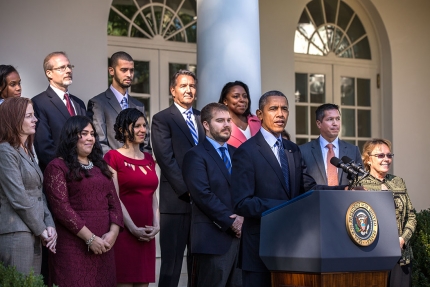
President Barack Obama delivers remarks on the Affordable Care Act during a statement in the Rose Garden

President Barack Obama delivers remarks on the Affordable Care Act during a statement in the Rose Garden of the White House, Oct. 21, 2013. (Official White House Photo by Pete Souza)

On October 1, HealthCare.gov opened for business, offering Americans a new way to compare health insurance plans and enroll in coverage. Nearly 20 million people have visited the site, and Americans all over the country are signing up for affordable, high-quality health insurance.

But, as President Obama explained today, the web site hasn’t worked as well as it’s supposed to.

"The problem has been that the website that’s supposed to make it easy to apply for and purchase the insurance is not working the way it should for everybody. And there’s no sugarcoating it. The website has been too slow, people have been getting stuck during the application process," he said. "And there’s no excuse for the problems, and these problems are getting fixed."

President Obama also reminded Americans that while HealthCare.gov will ultimately be the easiest way to buy insurance through the marketplaces, it isn’t the only way to apply and enroll.

"Even as we redouble our efforts to get the site working as well as it’s supposed to," he said, "we’re also redoubling our efforts to make sure you can still buy the same quality, affordable insurance plans the old-fashioned way – offline, either over the phone or in person.”

Related Topics: Health Care

The White House

Office of the Press Secretary

President Obama Designates Judge Patricia E. Campbell-Smith to Serve as Chief Judge of the U.S. Court of Federal Claims

WASHINGTON, DC – Today, President Obama announced that he has designated Judge Patricia E. Campbell-Smith to be the Chief Judge of the U.S. Court of Federal Claims.

“I am proud to designate Judge Campbell-Smith to serve as Chief Judge on the United States Court of Federal Claims,” said President Obama.  “She has a long and distinguished record of service, and I am confident she will serve with distinction.”

Judge Patricia E. Campbell-Smith, Chief Judge of the U.S. Court of Federal Claims
Judge Patricia E. Campbell-Smith currently serves on the United States Court of Federal Claims.  Previously, she served as a Special Master with the United States Court of Federal Claims from 2005 to 2011 and as Chief Special Master from 2011 to 2013.  In that role, she presided over litigation pursuant to the National Vaccine Injury Compensation Program.  Judge Campbell-Smith also served as a career law clerk for the Honorable Emily C. Hewitt of the United States Court of Federal Claims from 1998 to 2005.  From 1993 to 1996 and again from 1997 to 1998, she worked at the law firm of Liskow & Lewis in New Orleans, where she focused on environmental regulatory law, patent infringement litigation, and toxic tort litigation.  From 1996 to 1997, she served as a law clerk for the Honorable Sarah S. Vance, and from 1992 to 1993 she served as a law clerk for the Honorable Martin L.C. Feldman, both of the United States District Court for the Eastern District of Louisiana.  Campbell-Smith received her J.D. with honors in 1992 from Tulane Law School and her B.S. with honors in 1987 from Duke University.

The White House

Office of the Press Secretary

Remarks by the President on the Affordable Care Act


Rose Garden

11:33 A.M. EDT

THE PRESIDENT:  Everybody, have a seat. 

MS. BAKER:  Hello.  My name is Janice Baker.  I have the privilege to say that I'm the first person in the state of Delaware to enroll for health insurance through the new marketplace.  (Applause.)  Like many consumers out there, it took me a number of frustrating attempts before I could apply for and select my plan.  I kept trying because I needed access to the new health care options. 

I had applied to three private insurance companies only to be rejected due to preexisting health conditions.  I am too young for Medicare, but I'm too old not to have some health issues.  I was able to find a policy I am thrilled with, saving $150 a month, and much lower deductibles than my previous policy that I held through my small business.

I'm here today to encourage other people like me who needs access to quality, affordable insurance, and to tell them to have patience with such a new system.  Without this ability to get this insurance, I know that a single hospital stay could have bankrupted me and my business.

Thank you all.  And I am now honored to introduce the President of the United States.  (Applause.) 

THE PRESIDENT:  Great job.

MS. BAKER:  Thank you.  Thank you.  

THE PRESIDENT:  Thank you.  (Applause.)  Thank you, everybody.  Well, thank you, Janice.  And thanks to everybody here for coming on this beautiful day.  Welcome to the White House. 

About three weeks ago, as the federal government shut down, the Affordable Care Act’s health insurance marketplaces opened for business across the country.  Well, we’ve now gotten the government back open for the American people, and today I want to talk about how we’re going to get the marketplaces running at full steam, as well.  And I’m joined today by folks who have either benefited from the Affordable Care Act already, or who are helping their fellow citizens learn about what this law means for them and how they can get covered.

Of course, you’ve probably heard that HealthCare.gov –- the new website where people can apply for health insurance, and browse and buy affordable plans in most states –- hasn't worked as smoothly as it was supposed to work.  And the number of people who have visited the site has been overwhelming, which has aggravated some of these underlying problems. 

Despite all that, thousands of people are signing up and saving money as we speak.  Many Americans with a preexisting condition, like Janice, are discovering that they can finally get health insurance like everybody else.

So today, I want to speak to every American who’s looking to get affordable health insurance.  I want you to know what’s available to you and why it may be a good deal for you.  And for those who’ve had some problems with the website, I want to tell you what we’re doing to make it work better and how you can sign up to get covered in other ways.

But before I do that, let me remind everybody that the Affordable Care Act is not just a website.  It's much more.  For the vast majority of Americans -- for 85 percent of Americans who already have health insurance through your employer or Medicare or Medicaid -– you don’t need to sign up for coverage through a website at all.  You've already got coverage.  What the Affordable Care Act does for you is to provide you with new benefits and protections that have been in place for some time.  You may not know it, but you're already benefiting from these provisions in the law.

For example, because of the Affordable Care Act, young people like Jasmine Jennings, and Jessica Ugalde, and Ezra Salop, all of whom are here today, they’ve been able to stay on their parents’ plans until they’re 26.  Millions of other young people are currently benefiting from that part of the law.  (Applause.)  Another part of the Affordable Care Act is providing seniors with deeper discounts on their prescription medicine.  Billions of dollars have been saved by seniors already.  That’s part of the law.  It’s already in place.  It’s happening right now. 

Already, because of the Affordable Care Act, preventive care like mammograms and birth control are free through your employers.  That’s part of this law.  (Applause.)  So there are a wide range of consumer protections and benefits that you already have if you’ve got health insurance.  You may not have noticed them, but you’ve got them, and they’re not going anywhere.  And they’re not dependent on a website.

Here’s another thing that the Affordable Care Act does.  In states where governors and legislatures have wisely allowed it, the Affordable Care Act provides the opportunity for many Americans to get covered under Medicaid for the first time.  So in Oregon, for example, that’s helped cut the number of uninsured people by 10 percent just in the last three weeks.  Think about that.  That’s 56,000 more Americans who now have health care.  (Applause.)  That doesn’t depend on a website.

Now, if you’re one of the 15 percent of Americans who don’t have health insurance -- either because you can’t afford it or because your employer doesn’t offer it, or because you’re a small businessperson and you have to go out on the individual market and buy it on your own and it’s just too expensive -- October 1st was an important date.  That’s when we opened the new marketplaces where people without health insurance, or who can’t afford health insurance, or who aren’t part of a group plan, can finally start getting affordable coverage. 

And the idea is simple.  By enrolling in what we’re calling these marketplaces, you become part of a big group plan -- as if you were working for a big employer -- a statewide group plan that spreads risk between sick people and healthy people, between young and old, and then bargains on your behalf for the best deal on health care.  What we’ve done is essentially create a competition where there wasn’t competition before.  We created these big group plans, and now insurers are really interested in getting your business.  And so insurers have created new health care plans with more choices to be made available through these marketplaces. 

And as a result of this choice and this competition, prices have come down.  When you add the new tax credits that many people are eligible for through the law, then the prices come down even further.  So one study shows that through new options created by the Affordable Care Act, nearly 6 in 10 uninsured Americans will find that they can get covered for less than $100 a month.  Think about that.  (Applause.) 

Through the marketplaces, you can get health insurance for what may be the equivalent of your cell phone bill or your cable bill, and that’s a good deal. 

So the fact is the product of the Affordable Care Act for people without health insurance is quality health insurance that’s affordable.  And that product is working.  It’s really good.  And it turns out there’s a massive demand for it.  So far, the national website, HealthCare.gov, has been visited nearly 20 million times.  Twenty million times.  (Applause.)  And there’s great demand at the state level as well, because there are a bunch of states that are running their own marketplaces. 

We know that nearly one-third of the people applying in Connecticut and Maryland, for example, are under 35 years old.  They understand that they can get a good deal at low costs, have the security of health care, and this is not just for old folks like me -- that everybody needs good quality health insurance.  And all told, more than half a million consumers across the country have successfully submitted applications through federal and state marketplaces.  And many of those applications aren’t just for individuals, it’s for their entire families.  So even more people are already looking to potentially take advantage of the high quality, affordable insurance that is provided through the Affordable Care Act.

So let me just recap here.  The product is good.  The health insurance that’s being provided is good.  It’s high quality and it’s affordable.  People can save money, significant money, by getting insurance that’s being provided through these marketplaces.  And we know that the demand is there.  People are rushing to see what’s available.  And those who have already had a chance to enroll are thrilled with the result.  Every day, people who were stuck with sky-high premiums because of preexisting conditions are getting affordable insurance for the first time, or finding, like Janice did, that they’re saving a lot of money.  Every day, women are finally buying coverage that doesn’t charge them higher premiums than men for the same care.  (Applause.)  Every day, people are discovering that new health insurance plans have to cover maternity care, mental health care, free preventive care. 

So you just heard Janice’s story -- she owns her own small business.  She recently became the first woman to enroll in coverage through Delaware’s exchange.  And it’s true, it took her a few tries, but it was worth it after being turned down for insurance three times due to minor preexisting conditions.  So now she’ll be covered, she’ll save 150 bucks a month, and she won’t have to worry that one illness or accident will cost her her business that she’s worked so hard to build.

And Janice is not alone.  I recently received a letter from a woman named Jessica Sanford in Washington State.  And here’s what she wrote:  “I am a single mom, no child support, self-employed, and I haven’t had insurance for 15 years because it’s too expensive.  My son has ADHD and requires regular doctor visits and his meds alone cost $250 per month.  I have had an ongoing tendinitis problem due to my line of work that I haven’t had treated.  Now, finally, we get to have coverage because of the ACA for $169 per month.  I was crying the other day when I signed up.  So much stress lifted.”

Now, that is not untypical for a lot of folks like Jessica who have been struggling without health insurance.  That’s what the Affordable Care Act is all about.  The point is, the essence of the law -- the health insurance that’s available to people -- is working just fine.  In some cases, actually, it’s exceeding expectations -- the prices are lower than we expected, the choice is greater than we expected.

 But the problem has been that the website that’s supposed to make it easy to apply for and purchase the insurance is not working the way it should for everybody.  And there’s no sugarcoating it.  The website has been too slow, people have been getting stuck during the application process.  And I think it’s fair to say that nobody is more frustrated by that than I am -- precisely because the product is good, I want the cash registers to work.  I want the checkout lines to be smooth.  So I want people to be able to get this great product.  And there’s no excuse for the problems, and these problems are getting fixed.

 But while we’re working out the kinks in the system, I want everybody to understand the nature of the problem.  First of all, even with all the problems at HealthCare.gov, the website is still working for a lot of people -- just not as quick or efficient or consistent as we want.  And although many of these folks have found that they had to wait longer than they wanted, once they complete the process they’re very happy with the deal that’s available to them, just like Janice’s.

Second, I want everybody to remember that we’re only three weeks into a six-month open enrollment period, when you can buy these new plans.  (Applause.)  Keep in mind the insurance doesn’t start until January 1st; that’s the earliest that the insurance can kick in.  No one who decides to purchase a plan has to pay their first premium until December 15th.  And unlike the day after Thanksgiving sales for the latest Playstation or flat-screen TVs, the insurance plans don’t run out.  They’re not going to sell out.  They’ll be available through the marketplace -- (applause) -- throughout the open enrollment period.  The prices that insurers have set will not change.  So everybody who wants insurance through the marketplace will get insurance, period.  (Applause.)  Everybody who wants insurance through the marketplace will get insurance.

Third, we are doing everything we can possibly do to get the websites working better, faster, sooner.  We’ve got people working overtime, 24/7, to boost capacity and address the problems.  Experts from some of America’s top private-sector tech companies who, by the way, have seen things like this happen before, they want it to work.  They're reaching out.  They're offering to send help.  We’ve had some of the best IT talent in the entire country join the team.  And we’re well into a “tech surge” to fix the problem.  And we are confident that we will get all the problems fixed.

Number four -- while the website will ultimately be the easiest way to buy insurance through the marketplace, it isn’t the only way.  And I want to emphasize this.  Even as we redouble our efforts to get the site working as well as it’s supposed to, we’re also redoubling our efforts to make sure you can still buy the same quality, affordable insurance plans available on the marketplace the old-fashioned way -- offline, either over the phone or in person. 

And, by the way, there are a lot of people who want to take advantage of this who are more comfortable working on the phone anyway or in person.  So let me go through the specifics as to how you can do that if you’re having problems with the website or you just prefer dealing with a person. 

Yesterday, we updated the website’s home page to offer more information about the other avenues to enroll in affordable health care until the online option works for everybody.  So you’ll find information about how to talk to a specialist who can help you apply over the phone or to receive a downloadable application you can fill out yourself and mail in. 

We’ve also added more staff to the call centers where you can apply for insurance over the phone.  Those are already -- they've been working.  But a lot of people have decided first to go to the website.  But keep in mind, these call centers are already up and running.  And you can get your questions answered by real people, 24 hours a day, in 150 different languages.  The phone number for these call centers is 1-800-318-2596.  I want to repeat that -- 1-800-318-2596.  Wait times have averaged less than one minute so far on the call centers, although I admit that the wait times probably might go up a little bit now that I've read the number out loud on national television.  (Laughter.) 

But the point is the call centers are available.  You can talk to somebody directly and they can walk you through the application process.  And I guarantee you, if one thing is worth the wait, it’s the safety and security of health care that you can afford, or the amount of money that you can save by buying health insurance through the marketplaces.  (Applause.)  

Once you get on the phone with a trained representative, it usually takes about 25 minutes for an individual to apply for coverage, about 45 minutes for a family.  Once you apply for coverage, you will be contacted by email or postal mail about your coverage status. 

But you don't have to just go through the phone.  You can also apply in person with the help of local navigators -– these are people specially trained to help you sign up for health care, and they exist all across the country, or you can go to community health centers and hospitals.  Just visit LocalHelp.HealthCare.gov to find out where in your area you can get help and apply for insurance in person. 

And finally, if you’ve already tried to apply through the website and you’ve been stuck somewhere along the way, do not worry.  In the coming weeks, we will contact you directly, personally, with a concrete recommendation for how you can complete your application, shop for coverage, pick a plan that meets your needs, and get covered once and for all.

So here’s the bottom line.  The product, the health insurance is good.  The prices are good.  It is a good deal.  People don’t just want it; they’re showing up to buy it.  Nobody is madder than me about the fact that the website isn’t working as well as it should, which means it’s going to get fixed.  (Laughter and applause.)

And in the meantime, you can bypass the website and apply by phone or in person.  So don’t let problems with the website deter you from signing up, or signing your family up, or showing your friends how to sign up, because it is worth it.  It will save you money.  If you don't have health insurance, if you’ve got a preexisting condition, it will save you money and it will give you the security that your family needs.

In fact, even with the website issues, we’ve actually made the overall process of buying insurance through the marketplace a lot smoother and easier than the old way of buying insurance on your own.  Part of the challenge here is that a lot of people may not remember what it’s like to buy insurance the traditional way. 

The way we’ve set it up, there are no more absurdly long application forms.  There’s no medical history questionnaire that goes on for pages and pages.  There’s no more getting denied because you’ve had a preexisting condition.  Instead of contacting a bunch of different insurers one at a time, which is what Janice and a lot of people who are shopping on the individual market for health insurance had to do, there’s one single place you can go shop and compare plans that have to compete for your business.  There’s one single phone number you can call for help.  And once the kinks in the website have been ironed out, it will be an even smoother and even easier.  But in the meantime, we will help you sign up -- because consumers want to buy this product and insurance companies want to sell it to you. 

Now, let me close by addressing some of the politics that have swirled around the Affordable Care Act.  I recognize that the Republican Party has made blocking the Affordable Care Act its signature policy idea.  Sometimes it seems to be the one thing that unifies the party these days.  (Laughter.)  In fact, they were willing to shut down the government and potentially harm the global economy to try to get it repealed.  And I’m sure that given the problems with the website so far, they’re going to be looking to go after it even harder.  And let's admit it -- with the website not working as well as it needs to work, that makes a lot of supporters nervous because they know how it's been subject to so much attack, the Affordable Care Act generally.

But I just want to remind everybody, we did not wage this long and contentious battle just around a website.  That’s not what this was about.  (Applause.)  We waged this battle to make sure that millions of Americans in the wealthiest nation on Earth finally have the same chance to get the same security of affordable quality health care as anybody else.  That’s what this is about.  (Applause.)  And the Affordable Care Act has done that. 

People can now get good insurance.  People with preexisting conditions can now afford insurance.  And if the launch of this website proves anything, it’s that people across the country don’t just need that security, they want that security.  They want it.  (Applause.)  And in the meantime -- I’ve said many times -- I’m willing to work with anyone on any idea to make this law perform even better.  But it’s time for folks to stop rooting for its failure, because hardworking, middle-class families are rooting for its success.  (Applause.)  And if the product is good, they're willing to be patient.

I got a letter last week from a self-employed man named John Mier in Leetsdale, Pennsylvania.  He used the new marketplace to get himself and his wife covered and save a lot of money.  And here’s what he said, because it pretty much sums up my message today:  “Yes, the website really stank for the first week.”  (Laughter.)  “But instead of paying $1,600 per month for a group insurance plan, we have a plan that will only cost us $692 a month –- a savings of $900 per month.”  (Applause.)  John said that while he saw -- when he saw what they’d be paying, he turned to his wife and told her, “We might just pull through.  We can afford this.”  And John eventually predicted that “the website will work like a champ.” 

So John, he was frustrated by the website, but he's feeling a little less frustrated once he found out that he was saving 900 bucks a month on his health insurance.  (Applause.)  And John is right, the website is going to get fixed and the law works.  That's why we fought so hard to pass this law -- to save folks like John money; to give people who don't have health insurance the chance to get it for the first time; to lift from the American people the crushing burden of unaffordable health care; to free families from the pervasive fear that one illness -- (on-stage participant becomes ill) -- there you go, you are ok.  I'm right here.  I got you.  (Laughter.)  No, no -- you're okay.  This happens when I talk too long.  (Laughter.)  You'll be okay.  Here, why don't you go.  (Applause.)

Good catch, by the way, whoever was here.  (Laughter.) 

But that's always our goal, to free families from the pervasive fear that one illness or one injury might cost you everything that you dedicated a lifetime to build.  Our goal has always been to declare that in this country the security of health care is not a privilege for a fortunate few.  It's a right for all to enjoy.  (Applause.)  That's what the Affordable Care Act is all about.  That's its promise.  And I intend to deliver on that promise.

Thank you very much, everybody.  God bless you.  (Applause.)

 END                

12:00 P.M. EDT

Doing Better: Making Improvements to HealthCare.gov

On Sunday, the Department of Health and Human Services provided an update on the state of HealthCare.gov, addressing initial issues with the site and explaining its improvements. The following is crossposted from HHS.gov.

Read the original post here.


Over the past two and a half weeks, millions of Americans visited HealthCare.gov to look at their new health care options under the Affordable Care Act. In that time, nearly half a million applications for coverage have been submitted from across the nation. This tremendous interest – with over 19 million unique visits to date to HealthCare.gov– confirms that the American people are looking for quality, affordable health coverage, and want to find it online.

Unfortunately, the experience on HealthCare.gov has been frustrating for many Americans. Some have had trouble creating accounts and logging in to the site, while others have received confusing error messages, or had to wait for slow page loads or forms that failed to respond in a timely fashion. The initial consumer experience of HealthCare.gov has not lived up to the expectations of the American people. We are committed to doing better.

Aside from the difficulties since launching the site, there are parts of the overall system that have proved up to the task. The “Data Hub,” component, which provides HealthCare.gov with information that aids in determining eligibility for qualified health plans, is working. Individuals have been able to verify their eligibility for credits, enabling them to shop for and enroll in low or even no-cost health plans.

Related Topics: Health Care

Weekly Address: Working Together on Behalf of the American People

In this week’s address, President Obama said that now that the Federal government is reopened and the threat of default is lifted from the economy, there are three places Washington can take action to serve the American people. First, it’s time for a balanced, responsible approach to the budget that grows the economy and shrinks our long term deficits. Second, we must fix our broken immigration system. And finally, Congress should pass a farm bill to give rural communities the opportunity to grow. The President said it’s time to put aside politics and work on behalf of the American people and the country we love.

Transcript | Download mp4 | Download mp3

Related Topics: Economy

The White House

Office of the Press Secretary

WEEKLY ADDRESS: Working Together on Behalf of the American People

Remarks of President Barack Obama
Weekly Address
The White House
October 19, 2013

Hi everybody. This week, because Democrats and responsible Republicans came together, the government was reopened, and the threat of default was removed from our economy.

There’s been a lot of discussion lately of the politics of this shutdown. But the truth is, there were no winners in this. At a time when our economy needs more growth and more jobs, the manufactured crises of these last few weeks actually harmed jobs and growth. And it’s understandable that your frustration with what goes on in Washington has never been higher.

The way business is done in Washington has to change. Now that these clouds of crisis and uncertainty have lifted, we need to focus on what the majority of Americans sent us here to do – grow the economy, create good jobs, strengthen the middle class, lay the foundation for broad-based prosperity, and get our fiscal house in order for the long haul.

It won’t be easy. But we can make progress. Specifically, there are three places where I believe that Democrats and Republicans can work together right away.

First, we should sit down and pursue a balanced approach to a responsible budget, one that grows our economy faster and shrinks our long-term deficits further. There is no choice between growth and fiscal responsibility – we need both. So we’re making a serious mistake if a budget doesn’t focus on what you’re focused on: creating more good jobs that pay better wages. If we’re going to free up resources for the things that help us grow – education, infrastructure, research – we should cut what we don’t need, and close corporate tax loopholes that don’t help create jobs. This shouldn’t be as difficult as it has been in past years. Remember, our deficits are shrinking – not growing.

Second, we should finish the job of fixing our broken immigration system. There’s already a broad coalition across America that’s behind this effort, from business leaders to faith leaders to law enforcement. It would grow our economy. It would secure our borders. The Senate has already passed a bill with strong bipartisan support. Now the House should, too. The majority of Americans thinks this is the right thing to do. It can and should get done by the end of this year.

Third, we should pass a farm bill – one that America’s farmers and ranchers can depend on, one that protects vulnerable children and adults in times of need, and one that gives rural communities opportunities to grow and the longer-term certainty they deserve.

We won’t suddenly agree on everything now that the cloud of crisis has passed. But we shouldn’t hold back on places where we do agree, just because we don’t think it’s good politics, or just because the extremes in our parties don’t like compromise. I’ll look for willing partners from either party to get important work done. There’s no good reason why we can’t govern responsibly, without lurching from manufactured crisis to manufactured crisis. Because that isn’t governing – it’s just hurting the people we were sent here to serve.

Those of us who have the privilege to serve this country have an obligation to do our job the best we can. We come from different parties, but we’re Americans first. And our obligations to you must compel all of us, Democrats and Republicans, to cooperate, and compromise, and act in the best interests of this country we love.

Thanks everybody, and have a great weekend.