Press Briefing by Press Secretary Jay Carney, 1/28/2013
James S. Brady Press Briefing Room
12:45 P.M. EST
MR. CARNEY: Thanks for bearing with us today. A lot going on at the White House.
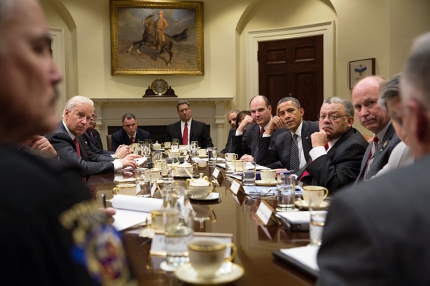
Before I take your questions I just wanted to note that the President and the Vice President completed a very productive meeting with law enforcement officers, chiefs of police, and sheriffs from around the country, including from Oak Creek, Wisconsin; Aurora, Colorado; and Newtown, Connecticut, as well as the head of the Major Cities Police Chiefs organization and the Major Counties Sheriffs organization. This all as part of the effort the President has undertaken to press forward on common-sense measures that can help reduce the scourge of gun violence in this country.
Separately, I wanted to say that the President welcomes the efforts by the bipartisan group in the Senate to put forward principles on the need for comprehensive immigration reform -- principles that mirror the President’s blueprint, which, as you know, he has been pressing for some time, which has been available on whitehouse.gov since 2011.
The President believes it is very important that we move forward on comprehensive immigration reform. It’s the right thing to do for the country, for our economy. It’s the right thing to do out of fairness to the middle class to make sure that everyone plays by the same set of rules.
He, in keeping with I think what you’ve recognized as an approach that we take to these issues, the President is traveling to Nevada tomorrow where he will continue a conversation with the American people about how we need to move forward and why we need to move forward with comprehensive immigration reform, why it’s important. It’s something that he talked about a lot during the campaign; he campaigned on this. And it is something that he has spoken about quite frequently since his reelection and made clear his commitment to act on this early in his second term. It’s now the second week of his second term and he is acting on it.
With that, I will take your questions.
Q Thank you. On immigration, the Senate group, in addition to putting out their principles, also says that they’re aiming to have a bill together by March. Since there is a timeline now, a bipartisan timeline for a bill on the Hill, does the President feel like he should also put forward a bill? Or is he leaning towards putting out just broad principles?
MR. CARNEY: Well, let me say a couple of things. First of all, he has put forward quite substantial detail already. I think the number of pages that you can find on whitehouse.gov dedicated to this subject is more than 25, and reflects the kind of detailed approach that the President has long taken on this issue.
On the first point, we welcome movement and progress, and there is no reason to delay on moving forward with this. The President has supported it for a long a time. It fell short in 2010 because of congressional opposition to it. And he believes that we are at a moment now where there seems to be support coalescing at a bipartisan level behind the very principles that he has long put forward and behind principles that have in the past enjoyed bipartisan support, that appear are now again to be winning bipartisan support. And that is a very positive thing.
I’m not going to negotiate legislative tactics from here, but we will be working with Congress, with both houses, both parties to help bring about a result that is a detailed, specific bill that can win bipartisan support in Congress and that this President can sign; that meets the very specific principles this President has put forward.
Q So is what we’re going to see from the President tomorrow, is that a reiteration of his principles, not a bill?
MR. CARNEY: What you’ll see tomorrow from the President is the very important part of this effort that is about engaging the American people. Now, the American people support comprehensive immigration reform, but as with all the things that we debate in Washington, we need to -- the President believes -- explain them, talk about them with the American people and engage with the American people to make sure they understand where we’re headed and why, and that’s what the President intends to do tomorrow.
Q I just wanted to ask one question on Egypt. In the President’s “60 Minutes” interview he said that if it hadn’t been for the leadership the U.S. showed, we might have seen a different outcome there. How does that square with what we’re seeing in Egypt over the past couple of days with 50 people dead in protests, President Morsi implementing curfews and state of emergency? Is that the type of outcome the U.S. expects and favors in Egypt?
MR. CARNEY: Well, let’s back up a little bit and talk about the specific things that you reference. We strongly condemn the recent violence that has taken place in various Egyptian cities. We extend our condolences to the families of those who were killed and to those who were injured. We look to all Egyptians to express themselves peacefully, and for all Egyptian leaders to make clear that violence is not acceptable.
We welcome serious calls for national dialogue to avoid further violence and to find peaceful means to move forward with the political process and building national unity.
Egyptians participated in their revolution to bring about democracy and freedom, not to pursue their goals through violence. We urge all Egyptians to peacefully utilize the democratic process as they continue to engage with their government.
We have been clear about what we stand for. We have engaged directly with the Egyptian government as they move forward on the difficult path towards greater democracy and rule of law, and we will continue to do so.
Yes, Reuters.
Q There was a very -- one noteworthy difference between what the group of senators is proposing today and what was in that 29-page blueprint on the White House website, and that is that the bipartisan group proposes the path to citizenship be conditioned on tighter border control measures. Now, does the President accept that kind of a linkage would have to come to get a deal?
MR. CARNEY: First of all, I think you glided over a very important aspect of this, which is that the set of principles put forward by this bipartisan group embraces the path to citizenship. This is a big deal. This is an important development. This is in keeping with the principles the President has been espousing for a long time, in keeping with bipartisan efforts in the past and with the effort this President believes has to end in a law that he can sign.
When it comes to border security, I think anyone who looks at this honestly will note the tremendous strides we have made in the past four years in protecting our borders. In fact, they have never been better enforced than they are now. And over the past four years this administration has dedicated unprecedented resources to secure the border, taken important steps to make interior and worksite enforcement of our immigration law smarter and more effective. And we have made historic investments in manpower, technology and infrastructure to help secure our borders.
And, like I said, our borders now are more secure than they have ever been in history. That work continues. But I think it's important, before we let the moment pass, to acknowledge that the progress we're seeing embodied in the principles put forward by this bipartisan group is happening for a reason. And I think it's happening because a consensus is developing in the country, a bipartisan consensus; and it's happening because the President has demonstrated significant leadership on this issue.
When the effort to achieve comprehensive immigration reform did not succeed in 2010, this President continued to press forward. He has given speeches on it repeatedly. He put out his detailed blueprint online and he made clear in the campaign last year that this would be a top priority of his in the second term. And he is keeping that commitment by pressing forward today.
This is an important first step that we've seen from Congress. We need to continue the movement. Going to Julie's question about timetables for legislation, the goal here is not for everyone just to get together and say we share common principles, but to achieve legislation that gets the job done and does it in a way that can earn the support of Congress and earn the signature of this President.
Q Point taken that, yes, we're seeing a bipartisan consensus that there should be a path to citizenship and that we haven't seen that in years. But my question is about the linkage between that these senators, this proposal says we do not go forward on giving a path to citizenship to anyone until border security is actually increased to a level that they will establish. Will that linkage be accepted?
MR. CARNEY: I'm not going to -- we're not at a stage here where, especially from the briefing room, we're going to negotiate details of legislation that doesn't yet exist.
I think what is positive about this discussion is that a bipartisan group in the Senate has embraced the principles that the President has long put forward and espoused. When we talk about issues like border security, instead of waiting until now as this effort gets underway to address border security challenges, this President in his first term has aggressively addressed those challenges and taken historic steps to creating a situation where we have tighter border security than we've ever had.
That work will continue and we look forward to working with Congress on legislation, on the issue of border security, and on the other important elements of immigration reform that have to be part of a comprehensive package.
Jessica.
Q Does the President specifically think the pathway to citizenship for the 11 million should be pre-conditioned on a council of experts determining whether border security is sufficient?
MR. CARNEY: I appreciate the question. I think I have answered it to the very best of my ability in response to questions from Matt. Border security is an important issue. The President has demonstrated that he doesn’t believe that just in theory --
Q So you won’t address specifically the idea of the council?
MR. CARNEY: There's not a -- look, I think we saw, and this is -- I'm not diminishing it. It's a welcome thing. We saw a four-page statement of principles that is a very positive development. The President has a -- I think Matt said 29-page comprehensive blueprint that's online. And we will work with Congress, with both parties in both houses to achieve the kind of bipartisan bill that we need.
Q Doesn't it step on the President's proposal by doing this today?
MR. CARNEY: Well, again, the President's principles and blueprint have been out for a long time. This is not a new issue for the President. He has been pushing it for a long time. We have been working with this very group and talking with them about the progress. And as I think you could tell from the tone of my opening statement, we welcome this. We think this is positive. This demonstrates that --
Q Do you still intend to unveil the amount of detail you were planning to unveil about your immigration legislation?
MR. CARNEY: We are proceeding as we always intended to proceed. And we always hoped that as we move forward with this effort that we would have with us members of Congress of both parties, important members of Congress of both parties who support the principle of the need for comprehensive immigration reform, support the component elements of that. And that's what we’re seeing, and that's a very positive development.
Q On a different topic, how often does the President go skeet shooting? (Laughter.) And are there photographs of him doing so?
MR. CARNEY: I would refer you simply to his comments. I don't know how often. He does go to Camp David with some regularity, but I’m not sure how often he’s done that.
Q Is there a photograph of him doing it?
MR. CARNEY: There may be, but I haven’t seen it.
Q Why haven’t we heard about it before?
MR. CARNEY: Because when he goes to Camp David, he goes to spend time with his family and friends and relax, not to produce photographs.
Q Jay.
MR. CARNEY: Yes, Major and then Wendell.
Q There were weekend reports of a very significant explosion at a nuclear facility in Iran -- Fordow; Fordow is the name of it, near Qom. And I wonder if you have anything that you can relay to us about what the U.S. government does or does not know about that. And also, there has been a glitch in trying to get the next P5-plus-1 talks with Iran, try to get it this month now, pushing into February. Is there anything new you want to tell us about the evaluation of the inability to get that process moved ahead?
MR. CARNEY: Sure. I appreciate both questions. On the first, we have no information to confirm the allegations in that report, and we do not believe the report is credible.
On the status --
Q -- of have an explosion of any kind?
MR. CARNEY: Correct, at the Fordow facility. We don't believe those are credible reports. We have no information that would confirm them and do not believe that those reports or that report is credible.
In terms of the P5-plus-1 talks, let’s be clear here that Iran did not accept the P5-plus-1 offer to go to Istanbul on January 28 and 29. The P5-plus-1 have offered concrete dates and venues since December and have shown flexibility regarding a date and venue, but Iran -- not for the first time -- has been continually putting forward new conditions as a delaying tactic. And the negotiations about negotiations is a familiar tactic that only results in further isolation and more pressure on Iran. So it’s not -- it will not achieve anything.
We have, however -- though there is still no agreement on the next round of talks, contacts are ongoing. And since Iran did not accept the offer to go to Istanbul on January 28 and 29, the P5-plus-1 have offered new dates in February. But let’s be clear, negotiating over negotiations is not a tactic that produces positive results for Iran; it only results in more isolation and more pressure.
Q And the President has said from this podium and other venues he’s not interested in that process, in allowing it to go on forever and ever -- negotiating by negotiating. When does this get to that point?
MR. CARNEY: Precisely. And that's why we’re being very clear with our partners about the fact that negotiations have to be over concrete issues, not over further negotiations. And we’ve been clear about what -- with our partners, what we’re ready and when we’re ready to take up these negotiations again. And Iran has to take the next step and engage.
Q To get back to immigration, I know you don't want to negotiate specific details, but this question that has been asked to you a couple of times is not a legislative detail; it’s a philosophical construct: coupling or decoupling. And from what you’ve said from the podium so far today, I think those of us listening could fairly assume the administration believes sufficient progress has been made on border security, that they ought not to be coupled directly with the fate of those who are going to watch this debate and whose futures in this country are dependent on this process. It’s a very significant issue for them, and it sounds as if you're signaling to the Senate they ought not to be coupled because it’s not the issue it was in 2007 or 2008. Is that a fair --
MR. CARNEY: We have not seen any legislative proposal from Congress -- either this group or others -- any new legislative proposal. What I have made clear is that in the four years that the President has been in office we have made historic progress on border security. And in the past, there have been those interested in this issue who have talked about the need to take action to enhance our border security as part of the comprehensive immigration effort or as a precursor to it. And while this President has always supported moving forward in a comprehensive way on all the elements, the fact is because it’s an important issue, we have made progress on border security and historic progress in the ways that I enumerated earlier.
I am not, as you mentioned, in a position to negotiate details of a piece of legislation that hasn’t been written, at least not in Congress.
Q But you can speak to this philosophical question of coupling or decoupling, can't you?
MR. CARNEY: I think the President believes that we need to move forward in a comprehensive way that includes a path to citizenship, that includes making sure that our businesses behave responsibly, that includes making sure that border security continues to be enhanced, and that includes allowing for a situation where some of these incredibly capable immigrants who are earning higher degrees in our country are allowed to stay and create businesses here and are not sent home to create businesses in other countries.
So this is a multipart process. What I'm not going to do is engage in specific negotiations from the podium today. There is important progress being made on this issue in a bipartisan way. That's a positive thing. The President goes to Nevada tomorrow to have this conversation, to continue to have this conversation with Americans who care deeply about it, to explain to them and engage with them over its importance to the economy, its importance to the middle class, importance to our businesses. And this will continue.
And we hope it moves forward in a quick -- with speed because there is no reason to delay. We are seeing a consensus building here. We are seeing leading members of both parties in Congress agree to general principles here that are shared across the board.
Wendell.
Q Different subject. The Dow Industrial’s moving average has been reported at its 2007 prerecession high. Standard & Poor’s index got there last Friday, as I understand. Unemployment obviously still far too high, almost twice as high as it was at that time. What do you say to critics who say the President’s recovery has benefited Wall Street but not Main Street?
MR. CARNEY: What I would say -- well, first I would point out that the precursor to your question was noted with no degree of surprise, which is that markets have done very well under this President. And one of the reasons they have done well is because this President took dramatic action to ensure that we did not -- a situation that was hemorrhaging and cascading towards depression was reversed, that important measures were taken to ensure that the financial sector did not collapse. And then, against the resistance of some in Congress -- resistance that we encounter to this day -- he put in place important Wall Street reform that ensures that the kind of situation we encountered in this country in 2007, 2008, and 2009 does not happen again -- where taxpayers are on the hook to bail out large financial institutions. So there’s a background here that’s very important.
There is no question that while we have seen unemployment come down, it has not come down far enough. While we have seen month after month of job creation, this President is focused above all on steps that ensure that we create even more jobs and that this economy continues to grow as we recover from the worst recession since the Great Depression.
This I think goes to a broader point. The President does not believe that anything we do in Washington is worthwhile if it doesn’t have as part of its purpose strengthening our economy, strengthening and providing more security for our middle class, and creating more opportunities for those who want to join the middle class to do so. That is the underlying principle behind everything he does when it comes to domestic and economic policy.
Q It is a fair assessment, though, that the recovery has benefited Wall Street more than Main Street?
MR. CARNEY: I think that people can make their assessments. The fact is the economy has been recovering after a situation where it was in terribly dire straits, a situation that this President inherited in January of 2009. And the actions that he took at the time -- whether it was the Recovery Act, saving the financial sector, saving the automobile industry -- were not particularly popular at the time in some cases and in some quarters, but they were the right things to do and they were the right things to do for the financial sector, but they were also the right things to do for the middle class and for the American economy.
The President took the action he did to ensure the financial sector wasn’t -- was saved, not because he thought it was good for the banks, but because collapse of the financial sector would have led to an even greater amount of hardship for the middle class, for average Americans in this country who are just trying to get by.
Q Could it have been possible to craft a recovery that would have benefited the middle class more than the investors, more than Wall Street?
MR. CARNEY: I’m not an economist, Wendell, and what I can tell you is that having been there -- working then for the Vice President -- the efforts to move forward on the Recovery Act as it was, which included, in part because of insistence by Republicans, a third of the Recovery Act -- a much unnoted fact -- tax cuts, for example -- and some of the other actions the President took in order to try to gain bipartisan support. I guess the point I’m saying is the idea that we would have somehow garnered more support in Congress for something different is a misreading of history.
Peter.
Q Yesterday there was a devastating fire that tore through a nightclub in Brazil; more than 230 people were killed. I’m just curious if the President has been notified or is aware of that taking place.
MR. CARNEY: I don’t know specifically, although he has had his morning briefing and I’m sure this was brought up. He also I’m sure has read about it.
Q So has he had any conversation then -- I guess you wouldn’t know --
MR. CARNEY: With the Brazilian authorities? I don’t have any conversations to read out.
Q In that conversation that took place in The New Republic magazine, the President became the most high-profile person to weigh in on the level of violence that exists in professional football. Given that we’re one week to the Super Bowl, I’m curious if there’s been any reaction from the NFL or from any other professionals given those comments.
MR. CARNEY: Not that I’m aware of. I think he spoke to that issue as a father, and I think that it’s something that parents across the country are grappling with in terms of whether or not they want their children to -- their sons, in this case, with football -- to be playing football given all we know about concussions.
Q Giving his opinions on college basketball playoffs and things like that, is that something he would weigh in on further in terms of trying to find new outlets to effect change in terms of violence in this sport?
MR. CARNEY: I haven’t had that discussion with him, so I can’t say.
Q Jay, there’s a lot of concern in the Hispanic community that the old might be separated from the young with this sort of expedited process of getting the children of immigrants, illegal immigrants, fast-tracked on citizenship. How does the President suggest you deal with that? If some of these children are fast-tracked and their parents might be torn and sent back home, how do you deal with that situation?
MR. CARNEY: Well, I’m not sure the second part is accurate. Obviously, I think any process that’s envisioned here in terms of a path to citizenship -- that if people follow the rules to achieve that, they would be on that path. So there’s not a --
Q But how do you ensure that the parents and the children aren’t separated? If the kids are fast-tracked --
MR. CARNEY: I think you’re getting into a broad -- you’re asking a broad question that goes to specifics here that aren’t necessarily reflected in the question.
Q But is there thought given to how you deal -- it’s a big concern in the Hispanic community that some of these kids, a significant number of them, might be separated from their parents. What’s the thought that the President has in dealing with that?
MR. CARNEY: Well, I think you heard the President talk about the importance of so-called DREAMers, DREAM Act children. I think it was reflected in the legislation that he put forward. It’s been reflected in the blueprint that he has put forward and that is available on whitehouse.gov. And he looks forward to working with Congress on legislation that addresses this broad principle that, again, seems to have bipartisan support -- that children who are brought to this country through no fault of their own, who have been often raised as Americans, thinking that they’re Americans, often don’t speak the language of their origin country, that they should not be punished for the actions that others took.
So that’s a principle that he’s spoken about a lot. It’s a principle embodied in the blueprint that he's put forward and that we believe is one that's shared by members of Congress.
Q And the visa overstay program, that appears to be sort of a new mechanism they're trying to put in place. Is that correct?
MR. CARNEY: I'm just not going to get into details of legislation that hasn't been put forward or worked out. I think that today is important because of the progress that the bipartisan group's efforts represent. The fact that those priorities and principles that they put forward mirror what the President has long stood for and put forward represents the opportunity that is at hand here and that the President hopes we can move forward and take advantage of.
Q And on another topic, Jay, has the President expressed any concern that Lance Armstrong may have used his influence in Washington on Capitol Hill with D.C. insiders to possibly get the attorney general in Southern California to drop his case? It's something that ABC News is hearing may have been the case.
MR. CARNEY: About the President? I haven't had that discussion with the President. The President I think has spoken out in the past about his views on performance-enhancing drugs. But I haven’t heard him talk about this specific --
Q Does he feel there should be pressure, that the DOJ should do something more beyond --
MR. CARNEY: I don't have anything for you on that. And I wouldn't weigh in on anything before the Department of Justice.
Yes, Margaret.
Q I heard you very clearly say that you didn't want to get into negotiating legislation --
MR. CARNEY: But you can try. (Laughter.)
Q It's nice to make you smile and wink. What I want to ask you is a non-negotiating question. It is just simply if the Senate were to pass the legislation as it's been described in concept, would the President sign it?
MR. CARNEY: But there is no legislation described in concept. It's a set of principles that mirror the President's principles. But this is the beginning of a process, at least in terms of legislation that needs to be crafted and voted on and hopefully signed by the President. So to say that he would sign something that doesn't exist would be unwise, in my view, and so I won't say it.
Let's just say the President has been very clear about what he supports. He's been very detailed in the blueprint that he's put forward. He is encouraged by the progress we have seen from members of both parties in the Senate and looks forward to working with members of both parties to reach a point in the hopefully not-too-distant future where we have a bill that has bipartisan support that is very specific and that he can sign because it meets his principles.
Q But in terms of weighing in on support, he would wait to see any legislation before he would?
MR. CARNEY: Well, I'm sure he wouldn’t promise to sign a bill that doesn't exist.
Q I want to ask one more on Egypt as well. Can you tell us whether the President has spoken with Morsi since the last few days of violence began? I know we don't have a readout yet, but I know he has made some foreign leader calls. We saw a call with Netanyahu read out today.
MR. CARNEY: He has not spoken with President Morsi that I'm aware of. I don't have any new calls to read out to you. We are always engaged with the government of Egypt at appropriate levels, but I just don't have any communications to read out to you. You could check with the State Department for more.
Q I'm hoping you could flesh out a little bit what sort of communications. Things really have changed and worsened in the last four or five days.
MR. CARNEY: I would have to refer you to State for any communications we've had -- our government has had with the government of Egypt in the last several days.
Q You said that the President condemns -- that the U.S. condemns the violence that's gone on in Egypt. Do you condemn any of President Morsi's actions as sort of cause and effect of that violence, or do you support this level of emergency rule and how he's handled things so far?
MR. CARNEY: We look to the government of Egypt to adhere to the right of all Egyptians to have due process. There needs to be a lasting solution to the conflict that we see in Egypt and it has to be a solution that adheres to the rights of all Egyptians. Obviously, this is not a lasting solution. But beyond that, I'd refer you to the State Department.
Our interest is in -- we welcome calls for a national dialogue. We call on all Egyptians to express themselves peacefully, and to make clear that violence is not acceptable. We call on all leaders -- all leaders -- in Egypt to make that clear. So our broader effort here is to support a process that leads to greater democracy in Egypt and greater prosperity.
Q Jay, at the top of the meeting with the police chiefs, the President said he hoped to get a consensus from them that would translate into a message to Congress. Did he get some kind of a concerted message from them? And what guidance did they -- especially the chiefs from the cities that have seen the mass shootings -- give him?
MR. CARNEY: I don't have a specific readout of that meeting, which ended shortly before I came out here for you. It was a productive meeting. It was an important meeting. The President obviously believes that law enforcement plays an important role in discussions about how to move forward to reduce gun violence. We may have more for you on the meeting later today. But this is -- I think reflects the President’s commitment to engage with all stakeholders on this important issue, and I know that today’s meeting was very important in that regard.
Q What’s the next step?
MR. CARNEY: Well, the President -- I will not announce a new meeting today, but you can be sure the President will continue to meet on this issue. The Vice President will obviously continue to meet on this issue. And he will continue -- he, the President -- will continue to press for progress on legislative action, as well as the other actions that were contained within his broad set of proposals from two weeks ago.
Mr. Landler, and then Zach.
Q Thanks, Jay. In his interview with the New Republic, the President was reflecting on the challenges of making a decision on whether to intervene in Syria, and he went through a number of different criteria and then made the observation that tens of thousands of people are dying in other places, including Congo. A few people in the human rights community were stopped by this and observed that, well, for one thing, the scale of the killing in Syria is so much greater right now than anywhere else in the world; and secondly, that Syria poses so many more strategic issues -- it’s in the heart of the Arab world, it borders a number of critical countries. So I guess I just wanted to press a little and ask whether he really does believe that Congo is in any way analogous to Syria in terms of what American interests are.
MR. CARNEY: I think you're over-reading what he said. I think the point he was making is that there is horrific violence in other parts of the world and in other countries besides Syria.
There is no question -- and we have been abundantly clear in our abhorrence -- about the violence in Syria and in the very strong position that we’ve taken that Assad has to go, that his days are numbered, and that he will go down in history as a tyrant with an abundance of Syrian blood on his hands.
I think we’ve seen the opposition in Syria make continued progress. I think we’ve seen Assad’s grip on power in Syria continue to lessen. We continue to take steps with our partners to provide both humanitarian aid and non-lethal assistance to the opposition, and to work with our partners to help bring about a post-Assad Syria that reflects the will of the Syrian people, because the right outcome here is for the Syrians to decide their own future.
Q And then, if I may, on one other topic -- in that readout that you put out a little while ago about his call with Prime Minister Netanyahu, he congratulated him for winning a plurality in the election. Does the President feel with the political season finished in Israel -- I guess we still have the maneuvering around a coalition -- but with the election now history, the election in the U.S. history, that this would be a good time to reset the relationship with the President and the Prime Minister?
MR. CARNEY: Mark, as I’ve said in the past, it’s important to understand two things: One, this country’s commitment to Israel’s security is unshakeable, and it has been reflected in this administration’s commitment to Israel’s security, demonstrated by the very specific actions that are unprecedented that have been taken by this administration on behalf of Israel’s security.
It is also the case that in his first four years as President, there is no leader with whom President Obama had more conversations or more meetings than Prime Minister Netanyahu. They have an important working relationship, and that will continue to be the case, the President believes.
I don’t want to get ahead of a process in Israel where, while the elections may be over, there is -- as you know, as an expert in the area -- there are several stages to this process, in the post-election process in Israel and we will wait to see what the government formation process produces. But these two leaders have spent a great deal of time together. They’ve spoken together many times and they are able to work together and will continue to work together.
Q Was the call warm? Can you characterize at all?
MR. CARNEY: Well, it was a congratulatory call so I think that’s fair to say, yes.
Q On the sequestration, in just about a month, deep cuts to spending are set to occur and we’ve heard little about it recently. Obviously, the White House has a plan or idea for what it would like to do to replace that, but can you talk a little bit about are you expecting to stop sequestration? Are there discussions beginning to -- about how to do that?
MR. CARNEY: The President believes that we need to move forward with Congress to further reduce our deficits in a balanced way and he’s put forward very specific proposals to do that, proposals that demonstrate a willingness to meet Republicans more than halfway. And that remains his position and his view.
On sequestration, I think it’s important to remember that it was designed never to become law. It was made onerous for all sides for a reason. These kinds of across-the-board cuts to both defense and non-defense spending are not supported by virtually anyone in Washington and certainly not the President, and to judge by their many statements along these lines, not Republican leaders in Congress.
So we believe that the right course of action is to take steps to make sure that sequester doesn’t happen because it’s bad for the economy and bad overall for the effort to reduce our deficits in a reasonable way, to cut spending in a careful way so that we allow those programs that help enhance our economic growth and help enhance our job creation to be properly funded, but reduce spending where appropriate so that we can help bring down our deficits -- more broadly, to do it in a way that’s balanced that includes revenues.
One thing we don’t hear often these days in some of these discussions is that while the President put forward very specific proposals that met the Republicans halfway and that the Republicans walked away from that effort, unfortunately, at the end of the year, at one point, House Speaker John Boehner said that he could achieve $800 billion in revenue simply by eliminating loopholes and capping deductions. Now, we certainly would be surprised if it’s their position now that those deductions don’t need to be capped and those loopholes don’t need to be closed, because some of those loopholes I think most American people would believe are highly unnecessary and unfair.
So we think we can move together with Congress to continue on the work that is achieved already -- $2.5 trillion in deficit reduction -- and do it in a balanced way. And the President has put forward specifics to do just that.
Q Are there any --
MR. CARNEY: I don’t have any meetings to announce. I don’t have any specifics to provide to you. But we believe that this needs to happen, and we look forward to working with Congress to make it happen.
Q Just one other quick question. You mentioned earlier that the President’s top priority it job creation, supporting the middle class. Does the President currently have any proposals on the table that he’s planning to advocate for soon to do that?
MR. CARNEY: Well, first of all, the President’s proposal that he put forward to Speaker of the House Boehner at the end of the year is a deficit reduction proposal that was designed to ensure that we continue economic growth. Remember, what people forget in the shorthand that it was written about and talked about at the end of the year is that avoiding sequester plus the tax hikes that would have occurred if we hadn’t taken action was a way of avoiding too much contraction, too much deficit reduction at once, because it would have potentially, at least according to some analyses, thrown us into recession.
So the President’s plan ensures that we would continue to reduce our deficit in a way that allows our economy to grow and create jobs. So that would be number one.
The President believes that action on immigration reform is, done right, helpful to our economy, increases fairness to our middle class, ensures that everybody is playing by the same set of rules, makes a level playing field for our businesses because it holds them responsible in terms of how they deal with these issues. These are all -- would be healthy for our economy and healthy for job creation.
Everything that he does on the domestic side of the ledger is viewed through the prism of how does it help the economy grow, how does it help create jobs.
Q When you talk about cooperation, Jay, there’s plenty of evidence that an immigration bill would improve conditions for the working-class people who supported the President in terms of wages and chances of getting jobs. The plan does call for the importation of more than 10 million low-scaled people at a time where --
MR. CARNEY: I appreciate your interpretation of the plan, but the President does believe, if done well, if done right in the way that meets both the principles currently put forward by the bipartisan group in the Senate and, more specifically, the principles the President has put forward and supported, that it will help our economy grow, help make it more fair, and help the middle class.
Q What about wages and job competition?
MR. CARNEY: Alexis, I think I called on you next here.
Q I have some questions -- sorry, Niall. This question is a simple one. Can you just illuminate why the President is going all the way to Nevada, where he could go to Florida or New York to talk about immigration? I mean, what’s the -- why?
MR. CARNEY: Why not? I mean, Nevada is an important state. Every state has a stake in this and I'm sure he will travel elsewhere to talk about this important issue, as well as talk about it here in Washington. So the President looks forward very much to going to Nevada.
Q But there’s nothing unique to the setting that he will bring into his speech specifically about the state? Is the state emblematic --
MR. CARNEY: Well, I don't want to preview his remarks, but I think -- I will just ask you to stay tuned.
Q Okay. Second question is, over the weekend there was an article about the lengths to which the administration is going to track down government leakers. My question is to what extent does the President want journalists to believe that technology, clandestine surveillance will be used against journalists who routinely write books or do articles about national security in order to work backward to find the leakers? Is that part of his plan?
MR. CARNEY: It’s part of no plan that I've heard him discuss.
Laura.
Q Thank you. Three questions on Mali.
MR. CARNEY: Three?
Q Three. How does -- the French took Timbuktu today. What is the White House reaction -- the first one. Second question, how does the President follow the Mali situation? And third question, French diplomats, since Friday, are telling us that the United States is asking the French to pay $20 million for the air support. What can you tell us about that?
MR. CARNEY: Well, I would refer you to the State Department. I don't know about that last report. I think you know that President Obama spoke with President Hollande on Friday. The United States is continuing to support international military action in Mali. We are also working to quicken development of -- or rather deployment of African troops that will compose the African-led international support mission to Mali.
As announced over the weekend by the Department of Defense, U.S. Africa Command will support the French military by conducting aerial refueling missions as operations in Mali continue. We are also continuing to share information with the French and have been assisting with the transport of some of their personnel and equipment to Mali.
In response to the first part of your question and progress that has been made, we obviously support the French effort. We support the French goal of denying terrorists a safe haven in the region, and we support the French operation -- as evidenced by the cooperation that I just discussed. We call for swift implementation of the U.N. Security Council Resolution 2085 to restore stability throughout Mali. It is also imperative that the transitional government of Mali present a political road map for a return to democratic governments -- governance rather -- and negotiations with groups that reject terrorism and accept a unified Mali.
Donovan.
Q Just a quick one, Jay. The Boy Scouts of America are currently considering repealing their ban on gays. And I was wondering -- I think they're planning an announcement this afternoon, according to reports. I was wondering if the President or you had heard of this and what his thoughts might be on that.
MR. CARNEY: I have not heard that, so why don't we wait until we hear something concrete.
Q Thanks, Jay.
MR. CARNEY: All the way in the back, last one. Yes.
Q Thank you. Jay, can you tell me if the President is aware of the eight-year prison sentence that was imposed against the pastor Saeed Abedini in Iran? And also, given the U.S. -- or the lack of diplomatic relations the U.S. has with Iran, what -- realistically, what can the U.S. do, what can the administration do in this case and other cases like it? Should his family have any hope that there’s anything the U.S. can do to help in this situation?
MR. CARNEY: Well, we are deeply disappointed that Saeed Abedini has been sentenced to eight years in prison in Iran on a charge related to his religious beliefs. Mr. Abedini’s attorney had only one day to present his defense, so we remain deeply concerned about the fairness and transparency of his trial.
We condemn Iran’s continued violation of the universal right of freedom of religion, and we call on the Iranian authorities to release Mr. Abedini. As you know, the State Department is in close contact with the Abedini family and is actively engaged on this case. For further details, I think the State Department is the best place to go.
We obviously have a variety of means, including this podium, to express our views on matters like this, and we are very concerned about this and very concerned about the process that led to this.
Thank you all very much.
Q I just had a quick question --the only measure that the President mentioned in his speech was H-1B visas, and I’m wondering if he would support a stand-alone bill that would expand those.
MR. CARNEY: The President supports comprehensive immigration reform.
Thank you very much.
END
1:29 P.M. EST