The White House

Office of the Press Secretary

Remarks by the President at a Campaign Event

Private Residence
Atherton, California

8:03 P.M. PDT

THE PRESIDENT:  Thank you.  Thank you, everybody.  (Applause.)  Thank you so much.  Thank you, everybody.  Please, please have a seat.  (Applause.) 

Well, let me start out by just saying that the Goldman family and Doug and Lisa, they have had my back from the get-go. At a time when a lot of people had no idea who I was, they stepped up and were enormous supporters, along with some of the people in this room.  They've been great friends.  Even though the boys here beat me in air hockey -- (laughter) -- they haven’t rubbed it in, except for when I show up and they have an air hockey table here -- (laughter.)  But they've just been extraordinary supporters and I could not thank them more for everything that they've done.  So please give them another round of applause.  (Applause.) 

I want to thank David Crosby and Graham Nash for providing some wonderful music.  (Applause.)  It's not every day you get Rock and Roll Hall of Famers strumming the guitar for you.  So we really appreciate them.  And they've been wonderful supporters as well.  We really appreciate that.

I want to thank Don Cheadle for helping to -- (applause) -- helping to frame the debate here.  And Don has been a terrific friend as well.  I'm not going to talk about the basketball game we had a couple of weeks ago.  (Laughter.)  We're not going to say anything about it. 

DON CHEADLE:  Thank you.

THE PRESIDENT:  Nothing.  (Laughter.)

And I want to thank all of you for being here. 

Now, in these kinds of settings I try not to give a long speech.  What I'd like to do is just make some very brief remarks at the top because I want to save as much time as possible just for questions, for comments, for advice.  I always get advice at these things so -- (laughter) -- I'm sure this crowd will not be shy.

But as has already been said, we've gone through three and a half of the toughest years in our lifetimes.  It wasn’t just the 800,000 jobs a month that we were losing.  We had lost 3 million jobs before I was even sworn into office.  We had lost 8 million before our economic policies had a chance to take effect.  And we’ve still got a long way to go here in California and all across the country.  There are a lot of folks who are hurting, people out of work or underemployed, people whose homes are $100,000 underwater and have no sense of how they’ll ever get out from under the debts that they’ve accumulated.  There are an awful lot of young people here who are extraordinarily talented, but don’t see a path or a vision for the future.  So our work is not done.
 
The good news, though, is that we’re beginning to steer that ship in the right direction.  We’ve set a path and a target and a direction where this is again a country where everybody gets a fair shot, everybody does their fair share, everybody plays by the same set of rules.  A lot of that has to do with making sure that every kid in this country is getting a good education.  And I could not be prouder of the work that we’ve done on education reform.
 
A lot of it has to do with making sure that higher education is not a luxury.  And it’s not just four-year colleges.  We need more engineers, we need more scientists, we need more Stanford grads, but we also need folks who are going to community colleges and are able to get the skills and the training that they need in order to compete for jobs the 21st century.
 
We’re making progress when it comes to science and innovation, and all the investments that we’ve been making to try to make sure that we retain the edge that made us into an economic superpower.  We’ve started to rebuild our infrastructure -- not just the infrastructure of the past, not just roads and bridges, but also smart grids and high-speed rail.
 
We’re starting to make progress when it comes to advanced manufacturing, bringing jobs back here to the United States of America.  And our exports have surged.  We’re opening up markets all across the world.  And it turns out that America continues to have the best workers and the best businesses in the world.  We just have to get organized and we’re starting to do so.

Health care continues to be an extraordinary challenge, but we’re starting to see the impact of the health care bill.  And young people, 2.5 million young people who are able to stay on their parent's plan because of the health care bill, millions of seniors who are seeing reductions in the cost of their prescription drugs.  And ultimately, 30 million people who right now are showing up at the emergency room are going to have the chance for affordable, decent health care coverage.  And in the process, we’re rationalizing the system, so that we start driving down costs.

We’ve doubled fuel-efficiency standards on cars.  We have doubled the amount of clean energy that we’re producing.  We’ve still got a long way to go to have the kind of energy strategy that we need.  But we actually have seen our imports of foreign oil drop down under 50 percent, the lowest that it’s been in 15 years.  And through not only the production of clean energy, but massive investments in energy efficiency, we’ve got a chance to get control of our energy future in a way that is good for our economy, good for our national security and is good for our environment and we can start tackling climate change in a serious way and lead the world on that issue.

It’s been mentioned that we ended the war in Iraq.  We’re in the process of ending the war in Afghanistan.  And in the process we’re also restoring respect for this country all around the world.  I had a chance to speak to 1,100 cadets who were graduating from the Air Force Academy this afternoon -- this morning.  And I told them, don’t buy this whole notion that America’s influence is declining in the world -- because the truth is, as we travel everywhere, we continue to be the agenda setters.  Folks continue to look to us to help shape international rules and norms that allow us to tackle things like terrorism or climate change or poverty and development.  We continue to be the one indispensible nation.  And because we project it with our values and our ideals, and restored a sense of rule of law, people are paying attention, people are listening and people are hungry for our leadership.

So the strides that we’ve made over the last three and a half years have been extraordinary, but we’ve still got a long way to go.  We’ve got a lot of work to do.  We may not even finish it in five years, but I certainly need five more years to get us locked in on where we need to go. 

And that’s where all of you come in.  A lot of people here have made a lot of sacrifices to put me in this office.  And you’ve continued to help inform and guide a lot of my thinking on a lot of important issues.  But I tell you, we’re not done.  And as much noise as there is out there -- and those of you who follow this stuff and you’re reading blogs and watching cable TV and it feels like the sky is falling -- let me tell you, when you get out into the country, this is a country full of decent people who believe in America, and are generous and kind and tolerant. 

You know, I gave one commencement this week before I went to the Air Force Academy -- it was the high school graduation at Joplin High.  Now, you’ll recall this is a town that had been devastated by a tornado, and the kids ended up going to high school in a mall, and they ended up eating at the food court there for lunch -- which they thought was an improvement.  (Laughter.)  But to see the faces of these young people and their parents, and all they had been through -- there was a young man who had lost both his parents in the tornado, had been thrown and was out for three days.  When he finally woke up, he had to go through five weeks of rehabilitation, and he had to look after a sister.  And he was graduating this year, and going on to college.  And when you talk to a young man like that and he says, I know it’s not easy, but I don't quit -- that captures who we are and what we’re about. 

And that’s been displayed -- that resilience and that strength has been displayed over the last three-and-a-half years, just like it’s been displayed over the last 300 years.  And that’s not fading.  That’s as strong as it’s ever been.  And that’s what inspires me.  That’s what makes me as determined now -- more determined now than I was in 2008.

So I hope you have that same determination, because I intend to win this thing and I intend to keep on changing this country. (Applause.) 

So thank you.  Thank you.  Thank you, guys.

END
8:14 P.M. PDT

The White House

Office of the Press Secretary

Remarks by the President at Campaign Event

Hyatt Regency Denver
Denver, Colorado

3:45 P.M. MDT

THE PRESIDENT:  Hello, Denver!  (Applause.)  Thank you.  Everybody please have a seat if you've got a seat, just so the folks back there can -- it is good to be back in Denver.  Can everybody please give Tami a wonderful round of applause for that great introduction.  (Applause.)

There are some special guests here.  You've heard from a bunch of them.  I just want to acknowledge them, because they are outstanding public servants.  First of all, one of the best governors and one of the funniest governors in the country, give it up for John Hickenlooper.  (Applause.)  One of the finest lieutenant governors -- and according to Hickenlooper, and he is right, somebody much cooler than the Governor -- the Lieutenant Governor Joe Garcia is here.  (Applause.) 

Your outstanding Mayor Michael Hancock is in the house.  (Applause.)  Diana DeGette, great congresswoman, is in the house. Jared Polis is here.  And Ed Perlmutter is in the house.  (Applause.)  We've also got national co-chair John Register here and the former mayor of Denver, Wellington Webb, in the house.  (Applause.) 

Plus, all of you are in the house and I can tell you're fired up.  (Applause.)  We had some folks to get you fired up.

AUDIENCE MEMBER:  Ready to go!

THE PRESIDENT:  And ready to go.  (Applause.)  

AUIDENCE MEMBER:  Si, se puede!

THE PRESIDENT:  Si, se puede -- that, too.  (Applause.)    

Now, I’m here not just because I need your help, although I do need your help.  (Laughter.)

AUDIENCE MEMBER:  You got it!

THE PRESIDENT:  I’m here because the country needs your help.  Four years ago, we came together to reclaim the basic values that built this country; that built the largest middle class and the most prosperous economy in the world.  And we came together because we believe that in America, your success shouldn’t be determined by the circumstances of your birth.  If you’re willing to work hard, you should be able to find a good job.  If you’re willing to meet your responsibilities, you should be able to own a home, maybe start a business, give your kids a chance to do better than you did -- no matter who you are, no matter where you come from, no matter what you look like, no matter who you love.  (Applause.) 

And the reason we came together in 2008, this wasn't about me.  This was about us.  We believed that the country was straying from these basic values.  We had a record surplus that had been squandered on tax cuts for people who didn’t need them and weren’t even asking for them.  Two wars being waged on a credit card.  Washington speculators were reaping huge profits by making bets with other people’s money.  Manufacturing was leaving our shores.  So a shrinking number of Americans were doing fantastically well, while the vast majority, a growing number were struggling to get by.  Falling incomes, rising costs, the slowest job growth in half a century -- that’s what we were confronting.

And it was all a house of cards that collapsed in the most destructive crisis since the Great Depression.  And just to give people a sense of perspective -- in the last six months of 2008, even while we were campaigning, nearly 3 million of our neighbors lost their jobs; 800,000 lost their jobs the month I was sworn into office. 

So it was tough.  But the good news is, Americans proved to be tougher.  We don’t quit.  We keep on going.  And together, we began to fight our way back.   

There were those who said we should let Detroit go bankrupt, but we met -- we made a bet on the American worker -- on the ingenuity of American companies -- and now the auto industry is back on top of the world and manufacturing is starting to invest in America again.  (Applause.)  We’ve seen American manufacturing adding jobs for the first time since the 1990s. 

Business got back to basics.  On the way over, the Governor and a couple of the Congressmen and I were talking about small businesses.  And all those folks who were taking a chance, maybe they failed the first time, maybe even the second time, and then during this recession they were doing everything they had -- maybe sometimes not taking any money out of the business themselves so they could keep their workers who depended on those jobs, on the job.  And it’s because of folks like that that we’ve created over 4 million jobs in the last 26 months -- more than 1 million of those in the last six months alone.  (Applause.) 

Now, we’re not satisfied.  We’re not satisfied when so many of our friends and family are still looking for work.  We’re not satisfied when neighbors have homes underwater.  We’re not satisfied when there are young people who are still looking for opportunity, states are still facing severe budget crunches, teachers are still being laid off, first responders.  A crisis this deep will not be solved overnight.  Anybody who says it will aren’t telling you the truth.  We’ve got more work to do.  And we know that.

But we also know that the last thing we can afford to do after we’ve started to make progress, as we’re starting to turn the corner, is a return to the policies -- the very same policies -- that got us into this mess in the first place.  Not now.  Not with so much at stake.  We have come too far to abandon the change that we fought for over these past years.  We’re not going to make it happen.  (Applause.)

We have to move forward, to the future we imagined in 2008  -- where everybody gets a fair shot, everybody is doing their fair share, everybody is playing by the same set of rules. 

And that's the choice in this election.  That’s the reason I’m running for a second term as President of the United States of America.  (Applause.)

Now, my opponent in this election, Governor Romney, is a patriotic American.  He's raised a wonderful family.  He should be proud of the great personal success he's had as the CEO of a large financial firm.  But I think he’s drawn the wrong lessons from his experience, because his working assumption is CEOs and wealthy investors like him get rich, then the rest of us automatically will, too.  

There was a woman in Iowa who shared her story of financial struggles, and he gave her an answer right out of an economic textbook.  He said, "Our productivity equals our income."  And the notion was that somehow the reason people can’t pay their bills is because they’re not working hard enough.  If they got more productive, suddenly their incomes would go up.  Well, those of us who’ve spent time in the real world -- (laughter) -- know that the problem isn’t that the American people aren’t productive enough -- you’ve been working harder than ever.  The challenge we face right now, and the challenge we’ve faced for over a decade, is that harder work has not led to higher incomes, and bigger profits at the top haven’t led to better jobs.
  
What Governor Romney doesn’t seem to get is that a healthy economy doesn’t just mean a few folks maximizing their profits through massive layoffs or busting unions.  You don’t make America stronger by shipping jobs and profits overseas.  When you propose cutting your own taxes while raising them on 18 million working families, that’s not a recipe for broad-based economic growth. 

Q    We need you, Barack!  (Applause.)

THE PRESIDENT:  And I need you! 

Q    You got me!  (Laughter.) 

THE PRESIDENT:  There is nothing new about these ideas.  It’s the same old stuff they've been peddling for years.  Though, Bill Clinton pointed this out a few weeks ago -- this time their agenda is on steroids.  (Laughter.)  They want even bigger tax cuts for the wealthiest Americans.  They want even deeper cuts to things like education and Medicare, and research and technology. They want to give banks and insurance companies even more power to do as they please. 

Governor Romney says that his 25 years in the private sector gives him a special understanding of how the economy works.  Now, if that’s true, I got to ask why is he running around with the same bad ideas that brought our economy to collapse this last time out?  (Applause.)  I mean, either he thinks they’re going to lead to a different result this time, or he’s hoping you won’t remember what happened the last time.  (Laughter.)  And I’m here to say we were there -- (laughter) -- we remember.  We’re not going back.  We’re moving forward.  (Applause.)  That's why I'm running for President again.  (Applause.) 

Now, understand, we don’t expect government to solve all our problems, and it shouldn’t try.  I learned from my mom no education policy can take the place of a loving, attentive and sometimes somewhat stern parent.  (Laughter.)  When I was a young community organizer, I was working with Catholic churches and they taught me that no government program can make as much of a  difference as kindness and commitment on the part of neighbors and friends.  Not every regulation is smart.  Not every tax dollar is spent wisely.  Your Governor, your Mayor, your President -- all of us are constantly looking for ways to make government smarter and to upgrade what we've been doing.  A lot of the stuff we're doing now we were doing back in the '30s, '40s, '50s and '60s.  We need to change some of this stuff. 

So we can't just be defending the status quo, we want to transform it, including how government works.  Not every person can be helped who refuses to help themselves.  But that’s not an excuse to tell the vast majority of responsible, hardworking Americans, you’re on your own; that unless you’re lucky enough to have parents who can lend you money, you may not be able to go to college.  That even if you pay your premiums every month, you may be out of luck if an insurance company decides to drop your coverage right when you need it most.  

That’s not who we are.  That’s not how we built America.  We built this country together.  We built railroads and highways, and the Hoover Dam and the Golden Gate Bridge -- together.  We sent my grandfather’s generation back to college on the GI Bill  -- together.   We didn’t do these things because it was going to be just good for one person or just one group.  We did it because we understood, you know what, if my neighbor, my friend, my colleague, my coworker, if they're getting a good education, then my business, my company, my community will thrive.  All of us will do better.  (Applause.)

If we invest in building roads and bridges, all of us will do better.  It will make all of us richer.  All of us will have opportunity.  Those previous generations understood we move forward together -- as one nation, and as one people.  That’s the true lesson of our past.  And that’s the right vision for our future.  That’s why I’m running for President.  (Applause.)  

I’m running to make sure that by the end of this decade, more of our citizens hold a college degree than any other nation on Earth.  (Applause.)  I want to make sure our schools are hiring and rewarding the best teachers, especially in math and science.  I want to give two million more Americans the chance to go to community colleges and learn the skills that local businesses are looking for right now.  (Applause.) 

Higher education isn't a luxury -- it’s an economic imperative that every American should be able to afford.  (Applause.)  That’s the choice in this election.

I’m running to make sure that the next generation of high-tech manufacturing takes place in Denver -- (applause) -- and Cleveland and Pittsburgh and Charlotte.  I don't want to reward businesses that are investing -- creating jobs overseas.  I want to reward them for investing right here in Colorado, creating jobs right here in the United States of America.  (Applause.) That’s the choice in this election.

I’m running so that we can have control over our energy future.  Our dependence on foreign oil is at its lowest point in 16 years.  (Applause.)  By the middle of the next decade, our cars will average nearly 55 miles per gallon.  (Applause.)   Thousands of Americans have jobs because of the production of renewable energies here in Colorado and all across the country.  (Applause.)  And your Governor and your mayors have been leaders in this -- your congressional delegation -- they understand now is not the time to cut these investments to pay for $4 billion a year in giveaways to the oil companies.  (Applause.)  Now is the time to end those subsidies on an industry that’s rarely been more profitable, and let's invest in the future.  Let's invest in energy that has rarely been more promising for our economy and our security and the safety of our planet.  (Applause.)

That’s why I’m running, Denver.  That’s the choice in this election.  (Applause.)  

For the first time in nine years, there are no Americans fighting in Iraq.  (Applause.)  Osama bin Laden is no longer a threat to this country and al Qaeda is on the path to defeat.  (Applause.)  We just came out of a NATO summit in Chicago in which all the countries participating, an international coalition, said the war in Afghanistan will end on 2014.  It will be over, and we are going to be starting to bring our troops home.  (Applause.)  And we're going to do it in a way that is responsible and allows Afghans to take a greater lead for their own security. 

America is safer and more respected because of the courage and the selflessness of the U.S. armed forces.  I was just at the Air Force Academy, shaking 1,100 hands -- (laughter and applause) -- giving 1,100 salutes.  And as long as I am Commander-in-Chief, this country will care for our veterans.  (Applause.)  We will care and serve our veterans the way they've served us -- because no veteran should have to fight for a job when they come home, or fight for a roof over their heads.  (Applause.) 

That's why we're so proud we're building that VA hospital right here in Denver.  (Applause.)  And our congressional delegation helped to make that happen.

My opponent has different ideas.  He said it was "tragic" to end the war in Iraq, and won’t set a timeline for ending the war in Afghanistan.  I have set a timeline.  Our coalition partners and the Afghans agree with me.  I intend to keep it.  After a decade of war that’s cost us thousands of lives and over a trillion dollars, the nation we need to build is our own.  (Applause.)  We're going to use half of what we’re no longer spending on the war to pay down our deficit, use the other half to invest in education and research -- (applause) -- and wireless networks and smart grids and broadband lines and new runways.  And that's the choice in this election. 

And I’m running to pay down our debt in a way that is balanced and responsible.  (Applause.)  After inheriting a $1 trillion deficit, I signed $2 trillion of spending cuts into law. My opponent won’t admit it, but it's been starting to appear in places -- real liberal outlets like the Wall Street Journal -- (laughter) -- since I’ve been President, federal spending has risen at the lowest pace in nearly 60 years.  Think about that.  (Applause.)  Think about that.

I'd just point out that it always goes up least under Democratic Presidents.  This other side, I don't know how they've been bamboozling folks into thinking that they are the responsible, fiscally disciplined party.  They run up these wild debts and then, when we take over we've got to clean it up.  (Applause.)  And they point and say, look how irresponsible they are.  Look at the facts.  Look at the numbers.

And now, I want to finish the job.  (Applause.)  I want to finish the job in a balanced way.  (Applause.)  Yes, we're going to streamline government.  There's more waste to be cut.  We can reform our tax code so that it’s simpler and fairer, but so that it also asks the wealthiest Americans to pay a little bit more. 

And let me say, my opponent, he won’t tell us how he’d pay for his new $5 trillion tax cut.  Now, this is a tax cut that gives an average of $250,000 to every millionaire in the country. This is on top of the Bush tax cuts.  This is more.  (Laughter.) So I'd get more.  I don't need more.  And we know that the tax bill -- or the bill for this tax cut, it's going to come from two places -- either it's passed on to our children, or it will be paid for by a whole lot of ordinary Americans. 

And we're not going to let that happen again.  (Applause.)  We're not going to let another millionaire’s tax cut get paid for by eliminating medical research projects into things like cancer or Alzheimer’s.  We're not going to pay for another tax cut by kicking more kids out of Head Start programs or asking students to pay more for college, or eliminating health insurance for millions of poor and elderly and disabled Americans on Medicaid. And I'm not going to allow Medicare to be turned into a voucher that would end the program as we know it.  We're not going to do that.  (Applause.)  We'll reform Medicare -- not by shifting the cost of care to seniors, but by reducing the spending that isn’t making people healthier. 

So that’s what’s at stake.  On issue after issue, we can’t afford to spend the next four years going backwards.  We don’t need to refight the battles over Wall Street reform -- we just saw how much it’s needed.  We don’t need to refight the battle over health care reform -- Tami told you why it’s needed.  We’ve got 2.5 million young people who are on their parent's plan right now because of that bill -- have health insurance who wouldn’t otherwise have it.  (Applause.)  Millions of seniors who are seeing their prescription drug prices lower because it was the right thing to do.  We’re not going to go back to days when the insurance companies had unchecked power to cancel your policy, or deny your coverage, or charge women differently than men.  We’re not going back there.   

We certainly don’t need another political fight about ending a woman’s right to choose, or get rid of Planned Parenthood, or taking away affordable birth control.  (Applause.)  I want women to control their own health choices, just like I want my daughters to have the same opportunities as your sons.  We’re not turning back the clock.  We won’t do that.  (Applause.)

We’re not going back to the days when you could be kicked out of the United States military because of who you are and who you love.  (Applause.)  We’re moving forward to a country where every American is treated with dignity and respect and equality. That’s what we’re moving towards.  (Applause.)   

We need to put an end to another election where multimillion-dollar donations speak louder than the voices of ordinary citizens.  (Applause.) 

We need to move forward so that we can stop denying citizenship to responsible young people just because they’re the children of undocumented immigrants.  (Applause.)  This is a country that is at its best when we harness the God-given talents of every individual; when we hear every voice; when we come together as one American family, and we’re striving for the same dream. 

That’s what we’re fighting for.  That’s why I’m running for President.  That’s why I need your help.  This election will be closer than the last one.  People don’t remember the last election was close.  (Laughter.)  We’re going to have to contend with even more negative ads, even more cynicism and nastiness and just plain foolishness.  But the outcome of the election is ultimately going to depend on all of you.

AUDIENCE MEMBER:  We’ll just have to work harder!

THE PRESIDENT:  That’s exactly right.  (Laughter and applause.)  Because if there’s one thing I learned in 2008, there's nothing more powerful than millions of voices calling for change.  When you guys are knocking on doors, when you're picking up phones and calling your friends and talking to your neighbors and your coworkers, when you decide it’s time for change to happen, well, guess what -- it happens.  Change comes to America. And that’s the spirit we need again.  That’s the spirit we need again. 

I took some pictures with some folks before I came out here, and one of the first pictures I took was with a couple of gentlemen -- these two right here -- 90 years old.  They were U.S. Olympians in 1938, with Jesse Owens -- (applause.)  They can get up.  They can stand up -- these gentlemen right here.  (Applause.)  1938.  Think about that -- 1938 -- '48, excuse me.  I'm sorry.  I'm making them even older.  (Laughter.)  1948.

And so we were talking about all the changes they've seen, everything that’s happened in their lifetimes.  And I was just imagining what the world looked like then and, because in part of the example they set, what the world looks like now.  And then, one of my last pictures -- in fact, the last picture I took was with a baby -- where's Barrett -- who was drooling on my -- (laughter) -- there he is right there.  (Applause.)  All right, so I got the drool all over me.  (Laughter.)  And I started imagining what the world will look like for him 50 years from now, and all the changes he's going to see.

And those stories are bound together.  That little baby, these two handsome gentlemen -- they're part of that same story of who we are as Americans -- (applause) -- and they understand that we're bound together.  And if people ask you what this campaign is about, you tell them it’s about these gentlemen and it's about that baby.  (Laughter.)  You tell them it's about hope.  You tell them it’s still about change.  (Applause.)  You tell them it’s still about ordinary people who believe in each other, who believe we have more in common than anything that drives us apart, who believe that in the face of great odds, we can make a difference in the life of this country. 

I still believe.  I believe, I am absolutely convinced, we're not as divided as our politics suggest right now.  I still believe we've got more in common than the pundits tell us.  We're not Democrats or Republicans first; we're Americans first.  That’s what I believe.  (Applause.) 

And so you should all know I still believe in you, and I'm asking you to believe in me.  (Applause.)  Because, as I told you in 2008, I'm not a perfect man, and I'll never be a perfect President, but I told you I'd always tell you what I thought, I'd always tell you where I stood, and I'd always wake up every single day fighting as hard as I can for you.  And I have kept that promise.  And I will keep that promise as long as I have the honor of being your President. 

So if you'll fight with me and stick with me and march with me and press with me, if you're willing to work even harder this time than the last time, we'll move this country forward.  (Applause.)  We will finish what we started.  (Applause.)  We'll remind the world again why the United States of America is the greatest nation on Earth.  (Applause.)   

Thank you, Denver.  God bless you.  God bless America.  (Applause.) 

END                        
4:18 P.M. MDT

The White House

Office of the Press Secretary

President Obama Announces More Key Administration Posts

WASHINGTON, DC – Today, President Barack Obama announced his intent to nominate the following individual to a key Administration post:

• Jonathan Lippman – Member, Board of Directors of the State Justice Institute

The President also announced his intent to appoint the following individual to a key Administration post:

• John F. Sopko – Special Inspector General for Afghanistan Reconstruction

President Obama said, “The extraordinary dedication these individuals bring to their new roles will greatly serve the American people.  I am grateful they have agreed to serve in this Administration and I look forward to working with them in the months and years to come.”

President Obama announced his intent to nominate the following individual to a key Administration post:

Judge Jonathan Lippman, Nominee for Member, Board of Directors of the State Justice Institute
Judge Jonathan Lippman is currently Chief Judge of the State of New York and Chief Judge of the New York Court of Appeals, a position he has held since 2009.  Judge Lippman has spent his entire legal career in the New York State court system, serving for 40 years in a variety of roles. He was Presiding Justice of the Appellate Division of the New York Supreme Court, First Department from 2007 to 2009; an Associate Justice of the Appellate Term for the Ninth and Tenth Judicial Districts from 2006 to 2007; a Justice of the Supreme Court, Ninth Judicial District from 2006 to 2009; and Chief Administrative Judge of all New York State Courts from 1996 to 2007.  Judge Lippman is a member of the Board of Directors of the Conference of Chief Justices, former President of the Conference of State Court Administrators, and former Vice Chair of the Board of the National Center for State Courts.  He is the recipient of numerous awards and honors, including the William H. Rehnquist Award for Judicial Excellence, which the National Center for State Courts awarded to him in 2008.  He holds a B.A. from New York University in Government and International Relations and a J.D. from the New York University School of Law.

President Obama announced his intent to appoint the following individual to a key Administration post:

John F. Sopko, Appointee for Special Inspector General for Afghanistan Reconstruction
John F. Sopko is currently a partner at Akin Gump Strauss Hauer & Feld LLP, a position he has held since 2009. From 2007 to 2009, Mr. Sopko served as Chief Counsel for Oversight and Investigations for the U.S. House Committee on Energy and Commerce. Previously, he was Deputy Director of the Homeland Security Institute from 2005 to 2007, and Minority General Counsel and Chief of Investigations for the U.S. House Select Committee on Homeland Security from 2003 to 2005. From 1999 to 2003, Mr. Sopko held a number of roles at the U.S. Department of Commerce, including Deputy Director of the National Technical Information Service, Acting Assistant Secretary and Deputy Assistant Secretary of the National Telecommunications and Information Administration, Deputy Assistant Secretary for Export Enforcement, and Chief Counsel for the Special Matters Unit at the Office of General Counsel. From 1982 to 1997, Mr. Sopko was Deputy Chief Counsel at the U.S. Senate Permanent Subcommittee on Investigations and from 1978 to 1982, he was Special Attorney at the Organized Crime and Racketeering Section of the U.S. Department of Justice. He holds a B.A. in Economics and Sociology from the University of Pennsylvania and a J.D. from Case Western Reserve University School of Law.

President Obama Touts a New American Century to Air Force Grads

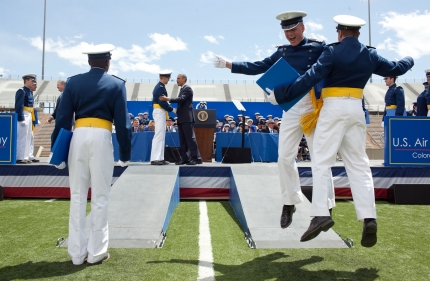
President Barack Obama salutes graduating cadets from the United States Air Force Academy (May 23, 2012)

President Barack Obama salutes graduating cadets as they cross the stage at the United States Air Force Academy commencement ceremony at Falcon Stadium, USAF Academy in Colorado Springs, Colorado, May 23, 2012. President Obama delivered the commencement address at the ceremony. (Official White House Photo by Chuck Kennedy)

Four years ago, when President Obama made his first trip to the Air Force Academy in Colorado Springs, Colorado, the class of 2012 was just beginning their tenure as cadets.

Today, he returned to deliver their commencement address. Acknowledging the continued need for the leadership and service the new graduates will provide, President Obama said the next century will be an American one:

I see an American Century because of the character of our country -- the spirit that has always made us exceptional. That simple yet revolutionary idea -- there at our founding and in our hearts ever since -- that we have it in our power to make the world anew, to make the future what we will. It is that fundamental faith -- that American optimism -- which says no challenge is too great, no mission is too hard. It’s the spirit that guides your class: "Never falter, never fail."

Approximately, 1,000 cadets graduated today and will soon begin their commissions as second lieutenants. Before leaving Falcon Field the President shook each of their hands.

Read his full remarks here.

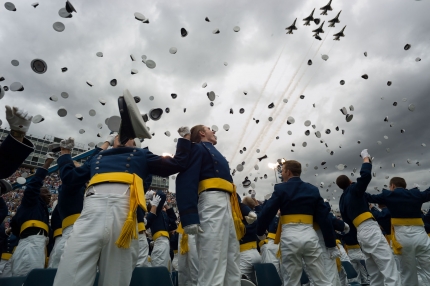
Graduates toss their hats as the Thunderbirds flyover during the United States Air Force Academy commencement ceremony (May 23, 2012)

Graduates toss their hats as the Thunderbirds flyover during the United States Air Force Academy commencement ceremony at Falcon Stadium, USAF Academy in Colorado Springs, Colorado, May 23, 2012. (Official White House Photo by Chuck Kennedy)

President Barack Obama participates in the United States Air Force Academy commencement ceremony (May 23, 2012)

President Barack Obama participates in the United States Air Force Academy commencement ceremony at Falcon Stadium, USAF Academy in Colorado Springs, Colorado, May 23, 2012. (Official White House Photo by Pete Souza)

The White House

Office of the Press Secretary

Remarks by the President at the Air Force Academy Commencement

Air Force Academy
Colorado Springs, Colorado

10:29 A.M. MDT

THE PRESIDENT:  Thank you so much.  (Applause.)  Please be seated.  Good morning, everybody!  It is wonderful to be at the United States Air Force Academy on such a spectacular day.  And it is a privilege to join you in honoring the Class of 2012.  (Applause.)  

I want to thank Secretary Donley for his introduction, but more importantly, for his leadership.  Generals Gould, Clark and Born; academy faculty and staff; Governor Hickenlooper; members of Congress; distinguished guests; ladies and gentlemen. 

I especially want to acknowledge a graduate of this academy who has kept our Air Force strong through a time of great challenge, a leader I’ve relied on and for whom today is his final commencement as chief of staff -- General Norton Schwartz. Norty, Suzie, we could not be prouder of you and we are grateful for 39 years of extraordinary service to our nation.  (Applause.)  
And although he is not with us today, I’m proud to have nominated another Academy graduate, General Mark Welsh, as the next chief of staff.  (Applause.)  

This is my second visit to the Academy.  I was here in the summer of 2008, and you were getting ready to head out to Jacks Valley.  So I was proud to be here when you began this journey, and I thought I’d come back and help you celebrate at the end.  (Laughter.)    

It’s great to be back at a school that has produced so many of the airmen I’ve known as President.  Every day, I rely on outstanding Academy graduates who serve at the White House.  Some of you know that photo from the Situation Room on the day we delivered justice to bin Laden -- you can see right next to me a great leader of our Special Operations forces, General Brad Webb. 
Last month, I was able to present the Commander-in-Chief Trophy to Coach Calhoun and the Fighting Falcons -- (applause) -- for the second straight year, a record 18th time.  And of course, every time I step on Air Force One, I count on Academy graduates like my pilot today -- Colonel Scott Turner.  Now, I was going to tell you a joke about Scott, but he’s my ride home.  (Laughter.) So I'm going to have to keep it to myself.

Cadets, you distinguished yourselves as leaders before you ever stepped foot on the Terrazzo.  And when you arrived, I know your upper classmen gave you quite a welcome.  They let you experience the joy of the Beast.  The pleasure of Recognition.  They made you experts on filling out forms.  I only ask that you resist the temptation to rate my speech -- "fast-neat-average-friendly-good-good."  (Laughter and applause.)  

But you survived.  In you we see the values of integrity and service and excellence that will define your lives.  And I know you couldn’t have made it without the love and support of your moms and dads and brothers and sisters and grandmas, grandpas, aunts, uncles, cousins.  So give them all a big round of applause.  (Applause.) 

This Academy is one of the most demanding academic institutions in America.  And you have excelled.  I’m told you have set at least three Academy records:  The largest number of graduates ever to go directly on to graduate school; the largest number of female graduates in Academy history -- (applause.)  You will follow in the footsteps of General Janet Wolfenbarger, who I was proud to nominate as the first female four-star general in Air Force history.  (Applause.)  

And of course, your final and perhaps most impressive distinction -- breaking the world's record for the largest game of dodgeball -- (applause) -- 3,000 participants, 30 hours.  I didn't know that was possible.  (Laughter.)  Of course, you are also the class that snuck into the Superintendent’s office and moved all the furniture into your dorm rooms -- (laughter) -- which does bring me to some important business.  In keeping with longstanding tradition, I hereby grant amnesty to all cadets serving restrictions and confinements for minor offenses.  (Applause.)  Of course, I leave it up to General Gould to define "minor."  (Laughter.) 

Cadets, this is the day you finally become officers in the finest Air Force in the world.  (Applause.)  Like generations before you, you'll be charged with the responsibility of leading those under your command.  Like classes over the past 10 years, you graduate in a time of war and you may find yourselves in harm’s way.  But you will also face a new test, and that’s what I want to talk to you about today.

Four years ago, you arrived here at a time of extraordinary challenge for our nation.  Our forces were engaged in two wars.  Al Qaeda, which had attacked us on 9/11, was entrenched in their safe havens.  Many of our alliances were strained and our standing in the world had suffered.  Our economy was in the worst recession since the Great Depression.  Around the world and here at home, there were those that questioned whether the United States still had the capacity for global leadership.

Today, you step forward into a different world.  You are the first class in nine years that will graduate into a world where there are no Americans fighting in Iraq.  (Applause.)  For the first time in your lives -- and thanks to Air Force personnel who did their part -- Osama bin Laden is no longer a threat to our country.  (Applause.)  We’ve put al Qaeda on the path to defeat. And you are the first graduates since 9/11 who can clearly see how we’ll end the war in Afghanistan.

So what does all this mean?  When you came here four years ago, there were some 180,000 American troops in Iraq and Afghanistan.  We’ve now cut that number by more than half.  And as more Afghans step up, more of our troops will come home -— while achieving the objective that led us to war in the first place and that is defeating al Qaeda and denying them safe haven. So we aren’t just ending these wars, we are doing so in a way that makes us safer and stronger.

Today we pay tribute to all our extraordinary men and women in uniform for their bravery, for their dedication.  Those who gave their lives in Iraq and Afghanistan to make this progress possible -— including 16 graduates of this Academy -- we honor them.  We will always honor them.

For a decade, we have labored under the dark cloud of war.  And now, we can see a light -- the light of a new day on the horizon.  So the end of these wars will shape your service and it will make our military stronger.  Ten years of continuous military operations have stretched our forces and strained their families.  Going forward, you’ll face fewer deployments.  You’ll have more time to train and stay ready.  That means you’ll be better prepared for the full range of missions you face.

And ending these wars will also ensure that the burden of our security no longer falls so heavily on the shoulders of our men and women in uniform.  As good as you are, you can’t be expected to do it alone.  There are many sources of American power -— diplomatic, economic and the power of our ideals.  And we’ve got to use them all.  And the good news is, today we are. 

Around the world, the United States is leading once more.  From Europe to Asia, our alliances are stronger than ever.  Our ties with the Americas are deeper.  We’re setting the agenda in the region that will shape our long-term security and prosperity like no other -- the Asia Pacific.

We’re leading on global security -- reducing our nuclear arsenal with Russia, even as we maintain a strong nuclear deterrent; mobilizing dozens of nations to secure nuclear materials so they never fall into the hands of terrorists; rallying the world to put the strongest sanctions ever on Iran and North Korea, which cannot be allowed to threaten the world with nuclear weapons.

We are leading economically -- forging trade pacts to create new markets for our goods; boosting our exports, stamped with three proud words -- Made in America.  (Applause.)  We’re expanding exchanges and collaborations in areas that people often admire most about America -- our innovation, our science, our technology.

We’re leading on behalf of human dignity and on behalf of freedom -- standing with the people of the Middle East and North Africa as they seek their rights; preventing a massacre in Libya with an international mission in which the United States -- and our Air Force -- led from the front.  (Applause.)  We’re leading global efforts against hunger and disease.  And we’ve shown our compassion, as so many airmen did in delivering relief to our neighbors in Haiti when they were in need and to our Japanese allies after the earthquake and tsunami.

Because of this progress, around the world there is a new feeling about America.  I see it everywhere I go, from London and Prague, to Tokyo and Seoul, to Rio and Jakarta.  There’s a new confidence in our leadership.  And when people around the world are asked, which country do you most admire, one nation comes out on top -- the United States of America.  (Applause.)

Of course, the world stage is not a popularity contest.  As a nation, we have vital interests, and we will do what is necessary always to defend this country we love -- even if it’s unpopular.  But make no mistake, how we’re viewed in the world has consequences -- for our national security and for your lives. 

See, when other countries and people see us as partners, they’re more willing to work with us.  It’s why more countries joined us in Afghanistan and Libya.  It’s why nations like Australia are welcoming our forces who stand side by side with allies and partners in the South Pacific.  It’s why Uganda and its African neighbors have welcomed our trainers to help defeat a brutal army that slaughters its citizens.

I think of the Japanese man in the disaster zone who, upon seeing our airmen delivering relief, said, "I never imagined they could help us so much."  I think of the Libyans who protected our airman when he ejected over their town, because they knew America was there to protect them.  And in a region where we've seen burning of American flags, I think of all the Libyans who were waving American flags.

Today, we can say with confidence and pride the United States is stronger and safer and more respected in the world, because even as we’ve done the work of ending these wars, we’ve laid the foundation for a new era of American leadership.  And now, cadets, we have to build it.  We have to build on it.  You have to build on it. 

Let’s start by putting aside the tired notion that says our influence has waned or that America is in decline.  We’ve heard that talk before.  During the Great Depression, when millions were unemployed and some believed that other economic models offered a better way, there were those who predicted the end of American capitalism.  Guess what, they were wrong.  We fought our way back.  We created the largest middle class in history and the most prosperous economy the world has ever known. 

After Pearl Harbor some said, the United States has been reduced to a third-rate power.  Well, we rallied.  We flew over The Hump and took island after island.  We stormed the beaches and liberated nations.  And we emerged from that war as the strongest power on the face of the Earth.

After Vietnam and the energy crisis of the 1970s, some said America had passed its high point.  But the very next decade, because of our fidelity to the values we stand for, the Berlin Wall came tumbling down and liberty prevailed over the tyranny of the Cold War.  (Applause.)

As recently as the 1980s with the rise of Japan and the Asian tigers, there were those who said we had lost our economic edge.  But we retooled.  We invested in new technologies.  We launched an Information Revolution that changed the world.

After all this, you would think folks understand a basic truth -- never bet against the United States of America.  (Applause.)  And one of the reasons is that the United States has been, and will always be, the one indispensable nation in world affairs.  It's one of the many examples of why America is exceptional.  It’s why I firmly believe that if we rise to this moment in history, if we meet our responsibilities, then -- just like the 20th century -- the 21st century will be another great American Century.  That’s the future I see.  That’s the future you can build.  (Applause.)   

I see an American Century because we have the resilience to make it through these tough economic times.  We're going to put America back to work by investing in the things that keep us competitive -- education and high-tech manufacturing, science and innovation.  We'll pay down our deficits, reform our tax code and keep reducing our dependence on foreign oil.  We need to get on with nation-building here at home.  And I know we can, because we’re still the largest, most dynamic, most innovative economy in the world.  And no matter what challenges we may face, we wouldn’t trade places with any other nation on Earth. 

I see an American Century because you are part of the finest, most capable military the world has ever known.  No other nation even comes close.  Yes, as today’s wars end, our military -- and our Air Force -- will be leaner.  But as Commander-in-Chief, I will not allow us to make the mistakes of the past.  We still face very serious threats.  As we’ve seen in recent weeks, with al Qaeda in Yemen, there are still terrorists who seek to kill our citizens.  So we need you to be ready for the full range of threats.  From the conventional to the unconventional, from nations seeking weapons of mass destruction to the cell of terrorists planning the next attack, from the old danger of piracy to the new threat of cyber, we must be vigilant.

And so, guided by our new defense strategy, we’ll keep our military -- and our Air Force -- fast and flexible and versatile. We will maintain our military superiority in all areas -- air, land, sea, space and cyber.  And we will keep faith with our forces and our military families. 

And as our newest veterans rejoin civilian life, we will never stop working to give them the benefits and opportunities that they have earned -- because our veterans have the skills to help us rebuild America, and we have to serve them as well as they have served us.  (Applause.) 

I see an American Century because we have the strongest alliances of any nation.  From Europe to Asia, our alliances are the foundation of global security.  In Libya, all 28 NATO allies played a role and we were joined by partners in the air from Sweden to the Gulf states.  In Afghanistan, we’re in a coalition of 50 allies and partners.  Today, Air Force personnel are serving in 135 nations -- partnering, training, building their capacity.  This is how peace and security will be upheld in the 21st century -- more nations bearing the costs and responsibilities of leadership.  And that’s good for America.  It’s good for the world.  And we’re at the hub of it, making it happen.

I see an American Century because no other nation seeks the role that we play in global affairs, and no other nation can play the role that we play in global affairs.  That includes shaping the global institutions of the 20th century to meet the challenges of the 21st.  As President, I’ve made it clear the United States does not fear the rise of peaceful, responsible emerging powers -- we welcome them.  Because when more nations step up and contribute to peace and security, that doesn’t undermine American power, it enhances it. 

And when other people in other countries see that we’re rooting for their success, it builds trust and partnerships that can advance our interests for generations.  It makes it easier to meet common challenges, from preventing the spread of nuclear weapons to combating climate change.  And so we seek an international order where the rights and responsibilities of all nations and peoples are upheld, and where counties thrive by meeting their obligations and they face consequences when they don’t.

I see an American Century because more and more people are reaching toward the freedoms and values that we share.  No other nation has sacrificed more -- in treasure, in the lives of our sons and daughters -- so that these freedoms could take root and flourish around the world.  And no other nation has made the advancement of human rights and dignity so central to its foreign policy.  And that’s because it’s central to who we are, as Americans.  It’s also in our self-interest, because democracies become our closest allies and partners.

Sure, there will always be some governments that try to resist the tide of democracy, who claim theirs is a better way.  But around the world, people know the difference between us.  We welcome freedom —- to speak, to assemble, to worship, to choose your leaders.  They don’t.  We welcome the chance to compete for jobs and markets freely and fairly.  They don’t.  When fundamental human rights are threatened around the world, we stand up and speak out.  And they don’t.

We know that the sovereignty of nations cannot strangle the liberty of individuals.  And so we stand with the student in the street who demands a life of dignity and opportunity.  We stand with women everywhere who deserve the same rights as men.  We stand with the activists unbowed in their prison cells, and the leaders in parliament who’s moving her country towards democracy. We stand with the dissident who seeks the freedom to say what he pleases, and the entrepreneur who wants to start a business without paying a bribe, and all those who strive for justice and dignity.  For they know, as we do, that history is on the side of freedom.

And finally, I see an American Century because of the character of our country -- the spirit that has always made us exceptional.  That simple yet revolutionary idea -- there at our founding and in our hearts ever since -- that we have it in our power to make the world anew, to make the future what we will.  It is that fundamental faith -- that American optimism -- which says no challenge is too great, no mission is too hard.  It’s the spirit that guides your class:  "Never falter, never fail."  (Applause.)

That is the essence of America, and there’s nothing else like it anywhere in the world.  It’s what’s inspired the oppressed in every corner of the world to demand the same freedoms for themselves.  It’s what’s inspired generations to come to our shores, renewing us with their energy and their hopes.  And that includes a fellow cadet, a cadet graduating today, who grew up in Venezuela, got on a plane with a one-way ticket to America, and today is closer to his dream of becoming an Air Force pilot -- Edward Camacho.  (Applause.)  Edward said what we all know to be true:  "I'm convinced that America is the land of opportunity." 

You’re right, Edward.  That is who we are.  That’s the America we love.  Always young, always looking ahead to that light of a new day on the horizon.  And, cadets, as I look into your eyes -- as you join that Long Blue Line -- I know you will carry us even farther, and even higher.  And with your proud service, I'm absolutely confident that the United States of America will meet the tests of our time.  We will remain the land of opportunity.  And we will stay strong as the greatest force for freedom and human dignity that the world has ever known.  

May God bless you.  May God bless the Class of 2012.  And may God bless the United States of America.  (Applause.)

END                
10:56 A.M. MDT

President Obama Speaks at the Air Force Academy Commencement Ceremony

May 23, 2012 | 27:12 | Public Domain

President Obama delivers the commencement address at the United States Air Force Academy.

Download mp4 (961MB) | mp3 (62MB)

Read the Transcript

Remarks by the President at the Air Force Academy Commencement

Air Force Academy
Colorado Springs, Colorado

10:29 A.M. MDT

THE PRESIDENT:  Thank you so much.  (Applause.)  Please be seated.  Good morning, everybody!  It is wonderful to be at the United States Air Force Academy on such a spectacular day.  And it is a privilege to join you in honoring the Class of 2012.  (Applause.)  

I want to thank Secretary Donley for his introduction, but more importantly, for his leadership.  Generals Gould, Clark and Born; academy faculty and staff; Governor Hickenlooper; members of Congress; distinguished guests; ladies and gentlemen. 

I especially want to acknowledge a graduate of this academy who has kept our Air Force strong through a time of great challenge, a leader I’ve relied on and for whom today is his final commencement as chief of staff -- General Norton Schwartz. Norty, Suzie, we could not be prouder of you and we are grateful for 39 years of extraordinary service to our nation.  (Applause.)  
And although he is not with us today, I’m proud to have nominated another Academy graduate, General Mark Welsh, as the next chief of staff.  (Applause.)  

This is my second visit to the Academy.  I was here in the summer of 2008, and you were getting ready to head out to Jacks Valley.  So I was proud to be here when you began this journey, and I thought I’d come back and help you celebrate at the end.  (Laughter.)    

It’s great to be back at a school that has produced so many of the airmen I’ve known as President.  Every day, I rely on outstanding Academy graduates who serve at the White House.  Some of you know that photo from the Situation Room on the day we delivered justice to bin Laden -- you can see right next to me a great leader of our Special Operations forces, General Brad Webb. 
Last month, I was able to present the Commander-in-Chief Trophy to Coach Calhoun and the Fighting Falcons -- (applause) -- for the second straight year, a record 18th time.  And of course, every time I step on Air Force One, I count on Academy graduates like my pilot today -- Colonel Scott Turner.  Now, I was going to tell you a joke about Scott, but he’s my ride home.  (Laughter.) So I'm going to have to keep it to myself.

Cadets, you distinguished yourselves as leaders before you ever stepped foot on the Terrazzo.  And when you arrived, I know your upper classmen gave you quite a welcome.  They let you experience the joy of the Beast.  The pleasure of Recognition.  They made you experts on filling out forms.  I only ask that you resist the temptation to rate my speech -- "fast-neat-average-friendly-good-good."  (Laughter and applause.)  

But you survived.  In you we see the values of integrity and service and excellence that will define your lives.  And I know you couldn’t have made it without the love and support of your moms and dads and brothers and sisters and grandmas, grandpas, aunts, uncles, cousins.  So give them all a big round of applause.  (Applause.) 

This Academy is one of the most demanding academic institutions in America.  And you have excelled.  I’m told you have set at least three Academy records:  The largest number of graduates ever to go directly on to graduate school; the largest number of female graduates in Academy history -- (applause.)  You will follow in the footsteps of General Janet Wolfenbarger, who I was proud to nominate as the first female four-star general in Air Force history.  (Applause.)  

And of course, your final and perhaps most impressive distinction -- breaking the world's record for the largest game of dodgeball -- (applause) -- 3,000 participants, 30 hours.  I didn't know that was possible.  (Laughter.)  Of course, you are also the class that snuck into the Superintendent’s office and moved all the furniture into your dorm rooms -- (laughter) -- which does bring me to some important business.  In keeping with longstanding tradition, I hereby grant amnesty to all cadets serving restrictions and confinements for minor offenses.  (Applause.)  Of course, I leave it up to General Gould to define "minor."  (Laughter.) 

Cadets, this is the day you finally become officers in the finest Air Force in the world.  (Applause.)  Like generations before you, you'll be charged with the responsibility of leading those under your command.  Like classes over the past 10 years, you graduate in a time of war and you may find yourselves in harm’s way.  But you will also face a new test, and that’s what I want to talk to you about today.

Four years ago, you arrived here at a time of extraordinary challenge for our nation.  Our forces were engaged in two wars.  Al Qaeda, which had attacked us on 9/11, was entrenched in their safe havens.  Many of our alliances were strained and our standing in the world had suffered.  Our economy was in the worst recession since the Great Depression.  Around the world and here at home, there were those that questioned whether the United States still had the capacity for global leadership.

Today, you step forward into a different world.  You are the first class in nine years that will graduate into a world where there are no Americans fighting in Iraq.  (Applause.)  For the first time in your lives -- and thanks to Air Force personnel who did their part -- Osama bin Laden is no longer a threat to our country.  (Applause.)  We’ve put al Qaeda on the path to defeat. And you are the first graduates since 9/11 who can clearly see how we’ll end the war in Afghanistan.

So what does all this mean?  When you came here four years ago, there were some 180,000 American troops in Iraq and Afghanistan.  We’ve now cut that number by more than half.  And as more Afghans step up, more of our troops will come home -— while achieving the objective that led us to war in the first place and that is defeating al Qaeda and denying them safe haven. So we aren’t just ending these wars, we are doing so in a way that makes us safer and stronger.

Today we pay tribute to all our extraordinary men and women in uniform for their bravery, for their dedication.  Those who gave their lives in Iraq and Afghanistan to make this progress possible -— including 16 graduates of this Academy -- we honor them.  We will always honor them.

For a decade, we have labored under the dark cloud of war.  And now, we can see a light -- the light of a new day on the horizon.  So the end of these wars will shape your service and it will make our military stronger.  Ten years of continuous military operations have stretched our forces and strained their families.  Going forward, you’ll face fewer deployments.  You’ll have more time to train and stay ready.  That means you’ll be better prepared for the full range of missions you face.

And ending these wars will also ensure that the burden of our security no longer falls so heavily on the shoulders of our men and women in uniform.  As good as you are, you can’t be expected to do it alone.  There are many sources of American power -— diplomatic, economic and the power of our ideals.  And we’ve got to use them all.  And the good news is, today we are. 

Around the world, the United States is leading once more.  From Europe to Asia, our alliances are stronger than ever.  Our ties with the Americas are deeper.  We’re setting the agenda in the region that will shape our long-term security and prosperity like no other -- the Asia Pacific.

We’re leading on global security -- reducing our nuclear arsenal with Russia, even as we maintain a strong nuclear deterrent; mobilizing dozens of nations to secure nuclear materials so they never fall into the hands of terrorists; rallying the world to put the strongest sanctions ever on Iran and North Korea, which cannot be allowed to threaten the world with nuclear weapons.

We are leading economically -- forging trade pacts to create new markets for our goods; boosting our exports, stamped with three proud words -- Made in America.  (Applause.)  We’re expanding exchanges and collaborations in areas that people often admire most about America -- our innovation, our science, our technology.

We’re leading on behalf of human dignity and on behalf of freedom -- standing with the people of the Middle East and North Africa as they seek their rights; preventing a massacre in Libya with an international mission in which the United States -- and our Air Force -- led from the front.  (Applause.)  We’re leading global efforts against hunger and disease.  And we’ve shown our compassion, as so many airmen did in delivering relief to our neighbors in Haiti when they were in need and to our Japanese allies after the earthquake and tsunami.

Because of this progress, around the world there is a new feeling about America.  I see it everywhere I go, from London and Prague, to Tokyo and Seoul, to Rio and Jakarta.  There’s a new confidence in our leadership.  And when people around the world are asked, which country do you most admire, one nation comes out on top -- the United States of America.  (Applause.)

Of course, the world stage is not a popularity contest.  As a nation, we have vital interests, and we will do what is necessary always to defend this country we love -- even if it’s unpopular.  But make no mistake, how we’re viewed in the world has consequences -- for our national security and for your lives. 

See, when other countries and people see us as partners, they’re more willing to work with us.  It’s why more countries joined us in Afghanistan and Libya.  It’s why nations like Australia are welcoming our forces who stand side by side with allies and partners in the South Pacific.  It’s why Uganda and its African neighbors have welcomed our trainers to help defeat a brutal army that slaughters its citizens.

I think of the Japanese man in the disaster zone who, upon seeing our airmen delivering relief, said, "I never imagined they could help us so much."  I think of the Libyans who protected our airman when he ejected over their town, because they knew America was there to protect them.  And in a region where we've seen burning of American flags, I think of all the Libyans who were waving American flags.

Today, we can say with confidence and pride the United States is stronger and safer and more respected in the world, because even as we’ve done the work of ending these wars, we’ve laid the foundation for a new era of American leadership.  And now, cadets, we have to build it.  We have to build on it.  You have to build on it. 

Let’s start by putting aside the tired notion that says our influence has waned or that America is in decline.  We’ve heard that talk before.  During the Great Depression, when millions were unemployed and some believed that other economic models offered a better way, there were those who predicted the end of American capitalism.  Guess what, they were wrong.  We fought our way back.  We created the largest middle class in history and the most prosperous economy the world has ever known. 

After Pearl Harbor some said, the United States has been reduced to a third-rate power.  Well, we rallied.  We flew over The Hump and took island after island.  We stormed the beaches and liberated nations.  And we emerged from that war as the strongest power on the face of the Earth.

After Vietnam and the energy crisis of the 1970s, some said America had passed its high point.  But the very next decade, because of our fidelity to the values we stand for, the Berlin Wall came tumbling down and liberty prevailed over the tyranny of the Cold War.  (Applause.)

As recently as the 1980s with the rise of Japan and the Asian tigers, there were those who said we had lost our economic edge.  But we retooled.  We invested in new technologies.  We launched an Information Revolution that changed the world.

After all this, you would think folks understand a basic truth -- never bet against the United States of America.  (Applause.)  And one of the reasons is that the United States has been, and will always be, the one indispensable nation in world affairs.  It's one of the many examples of why America is exceptional.  It’s why I firmly believe that if we rise to this moment in history, if we meet our responsibilities, then -- just like the 20th century -- the 21st century will be another great American Century.  That’s the future I see.  That’s the future you can build.  (Applause.)   

I see an American Century because we have the resilience to make it through these tough economic times.  We're going to put America back to work by investing in the things that keep us competitive -- education and high-tech manufacturing, science and innovation.  We'll pay down our deficits, reform our tax code and keep reducing our dependence on foreign oil.  We need to get on with nation-building here at home.  And I know we can, because we’re still the largest, most dynamic, most innovative economy in the world.  And no matter what challenges we may face, we wouldn’t trade places with any other nation on Earth. 

I see an American Century because you are part of the finest, most capable military the world has ever known.  No other nation even comes close.  Yes, as today’s wars end, our military -- and our Air Force -- will be leaner.  But as Commander-in-Chief, I will not allow us to make the mistakes of the past.  We still face very serious threats.  As we’ve seen in recent weeks, with al Qaeda in Yemen, there are still terrorists who seek to kill our citizens.  So we need you to be ready for the full range of threats.  From the conventional to the unconventional, from nations seeking weapons of mass destruction to the cell of terrorists planning the next attack, from the old danger of piracy to the new threat of cyber, we must be vigilant.

And so, guided by our new defense strategy, we’ll keep our military -- and our Air Force -- fast and flexible and versatile. We will maintain our military superiority in all areas -- air, land, sea, space and cyber.  And we will keep faith with our forces and our military families. 

And as our newest veterans rejoin civilian life, we will never stop working to give them the benefits and opportunities that they have earned -- because our veterans have the skills to help us rebuild America, and we have to serve them as well as they have served us.  (Applause.) 

I see an American Century because we have the strongest alliances of any nation.  From Europe to Asia, our alliances are the foundation of global security.  In Libya, all 28 NATO allies played a role and we were joined by partners in the air from Sweden to the Gulf states.  In Afghanistan, we’re in a coalition of 50 allies and partners.  Today, Air Force personnel are serving in 135 nations -- partnering, training, building their capacity.  This is how peace and security will be upheld in the 21st century -- more nations bearing the costs and responsibilities of leadership.  And that’s good for America.  It’s good for the world.  And we’re at the hub of it, making it happen.

I see an American Century because no other nation seeks the role that we play in global affairs, and no other nation can play the role that we play in global affairs.  That includes shaping the global institutions of the 20th century to meet the challenges of the 21st.  As President, I’ve made it clear the United States does not fear the rise of peaceful, responsible emerging powers -- we welcome them.  Because when more nations step up and contribute to peace and security, that doesn’t undermine American power, it enhances it. 

And when other people in other countries see that we’re rooting for their success, it builds trust and partnerships that can advance our interests for generations.  It makes it easier to meet common challenges, from preventing the spread of nuclear weapons to combating climate change.  And so we seek an international order where the rights and responsibilities of all nations and peoples are upheld, and where counties thrive by meeting their obligations and they face consequences when they don’t.

I see an American Century because more and more people are reaching toward the freedoms and values that we share.  No other nation has sacrificed more -- in treasure, in the lives of our sons and daughters -- so that these freedoms could take root and flourish around the world.  And no other nation has made the advancement of human rights and dignity so central to its foreign policy.  And that’s because it’s central to who we are, as Americans.  It’s also in our self-interest, because democracies become our closest allies and partners.

Sure, there will always be some governments that try to resist the tide of democracy, who claim theirs is a better way.  But around the world, people know the difference between us.  We welcome freedom —- to speak, to assemble, to worship, to choose your leaders.  They don’t.  We welcome the chance to compete for jobs and markets freely and fairly.  They don’t.  When fundamental human rights are threatened around the world, we stand up and speak out.  And they don’t.

We know that the sovereignty of nations cannot strangle the liberty of individuals.  And so we stand with the student in the street who demands a life of dignity and opportunity.  We stand with women everywhere who deserve the same rights as men.  We stand with the activists unbowed in their prison cells, and the leaders in parliament who’s moving her country towards democracy. We stand with the dissident who seeks the freedom to say what he pleases, and the entrepreneur who wants to start a business without paying a bribe, and all those who strive for justice and dignity.  For they know, as we do, that history is on the side of freedom.

And finally, I see an American Century because of the character of our country -- the spirit that has always made us exceptional.  That simple yet revolutionary idea -- there at our founding and in our hearts ever since -- that we have it in our power to make the world anew, to make the future what we will.  It is that fundamental faith -- that American optimism -- which says no challenge is too great, no mission is too hard.  It’s the spirit that guides your class:  "Never falter, never fail."  (Applause.)

That is the essence of America, and there’s nothing else like it anywhere in the world.  It’s what’s inspired the oppressed in every corner of the world to demand the same freedoms for themselves.  It’s what’s inspired generations to come to our shores, renewing us with their energy and their hopes.  And that includes a fellow cadet, a cadet graduating today, who grew up in Venezuela, got on a plane with a one-way ticket to America, and today is closer to his dream of becoming an Air Force pilot -- Edward Camacho.  (Applause.)  Edward said what we all know to be true:  "I'm convinced that America is the land of opportunity." 

You’re right, Edward.  That is who we are.  That’s the America we love.  Always young, always looking ahead to that light of a new day on the horizon.  And, cadets, as I look into your eyes -- as you join that Long Blue Line -- I know you will carry us even farther, and even higher.  And with your proud service, I'm absolutely confident that the United States of America will meet the tests of our time.  We will remain the land of opportunity.  And we will stay strong as the greatest force for freedom and human dignity that the world has ever known.  

May God bless you.  May God bless the Class of 2012.  And may God bless the United States of America.  (Applause.)

END                
10:56 A.M. MDT

Close Transcript

The White House

Office of the Press Secretary

Press Gaggle by Press Secretary Jay Carney en route Colorado Springs, CO, 5/23/12

Aboard Air Force One
En Route Colorado Springs, Colorado   

9:28 A.M. EDT

MR. CARNEY:  Good morning, everyone.  Thank you for starting early with us as we make our way over a number of states to Colorado -- Colorado Springs -- where the President will, with great pleasure, deliver the commencement address at the Air Force Academy -- part of a tradition where the President, every year, delivers the commencement at one of the service academies.  This year he very much looks forward to speaking to the class of 2012.

I think without stealing any of his thunder, I can tell you that the President will likely note how much has changed over the past four years since these cadets entered the academy and in terms of the U.S. position in the world, the strength of its alliances, the success of its fight against al Qaeda, the remarkable demonstrations again and again of the capacities -- unparalleled capacities of our men and women in uniform. 

And he will likely note as well that the service our men and women in uniform have provided their country over these past four years and over the past many years, especially since the wars in Afghanistan and Iraq began, only reinforces the absolute need and the President's firm commitment to provide our veterans when they return home -- to provide for our veterans when they return home.

And with that, I will take your questions.

Q    Does that mean that he's going to talk about the Job Corps, the Veteran Job Corps?

MR. CARNEY:  I'll leave the specifics to the President. 

That’s it?  Are we done?  (Laughter.)  That’s awesome.

Q    We're all sleepy.

Q    Jay, on the Iran nuclear talks today, does the administration have any expectations that there could be a breakthrough in the talks, any signals from Iran that they could be willing to take concrete steps to reduce their nuclear capacity?

MR. CARNEY:  I'll say a couple of things about that.  The talks are underway in Baghdad, as scheduled, and the fact that they are taking place as a continuance of the initial round is a sign of progress.  The initial round was important because the Iranians focused on their nuclear program, and that will continue to be the case, we hope.  I don’t have any readout of today's meetings, but I can say that we want to see this effort succeed.

Any process has to have as part of it reciprocal actions and Iran must demonstrate it is serious about moving forward with addressing the concerns of the international community.  As I said yesterday when asked about the announcement by the IAEA director, the fact that there are positive steps forward is absolutely worth noting, but we judge Iran by its actions, not by its promises.

And so we will continue to press forward with our allies and partners with the unprecedented sanctions regime as we, on a separate track, work with our P5-plus-1 partners to pursue an effort to resolve this conflict diplomatically.

Q    To follow up on that, is there any sense, Jay, that the talks will continue tomorrow or for several days? 

MR. CARNEY:  I don't have any update on that.  I think the talks are literally underway as we speak and we'll know more at the end of the day in Baghdad.

Q    Can you just talk about the choice of Baghdad as a venue?  I mean, is that significant for the administration or the President representing some of the changes you were referring to earlier?

MR. CARNEY:  Well, I would say I think there were a number of stories about the discussions among the participants about location.  We certainly feel very comfortable with Baghdad as a location.  I think it does say something about where Iraq has arrived and that's certainly important.  But beyond that, our focus is not on the location or the symbolism, but on the content of the negotiations.

Can I, since you guys are a little woolly-headed this morning, I just wanted to read something that I read this morning that caught my attention.  This is from Market Watch's Rex Nutting.  He says, "Of all the falsehoods told about President Obama, the biggest whopper is the one about his reckless spending spree.  Almost everyone believes that Obama has presided over a massive increase in federal spending, but it didn't happen.  Although there was a big stimulus bill under President Obama, federal spending is rising at its slowest pace since Dwight Eisenhower brought the Korean War to an end in the 1950s.  Even hapless Herbert Hoover managed to increase spending more than Obama has."

That means that the rate of spending -- federal spending increase is lower under President Obama than all of his predecessors since Dwight Eisenhower, including all of his Republican predecessors.  That is a fact not often noted in the press and certainly never mentioned by the Republicans. 

Q    You're emulating Herbert Hoover now as a standard --

MR. CARNEY:  Not at all.  I think it is simply a fact that despite the enormous challenges that this country faced when the President took office and the absolute essential need for taking dramatic action and significant action in passing a stimulus bill, as well as the other actions the President took, this President has been -- has demonstrated significant fiscal restraint and acted with great fiscal responsibility.  That is also why he has put forward a balanced plan to further reduce our deficit and debt by over $4 trillion.

That approach, that balanced approach is available -- is supported by a broad majority of the American people, majorities of Democrats, independents and Republicans outside of the nation's capital.  If only Republicans in Congress would agree to take that balanced approach, there is an opportunity for significant further deficit reduction. 

I simply make the point, as an editor might say, to check it out; do not buy into the BS that you hear about spending and fiscal constraint with regard to this administration.  I think doing so is a sign of sloth and laziness.

Next question.

Q    Yes, let’s move on. 

Q    -- you need more stimulus, not Herbert Hoover policies.  What do you think?

MR. CARNEY:  I just think -- you know, it’s an interesting point.  I think it is often noted, but not enough, that -- I remember the chart, seeing it, that the -- in the postwar era, the only two Presidents under which the size of the federal government shrank -- not Reagan, not Nixon, not Bush or Bush; Clinton and Carter.  How could that be?  Well, it’s a fact.  So next time --

Q    -- you need more stimulus.

MR. CARNEY:  Next time you are lectured by a Republican member of Congress who voted for all of the budget-busting measures under the previous administration, remind them of that record on my behalf.

Q    What do you say to the (inaudible) who says you need more stimulus?

MR. CARNEY:  Well, look, the President has an approach that includes essential investments in innovation, education, infrastructure, research and development -- essential investments to protect the middle class, to assist homeowners, for example, with refinancing their homes.  But it is part of an approach that includes wise deficit reduction.  That’s the approach that will lead to a continuation of our economic recovery, and a continuation of what is now 26 straight months of private sector job creation -- 26 months of private sector job creation, which, by the way, has resulted in over 4 million private sector jobs.  Those jobs numbers would be greater except the public sector has been reduced under -- the size of the public sector nationwide has come down because of cuts in state and local level of teachers and firefighters and policemen.  So again, these are often overlooked facts by our Republican friends. 

Q    This afternoon’s fundraisers and this evening’s -- do you expect the President to be talking about Bain Capital?

MR. CARNEY:  I would wait until you hear the President’s remarks.  I don’t have any updates for you on them. 

Q    Jay, what did you guys think of the CBO report that said that growth in the first half of next year could be down about 1.3 percent if the tax cuts aren’t extended and the spending cuts continue on?  Does that create a sense of urgency within the administration?

MR. CARNEY:  Well, I think the report reflects what is obvious, which is that we need -- and Congress needs -- to address all these issues in a balanced way.  The President, as you know, supports and has long supported, the extension of the middle-class tax cuts.  He does not believe we can afford, that the country can afford an extension of tax cuts for the wealthiest Americans, for millionaires and billionaires who, as you know, have done exceptionally well over these past years in no small measure because of those Bush -- expensive Bush tax cuts for the wealthiest Americans.

Now, speaking of deficits, those tax cuts for the wealthiest Americans contributed significantly to the red ink that was gushing out of our treasury under the Bush administration and which greeted President Obama when he took office.  It’s important to remember that in January of 2001, when President George W. Bush was sworn into office, he was turned over a federal budget situation that included surpluses as far as the eye could see.  Eight years later, he bequeathed upon President Obama a massive federal deficit and growing federal debt.  One of the reasons for that was the high-end tax cuts. 

So the President opposes extending those firmly and he supports extending middle-class tax cuts.  And he believes that overall we need to take a balanced approach to our fiscal challenges, which includes spending cuts to discretionary programs, over a trillion of which he's already signed into law, and reforms to our health care system as well as revenues.  And there’s not a single credible outside expert who’s looked at this who doesn't agree with that approach.

Q    Can I ask you about any movement with Congress?  I know that he met with leadership last week and you said he felt very optimistic that there would be common ground, and then there was some talk yesterday about being connected on a staff level, at least to Senate Dems.  Are there meetings on the staff level between Congress and the White House to try and get any number of these things passed?

MR. CARNEY:  There are communications every day between the White House and Congress on the "To-Do" list and other measures, including the need to pass the surface transportation bill that will keep American construction workers on the job, as well as other measures.  But the answer is, yes, in terms of the variety of measures included on the President’s congressional "To-Do" list.  They would have a swift impact on economic growth and job creation.

Q    Is there any sense that that's going to move any time soon?

MR. CARNEY:  Well, we remain optimistic that Congress will act on the "To-Do" list.  As you know and you’ve heard us say, the "To-Do" list is filled with measures that have traditionally enjoyed support from not just Democrats, but also Republicans.  We discussed one of them yesterday, the production tax credit, where we had a CEO from a company out of Elgin, Illinois -- Winergy -- Mr. Royer, who talked I think passionately about the need to extend that production tax credit and the fact that Republicans as well as Democrats have always supported it.

Q    Can you tell us any more about the fundraisers?  Who is going to be there, how many, how much they're paying?  Famous people?  Silicon Valley?  Zuckerberg?

MR. CARNEY:  I’d refer you to the campaign on that.  I just don't have that information.

Q    Mitt Romney is giving an education speech.  He’s going to outline his education agenda.  Some of his criticism has been that the President’s reforms have not really done much to the educational system, essentially that he’s arguing that the President is in cahoots with the labor unions.  Do you have any response to that?

MR. CARNEY:  I’ll respond to the question.  Is that the first time that Governor Romney has mentioned education since he began running for President this time?  It’s the first time I’ve heard of it.  As I recall education never came up in the Republican primaries in any of the debates.  Or if it did, it came up almost never.

The President’s education reforms, as you know, have enjoyed bipartisan support.  They are a often-overlooked aspect of his agenda that has enjoyed both Republican and Democratic support, and has been judged I think broadly to have made significant progress.  So I think the President looks forward to defending that record, and it’s certainly welcome after a long, long campaign season to know that the Republican candidate actually has something to say about education, something the American people care deeply about.

Right on. 

END 
9:44 A.M. EDT

The White House

Office of the Press Secretary

Obama Administration Launches Sweeping Shift to Mobile

New Directive to Make Federal Services Available on Mobile Devices, Spur “App Economy” and Entrepreneurship

WASHINGTON, DC – Today, the Obama Administration is launching a new initiative to accelerate efforts to make new and useful services available to consumers on their mobile devices. As part of the President's commitment to delivering a 21st century government, he is issuing a directive today requiring that each major Federal agency make two key government services the American people depend on available on mobile phones within the next 12 months. The Administration is also ramping up its ongoing efforts to make large amounts of government data more easily accessible to the public to spur entrepreneurs to develop innovative new services and mobile applications that take advantage of this data, creating new opportunities, businesses and jobs in the process.  These actions are part of a larger digital strategy being implemented by the Administration---a roadmap that will guide the Federal government as it makes the most of new sources of digital information.  

President Obama said, “Americans deserve a government that works for them anytime, anywhere, and on any device. By making important services accessible from your phone and sharing government data with entrepreneurs, we are giving hard-working families and businesses tools that will help them succeed.” 

Mobile is rapidly becoming the platform of choice for Americans; it is now anticipated that by 2015 more people will be accessing the Internet via mobile phones than via traditional desktop computers.  To serve the American people as they make this transition, the Administration is committed to making the mobile shift right along with them. The digital strategies announced today intend to do just that. By next spring, the American people will be able to access dozens of additional government services on their mobile phones for the first time.

The President has tasked his U.S. Chief Information Officer, Steven VanRoekel with releasing this comprehensive roadmap to help the Federal government seize on this opportunity and re-think digital services.

“We’re living in an increasingly mobile world and it is critical that the Federal government keep up with the way the American people do business. Already, families can use government apps to check the wait time at the airport, get access to critical veteran services, and check the status of their tax return. Today’s directive will accelerate our drive to make key services easily accessible to more Americans than ever,” said VanRoekel.

In conjunction with the launch of this strategy, U.S. Chief Technology Officer Todd Park is launching a new Presidential Innovation Fellows program.  This new initiative will bring in top innovators from outside government for focused “tours of duty” to work with Federal innovators on creative new projects. Among the projects that the Fellows will take on are ones to make consumer-friendly government information about health, education, energy, safety, and personal finance more accessible to all Americans.

“The release of government weather and GPS data has already led to countless entrepreneurial innovations, which have made life easier for America’s families while also creating multi-billion-dollar industries and generating jobs.   The initiatives we’re launching today will make government data resources even more accessible to the public and to entrepreneurs who can turn these data into services that can help Americans find the best doctor for their family, choose the college that offers them the most value for their money, save money on their energy bills through smarter shopping, and much more,” said Park. 

The Open Data Initiatives program announced today will speed and expand the release of government data in machine-readable form in realms ranging from healthcare to education to energy to public safety, and will actively stimulate the creation of new apps and services by entrepreneurs that will improve the lives of Americans in many tangible ways and create jobs of the future at the same time.

The White House

Office of the Press Secretary

Presidential Memorandum -- Building a 21st Century Digital Government

MEMORANDUM FOR THE HEADS OF EXECUTIVE DEPARTMENTS AND AGENCIES

SUBJECT: Building a 21st Century Digital Government

The innovative use of technology is fundamentally transforming how the American people do business and live their daily lives. Exponential increases in computing power, the rise of high-speed networks, and the growing mobile revolution have put the Internet at our fingertips, encouraging innovations that are giving rise to new industries and reshaping existing ones.

Innovators in the private sector and the Federal Government have used these technological advances to fundamentally change how they serve their customers. However, it is time for the Federal Government to do more. For far too long, the American people have been forced to navigate a labyrinth of information across different Government programs in order to find the services they need. In addition, at a time when Americans increasingly pay bills and buy tickets on mobile devices, Government services often are not optimized for smartphones or tablets, assuming the services are even available online.

On April 27, 2011, I issued Executive Order 13571 (Streamlining Service Delivery and Improving Customer Service), requiring executive departments and agencies (agencies) to, among other things, identify ways to use innovative technologies to streamline their delivery of services to lower costs, decrease service delivery times, and improve the customer experience. As the next step toward modernizing the way Government works, I charged my Federal Chief Information Officer (CIO) with developing a comprehensive Government-wide strategy to build a 21st century digital Government that delivers better digital services to the American people.

Today, the CIO is releasing that strategy, entitled "Digital Government: Building a 21st Century Platform to Better Serve the American People" (Strategy), which provides agencies with a 12-month roadmap that focuses on several priority areas. The Strategy will enable more efficient and coordinated digital service delivery by requiring agencies to establish specific, measurable goals for delivering better digital services; encouraging agencies to deliver information in new ways that fully utilize the power and potential of mobile and web-based technologies; ensuring the safe and secure delivery and use of digital services to protect information and privacy; requiring agencies to establish central online resources for outside developers and to adopt new standards for making applicable Government information open and machine-readable by default;

aggregating agencies' online resource pages for developers in a centralized catalogue on www.Data.gov; and requiring agencies to use web performance analytics and customer satisfaction measurement tools on all ".gov" websites.

Ultimately, this Strategy will ensure that agencies use emerging technologies to serve the public as effectively as possible. As a Government, and as a trusted provider of services, we must never forget who our customers are -- the American people.

In order to ensure that agencies make the best use of emerging technologies in serving the public, I hereby direct each agency to take the following actions:

(1) implement the requirements of the Strategy within 12 months of the date of this memorandum and comply with the timeframes for specific actions specified therein; and

(2) within 90 days of the date of this memorandum, create a page on its website, located at www.[agency].gov/digitalstrategy, to publicly report progress in meeting the requirements of the Strategy in a machine-readable format.

This memorandum shall be implemented consistent with applicable law and subject to the availability of appropriations, and with appropriate protections for privacy and civil liberties.

The Director of the Office of Management and Budget is authorized and directed to publish this memorandum in the Federal Register.

BARACK OBAMA

The White House

Office of the Press Secretary

President Obama To Award Presidential Medal of Freedom

WASHINGTON – On Tuesday, May 29th, President Barack Obama will award the Presidential Medal of Freedom.  The Medal of Freedom is our Nation’s highest civilian honor, presented to individuals who have made especially meritorious contributions to the security or national interests of the United States, to world peace, or to cultural or other significant public or private endeavors.  The Medals will be presented at the White House in an afternoon ceremony.