The White House

Office of the Press Secretary

Press Briefing by Press Secretary Jay Carney, Deputy Assistant to the President for Energy Heather Zichal, and Winergy Drive Systems Corporation CEO Terry Royer

James S. Brady Press Briefing Room

2:37 P.M. EDT

MR. CARNEY:  Good afternoon, ladies and gentlemen.  Welcome to the White House for your daily briefing.  As you know, on Thursday President Obama will travel to Iowa, where he will highlight the latest item on his congressional "To-Do" list, urging Congress to support American jobs and manufacturing in the clean energy sector by passing legislation to extend the production tax credit, and expand the 48C advanced energy manufacturing tax credit.

Today I am joined by Heather Zichal, Deputy Assistant to the President for Energy, who just concluded a meeting with wind energy developers and supply chain manufacturers, to discuss the value of the PTC and the 48C tax credits to a range of industries, companies and communities, and how we want to work together to ensure that they are passed.

We are also joined by one of those manufacturers, Terry Royer.  Terry is CEO of Winergy Drive Systems Corporation, which is headquartered in Elgin, Illinois, a western suburb of Chicago. Winergy started here in the United States with 11 employees in 2001, assembling and testing gearboxes, a key component inside a wind turbine.  Today, Winergy operates two factories in Elgin and has 380 employees.  Winergy, and the jobs they have created in Illinois, is an example of what is at stake if Congress fails to act and fails to extend clean energy tax credits. 

As you know, as with all the items on the "To-D"” list, this one has enjoyed bipartisan support in the past.  We certainly expect and hope that it will garner that same support moving forward.

As is the case when I have a guest, what I’d like to do is turn it over to Heather, who will have some remarks; she’ll turn it over to Terry.  I’ll call on you for any questions you have for the two of them on this particular issue.  You can save for afterward, questions on other issues.  Once they leave I’ll be here to take those questions.

And with that, I give you Heather Zichal.

MS. ZICHAL:  Thank you.  As Jay mentioned, the President recently proposed his "To-Do" list for Congress, which contains a number of key provisions that help create jobs and strengthen our economy.  As you know, there’s a key energy provision on that list. 

First, the production tax credit, which expires at the end of this year, provides a credit per kilowatt hour for utility scale wind producers.  And second, 48C, the Advanced Energy Manufacturers credit, provides a 30 percent credit to manufacturers who invest in capital equipment to make components for clean energy projects in the United States.

Now, what’s true of all the proposals, as Jay said, on the list is that they have historically been supported by both Democrats and Republicans.  The President will be in Newton, Iowa on Thursday to visit TPI Composites, a wind manufacturer, where they employ 700 workers.  And it demonstrates how important the production tax credit has been not only to the success of their industry but, looking forward, their continued success.

When it comes to the PTC, is has very broad support across the political spectrum.  The extension is supported by the Chamber of Commerce, the National Association of Manufacturers, the National Governors Association, including governors like Brownback and Branstad, as well as Republicans in both the House and the Senate.  Just last fall there was a bill introduced in the House to extend the PTC.  It has about 100 co-sponsors, 21 of which were Republicans.

Part of why you're seeing real bipartisanship -- bipartisan support is because we've made significant progress over the last few years in building up renewable energy in this country.  And it just doesn’t make sense to undo all of that progress, especially because thousands of American jobs across the country would be lost. 

Keep in mind where we stand today.  Thanks in part to our investments in clean energy, the largest in history, the U.S. has nearly doubled renewable energy generation from wind, solar and geothermal sources since 2008.  Generation from wind turbines has increased 27 percent in the last year along, continuing a trend of rapid growth.

Moreover, the administration's combination of tax credits in deployment and manufacturing has helped increase the domestic content of clean energy technologies in recent years.  By some industry estimates, domestic content of wind turbines and components has now reached 60 percent, which is up from around 25 percent in 2005.  That means more American jobs.  In fact, today, the wind industry supports tens of thousands of jobs all across the country.

While these are encouraging trends, it also means that thousands of jobs, including those in the supply chain, are at risk if Congress fails to act on renewing the credits.  This isn't guesswork.  We know from the past the when the PTC expires, orders of turbines slow, installations drop, and job losses occur.

As Jay mentioned, we just wrapped up a meeting with Secretaries Salazar and Chu and a number of individuals from -- representing the wind industry.  We met with developers, those involved in construction and manufacture.  I think some of the key takeaways from that meeting I'd like to share with you. 

Wind, overall, we heard has made significant progress in terms of cost, reliability and efficiency.  This year was a banner year for wind production.  But without an extension of the production tax credit, we could see job losses up to 37,000.  Some of the direct quotes:  "Without a PTC, industry is about to fall of a cliff."  Because of the uncertainty, we heard stories about companies refocusing their efforts outside of the United States, taking jobs and investment dollars with them.  Another direct quote:  "We don’t foresee any projects for 2013 in the United States."  And finally, "All of our construction base will be laid off or moved to Canada without the PTC."

So I think these underscore just how important this is.  And again, with the history of bipartisanship, we are hopeful that we will be able to work with Congress and get this extension renewed as quickly as possible.

I'd like now to introduce Terry.

MR. ROYER:  Thank you, Heather.  It's a pleasure to be here today.  It's a pleasure for me to be one of the many more than 450 manufacturing companies here in the United States that came about over the last five years because of bipartisan support for the production tax credit.  And as a result of that stable tax policy, the industry has had the ability to scale up and to grow and create real manufacturing jobs.

For myself, as a 28-year manufacturing leader, there is no more passion than I have, and that is to create here in the United States, and that it was has happened.  As Heather has mentioned, we went from over 20 percent of a wind turbine production being made in the U.S. to more than 65 percent being produced here today.  So these are real manufacturing jobs -- jobs like my family had growing up in southeast Iowa many years ago.  So for me, as a longtime manufacturing person, the stories about job creation and continuing the work that we’ve started five years. 

Four years ago, when the wind industry started to see this boom with this stable tax policy, more than 70 percent of the capacity that came online, this happened in the last four years of the installed base in the United States.  So you can see quickly how much the industry has grown, and it’s created more than 75,000 direct jobs and indirect jobs as a result of this growth over these last four years.

So for a company like mine -- again, I’ll reiterate, I’m speaking for more than 450 companies.  We started with 11 employees 10 years ago and have more than 380 employees today.  But I will tell you, with the uncertainty we’ve already created by not extending the tax credit, my company will be impacted and many of the 480 companies will be impacted.  And not only those manufacturing companies, but all those companies -- the diner down the street from my factory, the supply chain that supplies my factory will be impacted as well.

So for me and for all of us, we need to consider the support we have for this legislation and move it forward, because this has created real jobs and can continue to do so into the future.

Thank you.

MR. CARNEY:  With that, we’ll take your questions for Terry and Heather.  Who would like to start?

Yes, Jeff.

Q    For all of you maybe, can you talk a little bit about what you’re doing to get congressional support for this, and what sort of reaction you’re getting from them?  How likely is it that this will pass?

MS. ZICHAL:  Thank you for your question.  I think that, as you will hear from the President on Thursday and as you’ve heard from this administration from the very beginning days since we were in office, investing in clean energy is a priority for the President.  As I mentioned at the outset, the good thing about this proposal is it has a long history of bipartisan support.  It also has the support of NAM, the Chamber and others.  So we are working to expand that list of support.  We are working hand-in-hand with those in industry that are able to communicate the potential job-loss stories and translate to members that are looking at this question of an extension -- to translate what that means in terms of jobs in their communities and in their home districts.  And we are working every day with our legislative team to continue the dialogue with the Hill and find vehicles to move this as quickly as possible.

MR. CARNEY:  Jared.

Q    Thank you for taking our questions.  Do you have an estimate or I guess a timeframe for how long you would need the tax credits in place in terms -- because I’ve heard estimates of two years or four years or six before the industry can kind of be self-sustaining.

MR. ROYER:  Sure.  One of the things we’ve got to clearly stop doing and that is starting and stopping the production tax credit.  If you look over the last four years while we’ve had it, the industry has been able to scale up, the equipment has become more efficient, the cost of a turbine has decreased by more than 30 percent over those four years.  So the industry is getting to scale to where it can stand on its own.  So the question becomes is, how much longer? 

And we believe firmly long term that it can stand on its own.  In fact, today, without the tax credit, we’re competitive with everything with exception of natural gas at current prices. However, we all know that natural gas is a commodity that can change.

One of the things I like to always point out when people talk about competition to other forms of energy -- they’re all important.  Let me make that point.  We need all forms of energy in our portfolio for producing energy.  But let me make one thing clear.  Wind is not a commodity.  The price of wind 10 years from now will not cost any more than it does today.  So unlike natural gas, today it’s very inexpensive, but what will it be tomorrow?  So clean energy, clean forms of energy, has got to be part of our solution long term.

Q    So do you have an estimate?

MR. ROYER:  The question is how much longer.  One thing that we can’t do is we’ve scaled the industry up this year -- or the last four years -- and we can’t pull the rug out.  And that’s what we’re getting ready to do.  I think there’s a time horizon  -- you know, is it three, four, five years, but after that I think it’s good.  If you look at the trajectory we’ve scaled up and the cost that we brought down through the supply chain and the efficiency gained with the turbines, I think we’re in striking distance.  But it’s hard to predict.  Now, if we had the stopping effect that we’re getting ready to do without the production tax credit, we just kill all that momentum, for sure.

Q    Another question for Terry -- Terry, in other testimony, I’ve seen that developers are saying that if they don’t get these tax credits down the pike that they could see production for 2013 -- calendar year 2013 end because if those tax credits aren’t in place soon enough, you won’t be able to make those assessments.  Is that something that is sensitive?  And I guess -- Heather was saying something about moving to Canada -- your company, are you -- without these tax credits, are you not making anything next year or are you moving to Canada?

MR. ROYER:  That’s a very good question.  My company is an example of many of the component suppliers to the turbine industry by where -- and you’re right, it is very time sensitive. In fact, that’s why last year, last fall, we really started talking about the extension of this credit now, because it does have an 18-month cycle time when you go from developing the property to get permitting to ordering the equipment to those orders that come to my factory for the gearbox.  So it does have a long cycle.  So we do expect impact next year without immediate action on this topic.

Q    What’s it going to take for your company to expatriate, I guess?

MR. ROYER:  You know, again, all the companies like mine in the industry will be impacted and we’ll be making business adjustments accordingly.

MR. CARNEY:  Kristen.

Q    Sometimes the administration has been hesitant to give specific numbers in terms of job creation or losses.  What gives you confidence in the figure that you said, the 37,000 job losses that are a possibility?

MS. ZICHAL:  The number that I cited was the number that we heard directly from the industry in our conversations today.  And I think as Terry represents, there is certainly job -- there are certainly job opportunities in the clean energy sector, certainly with respect to wind energy there are tens of thousands of jobs because it’s not -- as Terry said, it’s not just about the manufacturers, it’s also about the supply chain and the additional jobs that are created there. 

And because of this uncertainty, businesses are forced to make very difficult decisions.  One woman in our meeting told us about the first layoff that she’s ever had to make in the 30-year history of their company.  So I think the point here is that we know that these are jobs, they’re real jobs, they’re in communities across the country whether it’s in the development or manufacturing side, and we need to continue to support this industry because it’s at a pivotal time.

MR. ROYER:  Can I make a follow-up statement on that?

MS. ZICAHL:  Sure.

MR. ROYER:  And to further answer your question, there is a study that was put out by the American Wind and Energy Association called the Navigate that actually speaks specifically to those statistics, of the 37,000 jobs lost.  However, it’s important to look at that study also and see what the growth trajectory can continue to be if we continue on this path with this industry, and what it can mean for further job growth I think is also important to talk about.

Q    Do you know what numbers those are?

MR. ROYER:  I’d rather not quote that because I may not state it right.  But it is in the study and it’s available.

MR. CARNEY:  Okay.  Thank you both very much for coming, and I’ll continue with the briefing.  Heather, Terry, I appreciate it.

Okay.  I expect nothing but easy questions today for obvious reasons.  (Laughter.)

Q    Happy birthday.

MR. CARNEY:  Thank you. 

Q    We're ready for you.  (Laughter.)

Q    Is “haha” your response?

MR. CARNEY:  Yes, it is.  So let’s start at the top.

Jim.

Q    Did anybody in high places sing to you today?

MR. CARNEY:  I had -- well, my children, in the highest place of all.  So -- but other than that, no, and I’m waiting.  Come on.  (Laughter.)   

Q    Thanks, Jay.  The International Atomic Energy Agency today said that they’d reached a tentative agreement with Iran to get access to scientist sites, documents.  Last week you said that Iran needed to show concrete steps to explain what its nuclear program is about.  Is this the kind of concrete step that the administration is looking for, and does it suggest that this is the kind of thing that ultimately leads to easing sanctions?

MR. CARNEY:  Well, progress is important and we appreciate the Director General’s efforts to conclude an agreement with Iran on the procedural framework to address the international community’s concerns about the nature of Iran’s nuclear program.

I think it’s important to note that the announcement today is a step forward -- it’s an agreement in principle that represents a step in the right direction.  But as we’ve said in the past about the totality of Iran’s obligations and their fulfillment of them, we will make judgments about Iran’s behavior based on actions, not just promises or agreements -- which is not to say that this is not an important step or a useful step.  It is.  The P5-plus-1 negotiations, as you know, deal with the totality of the international community’s concerns.  The IAEA has its specific track that it works on and this is a piece of that, which is certainly significant. 

But again, broadly, we judge, and will judge, Iran by its actions.  And we are at this stage because, as you know, when the President took office three years ago, three and a half years ago, the world was not unified in its view of Iran.  Iran was internally unified in the position it took with regards to its failure to meet its international obligations.  That equation has reversed because of the efforts that the United States and our allies and partners on this issue have taken to develop a broad consensus about the fact that the issue here is Iranian behavior -- its refusal to live up to its international obligations, its refusal to take steps thus far to eliminate concerns about its nuclear weapons ambitions.

Iran faces a choice.  The regime faces a choice.  They can meet their international obligations and rejoin the community of nations, or continue to fail to fulfill their obligations and face significant and harsh consequences, the likes of which we’ve already seen through the unprecedented and comprehensive sanctions regime that has been leveled against Iran.

Q    I guess the question is, how adjustable are the sanctions, and does Iran specifically know what it needs to achieve for sanctions to start to peel back?

MR. CARNEY:  Well, I think that the process of discussions within the P5-plus-1 framework is where that kind of -- those kinds of issues will be brought up and litigated.  The principle that I talked about at the beginning, however, is the principle that will be applied by the United States and other members of the P5-plus-1, which is that promises are one thing; actions and fulfillment of obligations are another.

We are very clear-eyed about Iranian behavior and what has taken to get us to this point.  So we will continue to pressure Tehran, continue to move forward with the sanctions that will be coming online as the year progresses, and we expect those to have the kind of effect on Iran in terms of making it clear to the regime what the price of a continued failure to meet its obligations will mean for that country and for its economy.

But it is also important to note that, as we’ve stated in the past, the first round of negotiations were positive.  They produced an opportunity to have a second round tomorrow in Baghdad, and we look for further progress.  But we’re not at the stage of negotiating what Iran would get in return for fulfillment of its obligations beyond the general principle, which is they would be able to rejoin the community of nations.

Q    Quick question on Colin Powell today.  He said he wasn’t ready to back the President, and wondered if the President is disappointed that a big -- a key supporter for him in '08 is not quite there and says he wants to "keep his powder dry."

MR. CARNEY:  Well, look, I think that the President's appreciated General Powell's support four years ago.  Obviously he had served in numerous -- several Republican administrations; was a self-identified, I believe, Republican.  And it's up to him and every American to decide whom they will support going forward.

The President -- the commitments that the President made in terms of national security and domestic policy are commitments that he has worked extremely hard to fulfill in office.  I think in the national security realm, which has, I think, particular resonance with General Powell, the President's record has been judged to be exemplary by outside observers and commentators, whether it's taking the fight effectively to al Qaeda, ending the war in Iraq, having a plan to refocus our efforts in Afghanistan and then begin to end that war -- something you heard a lot about over the weekend at NATO -- the rebalancing of our foreign policy towards Asia because of the importance of that region of the world in the 21st century.  These are all significant accomplishments that the President has achieved just in the past three-and-a-half years.  And he certainly looks forward to discussing that record in the debate that comes as the year progresses.

Jeff.

Q    Jay, does the President, the White House expect to get any kind of a political bump out of what happened this weekend and yesterday?  A lot of the issues were obviously foreign policy issues, but also have resonance in the campaign.

MR. CARNEY:  I think the kind of thing that you -- the kinds of issues that were discussed, both at the G8 and at the NATO summit are matters of international economic growth, as well as U.S. national security and alliance security.  These are weighty substantive issues.  They're not something that I think most Americans view through a political lens, and they're certainly not something that the President views through a political lens. When it comes to the first basket that was a subject of discussion at the G8 -- the international economy, the measures that Europe has taken and needs to take to address the eurozone crisis -- obviously those have an effect on the American economy, and, therefore, Americans as they cope with their personal economic situation as we emerge from the worst recession since the Great Depression. 

The President has spoken very clearly about the fact that Europe and instability there remains a headwind to the global economy and therefore the American economy, which only reinforces the need for us in the United States, for the elected officials who were sent here by their constituents to get the work done that the people want, to focus on the things they can get done to help the economy grow and help it create jobs.

And that’s why the President has an agenda that does just that and is filled with items, as we talked about earlier, on the "To-Do" list that have traditionally enjoyed support from both Democrats and Republicans.  So we need to act on the things that we can control to help insulate the American economy and the American people from the kinds of headwinds that we’ve experienced in the past and we continue to experience.

Q    Outside of Chicago do you get the impression or think that Americans -- have we been paying attention to the summit?

MR. CARNEY:  I think Americans care deeply about the issues that were discussed at NATO.  For example, the United States has been at war in Afghanistan for more than 10 years.  The cost of that war as well as the war that President Obama ended in Iraq have been profound both in terms of the sacrifice of our men and women in uniform as well as the financial cost.  So the American people I think have a keen interest in this, and they have a keen interest in a policy that is very focused on Afghanistan, that has the support of all of our ISAF and NATO allies, and that contains within it a vision for transferring responsibility for Afghan security to Afghan forces as the United States draws down.

The President has a vision for ending this war responsibly, ending U.S. engagement in this war responsibly, while fulfilling the mission objectives that he laid out after review of a policy, which, as you know, was adrift when he came into office.  That situation has changed dramatically, and I think the United States and I think the American people have a great interest in that.

Q    Do you think that the G8 statement in sort of linking towards -- or leaning towards growth versus austerity, does that help the President in his similar debate with Republicans?

MR. CARNEY:  I think you’re seeing this through -- everything through sort of the political lens or sort of electoral lens, and that’s not how the President views it.  I think that these macro issues affect and matter deeply to the American people at a macro level.  The need for balance in the approach that European countries take to the eurozone crisis I think is one that is broadly -- is something that is shared by leaders across the region, as well as obviously by the President.

I think most Americans simply want to make sure that their President is working with his European counterparts to advise the Europeans on a way forward for them that creates the kinds of stability in Europe that European leaders clearly want, the European people -- people in these European countries clearly want, and obviously that would be beneficial to our economic growth.

Wendell.

Q    The current round of P5-plus-1 talks, does the President see this as the last chance of resolving the issue over Iran’s nuclear program diplomatically, meaning that if they break down at some point with positive results in the first, the second is not so positive?

MR. CARNEY:  Well, I wouldn’t want to speculate about specific meetings and the results of -- the turns that may await down the road.  The President has made clear that there is a limited period of time here.  The window is open, the potential for a diplomatic solution here remains, and it is the best possible solution to this problem. 

And that’s why the President has put not only significant U.S. resources into this effort but has rallied the international community in support of this effort -- not just the negotiations but everything that preceded it, which was unifying the international community, creating a consensus about Iranian behavior, creating a broad coalition of nations that have agreed to the most stringent sanctions regime in history -- a regime that has resulted in real impacts on the Iranian economy and the Iranian political situation.

But the President has made clear that this -- there is not an infinite amount of time here for the Iranians to act.  That’s why it is so important for them to take seriously these negotiations, to take seriously the opportunity created here for Iran to rejoin the community of nations if the leadership so chooses to.

Q    On another matter -- the President has voiced support for the Occupy folks in the past, or at least their goals.  Did their actions in Chicago sour his support?

MR. CARNEY:  Well, I think you’re making broad comparisons between different groups.  What the President has said in the past is that he has understood the frustrations that Americans have about the failure, in particular, of Wall Street, in some cases to -- well, because obviously Wall Street’s role in the financial crisis that helped precipitate the worst recession since the Great Depression.  That is I think, one channel here that he was talking about in the past. 

The President addressed the protests in Chicago yesterday in his press conference and commended Chicago for how it carried out the NATO summit, and believes that every leader who attended felt that it was a success.

Let me move around a little bit, then I'll come back.  Tommy.

Q    Thanks, Jay.  Happy birthday, by the way. 

MR. CARNEY:  Thank you so much. 

Q    I have two questions.  First of all, this morning, Ed Rendell apparently became the latest Democrat to pile on President Obama in defense of Bain capital.  I'm wondering if you could tell us just how angry is the President that he's sort of become this -- like a reverse Sister Souljah for every Democrat who wants to score points with private equity?

MR. CARNEY:  Look, I think the President addressed this yesterday when he was asked about it in the press conference, so I would point you to his words.  And I will echo them by simply making the point that the issue here is not whether private equity plays a role in our economy; the issue is what experience do you bring to the presidency. 

And the President I think was very clear that the President's job is not just to maximize the profits of a few; it's to look out for all the shareholders in America -- in other words, all American citizens.  And that includes -- from top to bottom, that includes the most fortunate among us as well as those who might have been laid off from a company that failed, or in a downsizing or restructure; help making sure that programs are available for job retraining, or to ensure that those Americans have adequate health care.

So it's not -- I think the point that the President made yesterday was very clear.  The issue is, if you're -- somebody who aspires to the presidency is saying that the number-one criterion for the job that he has is his experience in business, and that he would bring to the job of the presidency the same approach that he brought to business, it is absolutely appropriate to examine what that would mean in practice, and what that approach would mean.  And his point I think yesterday was simply that that is not the approach that he has.  And he doesn’t -- I mean, I think it's --

Q    But isn't he angry that every Democrat -- I think he addressed --

MR. CARNEY:  No.  I think he addressed this yesterday.  Well, I think "every Democrat" is a gross abuse of the facts, but, yes.

Q    My second question was sort of related.  Another question I've heard asked a lot about this is, isn't it hypocritical for the President to attack Mitt Romney's record at Bain Capital and yet hold fundraisers and take donations from --

MR. CARNEY:  No.  The issue is -- those folks aren't running for President.  They do not believe that their experience in their line of work wholly qualifies them to sit in the Oval Office and be Commander-In-Chief and make the kinds of decisions on the economy that a President must make. 

He appreciates support from Americans from every walk of life and from every area of the economy.  And as you know -- I'm sure you've reported on it -- the fact of the matter is, the President's support, as demonstrated by contributions, comes demonstrably from small -- people who just contribute a little bit.  They are not from huge donors at all.  And for more details on that, I'm sure the campaign can help you fill in the blanks.

Jake.

Q    Just to follow on Tommy's question.  Why would you conclude, or why would the White House, the President conclude that because Mitt Romney ran his private equity firm a certain way that he would run the country the same way?  He's -- Mr. Romney has talked about experience that he has from that.  That doesn’t mean that he would then start taking the same actions as President, right?  The President took his experience  -- didn’t mean he started running the country like a community organizer or like a state senator; he just had experience.

MR. CARNEY:  Well, no, but the experience he had as a community organizer and state senator, and then as a United States senator were the experience that he believed helped qualify him for the presidency.  He made the case that that record --

Q    He didn’t do it as a community organizer; he did it as President.  And my only -- my question is, why are you saying that he would run things as --

MR. CARNEY:  Well, because the governor himself -- the former governor himself has said as much.  He’s not running -- that I can tell -- on his record -- or that you can because he hasn’t -- on his record in Massachusetts.  He’s running as a businessman who can do for America what he did in private equity. And I think Americans would expect that that credential deserves some scrutiny.  That’s all that’s happening here.

And I think it’s also important to put it in the context of different ideas about how we move the country forward, economically -- what the President’s vision is, both what his record is so far and since the end of the recession, since his policies have kicked in, the creation of more than 4 million private sector jobs, 11 straight quarters of economic growth -- and then compare that to -- and what he would do to continue to invest in education and infrastructure and innovation to ensure that our economy grows, his balanced approach to deficit reduction and dealing with our long-term debt challenges -- and compare that to what Republicans in general, across the board, Republicans who support the Ryan/Republican budget, including the presumptive nominee for the Republican Party and the President’s opponent, what they would do.  And what they say they would do is revert to the same policies that were in place in the run-up to the financial and economic collapse, the worst recession any of us -- most of us -- Lester, sorry -- I’ve seen in our lifetimes. (Laughter.)  Maybe I’m wrong about that.  (Laughter.)

What the Republicans haven’t put forward is an alternative that is any different from the very policies that helped bring about this -- so policies that maximize benefits for the wealthiest Americans and hope that those benefits trickle down to --

Q    (Inaudible.)

MR. CARNEY:  No, I will entertain another question -- but trickle down to middle-class Americans are not policies that this President agrees with.  He has a different vision.  They are also not policies that we need to theorize about because we’ve seen them tried and we saw what happened.  We saw middle-class incomes stagnate or decline.  We saw the most fortunate and wealthiest Americans see their incomes increase dramatically.  And then we saw the whole economy collapse.  Not really what you would expect somebody who wants to be President to say he wants to repeat, but there you have it.

Q    Okay.  So there’s a new ABC News-Washington Post poll in which twice as many people say they are worse off now, under President Obama than say they’re better off.  For most people it’s about the same.  But I think it’s 30 percent say they’re worse off now, 16 percent say they’re better off.  Under the tried and true standard of, are you better off than you were four years ago, does this not give President Obama pause?

MR. CARNEY:  Well, I think that a finding like that needs to be viewed in context, and I’ll explain why. 

Q    You're going to step back?

MR. CARNEY:  Well, no, not that far.  The fact is, four years ago today, we were just in the early stages of economic freefall.  Unemployment had not yet skyrocketed to the point that it would as a result of the recession.  We had not quite gotten to the period where the economy would contract by 9 percent -- nearly 9 percent -- as it did at the end of 2008, where four years ago would be the middle of 2008.

So it is a fact that the worst recession since the Great Depression had not fully blossomed four years ago.  But if you look at the same data, most Americans I think agree with the idea that that recession was caused -- its causes predated President Obama taking office.  There is no question that most Americans recognize that.  It’s a simple fact.

And it is also a fact that if you ask most Americans, do they want to go back to the policies that helped lead to that situation, the answer would be no.  And it’s a fact that since President Obama’s policies have taken effect, we’ve seen a reverse of all those trends.  We’ve seen economic growth, steadily -- not enough, but steady economic growth.  We’ve seen a situation that went from hemorrhaging of 800,000 jobs a month to a situation where we’ve created private sector jobs every month for over two years.

We still have further to travel on this road to recovery, but there is no question that the circumstance we’re in now, economically, and the trajectory that we’re on, economically, is better than the trajectory that this country was on four years ago today.

Q    Okay.  Just one last quick one.  The Romney campaign has put out a web video about Delphi in which workers from that company, who are non-union workers, who feel like they got shafted in the deal that the Obama administration helped put together during that bailout, talk about how they feel like they were victims, and how the Obama administration picked winners and losers and opted to give union personnel a better deal than non-union personnel.  Do you have a response to that?

MR. CARNEY:  I haven’t seen the ad, but I think the President is very proud of the record that he has and those who worked with him on it to help save the automobile industry.  I think if that’s a debate that Republicans want to have in the summer and fall, I personally look forward to it.

The fact is, is that every one of those workers at companies like that one and many others across the country would have lost their jobs if General Motors and Chrysler had been allowed to fail and eventually liquidate, which was the only alternative to the action that the President took.  It is simply a fact that had that action not been taken, against a lot of the sage advice of both economic and political of a lot of people, those jobs would have been lost and we would no longer have the number-one automaker in the world.  We would no longer be in a situation where we are creating manufacturing jobs at a rapid pace for the first time in this country in a long time.

Q    The non-union workers who felt --

MR. CARNEY:  Again, I haven’t seen this specific ad, but the --

Q    But do you know the details of that particular company’s bailout?

MR. CARNEY:  I don’t, but just, again, listening to what you say -- I don’t know the details of that particular company’s situation.  What I would say is that the alternative to the actions the President took is the loss of all those jobs -- everybody’s job in that industry.  The President wasn’t prepared to let that happen.  He insisted that companies that received taxpayer support only received it if they took steps to reform themselves and improve the kinds of products that they were producing.  That has happened, again, and for that reason GM, Chrysler as well as Ford are stronger now than they’ve been in years.

Dan.

Q    Thank you.  On Bain, is the Bain attack not driven in part by concern in the administration and in the campaign that when you look at the national numbers out there, that most Americans think that Romney is better on the economy than the President?

MR. CARNEY:  I can just repeat what I said.  I would point you to what the President said.  Again, citing the President, if someone who is running for President and is, in this case, President Obama’s opponent, is citing as his primary credential, the reason why he should be voted into the White House, his experience in business and that experience is what he did at this particular firm, it certainly bears scrutiny.  And that’s what the President was talking about yesterday.

Q    But aren’t you trying to undermine the fact that most Americans think that he is stronger on the economy than the President?

MR. CARNEY:  Well, first of all, I would say "most Americans" is a -- again, Tom, is a slight exaggeration of the facts.  But what we have said when you’ve asked questions about polls showing that Americans still have anxiety about the economy is we completely understand that, and that’s why we have to continue to make sure we're taking steps in May of 2012 to help the economy grow and help it create jobs.  Because the hole dug by that terrible recession was very deep and we are still only part of the way out of that hole, and we saw this economy lose 8 million jobs as a result, in part, because of the policies that were in place prior to when President Obama took office.  We've now recovered a substantial number of those jobs, but not nearly enough. 

And that’s why we have to continue to do everything we can, working with Congress, working in an administration way, to help the economy grow, to help businesses like the one represented here earlier at the briefing grow and hire American workers for manufacturing jobs here in the United States.  We need to do all these things to make sure that this economy continues to grow.

Q    What is behind Ambassador Crocker's decision to leave Afghanistan early?  And what kind of impact do you think this will have on the wind-down there?

MR. CARNEY:  The Ambassador, Ambassador Crocker, is leaving for health reasons.  And I would point you to the State Department as well as the Ambassador himself for more on that.

As you know, at the President's request Ambassador Crocker came out of retirement to take this post.  The President is enormously grateful for that, for Ambassador Crocker's hugely valuable service to this country and his long career in Afghanistan, in Iraq and previous posts.  He has done an extraordinary job in this current post, and he has been a key part of the implementation of the President's strategy in Afghanistan.  That strategy will continue, obviously.  The leadership team is strong, and the President looks forward to the further implementation of his strategy, as we just discussed over the weekend at the NATO summit.

Kate, and then Norah.

Q    Has the President spoken with Corey Booker since Sunday?  And if not, has anyone in the administration or any campaign officials reach out to him?

MR. CARNEY:  I don’t have any calls to read out.  I'm not aware that the President had a conversation like that and I'm not aware of anybody who has spoken to him.  I'm not saying they haven't, I just -- I have heard nothing on that.

Q    Was there a plan in place for Corey Booker to campaign on the President's behalf?  And if so, is that --

MR. CARNEY:  Again, the President addressed this.  The President cited Mayor Booker's very significant work as mayor; he's done a terrific job.  The President believes that.  And I think on this issue, the President spoke eloquently about how he views it and why he think it's -- it goes right to the heart of what we fully expect, and you fully expect, and, apparently, the President's opponent expects to be the main subject of the campaign, which is, what is your vision for America's economic future?  And is it doubling down on the policies of the past?  Is it going backward to an economic policy that envisions not just the Bush era tax cuts for the wealthiest Americans but even more tax cuts for the wealthiest Americans; envisions retaining subsidies for oil and gas companies and corporate jets and the like?  It envisions voucherizing Medicare, and an overall deficit and debt reduction plan that would result -- because it asks nothing more of the wealthiest -- would ask a huge amount from students and seniors and veterans and the like.

So there's that vision on the one hand, and the President's vision, which is a balanced approach towards deficit and debt reduction; investments in education, innovation, research and development and infrastructure; a situation where we deal with our long-term fiscal challenges by ensuring that everyone gets a fair shot and everybody plays by the same rules.  That’s the President's vision and that’s going to be central to the debate this fall.

Q    So will Corey Booker, though, be campaigning on his behalf?

MR. CARNEY:  I would refer you to the campaign for matters of campaign surrogates.

Q    Okay.  Does the President think that having been in private equity is a disqualifier for holding the office of the President? 

MR. CARNEY:  No.  No.  The President's point is that it is not the -- that private equity is an important part of our economy.  The difference -- the issue here is that his likely opponent has made clear that his number-one credential for being President, as he sees it, the one that he is telling the American people is the reason he should be voted into the highest office in the land, is his experience running a financial company.  And we know how that has played out -- the policies that are produced from that vision played out in Massachusetts.  We know, broadly speaking, how the policies that the Republicans support and the likely nominee supports played out in the first decade of this century. 

The President just has a profoundly different view of how we need to move forward.  And I think he made a very important point about what a President’s job is.  A President’s job is not the job of -- is not the same as being a CEO of a financial firm where your absolute primary objective is to maximize profits for your shareholders and investors.  And within the economy, that is a very valuable thing to do, but it is not the same experience -- or the same perspective that the President believes is the best for a President to have when he or she sits in the Oval Office.

Q    There has been criticism, though, that there’s been some cherry-picking of some negative examples and there were jobs created by Bain, too.  So what’s your response to that?  I mean, Sununu said on a conference call today, a Romney conference call, that the Obama campaign is cherry-picking just the negative examples.

MR. CARNEY:  Well, I didn’t see that, but I did hear that he also said it was absolutely appropriate to examine that record.  If we’re going to get into the specifics of a campaign ad, I really encourage you to talk to the campaign.  When it comes to what the President’s vision is, what his perspective is, the things that he said in the press conference yesterday, I’m happy to take your questions.  But on the specifics of campaign strategy and the contents of this or other ads, I refer you to the campaign.

Yes, Norah.

Q    On contraception, as you know, Catholic institutions are now suing the administration, and they said that the administration is stifling religious freedom by defining who’s exempt from providing contraception.  Cardinal Dolan was on CBS this morning and he said that it’s a "straight-jacketing and a hand-cuffing exemption."  Any response to Cardinal Dolan’s comments?  Is that what the President is doing, is straight-jacking and hand-cuffing religious institutions?

MR. CARNEY:  Well, Norah, the administration has worked closely with all communities of faith, including officials from Notre Dame and other Catholic institutions, to hear their concerns and promote the common good.  And our doors remain open to faith and community leaders.

As you know, the President -- the policy the President has outlines -- or rather, that he has outlined, meets two important objectives.  One, it ensures that women have access to important preventive services, including contraception.  Two, it respects religious liberty.  Under this policy, no religious university or religious organization will have to pay for or refer for contraceptive services.  And no religious institution will have to provide these services directly. 

We will continue to work to develop final rules that implement that policy.  And as we do, we’ll continue to ensure that millions of American women receive the preventative services that they need.

Q    So do you think their suit is meritless?

MR. CARNEY:  Well, I can't comment on a specific lawsuit.  I can simply tell you what the President’s policy is and remind you that the President has worked with leaders of religious institutions on this issue.  He has instructed his team to do that and we’ll continue to do so as we take further steps to implementing this rule.
 
But let’s be clear.  The objective that the President outlined is twofold -- one, ensure that women across America receive these important preventive services, including contraception; and two, respect religious liberty. 

The President, as he has reminded you, began his first job in Chicago in a position that was funded in part by Catholic Charities or Catholic institutions.  So he is very well aware of the important role that institutions like that play in our society, the fact that they can provide services that can be more helpful than any government program as he has said.  He believes strongly in religious liberty and the need to protect it.  He also believes strongly in the need to give women access to and provide preventive services that are essential, including contraception.  And the policy the President put in place meets those objectives.

Kristen.

Q    Thanks, Jay.  Is it a failure on the part of the administration that officials weren’t able to secure a deal with Pakistan to reopen its supply routes during the NATO summit?

MR. CARNEY:  We continue to work with Pakistan on this issue.  We did not anticipate that the supply line issue was going to be resolved prior to the summit.  And our teams continue to meet and we’re making diligent progress.  We expect this issue to be resolved.  We have said that, the government of Pakistan has said that and we expect it to happen.

Q    Can you guarantee a successful transition out of Afghanistan without this deal in place?  I mean, is this essential to --

MR. CARNEY:  Well, I would refer you to the Pentagon and ISAF for details on those routes and the role they play in terms of supplying resources to our troops in Afghanistan.  The fact is Pakistan says it wants to resolve this; we obviously are interested in resolving it; it will be resolved, we’re confident. We did not anticipate it would be resolved prior to the summit.  We are continuing to work towards its resolution.

Q    But going back to my original question, does the President see it as essentially a failure?  Is he disappointed by the fact --

MR. CARNEY:  I think -- how could he be disappointed by -- you’re basically setting up a straw man that says it wasn’t resolved before the summit.  I just told you we didn’t expect it to be resolved before the summit --

Q    During the summit.

MR. CARNEY:  -- or during the summit.  He met briefly with President Zardari.  There was no expectation for it to be resolved during the summit.  This is being worked on diligently by representatives of both governments and we expect them to be resolved.

Jared.

Q    I have an easy question.  Can you preview at all the President’s speech tomorrow in front of Air Force cadets, if that’s the right phrase?

MR. CARNEY:  At the Air Force Academy?  I’m afraid that I will have to leave you filled with anticipation, because I haven’t read the speech yet. 

I’ll do one more. 
  
Q    Tomorrow, the head of the Secret Service is scheduled to give his first public testimony on misconduct in Cartagena.  Does the White House believe in light of the embarrassing nature of the scandal and the fact that it overshadowed the President’s visit there that Mark Sullivan should apologize to the public or to the White House?

MR. CARNEY:  The President has addressed this issue on a couple of occasions.  He has great faith in the Secret Service, believes the director has done an excellent job.  The director moved very quickly to have this matter investigated and took action very quickly as a result of that investigation.  I don’t want to anticipate his testimony.

Q    One final thing.  There is now stories that this issue now encapsulates another agency with the DEA now investigating its own staff for having prostitutes in Cartagena.  Does the White House believe that this is like the Secret Service is saying, an isolated case or is there something more to be looked at?  Are you comfortable with --

MR. CARNEY:  My understanding is the DEA is going to conduct its own investigation, so I would refer you to the DEA.

Thanks, all.

END   
3:33 P.M. EDT

The White House

Office of the Press Secretary

President Obama Calls on Congress to Act on Clean Energy Tax Credits in “To Do List”

WASHINGTON, DC – On Thursday, President Obama will visit a wind manufacturer in Newton, Iowa. Newton is a city of roughly 16,000 residents, located 35 miles east of Des Moines. For many years, Maytag manufactured washers and dryers at its corporate headquarters in Newton, employing 3,500 at its peak. After being acquired by Whirlpool in 2006, plans were made to consolidate manufacturing into existing facilities, and the remaining 1,900 employees in Newton lost their jobs. But because of the growth in the wind industry, much of it stimulated by the federal Production Tax Credit (PTC), TPI Composites – a leading global provider of composite wind blades to major turbine manufacturers – built a plant in Newton in 2008 and today employs more than 700 workers.
 
In Newton, the President will urge Congress to create secure American jobs and restore middle class security by acting on the “To Do List.” Specifically, the President will highlight the need to reduce our reliance on foreign oil and develop more secure domestic energy sources by investing in clean energy manufacturing. He will call on Congress to pass legislation that will extend the PTC to support American jobs and manufacturing in the wind industry alongside an expansion of the 48C Advanced Energy Manufacturing Tax Credit that supports American-made clean energy manufacturing. According to industry estimates, the wind industry supports nearly 20,000 direct jobs along with over 30,000 manufacturing jobs in its supply chain. These credits have played an important role in fueling that job creation, and as a result have strong bipartisan support from Governors, Members of Congress, as well as industry.
 
Today, Deputy Assistant to the President for Energy and Climate Change, Heather Zichal; Deputy Assistant to the President and Deputy Director of the National Economic Council, Brian Deese; Secretary of Energy, Steven Chu; and Secretary of the Interior, Ken Salazar will meet with wind energy developers and supply chain manufacturers to discuss the value of the PTC and the 48C tax credits to a range of industries, companies, and communities, and how we want to work together to ensure they are passed. Thanks in part to the Obama Administration’s investments in clean energy – the largest in American history – the United States has nearly doubled renewable energy generation from sources like wind and solar since the President took office. Generation from wind turbines has increased 27 percent in the last year alone, continuing a trend of rapid growth.
 
Not only have the Administration’s clean energy tax credits helped increase domestic production of clean energy, but they have supported a dramatic expansion of clean energy technologies made in the United States. By some estimates, today 60 percent of the wind turbines in the United States along with component parts that power them (like towers, blades, gears, ball bearings and electrical switches) are made here at home, more than doubling the 25 percent in 2005. Most importantly, that means more American jobs, across a number of sectors and at factories throughout the country. In fact, according to industry estimates, the tens of thousands of manufacturing jobs supported by the wind industry are located at more than 400 facilities across 43 states.
 
On Thursday the President will make clear the importance of these tax credits for American businesses and underscore the thousands of jobs that are at stake if Congress continues to fail to take action.
 
Congress’ To Do List
 
1. Reward American Jobs, Eliminate Tax Incentives To Ship Jobs Overseas: Congress needs to attract and keep good jobs in the United States by passing legislation that gives companies a new 20 percent tax credit for the cost of moving their operations back to the U.S. and pay for it by eliminating tax incentives that allow companies to deduct the costs of moving their business abroad.

2. Cut Red Tape So Responsible Homeowners Can Refinance: Congress needs to pass legislation to cut red tape in the mortgage market so that responsible families who have been paying their mortgages on time can feel secure in their home by refinancing at today’s lower rates.

3. Invest in a New Hire Tax Credit For Small Businesses: Congress needs to invest in small businesses and jumpstart new hiring by passing legislation that gives a 10 percent income tax credit for firms that create new jobs or increase wages in 2012 and that extends 100 percent expensing in 2012 for all businesses.

4. Create Jobs By Investing In Affordable Clean Energy: Congress needs to help put America in control of its energy future by passing legislation that will extend the Production Tax Credit to support American jobs and manufacturing alongside an expansion of the 30 percent tax credit to investments in clean energy manufacturing (48C Advanced Energy Manufacturing Tax Credit).

5. Put Returning Veterans to Work Using Skills Developed in the Military: Congress needs to honor our commitment to returning veterans by passing legislation that creates a Veterans Jobs Corps to help Afghanistan and Iraq veterans get jobs as cops and firefighters, as well as other jobs serving their communities.
 
The President’s plan for congressional action has two key components:
 
Congress needs to help put America in control of its energy future by passing legislation that will extend the Production Tax Credit to support American jobs and manufacturing in the wind industry alongside an expansion of the 48C Advanced Energy Manufacturing Tax Credit that supports American-made clean energy manufacturing.
 
• Production Tax Credit: The Production Tax Credit, which expires at the end of 2012, provides a 2.2 cent per kilowatt hour credit for utility scale wind producers. Congress should act to extend the credit.
 
o By extending the PTC benefits for American clean energy producers we can avoid layoffs across the country: The wind industry projects that nearly 30,000 jobs will be lost next year if the PTC expires, including direct jobs as well as those in its supply chain. Concern has historical precedent:
 
 In the three historical moments when the credit was allowed to expire (June 1999, December 2001, and December 2003), there were two important effects: uncertainty about long-run profitability increased, and planned investments were delayed as producers waited for the credit to be renewed.
 
 According to the Council of Economic Advisers (2010), in years when the PTC was not in place, the growth rate of installed wind capacity slowed substantially, by 27 percentage points in that year relative to the average annual growth rate that includes the year prior and the year after the PTC expiration.
 
o Extension of the PTC has wide support across the political spectrum: The extension is supported by the Chamber of Commerce, the National Association of Manufacturers, and the National Governors Association, as well as Republican Governors and Republicans in both the House and the Senate.
 
• “48C” Advanced Energy Manufacturing Tax Credit: The Advanced Energy Manufacturing Tax Credit provides a 30 percent investment credit to manufacturers who invest in capital equipment to make components for clean energy projects in the U.S., working in tandem with the Production Tax Credit to create jobs and help reduce our dependence on foreign oil and secure a clean energy future for the United States.
 
o A successful program to leverage private investment: In the Recovery Act, $2.3bn in 48C credits were offered, and the program was over-subscribed by more than 3-to-1, meaning that over $5 billion projects with merit did not get funding. The President’s plan calls for an additional $5 billion in credits, which would support at least $17 billion in direct investment in clean energy manufacturing facilities.
 
o Supporting a secure energy future: Qualifying technologies include solar panels, wind turbines, and geothermal generation; fuel cells, advanced vehicle batteries, and smart grid technologies; carbon capture and sequestration technologies; advanced vehicles and advanced vehicle components.
 

The White House

Office of the Press Secretary

President Obama to Travel to Newton, Iowa

WASHINGTON, DC – On Thursday, President Obama will visit TPI Composites, a wind manufacturer in Newton, Iowa where he will urge Congress to act on the “To Do List,” specifically highlighting the need to invest in clean energy by passing legislation that will extend the Production Tax Credit (PTC) to support American jobs and manufacturing in the wind industry alongside an expansion of the 48C Advanced Energy Manufacturing Tax Credit that supports American-made clean energy manufacturing.

The White House

Office of the Press Secretary

Presidential Proclamation -- National Maritime Day, 2012

NATIONAL MARITIME DAY, 2012
- - - - - - -
BY THE PRESIDENT OF THE UNITED STATES OF AMERICA
A PROCLAMATION

For 237 years, the men and women of the United States Merchant Marine have risen to meet our country's call. They have strengthened our economy and our security in times of calm and conflict, connecting our service members to the supplies they need and transporting our exports into the global marketplace. On National Maritime Day, we pay tribute to all those who have served and sacrificed on our waterways and around the world.

From privateers who bravely fought for American independence to mariners who have supported our Armed Forces for over two centuries, the United States Merchant Marine carries forward an enduring legacy of service to our Nation. In the War of 1812, mariners put their lives on the line to preserve our young Republic, engaging British warships with sloops and schooners off our Atlantic coast. During World War II, they executed perilous transits to support our troops in combat. And throughout the 20th century and into the 21st, Merchant Mariners have contributed to the defense of our Nation by transporting essential cargo to ports across the globe. Their commitment has helped deliver us through periods of conflict, and their service will remain a critical asset to our security in the years ahead.

Our maritime industry also sustains the robust domestic and international trade networks that power our economy. As we open up new markets for American exports and support our businesses here at home, the United States Merchant Marine will continue to play a vital role in driving progress and prosperity in communities across our country. Today, we commemorate that important work, and we honor the mariners who dedicate their lives to seeing it through.

The Congress, by a joint resolution approved May 20, 1933, has designated May 22 of each year as "National Maritime Day," and has authorized and requested the President to issue annually a proclamation calling for its appropriate observance.

NOW, THEREFORE, I, BARACK OBAMA, President of the United States of America, do hereby proclaim May 22, 2012, as National Maritime Day. I call upon the people of the United States to mark this observance and to display the flag of the United States at their homes and in their communities. I also request that all ships sailing under the American flag dress ship on that day.

IN WITNESS WHEREOF, I have hereunto set my hand this twenty-second day of May, in the year of our Lord two thousand twelve, and of the Independence of the United States of America the two hundred and thirty-sixth.

BARACK OBAMA

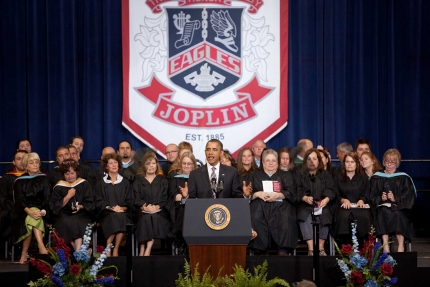
President Obama Returns to Joplin

President Barack Obama delivers the commencement address to the graduating seniors of Joplin High School (May 21, 2012)

President Barack Obama delivers the commencement address to the graduating seniors of Joplin High School at Missouri Southern State University in Joplin, May 21, 2012. (Official White House Photo by Lawrence Jackson)

Speaking tonight to the first group of students to graduate from Joplin High School since a tornado ripped through the Missouri city one year ago, President Obama praised the resilience of its community. 

“No matter how we might try to avoid it, life surely can bring some heartache, and life involves struggle.  And at some point life will bring loss,” he said. “But here in Joplin, you’ve also learned that we have the power to grow from these experiences.  We can define our lives not by what happens to us, but by how we respond.”

The President called the example set by the people of Joplin -- in the hard work they've put into the recovery, in the imagination they've shown in remaking their city -- "an inspiration." 

To learn more about the effort to rebuild Joplin, go to whitehouse.gov/joplin

Watch the President's full remarks here:

Related Topics: Additional Issues, Missouri

The White House

Office of the Press Secretary

Remarks by the President at the Joplin High School Commencement

Missouri Southern State University
Joplin, Missouri

8:40 P.M. CDT

THE PRESIDENT:  Thank you.  (Applause.)  Thank you, everybody.  Please have a seat.  A few people I want to acknowledge.  First of all, you have an outstanding governor in Jay Nixon, and we are proud of all the work that he’s done.   I want to acknowledge Senator Claire McCaskill who is here.  (Applause.)  Representative Billy Long.   (Applause.)  Your mayor, Melodee Colbert Kean.  (Applause.)  Somebody who doesn't get a lot of attention but does amazing work all across the country, including here in Joplin, the head of FEMA, the administrator, Craig Fugate, who spent an awful lot of time here helping to rebuild.  (Applause.)

Superintendent Huff.  (Applause.)  Principal Sachetta.  (Applause.)  To the faculty, the parents, the family, friends, the people of Joplin, and most of all the class of 2012.  (Applause.)  Congratulations on your graduation, and thank you for allowing me the honor of playing a small part in this special day. 

Now, the job of a commencement speaker primarily is to keep it short.  Chloe, they’ve given me more than two minutes.  (Laughter.)  But the other job is to inspire.  But as I look out at this class, and across this city, what’s clear is that you’re the source of inspiration today.  To me.  To this state.  To this country.  And to people all over the world.  

Last year, the road that led you here took a turn that no one could’ve imagined.  Just hours after the Class of 2011 walked across this stage, the most powerful tornado in six decades tore a path of devastation through Joplin that was nearly a mile wide and 13 long.  In just 32 minutes, it took thousands of homes, and hundreds of businesses, and 161 of your neighbors, friends and family.  It took a classmate Will Norton, who had just left this auditorium with a diploma in his hand.  It took Lantz Hare, who should’ve received his diploma next year. 

By now, I expect that most of you have probably relived those 32 minutes again and again.  Where you were.  What you saw.  When you knew for sure that it was over.  The first contact, the first phone call you had with somebody you loved, the first day that you woke up in a world that would never be the same. 

And yet, the story of Joplin isn’t just what happened that day.  It’s the story of what happened the next day.  And the day after that.  And all the days and weeks and months that followed.  As your city manager, Mark Rohr, has said, the people here chose to define the tragedy “not by what happened to us, but by how we responded.” 

Class of 2012, that story is yours.  It’s part of you now.  As others have mentioned, you’ve had to grow up quickly over the last year.  You’ve learned at a younger age than most of us that we can’t always predict what life has in store.  No matter how we might try to avoid it, life surely can bring some heartache, and life involves struggle.  And at some point life will bring loss.  

But here in Joplin, you’ve also learned that we have the power to grow from these experiences.  We can define our lives not by what happens to us, but by how we respond.  We can choose to carry on.  We can choose to make a difference in the world.  And in doing so, we can make true what’s written in Scripture -– that “tribulation produces perseverance, and perseverance, character, and character, hope.” 

Of all that’s come from this tragedy, let this be the central lesson that guides us, let it be the lesson that sustains you through whatever challenges lie ahead.   

As you begin the next stage in your journey, wherever you’re going, whatever you’re doing, it’s safe to say you will encounter greed and selfishness, and ignorance and cruelty, sometimes just bad luck.  You’ll meet people who try to build themselves up by tearing others down.  You’ll meet people who believe that looking after others is only for suckers. 

But you’re from Joplin.  So you will remember, you will know, just how many people there are who see life differently; those who are guided by kindness and generosity and quiet service. 

You’ll remember that in a town of 50,000 people, nearly 50,000 more came in to help the weeks after the tornado -– perfect strangers who’ve never met you and didn't ask for anything in return.

One of them was Mark Carr, who drove 600 miles from Rocky Ford, Colorado with a couple of chainsaws and his three little children.  One man traveled all the way from Japan, because he remembered that Americans were there for his country after last year’s tsunami, and he wanted the chance, he said, “to pay it forward.”  There were AmeriCorps volunteers who have chosen to leave their homes and stay here in Joplin till the work is done. 

And then there was the day that Mizzou’s football team rolled into town with an 18-wheeler full of donated supplies.  And of all places, they were assigned to help out on Kansas Avenue.  (Laughter and applause.)  I don't know who set that up.  (Laughter.)  And while they hauled away washing machines and refrigerators from the debris, they met a woman named Carol Mann, who had just lost the house she lived in for 18 years.  And Carol didn't have a lot.  She works part-time at McDonald’s.  She struggles with seizures, and she told the players that she had even lost the change purse that held her lunch money.  So one of them, one of the players, went back to the house, dug through the rubble, and returned with the purse with $5 inside. 

As Carol’s sister said, “So much of the news that you hear is so negative.  But these boys renewed my faith that there are so many good people in the world.” 

That’s what you’ll remember.  Because you’re from Joplin. 

You will remember the half million dollar donation that came from Angelina Jolie and some up-and-coming actor named Brad Pitt.  (Laughter.)  But you’ll also remember the $360 that was delivered by a nine-year-old boy who organized his own car wash.  You’ll remember the school supplies donated by your neighboring towns, but maybe you’ll also remember the brand new laptops that were sent from the United Arab Emirates -– a tiny country on the other side of the world.

When it came time for your prom, make-up artist Melissa Blayton organized an effort that collected over a 1,000 donated prom dresses, FedEx kicked in for the corsages, and Joplin’s own Liz Easton, who had lost her home and her bakery in the tornado, made a hundred -- or 1,500 cupcakes for the occasion.  They were good cupcakes.  (Laughter.)

There are so many good people in the world.  There is such a decency, a bigness of spirit, in this country of ours.  And so, Class of 2012, you’ve got to remember that.  Remember what people did here.  And like that man who came all the way from Japan to Joplin, make sure in your own life that you pay it forward.
 
Now, just as you’ve learned the goodness of people, you’ve also learned the power of community.  And you’ve heard from some of the other speakers how powerful that is.  And as you take on the roles of co-worker and business owner -- neighbor, citizen -- you’ll encounter all kinds of divisions between groups, divisions of race and religion and ideology.  You’ll meet people who like to disagree just for the sake of being disagreeable.  (Laughter.)  You’ll meet people who prefer to play up their differences instead of focusing on what they have in common, where they can cooperate.
 
But you’re from Joplin.  So you will always know that it’s always possible for a community to come together when it matters most.  After all, a lot of you could’ve spent your senior year scattered throughout different schools, far from home.  But Dr. Huff asked everybody to pitch in so that school started on time, right here in Joplin.  He understood the power of this community, and he understood the power of place.
 
So these teachers worked extra hours; coaches put in extra time.  That mall was turned into a classroom.  The food court became a cafeteria, which maybe some of you thought was an improvement.  (Laughter.)  And, yes, the arrangements might have been a little noisy and a little improvised, but you hunkered down.  You made it work together.  You made it work together.
 
That’s the power of community.  Together, you decided that this city wasn’t about to spend the next year arguing over every detail of the recovery effort.  At the very first meeting, the first town meeting, every citizen was handed a Post-It note and asked to write down their goals and their hopes for Joplin’s future.  And more than a thousand notes covered an entire wall and became the blueprint that architects are following to this day.  I’m thinking about trying this with Congress, give them some Post-It notes.  (Laughter and applause.)
  
Together, the businesses that were destroyed in the tornado decided that they weren’t about to walk away from the community that made their success possible -- even if it would’ve been easier, even if it would’ve been more profitable to go someplace else.  And so today, more than half the stores that were damaged on the Range Line are up and running again.  Eleven more are planning to join them.  And every time a company reopens its doors, people cheer the cutting of a ribbon that bears the town’s new slogan:  “Remember, rejoice, and rebuild.”  That’s community.
  
I’ve been told, Class of 2012, that before the tornado, many of you couldn’t wait to leave here once high school was finally over.  So Student Council President Julia Lewis -- where is Julia?  She’s out here somewhere.  (Laughter.)  She is too embarrassed to raise her hand.  I’m quoting you, Julia.  She said, “We never thought Joplin was anything special” -- now that’s typical with teenagers.  They don’t think their parents are all that special either -- (laughter) -- “but seeing how we responded to something that tore our community apart has brought us together.  Everyone has a lot more pride in our town.”  So it’s no surprise, then, that many of you have decided to stick around and go to Missouri Southern or go to colleges or community colleges that aren’t too far away from home.
  
That’s the power of community.  That’s the power of shared effort and shared memory.  Some of life’s strongest bonds are the ones we forge when everything around us seems broken.  And even though I expect that some of you will ultimately end up leaving Joplin, I’m pretty confident that Joplin will never leave you.  The people who went through this with you, the people who you once thought of as simply neighbors or acquaintances, classmates -- the people in this auditorium tonight -- you’re family now.  They’re your family.

And so, my deepest hope for all of you is that as you begin this new chapter in your life, you’ll bring that spirit of Joplin to every place you travel, to everything you do.  You can serve as a reminder that we’re not meant to walk this road alone, that we’re not expected to face down adversity by ourselves.  We need God.  We need each other.  We are important to each other and we’re stronger together than we are on our own.
 
And that’s the spirit that has allowed all of you to rebuild this city, and that’s the same spirit we need right now to help rebuild America.  And you, Class of 2012, you’re going to help lead this effort.  You’re the ones who will help build an economy where every child can count on a good education.  (Applause.)  You’re the one that’s going to make sure this country is a place where everybody who is willing to put in the effort can find a job that supports a family.  (Applause.)  You’re the ones that will make sure we’re a country that controls our own energy future, where we lead the world in science and technology and innovation.  America only succeeds when we all pitch in and pull together, and I’m counting on you to be leaders in that effort, because you’re from Joplin and you’ve already defied the odds.
 
Now, there are a lot of stories here in Joplin of unthinkable courage and resilience over the last year, but still there are some that stand out, especially on this day.  And, by now, most of you know Joplin High’s senior Quinton Anderson -- look, he is already looking embarrassed.  Somebody is talking about him again.  But, Quinton, I’m going to talk about you anyway, because in a lot of ways, Quinton’s journey has been Joplin’s journey.

When the tornado struck, Quinton was thrown across the street from his house.  The young man who found Quinton couldn’t imagine that Quinton would survive his injuries.  Quinton woke up in a hospital bed three days later.  And it was then that his sister Grace told him that both their parents had been lost in the storm.
 
So Quinton went on to face over five weeks of treatment, including emergency surgery.  But he left that hospital determined to carry on, to live his life, to be there for his sister.  And over the past year, he’s been a football captain who cheered from the sidelines when he couldn’t play.  He worked that much harder so he could be ready for baseball in the spring.  He won a national scholarship as a finalist for the High School Football Rudy Awards.  He plans to study molecular biology at Harding University this fall.  (Applause.)
  
Quinton has said that his motto in life is “always take that extra step.”  And today, after a long and improbable journey for Quinton -- and for Joplin and for the entire class of 2012 -- that extra step is about to take you towards whatever future you hope for and whatever dreams you hold in your hearts. 
 

Yes, you will encounter obstacles along the way.  I guarantee you will face setbacks and you will face disappointments.  But you’re from Joplin and you’re from America.  And no matter how tough times get, you’ll always be tougher.  And no matter what life throws at you, you will be ready.  You will not be defined by the difficulties you face, but by how you respond -- with grace and strength and a commitment to others.
 
Langston Hughes, poet, civil rights activist who knew some tough times, he was born here in Joplin.  In a poem called “Youth,” he wrote:

We have tomorrow
Bright before us
Like a flame.
Yesterday
A night-gone thing,
A sun-down name.
And dawn-today.  Broad arc above the road we came.
We march.

To the people of Joplin and the Class of 2012, the road has been hard and the day has been long.  But we have tomorrow, so we march.  We march together, and you’re leading the way, because you’re from Joplin.  Congratulations.  May God bless you.  May God bless the Class of 2012.  May God bless the United States of America.  (Applause.)

END
9:04 P.M. CDT

The White House

Office of the Press Secretary

Remarks by the President at NATO Press Conference

South Building
Chicago, Illinois

3:26 P.M. CDT

THE PRESIDENT:  Good afternoon, everybody.  Let me begin by saying thank you to my great friend, Rahm Emanuel, the mayor of the city of Chicago and to all my neighbors and friends, the people of the city of Chicago for their extraordinary hospitality and for everything that they’ve done to make this summit such a success.  I could not be prouder to welcome people from around the world to my hometown.

     This was a big undertaking, some 60 world leaders not to mention folks who were exercising their freedom of speech and assembly, the very freedoms that our alliance are dedicated to defending.  And so it was a lot to carry for the people of Chicago, but this is a city of big shoulders.  Rahm, his team, Chicagoans proved that this world-class city knows how to put on a world-class event. 

     And partly, this was a perfect city for this summit because it reflected the bonds between so many of our countries.  For generations, Chicago has welcomed immigrants from around the world, including an awful lot of our NATO allies.  And I’d just add that I have lost track of the number of world leaders and their delegations who came up to me over the last day and a half and remarked on what an extraordinarily beautiful city Chicago is.  And I could not agree more.

     I am especially pleased that I had a chance to show them Soldier Field.  I regret that I was not able to take in one of the Crosstown Classics, although I will note that my teams did okay.  (Laughter.)  Now -- White Sox fan in the back.  (Laughter.)  Right on.

     Now, as I said yesterday, NATO has been the bedrock of common security, freedom and prosperity for nearly 65 years.  It hasn’t just endured.  It has thrived, because our nations are stronger when we stand together.  We saw that, of course, most recently in Libya, where NATO afforded capabilities that no one else in the world could match.

     As President, one of my top foreign policy priorities has been to strengthen our alliances, including NATO, and that's exactly what we’ve done.  Two years ago in Lisbon, we took action in several areas that are critical to the future of our alliance and we pledged that in Chicago we would do more.  Over the last two days, we have delivered. 

     First, we reached agreement on a series of steps to strengthen the alliance’s defense capabilities over the next decade.  In keeping with the strategic concept we agreed to in Lisbon and in order to fulfill our Article Five commitment to our collective security, we agreed to acquire a fleet of remotely piloted aircraft, drones, to strengthen intelligence, surveillance and reconnaissance.  We agreed to continue air patrols over our Baltic allies, which reflects our unwavering commitment to collective defense.  We also agreed on a mix of conventional nuclear missile and missile defense forces that we need, and importantly, we agreed on how to pay for them and that includes pooling our resources in these difficult economic times. 

We’re moving forward with missile defense, and agreed that NATO is declaring an interim capability for the system.  America’s contribution to this effort will be a phased adaptive approach that we’re pursuing on European missile defense.  And I want to commend our allies who are stepping up and playing a leadership role in missile defense, as well.  Our defense radar in Turkey will be placed under NATO control.  Spain, Romania and Poland have agreed to host key U.S. assets.  The Netherlands will be upgrading radars, and we look forward to contributions from other allies.  Since this system is neither aimed at nor undermines Russia’s strategic deterrent, I continue to believe that missile defense can be an area of cooperation with Russia. 

     Second, we’re now unified behind a plan to responsibly wind down the war in Afghanistan, a plan that trains Afghan security forces, transitions to the Afghans and builds a partnership that can endure after our combat mission in Afghanistan ends.  Since last year, we’ve been transitioning parts of Afghanistan to the Afghan National Security Forces and that has enabled our troops to start coming home.  Indeed, we’re in the process of drawing down 33,000 U.S. troops by the end of this summer. 

     Here in Chicago, we reached agreement on the next milestone in that transition.  At the ISAF meeting this morning, we agreed that Afghan forces will take the lead for combat operations next year in mid-2013.  At that time, ISAF forces will have shifted from combat to a support role in all parts of the country.  And this will mark a major step toward the goal we agreed to in Lisbon, completing the transition to Afghan lead for security by the end of 2014, so that Afghans can take responsibility for their own country and so our troops can come home. 

     This will not mark the end of Afghanistan’s challenges, obviously, or our partnership with that important country.  But we are making substantial progress against our core objective of defeating al Qaeda and denying it safe haven, while helping the Afghans to stand on their own.  And we leave Chicago with a clear roadmap.  Our coalition is committed to this plan to bring our war in Afghanistan to a responsible end.

     We also agreed on what NATO’s relationship with Afghanistan will look like after 2014.  NATO will continue to train, advise and assist, and support Afghan forces as they grow stronger.  And while this summit has not been a pledging conference, it’s been encouraging to see a number of countries making significant financial commitments to sustain Afghanistan’s progress in the years ahead.  Today the international community also expressed its strong support for efforts to bring peace and stability to South Asia, including Afghanistan’s neighbors. 

     Finally, NATO agreed to deepen its cooperation with partners that have been critical to alliance operations, as in Afghanistan and Libya.  Today’s meeting was unprecedented, Our 28 allies, joined by 13 nations from around the world -- Europe, the Middle East, North Africa and Asia.  Each of these countries has contributed to NATO operations in different ways -- military, political, financial -- and each wants to see us do more together.  To see the breadth of those countries represented in that room is to see how NATO has truly become a hub of global security.

     So again I want to thank all my fellow leaders.  I think the bottom line is that we are leaving Chicago with a NATO alliance that is stronger, more capable and more ready for the future.  As a result, each of our nations -- the United States included -- is more secure, and we’re in a stronger position to advance the security and prosperity and freedom that we seek around the world.

     So with that, I’m going to take a couple of questions, and I’m going to start with Julie Pace of AP.  Where’s Julie?  There she is. 

     Q    Thank you, Mr. President.  You have said that the U.S. can’t deal with Afghanistan without also talking about Pakistan.  And yet, there has been little public discussion at this summit about Pakistan’s role in ending the war.  In your talks with President Zardari today, did you make any progress in reopening the supply lines?  And if the larger tensions with Pakistan can’t be resolved, does that put the NATO coalition’s gains in Afghanistan at risk?

     THE PRESIDENT:  Well, keep in mind my discussion with President Zardari was very brief, as we were walking into the summit and I emphasized to him what we have emphasized publicly as well as privately.  We think that Pakistan has to be part of the solution in Afghanistan, that it is in our national interest to see a Pakistan that is democratic, that is prosperous and that is stable, that we share a common enemy in the extremists that are found not only in Afghanistan, but also within Pakistan and that we need to work through some of the tensions that have inevitably arisen after 10 years of our military presence in that region.

     President Zardari shared with me his belief that these issues can get worked through.  We didn’t anticipate that the supply line issue was going to be resolved by this summit.  We knew that before we arrived in Chicago.  But we’re actually making diligent progress on it.

     And I think ultimately everybody in the alliance, all of ISAF, and most importantly the people of Afghanistan and Pakistan understand that neither country is going to have the kind of security, stability, and prosperity that it needs unless they can resolve some of these outstanding issues and join in common purpose with the international community in making sure that these regions are not harboring extremists.  So I don’t want to paper over real challenges there.  There is no doubt that there have been tensions between ISAF and Pakistan, the United States and Pakistan over the last several months.  I think they are being worked through both military and diplomatic channels.

     But ultimately, it is in our interest to see a successful, stable Pakistan and it is in Pakistan’s interest to work with us and the world community to ensure that they themselves are not consumed by extremism that is in their midst.  And so we’re going to keep on going at this.  And I think every NATO member, every ISAF member is committed to that.

     Hans Nichols.  Where is Hans? 

     Q    Yes, thank you, Mr. President.  Yesterday, your friend and ally, Cory Booker said that an ad that you released, that your campaign released was nauseating.  And it alleged that Romney at Bain Capital was “responsible for job losses at a Kansas City steel mill.”  Is that your view that Romney is personally responsible for those job losses?  Will comments from Booker and your former auto czar Steve Rattner that have criticized some of these advertisements call on you to pull back a little bit?  And, generally, can you give us your sense -- three part, Mr. President.  Could you give us your sense of just what private equity’s role is in stemming job losses as they seek a return on investment for their investors?  Thank you.

     THE PRESIDENT:  Well, first of all, I think Cory Booker is an outstanding mayor.  He is doing great work in Newark and obviously helping to turn that city around.  And I think it’s important to recognize that this issue is not a “distraction.”  This is part of the debate that we’re going to be having in this election campaign about how do we create an economy where everybody from top to bottom, folks on Wall Street and folks on Main Street, have a shot at success and if they’re working hard and they’re acting responsibly, that they’re able to live out the American Dream.

     Now, I think my view of private equity is that it is set up to maximize profits.  And that’s a healthy part of the free market.  That’s part of the role of a lot of business people.  That’s not unique to private equity.  And as I think my representatives have said repeatedly, and I will say today, I think there are folks who do good work in that area.  And there are times where they identify the capacity for the economy to create new jobs or new industries, but understand that their priority is to maximize profits.  And that’s not always going to be good for communities or businesses or workers. 

And the reason this is relevant to the campaign is because my opponent, Governor Romney, his main calling card for why he thinks he should be President is his business expertise.  He is not going out there touting his experience in Massachusetts.  He is saying, I’m a business guy and I know how to fix it, and this is his business. 

And when you’re President, as opposed to the head of a private equity firm, then your job is not simply to maximize profits.  Your job is to figure out how everybody in the country has a fair shot.  Your job is to think about those workers who got laid off and how are we paying for their retraining.  Your job is to think about how those communities can start creating new clusters so that they can attract new businesses.  Your job as President is to think about how do we set up a equitable tax system so that everybody is paying their fair share that allows us then to invest in science and technology and infrastructure, all of which are going to help us grow.

And so, if your main argument for how to grow the economy is I knew how to make a lot of money for investors, then you’re missing what this job is about.  It doesn’t mean you weren’t good at private equity, but that’s not what my job is as President.  My job is to take into account everybody, not just some.  My job is to make sure that the country is growing not just now, but 10 years from now and 20 years from now. 

So to repeat, this is not a distraction.  This is what this campaign is going to be about -- is what is a strategy for us to move this country forward in a way where everybody can succeed?  And that means I’ve got to think about those workers in that video just as much as I’m thinking about folks who have been much more successful.

Q    Just for -- is Romney personally responsible for those 750 job losses?

THE PRESIDENT:  What I would say is that Mr. Romney is responsible for the proposals he is putting forward for how he says he is going to fix the economy.  And if the main basis for him suggesting he can do a better job is his track record as the head of a private equity firm, then both the upsides and the downsides are worth examining.

     Hold on a second -- Alister Bull.

     Q    Thank you, Mr. President.  I’d like to take you back to not this summit, but the one you hosted at Camp David a couple of days ago and whether you feel that you can assure investors there are contingency plans in place to cope if Greece leaves the euro to prevent a Lehman-like shock to the U.S. and the global economy?

     THE PRESIDENT:  We had an extensive discussion of the situation in the eurozone and obviously everybody is keenly interested in getting that issue resolved.

     I’m not going to speculate on what happens if the Greek choose to exit because they’ve got an election and this is going to be an important debate inside of Greece.  Everybody who was involved in the G8 summit indicated their desire to see Greece stay in the eurozone in a way that's consistent with the commitments that it’s already -- that have already been made.  And I think it’s important for Greece, which is a democracy, to work through what their options are at time of great difficulty.

     I think we all understand, though, what’s at stake.  What happens in Greece has an impact here in the United States.  Businesses are more hesitant to invest if they see a lot of uncertainty looming across the Atlantic because they're not sure whether that's going to mean a further global slowdown.  And we’re already seeing very slow growth rates and in fact contraction in a lot of countries in Europe.  So we had an extensive discussion about how do we strengthen the European project generally in a way that does not harm world economic growth, but instead moves it forward.

And I’ve been clear I think in -- not just this week, but over the last two years about what I think needs to be done.  We’ve got to put in place firewalls that ensure that countries outside of Greece that are doing the right thing aren’t harmed just because markets are skittish and nervous.

     We’ve got to make sure that banks are recapitalized in Europe so that investors have confidence.  And we’ve got to make sure that there is a growth strategy to go alongside the need for fiscal discipline, as well as a monetary policy that is promoting the capacity of countries like a Spain or an Italy that have put in place some very tough targets and some very tough policies, to also offer their constituencies a prospect for the economy improving, job growth increasing, incomes expanding even if it may take a little bit of time.

     And the good news was you saw a consensus across the board from newly elected President Hollande to Chancellor Merkel to other members of the European community that that balanced approach is what’s needed right now.  They're going to be meeting this week to try to advance those discussions further.  We’ve offered to be there for consultation to provide any technical assistance and work through some of these ideas in terms of how we can stabilize the markets there. 

     Ultimately, what I think is most important is that Europe recognizes this euro project involves more than just a currency, it means that there’s got to be some more effective coordination on the fiscal and the monetary side and on the growth agenda.  And I think that there was strong intent there to move in that direction.  Of course, they’ve got 17 countries that have to agree to every step they take.  So I think about my one Congress, then I start thinking about 17 congresses and I start getting a little bit of a headache.  It’s going to be challenging for them.

     The last point I’ll make is I do sense greater urgency now than perhaps existed two years ago or two and a half years ago.  And keep in mind just for folks here in the States, when we look backwards at our response in 2008 and 2009, there was some criticism because we had to make a bunch of tough political decisions.

In fact, there’s still criticism about some of the decisions we made.  But one of the things we were able to do was to act forcefully to solve a lot of these problems early, which is why credit markets that were locked up started loosening up again.  That's why businesses started investing again.  That's why we’ve seen job growth of over 4 million jobs over the last two years.  That's why corporations are making money and that's why we’ve seen strong economic growth for a long time. 

And so, acting forcefully rather than in small, bite-sized pieces and increments, I think, ends up being a better approach, even though obviously we’re still going through challenges ourselves.  I mean, some of these issues are ones that built up over decades.

     All right?  Stephen Collinson.  Where’s Stephen?

     Q    Thank you, Mr. President.  As you at this summit try to continue the work of stopping Afghanistan from reverting to its former role as a terrorist haven, terrorists today in Yemen massacred a hundred soldiers.  Are you concerned that despite U.S. efforts, Yemen seems to be slipping further into anarchy?  And what more can the U.S. do to slow that process?

     THE PRESIDENT:  We are very concerned about al Qaeda activity and extremist activity in Yemen.  A positive development has been a relatively peaceful political transition in Yemen and we participated diplomatically along with Yemen’s neighbors in helping to lead to a political transition, but the work is not yet done.

     We have established a strong counterterrorism partnership with the Yemeni government, but there’s no doubt that in a country that is still poor, that is still unstable, it is attracting a lot of folks that previously might have been in the FATA before we started putting pressure on them there.  And we’re going to continue to work with the Yemeni government to try to identify AQAP leadership and operations and try to thwart them.  That's important for U.S. safety.  It’s also important for the stability of Yemen and for the region.

     But I think one of the things that we’ve learned from the Afghanistan experience is for us to stay focused on the counterterrorism issue, to work with the government, to not overextend ourselves, to operate smartly in dealing with these issues.  And it’s not unique to Yemen, by the way.  I mean we’ve got similar problems in Somalia, what’s happening now in Mali and the Sahel.  And so this is part of the reason why not only is NATO important, but these partnerships that we’re establishing is important because there are going to be times where these partners have more effective intelligence operations, more diplomatic contacts, et cetera in some of these parts of the world where the state is a little wobbly and you may see terrorists attempting to infiltrate or set up bases.

     Yes, I’m going to call on Jake Tapper because, Jake, Jay Carney told me that you’ve been talking to some of our troops in Afghanistan.  And since so much of the topic of this summit has been on Afghanistan, obviously none of this would be working were it not for the extraordinary sacrifices that they're making, so --

     Q    Thanks, Mr. President.  I appreciate it.  Yes, I put out an invitation for some troops and their families that I know and I’ll just give you two or three of them.  Mr. President, if this handoff and withdrawal prove premature, what plans are in place for dealing with an Afghanistan that's falling apart or is possibly again under Taliban rule?  And I’ll just do one more, do you feel that the reporting you receive from the Pentagon fully represents what the on-ground commanders assess?  Is there any disconnect between what leaders feel the public and President want to hear versus what is actually occurring on the ground?  These are from troops I’ve met who served in Nuristan Province.

     THE PRESIDENT:  Let me take the second question first.  I mean, I think that one of the things that I emphasize whenever I’m talking to John Allen or the Joint Chiefs or any of the officers who are in Afghanistan is -- I can’t afford a white wash.  I can’t afford not getting the very best information in order to make good decisions.  I should add, by the way, that the danger a lot of times is not that anybody is purposely trying to downplay challenges in Afghanistan.  A lot of times it’s just the military culture is we can get it done.  And so, their thinking is, how are we going to solve this problem, not boy, why is this such a disaster?  That’s part of the reason why we admire our military so much and we love our troops, because they’ve got that can-do spirit.

But I think that we have set up a structure that really tries to guard against that, because even in my White House for example, I’ve got former officers who have been in Afghanistan who I will send out there as part of the national security team of the White House, not simply the Pentagon, to interact and to listen and to go in and talk to the captains and the majors and the corporals and the privates, to try to get a sense of what’s going on. 

And I think the reports we get are relatively accurate in the sense that there is real improvement.  In those areas where we’ve had a significant presence, you can see the Taliban not having a foothold, that there is genuine improvement in the performance of Afghan national security forces.

But the Taliban is still a robust enemy.  And the gains are still fragile, which leads me then to the second point that you’ve made in terms of a premature withdrawal.  I don’t think that there is ever going to be an optimal point where we say, this is all done, this is perfect, this is just the way we wanted it and now we can wrap up all our equipment and go home.  This is a process and it’s sometimes a messy process, just as it was in Iraq. 

     But think about it.  We’ve been there now 10 years.  We are now committing to a transition process that takes place next year, but the full transition to Afghan responsibility is almost two years away.  And the Afghan Security Forces themselves will not ever be prepared if they don't start taking that responsibility.

     And, frankly, the large footprint that we have in Afghanistan over time can be counterproductive.  We’ve been there 10 years, and I think no matter how much good we’re doing and how outstanding our troops and our civilians and diplomats are doing on the ground, 10 years in a country that's very different, that's a strain not only on our folks but also on that country, which at a point is going to be very sensitive about its own sovereignty.

     So I think that the timetable that we’ve established is a sound one, it is a responsible one.  Are there risks involved in it?  Absolutely.  Can I anticipate that over the next two years there are going to be some bad moments along with some good ones?  Absolutely. 

But I think it is the appropriate strategy whereby we can achieve a stable Afghanistan that won’t be perfect, we can pull back our troops in a responsible way and we can start rebuilding America and making some of the massive investments we’ve been making in Afghanistan here back home, putting people back to work, retraining workers, rebuilding our schools, investing in science and technology, developing our business climate.

     But there are going to be challenges.  The one thing that I’m never doubtful about is just the amazing capacity of our troops and their morale.  When I was in Bagram just a couple of weeks ago, the fact that you still have so much determination and stick-to-it-ness and professionalism, not just from our troops but from all our coalition allies, all of ISAF, is a testament to them.  It’s extraordinary.  And we’ve very proud of them.

     All right, since I am in Chicago, even though my Press Secretary told me not to do this, I am going to call on a Chicagoan to ask a Chicago question. 

     Jay.

     Q    Mr. President.

     THE PRESIDENT:  Good to see you.  How you been?

     Q    Good to see you, too, Mr. President, and good to see you in Chicago.  Chicagoans look at you standing there with Chicago, Chicago, Chicago on the wall behind you.  There is an undeniable sense of pride.  In your view, how did reality match up to fantasy in welcoming the world leaders to Chicago?  And did the demonstrators in any way on the streets undermine your efforts, Mayor Emanuel’s efforts, to project the image of Chicago you would have liked to have seen?

     THE PRESIDENT:  I have to tell you, I think Chicago performed magnificently.  Those of us who were in the summit had a great experience.  If you talk to leaders from around the world, they love the city.  Michelle took some of the spouses down to the South Side to see the Comer Center where wonderful stuff is being done with early education.  They saw the Art Institute. 

I was just talking to David Cameron.  I think he’s sneaking off and doing a little sight-seeing before he heads home.  I encouraged everybody to shop.  I want to boost the hometown economy.  We gave each leader a Bean, a small model, for them to remember, as well as a football from Soldier Field.  Many of them did not know what to do with it.  (Laughter.)  So people had a wonderful time and I think the Chicagoans that they interacted with couldn’t have been more gracious and more hospitable.  So I could not have been prouder.

     Now, I think with respect to the protesters, as I said, this is part of what NATO defends, is free speech and the freedom of assembly.  And, frankly, to my Chicago press, outside of Chicago, folks really weren’t all that stressed about the possibility about having some protesters here, because that's what -- part of what America is about.  And obviously, Rahm was stressed, but he performed wonderfully and the Chicago police, Chicago’s finest, did a great job under some significant pressure and a lot of scrutiny.

     The only other thing I’ll say about this is thank you to everybody who endured the traffic situation.  Obviously, Chicago residents who had difficulties getting home or getting to work or what have you -- that's what can I tell you, that's part of the price of being a world city.  But this was a great showcase.  And if it makes those folks feel any better, despite being 15 minutes away from my house, nobody would let me go home.  I was thinking I would be able to sleep in my own bed tonight.  They said I would cause even worse traffic.  So I ended up staying in a hotel, which contributes to the Chicago economy.  (Laughter.) 

     Thank you, everybody.  (Applause.)

                                       END                          4:10 P.M. CDT

NATO Summit in Chicago: Day Two

President Obama wrapped up the second and final day of the NATO Summit in Chicago on Tuesday.

In the morning, he participated in a meeting with leaders from the 50 nations that make up the International Security Assistance Force in Afghanistan to discuss the next step in the transition of power there—setting a goal for Afghan forces to take the lead for combat operations across the country in 2013.

In the afternoon, President Obama and his NATO counterparts met with leaders from non-NATO nations that are making significant financial, operational, and political contributions to NATO operations. These types of partnerships allow NATO to extend its reach and better shoulder shared burdens.

Later in the afternoon, President Obama held a press conference before departing for Missouri, where he will deliver the commencement address at Joplin High School.

Related Topics: Foreign Policy, Missouri

President Obama Speaks at the Joplin High School Commencement Ceremony

May 21, 2012 | 22:52 | Public Domain

President Obama delivers the commencement address at Joplin High School. Just hours after last year’s graduation ceremony, the school was destroyed by a massive tornado that claimed the lives of one graduate and 160 others in Joplin.

Download mp4 (807MB) | mp3 (52MB)

Read the Transcript

Remarks by the President at the Joplin High School Commencement

Missouri Southern State University
Joplin, Missouri

8:40 P.M. CDT

THE PRESIDENT:  Thank you.  (Applause.)  Thank you, everybody.  Please have a seat.  A few people I want to acknowledge.  First of all, you have an outstanding governor in Jay Nixon, and we are proud of all the work that he’s done.   I want to acknowledge Senator Claire McCaskill who is here.  (Applause.)  Representative Billy Long.   (Applause.)  Your mayor, Melodee Colbert Kean.  (Applause.)  Somebody who doesn't get a lot of attention but does amazing work all across the country, including here in Joplin, the head of FEMA, the administrator, Craig Fugate, who spent an awful lot of time here helping to rebuild.  (Applause.)

Superintendent Huff.  (Applause.)  Principal Sachetta.  (Applause.)  To the faculty, the parents, the family, friends, the people of Joplin, and most of all the class of 2012.  (Applause.)  Congratulations on your graduation, and thank you for allowing me the honor of playing a small part in this special day. 

Now, the job of a commencement speaker primarily is to keep it short.  Chloe, they’ve given me more than two minutes.  (Laughter.)  But the other job is to inspire.  But as I look out at this class, and across this city, what’s clear is that you’re the source of inspiration today.  To me.  To this state.  To this country.  And to people all over the world.  

Last year, the road that led you here took a turn that no one could’ve imagined.  Just hours after the Class of 2011 walked across this stage, the most powerful tornado in six decades tore a path of devastation through Joplin that was nearly a mile wide and 13 long.  In just 32 minutes, it took thousands of homes, and hundreds of businesses, and 161 of your neighbors, friends and family.  It took a classmate Will Norton, who had just left this auditorium with a diploma in his hand.  It took Lantz Hare, who should’ve received his diploma next year. 

By now, I expect that most of you have probably relived those 32 minutes again and again.  Where you were.  What you saw.  When you knew for sure that it was over.  The first contact, the first phone call you had with somebody you loved, the first day that you woke up in a world that would never be the same. 

And yet, the story of Joplin isn’t just what happened that day.  It’s the story of what happened the next day.  And the day after that.  And all the days and weeks and months that followed.  As your city manager, Mark Rohr, has said, the people here chose to define the tragedy “not by what happened to us, but by how we responded.” 

Class of 2012, that story is yours.  It’s part of you now.  As others have mentioned, you’ve had to grow up quickly over the last year.  You’ve learned at a younger age than most of us that we can’t always predict what life has in store.  No matter how we might try to avoid it, life surely can bring some heartache, and life involves struggle.  And at some point life will bring loss.  

But here in Joplin, you’ve also learned that we have the power to grow from these experiences.  We can define our lives not by what happens to us, but by how we respond.  We can choose to carry on.  We can choose to make a difference in the world.  And in doing so, we can make true what’s written in Scripture -– that “tribulation produces perseverance, and perseverance, character, and character, hope.” 

Of all that’s come from this tragedy, let this be the central lesson that guides us, let it be the lesson that sustains you through whatever challenges lie ahead.   

As you begin the next stage in your journey, wherever you’re going, whatever you’re doing, it’s safe to say you will encounter greed and selfishness, and ignorance and cruelty, sometimes just bad luck.  You’ll meet people who try to build themselves up by tearing others down.  You’ll meet people who believe that looking after others is only for suckers. 

But you’re from Joplin.  So you will remember, you will know, just how many people there are who see life differently; those who are guided by kindness and generosity and quiet service. 

You’ll remember that in a town of 50,000 people, nearly 50,000 more came in to help the weeks after the tornado -– perfect strangers who’ve never met you and didn't ask for anything in return.

One of them was Mark Carr, who drove 600 miles from Rocky Ford, Colorado with a couple of chainsaws and his three little children.  One man traveled all the way from Japan, because he remembered that Americans were there for his country after last year’s tsunami, and he wanted the chance, he said, “to pay it forward.”  There were AmeriCorps volunteers who have chosen to leave their homes and stay here in Joplin till the work is done. 

And then there was the day that Mizzou’s football team rolled into town with an 18-wheeler full of donated supplies.  And of all places, they were assigned to help out on Kansas Avenue.  (Laughter and applause.)  I don't know who set that up.  (Laughter.)  And while they hauled away washing machines and refrigerators from the debris, they met a woman named Carol Mann, who had just lost the house she lived in for 18 years.  And Carol didn't have a lot.  She works part-time at McDonald’s.  She struggles with seizures, and she told the players that she had even lost the change purse that held her lunch money.  So one of them, one of the players, went back to the house, dug through the rubble, and returned with the purse with $5 inside. 

As Carol’s sister said, “So much of the news that you hear is so negative.  But these boys renewed my faith that there are so many good people in the world.” 

That’s what you’ll remember.  Because you’re from Joplin. 

You will remember the half million dollar donation that came from Angelina Jolie and some up-and-coming actor named Brad Pitt.  (Laughter.)  But you’ll also remember the $360 that was delivered by a nine-year-old boy who organized his own car wash.  You’ll remember the school supplies donated by your neighboring towns, but maybe you’ll also remember the brand new laptops that were sent from the United Arab Emirates -– a tiny country on the other side of the world.

When it came time for your prom, make-up artist Melissa Blayton organized an effort that collected over a 1,000 donated prom dresses, FedEx kicked in for the corsages, and Joplin’s own Liz Easton, who had lost her home and her bakery in the tornado, made a hundred -- or 1,500 cupcakes for the occasion.  They were good cupcakes.  (Laughter.)

There are so many good people in the world.  There is such a decency, a bigness of spirit, in this country of ours.  And so, Class of 2012, you’ve got to remember that.  Remember what people did here.  And like that man who came all the way from Japan to Joplin, make sure in your own life that you pay it forward.
 
Now, just as you’ve learned the goodness of people, you’ve also learned the power of community.  And you’ve heard from some of the other speakers how powerful that is.  And as you take on the roles of co-worker and business owner -- neighbor, citizen -- you’ll encounter all kinds of divisions between groups, divisions of race and religion and ideology.  You’ll meet people who like to disagree just for the sake of being disagreeable.  (Laughter.)  You’ll meet people who prefer to play up their differences instead of focusing on what they have in common, where they can cooperate.
 
But you’re from Joplin.  So you will always know that it’s always possible for a community to come together when it matters most.  After all, a lot of you could’ve spent your senior year scattered throughout different schools, far from home.  But Dr. Huff asked everybody to pitch in so that school started on time, right here in Joplin.  He understood the power of this community, and he understood the power of place.
 
So these teachers worked extra hours; coaches put in extra time.  That mall was turned into a classroom.  The food court became a cafeteria, which maybe some of you thought was an improvement.  (Laughter.)  And, yes, the arrangements might have been a little noisy and a little improvised, but you hunkered down.  You made it work together.  You made it work together.
 
That’s the power of community.  Together, you decided that this city wasn’t about to spend the next year arguing over every detail of the recovery effort.  At the very first meeting, the first town meeting, every citizen was handed a Post-It note and asked to write down their goals and their hopes for Joplin’s future.  And more than a thousand notes covered an entire wall and became the blueprint that architects are following to this day.  I’m thinking about trying this with Congress, give them some Post-It notes.  (Laughter and applause.)
  
Together, the businesses that were destroyed in the tornado decided that they weren’t about to walk away from the community that made their success possible -- even if it would’ve been easier, even if it would’ve been more profitable to go someplace else.  And so today, more than half the stores that were damaged on the Range Line are up and running again.  Eleven more are planning to join them.  And every time a company reopens its doors, people cheer the cutting of a ribbon that bears the town’s new slogan:  “Remember, rejoice, and rebuild.”  That’s community.
  
I’ve been told, Class of 2012, that before the tornado, many of you couldn’t wait to leave here once high school was finally over.  So Student Council President Julia Lewis -- where is Julia?  She’s out here somewhere.  (Laughter.)  She is too embarrassed to raise her hand.  I’m quoting you, Julia.  She said, “We never thought Joplin was anything special” -- now that’s typical with teenagers.  They don’t think their parents are all that special either -- (laughter) -- “but seeing how we responded to something that tore our community apart has brought us together.  Everyone has a lot more pride in our town.”  So it’s no surprise, then, that many of you have decided to stick around and go to Missouri Southern or go to colleges or community colleges that aren’t too far away from home.
  
That’s the power of community.  That’s the power of shared effort and shared memory.  Some of life’s strongest bonds are the ones we forge when everything around us seems broken.  And even though I expect that some of you will ultimately end up leaving Joplin, I’m pretty confident that Joplin will never leave you.  The people who went through this with you, the people who you once thought of as simply neighbors or acquaintances, classmates -- the people in this auditorium tonight -- you’re family now.  They’re your family.

And so, my deepest hope for all of you is that as you begin this new chapter in your life, you’ll bring that spirit of Joplin to every place you travel, to everything you do.  You can serve as a reminder that we’re not meant to walk this road alone, that we’re not expected to face down adversity by ourselves.  We need God.  We need each other.  We are important to each other and we’re stronger together than we are on our own.
 
And that’s the spirit that has allowed all of you to rebuild this city, and that’s the same spirit we need right now to help rebuild America.  And you, Class of 2012, you’re going to help lead this effort.  You’re the ones who will help build an economy where every child can count on a good education.  (Applause.)  You’re the one that’s going to make sure this country is a place where everybody who is willing to put in the effort can find a job that supports a family.  (Applause.)  You’re the ones that will make sure we’re a country that controls our own energy future, where we lead the world in science and technology and innovation.  America only succeeds when we all pitch in and pull together, and I’m counting on you to be leaders in that effort, because you’re from Joplin and you’ve already defied the odds.
 
Now, there are a lot of stories here in Joplin of unthinkable courage and resilience over the last year, but still there are some that stand out, especially on this day.  And, by now, most of you know Joplin High’s senior Quinton Anderson -- look, he is already looking embarrassed.  Somebody is talking about him again.  But, Quinton, I’m going to talk about you anyway, because in a lot of ways, Quinton’s journey has been Joplin’s journey.

When the tornado struck, Quinton was thrown across the street from his house.  The young man who found Quinton couldn’t imagine that Quinton would survive his injuries.  Quinton woke up in a hospital bed three days later.  And it was then that his sister Grace told him that both their parents had been lost in the storm.
 
So Quinton went on to face over five weeks of treatment, including emergency surgery.  But he left that hospital determined to carry on, to live his life, to be there for his sister.  And over the past year, he’s been a football captain who cheered from the sidelines when he couldn’t play.  He worked that much harder so he could be ready for baseball in the spring.  He won a national scholarship as a finalist for the High School Football Rudy Awards.  He plans to study molecular biology at Harding University this fall.  (Applause.)
  
Quinton has said that his motto in life is “always take that extra step.”  And today, after a long and improbable journey for Quinton -- and for Joplin and for the entire class of 2012 -- that extra step is about to take you towards whatever future you hope for and whatever dreams you hold in your hearts. 
 

Yes, you will encounter obstacles along the way.  I guarantee you will face setbacks and you will face disappointments.  But you’re from Joplin and you’re from America.  And no matter how tough times get, you’ll always be tougher.  And no matter what life throws at you, you will be ready.  You will not be defined by the difficulties you face, but by how you respond -- with grace and strength and a commitment to others.
 
Langston Hughes, poet, civil rights activist who knew some tough times, he was born here in Joplin.  In a poem called “Youth,” he wrote:

We have tomorrow
Bright before us
Like a flame.
Yesterday
A night-gone thing,
A sun-down name.
And dawn-today.  Broad arc above the road we came.
We march.

To the people of Joplin and the Class of 2012, the road has been hard and the day has been long.  But we have tomorrow, so we march.  We march together, and you’re leading the way, because you’re from Joplin.  Congratulations.  May God bless you.  May God bless the Class of 2012.  May God bless the United States of America.  (Applause.)

END
9:04 P.M. CDT

Close Transcript

The White House

Office of the Press Secretary

Presidential Nomination Sent to the Senate

NOMINATION SENT TO THE SENATE:

Thomas M. Durkin, of Illinois, to be United States District Judge for the Northern District of Illinois, vice Wayne R. Andersen, retired.