Weekly Address: Congress Must Act on "To-Do List"

President Obama is calling on Democrats and Republicans to come together and act on his Congressional “to-do list,” which will create jobs and help restore middle class security. In this make-or-break moment for the middle class, these five initiatives have bipartisan support and will help create an economy that is built to last.

Transcript | Download mp4 | Download mp3


Learn More:

See President Obama's "To Do" List for Congress


Related Topics: Economy, ToDo List

Weekly Address: Congress Must Act on "To-Do List"

May 12, 2012 | 3:30 | Public Domain

President Obama calls on Democrats and Republicans to come together and act on his Congressional “to-do list,” which will create jobs and help restore middle class security.

Download mp4 (124MB) | mp3 (8MB)

Read the Transcript

Weekly Address: Congress Must Act on “To-Do List”

In this week’s address, President Obama called on Democrats and Republicans to come together and act on his Congressional “to-do list,” which will create jobs and help restore middle class security. In this make-or-break moment for the middle class, these five initiatives have bipartisan support and will help create an economy that is built to last.  While some believe we should return to the same policies that led to the worst recession since the Great Depression, the President believes we must take action to speed up the recovery and ensure that our economy once again rewards hard work and responsibility as we keep our country moving forward.

Remarks of President Barack Obama
Weekly Address
The White House
May 12, 2012

We all know the past few years have been difficult for this country.  After the worst recession of our lifetimes, it will take longer than any of us would like for the economy to fully recover.  But there are plenty of steps we can take to speed up the recovery.  There are things we can do – right now – to help create jobs and restore some of the financial security that so many families have lost. 

Now, the other side isn’t so optimistic.  They think all we can do is cut taxes – especially for the wealthiest Americans – and go back to letting banks and corporations write their own rules again.  That’s their plan. 

But I think they’re wrong.  We tried their ideas for nearly a decade, and it didn’t work out so well.  We can’t go back to the same policies that got us into this mess.  We’ve got to move forward.  We need to build an economy where hard work and responsibility are rewarded – where you can find a good job, own your own home, maybe start a businesses, and give your kids the chance to do even better. 

That’s where we need to go.  And I’ve been pushing Congress to help us get there by passing a few common-sense policies that would make a difference.  Democrats and Republicans have already done some important work together – from passing tax cuts for workers, to opening up new markets for American products, to reforming our patent system.  But now we need to do more. 

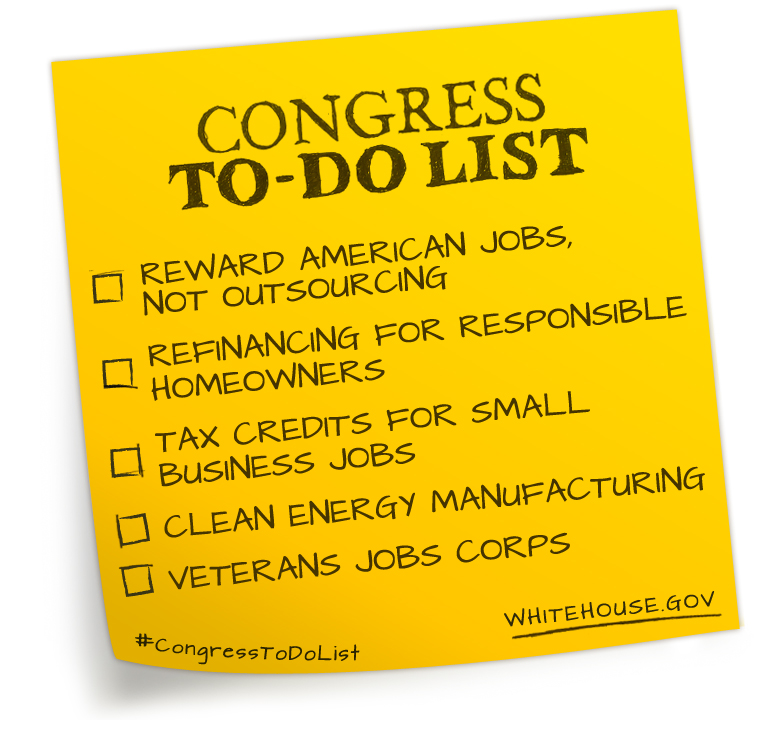
That’s why we made Congress a handy “To-Do” list – just like the kind I get from Michelle.  It’s short, but each of the ideas on this list will help create jobs and build a stronger economy right now. 

First, Congress should stop giving tax breaks to companies that ship jobs overseas, and use that money to cover moving expenses for companies that bring jobs back to America. 

Second, Congress should help the millions of Americans who have worked hard and made their mortgage payments on time refinance their mortgages at lower rates and save at least $3,000 a year.  

Third, Congress should help small business owners by giving them a tax break for hiring more workers and paying them higher wages.  Small businesses are the engine of economic growth in this country.  We shouldn’t be holding them back – we should be making it easier for them to succeed.  

Fourth, if Congress fails to act soon, clean energy companies will see their taxes go up and could be forced to lay off employees.  These companies are putting Americans to work and helping break our dependence on foreign oil.  Congress should extend these tax credits.  

And finally, Congress should help our veterans returning from Iraq and Afghanistan by creating a Veterans Job Corps.  Our men and women in uniform have served this country with honor.  Now it’s our turn to serve them.  

So that’s Congress’s “To-Do” List.  But now we need them to start crossing things off.  I need you to call your Members of Congress, write an email, tweet, and let them know we can’t afford to wait any longer to get things done.  Tell them now is the time to take steps we know will grow our economy and create jobs. 

You’re working harder.  You’re meeting your responsibilities.  Your representatives in Washington should do the same.  Let’s push Congress to do the right thing.  Let’s keep moving this country forward together. 

Thanks, and have a great weekend. 

###

Close Transcript

The White House

Office of the Press Secretary

President Obama Announces More Key Administration Posts

WASHINGTON, DC – Today, President Barack Obama announced his intent to nominate the following individuals to key Administration posts:

  • Thomas Hart Armbruster – Ambassador to the Republic of the Marshall Islands, Department of State
  • David Bruce Wharton – Ambassador to the Republic of Zimbabwe, Department of State

The President also announced his intent to appoint the following individual to a key Administration post:

  • William J. Shaw – Member, United States Commission on International Religious Freedom

President Obama said, “Our nation will be greatly served by the talent and expertise these individuals bring to their new roles.  I am grateful they have agreed to serve in this Administration, and I look forward to working with them in the months and years ahead.”

President Obama announced his intent to nominate the following individuals to key Administration posts:

Thomas Hart Armbruster, Nominee for Ambassador to the Republic of the Marshall Islands, Department of State
Thomas Hart Armbruster, a career member of the Senior Foreign Service, Class of Counselor, currently serves as a Diplomat-in-Residence at City College in New York.  Previously, from 2007 to 2010, he was the Consul General at the U.S. Consulate General in Vladivostok, Russia.  From 2004 to 2006, he was Deputy Chief of Mission at the U.S. Embassy in Dushanbe, Tajikistan.  Other overseas assignments include: Principal Officer at the U.S. Consulate General in Nuevo Laredo, Mexico (2000-2003); Political Affairs Officer (1999-2000) and Nuclear Affairs Officer (1997-1999) at the U.S. Embassy in Moscow, Russia; and Vice Consul at the U.S. Interests Section in Havana, Cuba (1991-1993).  Prior to joining the Foreign Service, he was a reporter for the CBS affiliate KGMB-TV in Hawaii.  Mr. Armbruster holds a B.A. from McDaniel College, an M.A. from St. Mary’s University, and an M.S. from the Naval War College.

David Bruce Wharton, Nominee for Ambassador to the Republic of Zimbabwe, Department of State
David Bruce Wharton, a career member of the Senior Foreign Service, Class of Minister-Counselor, is currently Deputy Assistant Secretary for Public Diplomacy in the Bureau of African Affairs at the Department of State.  He joined the Bureau of African Affairs in 2009 as Director of the Office of Public Diplomacy and Public Affairs, after a two-year assignment as Deputy Coordinator of the Department of State’s Bureau of International Information Programs.  From 2006 to 2007, he served in the Department’s Bureau of Human Resources and from 2003 to 2006, he was Deputy Chief of Mission at the U.S. Embassy in Guatemala.  A member of the Foreign Service since 1985, Mr. Wharton’s additional overseas assignments include posts in Argentina, Chile, Bolivia, South Africa, and Zimbabwe.  He received a B.A. from the University of Texas in Austin.

President Obama announced his intent to appoint the following individual to a key Administration post:

The Reverend William J. Shaw, Appointee for Member, United States Commission on International Religious Freedom
The Reverend William J. Shaw has served as Pastor of the White Rock Baptist Church in Philadelphia since 1956.  He is a Member of the United States Commission on International Religious Freedom, having been appointed by President Obama in June 2010.  Reverend Shaw served as President of the National Baptist Convention, USA Inc. from 1999 to 2009.   He currently sits on the Board of the Hospital of the University of Pennsylvania and has served as President of The Baptist Ministers’ Conference of Philadelphia and Vicinity, The Metropolitan Christian Council of Philadelphia, and the Union Theological Seminary National Alumni Association.  From 1981 through 1994, he served as Director of the Ministers’ Division of the National Congress of Christian Education.  Reverend Shaw has been the recipient of numerous awards, including the Unitas Award, given by the Alumni Association of the Union Theological Seminary and the T. B. Maston Foundation Christian Ethics Award from the Southwestern Baptist Theological Seminary.  Reverend Shaw has a B.A. from Bishop College, an M.A. from Union Theological Seminary, and a D.Min. from Colgate Rochester Divinity School.

President Obama Calls for a Simpler Refinancing Process

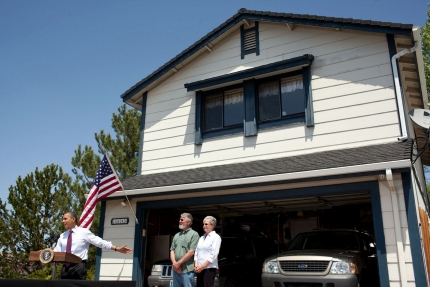
President Barack Obama delivers a statement to neighbors at the home of Valerie and Paul Keller (May 11, 2012)

President Barack Obama delivers a statement to neighbors at the home of Valerie and Paul Keller in Reno, Nevada, May 11, 2012. (Official White House Photo by Pete Souza)

Today in Nevada, President Obama pushed Congress to cut red tape and make it simpler for responsible homeowners to refinance and take advantage of today’s historically low interest rates.

First, he sat down with Val and Paul Keller -- two homeowners from Reno. They were able to refinance their mortgage after the President made changes to the Home Affordable Refinance Program, and because of that, they're currently saving around $240 a month. 

The President said that their experience is one that should be open to more Americans:

The pool of folks who can refinance right now, when their homes are underwater, is still too small. The reason the Kellers were able to refinance is because the only thing that we could do without congressional action was to give opportunities for refinancing for folks with a government-backed loan, an FHA-backed loan. But in order to expand that opportunity -- we want to include everybody; people whose mortgages aren't government-backed. And in order to do that we've got to have Congress move. 

President Obama's refinancing proposal is part of his To-Do List for Congress. To learn more, and watch a video from one of his economic advisors explaining how the President's plan would help homeowners more easily refinance their mortgages, click here.

Related Topics: Economy, Housing, ToDo List, Nevada

The White House

Office of the Press Secretary

Presidential Proclamation -- Mother's Day, 2012

MOTHER'S DAY, 2012
- - - - - - -
BY THE PRESIDENT OF THE UNITED STATES OF AMERICA
A PROCLAMATION

Mothers are cornerstones of our families and our communities. On Mother's Day, we honor the remarkable women who strive and sacrifice every day to ensure their children have every opportunity to pursue their dreams.

Our Nation first came together to celebrate Mother's Day on May 11, 1913, with the introduction of a House Resolution requesting President Woodrow Wilson, Members of Congress, and officials across the Federal Government wear white carnations in honor of America's mothers. Today, we continue to mark Mother's Day by paying tribute to the women who shape our characters and set our families up for success. Through their example, our children learn the principles of hard work, compassion, service, and personal responsibility. Through their encouragement and unconditional support, they instill the confidence and values so vital to our children's success.

Mothers raise children under an array of circumstances, and many work long hours inside and outside the home balancing myriad demands. Mothers are leaders and trailblazers in every part of our society -- from classrooms to boardrooms, at home and overseas, on the beat and on the bench. We celebrate the efforts of all our Nation's mothers, and we recognize that when more households are relying on women as primary or co-breadwinners, the success of women in our economy is essential to the success of our families, our communities, and our country. That is why I created the White House Council on Women and Girls as one of my first acts in office -- to ensure we integrate the needs of women and girls into every decision we make. I was proud to sign the Lilly Ledbetter Fair Pay Act, which continues to help women secure equal pay for equal work, and my Administration continues to promote workplace flexibility so no mother has to choose between her job and her child. And because of the Affordable Care Act, women finally have more power to make choices about their health care, and they have expanded access to a wide variety of preventive services such as mammograms at no additional cost.

Today, let us pay respect to mothers across America by embracing the women who continue to guide and inspire us, and by holding fast to the memories of those who live on in our hearts.

The Congress, by a joint resolution approved May 8, 1914 (38 Stat. 770), has designated the second Sunday in May each year as "Mother's Day" and requested the President to call for its appropriate observance.

NOW, THEREFORE, I, BARACK OBAMA, President of the United States of America, do hereby proclaim May 13, 2012, as Mother's Day. I urge all Americans to express love and gratitude to mothers everywhere, and I call upon all citizens to observe this day with appropriate programs, ceremonies, and activities.

IN WITNESS WHEREOF, I have hereunto set my hand this eleventh day of May, in the year of our Lord two thousand twelve, and of the Independence of the United States of America the two hundred and thirty-sixth.

BARACK OBAMA

The White House

Office of the Press Secretary

Remarks by the President on Helping Responsible Homeowners

Private Residence
Reno, Nevada

12:00 P.M. PDT

THE PRESIDENT:  Well, good afternoon, everybody.  (Applause.)  And thank you for arranging a beautiful day.  This is just a spectacular afternoon and I’m thrilled to be here.

We all know how difficult these past few years have been for this country, but especially for this state.  After the worst recession in our lifetimes -- a crisis that followed the collapse of the housing market -- it’s going to take a long time for the economy to fully recover.  More time than any of us would like.  But there are plenty of steps that we can take to speed up the recovery right now.  There are things we can do right now to help create jobs and help restore some of the financial security that too many families have lost. 

Now, I have to say that there are a few too many Republicans in Congress who don’t seem to be as optimistic as we are.  They think that all we can do are try the things that have been done in the past -- things that they’ve tried in the past.  So they want to cut more taxes, especially for the wealthiest Americans.  They want to cut back on the rules that we put in place for banks and financial institutions.  They’ve said that they want to let the housing market hit bottom, and just hope for the best.  That’s it.  We’ve heard those ideas before.  That’s their economic agenda.  And I’ll be honest with you, I don’t buy it.  I think they’re wrong. 

We tried their ideas for nearly a decade and they didn’t work.  And I refuse to sell this country short by going back to the exact same ideas that helped to get us in this mess in the first place.  Our goal is to build an economy where hard work and responsibility are rewarded -- where you can find a good job, make a good wage, own your own home, maybe start a business, send your kids to college.  Hopefully, their lives will be even better than ours.  That’s what I wish for Malia and Sasha, and I know you guys feel the same way who have kids.  

And that’s where we need to go.  I’ve been pushing Congress to help us get there by passing a few common-sense policies that we’re convinced will make a difference.  We even made a handy “To-Do” list for Congress so they can just check them off -- it’s a list like Michelle gives me.  (Laughter.)  I know Paul is familiar with that list.  He gets it from Val.

Now, there are only five things on this list -- because I don’t want to overload Congress with too much at once.  But they’re ideas that will help create jobs and build a stronger economy right now. 

So first up on the list -- it makes absolutely no sense that we actually give tax breaks to companies that ship jobs and factories overseas.  That doesn’t make any sense at all.  (Applause.)  So we told Congress it’s time to end the tax breaks for companies that ship jobs overseas, and use that money to cover moving expenses for companies that bring jobs back to America.  (Applause.)

Second, instead of just talking about job creators, Congress should help small businesses and help small business owners who create most of the new jobs in America.  So we want to give them a tax break for hiring more workers and paying them higher wages. 

The third thing on our “To-Do” list -- Congress should extend tax credits that are set to expire for our clean energy companies.  These businesses are putting folks to work here in this state of Nevada.  Last time I was here, in fact, I went to see a huge solar plant, solar energy plant.  A lot of folks are working both in the construction of it and maintaining it.  That’s happening all across the country.  And so we’ve got to make sure that we are helping those folks, because that helps us break our dependence on foreign oil.  Over the long term that will help drive down gas prices and it puts people to work right now.  It’s the right thing to do.  (Applause.)

Fourth, Congress should create a Veterans Jobs Corps so that we can help communities hire returning heroes -- our veterans -- as cops and firefighters and employees at national parks -- because nobody who fights for this country should ever have to come home and fight for a job or fight for a roof over their heads.  (Applause.)       
                     
All right, so that’s four -- which brings me to the fifth.  The fifth thing on the list, and that’s why I’m here today.  I’m calling on Congress to give every responsible homeowner the chance to save an average of $3,000 a year by refinancing their mortgage.  It’s a simple idea.  (Applause.)  It makes great sense.  And I know it will have an impact.  

Last October, I was in Clark County, where I announced new steps to help responsible homeowners refinance their homes.  And at the time, Congress wasn’t willing to act, so we did.  We went ahead and did what we could do administratively, without a new law being passed.  And as a result, Americans who were previously stuck in high interest loans have been able to take advantage of these lower rates.  And they’ve been able to save thousands of dollars every year.

And it turns out that two of those people are your neighbors, Paul and Valerie Keller.  (Applause.)  So I just had a chance to visit with Paul and Valerie and look at their beautiful home and check out the grill out back.  (Laughter.)  Valerie says Paul is a pretty good cook, so I’m going to take her word for it.

The Kellers have lived in this house for 14 years.  Val works nearby, helping secure loans for farmers and ranchers.  Paul is a retired electrical contractor who started a family business with their son.  Last year, with mortgage rates at historic lows, the Kellers decided it would make sense for them to refinance.  They thought it would be easy, since they’re current on their mortgage, they make their payments on time.  So this is an example of responsible homeowners doing the right thing.

But when they tried to refinance, they were told they couldn’t do it.  Because the Kellers’ house, like thousands of others in this state and probably some of the neighbors here, their house is underwater, which means that the price is currently lower than what they owe on it.  So they were hit -- you were hit with a historic drop in housing prices which caused the value of the homes in their neighborhood to plummet.  And a lot of banks historically have said, well, we’re not going to refinance you if your home is underwater.

Now, luckily, the Kellers saw my announcement that I had made down in Clark County.  So I’m assuming it must have been Val because whenever something smart is done, it’s usually the wife in the house.  (Laughter.)

So they called their lender, and within a few months, within 90 days, they were able to refinance under this new program that we set up.  Their monthly mortgage bill has now dropped $240 dollars a month, and that means every year they’re saving close to $3000.  (Applause.)

Now, Val says that they’ve been talking to some of their neighbors -- maybe some of you are here today -- and you’re saying, well, that sounds like a pretty good idea.  And a lot of folks across the country recognize this is a smart thing to do not only for homeowners but for our economy, because if Paul and Val have an extra $240, $250 a month, then they might spend it on the local business.  They might go to a restaurant a little more often.  They might spoil their grandkids even more.  (Laughter.)  And that means more money in the economy, and businesses do better, and slowly home prices start rising again.  So it makes sense for all of us.

And the good news is, since I’ve made this announcement, refinancing applications have gone up by 50 percent nationwide and 230 percent here in Nevada alone.  That’s the good news.  People are taking advantage of this.  (Applause.)  That's what we want to see. 

But here's the only catch -- and this is where you come in, because you're going to have to pressure Congress:  The pool of folks who can refinance right now, when their homes are underwater, is still too small.  The reason the Kellers were able to refinance is because the only thing that we could do without congressional action was to give opportunities for refinancing for folks with a government-backed loan, an FHA-backed loan.  But in order to expand that opportunity -- we want to include everybody; people whose mortgages aren't government-backed.  (Applause.)  And in order to do that we've got to have Congress move. 

There’s absolutely no reason why they can’t make this happen right now.  If they started now, in a couple of weeks, in a month, they could make every homeowner in America who is underwater right now eligible to be able to refinance their homes -- if they're making their payments, if they're responsible, if they're doing the right thing.  And think about all those families saving $3,000 on average a month year-- that's a huge boost to our economy.  And for some of you who are underwater, you might say, instead of spending that money I can plow that back into equity in my home, and build that back up, which would further strengthen housing prices here in Nevada and around the country. 

So it's the right thing to do.  There's already a bill in the works.  It's supported by independent, nonpartisan economists.  It's supported by industry leaders.  Congress should pass it right now.  (Applause.) 

And let me just say this -- maybe there are some members of Congress watching.  (Laughter.)  If you need some motivation to make this happen, then you should come to Reno and you should visit with folks like the Kellers.  (Applause.)  I'm not saying the Kellers want all these members of Congress up in their house.  (Laughter.)  It's bad enough having me and Secret Service in there.  (Laughter.)  But at least they -- they probably wouldn't mind saying hello and talking to them here in front of their house.  (Laughter.)  But they should talk to people whose lives are better because of the action that we took. 

All over the country, there are people just like Paul and Val, folks just like you, who are doing everything they can to do the right thing -- to meet their responsibilities, to look after their families, to raise their kids right, give them good values.  You're not looking for a handout.  You just want to make sure that somebody is looking out for you, and that when you do the right thing that you're able to keep everything that you’ve worked for.  That’s what folks are looking for, and that’s what they expect from Washington:  to put the politics aside and the electioneering aside, and just do what’s right for people.  (Applause.)

So I need all of you and everybody who’s watching to push Congress on their “To-Do” list.  Nag them until they actually get it done.  We need to keep moving this country forward.  Send them an email.  Tweet them.  Write them a letter if you’re old-fashioned like me.  (Laughter.) 

But communicate to them that this will make a difference.  It’s one small step that will help us create the kind of economy that all Americans deserve.  And that’s an economy that’s built to last.  An economy where everybody has a fair shot, everybody gets a fair share, everybody is playing by the same set of rules.  That’s what made us great in the past.  That’s what’s going to make us great in the future.

All right.  Thank you, everybody.  God bless you.  God bless America.  And give Paul and Val a big round of applause.  (Applause.)

END               
12:11 P.M. PDT 

President Obama on Helping Responsible Homeowners

May 11, 2012 | 14:08 | Public Domain

President Obama asks lawmakers to cut red tape and make it simpler for responsible homeowners to refinance their mortgages and take advantage of today’s historically low interest rates. The proposal is part of his To-Do List for Congress.

Download mp4 (499MB) | mp3 (32MB)

Read the Transcript

Remarks by the President on Helping Responsible Homeowners

Private Residence
Reno, Nevada

12:00 P.M. PDT

THE PRESIDENT:  Well, good afternoon, everybody.  (Applause.)  And thank you for arranging a beautiful day.  This is just a spectacular afternoon and I’m thrilled to be here.

We all know how difficult these past few years have been for this country, but especially for this state.  After the worst recession in our lifetimes -- a crisis that followed the collapse of the housing market -- it’s going to take a long time for the economy to fully recover.  More time than any of us would like.  But there are plenty of steps that we can take to speed up the recovery right now.  There are things we can do right now to help create jobs and help restore some of the financial security that too many families have lost. 

Now, I have to say that there are a few too many Republicans in Congress who don’t seem to be as optimistic as we are.  They think that all we can do are try the things that have been done in the past -- things that they’ve tried in the past.  So they want to cut more taxes, especially for the wealthiest Americans.  They want to cut back on the rules that we put in place for banks and financial institutions.  They’ve said that they want to let the housing market hit bottom, and just hope for the best.  That’s it.  We’ve heard those ideas before.  That’s their economic agenda.  And I’ll be honest with you, I don’t buy it.  I think they’re wrong. 

We tried their ideas for nearly a decade and they didn’t work.  And I refuse to sell this country short by going back to the exact same ideas that helped to get us in this mess in the first place.  Our goal is to build an economy where hard work and responsibility are rewarded -- where you can find a good job, make a good wage, own your own home, maybe start a business, send your kids to college.  Hopefully, their lives will be even better than ours.  That’s what I wish for Malia and Sasha, and I know you guys feel the same way who have kids.  

And that’s where we need to go.  I’ve been pushing Congress to help us get there by passing a few common-sense policies that we’re convinced will make a difference.  We even made a handy “To-Do” list for Congress so they can just check them off -- it’s a list like Michelle gives me.  (Laughter.)  I know Paul is familiar with that list.  He gets it from Val.

Now, there are only five things on this list -- because I don’t want to overload Congress with too much at once.  But they’re ideas that will help create jobs and build a stronger economy right now. 

So first up on the list -- it makes absolutely no sense that we actually give tax breaks to companies that ship jobs and factories overseas.  That doesn’t make any sense at all.  (Applause.)  So we told Congress it’s time to end the tax breaks for companies that ship jobs overseas, and use that money to cover moving expenses for companies that bring jobs back to America.  (Applause.)

Second, instead of just talking about job creators, Congress should help small businesses and help small business owners who create most of the new jobs in America.  So we want to give them a tax break for hiring more workers and paying them higher wages. 

The third thing on our “To-Do” list -- Congress should extend tax credits that are set to expire for our clean energy companies.  These businesses are putting folks to work here in this state of Nevada.  Last time I was here, in fact, I went to see a huge solar plant, solar energy plant.  A lot of folks are working both in the construction of it and maintaining it.  That’s happening all across the country.  And so we’ve got to make sure that we are helping those folks, because that helps us break our dependence on foreign oil.  Over the long term that will help drive down gas prices and it puts people to work right now.  It’s the right thing to do.  (Applause.)

Fourth, Congress should create a Veterans Jobs Corps so that we can help communities hire returning heroes -- our veterans -- as cops and firefighters and employees at national parks -- because nobody who fights for this country should ever have to come home and fight for a job or fight for a roof over their heads.  (Applause.)       
                     
All right, so that’s four -- which brings me to the fifth.  The fifth thing on the list, and that’s why I’m here today.  I’m calling on Congress to give every responsible homeowner the chance to save an average of $3,000 a year by refinancing their mortgage.  It’s a simple idea.  (Applause.)  It makes great sense.  And I know it will have an impact.  

Last October, I was in Clark County, where I announced new steps to help responsible homeowners refinance their homes.  And at the time, Congress wasn’t willing to act, so we did.  We went ahead and did what we could do administratively, without a new law being passed.  And as a result, Americans who were previously stuck in high interest loans have been able to take advantage of these lower rates.  And they’ve been able to save thousands of dollars every year.

And it turns out that two of those people are your neighbors, Paul and Valerie Keller.  (Applause.)  So I just had a chance to visit with Paul and Valerie and look at their beautiful home and check out the grill out back.  (Laughter.)  Valerie says Paul is a pretty good cook, so I’m going to take her word for it.

The Kellers have lived in this house for 14 years.  Val works nearby, helping secure loans for farmers and ranchers.  Paul is a retired electrical contractor who started a family business with their son.  Last year, with mortgage rates at historic lows, the Kellers decided it would make sense for them to refinance.  They thought it would be easy, since they’re current on their mortgage, they make their payments on time.  So this is an example of responsible homeowners doing the right thing.

But when they tried to refinance, they were told they couldn’t do it.  Because the Kellers’ house, like thousands of others in this state and probably some of the neighbors here, their house is underwater, which means that the price is currently lower than what they owe on it.  So they were hit -- you were hit with a historic drop in housing prices which caused the value of the homes in their neighborhood to plummet.  And a lot of banks historically have said, well, we’re not going to refinance you if your home is underwater.

Now, luckily, the Kellers saw my announcement that I had made down in Clark County.  So I’m assuming it must have been Val because whenever something smart is done, it’s usually the wife in the house.  (Laughter.)

So they called their lender, and within a few months, within 90 days, they were able to refinance under this new program that we set up.  Their monthly mortgage bill has now dropped $240 dollars a month, and that means every year they’re saving close to $3000.  (Applause.)

Now, Val says that they’ve been talking to some of their neighbors -- maybe some of you are here today -- and you’re saying, well, that sounds like a pretty good idea.  And a lot of folks across the country recognize this is a smart thing to do not only for homeowners but for our economy, because if Paul and Val have an extra $240, $250 a month, then they might spend it on the local business.  They might go to a restaurant a little more often.  They might spoil their grandkids even more.  (Laughter.)  And that means more money in the economy, and businesses do better, and slowly home prices start rising again.  So it makes sense for all of us.

And the good news is, since I’ve made this announcement, refinancing applications have gone up by 50 percent nationwide and 230 percent here in Nevada alone.  That’s the good news.  People are taking advantage of this.  (Applause.)  That's what we want to see. 

But here's the only catch -- and this is where you come in, because you're going to have to pressure Congress:  The pool of folks who can refinance right now, when their homes are underwater, is still too small.  The reason the Kellers were able to refinance is because the only thing that we could do without congressional action was to give opportunities for refinancing for folks with a government-backed loan, an FHA-backed loan.  But in order to expand that opportunity -- we want to include everybody; people whose mortgages aren't government-backed.  (Applause.)  And in order to do that we've got to have Congress move. 

There’s absolutely no reason why they can’t make this happen right now.  If they started now, in a couple of weeks, in a month, they could make every homeowner in America who is underwater right now eligible to be able to refinance their homes -- if they're making their payments, if they're responsible, if they're doing the right thing.  And think about all those families saving $3,000 on average a month year-- that's a huge boost to our economy.  And for some of you who are underwater, you might say, instead of spending that money I can plow that back into equity in my home, and build that back up, which would further strengthen housing prices here in Nevada and around the country. 

So it's the right thing to do.  There's already a bill in the works.  It's supported by independent, nonpartisan economists.  It's supported by industry leaders.  Congress should pass it right now.  (Applause.) 

And let me just say this -- maybe there are some members of Congress watching.  (Laughter.)  If you need some motivation to make this happen, then you should come to Reno and you should visit with folks like the Kellers.  (Applause.)  I'm not saying the Kellers want all these members of Congress up in their house.  (Laughter.)  It's bad enough having me and Secret Service in there.  (Laughter.)  But at least they -- they probably wouldn't mind saying hello and talking to them here in front of their house.  (Laughter.)  But they should talk to people whose lives are better because of the action that we took. 

All over the country, there are people just like Paul and Val, folks just like you, who are doing everything they can to do the right thing -- to meet their responsibilities, to look after their families, to raise their kids right, give them good values.  You're not looking for a handout.  You just want to make sure that somebody is looking out for you, and that when you do the right thing that you're able to keep everything that you’ve worked for.  That’s what folks are looking for, and that’s what they expect from Washington:  to put the politics aside and the electioneering aside, and just do what’s right for people.  (Applause.)

So I need all of you and everybody who’s watching to push Congress on their “To-Do” list.  Nag them until they actually get it done.  We need to keep moving this country forward.  Send them an email.  Tweet them.  Write them a letter if you’re old-fashioned like me.  (Laughter.) 

But communicate to them that this will make a difference.  It’s one small step that will help us create the kind of economy that all Americans deserve.  And that’s an economy that’s built to last.  An economy where everybody has a fair shot, everybody gets a fair share, everybody is playing by the same set of rules.  That’s what made us great in the past.  That’s what’s going to make us great in the future.

All right.  Thank you, everybody.  God bless you.  God bless America.  And give Paul and Val a big round of applause.  (Applause.)

END               
12:11 P.M. PDT 

Close Transcript

The White House

Office of the Press Secretary

Presidential Proclamation -- Military Spouse Appreciation Day, 2012

MILITARY SPOUSE APPRECIATION DAY, 2012
- - - - - - -
BY THE PRESIDENT OF THE UNITED STATES OF AMERICA
A PROCLAMATION

For more than two centuries, our freedom has been safeguarded by brave patriots who have stepped forward and sworn an oath to defend the principles upon which our Republic was founded. Alongside these selfless heroes, our Nation's military spouses also offer tremendous service and make great sacrifices for our country. On Military Spouse Appreciation Day, we recognize the important role our military families play in keeping our Armed Forces strong and our country safe.

Our military spouses are a vital part of communities across America and around the world. We know them as our neighbors and friends, colleagues and coaches, teachers and nurses. They move from duty station to duty station, picking up their families and careers whenever their country asks. They keep their households running while dealing with the strain of deployment. They support our wounded warriors, preserve the legacies of our fallen, and find ways to give back to our country day after day.

The strength and readiness of America's military depends on the well-being of our military spouses and families, and my Administration remains committed to ensuring they have the support and resources they deserve. Across Federal agencies, we have made major investments in education and childcare for military families, increased the availability of mortgage assistance to military homeowners, and extended new opportunities for veterans and their loved ones under the Post-9/11 GI Bill.

Inspired by the stories of our military spouses' resilience and service, First Lady Michelle Obama and Dr. Jill Biden launched the Joining Forces initiative to encourage all Americans to recognize, honor, and serve our military families. In only 1 year, Joining Forces has rallied American businesses to hire tens of thousands of veterans and military spouses, schools have improved educational opportunities for military children, and the medical community has vowed better care for military families. And from small towns to big cities, Americans have shown their gratitude by pledging hours of service and taking on projects that support military families in their communities. To learn more and get involved, visit www.JoiningForces.gov.

America's service members represent only one percent of our population, but they shoulder the responsibility of protecting our entire Nation and defending the ideals we hold dear. Just as we bear a sacred obligation to serve our men and women in uniform as well as they have served us, we share an equal responsibility to care for their extraordinary spouses who are heroes on the home front. On Military Spouse Appreciation Day, let us honor the unparalleled contributions of our military spouses and reaffirm our commitment to ensuring the priorities of our military families remain the priorities of our Nation.

NOW, THEREFORE, I, BARACK OBAMA, President of the United States of America, by virtue of the authority vested in me by the Constitution and the laws of the United States, do hereby proclaim May 11, 2012, as Military Spouse Appreciation Day. I call upon the people of the United States to honor military spouses with appropriate ceremonies and activities.

IN WITNESS WHEREOF, I have hereunto set my hand this eleventh day of May, in the year of our Lord two thousand twelve, and of the Independence of the United States of America the two hundred and thirty-sixth.

BARACK OBAMA

West Wing Week: 5/11/12 or "Teach Your Parents How to Tweet"

May 11, 2012 | 5:55

This week, the President traveled to Virginia and New York to urge Congress not to let interest rates double on student loans and to introduce a to-do list for Congress. He also hosted the University of Kentucky Wildcats, the Fermi Science award winners, and this year's Gershwin Award Winners.

Download mp4 (190.9MB)

The White House

Office of the Press Secretary

President Obama Announces Impact of October Refinancing Actions, Calls on Congress to Act on “To Do List”

Today, President Obama will travel to Reno, Nevada, where he will continue to push Congress to act on a “To Do List” he laid out earlier this week with initiatives that have bipartisan support and will create jobs and help restore middle class security.  While in Reno, the President will discuss the impact of refinancing changes he announced last October and meet with Val and Paul Keller, Reno homeowners who have since taken advantage of these changes. He will also highlight the next initiative on the “To Do List” which calls on Congress to cut the red tape so that responsible homeowners across the country who have been paying their mortgage on time can feel secure in their home and refinance at today’s lower rates.

Congress’ To Do List 

1. Reward American Jobs, Eliminate Tax Incentives To Ship Jobs Overseas: Congress needs to attract and keep good jobs in the United States by passing legislation that gives companies a new 20 percent tax credit for the cost of moving their operations back to the U.S. and pay for it by eliminating tax incentives that allow companies to deduct the costs of moving their business abroad.

2. Cut Red Tape So Responsible Homeowners Can Refinance: Congress needs to pass legislation to cut red tape in the mortgage market so that responsible families who have been paying their mortgages on time can feel secure in their home by refinancing at today’s lower rates.

3. Invest in a New Hire Tax Credit For Small Businesses: Congress needs to invest in small businesses and jumpstart new hiring by passing legislation that gives a 10 percent income tax credit for firms that create new jobs or increase wages in 2012 and that extends 100 percent expensing in 2012 for all businesses.

4. Create Jobs By Investing In Affordable Clean Energy: Congress needs to help put America in control of its energy future by passing legislation that will extend the Production Tax Credit to support American jobs and manufacturing alongside an expansion of the 30 percent tax credit to investments in clean energy manufacturing (48C Advanced Energy Manufacturing Tax Credit)

5. Put Returning Veterans to Work Using Skills Developed in the Military: Congress needs to honor our commitment to returning veterans by passing legislation that creates a Veterans Job Corps to help Afghanistan and Iraq veterans get jobs as cops, firefighters, and serving their communities.

In 2009, the Administration announced the Home Affordable Refinance Program which was designed to help more responsible homeowners refinance their mortgages. In its first two years it helped nearly 1 million homeowners refinance and save thousands of dollars a year. Unfortunately, eligibility regulations and costs associated with the program kept it from having a wider impact.
That’s why, in October of 2011 the President announced, as part of his We Can’t Wait effort, that Fannie Mae or Freddie Mac (GSEs) and their regulator, the Federal Finance Housing Agency (FHFA), would work with lenders to remove barriers to allow more responsible families to benefit from refinancing their mortgages at historically low rates.  These were important changes, which made it possible for homeowners who had been locked out of the market because they didn’t have enough equity in their home, to refinance - so long as they have a loan backed by Fannie Mae or Freddie Mac, have not been late on their mortgage in the last six months, and have not made more than one late payment in the past year. The group that manages the program, the FHFA also waived a set of unnecessary costs and fees that were dissuading some from taking advantage of the program and worked to get rid of certain restrictions in order to increase competition among lenders.

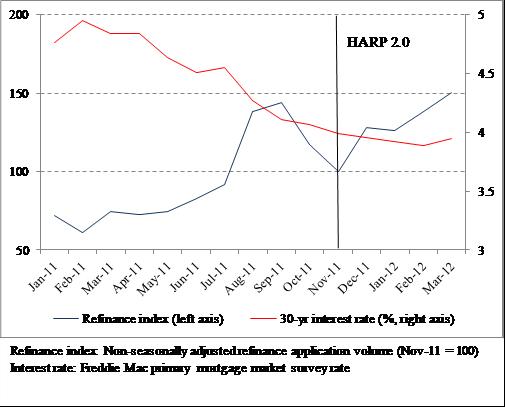
Today, the President will announce that these changes have had a significant impact on responsible homeowners looking to refinance. Nationwide, refinancing applications have increased by 50% since the announcement in the fall
 
 
• Much of this increase is driven by a spike in HARP participation. Roughly one in three borrowers applying for refinancing today is applying for a loan through HARP, up from less than one in ten a year ago.


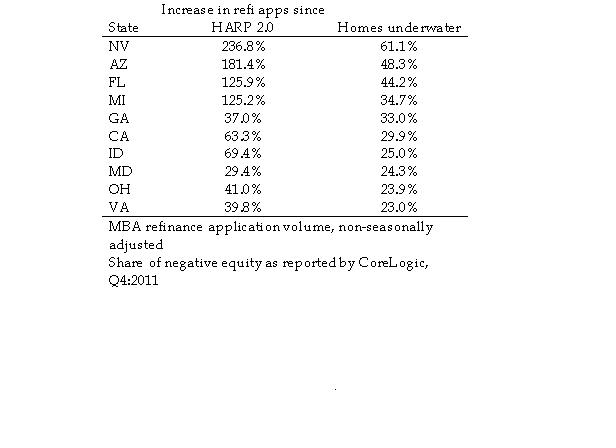
• The impact in states with the highest share of homeowners who are deeply underwater has been even more dramatic.
• Refinancing applications in Nevada are up 237% since the first changes were put into place.
• In Arizona refinancing applications have increased 181%.
• In Florida refinancing applications have increased 126%.
• These state-level increases are also being driven almost entirely by HARP 2.0. Informal surveys suggest that two in every three refinancing applications in these states are for HARP loans.  
 

Refinancing Activity in States with Highest Share of Underwater Borrowers


Today, the President will meet with Val and Paul Keller who live in Reno, Nevada and have personally benefitted from the refinancing changes the President announced in October. Val is an Operations Assistant for a lender that makes loans to farmers and ranchers and Paul is a retired Electrical Contractor who started a family business with their son. The Kellers have lived in their home in Reno for over 14 years. Their home is now worth $100,000, less than they paid for it back in 1998 and less than their $168,000 loan. Because they owe substantially more on their home than it is worth they have long been unable to refinance. But on October 24, 2011, Valerie was watching the President on TV and saw him announce that the Administration had worked with lenders to remove that barrier for responsible borrowers. Val and Paul realized that they were precisely the kind of borrower the President had intended to help - they were current on their mortgage with no late payment in the past six months, but nonetheless had been unable to get refinancing for years. Seeing this as an opportunity to finally get out from under their high interest rate Val called her lender. A few months later the Kellers were in a loan that reduced their monthly payments by $240.00 saving them money they are now using to pay down debt, including the principal on their home.
 
The Kellers story and today’s data make clear that the executive actions announced by the President last fall are having an outsized impact – bringing refinancing relief to tens of thousands of families across the country. However, there are still critical barriers that still stand in the way of the President’s goal that every responsible family that has been paying their mortgages on time should have an opportunity to save thousands of dollars by refinancing at today’s historically low interest rates. That is why the President is urging Congress as part of his “To-Do List” to take action to remove these remaining barriers.
 
The President’s plan for congressional action has three key components:
 
1. Remove the final barriers for borrowers with GSE insured loans: Common sense reforms that come at no cost to taxpayers and would apply to approximately 12 million borrowers, unlocking competition between banks for borrowers’ refinancing business and eliminating fees and appraisal costs. These steps will increase the number of families who can save on average $3000 a year by refinancing.
 
Cutting red tape: Some borrowers still need manual appraisals to determine if they are eligible for refinancing, which can take lots of time and cost up to $1,000. Under the President’s plan, the GSEs would be directed to expand their automated valuation processes, eliminating a significant barrier that will reduce cost and time for borrowers and lenders alike.
 
Increasing competition so borrowers get the best possible deal: Today, lenders looking to compete with the current servicer of a borrower’s loan for that borrower’s refinancing business continue to face barriers to participating in HARP. This lack of competition means higher prices and less favorable terms for the borrower. The President’s plan would extend the same streamlined underwriting currently enjoyed by the borrower’s existing lender to the rest of the market, leveling the playing field and unlocking competition between banks for borrowers’ business.
 
Extending streamlined refinancing for all GSE borrowers: The President’s plan would finally extend these steps to streamline refinancing for homeowners to all GSE borrowers. Those who have significant equity in their home – and thus present less credit risk – should benefit fully from all streamlining, including lower fees and fewer barriers. This will allow more borrowers to take advantage of a program that provides low-hassle, low-cost access to today’s low interest rates – and make it easier and more automatic for servicers to market and promote this program for all GSE borrowers.
 
2. Providing simple, low-cost refinancing opportunities for non-GSE borrowers: The President’s proposal would also extend access to streamlined refinancing for borrowers who’ve been paying their mortgages on time to those who currently do not have a loan backed by the GSEs to FHA.  This would be run through the FHA and open up today’s low rates to another 3-4 million families.
 
Open to borrowers who are current on their mortgages: The refinancing program will be open to all non-GSE, non-FHA borrowers with standard loans who are current on their mortgage, meet a minimum credit score, meet FHA loan limits, and live in a single-family home that they own.
 
Streamlined process: Borrowers will apply through a streamlined process designed to make it simpler and less expensive for borrowers and lenders to refinance.
 
Example of how this works: A borrower has a non-GSE mortgage originated in 2005 with a 6 percent rate and an initial balance of $300,000 – resulting in monthly payments of about $1,800. The outstanding balance is now about $272,000 and the borrower’s home is now worth $225,000, leaving the borrower underwater (with a loan-to-value ratio of about 120%). Though the borrower has been paying his mortgage on time, he cannot refinance at today’s historically low rates. Under the President’s legislative plan, the borrower would be eligible to refinance into a 4.25% percent 30-year loan, which would reduce monthly payments by about $460 a month.
 
3. Giving Borrowers an Incentive to Rebuild Equity in their Homes: All underwater borrowers who decide to refinance will have a choice: they can take the benefit of the reduced interest rate in the form of lower monthly payments, or they can apply that savings to rebuilding equity in their homes. The latter course will give the majority of underwater borrowers the chance to get back above water in five years or less. 
 
Covered closing costs: To encourage borrowers to make the decision to rebuild equity in their homes, we are proposing that legislation that would cover the closing costs of borrowers who chose this option – a benefit averaging about $3,000 per homeowner.
 
Example of how this works: A borrower has a 5.5 percent $216,000 30-year mortgage originated in early 2007. The loan now has an outstanding balance of $200,000, but the house is worth $167,000 (a loan-to-value ratio of 120%). The monthly payment on this mortgage is $1,228. While this homeowner is responsibly paying her monthly mortgage, she is locked out of refinancing. By refinancing into a 4.0 percent 20-year mortgage loan, this borrower keeps her monthly payments effectively the same. After five years her mortgage balance would decline to $165,000, bringing the homeowner above water.