The White House

Office of the Press Secretary

Statement by the President on Senator Richard Lugar

As a friend and former colleague, I want to express my deep appreciation for Dick Lugar’s distinguished service in the United States Senate.  While Dick and I didn’t always agree on everything, I found during my time in the Senate that he was often willing to reach across the aisle and get things done.   My administration’s efforts to secure the world’s most dangerous weapons has been based on the work that Senator Lugar began, as well as the bipartisan cooperation we forged during my first overseas trip as Senator to Russia, Ukraine and Azerbaijan.  Senator Lugar comes from a tradition of strong, bipartisan leadership on national security that helped us prevail in the Cold War and sustain American leadership ever since.  He has served his constituents and his country well, and I wish him all the best in his future endeavors.

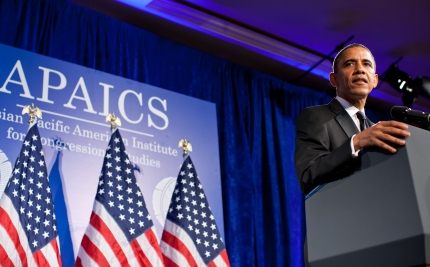
President Obama Speaks at the Asian Pacific American Institute for Congressional Studies Annual Gala

May 08, 2012 | 13:41 | Public Domain

President Obama delivers remarks at the 18th Annual Gala of the Asian Pacific American Institute for Congressional Studies.

Download mp4 (483MB) | mp3 (31MB)

Read the Transcript

Remarks by the President at the 18th Annual Gala for the Asian Pacific American Institute for Congressional Studies

Ritz Carlton
Washington, D.C.

5:46 P.M. EDT 

THE PRESIDENT:  Thank you.  (Applause.)  Thank you very much.  Thank you. 

AUDIENCE:  Four more years!  Four more years!  Four more years!  Four more years!

THE PRESIDENT:  Thank you so much.  Thank you.  Everybody, please, please, have a seat.  Have a seat.  You're making me blush.  (Laughter.)  Mahalo! 

AUDIENCE:  Mahalo!

THE PRESIDENT:  Thank you so much.  Thank you, Norm, for that kind introduction.  More importantly, thank you for your lifetime of distinguished service to our country.  I want to thank all the members of Congress who are with us -- including two people who are fighting hard every day on behalf of every member of this community -- Judy Chu and Mike Honda.  Give them a big round of applause.  (Applause.)  

Now, I am thrilled to be here tonight because all of you hold a special place in my heart.  When I think about Asian Americans and Pacific Islanders, I think about my family -- my sister, Maya; my brother-in-law, Konrad who's in the house somewhere -- (applause.)  I don't know where Konrad is.  My nieces Suhaila and Savita.  I think about all the folks I grew up with in Honolulu, as part of the -- (applause) --

AUDIENCE MEMBER:  Aloha!  (Laughter.) 

THE PRESIDENT:  As part of the Hawaiian ohana.  I think about the years I spent in Indonesia.  So for me, coming here feels a little bit like home.  This is a community that helped to make me who I am today.  It’s a community that helped make America the country that it is today. 

So your heritage spans the world.  But what unites everyone is that in all of your families you have stories of perseverance that are uniquely American.  Some of you -- those from Hawaii or the Pacific Islands -- (applause) -- live where your family has lived for generations and your story is, in part, about keeping alive treasured native traditions.  But for others, your story starts with ancestors who, at some point, left behind everything they knew to seek the promise of a new land.  Maybe the story traces back a century and a half, to the laborers who risked their lives to connect our coasts by rail.  Maybe it begins with one of the hundreds of thousands of immigrants who, decades ago, made the tough journey to Angel Island.

Maybe the story starts with your parents.  Or maybe it starts with you.  But here’s the thing.  No matter when it began, no matter where it began, your stories are about someone who came here looking for new opportunities not merely for themselves, but for their children, and for their children’s children, and for all generations to come. 

Few of them had money.  A lot of them didn’t have belongings.  But what they did have was an unshakeable belief that this country -- of all countries -- is a place where anybody can make it if they try. 

Now, many of them faced hardship; many of them faced ridicule; many of them faced racism.  Many were treated as second-class citizens -- as people who didn’t belong.  But they didn’t give up.  They didn’t make excuses.  They kept forging ahead.  They kept building up America.  They kept fighting for America -- Like Danny Inouye, who's here.  (Applause.)  Danny, who was my senator most of my life.  (Laughter.)  Love that man.

But they were trailblazers like Dalip Singh Saund -- a young man from India who, in 1920, came to study agriculture, stayed to become a farmer, and took on the cause of citizenship for all people of South Asian descent.  (Applause.)   And once Dalip earned his own citizenship, he stepped up to serve the country he loved -- and became the first Asian American elected to the Congress.  (Applause.)

They were pioneers like my former congresswoman, Patsy Mink, who was not only the first -- (applause) -- not only the first Asian American woman elected to Congress but the author of Title IX -- which has changed the playing field for all of our girls.  (Applause.)

And then there’s the story of a young Japanese American boy, just 10 when his family was forced from their home and taken hundreds of miles away to an internment camp.  For three years, they lived in that camp, but when that boy got home, he didn’t turn his back on America -- he devoted his life to America.  In his words, he pledged "to speak out for the underrepresented and to pick up on those issues that weren’t being carried by others." And as the first Asian American to ever serve in a President’s Cabinet, Norm Mineta made good on that pledge.  (Applause.)

So think about how proud all those previous generations would be to see this room, to see how far this community has come.  Asian Americans, Pacific Islanders are now the inventors and entrepreneurs keeping our country on the cutting edge; the businessmen and women at the helm of some of our most successful industries; leaders in every aspect of American life -- in science and medicine, in education, in sports, in the arts, in our Armed Forces; in our government and in our courts.  In fact, over the past three years, we have more than doubled the number of Asian Americans on the federal bench.  (Applause.)

Just yesterday, Jacqueline Nguyen became the first Asian American woman to get confirmed as a federal appellate judge.  (Applause.)  Where’s Jacqueline?  She’s here tonight.  There she is.  (Applause.)  You didn't bring your robe, though.  (Laughter.)  That's pretty cool.  (Laughter.)  And we’re so proud to have her along with another appellate judge I appointed, Denny Chin.  He’s here.  (Applause.)  Where’s Denny?  There he is, back there.  So we thank them for their service. 

Whether your heritage stems from South Asia or East Asia, from my native Hawaii or the Pacific Islands, whether you’re first generation --

AUDIENCE MEMBER:  Wahooo!

THE PRESIDENT:  These Hawaiians here -- (laughter) -- what’s up with that?  (Applause.)

AUDIENCE MEMBERS:  Wahooo!  (Laughter.)  Aloha!  (Applause.)

THE PRESIDENT:  Whether you are first generation or the fifth, you’re helping to build a better America.

And I know it can be tempting -- given the success that's on display here tonight -- for people to buy into the myth of the "model minority" and glance over the challenges that this community still faces.  But we have to remember there's still educational disparities like higher dropout rates in certain groups, lower college enrollment rates in others.  There's still economic disparities like higher rates of poverty and obstacles to employment.  There are health disparities like higher rates of diabetes and cancer and Hepatitis B.  Those who are new to America -- many still face language barriers.  Others -- like Vincent Chin who we lost three decades ago -- have been victims of horrible hate crimes, driven by the kinds of ignorance and prejudice that are an affront to everything America stands for. 

So those are real problems, and we can't ignore them.  And if we’re going to do a better job addressing them, then we first have to stop grouping everybody just in one big category.  Dozens of different communities fall under the umbrella of the Asian Americans and Pacific Islanders, and we have to respect that the experiences of immigrant groups are distinct and different.  And your concerns run the gamut. 

That’s something that Washington needs to understand better. And that’s why I reestablished the White House Initiative on Asian Americans and Pacific Islanders --  (applause) -- so that we could better identify specific issues within specific communities.  Many of those commissioners are here.  I want to thank them for the great job that they're doing.  (Applause.)

And so we’re making a difference -- on that front and on many other fronts.  When we stepped up support for America’s small businesses, we stepped up support for this community -- providing over $7 billion in loans for small businesses owned by Asian Americans and Pacific Islanders.  (Applause.)  When we passed health care reform, we put in place new mechanisms to get better data about health disparities.  (Applause.)  Because of that law, nearly 3 million Asian Americans and Pacific Islanders are going to receive expanded and preventive coverage through private insurance and nearly 1 million are receiving free preventive services through Medicare.  (Applause.) 

So some of the things that matter to this community are things that matter to every community, like making sure that a woman earns an equal day’s pay for an equal day’s work.  (Applause.)  Or ending "don't ask, don't tell" so that nobody has to hide who they love to serve the country they love.  (Applause.)  Or enacting education reform so that every child has access to good schools and higher education.  (Applause.)  Or caring for our veterans because it's our duty to serve them as well as they have served us.  (Applause.) 

That's what this country is about.  That's what we’ve always been about.  We've gone through some tough years because of this extraordinary recession and we've still got a long way to go.  But we will get there.  We will arrive at that destination where every child born in America regardless of race, creed, color, is going to have a chance.  We're going to do that together -- because in this country, we look out for each other.  We fight for each other.  If somebody is suffering through injustice or inequality, we take up their cause as if it was our own.  That's the story of America.  And that's certainly the story of this community.  (Applause.) 

In the midst of World War II, when the son of Japanese immigrants, Gordon Hirabayashi, ignored the curfews and refused transfer to an internment camp; when he was jailed for his defiance; when he later appealed his conviction and took his case all the way to the Supreme Court -- he understood that he was fighting for something larger than himself.  And he once said, "I never look at my case just as a Japanese American case.  It's an American case, with principles that affect the fundamental human rights of all Americans."  (Applause.)  And while Gordon is no longer with us, later this year I'll award him the Presidential Medal of Freedom -- the highest civilian award America has to offer.  (Applause.)  Because he reminds us that each of us is only who we are today because somebody, somewhere, felt a sense of responsibility -- not just to themselves, but to their family, and their communities, and to this country that we all love.

So tonight, we honor the trailblazers who came before.  But we also celebrate the leaders yet to come -- all the young people who are here tonight.  (Applause.)  Together, it’s our turn to be responsible for the future.  It’s our turn to make sure the next generation has more opportunities than we did.  It’s our turn to make sure that no matter who you are, no matter where you came from, no matter what you look like, America forever remains the place where you can make it if you try. 

Thank you, everybody.  God bless you.  God bless the United States of America.  (Applause.)

                        END             6:00 P.M. EDT 


Close Transcript

President Obama Salutes Asian Americans and Pacific Islanders

President Barack Obama delivers the keynote address at the APAICS 18th Annual Gala Dinner (May 8, 2012)

President Barack Obama delivers the keynote address at the Asian Pacific American Institute for Congressional Studies (APAICS) 18th Annual Gala Dinner at the Ritz-Carlton in Washington, D.C., May 8, 2012. (Official White House Photo by Pete Souza)

This afternoon, the President traveled across town to the Annual Gala for the Asian Pacific American Institute for Congressional Studies.

There, he spoke about one of the common threads that unites us all as Americans:

We've gone through some tough years because of this extraordinary recession and we've still got a long way to go. But we will get there. We will arrive at that destination where every child born in America regardless of race, creed, color, is going to have a chance. We're going to do that together -- because in this country, we look out for each other. We fight for each other. If somebody is suffering through injustice or inequality, we take up their cause as if it was our own. That's the story of America. 

Read the full remarks here.

Related Topics: Inside the White House

The White House

Office of the Press Secretary

Presidential Nominations Sent to the Senate

NOMINATIONS SENT TO THE SENATE:

Maria Lopez De Leon, of Texas, to be a Member of the National Council on the Arts for a term expiring September 3, 2016, vice James Ballinger, term expired.
Emil J. Kang, of North Carolina, to be a Member of the National Council on the Arts for a term expiring September 3, 2018, vice Benjamin Donenberg, term expiring.
Kristine L. Svinicki, of Virginia, to be a Member of the Nuclear Regulatory Commission for the term of five years expiring June 30, 2017.  (Reappointment)

The White House

Office of the Press Secretary

President Obama Announces Another Key Administration Post

WASHINGTON, DC – Today, President Barack Obama announced his intent to nominate the following individual to a key Administration post:

• Kristine L. Svinicki – Commissioner, Nuclear Regulatory Commission

President Obama announced his intent to nominate the following individual to a key Administration post:

Kristine L. Svinicki, Nominee for Commissioner, Nuclear Regulatory Commission
Kristine L. Svinicki is a Commissioner of the U.S. Nuclear Regulatory Commission (NRC), a position she has held since 2008.  Prior to joining the NRC, Ms. Svinicki served as a professional staff member on the Senate Armed Services Committee for Senator John Warner and Senator John McCain.  From 2001 to 2005, she served as a senior policy advisor to Senator Larry Craig.  From 1990 to 2001, Ms. Svinicki worked as a nuclear engineer in the U.S. Department of Energy’s Office of Nuclear Energy, Science, and Technology, the Office of Civilian Radioactive Waste Management, and the Idaho Operations Office.  She began her career in 1989 as an energy engineer with the State of Wisconsin at the Wisconsin Public Service Commission in Madison, Wisconsin.  Ms. Svinicki received a B.S. in Nuclear Engineering from the University of Michigan. 

The White House

Office of the Press Secretary

President Obama Announces More Key Administration Posts

WASHINGTON, DC – Today, President Barack Obama announced his intent to nominate the following individuals to key Administration posts:

• Maria Lopez De Leon - Member, National Council on the Arts
• Emil J. Kang – Member, National Council on the Arts

President Obama said, “I am proud that such experienced and committed individuals have agreed to serve the American people in these important roles.  I look forward to working with them in the months and years ahead.”

President Obama announced his intent to nominate the following individuals to key Administration posts:

Maria Lopez De Leon, Nominee for Member, National Council on the Arts
Maria Lopez De Leon is the Executive Director and a member of the board of the National Association of Latino Arts and Culture (NALAC). Ms. De Leon has been affiliated with NALAC for thirteen years and has served as Executive Director for ten years.  Under Ms. De Leon’s leadership, NALAC launched the Fund for the Arts, a grant program for Latino artists and organizations, completed production of a documentary series on Latino art and culture for PBS, and developed a grant program for cultural exchanges between the US, Mexico, and Central America.   Ms. De Leon is an advisory council member of San Anto Cultural Arts, Women of Color in the Arts, and is a fellow of the Rockwood Leadership Institute. 

Emil J. Kang, Nominee for Member, National Council on the Arts
Emil J. Kang is the Executive Director for the Arts and Professor of the Practice of Music at the University of North Carolina at Chapel Hill.  Previously, he served as President and Executive Director of the Detroit Symphony Orchestra.  He has also held positions with the Seattle Symphony and the American Composers Orchestra and was an Orchestra Management Fellow with the League of American Orchestras.  Mr. Kang serves as Secretary of the Board of Directors of the Association of Performing Arts Presenters, and is a member of both the Nominating Committee of the International Society for the Performing Arts and Board of Advisors of the Kenan Institute for the Arts at the University of North Carolina School of the Arts.  Mr. Kang holds a B.A. in Economics from the University of Rochester.

President Obama's To-Do List for Congress: Reward American Jobs, Not Outsourcing

President Barack Obama delivers remarks on the economy at the State University of New York, in Albany

President Barack Obama delivers remarks on the economy at the College of Nanoscale Science and Engineering’s Albany NanoTech Complex at the State University of New York, in Albany, N.Y., May 8, 2012. (Official White House Photo by Pete Souza)

Today, Republicans in Congress voted to block President Obama’s proposal to keep student loan interest rates from doubling. If Congress doesn’t act by July 1, more than 7 million students around the country will rack up an average of $1,000 of extra debt. The President has visited colleges in Iowa, Colorado, and North Carolina to speak with students about this important issue, and he will continue to put pressure on Congress to work together and keep student loan interest rates low.

It’s time for Congress to take action on other common sense initiatives as well. This afternoon, President Obama called on Congress to move forward with a “To-Do List” that will create jobs and help restore middle class security. The President traveled to the College of Nanoscale Science and Engineering’s NanoTech Complex in Albany, New York, where he described a list of initiatives that have bipartisan support and will help create an economy built to last.

The first item on the To-Do List will help spur American manufacturing, an industry that’s adding jobs for the first time since the 1990s, including many in upstate New York. But Congress can take action now to help create more jobs for American workers, President Obama said:

At the moment, companies get tax breaks for moving factories, jobs and profits overseas.  They can actually end up saving on their tax bill when they make the move.  Meanwhile, companies that choose to stay here are getting hit with one of the highest tax rates in the world.  That doesn’t make sense. 

…before we completely rework the tax code, before we've done a full-blown tax reform, at the very least what we can do right away is stop rewarding companies who ship jobs overseas and use that money to cover moving expenses for companies that are moving jobs back here to America.  So we're putting that on Congress’s "To-Do" list. 

 The proposals that the President highlighted today are important steps that Congress can take right now to create jobs. It’s time for Congress to act. Check out the full to-do list, then join the conversation and make your voice heard with the hashtag #CongressToDoList.

Jon Carson is the Director of the Office of Public Engagement.

The White House

Office of the Press Secretary

Remarks by the President, Albany, NY

College of Nanoscale Science and Engineering
State University of New York
Albany, New York

1:24 P.M. EDT

THE PRESIDENT:  Hello, New York!  (Applause.)  Thank you.  Thank you so much.  Thank you.  Everybody, please have a seat.  It is great to be back in Albany.  It is wonderful to be with all of you here today. 

And I want to thank Governor Cuomo not only for the outstanding introduction, but also for the extraordinary leadership that he's showing here in the great state of New York. Please give him a big round of applause.  (Applause.)  He is doing outstanding work.

I also want to thank Mayor Jennings, who's here.  Give the Mayor a big round of applause.  (Applause.)  Don't be shy.  We've got Chancellor Zimpher -- (applause) -- we appreciate very much. Dr. Kaloyeros -- I want to make sure I say that right, folks mess up my name all the time -- (laughter) -- Kaloyeros for hosting us here today.  (Applause.)  We’ve got a couple members of Congress here -- Paul Tonko.  (Applause.)  And also, Representative Chris Gibson is here.  (Applause.) 

And all of you are, and I'm happy about that.  (Applause.)  Yes.  So it is wonderful to be here at the University of Albany NanoCollege.  This is one of the only colleges in the world dedicated to nanotechnology.  And it’s a incredible complex.  But you’re working on particles as small as an atom, and you’re doing it in rooms that are 10,000 times cleaner than a hospital operating room –- which is very impressive, since "clean" is not usually a word I associate with college students.  (Laughter.)  Maybe things have changed since I was in school. 

Now, the reason I came here today is because this school -- bless you -- and this community represents the future of our economy.  Right now, some of the most advanced manufacturing work in America is being done right here in upstate New York.  Cutting-edge businesses from all over the world are deciding to build here and hire here.  And you’ve got schools like this one that are training workers with the exact skills that those businesses are looking for. 

Now, we know the true engine of job creation in this country is the private sector -- it's not Washington.  But there are steps we can take as a nation to make it easier for companies to grow and to hire, to create platforms of success for them -- everything from giving more people the chance to get the right training and education to supporting new research projects into science and technology.  In fact, there was a substantial investment made here -- I was talking to Governor Cuomo about the investment his father made here to help get this center started. 

There are things we can do to make sure that if you’re willing to work hard and meet your responsibilities, you can find a job, own a home, maybe start a business, and most importantly, give your kids a chance to do even better than you did.  And that’s something we believe has to be available to everybody, no matter where you come from, no matter what you look like.  We can make a difference.  And at this make-or-break moment for America's middle class, there’s no excuse for inaction.  There’s no excuse for dragging our feet.  None. 

Now, over the last few years, there are certain steps that I’ve been able to take on my own to help spur the kind of innovation that we're seeing here, and also to help the overall economy grow.  So we announced a new policy several months back that will help families refinance their mortgages, save up to thousands of dollars a year.  We sped up loans and competitive grants for new projects all across the country so thousands of construction workers can get back on the job.  We simplified the student loan process to help roughly 5.8 million students -- like the students here -- save money on repayments.  (Applause.)

So these are some steps that the administration has been able to take on its own.  But the truth is, the only way we can accelerate the job creation that takes place on a scale that is needed is bold action from Congress. 

Because of the Recovery Act, because of all the work we've done, we've created over 4 million jobs over the last two years. We've created hundreds of thousands of jobs each month over the last several months.  So we're making progress, but everybody knows we need to do more.  And in order to do that, we're going to need some more action from Congress.  Democrats and Republicans have to come together.  And they've shown that they can do it.  I mean, they did some important work.  They passed tax cuts for workers, approved trade deals to open up new markets for American products.  We reformed our patent system to make it easier for innovative ideas to come to market.  Those are all good things.  But the size of the challenges we face requires us to do more.

So back last September, I sent Congress a jobs bill that included all sorts of policies that we knew would help grow our economy and put more Americans back to work.  That wasn't just my opinion, that wasn't just the opinion of Democrats.  It was the opinion of independent, nonpartisan experts -- economists who do this for a living, and analysts on Wall Street who evaluate what's going to really make the economy grow.  The one big piece that we were able to get done was make sure that we didn't see payroll tax go up and people get 40 bucks taken out of their paychecks each time. 

But most of it didn't get done in Congress.  Just about every time we put these policies up for a vote, the Republicans in Congress got together and they said no.  They said no to putting hundreds of thousands of construction workers back on the job repairing our roads and our bridges and our schools and our transit systems.  No to a new tax cut for businesses that hire new workers.  No to putting more teachers back in our classrooms, more cops back on the beat, more firefighters back to work.  And this is at a time when we know one of the biggest drags on our economy has been layoffs by state and local governments -- that's true all across the country.

And it's worth noting, by the way -- this is just a little aside -- after there was a recession under Ronald Reagan, government employment went way up.  It went up after the recessions under the first George Bush and the second George Bush.  So each time there was a recession with a Republican President, compensated -- we compensated by making sure that government didn't see a drastic reduction in employment. 

The only time government employment has gone down during a recession has been under me.  (Applause.)  So I make that point just so you don't buy into this whole bloated government argument that you hear.  And frankly, if Congress had said yes to helping states put teachers back to work and put the economy before our politics, then tens of thousands more teachers in New York would have a job right now.  That is a fact.  And that would mean not only a lower unemployment rate, but also more customers for business.

Now, I know this is an election year.  But it's not an excuse for inaction.  Six months is plenty of time for Democrats and Republicans to get together and do the right thing, taking steps that will spur additional job creation right now.  Just saying no to ideas that we know will help our economy isn’t an option.  There’s too much at stake.  We've all got to pull in the same direction.

So even if Republicans are still saying no to some of the bigger proposals we made in the jobs act, there are some additional ideas that could help people get to work right now and that they haven't said no to yet -- so I'm hoping they say yes.  And they’re simple ideas.  They’re the kinds of things that, in the past, have been supported by Democrats and Republicans.  These are traditionally ideas that have had bipartisan support.  They won’t have as big of an impact as rebuilding our infrastructure or helping states hire back teachers, but together, all of these ideas will do two things:  They'll grow the economy faster and they'll create more jobs.

So today I’m announcing a handy little "To-Do" list that we’ve put together for Congress.  (Laughter.)  You can see it for yourselves at whitehouse.gov.  It’s about the size of a Post-It note, so every member of Congress should have time to read it -- (laughter) -- and they can glance at it every so often.  And hopefully we'll just be checking off the list -- just like when Michelle gives me a list, I check it off.  (Laughter.)  Each of the ideas on this list will help accelerate our economy and put people back to work -- not in November, not in next year, but right now.

All right, so I'm going to go through the list.  First, Congress needs to help the millions of Americans who have worked hard, made their mortgage payments on time, but still have been unable to refinance their mortgages with these historically low rates.  This would make a huge difference for the economy.  (Applause.) 

Families could save thousands of dollars, and that means they've got more money in their pocket, which means they can either build their equity back up on their homes or they go out and use that money to do things like helping their kids finance a college education.  So Congress should give those responsible homeowners a chance to refinance at a lower rate.  We estimate they'd save at least $3,000 a year.  So that’s on our "To-Do" list.  It's not complicated.  (Applause.)

Second, if Congress fails to act soon, clean energy companies will see their taxes go up and they could be forced to lay off employees.  In fact, we're already hearing from folks who produce wind turbines and solar panels and a lot of this green energy that they're getting worried because there's uncertainty out there.  Congress hasn't renewed some of the tax breaks that are so important to this industry.  And since I know that the other side in Congress have promised they'll never raise taxes as long as they live, this is a good time to keep that promise when it comes to businesses that are putting Americans to work and helping break our dependence on foreign oil.  (Applause.)  So we should extend these tax credits.  That’s on the "To-Do" list. That’s number two.

Number three, Congress should help small business owners by giving them a tax break for hiring more workers and paying them higher wages.  (Applause.)  We believe small businesses are the engine of economic growth in this country.  We should not hold them to a situation where they may end up having to pay higher taxes just by hiring more workers.  We should make it easier for them to succeed.  So that’s on our "To-Do" list.  That’s number three.

Number four, Congress should help our veterans returning from Iraq and Afghanistan find a good job once they come home.  (Applause.)  Our men and women in uniform have served this country with such honor and distinction -- a lot of them come from upstate New York.  Now it’s our turn to serve them.  So we should create a Veterans Job Corps that helps them find work as cops and firefighters, employees at our national parks.  That’s on our "To-Do" list.

Then the last item, the fifth item, which bears especially on what's going on here -- the last item on our congressional "To-Do" list is something that will help a lot of you in particular.  You know better than anybody that technology has advanced by leaps and bounds over the last few decades.  And that’s a great thing.  Businesses are more productive; consumers are getting better products for less.  But technology has also made a lot of jobs obsolete.  Factories where people once thought they’d retire suddenly left town.  Jobs that provided a decent living got shipped overseas.  And the result has been a lot of pain for a lot of communities and a lot of families.

There is a silver lining to all of this, though.  After years of undercutting the competition, now it’s getting more expensive to do business in places like China.  Wages are going up.  Shipping costs are going up.  And meanwhile, American workers are getting more and more efficient.  Companies located here are becoming more and more competitive.  So for a lot of businesses, it’s now starting to make sense to bring jobs back home.  (Applause.) 

And here in the tri-city area, you’ve got companies like IBM and Global Foundries that could have decided to pack up and move elsewhere, but they chose to stay in upstate New York because it made more sense to build here and to hire here.  You have more to offer -- got some of the best workers in the world, you've got an outstanding university.

Now I want what’s happening in Albany to happen all across the country -- places like Cleveland and Pittsburgh and Raleigh. (Applause.)  I want to create more opportunities for hardworking Americans to start making things again, and selling them all over the world stamped with those proud words:  Made in America.  That’s the goal.  (Applause.)

So the good news is we’re already starting to see it happen. American manufacturers are creating jobs for the first time since the late 1990s.  And that’s good for you, but it’s also good for the businesses that supply the materials you use.  It’s good for the construction workers who build the facilities you work in.  It’s good for communities where people are buying more houses and spending more money at restaurants and stores.  Everybody benefits when manufacturing is going strong. 

So you’ve heard about outsourcing.  Today, more and more companies are insourcing.  One recent study found that half of America’s largest companies are thinking of moving their manufacturing operations from China back to the United States of America.  (Applause.)  That’s good news.  Because even when we can’t make things cheaper than other countries because of their wage rates, we can always make them better.  That’s who we are.  That’s what America is all about.  (Applause.)

So this brings me back to our "To-Do" list.  What we need to do now is to make it easier for more companies to do the right thing, and one place to start is our tax code.  At the moment, companies get tax breaks for moving factories, jobs and profits overseas.  They can actually end up saving on their tax bill when they make the move.  Meanwhile, companies that choose to stay here are getting hit with one of the highest tax rates in the world.  That doesn’t make sense. 

And politicians from both parties have been talking about changing it for years, so I’ve put forward my own plan to make it right in the long term.  But in the short term, before we completely rework the tax code, before we've done a full-blown tax reform, at the very least what we can do right away is stop rewarding companies who ship jobs overseas and use that money to cover moving expenses for companies that are moving jobs back here to America.  (Applause.)  So we're putting that on Congress’s "To-Do" list.  This is something simple to do.  We shouldn’t wait.  We should get it done right now. 

So that’s the fifth item.  That's all on our "To-Do" list.  I'm not trying to overload Congress here.  (Laughter.)   

So over the next few weeks, I’m going to be taking about this "To-Do" list when I'm on the road.  I’m going to be talking about all the things that Congress can do right now to boost our economy and accelerate even more job growth.  Of course, it’s not enough just to give them the list -- we've also got to get them to start crossing things off the list.  And that’s where all of you come in. 

I'm going to need you to pick up the phone, write an email, tweet, remind your member of Congress we can’t afford to wait until November to get things done.  Tell them now is the time to help more Americans save money on their mortgages; time for us to invest more in clean energy and small businesses; it's time for us to help more veterans find work; and it's time to make it easier for companies to bring jobs back to America.  It's the right thing to do.

Now, I'm cheating a little bit.  I said that was my "To-Do" list.  There actually is one other thing they've got to do.  Before they do anything else, Congress needs to keep student loan rates from doubling for students who are here and all across the country.  (Applause.)  That has to happen by January 1st [sic] or rates on Stafford loans double.  These young people are nodding their heads -- they don't like that.  They've heard about this.  (Laughter.) 

And we need to pass a transportation bill that guarantees almost a million construction workers can stay on the job.  (Applause.)  The good news is both parties say they want to make this happen.  We’ve done this before.  So Congress just needs to work out the details.  Don't let politics get in the way.  Get this done before July 1st.  Those bills should be passed right now.

So I'm cheating a little bit.  There are actually seven items on the "To-Do" list.  (Laughter.)  But two of them are old business and folks have already said they want to get them done.

Albany, we’ve got a long way to go if we’re going to make sure everybody who wants a job can find one, and every family can feel that sense of security that was the essence of America's middle-class experience.  But we can't just go back to the way things used to be.  We've got to move forward -- to an economy where everybody gets a fair shot, everybody is doing their fair share, everybody plays by the same set of rules.

And that's what you guys are doing here in Albany.  You're investing in your future.  You're not going backwards, you're going forward.  With your help, I know we can get there -- because here in America, we don’t give up.  We keep moving.  We look out for one another.  We pull each other up.  That’s who we are.  And if we work together with common purpose, I've got no doubt we can keep moving this country forward and remind the world just why it is the United States of America is the greatest nation on Earth.  (Applause.)

Thank you so much, everybody.  God bless you.  God bless America.  (Applause.)

END
1:44 P.M. EDT 

President Obama Speaks on the Economy

May 08, 2012 | 21:34 | Public Domain

President Obama introduces his “to-do list” for Congress, a list of initiatives that will create jobs and help the middle class, and calls on Congress to take action on the list’s first item by passing legislation that rewards companies who bring jobs back to American with lower taxes and pay for it by eliminating tax incentives for companies to ship jobs overseas.

Download mp4 (762MB) | mp3 (49MB)

Read the Transcript

Remarks by the President, Albany, NY

College of Nanoscale Science and Engineering
State University of New York
Albany, New York

1:24 P.M. EDT

THE PRESIDENT:  Hello, New York!  (Applause.)  Thank you.  Thank you so much.  Thank you.  Everybody, please have a seat.  It is great to be back in Albany.  It is wonderful to be with all of you here today. 

And I want to thank Governor Cuomo not only for the outstanding introduction, but also for the extraordinary leadership that he's showing here in the great state of New York. Please give him a big round of applause.  (Applause.)  He is doing outstanding work.

I also want to thank Mayor Jennings, who's here.  Give the Mayor a big round of applause.  (Applause.)  Don't be shy.  We've got Chancellor Zimpher -- (applause) -- we appreciate very much. Dr. Kaloyeros -- I want to make sure I say that right, folks mess up my name all the time -- (laughter) -- Kaloyeros for hosting us here today.  (Applause.)  We’ve got a couple members of Congress here -- Paul Tonko.  (Applause.)  And also, Representative Chris Gibson is here.  (Applause.) 

And all of you are, and I'm happy about that.  (Applause.)  Yes.  So it is wonderful to be here at the University of Albany NanoCollege.  This is one of the only colleges in the world dedicated to nanotechnology.  And it’s a incredible complex.  But you’re working on particles as small as an atom, and you’re doing it in rooms that are 10,000 times cleaner than a hospital operating room –- which is very impressive, since "clean" is not usually a word I associate with college students.  (Laughter.)  Maybe things have changed since I was in school. 

Now, the reason I came here today is because this school -- bless you -- and this community represents the future of our economy.  Right now, some of the most advanced manufacturing work in America is being done right here in upstate New York.  Cutting-edge businesses from all over the world are deciding to build here and hire here.  And you’ve got schools like this one that are training workers with the exact skills that those businesses are looking for. 

Now, we know the true engine of job creation in this country is the private sector -- it's not Washington.  But there are steps we can take as a nation to make it easier for companies to grow and to hire, to create platforms of success for them -- everything from giving more people the chance to get the right training and education to supporting new research projects into science and technology.  In fact, there was a substantial investment made here -- I was talking to Governor Cuomo about the investment his father made here to help get this center started. 

There are things we can do to make sure that if you’re willing to work hard and meet your responsibilities, you can find a job, own a home, maybe start a business, and most importantly, give your kids a chance to do even better than you did.  And that’s something we believe has to be available to everybody, no matter where you come from, no matter what you look like.  We can make a difference.  And at this make-or-break moment for America's middle class, there’s no excuse for inaction.  There’s no excuse for dragging our feet.  None. 

Now, over the last few years, there are certain steps that I’ve been able to take on my own to help spur the kind of innovation that we're seeing here, and also to help the overall economy grow.  So we announced a new policy several months back that will help families refinance their mortgages, save up to thousands of dollars a year.  We sped up loans and competitive grants for new projects all across the country so thousands of construction workers can get back on the job.  We simplified the student loan process to help roughly 5.8 million students -- like the students here -- save money on repayments.  (Applause.)

So these are some steps that the administration has been able to take on its own.  But the truth is, the only way we can accelerate the job creation that takes place on a scale that is needed is bold action from Congress. 

Because of the Recovery Act, because of all the work we've done, we've created over 4 million jobs over the last two years. We've created hundreds of thousands of jobs each month over the last several months.  So we're making progress, but everybody knows we need to do more.  And in order to do that, we're going to need some more action from Congress.  Democrats and Republicans have to come together.  And they've shown that they can do it.  I mean, they did some important work.  They passed tax cuts for workers, approved trade deals to open up new markets for American products.  We reformed our patent system to make it easier for innovative ideas to come to market.  Those are all good things.  But the size of the challenges we face requires us to do more.

So back last September, I sent Congress a jobs bill that included all sorts of policies that we knew would help grow our economy and put more Americans back to work.  That wasn't just my opinion, that wasn't just the opinion of Democrats.  It was the opinion of independent, nonpartisan experts -- economists who do this for a living, and analysts on Wall Street who evaluate what's going to really make the economy grow.  The one big piece that we were able to get done was make sure that we didn't see payroll tax go up and people get 40 bucks taken out of their paychecks each time. 

But most of it didn't get done in Congress.  Just about every time we put these policies up for a vote, the Republicans in Congress got together and they said no.  They said no to putting hundreds of thousands of construction workers back on the job repairing our roads and our bridges and our schools and our transit systems.  No to a new tax cut for businesses that hire new workers.  No to putting more teachers back in our classrooms, more cops back on the beat, more firefighters back to work.  And this is at a time when we know one of the biggest drags on our economy has been layoffs by state and local governments -- that's true all across the country.

And it's worth noting, by the way -- this is just a little aside -- after there was a recession under Ronald Reagan, government employment went way up.  It went up after the recessions under the first George Bush and the second George Bush.  So each time there was a recession with a Republican President, compensated -- we compensated by making sure that government didn't see a drastic reduction in employment. 

The only time government employment has gone down during a recession has been under me.  (Applause.)  So I make that point just so you don't buy into this whole bloated government argument that you hear.  And frankly, if Congress had said yes to helping states put teachers back to work and put the economy before our politics, then tens of thousands more teachers in New York would have a job right now.  That is a fact.  And that would mean not only a lower unemployment rate, but also more customers for business.

Now, I know this is an election year.  But it's not an excuse for inaction.  Six months is plenty of time for Democrats and Republicans to get together and do the right thing, taking steps that will spur additional job creation right now.  Just saying no to ideas that we know will help our economy isn’t an option.  There’s too much at stake.  We've all got to pull in the same direction.

So even if Republicans are still saying no to some of the bigger proposals we made in the jobs act, there are some additional ideas that could help people get to work right now and that they haven't said no to yet -- so I'm hoping they say yes.  And they’re simple ideas.  They’re the kinds of things that, in the past, have been supported by Democrats and Republicans.  These are traditionally ideas that have had bipartisan support.  They won’t have as big of an impact as rebuilding our infrastructure or helping states hire back teachers, but together, all of these ideas will do two things:  They'll grow the economy faster and they'll create more jobs.

So today I’m announcing a handy little "To-Do" list that we’ve put together for Congress.  (Laughter.)  You can see it for yourselves at whitehouse.gov.  It’s about the size of a Post-It note, so every member of Congress should have time to read it -- (laughter) -- and they can glance at it every so often.  And hopefully we'll just be checking off the list -- just like when Michelle gives me a list, I check it off.  (Laughter.)  Each of the ideas on this list will help accelerate our economy and put people back to work -- not in November, not in next year, but right now.

All right, so I'm going to go through the list.  First, Congress needs to help the millions of Americans who have worked hard, made their mortgage payments on time, but still have been unable to refinance their mortgages with these historically low rates.  This would make a huge difference for the economy.  (Applause.) 

Families could save thousands of dollars, and that means they've got more money in their pocket, which means they can either build their equity back up on their homes or they go out and use that money to do things like helping their kids finance a college education.  So Congress should give those responsible homeowners a chance to refinance at a lower rate.  We estimate they'd save at least $3,000 a year.  So that’s on our "To-Do" list.  It's not complicated.  (Applause.)

Second, if Congress fails to act soon, clean energy companies will see their taxes go up and they could be forced to lay off employees.  In fact, we're already hearing from folks who produce wind turbines and solar panels and a lot of this green energy that they're getting worried because there's uncertainty out there.  Congress hasn't renewed some of the tax breaks that are so important to this industry.  And since I know that the other side in Congress have promised they'll never raise taxes as long as they live, this is a good time to keep that promise when it comes to businesses that are putting Americans to work and helping break our dependence on foreign oil.  (Applause.)  So we should extend these tax credits.  That’s on the "To-Do" list. That’s number two.

Number three, Congress should help small business owners by giving them a tax break for hiring more workers and paying them higher wages.  (Applause.)  We believe small businesses are the engine of economic growth in this country.  We should not hold them to a situation where they may end up having to pay higher taxes just by hiring more workers.  We should make it easier for them to succeed.  So that’s on our "To-Do" list.  That’s number three.

Number four, Congress should help our veterans returning from Iraq and Afghanistan find a good job once they come home.  (Applause.)  Our men and women in uniform have served this country with such honor and distinction -- a lot of them come from upstate New York.  Now it’s our turn to serve them.  So we should create a Veterans Job Corps that helps them find work as cops and firefighters, employees at our national parks.  That’s on our "To-Do" list.

Then the last item, the fifth item, which bears especially on what's going on here -- the last item on our congressional "To-Do" list is something that will help a lot of you in particular.  You know better than anybody that technology has advanced by leaps and bounds over the last few decades.  And that’s a great thing.  Businesses are more productive; consumers are getting better products for less.  But technology has also made a lot of jobs obsolete.  Factories where people once thought they’d retire suddenly left town.  Jobs that provided a decent living got shipped overseas.  And the result has been a lot of pain for a lot of communities and a lot of families.

There is a silver lining to all of this, though.  After years of undercutting the competition, now it’s getting more expensive to do business in places like China.  Wages are going up.  Shipping costs are going up.  And meanwhile, American workers are getting more and more efficient.  Companies located here are becoming more and more competitive.  So for a lot of businesses, it’s now starting to make sense to bring jobs back home.  (Applause.) 

And here in the tri-city area, you’ve got companies like IBM and Global Foundries that could have decided to pack up and move elsewhere, but they chose to stay in upstate New York because it made more sense to build here and to hire here.  You have more to offer -- got some of the best workers in the world, you've got an outstanding university.

Now I want what’s happening in Albany to happen all across the country -- places like Cleveland and Pittsburgh and Raleigh. (Applause.)  I want to create more opportunities for hardworking Americans to start making things again, and selling them all over the world stamped with those proud words:  Made in America.  That’s the goal.  (Applause.)

So the good news is we’re already starting to see it happen. American manufacturers are creating jobs for the first time since the late 1990s.  And that’s good for you, but it’s also good for the businesses that supply the materials you use.  It’s good for the construction workers who build the facilities you work in.  It’s good for communities where people are buying more houses and spending more money at restaurants and stores.  Everybody benefits when manufacturing is going strong. 

So you’ve heard about outsourcing.  Today, more and more companies are insourcing.  One recent study found that half of America’s largest companies are thinking of moving their manufacturing operations from China back to the United States of America.  (Applause.)  That’s good news.  Because even when we can’t make things cheaper than other countries because of their wage rates, we can always make them better.  That’s who we are.  That’s what America is all about.  (Applause.)

So this brings me back to our "To-Do" list.  What we need to do now is to make it easier for more companies to do the right thing, and one place to start is our tax code.  At the moment, companies get tax breaks for moving factories, jobs and profits overseas.  They can actually end up saving on their tax bill when they make the move.  Meanwhile, companies that choose to stay here are getting hit with one of the highest tax rates in the world.  That doesn’t make sense. 

And politicians from both parties have been talking about changing it for years, so I’ve put forward my own plan to make it right in the long term.  But in the short term, before we completely rework the tax code, before we've done a full-blown tax reform, at the very least what we can do right away is stop rewarding companies who ship jobs overseas and use that money to cover moving expenses for companies that are moving jobs back here to America.  (Applause.)  So we're putting that on Congress’s "To-Do" list.  This is something simple to do.  We shouldn’t wait.  We should get it done right now. 

So that’s the fifth item.  That's all on our "To-Do" list.  I'm not trying to overload Congress here.  (Laughter.)   

So over the next few weeks, I’m going to be taking about this "To-Do" list when I'm on the road.  I’m going to be talking about all the things that Congress can do right now to boost our economy and accelerate even more job growth.  Of course, it’s not enough just to give them the list -- we've also got to get them to start crossing things off the list.  And that’s where all of you come in. 

I'm going to need you to pick up the phone, write an email, tweet, remind your member of Congress we can’t afford to wait until November to get things done.  Tell them now is the time to help more Americans save money on their mortgages; time for us to invest more in clean energy and small businesses; it's time for us to help more veterans find work; and it's time to make it easier for companies to bring jobs back to America.  It's the right thing to do.

Now, I'm cheating a little bit.  I said that was my "To-Do" list.  There actually is one other thing they've got to do.  Before they do anything else, Congress needs to keep student loan rates from doubling for students who are here and all across the country.  (Applause.)  That has to happen by January 1st [sic] or rates on Stafford loans double.  These young people are nodding their heads -- they don't like that.  They've heard about this.  (Laughter.) 

And we need to pass a transportation bill that guarantees almost a million construction workers can stay on the job.  (Applause.)  The good news is both parties say they want to make this happen.  We’ve done this before.  So Congress just needs to work out the details.  Don't let politics get in the way.  Get this done before July 1st.  Those bills should be passed right now.

So I'm cheating a little bit.  There are actually seven items on the "To-Do" list.  (Laughter.)  But two of them are old business and folks have already said they want to get them done.

Albany, we’ve got a long way to go if we’re going to make sure everybody who wants a job can find one, and every family can feel that sense of security that was the essence of America's middle-class experience.  But we can't just go back to the way things used to be.  We've got to move forward -- to an economy where everybody gets a fair shot, everybody is doing their fair share, everybody plays by the same set of rules.

And that's what you guys are doing here in Albany.  You're investing in your future.  You're not going backwards, you're going forward.  With your help, I know we can get there -- because here in America, we don’t give up.  We keep moving.  We look out for one another.  We pull each other up.  That’s who we are.  And if we work together with common purpose, I've got no doubt we can keep moving this country forward and remind the world just why it is the United States of America is the greatest nation on Earth.  (Applause.)

Thank you so much, everybody.  God bless you.  God bless America.  (Applause.)

END
1:44 P.M. EDT 
Close Transcript

President Obama Joins Elected Officials and Student Leaders to Urge #DontDoubleMyRate

This afternoon, President Obama joined elected officials and student leaders from colleges and universities across the country on a phone call to discuss the effort to prevent interest rates on more than 7 million students’ loans from doubling on July 1, unless Congress takes action.

During the call, mayors, governors and other officials were joined in their offices by local students to hear the President’s message and they tweeted out messages to echo his call to keep college affordable for all Americans. You can see photos from those on the call below or at Storify.com.

Learn more about the President’s efforts here and join in the conversation on Twitter with the hashtag #DontDoubleMyRate.