Press Briefing by Press Secretary Jay Carney, 3/15/2012
James S. Brady Press Briefing Room
12:50 P.M. EDT
MR. CARNEY: Good afternoon, ladies and gentlemen. Welcome to the White House for your daily briefing.
Q On the Ides of March.
MR. CARNEY: The Ides of March. I didn’t see the movie. Did you see the movie? (Laughter.) But I plan to. And I loved the play.
Q You chat with Clooney last night, did you?
MR. CARNEY: I don't have any announcements to make at the top of the briefing. (Laughter.)
Q How did it feel being a guest last night?
MR. CARNEY: It was a really nice affair. It was, no question, a very appropriate event to celebrate the relationship, the essential relationship we have with the United Kingdom. And I think you saw in the comments that the President made and the Prime Minister made that the relationship has never been stronger between our two countries. The number of areas of cooperation between our countries has probably never been so broad and numerous. And the relationship between the two leaders is strong as well. So it was a very nice event. But I have --
Q Does cooperation include tapping oil reserves? (Laughter.)
MR. CARNEY: Let me go to questions. The Associated Press -- Jim.
Q Thanks, Jay. Two topics. I wanted to ask you about Karzai's comments today -- he wants an immediate pullout of NATO forces from rural areas and villages, pulling back the bases. He also wants Afghan forces to take the lead in 2013. I wondered if either of those are consistent with where the President stands right now on Afghanistan. And on the Taliban and its declaration that they've stopped discussions, isn't that a major setback in terms of what the President wants to do in Afghanistan?
MR. CARNEY: Let me deal with the segments of that question. First of all, as you know, the President's policy, his strategy in Afghanistan is to draw down the forces that were surged into Afghanistan. That is happening now; 33,000 forces will be withdrawn -- 33,000 U.S. troops will be withdrawn by the end of the summer.
As he said yesterday in his comments in the Rose Garden, our strategy is to shift to a support role in 2013 and to complete the transition to full Afghan security lead in 2014. So without getting into the specifics of what you do in certain parts of the country, and the nature of different deployments, it is consistent to say -- as we saw in Iraq -- that that kind of transition involves a change in the footprint as more and more portions of the country are turned over to Afghan security lead -- which is happening already.
So with regards to the statement from the Taliban, we support an Afghan-led process towards reconciliation. There is no likely resolution to the conflict in Afghanistan without a political resolution. And our conditions for participation in that process by the Taliban have been clear in terms of the reconciliation: Those who would be reconciled need to lay down their arms, renounce al Qaeda, promise to abide by the Afghan constitution. And we continue to support that process.
Q The Taliban claims that the U.S. has changed the terms for those negotiations. Is that the case?
MR. CARNEY: The terms have been as I've stated them on many occasions, and just did again. The fact also is that this is an Afghan-led process that we support. And it is also true that we're not going to get into great detail about every conversation we've had or meeting we've had with the various parties, but we broadly support a process here that is essential to the long-term resolution of the conflict in Afghanistan.
Q One other on another subject -- reports today that the President and Prime Minister Cameron discussed having strategic oil reserves. What's the status of the White House's attempt to tap the SPR? And are you making those -- are you having those kinds of discussions with other foreign leaders? Because obviously you want to do this with international concurrence.
MR. CARNEY: Jim, the suggestion that energy issues were among the topics discussed by the British Prime Minister and the President should not be surprising. That was certainly a -- energy issues were among the topics discussed in the meetings that they had. It is inaccurate, as was reported today, that any kind of agreement was reached on a course of action, or that any kind of timetable associated with a course of action was agreed to. Those reports are wrong. They're false.
Reuters.
Q Jay, you talked about the strategy being to draw down the troops and to proceed with that. But in terms of the goal of the mission, how can the events of recent days not be a setback to that, with the Taliban suspending the nascent talks? How can you achieve that goal of turning over security to the Afghans with all of these setbacks?
MR. CARNEY: Well, Caren, I appreciate the question. It is certainly the case that our challenge in Afghanistan has been, and continues to be, and will be difficult. What is also true is that since the President began implementing his strategy, with its very clear focus on the top priority of ultimately defeating al Qaeda, we have met with success and we have achieved significant progress.
Some of the events that you refer to are clearly tragic and unfortunate, and don’t make the mission any easier to accomplish. But what we do know is that our men and women in uniform in Afghanistan are the very best in the world and they have done a tremendous job to this point in implementing the President's strategy, and even amidst these difficult times, they are continuing the process of transferring -- to making that transition to Afghan security lead.
We are withdrawing American troops as part of the President's plan. We will continue to do that. We will continue as we do to strengthen the Afghan security forces. We will continue to take the fight to al Qaeda across the region, to diminish and ultimately defeat core al Qaeda, which is based there in the region. And in accordance with the President's strategy, as agreed to at Lisbon by NATO, we will finish the transfer to Afghan security lead in 2014. That’s the mission, and we are sticking to it.
Q How concerned is the President about the implications of recent events on what you hope to do at the NATO summit, what you hope to announce, what you hope to maybe cite as progress?
MR. CARNEY: Well, again, I would not in any way attempt to suggest that the Koran burning, the incident last weekend involving the civilian deaths were anything but unfortunate, tragic and terrible. And they clearly do not help the cause of the mission. But it is also the case that there have been difficult times in the course of our efforts in Afghanistan in the past, and we have continued to focus on the mission. We have continued to maintain the highest levels of professionalism in executing the mission, and we have made great progress because of that.
And the important aspect of all of this is that the President knows where we are going with this strategy. He laid it out clearly. He took a situation that existed when he was sworn into office in Afghanistan, where there was great murkiness about our goals there, our purpose there, whether we had the right force structure, whether we were building towards an opportunity to allow our troops to leave -- none of those questions were clear, and this President made them clear.
This President made clear that our objective in Afghanistan, the reason why American men and women are in harm's way in that country, is because we were attacked by al Qaeda, which was based in that country, and therefore, the number-one objective of our Afghanistan mission has to be to disrupt, dismantle and ultimately defeat al Qaeda. In support of that, we have to stabilize Afghanistan enough, stabilize the government enough to give it the space to fully train up the necessary Afghan security forces so that Afghans can take responsibility for the security of their country.
And that was a significant refocusing and narrowing of our objectives. And in doing that, and in providing the resources necessary to achieve the strategy, we have had some success -- I think indisputable success. But it is a hard mission and it is not complete, and we are fulfilling the President’s strategy.
Yes, Jessica.
Q Two questions on two different topics. Following up on the SPR -- you said, just to press you further on this, that there is no timetable and no agreement, but then are you acknowledging that they did discuss releasing the emergency oil reserves?
MR. CARNEY: Jessica, as has been the case every time I'm asked about that issue, I am not going to discuss specifics about it. I can tell you that among the many topics of discussion that the British Prime Minister and the President had were energy issues and the situation globally with the rise in the price of oil. But I can say very clearly that the report suggesting that any kind of an agreement was reached on a course of action with regard to those energy issues, that any agreement was reached with a timetable associated with it, that report is false. It is not accurate.
Q The Pentagon, in a briefing now with Captain Kirby, said that when Secretary Panetta was landing in Afghanistan, an Afghan man drove onto the runway. And the Pentagon is saying the vehicle had been stolen 30 minutes before the attack; it was aimed at the arriving -- the VIP party. What does this tell us about the UK and the U.S. military’s inability to protect the Secretary of Defense?
MR. CARNEY: I would refer you for details about the security arrangements at the particular base, and what happened there and how that happened to the Pentagon and to our personnel there. We’re obviously aware of what happened, nobody more so than the Secretary of Defense. But for any details about that incident, I think you should turn to the Pentagon.
Q Does the White House have concerns?
MR. CARNEY: The President is very aware of the fact, as is every member of his national security team, including, of course, Secretary Panetta, and the Chairman of the Joint Chiefs, and the commanders in the field, that Afghanistan is a dangerous place, continues to be a dangerous place, and that our personnel there are executing a mission that entails significant risks. That is not news. But again, for details about this incident, I would refer you to the Pentagon.
Q Specifically about the inability -- there’s a 30-minute gap there between the time the car was stolen --
MR. CARNEY: Jessica, I understand, but these are details about an incident that may or may not be reflective of broader questions about either that base or base security. And I just am not in a position to adequately address questions of that nature.
Roger.
Q Yes, I’d like to try the SPR stuff a couple more times. (Laughter.) Surprise. What kind of coordination is underway right now, if there’s a decision to go ahead with the SPR? Can you talk about the mechanics a little bit?
MR. CARNEY: No. And again, that is pure speculation that doesn't even comport with the pure fact that I just bestowed upon you, which is that the report of any kind of agreement or timetable associated with agreement, related to a course of action is just wrong. So, of course, the United Kingdom -- the leader of -- the Prime Minister of the UK and the U.S. President, in their discussions, talked about the pressing issues of the day in which these two countries share an interest, and that includes Afghanistan and Iran and Syria, bilateral trade relationship and energy issues, among others. So it should not be a surprise that that topic area was on the table and was discussed. But the reports that I think everyone is referencing when they're asking these questions were not accurate.
Q So is it correct to infer that -- to the markets, anyway, there is nothing imminent?
MR. CARNEY: I’m not -- I am here to simply address -- speak for the President, the White House, the administration, and make clear a factual assertion about this report. I’m not here to comment on the markets.
Q Have you spoken to your British counterparts about how this story might have gotten out? Have you had any discussions with them?
MR. CARNEY: I have not -- I don't have anything to relay to you about conversations with our counterparts --
Q In the past, Robert would talk to the French side --
MR. CARNEY: Hans, if I could -- if I could just finish. I certainly know that our friends overseas are not new to the idea that occasionally there are erroneous press reports.
Norah.
Q So are you working with them to sort of tamp this --
MR. CARNEY: Hans, let me go here. I think I called on Bloomberg, so let me go to Norah.
Q Sorry, who are we on?
MR. CARNEY: We're on Norah O'Donnell, CBS.
Q The President, as you've made the case, has put in the tightest sanctions ever on Iran. As part of the sanctions that this administration has pushed is encouraging, of course, the EU to go through with an oil embargo that starts July 1st. That will take about a million barrels of oil off the market a day. So given that, and what that will do to oil prices and gas prices, what is the President doing to make sure it doesn't -- that doesn't affect the American consumer and the British consumer?
MR. CARNEY: As you, I'm sure, recall, in the legislation related to that, it very specifically made clear that in the implementation of the sanctions we would be mindful of potential impacts on the global economy, on the effects on individual, specific allies. And without getting into hypothetical details about how that plays out, we are obviously aware of and mindful of that kind of potential. I'm not going to speculate from here about what specific sanctions and the implementation of them might have -- what effect it might have or what price impact it might have on a barrel of oil. But we were very aware of, and we talked a lot about, this fact when we were reviewing this legislation and then the President signed it.
Q But there's an honest question to be asked, which is that, what is the plan? I mean, you're going to take a million barrels a day offline. So is the administration encouraging others -- Saudi Arabia and others -- to put out more, or is the U.S. and the British going to make sure that they can make sure that the markets are not disrupted by releasing the SPR?
MR. CARNEY: Well, Norah, I'm just not going to get into hypotheticals about what course of action we might take, we and our allies might take, other countries might take as events proceed globally here. The fact is that we're -- the issue that you raise is one we're obviously aware of and knew in advance was something that we wanted to monitor very carefully.
We also have a very keen interest in tightening the sanctions in Iran. As you noted in your question, we have been extremely aggressive, with our partners, in a broad coalition action against the Iranian regime in an effort to try to pressure Tehran to live up to its international obligations, to abandon its nuclear weapons ambitions. And that effort has already had a significant impact on the Iranian economy, on the political leadership, and we will continue to press from all corners to increase the pressure.
Jake.
Q Just to follow up on Jessica’s question about the incident yesterday -- there had been eight green-on-blue incidents this year alone. Twelve of the fifty-nine coalition troops who have been killed were killed by Afghan supposed allies. Last time I talked to somebody in the White House about this I was told that the latest information -- this is a few weeks ago -- was that they were all unrelated cases. Is that still what -- the information you have, that these were all unrelated?
MR. CARNEY: I don’t have any information that would alter that assessment, but that’s an assessment that I think is more -- is made in more depth over at the Pentagon and elsewhere.
It is important to remember, as I think I noted during one of my briefings, the huge volume of missions carried out jointly by U.S. and Afghan forces daily, weekly, and effectively -- which does not in any way take away from the terrible incidents that you cite, including those in the wake of the inadvertent burning of the Koran.
So I don’t have any information that suggests a different evaluation of the nature of these incidents. Perhaps the Pentagon does. But I think we have to remember how broad the mission is over there, how many operations occur with Afghan and U.S. forces working together towards the same goal, and effectively, in preventing the Taliban from gaining momentum and taking the fight to al Qaeda. So that’s where we are right now. I would refer you to the Pentagon for more.
Q Okay. I have two more questions. The President said yesterday that the incidents, and all these incidents in the last month or so, would not quicken -- this is not a quote -- but they would not quicken the pace of U.S. withdrawal. Is it possible, though, that they could change the pace in terms of when the Afghans take more of a lead in security, as Karzai suggested? Is that possible?
MR. CARNEY: Well, look, we make these assessments -- as the President has made clear when he has spoken about this issue, when he laid out his strategy, when he spoke about it in the wake of Lisbon -- in coordination with our allies and in a manner that is designed to ensure that we are as successful as possible in fulfilling the objectives of the mission.
We are operating under a timetable that was laid out in Lisbon that includes as part of these evaluations what the President said yesterday about transitioning in 2013 into a support role, as part of the full transition to full Afghan security lead in 2013. I think within the context of that framework, how that -- as we've always said, the pace of withdrawal, the nature of the deployments, how quickly certain territories in Afghanistan are turned over, those kinds of details I'm sure will be made closer to the ground -- or those decisions will be made closer to the ground, and will depend on conditions as the weeks and months go on.
But the overall structure I think is clear. And I think in the context of this, what I think a lot of people have missed -- as theirs has been a focus on the initial surge and forces in Afghanistan and on the successes we've had there and the progress we've made there, as well as the challenges we've faced -- is that part of that strategy the President put in place was to have a timetable for withdrawing U.S. troops, to ending that war responsibly. And that is his strategy and he's implementing it.
Q And the last question has to do with the -- there's been some press notice to a Yemeni journalist who's been detained. President Obama, when he spoke to President Saleh more than a year ago -- it was actually mentioned in the readout that the President expressed concern over the release of -- I know I'm going to botch the pronunciation of his name -- but Abdulelah Shaye, who had been sentenced to five years in prison for his association with AQAP.
There have been journalistic organizations, international ones, who have protested his detention, and expressed curiosity, if not outrage, that President Obama would be involving himself in the detention of a journalist. Can you tell us anything about why President Obama thinks that this man -- apparently thinks that this man is a threat?
MR. CARNEY: I appreciate the question, Jake, but I will have to take it, because I don’t have any information on it. But I'll get back to you.
Kristen.
Q Thanks, Jay. Vice President Biden just finished speaking a short while ago. He was calling out Republican rivals by name. Is it fair to say he's going to be the official sort of attack dog or voice of the campaign until there is a Republican nominee?
MR. CARNEY: Well, I would refer your questions about this speech, which was a campaign speech, to the campaign. The Vice President also has, and will continue to have, significant responsibilities as Vice President, the President's partner in implementing the President's policies. And I think I could regale you with details about the depth and breadth of his responsibilities in both foreign and domestic policy if you like. But I could also just move on and take another question. (Laughter.)
Q Was there a reason why the President spoke at the same time as the Vice President? Was there an attempt to downplay the Vice President's remarks?
MR. CARNEY: Certainly not that I'm aware of. I would refer you to the campaign. We generally try to keep our schedules tight. Sometimes they slide. But I would refer you -- on the Vice President's schedule, on this event, to the campaign.
Q And also, Jay, the U.S. Roman Catholic Bishops are signaling that they will continue to fight for what they're calling a "broader religious exemption" to the employer birth control mandate. I'm wondering what your reaction is to that. And there’s also been some discussion that they would welcome more dialogue with the executive branch. Is that something that you would be amenable to?
MR. CARNEY: Well, we have had a dialogue with a lot of stakeholders on the issue of providing preventive services to women. And as you know because you covered it, the President -- he brought the process to a solution here that met his two objectives -- to ensure that women across America, no matter where they worked were able to get the same preventive services, including contraceptive services without having to pay for them, and that religious -- that those with religious objections would not have to -- institutions, for example, like colleges and universities would not have to provide or pay for contraception if they objected to doing so. And that is the solution that we reached.
And we continue to have discussions with stakeholders on the issue of a self-funded plan, so-called self-funded plans, as we made clear we would. But the President’s position here, the solution that was reached here to achieve these two objectives and to find that balance has been reached. And we firmly believe that it achieves the goals that the President set.
Wendell. Sorry. And then Carol.
Q The SWIFT financial service, as I understand it, today severed ties with most if not all of Iran’s banks. What do you expect the impact to be? How quickly?
MR. CARNEY: I wouldn’t speculate except to say that it is part of a process of tightening sanctions. It is part of the process of isolating Iran and making clear to the Iranian leadership that there is a price to pay for their intransigence, their refusal to abide by their international obligations, their refusal to adequately reassure the international community that its nuclear intentions are peaceful and non-weapon-related.
And we have made clear, as we did earlier this year, that when it was the case that we had already implemented the harshest sanctions with the broadest international coalition in history, that we were going to continue to ratchet them up. And this is certainly -- as part of the international effort, this is part of it.
Q You don't want to give an assessment of how steep this price is that --
MR. CARNEY: Well, I think I would point you to experts in terms of -- maybe over at Treasury about what the specific impact of this course of action would be. The overall -- the broader impact and the goal is to raise the price of intransigence, and we believe it will have that effect as part of the overall sanctions regime.
Q Mitt Romney says one of the problems with the price of oil is that the U.S. has not convinced the rest of the world it will be energy independent. What's your reaction to that?
MR. CARNEY: Well, I didn't see that comment, and I would simply say that President Obama, from the time he came into office, has pursued a policy that is driven by that goal -- increasing America's energy independence, reducing our dependence on foreign sources of energy -- for economic reasons and national security reasons.
And certainly he has been more aggressive in doing that than any of his 43 predecessors, I think it's safe to say. And he has pursued an all-of-the-above energy strategy that includes not just aggressively increasing oil and gas production, fossil fuel production domestically, but insisting that we explore all energy alternatives -- wind, solar, biofuels, advanced battery technology; that we take action like he did when he worked with the automobile companies to put in place historic fuel-efficiency standards, which by themselves will save American consumers $1.7 trillion; and reduce our consumption of oil and therefore our consumption and dependence on foreign oil by something along the lines of 12 billion barrels.
So those who suggest that it's an important goal to pursue are right. What's also important is that you have the policies that prove you're trying to pursue it -- that as the President made clear today, just drilling is not a plausible solution to our energy challenges. The math doesn't work. You have to do everything. You have to do oil and gas. You have to do nuclear. You have to do alternative energy sources. Because if you don't, you will continue to have a situation where the United States depends heavily on foreign countries for oil, and depends heavily for its foreign oil imports on a region of the world that has historically been very unstable.
So all of the above -- that's the appropriate approach. And "all of the above" doesn't mean "drill, drill, drill." It means, drill, invest, and take executive actions and legislative actions to ensure that we have greater energy security.
I appreciate the question, Wendell.
Ari.
Q I could tell.
Q There's been a lot of attention paid to a New York Times op-ed by a departing Goldman Sachs exec. I know the White House is very proud of the increased regulations on Wall Street under the Dodd-Frank bill, but I wonder if you could speak to the culture of Wall Street and whether you think that has improved at all since the financial collapse.
MR. CARNEY: Ari, I’m not going to comment on one employee of one firm. I think that the point I would make is the one that you reference in your question, which is that this President has been focused on the absolute need to ensure that we put into place rules of the road that prevent the kind of reckless behavior in our big financial institutions that contributed to the greatest financial crisis this country has seen since the 1930s. And that’s what the historic Wall Street reform that the President signed into law does. And that’s what the Volcker Rule, which is part of that historic Wall Street reform, is designed to do.
So this President’s commitment on this issue -- against a great deal of resistance and a considerable amount of post-law- signing attempts to undo -- has continued to pursue. I’m not sure that makes sense as a sentence, but I’m doing my best. (Laughter.)
Q Without talking about an individual, do you think the culture of Wall Street has changed at all since then?
MR. CARNEY: Well, I think that what we can -- what leaders can do in Washington is make sure that Wall Street plays by the same rules as Main Street, and by insisting on that, effect cultural change by making it against the rules to, as the Volcker Rule does, to make risky bets with other people’s money, with your creditors deposits. That’s the kind of action that led to a situation where we had a global financial market meltdown.
I noted on one of the business news channels last -- I guess we hit an anniversary of the low in the markets during that dreadful period in early 2009. Markets are now double what they were then; in some cases, even more. And I think while that is certainly good for business and it’s good for the economy and good for folks who were able to hold on to their investments and their 401(k) retirement plans, to see their savings that had been decimated, resurrected to some degree, what it cannot result in is amnesia, because it was not that long ago when this country was staring into the abyss and dramatic action had to be taken to prevent a Great Depression.
Carol.
Q Back on the oil reserves. There’s a separate news report also in Reuters that said that the Prime Minister and the President did discuss SPR. Are you saying that that report is also inaccurate?
MR. CARNEY: No, I said that the President and Prime Minister spoke about a number of issues, including energy issues, including --
Q Including SPR?
MR. CARNEY: I’m not going to get into specific --
Q Why don't you get into that?
MR. CARNEY: Because I don't -- whether I’m asked about it from this direction, or directly about what the President thinks or might do or how he would do it, I just don't --
Q I'm just asking if it's been discussed.
MR. CARNEY: Well, energy issues were discussed. I’m not going to get into specifics about what aspect of the global oil market or energy issues they discussed, but I am confirming that that was one topic of the conversation. What I am making clear is not accurate is the reports of some sort of agreement.
Q But you’re not saying this other report is inaccurate?
MR. CARNEY: I am simply saying that energy issues were among the topics discussed.
Q Okay. Secondly, you have the Vice President out today giving a campaign speech. The President is traveling to -- continuing to travel to a number of swing states. There were a number of bundlers who were invited to the state dinner last night, and you have him giving increasingly fiery speeches. Do you still maintain that this White House is not in campaign mode?
MR. CARNEY: I still maintain that the President is still spending the vast preponderance of his time on his official duties, as is everyone who works here. There is a campaign, of course, and it is active and doing the things that it does in preparation for the time when there is a general election nominee for the other party and there’s a debate to be had more directly.
I’m going to have to just take issue with the idea -- I hope, anyway -- that Maryland is a swing state. But that is where he traveled today, where he gave a speech about energy.
Q Well, he’s also doing a number of fundraisers, and he’s traveling on Friday. He has been going to --
MR. CARNEY: Well, he certainly has been having political events, and we’ve been clear about that. And he is participating in that way in his campaign, but as a share of time it is still fairly minimal. But I’ve been very clear, and others have been very clear, that that percentage will increase as the year progresses, and especially once there is a Republican nominee.
Q How do you gauge it now? Do you think it's increased in the last month?
MR. CARNEY: I think it has -- from the formation of the campaign, I'm sure it has steadily but very gradually increased. I think it ebbs and flows, depending on what the schedule allows. But it's -- this President has support, obviously, in his own party. He did not have to engage in a primary fight, and he has, therefore, been able to focus the vast majority of his time on his official duties. And he'll continue to do that for as long as possible, within the confines that a general election campaign creates.
Mr. Knoller.
Q What about the preponderance of his public time? Would you admit that is increasingly political?
MR. CARNEY: No. I would admit that there is -- there will be a gradual increase in the amount of his time that he spends on political events. But we are a long way from the point where that becomes a significant part of his schedule. We're just not there yet.
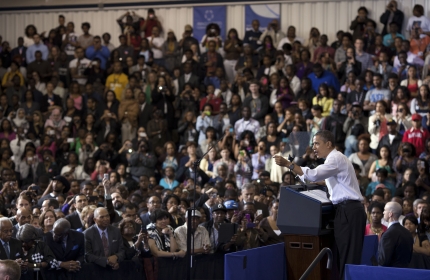
The President gave an energy speech today. He gave a speech that addressed the fact that when we're trying to get the country moving in the right direction, adopting an all-of-the-above approach, that, unfortunately, we have some folks who, by the nature of our system, are charged with the task of governing along with us, who seem not to believe, or seem to think -- seem not to believe that we need to have anything but fossil fuels to secure our energy future, and seem to think that even talking about alternative energy sources is funny. And I think calling them "flat-earthers" is appropriate.
Q Isn't that a campaign message?
MR. CARNEY: No, it's a policy message. We believe we have to do this for the sake of America's economic future. It is simply not an option to say that we can just keep drilling with 2 percent of the known oil reserves in the world when we consume 20 percent of the world's oil. It's just -- I was a mediocre math student, but that doesn’t seem to work out. That won't work out well for the United States.
So what do we do? We aggressively -- because we're America -- innovate, invest, insist that the best technologies are made here, the best products are made here, and the best jobs are created here, so that we can kill two birds with one stone -- grow our economy, enhance our national security.
Lee.
Q Given the present situation in Afghanistan, why is the President so confident that after 2013 or 2014, when all the U.S. troops withdraws from there, Afghanistan will not be used as a launching pad for attacks against the U.S.?
MR. CARNEY: It is the focus of the policy of the President to disrupt, dismantle and defeat al Qaeda; to stabilize Afghanistan enough so that Afghan forces can gradually take over security responsibility for their country. That has to be, ultimately, Afghanistan's future. And we have sacrificed greatly, in our national security interests, but to ensure that that can come about.
Obviously, there are challenges. Obviously, there have been setbacks. But the progress is also undeniable, when you evaluate where we are against the objectives the President put into place when he announced his strategy. So it is the assessment of this President, it is the assessment of NATO, that the timetable that is governing the drawdown, that is governing the transition, is the right timetable. It is a timetable that will allow us to achieve our objectives, as well as bring our men and women home.
Q And secondly, Afghanistan doesn't have enough resources to pay for its own soldiers. So who is going to pay for those soldiers after 2014?
MR. CARNEY: Well, I think you're -- that gets way ahead of where we are. The President made clear in announcing his Afghanistan strategy that we and our allies and a broad coalition of international partners will continue to have a robust, strategic relationship with Afghanistan beyond the transition period. But it's 2012, and what that looks like obviously is difficult to predict with any specificity right now.
Q Thanks, Jay.
MR. CARNEY: Nakamura, I'll throw you in there for a bonus question.
Q Today I think the campaign is releasing a 17-minute documentary-style video -- I know -- and --
MR. CARNEY: It's going to be easy.
Q What's that?
MR. CARNEY: It's going to be easy, this one. (Laughter.)
Q I wanted to see if you've seen it and if the President has seen it, and if so, what the reaction is to it. And then, if not, when do you plan to see it and if there's any viewing parties within the White House, like around the country tonight? What kind of setting would you be seeing it in?
MR. CARNEY: I look forward to seeing it many times -- (laughter) -- in my spare time, of which I don't have enough. But I don't have any -- I'm certainly not aware of any viewing parties. I mean, I, again, refer you to the campaign, and I'm just going to go out on a limb that they probably have a plan for the unveiling of and distribution of what I'm sure will be a very compelling film.
Q I think they’ve talked about having viewing parties for supporters who have signed up early and stuff like that, but I just want to know if -- I mean, does the President -- has the President screened it to make sure it’s --
MR. CARNEY: I haven't -- well, I mean, it is his campaign, but I haven't asked him whether he's seen it. But it certainly wouldn't be -- it wouldn’t surprise me if he has.
Thanks, guys.
END
1:35 P.M. EDT