The White House

Office of the Press Secretary

Statement by National Security Council Spokesman Tommy Vietor on Accident in Switzerland

The President sends his deepest condolences to the victims and their families of last night’s bus accident in Switzerland.  The loss of so many young lives is especially heartbreaking.  Our thoughts and prayers are with the Belgian communities of Lommel and Heverlee and all the people of Belgium at this difficult time.  As a close friend of both Belgium and Switzerland, the United States stands ready to provide whatever assistance may be helpful.

The White House

Office of the Press Secretary

Remarks by President Obama and Prime Minister Cameron of the United Kingdom in a Joint Press Conference

Rose Garden

12:27 P.M. EDT
 
PRESIDENT OBAMA:  Good afternoon, everyone.  Please have a seat.  Again, it is a great honor to welcome my friend and partner, Prime Minister David Cameron, back to the White House for this official visit. 
 
I know there’s been a lot of focus on last night’s game.  Some have asked how it came about.  So I want to set the record straight.  During my visit to London last year, David arranged for us to play some local students -- table tennis.  As they would say in Britain, we got thrashed.  So when it came to sports on this visit, I thought it would be better if we just watched.  That said, I’m still trying to get David to fill out his bracket.
 
We’ve just finished up a very good discussion, and it was a reminder of why I value David’s leadership and partnership so much.  He appreciates how the alliance between our countries is a foundation -- not only for the security and prosperity of our two nations, but for international peace and security as well.  David shares my belief that, in a time of rapid change, the leadership of the United States and the United Kingdom is more important than ever.  And we share the view that the future we seek is only possible if the rights and responsibilities of nations and people are upheld.  And that’s a cause that we advanced today.
 
At a time when too many of our people are still out of work, we agree that we've got to stay focused on creating the growth and jobs that put our people back to work, even as both our countries make difficult choices to put our fiscal houses in order.  Between us, we have the largest investment relationship in the world, and we’ve instructed our teams to continue to explore ways to increase transatlantic trade and investment.  And I very much appreciate David’s perspective on the fiscal situation in the eurozone, where both our countries -- our economies, our businesses, our banks -- are deeply connected. 

We moved on to discuss Afghanistan, where we are the two largest contributors of forces to the international mission and where our forces continue to make extraordinary sacrifices.  The tragic events of recent days are a reminder that this continues to be a very difficult mission.  And obviously we both have lost a number of extraordinary young men and women in theater.  What’s also undeniable, though -- and what we can never forget -- is that our forces are making very real progress:  dismantling al Qaeda; breaking the Taliban’s momentum; and training Afghan forces so that they can take the lead and our troops can come home.

That transition is already underway, and about half of all Afghans currently live in areas where Afghan security forces are taking responsibility.  Today, the Prime Minister and I reaffirmed the transition plan that we agreed to with our coalition partners in Lisbon.  Specifically, at the upcoming NATO summit in my hometown of Chicago, we’ll determine the next phase of transition.  This includes shifting to a support role next year, in 2013, in advance of Afghans taking full responsibility for security in 2014.  We’re going to complete this mission, and we're going to do it responsibly.  And NATO will maintain an enduring commitment so that Afghanistan never again becomes a haven for al Qaeda to attack our countries. 

We also discussed the continuing threat posed by Iran’s failure to meet its international obligations.  On this we are fully united.  We are determined to prevent Iran from acquiring a nuclear weapon.  We believe there is still time and space to pursue a diplomatic solution, and we’re going to keep coordinating closely with our P5-plus-1 partners.  At the same time, we’re going to keep up the pressure, with the strongest U.S. sanctions to date and the European Union preparing to impose an embargo on Iranian oil.  Tehran must understand that it cannot escape or evade the choice before it -- meet your international obligations or face the consequences.

We reaffirmed our commitment to support the democratic transitions underway in the Middle East and North Africa.  British forces played a critical role in the mission to protect the Libyan people, and I want to commend David personally for the leadership role he plays in mobilizing international support for the transition in Libya.

We also discussed the horrific violence that the Assad regime continues to inflict on the people of Syria.  Right now, we’re focused on getting humanitarian aid to those in need.  We agreed to keep increasing the pressure on the regime -- mobilizing the international community; tightening sanctions; cutting the regime’s revenues; isolating it politically, diplomatically, and economically. 
 
Just as the regime and security forces continue to suffer defections, the opposition is growing stronger.  I’ll say it again:  Assad will leave power.  It’s not a question of if, but when.  And to prepare for that day, we’ll continue to support plans for a transition to support the legitimate aspirations of the Syrian people.  More broadly, we recommitted ourselves and our leadership to the goal of global development. 
 
Along with our international partners, we've saved countless lives from the famine in the Horn of Africa.  David, you've done an outstanding job in bringing the international community to support progress in Somalia, including lifesaving aid.  At the same time, we're renewing our commitment to improve maternal health and preventable deaths of children, and supporting the Global Fund for AIDS, TB and Malaria so that we can realize our goal, and that’s the beginning of the end of AIDS.  And let me say that it's a tribute to David's leadership that the UK will be playing a leading role in the global partnership to strengthen the open government upon which human rights and development depend.
 
Finally, I'm very pleased that we're bringing our two militaries, the backbone of our alliance, even closer.  As I told David, I can announce that next month, we intend to start implementing our long-awaited defense trade treaty with the UK.  This will put advanced technologies in the hands of our troops, and it will mean more jobs for workers in both our countries.  And we're moving ahead with our joint initiative to care for our men and women in uniform.
 
For decades, our troops have stood together on the battlefield.  Now we're working together for them when they come home -- with new partnerships to help our wounded warriors recover, assist our veterans transition back to civilian life, and to support our remarkable military families. 
 
So, David, thank you, as always, for being such an outstanding ally, partner and friend.  As I said this morning, because of our efforts, our alliance is as strong as it has ever been.  And Michelle and I are very much looking forward to hosting you and Samantha at tonight's state dinner.  I look forward, as well, to welcoming you to Camp David and my hometown of Chicago in May, to carry on the work upon which both our nations and the world depend. 
 
So, David, welcome, and thank you.
 
PRIME MINISTER CAMERON:  Well, thank you very much for that, Barack.  And thank you for last night's sporting event.  I thought there was a link between that and the table tennis.  I remember it well.  And because I know America doesn’t like being on the losing side, I'm trying to make up to you with the gift of a table tennis table, which I hope will be there in the White House --
 
PRESIDENT OBAMA:  We should practice this afternoon.
 
PRIME MINISTER CAMERON:  I think -- well, I certainly need the practice.  One of these days I'll get my own back by getting you to a cricket match and explaining the rules to you and some of the terminology that you'll have to try and get straight, as I tried last night.  But thank you. 
 
We've had excellent discussions today, and it was great that our teams had time to join those talks as well.  And, Barack, thank you, because there are some countries whose alliance is a matter of convenience, but ours is a matter of conviction.  Two states, as I said this morning, united for freedom and enterprise; working together, day in, day out, to defend those values and advance our shared interests. 
 
That has been the fundamental business of this visit and we’ve just made important progress on four vital areas:  Afghanistan, Syria, Iran, and economic growth.  And I want to take each in turn.
 
First, Afghanistan.  Recent days have reminded us just how difficult our mission is and how high the cost of this war has been for Britain, for America, and for Afghans themselves.  Britain has fought alongside America every day since the start.  We have 9,500 men and women still serving there.  More than 400 have given their lives.  And today, again, we commemorate each and every one of them. 
 
But we will not give up on this mission because Afghanistan must never again be a safe haven for al Qaeda to launch attacks against us.  We won’t build a perfect Afghanistan, although let’s be clear, we are making some tangible progress with more markets open, more health centers working, more children going to school, more people able to achieve a basic standard of living and security.  But we can help ensure that Afghanistan is capable of delivering its own security without the need for large numbers of foreign troops. 
 
We are now in the final phases of our military mission.  That means completing the training of the Afghan forces so that they can take over the tasks of maintaining security themselves. That transition to Afghan control, as agreed at Lisbon, is now well underway.  And next year, as the President said, in 2013, this includes shifting to a support role as Afghans take the lead.  This is an advance of Afghan forces taking full responsibility for security in 2014.  And as we’ve always said, we won’t be in a combat role after 2014.  At the same time, we will also back President Karzai in working towards an Afghan-led political settlement. 
 
Second, a year on from the United Nations Security Council resolution on Libya, we agreed we must maintain our support for the people of the Arab world as they seek a better future.  And let me just say, in response to what you said, Mr. President -- Barack -- about Libya, that I’m very proud of the action that Britain and France and others took, but let us be absolutely clear.  None of that would have been possible without the overwhelming support and overwhelming force that the United States provided in the early stages of that campaign -- exactly what you promised you would do -- that actually made that intervention possible and has given that chance -- that country a chance at prosperity and stability and some measure of democracy.
 
Most urgently now in Syria, we are working to get humanitarian aid to those who need it.  And Britain is today pledging an additional £2 million in food and medical care.  At the same time, we must properly document the evidence so that those guilty of crimes can be held to account, no matter how long it takes.
 
Above all, we must do everything we can to achieve a political transition that will stop the killing.  So we must maintain the strongest pressure on all those who are resisting change at all costs.  We’ll give our support to Kofi Annan, as he makes the case for the transition.  And we are ready to work with Russia and China for the same goal, including through a new United Nations Security Council resolution.
 
But we should be clear.  What we want is the quickest way to stop the killing.  That is through transition rather than revolution or civil war.  But if Assad continues, then civil war or revolution is the inevitable consequence.  So we will work with anyone who is ready to build a stable, inclusive, and democratic Syria for all Syrians.
 
Third, we've discussed Iran’s nuclear program.  The President’s tough, reasonable approach has united the world behind unprecedented sanctions pressure on Iran.  And Britain has played a leading role in helping to deliver an EU-wide oil embargo.  Alongside the financial sanctions being led by America, this embargo is dramatically increasing the pressure on the regime.
 
Now, we are serious about the talks that are set to resume, but the regime has to meet its international obligations.  If it refuses to do so, then Britain and America, along with our international partners, will continue to increase the political and economic pressure to achieve a peaceful outcome to this crisis.  The President and I have said nothing is off the table. That is essential for the safety of the region and the wider world.
 
Fourth, growth.  Both Britain and America are dealing with massive debts and deficits.  Of course, the measures we take in our domestic economies reflect different national circumstances, but we share the same goals -- delivering significant deficit reduction over the medium term and stimulating growth.
 
One of the keys to growth is trade.  The EU and the U.S. together account for more than half of all global trade.  Foreign direct investment between Britain and America is the largest in the world.  It creates and sustains around a million jobs each side of the Atlantic, and it provides a strong foundation for bilateral trade worth nearly $200 billion a year.  So deepening trade and investment between us is crucial and can really help to stimulate growth.  Barack and I have agreed to prioritize work ahead of the G8 on liberalizing transatlantic trade and investment flows.
 
So we’ve had some very important discussions this morning, and I’m looking forward to continuing our talks at the G8 and the NATO summit, and to visiting you, Barack, at Camp David and in your hometown of Chicago.  Who knows what sport we will be able to go and see there?
 
As Barack has said, the relationship between Britain and America is the strongest that it has ever been.  And I believe that’s because we’re working together as closely as at any point in our history.  And together, I’m confident that we can help secure the future of our nations and the world for generations to come.
 
Thank you.
 
PRESIDENT OBAMA:  Thank you, David. 
 
So we’ve got questions from each respective press corps.  We’re going to start with Ari Shapiro of NPR.
 
Q    Thank you, Mr. President.  Given the extraordinarily difficult circumstances in Afghanistan from the last few weeks, I wonder what makes you confident that two years from now when the last troops leave it will be better than it is today.  And I wonder if you could also talk about the pace of withdrawal, whether you see something more gradual or speedier. 
 
And, Mr. Prime Minister, you and the President take very different approaches to economic growth -- whereas you emphasize more austerity measures, the President focuses more on stimulative measures.  And I wonder whether you could explain why you believe that your approach is likely to create more jobs than President Obama's approach.
 
Thank you.
 
PRESIDENT OBAMA:  Well, first of all, on Afghanistan, I think both David and I understand how difficult this mission is because we've met with families whose sons or daughters or husbands or wives made the ultimate sacrifice.  We visit our wounded warriors and we understand the sacrifices that they've made there.
 
But as I indicated, we have made progress.  We're seeing an Afghan national security force that is getting stronger and more robust and more capable of operating on its own.  And our goal, set in Lisbon, is to make sure that over the next two years, that Afghan security force continues to improve, enhance its capabilities, and so we'll be prepared to provide for that country's security when we leave.
 
We also think it's important that there is a political aspect to this -- that all the various factions and ethnic groups inside of Afghanistan recognize that it's time to end 30 years of war.  And President Karzai has committed to a political reconciliation process.  We are doing what we can to help facilitate that.  Ultimately, it's going to be up to the Afghans to work together to try to arrive at a path to peace.  And we can't be naïve about the difficulties that are going to be involved in getting there.
 
But if we maintain a steady, responsible transition process, which is what we've designed, then I am confident that we can put Afghans in a position where they can deal with their own security.  And we're also underscoring, through what we anticipate to be a strategic partnership that's been signed before we get to Chicago, that the United States, along with many other countries, will sustain a relationship with Afghanistan.  We will not have combat troops there, but we will be working with them both to ensure their security but also to ensure that their economy continues to improve.
 
There are going to be multiple challenges along the way.  In terms of pace, I don't anticipate, at this stage, that we're going to be making any sudden additional changes to the plan that we currently have.  We have already taken out 10,000 of our troops.  We’re slated to draw down an additional 23,000 by this summer.  There will be a robust coalition presence inside of Afghanistan during this fighting season to make sure that the Taliban understand that they're not going to be able to regain momentum.
 
After the fighting season, in conjunction with all our allies, we will continue to look at how do we effectuate this transition in a way that doesn't result in a steep cliff at the end of 2014, but rather is a gradual pace that accommodates the developing capacities of the Afghan national security forces.
 
Although you asked it to David, I want to make sure that I just comment quickly on the economic issues because this is a question that David and I have been getting for the last two years.  We always give the same answer, but I figure it’s worth repeating.  The United States and Great Britain are two different economies in two different positions.  Their banking sector was much larger than ours.  Their capacity to sustain debt was different than ours.  And so, as a consequence, each of us are going to be taking different strategies and employing different timing. 
 
But our objectives are common, which is we want to make sure that we have a -- we have governments that are lean, that are effective, that are efficient, that are providing opportunity to our people, that are properly paid for so that we’re not leaving it to the next generation.  And we want to make sure that ultimately our citizens in both our countries are able to pursue their dreams and opportunities by getting a good education and being able to start a small business, being able to find a job that supports their families and allows them to retire with dignity and respect.
 
And so this notion that somehow two different countries are going to have identical economic programs doesn't take into account profound differences in position.  But the objectives, the goals, the values I think are the same.  And I'm confident that because of the resilience of our people and our businesses and our workers, our systems of higher education, that we are both countries that are incredibly well positioned to succeed in this knowledge-based economy of the 21st century. 
 
PRIME MINISTER CAMERON:  I very much agree with that.  I mean, there are differences because we're not a reserve currency, so we have to take a different path.  But I think it would be wrong to think that Britain is just taking measures to reduce its deficit.  We're also taking a series of measures to help promote growth. 
 
Just before coming here, we took a series of steps to try and unblock and get moving our housing market, where we've cut corporation tax in our country to show that it's a great destination for investment.  We're investing in apprenticeships. So a series of steps have been taken. 
 
But there are differences, as Barack has said, between the states of the two economy and the circumstances we face.  But we're both trying to head in the same direction of growth and low deficits.  And actually, if you look at the U.S. plans for reducing the deficit over coming years, in many ways they are actually steeper than what we're going to be doing in the UK. 
 
So different starting points, different measures on occasions, but the same destination, and a very good shared understanding as we try to get there.
 
I've got Joey Jones, from Sky News.
 
Q    And to Mr. President, can I ask you both whether you have any information about an apparent car bombing at Camp Bastion this afternoon?  And on the general Afghan question, why do you think it is that people feel that you talk a good game but they don’t buy it?  Why do you think it is that the British and American people look at a situation that they think is, frankly, a mess -- they see terrible sacrifice, they see two men who are unable to impose their wills -- and they just are not persuaded by your arguments?
 
PRIME MINISTER CAMERON:  Well, first of all, on what has happened at Camp Bastion, it is very early, details still coming through.  Obviously, we'll want to examine and investigate exactly what has happened before making clear anything about it.
 
But the security of our people, of our troops, security of both our nation's forces is absolutely the priority.  And if there are things that need to be done in the coming hours and days to keep them safer, be in no doubt we will do them. 
 
On the broader issue of Afghanistan, I would make this point -- if you compare where we are today with where we've been two, three years ago, the situation is considerably improved.  I think the U.S. surge and the additional UK troops we put in, particularly into Helmand Province, had a transformative effect. The level of insurgent attacks are right down.  The level of security is right up.  The capital of Helmand Province, Lashkar Gah, is now fully transitioned over to Afghan lead control.  The markets are open.  You're able to do -- take part in economic activity in that town, which simply wasn’t possible when I first visited it several years ago. 
 
So, look, it’s still a very difficult situation.  There are many challenges we have to overcome.  But what’s happening in Afghanistan today is quite different to the situation we had three, four, five years ago.
 
Do I think we can get to a situation by the end of 2014 where we have a large Afghan national army, a large Afghan police force, both of which are pretty much on track -- and that with the Afghan government, they’re capable of taking care of their own security in a way that doesn’t require large numbers of foreign troops, and that country isn’t a threat in the way that it was in the past in terms of a base for terrorism?  Yes, I think we can achieve that. 
 
Now, it's been very hard work.  The sacrifices have been very great.  But we have to keep reminding ourselves and everybody why we are there, what we are doing.  You have to go back and remember that the vast majority of terrorist plots that were affecting people in the UK, people in the U.S., came out of that country and that region.  That’s why we went in there; that’s why we’re there today. 
 
It’s not some selfish, long-term strategic interest.  It’s simply that we want Afghanistan to be able to look after its own security with its own security forces so we are safe at home.  That’s the key.  That’s the message we need to keep explaining to people.  But I think what we’re trying to do by the end of 2014 is achievable and doable.
 
PRESIDENT OBAMA:  I concur with everything David said.  The only thing I would add -- you asked why is it that poll numbers indicate people are interested in ending the war in Afghanistan. It’s because we’ve been there for 10 years, and people get weary, and they know friends and neighbors who have lost loved ones as a consequence of war.  No one wants war.  Anybody who answers a poll question about war saying enthusiastically, we want war, probably hasn’t been involved in a war. 
 
But as David said, I think the vast majority of the American people and British understand why we went there.  There is a reason why al Qaeda is on its heels and has been decimated.  There's a reason why Osama bin Laden and his lieutenants are not in a position to be able to execute plots against the United States or Great Britain.  There is a reason why it is increasingly difficult for those who are interested in carrying out transnational operations directed against our interests, our friends, our allies, to be able to do that -- is because the space has shrunk and their capacity to operate is greatly diminished. 
 
Now, as David indicated, this is a hard slog, this is hard work.  When I came into office there has been drift in the Afghanistan strategy, in part because we had spent a lot of time focusing on Iraq instead.  Over the last three years we have refocused attention on getting Afghanistan right.  Would my preference had been that we started some of that earlier?  Absolutely.  But that’s not the cards that were dealt.  We’re now in a position where, given our starting point, we’re making progress.  And I believe that we’re going to be able to make our -- achieve our objectives in 2014.
 
Alister Bull.
 
Q    Thank you, Mr. President, Mr. Prime Minister.  Mr. President, switching to Iran --
 
PRESIDENT OBAMA:  Can I just point out that somehow Alister gets to ask a question on behalf of the U.S. press corps -- (laughter) -- but he sounds like --
 
Q    It's the special relationship.  (Laughter.)
 
PRESIDENT OBAMA:  Were you upset about that, Chuck?  (Laughter.)  Yes, what’s going on with that, Jay?  Come on, man. (Laughter.)  It’s a special relationship.
 
Q    It is a special relationship.  On Iran, do you believe that the six-power talks represent a last chance for the country to diffuse concerns over its nuclear program and avert military action? 
 
And, Prime Minister, on Syria, how are you approaching the Russians to get them on board for a fresh Security Council resolution?  And do you believe President Bashar al-Assad ought to be tried as a war crime -- a war criminal?
 
Thank you.
 
PRESIDENT OBAMA:  As David said, we have applied the toughest sanctions ever on Iran, and we’ve mobilized the international community with greater unity than we’ve ever seen. Those sanctions are going to begin to bite even harder this summer.  And we’re seeing significant effects on the Iranian economy. 
 
So they understand the seriousness with which we take this issue.  They understand that there are consequences to them continuing to flout the international community.  And I have sent a message very directly to them publicly that they need to seize this opportunity of negotiations with the P5-plus-1 to avert even worse consequences for Iran in the future.
 
Do I have a guarantee that Iran will walk through this door that we’re offering them?  No.  In the past there has been a tendency for Iran in these negotiations with the P5-plus-1 to delay, to stall, to do a lot of talking but not actually move the ball forward.
 
I think they should understand that because the international community has applied so many sanctions, because we have employed so many of the options that are available to us to persuade Iran to take a different course, that the window for solving this issue diplomatically is shrinking. 
 
And as I said in a speech just a couple of weeks ago, I am determined not simply to contain Iran that is in possession of a nuclear weapon; I am determined to prevent Iran from getting a nuclear weapon -- in part for the reasons that David mentioned.  It would trigger a nuclear arms race in the most dangerous part of the world.  It would raise nonproliferation issues that would carry significant risks to our national security interests.  It would embolden terrorists in the region who might believe that they could act with more impunity if they were operating under the protection of Iran.
 
And so this is not an issue that is simply in one country's interests or two countries' interests.  This is an issue that is important to the entire international community.  We will do everything we can to resolve this diplomatically, but ultimately, we've got to have somebody on the other side of the table who's taking this seriously.  And I hope that the Iranian regime understands that; that this is their best bet for resolving this in a way that allows Iran to rejoin the community of nations and to prosper and feel secure themselves.
 
PRIME MINISTER CAMERON:  Thank you.  On Syria, when you see what is happening in Homs and elsewhere, I think we need to appeal to people's humanity to stop this slaughter, to get aid and assistance to those who've been affected, and to ratchet up the pressure on this dreadful regime. 
 
But in the case of Russia, I think we should also appeal to their own interest.  It's not in their interest to have this bloodied, broken, brutal regime butchering people nightly on the television screens.  The irony is that people in Syria often felt that the Russians were their friends, and many in the West they were more suspicious of.  Now they can see people in the West wanting to help them, raising their issues, calling for the world to act on their problems.  And we need to make sure that Russia joins with that.
 
So it's going to take a lot of hard work.  It's going to take a lot of patient diplomacy.  But I think it's actually in Russia's interest that we deal with this problem, that we achieve transition, and that we get peace and stability in Syria.  And that's the appeal that we should make.
 
On the issue of holding people responsible -- I do.  They're not a signatory to the ICC, but what is being done in Homs -- and I've spoken personally to one of the photographers who was stuck in Homs, when he got out to the UK -- what he witnessed, what he saw is simply appalling and shouldn't be allowed to stand in our world. 
 
And that's why Britain and others have sent monitors to the Turkish border and elsewhere to make sure we document these crimes, we write down what has been done so that no matter how long it takes -- people should always remember that international law has got a long reach and a long memory, and the people who are leading Syria at the moment and committing these crimes need to know that.
 
Tom Bradby from ITN.
 
Q    MR. President, it's great you've agreed to learn about cricket.  I noticed the Prime Minister neglected to tell you that a test match usually takes five days.  (Laughter.)  So it's going to be a long trip.  (Laughter.)
 
On the serious subject of Syria. you say you want Assad to go.  You wanted Qaddafi to go, and he didn't for a long, long time.  So could you just answer specifically, have you discussed today the possibility of a no-fly zone?  Have you discussed how you might implement it?  Have you discussed how you would degrade the Syrian defenses?  Have you discussed time scales on any of those issues?
 
PRIME MINISTER CAMERON:  What I’d say, Tom, is that our teams work incredibly closely together on this issue, and the focus right now is, as I said, on trying to achieve transition, not trying to foment revolution.  We think that the fastest way to end the killing, which is what we all want to see, is for Assad to go.  So the way we should try to help bring that about is through diplomatic pressure, sanctions pressure, political pressure, the pressure that Kofi Annan can bring to bear.  That is where our focus is. 
 
Of course, our teams, all the time, as I put it, kick the tires, push the system, ask the difficult questions -- what are the other options, what are the other things that we could do?  And it’s right that we do that.  But they're not without their difficulties and complications, as everybody knows.  So the focus is transition and all the things that we can to do bring that pressure to bear.  And that has been the focus of our discussions.
 
PRESIDENT OBAMA:  I’d echo everything that David said.  Our military plans for everything.  That's part of what they do.  But I was very clear during the Libya situation that this was unique. We had a clear international mandate; there was unity around the world on that.  We were able to execute a plan in a relatively short timeframe that resulted in a good outcome. 
 
But each country is different.  As David just mentioned with respect to Syria, it is a extremely complicated situation.  The best thing that we can do right now is to make sure that the  international community continues to unify around the fact that what the Syrian regime is doing is unacceptable.  It is contrary to every international norm that we believe in. 
 
And for us to provide strong support to Kofi Annan, to continue to talk to the Russians, the Chinese and others about why it is that they need to stand up on behalf of people who are being shelled mercilessly, and to describe to them why it is in their interest to join us in a unified international coalition -- that’s the most important work that we can do right now.
 
There may be some immediate steps that we've discussed just to make sure that humanitarian aid is being provided in a robust way, and to make sure that a opposition unifies along principles that ultimately would provide a clear platform for the Syrian people to be able to transition to a better form of government. 
 
But when we see what's happening on television, our natural instinct is to act.  One of the things that I think both of us have learned in every one of these crises -- including in Libya  -- is that it's very important for us to make sure that we have thought through all of our actions before we take those steps.  And that’s not just important for us; it's also important for the Syrian people -- because, ultimately, the way the international community mobilizes itself, the signals we send, the degree to which we can facilitate a more peaceful transition or a soft landing, rather than a hard landing that results in civil war and, potentially, even more deaths -- the people who are going to ultimately be most affected by those decisions are the people in Syria itself.  All right? 
 
Thank you very much, everybody.  Enjoy the day.  See some of you tonight.

END  
1:03 P.M. EDT

President Obama and Prime Minister Cameron Hold a Press Conference

March 14, 2012 | 37:00 | Public Domain

President Obama and Prime Minister David Cameron hold a joint press conference in the Rose Garden, after meeting in the Oval Office during the Prime Minister's official visit.

Download mp4 (1331MB) | mp3 (85MB)

Read the Transcript

Remarks by President Obama and Prime Minister Cameron of the United Kingdom in a Joint Press Conference

Rose Garden

12:27 P.M. EDT
 
PRESIDENT OBAMA:  Good afternoon, everyone.  Please have a seat.  Again, it is a great honor to welcome my friend and partner, Prime Minister David Cameron, back to the White House for this official visit. 
 
I know there’s been a lot of focus on last night’s game.  Some have asked how it came about.  So I want to set the record straight.  During my visit to London last year, David arranged for us to play some local students -- table tennis.  As they would say in Britain, we got thrashed.  So when it came to sports on this visit, I thought it would be better if we just watched.  That said, I’m still trying to get David to fill out his bracket.
 
We’ve just finished up a very good discussion, and it was a reminder of why I value David’s leadership and partnership so much.  He appreciates how the alliance between our countries is a foundation -- not only for the security and prosperity of our two nations, but for international peace and security as well.  David shares my belief that, in a time of rapid change, the leadership of the United States and the United Kingdom is more important than ever.  And we share the view that the future we seek is only possible if the rights and responsibilities of nations and people are upheld.  And that’s a cause that we advanced today.
 
At a time when too many of our people are still out of work, we agree that we've got to stay focused on creating the growth and jobs that put our people back to work, even as both our countries make difficult choices to put our fiscal houses in order.  Between us, we have the largest investment relationship in the world, and we’ve instructed our teams to continue to explore ways to increase transatlantic trade and investment.  And I very much appreciate David’s perspective on the fiscal situation in the eurozone, where both our countries -- our economies, our businesses, our banks -- are deeply connected. 

We moved on to discuss Afghanistan, where we are the two largest contributors of forces to the international mission and where our forces continue to make extraordinary sacrifices.  The tragic events of recent days are a reminder that this continues to be a very difficult mission.  And obviously we both have lost a number of extraordinary young men and women in theater.  What’s also undeniable, though -- and what we can never forget -- is that our forces are making very real progress:  dismantling al Qaeda; breaking the Taliban’s momentum; and training Afghan forces so that they can take the lead and our troops can come home.

That transition is already underway, and about half of all Afghans currently live in areas where Afghan security forces are taking responsibility.  Today, the Prime Minister and I reaffirmed the transition plan that we agreed to with our coalition partners in Lisbon.  Specifically, at the upcoming NATO summit in my hometown of Chicago, we’ll determine the next phase of transition.  This includes shifting to a support role next year, in 2013, in advance of Afghans taking full responsibility for security in 2014.  We’re going to complete this mission, and we're going to do it responsibly.  And NATO will maintain an enduring commitment so that Afghanistan never again becomes a haven for al Qaeda to attack our countries. 

We also discussed the continuing threat posed by Iran’s failure to meet its international obligations.  On this we are fully united.  We are determined to prevent Iran from acquiring a nuclear weapon.  We believe there is still time and space to pursue a diplomatic solution, and we’re going to keep coordinating closely with our P5-plus-1 partners.  At the same time, we’re going to keep up the pressure, with the strongest U.S. sanctions to date and the European Union preparing to impose an embargo on Iranian oil.  Tehran must understand that it cannot escape or evade the choice before it -- meet your international obligations or face the consequences.

We reaffirmed our commitment to support the democratic transitions underway in the Middle East and North Africa.  British forces played a critical role in the mission to protect the Libyan people, and I want to commend David personally for the leadership role he plays in mobilizing international support for the transition in Libya.

We also discussed the horrific violence that the Assad regime continues to inflict on the people of Syria.  Right now, we’re focused on getting humanitarian aid to those in need.  We agreed to keep increasing the pressure on the regime -- mobilizing the international community; tightening sanctions; cutting the regime’s revenues; isolating it politically, diplomatically, and economically. 
 
Just as the regime and security forces continue to suffer defections, the opposition is growing stronger.  I’ll say it again:  Assad will leave power.  It’s not a question of if, but when.  And to prepare for that day, we’ll continue to support plans for a transition to support the legitimate aspirations of the Syrian people.  More broadly, we recommitted ourselves and our leadership to the goal of global development. 
 
Along with our international partners, we've saved countless lives from the famine in the Horn of Africa.  David, you've done an outstanding job in bringing the international community to support progress in Somalia, including lifesaving aid.  At the same time, we're renewing our commitment to improve maternal health and preventable deaths of children, and supporting the Global Fund for AIDS, TB and Malaria so that we can realize our goal, and that’s the beginning of the end of AIDS.  And let me say that it's a tribute to David's leadership that the UK will be playing a leading role in the global partnership to strengthen the open government upon which human rights and development depend.
 
Finally, I'm very pleased that we're bringing our two militaries, the backbone of our alliance, even closer.  As I told David, I can announce that next month, we intend to start implementing our long-awaited defense trade treaty with the UK.  This will put advanced technologies in the hands of our troops, and it will mean more jobs for workers in both our countries.  And we're moving ahead with our joint initiative to care for our men and women in uniform.
 
For decades, our troops have stood together on the battlefield.  Now we're working together for them when they come home -- with new partnerships to help our wounded warriors recover, assist our veterans transition back to civilian life, and to support our remarkable military families. 
 
So, David, thank you, as always, for being such an outstanding ally, partner and friend.  As I said this morning, because of our efforts, our alliance is as strong as it has ever been.  And Michelle and I are very much looking forward to hosting you and Samantha at tonight's state dinner.  I look forward, as well, to welcoming you to Camp David and my hometown of Chicago in May, to carry on the work upon which both our nations and the world depend. 
 
So, David, welcome, and thank you.
 
PRIME MINISTER CAMERON:  Well, thank you very much for that, Barack.  And thank you for last night's sporting event.  I thought there was a link between that and the table tennis.  I remember it well.  And because I know America doesn’t like being on the losing side, I'm trying to make up to you with the gift of a table tennis table, which I hope will be there in the White House --
 
PRESIDENT OBAMA:  We should practice this afternoon.
 
PRIME MINISTER CAMERON:  I think -- well, I certainly need the practice.  One of these days I'll get my own back by getting you to a cricket match and explaining the rules to you and some of the terminology that you'll have to try and get straight, as I tried last night.  But thank you. 
 
We've had excellent discussions today, and it was great that our teams had time to join those talks as well.  And, Barack, thank you, because there are some countries whose alliance is a matter of convenience, but ours is a matter of conviction.  Two states, as I said this morning, united for freedom and enterprise; working together, day in, day out, to defend those values and advance our shared interests. 
 
That has been the fundamental business of this visit and we’ve just made important progress on four vital areas:  Afghanistan, Syria, Iran, and economic growth.  And I want to take each in turn.
 
First, Afghanistan.  Recent days have reminded us just how difficult our mission is and how high the cost of this war has been for Britain, for America, and for Afghans themselves.  Britain has fought alongside America every day since the start.  We have 9,500 men and women still serving there.  More than 400 have given their lives.  And today, again, we commemorate each and every one of them. 
 
But we will not give up on this mission because Afghanistan must never again be a safe haven for al Qaeda to launch attacks against us.  We won’t build a perfect Afghanistan, although let’s be clear, we are making some tangible progress with more markets open, more health centers working, more children going to school, more people able to achieve a basic standard of living and security.  But we can help ensure that Afghanistan is capable of delivering its own security without the need for large numbers of foreign troops. 
 
We are now in the final phases of our military mission.  That means completing the training of the Afghan forces so that they can take over the tasks of maintaining security themselves. That transition to Afghan control, as agreed at Lisbon, is now well underway.  And next year, as the President said, in 2013, this includes shifting to a support role as Afghans take the lead.  This is an advance of Afghan forces taking full responsibility for security in 2014.  And as we’ve always said, we won’t be in a combat role after 2014.  At the same time, we will also back President Karzai in working towards an Afghan-led political settlement. 
 
Second, a year on from the United Nations Security Council resolution on Libya, we agreed we must maintain our support for the people of the Arab world as they seek a better future.  And let me just say, in response to what you said, Mr. President -- Barack -- about Libya, that I’m very proud of the action that Britain and France and others took, but let us be absolutely clear.  None of that would have been possible without the overwhelming support and overwhelming force that the United States provided in the early stages of that campaign -- exactly what you promised you would do -- that actually made that intervention possible and has given that chance -- that country a chance at prosperity and stability and some measure of democracy.
 
Most urgently now in Syria, we are working to get humanitarian aid to those who need it.  And Britain is today pledging an additional £2 million in food and medical care.  At the same time, we must properly document the evidence so that those guilty of crimes can be held to account, no matter how long it takes.
 
Above all, we must do everything we can to achieve a political transition that will stop the killing.  So we must maintain the strongest pressure on all those who are resisting change at all costs.  We’ll give our support to Kofi Annan, as he makes the case for the transition.  And we are ready to work with Russia and China for the same goal, including through a new United Nations Security Council resolution.
 
But we should be clear.  What we want is the quickest way to stop the killing.  That is through transition rather than revolution or civil war.  But if Assad continues, then civil war or revolution is the inevitable consequence.  So we will work with anyone who is ready to build a stable, inclusive, and democratic Syria for all Syrians.
 
Third, we've discussed Iran’s nuclear program.  The President’s tough, reasonable approach has united the world behind unprecedented sanctions pressure on Iran.  And Britain has played a leading role in helping to deliver an EU-wide oil embargo.  Alongside the financial sanctions being led by America, this embargo is dramatically increasing the pressure on the regime.
 
Now, we are serious about the talks that are set to resume, but the regime has to meet its international obligations.  If it refuses to do so, then Britain and America, along with our international partners, will continue to increase the political and economic pressure to achieve a peaceful outcome to this crisis.  The President and I have said nothing is off the table. That is essential for the safety of the region and the wider world.
 
Fourth, growth.  Both Britain and America are dealing with massive debts and deficits.  Of course, the measures we take in our domestic economies reflect different national circumstances, but we share the same goals -- delivering significant deficit reduction over the medium term and stimulating growth.
 
One of the keys to growth is trade.  The EU and the U.S. together account for more than half of all global trade.  Foreign direct investment between Britain and America is the largest in the world.  It creates and sustains around a million jobs each side of the Atlantic, and it provides a strong foundation for bilateral trade worth nearly $200 billion a year.  So deepening trade and investment between us is crucial and can really help to stimulate growth.  Barack and I have agreed to prioritize work ahead of the G8 on liberalizing transatlantic trade and investment flows.
 
So we’ve had some very important discussions this morning, and I’m looking forward to continuing our talks at the G8 and the NATO summit, and to visiting you, Barack, at Camp David and in your hometown of Chicago.  Who knows what sport we will be able to go and see there?
 
As Barack has said, the relationship between Britain and America is the strongest that it has ever been.  And I believe that’s because we’re working together as closely as at any point in our history.  And together, I’m confident that we can help secure the future of our nations and the world for generations to come.
 
Thank you.
 
PRESIDENT OBAMA:  Thank you, David. 
 
So we’ve got questions from each respective press corps.  We’re going to start with Ari Shapiro of NPR.
 
Q    Thank you, Mr. President.  Given the extraordinarily difficult circumstances in Afghanistan from the last few weeks, I wonder what makes you confident that two years from now when the last troops leave it will be better than it is today.  And I wonder if you could also talk about the pace of withdrawal, whether you see something more gradual or speedier. 
 
And, Mr. Prime Minister, you and the President take very different approaches to economic growth -- whereas you emphasize more austerity measures, the President focuses more on stimulative measures.  And I wonder whether you could explain why you believe that your approach is likely to create more jobs than President Obama's approach.
 
Thank you.
 
PRESIDENT OBAMA:  Well, first of all, on Afghanistan, I think both David and I understand how difficult this mission is because we've met with families whose sons or daughters or husbands or wives made the ultimate sacrifice.  We visit our wounded warriors and we understand the sacrifices that they've made there.
 
But as I indicated, we have made progress.  We're seeing an Afghan national security force that is getting stronger and more robust and more capable of operating on its own.  And our goal, set in Lisbon, is to make sure that over the next two years, that Afghan security force continues to improve, enhance its capabilities, and so we'll be prepared to provide for that country's security when we leave.
 
We also think it's important that there is a political aspect to this -- that all the various factions and ethnic groups inside of Afghanistan recognize that it's time to end 30 years of war.  And President Karzai has committed to a political reconciliation process.  We are doing what we can to help facilitate that.  Ultimately, it's going to be up to the Afghans to work together to try to arrive at a path to peace.  And we can't be naïve about the difficulties that are going to be involved in getting there.
 
But if we maintain a steady, responsible transition process, which is what we've designed, then I am confident that we can put Afghans in a position where they can deal with their own security.  And we're also underscoring, through what we anticipate to be a strategic partnership that's been signed before we get to Chicago, that the United States, along with many other countries, will sustain a relationship with Afghanistan.  We will not have combat troops there, but we will be working with them both to ensure their security but also to ensure that their economy continues to improve.
 
There are going to be multiple challenges along the way.  In terms of pace, I don't anticipate, at this stage, that we're going to be making any sudden additional changes to the plan that we currently have.  We have already taken out 10,000 of our troops.  We’re slated to draw down an additional 23,000 by this summer.  There will be a robust coalition presence inside of Afghanistan during this fighting season to make sure that the Taliban understand that they're not going to be able to regain momentum.
 
After the fighting season, in conjunction with all our allies, we will continue to look at how do we effectuate this transition in a way that doesn't result in a steep cliff at the end of 2014, but rather is a gradual pace that accommodates the developing capacities of the Afghan national security forces.
 
Although you asked it to David, I want to make sure that I just comment quickly on the economic issues because this is a question that David and I have been getting for the last two years.  We always give the same answer, but I figure it’s worth repeating.  The United States and Great Britain are two different economies in two different positions.  Their banking sector was much larger than ours.  Their capacity to sustain debt was different than ours.  And so, as a consequence, each of us are going to be taking different strategies and employing different timing. 
 
But our objectives are common, which is we want to make sure that we have a -- we have governments that are lean, that are effective, that are efficient, that are providing opportunity to our people, that are properly paid for so that we’re not leaving it to the next generation.  And we want to make sure that ultimately our citizens in both our countries are able to pursue their dreams and opportunities by getting a good education and being able to start a small business, being able to find a job that supports their families and allows them to retire with dignity and respect.
 
And so this notion that somehow two different countries are going to have identical economic programs doesn't take into account profound differences in position.  But the objectives, the goals, the values I think are the same.  And I'm confident that because of the resilience of our people and our businesses and our workers, our systems of higher education, that we are both countries that are incredibly well positioned to succeed in this knowledge-based economy of the 21st century. 
 
PRIME MINISTER CAMERON:  I very much agree with that.  I mean, there are differences because we're not a reserve currency, so we have to take a different path.  But I think it would be wrong to think that Britain is just taking measures to reduce its deficit.  We're also taking a series of measures to help promote growth. 
 
Just before coming here, we took a series of steps to try and unblock and get moving our housing market, where we've cut corporation tax in our country to show that it's a great destination for investment.  We're investing in apprenticeships. So a series of steps have been taken. 
 
But there are differences, as Barack has said, between the states of the two economy and the circumstances we face.  But we're both trying to head in the same direction of growth and low deficits.  And actually, if you look at the U.S. plans for reducing the deficit over coming years, in many ways they are actually steeper than what we're going to be doing in the UK. 
 
So different starting points, different measures on occasions, but the same destination, and a very good shared understanding as we try to get there.
 
I've got Joey Jones, from Sky News.
 
Q    And to Mr. President, can I ask you both whether you have any information about an apparent car bombing at Camp Bastion this afternoon?  And on the general Afghan question, why do you think it is that people feel that you talk a good game but they don’t buy it?  Why do you think it is that the British and American people look at a situation that they think is, frankly, a mess -- they see terrible sacrifice, they see two men who are unable to impose their wills -- and they just are not persuaded by your arguments?
 
PRIME MINISTER CAMERON:  Well, first of all, on what has happened at Camp Bastion, it is very early, details still coming through.  Obviously, we'll want to examine and investigate exactly what has happened before making clear anything about it.
 
But the security of our people, of our troops, security of both our nation's forces is absolutely the priority.  And if there are things that need to be done in the coming hours and days to keep them safer, be in no doubt we will do them. 
 
On the broader issue of Afghanistan, I would make this point -- if you compare where we are today with where we've been two, three years ago, the situation is considerably improved.  I think the U.S. surge and the additional UK troops we put in, particularly into Helmand Province, had a transformative effect. The level of insurgent attacks are right down.  The level of security is right up.  The capital of Helmand Province, Lashkar Gah, is now fully transitioned over to Afghan lead control.  The markets are open.  You're able to do -- take part in economic activity in that town, which simply wasn’t possible when I first visited it several years ago. 
 
So, look, it’s still a very difficult situation.  There are many challenges we have to overcome.  But what’s happening in Afghanistan today is quite different to the situation we had three, four, five years ago.
 
Do I think we can get to a situation by the end of 2014 where we have a large Afghan national army, a large Afghan police force, both of which are pretty much on track -- and that with the Afghan government, they’re capable of taking care of their own security in a way that doesn’t require large numbers of foreign troops, and that country isn’t a threat in the way that it was in the past in terms of a base for terrorism?  Yes, I think we can achieve that. 
 
Now, it's been very hard work.  The sacrifices have been very great.  But we have to keep reminding ourselves and everybody why we are there, what we are doing.  You have to go back and remember that the vast majority of terrorist plots that were affecting people in the UK, people in the U.S., came out of that country and that region.  That’s why we went in there; that’s why we’re there today. 
 
It’s not some selfish, long-term strategic interest.  It’s simply that we want Afghanistan to be able to look after its own security with its own security forces so we are safe at home.  That’s the key.  That’s the message we need to keep explaining to people.  But I think what we’re trying to do by the end of 2014 is achievable and doable.
 
PRESIDENT OBAMA:  I concur with everything David said.  The only thing I would add -- you asked why is it that poll numbers indicate people are interested in ending the war in Afghanistan. It’s because we’ve been there for 10 years, and people get weary, and they know friends and neighbors who have lost loved ones as a consequence of war.  No one wants war.  Anybody who answers a poll question about war saying enthusiastically, we want war, probably hasn’t been involved in a war. 
 
But as David said, I think the vast majority of the American people and British understand why we went there.  There is a reason why al Qaeda is on its heels and has been decimated.  There's a reason why Osama bin Laden and his lieutenants are not in a position to be able to execute plots against the United States or Great Britain.  There is a reason why it is increasingly difficult for those who are interested in carrying out transnational operations directed against our interests, our friends, our allies, to be able to do that -- is because the space has shrunk and their capacity to operate is greatly diminished. 
 
Now, as David indicated, this is a hard slog, this is hard work.  When I came into office there has been drift in the Afghanistan strategy, in part because we had spent a lot of time focusing on Iraq instead.  Over the last three years we have refocused attention on getting Afghanistan right.  Would my preference had been that we started some of that earlier?  Absolutely.  But that’s not the cards that were dealt.  We’re now in a position where, given our starting point, we’re making progress.  And I believe that we’re going to be able to make our -- achieve our objectives in 2014.
 
Alister Bull.
 
Q    Thank you, Mr. President, Mr. Prime Minister.  Mr. President, switching to Iran --
 
PRESIDENT OBAMA:  Can I just point out that somehow Alister gets to ask a question on behalf of the U.S. press corps -- (laughter) -- but he sounds like --
 
Q    It's the special relationship.  (Laughter.)
 
PRESIDENT OBAMA:  Were you upset about that, Chuck?  (Laughter.)  Yes, what’s going on with that, Jay?  Come on, man. (Laughter.)  It’s a special relationship.
 
Q    It is a special relationship.  On Iran, do you believe that the six-power talks represent a last chance for the country to diffuse concerns over its nuclear program and avert military action? 
 
And, Prime Minister, on Syria, how are you approaching the Russians to get them on board for a fresh Security Council resolution?  And do you believe President Bashar al-Assad ought to be tried as a war crime -- a war criminal?
 
Thank you.
 
PRESIDENT OBAMA:  As David said, we have applied the toughest sanctions ever on Iran, and we’ve mobilized the international community with greater unity than we’ve ever seen. Those sanctions are going to begin to bite even harder this summer.  And we’re seeing significant effects on the Iranian economy. 
 
So they understand the seriousness with which we take this issue.  They understand that there are consequences to them continuing to flout the international community.  And I have sent a message very directly to them publicly that they need to seize this opportunity of negotiations with the P5-plus-1 to avert even worse consequences for Iran in the future.
 
Do I have a guarantee that Iran will walk through this door that we’re offering them?  No.  In the past there has been a tendency for Iran in these negotiations with the P5-plus-1 to delay, to stall, to do a lot of talking but not actually move the ball forward.
 
I think they should understand that because the international community has applied so many sanctions, because we have employed so many of the options that are available to us to persuade Iran to take a different course, that the window for solving this issue diplomatically is shrinking. 
 
And as I said in a speech just a couple of weeks ago, I am determined not simply to contain Iran that is in possession of a nuclear weapon; I am determined to prevent Iran from getting a nuclear weapon -- in part for the reasons that David mentioned.  It would trigger a nuclear arms race in the most dangerous part of the world.  It would raise nonproliferation issues that would carry significant risks to our national security interests.  It would embolden terrorists in the region who might believe that they could act with more impunity if they were operating under the protection of Iran.
 
And so this is not an issue that is simply in one country's interests or two countries' interests.  This is an issue that is important to the entire international community.  We will do everything we can to resolve this diplomatically, but ultimately, we've got to have somebody on the other side of the table who's taking this seriously.  And I hope that the Iranian regime understands that; that this is their best bet for resolving this in a way that allows Iran to rejoin the community of nations and to prosper and feel secure themselves.
 
PRIME MINISTER CAMERON:  Thank you.  On Syria, when you see what is happening in Homs and elsewhere, I think we need to appeal to people's humanity to stop this slaughter, to get aid and assistance to those who've been affected, and to ratchet up the pressure on this dreadful regime. 
 
But in the case of Russia, I think we should also appeal to their own interest.  It's not in their interest to have this bloodied, broken, brutal regime butchering people nightly on the television screens.  The irony is that people in Syria often felt that the Russians were their friends, and many in the West they were more suspicious of.  Now they can see people in the West wanting to help them, raising their issues, calling for the world to act on their problems.  And we need to make sure that Russia joins with that.
 
So it's going to take a lot of hard work.  It's going to take a lot of patient diplomacy.  But I think it's actually in Russia's interest that we deal with this problem, that we achieve transition, and that we get peace and stability in Syria.  And that's the appeal that we should make.
 
On the issue of holding people responsible -- I do.  They're not a signatory to the ICC, but what is being done in Homs -- and I've spoken personally to one of the photographers who was stuck in Homs, when he got out to the UK -- what he witnessed, what he saw is simply appalling and shouldn't be allowed to stand in our world. 
 
And that's why Britain and others have sent monitors to the Turkish border and elsewhere to make sure we document these crimes, we write down what has been done so that no matter how long it takes -- people should always remember that international law has got a long reach and a long memory, and the people who are leading Syria at the moment and committing these crimes need to know that.
 
Tom Bradby from ITN.
 
Q    MR. President, it's great you've agreed to learn about cricket.  I noticed the Prime Minister neglected to tell you that a test match usually takes five days.  (Laughter.)  So it's going to be a long trip.  (Laughter.)
 
On the serious subject of Syria. you say you want Assad to go.  You wanted Qaddafi to go, and he didn't for a long, long time.  So could you just answer specifically, have you discussed today the possibility of a no-fly zone?  Have you discussed how you might implement it?  Have you discussed how you would degrade the Syrian defenses?  Have you discussed time scales on any of those issues?
 
PRIME MINISTER CAMERON:  What I’d say, Tom, is that our teams work incredibly closely together on this issue, and the focus right now is, as I said, on trying to achieve transition, not trying to foment revolution.  We think that the fastest way to end the killing, which is what we all want to see, is for Assad to go.  So the way we should try to help bring that about is through diplomatic pressure, sanctions pressure, political pressure, the pressure that Kofi Annan can bring to bear.  That is where our focus is. 
 
Of course, our teams, all the time, as I put it, kick the tires, push the system, ask the difficult questions -- what are the other options, what are the other things that we could do?  And it’s right that we do that.  But they're not without their difficulties and complications, as everybody knows.  So the focus is transition and all the things that we can to do bring that pressure to bear.  And that has been the focus of our discussions.
 
PRESIDENT OBAMA:  I’d echo everything that David said.  Our military plans for everything.  That's part of what they do.  But I was very clear during the Libya situation that this was unique. We had a clear international mandate; there was unity around the world on that.  We were able to execute a plan in a relatively short timeframe that resulted in a good outcome. 
 
But each country is different.  As David just mentioned with respect to Syria, it is a extremely complicated situation.  The best thing that we can do right now is to make sure that the  international community continues to unify around the fact that what the Syrian regime is doing is unacceptable.  It is contrary to every international norm that we believe in. 
 
And for us to provide strong support to Kofi Annan, to continue to talk to the Russians, the Chinese and others about why it is that they need to stand up on behalf of people who are being shelled mercilessly, and to describe to them why it is in their interest to join us in a unified international coalition -- that’s the most important work that we can do right now.
 
There may be some immediate steps that we've discussed just to make sure that humanitarian aid is being provided in a robust way, and to make sure that a opposition unifies along principles that ultimately would provide a clear platform for the Syrian people to be able to transition to a better form of government. 
 
But when we see what's happening on television, our natural instinct is to act.  One of the things that I think both of us have learned in every one of these crises -- including in Libya  -- is that it's very important for us to make sure that we have thought through all of our actions before we take those steps.  And that’s not just important for us; it's also important for the Syrian people -- because, ultimately, the way the international community mobilizes itself, the signals we send, the degree to which we can facilitate a more peaceful transition or a soft landing, rather than a hard landing that results in civil war and, potentially, even more deaths -- the people who are going to ultimately be most affected by those decisions are the people in Syria itself.  All right? 
 
Thank you very much, everybody.  Enjoy the day.  See some of you tonight.

END  
1:03 P.M. EDT
Close Transcript

The White House

Office of the Press Secretary

Statement by the Press Secretary on the Senate Passage of the Transportation Bill

Maintaining a world class infrastructure system is critical to creating an economy built to last. Our country needs and deserves a commitment to surface transportation that will create jobs by rebuilding and modernizing our roads and bridges and allows us to compete and grow in the global economy.  

We are pleased that Senators have continued the tradition of working across the aisle to pass a bill that keeps Americans at work maintaining our nation’s vital infrastructure and provides states and localities the certainty they need to plan ahead. We are hopeful that the House will move swiftly and in similarly bipartisan fashion to do the same.

The Obama Administration will also continue to work with Congress to make additional investments to create jobs right now and to provide longer-term funding to support economic growth and competitiveness for generations to come.

The White House

Office of the Press Secretary

President Obama Announces Grant Colfax as New Director of the Office of National AIDS Policy

WASHINGTON, DC – Today, President Obama announced the appointment of one of the nation’s leading public health policy experts as the Director of the Office of National AIDS Policy (ONAP). Grant Colfax, MD, Director of the HIV Prevention Section in the San Francisco Department of Public Health will coordinate the continuing efforts of the government to reduce the number of HIV infections across the United States. A component of the White House Domestic Policy Council, ONAP emphasizes prevention through wide-ranging education initiatives and helps to coordinate the care and treatment of citizens with HIV/AIDS.  

“Grant Colfax will lead my Administration’s continued progress in providing care and treatment to people living with HIV/AIDS,” said President Obama. “Grant’s expertise will be key as we continue to face serious challenges and take bold steps to meet them.  I look forward to his leadership in the months and years to come."

ONAP coordinates with the National Security Council and the Office of the Global AIDS Coordinator, and works with international bodies to ensure that America’s response to the global pandemic is fully integrated with other prevention, care, and treatment efforts around the world. Through the U.S. President's Emergency Plan for AIDS Relief (PEPFAR) initiative, the U.S. has made enormous progress in responding to the global HIV/AIDS pandemic, working with countries heavily impacted by HIV/AIDS to help expand access to treatment, care, and prevention.  

Grant Colfax, MD, was most recently Director of the HIV Prevention Section in the San Francisco Department of Public Health.   Dr. Colfax is a graduate of Harvard Medical School and completed his medical residency at the University of California, San Francisco. His work focuses on collaborating with community stakeholders to implement sustainable, evidence-based HIV prevention and treatment interventions and policies in public health settings and measuring their effectiveness. Under his leadership, San Francisco greatly expanded HIV testing and treatment support efforts. Until assuming his ONAP role, Dr. Colfax was also an NIH- and CDC supported scientist studying HIV testing strategies, clinical trials of medications to treat substance dependence, and biomedical HIV prevention interventions. Dr. Colfax was a practicing clinician at the Positive Health Program, San Francisco’s premier public HIV clinic.

UK Prime Minister David Cameron Arrives at the White House

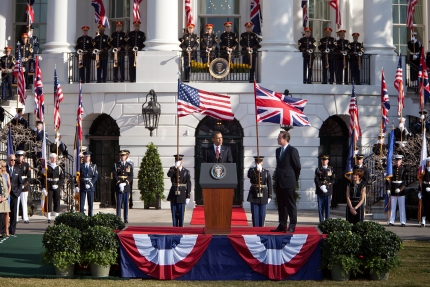
President Barack Obama delivers remarks during an Official Arrival Ceremony (March 14, 2012)

President Barack Obama delivers remarks during an Official Arrival Ceremony on the South Lawn of the White House honoring Prime Minister David Cameron of the United Kingdom and Mrs. Samantha Cameron, March 14, 2012. (Official White House Photo by Sonya N. Hebert)

In a ceremony steeped in tradition, President Obama -- together with the First Lady, the Vice President and Dr. Biden -- welcomed Prime Minister David Cameron and his wife, Samantha, to the White House on behalf of the American people.

The two leaders reviewed the troops assembled as an honor guard for the occasion, acknowledged a few bits of slang each had picked up from the other, and talked about "the rock-solid alliance" between the United States and the United Kingdom.

The President said:

We stand together and we work together and we bleed together and we build together, in good times and in bad, because when we do, our nations are more secure, our people are more prosperous, and the world is a safer and better and more just place. Our alliance is essential -- it is indispensable -- to the security and prosperity that we seek not only for our own citizens, but for people around the world.

That was a sentiment echoed by the Prime Minister:

The partnership between our countries, between our peoples, is the most powerful partnership for progress that the world has ever seen. That is why whenever an American President and a British Prime Minister get together, there is a serious and important agenda to work through. And today is no different. Afghanistan, Iran, the Arab Spring, the need for trade, for growth, for jobs in the world economy, the biggest issues in the world -- that is our agenda today.

Watch video from the ceremony here. And check in throughout the day for more about the official visit.


The White House

Office of the Press Secretary

Joint Fact Sheet: The U.S.-UK Partnership for Global Development

In May 2011, President Obama and Prime Minister Cameron reaffirmed our mutual commitment to improving the lives of the world’s poorest people through the U.S.-UK Partnership for Global Development.  Through the Partnership, we are working together to achieve better results by advancing economic growth; preventing conflict in fragile states; improving global health, particularly for girls and women; strengthening mutual accountability, transparency, and measurement of results; and mitigating the effects of climate change. 

We have followed through on these commitments in multiple ways, through coordinated development cooperation at a country level, joint responses to new and emerging crises, and combined advocacy efforts to strengthen international action.

Economic Growth - Inclusive economic growth, driven by a strong private sector, is vital for reducing poverty.  The UK is actively supporting the U.S. 2012 Presidency of the G8, which will focus on food security, agriculture, and nutrition.  In 2013, the UK will host the G8 with active support from the U.S.  We will achieve the financial pledges we made at the 2009 L’Aquila G8, and reaffirm the commitment we made then to the Rome Principles for collective global action. We will take concrete steps to strengthen food security in Africa, working with African countries, other development partners, and especially the private sector. We will encourage investments in agricultural development and large scale interventions to promote inclusive economic growth and alleviate hunger.

Conflict and Fragility - In 2011, the Horn of Africa faced a major humanitarian crisis caused by drought in Kenya, Ethiopia, and Somalia. The U.S. and UK, as the two largest bilateral donors, have been in the vanguard of a major international response to meet the needs of 13.3 million affected people – focusing resources and attention on immediate needs, building resilience, and strengthening long-term development to improve self-sufficiency.  Jointly, we are co-sponsoring a donor event in March 2012 to improve resilience in the Horn of Africa and have established a ministerial-level “Resilience Political Champions Group” to sharpen the political commitment to helping countries become more resilient to the increasing number and severity of natural disasters.

At the Fourth High Level Forum on Aid Effectiveness in Busan, the U.S. and UK endorsed a New Deal for Engagement in Fragile States.  Through its implementation, we are working with the Government of Afghanistan and others to develop progress measures for reforms, which can provide a basis for our assistance, and are coordinating closely to address fragility during the transition through promoting sustainability and inclusive economic growth.  We are developing other pilots in South Sudan and Liberia. 

Global Health, Girls and Women - Investment in reproductive, maternal, and newborn health saves lives and is highly cost effective.  In June 2011, at the Global Alliance for Vaccines and Immunization Replenishment Conference, the U.S. and the UK worked together to secure commitments that exceeded GAVI’s $3.7 billion request by $500 million.  The funds pledged will allow GAVI to immunize more than 250 million children in the world’s poorest countries by 2015, preventing more than 4 million premature deaths.

The U.S. and the UK continue to provide strong support to the Global Fund for AIDS, Tuberculosis, and Malaria, honoring our significant financial pledges, encouraging new donors, and supporting its new leadership, strategy, and reform plan.

As key members of the Alliance for Reproductive, Maternal, and Newborn Health, we are working to accelerate progress in ten focus countries that account for the majority of maternal and neonatal mortality worldwide.  Consistent with the Alliance’s 2011 progress report, the UK will host a major international event in July to galvanize support for increasing women’s access to family planning.  The U.S. and UK are also serving together on the Steering Committee for the Child Survival Call to Action to end preventable child deaths in this generation.  

Aid Effectiveness - The U.S. and UK recognize the catalytic role that effective development cooperation plays in alleviating poverty and are committed to getting value for money for our taxpayers.  In Busan we supported a range of major international commitments to strengthen the effectiveness of development efforts, and the U.S. joined the UK as a signatory of the International Aid Transparency Initiative.

Linked to this, the U.S. and UK worked with seven other countries to establish the Open Government Partnership (OGP) in 2011.  The U.S. currently chairs the OGP with Brazil, and the UK will take over the U.S. co-chair in April 2012.  This innovative partnership between governments and civil society commits governments to new levels of transparency and accountability to result in better responsiveness and services for their citizens.  Over 50 countries have already signed up.

Climate Change - Climate change threatens to reverse the progress we’ve made in reducing poverty, as it is the world’s poorest who are among the most vulnerable to a changing environment.  Both the U.S. and UK continue to support scaling-up actions and mobilizing finance, both public and private, for initiatives to reduce emissions resulting from deforestation and forest degradation in developing countries.  We are also collaborating closely to increase resilience of communities to climate change and supporting the development and deployment of clean energy technologies as part of our collective commitments to global action.

Looking forward - Our partnership remains vibrant and vital.  We remain strongly focused on reducing global poverty and recognize that progress can be accelerated by embracing new partnerships and new innovations. That is why the UK recently joined USAID’s “Saving Lives at Birth” Grand Challenge for Development, to identify and scale up transformative approaches that save the lives of mothers and newborns in rural areas of the developing world at the time of birth.  More broadly, we are building on the substantial progress at Busan and elsewhere in engaging with emerging market countries such as Brazil, Russia, India, and China, and with the private sector, to support the creation of the new Global Partnership and engage these countries in poverty eradication. 

Finally, we continue to maintain our strong commitment to achieving the Millennium Development Goals (MDGs), including co-hosting an annual MDG Countdown event at the UN General Assembly to showcase excellent results and progress towards each of the MDGs.  We are actively participating in international and intergovernmental discussions on a post-2015 reaffirmation of the importance of ending world poverty and renewal of our international commitment to achieve this. 

The White House

Office of the Press Secretary

Joint Fact Sheet: U.S. and UK Counterterrorism Cooperation

Today, President Obama and Prime Minister Cameron reaffirmed their commitment to continue close bilateral cooperation on global counterterrorism issues.  For decades, and especially since the attacks of September 11, 2001, the U.S. and UK have engaged in unprecedented and unparalleled information-sharing and cooperation to strengthen our joint resolve and effectiveness against terrorist threats.  Many of our joint achievements must remain secret, but we can acknowledge that day-to-day interaction by dedicated U.S. and UK professionals has led to many noteworthy successes, particularly against al-Qa’ida, its affiliates and adherents, saving countless lives.  

Securing the U.S. and UK Homelands:  U.S. and UK cooperation has led to the disruption of multiple terrorist operations planned on U.S. and UK soil.  In 2006, close U.S.-UK cooperation led to the disruption of a large-scale al-Qa’ida plot against transatlantic aviation, which if executed would have had global impact.  Critical information flow between the U.S. and UK governments led to the plotters arrests.  In 2004, UK authorities disrupted a cell plotting to attack the New York Stock Exchange and World Bank headquarters, among other targets, in the United States. 

Protecting Citizens from across the Globe:  Bilateral counterterrorism cooperation has been essential in preventing numerous terrorist attacks over the last decade, including in the United States, Europe, the Middle East, Africa, and South Asia.  Over the last decade, U.S. and UK Forces have seamlessly collaborated on CT-related combat operations, particularly in Iraq and Afghanistan.  Additionally, the U.S. is the UK’s closest foreign partner in helping to ensure a safe and secure Olympic Games in London; the event will attract over 2 million visitors from across the globe.

Safeguarding Global Transit: The U.S. and UK work closely to deter attacks that seek to exploit the global transit and communication system. Joint initiatives that advance transport security, counter piracy, defend cyber space and information systems, and interdict weapons smuggling serve to protect the means by which our increasingly interconnected world operates.  In 2010, for example, British authorities removed from a U.S.-bound cargo plane an explosive device planted by al-Qaida in the Arabian Peninsula that was set to explode over the United States.

Upholding Standards of Law and Order: Bilateral law enforcement and intelligence cooperation has led to arrest and conviction of numerous terrorist operatives and supporters.  Whether it be the 2009 30-year conviction in the U.K. of a terrorist cell leader planning to blow up planes mid flight between the UK and America and Canada or the 2010 apprehension of a British Airways software engineer who was providing support to al-Qa’ida in the Arabian Peninsula attack planning, U.S. and UK law enforcement professionals uphold the highest criminal justice standards as they relentlessly work to protect the public.

Denying Terrorists Safe-Haven: The U.S. and UK share a common understanding of the underlying conditions that terrorists exploit to secure safe-haven.  The governments consult each other regularly and maximize comparative advantages to ensure international development efforts, institution-building and reform initiatives and capacity building including building resilience to counter extremist ideology and undermining violent extremists’ attempts to justify terrorism.  Our foreign assistance programs complement shared objectives and promote stability and security in some of the most difficult terrain around the world, including in Afghanistan, where our forces have been engaged since 2001.  We collaborated to help set up the Global Counterterrorism Forum to mobilize resources and expertise for countries confronting the global threat.  This shared vision was also displayed during the recent UK-hosted Somalia conference, as Secretary of State Clinton worked closely with PM Cameron and international attendees to forge a consensus in support of regional efforts to advance stability and governance in that war-torn country and terrorist safe-haven.

Confronting Emerging Transnational Threats:   In addition to combating terrorism, the U.S. and U.K. are deepening cooperation against transnational organized crime, a significant and growing threat to our national and international security.  Last July, the U.S. and U.K. coordinated the simultaneous release of their respective strategies on transnational organized crime, focusing on  targeting major transnational criminal networks, combating the increase in kidnapping for ransom, and severing the linkages between crime and terrorism.

The White House

Office of the Press Secretary

Joint Fact Sheet: U.S.-UK Progress Towards a Freer and More Secure Cyberspace

Today, President Obama and Prime Minister Cameron reaffirmed the vital partnership between our two nations on cybersecurity.  Recognizing there are few areas where partnership across borders is more urgent or necessary, the President and Prime Minister noted with satisfaction the deep level of cooperation that exists between the United States and the United Kingdom in ensuring networked technologies continue to empower our societies and economies, and those around the globe.

At the same time we remain focused on the threats to a global cyberspace and to the rights of its users.  As a handful of governments use cyberspace to oppress their citizens and prevent access to legitimate political speech, we will continue to cast light on these activities.  We condemn in the strongest terms Syria and Iran’s unilateral actions to deprive citizens of their rights to freely seek and impart information on-line, and reaffirm our commitment to safeguarding the free flow of information and the exercise of these fundamental freedoms, wherever they are threatened.

President Obama and Prime Minister Cameron further agreed that protecting our economies must also begin in the example we set at home.  Economies built to last must encourage innovation; strengthen the security and reliability of the global internet; and fully leverage the expertise of the private sector, civil society, and academia in making sound Internet and technology policy.

We have made significant progress in advancing this vision:

  1. We affirm that the digital world cannot be a lawless frontier, and commend states that are increasingly recognizing their role in promoting a just and peaceful order.  We support the growing consensus around international norms of behavior in a networked world, and the contribution the United Kingdom’s November London Conference on Cyberspace played in this regard.  It was the start of a focused and inclusive dialogue between all those with a stake in the Internet, and where most states present agreed that efforts to improve cybersecurity must not come at the expense of human rights like freedom of expression and association, which apply with equal force online as well as off.  The President and the Prime Minister look forward to further progress being made at the Conference on Cyberspace in Budapest later this year, and in Seoul in 2013.
  2. We share an abiding commitment to keeping cyber-criminals from victimizing our citizens and weakening our trust in networked technology.  Owing in part to our close partnership, it is harder than ever before for criminals to operate in cyberspace with impunity.  To further strengthen the rule of law in cyberspace, both nations are now party to the Budapest Convention on Cybercrime, and will work actively with other nations as they undertake the accession process.  The United States and United Kingdom enjoy a model international partnership, as authorities including the U.S. Federal Bureau of Investigation and the UK Serious Organised Crime Agency work together to detect and prevent fraud, exploitation, and other types of on-line crime.
  3. We recognize that today, our economic security and network security are inextricable; therefore, we must do a better job of sharing cybersecurity information between industry and our two governments, while continuing to safeguard the privacy and civil liberties of citizens that are the hallmarks of open and democratic societies.  In the UK a new project is underway that enables companies in key sectors of the economy to exchange and act on cyber threat information, and to work with each other and government to develop long term cybersecurity solutions.  In the U.S., Federal agencies are building trusted relationships with critical sectors for sharing cyber threat information founded upon sound information handling policies and oversight. In addition, the Obama Administration has proposed a new statutory framework to further facilitate the exchange of cyber threat information between the public and private sectors, with strong protections for privacy and civil liberties. The Administration is committed to working with Congress to see such legislation enacted.
  4. As two of the world’s most networked nations, we cannot lose sight of our obligation to carry the benefits of this technology to individuals the world over, especially its poorest, as a commitment to their future.  The United States and United Kingdom are committed to enhancing connectivity and building capacity through our diplomacy, international aid, and other projects abroad.  Just a few examples include the U.S.-hosted 2011 East African Community cybersecurity workshop in Nairobi, an international conference Department for International Development (DfID) will host later this year on the use of new technologies and social media to promote greater transparency and accountability between governments and citizens, and our active promotion of the Open Government Partnership.
  5. We cannot be secure in cyberspace without sharing with one another the knowledge of the threats we face, and our policies for confronting them.  As the United States and the United Kingdom continue developing joint capabilities that support our national security interests in cyberspace, we are sharing more and more incident data to help us and our allies counter advanced persistent threats.  We are also actively testing our National Cyber Incident Response plans through joint exercises; and this year we will step up our joint planning across government in order to anticipate and prepare for future challenges in cyberspace.
  6. Finally, we recognize that we must stay one step ahead of cybersecurity threats by investing in cutting-edge research, and pooling our resources across borders.  To help ensure our nations remain at the forefront of the information economy, the United States and the United Kingdom have launched a trilateral initiative with Australia to fund new research and development for improved cybersecurity.  The international partners will jointly request research proposals, conduct joint reviews, and provide coordinated funding and support to pull-through of the resultant technologies.

The White House

Office of the Press Secretary

Joint Fact Sheet: U.S. and UK Defense Cooperation

Today President Obama and Prime Minister Cameron reaffirmed their commitment to continue close cooperation on defense as the United States and United Kingdom build their Armed Forces for the future. The U.S. and UK share an unprecedented defense relationship that has helped secure our shared interests and values since the World Wars of the last century.  We have developed unparalleled military interoperability and interconnectedness, working together to meet the challenges of the Cold War, leading in NATO, and fighting side-by-side in defense of global interests. At every level of our defense establishments British and American service men and women train together, learn together, develop capability together and, when called upon, fight together. 

Standing Together: British and American forces routinely operate side-by-side across a wide range of operations. A century of shared battlefield experience has led to a level of interoperability and familiarity that is unique in its breadth.  This is exemplified in Afghanistan today where the U.S. and UK are the two largest contributors to ISAF, and our Armed Forces are working together to degrade the insurgency and to train and mentor the Afghan Forces to provide security in Afghanistan.  For example, in Helmand province the U.S. Marines’ Task Force Leatherneck and the UK-led Task Force Helmand are working together to deliver stability.   

British and American exchange personnel routinely deploy on operations with their host units.  For example, British air transport pilots flew with the U.S Air Force in Haiti earthquake relief operations, and British F-18 pilots are currently flying operational missions from the USS Stennis. U.S. Marine Corp exchange officers have deployed on operational tours to Afghanistan with their host British units, in some cases in a command position, and the U.S. Air Force has a long tradition of exchanging pilots on transport, aerial refueling, and combat aircraft with Royal Air Force units.  

Training, Learning, and Developing Together:  The ability of American and British forces to operate on the battlefield effectively is due in large part to the close-knit and constant training and exchange opportunities undertaken together.  As close Allies, the U.S. and UK host each other's forces in order to conduct training, be prepared to forward-deploy when necessary, and in many cases conduct current operations.  The U.S. currently has over 9,000 personnel permanently stationed in the UK, primarily on shared Royal Air Force (RAF) bases such as RAF Lakenheath and Mildenhall, where U.S. units conduct fighter, transport, and aerial refueling operations.  The Joint Analysis Center (JAC) at RAF Molesworth is a prime example of cooperation, where U.S. and British analysts monitor the world’s trouble spots together.  All four U.S. services send exchange officers to work with the British services, and exchange both junior and senior military officers with British defense schools. 

The UK currently stations over 800 British personnel in the U.S., conducting a wide variety of activities from conducting RPAS (Remotely Pilot Air Systems) operations in Afghanistan from Creech AFB, Nevada, to working side by side with American colleagues on major acquisition projects such as the Joint Strike Fighter and C-17 projects, to working with U.S. counterparts on cyber and space cooperation.  Approximately 200 British officers are on exchange with the American services to develop joint approaches to develop capability and increase interoperability.

During the month of March, 2012, alone, 1,100 UK military personnel will take part in 10 training exercises with U.S. forces across the country, to include a detachment from the Royal Regiment of Artillery participating in an adventure training expedition near the Grand Canyon, a squadron of Royal Air Force (RAF) GR4 Tornadoes conducting live-fire heavy weapons training in Arizona, and an RAF squadron participating in a Red Flag exercise at Nellis AFB, Nevada. 
           
The U.S. and UK routinely entrust their best and brightest NCO's and officers to each other's academies, military schools, and units to gain experience and insight into the other partner's way of doing business.  Exchanging military personnel ensures a cadre of individuals in each military that understands their counterparts and cross-fertilizes the best each nation has to offer in ideas and doctrine.  Also during March a senior British officer, Gen Richard Shirreff, will conduct a speaking tour at West Point, Ft. Leavenworth, and the Pentagon as part of the yearly Kermit Roosevelt Speaking seminar, a tradition between the British and American Armies that dates back to 1948.  U.S. General Robert Cone is reciprocating later in the year at the British Ministry of Defence, the Land Forces headquarters, and the Royal Military Academy at Sandhurst.

Today the UK also has a wide range of senior personnel serving in advisory or command positions in U.S. Headquarters, including the Deputy Commander of the 1st Infantry Division, senior planning staff at CENTCOM, and senior liaison positions in NORTHCOM, CENTCOM, CYBERCOM, PACOM and STRATCOM.  British officers also serve as faculty at West Point and the Naval War College.  Similarly, U.S. officers serve with the British military in multiple advisory levels, attend British defense schools, and are integrated into British combat units, sometimes in command positions.  

Collaborating for the Future: The President and the Prime Minister agreed that both defense departments will continue to push for increased interoperability across the spectrum of military operations after today’s operations come to an end.  The U.S. Defense Strategic Guidance and UK Strategic Defence and Security Review reached many common conclusions, including the need for increased cooperation in dealing with the threats we face. We are committed to working together, and with other close allies, wherever possible. 

 Navy - Secretary Panetta and Secretary Hammond recently signed a Statement of Intent directing the U.S. and Royal Navies to seek ways to better develop aircraft carrier doctrine and maritime power projection capabilities. 

 Land - We will also seek to develop similar initiatives to enhance the already close ground force relationship though increased training opportunities in Europe and unit exchanges in the U.S.

• Air - The UK is a tier-one partner in the development of the Joint Strike Fighter - a unique program in which each country’s defense industries are sharing in the development of a common platform that will ensure the U.S., UK, and other partners own the cutting edge in air superiority for the next generation.

• Cyber - The U.S. and UK, along with other capable nations, are working together to protect vital information infrastructure from cyber attack. We are committed to building our interoperability in this vital new space, building on a Memorandum of Understanding signed in 2011.  

 Space – The UK and U.S. will work with other partner nations to explore the potential for collaboration and information sharing in this expanding realm of activity.

 Management of defense – Both countries are committed to ensuring that our Armed Forces have what they need for the future, are given the support they and their families deserve, while maximizing the value of the resources spent on defense. There are many areas where we can work together to make this happen, ranging from our Service Personnel Task Force, to work on future energy requirements, science and technology, to nuclear sharing.

Leading Together: The United Kingdom and United States stand shoulder to shoulder with each other to deter and, if required, defeat threats to our common way of life.

The President and Prime Minister agree that there are new opportunities to strengthen this relationship further.  With new strategic circumstances come new reasons to cooperate.  We cannot afford to miss these opportunities.  Both countries recognize that many of the problems that we both face cannot be solved alone.

By working together more closely, we set an example to others and provide a basis for further collaboration with our Allies and partners, including through NATO, in the years to come.