The White House

Office of the Press Secretary

Remarks by the President at a Campaign Event

Private Residence
Houston, Texas
March 9, 2012

8:52 P.M. CST
 
THE PRESIDENT:  Well, it is wonderful to see all of you here today.  I just want to, first of all, obviously thank Tony and Dina.  They have been great friends for a very long time.  In fact, the first time I met Tony, I was still in law school and Tony was an alum, and he came back to law school and he was a big cheese, and important, and -- but he was willing to shake my hand and -- (laughter) -- couldn't really pronounce my name -- (laughter.)  But he was very nice to me, and I will never forget that.  And we've been great friends ever since.  So I'm so grateful to him.
 
I want to acknowledge somebody who has also been a good friend for a long time and did a lot of work for this -- Rodney Ellis, outstanding state senator.  (Applause.)  State Representative Garnet Coleman is in the house.  (Applause.)
 
And so many of you -- as we were looking around the room, folks here, there are folks who, first Houston event, second Houston event -- (laughter) -- I mean, I've just got -- they're dispersed throughout the crowd.  But we just have a lot of good friends here.
 
And I also want to acknowledge, by the way, Mayor White is here, and the -- (applause) -- just want to thank him for the great work that he has done.
 
I want to spend most of my time just interacting and answering questions.  So I'm going to keep my remarks at the top relatively brief. 
 
We've obviously gone through three of the toughest years that any of us can recall -- worst financial crisis, worst economic crisis in our lifetimes.  And yet, three years later, we can look then and look now and say to ourselves that we have made progress.  When I took office, we were losing 800,000 jobs a month.  We found out last month that we created another 233,000 jobs, which gets us close to 4 million jobs created over the last two years -- (applause) -- the strongest manufacturing growth since the 1990s. 
 
We're obviously still in the midst of a lot of struggles for a lot of people, but the trend lines are good.  And the reason is because so many of you believed in the same vision that I believe in:  an America where if you work hard, if you take responsibility, if you're willing to apply yourself, you can make it if you try here, no matter what you look like, no matter where you come from, no matter what your name.  And that was the premise of our campaign back in 2008.  Part of what I think allowed us to be successful against some very long odds was, at its core, our campaign reaffirmed our basic faith and confidence and optimism in America. 
 
And it's that optimism that has carried me through these difficult three years, because everywhere I go I meet people who, despite hardship, despite losing a job, despite a plant closing in town, people are resilient and they come back and they're not willing to quit or say no.  And that's what's really carried me through.  And because of that enormous decency at the core of the American people, I'm confident that we're going to be able to keep moving over the next year, the next five years, the next 10 years, the next 20 years.
 
But our ability to bounce back and then thrive is also going to depend on some choices that we make right now.  And as important as 2008 was, I think this election is even more important.  Because very rarely are you going to see such a stark choice about how one party sees the country and where we need to go and how the other party sees the country and where we need to go. 
 
I strongly believe that we're going to have to invest in American manufacturing.  I was at a plant today, in Virginia, where they make the jet engines for Boeing.  And we're starting to set up pilot programs around the country where we're connecting universities with manufacturers, community colleges with businesses, bringing scientists and engineers together, to make sure that we're innovating and making things and building things right here in America.  I don't want a country where we're just consuming.  I want a country where we're building and we're selling stuff.
 
And that requires the private sector taking the lead, but it also requires investments in research and science and education, making sure we've got the engineers that are needed for us to compete.  And that's something that, historically, has been an important role of government.  But we've got a party that somehow believes that those investments are unimportant -- despite the fact that's what made us into an economic superpower. 
 
I believe that we've got to make sure that our K-12 education system works.  (Applause.)  And that's not just a function of money, it's a function of reform.  And we've initiated bolder reforms on education than at any time in the last 20, 30 years.  Forty-six states have revamped their education system so that we're holding schools more accountable, we're asking them to make sure that they're thinking about students first, but we're also giving them the resources to train their teachers and succeed, and to teach more creatively, not just teach to the test.  That involves us making an investment.  That involves us being involved.
 
Same thing when our kids get to college.  There's actually more tuition debt now than there is credit card debt.  And one of the things we're very proud of over the last three years is we revamped our student loan programs to free up $60 billion to make college more accessible to young people all across the country. 
 
The other -- you don't hear much in the debates of the other party right now about education.  In fact, I don't think it's been mentioned.  And yet, nothing is going to be more significant in whether or not we can compete in the 21st century.  There's a stark choice there.
 
When it comes to energy -- Texas is an energy state.  And over the last several weeks, I've had to remind people we actually have higher production now in oil than at any time in the last eight years.  We are starting to tap into the natural gas resources of this country that could provide energy for 100 years.  But we only have 3 percent of the world's oil reserves, which means that we're going to have to focus on efficiency.  And when we double fuel-efficiency standards on cars, that's not bad for the oil industry, but it does make sure that American businesses and American families are going to be able to keep on going even as demand goes up in China and India and Brazil and other places. 
 
And we've got to invest in clean energy -- solar and wind and biodiesel.  It's not an either/or, it's a all-of-the-above strategy in order for us to free ourselves from dependence of the -- on foreign oil and the winds of what happens in the Middle East.  That's a choice.
 
We've got a choice that we're going to have to make about the deficit, and how we solve that problem and bring down our debt.  And the fact of the matter is, is that we've already made more discretionary cuts than had been proposed by the Bowles-Simpson commission.  We have cut programs that aren't working to make sure that we're funding those that do.  We're revamping and reforming government so it's more efficient.  I'm prepared to make some significant reforms on entitlements to ensure that they're there for future generations. 
 
But even after we've done all that, it's not going to work unless those of us in this room also agree that we've got to make sure that we're doing our fair share.  Because the tax rate right now is the lowest it's been in 50 years, and we disproportionately benefit from that.  So the idea of shared responsibility, which has been rejected by the other side, you know what, I think that's central to who we are.  And if we're going to get a handle on this thing, it's just basic math -- we can't just do one side of the equation, we've got to deal with both sides of the equation, both revenues and spending.  (Applause.)
 
So whether it's health care, whether it's the role of women, whether it's how serious we're going to take immigration reform and making sure we're a nation of laws and a nation of immigrants, whether it's foreign policy and whether we have -- whether we continue the course that we've set over the last three years, which says, we're going to go after those who would do us harm, but we also understand that our security doesn't just depend on our military, it depends on the respect we're held in the world and how we reach out diplomatically and whether we're helping other countries feed themselves and prosper -- on each of these issues there is a stark choice. 
 
And here's the good news:  I am absolutely confident that our vision about where America needs to go is shared by the American people.  Not 100 percent -- this is a big, diverse, complicated country, and the democratic debate is always messy.  But when you travel to town halls, or VFW halls, or churches or synagogues, or -- wherever you go around the country, what you'll find is a common belief that everybody should get a fair shot, everybody should do their fair share, everybody should play by the same set of rules, and that we're stronger together than we are when we're apart.  And those basic principles, I think, are consistent with what we fought for in 2008.  And they are the foundation for my campaign in 2012.
 
And so if you're with me in pursuing that vision -- we've gotten a lot of stuff done over these last three and a half years, but I'd say I've got about five more years to finish the job.  (Applause.)
 
So, all right.  Thank you, everybody.
 
END                    
9:03 P.M. CST

President Obama Speaks on Manufacturing

March 09, 2012 | 22:23 | Public Domain

President Obama speaks at a Rolls-Royce jet engine manufacturing plant about the importance of a strong American manufacturing industry that creates good jobs for workers making products that can be sold all over the world.

Download mp4 (214MB) | mp3 (21MB)

Read the Transcript

President Obama to Announce New Efforts to Support Manufacturing Innovation, Encourage Insourcing

Administration Proposes New National Network to Support Manufacturing, Takes Immediate Action to Create a Pilot Manufacturing Institute

On Friday, President Obama will continue to highlight the successful trend of insourcing – companies from around the world bringing jobs back and making new investments here in the United States – at the Rolls-Royce Crosspointe jet engine disc manufacturing facility in Prince George County, Virginia. The President’s Blueprint for An Economy Built to Last lays out a number of ways we can encourage insourcing, support investment in our manufacturing sector, and create good jobs here in the United States, and today’s announcements build on those efforts.

The President will announce a new proposal for a National Network for Manufacturing Innovation, to build a network of up to fifteen Institutes for Manufacturing Innovation around the country, serving as regional hubs of manufacturing excellence that will help to make our manufacturers more competitive and encourage investment in the United States. The President’s Budget proposes a $1 billion investment to create this new National Network for Manufacturing Innovation.

The President will also announce that the Administration will take immediate steps to launch a pilot institute for manufacturing innovation as part of its We Can’t Wait efforts. The pilot institute will be funded from $45 million of existing resources from the Departments of Defense, Energy, and Commerce and the National Science Foundation, and will be selected from a competitive application process.

The Rolls-Royce Crosspointe jet engine disc manufacturing facility the President will visit is an example of how insourcing means companies from around the world are creating new, good paying jobs here at home. The company is planning to add 140 new jobs at Crosspointe and more than 100 additional jobs in Indiana manufacturing components for commercial aircraft engines. Crosspointe is a center of advanced manufacturing and innovation that demonstrates collaboration can spur American jobs and competitiveness.

BACKGROUND ON TODAY’S ANNOUNCEMENTS:

Over the past two years, the U.S. manufacturing sector has added more than 400,000 jobs, the first period of sustained job growth since the 1990s. The President’s proposals to revitalize American manufacturing build on that momentum and recognize that a growing and vibrant manufacturing sector is central to our ability to innovate, to export, and to create good-paying American jobs. Over the previous decade manufacturing production and investment stalled, and we lost ground to our competitors. To create an economy that is built to last, we must ensure that the next generation of products are not only invented here, but manufactured here as well.

To meet this challenge the President will announce a new $1 billion proposal, the National Network for Manufacturing Innovation. The President’s proposal will catalyze a network of up to fifteen Institutes for Manufacturing Innovation around the country. The Institutes will bring together industry, universities and community colleges, federal agencies, and our states to accelerate innovation by investing in industrially-relevant manufacturing technologies with broad applications to bridge the gap between basic research and product development, provide shared assets to help companies – particularly small manufacturers – access cutting-edge capabilities and equipment, and create an unparalleled environment to educate and train students and workers in advanced manufacturing skills. Each Institute will serve as a regional hub of manufacturing excellence, providing the innovation infrastructure to support regional manufacturing hubs and ensuring that our manufacturing sector is a key pillar in an economy that is built to last. This model has been successfully deployed in other countries and represents a gap in the U.S. manufacturing innovation infrastructure that the President’s proposal will address.

The Institutes will each have a well-defined technology focus to address industrially-relevant manufacturing challenges on a large scale and to provide the capabilities and facilities required to reduce the cost and risk of commercializing new technologies. While the Institutes would be competitively selected, several areas of innovation illustrate the opportunities that this proposal could help to realize:

  • Developing lightweight materials, such as low-cost carbon fiber composites (CFC's), that will improve fuel efficiency, performance, and corrosion resistance of the next generation of automobiles, aircraft, ships and trains.
  • Refining standards, materials, and equipment for “3-D printing”(also known as additive manufacturing) to enable low-cost, small batch production using digital designs that can be transmitted from designers located anywhere.
  • Creating a smart manufacturing infrastructure and approaches that lets operators make real-time use of “big data” flows from fully-instrumented plants in order to improve productivity, optimize supply chains, and improve energy, water, and materials use.

The new National Network for Manufacturing Innovation will work to leverage new investment from industry, state and local government, and the research community. This initiative will be a collaboration between Commerce’s National Institute of Standards and Technology, the National Science Foundation, the Department of Defense, and the Department of Energy.

The President also announced the launch of a pilot institute with an initial federal investment of $45 million from the Department of Defense, Department of Energy, Department of Commerce, and the National Science Foundation. The pilot will demonstrate the type the collaboration planned for the National Network for Manufacturing Innovation. The pilot will be selected through a competitive process that uses existing resources and fits within the agencies’ statutory missions, using current funding and authorities, while addressing key challenges faced by the U.S. manufacturing sector.

The pilot institute will address a focused technology area to reduce the risk and cost of commercializing and scaling-up new manufacturing products and processes. At least $30 million in total funding from the Departments of Defense, Energy and Commerce will support investments in advanced manufacturing equipment and research activities, $5 million in funding from NSF will support basic research in advanced manufacturing and the workforce development component of the pilot, in part under the NSF Advanced Technological Education program, and $10 million in funding from the Department of Defense will support scaling-up production of technologies developed from the pilot institute in support of critical national defense needs. This approach reflects a unique degree of inter-agency coordination around a shared goal to promote the President’s manufacturing agenda without need for Congressional action.

Crosspointe demonstrates the potential for supporting U.S. manufacturing through this type of collaboration model. Later this summer, the Commonwealth Center for Advanced Manufacturing (CCAM) will open its doors, an applied research center developed in partnership between eight companies including Rolls-Royce, the state of Virginia, three leading Virginia universities, and an investment from Commerce’s Economic Development Administration. CCAM, like the proposed Institutes, bridges the gap from basic research to product development and supports the skills needed for an advanced manufacturing workforce.

Close Transcript

The White House

Office of the Press Secretary

President Obama Signs Indiana Disaster Declaration

The President today declared a major disaster exists in the State of Indiana and ordered Federal aid to supplement state and local recovery efforts in the area affected by severe storms, straight-line winds, and tornadoes during the period of February 29 to
March 3, 2012.

The President's action makes federal funding available to affected individuals in the counties of Clark, Jefferson, Ripley, Scott, Warrick, and Washington.
 
Assistance can include grants for temporary housing and home repairs, low-cost loans to cover uninsured property losses, and other programs to help individuals and business owners recover from the effects of the disaster.
Federal funding is also available on a cost-sharing basis for hazard mitigation measures statewide.
 
W. Craig Fugate, Administrator, Federal Emergency Management Agency (FEMA), Department of Homeland Security, named Gregory W. Eaton as the Federal Coordinating Officer for federal recovery operations in the affected area.
 
FEMA said additional designations may be made at a later date if requested by the state and warranted by the results of further damage assessments.
 
FEMA said that residents and business owners who sustained losses in the designated counties can begin applying for assistance tomorrow by registering online at http://www.DisasterAssistance.gov or by calling 1-800-621-FEMA(3362) or 1-800-462-7585 (TTY) for the hearing and speech impaired. The toll-free telephone numbers will operate from 7 a.m. to 10 p.m. (local time) seven days a week until further notice.

The White House

Office of the Press Secretary

Remarks by the President at a Campaign Event

Minute Maid Park
Houston, Texas

6:58 P.M. CST

THE PRESIDENT:  Hello, Texas!  (Applause.)  Oh, it is good to be back in Houston.  (Applause.)  The weather wasn’t quite cooperating.  (Laughter.)  But we got here.  And so did you.

We've got some wonderful folks here, but first of all, can everybody please give Debra Jones a big round of applause for the wonderful introduction.  (Applause.) 

We have in the house your outstanding Mayor, Annise Parker.  (Applause.)  We've got Congressman Gene Green.  (Applause.)  We've got Congressman Al Green.  He's the one who taught me how to sing.  (Laughter.)  We've got Congresswoman Sheila Jackson Lee.  (Applause.)  And we have all of you.  (Applause.)

It is good to be in this facility.  As a White Sox fan, I have fond memories of this facility.

AUDIENCE:  Booo -- (laughter.)

THE PRESIDENT:  I want to thank Jim Crane for helping to make it available.  And I want to thank all of you for being part of this thing here today. 

AUDIENCE MEMBER:  I love you!

THE PRESIDENT:  I love you back.  (Applause.)

So I'm here today not just because I need your help.  I’m here because the country needs your help.  There was a reason why so many of you worked your hearts out back in 2008.  It wasn’t because you thought it was going to be easy.  After all, you decided to support a candidate named Barack Obama.  (Applause.)  You knew that wasn’t going to be a sure thing.  (Laughter.)  

You didn’t join the campaign just because of me.  You joined it because of your commitment to each other.  You joined it because you had a common vision for America.  Not a vision where everybody is left to fend for themselves; it was a vision where everyone who works hard has a chance to get ahead -- not just those at the very top, but everybody. 

That’s the vision that we shared.  That’s the change that we believed in.  And we knew it wouldn’t come easy.  We knew it wouldn’t come quickly.  We knew problems had been building up for decades.  But, I tell you what, in just three years, because of what you did, we've begun to see what change looks like.  (Applause.)  

Change is the first bill I signed into law that says women deserve an equal day’s pay for an equal day’s work.  (Applause.) Our daughters should be treated just the same and have the same opportunities as our sons. 

Change is the decision that we made that Debra alluded to, to rescue the American auto industry, save it from collapse, even when some politicians were saying let’s let Detroit go bankrupt. With 1 million jobs on the line, I wasn’t going to let that happen.  And today, GM is back as the number automaker in the world, reporting the highest profits in its history.  (Applause.) And with 200,000 new jobs created in the last two and a half years, the American auto industry is back.  (Applause.)  That's what change is.  That happened because of you.  (Applause.)

Change is the decision that we made to stop waiting for Congress to do something about our oil addiction and finally raise our fuel-efficiency standards.  And by the next decade, we will be driving American-made cars that are getting 55 miles a gallon, and that saves American families about $8,000 at the pump.  (Applause.)  That’s what change is.   That happened because of you.  

Change is the fight we won to stop handing over $60 billion in taxpayer subsidies to banks in the student loan program, give that money directly to students, and as a consequence millions of young people all across the country are getting help that they didn't have before.  (Applause.)

AUDIENCE:  TSU loves you!  (Applause.)

THE PRESIDENT:  We’ve got TSU in the house.  (Applause.)

Change is the fact that for the first time in history, you don’t have to hide who you love in order to serve the country you love -- "don't ask, don't tell" is over.  (Applause.)

And, yes, change is health care reform that we passed after a century of trying.  (Applause.)  This is reform that makes sure that nobody in this country goes bankrupt just because they get sick.  And already 2.5 million young people have health insurance today that did not have it before because this law lets them stay on their parent's plan.  (Applause.)  Because of this law, preventive care is now covered.  And, yes, that includes preventive care for women -- checkups, mammograms, birth control. (Applause.) 

We fought for this because the top doctors, the medical experts in the country said this kind of preventive care saves women’s lives.  We fought for it because we know it saves money. It’s a lot cheaper to prevent an illness than to treat one.  So when you see politicians who are trying to take us back to the days when this care was more expensive and harder to get for women -- and I know you’re seeing some of that here in Texas -- you just remember we can't let them get away with it.  We fought for this change.  (Applause.)   We’re going to protect this change.  It’s the right thing to do.  (Applause.)

And change is keeping another promise I made in 2008.  For the first time in nine years, we do not have any Americans who are fighting in Iraq.  (Applause.)  We refocused our efforts on the terrorists who actually attacked us on 9/11.  And thanks to our brave men and women in uniform -- and there are a lot of servicemembers and a lot of veterans in the great state of Texas -- al Qaeda is weaker than it’s ever been and Osama bin Laden will never again walk the face of this Earth.  (Applause.)

None of this has been easy.  We’ve got a lot more work to do.  There's still too many Americans out there looking for work; still too many families struggling to pay the bills or make the mortgage.  We’re still recovering from the worst economic crisis of our generation -- or many generations.  But over the past two years, businesses have added almost 4 million new jobs.  (Applause.)  Our manufacturers are creating jobs for the first time since the 1990s.  Our economy steadily has been getting stronger.  The recovery is accelerating.  America is coming back. And the last thing we can afford do is go back to the same policies that got us into this mess in the first place.  (Applause.)

Of course, that’s exactly what the other folks running for this office want us to do.

AUDIENCE  Booo --

THE PRESIDENT:  They think you all have amnesia.  (Laughter.)  They think you’ve forgotten how we got into this mess.  They want to go back to the days when Wall Street played by its own rules.  They want to go back to the days when insurance companies could deny you coverage or jack up your premiums without any reason.  They want to go back to spending trillions of dollars more on tax breaks for the wealthiest individuals -- folks like me -- even if it means adding to the deficit, or gutting education, or gutting investments in clean energy, or gutting Medicare.  They’re philosophy is simple:  We’re better off when everybody is left to fend for themselves.

Let me tell you something:  They are wrong.  In the United States of America, we’re always greater together than we are on our own.  (Applause.)  We’re better off when we keep that basic American promise where if you work hard, you can do well enough to raise a family or own a home, start your own business, send your kids to college, put a little away for retirement; maybe someday own the Astros.  (Applause.)  That’s the choice we face in this election.

Look, we want everybody to succeed.  We want everybody to do well -- not just a few but everybody to have that chance.  That’s what America’s about.  No matter where you come from, no matter what you look like, if you are willing to work hard, if you are willing to roll up your sleeves, you can make it.  That’s the American way.

And this is not just another political debate -- this is the defining issue of our time.  This is a make-or-break moment for middle-class families and everybody who’s trying to get into the middle class.  We can go back to an economy that’s built on outsourcing and bad debt and phony financial profits; or we can fight for an economy that’s built to last. 

And that’s what we’ve been talking about for the last three years:  an economy built on American manufacturing and American energy and the skills that American workers need, the education that our kids deserve, and the values that always made this country great -- hard work and fair play and shared responsibility; everybody, from top to bottom, everybody pitching in. 

And you know what?  That’s actually what everybody wants to do.  When you hear some of these political debates -- poor people want to work hard, they want to find a job.  Wealthy people -- they believe in this country, they want to give back.  But we’ve gotten into this pattern where our politics divide us and pushes us apart.  We need to make sure that the next generation of manufacturing takes root not in Asia, not in Europe, but right here.  In Detroit and Pittsburgh and Cleveland and Houston.  (Applause.)  We don’t want to be a nation -- nobody should want us to be known for just buying and consuming things.  We want to build things, make things, invent things, sell things all around the world -- which is why we need to stop giving tax breaks to businesses that ship jobs overseas.  Let’s reward companies that are creating jobs right here in the United States of America.  (Applause.)

We've got to make our schools the envy of the world, and that starts with the men and women in front of the classroom.  An interesting statistic:  A great teacher can increase the lifetime incomes of a classroom by over $250,000.  Just one teacher.  (Applause.)  So I don’t want folks bashing teachers.  I don't want folks defending the status quo.  I want us to give the schools the resources they need to recruit and keep good teachers on the job, to reward the best ones.  (Applause.)

Let’s grant schools the flexibility to teach with creativity and passion.  Stop teaching to the test.  (Applause.)  Replace teachers -- train our teachers, and those who aren’t helping our kids learn, we’re going to have to replace.

And when kids do graduate, the most daunting challenge is affording the cost of college.  Right now Americans owe more in tuition debt than credit card debt.  So this Congress -- and I know these members of Congress agree with me here -- we’ve got to stop the interest rates on student loans from doubling in July.  (Applause.)  And colleges and universities have to do their part. If they can’t stop tuition from going up, then there should be some penalties because -- because taxpayers are willing to help young people, but ultimately colleges and universities have got to do their part, too.  Higher education can’t be a luxury; it’s an economic imperative that every family in America should be able to afford.  (Applause.)
An economy that's built to last is one that supports our scientists and our researchers that are trying to make the next breakthrough, invent the next product, discover the next source of clean energy right here in the United States of America.

You know, Houston -- this is an oil town.  And that's good. We need oil.  And we’ve got a high production of oil right now.  When you hear folks saying, oh, Obama is not supporting oil production -- we’ve got the highest production we’ve had in eight years.  (Applause.)  We’re opening up millions of acres to new production; got more rigs than the entire world combined right here in the United States.

But we don't need to subsidize oil companies when they're doing this well.  (Applause.)  So what I’ve said is rather than continue a hundred years of taxpayer subsidies to an industry that’s very, very profitable, let’s double down on our investments in clean energy industry.  It’ never been more promising.  (Applause.)  That will create jobs in Texas -– solar power and wind power, biofuels.  (Applause.)  We want an all-of-the-above strategy.  Yes, oil.  Yes, gas.  Yes, solar.  Yes, wind.

AUDIENCE MEMBER:  Yes, we can.

THE PRESIDENT:  Yes, we can.  (Applause.)  We can do it. 

We've got to rebuild our infrastructure.  I’m biased, I want America to have the best stuff.  I want us to have the best roads, the best airports, the fastest railroads, the quickest Internet access.  So I said let’s take the money that we’re no longer spending in Iraq, let’s use half of it to pay down our debt.  Let’s use the rest to do some nation-building right here in Houston, right here in Texas, right here in the United States of America.  (Applause.)

And let’s make sure our tax system has everybody doing their fair share.  I called for something called the Buffett Rule:  If you make more than $1 million a year, you should not pay a lower tax rate than your secretary.  (Applause.)   And you know what, most folks who've done well, they agree.  They understand.  They understand that folks making $250,000 a year or less -- 98 percent of American families -- can't see their taxes going up.

AUIDENCE MEMBER:  That's right.

THE PRESIDENT:  You agree with that.  (Laughter.)   But folks like me, we can afford to do a little bit more if it means protecting our kids and making sure that we’re investing in the future.  This isn’t class warfare.  This isn’t about envy.  This is -- this is just basic math.   (Applause.)  Because if somebody like me gets a tax break that I don’t need, that I wasn’t asking for and that the country can’t afford, then one of two things happens:  Either it adds to our deficit, or it’s going to take something away from somebody else.  From a student -- suddenly their college tuition gets more expensive.  Or a senior citizen who suddenly is paying higher on their prescription drugs.  Or a veteran who desperately needs help to recover from sacrificing on our behalf. 

That's not right.

AUDIENCE MEMBER:  It ain't right! 

THE PRESIDENT:  Not only is it not right, it ain't right.  (Laughter and applause.)  That's not who we are as Americans. 

You hear a lot of politicians during election years, they talk about values.  Well, look, I agree, we should be talking about what are our values as Americans.  Hard work -- that’s a value.  Looking out for one another -- that’s a value.  (Applause.)  The idea that we’re all in this together, as Debra said, that I am my brother’s keeper, I am my sister’s keeper -- that's a value.  (Applause.)  

Everybody here, whatever success we have, it's because someone, somewhere, took responsibility not only for themselves but also for their kids, for their neighborhood, for their church, for their community, for our country’s future.  Our American story has never been just about what we can do on our own.  It’s about what we can do together.  (Applause.)  We're not going to be able to compete around the world, win the race for new jobs and businesses, and creating -- recreating middle-class security with the same old you-are-on-your-own economics.  It doesn’t work.  It didn’t work when it was tried right before the Great Depression.  It didn’t work when we tried it in the last decade.  Why would we think it would work now?  That's another example of amnesia some of these folks have.  (Laughter.) 

We tried what they're peddling; it did not work.  You understand that.  Look, let me give you just some examples.  You know if we attract an outstanding teacher to the profession by giving her the pay and respect and support that she deserves, and that teacher then goes on and educates the next Steve Jobs, we all benefit.  (Applause.)  If we provide faster Internet to some rural town in Texas, so suddenly that storeowner in that little town can start selling his goods all around the country and all around the world, we benefit.  The economy benefits.  America benefits.  If we build a new bridge that saves a shipping company time and money, workers, customers, that business, everybody -- we all do better. 

This isn't a Democratic idea or a Republican idea.  It was a Republican President, Abraham Lincoln, who launched the Transcontinental Railroad, the National Academy of Sciences, and the first land grant colleges in the middle of a Civil War.  It was a Republican, Teddy Roosevelt, who called for a progressive income tax.  Dwight Eisenhower built the Interstate Highway System.  Republicans helped FDR pass the law that gave millions of returning heroes, including my grandfather, the chance to go to college on the G.I. Bill.  (Applause.)  

This should not be a partisan idea.  And you know what, that same spirit of common purpose that lies at the heart of America, it’s still there.  It might not be there in Washington. but out in America, it’s there.  It’s there where you talk to people in main streets or town halls or VFW halls.  It’s there when you talk to the members of our Armed Forces.  If you go into a church or a synagogue or a mosque, you’ll find out people are supporting each other and believe in the notion of everyone pulling together.

Our politics may be divided, but most Americans understand that we’re in this together.  No matter who we are or what we look like, where we come from, what our names are, we rise and fall as one nation and as one people.  (Applause.)  And that’s what’s at stake right now.  That’s what this election is all about. 

I know it’s been a tough few years.  I know the change that we fought for hasn’t always come as fast we’d like.  And after all that’s happened in Washington, sometimes it may be tempting to start feeling cynical again and think maybe change isn’t possible.  But I want you to remember what we used to say during the last campaign.  We didn’t promise easy.  You never heard me say change was easy.  Real change -- big change -- is hard.  It takes time.  It takes more than a single year, a single term.  It will take more than a single President. 

What it really requires is ordinary citizens, all across the country, committed to fighting and pushing and inching this country, step by step, closer to common ideals, our highest ideals. 

You know what else I said in 2008?  I said I’m not a perfect man; I didn’t promise I’d be a perfect President.  But what I promised you was that I would always tell you what I thought, I’d always tell you where I stood, and I would wake up every single day fighting as hard as I could, fighting as hard as I know how, for you.  (Applause.)  And I’ve kept that promise.  I have kept that promise, Texas.  (Applause.)  

So if you’re willing to keep working with me and marching with me and standing with me, pushing through the obstacles to reach for that vision that you hold in your hearts, change will come.  (Applause.)  If you’re willing to work as hard in the next election as you did in the last election, change will come.  We’ll finish what we’ve started in 2008. 

God bless you.  God bless the United States of America.  (Applause.)  Thank you.

END               
7:21 P.M. CST 

The White House

Office of the Press Secretary

Readout of the President’s Call with President-Elect Putin

President Obama called Russian President-elect and Prime Minister Putin to congratulate him on his recent victory in the Russian Presidential election.  President Obama highlighted achievements in U.S.-Russia relations over the past three years with President Medvedev, including cooperation on Afghanistan, the conclusion and ratification of the START agreement, Russia’s recent invitation to join the World Trade Organization (WTO) and cooperation on Iran.  President Obama and President-Elect Putin agreed that the successful reset in relations should be built upon during the coming years.  The President said that he looked forward to hosting President-Elect Putin at the G-8 Summit in May at Camp David.  The two leaders outlined areas for future cooperation, including strengthening trade and investment relations arising out of Russia’s pending accession to the WTO. President Obama and President-Elect Putin agreed to continue discussions on areas where the United States and Russia have differed, including Syria and missile defense. President Obama and President-Elect Putin agreed to continue their efforts to find common ground and remove obstacles to better relations.

President Obama Talks About How to Boost Innovation in Manufacturing

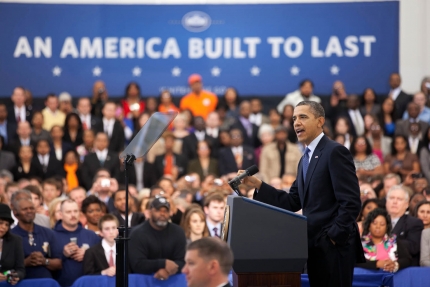
President Barack Obama delivers remarks on the economy in Petersburg, VA (March 9, 2012)

President Barack Obama delivers remarks on the economy after touring the Rolls-Royce Crosspoint facility in Prince George County, Va., March 9, 2012. (Official White House Photo by Chuck Kennedy)

On a day when we received another strong jobs report -- private employers added 233,000 jobs in February, marking the 24th straight month of job growth  -- President Obama headed to Petersburg, Virginia to talk about additional steps we can take to continue boosting the economy. 

Manufacturing is one of the sectors helping to lead the recovery, and today American factories are adding jobs for the first time since the 1990s. That's a valuable trend, and President Obama is doing everything in his power to support it.

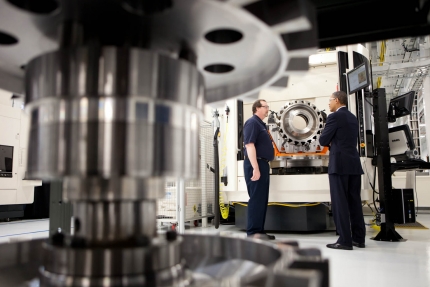
President Barack Obama tours the Rolls-Royce Crosspoint facility (March 9, 2012)

President Barack Obama tours the Rolls-Royce Crosspoint facility in Prince George County, Va., March 9, 2012. President Obama viewed a machine cutting titanium into airplane engine parts used on the Boeing 787 Dreamliner. (Official White House photo by Chuck Kennedy)

Through an initiative called the Advanced Manufacturing Partnership, the President has convened some of the leading minds in science, education, and industry with a goal of ensuring that products that change the world are invented and assembled right here in the United States. In Petersburg, he discussed his plans to build on their work:

I’m laying out my plans for a new National Network of Manufacturing Innovation–-and these are going to be institutes of manufacturing excellence where some of our most advanced engineering schools and our most innovative manufacturers collaborate on new ideas, new technology, new methods, new processes.

The President is investing $45 million in a pilot program aimed at promoting collaboration between government and industry in order to encourage innovation in manufacturing: 

With that pilot in place, we’ll keep on pushing Congress to do the right thing because this is the kind of approach that can succeed, but we’ve got to have this all across the country. I want everybody thinking about how are we making the best products; how are we harnessing the new ideas and making sure they’re located here in the United States.

To learn more, read the President's full remarks.

Weekly Wrap Up: Unbreakable Bonds

A quick look at what happened this week on WhiteHouse.gov:

A Special Bond: Addressing the AIPAC Policy Conference in Washington, D.C. on Sunday, the President reaffirmed the strength of our relationship with Israel, discussing both countries’ mutual interests, the importance of securing peace between Israelis and Palestinians, and the actions his Administration has taken to support Israel. The President’s statements at the conference were followed by a meeting with Israeli Prime Minister Benjamin Netanyahu at the White House on Monday. Speaking to reporters before sitting down for the meeting, the President noted, “As I’ve said repeatedly, the bond between our two countries is unbreakable.”

An Important Milestone: On Thursday, President Obama welcomed Prime Minister Abdurrahim ElKeib of Libya to West Wing—marking the first White House visit from a Libyan prime minister in nearly 60 years. At the meeting, President Obama applauded Dr. ElKeib’s leadership and encouraged his government continue making progress with the country’s democratic transition.

Mutually Beneficial Partnership with Ghana: In 2009, Ghana was one of the first nations to host the President and First Lady Michelle Obama. On Thursday, the President returned the favor, welcoming the President of Ghana, John Atta Mills, to the White House to discuss the growing commercial and economic ties between the two nations. The President outlined a number of initiatives in which both countries are working together—“[The] President’s government recently is collaborating with a number of American businesses to build infrastructure inside of Ghana, which will create thousands of jobs here in the United States. And the trade that we engage in creates jobs for tens of thousands of people back in Ghana.”

The White House

Office of the Press Secretary

President Obama Announces More Key Administration Posts

WASHINGTON, DC – Today, President Barack Obama announced his intent to nominate the following individuals to key Administration posts:

  • Arthur Bienenstock – Member, National Science Board, National Science Foundation
  • Paula Gangopadhyay – Member, National Museum and Library Services Board
  • Luis Herrera – Member, National Museum and Library Services Board
  • Suzanne E. Thorin – Member, National Museum and Library Services Board
  • Dorothea-Maria (Doria) Rosen – Ambassador to the Federated States of Micronesia, Department of State
  • Katherine C. Tobin – Governor, Board of Governors of the United States Postal Service

The President also announced his intent to appoint the following individual to a key Administration post:

  • Sonny Ramaswamy – Director, National Institute of Food and Agriculture, Department of Agriculture

President Obama said, “These dedicated individuals bring a wealth of experience and talent to their new roles and I am proud to have them serve in this Administration.  I look forward to working with them in the months and years to come.”

President Obama announced his intent to nominate the following individuals to key Administration posts:

Dr. Arthur Bienenstock, Nominee for Member, National Science Board, National Science Foundation
Dr. Arthur Bienenstock is Special Assistant to the President for Federal Research Policy, Director of the Wallenberg Research Link, and Professor Emeritus of Photon Science at Stanford University.  Dr. Bienenstock has served as President of the American Physical Society, Chair of the Council of Scientific Society Presidents, and Vice Provost and Dean of Research and Graduate Policy at Stanford University from 2003 to 2006.  From 1997 to 2001, Dr. Bienenstock served as Associate Director for Science of the Office of Science and Technology Policy (OSTP).  In the 20 years prior to joining OSTP, Dr. Bienenstock directed the Stanford Synchrotron Radiation Laboratory at the SLAC National Accelerator Laboratory.  From 1963 until 1997, he maintained an active research group in the general areas of solid-state physics, amorphous materials and synchrotron radiation. He has published over 100 scientific papers in these areas.  Dr. Bienenstock received his B.S. and M.S. from the Polytechnic Institute of Brooklyn and his Ph.D. from Harvard University.

Paula Gangopadhyay, Nominee for Member, National Museum and Library Services Board
Paula Gangopadhyay is the Chief Learning Officer at The Henry Ford, where she is responsible for leadership, strategy, and education.  Ms. Gangopadhyay has held a variety of positions in education and arts policy, including Executive Director of the Plymouth Community Arts Council from 2006 to 2008; Curator of Education, Public Programs, Visitor Services and Volunteers at the Public Museum of Grand Rapids from 2002 to 2006; and Executive Director of the Great Lakes Center for Education, Research and Practice from 2000 to 2001. She was Executive Director of the Commission for Lansing Schools Success from 1998 to 2000 and Executive Director of Meridian Historical Village from 1995 to 1998.  Ms. Gangopadhyay has served as a member of many state and national boards, including the Michigan Humanities Council.  Ms. Gangopadhyay received her B.A. and M.A. from Indore University, and her post-graduate certification in archival, museum and editing studies from Duquesne University.

Luis Herrera, Nominee for Member, National Museum and Library Services Board
Luis Herrera is the City Librarian of the San Francisco Public Library, where he is responsible for the administration of the city’s 28 libraries. Previously, Mr. Herrera served as the Director of Information Services for Pasadena Public Library, the Deputy Director of the San Diego Public Library and Associate Director of the Long Beach Public Library in California.  In January 2012, Mr. Herrera was named the Library Journal’s Librarian of the Year. Mr. Herrera serves as Chair of the California Council for Humanities and was appointed to serve on the Steering Committee for the Digital Public Library of America in 2011, and served on the Library Advisory Board of the Bill and Melinda Gates Foundation from 1998 to 2002.  Mr. Herrera earned his B.S. from the University of Texas at El Paso, an M.L.S. from the University of Arizona, and an M.P.A. from California State University.

Suzanne E. Thorin, Nominee for Member, National Museum and Library Services Board
Suzanne E. Thorin is the Dean of Libraries and University Librarian at Syracuse University, a position she has held since 2005. She is a member of the Chancellor’s Cabinet and also oversees the Syracuse University Press.  Previously, Ms. Thorin was the Ruth Lilly University Dean of Libraries and Associate Vice President for Digital Libraries at Indiana University.  She was formerly Chief of Staff to the Librarian of Congress and the official U.S. representative for the G-7 electronic libraries project, one of eleven G-7 pilot projects for the Global Information Society.  Ms. Thorin received a B.Mus. from North Park University in Chicago and an M.M. from the University of Michigan, Ann Arbor.

Dorothea-Maria (Doria) Rosen, Nominee for Ambassador to the Federated States of Micronesia, Department of State
Dorothea-Maria (Doria) Rosen, a career member of the Senior Foreign Service, currently serves as the Diplomat-in-Residence for the Midwest region, based out of the University of Illinois at Chicago.  Prior to this position, she was the Deputy Principal Officer in Frankfurt, Germany.  From 2004 to 2008, Ms. Rosen served as the Consul General in Bern, Switzerland.  From 2001 to 2004, she was Deputy Chief of Mission in Reykjavik, Iceland.  Other overseas positions include: Visa Branch Chief in Frankfurt, Germany (1996-1999); Nonimmigrant Visa Chief in Manila, Philippines (1994-1996); Political Military Officer in Berlin, Germany (1991-1994); Consular Officer in Accra, Ghana (1989-1991); Deputy Chief Immigrant Visa Section in Seoul, South Korea (1988-1989); and Vice Consul in Stuttgart, Germany (1983-1986) and Bucharest, Romania (1981-1983).  In Washington, Ms. Rosen has served as Director of the Office of Public and Diplomatic Liaison in the Bureau of Consular Affairs (1999-2001) and as an analyst in the Bureau of Intelligence and Research (1986-1988).  Prior to entering the Foreign Service, Ms. Rosen served as an Army Reservist from 1979 to 1981.  From 1976 to 1979, she served on active duty in the U.S. Army Judge Advocate General’s Corps in Heidelberg, Germany.  She holds an A.B. from Vassar College and a J.D. from Hofstra University Law School.  

Dr. Katherine C. Tobin, Nominee for Governor, Board of Governors of the United States Postal Service
Dr. Katherine C. Tobin served as Deputy Assistant Secretary for Performance Improvement at the Department of Education from May 2009 to February 2011.  From 2006 to 2009, Dr. Tobin was a member of the U.S. Postal Service Board of Governors, where she was Chairman of the Board’s Audit and Finance Committee.  She was a Senior Market Research Manager at TNS from 2003 to 2005 and at Catalyst, a nonprofit working to advance women in business, from 1998 to 2003.  In 1994, she founded the Leadership Institute, LLC, which advised corporations on market research and management issues.  Earlier in her career, Dr. Tobin worked in management and development for a diverse group of educational and corporate institutions, including Manhattanville College, the University of Nevada, Stanford University, and Hewlett-Packard.  Dr. Tobin earned a B.A. from Skidmore College, a M.A. from the University of Massachusetts’ School of Education, and a M.A. and Ph.D. from Stanford University’s School of Education.

President Obama also announced his intent to appoint the following individual to a key Administration post:

Dr. Sonny Ramaswamy, Appointee for Director, National Institute of Food and Agriculture, Department of Agriculture
Dr. Sonny Ramaswamy is Dean of the College of Agricultural Sciences at Oregon State University and Director of the Oregon Agricultural Experiment Station. Previously, Dr. Ramaswamy was Associate Dean of the Purdue University College of Agriculture and directed the University's agricultural research programs from 2006 to 2009.  Prior to joining the Purdue faculty, Dr. Ramaswamy was head of the Department of Entomology at Kansas State University from 1997 to 2006, where he held the title of Distinguished Professor.  He also served on the faculty of Mississippi State University, was a research associate at Michigan State University, and is a fellow of the American Association for the Advancement of Science and the Entomological Society of America.  Dr. Ramaswamy received a B.S. and M.S. in Entomology from the University of Agricultural Sciences in Bangalore, India, and a Ph.D. in Entomology from Rutgers University.

The White House

Office of the Press Secretary

Remarks by the President on Manufacturing and the Economy

Rolls-Royce Crosspointe
Petersburg, Virginia

12:57 P.M. EST
 
THE PRESIDENT:  Hello, Virginia!  (Applause.)  Thank you so much.  Thank you, everybody.  Wow, what a unbelievable crowd.  Everybody, please have a seat -- if you have one.  (Laughter.)
 
Well, thank you, James, for that rousing introduction and letting me hang out a little bit with your workers.  We’ve got a few other folks I want to acknowledge:  The Governor of the great Commonwealth of Virginia, Bob McDonnell, is here.  (Applause.)  Outstanding Congressman Bobby Scott is in the house.  (Applause.)  We’ve got your Mayor, Brian Moore.  (Applause.)  And I want to very much say thank you to our outstanding Secretary of Commerce, Secretary Bryson, who was here and he is doing great work trying to create jobs and investment and opportunity all across the country.  (Applause.)
 
It is great to be back in Petersburg.  (Applause.)  Last time I was here was during the campaign.  I had my bus pull over so I could get a cheeseburger -- (laughter) -- at Longstreet’s Deli.  (Applause.)  You guys have eaten there.  (Laughter.)  Some of you may think this violates Michelle’s Let’s Move program -- (laughter) -- but she gives me a pass when it comes to a good burger -- (laughter) -- and fries. 
 
Now, back then, in 2008, we were talking about how working Americans were already having a tough go of it.  Folks were working harder and longer for less.  It was getting tougher to afford health care or to send your kids to college.  The economy was already shedding jobs, and in less than a decade, nearly one in three manufacturing jobs had vanished.  Then the bottom fell out of the economy, and things got that much tougher.  We were losing 700,000 to 800,000 jobs a month.  The economy was hemorrhaging. 
 
And three and a half years later, we’re still recovering from the worst economic crisis in our lifetimes.  And we’ve got a lot of work to do before everybody who wants a good job can find one, before middle-class folks regain that sense of security that had been slipping away even before the recession hit, and before towns like Petersburg get fully back on their feet.
 
But here’s the good news:  Over the past two years, our businesses have added nearly 4 million new jobs.  (Applause.)  We just found out that last month in February we added 233,000 private sector jobs.  (Applause.)  More companies are bringing jobs back and investing in America.  And manufacturing is adding jobs for the first time since the 1990s.  (Applause.)  We just had another good month last month in terms of adding manufacturing jobs.  And this facility is part of the evidence of what’s going on all across the country.  This company is about to hire more than 200 new workers -- 140 of them right here in Petersburg, Virginia.  (Applause.)
 
So the economy is getting stronger.  And when I come to places like this, and I see the work that’s being done, it gives me confidence there are better days ahead.  I know it because I would bet on American workers and American know-how any day of the week.  (Applause.)
 
The key now -- our job now is to keep this economic engine churning.  We can’t go back to the same policies that got us into this mess.  We can’t go back to an economy that was weakened by outsourcing and bad debt and phony financial profits.  We’ve got to have an economy that’s built to last.  And that starts with American manufacturing.  It starts with you.  (Applause.)
 
For generations of Americans, manufacturing has been the ticket into the middle class.  Every day, millions clocked in at foundries and on assembly lines, making things.  And the stuff we made -- steel and cars and jet engines -- that was the stuff that made America what it is.  It was understood around the world. 
 
The work was hard, but the jobs were good.  They paid enough to own a home, and raise kids and send them to college, gave you enough to retire on with dignity and respect.  They were jobs that told us something more important than how much we were worth; they told us what we were worth.  They told us that we were building more than just products.  They told us we were building communities and neighborhoods, we were building a country.  It gave people pride about what America was about.
 
And that’s why one of the first decisions I made as President was to stand by manufacturing, to stand by the American auto industry when it was on the brink of collapse.  (Applause.)  The heartbeat of American manufacturing was at stake -- and so were more than a million jobs.  And today, the American auto industry is coming back, and GM is number one in the world again, and Ford is investing billions in American plants and factories.  (Applause.)  And together, over the past two and a half years, the entire auto industry has added more than 200,000 jobs.
 
And here’s the thing.  They’re not just building cars again, they’re building better cars.  For the first time in three decades, we raised fuel standards in this country, so that by the middle of the next decade the cars that are built in America will average nearly 55 miles to the gallon.  (Applause.)  That will save the typical family about $8,000 at the pump over time.  That’s real savings.  (Applause.)  That's real money. 
 
And it shows that depending on foreign oil doesn’t have to be our future.  It shows that when we harness our own ingenuity, our technology, then we control our future.  See, America thrives when we build things better than the rest of the world.  I want us to make stuff here and sell it over there.  (Applause.)  I don't want stuff made over there and selling it over here.  (Applause.)  And that’s exactly what you’re doing here at the largest Rolls-Royce facility in the world.  That’s what you’re doing by building the key components of newer, faster, more fuel-efficient jet engines. 
 
I just took a tour and I learned a bit about how a jet engine comes together.  Don’t quiz me on it.  (Laughter.)  I'm a little fuzzy on some of the details.  (Laughter.)  I did press some buttons back there.  (Laughter.)
 
But a few weeks ago, I actually got to see the finished product.  I went to Boeing, in Washington State, and I checked out a new Dreamliner.  I even got to sit in the cockpit, which was pretty sweet.  I didn’t press any buttons there, though -- (laughter) -- because if it had started going it would have been a problem.
 
So this plane, the Dreamliner, is going to keep America at the cutting edge of aerospace technology.  American workers are manufacturing various components for it in Ohio, and Oklahoma, and South Carolina, and Kansas, and right here in Petersburg.  In fact, the demand for their planes was so high last year that Boeing had to hire 13,000 workers all across America just to keep up.  And Boeing is gaining more and more share all the time. 
 
So think about that.  Rolls-Royce is choosing to invest in America.  You’re creating jobs here, manufacturing components for jet engines, for planes that we’re going to send all around the world.  And that’s the kind of business cycle we want to see.  Not buying stuff that’s made someplace else and racking up debt, but by inventing things and building things and selling them all around the world stamped with three proud words:  “Made in America.”  (Applause.)  Made in America.
 
Think about how important this is.  I mean, imagine if the plane of the future was being built someplace else.  Imagine if we had given up on the auto industry.  Imagine if we had settled for a lesser future.
 
But we didn’t.  We’re Americans.  We are inventors.  We are builders.  We’re Thomas Edison and we’re the Wright Brothers and we are Steven Jobs.  That’s who we are.  That’s what we do.  We invent stuff, we build it.  And pretty soon, the entire world adapts it.  That’s who we are.  And as long as I’m President, we’re going to keep on doing it.  (Applause.)  We’re going to make sure the next generation of life-changing products are invented and manufactured here in the United States of America.  (Applause.)
 
So that’s why we launched an all-hands-on-deck effort.  We brought together the brightest academic minds, the boldest business leaders, the most dedicated public servants from our science and our technology agencies all with one big goal:  a renaissance in American manufacturing.  We called it the Advanced Manufacturing Partnership.  The Advanced Manufacturing Partnership.  And today, we’re building on it.
 
I’m laying out my plans for a new National Network of Manufacturing Innovation –- and these are going to be institutes of manufacturing excellence where some of our most advanced engineering schools and our most innovative manufacturers collaborate on new ideas, new technology, new methods, new processes.
 
And if this sounds familiar, that’s because what you’re about to do right here at Crosspointe.  Later this summer, the Commonwealth Center for Advanced Manufacturing will open its doors.  And it’s a partnership between manufacturers, including this one, UVA, Virginia Tech, Virginia State University -- (applause) -- VSU is a little overrepresented here, obviously --  (laughter) -- the Commonwealth and the federal government.  So think of this as a place where companies can share access to cutting-edge capabilities.  At the same time, students and workers are picking up new skills, they’re training on state-of-the-art equipment; they’re solving some of the most important challenges facing our manufacturers. 
 
You just got all this brain power and skill and experience coming together in this hub, and that makes the whole greater than the sum of its parts.  It allows everybody to learn from each other and figure out how we’re going to do things even better.  It’s going to help get that next great idea from a paper or a computer to the lab, to the factory, to the global marketplace.  And that’s especially important for the one in three Americans in manufacturing who work for a small business that doesn’t always have access to resources like these.
 
Obviously, big companies -- the Boeings, the Intels, the Rolls Royces -- they’ve got the resources, the capital, to be able to create these platforms.  But some of the small to medium-sized businesses, it’s a little bit harder.  So this gives them access and allows them to take part in this new renaissance of American inventiveness.  And we’ve got to build these institutes all across the country -- all across the country.  I don’t want it just here at Crosspointe, I want it everywhere. 
 
To do that, we need Congress to act.  Hmm.  (Laughter and applause.)  It’s true.  (Laughter.)  But that doesn’t mean we have to hold our breath.  We’re not going to wait -- we’re going to go ahead on our own.  Later this year, we’re going to choose the winner of a competition for a pilot institute for manufacturing innovation -- help them get started.  With that pilot in place, we’ll keep on pushing Congress to do the right thing because this is the kind of approach that can succeed, but we’ve got to have this all across the country.  I want everybody thinking about how are we making the best products; how are we harnessing the new ideas and making sure they’re located here in the United States. 
 
And sparking this network of innovation across the country – it will create jobs and it will keep America in the manufacturing game.  Of course, there’s more we can do to seize this moment of opportunity to create new jobs and manufacturing here in America.
 
We’ve got to do everything we can to encourage more companies to make the decision to invest in America and bring jobs back from overseas.  And we’re starting to see companies do that.  They’re starting to realize this is the place with the best workers, the best ideas, the best universities.  This is the place to be.  (Applause.)  We've got to give them a little more encouragement.
 
Right now, companies get tax breaks for moving jobs and profits overseas.  Companies that choose to invest in America, they get hit with one of the highest tax rates in the world.  Does that make any sense?
 
AUDIENCE:  No!
 
THE PRESIDENT:  It makes no sense.  Everybody knows it.  So it's time to stop rewarding businesses that ship jobs overseas; reward companies that create good jobs right here in the United States of America.  That's how our tax code can work.  (Applause.)  That's how our tax code should work.
 
At the same time, we’ve got to do everything we can to make sure our kids get an education that gives them every chance to succeed.  (Applause.)  I’ve been told that last year’s valedictorian at Petersburg High, whose name is Kenneisha Edmonds, she had a pretty good statement.  She said her cap and gown was “the best gown that anybody can hang in their closet."  (Laughter.)  I like that.  So let’s make sure students like Kenneisha have teachers who bring out the best in them.  Let’s make sure if they want to go to college, their families can afford them to go to college.  (Applause.)
 
And let’s make sure all our workers have the skills that companies like this one are looking for -- because we've got to have folks engaged in lifelong learning.  The days when you started out at 20 at one company and you just kept on doing the same thing for 40 years -- that's not going to happen anymore.
 
So even if -- as I was meeting some of the folks here, they had been in the industry, they'd been machinists, they'd been in manufacturing for years.  But they're constantly upgrading their skills and retraining.  And some of them had been laid off and had gone back to school before they came to this company.  And so we've got to make sure those opportunities for people mid-career and onward, that they can constantly go back to a community college and retool so that they can make sure they're qualified for the jobs of tomorrow.
 
At a time when so many Americans are looking for work, no job opening should go unfilled just because people didn’t have an opportunity to get the training they needed.  And that’s why I've asked Congress -- (applause) -- I've asked Congress, join me in a national commitment to train 2 million Americans with the skills that will lead directly to a job -- right now.  (Applause.) 
 
We need to create more partnerships like the one this plant has with John Tyler Community College.  (Applause.)  We should give more community colleges the resources they need.  I want them to be community career centers -- places that teach people skills that companies are looking for right now, from data management to the kind of high-tech manufacturing that's being done at this facility.
 
So day by day, we’re restoring this economy from crisis.  But we can’t stop there.  We've got to make this economy ready for tomorrow.  Day by day, we’re creating new jobs, but we can’t stop there -- not until everybody who’s out there pounding the pavement, sending out their résumés has a chance to land one of those jobs. 
 
Every day we’re producing more oil and gas than we have in years, but we can’t stop there.  I want our businesses to lead the world in clean energy, too.  (Applause.)  We’ve got the best colleges and universities in the world, but we can’t stop there. I want to make sure more of our students can afford to go to those colleges and universities.  (Applause.)  Everybody knows we’ve got the best workers on Earth, but we can't stop there.   We’ve got to make sure the middle class doesn’t just survive these times, we want them to thrive.  We want them to dream big dreams and to feel confident about the future.
 
I did not run for this office just to get back to where we were.  I ran for this office to get us to where we need to be.  (Applause.)  And I promise you we will get there.  (Applause.)   Some of these challenges may take a year; some may take one term; some may take a decade -- but we're going to get there.  Because when we work together, we know what we’re capable of.  We’ve got the tools, we've got the know-how, we've got the toughness to overcome any obstacle.  And when we come together and combine our creativity and our optimism and our willingness to work hard, and if we're harnessing our brainpower and our manpower, our horsepower, I promise you we will thrive again.  We will get to where we need to go.  And we will leave behind an economy that is built to last.  We will make this another American century. 
 
Thank you.  (Applause.)  God bless you.  God bless the United States of America.  (Applause.)
 
END
1:20 P.M. EST

By the Numbers: Two Years

Today’s jobs report shows that private sector employers added 233,000 jobs to their payrolls in February. That means the economy has added jobs for 24 consecutive months—that’s two full years of job growth. More than 3.9 million jobs were added during that time.

These numbers tell the story of our economic recovery from the worst recession since the Great Depression. And although we’re steadily moving in the right direction, these numbers also tell the story of how much work still has to be done to restore the middle class security—and the 8 million jobs—that were lost as a result of the financial crisis.

These numbers are your story, too, whether you’ve found a job or are still looking for one. Maybe you’ve hired new employees for your small business or maybe you’re still waiting for business to pick back up—these numbers tell the story of your progress.

So help us add to the narrative by sharing your story. If you’re a business owner who’s been able to hire new employees in the last two years, tell us when you started hiring and what enabled your business to grow. If you’ve been hired in the past two years, tell us what that job means for you and your family.  And if you’re still looking for work, tell us why it’s so important that we do more than just recover from this crisis, and instead build an economy that offers true security for the middle class.

We’ll use these stories to help illustrate the progress of the last two years and the importance of doing everything we can to continue strengthening our economy and creating jobs in the months and years ahead.

Related Topics: Economy