Press Briefing by Principal Deputy Press Secretary Josh Earnest, 6/10/2014
James S. Brady Press Briefing Room
1:02 P.M. EDT
MR. EARNEST: Good afternoon, everybody. Apologize for the delay. We’re still working out some scheduling kinks here. So we’re going to get better, I promise. Let me do a quick topper here and then we’ll go to your questions.
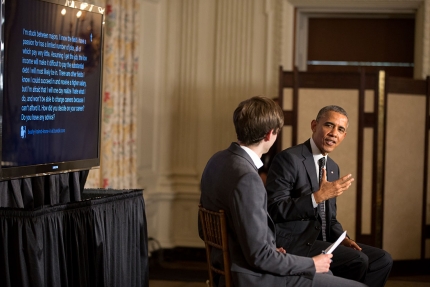
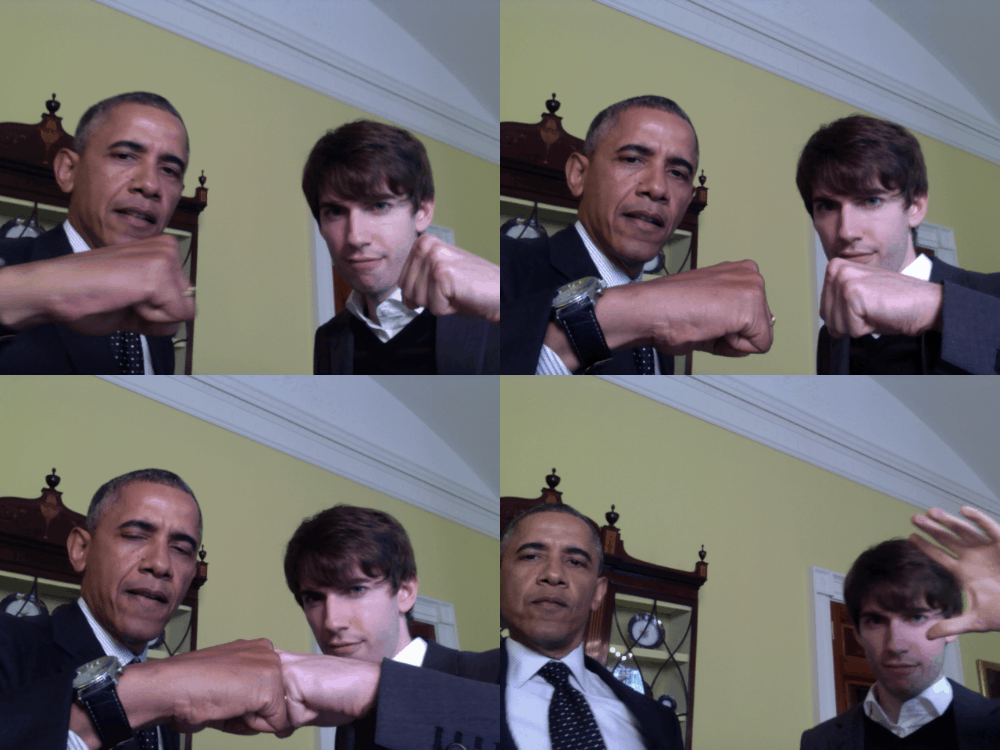
This afternoon, the President will participate in a live Q&A with Tumblr -- no “e” --- (laughter) to continue to talk about the importance of making college more affordable for current students, graduates, and their families, and the new executive actions that he announced yesterday to further that goal. This is the first-ever live White House Q&A with Tumblr, which has a very wide reach among young people. About 40 percent of Tumblr’s more than 350 million monthly users are between the ages of 18 and 34.
This event is part of a weeklong message push the President is doing to highlight the steps he is taking to offer relief to Americans who are working hard to pay back their student loans, and to urge Congress to pass legislation to help more young people save money by refinancing their federal student loans.
Earlier today, our Council of Economic Advisers and Domestic Policy Council released a report showing the impact of crushing student debt on young Americans and our economy, and new data showing how borrowers in each state would benefit from both the President’s executive actions and the Senate Democrats’ bill. For example, in my home state of Missouri, we estimate that over 110,000 additional borrowers would be able to cap their monthly student loan payments under the President’s “Pay As You Earn” proposal.
Our DPC Director, Cecilia Muñoz, and the Secretary of Education, Arne Duncan, will hold a press call on this report later today. And you can contact the press office for more information about how to participate in that call.
So with that, Julie, do you want to get us started with questions today?
Q Thanks, Josh. Five Americans were killed in Afghanistan in what appears to be a coalition airstrike, friendly-fire incident. And I know there was a brief statement from NSC, but I’m wondering if the administration has any more detail on exactly how this happened this morning.
MR. EARNEST: Julie, our thoughts and prayers here at the White House are with the families of those who were killed in Afghanistan earlier today. The Department of Defense is still looking into what exactly happened, and it will be their responsibility to determine what actually led to their deaths. So I’m going to hold off on weighing in any further, pending that investigation of what exactly happened. But it is true that our hearts here at the White House are heavy as a result of this loss.
Q And I assume the President has been briefed on what is known at this point?
MR. EARNEST: The President has been informed.
Q And if we could move to Iraq, Islamic militants have overrun the city of Mosul. What responsibility does the U.S. have to help the Iraqi government regain control there?
MR. EARNEST: Well, let me start by saying that the United States condemns in the strongest possible terms the Islamic State of Iraq and the Levant’s aggression in Mosul. It has led to a serious deterioration of the security situation in that city and in Nineveh Province. ISIL gained strength from the situation in Syria. This threat exemplifies the need for Iraqis from all communities to work together to confront this common enemy and isolate these militant groups from the broader population. The situation is extremely serious, and U.S. officials in both Washington and Baghdad are tracking events closely in coordination with the government of Iraq.
The United States will continue to stand with the Iraqi people and provide all necessary and appropriate assistance to the government of Iraq under the Strategic Framework Agreement to assist it in our common fight against the threat that ISIL poses to Iraq and the broader region.
So, from there, I think you can conclude that this administration is committed to preserving the partnership that we have with the Iraqi government, that there is some assistance that we can provide and have been providing, and we’ll continue to do that. At the same time, we’re also urging the government to take additional steps that will make it clear that they are governing that country with the interests of all Iraqis in mind. And that’s an important priority as well. And that is an important part of countering this violent extremist aggression that we’re seeing in some parts of that country.
Q Can you be more specific about what kind of assistance the U.S. is working on as it relates to this current situation? And again, does the U.S. feel any special responsibility to assist the Iraqi government given our very recent history with Iraq?
MR. EARNEST: Well, I do have some details here. Our shipments, in terms of assistance to Iraq, have included the delivery of 300 Hellfire missiles, millions of rounds of small arms fire, thousands of rounds of tank ammunition, helicopter-fired rockets, machine guns, grenades, flares, sniper rifles, M16s and M4 rifles to the Iraqi security forces.
Q But that’s all before today’s incident, correct? This is not in response to --
MR. EARNEST: That’s right. And what this is -- this is an illustration of the kind of military-to-military relationship we have with the government of Iraq. I mean, in terms of our relationship with them, it’s an important one, but it’s governed by the Status of Forces Agreement Strategic Framework Agreement.
But we’re also in a position to encourage all Iraqi leaders, including Prime Minister Maliki, to do more to address unresolved issues to better meet the needs of all the Iraqi people. And we’re going to continue to work consistently with Iraqi leaders from across the political spectrum to encourage a government that effectively addresses unresolved issues; that like so many things that we are challenged to deal with in terms of American foreign policy, these kinds of solutions don’t have a solely -- or these kinds of challenges don’t have a solely military solution.
So while we can provide important military assistance to improve the security situation in Iraq, addressing these challenges is going to require a commitment by the Iraqi leadership, including Prime Minister Maliki, to confront the kinds of unresolved issues that are facing all of the people in Iraq.
Mark.
Q Continuing on Iraq, is what’s going on there a civil war? Is this is a civil war in Iraq?
MR. EARNEST: Well, that’s not a pronouncement that I would make from this podium. But as I mentioned at the beginning, this is a situation that is very serious and one that we’re concerned about. It is clear that there are some very serious security challenges in Iraq that have deteriorated in an important way recently.
So we’re going to continue our important relationship in terms of providing some security and military assistance to the government of Iraq. But, ultimately, there’s also a responsibility on the part of the Iraqi leaders to step up to the plate here. That includes Prime Minister Maliki to do more to address the unresolved issues and better meet the needs of the Iraqi people.
Q And on the issue of Sergeant Bergdahl, Congressman Greg Walden said that the administration had briefed as many as 90 people within the administration but not a single member of Congress, and complained about that yesterday. Is that an appropriate way to deal with Congress on this issue?
MR. EARNEST: Well, you’re assuming that what he said is accurate. Let me start with this to clarify what exactly that 80 to 90 number refers to. This number originated in a classified briefing that was provided to House members yesterday on the efforts to recover Sergeant Bergdahl. So that 80 to 90 number was then subsequently read out by some House members who had attended at least part of that briefing.
So let me clarify what exactly the administration officials were talking about when they referred to that 80 to 90 people. They were referring to individuals in the administration that had access to intelligence related to the Taliban’s activities in Qatar. Now, you’ll recall that the negotiations that were conducted by the administration to secure the release of Sergeant Bergdahl were facilitated by the Qatar government, that they were essentially the intermediaries in this transaction.
Q Can you say it again, what you just said -- the 80 to 90 people?
MR. EARNEST: That this 80 to 90 people had access to intelligence related to Taliban activities in Qatar.
Q But 85 to 90 did not know about the possible deal?
MR. EARNEST: Well, that’s what I’m getting to here. There was a smaller number of individuals who were aware of specific military actions, including the one related to the transfer of Sergeant Bergdahl out of Taliban captivity and into American custody. And the reason for that is simple: This is a secret military mission in which disclosure of the mission could put into jeopardy not just the life of Sergeant Bergdahl, but also the lives of the American servicemen who were involved in the mission. So discretion on this matter was important, and that’s why the number of people who were aware of this military operation in advance was even smaller than 80 to 90.
Q And different topic entirely -- the President has made his second off-campus outing in as many days today. What’s going on? (Laughter.) Does he have senioritis, as some have suggested?
MR. EARNEST: I think the President thought it was a beautiful day to go out to lunch, and that’s exactly what he’s doing.
Q And joking aside, is it your sense that people will pay more attention to the President when he does off-campus things like this?
MR. EARNEST: Well, I think people pay a lot of attention to what the President does. I don’t think the President is going to lunch with the Secretary of Education to seek attention. I think he is going out to lunch with the Secretary of Education to seek a nice meal.
You’ve heard the President talk a lot himself about his own desire to try to break outside of the White House bubble, to get off the 18 acres that make up the White House complex. And the President has been looking for opportunities to do that recently. There’s no doubt about that. He traveled to a little league baseball game in Northwest Washington, where he stopped off on the way to a political event. The President also recently walked over to the Department of the Interior when he had a public event over there and he had the opportunity to greet some tourists who happened to be in town.
These were events that the President genuinely enjoyed. He was pleased to have the chance to get outside of the bubble a little bit and to shake some hands and to visit with some folks. And that’s something that he enjoys doing, it’s something that he -- it’s one of the things that he enjoyed a lot about the campaign, both his first campaign for President but also his reelection campaign, was that it afforded him the opportunity to spend a lot of time with -- outside of the gates of the White House. And we’re looking -- he’s looking for opportunities to do more of that now, and that’s what he’s doing.
Q Doesn’t the bubble go with him, Josh? (Laughter.)
MR. EARNEST: To a certain extent, it does. But there’s a difference between sitting in the Oval Office and being able to go out to a restaurant or somewhere else and have the chance to shake hands and bump into people, and to sort of be off of a specific, regimented schedule that does govern a large portion of his day. But my sense is, is that the reason that the President goes out to lunch with a colleague -- in this case, the Secretary of Education -- is for many of the same reasons that you yourself might choose to go out to lunch with one of your colleagues.
Michelle.
Q Given what we’ve just been talking about concerning Congress notification and Bergdahl, do you think that there’s a concern that what has happened here has eroded or will erode support among Democrats in Congress?
MR. EARNEST: No.
Q Okay. One other quick question.
MR. EARNEST: How about that for a direct answer, huh? (Laughter.)
Q I love it. It’s great. Does this administration trust Congress?
MR. EARNEST: Sure. (Laughter.) Look, it only goes so far, right? Let me elaborate on that. This administration has demonstrated on a variety of topics a commitment to consulting with Congress. There is a responsibility that Congress has that’s laid out in the Constitution of the United States to advise and consult the executive branch on a wide range of topics -- everything from presidential appointments to the appointing of federal judges and, in some cases, matters relating to national security.
The responsibility to communicate and coordinate and consult with Congress is one that this administration takes seriously. And there was a lot of conversation about this last summer -- that the President believes that our foreign policy priorities are strengthened when there is a public demonstration of a bipartisan commitment to those priorities. So we seek opportunities to work in collaborative fashion with Democrats and Republicans on a range of issues, including national priorities -- national security priorities that the President himself has identified.
Q And we were just talking about Americans killed overseas -- well, a lot of Americans have been killed in the last few days and weeks on American soil. And the President really wanted to -- I think it was in the State of the Union, he pledged to do something about guns, even without Congress. So do you feel like those executive actions have really done anything? And is there a plan to try to do more? I don’t know what exactly, but something.
MR. EARNEST: Well, at the beginning of last year, at the beginning of 2013, the administration did roll out 23 specific executive actions. These were steps that the President and Vice President identified where specific administrative action that could be pursued by the administration could have a positive impact in trying to reduce gun violence. We’ve, I think, been pretty upfront about two things. One, that those administrative actions were in no way a substitute for robust congressional action. There are a number of commonsense measures that have strong bipartisan support that could be taken to reduce gun violence without infringing on Second Amendment rights that the President is committed to defending.
Secondly, even that robust congressional action is not going to prevent every single terrible thing from happening. And there is no doubt that there has been an alarming frequency of tragic incidents of gun violence that are concerning to Democrats and Republicans in Washington but, more importantly, to people all across the country.
And so I think the question is not what can we do to make sure that something like this never, ever happens again. There are going to be other tragedies. But the question I think really facing lawmakers right now is, what commonsense steps can Democrats and Republicans take to reduce the likelihood of gun violence? And there are some, and they have unfortunately been bottled up in Congress. And that is a disappointment to the President.
But that is not going to stop the President from continuing to push for administrative steps that we could take that could reduce incidents of gun violence, and continue pushing Congress to take action on commonsense steps that, again, would reduce gun violence but also protect the Second Amendment rights that so many Americans across the country hold dear and that the President himself personally believes in.
Let’s move around just a little bit. Carrie.
Q So, on Bergdahl, you suggested that the White House does trust Congress. But wasn’t the decision in this case a clear example or evidence that you actually don’t -- this White House does not trust Congress?
MR. EARNEST: No, I don’t think so. I mean, Congress was consulted on efforts to secure Sergeant Bergdahl’s release, and there are any number of Democratic and Republican members of Congress who have said as much.
Q But you didn’t loop them in -- my understanding was for this --
MR. EARNEST: Sure we did.
Q But not far enough ahead of time where if it could have gotten out it might have endangered what happened.
MR. EARNEST: I think it is a wise decision when the President himself last week said that he made no apologies for closely holding the details, the precise operational details of a secret military mission. The President makes no apologies for that. That was necessary for the -- to protect, or at least reduce the danger faced by Sergeant Bergdahl and by the American servicemen who were on this mission to secure his release. So I think that was a prudent step that Presidents of both parties have adopted to protect the operational details of secret military missions.
Q Just to follow up on that question of how many people knew about the mission itself -- you said a smaller number than 80 or 90 or whatever you said. What is that? A dozen? Two dozen? Less than that?
MR. EARNEST: I would resist the temptation to hazard a guess.
Q But that’s a big range between 90 and less than that.
MR. EARNEST: Well, it’s an indication, though --
Q Can you give us anything else to --
MR. EARNEST: I recognize it may or may not be double digits, but I do think that it is an indication, though -- (laughter) -- it is an indication, though, of how closely held these precise operational details were. And that is not uncommon. Again, if you have -- if you’re going to put servicemen and women in harm’s way on a secret military mission, making phone calls and -- making a lot of phone calls around town, it doesn’t seem like a very prudent measure. And, again, this is --
Q But it’s --
MR. EARNEST: Let me finish. This is akin to decisions that have been made by Democratic and Republican Presidents of previous administrations, too. This is not unique just to this Commander-in-Chief.
Q But, Josh, if I can follow up right on that, the question is not how many people were briefed on these specifics of where and when you were picking up Bergdahl -- that’s frankly irrelevant. The question is how many people were briefed on the fact that the White House had made a decision to have the deal to exchange Bergdahl for five Taliban prisoners. How many of the 90 -- was it all of the 90 -- knew that the White House had decided this was going to go forward? Not when and where they were picking him up in Pakistan or in Afghanistan.
MR. EARNEST: Well, I guess I’m not sure I entirely understand your question.
Q My question is very simple: How many in the administration were briefed on the fact that the administration decided to make this exchange -- Taliban detainees at Gitmo for Bergdahl?
MR. EARNEST: I think you’re trying to separate two things that’s difficult to separate.
Q (Inaudible.)
MR. EARNEST: Not really, because the exchange occurred in the context of this secret military mission. By spending a lot of time talking about the fact that a decision like this had been made to send some servicemen and women to go and secure the release of Sergeant Bergdahl requires the disclosure of the military mission to do so.
Q We don’t know where it’s going to take place, you don’t know what -- I mean, we had all these years -- we didn’t know where Bergdahl was, right? Did we? I mean, telling someone you’ve made a decision to make this deal doesn’t say where the military operation is going to be or even the precise timing of it. That’s an entirely separate question.
MR. EARNEST: Again, I think it’s difficult to separate these two things, because the decision to move forward to secure his release necessarily involves a secret military mission. So again, I’m not sure that you can draw a distinction between those two things.
Q Couldn’t you tell Congress that you were making a decision to do this trade without telling them exactly where it was going to take place and how it was going to take place?
MR. EARNEST: You don’t think they would have asked?
Q I think they would have said -- I do not think that would have been the biggest question.
MR. EARNEST: Well, that’s not what my experience with Congress is. Maybe yours has been a little different than mine.
Q Well, which member of Congress is asking for operational details? I haven’t heard any member of Congress ask for operational details.
MR. EARNEST: Let’s just make one other thing clear -- and I think that this is also important -- that there had been a number of consultations between senior administration officials and relevant congressional leaders about this proposed swap; that there have been a number of conversations over the years about this possibility.
Q And Congress didn’t like the idea of the exchange.
MR. EARNEST: Some of them didn’t, some of them did -- right? Senator McCain, when he was being interviewed on a television network, indicated that this was a proposal that he’d strongly consider. So there were differing opinions among members of Congress. They’re certainly entitled to those opinions. Some of them are more informed than others, but they’re entitled to those opinions.
Ultimately, the President and his opinion is the one that carried the day as it should, because of his commitment to this longstanding principle that American servicemembers are not going to get left behind.
Q Now, Speaker Boehner today said that the Congress was briefed six months before the bin Laden raid and multiple times before the operation took place, including a heads-up days before it happened. Is that correct?
MR. EARNEST: Well, I’m not going to get into the detailed conversations that may or may not have taken place between this administration and Speaker Boehner. But let me try to -- I think that is a useful example, so let’s talk about it.
What you saw in advance of the bin Laden operation was consultation between this administration and relevant members of Congress about some of the intelligence that had been gathered about bin Laden’s possible whereabouts -- that that was something that was the source of a number of conversations between the administration and leaders in Congress.
However, when the decision was made to launch a mission to bring Osama bin Laden to justice, Congress was not notified. Again, these were precise operational details of a secret military mission that had to be kept secret.
Q So the Speaker didn’t get a heads-up days before?
MR. EARNEST: The Speaker was not informed of precise operational details of a secret military mission. He had been part of conversations. I believe that he was among those members of Congress. There were members of Congress -- I don’t know whether or not it included Speaker Boehner. If he says it includes him, then I don’t know of a reason to disagree with him. But there were senior members of Congress who were informed about this intelligence that had been gathered about bin Laden’s whereabouts, but they were not notified in advance of the precise operational details of that secret military mission.
The reason that this is important is that is a good indication of our procedure when handling these kinds of situations -- right? That you had -- as it relates to Sergeant Bergdahl, Congress was consulted on more than one occasion over the last several years about our efforts to secure his release, and that included the discussion of a possible prisoner exchange. But when the decision was made to execute that exchange in the context of a secret military mission, members of Congress were not notified in advance. And that is consistent with the way that -- well, let me just say it this way: In both cases, you have members of Congress who are kept apprised of our intelligence as it relates to these two national security priorities, but you have some notifications that are not provided because of the need to keep precise operational details of a secret military mission secret.
Q And just one more quick question. On the exchange, was there anything that the Taliban received besides the five detainees released from Gitmo? Was there anything either from the United States directly or from a third party? Any financial considerations or anything else besides the release of those five detainees?
MR. EARNEST: I’ve seen these reports that suggest that a ransom was somehow paid, and those reports are inaccurate.
Q Inaccurate -- not from the United States government, not from a third party? None?
MR. EARNEST: That’s correct.
Margaret.
Q Thanks. I have a transportation question to ask you. But just quickly to follow up on the 80 to 90 -- I know you won’t give us the magic number. Can you give us, like, a cross-section of these are folks inside the NSC, at the Pentagon, on the Hill, in the State Department? Or where do they come from, the 80 to 90?
MR. EARNEST: Well, are you asking about the 80 to 90, or some number that’s smaller than 80 or 90?
Q Whatever you’ll tell us. (Laughter.) Well, just tell us what you can about 80 to 90, and then anything about the smaller group.
MR. EARNEST: Sure. Well, let me just describe what the 80 to 90 are again. Let me try to do that, and given the constraints that obviously exist here. The 80 to 90 refers to people who are in the loop -- for lack of a better technical description -- on the intelligence that is collected on Taliban activities in Qatar.
Q So they work for the government, or some of them don’t work for the government?
MR. EARNEST: I’m not going to elaborate on that. When you say “they,” what are you talking about?
Q They, the people.
MR. EARNEST: The people in the Taliban, or the 80 to 90 people that I’m talking about?
Q The 80 to 90 --
MR. EARNEST: I want to be precise, though, because the details are important.
Q The 80 to 90. You say they are people. Are they people who work for the Obama administration?
MR. EARNEST: They are. So these are members of the Obama administration.
Q All the 80 to 90 are all members of the --
MR. EARNEST: That’s my understanding, yes.
Q Does that include contractors or just government workers?
MR. EARNEST: I don’t know whether or not that includes contractors.
Q But it’s not members of Congress. It’s people who work at the White House and within agencies. And those agencies include the Pentagon and any other agencies? Intel agency -- CIA?
MR. EARNEST: Again, I’m not going to be able to get into this kind of granular detail. But suffice it to say that people who are typically in the loop on this kind of intelligence, people who you’d expect to be in the loop on this kind of intelligence were, and the number of those people was 80 to 90.
Now, the other thing I want to reiterate here, though, is that is not necessarily to the exclusion of consultation with members of Congress. There were a number of consultations earlier this year, in 2011 and in 2012, on this topic. And that means that, to varying degrees, members of Congress from relevant committees and in the leadership were apprised of these kinds of details.
Q So when we talk about the 80 to 90, those are 80 to 90 people who work for the administration and --
MR. EARNEST: And I think that was the specific question that was asked in this classified briefing, which is how many members of the administration were aware.
Q The transportation question I wanted to ask is --
MR. EARNEST: Fire away.
Q -- Secretary Foxx today has said that he opposes this Republican-backed idea, the one where you would take the savings from the ending the Saturday and infusing the Highway Trust Fund on a short-term basis with that. But the administration has already supported ending Saturday mail delivery and also has been looking for extra money for the Highway Trust Fund. So I guess the question is, is the White House taking sides on this? And if so, which side are you taking on it?
MR. EARNEST: That is a good question. I’m going to have to take that question and see if we can get you a precise answer on that.
JC?
Q It’s now almost two weeks since the release of these prisoners from Gitmo. Does this administration have any information on the status of these individuals from the Amir of Qatar’s office or any intelligence as well?
MR. EARNEST: Well, as you know, there were certain agreements that were struck between this government and the government of Qatar about the restrictions that would be placed on these detainees after they were transferred to Qatar. And we have not been in a position to provide a lot of details about what those restrictions are beyond the one-year travel restriction that’s been publicly reported.
But the President, when he was asked about this last week when he was in Europe, articulated his own confidence in the ability of our intelligence agencies and our military to keep us safe. That’s why the President concluded that executing this prisoner exchange was in the best interest of our national security. This was a determination that was shared by the Secretary of Defense and, frankly, every senior member of the President’s national security team.
So we have confidence that this exchange has been done in accordance with the agreement thus far.
Stephen.
Q Back to Iraq. You repeatedly said that Maliki needed to address outstanding issues. Is it the position of the White House that to some extent the Iraqi government brought the situation on itself because it didn’t do enough to reach out to Sunni communities?
MR. EARNEST: I think it is too much to say that the Iraqi government has brought this on itself. We condemn in the strongest possible terms this aggression that we’re seeing from this extremist group. And that is why we’re offering so much security and military cooperation with the Maliki government to try to fight against this aggression. A lot of this aggression is targeting innocent Iraqi citizens -- it’s despicable. And we stand with the Iraqi people as they fight it.
But that said, there is more that can be done by all of the political leadership in Iraq, including Prime Minister Maliki, to better reflect -- or to better represent the needs of all the Iraqi people, and to address some of the unmet needs and concerns that have been expressed by the citizens there.
Q What does it say about the cohesion of the Iraqi forces right now -- which the U.S. and its allies trained -- the second-biggest city in Iraq could fall to these groups?
MR. EARNEST: I’m not in a position to offer an assessment about their military capabilities. We do still feel like we have a partner there that we can work with in terms of a security cooperation, offering military assistance and counterterrorism assistance as well. That relationship continues notwithstanding what clearly is a deterioration in the security condition in at least one province in Iraq.
Peter.
Q Josh, obviously, the trade was five Taliban members for Bowe Bergdahl. Were there ever considerations in those conversations with members of Congress that it might be four, would you be satisfied with four; it would be six? Where is the line drawn in terms of what our willingness is in exchange for an American who is in captivity? As the President said, it’s a sacred obligation we have to our troops. Where does he draw that line? When would it have been too many?
MR. EARNEST: Well, I think that that is a judgment that’s made on a case-by-case basis. In this circumstance, this prisoner swap is one that had been long contemplated. So again, the prospect of exchanging these specific five prisoners in Guantanamo for Sergeant Bergdahl is one that had been contemplated for some time and is one that is an arrangement that had previously been discussed with senior members of Congress. There’s a certain amount of continuity involved in this determination that had been reached.
Q If you said four, would the Taliban have said no? Or three, or two, or one? Did we try?
MR. EARNEST: I’m not in a position to offer up or to even have any knowledge of the negotiating position that had been adopted by the Taliban. But Michelle asked me sort of a similar line of questioning yesterday about this, about why there weren’t other aspects of -- why there weren’t other elements introduced into the deal, like future negotiations between the Taliban and the Afghan government. And the reason for that is simple: Our primary goal in the context of these talks over the last few months has been the release and -- the releasing of Sergeant Bergdahl. That was our goal, and that’s what we were pursuing quite aggressively.
Q I want to ask you quickly just more specific to what happened today in Troutdale, Oregon. Has the President been briefed on the shooting that took place in Oregon today?
MR. EARNEST: Yes.
Q And beyond that right now, the President said at the time of the Sandy Hook shooting that he hoped there would never be another incident like this under his watch as President of the United States. As of today, there have been 75 shootings at a school in one form or another since Sandy Hook -- 75 shootings in the last 18 months. That averages out to more than four a month in one form or another. Why isn’t the President walking out to this podium, as he did in the days that immediately followed Sandy Hook, on a daily basis or in some form -- it’s campaign season quickly approaching -- and making this a higher priority not just behind the scenes, but actively in front of the American people right now?
MR. EARNEST: This is a priority of the President’s. And I think anybody who watched him speak publicly about this issue in the aftermath of the Sandy Hook shooting could see that this is an issue that affected the President personally. And he does have a commitment to trying to make progress on this issue, that there are some commonsense things that can be done that would make our communities safer and not infringing on the Second Amendment rights of law-abiding Americans.
Q Are there any plans coming in the near future?
MR. EARNEST: Well, let me say that the other thing that the President observed was that progress on this issue is going to require citizens across the country making clear that this is a priority to them, too; that it had to be individual members of Congress who are hearing from their constituents that commonsense steps should be taken by Congress.
The President is going to continue to look for opportunities to act administratively, unilaterally, using his executive authority to try to make our community safer. We’re always looking for those kinds of opportunities. But none of those opportunities, when they present themselves, is going to be an acceptable substitute for robust legislative action. And that legislative action has been attempted, but blocked. And the only way that we’re going to remove that obstacle is for people all across the country who share the President’s concern to make their voice heard.
Q On the topic of immigration, according to the Border Patrol, 48,000 unaccompanied minors from El Salvador, Guatemala and Honduras have now entered the U.S. this year alone through the first -- we’re not even through six months of the year right now. Does the White House have concerns that this could, in some form, derail efforts at immigration reform?
MR. EARNEST: No, we’re not. The principles related to immigration reform are crystal clear. They are strongly backed by Democrats and Republicans in the Senate. They are strongly backed by business leaders and leaders in the faith community all across the country.
I’m looking here in my folder to read to you briefly from a letter that was sent to members of Congress just today by leading business leaders from across the country. It says, “We write, as chief executive officers of American companies -- some large, some small -- to express our support for immigration reform. We urge Congress to act, the sooner the better, to fix immigration so it works for our businesses and our communities. We need better border security and better immigration law enforcement, including in the workplace.” They go on to say that, “with secure borders in place, we also need a practical solution for the millions of immigrants living in the U.S. illegally.”
Q But does this demonstrate in some form a loophole that presently exists? 48,000 people in less than six months, young minors arriving in the U.S. It’s not clear where they’re going, except they’re staying here.
MR. EARNEST: It’s not a loophole. As we’ve made clear that -- DACA would not apply, the deferred action would not apply to these unaccompanied minors. They are going through the immigration process to determine how to return them to their home countries or to otherwise handle their immigration status.
Q Last question, very quickly. There are now two teenagers living in the White House. Does the President have any plans that you can share with us to help celebrate Sasha’s birthday today?
MR. EARNEST: That’s a good question. I don’t know what the birthday plans are today. I’m sure there’s going to be something fun, though.
Let’s see here -- April.
Q Josh, I want to go to the Ag Secretary. The Shirley Sherrod issue firing is back in your lap again. Secretary Vilsack is supposed to testify about her firing. Why did the White House want to prevent him from testifying in the first place?
MR. EARNEST: April, I’m going to have to take your question. I’m not aware of the circumstances of this particular lawsuit.
Q Well, let me ask you this then. In the years that followed since her firing, are there any regrets? She has been offered -- Shirley Sherrod was offered jobs, consulting jobs with the federal government and she has refused. And she has not come back to work for the federal government. Are there any regrets about what happened in her firing?
MR. EARNEST: Well, I think that in the immediate aftermath of her firing there was regret expressed. But I don’t have anything new to add to that circumstance from the White House.
Q And lastly, on the VA, officials are saying that it’s a culture. And we’ve heard from the President -- he said it’s a culture that needs to be broken there. Is this administration prepared to “break the culture” in the VA that has been 40 to 50 years in the making, according to some at the VA?
MR. EARNEST: There is no doubt that there are serious reforms that need to be put in place at the Veterans Administration. The President feels very strongly about keeping our covenant with American men and women who have put on the uniform of the United States military. The President’s commitment to that has not changed. If anything, the President’s commitment to that has been strengthened by the problems that have been exposed in that system.
So this administration will continue to work to put in place reforms that will make sure that we live up to that commitment. That has already included some personnel changes. That has already included some management and operational changes in terms of the way the VA policy is implemented and in terms of the standard operating procedure at the Veterans Affairs Department. So we are casting a wide net in search of reforms. And if there are changes in culture that accompany these reforms that will improve the service that’s provided to our veterans, that will be all the better.
Q And lastly on that, it took 40 to 50 years -- it took about five decades for this culture to come to this point. Do you think in two and a half years that this administration can break -- successfully break that culture to have a new VA?
MR. EARNEST: Well, April, as you point out, there have been problems at the VA that previous administrations have also grappled with. These are deeply rooted problems that will not be easily solved. I don’t know that every single challenge that’s faced by the VA is going to be solved in two and a half years, but I can assure you we’re going to try.
Tommy.
Q I have two quick questions. Congratulations, first of all, on your new job.
MR. EARNEST: Thank you.
Q My first question -- there has been -- since the Bergdahl swap, I’ve seen Secretary Kerry, and before that I saw Tommy Vietor on TV also giving his assurances almost with a wink, like you know if these five guys step out of line, don’t worry about it, they’re going to get droned. And my question is, is this just like bravado, or is there like a specific contingency in place for if these guys step out of line? Do we have a drone ready for them? Or not specifically a drone, but --
MR. EARNEST: That’s probably another precise operational detail I wouldn’t get into. But let me just say the President was asked a question similar to this when he did his news conference in Poland, and I think his answer is a little instructive. And I got somebody else’s answer on this, too. The President said, “I wouldn’t be doing it” -- meaning executing this transfer of prisoners -- “if I thought it was contrary to American national security. And we have confidence that we will be in a position to go after them if, in fact, they are engaged in activities that threaten our defenses.”
So the President I think is articulating a pretty clear sense of confidence that our national security -- that threats to our national security have been sufficiently mitigated. That’s something that the Secretary of Defense himself also certified.
I also saw that retired General Paul Eaton was asked about this as well, and he said, “These are not super villains. We have exchanged them, which has been going on since the beginning of time, for one of our guys. So we’re releasing five Joes out there who are not super villains. They can be captured or killed in the future, so I’m not sure why we’re so afraid of these guys.”
So there are certainly members of our uniformed military or gentlemen who have served honorably in our United States military who are confident in our military capabilities to protect the nation’s security.
Q I can’t believe it, but it doesn’t seem like anybody ever asked about this. And now that these Nevada shooters have been implicated as having been supporters of Cliven Bundy, was the President satisfied with the way that the Bureau of Land Management handled the standoff at the Bundy Ranch, and you had these armed militia guys pointing loaded weapons at law enforcement officials? And that was just sort of -- they sort of just let that go and backed off. Was the President satisfied with the way that whole thing was handled?
MR. EARNEST: Well, I’m reluctant to sort of delve into this territory, because I know there is an ongoing investigation in Las Vegas surrounding this tragic shooting that we saw there over the weekend. I don’t want to get ahead of that investigation that’s ongoing.
Q Josh, I wanted to ask you about Bergdahl. Can you name one member of Congress, a Democrat or Republican, who has demanded operational details of the military mission?
MR. EARNEST: I’m not in a position to -- I mean, you can ask them if that’s something that they would be interested in.
Q You’re citing that as a reason to not inform Congress about this swap.
MR. EARNEST: No, no, no.
Q Yes, you are. That’s what you were doing with Jon repeatedly. You said that we’re not about to give up operational details. Who is asking for operational details?
MR. EARNEST: What I was making clear, Ed, is that we had repeatedly consulted with members of Congress about our ongoing efforts to obtain the release of Sergeant Bergdahl. That consultation is something that this administration remains committed to. And that consultation was shared with a wide variety of members of Congress, including leadership and those in relevant communities.
Q In the run-up to the swap it was shared? You’re talking months ago?
MR. EARNEST: I’m talking about both this year and in previous years, that this had been the source of a number of discussions between senior administration officials and our --
Q -- one swap directly.
MR. EARNEST: That’s correct.
Q These briefings last night with Tony Blinken and other officials here, House members came out -- some of them on the record, including Republican Buck McKeon, Chairman of the Armed Services Committee. He says that when pressed about who made the final call on this swap, that Tony Blinken, Deputy National Security Advisor here, said Chuck Hagel, the Defense Secretary. Is that true?
MR. EARNEST: Well, ultimately, it’s the Commander-in-Chief’s responsibility to make sure that no American servicemember is left behind. And this is a principle the President is committed to. The President himself talked about why this is an important principle to protect and why he believed that this exchange of prisoners was in the best interest of our national security.
Q But the President personally signed off on it?
MR. EARNEST: That is something that Secretary Hagel and every other member of the President’s national security team agreed with. So there’s no daylight between the President and any of his national security advisors about the wisdom of this decision --
Q But the President signed off on this, just to be clear, or did Chuck Hagel? Did the President sign off on this swap?
MR. EARNEST: The President is the Commander-in-Chief, and the President is the one that’s ultimately responsible for making sure that we fulfill this commitment that we don’t leave anybody behind. Now, there were some attendant decisions to be made about what we could do to mitigate the threat to our national security through the release of these five Gitmo detainees. The President determined that that threat to our national security had been sufficiently mitigated. That was something that the Secretary of Defense also certified, but that was also the widespread unanimous agreement of the President’s national security team.
Q Two quick ones Secretary Clinton with the book coming out. I want to ask you, though, not about the book but specific policy issues that she talked about. She was asked last night on ABC about how, when she was Secretary of State, there were no major peace agreements, no major achievements that she could point to, and she responded, “We’ve had Presidents” -- saying over the years -- “who have made tough calls, hard choices” -- “some of which have worked out, some of which have not.” Since she actually served under this President, can you name two or three accomplishments that she and the President had in the first term on foreign policy?
MR. EARNEST: Feels a little like a pop quiz, but I’ve got a couple of ideas. Let’s start with what I think the President would describe as one of his most important national security priorities, which is ending the war in Iraq and winding down in responsible fashion the war in Afghanistan, and doing that after the success of our efforts to dismantle and destroy al Qaeda core that had established a base of operations in the mountains between Afghanistan and Pakistan. That is a significant foreign policy accomplishment, and that was an accomplishment that is due in no small part to the bravery of our men and women in uniform. But there was also a very important role to be played by other members of our national security team, including intelligence officers, including diplomatic officers, and some civilian employees of the federal government who have played an important role in trying to build up civil institutions in Afghanistan so that Afghanistan could never again be used as a base of operations for al Qaeda core or other extremists that seek to do harm to the United States of America and our allies.
So in terms of important foreign policy accomplishments for which Secretary Clinton can rightly claim her share of the credit, I would put ending the war in Iraq, responsibly winding down the war in Afghanistan, and decimating and destroying core al Qaeda -- that those are a handful of accomplishments that certainly this President and this Commander-in-Chief are proud of, but it’s one that -- those are the kinds of accomplishments that Secretary Clinton can justifiably be proud of as well.
Q Last one. This morning on “Good Morning, America” she did another interview and she said that she had a meeting with then-Senator Obama in 2008 when she wound down her campaign. She called it an awkward but necessary meeting because she wanted to clear the air on a couple of issues. Specifically, she said, “One of them was the sexism that unfortunately was present in that 2008 campaign.” Does the President feel bad about that -- that there were moments where she felt like the Obama campaign, other Democratic campaigns -- she cited John Edwards commenting on her clothing -- does the President feel bad that Secretary Clinton felt that there was sexism in that campaign?
MR. EARNEST: Well, I think that is leaving the suggestion that she didn’t leave in her -- it is hard for me to comment on this because I didn’t see the interview. Suffice it to say that there was certainly -- it was a historic campaign and one the President was proud to be involved in. And the reason that that campaign was so historic -- well, there are many reasons, but one of those reasons is that you had a woman like Secretary Clinton -- then-Senator Clinton, who was running such a powerful, strong, sophisticated, popular campaign for the presidency. That is something that we hadn’t seen before. And that is something that Secretary Clinton is proud of and should be proud of. The President ran his own historic campaign that he, too, is proud of. And I think it is a testament to both leaders that after a vibrant, contentious, hotly debated campaign, that the two of them worked together in the first term of this administration to accomplish some really important things.
Major.
Q Josh, one thing on Iraq and then I’ll get back to Bergdahl things. In the statement released by the State Department, it said the United States supports a strong, coordinated response to push back against this aggression in Mosul. What does that mean? And does that suggest a more forceful and engaged U.S. military role with Iraq that we have seen since the pullout?
MR. EARNEST: Well, I think what it reflects is a commitment that we have under the Status of Forces Agreement Strategic Framework Agreement, to assist the Maliki government in fighting these forces of extremism, including those who are perpetrating terrible acts of violence on Iraqi civilians. Let me address it this way: We remain engaged in an ongoing discussion with the Iraqi government on how we can continue to support Iraq’s counterterrorism effort as part of our overall strategic partnership. Iraq will not succeed unless its security forces are well supplied, trained, and equipped. That goes to the list of supplies that I read earlier.
Let me finish with this: Our response to Iraqi requests for expedited deliveries of defense articles since the Anbar crisis began in January has been rapid, comprehensive, and is continuing. Our assistance enables Iraq to combat ISIL on the front lines, where hundreds of Iraqi security force personnel have been killed or injured in that fight this year.
So there is an enduring relationship that we have that involves the United States of America providing military assistance and counterterrorism cooperation with the Iraqi government to try to protect Iraqi civilians from these acts of terrorism.
Q The key question is, does this particular event suggest to the President that he needs to bring his team together and look at other ideas or to dramatically or just incrementally ramp up what we have done to, as this statement says, push back against this aggression, possibly reverse it, and stabilize the situation that is currently unstable and getting worse?
MR. EARNEST: Well, I think it is fair for you to conclude that we are closely watching this situation. We’re concerned about how the security situation in Mosul has deteriorated so precipitously in just the last couple of days. So that’s something that we’re watching, and we’ll do that with an eye to examining how we can better support the Maliki government and the Iraqi people as they fight these extremist forces in their country.
Q A couple things on this 80 to 90 -- because I think for the public record, you and I -- for the betterment of everyone here, can sort of walk through this in ways that --
MR. EARNEST: I’m game to give it a try.
Q -- will not compromise your limitations.
MR. EARNEST: I’ll do my best.
Q On the record, this administration said Justice, the Pentagon, State Department, and the White House, NSC were all involved in the final decision and consulted and agreed -- correct? That’s what you said on the record. All those various agencies were involved at one level or another on the ultimate decision -- not the operational details, but the process of going through and making this swap, correct?
MR. EARNEST: I don’t have that list of agencies in front of me, but I’m happy to grant the premise of where we’re headed here.
Q So that would at least -- I mean, just sort of sorting that out mentally, you could probably come up with five to 10 in each of those agencies, so at least we’re talking about 20, 25 people who had at least general knowledge and perhaps signoff authority on this swap. Fair enough?
MR. EARNEST: Yes. I mean, it’s important to also remember --
Q Not operational details, but the swap itself, that it was going to happen.
MR. EARNEST: Well, I think that they were aware that this is something that had been discussed. Again, the going-to-happen thing -- as soon as you start talking about this swap happening, you’re talking about a secret military mission. And that’s part of Jon’s line of questioning that was very difficult to answer.
Q But remember, when this story first broke, among the things that was said by this White House was, well, we talked to Justice about it -- meaning “we” at the Pentagon and State Department -- coordinated with them; they found it to be something worthy of signing off on. So it sounded as if there was a multi-agency involvement in the actual “yes, this is something we’re going to do, the security situation has been addressed or thought through, and a decision has been made; State Department thinks it’s okay diplomatically, the Justice Department thinks it’s okay legally.”
All those things are on the record. That’s not a mystery. So it just sounds to me like we’re in the range of 20, 25 people who would have been in a position to be -- knowledge of this happening and sign off on it. Is that a fair assessment?
MR. EARNEST: I don’t know if it’s a fair assessment because I don’t know exactly how many people were in the loop in these kinds of conversations. But I think it’s also important to understand and reflect that a number of conversations were had with members of Congress about this precise swap.
Q Theoretical conversations.
MR. EARNEST: Theoretical conversations? They had specific conversations about our efforts to secure Sergeant Bergdahl’s release, and specific conversations that that release could require the swap of these five Guantanamo detainees.
So, I mean, if you want to call it a theoretical discussion, you can. But I would call it a pretty specific --
Q I’m not calling it, that’s what they’re calling it.
MR. EARNEST: Okay. But I would actually describe it as a pretty specific and candid outline of a possible deal.
Q And that in itself constitutes the required and necessary consultation?
MR. EARNEST: I think what Congress was seeking and is seeking, and I think rightfully seeks, is consultation with this administration on important national security priorities. And the fact that there have been a number of discussions from senior administration officials with members of Congress about efforts to secure the release of Sergeant Bergdahl, and that release requiring the exchange of five specific prisoners from Guantanamo, is an indication of our commitment to that consultation.
Now, there’s also a separate issue, which is that there are specific members of Congress who have expressed their displeasure with being left out of the loop about this specific secret military mission. And the fact of the matter is there’s actually probably not any disagreement here. I’m acknowledging candidly that we did not notify them of the precise operational details of this mission, and there are no regrets about that. And that was necessary to protect the operational security of the mission.
Q Thank you.
MR. EARNEST: Thank you, sir. Jon.
Q Thank you, Josh.
MR. EARNEST: You’re welcome, Jon.
Q Congratulations again. Senator Jim Inhofe, the ranking Republican on the Armed Services Committee, considers himself one of those who was not brought in on this issue. And he says, yesterday, that the issue is not Bergdahl at all, it is the idea of simply releasing Taliban terrorists. And he pointed out that when they were released, Mullah Mohammed Omar, the Supreme Commander of Taliban, said this was a great victory for Taliban. What do you say to Senator Inhofe when he says the issue of the five who are being released and releasing five people who are combatants and terrorists, in his view?
MR. EARNEST: A couple of things. The first is, as I mentioned just to Major, that there were specific consultations by administration officials with relevant members of Congress -- I do not know whether or not that includes Senator Inhofe -- but with relevant members of Congress about our efforts to secure the release of Sergeant Bergdahl. And those consultations included the idea that Sergeant Bergdahl’s release would be predicated on a prisoner swap and the release of five Taliban detainees who had previously been detained in Guantanamo.
The second important thing for Senator Inhofe and your readers to understand is that these Gitmo detainees were transferred to the custody of Qatar, and that there have been limitations placed on their activities.
Third, I would point out that the President, the Secretary of Defense, and uniformed military personnel like retired General Paul Eaton and retired General James Mattis, who have indicated that the risk posed to our national security by their release has been sufficiently mitigated -- that we have capabilities to protect our national security that will be used to protect our national security from threats posed by these released detainees.
Q The senator did say the recidivism rate is 30 percent with released prisoners so far. In other words, 30 percent of those released have gone back into combat. Was that a figure that was discussed by any of these people who certified?
MR. EARNEST: Well, I’m not in a position to read you in on on discussions that may have included that. But the President himself was asked about this, again, at the news conference that he did in Poland, so I’d refer you to his remarks there.
I’ll just summarize here. In terms of potential threats, the release of the Taliban who are being held in Guantanamo was conditioned on the Qataris keeping eyes on them and creating a structure in which we can monitor their activities. We will be keeping eyes on them. Is there the possibility of some of them trying to return to activities that are detrimental to us? Absolutely. That’s been true of all the prisoners that were released from Guantanamo.
And again, I would refer you to the remarks of General Eaton and General Mattis, who said, “We are quite capable, the ferocity and the skill of our troops when we close in on an enemy, these guys will not be that difficult to take out.”
Jared, I’ll give you the last one.
Q What would the White House do to improve security and trust with Congress so that the President can comply with the reporting requirements of the NDAA?
MR. EARNEST: I’ll say two things about that. We have articulated our concerns in the past about whether or not the requirements of the NDAA are, in fact, constitutional. The President and his attorneys have made what I think is a pretty persuasive case that they’re not, but that is the subject of some debate between this administration and Congress.
That is why, as a matter of course, when we have released Gitmo detainees in the past or transferred Gitmo detainees in the past, that 30-day notice has been provided. In this case, there was -- an exception was made because of the urgent particulars of this specific situation, which is the need to secure the release of Sergeant Bergdahl.
Q Is ISIS’s action in Mosul an indication that the civil war in Syria is moving to other countries? What can the U.S. do about this?
MR. EARNEST: Well, Jared, the President has talked for quite some time now about -- well, the President and others have talked for quite some time now about the destabilizing impact that the violence and combat that’s going on in Syria right now is destabilizing other countries. And the prospect that neighbors of Syria are threatened by that violence is something that we’re significantly concerned about.
That’s why the President has worked in cooperative fashion to try to mobilize regional partners to address this problem. The President has met a number of times with the King of Jordan to talk about this issue. But there’s no doubt that this is one of the many reasons that we are monitoring closely the activities that are ongoing in Syria because of the threat that they pose to other countries in the region; that we can see elements of that fight spill into other countries and destabilize the security situation in those other countries.
That is what we’re seeing in Syria right now. The potential exists for that to occur in other countries. And that’s something that we are concerned about.
Q And the fighting along the border between Syria and Anbar province, is the White House doing anything at all to mitigate the refugee problem that’s happening across that international border?
MR. EARNEST: Well, we are doing two things. One is we are cooperating closely with the Iraqi government to make sure that they have the resources that they need to launch counterterrorism missions and otherwise provide for the security of their country.
But secondly, the United States continues to be the largest donor of humanitarian assistance to Syrian refugees. We do that by offering up financial assistance to countries that are housing refugees. We also do that by working through the U.N. and other nonprofit, nongovernmental organizations to try to meet the basic humanitarian needs of those that have been displaced by the fighting in Syria.
This has been a humanitarian disaster on an unthinkable scale. And the humanitarian toll that it’s taken on people in Syria and in neighboring countries is significant. It’s why the United States is such a big donor to efforts to try to meet those needs, but it’s also why it’s the subject of so much concern by this administration.
Thanks a lot, everybody.
END
2:05 P.M. EDT