The White House

Office of the Press Secretary

FACT SHEET: U.S.-France Security Cooperation


The United States and France are long-standing allies and friends.  Today, more than 232 years after the French Navy supported George Washington’s forces at Yorktown and nearly 70 years after 160,000 Allied troops landed on beaches of Normandy to begin the liberation of France, our alliance continues to enhance the security of our countries, the Transatlantic region, and the world.

Operations and Planning

The United States coordinates closely with France on operational issues around the world.  In Mali, the Central African Republic, and elsewhere in Africa, our collaboration has focused on combating terrorism and developing regional capabilities to increase security and stability.  In the Middle East, our close cooperation played a significant role in securing agreement to remove Syria’s chemical weapons stockpiles, and more recently, the Harry S. Truman Carrier Strike Group conducted combined operations with the French navy's Task Force 473 in the U.S. 5th Fleet area of responsibility.  Off the Horn of Africa and in the Red Sea, our nations have contributed to combatting piracy and promoting maritime security through the Combined Maritime Forces.  The United States also partners with France in the Pacific and Caribbean, where our security forces work together to address a wide variety of challenges in the maritime domain. 

Exercise and Training Programs

To support our extensive operational cooperation, the United States maintains an active training and exercise program with France.  Interoperability is an important focus, and programs to enhance the ability of our forces to work together include French participation in the Red Flag series of exercises and carrier landing exchanges during the recent deployment of the Charles de Gaulle carrier battle group with U.S. forces in the Middle East.  France has been instrumental in providing training areas for our Special Marine Air-Ground Task Force, currently deployed in Spain.  Both the United States and France are active participants in NATO exercises, such as last November’s STEADFAST JAZZ, which included U.S. land force elements under a French-led land component command.

Exchange Personnel

The United States maintains an extensive bilateral personnel exchange program with France.  Currently, there are almost 100 personnel serving in long-term exchanges and training programs, as well as numerous other personnel at short-term training courses.  The personnel exchange program has grown over the past year, as operations in Africa and extensive cooperation elsewhere have led to a greater need for full-time coordination.  In addition to our bilateral efforts, the United States fully supported French reintegration into NATO’s military command structures.  The French military maintains a significant presence at Allied Command Transformation in Norfolk, VA, which has been commanded by a French four-star general since 2009.

Space

The United States maintains an active partnership with France on space security, working to improve the safety, sustainability, and stability of outer space activities.  The most recent example of this partnership was the signing of a Space Situational Awareness Agreement between U.S. Strategic Command and the French Ministry of Defense on January 21, 2014, which will enhance information sharing between our two countries in this critical domain.  This agreement will make a significant contribution to spaceflight safety as we increase our ability to share data on space objects, thereby reducing the risk of collision.  Both nations are also actively engaged in the development of bilateral and multilateral space transparency and confidence building measures to encourage responsible actions in, and the peaceful use of, space.

Cybersecurity

The United States values working with France on cybersecurity, which is important for ensuring the vibrancy of our economies and enhancing our shared security.  We are long-standing partners in this area, and the United States looks forward to continuing its collaboration with France to further strategic policy objectives, improve network defense, cooperate in responding to cyber incidents, and build upon existing diplomatic and military cooperation on cyber issues.  As NATO allies, the United States and France are committed to integrating cyber defense measures into NATO networks, as well as identifying and delivering national cyber defense capabilities that strengthen Alliance collaboration and interoperability.  The United States continues to seek new opportunities for collaboration with our European partners on cybersecurity, including through dialogue with the European Union.

Acquisition

The United States and France have an active defense procurement program focused on unique capabilities to supplement national production and maintaining interoperability.  The most recent of these programs was the expedited delivery of two unarmed MQ-9 Reaper unmanned aerial systems to French forces operating in Africa.  The aircraft, delivered on December 30, 2013, to support immediate operational requirements, are part of a longer-term project with an option to purchase up to 16 aircraft with a total value of $1.5 billion.  Other notable projects include U.S. HELLFIRE II missiles for the Tigre helicopter, Airborne Warning and Control System (AWACS) aircraft that are currently undergoing mid-life upgrades, E-2 Hawkeye aircraft that operate from the Charles de Gaulle, and unique carrier holdback bars to support carrier operations.

Nuclear Security

Looking forward to the 2014 Nuclear Security Summit, the United States plans to continue to cooperate closely with France on civil nuclear security.  To reduce the risk of terrorist access to civil nuclear facilities and materials, both nations will hold regular exchanges to strengthen nuclear security culture, security of nuclear materials in transport, cybersecurity, and security of sensitive nuclear information.

The United States is partnering with France, as well as Belgium and Germany, to develop and qualify new high-density low-enriched uranium (LEU) fuels in order to convert all remaining research reactors in Europe from highly enriched uranium (HEU) to LEU fuel.  With these partners, the United States is also working to minimize the use of HEU in the production of the medical isotope molybdenum-99, while ensuring that reliable supplies of this important medical isotope are available to patients worldwide.  The United States is also working with these countries to advance nuclear forensics technologies, strengthen international safeguards at declared nuclear facilities, and develop software tools to assess the effectiveness of physical protection systems against outsider threats.

Countering Nuclear Terrorism

The United States and France, together with the United Kingdom, have a robust partnership to strengthen our collective efforts to reduce the risks of nuclear terrorism.  This cooperation is founded upon a strong pillar of mutual trust and respect, and the United States and France remain dedicated to our joint work within the P3 to improve our technical and operational capabilities to diagnose, render safe, characterize, and dispose of a nuclear threat device.  We also continue to recognize our shared responsibility to engage the international community to inform and strengthen worldwide preparedness to detect and thwart the threat of nuclear terrorism.  The United States and France are committed to gain the benefits of our unique experiences securing sensitive technical information, technology, and nuclear material to continuously improve upon the efficacy of our respective security regimes.  On the basis of this knowledge, the United States will continue to work with France and international partners to enhance the effectiveness and sustainability of their physical security measures to decrease the likelihood that terrorists could acquire any amount of nuclear material to execute an attack.

The White House

Office of the Press Secretary

FACT SHEET: United States-France Economic and Commercial Partnership

France is one of the United States’ largest and most important commercial partners.  The strength of our economic relationship is based on extensive bilateral trade as well as substantial investment in each other’s markets, both of which create high quality, well-paying jobs.   Our dynamic economic partnership also drives cooperation in other cooperative fora such as the G8 and G20.

Jobs and Investment

France is a key source of foreign direct investment (FDI) and jobs in the United States.  The total stock of French FDI in the United States stood at $222 billion at the end of 2012.  France is one of the top five sources of jobs created by FDI in the United States, with U.S. affiliates of French firms employing approximately 525,000 Americans in 2011 at an average wage of nearly $80,000.  At the same time, the United States was the leading job-creating investor in France in 2012, with U.S. FDI stock in France totaling $83 billion.  More than 1,240 affiliates of U.S. firms were present in 2012 in France, supporting an estimated 440,000 jobs. 

Trade

France was the United States’ 8th largest goods trading partner in 2013, with U.S. goods exports to France valued at $32 billion and imports from France totaling $45 billion.  The United States is France’s largest customer for goods outside of the European Union.  Almost 25 percent of bilateral goods trade is in the aerospace sector, evidencing the interconnectedness of the global supply chains of major aircraft manufacturers on both sides of the Atlantic.  France and the United States are also key trading partners in services, with U.S. services exports to France reaching $15.1 billion in the first nine months of 2013 and services imports from France valued at $11.7 billion during the same period.  The United States and France, through its membership in the European Union, are engaged in negotiation of a Transatlantic Trade and Investment Partnership (T-TIP).  The United States seeks to deepen economic ties with Europe through an ambitious and comprehensive agreement.

Launching of Bilateral Economic-Commercial Dialogue

The U.S. Department of Commerce and French Ministry of Economy and Finance have agreed to establish a “U.S.-France Economic-Commercial Dialogue” to enhance bilateral cooperation and to expand trade and investment.  The dialogue aims to facilitate the exchange of information and encourage bilateral discussions to identify ways to boost jobs and growth in both countries and to improve competitiveness through innovation and entrepreneurship.  Potential items for discussion and cooperation include: development and support of small and medium-sized businesses (SMEs); encouragement of direct investment in both directions; strategies to promote advanced manufacturing, innovation, and entrepreneurship; workforce training; promotion of green products and energy technologies; market access issues; and the potential benefits of the T-TIP.  The dialogue will be co-chaired by the Commerce Assistant Secretary for Global Markets and an equivalent level Economy Ministry official.  The two sides aim to hold a first meeting of the dialogue in May or June of 2014.

The White House

Office of the Press Secretary

Statement of the President on the Retirement of Abraham Foxman


For decades, Abe Foxman has been a tireless voice against anti-Semitism and prejudice in all of its forms, always calling us to reject hatred and embrace our common humanity. Michelle and I wish him well as he prepares to leave the leadership of the Anti-Defamation League – an organization that he built, and led with such passion and persistence. Abe is irreplaceable, but the causes that he has dedicated his life to will continue to inspire people in the United States, Israel, and around the world.

Inside the French State Visit

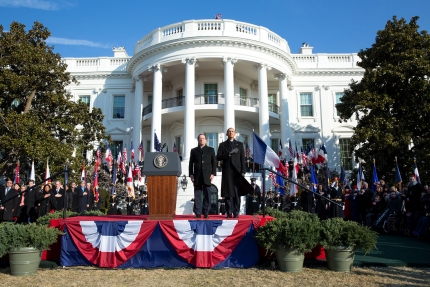
President Barack Obama and President François Hollande of France listen to the French and U.S. national anthems during the state arrival ceremony

President Barack Obama and President François Hollande of France listen to the French and U.S. national anthems during the state arrival ceremony on the South Lawn of the White House, Feb. 11, 2014. (Official White House Photo by Pete Souza)

  • 01 Honor Guard Hats Are Lined Up
    1 of 29
  • 02 President And First Lady Stand On Red Carpet
    2 of 29
  • 03 Listen To The National Anthems
    3 of 29
  • 04 Reviewing The Troops
    4 of 29
  • 05 President Obama And President Hollande Greet Attendees
    5 of 29
  • 06 President Hollande Delivers Remarks
    6 of 29
  • 07 Color Guard Member Holds A French Flag
    7 of 29
  • 08 Waving From The South Portico
    8 of 29
  • 09 President Hollande Signs Guest Book
    9 of 29
  • 10 Admiring Kennedy Portrait
    10 of 29
  • 11 President Obama And President Hollande On The Colonnade
    11 of 29
  • 12 President Obama And President Hollande Bilateral Meeting
    12 of 29
  • 13 President Obama And President Hollande In Expanded Bilateral Meeting
    13 of 29
  • 14 President Obama And President Hollande Press Conference
    14 of 29
  • 15 President Obama Says Goodbye To President Hollande
    15 of 29
  • 16 President Obama and the First Lady Wait In The Cross Hall
    16 of 29
  • 17 President Obama and The First Lady Greet President Hollande
    17 of 29
  • 18 President Obama The First Lady Enter the Grand Foyer
    18 of 29
  • 19 Talking In the Yellow Oval Room
    19 of 29
  • 20 Waiting With The Color Guard
    20 of 29
  • 21 Descending The Grand Staircase
    21 of 29
  • 22 Talking In The Blue Room
    22 of 29
  • 23 View Of The White House South Portico Exterior
    23 of 29
  • 24 President Obama Delivers Remarks And A Toast
    24 of 29
  • 25 President Obama Talks With Guests
    25 of 29
  • 26 First Lady Thanks Chefs, Organizer
    26 of 29
  • 27 President Obama Helps First Lady Michelle Obama
    27 of 29
  • 28 Mary J. Blige Performs
    28 of 29
  • 29 Guests Watch Mary J. Blige Perform
    29 of 29

This morning, President Obama, Vice President Biden, and the First Lady welcomed French President François Hollande to the White House – the first state visit by a French president in nearly 20 years. Check out photos from throughout the day, including images from Chief White House Photographer Pete Souza's Instagram feed, and then learn more about how the White House kitchen prepared for the France State Dinner, which the President and First Lady will host tonight in honor of the visit.

Related Topics: Europe and Eurasia

The White House

Office of the Press Secretary

President Obama Signs Georgia Emergency Declaration

Today, the President declared an emergency in the State of Georgia and ordered federal aid to supplement state and local response efforts due to the emergency conditions resulting from a severe winter storm beginning on February 10, 2014, and continuing.

The President's action authorizes the Department of Homeland Security, Federal Emergency Management Agency (FEMA), to coordinate all disaster relief efforts which have the purpose of alleviating the hardship and suffering caused by the emergency on the local population, and to provide appropriate assistance for required emergency measures, authorized under Title V of the Stafford Act, to save lives and to protect property and public health and safety, and to lessen or avert the threat of a catastrophe in the counties of Banks, Barrow, Bartow, Carroll, Catoosa, Chattooga, Cherokee, Clarke, Cobb, Dade, Dawson, DeKalb, Douglas, Elbert, Fannin, Floyd, Forsyth, Franklin, Fulton, Gilmer, Gordon, Gwinnett, Habersham, Hall, Haralson, Hart, Jackson, Lincoln, Lumpkin, Madison, Murray, Oconee, Oglethorpe, Paulding, Pickens, Polk, Rabun, Stephens, Towns, Union, Walker, Walton, White, Whitfield, and Wilkes.

Specifically, FEMA is authorized to identify, mobilize, and provide at its discretion, equipment and resources necessary to alleviate the impacts of the emergency.  Emergency protective measures, limited to direct federal assistance, will be provided at 75 percent federal funding. 

W. Craig Fugate, Administrator, Federal Emergency Management Agency (FEMA), Department of Homeland Security, named W. Michael Moore as the Federal Coordinating Officer for federal recovery operations in the affected area. 

The White House

Office of the Press Secretary

Remarks by President Obama and President Hollande of France at Arrival Ceremony

South Lawn

9:25 A.M. EST
 
THE PRESIDENT:  Good morning, everybody.  Bonjour!  That’s the extent of my French.  (Laughter.)  Few places in the world warm the heart like Paris in the spring.  This morning, we’re going to do our best with Washington in the winter.  (Laughter.) 
 
France is America’s oldest ally, and in recent years we’ve deepened our alliance.  And today, on behalf of the American people and Michelle and myself, it is a great honor to welcome my friend President Hollande and his delegation for their first state visit to the United States -- in fact, the first state visit by a French President in nearly 20 years.  (Applause.)  
 
Yesterday at Monticello we reflected on the values that we share -- the ideals at the heart of our alliance.  Here, under the red, white and blue -- and the blue, white and red -- we declare our devotion once more to “life, liberty and the pursuit of happiness” -- to “liberté, egalité, and fraternité.”  (Laughter and applause.)
   
For more than two centuries, we’ve not only proclaimed our ideals, our citizens have bled to preserve them, from a field in Yorktown to the beaches of Normandy to the mountains of Afghanistan.  And today, we are honored to be joined by two extraordinary men who were there those historic days 70 years ago.  I ask them to stand, proud veterans of D-Day who are here in attendance today.  (Applause.)   
 
So it’s no exaggeration that we stand here because of each other.  We owe our freedom to each other.  Of course, we Americans also thank our French friends for so much else -- this capital city, designed by L’Enfant; our Statue of Liberty, a gift from France; and something many Americans are especially grateful for, New Orleans and the French Quarter.  (Laughter.)   
 
Mr. President, like generations before us, we now have the task not simply to preserve our enduring alliance, but to make it new for our time.  No one nation can meet today’s challenges alone or seize its opportunities.  More nations must step up and meet the responsibilities of leadership, and that is what the United States and France are doing together. 
 
To our French friends, I say let’s do even more together, for the security that our citizens deserve, for the prosperity that they seek, and for the dignity of people around the world who seek what we declared two centuries ago -- those “unalienable rights,” those “sacred rights of man.”
 
President Hollande, members of the French delegation, we are honored to have you here as one of our strongest allies and closest friends.  Welcome to the United States.  Bienvenue, mes amis.  (Applause.)
 
PRESIDENT HOLLANDE:  Mr. President, dear Barack, dear Michelle, ladies and gentlemen:  It’s cold in Washington.  (Laughter.)  You’re right.  But it’s a beautiful day, a great day for our American friends.  And I will speak in French because I am obliged to do that for my country.
 
(As Interpreted.)  We are received here, my delegation and myself, as friends.  And I am particularly touched by this reception by the President of the United States.  We are always united by a common history, from Yorktown to the beaches of Normandy.  As you said so rightly, each of our countries knows what it owes to the other -- its freedom.
 
Yesterday, we were in Monticello, Thomas Jefferson’s residence -- a great American statesman, once ambassador to France -- who remains one of the most beautiful symbols of the ties that unite us.  This afternoon, at the Arlington Cemetery, I shall award the Legion d’Honneur, the highest French distinction, to the American Unknown Soldier.  And I shall present American veterans who fought in the Second World War with an award and I’d like to pay tribute to these men.  (Applause.)
 
Thus doing, I wish to demonstrate the fact that France will never forget the spirit of sacrifice shown by these American soldiers, nameless heroes who left their homes to liberate my country and Europe.  We shall pay tribute to them during the celebrations that will take place in France to commemorate the 70th anniversary of the Normandy landing.  And I hope, Barack, that you will join me on the 6th of June, 2014, 70 years after D-Day landing.
 
Our two countries hold universal values, values that inspired Eleanor Roosevelt and René Cassin to write together the Universal Declaration of Human Rights.  We stand together to fight terrorism.  Today still, France and the United States stand side by side to make these values prevail.  We stand together with the United States to address the threat of the proliferation of weapons of mass destruction and chemical weapons; together to solve the crises faced by the Middle East; together to support Africa’s development; and together to fight global warming and climate change.  (Applause.)
 
Today, we stand united and we have built a model of friendship –- a friendship that is the best recipe for a better world, a world such as the one that was dreamt by Thomas Jefferson and Lafayette.  It is not just about friendship; it is about an alliance that will enable us to make this world a better place, a safer place, a more humane place.
 
Mr. President, I am proud to stand here.  You are this great man of the United States of America and you represent the United States of America, a country where everything is possible for who wants it; a country devoted to freedom and equality.  Long live the United States.  Long live France.  Long live the Franco-American friendship.  (Applause.)  Thank you.
 
END  
9:39 A.M. EST
 

The White House

Office of the Press Secretary

Statement by the Press Secretary on Cyprus

President Obama and the United States welcome the meeting today of the two Cypriot leaders, Mr. Nicos Anastasiades and Mr. Dervish Eroglu, and the renewal of negotiations on a Cyprus settlement under the auspices of the United Nations.  The Joint Statement agreed by the two leaders reflects a spirit of compromise and lays a solid foundation for results-oriented talks. The United States congratulates the two leaders for the courage and vision that enabled them to reach agreement on this important statement, which embodies key principles to guide their further work.  The United States also welcomes the constructive role played in this effort by Turkey and Greece, led by Prime Minister Erdogan and Prime Minister Samaras, as well as other international parties.  The division of Cyprus has endured for far too long.  Through a settlement, both communities can realize their full potential, with enhanced stability and economic prosperity for all the people of the island.  We encourage the sides to work expeditiously to resolve the outstanding core issues and achieve a settlement that reunifies Cyprus as a bi-zonal, bi-communal federation at the earliest possible time.

The United States welcomes President Anastasiades’ proposal for a package of bold and innovative confidence-building measures and other constructive proposals, which have the potential, when agreed and implemented by the parties, to dramatically enhance cooperation between the Greek Cypriot and Turkish Cypriot communities and restore faith in settlement efforts.  The United States will engage in diplomacy with all stakeholders to explore possible initiatives to reinforce settlement negotiations, including measures aimed at the future revitalization of the Famagusta region, when agreed by the two communities.  The United States reaffirms its support for the exercise of the sovereign rights of the Republic of Cyprus to explore and develop the resources in its off-shore zones.  We continue to believe that the island’s oil and gas resources, like all of its resources, should be equitably shared between both communities in the context of an overall settlement.  We underscore the importance of upholding peace and security in and around Cyprus and the Eastern Mediterranean.  The United States urges all parties to avoid any threats or other actions or statements that escalate tension.

President Obama and President Hollande Visit Monticello

February 10, 2014 | 8:42 | Public Domain

President Obama and President Hollande of France deliver remarks during a tour of Monticello. As the residence of Thomas Jefferson, one of the United States’ earliest envoys to France, Monticello reflects Jefferson’s affection for the people of France, the long-standing relations between our two democracies, and the shared values we hold dear: life, liberty, and the pursuit of happiness.

Download mp4 (344MB) | mp3 (9MB)

Read the Transcript

Remarks by President Obama and President Hollande of France After Touring Thomas Jefferson's Monticello

Monticello
Charlottesville, Virginia

5:32 P.M. EST

PRESIDENT OBAMA:  Well, this has been a wonderful visit.  And I want to thank François for joining us here today.  I thought this was an appropriate way to start the state visit because what it signifies is the incredible history between the United States and France.

As one of our Founding Fathers, the person who drafted our Declaration of Independence, somebody who not only was an extraordinary political leader but also one of our great scientific and cultural leaders, Thomas Jefferson represents what’s best in America.  But as we see as we travel through his home, what he also represents is the incredible bond and the incredible gifts that France gave to the United States, because he was a Francophile through and through.

He drew inspiration from the Enlightenment ideas that had been developed in France and throughout Europe, but he also drew from the arts, from the architecture, from the writings, from the culture and from the cuisine of France.  And so, in this sense, this home represents the bonds that helped lead to the American Revolution, helped to influence the French Revolution, figures like Lafayette, who played such a central role in our own independence -- all this is signified here at Monticello. 

And our hope in starting our visit this way is that, just as we can extend back through generations to see the links between the United States and France, tomorrow we'll have an opportunity to talk about not only our current bonds and alliance but also ways that we can strengthen our cooperation in the future.

And of course, this house also represents the complicated history of the United States.  We just visited downstairs where we know the slaves helped to build this magnificent structure, and the complex relations that Jefferson, the drafter of the Declaration of Independence, had to slavery.  And it’s a reminder for both of us that we are going to continue to fight on behalf of the rights of all peoples -- something that I know France has always been committed to, and we are committed to as well. 

And I'm looking forward to talking about issues of human dignity and human rights not just in our own countries, but around the world as well.

So, Mr. President, welcome to Monticello, and we look forward to continuing our conversation tomorrow.

PRESIDENT HOLLANDE:  (As interpreted.)  I would like to thank especially President Obama for having invited me to this house.  This is Thomas Jefferson’s house, which means that this was a man who understood -- met the secretary of Enlightenment, and he wanted to represent this life throughout this house.  You can see life everywhere.  You can see it the objects, in the refinement of the objects, and its architecture. 

Why is this house a symbol?  Because here Lafayette was welcomed.  Together, Lafayette and Jefferson imagined something that seemed impossible -- mainly American independence and the rights of -- human rights and the rights of the citizen.  Thomas Jefferson drafted the Declaration of Independence, and Lafayette was also involved in drafting the Rights of the Citizen, and they met together in this house.

There is something quite unique about Jefferson in the fact that he been ambassador of the United States to France before becoming U.S. President.  I do believe that is the only American President that had that experience.  And he was U.S. ambassador to France at the time of the French Revolution, and he departed from France in August of 1789, which means after the 14th of July with the taking of the Bastille.  He thought he had seen enough and that he could go back home.  And then of course, he was involved in the governance of the United States before becoming President.  And then Jefferson purchased Louisiana from Napoleon. And today we are not demanding anything.  (Laughter.)

PRESIDENT OBAMA:  It was a good bargain, though.  (Laughter.)

PRESIDENT HOLLANDE:  (As interpreted.)  I also wish to confirm that this bond that unites us with Jefferson, that these bonds are sustained over time, because he represents values and principles.  Freedom, human dignity, rights -- these are the values to which we are continuing to fight around the world, the United States and France.  We were allies in the time of Jefferson and Lafayette.  We are still allies today.  We were friends in the time of Jefferson and Lafayette, and we will remain friends forever.

Thank you.

PRESIDENT OBAMA:  Thank you very much. 

END
5:41 P.M. EST

Close Transcript

The White House

Office of the Press Secretary

Remarks by President Obama and President Hollande of France After Touring Thomas Jefferson's Monticello

Monticello
Charlottesville, Virginia

5:32 P.M. EST

PRESIDENT OBAMA:  Well, this has been a wonderful visit.  And I want to thank François for joining us here today.  I thought this was an appropriate way to start the state visit because what it signifies is the incredible history between the United States and France.

As one of our Founding Fathers, the person who drafted our Declaration of Independence, somebody who not only was an extraordinary political leader but also one of our great scientific and cultural leaders, Thomas Jefferson represents what’s best in America.  But as we see as we travel through his home, what he also represents is the incredible bond and the incredible gifts that France gave to the United States, because he was a Francophile through and through.

He drew inspiration from the Enlightenment ideas that had been developed in France and throughout Europe, but he also drew from the arts, from the architecture, from the writings, from the culture and from the cuisine of France.  And so, in this sense, this home represents the bonds that helped lead to the American Revolution, helped to influence the French Revolution, figures like Lafayette, who played such a central role in our own independence -- all this is signified here at Monticello. 

And our hope in starting our visit this way is that, just as we can extend back through generations to see the links between the United States and France, tomorrow we'll have an opportunity to talk about not only our current bonds and alliance but also ways that we can strengthen our cooperation in the future.

And of course, this house also represents the complicated history of the United States.  We just visited downstairs where we know the slaves helped to build this magnificent structure, and the complex relations that Jefferson, the drafter of the Declaration of Independence, had to slavery.  And it’s a reminder for both of us that we are going to continue to fight on behalf of the rights of all peoples -- something that I know France has always been committed to, and we are committed to as well. 

And I'm looking forward to talking about issues of human dignity and human rights not just in our own countries, but around the world as well.

So, Mr. President, welcome to Monticello, and we look forward to continuing our conversation tomorrow.

PRESIDENT HOLLANDE:  (As interpreted.)  I would like to thank especially President Obama for having invited me to this house.  This is Thomas Jefferson’s house, which means that this was a man who understood -- met the secretary of Enlightenment, and he wanted to represent this life throughout this house.  You can see life everywhere.  You can see it the objects, in the refinement of the objects, and its architecture. 

Why is this house a symbol?  Because here Lafayette was welcomed.  Together, Lafayette and Jefferson imagined something that seemed impossible -- mainly American independence and the rights of -- human rights and the rights of the citizen.  Thomas Jefferson drafted the Declaration of Independence, and Lafayette was also involved in drafting the Rights of the Citizen, and they met together in this house.

There is something quite unique about Jefferson in the fact that he been ambassador of the United States to France before becoming U.S. President.  I do believe that is the only American President that had that experience.  And he was U.S. ambassador to France at the time of the French Revolution, and he departed from France in August of 1789, which means after the 14th of July with the taking of the Bastille.  He thought he had seen enough and that he could go back home.  And then of course, he was involved in the governance of the United States before becoming President.  And then Jefferson purchased Louisiana from Napoleon. And today we are not demanding anything.  (Laughter.)

PRESIDENT OBAMA:  It was a good bargain, though.  (Laughter.)

PRESIDENT HOLLANDE:  (As interpreted.)  I also wish to confirm that this bond that unites us with Jefferson, that these bonds are sustained over time, because he represents values and principles.  Freedom, human dignity, rights -- these are the values to which we are continuing to fight around the world, the United States and France.  We were allies in the time of Jefferson and Lafayette.  We are still allies today.  We were friends in the time of Jefferson and Lafayette, and we will remain friends forever.

Thank you.

PRESIDENT OBAMA:  Thank you very much. 

END
5:41 P.M. EST

President Obama and President Hollande Visit Monticello

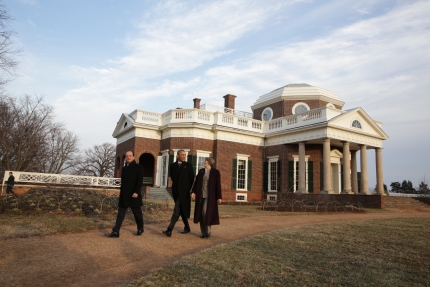
President Barack Obama and President François Hollande of France tour Monticello, the home of Thomas Jefferson in Charlottesville, Va.

President Barack Obama and President François Hollande of France tour Monticello, the home of Thomas Jefferson in Charlottesville, Va., with Leslie Bowman, President of the Thomas Jefferson Foundation, Feb. 10, 2014 (Official White House Photo by Chuck Kennedy)

This afternoon, President Obama and French President François Hollande visited Monticello, the home of former President Thomas Jefferson, just outside of Charlottesville, Virginia. Jefferson, who drafted the Declaration of Independence, was a noted Francophile, and served as the U.S. Minister to France from 1785 to 1789.

Monticello, a UNESCO World Heritage Site, is widely regarded as an architectural masterpiece. Jefferson began work on his home at age 26, designing – and continually redesigning – the house following neoclassical principles.

After touring Monticello, President Obama remarked that it symbolizes the “incredible history between the United States and France,” and the "incredible bond and the incredible gifts that France gave to the United States.” The house also represents the "complicated history of the United States," President Obama said, as well as the “complex relations” between Jefferson and the institution of slavery. President Obama added that for France and the United States, Monticello is “a reminder for both of us that we’re going to continue to fight on behalf of the rights of all peoples."

Tomorrow morning, President Obama and the First Lady will welcome the French President to the White House, holding a state dinner in his honor tomorrow evening.

Take a look inside the kitchen as White House Chef Cris Comerford and Pastry Chef Bill Yosses take over the White House Instagram ahead of tomorrow's dinner.

Related Topics: Europe and Eurasia, Virginia