The White House

Office of the Vice President

Readout of Vice President Biden’s Meeting with Prime Minister Irakli Garibashvili of Georgia

President Obama joined Vice President Biden’s meeting today with Georgian Prime Minister Irakli Garibashvili.  The President and Vice President both congratulated the Prime Minister for Georgia’s success in completing the country’s first peaceful, democratic transition of power, and urged the Prime Minister to continue working with all of Georgia’s leaders and with civil society to advance the rule of law and to consolidate Georgia’s significant democratic achievements.  They also thanked Georgia for being a valued friend and reliable partner in supporting our most challenging regional and global priorities.  In doing so, the President expressed the United States’ deep appreciation for Georgia’s significant contributions to the NATO mission in Afghanistan and honored the sacrifices made by Georgian soldiers and their families.  The President and Prime Minister further discussed opportunities for strengthening U.S.-Georgia strategic cooperation, including on increasing trade and investment ties between our two economies.  The President and Vice President also reaffirmed the United States’ strong support for Georgia’s sovereignty and territorial integrity within its internationally recognized borders.  They also assured the Prime Minister that the Georgian people had the United States’ unwavering support as they pursue their Euro-Atlantic aspirations and pledged continued U.S. assistance to help the new Georgian government as it pursues political, economic, and defense reforms.

A White House Call To Action to Advance the BRAIN Initiative

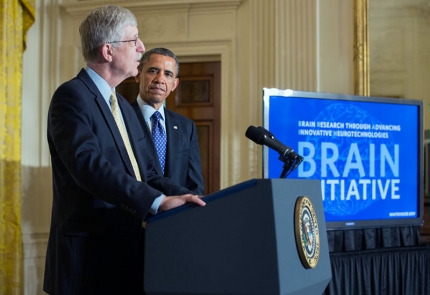
President Barack Obama is introduced by Dr. Francis Collins

President Barack Obama is introduced by Dr. Francis Collins, Director, National Institutes of Health, at the BRAIN Initiative event in the East Room of the White House, April 2, 2013. (Official White House Photo by Chuck Kennedy)

On April 2, 2013, President Obama launched the Brain Research through Advancing Neurotechnologies (BRAIN) Initiative, a Grand Challenge designed to revolutionize our understanding of the human brain. 

Under this initiative, Federal agencies such as the Defense Advanced Research Projects Agency (DARPA), the National Institutes of Health (NIH), the National Science Foundation (NSF), and the Food and Drug Administration (FDA) are supporting the development and application of innovative, new technologies that can create a dynamic understanding of brain function and its relationship to behavior. These scientific and technological advances could also lead to improvements in our ability to diagnose, treat, and even prevent diseases of the brain. Recently, DARPA, NIH, and NSF have made announcements of significant new solicitations or awards related to the BRAIN Initiative. Other Federal activities are being coordinated with the BRAIN Initiative through the National Science and Technology Council’s Interagency Working Group on Neuroscience.

The White House

Office of the Press Secretary

Presidential Nominations Sent to the Senate

NOMINATIONS SENT TO THE SENATE:

Todd Sunhwae Kim, of the District of Columbia, to be an Associate Judge of the District of Columbia Court of Appeals for the term of fifteen years, vice Kathryn A. Oberly, retired.

Governors Come to D.C. for the National Governors Association Winter Meeting

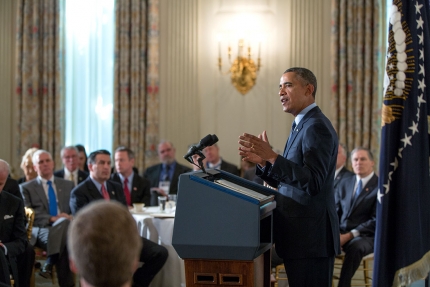
President Barack Obama meets with the National Governors Association in the State Dining Room of the White House, Feb. 24, 2014.

President Barack Obama meets with the National Governors Association in the State Dining Room of the White House, Feb. 24, 2014. (Official White House Photo by Pete Souza)

This weekend, governors from across the nation gathered in Washington, D.C. for the 2014 National Governors Association (NGA) Winter Meeting. The meeting gives governors an opportunity to talk about issues affecting states and discuss innovative solutions.

Last night, the President and the First Lady welcomed the NGA to the White House for the 2014 Governors' Dinner. The President told the governors in attendance that he looked forward to working with them, "not just in our meetings tomorrow, but throughout this year – what I hope to be a year of action. Our partnership on behalf of the American people, on issues ranging from education to health care to climate change, runs deep, deeper than what usually hits the front page."

This morning, President Obama and Vice President Biden both delivered additional remarks to the NGA in the State Dining Room at the White House.

Related Topics: Economy

The White House

Office of the Press Secretary

Readout of the President’s Call with Prime Minister Renzi of Italy

President Obama spoke by phone today with Prime Minister Matteo Renzi of Italy to congratulate him on his new office and to reaffirm the deep and enduring bonds that the United States and Italy share.  The President expressed support for Prime Minister Renzi’s leadership on creating economic growth and jobs, and he looks forward to continued close U.S.-Italian partnership on Afghanistan, Libya, the Transatlantic Trade and Investment Partnership, and security and defense cooperation.  Both leaders welcomed their March meeting in Rome as an opportunity to build deeper bilateral cooperation on these and other matters of mutual interest. 

The White House

Office of the Press Secretary

Presidential Determination -- Proposed Nuclear Agreement with Vietnam

MEMORANDUM FOR THE SECRETARY OF STATE THE SECRETARY OF ENERGY

SUBJECT: Proposed Agreement for Cooperation Between the Government of the United States of America and the Government of the Socialist Republic of Vietnam Concerning Peaceful Uses of Nuclear Energy

I have considered the proposed Agreement for Cooperation Between the Government of the United States of America and the Government of the Socialist Republic of Vietnam Concerning Peaceful Uses of Nuclear Energy, along with the views, recommendations, and statements of the interested agencies.

I have determined that the performance of the Agreement will promote, and will not constitute an unreasonable risk to, the common defense and security. Pursuant to section 123 b. of the Atomic Energy Act of 1954, as amended (42 U.S.C. 2153(b)), I hereby approve the proposed Agreement and authorize the Secretary of State to arrange for its execution.

The Secretary of State is authorized to publish this determination in the Federal Register.

BARACK OBAMA

The White House

Office of the Press Secretary

Remarks by the President and Vice President at NGA Meeting

State Dining Room

11:15 A.M. EST

THE VICE PRESIDENT:  Thank you very much.  Thanks for making the Cabinet stand up for me.  (Laughter.)  I appreciate it.

It’s great to see you all.  And I don't know about you all, I had a great time last night and got a chance to actually do what we should be doing more of -- talking without thinking about politics and figuring how we can solve problems.

You’ve observed by now the reason the President and I like doing this every year is it’s nice dealing with people who know they got to get a job done, and they get a job done.  And I’ve gotten a chance to work directly with an awful lot of you in the days of the Recovery Act, and even when we were working on the gun violence; rebuilding from that super storm Sandy, which hit my state as well, and tornadoes and floods in a number of your states. 

But it never ceases to amaze me how you all mobilize.  You just mobilize.  When crises hit your states, you mobilize and you rebuild.  And you rebuild your infrastructure not to the standards that existed before, but to 21st century standards.  You balance your budgets, you save neighborhoods, and you bring back jobs to your communities.

And the other thing I pick up -- and I may be wrong.  I’m always labeled as the White House optimist, like I’m the kid who fell off the turnip truck yesterday, but I am the youngest here -- (laughter) -- and new.  But it always amazes me your sense of optimism.  You’re the one group of folks you go to with all the problems you have that you’re optimistic.  You're optimistic about it being able to be done, getting things done.  That is not always the mood up in the place where I spent a large portion of my career.

And last night I got to speak to a bunch of you, particularly about the job skills initiative the President asked me to lead, and I had a chance to speak with some of you specifically, and I’m going to ask to -- I’m going to get a chance to see more of you this afternoon.  But this is more than just -- at least from the President’s perspective and mine -- more than just a job skills initiative.  It’s about literally opening the aperture to the middle class.  The middle class has actually shrunk. 

And we always have these debates with our economists -- is the middle class $49,820 or $52,000.  The middle class to me, and I think to most of you, it’s really a state of mind.  It’s about being able to own your home and not have to rent it.  It’s about being able to send your kid to a park where you know you can send them out, and they’ll come home safely.  It’s about being able to send them to school, that if they do well in the school, they're going to be able to get to something beyond high school if they want to do that.  And you’re going to be able to pay for it.  And in the meantime, you may be able to take care of your mom and dad who are in tough shape and hope that your kids never have to take care of you.  That's the middle class.

And before the Great Recession, it was already beginning to shrink.  So together, we got to open -- Mary, you and I have talked about this -- about opening the aperture here for access to the middle class.  But we’ll be speaking a lot more about that in the next several months.  A couple of you invited me to come out your way, including some of my Republican friends.  And I’m going to be working with all of you. 

But today I just want to say thank you.  Thank you for what you always do.  You come to town; you come to town with answers.  You come to town with suggestions.  You come to town to get things done.  And believe me, we need that and the American people are looking for it.

And I want to welcome you back to the White House, and introduce you now to my friend, your President, Barack Obama.  (Applause.)

THE PRESIDENT:  Thank you, everybody.  Thank you.  Please, have a seat.  Thank you so much. 

Welcome to the White House.  I know that you’ve already been doing a lot of work, and I’m glad to be able to come here and engage in a dialogue with all of you.  I want to thank Mary and John for their leadership at the NGA.  I want to thank my outstanding Vice President, Joe Biden, who is very excited I think about the jobs initiative, and is going to be -- the job training initiative, and I think is going to be doing a great job on that.

Michelle and I had a wonderful time hosting you guys last night, and I hope all the spouses enjoyed it.  And I know Alex enjoyed it.  (Laughter.)  One good thing about living here is that you can make all the noise you want and nobody is going to complain.  (Laughter.)  And I enjoyed watching some of you with your eyes on higher office size up the drapes -- (laughter) --and each other.

We don’t have a lot of time today, so I want to be very brief, go straight to Q&A and discussion.  We’re at a moment when our economy is growing; our businesses have now created over 8.5 million new jobs over the past four years.  But, as I’ve said several times, the trends that have battered the middle class for a couple of decades now are still there and still have to be addressed.  Those at the top are doing very well.  Ordinary families still feeling squeezed.  Too many Americans are working harder than ever, and just barely getting by. 

And reversing these trends are going to require us to work together around what I’m calling an opportunity agenda based on four things.  Number one, more good jobs that pay good wages.  Number two, training more Americans to be able to take the jobs that are out there right now and the jobs that are created.  Number three, guaranteeing access to a world-class education for every American child all across our 50 states and our territories.  And making sure that hard work pays off -- with wages that you can live on, savings that you can retire on, health insurance that you can count on.

And all of this is going to take some action.  So far, just in the past few weeks, I’ve acted to lift the wages of workers who work for federal contractors to pay their -- make sure their employees are getting paid at least $10.10 an hour.  We’ve ordered an across-the-board reform of our job training programs, much of it aligned with some of the work that Mary has done during her tenure as head of the NGA.  We directed our Treasury to create a new way for Americans to start saving for retirement.  We’ve been able to rally America’s business leaders to help more of the long-term unemployed find work, and to help us make sure that all of our kids have access to high-speed Internet and high-tech learning tools in the classroom.

The point is, this has to be a year of action.  And I’m eager to work with Congress wherever I can.  My hope is, is that despite this being an election year, that there will be occasions where both parties determine that it makes sense to actually get some things done in this town.  But wherever I can work on my own to expand opportunity for more Americans, I’m going to do that.  And I am absolutely convinced that the time is right to partner with the states and governors all across the country on these agendas, because I know that you guys are doing some terrific work in your own states.

There may not be much of an appetite in Congress for doing big jobs bills, but we can still grow SelectUSA.  Secretary Pritzker’s team has put together a terrific formula where we’re attracting investors from all around the world to see America as an outstanding place to invest.  And I mentioned this at the State of the Union:  For the first time last year, what we’re seeing is, is that world investors now see America as the number-one place to do business rather than China.  And it’s a sign of a lot of things converging, both on the energy front, worker productivity, our innovation, our research, ease of doing business.  And a lot of that work is as a consequence of steps we’ve taken not just at the federal level, but also at the state level.  So we’ve got to take advantage of that.

Secretary Pritzker has been helping a Belgian company create jobs in Stillwater, Oklahoma; helping an Austrian company create jobs in Cartersville, Georgia.  So we can do more of this, and we really want to engage with you over the next several months to find ways that we can help market America and your states to businesses all around the world and bring jobs back.

Since I called on Congress to raise the minimum wage last year, six states have gone ahead and done it on their own.  Last month, I asked more business leaders to raise their workers’ wages.  Last week, GAP said it would lift wages for about 65,000 of its employees.  Several of you are trying to boost wages for your workers.  I’m going to do everything I can to support those efforts. 

While Congress decides what it’s going to do on making high-quality pre-K available to more kids, there is bipartisan work being done among the folks in this room.  You’ve got governors like Robert Bentley and Jack Markell, Susana Martinez, Deval Patrick -- all expanding funding or dedicating funds to make that happen in their states.  And we want to partner with you.  This year, I’ll pull together a coalition of philanthropists, elected officials and business leaders, all of whom are excited and interested in working with you to help more kids access the high-quality pre-K that they need.

And while Congress talks about repealing the Affordable Care Act or doing this or doing that to it, places like California and Kentucky are going gangbusters and enrolling more Americans in quality, affordable health care plans.  You’ve got Republican governors here -- I won’t name them in front of the press, because I don’t want to get you all in trouble -- who have chosen to cover more people through new options under Medicaid.  And as a result, millions of people are going to get help.

States that don’t expand Medicaid are going to be leaving up to 5.4 million Americans uninsured.  And that doesn’t have to happen.  Work with us to get this done.  We can provide a lot of flexibility.  Folks like Mike Beebe in Arkansas have done some terrific work designing programs that are right for their states but also provide access to care for people who need it.  And I think Kathleen Sebelius, a former governor herself, has shown herself willing to work with all of you to try to find ways to get that done.

On the West Coast, you’ve got Governors Brown, Inslee, Kitzhaber who are working together to combat the effects of climate change on their states.  We’ve set up a taskforce of governors and mayors and tribal leaders to help communities prepare for what we anticipate are going to be intensifying impacts of climate change.  And we’re setting up climate hubs in seven states across the country to help farmers and ranchers adapt their operations to a changing environment. 

In the budget that I’ll send to Congress next week, I’m going to propose fundamentally reforming the way federal governments fund wildfire suppression and prevention to make it more stable and secure, and this is an idea that’s supported by both Democrats and Republicans.

And finally, I want to thank those of you who have worked with Michelle and Jill Biden on their Joining Forces initiative to support our military families.  At your meeting here two years ago, they asked for your help to make it easier for servicemembers and their spouses to carry licenses for professions like teaching or nursing from state to state, rather than have to get a new one every time they were reassigned.  At the time, only 12 states had acted to make this easier for spouses; only nine had acted to make it easier for servicemembers.  Today, 42 states have passed legislation to help spouses; 45 states have made it easier for servicemembers.  We’ve got a few states remaining.  Let’s get it done for everybody, because it’s the right thing to do for those men and women who are working every day to make sure we stay free and secure. 

The point is, even when there is little appetite in Congress to move on some of these priorities, at the state level you guys are governed by practical considerations.  You want to do right by your people and you see how good policy impacts your citizens, and you see how bad policy impacts your citizens, and that means that there’s less room for posturing and politics, and more room for getting stuff done. 

We want to work with you.  And I’m committed to making sure that every single member of my Cabinet, every single person in the White House, every single member of my team will be responsive to you.  We won’t agree on every single issue every single time, but I guarantee you that we will work as hard as we can to make sure that you succeed -- because when you succeed, the people in your states succeed and America succeeds, and that’s our goal. 

So thank you very much, and I look forward to having a great discussion.  Thank you, everybody.  (Applause.)

END
11:27 A.M. EST
The White House

Office of the Press Secretary

Statement from the President on the Retirement of John Dingell

Serving nearly six decades in the House of Representatives, John Dingell has earned the distinction of being both the longest-serving Member of Congress in U.S. history and one of the most influential legislators of all time.  After serving his country in the Army during World War II, John was first elected to Congress in 1955 – representing the people of southeastern Michigan in a seat previously held by his father.  In Washington, John risked his seat to support the Civil Rights Act of 1964, fought to pass Medicare in 1965, and penned legislation like the Clean Air Act, the Safe Drinking Water Act, and the Endangered Species Act that have kept millions of Americans healthy and preserved our natural beauty for future generations.  

But of all John’s accomplishments, perhaps the most remarkable has been his tireless fight to guarantee quality, affordable health care for every American.  Decades after his father first introduced a bill for comprehensive health reform, John continued to introduce health care legislation at the beginning of every session.  And as an original author of the Affordable Care Act, he helped give millions of families the peace of mind of knowing they won’t lose everything if they get sick.  Today, the people of Michigan – and the American people – are better off because of John Dingell’s service to this country, and Michelle and I wish him, his wife Debbie, and their family the very best.

The President and Vice President Speak to the National Governors Association

February 24, 2014 | 13:56 | Public Domain

President Obama says that "the time is right to partner with the states and governors all across the country" on increasing opportunity for all Americans.

Download mp4 (512MB) | mp3 (13MB)

Read the Transcript

Remarks by the President and Vice President at NGA Meeting

State Dining Room

11:15 A.M. EST

THE VICE PRESIDENT:  Thank you very much.  Thanks for making the Cabinet stand up for me.  (Laughter.)  I appreciate it.

It’s great to see you all.  And I don't know about you all, I had a great time last night and got a chance to actually do what we should be doing more of -- talking without thinking about politics and figuring how we can solve problems.

You’ve observed by now the reason the President and I like doing this every year is it’s nice dealing with people who know they got to get a job done, and they get a job done.  And I’ve gotten a chance to work directly with an awful lot of you in the days of the Recovery Act, and even when we were working on the gun violence; rebuilding from that super storm Sandy, which hit my state as well, and tornadoes and floods in a number of your states. 

But it never ceases to amaze me how you all mobilize.  You just mobilize.  When crises hit your states, you mobilize and you rebuild.  And you rebuild your infrastructure not to the standards that existed before, but to 21st century standards.  You balance your budgets, you save neighborhoods, and you bring back jobs to your communities.

And the other thing I pick up -- and I may be wrong.  I’m always labeled as the White House optimist, like I’m the kid who fell off the turnip truck yesterday, but I am the youngest here -- (laughter) -- and new.  But it always amazes me your sense of optimism.  You’re the one group of folks you go to with all the problems you have that you’re optimistic.  You're optimistic about it being able to be done, getting things done.  That is not always the mood up in the place where I spent a large portion of my career.

And last night I got to speak to a bunch of you, particularly about the job skills initiative the President asked me to lead, and I had a chance to speak with some of you specifically, and I’m going to ask to -- I’m going to get a chance to see more of you this afternoon.  But this is more than just -- at least from the President’s perspective and mine -- more than just a job skills initiative.  It’s about literally opening the aperture to the middle class.  The middle class has actually shrunk. 

And we always have these debates with our economists -- is the middle class $49,820 or $52,000.  The middle class to me, and I think to most of you, it’s really a state of mind.  It’s about being able to own your home and not have to rent it.  It’s about being able to send your kid to a park where you know you can send them out, and they’ll come home safely.  It’s about being able to send them to school, that if they do well in the school, they're going to be able to get to something beyond high school if they want to do that.  And you’re going to be able to pay for it.  And in the meantime, you may be able to take care of your mom and dad who are in tough shape and hope that your kids never have to take care of you.  That's the middle class.

And before the Great Recession, it was already beginning to shrink.  So together, we got to open -- Mary, you and I have talked about this -- about opening the aperture here for access to the middle class.  But we’ll be speaking a lot more about that in the next several months.  A couple of you invited me to come out your way, including some of my Republican friends.  And I’m going to be working with all of you. 

But today I just want to say thank you.  Thank you for what you always do.  You come to town; you come to town with answers.  You come to town with suggestions.  You come to town to get things done.  And believe me, we need that and the American people are looking for it.

And I want to welcome you back to the White House, and introduce you now to my friend, your President, Barack Obama.  (Applause.)

THE PRESIDENT:  Thank you, everybody.  Thank you.  Please, have a seat.  Thank you so much. 

Welcome to the White House.  I know that you’ve already been doing a lot of work, and I’m glad to be able to come here and engage in a dialogue with all of you.  I want to thank Mary and John for their leadership at the NGA.  I want to thank my outstanding Vice President, Joe Biden, who is very excited I think about the jobs initiative, and is going to be -- the job training initiative, and I think is going to be doing a great job on that.

Michelle and I had a wonderful time hosting you guys last night, and I hope all the spouses enjoyed it.  And I know Alex enjoyed it.  (Laughter.)  One good thing about living here is that you can make all the noise you want and nobody is going to complain.  (Laughter.)  And I enjoyed watching some of you with your eyes on higher office size up the drapes -- (laughter) --and each other.

We don’t have a lot of time today, so I want to be very brief, go straight to Q&A and discussion.  We’re at a moment when our economy is growing; our businesses have now created over 8.5 million new jobs over the past four years.  But, as I’ve said several times, the trends that have battered the middle class for a couple of decades now are still there and still have to be addressed.  Those at the top are doing very well.  Ordinary families still feeling squeezed.  Too many Americans are working harder than ever, and just barely getting by. 

And reversing these trends are going to require us to work together around what I’m calling an opportunity agenda based on four things.  Number one, more good jobs that pay good wages.  Number two, training more Americans to be able to take the jobs that are out there right now and the jobs that are created.  Number three, guaranteeing access to a world-class education for every American child all across our 50 states and our territories.  And making sure that hard work pays off -- with wages that you can live on, savings that you can retire on, health insurance that you can count on.

And all of this is going to take some action.  So far, just in the past few weeks, I’ve acted to lift the wages of workers who work for federal contractors to pay their -- make sure their employees are getting paid at least $10.10 an hour.  We’ve ordered an across-the-board reform of our job training programs, much of it aligned with some of the work that Mary has done during her tenure as head of the NGA.  We directed our Treasury to create a new way for Americans to start saving for retirement.  We’ve been able to rally America’s business leaders to help more of the long-term unemployed find work, and to help us make sure that all of our kids have access to high-speed Internet and high-tech learning tools in the classroom.

The point is, this has to be a year of action.  And I’m eager to work with Congress wherever I can.  My hope is, is that despite this being an election year, that there will be occasions where both parties determine that it makes sense to actually get some things done in this town.  But wherever I can work on my own to expand opportunity for more Americans, I’m going to do that.  And I am absolutely convinced that the time is right to partner with the states and governors all across the country on these agendas, because I know that you guys are doing some terrific work in your own states.

There may not be much of an appetite in Congress for doing big jobs bills, but we can still grow SelectUSA.  Secretary Pritzker’s team has put together a terrific formula where we’re attracting investors from all around the world to see America as an outstanding place to invest.  And I mentioned this at the State of the Union:  For the first time last year, what we’re seeing is, is that world investors now see America as the number-one place to do business rather than China.  And it’s a sign of a lot of things converging, both on the energy front, worker productivity, our innovation, our research, ease of doing business.  And a lot of that work is as a consequence of steps we’ve taken not just at the federal level, but also at the state level.  So we’ve got to take advantage of that.

Secretary Pritzker has been helping a Belgian company create jobs in Stillwater, Oklahoma; helping an Austrian company create jobs in Cartersville, Georgia.  So we can do more of this, and we really want to engage with you over the next several months to find ways that we can help market America and your states to businesses all around the world and bring jobs back.

Since I called on Congress to raise the minimum wage last year, six states have gone ahead and done it on their own.  Last month, I asked more business leaders to raise their workers’ wages.  Last week, GAP said it would lift wages for about 65,000 of its employees.  Several of you are trying to boost wages for your workers.  I’m going to do everything I can to support those efforts. 

While Congress decides what it’s going to do on making high-quality pre-K available to more kids, there is bipartisan work being done among the folks in this room.  You’ve got governors like Robert Bentley and Jack Markell, Susana Martinez, Deval Patrick -- all expanding funding or dedicating funds to make that happen in their states.  And we want to partner with you.  This year, I’ll pull together a coalition of philanthropists, elected officials and business leaders, all of whom are excited and interested in working with you to help more kids access the high-quality pre-K that they need.

And while Congress talks about repealing the Affordable Care Act or doing this or doing that to it, places like California and Kentucky are going gangbusters and enrolling more Americans in quality, affordable health care plans.  You’ve got Republican governors here -- I won’t name them in front of the press, because I don’t want to get you all in trouble -- who have chosen to cover more people through new options under Medicaid.  And as a result, millions of people are going to get help.

States that don’t expand Medicaid are going to be leaving up to 5.4 million Americans uninsured.  And that doesn’t have to happen.  Work with us to get this done.  We can provide a lot of flexibility.  Folks like Mike Beebe in Arkansas have done some terrific work designing programs that are right for their states but also provide access to care for people who need it.  And I think Kathleen Sebelius, a former governor herself, has shown herself willing to work with all of you to try to find ways to get that done.

On the West Coast, you’ve got Governors Brown, Inslee, Kitzhaber who are working together to combat the effects of climate change on their states.  We’ve set up a taskforce of governors and mayors and tribal leaders to help communities prepare for what we anticipate are going to be intensifying impacts of climate change.  And we’re setting up climate hubs in seven states across the country to help farmers and ranchers adapt their operations to a changing environment. 

In the budget that I’ll send to Congress next week, I’m going to propose fundamentally reforming the way federal governments fund wildfire suppression and prevention to make it more stable and secure, and this is an idea that’s supported by both Democrats and Republicans.

And finally, I want to thank those of you who have worked with Michelle and Jill Biden on their Joining Forces initiative to support our military families.  At your meeting here two years ago, they asked for your help to make it easier for servicemembers and their spouses to carry licenses for professions like teaching or nursing from state to state, rather than have to get a new one every time they were reassigned.  At the time, only 12 states had acted to make this easier for spouses; only nine had acted to make it easier for servicemembers.  Today, 42 states have passed legislation to help spouses; 45 states have made it easier for servicemembers.  We’ve got a few states remaining.  Let’s get it done for everybody, because it’s the right thing to do for those men and women who are working every day to make sure we stay free and secure. 

The point is, even when there is little appetite in Congress to move on some of these priorities, at the state level you guys are governed by practical considerations.  You want to do right by your people and you see how good policy impacts your citizens, and you see how bad policy impacts your citizens, and that means that there’s less room for posturing and politics, and more room for getting stuff done. 

We want to work with you.  And I’m committed to making sure that every single member of my Cabinet, every single person in the White House, every single member of my team will be responsive to you.  We won’t agree on every single issue every single time, but I guarantee you that we will work as hard as we can to make sure that you succeed -- because when you succeed, the people in your states succeed and America succeeds, and that’s our goal. 

So thank you very much, and I look forward to having a great discussion.  Thank you, everybody.  (Applause.)

END
11:27 A.M. EST

Close Transcript

President Obama Encourages Licensing and Credential Legislation for Military Spouses and Service Members at National Governors Association Meeting

P022414PS-0191

President Barack Obama meets with the National Governors Association in the State Dining Room of the White House, Feb. 24, 2014. (Official White House Photo by Pete Souza)

Today, in remarks to the National Governors Association, President Obama told governors from across the nation that impactful licensing and credential legislation is a necessity for military spouses and transitioning service members.

Since the First Lady and Dr. Biden first began meeting with members of the military community, they have heard countless stories about how spouses struggled to find jobs in their fields because when they moved, their professional licenses were no longer valid, or they didn’t meet a new state’s credentialing requirements. Upon learning about these obstacles, the First Lady and Dr. Biden began advocating for new legislation that supports transitioning service members and military spouses to get the professional licenses and credentials they need to get hired.