The White House

Office of the Press Secretary

Readout of the President's Call with General Allen

This afternoon, President Obama called General John Allen, Commander of U.S. Forces and the NATO International Security Assistance Force in Afghanistan, to discuss the ongoing violence in Afghanistan and the tragic killing of two U.S. servicemembers this morning. On behalf of the American people, the President expressed his condolences to General Allen and to the families who lost loved ones. The President thanked General Allen for all of the measures he is taking to protect our servicemembers and civilians in Afghanistan and to encourage calm. We welcome President Karzai's statement this morning encouraging peaceful expressions, and his call for dialogue and calm. The United States remains committed to a partnership with the government and people of Afghanistan, as we work to realize our shared goal of disrupting, dismantling and defeating al Qaeda and strengthening the Afghan state.

The White House

Office of the Press Secretary

Statement by the President on Yemen’s Transition to President Abdo Rabo Mansour Hadi

Just over one year ago, thousands of men and women gathered in city squares across Yemen to demand a government that was responsive to their democratic aspirations. The determination and sacrifice of the Yemeni people in the struggle for their universal rights has been inspiring and has brought about unprecedented political change in Yemen.  This week, millions of Yemenis voted for a new president and the beginning of a promising new chapter in Yemen’s history. 

Today, I called Yemeni President Abdo Rabo Mansour Hadi to congratulate him and the Yemeni people as they mark this historic and peaceful transfer of power that honors all the brave Yemenis who have set their country on a path for a more stable, secure, and democratic future. I told President Hadi that the United States will stand with the people of Yemen as they continue their efforts to forge a brighter future for their country. I also offered my condolences for the lives lost at the presidential compound in Mukalla, Hadramawt.

The Yemeni people have achieved a new beginning for their country, but much work lies ahead.  Going forward, as part of their political agreement, Yemenis must convene an inclusive National Dialogue, reform their constitution, reorganize the military and security services, and hold presidential and parliamentary elections by 2014.  This is an ambitious agenda, but with the determination they have shown over the past year, Yemenis have proven they are up to the task. Under President Hadi’s leadership, Yemen has the potential to serve as a model for how peaceful transitions can occur when people resist violence and unite under a common cause.  The United States will remain a steadfast partner to Yemen and its people as they transition to a democracy worthy of their struggle.

By the Numbers: $4 Billion

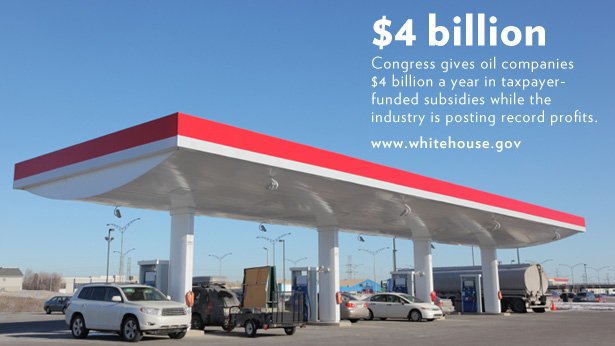
Oil companies receive $4 billion every year in taxpayer-funded subsidies, despite continually bringing in record high profits. Meanwhile, gas prices are on the rise—just like they were this time last year—and the same people funding those subsidies are paying more at the pump for the gas they need to get to school and work.

As the President explained in his weekly address, there are no quick fixes to this problem. But we can develop a strategy to take control of our energy future and avoid gas spike prices down the line.

In his State of the Union, President Obama introduced an all-of-the-above strategy that develops every available source of American-made energy. This includes everything from tapping our offshore oil supplies and vast natural gas reserves, to doubling down on clean energy resources like wind and solar power, to developing new technologies that help us use less energy altogether.

But we need the right incentives in place to help put this strategy in place. Instead of $4 billion in yearly taxpayer-funded subsidies to the oil industry, we should renew tax credits that encourage new investments in clean energy.

Want to know more about President Obama’s blueprint for an America built on homegrown energy? Here’s everything you need to know.

The White House

Office of the Press Secretary

WEEKLY ADDRESS: An All-Of-The-Above Approach to American Energy

WASHINGTON, DC—In this week’s address, President Obama spoke to the American people about the importance of taking an all-of-the-above approach to addressing our nation’s energy challenges. With only 2% of the world’s oil reserves, we cannot simply drill our way to lower gas prices, as some in Washington have suggested.  Americans understand that we must have a long-term strategy that uses every available source of energy—including oil, gas, wind, solar, nuclear, biofuels, and more.  We also cannot fail to recognize the important role that increasing the efficiency of our cars and trucks can play in both reducing our dependence on oil and saving consumers money at the pump.  Finally, at a time when oil companies are making record profits and American families are paying record prices, we must end, once and for all, the $4 billion a year in tax breaks oil companies receive.  There are no quick fixes to this problem, but together we can make a serious effort to overcome our energy challenges and help create American jobs.

Remarks of President Barack Obama
As Prepared for Delivery
The White House
Saturday, February 25, 2012

Hello, everybody.

In the State of the Union, I laid out three areas we need to focus on if we’re going to build an economy that lasts: new American manufacturing, new skills and education for American workers, and new sources of American-made energy.

These days, we’re getting another painful reminder why developing new energy is so important to our future.  Just like they did last year, gas prices are starting to climb.  Only this time, it’s happening earlier.  And that hurts everyone – everyone who owns a car; everyone who owns a business.  It means you have to stretch your paycheck even further.  Some folks have no choice but to drive a long way to work, and high gas prices are like a tax straight out of their paychecks.

Now, some politicians always see this as a political opportunity.  And since it’s an election year, they’re already dusting off their three-point plans for $2 gas.  I’ll save you the suspense:  Step one is drill, step two is drill, and step three is keep drilling.  We hear the same thing every year. 

Well the American people aren’t stupid.  You know that’s not a plan – especially since we’re already drilling.  It’s a bumper sticker.  It’s not a strategy to solve our energy challenge.  It’s a strategy to get politicians through an election. 

You know there are no quick fixes to this problem, and you know we can’t just drill our way to lower gas prices.  If we’re going to take control of our energy future and avoid these gas price spikes down the line, then we need a sustained, all-of-the-above strategy that develops every available source of American energy – oil, gas, wind, solar, nuclear, biofuels, and more.  We need to keep developing the technology that allows us to use less oil in our cars and trucks; in our buildings and plants.  That’s the strategy we’re pursuing, and that’s the only real solution to this challenge. 

Now, we absolutely need safe, responsible oil production here in America.  That’s why under my Administration, America is producing more oil today than at any time in the last eight years.  In 2010, our dependence on foreign oil was under 50% for the first time in more than a decade.  And while there are no short-term silver bullets when it comes to gas prices, I’ve directed my administration to look for every single area where we can make an impact and help consumers in the months ahead, from permitting to delivery bottlenecks to what’s going on in the oil markets. 

But over the long term, an all-of-the-above energy strategy means we have to do more.  It means we have to make some choices. 

Here’s one example.  Right now, four billion of your tax dollars subsidize the oil industry every year.  Four billion dollars. 

Imagine that.  Maybe some of you are listening to this in your car right now, pulling into a gas station to fill up.  As you watch those numbers rise, know that oil company profits have never been higher.  Yet somehow, Congress is still giving those same companies another four billion dollars of your money.  That’s outrageous.  It’s inexcusable.  And it has to stop.

A century of subsidies to the oil companies is long enough.  It’s time to end taxpayer giveaways to an industry that’s never been more profitable, and use that money to reduce our deficit and double-down on a clean energy industry that’s never been more promising.  Because of the investments we’ve already made, the use of wind and solar energy in this country has nearly doubled – and thousands of Americans have jobs because of it.  And because we put in place the toughest fuel economy standards in history, our cars will average nearly 55 miles per gallon by the middle of the next decade – something that, over time, will save the typical family more than $8,000 at the pump.  Now Congress needs to keep that momentum going by renewing the clean energy tax credits that will lead to more jobs and less dependence on foreign oil. 

Look, we know there’s no silver bullet that will bring down gas prices or reduce our dependence on foreign oil overnight.  But what we can do is get our priorities straight, and make a sustained, serious effort to tackle this problem.  That’s the commitment we need right now.  And with your help, it’s a commitment we can make.  Thank you.

Weekly Address: An All-Of-The-Above Approach to American Energy

President Obama talks about how important it is to embrace an all-of-the-above approach to addressing our nation’s energy challenges.

Transcript | Download mp4 | Download mp3

Weekly Address: An All-Of-The-Above Approach to American Energy

February 25, 2012 | 4:41 | Public Domain

President Obama talks about how important it is to embrace an all-of-the-above approach to addressing our nation’s energy challenges.

Download mp4 (166MB) | mp3 (4MB)

Read the Transcript

WEEKLY ADDRESS: An All-Of-The-Above Approach to American Energy

WASHINGTON, DC—In this week’s address, President Obama spoke to the American people about the importance of taking an all-of-the-above approach to addressing our nation’s energy challenges. With only 2% of the world’s oil reserves, we cannot simply drill our way to lower gas prices, as some in Washington have suggested.  Americans understand that we must have a long-term strategy that uses every available source of energy—including oil, gas, wind, solar, nuclear, biofuels, and more.  We also cannot fail to recognize the important role that increasing the efficiency of our cars and trucks can play in both reducing our dependence on oil and saving consumers money at the pump.  Finally, at a time when oil companies are making record profits and American families are paying record prices, we must end, once and for all, the $4 billion a year in tax breaks oil companies receive.  There are no quick fixes to this problem, but together we can make a serious effort to overcome our energy challenges and help create American jobs.

Remarks of President Barack Obama
As Prepared for Delivery
The White House
Saturday, February 25, 2012

Hello, everybody.

In the State of the Union, I laid out three areas we need to focus on if we’re going to build an economy that lasts: new American manufacturing, new skills and education for American workers, and new sources of American-made energy.

These days, we’re getting another painful reminder why developing new energy is so important to our future.  Just like they did last year, gas prices are starting to climb.  Only this time, it’s happening earlier.  And that hurts everyone – everyone who owns a car; everyone who owns a business.  It means you have to stretch your paycheck even further.  Some folks have no choice but to drive a long way to work, and high gas prices are like a tax straight out of their paychecks.

Now, some politicians always see this as a political opportunity.  And since it’s an election year, they’re already dusting off their three-point plans for $2 gas.  I’ll save you the suspense:  Step one is drill, step two is drill, and step three is keep drilling.  We hear the same thing every year. 

Well the American people aren’t stupid.  You know that’s not a plan – especially since we’re already drilling.  It’s a bumper sticker.  It’s not a strategy to solve our energy challenge.  It’s a strategy to get politicians through an election. 

You know there are no quick fixes to this problem, and you know we can’t just drill our way to lower gas prices.  If we’re going to take control of our energy future and avoid these gas price spikes down the line, then we need a sustained, all-of-the-above strategy that develops every available source of American energy – oil, gas, wind, solar, nuclear, biofuels, and more.  We need to keep developing the technology that allows us to use less oil in our cars and trucks; in our buildings and plants.  That’s the strategy we’re pursuing, and that’s the only real solution to this challenge. 

Now, we absolutely need safe, responsible oil production here in America.  That’s why under my Administration, America is producing more oil today than at any time in the last eight years.  In 2010, our dependence on foreign oil was under 50% for the first time in more than a decade.  And while there are no short-term silver bullets when it comes to gas prices, I’ve directed my administration to look for every single area where we can make an impact and help consumers in the months ahead, from permitting to delivery bottlenecks to what’s going on in the oil markets. 

But over the long term, an all-of-the-above energy strategy means we have to do more.  It means we have to make some choices. 

Here’s one example.  Right now, four billion of your tax dollars subsidize the oil industry every year.  Four billion dollars. 

Imagine that.  Maybe some of you are listening to this in your car right now, pulling into a gas station to fill up.  As you watch those numbers rise, know that oil company profits have never been higher.  Yet somehow, Congress is still giving those same companies another four billion dollars of your money.  That’s outrageous.  It’s inexcusable.  And it has to stop.

A century of subsidies to the oil companies is long enough.  It’s time to end taxpayer giveaways to an industry that’s never been more profitable, and use that money to reduce our deficit and double-down on a clean energy industry that’s never been more promising.  Because of the investments we’ve already made, the use of wind and solar energy in this country has nearly doubled – and thousands of Americans have jobs because of it.  And because we put in place the toughest fuel economy standards in history, our cars will average nearly 55 miles per gallon by the middle of the next decade – something that, over time, will save the typical family more than $8,000 at the pump.  Now Congress needs to keep that momentum going by renewing the clean energy tax credits that will lead to more jobs and less dependence on foreign oil. 

Look, we know there’s no silver bullet that will bring down gas prices or reduce our dependence on foreign oil overnight.  But what we can do is get our priorities straight, and make a sustained, serious effort to tackle this problem.  That’s the commitment we need right now.  And with your help, it’s a commitment we can make.  Thank you.

Close Transcript

President Obama’s Bilateral Meeting with Prime Minister Helle Thorning-Schmidt of Denmark

February 24, 2012 | 10:32 | Public Domain

President Obama and Prime Minister Helle Thorning-Schmidt of Denmark speak to the press after a bilateral meeting at the White House.

Download mp4 (101MB) | mp3 (10MB)

Read the Transcript

Remarks by President Obama and Prime Minister Thorning-Schmidt of Denmark after a Bilateral Meeting

The Oval Office

3:41 P.M. EST

PRESIDENT OBAMA:  Well, I want to welcome Prime Minister Thorning-Schmidt to the White House and to the Oval Office.  This is the first time that we've had a chance to meet, but obviously we've been very impressed with the first five months of her prime ministership.  I shared with her how much Michelle and I appreciated the extraordinary hospitality that was shown to Michelle and I when I visited Copenhagen in the past.  And I also wanted to just say how much we appreciate the great alliance and partnership that we have with the Danish people on a whole range of international issues.

Obviously, most recently, the operations in Libya could not have been as effective had it not been for the precision and the excellence of the Danish armed forces and their pilots.  But that's fairly typical of the way that Danes have punched above their weight in international affairs.

In Afghanistan, I thanked the Prime Minister for the extraordinary contributions of Danish troops in the Helmand area.  They operate without caveat, have taken significant casualties, for which obviously all of us extend our condolences to the families that have been affected.  But because of the outstanding work that's been done by Danish soldiers in Afghanistan, we're seeing great progress in the areas where they operate. 

We had a chance to talk about the economy.  As we were exchanging notes, it turns out that, like folks here in the United States, everybody in Denmark wants to talk about the economy all the time, and jobs and growth.  And we agreed that there has been some progress in resolving the sovereign debt issues, that there has been some progress with respect to the agreements between the EU and the IMF and Greece, the new government in Italy, new governments in Spain and Portugal are all making significant progress, but that there's a lot more work to do.  And we will be consulting closely with Denmark. 

And we exchanged ideas on how we can ensure not only economic stability in Europe but also growth in Europe, because if Europe is growing then that benefits the U.S. economy as well.  And we emphasized other additional ways that we can encourage trade and reduce economic frictions between the two sides of the transatlantic relationship.

In preparation for our meeting in Chicago, at NATO, in my hometown, we talked about the transition that was already agreed to in Lisbon, when it comes to putting Afghans in the lead in security over the next several years.  And we are going to be consulting with not only Denmark but our other allies in making sure that that is a smooth transition and one that is sustained, where we continue to help the Afghan government to support its own sovereignty and effectively control its borders.

We also discussed the extraordinary counterterrorism cooperation that's taking place between our two countries.  And I thanked the Prime Minister for the excellent work that her intelligence team has done.  We are in constant communication on a whole host of issues.  The Danes are very much one of the leaders when it comes to counterterrorism, and are obviously familiar with the significant threats that are posed by terrorism.  So we appreciate that very much.

And we had a chance to talk about a wide range of international issues, including the situation in Syria.  And I have to say that all of us who've been seeing the terrible pictures coming out of Syria and Homs recently recognize it is absolutely imperative for the international community to rally, and send a clear message to President Assad that it is time for a transition, it is time for that regime to move on, and it is time to stop the killing of Syrian citizens by their own government.

And I'm encouraged by the international unity that we are developing -- the meetings that took place in Tunisia that Secretary Clinton attended.  And we are going to continue to keep the pressure up, and are looking for every tool available to prevent the slaughter of innocents in Syria.  And this is an area where I think the Prime Minister and I deeply agree -- it's important that we not be bystanders during these extraordinary events. 

At the same time, there are other threats in the region, including the situation in Iran.  And I thanked the Prime Minister and the Danish government for their leadership role in applying the toughest sanctions we've ever seen coming out of the EU.  Difficult sanctions to apply, but we both agree that we're making progress and they are working in sending a message to Iran that it needs to take a different path if it wants to rejoin the international community, and that there is a expectation on the part of the world that they abide by their international obligations when it comes to their nuclear program.

So the final thing we talked about was the fact that we both have two daughters; they're roughly the same ages.  (Laughter.)  We traded notes.  The Prime Minister's daughters are slightly older than Malia and Sasha.  She assures me that they continue to behave themselves, even well into their teenage years.  So I'm encouraged by the report. 

PRIME MINISTER THORNING-SCHMIDT:  Good.  (Laughter.)

PRESIDENT OBAMA:  And I thank you very much.  I hope that you have a wonderful stay while you're here, and we look forward to working with you again in the near future.

PRIME MINISTER THORNING-SCHMIDT:  Thank you, Mr. President.  And thank you so much for your kind words.  And the Danish people have a very strong sense of closeness to the United States, and we always have had that sense.  We have close economic, political ties with each other.  But not only that, we exchange tourism, students, ideas, and culture.  But perhaps most important of all, we have -- we share common values.  And I think in a turbulent time, this is very, very important.

So basically, the friendship and the alliance between our two countries is in very good shape right now.  And I thank you for that.

As you said, we discussed the current situation.  Denmark holds the presidency of the EU right now, and we talk about the debt situation most of the time, in Europe.  I conveyed the message to the President that I am convinced that we will see ourselves through this crisis.  We have now put some very important measures in place.  We have fiscal conservation, we have reforms, and we have focus on growth and jobs right now.

In doing that, in this endeavor, I think a closer transatlantic relationship will be important.  We are dependent on each other and we should have closer trade with each other, and I think that would be part of creating sustainable growth in our own countries. 

As you were saying, Mr. President, we also have close ties in terms of security.  It is clear -- it has been for a long time -- that Danish soldiers are serving alongside American soldiers in Afghanistan, and I used the opportunity today to thank you and the American people for the great effort you have put in Afghanistan.  It is greatly appreciated worldwide.  And I know that the Danish people really appreciate the global leadership that you and your people have taken also within that context.

I look forward, of course, to coming back to the States, to your hometown, Chicago, to participate in the NATO summit.  And what we will be discussing there is Afghanistan, of course.  One of the major issues there is transition to the next phase in Afghanistan, and where -- what we want to see is the Afghans taking responsibility for their own security.  And we are, in Europe, with all the Danish leadership, trying to gather donors in this -- in securing that the Afghans are capable of taking over their own security.

We have some great samples of our alliance.  We have worked together, again, in Libya, where we made sure that Libya came out on a path of democracy.  And I think, again, the Americans showed leadership in that context.

Another area that we discussed, as you’ve said, was Syria, which is quite the opposite situation.  It is horrendous what we see in Syria right now.  But I think it is also very, very true that we have worked together in that area.  We must continue that endeavor, and just today we have seen that, of the leadership of the League of Arab States, there has been a step forward in trying to put pressure on Syria, which is very, very important.  The same goes for Iran. 

Another area in security where we work together is in terms of piracy, and I used the opportunity of thanking sincerely the President for the courageous operation that led to the freeing of two aid workers that worked for the Danish Refugee Council.  They are now safe because of the Americans.  Thank you for that.

So basically our security -- our cooperation in terms of security are very great indeed. 

I will finish here just by saying that I think our meeting here today has confirmed the friendship and the alliance between our two countries.  There’s a lot we can do that -- you're always welcome to come to Denmark -- and I think it is very, very important that we have these kind of meetings to renew the friendship, and this is what you’ve done today. 

Thank you.

PRESIDENT OBAMA:  Thank you very much, everybody. 

END
3:51 P.M. EST

Close Transcript

A Meeting with Danish Prime Minister Thorning-Schmidt

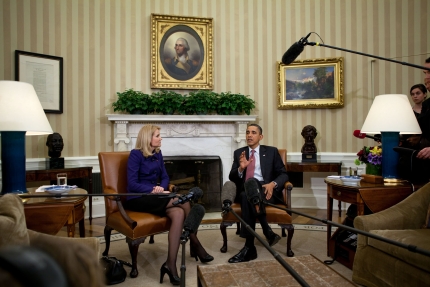
President Barack Obama and Prime Minister Helle Thorning-Schmidt of Denmark (February 24, 2012)

President Barack Obama and Prime Minister Helle Thorning-Schmidt of Denmark hold a bilateral meeting in the Oval Office, Feb. 24, 2012. (Official White House Photo by Sonya Hebert)

Five months after becoming the first female prime minister of Denmark, Helle Thorning-Schmidt was at the White House today for a meeting with President Obama.

The two leaders talked through a range of issues -- including counterterrorism cooperation and international security. The President also took time to thank Prime Minister Thorning-Schmidt  for what he called the "extraordinary contributions" of Danish troops in the Helmand area of Afghanistan.

But in comparing notes, President Obama said that he learned that -- just like Americans -- Danes are focused intensely on creating jobs and growing the economy.

The President said:

[We] agreed that there has been some progress in resolving the sovereign debt issues, that there has been some progress with respect to the agreements between the EU and the IMF and Greece, the new government in Italy, new governments in Spain and Portugal are all making significant progress, but that there's a lot more work to do. And we will be consulting closely with Denmark. 

President Obama will meet again with a range of leaders from Europe in Chicago in May -- for a NATO summit and a meeting of the G-8.

Related Topics: Defense, Economy, Foreign Policy

The White House

Office of the Press Secretary

Remarks by President Obama and Prime Minister Thorning-Schmidt of Denmark after a Bilateral Meeting

The Oval Office

3:41 P.M. EST

PRESIDENT OBAMA:  Well, I want to welcome Prime Minister Thorning-Schmidt to the White House and to the Oval Office.  This is the first time that we've had a chance to meet, but obviously we've been very impressed with the first five months of her prime ministership.  I shared with her how much Michelle and I appreciated the extraordinary hospitality that was shown to Michelle and I when I visited Copenhagen in the past.  And I also wanted to just say how much we appreciate the great alliance and partnership that we have with the Danish people on a whole range of international issues.

Obviously, most recently, the operations in Libya could not have been as effective had it not been for the precision and the excellence of the Danish armed forces and their pilots.  But that's fairly typical of the way that Danes have punched above their weight in international affairs.

In Afghanistan, I thanked the Prime Minister for the extraordinary contributions of Danish troops in the Helmand area.  They operate without caveat, have taken significant casualties, for which obviously all of us extend our condolences to the families that have been affected.  But because of the outstanding work that's been done by Danish soldiers in Afghanistan, we're seeing great progress in the areas where they operate. 

We had a chance to talk about the economy.  As we were exchanging notes, it turns out that, like folks here in the United States, everybody in Denmark wants to talk about the economy all the time, and jobs and growth.  And we agreed that there has been some progress in resolving the sovereign debt issues, that there has been some progress with respect to the agreements between the EU and the IMF and Greece, the new government in Italy, new governments in Spain and Portugal are all making significant progress, but that there's a lot more work to do.  And we will be consulting closely with Denmark. 

And we exchanged ideas on how we can ensure not only economic stability in Europe but also growth in Europe, because if Europe is growing then that benefits the U.S. economy as well.  And we emphasized other additional ways that we can encourage trade and reduce economic frictions between the two sides of the transatlantic relationship.

In preparation for our meeting in Chicago, at NATO, in my hometown, we talked about the transition that was already agreed to in Lisbon, when it comes to putting Afghans in the lead in security over the next several years.  And we are going to be consulting with not only Denmark but our other allies in making sure that that is a smooth transition and one that is sustained, where we continue to help the Afghan government to support its own sovereignty and effectively control its borders.

We also discussed the extraordinary counterterrorism cooperation that's taking place between our two countries.  And I thanked the Prime Minister for the excellent work that her intelligence team has done.  We are in constant communication on a whole host of issues.  The Danes are very much one of the leaders when it comes to counterterrorism, and are obviously familiar with the significant threats that are posed by terrorism.  So we appreciate that very much.

And we had a chance to talk about a wide range of international issues, including the situation in Syria.  And I have to say that all of us who've been seeing the terrible pictures coming out of Syria and Homs recently recognize it is absolutely imperative for the international community to rally, and send a clear message to President Assad that it is time for a transition, it is time for that regime to move on, and it is time to stop the killing of Syrian citizens by their own government.

And I'm encouraged by the international unity that we are developing -- the meetings that took place in Tunisia that Secretary Clinton attended.  And we are going to continue to keep the pressure up, and are looking for every tool available to prevent the slaughter of innocents in Syria.  And this is an area where I think the Prime Minister and I deeply agree -- it's important that we not be bystanders during these extraordinary events. 

At the same time, there are other threats in the region, including the situation in Iran.  And I thanked the Prime Minister and the Danish government for their leadership role in applying the toughest sanctions we've ever seen coming out of the EU.  Difficult sanctions to apply, but we both agree that we're making progress and they are working in sending a message to Iran that it needs to take a different path if it wants to rejoin the international community, and that there is a expectation on the part of the world that they abide by their international obligations when it comes to their nuclear program.

So the final thing we talked about was the fact that we both have two daughters; they're roughly the same ages.  (Laughter.)  We traded notes.  The Prime Minister's daughters are slightly older than Malia and Sasha.  She assures me that they continue to behave themselves, even well into their teenage years.  So I'm encouraged by the report. 

PRIME MINISTER THORNING-SCHMIDT:  Good.  (Laughter.)

PRESIDENT OBAMA:  And I thank you very much.  I hope that you have a wonderful stay while you're here, and we look forward to working with you again in the near future.

PRIME MINISTER THORNING-SCHMIDT:  Thank you, Mr. President.  And thank you so much for your kind words.  And the Danish people have a very strong sense of closeness to the United States, and we always have had that sense.  We have close economic, political ties with each other.  But not only that, we exchange tourism, students, ideas, and culture.  But perhaps most important of all, we have -- we share common values.  And I think in a turbulent time, this is very, very important.

So basically, the friendship and the alliance between our two countries is in very good shape right now.  And I thank you for that.

As you said, we discussed the current situation.  Denmark holds the presidency of the EU right now, and we talk about the debt situation most of the time, in Europe.  I conveyed the message to the President that I am convinced that we will see ourselves through this crisis.  We have now put some very important measures in place.  We have fiscal conservation, we have reforms, and we have focus on growth and jobs right now.

In doing that, in this endeavor, I think a closer transatlantic relationship will be important.  We are dependent on each other and we should have closer trade with each other, and I think that would be part of creating sustainable growth in our own countries. 

As you were saying, Mr. President, we also have close ties in terms of security.  It is clear -- it has been for a long time -- that Danish soldiers are serving alongside American soldiers in Afghanistan, and I used the opportunity today to thank you and the American people for the great effort you have put in Afghanistan.  It is greatly appreciated worldwide.  And I know that the Danish people really appreciate the global leadership that you and your people have taken also within that context.

I look forward, of course, to coming back to the States, to your hometown, Chicago, to participate in the NATO summit.  And what we will be discussing there is Afghanistan, of course.  One of the major issues there is transition to the next phase in Afghanistan, and where -- what we want to see is the Afghans taking responsibility for their own security.  And we are, in Europe, with all the Danish leadership, trying to gather donors in this -- in securing that the Afghans are capable of taking over their own security.

We have some great samples of our alliance.  We have worked together, again, in Libya, where we made sure that Libya came out on a path of democracy.  And I think, again, the Americans showed leadership in that context.

Another area that we discussed, as you’ve said, was Syria, which is quite the opposite situation.  It is horrendous what we see in Syria right now.  But I think it is also very, very true that we have worked together in that area.  We must continue that endeavor, and just today we have seen that, of the leadership of the League of Arab States, there has been a step forward in trying to put pressure on Syria, which is very, very important.  The same goes for Iran. 

Another area in security where we work together is in terms of piracy, and I used the opportunity of thanking sincerely the President for the courageous operation that led to the freeing of two aid workers that worked for the Danish Refugee Council.  They are now safe because of the Americans.  Thank you for that.

So basically our security -- our cooperation in terms of security are very great indeed. 

I will finish here just by saying that I think our meeting here today has confirmed the friendship and the alliance between our two countries.  There’s a lot we can do that -- you're always welcome to come to Denmark -- and I think it is very, very important that we have these kind of meetings to renew the friendship, and this is what you’ve done today. 

Thank you.

PRESIDENT OBAMA:  Thank you very much, everybody. 

END
3:51 P.M. EST
The White House

Office of the Press Secretary

Fact Sheet: The United States and Denmark – NATO Allies and Global Partners

President Obama hosted Prime Minister Helle Thorning-Schmidt for a meeting in the Oval Office on February 24.  Denmark has the distinction of being the only Nordic country that is a member of both NATO and the European Union (EU), making it an especially valuable partner of the United States in a wide variety of endeavors in Europe and around the world.  Denmark currently holds the rotating EU Presidency until the end of June. 
 
Defense and Security Cooperation:  As NATO allies, the United States and Denmark are committed to each other’s security and stand together in critical crisis areas worldwide.

  • Libya:  Denmark was among the first and most active participants in the UN-authorized NATO military intervention to protect Libyan civilians.  It deployed F-16s during the entire seven-month civilian protection mission. 
  • Afghanistan:  Denmark is a key contributor to the NATO-led International Security Assistance Force (ISAF), currently providing 650 combat troops operating without national caveats in one of the most challenging areas of the country.   Denmark will continue to play a strong role in Helmand Province providing military forces through 2014 and other training and development assets beyond that date.  Since 2002, it has given approximately $530 million in bilateral development assistance to Afghanistan. 
  • NATO Capabilities:  Denmark is one of NATO’s most capable allies.  The United States welcomes its interest in leading the Smart Defense initiative to purchase jointly and stockpile munitions, which will cut costs and improve efficiency.
  • Bilateral Defense Cooperation:  The United States and Danish militaries enjoy a very high level of interoperability; many Danish officers, including all its pilots, have trained in the United States. 
  • Missile Defense:  The United States and Denmark cooperate actively in implementing the European Phased Adaptive Approach.  The Kingdom of Denmark is home to U.S. early-warning radar at Thule Air Base in Greenland and hosted the 2011 multinational missile-defense conference, where NATO focused on strengthening cooperation to protect our populations and territory from ballistic missiles.
  • Counter-Piracy:  Denmark is one of the world’s main seafaring nations (some 10 percent of global shipping moves in Danish-owned or –operated ships), and as such, is a leader in international efforts to counter piracy off the coast of Somalia, chairing an international working group on legal issues and twice commanding an international naval task force.  Denmark has made significant contributions, including maritime patrol aircraft, to the NATO-led counter-piracy operation.
  • Security and Capacity-Building Cooperation Against Terrorism:  Denmark is one of the United States’ strongest and most dynamic counterterrorism partners.  Denmark is a member of the Global Counterterrorism Forum (GCTF), a major multilateral initiative to strengthen the international architecture to deal with 21st century terrorism.  Denmark is particularly active in the Forum’s work in the Sahel and the Horn of Africa. 
  • Nuclear Security Summit:  The United States and Denmark will participate in the March 26-27 Nuclear Security Summit in Seoul.  Both countries support efforts to lock down vulnerable nuclear material and acknowledge the important actions of the IAEA and multilateral initiatives such as the Global Initiative to Combat Nuclear Terrorism to reduce the threat of nuclear terrorism.
  • Law Enforcement:  U.S. and Danish authorities enjoy excellent cooperation encompassing a wide range of law-enforcement issues, including cyber, drug, fraud, fugitive, gang-violence, and online child-predator matters.

Diplomatic Cooperation and Global Development:  Denmark is one of the world’s most active and generous providers of international development assistance and an active partner with the United States in addressing challenges around the globe.

  • Development Assistance:  Denmark gave approximately $2.9 billion in development assistance in 2010, which was 0.9 percent of GDP; the new government has pledged to raise it to even greater levels.  
  • Women’s Entrepreneurship:  On December 14, the United States, Denmark and Goldman Sachs announced at the World Bank a public-private partnership to support women’s entrepreneurship, starting with a pilot phase in Tanzania.  The partnership will build on Goldman Sachs’s “10,000 Women” initiative and the U.S. State Department’s program for female entrepreneurs. 
  • Women in Global Security:  The U.S. Embassy in Copenhagen and the Danish Foreign Ministry co-hosted a regional conference on the Role of Women in Global Security in October 2010, drawing high-level participation from the Nordic and Baltic states, the U.S., NATO, and three focus countries:  Afghanistan, Uganda and Liberia.
  • Democratization:  Both countries cooperate in supporting democratization efforts in the Middle East and North Africa.  Denmark provided funding totaling about $46 million in 2011.
  • Bilateral Cooperation:  Danish Minister for Development Cooperation Christian Friis Bach and USAID Administrator Rajiv Shah were signatories of a Joint Statement by Development Ministers leading up to the Fourth High-Level Forum on Aid Effectiveness in Busan, South Korea.  The Danish Ministry of Foreign Affairs has agreed to co-host a USAID conference focused on the Horn of Africa in March in Nairobi, Kenya.

Economic, Energy and Environmental Cooperation:  The robust U.S.-Danish economic partnership creates jobs, is helping to build a sustainable energy economy, and advances scientific research in the Arctic.

  • Trade, Investment, and Jobs: The United States is Denmark’s largest trading partner outside the European Union.  Total bilateral trade in goods and services was approximately $25 billion in 2010.  Danish direct investment in the U.S. was $9.9 billion in 2010.  More than 250 Danish companies have subsidiaries in the U.S. employing over 35,000 Americans. 
  • Green Growth:  Denmark is the only net exporter of energy in the EU and a global leader in energy efficiency and renewable energy technology.  The United States and Denmark work closely in multiple fora, including the Clean Energy Ministerial, to build the foundation for a sustainable global energy economy.
    • In October, Denmark hosted the first Global Green Growth Forum, a high-level gathering of international business, governmental and research leaders seeking to promote green economy issues.
    • The U.S. Embassy in Copenhagen and the Danish employers’ federation jointly facilitated matchmaking between American and Danish clean-tech companies at two Green Partnership events (May 2010 in Copenhagen, September 2011 in Washington D.C.), to create opportunities to export clean energy technology to markets around the world.
  • Scientific Cooperation:  The U.S. and Denmark entered into a bilateral Science and Technology agreement in 2009.  The U.S. National Renewable Energy Laboratory and the Technical University of Denmark have jointly led research to design more efficient wind energy systems since 2007, and are expanding their efforts to other renewable-energy and energy-efficiency technologies.  Danish and U.S. health authorities have a history of cooperation on such topics as health information technology, communicable and non-communicable diseases, antimicrobial resistance and improving health care quality in hospital and primary care settings.    In 2006, Denmark opened its Innovation Center in Silicon Valley, accelerating the entry of Danish companies into Silicon Valley and promoting U.S. investments in Denmark.
  • Arctic Collaboration:  The United States and Denmark are both members of the Arctic Council (AC).  The Kingdom of Denmark released a comprehensive 2011-2020 Arctic Strategy late last year that calls for environmentally-sustainable development achieved through close cooperation with Arctic nations.
    • Denmark and Greenland hosted the AC foreign ministers’ meeting in Nuuk, Greenland in May 2011, where the AC’s first legally-binding agreement was signed, dealing with Cooperation on Aeronautical and Maritime Search and Rescue in the Arctic.  Denmark, the United States and other AC countries agreed to develop plans for ecosystem-based management of the Arctic Ocean.
    • The U.S.-Denmark-Greenland Joint Committee (JC) promotes action-based cooperation on a wide range of scientific, environmental, economic, commercial and educational matters.  A wide range of U.S. government agencies are active in Greenland, in close collaboration with Danish and Greenlandic counterparts.
  • Climate Change:  Denmark is a leader in addressing climate change.  It pledged $207 million for fast-start climate finance for 2010-2012.  The current government has announced a unilateral goal of reducing greenhouse gas (GHG) emissions by 40 percent by 2020.  An impetus is green growth, particularly given increased global wind technology competition.  Denmark’s global export of clean technologies peaked in 2008 at approximately $11.8 billion.
    • As president of the UN’s 15th session of the Conference of the Parties (COP-15) in December 2009, Denmark hosted President Obama and some 120 heads of state and government along with 24,000 people, the largest-ever gathering associated with international climate negotiations.  The resulting Copenhagen Accord has paved the way for agreement in Cancun and Durban on a new framework to address climate change that includes action from developed and developing countries.
    • Denmark takes an active role in low-emissions development strategies (LEDS), encouraging developing countries’ transition to low-emission, climate-resilient economies.  In December 2010, Denmark joined an initiative with the Alliance of Small Island States, the World Bank and the UN Development Program, and pledged $14.5 million to kick off the initiative.

Educational and Cultural Ties:  Traditionally close relations between our two societies continue to grow stronger through regular educational and cultural exchange.

  • Educational Exchange:
    • Since 2009, the U.S. Embassy in Copenhagen has seen a 46 percent increase in student visa applications and a 22 percent increase in exchange visitor applications. 
    • More than 3,400 visas were issued to Danish students traveling to the United States on academic exchanges and for long-term study in 2011. 
    • Last year marked the 60th anniversary of the Fulbright program in Denmark.   Since 1951, more than 2,000 Danes have been educated in the United States and more than 1,000 Americans in Denmark on Fulbright scholarships, including Senior Advisor to the Prime Minister Noa Reddington, chairman of the parliamentary Foreign Policy Committee Jeppe Kofod, and former Minister of Foreign Affairs and Minister of the Economy Niels Helveg Petersen.
    • The State Department has a unique online partnership with the Danish educational system, which disseminates information about the United States to Danish schools.
  • Cultural Exchange:
    • As one of the leading Jazz centers of Europe, Denmark has been home to many American Jazz icons such as Dexter Gordon and Ben Webster, and continues to attract leading American Jazz artists today.
    • The Royal Danish Ballet maintains close ties to the American Ballet community and tours frequently in the United States, including last year during Queen Margrethe II’s visit.
    • Since gaining a national profile for itself in the 1980s, Danish cinema continues to be celebrated in the United States.  Last year, Susanne Bier became the third Danish director to win an Academy Award.