The White House

Office of the Press Secretary

Press Gaggle by Press Secretary Jay Carney en route Miami, FL, 2/23/2012

Aboard Air Force One
En Route

11:35 A.M. EST  

MR. CARNEY:  Good morning, everyone.  Thanks for joining us on our trip today to Miami and Orlando, Florida.  It’s a good thing we left that cold winter weather behind today as we head to Florida. 
 
I don’t have but one announcement right before I take your questions, and that is, as I’m sure you’re all aware, it’s Jen Epstein’s birthday today.  I needed to appropriately acknowledge that.  Thank you for spending your birthday with us.  Appreciate it.  I assume that you’re now able to rent a car without an added payment.  (Laughter.)  Well, it doesn't look -- you're youthful and full of energy.

So with that I’ll take your questions.
 
Q    Jay, the President apologized to Karzai over the burning of the Koran.  Is the President worried, or is he frustrated that he has to do this and that it feeds a kind of a political narrative that the Republicans have created that he’s --

MR. CARNEY:  That's a fully false, fallacious and ridiculous narrative that is not borne out by any facts.  The President, following up on a telephone conversation, the likes of which he has routinely with President Karzai, wrote a long letter on a variety of issues related to our bilateral engagement, including reconciliation, including the trilateral talks between -- with Pakistan last week in Islamabad, in which he also expressed his condolences and -- or rather, his apology for the inadvertent burning of religious materials by American personnel in Afghanistan.
 
It is wholly appropriate, given the sensitivities to this issue, the understandable sensitivities.  His primary concern as Commander-in-Chief is the safety of American men and women in Afghanistan, of our military and civilian personnel there.  And it was absolutely the right thing to do.
 
And I would simply note that Secretary Panetta, Joint Chiefs Chairman Dempsey and I have all conveyed apologies on behalf of the United States for this incident.
 
Q    Did President Karzai ask him for that letter after their phone call?
 
MR. CARNEY:  -- the letter, which I can't show you because it’s not appropriate to show, but it’s a lengthy three-page letter on a host of issues, several sentences of which relate to this matter.
 
Q    What’s the reception been to the letter, Jay?
 
MR. CARNEY:  I don’t have an update for you.  I understand that President Karzai released some quotations from the letter.  But I don’t have any readout for you on the reception.  I think that the message that we’re trying to convey here is that this was inadvertent.  We take is very seriously.  There is an ISAF investigation.  And even prior to any completion of that investigation, General Allen is taking steps to ensure that this kind of thing can’t happen again by instituting training on the handling of religious materials.
 
Q    President Karzai’s office said today that they’d like a trial of those involved in this incident.  Do you have any reaction to that?
 
MR. CARNEY:  As I said, there’s an investigation going on to find out exactly what happened.  The inappropriate handling of these materials was inadvertent, but sensitivities here are ones that we understand and we have great respect -- the actions here, while inadvertent, do not reflect the great respect that our military personnel have for the religious traditions of the Afghan people.
 
Q    Any idea how long the investigation might take?
 
MR. CARNEY:  I’d refer you to the Defense Department and to ISAF for that.
 
Q    Jay, can you talk a little bit about why we’re on a smaller plane?  Is this anything to do with cost and given that you’re --
 
MR. CARNEY:  It has absolutely nothing to do with anything but scheduled maintenance on the larger plane that ran long.  That’s my understanding from the military office.  But we’re just going to be a little more cozy today.
 
Q    It may in fact be more fuel-efficient than a 747, but that’s inadvertent, even though today is --
 
MR. CARNEY:  How the President travels is determined by the Air Force and by the Secret Service.  And the issue here was maintenance that ran long on one of the 747s.
 
Q    Two questions.  Any chance that the President will make a -- drop by a basketball game some people may be watching tonight?
 
MR. CARNEY:  We have been encouraging him to call an audible, if you will, and -- I guess that’s a different sport --so that we can stay in Miami and watch the game.  Unfortunately, that’s not going to be possible.
 
Q    Not at all?  Not even a pop-in?  Okay.

Q    A Quinnipiac Poll out that suggests that people are feeling better about the economy, but it hasn’t translated yet to the President’s approval ratings -- 45 to 49 percent in this poll.  I know you don’t make your decisions based on polls, but is that a stat you’re aware of, and why do you think there is that lag in people feeling better about the economy but not --
 
MR. CARNEY:  Well, first of all, I think that any data that suggests people are feeling good about the economy is simply a reflection of the fact that the economy has been growing now for a sustained period and that recovery has been picking up some steam.  And most importantly, more Americans are finding work and the unemployment rate is coming down.  Those are all positive signs.  There are other signs that we saw in housing and elsewhere in the economy that reinforce the idea that the recovery is picking up some pace.

As for the President’s poll numbers, I mean, there are a variety of polls that show different things about his approval rating and things like that, as well as whether people believe that he has their interests at heart in the policy decisions he makes, which I can assure you he does.  His extreme focus in matters of domestic policy is on protecting, building the middle class and growing this economy and increasing job creation in this economy.

So as for the longer-term political implications, that’s largely beyond anyone’s control.  What he focuses on is getting the policy right, making sure we’re growing the economy, making sure that we have an economy built to last that’s built on the foundations -- the four pillars that he talked about in the State of the Union address, including the need for American energy.  And that’s a subject that he’ll address today in Florida.
 
Q    Is he going to make any news today?
 
MR. CARNEY:  Well, I’ll let you all decide.  What he will certainly talk about is the absolute need to take an all-of-the-above approach to our long-term energy needs and our energy security.  That includes expanding, as he has done, drilling for -- exploration for and drilling for traditional forms of fossil fuels -- oil, and gas.  It also means investing in and expanding the use of alternative energies.  It means doing everything you can to decrease our dependence on foreign sources of energy.  And the simple fact is, since he’s been in office, domestic production is up, reliance on foreign sources of energy is down.
 
Q    Jay, some of that production, though, that kind of rise, began under Bush.  Is the President taking credit for his policies doing that, or is it something that was already beginning to happen?
 
MR. CARNEY:  I took this question yesterday and I appreciate it.  There’s no question that the President’s commitment to expanding domestic production of oil and gas has been a priority since he took office, and it is simply an unsustainable argument to suggest otherwise.  The numbers here don't lie.  Whatever the policies were that were in place prior to him taking office, he has instituted policies that have resulted in a focus on increasing production; selling of lease sales -- huge lease sales in the Gulf; expanding production and development of fossil fuels in Alaska and elsewhere; the approval for the first time in 30 of a permit to build a nuclear reactor; and the substantial increase in investment in alternative energy sources.

His approach is an all-of-the-above approach.  And it is, I think, incumbent upon anyone who analyzes this or writes about it to note the facts, and the facts here are pretty clear.

Q    Jay, do you know if the President happened to watch any of the debate last night, and if not, what he did instead then?

MR. CARNEY:  I know that he didn't watch it.  But I don't know what he did otherwise.

Q    Is he of the opinion that Mitt Romney is making a comeback?

MR. CARNEY:  We didn't discuss it in those terms.  But he didn't catch the debate. 

Q    He did not?

MR. CARNEY:  Did not, no.  But as I think I've told you before, he tends to, when he's home after work, spend time with his family, and if he is watching TV it tends to be sports or movies.

Q    How often does he watch sports or --

MR. CARNEY:  I just know that he did not --

Q    You don't know that he did not watch sports last night or -- instead, or --

MR. CARNEY:  I don't know.  I'll have to ask him if he --

Q    Has he spoken with Jeremy Lin by phone?  I don't remember.  Has that happened yet?

MR. CARNEY:  I don't believe so.

Q    Is there any update on Syria?  I don't remember if this was covered in the briefing yesterday, but whether Marie Colvin's and Anthony Shadid's death and their final stories have in any way shaped the President's views on how -- the approach?

MR. CARNEY:  Well, I think -- I mean, certainly the President is aware of the tragic news of the death of Marie Colvin and of Remi Ochlik I think his name is -- I'm sure I'm mispronouncing it -- as well as Anthony Shadid and I'm sure -- and I know of other journalists and -- but what their deaths tell us, because of their courageous reporting, is that the overwhelming number of victims of Assad’s brutality are innocent, unarmed Syrian civilians.

I mean, one of the most powerful reports I read about Marie Colvin’s death is that hours before she was killed by the Assad regime, she reported on the death of a two-year-old child -- again, at the hands of Assad’s forces.  So the victims here are overwhelmingly Syrians and the assault that Assad continues to wage against the Syrian people is heinous and unforgiveable. 

That’s why we’re working with a broad array and a growing array of international partners to isolate and pressure Assad to bring about a peaceful transition in that country, a transition which is inevitable and which is already underway.  As you know, the "Friends of Syria" group is meeting I believe tomorrow, and we will be an active participant in that meeting.

Q    Jay, has the President -- I know you say he doesn’t watch a lot of TV, but has he been watching some of these images as they’ve been unfolding from Syria -- some of these really disturbing images?

MR. CARNEY:  I know that he is fully aware of and has been briefed on and read many news accounts about the atrocities committed by the Assad regime.  It is the reason why he has so forcefully condemned it, both he and other members of his government, his administration.  Again, I don’t know that -- well, I don’t know whether or not he’s see television coverage of it, but he has read a great deal about it, been briefed on extensively the extent of the violence, the extent of the brutality, and is fully aware of the shameful cowardice that that behavior represents.

Q    Jay, given the condemnation and the isolation, the brutality, as you point out, still continues.  Is the thinking at the White House evolving either to arm -- to consider arming rebels or having some other kind of military influence over this outcome?

MR. CARNEY:  Well, we continue to believe that a political resolution is the best approach.  We believe there’s still time for that.  That is why we are working with our international partners and all of the "Friends of Syria" to help try to bring that about, through pressuring and isolating Assad and trying to force him to relinquish the power that he so inappropriately wields. 

But we’ve said in response to questions about supplying weaponry and arms to the opposition that we do not feel that the right course at this time is to further militarize the situation in Syria, because a greater militarization will lead down a dangerous and chaotic path -- lead Syria down a dangerous and chaotic path.  Obviously, we’ll have to evaluate this as time goes on.

But the fact of the matter now is that the aggression, the violence, the military action that is being waged in Syria is overwhelmingly initiated by and carried out by the forces of Bashar Assad.  And that is why we are working so hard collectively with our international partners to pressure him to cease and desist.
 
Q    Is it correct to say that the U.S. is developing as a backup option or a contingency option plans to arm rebels but don’t want to go that way right now?

MR. CARNEY:  I think that’s -- you’re probably getting ahead of yourself there in that question.  I don’t have any information to suggest that.  Our focus right now is helping with the "Friends of Syria" to try to mitigate the humanitarian disaster that is unfolding, especially in Homs and other parts of Syria, to bolster the Syrian opposition as it organizes and unifies, and to continue to pressure and isolate the Assad regime.

The international community needs to act in that regard.  We were greatly disappointed by the veto of the Security Council Resolution by China and Russia.  We think the overwhelming vote for that very similar if not identical resolution in the U.N. General Assembly makes clear the vast global support for the Syrian people and how much on the wrong side of history those nations are that did not vote in favor of that resolution.

Anything else, guys?  Thank you.
   
Please note: The final question from this afternoon’s gaggle abroad Air Force One was inadvertently left off the gaggle transcript circulated earlier today. The missing question and answer are included below.

Q What’s the precedent for apologizing when the military has already apologized?

MR. CARNEY:  Well, in this case, again, the President was -- had been -- had a conversation with President Karzai the day before he was -- in a follow-up to that conversation, wrote an extensive letter on a number of topics, including the Afghan-led reconciliation process and our bilateral relationship with Afghanistan, in which he included an expression of his regret and apologies for the inappropriate and inadvertent mishandling of religious materials. 

I would note that one of my predecessors, Dana Perino, the Press Secretary for President George W. Bush, following an incident in which an American serviceman apparently shot or did damage to a Koran in 2008, she expressed apologies on behalf of the President.  And that’s appropriate for the same reason, because our concern -- this President’s concern, as was surely the case with President Bush, is the safety and security of our men and women in uniform, as well as our civilians in Afghanistan. 

And one of the reasons that it’s appropriate to express our sincere apologies for this incident is that the kind of reaction that it can cause risks putting our men and women in harm’s way, or in further risk than they already are.  So I think that precedent is a useful one to look at.

Thanks, guys.

END
11:54 A.M. EST

The White House

Office of the Press Secretary

Remarks by the President During Walking Tour of Industrial Assessment Center -- University of Miami

Miami, Florida

1:55 P.M. EST

THE PRESIDENT:  This is for background because you guys just came in.  What this facility does is teach these outstanding young engineers how to do energy assessments for manufacturers, industrial buildings across the board.  And so far they have -- how many?  Two hundred assessments, saving these companies up to 25 percent in their energy usage.  And that's going to end up saving them millions of dollars.

So it's a great example of how people are being trained right now to make our businesses more energy-efficient all across the country.

All right.

END
1:56 P.M. EST

The White House

Office of the Press Secretary

Statement by the Press Secretary on the Case of Iranian Pastor Youcef Nadarkhani

The United States condemns in the strongest possible terms reports that Iranian authorities’ reaffirmed a death sentence for Iranian Pastor Youcef Nadarkhani for the sole reason of his refusal to recant his Christian faith.  This action is yet another shocking breach of Iran’s international obligations, its own constitution, and stated religious values.  The United States stands in solidarity with Pastor Nadarkhani, his family, and all those who seek to practice their religion without fear of persecution—a fundamental and universal human right.  The trial and sentencing process for Pastor Nadarkhani demonstrates the Iranian government’s total disregard for religious freedom, and further demonstrates Iran's continuing violation of the universal rights of its citizens.  The United States calls upon the Iranian authorities to immediately lift the sentence, release Pastor Nadarkhani, and demonstrate a commitment to basic, universal human rights, including freedom of religion.  The United States renews its calls for people of conscience and governments around the world to reach out to Iranian authorities and demand Pastor Nadarkhani's immediate release.

The White House

Office of the Press Secretary

Fact Sheets on American Energy

Attached are two facts sheets pertaining to the President’s remarks on American energy today in Miami, Florida.

Supporting an All-of-the-Above Approach to American Energy and Protecting Consumers at the Pump

All-of-the-Above Approach to American Energy -- Reducing Energy Costs for American Consumers and Businesses


The White House

Office of the Press Secretary

Notice -- Continuation of the National Emergency with Respect to Libya

NOTICE

CONTINUATION OF THE NATIONAL EMERGENCY WITH RESPECT TO LIBYA

On February 25, 2011, by Executive Order 13566, I declared a national emergency pursuant to the International Emergency Economic Powers Act (50 U.S.C. 1701-1706) to deal with the unusual and extraordinary threat to the national security and foreign policy of the United States constituted by Colonel Muammar Qadhafi, his government, and close associates who took extreme measures against the people of Libya, including by using weapons of war, mercenaries, and wanton violence against unarmed civilians.  In addition, there was a serious risk that Libyan state assets would be misappropriated by Qadhafi, members of his government, members of his family, or his close associates if those assets were not protected.  The foregoing circumstances, the prolonged attacks, and the increased numbers of Libyans seeking refuge in other countries caused a deterioration in the security of Libya and posed a serious risk to its stability.

We are in the process of winding down the sanctions in response to the many positive developments in Libya, including the fall of Qadhafi and his government.  We are working closely with the new Libyan government and with the international community to effectively and appropriately ease restrictions on sanctioned entities, including by taking action consistent with the U.N. Security Council's decision to lift sanctions against the Central Bank of Libya and two other entities on December 16, 2011.  However, the situation in Libya continues to pose an unusual and extraordinary threat to the national security and foreign policy of the United States and we need to protect against this threat and the diversion of assets or other abuse by certain members of Qadhafi's family and other former regime officials.  Therefore, the national emergency declared on February 25, 2011, and the measures adopted on that date to deal with that emergency, must continue in effect beyond February 25, 2012.  Therefore, in accordance with section 202(d) of the National Emergencies Act (50 U.S.C. 1622(d)), I am continuing for 1 year the national emergency declared in Executive Order 13566.

This notice shall be published in the Federal Register and transmitted to the Congress.

BARACK OBAMA

THE WHITE HOUSE,
         February 23, 2012.

The White House

Office of the Press Secretary

Letter -- Continuation of the National Emergency with Respect to Libya

TEXT OF A LETTER FROM THE PRESIDENT
TO THE SPEAKER OF THE HOUSE OF REPRESENTATIVES
AND THE PRESIDENT OF THE SENATE

February 23, 2012

Dear Mr. Speaker: (Dear Mr. President:)

Section 202(d) of the National Emergencies Act (50 U.S.C. 1622(d)) provides for the automatic termination of a national emergency unless, within 90 days prior to the anniversary date of its declaration, the President publishes in the Federal Register and transmits to the Congress a notice stating that the emergency is to continue in effect beyond the anniversary date.  In accordance with this provision, I have sent to the Federal Register for publication the enclosed notice stating that the national emergency declared in Executive Order 13566 of February 25, 2011, is to continue in effect beyond February 25, 2012.

Colonel Muammar Qadhafi, his government, and close associates took extreme measures against the people of Libya, including by using weapons of war, mercenaries, and wanton violence against unarmed civilians.  In addition, there was a serious risk that Libyan state assets would be misappropriated by Qadhafi, members of his government, members of his family, or his close associates if those assets were not protected.  The foregoing circumstances, the prolonged attacks, and the increased numbers of Libyans seeking refuge in other countries caused a deterioration in the security of Libya, posed a serious risk to its stability, and led me to declare a national emergency to deal with this threat to the national security and foreign policy of the United States.

We are in the process of winding down the sanctions in response to the many positive developments in Libya, including the fall of Qadhafi and his government.  We are working closely with the new Libyan government and with the international community to effectively and appropriately ease restrictions on sanctioned entities, including by taking actions consistent with the U.N. Security Council's decision to lift sanctions against the Central Bank of Libya and two other entities on December 16, 2011.  However, the situation in Libya continues to pose an unusual and extraordinary threat to the national security and foreign policy of the United States and we need to protect against this threat and the diversion of assets or other abuse by certain members of Qadhafi's family and other former regime officials.  Therefore, I have determined that it is necessary to continue the national emergency with respect to Libya.

Sincerely,

BARACK OBAMA

The White House

Office of the Press Secretary

Letter -- Continuation of the National Emergency with Respect to Cuba and the Emergency Authority Relating to the Regulation of the Anchorage and Movement of vessels

TEXT OF A LETTER FROM THE PRESIDENT
TO THE SPEAKER OF THE HOUSE OF REPRESENTATIVES
AND THE PRESIDENT OF THE SENATE

February 23, 2012

Dear Mr. Speaker: (Dear Mr. President:)

Section 202(d) of the National Emergencies Act (50 U.S.C. 1622(d)) provides for the automatic termination of a national emergency unless, within 90 days prior to the anniversary date of its declaration, the President publishes in the Federal Register and transmits to the Congress a notice stating that the emergency is to continue in effect beyond the anniversary date.  In accordance with this provision, I have sent the enclosed notice to the Federal Register for publication, stating that the national emergency declared with respect to the Government of Cuba's destruction of two unarmed U.S. registered civilian aircraft in international airspace north of Cuba on February 24, 1996, as amended and expanded on February 26, 2004, is to continue in effect beyond March 1, 2012.

Sincerely,

BARACK OBAMA

The White House

Office of the Press Secretary

Notice -- Continuation of the National Emergency with Respect to Cuba and the Emergency Authority Relating to the Regulation of the Anchorage and Movement of vessels

NOTICE

CONTINUATION OF THE NATIONAL EMERGENCY WITH RESPECT TO CUBA
AND OF THE EMERGENCY AUTHORITY RELATING TO THE REGULATION
OF THE ANCHORAGE AND MOVEMENT OF VESSELS

On March 1, 1996, by Proclamation 6867, a national emergency was declared to address the disturbance or threatened disturbance of international relations caused by the February 24, 1996, destruction by the Cuban government of two unarmed U.S. registered civilian aircraft in international airspace north of Cuba.  On February 26, 2004, by Proclamation 7757, the national emergency was extended and its scope was expanded to deny monetary and material support to the Cuban government.  The Cuban government has not demonstrated that it will refrain from the use of excessive force against U.S. vessels or aircraft that may engage in memorial activities or peaceful protest north of Cuba.  In addition, the unauthorized entry of any U.S. registered vessel into Cuban territorial waters continues to be detrimental to the foreign policy of the United States.  Therefore, in accordance with section 202(d) of the National Emergencies Act (50 U.S.C. 1622(d)), I am continuing the national emergency with respect to Cuba and the emergency authority relating to the regulation of the anchorage and movement of vessels set out in Proclamation 6867 as amended by Proclamation 7757.

This notice shall be published in the Federal Register and transmitted to the Congress.

BARACK OBAMA

THE WHITE HOUSE,
         February 23, 2012.

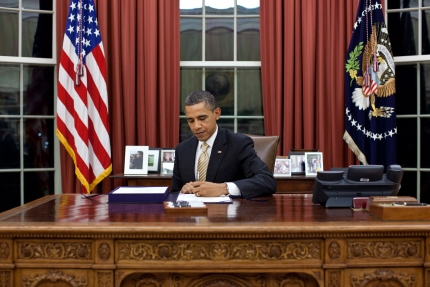
President Obama Signs the Payroll Tax Cut

Just now, President Obama signed the Middle Class Tax Relief and Job Creation Act of 2012 -- extending the payroll tax cut and emergency jobless benefits through the end of the year.

Last week, the President called on Americans from across the country to add their voices to the debate and let us know what they would do without an extra $40 in their paychecks. Thousands of individuals did exactly that, and it made all the difference.

At the time, President Obama said, "Until you see me sign this thing, you've got to keep on speaking up...If it's not on the White House website, it hasn't happened."

It happened. Here's that picture the President promised:

President Obama signs the payroll tax cut (February 22, 2012)

President Barack Obama signs H.R. 3630 - Middle Class Tax Relief and Job Creation Act of 2012 in the Oval Office, Feb. 22, 2012. (Official White House Photo by Pete Souza)

 
Related Topics: Economy, Taxes

President Obama Speaks at the National Museum of African American History and Culture Groundbreaking

February 22, 2012 | 6:13 | Public Domain

The President speaks at the groundbreaking ceremony for the National Museum of African American History and Culture on the National Mall.

Download mp4 (59MB) | mp3 (6MB)

Read the Transcript

Remarks by the President at the Groundbreaking Ceremony of the National Museum of African American History and Culture

The National Mall

11:21 A.M. EST

THE PRESIDENT:  Thank you.  (Applause.)  Thank you so much. Thank you so much.  Please, have a seat.  Thank you very much.  Well, good morning, everybody.

AUDIENCE:  Good morning.

THE PRESIDENT:  I want to thank France for that introduction and for her leadership at the Smithsonian.  I want to thank everybody who helped to make this day happen.  I want to thank Laura Bush; Secretary Salazar; Sam Brownback; my hero, Congressman John Lewis; Wayne Clough, and everybody who's worked so hard to make this possible. 

I am so proud of Lonnie Bunch, who came here from Chicago, I want to point out.  (Laughter and applause.)  I remember having a conversation with him about this job when he was planning to embark on this extraordinary journey.  And we could not be prouder of the work that he has done to help make this day possible.

I promise to do my part by being brief. 

As others have mentioned, this day has been a long time coming.  The idea for a museum dedicated to African Americans was first put forward by black veterans of the Civil War.  And years later, the call was picked up by members of the civil rights generation -– by men and women who knew how to fight for what was right and strive for what is just.  This is their day.  This is your day.  It’s an honor to be here to see the fruit of your labor.

It’s also fitting that this museum has found a home on the National Mall.  As has been mentioned, it was on this ground long ago that lives were once traded, where hundreds of thousands once marched for jobs and for freedom.  It was here that the pillars of our democracy were built, often by black hands.  And it is on this spot –- alongside the monuments to those who gave birth to this nation, and those who worked so hard to perfect it –- that generations will remember the sometimes difficult, often inspirational, but always central role that African Americans have played in the life of our country. 

This museum will celebrate that history.  Because just as the memories of our earliest days have been confined to dusty letters and faded pictures, the time will come when few people remember drinking from a colored water fountain, or boarding a segregated bus, or hearing in person Dr. King's voice boom down from the Lincoln Memorial.  That’s why what we build here won't just be an achievement for our time, it will be a monument for all time.  It will do more than simply keep those memories alive.

Just like the Air and Space Museum challenges us to set our sights higher, or the Natural History Museum encourages us to look closer, or the Holocaust Museum calls us to fight persecution wherever we find it, this museum should inspire us as well.  It should stand as proof that the most important things in life rarely come quickly or easily.  It should remind us that although we have yet to reach the mountaintop, we cannot stop climbing.

And that’s why, in moments like this, I think about Malia and Sasha.  I think about my daughters and I think about your children, the millions of visitors who will stand where we stand long after we're gone.  And I think about what I want them to experience.  I think about what I want them to take away.

When our children look at Harriet Tubman's shawl or Nat Turner's bible or the plane flown by Tuskegee Airmen, I don’t want them to be seen as figures somehow larger than life.  I want them to see how ordinary Americans could do extraordinary things; how men and women just like them had the courage and determination to right a wrong, to make it right. 

I want my daughters to see the shackles that bound slaves on their voyage across the ocean and the shards of glass that flew from the 16th Street Baptist church, and understand that injustice and evil exist in the world.  But I also want them to hear Louis Armstrong’s horn and learn about the Negro League and read the poems of Phyllis Wheatley.  And I want them to appreciate this museum not just as a record of tragedy, but as a celebration of life.

When future generations hear these songs of pain and progress and struggle and sacrifice, I hope they will not think of them as somehow separate from the larger American story.  I want them to see it as central -- an important part of our shared story.  A call to see ourselves in one another.  A call to remember that each of us is made in God’s image.  That’s the history we will preserve within these walls.  The history of a people who, in the words of Dr. King, “injected new meaning and dignity into the veins of civilization.” 

May we remember their stories.  May we live up to their example.  Thank you, God bless you, and God bless the United States of America.  (Applause.)

END              
11:28 A.M. EST

Close Transcript