Weekly Address: It’s Time for Congress to Act to Help Responsible Homeowners

February 04, 2012 | 3:55 | Public Domain

President Obama continues his call for a return to American values, including fairness and equality, as part of his blueprint for an economy built to last. 

Download mp4 (138MB) | mp3 (4MB)

Read the Transcript

WEEKLY ADDRESS: It’s Time for Congress to Act to Help Responsible Homeowners

WASHINGTON, DC—In this week’s address, President Obama continued his call for a return to American values, including fairness and equality, as part of his blueprint for an economy built to last.  This is why the President is sending Congress his plan to give responsible homeowners the chance to save thousands of dollars on their mortgages by refinancing at historically low rates without adding a cent to the deficit.  The housing crisis has been the single largest drag on the recovery, and although the Administration’s actions have helped responsible homeowners refinance their mortgages and stay in their homes, Congress must act now to do more to continue assisting homeowners and the economy.  President Obama asks all Americans to tell their elected officials to pass this plan to keep more families in their homes and more neighborhoods thriving and whole.

Remarks of President Barack Obama
Weekly Address
The White House
Saturday, February 4, 2012

Over the last couple of weeks, I’ve been traveling around the country and talking with folks about my blueprint for an economy built to last.  It’s a blueprint that focuses on restoring the things we’ve always done best.  Our strengths.  American manufacturing.  American energy.  The skills and education of American workers. 

And most importantly, American values like fairness and responsibility. 

We know what happened when we strayed from those values over the past decade – especially when it comes to our housing market.

Lenders sold loans to families who couldn’t afford them.  Banks packaged those mortgages up and traded them for phony profits.  It drove up prices and created an unsustainable bubble that burst – and left millions of families who did everything right in a world of hurt.

It was wrong.  The housing crisis has been the single biggest drag on our recovery from the recession.  It has kept millions of families in debt and unable to spend, and it has left hundreds of thousands of construction workers out of a job.

But there’s something even more important at stake.  I’ve been saying this is a make-or-break moment for the middle class.  And the housing crisis struck right at the heart of what it means to be middle-class in this country: owning a home.  Raising our kids.  Building our dreams.

Right now, there are more than 10 million homeowners in this country who, because of a decline in home prices that is no fault of their own, owe more on their mortgages than their homes are worth.  Now, it is wrong for anyone to suggest that the only option for struggling, responsible homeowners is to sit and wait for the housing market to hit bottom.  I don’t accept that.  None of us should.

That’s why we launched a plan a couple years ago that’s helped nearly one million responsible homeowners refinance their mortgages and save an average of $300 on their payments each month.  Now, I’ll be the first to admit it didn’t help as many folks as we’d hoped.  But that doesn’t mean we shouldn’t keep trying.

That’s why I’m sending Congress a plan that will give every responsible homeowner the chance to save about $3,000 a year on their mortgages by refinancing at historically low rates.  No more red tape.  No more endless forms.  And a small fee on the largest financial institutions will make sure it doesn’t add a dime to the deficit.

I want to be clear: this plan will not help folks who bought a house they couldn’t afford and then walked away from it.  It won’t help folks who bought multiple houses just to turn around and sell them. 

What this plan will do is help millions of responsible homeowners who make their payments every month, but who, until now, couldn’t refinance because their home values kept dropping or they got wrapped up in too much red tape.

But here’s the catch.  In order to lower mortgage payments for millions of Americans, we need Congress to act.  They’re the ones who have to pass this plan.  And as anyone who has followed the news in the last six months can tell you, getting Congress to do anything these days is not an easy job.

That’s why I’m going to keep up the pressure on Congress to do the right thing.  But I also need your help.  I need your voice.  I need everyone who agrees with this plan to get on the phone, send an email, tweet, pay a visit, and remind your representatives in Washington who they work for.  Tell them to pass this plan.  Tell them to help more families keep their homes, and more neighborhoods stay vibrant and whole. 

The truth is, it will take time for our housing market to recover.  It will take time for our economy to fully bounce back.  But there are steps we can take, right now, to move this country forward.  That’s what I promise to do as your President, and I hope Members of Congress will join me.

Thank you, and have a great weekend.

Close Transcript

Weekly Address: It’s Time for Congress to Act to Help Responsible Homeowners

President Obama continues his call for a return to American values, including fairness and equality, as part of his blueprint for an economy built to last. 


Transcript | Download mp4 | Download mp3


Learn more

Related Topics: Economy

The White House

Office of the Press Secretary

President Obama Announces More Key Administration Posts

WASHINGTON – Today, President Barack Obama announced his intent to nominate the following individuals to key Administration posts:

  • Bill Baer – Assistant Attorney General for the Antitrust Division, Department of Justice
  • Marcilynn A. Burke – Assistant Secretary for Land and Minerals Management, Department of the Interior
  • Joseph Jordan – Administrator for Federal Procurement Policy, Office of Management and Budget
  • John Norris – Commissioner, Federal Energy Regulatory Commission
  • Heidi Shyu – Assistant Secretary of the Army for Acquisition, Logistics, and Technology, Department of Defense

The President also announced his intent to appoint the following individuals to key Administration posts:

  • Milton Irvin – Member, President's Board of Advisors on Historically Black Colleges and Universities
  • George B. Walker, Jr. – Member, President's Board of Advisors on Historically Black Colleges and Universities

President Obama said, “I am proud that such experienced and committed individuals have agreed to serve the American people in these important roles.  I look forward to working with them in the months and years ahead.”

President Obama announced his intent to nominate the following individuals to key Administration posts:

Bill Baer, Nominee for Assistant Attorney General for the Antitrust Division, Department of Justice
Bill Baer is the chair of the Antitrust Practice Group at Arnold and Porter LLP.  He joined Arnold and Porter in 1980, becoming a partner at the firm in 1983.   In his practice, Mr. Baer represents a broad range of companies in U.S. and international cartel investigations, mergers and acquisition reviews, and in antitrust litigation.   From 1995 to 1999, he served as the Director for the Bureau of Competition at the Federal Trade Commission (FTC).  Mr. Baer began his legal career in 1975 as a trial attorney for the Bureau of Consumer Protection at the FTC.  Mr. Baer holds a B.A. from Lawrence University and a J.D. from Stanford Law School.

Marcilynn A. Burke, Nominee for Assistant Secretary for Land and Minerals Management, Department of the Interior
Marcilynn A. Burke has served as Acting Assistant Secretary for Land and Minerals Management at the Department of the Interior (DOI) since July 2011 and as Deputy Director of the Bureau of Land Management since August 2009.   Prior to serving in these positions at DOI, Ms. Burke was a tenured Associate Professor of Law at the University of Houston Law Center where she taught natural resources, land use management, environmental, and property law.  Before she began her teaching career, Ms. Burke was an associate at the law firm of Cleary, Gottlieb, Steen, & Hamilton.  She earned her A.B. from the University of North Carolina at Chapel Hill and her J.D. from Yale University.

Joseph Jordan, Nominee for Administrator for Federal Procurement Policy, Office of Management and Budget
Joseph Jordan is currently Senior Advisor to Office of Management and Budget Acting Director Jeffrey Zients, a position he has held since December 2011. Between 2009 and 2011, Mr. Jordan served as Associate Administrator for Government Contracting and Business Development at the Small Business Administration (SBA). Prior to joining SBA, Mr. Jordan was an Engagement Manager with McKinsey & Company, a global management consulting firm.  At McKinsey, he specialized in developing purchasing and supply management strategies for clients across several industries. He also worked with the firm’s public sector practice, advising state governments on how to cut costs and capture efficiencies.   In 2000, Mr. Jordan helped build and manage operations of Backwire, a web-based publisher-marketer. When the company was purchased by Leap Wireless, he transitioned to become Leap’s project manager for strategic planning and product development. From 1998 to 2000, Mr. Jordan worked as an Associate Producer on MSNBC’s Hardball with Chris Matthews.  Mr. Jordan received his B.A. from The College of the Holy Cross and an M.B.A. from the University of Virginia's Darden School of Business Administration.

John Norris, Nominee for Commissioner, Federal Energy Regulatory Commission
John Norris is a Commissioner at the Federal Energy Regulatory Commission (FERC), a position he has held since December 2009.  Over the past 10 years, Mr. Norris has also been involved in numerous local, regional, and national energy related boards and organizations.  Before his appointment to FERC, he was Chief of Staff at the U.S. Department of Agriculture.  From 2005 to 2009, Mr. Norris served as Chairman of the Iowa Utilities Board (IUB).   Prior to joining IUB, he served as Chief of Staff and Energy Advisor to Governor Tom Vilsack, Chief of Staff to U.S. Representative Leonard Boswell, and owned and managed a restaurant in Greenfield, Iowa.  Mr. Norris received a B.A. in Political Science from Simpson College and a J.D. from the University of Iowa College of Law.

Heidi Shyu, Nominee for Assistant Secretary of the Army for Acquisition, Logistics, and Technology, Department of Defense
Heidi Shyu has served as Acting Assistant Secretary of the Army for Acquisition, Logistics, and Technology (ALT) since June 2011, and as Principal Deputy Assistant Secretary for ALT since November 2010.  Prior to joining the Administration, Ms. Shyu worked for the Raytheon Company from 1997 to 2010.  During that time, she held several leadership positions including Vice President of Technology Strategy for Space and Airborne Systems (2009-2010), Corporate Vice President of Technology and Research (2007-2009), Vice President and Technical Director for Space and Airborne Systems (2004-2007), and Vice President of Unmanned and Reconnaissance Systems (2002-2003).   Prior to working at Raytheon, Ms. Shyu worked for Hughes Aircraft Company (1992-1997), Litton (1990-1991), and Grumman Aerospace (1989-1990).  She began her career in 1978 as an Engineer for Hughes Aircraft Company.  Ms. Shyu holds a B.S. from University of New Brunswick in Canada, an M.S. from the University of Toronto, and an M.S.E.E. from University of California, Los Angeles.

President Obama also announced his intent to appoint the following individuals to key Administration posts:

Milton Irvin, Appointee for Member, President's Board of Advisors on Historically Black Colleges and Universities
Milton Irvin is currently Chair of the Advisory Board for Castle Oak Securities, L.P.  In January 2012, Mr. Irvin retired from UBS AG where he had been a Managing Director and the Americas’ Head of Diversity and Inclusion since 2002.  Before working at UBS, Mr. Irvin served as President and COO of Imbot.com, from 2000 to 2002, and Blaylock & Partners L.P., from 1998 to 1999.  Mr. Irvin began his career as a corporate lending officer at Chase Manhattan Bank, and then spent 20 years at Salomon Brothers, holding numerous positions including Managing Director and Head of Generalist Sales.  Mr. Irvin currently serves on the Wharton Graduate Advisory Board, the Board of the Harlem School of the Arts, and LEAD, a non-profit that unites colleges and universities with corporations to encourage minority high school students to explore careers in business, science, engineering, and technology.  In 1994, President Clinton appointed Mr. Irvin to the Advisory Committee of the Pension Benefit Guaranty Corporation for which he served as chairman from 1995 to 1997.  Mr. Irvin earned his B.S. from the United States Merchant Marine Academy and his M.B.A. from the Wharton School of Business at the University of Pennsylvania.

The Reverend George B. Walker, Jr., Appointee for Member, President's Board of Advisors on Historically Black Colleges and Universities
The Reverend George B. Walker, Jr. is the Vice President of Strategic Partnerships at the Gay & Lesbian Victory Fund and Victory Institute (“Victory”), a position he has held since October 2011. From 2008 to 2011, Reverend Walker was the Vice President of Leadership Initiatives at Victory.  Before joining Victory, Reverend Walker worked at the American Constitution Society for Law and Policy as the Development Director from 2006 to 2008; the Human Rights Campaign as Major Gifts Officer from 2004 to 2006; and the Center for Community Change, where he was Deputy Operations Director from 2003 to 2004 and Director of Evaluation from 2001 to 2003.  From 1994 to 1996, Reverend Walker worked as a volunteer for the U.S. Peace Corps.  He later served as Associate Director of the Peace Development Fund from 1998 to 2001.  Reverend Walker is the recipient of the U.S. Peace Corps’ Franklin H. Williams Award, the German Marshall Memorial Fellowship, and the Pipeline Project’s 21st Century Leadership Fellowship.  Reverend Walker holds a B.A. from Morehouse College and an M.Div. from the Divinity School at Duke University.

The White House

Office of the Press Secretary

President Obama Announces Another Key Administration Post

WASHINGTON – Today, President Barack Obama announced his intent to nominate the following individual to a key Administration post:

  • Jeremiah O. Norton – Member, Board of Directors of the Federal Deposit Insurance Corporation

President Obama announced his intent to nominate the following individual to a key Administration post:

Jeremiah O. Norton, Nominee for Member, Board of Directors of the Federal Deposit Insurance Corporation
Jeremiah O. Norton is currently an Executive Director of J.P. Morgan Securities, LLC.  In this role, Mr. Norton advises financial institutions on mergers and acquisitions and other corporate finance transactions.  Prior to joining J.P. Morgan, Mr. Norton served as the Deputy Assistant Secretary for Financial Institutions Policy at the Department of the Treasury from 2007 to 2009.  In that role, he led the Department’s office that developed, analyzed, and coordinated policies on legislative and regulatory issues affecting financial institutions.  Additionally, he oversaw the Terrorism Risk Insurance Program. Prior to his time at the U.S. Treasury, Mr. Norton served on the legislative staff of Representative Edward R. Royce as the primary advisor on banking and insurance issues.  Prior to joining Representative Royce, Mr. Norton worked in the Financial Institutions and Governments investment banking group at J.P. Morgan.  Mr. Norton received an A.B. in Economics from Duke University, and a J.D. from the Georgetown University Law Center.

President Obama Speaks about the Veterans Job Corps

February 03, 2012 | 13:49 | Public Domain

The Veterans Jobs Corps, which President Obama first proposed in his State of the Union address, will put veterans back to work protecting and rebuilding America.

Download mp4 (132MB) | mp3 (13MB)

Read the Transcript

Remarks by the President on the Veterans Job Corps

Fire Station #5
Arlington, Virginia

11:30 A.M. EST

THE PRESIDENT:  Thank you!  Thank you, guys.  (Applause.) Thank you so much.  Everybody, please have a seat.  Well, good morning, everybody.

AUDIENCE:  Good morning!

THE PRESIDENT:  Jacob, thank you for that introduction.  More importantly, thank you for your extraordinary service to our country.

I want to acknowledge two outstanding members of my Cabinet who are here today -- Secretary of Veterans Affairs Ric Shinseki is in the house, also one of our finest -- (applause) -- himself, one of our finest veterans and obviously an extraordinary leader when he was in our Army.  And I also want to acknowledge Interior Secretary Ken Salazar, who's in the house.  (Applause.)  

And we’re joined by another president -- the International Association of Firefighters president, Harold Schaitberger, is here.  (Applause.)

Now, this is a fire station that holds some special significance for our country.  On September 11th, the firefighters of this house were among the first to respond to the attack on the Pentagon.  You guys answered this nation’s call during its hour of need.  And in the years that followed, as Americans went to war, some of you answered that call as well.

Today’s 9/11 generation of veterans has already earned a special place in our history.  Our veterans -- and all the brave men and women who serve our country -- are the reason why America’s military is the greatest in the history of the world.  In the face of great odds and grave danger, they get the job done.  They work as a team.  They personify the very best that America has to offer.

That’s true on the battlefront.  But we’re here today because it's also true on the home front.  After a decade of war, our nation needs to do some building right here in the United States of America.

Now, this morning, we received more good news about our economy.  In January, American businesses added another 257,000 jobs.  The unemployment rate came down because more people found work.  And altogether, we’ve added 3.7 million new jobs over the last 23 months.   

Now, these numbers will go up and down in the coming months, and there's still far too many Americans who need a job, or need a job that pays better than the one they have now.  But the economy is growing stronger.  The recovery is speeding up.  And we've got to do everything in our power to keep it going. 

We can't go back to the policies that led to the recession. And we can't let Washington stand in the way of our recovery.  We want Washington to be helping with the recovery, not making it tougher. 

The most important thing Congress needs to do right now is to stop taxes from going up on 160 million Americans at the end of this month.  They've got to renew the payroll tax cut that they extended only for a couple of months.  They need to pass an extension of the payroll tax cut and unemployment insurance -- and do it without drama, without delay, without linking it to some ideological side issues.  They just need to get it done.  It shouldn't be that complicated.  Now is not the time for self-inflicted wounds to our economy.  Now is the time for action.

So I want to send a clear message to Congress:  Do not slow down the recovery that we're on.  Don't muck it up.  Keep it moving in the right direction.  (Applause.)

Beyond preventing a tax hike, we need to do a lot more to create an economy that’s built to last.  To restore American manufacturing, we need to stop giving tax breaks to companies that ship jobs overseas; give those tax breaks to companies that are investing in plants and equipment and hiring workers right here in the United States of America.  That makes a lot of sense.

To reduce our dependency on foreign oil, we need to stop subsidizing oil companies that are already making record profits, and double down on clean energy, that creates jobs and creates opportunities in new industries but also improves our security, because we're not as dependent on foreign oil. 

To make sure our businesses don’t have to move overseas to find skilled workers, we've got to invest in education, and make sure college is affordable for every hardworking American. 

And -- this is the reason we're here today -- we need to make sure that as our troops return from battle, they can find a job when they get home.  That’s what I want to talk about today. (Applause.)

The war in Iraq is over.  The war in Afghanistan is moving to a new phase -- we're transitioning to Afghan lead.  Over the past decade, nearly 3 million service members have transitioned back to civilian life, and more are joining them every day.

When these men and women come home, they bring unparalleled skills and experience.  Folks like Jacob -- they’ve saved lives in some of the toughest conditions imaginable.  They’ve managed convoys and moved tons of equipment over dangerous terrain.  They’ve tracked millions of dollars of military assets.  They've handled pieces of equipment that are worth tens of millions of dollars.  They do incredible work.  Nobody is more skilled, more precise, more diligent, more disciplined.

Our veterans are some of the most highly trained, highly educated, highly skilled workers that we’ve got.  These are Americans that every business should be competing to attract.  These are the Americans we want to keep serving here at home as we rebuild this country.  So we’re going to do everything we can to make sure that when our troops come home, they come home to new jobs and new opportunities and new ways to serve their country.

Now, this has been a top priority of mine since I came into office.  Already, we’ve helped 600,000 veterans and their family members go back to school on the Post-9/11 G.I. Bill.  We’ve hired over 120,000 veterans to serve in the federal government.  We’ve made it easier for veterans to access all sorts of employment services.  We’ve set up online tools to connect veterans with job openings that match their skills. 

Michelle and Jill Biden have worked with the private sector, with businesses, to secure a pledge of 135,000 jobs for veterans and their families.  And with the support of Democrats and Republicans, we’ve put in place two new tax credits for companies that hire veterans.

So these are all important steps.  We’ve made progress.  But we’ve got to do more.  There’s more we can do.
 
In my State of the Union address, I proposed a new initiative, called the Veterans Jobs Corps, to put veterans back to work protecting and rebuilding America.  And today, we’re laying out the details of this proposal.

First, we want to help communities hire more veterans as cops and firefighters.  You guys have seen what a great job Jacob is doing.  Well, there are a whole bunch of folks like that who could be doing that same outstanding work all across the country. But it’s not that easy these days to get a job at a firehouse.

Over the past few years, tight budgets have forced a lot of states, a lot of local communities to lay off a lot of first responders.  Now, my administration -- when I first came into office, one of the first things we did was, through the Recovery Act, make sure that states and local governments helped -- or got the help that they needed to prevent some of these layoffs.  And thousands of jobs were saved all across the country.

Harold and I were talking as we came over here -- thousands of firefighter jobs were saved because of the actions we took. But budgets are still tight, and that’s a problem we need to fix. Jobs that protect our families and our communities shouldn’t be the first on the chopping block.  They should be one of our highest priorities as a nation. 

Over the past three years, my administration has made it possible for states to keep thousands of first responders on the job.  But today, we’re announcing that communities who make it a priority to recruit veterans will be among the first in line when it comes to getting help from the federal government. 

And I know that’s one of the things, Chief, that you’ve been doing here in Arlington.

So we want to prioritize veterans and we want to help states and local communities hire veterans to firehouses and police stations all across the country.

The second thing we want to do is to connect up to 20,000 veterans with jobs that involve rebuilding local communities or national parks.  That’s why Ken Salazar is here as the Interior Secretary.  He needs some help.  And our veterans are highly qualified to help him.  They’ve already risked their lives defending America.  They should have the opportunity to rebuild America.  We’ve got roads and bridges in and around our national parks in need of repair.  Let’s fix them. 

Of course, Congress needs to fund these projects.  Congress should take the money that we’re no longer spending on war, use half of it to pay down our debt, and use the rest to do some nation-building here at home, to improve the quality of life right here in the United States of America -- (applause) -- and put our veterans to work.  (Applause.) 

So let’s get more cops on the beat.  Let’s gets more rangers in the parks.  Let’s get more firefighters on call.  And, in the process, we’re going to put more veterans back to work.  It’s good for our communities, it’s good for our economy, and it’s good for our country.

And for veterans who want to do something else -- maybe put their leadership skills to use starting a small business -- we’re going to start offering entrepreneurial training to our veterans. We want service members prepared for battle -- and for professional success when they come home.  So we should do all that we can to support our troops and our veterans -- in helping them start a business, in helping them get a foothold in a fire station like this one, and start moving up the ranks, doing outstanding work the way Jacob has been doing.
 
But we also need to follow their lead.  We want to help them, but we should also learn from them.  We should remember from our veterans that no matter what the circumstances, those men and women in uniform -- a lot like the firefighters in this fire station -- work together.  Act as a team.  Finish the job. That’s what we've got to do when it comes to our nation's recovery.

These are challenging times for America, but we’ve faced challenging times before.  On the grounds here you've got a stone from the Pentagon and a beam from the World Trade Center.  And that reminds us of our resolve as a people.  They remind us that when we come together as one people and as one community, one nation, then we prevail.  That’s who we are.

This is a nation that exists because generations of Americans worked together to build it.  This is a nation where, out of many, we come together as one.  Those are the values that every veteran understands.  Those are values that this fire station understands.  We've got to make sure that we return to those values.  And if we do, then I guarantee you we'll remind everybody around the world just why it is the United States is the greatest country on Earth.

Thank you very much, everybody.  God bless you.  God bless America.  (Applause.)

END          
11:44 P.M. EST

Close Transcript

Creating a Veterans Job Corps

President Barack Obama delivers remarks on the Veterans Job Corp (February 3, 2012)

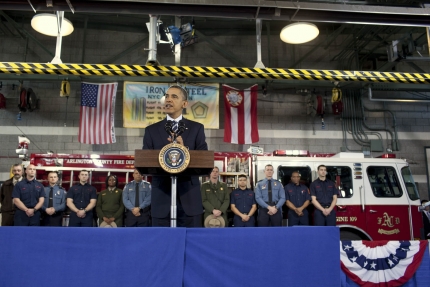
President Barack Obama delivers remarks on the Veterans Job Corp and the economy while speaking at Fire Station #5 in Arlington, Va., Feb. 3, 2012. (Official White House Photo by Pete Souza)

Even with the news that the economy added 257,000 private sector jobs in January, there is more work to do to help our veterans returning from war find new jobs at home. And this morning, President Obama visited a fire station in Arlington, Virginia to discuss a new set of ideas to do just that -- including a Veterans Job Corps.

In the State of the Union, President Obama said:

[Our] freedom endures because of the men and women in uniform who defend it. As they come home, we must serve them as well as they’ve served us. That includes giving them the care and the benefits they have earned –- which is why we’ve increased annual VA spending every year I’ve been President. And it means enlisting our veterans in the work of rebuilding our nation.

That's a sentiment the President echoed today at Fire Station #5:

Our veterans are some of the most highly trained, highly educated, highly skilled workers that we’ve got.  These are Americans that every business should be competing to attract. These are the Americans we want to keep serving here at home as we rebuild this country. So we’re going to do everything we can to make sure that when our troops come home, they come home to new jobs and new opportunities and new ways to serve their country.

Already, the Obama Administration has helped 600,000 veterans and their family members go back to school on the Post-9/11 G.I. Bill and hired more than 120,000 veterans to serve in the federal government. First Lady Michelle Obama and Dr. Jill Biden have worked with the private sector to secure a pledge from businesses to hire 135,000. And President Obama worked with Congress last fall to pass two new tax credits for companies that put veterans to work.

Now President Obama is making a new push to help veterans build the lives the deserve. In Arlington, he called for three new initiatives.

First, President Obama is working to help state and local communities hire veterans to work as first responders. The administration will make available $166 million in 2012 Community Oriented Policing Services (COPS) Hiring Grant funding and $320 million in 2012 Staffing for Adequate Fire and Emergency Response (SAFER) grants and award that money with a preference to communities that recruit and hire post-9/11 veterans. The President's budget for the 2013 fiscal year will include additional $5 billion for these grant programs.

Second, the President is working to develop a Veterans Job Corps conservation program that will put up to 20,000 veterans to work over the next five years. They'll work to restore habitats, eradicate invasive species, maintain public lands, and operate public facilities.

Third, President Obama wants to expand entrepreneurship training opportunities for service members and veterans. Back in August, the Administration established a two-day course in entrepreneurship as part of the Transition Assistance Program with the Departments of Defense and Veterans Affairs, along with the Small Business Administration. The SBA also offers an eight week online training program that will teach the fundamentals of small business ownership to more than 10,000 veterans every year.


Learn More

  • Visit Joining Forces to learn more about ways to help military families.
  • Check out the online tools available to help veterans search for jobs.

The White House

Office of the Press Secretary

Presidential Memorandum -- Delegation of Authority Pursuant to Sections 110(d)(4) and 110(f) of the Trafficking Victims Protection Act of 2000, as Amended

MEMORANDUM FOR THE SECRETARY OF STATE

SUBJECT: Delegation of Authority Pursuant to Sections 110(d)(4) and 110(f) of the Trafficking Victims Protection Act of 2000, as Amended

By the authority vested in me as President by the Constitution and the laws of the United States of America, including section 301 of title 3, United States Code, I hereby delegate to you the authority conferred upon the President by the Trafficking Victims Protection Act of 2000 (Division A of Public Law 106-386), as amended (the "Act"), to determine, consistent with sections 110(d)(4) and 110(f) of the Act, with respect to Burma for fiscal year 2012, that assistance described in section 110(d)(1)(B) of the Act would promote the purposes of the Act or is otherwise in the national interest of the United States.

You are authorized and directed to publish this memorandum in the Federal Register.

BARACK OBAMA

The White House

Office of the Press Secretary

NEW DETAILS: President Obama to Host White House Science Fair

Event Will Highlight Winners of National Science, Technology, Engineering and Math (STEM) Competitions

WASHINGTON, DC -- On Tuesday, February 7th, President Obama will host the second White House Science Fair celebrating the student winners of a broad range of science, technology, engineering and math (STEM) competitions from across the country. The President will also announce key steps that the Administration and its partners are taking to help more students excel in math and science, and earn degrees in these subjects.

At the fair, the President will view exhibits of student work, ranging from breakthrough research to new inventions, followed by remarks to an audience of students, science educators and business leaders on the importance of STEM education to the country’s economic future.

The President hosted the first-ever White House Science Fair in late 2010, fulfilling a commitment he made at the launch of his Educate to Innovate campaign to inspire students to excel in math and science.  As the President noted then, “If you win the NCAA championship, you come to the White House. Well, if you're a young person and you produce the best experiment or design, the best hardware or software, you ought to be recognized for that achievement, too.” In addition, over the past year, the President met with the three young women who won the Google Science Fair, met a student robotics team on his bus tour through North Carolina and Virginia, and made a surprise appearance at the New York City Science Fair.

The White House

Office of the Press Secretary

Remarks by the President on the Veterans Job Corps

Fire Station #5
Arlington, Virginia

11:30 A.M. EST

THE PRESIDENT:  Thank you!  Thank you, guys.  (Applause.) Thank you so much.  Everybody, please have a seat.  Well, good morning, everybody.

AUDIENCE:  Good morning!

THE PRESIDENT:  Jacob, thank you for that introduction.  More importantly, thank you for your extraordinary service to our country.

I want to acknowledge two outstanding members of my Cabinet who are here today -- Secretary of Veterans Affairs Ric Shinseki is in the house, also one of our finest -- (applause) -- himself, one of our finest veterans and obviously an extraordinary leader when he was in our Army.  And I also want to acknowledge Interior Secretary Ken Salazar, who's in the house.  (Applause.)  

And we’re joined by another president -- the International Association of Firefighters president, Harold Schaitberger, is here.  (Applause.)

Now, this is a fire station that holds some special significance for our country.  On September 11th, the firefighters of this house were among the first to respond to the attack on the Pentagon.  You guys answered this nation’s call during its hour of need.  And in the years that followed, as Americans went to war, some of you answered that call as well.

Today’s 9/11 generation of veterans has already earned a special place in our history.  Our veterans -- and all the brave men and women who serve our country -- are the reason why America’s military is the greatest in the history of the world.  In the face of great odds and grave danger, they get the job done.  They work as a team.  They personify the very best that America has to offer.

That’s true on the battlefront.  But we’re here today because it's also true on the home front.  After a decade of war, our nation needs to do some building right here in the United States of America.

Now, this morning, we received more good news about our economy.  In January, American businesses added another 257,000 jobs.  The unemployment rate came down because more people found work.  And altogether, we’ve added 3.7 million new jobs over the last 23 months.   

Now, these numbers will go up and down in the coming months, and there's still far too many Americans who need a job, or need a job that pays better than the one they have now.  But the economy is growing stronger.  The recovery is speeding up.  And we've got to do everything in our power to keep it going. 

We can't go back to the policies that led to the recession. And we can't let Washington stand in the way of our recovery.  We want Washington to be helping with the recovery, not making it tougher. 

The most important thing Congress needs to do right now is to stop taxes from going up on 160 million Americans at the end of this month.  They've got to renew the payroll tax cut that they extended only for a couple of months.  They need to pass an extension of the payroll tax cut and unemployment insurance -- and do it without drama, without delay, without linking it to some ideological side issues.  They just need to get it done.  It shouldn't be that complicated.  Now is not the time for self-inflicted wounds to our economy.  Now is the time for action.

So I want to send a clear message to Congress:  Do not slow down the recovery that we're on.  Don't muck it up.  Keep it moving in the right direction.  (Applause.)

Beyond preventing a tax hike, we need to do a lot more to create an economy that’s built to last.  To restore American manufacturing, we need to stop giving tax breaks to companies that ship jobs overseas; give those tax breaks to companies that are investing in plants and equipment and hiring workers right here in the United States of America.  That makes a lot of sense.

To reduce our dependency on foreign oil, we need to stop subsidizing oil companies that are already making record profits, and double down on clean energy, that creates jobs and creates opportunities in new industries but also improves our security, because we're not as dependent on foreign oil. 

To make sure our businesses don’t have to move overseas to find skilled workers, we've got to invest in education, and make sure college is affordable for every hardworking American. 

And -- this is the reason we're here today -- we need to make sure that as our troops return from battle, they can find a job when they get home.  That’s what I want to talk about today. (Applause.)

The war in Iraq is over.  The war in Afghanistan is moving to a new phase -- we're transitioning to Afghan lead.  Over the past decade, nearly 3 million service members have transitioned back to civilian life, and more are joining them every day.

When these men and women come home, they bring unparalleled skills and experience.  Folks like Jacob -- they’ve saved lives in some of the toughest conditions imaginable.  They’ve managed convoys and moved tons of equipment over dangerous terrain.  They’ve tracked millions of dollars of military assets.  They've handled pieces of equipment that are worth tens of millions of dollars.  They do incredible work.  Nobody is more skilled, more precise, more diligent, more disciplined.

Our veterans are some of the most highly trained, highly educated, highly skilled workers that we’ve got.  These are Americans that every business should be competing to attract.  These are the Americans we want to keep serving here at home as we rebuild this country.  So we’re going to do everything we can to make sure that when our troops come home, they come home to new jobs and new opportunities and new ways to serve their country.

Now, this has been a top priority of mine since I came into office.  Already, we’ve helped 600,000 veterans and their family members go back to school on the Post-9/11 G.I. Bill.  We’ve hired over 120,000 veterans to serve in the federal government.  We’ve made it easier for veterans to access all sorts of employment services.  We’ve set up online tools to connect veterans with job openings that match their skills. 

Michelle and Jill Biden have worked with the private sector, with businesses, to secure a pledge of 135,000 jobs for veterans and their families.  And with the support of Democrats and Republicans, we’ve put in place two new tax credits for companies that hire veterans.

So these are all important steps.  We’ve made progress.  But we’ve got to do more.  There’s more we can do.
 
In my State of the Union address, I proposed a new initiative, called the Veterans Jobs Corps, to put veterans back to work protecting and rebuilding America.  And today, we’re laying out the details of this proposal.

First, we want to help communities hire more veterans as cops and firefighters.  You guys have seen what a great job Jacob is doing.  Well, there are a whole bunch of folks like that who could be doing that same outstanding work all across the country. But it’s not that easy these days to get a job at a firehouse.

Over the past few years, tight budgets have forced a lot of states, a lot of local communities to lay off a lot of first responders.  Now, my administration -- when I first came into office, one of the first things we did was, through the Recovery Act, make sure that states and local governments helped -- or got the help that they needed to prevent some of these layoffs.  And thousands of jobs were saved all across the country.

Harold and I were talking as we came over here -- thousands of firefighter jobs were saved because of the actions we took. But budgets are still tight, and that’s a problem we need to fix. Jobs that protect our families and our communities shouldn’t be the first on the chopping block.  They should be one of our highest priorities as a nation. 

Over the past three years, my administration has made it possible for states to keep thousands of first responders on the job.  But today, we’re announcing that communities who make it a priority to recruit veterans will be among the first in line when it comes to getting help from the federal government. 

And I know that’s one of the things, Chief, that you’ve been doing here in Arlington.

So we want to prioritize veterans and we want to help states and local communities hire veterans to firehouses and police stations all across the country.

The second thing we want to do is to connect up to 20,000 veterans with jobs that involve rebuilding local communities or national parks.  That’s why Ken Salazar is here as the Interior Secretary.  He needs some help.  And our veterans are highly qualified to help him.  They’ve already risked their lives defending America.  They should have the opportunity to rebuild America.  We’ve got roads and bridges in and around our national parks in need of repair.  Let’s fix them. 

Of course, Congress needs to fund these projects.  Congress should take the money that we’re no longer spending on war, use half of it to pay down our debt, and use the rest to do some nation-building here at home, to improve the quality of life right here in the United States of America -- (applause) -- and put our veterans to work.  (Applause.) 

So let’s get more cops on the beat.  Let’s gets more rangers in the parks.  Let’s get more firefighters on call.  And, in the process, we’re going to put more veterans back to work.  It’s good for our communities, it’s good for our economy, and it’s good for our country.

And for veterans who want to do something else -- maybe put their leadership skills to use starting a small business -- we’re going to start offering entrepreneurial training to our veterans. We want service members prepared for battle -- and for professional success when they come home.  So we should do all that we can to support our troops and our veterans -- in helping them start a business, in helping them get a foothold in a fire station like this one, and start moving up the ranks, doing outstanding work the way Jacob has been doing.
 
But we also need to follow their lead.  We want to help them, but we should also learn from them.  We should remember from our veterans that no matter what the circumstances, those men and women in uniform -- a lot like the firefighters in this fire station -- work together.  Act as a team.  Finish the job. That’s what we've got to do when it comes to our nation's recovery.

These are challenging times for America, but we’ve faced challenging times before.  On the grounds here you've got a stone from the Pentagon and a beam from the World Trade Center.  And that reminds us of our resolve as a people.  They remind us that when we come together as one people and as one community, one nation, then we prevail.  That’s who we are.

This is a nation that exists because generations of Americans worked together to build it.  This is a nation where, out of many, we come together as one.  Those are the values that every veteran understands.  Those are values that this fire station understands.  We've got to make sure that we return to those values.  And if we do, then I guarantee you we'll remind everybody around the world just why it is the United States is the greatest country on Earth.

Thank you very much, everybody.  God bless you.  God bless America.  (Applause.)

END          
11:44 P.M. EST
The White House

Office of the Press Secretary

Message -- Continuation of the National Emergency with Respect to the Situation in or in Relation to Côte d'Ivoire

TO THE CONGRESS OF THE UNITED STATES:

Section 202(d) of the National Emergencies Act (50 U.S.C. 1622(d)) provides for the automatic termination of a national emergency, unless, within 90 days prior to the anniversary date of its declaration, the President publishes in the Federal Register and transmits to the Congress a notice stating that the emergency is to continue in effect beyond the anniversary date. In accordance with this provision, I have sent to the Federal Register for publication the enclosed notice stating that the national emergency declared in Executive Order 13396 of February 7, 2006, with respect to the situation in or in relation to Côte d'Ivoire is to continue in effect beyond February 7, 2012.

The situation in or in relation to Côte d'Ivoire, which has been addressed by the United Nations Security Council in Resolution 1572 of November 15, 2004, and subsequent resolutions, has resulted in the massacre of large numbers of civilians, widespread human rights abuses, significant political violence and unrest, and fatal attacks against international peacekeeping forces. Since the inauguration of President Alassane Ouattara in May 2011, the Government of Côte d'Ivoire and its people have made significant advances in the promotion of democratic, social, and economic development. Although considerable progress has been made, the situation in or in relation to Côte d'Ivoire continues to pose an unusual and extraordinary threat to the national security and foreign policy of the United States. For these reasons, I have determined that it is necessary to continue the national emergency and related measures under Executive Order 13396 of February 7, 2006, Blocking Property of Certain Persons Contributing to the Conflict in Côte d'Ivoire.

BARACK OBAMA