Ensuring Fair Pay for Homecare Workers

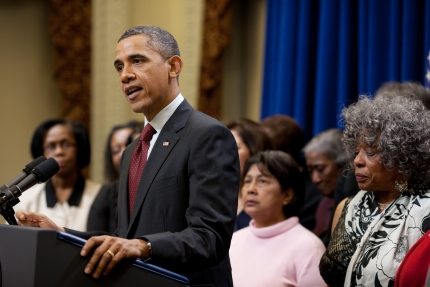
20111215 President Obama with Pauline Beck

President Barack Obama delivers remarks on new minimum wage/overtime protections for in-home care workers at a “We Can’t Wait” event in the Eisenhower Executive Office Building of the White House, Dec. 15, 2011. Among the workers joining the President was Pauline Beck, right, a home care worker from California who, in 2007, was shadowed by then Senator Obama as part of an event called “Walk a Day in My Shoes.” (Official White House Photo by Pete Souza)

Four years ago, President Obama spent the day with Pauline Beck, a home health care worker. He followed her throughout her day -- as she got up at 5:00 in the morning to care for an 86-year-old amputee. He saw first-hand the demands of her work.

Their business is a growing industry -- one of the fastest in America. As the population of this country gets older, more Americans are turning to people like Pauline Beck to help make sure they have the care they need. And as the President said this morning, "As the homecare business has changed over the years, the law hasn’t changed to keep up." In the eyes of the law, homecare workers fall into the same category as a teenaged babysitter.

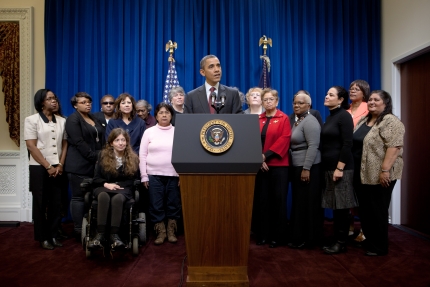
20111215 President Obama on Home Care Workers

President Barack Obama delivers remarks on new minimum wage/overtime protections for in-home care workers at a “We Can’t Wait” event in Room 430 of the Eisenhower Executive Office Building of the White House, Dec. 15, 2011. Attendees include: Labor Secretary Hilda Solis, Karen Kulp, President & CEO Home Care Associates; and home care workers: Pauline Beck, Thelma Reta, Iterra Blackshear, Tracy Dudzinski, Manuela Butler, Elma Wauneetta Phillips, Bertie Caraway, Margaret Glover, Elva Munoz, Michelle Wise, Olive Nanette Lyons, April Jones-Britt, Martha Cobos, and Gilda Brown; and home care employers: Sascha M. Bittner and Robin L. Shaffert. (Official White House Photo by Lawrence Jackson)

So today, the President did something to help homecare workers like Pauline Beck. He announced his support of a law to extend overtime pay protections and a guaranteed minimum wage to those who do this work:

We are going to make sure that over a million men and women in one of the fastest-growing professions in the country don’t slip through the cracks. We’re going to make sure that companies who do right by their workers aren’t undercut by companies who don’t. We’re going to do what’s fair, and we’re going to do what’s right.

Read the Transcript  |  Download Video: mp4 (73MB) | mp3 (7MB)

Watch President Obama's full remarks here.

Related Topics: Economy, Health Care, California

The White House

Office of the Press Secretary

Letter from the President to the Speaker of the House of Representatives and the President Pro Tempore of the Senate Regarding the War Powers Resolution

TEXT OF A LETTER FROM THE PRESIDENT
TO THE SPEAKER OF THE HOUSE OF REPRESENTATIVES
AND THE PRESIDENT PRO TEMPORE OF THE SENATE

December 15, 2011

Dear Mr. Speaker:  (Dear Mr. President:)

I am providing this supplemental consolidated report, prepared by my Administration and consistent with the War Powers Resolution (Public Law 93-148), as part of my efforts to keep the Congress informed about deployments of U.S. Armed Forces equipped for combat.

MILITARY OPERATIONS AGAINST AL-QA'IDA, THE TALIBAN, AND ASSOCIATED FORCES AND IN SUPPORT OF RELATED U.S. COUNTERTERRORISM OBJECTIVES

Since October 7, 2001, the United States has conducted combat operations in Afghanistan against al-Qa'ida terrorists and their Taliban supporters.  In support of these and other overseas operations, the United States has deployed combat-equipped forces to a number of locations in the U.S. Central, Pacific, European, Southern, and Africa Command areas of operation.  Previously such operations and deployments have been reported, consistent with Public Law 107-40 and the War Powers Resolution, and operations and deployments remain ongoing.  These operations, which the United States has carried out with the assistance of numerous international partners, have been successful in seriously degrading al-Qa'ida's capabilities and brought an end to the Taliban's leadership of Afghanistan.

United States Armed Forces are also actively pursuing and engaging remaining al-Qa'ida and Taliban fighters in Afghanistan.  The total number of U.S. forces in Afghanistan is approximately 93,000, of which more than 78,000 are assigned to the North Atlantic Treaty Organization (NATO)-led International Security Assistance Force (ISAF) in Afghanistan.  The U.N. Security Council most recently reaffirmed its authorization of ISAF for a 12-month period until October 13, 2012, in U.N. Security Council Resolution 2011 (October 12, 2011).  The mission of ISAF, under NATO command and in partnership with the Government of the Islamic Republic of Afghanistan, is to conduct population centric counterinsurgency operations, enable expanded and effective capabilities of the Afghan National Security Forces, support improved governance and development in order to protect the Afghan people, and promote sustainable security.  Forty-nine nations, including the United States and all 28 NATO Allies, contribute troops to ISAF.  These combat operations are gradually pushing insurgents to the edges of secured population areas in a number of important regions, largely resulting from the increase in U.S. forces over the past 2 years.

United States and other coalition forces will continue to execute the strategy of clear-hold-build, and transition, until full responsibility for security rests with the Afghan National Security Forces.

The United States continues to detain approximately 2,500 al Qa'ida, Taliban, and associated force fighters who are believed to pose a continuing threat to the United States and its interests.

The combat equipped forces, deployed since January 2002 to Naval Base, Guantanamo Bay, Cuba, continue to conduct secure detention operations for the approximately 170 detainees at Guantanamo Bay under Public Law 107-40 and consistent with principles of the law of war.

In furtherance of U.S. efforts against members of al-Qa'ida, the Taliban, and associated forces, the United States continues to work with partners around the globe, with a particular focus on  countries within the U.S. Central Command's area of responsibility.  In this context, the United States has deployed U.S. combat-equipped forces to assist in enhancing the counterterrorism capabilities of our friends and allies, including special operations and other forces for sensitive operations in various locations around the world.  The United States is committed to thwarting the efforts of al-Qa'ida and its associated forces to carry out future acts of international terrorism, and we have continued to work with our counterterrorism partners to disrupt and degrade the capabilities of al-Qa'ida and its associated forces.  As necessary, in response to the terrorist threat, I will direct additional measures against al-Qa'ida, the Taliban, and associated forces to protect U.S. citizens and interests.  It is not possible to know at this time the precise scope or the duration of the deployments of U.S. Armed Forces necessary to counter this terrorist threat to the United States.  A classified annex to this report provides further information.

MILITARY OPERATIONS IN IRAQ

Since the expiration of the authorization and mandate for the Multinational Force in Iraq in U.N. Security Council Resolution 1790 on December 31, 2008, U.S. forces have continued operations to support Iraq in its efforts to maintain security and stability in Iraq, pursuant to the bilateral Agreement Between the United States of America and the Republic of Iraq on the Withdrawal of United States Forces from Iraq and the Organization of Their Activities during Their Temporary Presence in Iraq (Security Agreement), which entered into force on January 1, 2009.  These contributions have included, but have not been limited to, assisting in building the capability of the Iraqi security forces, supporting the development of Iraq's political institutions, enhancing the capacity of the Ministries of Defense and Interior, providing critical humanitarian and reconstruction assistance to the Iraqis, and supporting the U.S. diplomatic mission.  The United States continues its responsible drawdown, in accordance with commitments in the Security Agreement, to withdraw U.S. forces from Iraq by December 31, 2011.  The number of U.S. forces in Iraq as of October 28, 2011, was 36,011.

MILITARY OPERATIONS IN LIBYA

As I reported on March 21 and June 15, and at my direction, consistent with a request from the Arab League, and as authorized by the U.N. Security Council under the provisions of U.N. Security Council Resolution 1973, U.S. military forces commenced operations on March 19, 2011, to prevent a humanitarian catastrophe and address the threat posed to international and regional peace and security by the crisis in Libya and to protect the people of Libya from the Qadhafi regime, which had made a lawless challenge to the authority of the Security Council.  The initial phase of U.S. military involvement in Libya was conducted under the U.S. Africa Command.  By April 4, however, the United States had transferred responsibility for the military operations in Libya to NATO and the U.S. involvement assumed a supporting role in the coalition's efforts.  From April 4 through October 31, U.S. participation consisted of:  (1) non-kinetic support to the NATO-led operation, including intelligence, logistical support, and search and rescue assistance; (2) aircraft that have assisted in the suppression and destruction of air defenses in support of the no-fly zone; and (3) since April 23, precision strikes by unmanned aerial vehicles against a limited set of clearly defined targets in support of the NATO-led coalition's efforts.  Although the United States was no longer in the lead, U.S. support for the NATO based coalition remained crucial to ensuring the success of international efforts to protect civilians and civilian populated areas from the actions of the Qadhafi regime, and to address the threat to international and regional peace and security posed by the crisis in Libya.  With the exception of operations to rescue the crew of a U.S. aircraft on March 21, 2011, and approximately 16 U.S. military personnel deployed under Chief of Mission authority to assist with re-establishment of U.S. Embassy Tripoli in September, the United States deployed no ground forces to Libya.  The U.N. Security Council adopted Resolution 2016 on October 27, 2011, which terminated the no-fly zone and civilian protection mandates effective October 31.  NATO terminated its mission at the same time.

MILITARY OPERATIONS IN SUPPORT OF U.S. EMBASSY CAIRO SECURITY

On January 31, 2011, a security force of approximately 40 U.S. military personnel from the U.S. Central Command deployed to bolster the security of the U.S. Embassy in Cairo and its personnel.  The force ended its deployment on July 4, 2011.  This security force was separate from, and in addition to, the U.S. contingent of the Multinational Force and Observers, which have been present in Egypt since 1981.

MILITARY OPERATIONS IN CENTRAL AFRICA

On October 13, an initial team of U.S. military personnel with appropriate combat equipment deployed to Uganda to advise regional forces that are working to protect civilians, apprehend or remove Joseph Kony and other senior Lord's Resistance Army (LRA) commanders from the battlefield, and disarm and demobilize the remaining LRA fighters.  During the next month, additional U.S. military personnel deployed to the region, including a second combat-equipped team and associated headquarters, communications, and logistics personnel.  The total number of U.S. military personnel deployed for this mission, including those providing logistical and support functions, is approximately 100.  United States forces are providing information, advice, and assistance to select partner nation forces.  Subject to the approval of each respective host nation, elements of these U.S. forces have begun to deploy to forward locations in the LRA-affected areas of the Central African Republic to enhance regional efforts against the LRA, and similar movements are planned for the Republic of South Sudan and the Democratic Republic of the Congo.  However, these forces will not engage LRA forces except in self-defense.  The deployment of these U.S. Armed Forces furthers U.S. national security interests and foreign policy efforts and is contributing to advancing peace and respect for human rights in central Africa.

MARITIME INTERCEPTION OPERATIONS

As noted in previous reports, the United States remains prepared to conduct maritime interception operations on the high seas in the areas of responsibility of each of the geographic combatant commands.  These maritime operations are aimed at stopping the movement, arming, and financing of certain international terrorist groups, and also include operations aimed at stopping proliferation by sea of weapons of mass destruction and related materials.

U.S.-NATO OPERATIONS IN KOSOVO

The U.N. Security Council authorized Member States to establish a NATO-led Kosovo Force (KFOR) in Resolution 1244 on June 10, 1999.  The original mission of KFOR was to monitor, verify, and, when necessary, enforce compliance with the Military Technical Agreement between NATO and the then-Federal Republic of Yugoslavia (now Serbia), while maintaining a safe and secure environment.  Today, KFOR deters renewed hostilities in cooperation with local authorities and international institutions.  The principal military tasks of KFOR forces are to help maintain a safe and secure environment and to ensure freedom of movement throughout Kosovo.
 
Currently, 22 NATO Allies contribute to KFOR.  Eight non-NATO countries also participate.  The United States contribution to KFOR is approximately 800 U.S. military personnel out of the total strength of approximately 6,240 personnel, plus a temporarily deployed Operational Reserve Force. 

I have directed the participation of U.S. Armed Forces in all of these operations pursuant to my constitutional and statutory authority as Commander in Chief (including the authority to carry out Public Law 107-40 and other statutes) and as Chief Executive, as well as my constitutional and statutory authority to conduct the foreign relations of the United States.  Officials of my Administration and I communicate regularly with the leadership and other Members of Congress with regard to these deployments, and we will continue to do so.

Sincerely,

BARACK OBAMA

The White House

Office of the Press Secretary

Obama Administration Releases Report and Interactive Maps Highlighting Critical American Jobs Act Investments in Education

WASHINGTON, DC – Today, the Obama Administration released a report, Education and the American Jobs Act: Creating Jobs through Investments in Our Nation’s Schools, and interactive maps that highlight estimated benefits that states and local school districts would receive if Congress acts to pass the American Jobs Act. 

The White House report provides an analysis of the condition of America’s schools, which have fallen into disrepair, as well as the difficult budget environment facing school districts and teachers nationwide.  In order to address these critical needs, President Obama proposed $25 billion to renovate and modernize more than 35,000 public schools and $5 billion to upgrade infrastructure at America’s community colleges through the American Jobs Act, as well as $30 billion to keep hundreds of thousands of educators in the classroom.

“Upgrading America’s schools is a smart investment,” Secretary of Education Arne Duncan said. “There’s a short-term return in the form of jobs to do the work, and in the long term our students—and our country—will benefit from modern facilities and technology.”

“Congress should act now and pass the American Jobs Act, to improve our schools, create jobs, and prepare our students for 21st century careers,” said Melody Barnes, Director of the White House Domestic Policy Council. 

The President’s education investment through the American Jobs Act proposes $30 billion for enhancing the condition of our nation’s public schools – with $25 billion allocated to K-12 schools, including a priority for rural schools and dedicated funding for Bureau of Indian Education funded schools, and $5 billion to upgrade infrastructure at community colleges across the country.

The range of critical repairs and needed construction projects would put hundreds of thousands of Americans, including construction workers, engineers, maintenance staff,  and electrical workers, back to work. Modernization and repair needs are mounting in America’s schools, as school districts nationwide estimate $271 billion in deferred building maintenance, or more than $5,000 per student.

The President’s education investment in the American Jobs Act also included $30 billion in funding – which Congress voted against in October – to support nearly 400,000 education jobs, preventing layoffs and allowing educators to be hired or rehired. It also would have supported state and local efforts to retain, rehire, and hire early childhood, elementary, and secondary educators.  Over the 12 months ending October 2011, nearly 60 percent of all local government job losses were teachers and education personnel. 

In addition to the release of the report, the Department of Education released two interactive maps that display the American Jobs Act’s estimated impact on every state and school district in the nation. These maps and the downloadable dataset behind them can be found at http://data.ed.gov/american-jobs-act.

To view the full report, which includes a state-by-state appendix that integrates state- and school district-level data detailing the education investments of the American Jobs Act, please visit http://obamawhitehouse.archives.gov/sites/default/files/aja_ed_state_by_state_report_final.pdf.

President Obama on Ensuring Fair Pay for In-Home Care Workers

December 15, 2011 | 7:38 | Public Domain

President Obama announces a new rule that will ensure in-home care workers are included in the same minimum wage and overtime protections afforded to other workers under the Fair Labor Standards Act.

Download mp4 (73MB) | mp3 (7MB)

Read the Transcript

Remarks by the President on Minimum Wage and Overtime Protections for In-Home Care Workers

Eisenhower Executive Office Building

12:13 P.M. EST

THE PRESIDENT:  Hello, everybody.  As I said in Kansas last week, the defining issue of our time is whether we can build an economy where hard work pays off and responsibility is rewarded.  It’s whether this is going to be a country where working people can earn enough to raise a family and build a modest savings and own a home, secure their own retirement, look after their kids.  That’s the test of our time.

In some cases, building this kind of economy is going to require some action from Congress.  And right now, Congress needs to make sure that 160 million working Americans don’t see their taxes go up on January 1st.  None of the workers who’ve joined us here today can afford a $1,000 tax increase next year.  And it wouldn’t be good for the economy.  Every economist indicates that it’s important for us to extend the payroll tax cut and make sure that unemployment insurance is extended.  So this Congress cannot and should not leave for vacation until that -- until they have made sure that that tax increase doesn’t happen.  Let me repeat that:  Congress should not and cannot go on vacation before they have made sure that working families aren’t seeing their taxes go up by $1,000 and those who are out there looking for work don’t see their unemployment insurance expire.

There’s no reason why we shouldn’t be able to extend these items -- the payroll tax cut, UI -- before the holidays.  There’s no reason the government should shut down over this.  And I expect all of us to do what’s necessary in order to do the people’s business and make sure that it’s done before the end of the year.

Now, only Congress can prevent the payroll tax from going up next year.  But there are also some things that we can do without Congress to help make sure that hard work pays off.  And that’s why we’re here today. 

Right behind me here is my friend Pauline Beck.  One day, back in 2007, Pauline was my boss.  I was in California to take part in an event called “Walk a Day in My Shoes,” where you’d spend the day working the job of someone who was in the service industry.  And I was lucky enough to be paired up with Pauline, and I have tell you, it ended up being one of my favorite days of the entire campaign.

Pauline is a home health care worker.  When we met, she was getting up every day at 5:00 a.m. to go to work taking care of an 86-year-old amputee named “Mr. John.”  And each day, she’d dress Mr. John and help him into his wheelchair.  She’d make him breakfast.  She’d scrub his floors.  She’d clean his bathroom.  She was his connection to the outside world.  And when the workday was done, she would go home to take care of a grandnephew and two foster children who didn’t have families of their own.  Heroic work, and hard work.  That’s what Pauline was all about.

And one of the things I remember about Pauline was her patience.  She was patient with me even when I didn’t wring out the mop properly or didn’t shake out the sheets before putting them in the laundry bin.  But I also remember listening to her talk about the hardships in her life, and she did so without any self-pity.  She was glad to be working hard and she was glad to be helping someone.  All she wanted in return for a hard day’s work was enough to take care of those kids she was going home to, enough to save a little bit for retirement, maybe take a day off once in a while to rest her aching back. 

Each of the folks who are here today has a story like Pauline’s.  They represent nearly 1.8 million homecare workers across the country -- hardworking professionals, mostly women, who work around the clock so that folks who need help, including many of our family members, can live independently in their own home.  Right now, homecare is one of the fastest-growing industries in America, partly because we’re getting older as a society.  And as the baby boom generation heads into retirement, more and more Americans are going to need the services of these outstanding workers.

But here’s the thing:  As the homecare business has changed over the years, the law hasn’t changed to keep up.  So even though workers like Pauline do everything from bathing to cooking, they’re still lumped in the same category as teenage babysitters when it comes to how much they make.  That means employers are allowed to pay these workers less than minimum wage with no overtime.  That’s right -- you can wake up at 5:00 in the morning, care for somebody every minute of the day, take the late bus home at night, and still make less than the minimum wage.  And this means that many homecare workers are forced to rely on things like food stamps just to make ends meet.

That’s just wrong.  In this country, it’s unexcusable.  I can tell you firsthand that these men and women, they work their tails off, and they don’t complain.  They deserve to be treated fairly.  They deserve to be paid fairly for a service that many older Americans couldn’t live without.  And companies who do pay fair wages to these women shouldn’t be put at a disadvantage.

Four years ago, a homecare worker named Evelyn Coke took her case all the way up to the Supreme Court.  And Evelyn was working up to 70 hours a week with no overtime pay.  But the Court ruled against her, saying that to change the law would require action from Congress or the Department of Labor.  I’m sure many of you won’t be surprised to know that Congress hasn’t acted on this issue so far.

Today, I will.  Today, we’re guaranteeing homecare workers minimum wage and overtime pay protection.  And that’s thanks to the hard work of my Secretary of Labor, Hilda Solis.  We are going to make sure that over a million men and women in one of the fastest-growing professions in the country don’t slip through the cracks.  We’re going to make sure that companies who do right by their workers aren’t undercut by companies who don’t.  We’re going to do what’s fair, and we’re going to do what’s right.

Evelyn Coke didn’t live to see this day.  But the truth is, Americans like Evelyn and Pauline and the rest of the workers who are here today, they’re one of the reasons that I ran for President.  They work hard.  They play by the rules.  In exchange, they just want to see that their hard work and their responsibility is rewarded.  It’s that simple.  Americans all deserve a fair shake and a fair shot.  And as long as I have the honor of serving as President, I’m going to do everything in my power to make sure that those very modest expectations are fulfilled.  I’m going to make sure that they are treated right.  I’m going to make sure that every American is treated fairly.

Thanks very much, everybody.  Thank you. 

END
12:20 P.M. EST

Close Transcript

The White House

Office of the Press Secretary

Presidential Nominations and Withdrawal Sent to the Senate

NOMINATIONS SENT TO THE SENATE:

Sharon Block, of the District of Columbia, to be a Member of the National Labor Relations Board for the term of five years expiring December 16, 2014, vice Craig Becker.

Richard F. Griffin, Jr., of the District of Columbia, to be a Member of the National Labor Relations Board for the term of five years expiring August 27, 2016, vice Wilma B. Liebman, term expired.

Michael A. Raynor, of Maryland, a Career Member of the Senior Foreign Service, Class of Counselor, to be Ambassador Extraordinary and Plenipotentiary of the United States of America to the Republic of Benin.

Jacob Walles, of Delaware, a Career Member of the Senior Foreign Service, Class of Minister-Counselor, to be Ambassador Extraordinary and Plenipotentiary of the United States of America to the Tunisian Republic.

WITHDRAWAL SENT TO THE SENATE:

Craig Becker, of Illinois, to be a Member of the National Labor Relations Board for the term of five years expiring December 16, 2014, vice Dennis P. Walsh, which was sent to the Senate on January 26, 2011.

The White House

Office of the Press Secretary

Remarks by the President on Minimum Wage and Overtime Protections for In-Home Care Workers

Eisenhower Executive Office Building

12:13 P.M. EST

THE PRESIDENT:  Hello, everybody.  As I said in Kansas last week, the defining issue of our time is whether we can build an economy where hard work pays off and responsibility is rewarded.  It’s whether this is going to be a country where working people can earn enough to raise a family and build a modest savings and own a home, secure their own retirement, look after their kids.  That’s the test of our time.

In some cases, building this kind of economy is going to require some action from Congress.  And right now, Congress needs to make sure that 160 million working Americans don’t see their taxes go up on January 1st.  None of the workers who’ve joined us here today can afford a $1,000 tax increase next year.  And it wouldn’t be good for the economy.  Every economist indicates that it’s important for us to extend the payroll tax cut and make sure that unemployment insurance is extended.  So this Congress cannot and should not leave for vacation until that -- until they have made sure that that tax increase doesn’t happen.  Let me repeat that:  Congress should not and cannot go on vacation before they have made sure that working families aren’t seeing their taxes go up by $1,000 and those who are out there looking for work don’t see their unemployment insurance expire.

There’s no reason why we shouldn’t be able to extend these items -- the payroll tax cut, UI -- before the holidays.  There’s no reason the government should shut down over this.  And I expect all of us to do what’s necessary in order to do the people’s business and make sure that it’s done before the end of the year.

Now, only Congress can prevent the payroll tax from going up next year.  But there are also some things that we can do without Congress to help make sure that hard work pays off.  And that’s why we’re here today. 

Right behind me here is my friend Pauline Beck.  One day, back in 2007, Pauline was my boss.  I was in California to take part in an event called “Walk a Day in My Shoes,” where you’d spend the day working the job of someone who was in the service industry.  And I was lucky enough to be paired up with Pauline, and I have tell you, it ended up being one of my favorite days of the entire campaign.

Pauline is a home health care worker.  When we met, she was getting up every day at 5:00 a.m. to go to work taking care of an 86-year-old amputee named “Mr. John.”  And each day, she’d dress Mr. John and help him into his wheelchair.  She’d make him breakfast.  She’d scrub his floors.  She’d clean his bathroom.  She was his connection to the outside world.  And when the workday was done, she would go home to take care of a grandnephew and two foster children who didn’t have families of their own.  Heroic work, and hard work.  That’s what Pauline was all about.

And one of the things I remember about Pauline was her patience.  She was patient with me even when I didn’t wring out the mop properly or didn’t shake out the sheets before putting them in the laundry bin.  But I also remember listening to her talk about the hardships in her life, and she did so without any self-pity.  She was glad to be working hard and she was glad to be helping someone.  All she wanted in return for a hard day’s work was enough to take care of those kids she was going home to, enough to save a little bit for retirement, maybe take a day off once in a while to rest her aching back. 

Each of the folks who are here today has a story like Pauline’s.  They represent nearly 1.8 million homecare workers across the country -- hardworking professionals, mostly women, who work around the clock so that folks who need help, including many of our family members, can live independently in their own home.  Right now, homecare is one of the fastest-growing industries in America, partly because we’re getting older as a society.  And as the baby boom generation heads into retirement, more and more Americans are going to need the services of these outstanding workers.

But here’s the thing:  As the homecare business has changed over the years, the law hasn’t changed to keep up.  So even though workers like Pauline do everything from bathing to cooking, they’re still lumped in the same category as teenage babysitters when it comes to how much they make.  That means employers are allowed to pay these workers less than minimum wage with no overtime.  That’s right -- you can wake up at 5:00 in the morning, care for somebody every minute of the day, take the late bus home at night, and still make less than the minimum wage.  And this means that many homecare workers are forced to rely on things like food stamps just to make ends meet.

That’s just wrong.  In this country, it’s unexcusable.  I can tell you firsthand that these men and women, they work their tails off, and they don’t complain.  They deserve to be treated fairly.  They deserve to be paid fairly for a service that many older Americans couldn’t live without.  And companies who do pay fair wages to these women shouldn’t be put at a disadvantage.

Four years ago, a homecare worker named Evelyn Coke took her case all the way up to the Supreme Court.  And Evelyn was working up to 70 hours a week with no overtime pay.  But the Court ruled against her, saying that to change the law would require action from Congress or the Department of Labor.  I’m sure many of you won’t be surprised to know that Congress hasn’t acted on this issue so far.

Today, I will.  Today, we’re guaranteeing homecare workers minimum wage and overtime pay protection.  And that’s thanks to the hard work of my Secretary of Labor, Hilda Solis.  We are going to make sure that over a million men and women in one of the fastest-growing professions in the country don’t slip through the cracks.  We’re going to make sure that companies who do right by their workers aren’t undercut by companies who don’t.  We’re going to do what’s fair, and we’re going to do what’s right.

Evelyn Coke didn’t live to see this day.  But the truth is, Americans like Evelyn and Pauline and the rest of the workers who are here today, they’re one of the reasons that I ran for President.  They work hard.  They play by the rules.  In exchange, they just want to see that their hard work and their responsibility is rewarded.  It’s that simple.  Americans all deserve a fair shake and a fair shot.  And as long as I have the honor of serving as President, I’m going to do everything in my power to make sure that those very modest expectations are fulfilled.  I’m going to make sure that they are treated right.  I’m going to make sure that every American is treated fairly.

Thanks very much, everybody.  Thank you. 

END
12:20 P.M. EST

First Look: New Obama Family Portrait

Official Obama Family Portrait 2011

President Barack Obama, First Lady Michelle Obama, and their daughters, Malia, left, and Sasha, right, sit for a family portrait in the Oval Office, Dec. 11, 2011. (Official White House Photo by Pete Souza)

The White House photo office today released a new official portrait of the First Family, which was taken by Pete Souza in the Oval Office on Sunday December 11, 2011 after the family returned to the White House after church services. The previous official portrait, below, was taken in the Green Room in 2009 by Annie Leibovitz.

First Family Official Portrait

The Official Portrait of the First Family. October 23, 2009. (by Annie Leibovitz)

Related Topics:

The White House

Office of the Press Secretary

Presidential Memorandum -- Determinations under Section 1106(a) of the Omnibus Trade and Competitiveness Act of 1988 - Russian Federation

MEMORANDUM FOR THE UNITED STATES TRADE REPRESENTATIVE

SUBJECT: Determinations under Section 1106(a) of the Omnibus Trade and Competitiveness Act of 1988 – Russian Federation

Pursuant to section 1106(a) of the Omnibus Trade and Competitiveness Act of 1988 (19 U.S.C. 2905(a)), I determine that state trading enterprises account for a significant share of the exports of the Russian Federation (Russia) and goods that compete with imports into Russia. I further determine that such state trading enterprises unduly burden and restrict, or adversely affect, the foreign trade of the United States or of the U.S. economy, or are likely to result in such a burden, restriction, or effect.

Russia is seeking to become a member of the World Trade Organization (WTO). The terms and conditions for Russia's accession to the WTO include Russia's commitments that it will ensure that state-owned and state-controlled enterprises, when engaged in commercial activity, will make purchases, which are not intended for governmental use, and sales in international trade in a manner consistent with applicable provisions of the Marrakesh Agreement Establishing the World Trade Organization (WTO Agreement). In addition, Russia's state trading enterprises will make purchases and sales based solely on commercial considerations, e.g., price, quality, marketability, and availability, and that U.S. business firms will have an adequate opportunity to compete for sales to and purchases from these enterprises on non-discriminatory terms and conditions. The obligations that Russia will assume under the WTO Agreement, including Russia's protocol of accession, meet the requirements of section 1106(b)(2)(A) (19 U.S.C. 2905(b)(2)(A)), and thus my determinations under section 1106(a) do not require invocation of the non-application provisions of the WTO Agreement.

You are authorized and directed to publish this memorandum in the Federal Register.

BARACK OBAMA

The White House

Office of the Press Secretary

We Can’t Wait: President Obama Will Announce Administrative Action to Provide Minimum Wage and Overtime Protections for Nearly 2 Million In-Home Care Workers

WASHINGTON - The White House today will announce new rules proposed by the U.S. Department of Labor that would provide minimum wage and overtime protections for nearly two million workers who provide in-home care services for the elderly and infirmed. Many of these workers provide critical in-home health care services such as tube feeding, wound care, or assistance with physical therapy, and deserve the protections provided under the Fair Labor Standards Act (FLSA). Today’s announcement is the latest in a series of executive actions the Obama Administration is taking to strengthen the economy and move the country forward because we can’t wait for Congress to act. 

“The nearly 2 million in-home care workers across the country should not have to wait a moment longer for a fair wage. They work hard and play by the rules and they should see that work and responsibility rewarded. Today’s action will ensure that these men and women get paid fairly for a service that a growing number of older Americans couldn’t live without,” said President Obama.

"The care provided by in-home workers is crucial to the quality of life for many families," said Secretary of Labor Hilda L. Solis. "The vast majority of these workers are women, many of whom serve as the primary breadwinner for their families. This proposed regulation would ensure that their work is properly classified so they receive appropriate compensation and that employers who have been treating these workers fairly are no longer at a competitive disadvantage. "

Currently, workers classified as ‘companions’ are exempt from the FLSA’s minimum wage and overtime pay requirements. When established in 1974, such exemptions were meant to apply to casual babysitters and companions for the elderly and infirm, not workers whose vocation was in-home care service, and who were responsible for their families’ support. With an aging American population, there has been increased demand for long-term in-home care, and as a result the in-home care industry has grown substantially.  Today’s 1.79 million home care workers are professional caregivers, not mere companions.  In view of this changed landscape, the proposed regulation reconsiders whether the current exemption is now too broad. Of the 1.79 million home care workers, 1.59 million are employed by staffing agencies of which over 92% are women, nearly 30% are African American, 12% are Hispanic and close to 40% rely on public benefits such as Medicaid and food stamps.

Today’s proposed rule would expand minimum wage and overtime protections by ensuring that all home care workers employed by third parties, like staffing agencies, will receive protections. It would also ensure that those employed by families and performing skilled in-home care work, such as medically related tasks for which training is typically a prerequisite, are covered. However, those employed by families and truly engaged in tasks related to fellowship and protection- such as visiting with friends and neighbors or engaging in hobbies- would still be considered ‘companions’ and will not be subject to wage protections.

This issue gained national attention when, in 2007, the Supreme Court ruled that Evelyn Coke, a home care worker who worked as much as 70 hours a week, was not entitled to overtime pay under existing regulations. Thus, any change to these rules requires action by Congress or the Department of Labor. There have been bills introduced in numerous Congresses to address this issue (including legislation that then-Senator Obama co-sponsored in the 110th Congress) but these bills have not moved forward. The Department of Labor is therefore now proposing regulations to change these rules and ensure that home care workers like Evelyn Coke will have basic wage protections.

States’ regulations currently vary in whether they extend minimum wage and overtime provisions to home health care workers.  Twenty nine states currently do not include home health care workers in their minimum wage and overtime provisions: Alabama, Alaska, Arkansas, Connecticut, Delaware, Florida, Georgia, Idaho, Indiana, Iowa, Kansas, Kentucky, Louisiana, Mississippi, Missouri, New Hampshire, New Mexico, North Carolina, Oklahoma, Oregon, Rhode Island, South Carolina, Tennessee, Texas, Utah, Vermont, Virginia, West Virginia, and Wyoming. Nearly half of the nation’s home care workers work in these states. Today’s proposed regulation would provide home care workers in these states with new protections. Sixteen states extend both minimum wage and overtime coverage to most home health care workers:  California, Colorado, Hawaii, Illinois, Maine, Maryland, Massachusetts, Michigan, Minnesota, Montana, Nevada, New Jersey, New York, Pennsylvania, Washington, and Wisconsin. Five states and the District of Columbia extend minimum wage, but not overtime coverage to home care workers: Arizona, Nebraska, North Dakota, Ohio, and South Dakota and the District of Columbia. Even in those states that have some existing minimum wage or overtime protection for home care workers, this proposed rule would extend the additional protections of federal education and enforcement by the Labor Department’s Wage and Hour Division.

The Labor Department's Wage and Hour Division is responsible for enforcing the Fair Labor Standards Act that was passed in 1938 to provide minimum wage and overtime protections for workers, to prevent unfair competition among businesses based on subminimum wages, and to spread employment by requiring employers whose employees work excessive hours to pay employees at one-and-one-half times the regular rate of pay for all hours worked over 40 in a week. Upon publication of the proposed rule, interested parties will be invited to submit comments at www.regulations.gov. More information, including the proposed rule and fact sheet is available on the Department's Companionship Webpage at www.dol.gov/whd/flsa/companionNPRM.htm.

We Can't Wait: Meet the Home Healthcare Worker Who Inspired the President

Today Pauline Beck will be at the White House to watch as President Obama announces proposed changes to the Fair Labor Standards Act (FLSA) that will affect home healthcare workers like herself. Today's event has special significance for Pauline, because it was the day then-Senator Obama spent "in her shoes" that informed him of the important work these Americans do and the need to level the playing field so they are fairly compensated for their efforts. Take a minute to watch the video and learn her story.

Related Topics: Economy, Health Care, Women