The White House

Office of the Press Secretary

Statement by the President on Hajj and Eid al-Adha

Michelle and I extend our greetings for a happy Eid al-Adha to Muslims worldwide and congratulate those performing Hajj. Thousands of Muslim Americans are among those who have joined one of the world’s largest and most diverse gatherings in making the pilgrimage to Mecca and nearby sites.

As Muslims celebrate this Eid, they will also commemorate Abraham’s willingness to sacrifice his son by distributing food to those less fortunate around the world.  They join the United States and the international community in relief efforts to assist those struggling to survive in the Horn of Africa and those recovering from the devastating earthquake in Turkey. 

The Eid and Hajj rituals are a reminder of the shared roots of the world’s Abrahamic faiths and the powerful role that faith plays in motivating communities to serve and stand with those in need.  On behalf of the American people, we extend our best wishes during this Hajj season.  Eid Mubarak and Hajj Mabrour.

The White House

Office of the Press Secretary

WEEKLY ADDRESS: "We Have to Increase the Pace"

WASHINGTON—In this week’s address, Vice President Biden noted that this month’s jobs numbers demonstrated that Congress should pass the American Jobs Act to strengthen our economy and create jobs right away.  Republicans in Congress have voted against components of the bill to put teachers and firefighters back to work and they have unanimously opposed a bill to rebuild our crumbling infrastructure and create jobs for 400,000 construction workers, even though these are the kinds of programs they have supported in the past.  The President is acting without Congress through executive actions to help our veterans find jobs, save families thousands of dollars by refinancing their mortgages, and reducing the cost of student loans, but that is not enough.  Democrats and Republicans must come together to pass the American Jobs Act to strengthen the economy, because the American people can’t wait any longer for Congress to act.

Remarks of Vice President Joe Biden
Weekly Address
Pittsburgh, Pennsylvania
Saturday, November 5, 2011

Hi, this is Joe Biden.  I’m speaking to you from the University of Pittsburgh, where I just spoke to students here about what we’ve done to help ease the burden on them when it comes to the rising cost of tuition and the accumulating student debt and what we’re going to do to help create jobs when they graduate.

Today we found out we’ve had the 20th month in a row where we’ve increased private sector jobs -- 104,000 this month, 104,000 private sector jobs.  And as all you know, that's not nearly enough.  We have to increase the pace.  We have to act now to do everything in our power to keep this economy moving and to grow jobs.

President Obama is on his way back from France where he just met with the leaders of the 20 largest economies in the world, where he urged our European friends to step up and stabilize their own economies because if they fail, it will affect the whole world.

Too many Americans are still struggling.  Too many college students here at the University of Pittsburgh and elsewhere are worrying about the rising cost of their tuition, and the increasing accumulation of debt.  And too many of their parents are in stagnant jobs or out of work, wondering if they're going to be able to send their child back to college next semester.

My dad used to have a saying.  He said, a job is about a lot more than a paycheck.  It’s about dignity.  It’s about respect.

And too many Americans have been stripped of their dignity through no fault of their own.  So we can't wait to help them.  The President and I believe we have to act now.  That's why we’ve introduced the jobs bill which independent validators said would create 2 million new jobs.

Although 51 senators voted for that jobs bill, our Republican colleagues in the Senate used a procedural requirement that requires it to have 60 votes, so it failed. 

And since then we’ve taken every important piece of the jobs bill and demanded that we have a separate vote.  But our Republican colleagues in the Senate have voted unanimously to vote down each and every part so far:  to restore 400,000 jobs for teachers, police officers, firefighters, putting them back in classrooms, on the streets and in the fire houses.

And then on Thursday, they unanimously voted down the second part of our program:  to rebuild our crumbling roads and bridges, which would have created more than 400,000 good-paying jobs.

These are all programs that the Republicans in the past have supported, but once again, every Republican voted no -- blocking the majority will to put these folks back to work.

I think the assumption is that they're voting no because of the way we would pay for these jobs, and we do pay for them.  We think everybody should pay their fair share, so that's why we put a small surtax on the first dollar after a person has already made $1 million.  That seems fair to us, and it pays for the bill.  It’s a small price to pay to put hundreds of thousands of people back to work.

So, look, we can't wait.  We can't wait for the Congress to start acting responsibly, and that's why the President has used his executive power to announce that hundreds of thousands of people will be able to refinance their homes from 6 percent interest rates to 4 percent, saving them an average of $2,000 a year.  That's why the President announced that beginning next year, no student will have to pay back more than 10 percent of their discretionary income toward their student debt.  He also announced new regulations regarding prescription drugs to prevent price gouging.  And there’s more to come.

If the Republican Congress won’t join us, we’re going to continue to act on our own to make the changes that we can to bring relief to middle-class families and those aspiring to get in the middle class.

Look, it’s simple:  We refuse to take no for an answer.  We know these steps taken alone are not going to solve all of our problems, but they will make a difference in the lives of millions of American families struggling to hold on.  And you know and I know if the Republicans would just let the Congress do its job, let it step up and meet its responsibilities, we could do so much more, and we could do it immediately.

That's why the President and I need your help to tell your Republican congressmen and senators to step up.  Tell them to stop worrying about their jobs and start worrying about yours because we’re all in this together, and together is the way we’re going to bring America back even stronger than it was before.

Thank you.

Weekly Address: We Have to Increase the Pace

Speaking from the University of Pittsburgh, Vice President Biden argues that this month’s jobs numbers demonstrate that Congress should pass the American Jobs Act to strengthen our economy and create jobs right away.

Transcript | Download mp4 | Download mp3

Watch Vice President Biden's full remarks here

Related Topics: Economy

The White House

Office of the Press Secretary

President Obama Signs Virginia Disaster Declaration

The President today declared a major disaster exists in the Commonwealth of Virginia and ordered Federal aid to supplement commonwealth and local recovery efforts in the area affected by an earthquake during the period of August 23 to October 25, 2011.
 
The President's action makes federal funding available to affected individuals in Louisa County.
 
Assistance can include grants for temporary housing and home repairs, low-cost loans to cover uninsured property losses, and other programs to help individuals and business owners recover from the effects of the disaster.
Federal funding is also available on a cost-sharing basis for hazard mitigation measures for all counties and independent cities in the Commonwealth of Virginia.
 
W. Craig Fugate, Administrator, Federal Emergency Management Agency (FEMA), Department of Homeland Security, named Donald L. Keldsen as the Federal Coordinating Officer for federal recovery operations in the affected area.
 
FEMA said additional designations may be made at a later date if requested by the commonwealth and warranted by the results of further damage assessments.
 
FEMA said that residents and business owners who sustained losses in the designated counties can begin applying for assistance tomorrow by registering online at http://www.DisasterAssistance.gov or by calling 1-800-621-FEMA(3362) or 1-800-462-7585 (TTY) for the hearing and speech impaired. The toll-free telephone numbers will operate from 7 a.m. to 10 p.m. (local time) seven days a week until further notice.
 
FOR FURTHER INFORMATION MEDIA SHOULD CONTACT:  FEMA NEWS DESK AT (202) 646-3272 OR FEMA-NEWS-DESK@DHS.GOV

President Obama Speaks About the US-France Alliance

November 04, 2011 | 9:14 | Public Domain

President Obama honors the special relationship between France and the United States with President Nicolas Sarkozy at a special event in Cannes.

Download mp4 (88MB) | mp3 (9MB)

Read the Transcript

Remarks by President Obama In Honoring the Alliance Between the United States and France

City Hall
Cannes, France

4:27 P.M. CET

THE PRESIDENT: Good afternoon. Bon après-midi. (Applause.) I studied French in school, and that's about as far as I got. (Laughter.)

But, Mr. President, I understand clearly the affection with which you've once again described our alliance and the friendship between our peoples. So thank you, Nicolas, my partner, mon ami. Thank you. (Applause.)

To Generals Puga and Estrate and members of the French Armed Forces; to Mayor Brochand and the people of Cannes -- thank you for your wonderful hospitality and the beautiful weather -- (laughter) -- that I'm enjoying here today.

We stand here today as free and democratic peoples because of each other. It was the ideas of the Enlightenment, centered here in France, that helped inspire a band of Colonists across the ocean to seek our freedom. It was the success of our Revolution that helped inspire your own. In our founding documents, we pledge ourselves to the same inalienable rights, and to the truth that all men and women are created equal. We are societies where our diversity is considered a strength; where you can become President even if your name is Obama or Sarkozy. (Laughter.) We live by a common creed: life, liberty and the pursuit of happiness -- liberté, égalité, fraternité. (Applause.)

And for more than two centuries, we haven't simply professed these ideas, we have preserved them, by serving together and by sacrificing together. And not far from here is the hometown of Admiral de Grasse, who helped Americans secure our independence. Here at this memorial, we recall our shared sacrifices in the trenches of the First World War. And just as President Sarkozy and I have honored those who fell at Normandy, let it also be remembered that American and free French forces stormed the beaches of this southern coast. And not far from here, at Rhone, some of them rest in peace in the land that they liberated.

Nor have we simply defended these ideals for ourselves. Together we have stood up for our ideals around the world. And today, we pay special tribute to all those who have served and given their lives -- French, American, and forces from our allies and partners -- so that Afghanistan will never again become a haven for those who would attack us. They have sacrificed to keep us all safe, and we honor them all.

We saw this same solidarity most recently in the mission to protect the Libyan people. When the old regime threatened to massacre on a horrific scale, the world refused to stand by. The United States was proud to play a decisive role, especially in the early days, taking out Libyan air defenses and conducting precision strikes that stopped the regime in its tracks. But at the same time, this mission showed us why NATO remains the world’s most effective alliance. We acted quickly, in days -- the fastest mobilization in NATO history. And whether contributing forces or command staff, every single one of NATO’s 28 members played a role. Eighteen nations, including Arab states, provided forces.

And in a historic first, our NATO allies, including France, and especially the extraordinary leadership of President Sarkozy, helped us to conduct 90 percent of our strike missions -- (applause) -- 90 percent. So that showed more nations bearing the burdens and costs of peace and security. And that’s how our alliance must work in the 21st century.

In this mission, French and American soldiers, airmen, naval officers, served shoulder to shoulder -- the commanders who planned and executed this complex operation; the pilots who prevented a massacre in Benghazi; the tanker crews from bases here in France who sustained this operation; the airmen who delivered lifesaving aid; the sailors and Marines who enforced the arms embargo at sea.

In fact, American pilots even flew French fighter jets off a French aircraft carrier in the Mediterranean. Allies don’t get any closer than that. And thanks to their extraordinary service, the last air mission over Libya ended on Monday, and that operation ended in giving the Libyan people the opportunity to live with freedom and democracy. And I might add, we succeeded in bring every single one of our service members back safely, which is a remarkable achievement.

Every man and woman in uniform who participated in this effort can know that you have accomplished every objective. You saved the lives of countless Libyan men, women and children. And today, the Libyan people have liberated their country and begun to forge their own future, and the world has once again seen that the longing for freedom and dignity is universal.

Thousands of personnel made this operation a success, but we are honored to have some of them join us today. And I would ask you in joining me in saluting Admirals Jim Stavridis and Sam Locklear, as well as General Ralph Jodice, and all our service members who are here for a job well done. (Applause.)

Finally, I would note that this success is part of a larger story. After a difficult decade, the tide of war is receding. The long war in Iraq is finally coming to an end. With our allies and partners, including the extraordinary sacrifices of the French people, we've achieved major victories against
al Qaeda, including Osama bin Laden. In Afghanistan, where French and American soldiers fight side by side, we've begun a transition so Afghans can take responsibility for their security and our troops can begin coming home.

Today, America and our allies are moving forward with confidence and with strength. And these men and women in uniform carry on a legacy that I actually can see from the windows of the White House. In one direction, there's the monument to Washington; in the other, a statue of Rochambeau, who served so well at Washington's side. And at the base of that statue are words Washington expressed to his friend after the Revolutionary War in America was won -- and I've shared these words with President Sarkozy on one of our visits, so I want to conclude with them this afternoon, because they capture the spirit that we celebrate today.

This is what Washington said to his dear friend from France: "We are fellow laborers in the cause of liberty, and we have lived together as brothers should do -- in harmonious friendship."

President Sarkozy, ladies and gentlemen, members of the Armed Forces of France and the United States, for more than two centuries we have stood together in friendship, and because of our unwavering commitment to the cause of liberty, I'm confident that we'll continue to stand together, strong and free, for all the centuries to come. So vive la France. God bless America. And long live the alliance between our two great nations. (Applause.)

END
4:35 P.M. CET

Close Transcript

President Obama’s Press Conference on the G20 Summit

November 04, 2011 | 23:58 | Public Domain

President Obama speaks to the press about the world economy and progress made at the G20 Summit.

Download mp4 (229MB) | mp3 (22MB)

Read the Transcript

Press Conference by President Obama After G20 Summit

Press Center
Claude Debussy Theater
Cannes, France

3:40 P.M. CET

PRESIDENT OBAMA:  Good afternoon, everybody.  I want to begin by thanking my friend, President Sarkozy, for his leadership and his hospitality.  And I want to thank the people of Cannes for this extraordinary setting.

Over the past two years, those of us in the G20 have worked together to rescue the global economy, to avert another depression, and to put us on the path to recovery.  But we came to Cannes with no illusions.  The recovery has been fragile.  And since our last meeting in Seoul we’ve experienced a number of new shocks -- disruptions in oil supplies, the tragic tsunami in Japan, and the financial crisis in Europe.

As a result, advanced economies, including the United States are growing and creating jobs, but not nearly fast enough.  Emerging economies have started to slow.  Global demand is weakening.  Around the world, hundreds of millions of people are unemployed, or underemployed.  Put simply, the world faces challenges that put our economic recovery at risk. 

So the central question coming into Cannes was this:  Could the world’s largest economies confront this challenge squarely -- understanding that these problems will not be solved overnight, could we make progress?  After two days of very substantive discussions I can say that we’ve come together and made important progress to put our economic recoveries on a firmer footing. 

With respect to Europe, we came to Cannes to discuss with our European friends how they will move forward and build upon the plan they agreed to last week to resolve this crisis.  Events in Greece over the past 24 hours have underscored the importance of implementing the plan, fully and as quickly as possible. 

Having heard from our European partners over the past two days, I am confidence that Europe has the capacity to meet this challenge.  I know it isn’t easy, but what is absolutely critical, and what the world looks for in moments such as this, is action. 

That’s how we confronted our financial crisis in the United States -- having our banks submit to stress tests that were rigorous, increasing capital buffers, and passing the strongest financial reforms since the Great Depression.  None of that was easy, and it certainly wasn’t always popular.  But we did what was necessary to address the crisis, put ourselves on a stronger footing, and help rescue the global economy. 

And that’s the challenge that Europe now faces.  Make no mistake, there's more hard work ahead and more difficult choices to make.  But our European partners have laid a foundation on which to build, and it has all the elements needed for success:  a credible firewall to prevent the crisis from spreading, strengthening European banks, charting a sustainable path for Greece, and confronting the structural issues that are at the heart of the current crisis.

And here in Cannes we’ve moved the ball forward.  Europe remains on track to implement a sustainable path for Greece.  Italy has agreed to a monitoring program with the IMF -- in fact, invited it.  Tools have been identified that will better enable the world to support European action.  And European finance ministers will carry this work forward next week.

All of us have an enormous interest in Europe's success, and all of us will be affected if Europe is not growing -- and that certainly includes the United States, which counts Europe as our largest trading partner.  If Europe isn't growing, it's harder for us to do what we need to do for the American people:  creating jobs, lifting up the middle class, and putting our fiscal house in order.  And that's why I've made it clear that the United States will continue to do our part to support our European partners as they work to resolve this crisis.

More broadly, we agreed to stay focused on jobs and growth with an action plan in which each nation does its part.  In the United States, we recognize, as the world's largest economy, the most important thing we can do for global growth is to get our own economy growing faster.  Back home, we're fighting for the American Jobs Act, which will put people back to work, even as we meet our responsibilities to reduce our deficit in the coming years.

We also made progress here in Cannes on our rebalancing agenda.  In an important step forward, countries with large surpluses and export-oriented countries agreed to take additional steps to support growth and boost demand in their own countries. In addition, we welcome China's determination to increase the flexibility of the RMB.  This is something we've been calling for for some time, and it will be a critical step in boosting growth.

Finally, we also made progress across a range of challenges to our shared prosperity.  Following our reforms in the United States, the G20 adopted an unprecedented set of high-level financial reforms to prevent a crisis in the future.  We agreed to keep phasing out fossil fuel subsidies -- perhaps the single-most important step we can take in the near term to fight climate change and create clean-energy economies. 

And even as our countries work to save lives from the drought and terrible famine in the Horn of Africa, we agreed on the need to mobilize new resources to support the development that lifts nations out of poverty.

So, again, I want to thank President Sarkozy and our French hosts for a productive summit.  I want to thank my fellow leaders for their partnership and for the progress we've made to create the jobs and prosperity that our people deserve.

So with that, let me take a few questions.  I'll start with Jim Kuhnhenn of AP.

Q    New jobless numbers today back in the States.  You're on a pace to face the voters with the highest unemployment rate of any postwar President.  And doesn't that make you significantly vulnerable to a Republican who might run on a message of change?  And if I may add, given that you have just witnessed the difficulties of averting economic problems beyond your control, what state do you think the economy will be in when you face reelection next year?

PRESIDENT OBAMA:  Jim, I have to tell you the least of my concerns at the moment is the politics of a year from now.  I'm worried about putting people back to work right now, because those folks are hurting and the U.S. economy is underperforming. And so everything that we're doing here in the -- here at the G20 mirrors our efforts back home -- that is, how do we boost growth; how do we shrink our deficits in a way that doesn't slow the recovery right now; how do we make sure that our workers are getting the skills and the training they need to compete in a global economy.  And not only does the American Jobs Act answer some of the needs for jobs now, but it will also lay the foundation for future growth through investments in infrastructure, for example.

So my hope is, is that the folks back home, including those in the United States Senate and the House of Representatives, when they look at today’s job numbers -- which were positive but indicate once again that the economy is growing way too slow -- that they think twice before they vote “no” again on the only proposal out there right now that independent economists say would actually make a dent in unemployment right now.  There’s no excuse for inaction.  That’s true globally; it’s certainly true back home as well.  And I’m going to keep on pushing it regardless of what the politics are.

Chuck Todd.

Q    Thank you, Mr. President.  Clearly, there was some sort of dispute between you and the European leaders about how to fund this bailout.  And you, in your remarks, emphasized the fact that TARP was done with U.S. funds, that there wasn’t any international involvement here.  Are you confident now that the European leaders are going to own this firewall or bailout fund themselves, not looking for handouts from other countries, and that they will do what they have to do?

And the second part of my question is, how hard was it to convince these folks to do stimulus measures when your own stimulus measure -- you’ve mentioned it twice now -- is not going anywhere right now on Capitol Hill?

PRESIDENT OBAMA:  Well, first of all, we didn’t have a long conversation about stimulus measures, so that was maybe two or three G20s ago.  We had a discussion about what steps could be taken to continue to spur economic growth.  And that may not always involve government spending.  For example, the rebalancing agenda that I talked about is one way in which we can make a big difference in spurring on global demand.  It requires some adjustments, some changes in behavior on the part of countries.  But it doesn’t necessarily involve classic fiscal stimulus.

It wasn’t a dispute with the Europeans.  I think the Europeans agree with us that it is important to send a clear signal that the European project is alive and well, and that they are committed to the euro, and that they are committed to resolving this crisis.  And I think if you talk to European leaders, they are the first ones to say that that begins with European leaders arriving at a common course of action.

So essentially, what we’ve seen is all the elements for dealing with the crisis put in place, and we think those are the right elements.  The first is having a solution to the specific problem of Greece.  And although the actions of Papandreou and the referendum issue over the last couple of days I think got a lot of people nervous, the truth is, is that the general approach -- which involved a voluntary reduction on the part of those who hold the Greeks’ debt, reducing the obligations of the Greek government -- Greece continuing with reforms and structural change, that’s the right recipe.  It just has to be carried out. And I was encouraged by the fact that despite all the turmoil in Greece, even the opposition leader in Greece indicated that it’s important to move forward on the proposal. 

The second component is recapitalization of Europe’s banks. And they have identified that need and they are resourcing that need.  And that I think is going to be critical to further instill confidence in the markets.

And the third part of it is creating this firewall, essentially sending a signal to the markets that Europe is going to stand behind the euro.  And all the details, the structure, how it operates, are still being worked out among the European leaders.  What we were able to do was to give them some ideas, some options in terms of how they would put that together. 

And what we’ve said is -- and I’m speaking now for the whole of the G20 -- what we’ve said is the international community is going to stand ready to assist and make sure that the overall global economy is cushioned by the gyrations in the market and the shocks that arise as Europe is working these issues through. And so they’re going to have a strong partner in us.  But European leaders understand that ultimately what the markets are looking for is a strong signal from Europe that they’re standing behind the euro.

Q    So you’re discouraging them from looking for money -- outside money?

PRESIDENT OBAMA:  No, what we were saying is that -- and this is reflected in the communiqué -- that, for example, creating additional tools for the IMF is an important component of providing markets overall confidence in global growth and stability, but that is a supplement to the work that is being done here in Europe. 

And based on my conversations with President Sarkozy, Chancellor Merkel, and all the other European leaders, I believe they have that strong commitment to the euro and the European project.

David Muir.

Q    Thank you, Mr. President.  I’m curious what you would say to Americans back home who’ve watched their 401(k)s recover largely when the bailout seemed a certainty, and then this week with the brand new political tumult in Greece, watched themselves lose essentially what they had gained back.  You mentioned you’re confident in the bailout plan.  Are you confident this will actually happen, and if so, that it will work?

PRESIDENT OBAMA:  Well, first of all, if you’re talking about the movements of the U.S. stock market, the stock market was down when I first took office and the first few months I was in office about 3,000 points lower than it is now.  So nothing has happened in the last two weeks that would suggest that somehow people’s 401(k)s have been affected the way you describe.

Am I confident that this will work?  I think that there’s more work to do.  I think there are going to be some ups and downs along the way.  But I am confident that the key players in Europe -- the European political leadership -- understands how much of a stake they have in making sure that this crisis is resolved, that the eurozone remains intact, and I think that they are going to do what's necessary in order to make that happen.

Now, let's recognize how difficult this is.  I have sympathy for my European counterparts.  We saw how difficult it was for us to save the financial system back in the United States.  It did not do wonders for anybody's political standing, because people's general attitude is, you know what, if the financial sector is behaving recklessly or not making good decisions, other folks shouldn't have to suffer for it. 

You layer on top of that the fact that you're negotiating with multiple parliaments, a European parliament, a European Commission -- I mean, there are just a lot of institutions here in Europe.  And I think several  -- I'm not sure whether it was Sarkozy or Merkel or Barroso or somebody, they joked with me that I'd gotten a crash course in European politics over the last several days.  And there are a lot of meetings here in Europe as well.  So trying to coordinate all those different interests is laborious, it's time consuming, but I think they're going to get there.

What is also positive is -- if there's a silver lining in this whole process, it's the fact that I think European leaders recognize that there are some structural reforms, institutional modifications they need to make if Europe and the eurozone is to be as effective as they want it to be. 

I think that what this has exposed is that if you have a single currency but you haven't worked out all the institutional coordination and relationships between countries on the fiscal side, on the monetary side, that that creates additional vulnerabilities.  And there's a commitment on the part of European leaders, I think, to examine those issues.  But those are long term.  In the short term, what they've got to do is just make sure that they're sending a signal to the markets that they stand behind the euro. 

And if that message is sent, then I think this crisis is averted, because some of this crisis is psychological.  Italy is a big country with a enormous industrial base, great wealth, great assets, and has had substantial debt for quite some time -- it's just the market is feeling skittish right now.  And that's why I think Prime Minister Berlusconi's invitation to the IMF to certify that the reform plan that they put in place is one that they will, in fact, follow is an example of the steady, confidence-building measures that need to take place in order for us to get back on track.

Norah O'Donnell.

Q    Thank you, Mr. President.  The world leaders here have stressed growth -- the importance of growth.  And yet growth back at home has been anemic, the new jobs report today showing just 88,000 jobs added.  The Republicans in Congress have made it clear that they're going to block your jobs bill because they believe the tax hikes in it hurt small businesses.  At what point do you feel that you declare stalemate to try and reach common ground?  And do you feel like you have been an effective leader when it comes to the economy?

PRESIDENT OBAMA:  Well, first of all, wherever Republicans indicate an interest in doing things that would actually grow the economy, I'm right there with them.  So they've said that passing trade bills with South Korea and Panama and Colombia would help spur growth -- those got done, with significant bipartisan support.  They've suggested that we need to reform our patent laws -- that's something that was part of my long-term program for economic growth; we've got that done.  What I've said is all those things are nice and they're important, but if we want to grow the economy right now then we have to think bigger; we've got to do something bolder and more significant. 

So we put forward the American Jobs Act, which contains ideas that are historically supported by Democrats and Republicans -- like rebuilding our infrastructure, our roads and our bridges; putting teachers back in the classroom; providing tax credits to small businesses. 

You say, Norah, that the reason they haven't voted for them is because they don't want to tax small business.  Well, actually, that's not -- if that's their rationale then it doesn't fly, because the bill that they voted down yesterday -- a component of the American jobs bill -- essentially said we can create hundreds of thousands of jobs, rebuilding our infrastructure, making America more competitive, and the entire program will be paid for by a tax not on millionaires but people making a million dollars a year or more, which in the United States is about -- a little over 300,000 people. 

Now, there aren't a lot of small businesses across the country that are making that kind of money.  In fact, less than 3 percent of small businesses make more than $250,000 a year.  So what they've said is, we prefer to protect 300,000 people rather than put hundreds of thousands of people back to work and benefit 300 million Americans who are hurting because of low growth.

So we're going to keep on pushing.  Now, there are steps that we can take absent congressional action.  And the refinancing proposal that we put forward in Las Vegas is an example of that -- helping students with student loans.  We're going to keep on rolling out administrative steps that we can take that strengthen the economy.  But if we're going to do something big to jumpstart the economy at a time when it's stabilized but unemployment is way too high, Congress is going to need to act. 

And in terms of my track record on the economy -- well, here's just a simple way of thinking about it:  When I came into office, the U.S. economy had contracted by 9 percent -- the largest contraction since the Great Depression.  Little over a year later, the economy was growing by 4 percent, and it's been growing ever since. 

Now, is that good enough?  Absolutely not.  We've got to do more.  And as soon as I get some signal from Congress that they’re willing to take their responsibilities seriously, I think we can do more.  But that’s going to require them to break out of the rigid ideological positions that they’ve been taking.  And the same is true, by the way, when it comes to deficit reduction.
 
We can solve all our problems.  We can grow our economy now, put people back to work, reduce our deficit.  And you get surprising consensus from economists about how to do it, from both the left and the right.  It’s just a matter of setting politics aside.  And we’re constantly remembering that the election is one year away.  If we do that, there's no reason why can’t solve these problems.

All right?  Thank you, everybody.

END
4:04 P.M. CET

Close Transcript

Progress at the G-20

20111104 POTUS G20 Press Conference

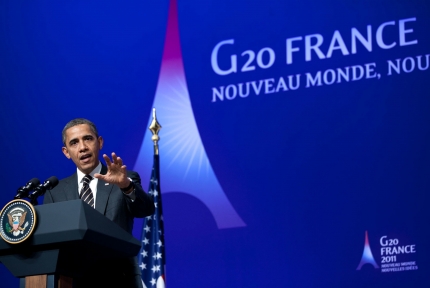
President Barack Obama answers a question at his press conference at the G20 Summit in Cannes, France, Nov. 4, 2011. (Official White House Photo by Pete Souza)

When world leaders gathered this week in France, they acknowledged that the global economy was facing significant challenges that put recovery from the recession at risk.

The debt crisis in Europe has put stress on the continent's banking system, and countries like Greece and Italy are struggling to restore fiscal order.

In our country, the economy hasn't rebounded how anyone had hoped. We're adding jobs, but not at anywhere near the pace we need, and too many remain out of work.

And in emerging economies, the rate of growth seems to be slowing as continued financial instability in the rest of the world begins to drag these countries down, as well.

To counter these threats, the G20 leaders in France pledged to coordinate actions and policies to reinvigorate the global economy.

And the focus of that coordination? Jobs.

"There's no excuse for inaction," President Obama said in a press conference earlier today. "That's true globally and it's certainly true back home right now."

Read the Transcript  |  Download Video: mp4 (229MB) | mp3 (22MB)

Watch President Obama's full remarks here

While European governments were vowing to do everything necessary to ensure the stability of the euro, the United States made a pledge of its own in the G20 action plan:

The US commits to the timely implementation of a package of near-term measures to sustain the recovery, through public investments, tax reforms, and targeted jobs measures, consistent with a credible plan for medium-term fiscal consolidation.

This commitment puts even greater emphasis on the need for Congress to take action on the American Jobs Act.

The world is looking for American leadership, and that's exactly what the President's job proposal is.

Related Topics: Economy, Foreign Policy

The White House

Office of the Press Secretary

President Obama Announces Another Key Administration Post

WASHINGTON, DC – Today, President Barack Obama announced his intent to nominate the following individual to a key Administration post:

• Meredith M. Broadbent - Member, United States International Trade Commission

President Obama announced his intent to nominate the following individual to a key Administration post:

Meredith M. Broadbent, Nominee for Member, United States International Trade Commission
Meredith M. Broadbent is a senior advisor at the Center for Strategic and International Studies (CSIS), where she holds the William M. Scholl Chair in International Business. Before joining CSIS, she was a Trade Advisor at the Global Business Dialogue. From 2003 to 2008, she served as Assistant U.S. Trade Representative for Industry, Market Access, and Telecommunications. Previously, she was a senior professional staff member for the House Ways and Means Committee. Earlier in her career, Ms. Broadbent served as professional staff for the House Ways and Means Trade Subcommittee. She holds a B.A. in History from Middlebury College and an M.B.A. from the George Washington University School of Business and Public Management.

The White House

Office of the Press Secretary

President Obama Announces More Key Administration Posts

WASHINGTON, DC – Today, President Barack Obama announced his intent to nominate the following individuals to key Administration posts:

  • Anne C. Richard - Assistant Secretary for Population, Refugees and Migration, Department of State
  • Tara D. Sonenshine - Under Secretary for Public Diplomacy and Public Affairs, Department of State

The President also announced his intent to appoint the following individuals to key administration posts:

  • Julie Ann Petty - Member, President's Committee for People with Intellectual Disabilities
  • Lauren Elizabeth Potter - Member, President's Committee for People with Intellectual Disabilities

President Obama said, “I am grateful that these talented and dedicated individuals have agreed to take on these important roles and devote their talents to serving the American people.  I look forward to working with them in the coming months and years.”

President Obama announced his intent to nominate the following individuals to key Administration posts:

Anne C. Richard, Nominee for Assistant Secretary for Population, Refugees and Migration, Department of State
Anne C. Richard is the Vice President of Government Relations and Advocacy for the International Rescue Committee (IRC).  Prior to joining IRC in 2004, Ms. Richard was Director of the Office of Resources, Plans and Policy at the Department of State from 1999 to 2001.  From 1997 to 1999, she was Deputy Chief Financial Officer of the Peace Corps.  She has also served as a budget and policy advisor at the Department of State and as Budget Examiner at the United States Office of Management and Budget.  Ms. Richard was an International Affairs Fellow of the Council on Foreign Relations from 1993 to 1994 and was part of the team that created the International Crisis Group.  From 1985 to 1986, she was a fellow of the Robert Bosch Foundation in Germany.  She received a B.S. in Foreign Service from Georgetown University and an M.A. in Public Policy Studies from the University of Chicago.

Tara D. Sonenshine, Nominee for Under Secretary for Public Diplomacy and Public Affairs, Department of State
Tara D. Sonenshine is the Executive Vice President of the United States Institute of Peace (USIP).  Prior to joining USIP, she was a strategic communications adviser to many international organizations including USIP, the International Crisis Group, Internews, CARE, The American Academy of Diplomacy, and the International Women’s Media Foundation. Ms. Sonenshine served in various capacities at the White House during the Clinton Administration, including Transition Director, Director of Foreign Policy Planning for the National Security Council, and Special Assistant to the President and Deputy Director of Communications.   Prior to serving in the Clinton Administration, Ms. Sonenshine was an Editorial Producer of ABC News’ Nightline, where she worked for more than a decade.  She was also an off-air reporter at the Pentagon for ABC’s World News Tonight and is the recipient of 10 News Emmy Awards for coverage of international affairs.  She holds a B.A. in Political Science from Tufts University.

President Obama announced his intent to appoint the following individuals to  key Administration posts:

Lauren Elizabeth Potter, Appointee for Member, President’s Committee for People with Intellectual Disabilities
Lauren Elizabeth Potter is a cast member on the FOX television program Glee where she plays the part of Becky Jackson.  Ms. Potter also serves on the Board of Best Buddies International, has participated in the Abilitypath.org campaign against bullying, partnered with the Special Olympics in their “End the Word” campaign, and is currently lending her name and fame to numerous organizations, including the Down Syndrome Association and the American Association of People with Disabilities.  Her disability rights advocacy has earned her awards from The Down Syndrome Association of Los Angeles, the Arc, and the Full Life Festival.  Ms. Potter is a graduate of Polytechnic High School in Riverside, California and she is currently a student at Irvine Valley College.

Julie Ann Petty, Appointee for Member, President’s Committee for People with Intellectual Disabilities
Julie Ann Petty is a project trainer for Partners for Inclusive Communities at the Arkansas University Center on Disabilities.  Ms. Petty’s work at the Center on Disabilities focuses on educating those with intellectual disabilities on health and safety.  She is also co-chair of the Alliance for Full Participation, a nationwide coalition of self-advocacy disability organizations.  Previously, Ms. Petty served as state coordinator for Arkansas People First (1998-2007), national chairperson of Self Advocates Becoming Empowered (2006-2008), and a policy analyst for the Human Service Research Institute (2007 – 2009).  Ms. Petty received her B.A. in Journalism from the University of Arkansas.

President Obama’s Bilateral Meeting with President Cristina Fernandez de Kirchner of Argentina

November 04, 2011 | 10:22 | Public Domain

The President holds a bilateral meeting with President Cristina Fernandez de Kirchner of Argentina around the G20 Summit in Cannes.

Download mp4 (99MB) | mp3 (10MB)

Read the Transcript

Remarks by President Obama and President Cristina Fernandez de Kirchner of Argentina Before Bilateral Meeting

InterContinental Carlton Cannes Hotel
Cannes, France

2:19 P.M. CET

PRESIDENT OBAMA: Well, it is wonderful to be joined by the President of Argentina, a great friend of not only mine but the United States. We've spent a lot of time together at the G20, and I have very much appreciated the engagement and the passion that President Kirchner has brought to the important global issues that we've been discussing.

Obviously, there are a lot of bonds between Argentina and the United States that date back many years, and this is an excellent opportunity for us to build on that history. We have a wide range of areas of common interest and common concern. We'll be discussing the possibilities of deeper cooperation on economics, on trade, on science, on technology, and on security issues. And we'll also have a chance to discuss the upcoming Summit of the Americas in Colombia, and how we can set an agenda that focuses on increasing prosperity and employment and opportunity for people throughout the Americas.

So thank you so much, Madam President, for meeting with me. And I want to congratulate her on her recent election.

PRESIDENT KIRCHNER: (As interpreted.) Thank you very much, Mr. President. To me, as President of the Argentine Republic, it is indeed a pleasure to have a chance to meet you, and a great honor as well to have this relationship with you. And, of course, the leadership of the United States at the global level cannot be overlooked, not just in the political field but also in the economic field.

And this meeting is particularly significant to us. I would like to thank you for your kind words. And I would like to say that the G20 has proved a positive and fruitful meeting. We have had an opportunity to discuss problem candidly and in a straightforward and effective manner. So thank you once again for that, too.

Allow me to say as well that the U.S. is a top foreign investor worldwide, needless to say, and it is the second-largest foreign investor in Argentina, after Spain. In fact, over 500 American companies have settled down in Argentina, and 60 percent of those companies actually figure among the 100 leading companies of the United States. And they’re also flagship companies -- I must mention that, too.

It is a fact that the bilateral trade and bilateral relations between our two countries are extremely important for us as well. And although it is true that nowadays the United States has a surplus as far as Argentina is concerned, the figures that Argentina has experienced in recent years through its accumulated growth I daresay have also been positive for the balance of trade in the United States, since as the industrialization process resumed in Argentina we were obviously in need of products with added value that we were able to purchase from the United States.

Let me mention, by the way, that when President Kirchner took office in 2003, Argentina still had a positive balance, and the difference was $1 billion at the time. Of course, now the figures have changed, and we’re talking about $4.7 billion in favor of the United States this year -- the surplus figures being that.

I believe this will be an excellent opportunity for us to discuss, as I was saying, our bilateral and trade relations, and to look at ways to deepen and enhance those relationships. Let me also stress that the bonds between us are not just at an institutional but also at a personal level. I know that both President Obama and myself are big fans of science and technology and innovation. In fact, I as President, created the Minister of Science and Technology in Argentina.

Very recently, we were very pleased to receive a visit from NASA -- actually, Mr. Charles Bolden came to see us. And the Argentine Republic has recently launched a satellite in cooperation with NASA. And one of the features of this satellite is that it can be used to measure the salinity of the seas and the impact this has on climate change. And we also know this is one issue that has made President Obama lose sleep in recent times -- and not just him, but me as well.

There are many other issues and commonalities between us. Of course, international security, drug trafficking, the fight against terrorism, among other many areas of common interest that we both consider important -- and trafficking in persons, I should mention as well. So we believe this will be a wonderful opportunity for fruitful and positive discussions between us.

PRESIDENT OBAMA: Thank you.

END
2:29 P.M. CET


Close Transcript