Economists: The President’s Plan Will Create Jobs Now, The GOP’s Won’t

Yesterday, the President held a press conference and once again urged Congress to pass the American Jobs Act to jumpstart the economy and put the American people back to work.  There’s no question that the American Jobs Act will put more money in the pockets of working Americans, get police officers, teachers and firefighters back to work and put construction workers back on the job rebuilding our crumbling roads and bridges.  These are the steps we must take to get our economy moving again. 

But don’t take our word for it.   Prominent, independent experts have confirmed that the American Jobs Act will materially improve economic growth and employment next year. For example, Moody’s Mark Zandi released a report stating that “The plan would add 2 percentage points to GDP growth next year, add 1.9 million jobs, and cut the unemployment rate by a percentage point.”  Macroeconomic Advisers estimated that it would increase growth by 1.3%, and result in 1.3 million more jobs in 2012. The President has proposed a plan.  It’s been assessed and reviewed by independent experts. 

But what do those same independent experts say about the Republican’s plan?  According to an article in the New York Times this morning, Macroeconomic Advisers chairman Joel Prakken said their plan “would have little immediate effect relative to a plan that stimulates aggregate demand.”  Moody’s Mark Zandi said the Republicans' ideas “won’t mean much for the economy and job market in the next year,” even as he said “it is vital for Congress and the administration to provide some near-term support to the economy.”

The Republican plan won’t create jobs in the short term.  The American Jobs Act is made up of the kind of ideas that both Republicans and Democrats have supported in the past. There’s simply no excuse for them sitting on the sidelines while teachers are being laid off in droves and construction workers are out of a job.  It’s time for Republicans to stop playing politics and pass this bill. 

Dan Pfeiffer is White House Communications Director
Related Topics: Economy

The White House

Office of the Press Secretary

Statement by the Press Secretary on the Visit of Prime Minister Necas of the Czech Republic

President Obama will host Prime Minister Petr Necas of the Czech Republic for a meeting in the Oval Office on Thursday, October 27. The President welcomes the opportunity to reciprocate the warm hospitality that he received during his visits to Prague in April 2009 and April 2010. The United States and the Czech Republic are strong NATO allies and the President looks forward to consulting with the Prime Minister about preparations for the 2012 NATO Summit that the U.S. will host in Chicago as part of our ongoing security dialogue. The President and Prime Minister will also discuss the enhancement of bilateral economic and commercial relations as well as cooperation on promoting democracy, good governance and human rights around the world.

The White House

Office of the Press Secretary

Statement by the President on Ten Years of American Service in Afghanistan

Ten years ago today, in response to the 9/11 terrorist attacks, our nation went to war against al Qaeda and its Taliban protectors in Afghanistan.  As we mark a decade of sacrifice, Michelle and I join all Americans in saluting the more than half a million men and women who have served bravely in Afghanistan to keep our country safe, including our resilient wounded warriors who carry the scars of war, seen and unseen.  We honor the memory of the nearly 1,800 American patriots, and many coalition and Afghan partners, who have made the ultimate sacrifice in Afghanistan for our shared security and freedom.  We pay tribute to our inspiring military families who have persevered at home with a loved one at war.  And we are grateful to our tireless diplomats and intelligence, homeland security and law enforcement professionals who have worked these ten years to protect our country and save American lives.

Thanks to the extraordinary service of these Americans, our citizens are safer and our nation is more secure.  In delivering justice to Osama bin Laden and many other al Qaeda leaders, we are closer than ever to defeating al Qaeda and its murderous network.  Despite the enormous challenges that remain in Afghanistan, we’ve pushed the Taliban out of its key strongholds, Afghan security forces are growing stronger, and the Afghan people have a new chance to forge their own future.  We’ve fought alongside Afghans, and close friends and allies from dozens of nations who have joined us in common purpose. In Afghanistan and beyond, we have shown that the United States is not and never will be at war with Islam and that we are a partner with those who seek justice, dignity and opportunity.

After a difficult decade, we are responsibly ending today’s wars from a position of strength.  As the rest of our troops come home from Iraq this year, we have begun to draw down our forces in Afghanistan and transition security to the Afghan people, with whom we will forge an enduring partnership.  As our sons and daughters come home to their families, we will uphold our sacred trust with our 9/11 Generation veterans and work to provide the care, benefits and opportunities they deserve.  And as we reflect on ten years of war and look ahead to a future of peace, Michelle and I call upon all Americans to show our gratitude and support for our fellow citizens who risk their lives so that we can enjoy the blessings of freedom and security.

Watch Live & Engage: 1985 Chicago Bears Visit the White House

It's an exciting day for us Chicagoans at the White House. Today, President Obama will welcome the 1985 Super Bowl Champion Chicago Bears to celebrate the 25th anniversary of their Super Bowl victory. The '85 Bears' visit is long overdue -- in 1986, the team’s White House reception was canceled due to the Space Shuttle Challenger tragedy. The Bears are finally here and we hope you'll watch and join the conversation. Watch the visit live at 3:05 p.m. EDT and join the discussion on Twitter with the hashtag #85BearsWH and on Facebook.

Here's how you can watch and engage:

Related Topics:

The White House

Office of the Press Secretary

Executive Order 13587 -- Structural Reforms to Improve the Security of Classified Networks and the Responsible Sharing and Safeguarding of Classified Information

EXECUTIVE ORDER

STRUCTURAL REFORMS TO IMPROVE THE SECURITY OF CLASSIFIED NETWORKS AND THE RESPONSIBLE SHARING AND SAFEGUARDING OF CLASSIFIED INFORMATION

By the authority vested in me as President by the Constitution and the laws of the United States of America and in order to ensure the responsible sharing and safeguarding of classified national security information (classified information) on computer networks, it is hereby ordered as follows: 

Section 1. Policy. Our Nation's security requires classified information to be shared immediately with authorized users around the world but also requires sophisticated and vigilant means to ensure it is shared securely. Computer networks have individual and common vulnerabilities that require coordinated decisions on risk management.

This order directs structural reforms to ensure responsible sharing and safeguarding of classified information on computer networks that shall be consistent with appropriate protections for privacy and civil liberties. Agencies bear the primary responsibility for meeting these twin goals. These structural reforms will ensure coordinated interagency development and reliable implementation of policies and minimum standards regarding information security, personnel security, and systems security; address both internal and external security threats and vulnerabilities; and provide policies and minimum standards for sharing classified information both within and outside the Federal Government. These policies and minimum standards will address all agencies that operate or access classified computer networks, all users of classified computer networks (including contractors and others who operate or access classified computer networks controlled by the Federal Government), and all classified information on those networks.

Sec. 2. General Responsibilities of Agencies.

Sec. 2.1. The heads of agencies that operate or access classified computer networks shall have responsibility for appropriately sharing and safeguarding classified information on computer networks. As part of this responsibility, they shall:

(a) designate a senior official to be charged with overseeing classified information sharing and safeguarding efforts for the agency;

(b) implement an insider threat detection and prevention program consistent with guidance and standards developed by the Insider Threat Task Force established in section 6 of this order;

(c) perform self-assessments of compliance with policies and standards issued pursuant to sections 3.3, 5.2, and 6.3 of this order, as well as other applicable policies and standards, the results of which shall be reported annually to the Senior Information Sharing and Safeguarding Steering Committee established in section 3 of this order;

(d) provide information and access, as warranted and consistent with law and section 7(d) of this order, to enable independent assessments by the Executive Agent for Safeguarding Classified Information on Computer Networks and the Insider Threat Task Force of compliance with relevant established policies and standards; and

(e) detail or assign staff as appropriate and necessary to the Classified Information Sharing and Safeguarding Office and the Insider Threat Task Force on an ongoing basis.

Sec. 3. Senior Information Sharing and Safeguarding Steering Committee.

Sec. 3.1. There is established a Senior Information Sharing and Safeguarding Steering Committee (Steering Committee) to exercise overall responsibility and ensure senior-level accountability for the coordinated interagency development and implementation of policies and standards regarding the sharing and safeguarding of classified information on computer networks.

Sec. 3.2. The Steering Committee shall be co-chaired by senior representatives of the Office of Management and Budget and the National Security Staff. Members of the committee shall be officers of the United States as designated by the heads of the Departments of State, Defense, Justice, Energy, and Homeland Security, the Office of the Director of National Intelligence, the Central Intelligence Agency, and the Information Security Oversight Office within the National Archives and Records Administration (ISOO), as well as such additional agencies as the co-chairs of the Steering Committee may designate.

Sec. 3.3. The responsibilities of the Steering Committee shall include:

(a) establishing Government-wide classified information sharing and safeguarding goals and annually reviewing executive branch successes and shortcomings in achieving those goals;

(b) preparing within 90 days of the date of this order and at least annually thereafter, a report for the President assessing the executive branch's successes and shortcomings in sharing and safeguarding classified information on computer networks and discussing potential future vulnerabilities;

(c) developing program and budget recommendations to achieve Government-wide classified information sharing and safeguarding goals;

(d) coordinating the interagency development and implementation of priorities, policies, and standards for sharing and safeguarding classified information on computer networks;

(e) recommending overarching policies, when appropriate, for promulgation by the Office of Management and Budget or the ISOO;

(f) coordinating efforts by agencies, the Executive Agent, and the Task Force to assess compliance with established policies and standards and recommending corrective actions needed to ensure compliance;

(g) providing overall mission guidance for the Program Manager-Information Sharing Environment (PM-ISE) with respect to the functions to be performed by the Classified Information Sharing and Safeguarding Office established in section 4 of this order; and

(h) referring policy and compliance issues that cannot be resolved by the Steering Committee to the Deputies Committee of the National Security Council in accordance with Presidential Policy Directive/PPD-1 of February 13, 2009 (Organization of the National Security Council System).

Sec. 4. Classified Information Sharing and Safeguarding Office.

Sec. 4.1. There shall be established a Classified Information Sharing and Safeguarding Office (CISSO) within and subordinate to the office of the PM-ISE to provide expert, fulltime, sustained focus on responsible sharing and safeguarding of classified information on computer networks. Staff of the CISSO shall include detailees, as needed and appropriate, from agencies represented on the Steering Committee.

Sec. 4.2. The responsibilities of CISSO shall include:

(a) providing staff support for the Steering Committee;

(b) advising the Executive Agent for Safeguarding Classified Information on Computer Networks and the Insider Threat Task Force on the development of an effective program to monitor compliance with established policies and standards needed to achieve classified information sharing and safeguarding goals; and

(c) consulting with the Departments of State, Defense, and Homeland Security, the ISOO, the Office of the Director of National Intelligence, and others, as appropriate, to ensure consistency with policies and standards under Executive Order 13526 of December 29, 2009, Executive Order 12829 of January 6, 1993, as amended, Executive Order 13549 of August 18, 2010, and Executive Order 13556 of November 4, 2010.

Sec. 5. Executive Agent for Safeguarding Classified Information on Computer Networks.

Sec. 5.1. The Secretary of Defense and the Director, National Security Agency, shall jointly act as the Executive Agent for Safeguarding Classified Information on Computer Networks (the "Executive Agent"), exercising the existing authorities of the Executive Agent and National Manager for national security systems, respectively, under National Security Directive/NSD-42 of July 5, 1990, as supplemented by and subject to this order.

Sec. 5.2. The Executive Agent's responsibilities, in addition to those specified by NSD-42, shall include the following:

(a) developing effective technical safeguarding policies and standards in coordination with the Committee on National Security Systems (CNSS), as re-designated by Executive Orders 13286 of February 28, 2003, and 13231 of October 16, 2001, that address the safeguarding of classified information within national security systems, as well as the safeguarding of national security systems themselves;

(b) referring to the Steering Committee for resolution any unresolved issues delaying the Executive Agent's timely development and issuance of technical policies and standards;

(c) reporting at least annually to the Steering Committee on the work of CNSS, including recommendations for any changes needed to improve the timeliness and effectiveness of that work; and

(d) conducting independent assessments of agency compliance with established safeguarding policies and standards, and reporting the results of such assessments to the Steering Committee.

Sec. 6. Insider Threat Task Force.

Sec. 6.1. There is established an interagency Insider Threat Task Force that shall develop a Government-wide program (insider threat program) for deterring, detecting, and mitigating insider threats, including the safeguarding of classified information from exploitation, compromise, or other unauthorized disclosure, taking into account risk levels, as well as the distinct needs, missions, and systems of individual agencies. This program shall include development of policies, objectives, and priorities for establishing and integrating security, counterintelligence, user audits and monitoring, and other safeguarding capabilities and practices within agencies.

Sec. 6.2. The Task Force shall be co-chaired by the Attorney General and the Director of National Intelligence, or their designees. Membership on the Task Force shall be composed of officers of the United States from, and designated by the heads of, the Departments of State, Defense, Justice, Energy, and Homeland Security, the Office of the Director of National Intelligence, the Central Intelligence Agency, and the ISOO, as well as such additional agencies as the co-chairs of the Task Force may designate. It shall be staffed by personnel from the Federal Bureau of Investigation and the Office of the National Counterintelligence Executive (ONCIX), and other agencies, as determined by the co-chairs for their respective agencies and to the extent permitted by law. Such personnel must be officers or full-time or permanent part-time employees of the United States. To the extent permitted by law, ONCIX shall provide an appropriate work site and administrative support for the Task Force.

Sec. 6.3. The Task Force's responsibilities shall include the following:

(a) developing, in coordination with the Executive Agent, a Government-wide policy for the deterrence, detection, and mitigation of insider threats, which shall be submitted to the Steering Committee for appropriate review;

(b) in coordination with appropriate agencies, developing minimum standards and guidance for implementation of the insider threat program's Government-wide policy and, within 1 year of the date of this order, issuing those minimum standards and guidance, which shall be binding on the executive branch;

(c) if sufficient appropriations or authorizations are obtained, continuing in coordination with appropriate agencies after 1 year from the date of this order to add to or modify those minimum standards and guidance, as appropriate;

(d) if sufficient appropriations or authorizations are not obtained, recommending for promulgation by the Office of Management and Budget or the ISOO any additional or modified minimum standards and guidance developed more than 1 year after the date of this order;

(e) referring to the Steering Committee for resolution any unresolved issues delaying the timely development and issuance of minimum standards;

(f) conducting, in accordance with procedures to be developed by the Task Force, independent assessments of the adequacy of agency programs to implement established policies and minimum standards, and reporting the results of such assessments to the Steering Committee;

(g) providing assistance to agencies, as requested, including through the dissemination of best practices; and

(h) providing analysis of new and continuing insider threat challenges facing the United States Government. 

Sec. 7. General Provisions. (a) For the purposes of this order, the word "agencies" shall have the meaning set forth in section 6.1(b) of Executive Order 13526 of December 29, 2009.

(b) Nothing in this order shall be construed to change the requirements of Executive Orders 12333 of December 4, 1981, 12829 of January 6, 1993, 12968 of August 2, 1995, 13388 of October 25, 2005, 13467 of June 30, 2008, 13526 of December 29, 2009, 13549 of August 18, 2010, and their successor orders and directives.

(c) Nothing in this order shall be construed to supersede or change the authorities of the Secretary of Energy or the Nuclear Regulatory Commission under the Atomic Energy Act of 1954, as amended; the Secretary of Defense under Executive Order 12829, as amended; the Secretary of Homeland Security under Executive Order 13549; the Secretary of State under title 22, United States Code, and the Omnibus Diplomatic Security and Antiterrorism Act of 1986; the Director of ISOO under Executive Orders 13526 and 12829, as amended; the PM-ISE under Executive Order 13388 or the Intelligence Reform and Terrorism Prevention Act of 2004, as amended; the Director, Central Intelligence Agency under NSD-42 and Executive Order 13286, as amended; the National Counterintelligence Executive, under the Counterintelligence Enhancement Act of 2002; or the Director of National Intelligence under the National Security Act of 1947, as amended, the Intelligence Reform and Terrorism Prevention Act of 2004, as amended, NSD-42, and Executive Orders 12333, as amended, 12968, as amended, 13286, as amended, 13467, and 13526.

(d) Nothing in this order shall authorize the Steering Committee, CISSO, CNSS, or the Task Force to examine the facilities or systems of other agencies, without advance consultation with the head of such agency, nor to collect information for any purpose not provided herein.

(e) The entities created and the activities directed by this order shall not seek to deter, detect, or mitigate disclosures of information by Government employees or contractors that are lawful under and protected by the Intelligence Community Whistleblower Protection Act of 1998, Whistleblower Protection Act of 1989, Inspector General Act of 1978, or similar statutes, regulations, or policies.

(f) With respect to the Intelligence Community, the Director of National Intelligence, after consultation with the heads of affected agencies, may issue such policy directives and guidance as the Director of National Intelligence deems necessary to implement this order.

(g) Nothing in this order shall be construed to impair or otherwise affect:

(1) the authority granted by law to an agency, or the head thereof; or

(2) the functions of the Director of the Office of Management and Budget relating to budgetary, administrative, or legislative proposals

(h) This order shall be implemented consistent with applicable law and appropriate protections for privacy and civil liberties, and subject to the availability of appropriations.

(i) This order is not intended to, and does not, create any right or benefit, substantive or procedural, enforceable at law or in equity by any party against the United States, its departments, agencies, or entities, its officers, employees, or agents, or any other person.

 BARACK OBAMA

THE WHITE HOUSE,
         October 7, 2011.

The Employment Situation in September

Today’s employment report shows that private sector payrolls increased by 137,000 and overall payroll employment rose by 103,000 in September. The unemployment rate remained unchanged at 9.1 percent, a level that is unacceptably high. Despite a slowdown in economic growth from substantial headwinds experienced throughout the year, the economy has added private sector jobs for 19 straight months, for a total of 2.6 million jobs over that period.

Clearly, we need faster economic growth to put Americans back to work. Today’s report underscores the President’s call for Congress to pass the American Jobs Act to put more money in the pockets of working and middle class families; to make it easier for small businesses to hire workers; to keep teachers in the classroom; to put construction crews to work rebuilding our nation’s infrastructure; and other measures that will help the economy grow while not adding to the deficit over ten years.

West Wing Week: 10/07/11 or "Why Is That White House Pink?"

October 07, 2011 | 6:19 | Public Domain

Welcome to the West Wing Week, your guide to everything that's happening at 1600 Pennsylvania Ave. This week, the President continued to call on Congress to pass the American Jobs Act, welcomed a new Chairman of the Joint Chiefs of Staff, spoke at the Human Rights Campaign annual dinner, hosted a Cabinet meeting, traveled to Texas, and convened a televised news conference. That's September 30th to October 6th or "Why Is That White House Pink?"

Download mp4 (149.7MB)

West Wing Week: "Why Is that White House Pink?"

Welcome to the West Wing Week, your guide to everything that's happening at 1600 Pennsylvania Ave. This week, the President continued to call on Congress to pass the American Jobs Act, welcomed a new Chairman of the Joint Chiefs of Staff, spoke at the Human Rights Campaign annual dinner, hosted a Cabinet meeting, traveled to Texas and convened a televised news conference. That's September 30th to October 6th or "Why Is that White House Pink?"

Download Video: mp4 (149.7MB)

President Obama: Our Economy Really Needs a Jolt Right Now

President Obama's News Conference on the American Jobs Act

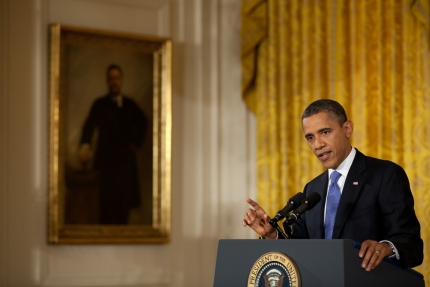
President Barack Obama speaks during a press conference in the East Room of the White House, Oct. 6, 2011. (Official White House Photo by Pete Souza)

President Obama held a press conference today to talk about the American Jobs Act and the upcoming Senate vote on his plan to put people back to work and put more money in the pockets of working Americans. 

Before taking questions from the reporters who were gathered in the White House, the President talked about the very real danger that fallout from the economic situation in Europe could further jeopardize our own economic recovery:

This is not a game; this is not the time for the usual political gridlock. The problems Europe is having today could have a very real effect on our economy at a time when it’s already fragile. But this jobs bill can help guard against another downturn if the situation in Europe gets any worse. It will boost economic growth; it will put people back to work. 

And by the way, this is not just my belief. This is what independent economists have said -- not politicians, not just people in my administration. Independent experts who do this for a living have said this jobs bill will have a significant effect for our economy and for middle-class families all across America. And what these independent experts have also said is that if we don’t act, the opposite will be true. There will be fewer jobs; there will be weaker growth.

Related Topics: Economy

The White House

Office of the Press Secretary

President Obama Announces the Creation of a Presidential Emergency Board, Names Members

WASHINGTON – Today, President Barack Obama signed an Executive Order creating a Presidential Emergency Board to help resolve an ongoing dispute between major freight rail carriers and their unions. 

President Obamasaid, “Freight rail is vital to our economy and our future.  It’s in our national interest to make sure our freight rail system runs smoothly, since a disruption could affect businesses across the country and cause unnecessary damage to our already-fragile economy.  These dedicated individuals have a wealth of experience and talent addressing and resolving labor-management disputes.  I’m grateful they have agreed to serve in this capacity, and I trust them to work toward a swift and smooth resolution of these outstanding contracts.”

The Presidential Emergency Board will provide a structure for the two sides to resolve their disagreements.  The Presidential Emergency Board will hear evidence and, within 30 days, will deliver a report to the President recommending how the dispute should be resolved. 

President Obama also announced that he intends to appoint the following members to Presidential Emergency Board No. 243:

  • Ira F. Jaffe – Chair, Presidential Emergency Board No. 243
  • Roberta GolickMember, Presidential Emergency Board No. 243
  • Joshua M. JavitsMember, Presidential Emergency Board No. 243
  • Gil VernonMember, Presidential Emergency Board No. 243
  • Arnold M. ZackMember, Presidential Emergency Board No. 243

Ira F. Jaffe, Appointee for Chair, Presidential Emergency Board

Ira F. Jaffehas been an arbitrator and mediator of labor and employment disputes since 1981 and has presided over more than 4,000 cases in a wide variety of industries in the private and public sectors.  Mr. Jaffe serves on over 60 permanent arbitration panels and has served on three separate PEBs, one in 2001 and two in 2007. Mr. Jaffe is also a Vice-President of the National Academy of Arbitrators (NAA) and has been a frequent contributor at the NAA Meetings and at other professional conferences.  Mr. Jaffe served as the National President of the Society of Federal Labor Relations Professionals in 1990. As an Adjunct Professor at the George Washington University Law School in the 1980s, Mr. Jaffe taught courses in labor law, collective bargaining and labor arbitration, and agency and partnership.  He is a Charter Fellow in the American College of Employee Benefits Counsel and has arbitrated and mediated a wide variety of employee benefits disputes.  He is also a Fellow in the College of Labor and Employment Lawyers. Mr. Jaffe is a graduate of the Cornell University School of Industrial and Labor Relations and of the George Washington University Law School.

Roberta Golick, Appointee for Member, Presidential Emergency Board

Roberta Golickis President of the National Academy of Arbitrators, one of the leading North American organizations of neutral arbitrators of labor-management and employment disputes.  With more than 35 years’ experience in the profession, Ms. Golick has handled thousands of cases in both the private and public sectors during the course of her career.  Ms. Golick was the 1996 recipient of the Cushing-Gavin Award, given annually by the Boston Labor Guild to a single neutral each year for “Excellence in Labor-Relations, Exemplifying Moral Integrity, Professional Competence and Community Concern.”  She received her B.A. from Barnard College, Columbia University and her J.D. from Boston University School of Law.

Joshua M. Javits, Appointee for Member, Presidential Emergency Board

Joshua M. Javitsis a neutral mediator and arbitrator and serves on numerous permanent arbitration panels.  He served on a Presidential Emergency Board in 2007. From 1993 to 2001, Mr. Javits was a Partner at Ford & Harrison LLP where he also served as executive director of the Labor Relations Association of Passenger Railroads. He was also an adjunct professor at the Georgetown University Law Center where he taught courses in labor arbitration, transportation labor law, and alternative dispute resolution. He was Chairman and Member of the National Mediation Board from 1988 to 1993.  He began his career as a trial attorney with the National Labor Relations Board. Mr. Javits has represented both labor unions and management, at different times, and is on the rosters of the American Arbitration Association, the Federal Mediation and Conciliation Service, and the National Mediation Board.  He has been rated “AV” – the highest rating – by Martindale Hubbell’s Best Lawyers in America since 2001.  Mr. Javits is a graduate of Yale College and Georgetown University Law Center.

Gil Vernon, Appointee for Member, Presidential Emergency Board

Gil Vernonhas been engaged in the practice of labor arbitration and dispute resolution since 1979.  From 1979 to 1983, he was also an instructor in the Department of Business Administration of the University of Wisconsin, Eau Claire, teaching labor relations, labor law, personnel, compensation administration and management.  Prior to that, Mr. Vernon was a carrier member of the National Railroad Adjustment Board in Chicago, Illinois.  Previously, he was a Labor Relations Officer, and before that a Crew Dispatcher and union member, for the Chicago, Milwaukee, St. Paul and Pacific Railroad in Chicago.  He was appointed to a Presidential Emergency Board in 1996.  Mr. Vernon is the immediate past President of the National Academy of Arbitrators.  He is on the Major League Baseball Salary Arbitration panel, the National Railroad Adjustment Board, and more than 15 airline arbitration panels, among others.  He previously served on seven multi-year railroad arbitration panels as well as the Protective Benefits Panel of the Railroad Retirement Board.  Mr. Vernon received his B.A. from Hope College and his M.A. from the University of Chicago.

Arnold M. Zack, Appointee for Member, Presidential Emergency Board

Arnold M. Zackhas been an arbitrator and mediator of over 5,000 labor disputes since 1957 and a Member of four Presidential Emergency Boards, serving as Chair twice. He is currently the President and Chief Judge of the Asian Development Bank Administrative Tribunal.  Mr. Zack was the President of the National Academy of Arbitrators from 1994 to 1995.  From 1990 to 2000 he was the Chair of the Essential Industries Dispute Settlement Board in Bermuda, and the Chair of the Essential Services Dispute Settlement Board there from 1998 to 2001.  Mr. Zack has also served and taught as a senior research associate at the Labor and Worklife Program at Harvard Law School since 1985. He was a Fulbright Scholar, a Wortheim fellow, and is a member of the College of Labor and Employment Lawyers.  Among his awards is the Distinguished Service Award of the American Arbitration Association and the Pioneer Award and Willoughby Abner Award of the Association on Conflict Resolution.  Mr. Zack holds degrees from Tufts University, Yale Law School and Harvard University’s Kennedy School of Government.