The White House

Office of the Press Secretary

Presidential Nominations Sent to the Senate

NOMINATIONS SENT TO THE SENATE:

Catherine Allgor, of California, to be a Member of the Board of Trustees of the James Madison Memorial Fellowship Foundation for a term expiring September 27, 2014, vice John Richard Petrocik, term expired.        

Eduardo Arriola, of Florida, to be a Member of the Board of Directors of the Inter-American Foundation for a term expiring October 6, 2016, vice Kay Kelley Arnold, term expired.

Sara Margalit Aviel, of California, to be United States Alternate Executive Director of the International Bank for Reconstruction and Development for a term of two years, vice Ana M. Guevara.

Daniel J. Becker, of Utah, to be a Member of the Board of Directors of the State Justice Institute for a term expiring September 17, 2013.  (Reappointment)

Dana Katherine Bilyeu, of Nevada, to be a Member of the Federal Retirement Thrift Investment Board for a term expiring October 11, 2015.  (Reappointment)

Mark Francis Brzezinski, of Virginia, to be Ambassador Extraordinary and Plenipotentiary of the United States of America to Sweden.

Steven H. Cohen, of Illinois, to be a Member of the Board of Trustees of the Harry S Truman Scholarship Foundation for a term expiring December 10, 2013, vice Luis D. Rovira, term expired.

Albert DiClemente, of Delaware, to be a Director of the Amtrak Board of Directors for a term of five years.  (Reappointment)

James R. Hannah, of Arkansas, to be a Member of the Board of Directors of the State Justice Institute for a term expiring September 17, 2013.  (Reappointment)

David Avren Jones, of Connecticut, to be a Member of the Federal Retirement Thrift Investment Board for a term expiring October 11, 2014, vice Alejandro Modesto Sanchez, resigned.

Michael A. Khouri, of Kentucky, to be a Federal Maritime Commissioner for a term expiring June 30, 2016.  (Reappointment)

Alan B. Krueger, of New Jersey, to be a Member of the Council of Economic Advisers, vice Austan Dean Goolsbee, resigned.

Drew R. McCoy, of Massachusetts, to be a Member of the Board of Trustees of the James Madison Memorial Fellowship Foundation for a term expiring January 27, 2016.  (Reappointment)

David J. McMillan, of Minnesota, to be a Member of the Advisory Board of the Saint Lawrence Seaway Development Corporation, vice Scott Kevin Walker.

Adam E. Namm, of New York, a Career Member of the Senior Foreign Service, Class of Minister-Counselor, to be Ambassador Extraordinary and Plenipotentiary of the United States of America to the Republic of Ecuador.

Susan Denise Page, of Illinois, to be Ambassador Extraordinary and Plenipotentiary of the United States of America to the Republic of South Sudan.

J. Kelly Ryan, of Maryland, to be a Member of the Board of Directors of the Inter-American Foundation for the remainder of the term expiring September 20, 2012, vice Thomas A. Shannon, Jr., resigned.

Wenona Singel, of Michigan, to be a Member of the Advisory Board of the Saint Lawrence Seaway Development Corporation, vice Jack Edwin McGregor.

Mary B. Verner, of Washington, to be a Member of the Board of Directors of the National Institute of Building Sciences for a term expiring September 7, 2012, vice Steve M. Hays, term expired.

Mary B. Verner, of Washington, to be a Member of the Board of Directors of the National Institute of Building Sciences for a term expiring September 7, 2015.  (Reappointment)

Michael James Warren, of the District of Columbia, to be a Member of the Board of Directors of the Overseas Private Investment Corporation for a term expiring December 17, 2014.  (Reappointment)

The White House

Office of the Press Secretary

President Obama Announces More Key Administration Posts

WASHINGTON – Today, President Barack Obama announced his intent to nominate the following individuals to key Administration posts:

  • Eduardo Arriola –Member, Board of Directors of the Inter-American Foundation
  • Sara Aviel– United States Alternate Executive Director, International Bank for Reconstruction and Development
  • Daniel Becker– Member, Board of Directors of the State Justice Institute
  • Mark Francis Brzezinski– Ambassador to Sweden, Department of State
  • Dana Bilyeu -Member, Federal Retirement Thrift Investment Board
  • Steven H. Cohen - Member, Board of Trustees of the Harry S Truman Scholarship Foundation
  • Bert DiClemente -Director, Amtrak Board of Directors
  • James Hannah -Member, Board of Directors of the State Justice Institute
  • David Jones -Member, Federal Retirement Thrift Investment Board
  • Drew R. McCoy -  Member, Board of Trustees of the James Madison Memorial Fellowship Foundation
  • Adam Namm -Ambassador to the Republic of Ecuador, Department of State
  • Wenona Singel - Member, Advisory Board of the Saint Lawrence Seaway Development Corporation
  • Mary B. Verner – Member, Board of Directors of theNational Institute of Building Sciences
     

The President also announced his intent to appoint the following individuals to key Administration posts:

  • Jean Bailey Member, President's Advisory Committee on the Arts on the John F. Kennedy Center for the Performing Arts
  • Susan M. Dimarco Johnson Member, President's Advisory Committee on the Arts for the John F. Kennedy Center for the Performing Arts
  • Sonya M. Halpern Member, President's Advisory Committee on the Arts for the John F. Kennedy Center for the Performing Arts
  • Mattie McFadden-Lawson Member, President's Advisory Committee on the Arts for the John F. Kennedy Center for the Performing Arts
  • Melissa Moss Member, President's Advisory Committee on the Arts on the John F. Kennedy Center for the Performing Arts
  • Deborah Dozier Potter Member, President's Advisory Committee on the Arts for the John F. Kennedy Center for the Performing Arts
  • Kristin Gatchel Replogle Member, President's Advisory Committee on the Arts for the John F. Kennedy Center for the Performing Arts
  • Jennifer Scully-Lerner Member, President's Advisory Committee on the Arts for the John F. Kennedy Center for the Performing Arts
  • Ellen Schapps Richman Member, President's Advisory Committee on the Arts for the John F. Kennedy Center for the Performing Arts
  • Mary Rouse-Terlevich – Member, President's Advisory Committee on the Arts for the John F. Kennedy Center for the Performing Arts
  • Ellen Susman Member, President's Advisory Committee on the Arts for the John F. Kennedy Center for the Performing Arts
  • Mona Sutphen - Member, President's Intelligence Advisory Board
  • Harry Wilson - Member, Advisory Committee to the Pension Benefit Guaranty Corporation
  • Philip Zelikow - Member, President's Intelligence Advisory Board

President Obama said, “I am confident that these outstanding men and women will greatly serve the American people in their new roles and I look forward to working with them in the months and years to come.”

President Obama announced his intent to nominate the following individuals to key Administration posts:

Eduardo Arriola, Nominee for Member, Board of Directors of the Inter-American Foundation
Eduardo Arriola is the Chairman of the Board of Apollo Bank and the co-Founder of Inktel Direct, a provider of business solutions for direct marketing. He currently serves on the FBA-FDIC Advisory Board, the Florida Bankers Association BancServ Board of Directors and is a member of the Young Presidents’ Organization.  Mr. Arriola is a past president and board member of EO, a network of entrepreneurs, and has previously served on the board of directors of Kristi House and City Year Miami. In 2011, he was awarded the Horizon Award by the Florida Bankers Association, in recognition of his commitment to the banking industry.  Mr. Arriola is a graduate of Boston College.

Sara Aviel, Nominee for United States Alternate Executive Director, International Bank for Reconstruction and Development
Sara Aviel currently serves as a Senior Advisor to Secretary of the Treasury Timothy Geithner.  In that capacity, she works on a range of issues including development policy, G-20 summits, the Strategic and Economic Dialogue with China, and formulating a response to the global financial crisis.  Prior to joining the Administration, Ms. Aviel was on the leadership team for Root Capital, a social investment fund that provides financing to small and medium enterprises in developing countries.  Previously, she was a Strategic Innovations Advisor at Mercy Corps, responsible for working directly with the Board of Directors to facilitate corporate partnerships and long-term strategic initiatives.  Ms. Aviel also served as a Lecturer on international development and humanitarian relief at Yale College.  She previously worked for CARE, both in Afghanistan and throughout Africa.  Ms. Aviel holds an M.B.A, as well as M.A. and B.A. degrees in Political Science, from Yale University.

Daniel Becker, Nominee for Member, Board of Directors of the State Justice Institute
Daniel Becker has served as State Court Administrator at the Administrative Office of the Courts for the State of Utah since 1995.  In that capacity, he is responsible to the Utah Supreme Court and Utah Judicial Council for the administration of the state court system.  He was appointed by President Barack Obama to the Board of Directors of the State Justice Institute in 2010 and presently serves as Vice-Chair.  From 1984 to 1995, Mr. Becker worked for the North Carolina Administrative Office of the Courts, serving in the positions of: Deputy Director (1993-1995); Court Services Administrator (1986-1993); and Assistant to the Director (1984-1986).  He also held the positions of Trial Court Administrator for the Fourteenth Judicial District of North Carolina, and Assistant Director of Operations for the Georgia Administrative Office of the Courts.  Mr. Becker was the recipient of the National Center for State Courts’ 2001 Distinguished Service Award and the 2006 Warren E. Burger Award for Excellence in Judicial Administration.  He holds a B.A. and M.P.A. from Florida Atlantic University.

Mark Francis Brzezinski, Nominee for Ambassador to Sweden, Department of State
Mark Francis Brzezinski is currently a partner in the Washington, D.C. office of McGuireWoods, where he specializes in anti-corruption law.  Prior to his current role, Mr. Brzezinski served as a Director on the National Security Council from 1999 to 2001, focusing on issues relating to the Balkans, Russia, Eurasia and Southeast Europe.  From 1996 to 1999, he was an attorney at Hogan & Hartson.  From 1991 to 1993, he worked in Poland as a Fulbright Scholar.  Mr. Brzezinski is a member of the J. William Fulbright Foreign Scholarship Board and the Council on Foreign Relations.  He holds a B.A. from Dartmouth College, a J.D. from the University of Virginia School of Law and a Doctorate from Oxford University.

Dana K. Bilyeu, Nominee for Member, Federal Retirement Thrift Investment Board
Dana K. Bilyeu was first appointed to the Federal Retirement Thrift Investment Board in June, 2010. She is also the Executive Officer of the Public Employees' Retirement System of Nevada (NVPERS), serving in that position since 2003. Ms. Bilyeu began her employment with NVPERS in 1995, in the position of Operations Officer, overseeing all aspects of benefit administration for the System.  Preceding her employment at NVPERS, Mrs. Bilyeu was the System's legal counsel in the Office of the Nevada Attorney General. Mrs. Bilyeu is a member of the executive committee of the National Association of State Retirement Administrators, and is a member of the National Council on Teacher Retirement, the National Conference of Public Employee Retirement Systems, and the National Association of Public Pension Attorneys. She also serves on the Public Employees’ Board of the International Foundation of Employee Benefit Plans. Mrs. Bilyeu previously served as a member of the Social Security Advisory Board from 2007 through September 2010. She received her J.D. from California Western School of Law and her B.A. from the University of Arizona.

Steven H. Cohen, Nominee for Member, Board of Trustees of the Harry S Truman Scholarship Foundation
Steven H. Cohen is the founder and President of the Cohen Law Group as well as a co-founder of the Whistleblower Action Network.  Mr. Cohen is also an adjunct faculty member at the Northwestern Law School in Chicago, teaching clinical trial advocacy.  He serves on the Board of Trustees for Beloit College, the Chicago School of Professional Psychology and the TCS Education System, and the Mikva Challenge Foundation, a Chicago based organization that engages Chicago area high school students in local and national political elections.  Mr. Cohen received his Bachelor’s degree from Beloit College and his law degree from the Northwestern University School of Law.

Bert DiClemente, Nominee for Director, Amtrak Board of Directors
Bert DiClementewas originally appointed to the Amtrak Board in June 2010. Mr. DiClemente recently retired as the Vice President of CB Richard Ellis, Inc., a position he had served in since 2003. Previously, he worked as Director of Insignia/ESG (1998-2003) and as Associate Director at Jackson Cross & Associates (1997-1998).  He was responsible for the leasing and selling of commercial real estate and represented a number of Fortune 500 Companies.  Mr. DiClemente also served as State Director for then United States Senator Joseph R. Biden, Jr., from 1977 to 1997.  He received a B.A. in Political Science from the University of Delaware.

Chief Justice Jim Hannah, Nominee for Member, Board of Directors of the State Justice Institute
Chief Justice Jim Hannah is currently serving as Chief Justice of the Arkansas Supreme Court.  He was first elected as an Associate Justice in 2000 and re-elected as Chief Justice in 2004 and 2008.  He was appointed by President Barack Obama to the Board of Directors of the State Justice Institute in 2010. Prior to serving on the Arkansas Supreme Court, he served as a Chancery/Probate Judge in the 17th Judicial District from 1979 to 1999.  Chief Justice Hannah maintained a private law practice for ten and a half years before he was elected to the trial bench. While in private practice, he also served as the city attorney for Searcy, Arkansas, as city attorney for several communities in White County, as a city judge for Kensett, Arkansas and Rosebud, Arkansas, as deputy prosecuting attorney for Woodruff County, and as the White County Juvenile Judge.  Chief Justice Hannah has served as President on the Board of the Arkansas Judicial Council.  He has served as Chairman of the Arkansas Judicial Resources Assessment Committee, Legislative Committee, and Retirement Committee.  He has also served on the board of the Conference of Chief Justices and is currently serving as Co-Chair of the Committee of Families and Courts.  In addition, he sits on the U.S. Supreme Court Judicial Conference Committee on Federal-State Jurisdiction and the Arkansas Supreme Court Committees on Technology, Child Support, and Foster Care.  Chief Justice Hannah received a B.S.B.A. from the University of Arkansas, Fayetteville, and a J.D. from the University of Arkansas School of Law.

David Avren Jones, Nominee for Member, Federal Retirement Thrift Investment Board
David Avren Jones established D.A. Jones LLC, an independent consulting firm and trustee for a number of families and their entities, in 2004.  Before the founding of his own firm, Mr. Jones was a managing director and the senior client executive at Deutsche Bank Private Wealth Management in New York.  His other prior experiences include running his own investment advisory firm, Bannister Capital Management, and serving as CEO of Citicorp Securities Markets, Inc. in New York, where he was responsible for the firm’s fixed income and foreign exchange businesses for North America. Mr. Jones also worked at Goldman Sachs as the fixed income trading manager in London.  Mr. Jones has served as a member of the Treasury Borrowing Advisory Committee, as Vice Chairman of the Primary Dealers Committee and as a director of the Public Securities Association.  He is a past Chairman of the Board of Trustees of The Jewish Home Lifecare System in New York and serves as the Chairman of Fund for the Aged, Inc.  Mr. Jones is a graduate of Princeton University and the Harvard Business School.

Drew R. McCoy, Nominee for Member, Board of Trustees of the James Madison Memorial Fellowship Foundation
Drew R. McCoy is the Jacob and Frances Hiatt Professor of History at Clark University in Worcester, Massachusetts, and a specialist in American political and intellectual history from the Revolution to the Civil War.  His numerous published works include The Elusive Republic:  Political Economy in Jeffersonian America, a general study of political economy in Revolutionary and Early National America and The Last of the Fathers:  James Madison and the Republican Legacy, a partial biography of James Madison that focuses on President Madison's retirement.  Dr. McCoy received an A.B. from Cornell University and an M.A. and Ph.D. from the University of Virginia.

Adam E. Namm, Nominee for Ambassador to the Republic of Ecuador, Department of State
Adam E. Namm is the Director of the Bureau of Overseas Buildings Operations (OBO) at the State Department.  A career member of the Senior Foreign Service, class of Minister Counselor, Mr. Namm joined the Department of State in 1987.  His most recent overseas assignment was as Management Counselor in Islamabad, with prior tours in Bogota, Dhahran, and Santo Domingo.  His domestic assignments have included Executive Assistant in the Bureau of Administration, Director of the Office of Allowances, Special Assistant to the Under Secretary for Management, and both Desk Officer and Post Management Officer in the Bureau of Western Hemisphere Affairs.  Mr. Namm holds an A.B. magna cum laude in International Relations from Brown University and an M.S. in National Security Strategy from the National War College.

Wenona Singel, Nominee for Member, Advisory Board of the Saint Lawrence Seaway Development Corporation
Wenona Singel is an Assistant Professor of Law at Michigan State University College of Law and the Associate Director of the Indigenous Law & Policy Center, where she teaches courses in the fields of federal Indian law and natural resources law.  Ms. Singel is also an Associate Appellate Justice for the Little Traverse Bay Bands of Odawa Indians and the former Chief Appellate Judge for the Grand Traverse Band of Ottawa and Chippewa Indians.  Previously, she was an Assistant Professor at the University of North Dakota School of Law and a Fellow with the Northern Plains Indian Law Center.  Before teaching, Ms. Singel worked in private practice with firms that included Kanji & Katzen, P.L.L.C. in Ann Arbor, MI, and Dickinson Wright in Bloomfield Hills, MI.  She served as a member of the Economic Development Commission of the Little Traverse Bay Bands of Odawa Indians and as General Counsel for the Grand Traverse Resort, a tribally-owned resort in northern Michigan.  She is an enrolled member of the Little Traverse Bay Bands of Odawa Indians.  Ms. Singel received an A.B. from Harvard College and a J.D. from Harvard Law School.

Mary B. Verner, Nominee for Member, Board of Directors of the National Institute of Building Sciences
Mary Verner is the Mayor of Spokane, Washington.  Mayor Verner served on the Spokane City Council before she was elected mayor.  She has also held a number of professional positions on behalf of the Native American community: she was a manager of natural resources with the Spokane Tribe of Indians, and she served as Executive Director of the Upper Columbia United Tribes.  Mayor Verner serves on a wide variety of local boards and regional associations, and has led her City’s programs to retrofit residential, commercial and public buildings to be energy-efficient.  She received a B.A. from Davidson College, an M.A. from Yale University School of Forestry and Environmental Studies, and a J.D. from Gonzaga University School of Law.


President Obama announced his intent to appoint the following individuals to key Administration posts:

Dr. Jean Bailey, Appointee for Member, President's Advisory Committee on the Arts for the John F. Kennedy Center for the Performing Arts
Dr. Jean Bailey is a Graduate Professor of Human Development in the School of Education at Howard University.  Additionally, she directs the Center for Drug Abuse Research and chairs the Howard University Republic of South Africa Project. Dr. Bailey has devoted her professional career to optimizing developmental outcomes for children and families.  She currently serves on the Board of InventNow.Org and the National African American Drug Policy Coalition.  Dr. Bailey received her B.S. from Southern University, and an M.S. and Ph.D. from Tulane University.

Cynthia Butler-McIntyre, Appointee for Member, Board of Trustees of the Christopher Columbus Fellowship Foundation
Cynthia Butler-McIntyre is the Director of Human Resources in the Jefferson Parish Public School System in Louisiana and the 24th National President of Delta Sigma Theta, a public service organization. She is a National Board Member of the National Council of Negro Women, a past National Board Member of the National Alliance of Black School Educators, and the Secretary of the Louisiana State Association of School Personnel Administrators.  Ms. Butler-McIntyre holds an Honorary Doctorate of Divinity degree from Christian Bible College of Louisiana, an M.A. in Educational Administration from the University of New Orleans, and a B.A. in Early Childhood Education from Dillard University.

Susan M. DiMarco Johnson, Appointee for Member, President's Advisory Committee on the Arts for the John F. Kennedy Center for the Performing Arts
Susan M. DiMarco Johnson is a dentist, who worked in private practice until 1998.  Ms. DiMarco Johnson is an active volunteer in numerous civic and arts related activities in New Jersey, New York, and Washington, DC.  Currently, she serves on the board of EarthEcho International, an environmental education non-profit organization.  She previously served on the Board of Directors of the Montclair Art Museum and as Vice Chair of the corporate board of the Covenant House, a privately-funded childcare agency in New York City.  Ms. DiMarco Johnson received her degree in Dentistry from Georgetown Dental School.

Sonya M. Halpern, Appointee for Member, President's Advisory Committee on the Arts for the John F. Kennedy Center for the Performing Arts
Sonya M. Halpern is a former advertising sales and marketing executive who has worked for ESPN, Inc., The Walt Disney Company, and Cox Enterprises.  She currently serves on the Board of Directors of the National Black Arts Festival and has served as Co-Chair of the Festival’s annual gala for the past three years. Earlier this year, Ms. Halpern was appointed to the Atlanta Judicial Commission by Atlanta Mayor Kasim Reed.  She holds a B.A. in Mass Communications from the University of Massachusetts and an M.B.A. from the University of Hartford.

Mattie McFadden-Lawson, Appointee for Member, President's Advisory Committee on the Arts for the John F. Kennedy Center for the Performing Arts
Mattie McFadden-Lawson is the President of MML Design & Consulting Group, an interior and exterior design company based in Los Angeles.  Mrs. McFadden-Lawson currently serves on the Board of the Music Center/Performing Arts Center of Los Angeles County and is the Board Chair of Center Dance Arts/Music Center.  She also serves as a founding member of the Dance Council of the Colburn School, Vice Chair of the Los Angeles County Arts Commission, and Board Member of the Ford Theater Foundation of the Los Angeles County Arts Commission.  Ms. McFadden-Lawson received a B.A. from Brooklyn College, an M.A. from Howard University, and a, M.P.A. from Harvard University. 

Melissa Moss,  Appointee for Member, President's Advisory Committee on the Arts for the John F. Kennedy Center for the Performing Arts
Melissa Mossis the President of Moss Advisors, based in Washington, DC.  From 2002 until 2009 she was a Senior Vice President at Capital Guardian Trust Company and previously served as the CEO of Women’s Consumer Network.  Ms. Moss is currently on the board of the National Shakespeare Theatre, The National Symphony Orchestra, and Business Forward. She has also served on the boards of Wolf Trap, First Book, the National Building Museum, and the National Partnership for Women and Families.  She received her B.A. from UCLA and a M.P.A. from Harvard University.

Deborah Dozier Potter, Appointee for Member, President's Advisory Committee on the Arts for the John F. Kennedy Center for the Performing Arts
Deborah Dozier Potter is President of Trail Inc., a hotel and real estate development firm.  Prior to this, Ms. Potter was an actors' agent and started her own talent agency and management company.  Her memoir, Let Buster Lead: Discovering Love, Post-traumatic Stress Disorder and Self-assurance, was published in 2007 and she is a volunteer faculty member of The New Mexico School for the Arts.  Mrs. Potter previously served on the President's Advisory Council on the Arts from 1993 until 2001.

Kristin Gatchel Replogle, Appointee for Member, President's Advisory Committee on the Arts for the John F. Kennedy Center for the Performing Arts
Kristin Gatchel Replogle is President of the Replogle Family Foundation.  Ms. Replogle currently serves on the board of directors for WakeMed Hospital, North Carolina State University’s Institute for Nonprofits, SAFEchild, and the Girl Scouts.  From 1990 to 1995, she was a speech pathologist at Massachusetts General Hospital, where she specialized in traumatic brain injury and was responsible for training graduate students.  Ms. Replogle received her B.S. and M.A. in speech language-pathology from Miami University of Ohio. 

Ellen Schapps Richman, Appointee for Member, President's Advisory Committee on the Arts for the John F. Kennedy Center for the Performing Arts
Ellen Schapps Richman is an adjunct professor of marketing at Columbia Graduate School of Business.  Prior to this, Ms. Schapps Richman was an associate adjunct professor of Marketing at Pace University’s Lubin School of Business.  She is on the Board of the United Way of Greenwich and current Chairman and former President of UJA Federation of Greenwich.  Ms. Schapps Richman received a B.A. from Skidmore College and an M.B.A. from New York University’s Stern School of Business.

Molly Rouse-Terlevich, Appointee for Member, President's Advisory Committee on the Arts for the John F. Kennedy Center for the Performing Arts
Molly Rouse-Terlevich is as a Trustee of the Pennsylvania Chapter of the National Museum of Women in the Arts and of the Lewa Downs Wildlife Conservancy in Kenya and is a former Trustee of the Pennsylvania Ballet and the Tyler Arboretum.  In addition, Ms. Rouse-Terlevich is involved in fundraising projects with numerous organizations including the Pennsylvania Academy of the Fine Arts, the Baldwin School and the University of Pennsylvania.  Ms. Rouse-Terlevich received a Bachelor of Arts in English and a Masters of Education from the University of Pennsylvania.

Jennifer Scully-Lerner, Appointee for Member, President's Advisory Committee on the Arts for the John F. Kennedy Center for the Performing Arts
Jennifer Scully-Lerner is a Vice President of Private Wealth Management at Goldman Sachs. In addition, she is the co-head of the Goldman Sachs firm-wide Women’s Network and is the New York Chair of the Women's Leadership Forum.  Ms. Scully-Lerner serves on the President’s Council of the New York Public Library and on the International Board of Covenant House. She is an active mentor with Student Sponsor Partnership and a speaker at the annual Adventures of the Mind Conference.  Ms. Scully-Lerner received her B.A. from Vanderbilt University and her M.B.A. from Columbia Business School.

Ellen Susman, Appointee for Member, President's Advisory Committee on the Arts for the John F. Kennedy Center for the Performing Arts
Ellen Susman is President of the Susman Family Foundation, which supports a variety of programs relating to the arts, justice, and the environment. Previously, Ms. Susman was the producer and host of “Balancing Your Life”, an award-winning national PBS program celebrating the strength of women as they work to balance career and family.  She has served on the Board of Directors of The Houston Grand Opera, the Alley Theatre, and The Houston Symphony Society Board.  Ms. Susman received her B.A. from Briarcliff College.

Mona Sutphen, Appointee for Member, President’s Intelligence Advisory Board
Mona Sutphen is currently a Managing Director at UBS covering geopolitical and policy risk matters.  She served as White House Deputy Chief of Staff for Policy from 2009 until February 2011.  Prior to joining the Administration, Ms. Sutphen was Managing Director for Stonebridge-International LLC and a Vice President at Currenex, an online institutional foreign exchange trading platform.  From 1991 to 2000, Ms. Sutphen served as a U.S. Foreign Service Officer with postings on the National Security Council, at the U.S. Mission to the United Nations, in the Office of the High Representative in Bosnia, in the State Department’s human rights bureau, and at the U.S. Embassy in Bangkok.  She is a member of the Council on Foreign Relations.  Ms. Sutphen holds a B.A. from Mount Holyoke College and an M.Sc. from the London School of Economics.

Harry J. Wilson, Appointee for Member, Advisory Committee to the Pension Benefit Guaranty Corporation
Harry J. Wilson is currently the Chairman and CEO of MAEVA Advisors, LLC, a boutique firm specializing in corporate restructurings. Mr. Wilson is a career private equity and distressed securities investor, having spent most of his career at The Blackstone Group and Silver Point Capital, where he was a partner. In 2009, he served as a senior member of the team at the US Treasury Department overseeing the restructurings of General Motors and Chrysler. Mr. Wilson has deep expertise in corporate restructuring and has invested across a broad array of asset classes throughout his career. He received an A.B. in government from Harvard College and an MBA from Harvard Business School.

Dr. Philip Zelikow, Appointee for Member, President’s Intelligence Advisory Board
Dr. Philip Zelikow is the Associate Dean for the Graduate School of Arts and Sciences and the White Burkett Miller Professor of History at the University of Virginia.  From 2005 to 2007, Dr. Zelikow served as Counselor of the Department of State.  From 2003 to 2004, he was Executive Director of the National Commission on Terrorist Attacks Upon the United States (also known as the “9/11 Commission”).  Dr. Zelikow was a member of the President’s Foreign Intelligence Advisory Board from 2001 to 2003.  From 1991 to 1998, he was an Associate Professor of Public Policy at Harvard.  Dr. Zelikow was a career Foreign Service Officer from 1985 to 1991 and was detailed to the White House as Director for European Security on the staff of the National Security Council from 1989 to 1991.  He taught for the U.S. Navy, at the Naval Postgraduate School, before entering the Foreign Service.  A former trial and appellate attorney in Houston, he holds a B.A. from the University of Redlands, a J.D. from the University of Houston and a Ph.D. from the Fletcher School of Law and Diplomacy at Tufts University.

The White House

Office of the Press Secretary

President Obama Announces More Key Administration Posts

WASHINGTON – Today, President Barack Obama announced his intent to nominate the following individuals to key Administration posts:

  • Catherine Allgor  - Member, Board of Trustees of the James Madison Memorial Fellowship Foundation
  • MichaelA. Khouri - Commissioner, Federal Maritime Commission
  • David McMillan –Member, Advisory Board of the Saint Lawrence Seaway Development Corporation
  • Kelly Ryan – Member, Board of Directors of the Inter-American Foundation

The President announced his intent to nominate the following individuals to key Administration posts:

Catherine Allgor, Nominee for Member, Board of Trustees of the James Madison Memorial Fellowship Foundation
Catherine Allgor is a professor of history and Presidential Chair at the University of California at Riverside.  Professor Allgor is an expert on Dolley Madison and her research primarily focuses on the role of women in the early republic, the effect of gender in electoral politics, the issue of coverture and female disenfranchisement in the founding era, and the historical influence of First Ladies.  Her first book, Parlor Politics: In Which the Ladies of Washington Help Build a City and a Government, won the James H. Broussard First Book Prize from the Society for Historians of the Early American Republic.  A Perfect Union: Dolley Madison and the Creation of the American Nation was a finalist for the George Washington Prize and the 2007-2008 selection for the UCRF1RST Book.  Professor Allgor received an A.A. from Bucks County Community College, an A.B. from Mount Holyoke College, and an M.A., M. Phil, and Ph.D. from Yale University.

Michael A. Khouri, Nominee for Commissioner, Federal Maritime Commission
Michael A. Khouri was originally confirmed as a Federal Maritime Commissioner on December 24, 2009.  Commissioner Khouri has 40 years of experience in the maritime industry serving in vessel operations, legal, administrative, executive and government assignments. He was a member in the law firm of Pedley & Gordinier and previously held the position of President and COO with MERS/Economy Boat, a marine fuels and ship chandler. Prior to his tenure at MERS, Commissioner Khouri served for 23 years at American Commercial Lines, holding executive positions including General Counsel, Senior V.P. for Law & Corporate Affairs, and Senior V.P. for Transportation Services-Marine Operations. He began his marine career in 1971 as a crewman on Crounse Corporation vessels before promotion to the pilot house serving as Pilot and Captain. Commissioner Khouri has served on the Board of Directors of the American Waterways Operators Association and the Waterways Council, Inc. He received his B.A. in Economics from Tulane University, his J.D. from Brandeis School of Law-University of Louisville, and is a graduate of the Advanced Management Program at Harvard Business School.

Dave McMillan, Nominee for Member, Advisory Board of the Saint Lawrence Seaway Development Corporation

Dave McMillan is Senior Vice President for Marketing, Regulatory and Public Affairs of ALLETE and Executive Vice President of Minnesota Power, where he has served in a variety of roles since 1989.  In February 2011, he was elected to serve a six year term on the University of Minnesota’s Board of Regents.  Mr. McMillan is currently on the Board of Directors of St. Luke's Hospital and was previously a member of the Duluth Entertainment Convention Center's Board of Directors.  He has served as the board chair of the Minnesota Chamber of Commerce, the Natural Resources Research Institute, the Area Partnership for Economic Expansion, and Goodwill Industrial Vocational Enterprises.  Mr. McMillan received a B.A. in Economics and History from the University of Minnesota Duluth and a J.D. from the University of Minnesota.

Kelly Ryan, Nominee for Member, Board of Directors of the Inter-American Foundation

Kelly Ryan is currently the Acting Deputy Assistant Secretary for Immigration and Border Security at the Department of Homeland Security.  Previously, Ms. Ryan served as the Chief of the National Security Branch of the Fraud Detection and National Security Directorate at U.S. Citizenship and Immigration Services.  From 2002 to 2009, she was a Deputy Assistant Secretary at the Bureau of Population, Refugees, and Migration at the Department of State.  Prior to that, Ms. Ryan served as Associate General Counsel at the U.S. Department of Justice from 1992 until 1998 and Chief of the Refugee and Asylum Law Division in the Office of the General Counsel at the then Immigration and Naturalization Service from 1998 until 2002.  Ms. Ryan is a graduate of Tulane University and holds a J.D. from Georgetown University and a LL.M. from Cambridge University.

The White House

Office of the Press Secretary

Statement by the President on Robert Gates becoming Chancellor of William & Mary

I congratulate Robert Gates on his selection as the twenty-fourth Chancellor of the College of William & Mary. In Bob, one of our nation’s oldest colleges has found one of our nation’s finest public servants. I’m confident that Bob will bring to this new role the same sense of duty and personal integrity that I and other Presidents valued during his distinguished career in government. As he did at Texas A&M and the Department of Defense, Bob will again help lead an institution devoted to our nation’s most precious resource—our young men and women. I wish Bob the very best as he begins this new chapter at his alma mater, which helped to inspire his commitment to public service five decades ago.

President Obama in Detroit: “We’ve Got to Fully Restore the Middle Class in America”

Watch the President's speech in Detroit here.

Today, President Obama traveled to Detroit, Michigan where he spoke at a Labor Day picnic with workers at a GM plant. During his remarks, the President spoke of the important role the labor unions have played in establishing the “cornerstones of middle-class security:”

Work to make sure that folks get an honest day’s pay for an honest day’s work. Work to make sure that families get a fair shake. The work you've done that helped build the greatest middle class the world has ever known. I’m talking about the work that got us a 40-hour workweek and weekends, and paid leave and pensions, and the minimum wage and health insurance, and Social Security and  Medicare -- the cornerstones of middle-class security. That's because of your work. 

If you want to know who helped lay these cornerstones of an American middle class you just have to look for the union label.

That’s the bedrock this country is built on. Hard work. Responsibility. Sacrifice. Looking out for one another. Giving everybody a shot, everybody a chance to share in America’s prosperity, from the factory floor to the boardroom. That’s what unions are all about. 

Related Topics: Economy, Michigan

The White House

Office of the Press Secretary

Remarks by the President at Detroit Labor Day Event

GM Plant Parking Lot

Detroit, Michigan

Please see below for a correction (marked with an asterisk) to a typo in the transcript.

1:30 P.M. EDT

THE PRESIDENT:  Thank you, Detroit!  (Applause.)  Thank you, Michigan!  (Applause.)  Oh, this is a --

AUDIENCE:  Four more years!

THE PRESIDENT:  Thank you.  (Applause.)  Thank you, everybody.  It is --

AUDIENCE:  Four more years!  Four more years!  Four more years!

THE PRESIDENT:  Thank you, everybody.  Thank you.

AUDIENCE:  Four more years!  Four more years!  Four more years!

THE PRESIDENT:  Thank you.  Thank you, everybody.  I can tell Ghana got you fired up.  (Applause.)  Thank you, Ghana, for that introduction.  Thank you all for having me.  It is good to be back in Detroit.  (Applause.)  I'm glad I was able to bring a friend -- a proud daughter of the Teamsters, your Secretary of Labor, Hilda Solis, in the house.  (Applause.)  

We’re thrilled to be joined by so many other friends.  I want to acknowledge, first of all, two of the finest senators in the country -- Carl Levin and Debbie Stabenow are in the house. (Applause.)   Outstanding members of the congressional delegation -- John Dingell Bingham*, John Conyers, Sandy Levin, Gary Peters, and Hansen Clarke.  (Applause.)

The president of the Metropolitan Detroit Central Labor Council, our host, Saundra Williams.  (Applause.)  AFL-CIO president, Rich Trumka.  (Applause.)  President of the Michigan AFL-CIO, Mark Gaffney.  (Applause.)  And some proud sons and daughters of Michigan representing working people here and across the country -- SEIU President Mary Kay Henry, Teamsters President Jimmy Hoffa, UAW President Bob King, Utility Workers President Mike Langford.  (Applause.)  We are proud of them and we're proud of your congressional delegation who are working every single day with your state and local elected officials to create jobs and economic growth and prosperity here in Michigan and all across the country.

I am honored, we are honored, to spend this day with you and your families -- the working men and women of America.  This day belongs to you.  You deserve a little R&R, a little barbecue -- (laughter) -- little grilling -- because you’ve been working hard.  (Applause.)  You’ve been working hard to make ends meet.  You’ve been working hard to build a better life for your kids.  You’ve been working hard to build a better Detroit.  (Applause.) But that’s not all I’m going to talk to you about.

I also want to talk about the work you’ve been doing for decades:  Work to make sure that folks get an honest day’s pay for an honest day’s work.  (Applause.)  Work to make sure that families get a fair shake.  The work you've done that helped build the greatest middle class the world has ever known.  (Applause.)  I’m talking about the work that got us a 40-hour workweek and weekends, and paid leave and pensions, and the minimum wage and health insurance, and Social Security and  Medicare -- (applause) -- the cornerstones of middle-class security.  That's because of your work.  (Applause.)

If you want to know who helped lay these cornerstones of an American middle class you just have to look for the union label. (Applause.)

That’s the bedrock this country is built on.  Hard work.  Responsibility.  Sacrifice.  Looking out for one another.  Giving everybody a shot, everybody a chance to share in America’s prosperity, from the factory floor to the boardroom.  That’s what unions are all about.  (Applause.)

And that’s something that’s worth keeping in mind today.  We’ve come through a difficult decade in which those values were all too often given short shrift.  We’ve gone through a decade where wealth was valued over work, and greed was valued over responsibility.  And the decks were too often stacked against ordinary folks in favor of the special interests.  And everywhere I went while I was running for this office, I met folks who felt their economic security slipping away, men and women who were fighting harder and harder just to stay afloat.  And that was even before the economic crisis hit, and that just made things even harder.

So these are tough times for working Americans.  They’re even tougher for Americans who are looking for work –- and a lot of them have been looking for work for a long time.  A lot of folks have been looking for work for a long time here in Detroit, and all across Michigan, and all across the Midwest, and all across the country.  So we’ve got a lot more work to do to recover fully from this recession.

But I’m not satisfied just to get back to where we were before the recession; we’ve got to fully restore the middle class in America.  (Applause.)  And America cannot have a strong, growing economy without a strong, growing middle class and without a strong labor movement.  (Applause.)

That’s the central challenge that we face in our country today.  That’s at the core of why I ran for President.  That’s what I’ve been fighting for since I’ve been President.  (Applause.)  Everything we’ve done, it’s been thinking about you. We said working folks deserved a break -- so within one month of me taking office, we signed into law the biggest middle-class tax cut in history, putting more money into your pockets.  (Applause.)

We said working folks shouldn’t be taken advantage of -- so we passed tough financial reform that ended the days of taxpayer bailouts, and stopped credit card companies from gouging you with hidden fees and unfair rate hikes, and set up a new consumer protection agency with one responsibility:  sticking up for you. (Applause.)

We said that if you’re going to work hard all day to provide a better life for your kids, then we’re going to make sure that those kids get the best education possible.  So we helped keep teachers on the job.  (Applause.)  We’re reforming our public schools, and we’re investing in community colleges and job-training programs.  (Applause.)  And we ended wasteful giveaways that went to the big banks and used the savings to make college more affordable for millions of your kids.  (Applause.)

We said that every family in America should have affordable, accessible health care.  (Applause.)  We said you shouldn’t be discriminated against because you’ve got a preexisting condition. We said young adults without insurance should be able to stay on their parents’ plans.  We got that done -- for you.  (Applause.)

And here’s what else we said, Detroit.  We said that American autoworkers could once again build the best cars in the world.  (Applause.)  So we stood by the auto industry.  And we made some tough choices that were necessary to make it succeed.  And now, the Big Three are turning a profit and hiring new workers, and building the best cars in the world right here in Detroit, right here in the Midwest, right here in the United States of America.  (Applause.)

I know it.  I’ve seen it.  I’ve been to GM’s Hamtramck plant.  (Applause.)  I’ve been to Chrysler’s Jefferson North Plant.  (Applause.)   I’ve seen Detroit prove the cynics and the naysayers wrong.

We didn’t just stop there.  We said American workers could manufacture the best products in the world.  So we invested in high-tech manufacturing and we invested in clean energy.  And right now, there’s an advanced battery industry taking root here in Michigan that barely existed before.  (Applause.)  Half of the workers at one plant in Detroit were unemployed before a new battery company came to town.  And we’re growing our exports so that more of the world buys products that are stamped with three simple words:  “Made in America.”  (Applause.)

So that’s what we’re fighting for, Michigan.  We’re fighting for good jobs with good wages.  We’re fighting for health care when you get sick.  We’re fighting for a secure retirement even if you’re not rich.  We’re fighting for the chance to give our kids a better life than we had.  That’s what we’re doing to restore middle-class security and rebuild this economy the American way -- based on balance and fairness and the same set of rules for everybody from Wall Street to Main Street.  (Applause.) An economy where hard work pays off and gaming the system doesn’t pay off, and everybody has got a shot at the American Dream.  That’s what we’re fighting for.  (Applause.)

On Thursday, we’re going to lay out a new way forward on jobs to grow the economy and put more Americans back to work right now.  I don’t want to give everything away right here, because I want you all to tune in on Thursday -- (applause) -- but I'll give you just a little bit.  (Applause.)

We’ve got roads and bridges across this country that need rebuilding.  We’ve got private companies with the equipment and the manpower to do the building.  We’ve got more than 1 million unemployed construction workers ready to get dirty right now.  There is work to be done and there are workers ready to do it.  Labor is on board.  Business is on board.  We just need Congress to get on board.  Let’s put America back to work.  (Applause.)

Last year, we worked together, Republicans and Democrats, to pass a payroll tax cut.  And because of that, this year the average family has an extra $1,000 in their pocket because of it.

AUDIENCE MEMBER:  Thank you!

THE PRESIDENT:  But that’s going to expire in a few months if we don’t come together to extend it.  And I think putting money back in the pockets of working families is the best way to get demand rising, because that then means business is hiring, and that means the government -- that means that the economy is growing.  (Applause.)

So I’m going to propose ways to put America back to work that both parties can agree to, because I still believe both parties can work together to solve our problems.  And given the urgency of this moment, given the hardship that many people are facing, folks have got to get together.

But we’re not going to wait for them.  (Applause.)  We’re going to see if we’ve got some straight shooters in Congress.  We’re going to see if congressional Republicans will put country before party.  (Applause.)  We’ll give them a plan, and then we’ll say, do you want to create jobs?  Then put our construction workers back to work rebuilding America.  (Applause.)  Do you want to help our companies succeed?  Open up new markets for them to sell their products.  You want -- you say you’re the party of tax cuts?  Well then, prove you’ll fight just as hard for tax cuts for middle-class families as you do for oil companies and the most affluent Americans.  (Applause.)  Show us what you got.  (Applause.)

The time for Washington games is over.  (Applause.)  The time for action is now.  No more manufactured crises.  No more games.  Now is not the time for the people you sent to Washington to worry about their jobs; now is the time for them to worry about your jobs.  (Applause.)

Now, let me say a word about labor in particular.  Now, I know this is not going to be an easy time.  I know it’s not easy when there's some folks who have their sights trained on you.  After all that unions have done to build and protect the middle class, you’ve got people trying to claim that you’re responsible for the problems middle-class folks are facing.

AUDIENCE:  Booo --

THE PRESIDENT:  You’ve got Republicans saying you’re the ones exploiting working families.  Imagine that.

Now, the fact is, our economy is stronger when workers are getting paid good wages and good benefits.  (Applause.)  Our economy is stronger when we've got broad-based growth and broad-based prosperity.  That’s what unions have always been about -- shared prosperity.

You know, I was on the plane flying over here, and Carl Levin was with me, and he showed me a speech that Harry Truman had given on Labor Day 63 years ago, right here in Detroit -- 63 years ago.  And just to show that things haven't changed much, he talked about how Americans had voted in some folks into Congress who weren’t very friendly to labor.  And he pointed out that some working folks and even some union members voted these folks in.  And now they were learning their lesson.  And he pointed out that -- and I'm quoting here -- “the gains of labor were not accomplished at the expense of the rest of the nation.  Labor’s gains contributed to the nation’s general prosperity.”  (Applause.)

What was true back in 1948 is true in 2011.  When working families are doing well, when they're getting a decent wage and they're getting decent benefits, that means they're good customers for businesses.  (Applause.)  That means they can buy the cars that you build.  (Applause.)  That means that you can buy the food from the farmers.  That means you can buy from Silicon Valley.  You are creating prosperity when you share in prosperity.  (Applause.)

So when I hear some of these folks trying to take collective bargaining rights away, trying to pass so-called “right to work” laws for private sector workers --

AUDIENCE:  Booo --

THE PRESIDENT:  -- that really mean the right to work for less and less and less -- when I hear some of this talk I know this is not about economics.  This is about politics.

And I want everybody here to know, as long as I’m in the White House I’m going to stand up for collective bargaining.  (Applause.)

AUDIENCE:  Four more years!  Four more years!  Four more years!

THE PRESIDENT:  That’s why we’ve reversed harmful decisions that were designed to undermine those rights.  That's why we passed the Fair Pay Act to stop pay discrimination.  (Applause.) That's why we appointed people who are actually fulfilling their responsibilities to make sure that the offices and factories and mines workers that clock in each day, that they're actually safe on the job.

And we’re going to keep at it.  Because having a voice on the job and a chance to organize and a chance to negotiate for a fair day’s pay after a hard day’s work, that is the right of every man and woman in America -- not just the CEO in the corner office, but also the janitor who cleans that office after the CEO goes home.  (Applause.) Everybody has got the same right.  (Applause.)

And that’s true for public employees as well.  Look, the recession had a terrible effect on state and local budgets -- we all understand that.  Unions have recognized that; they’ve already made tough concessions.  In the private sector, we live in a more competitive global economy -- so unions like the UAW understand that workers have to work with management to revamp business models, to innovate so we can sell our products around the world.  We understand that the world is changing; unions understand that the world is changing.  Unions understand they need to help drive the change, whether it’s on the factory floor, or in the classroom, or in the government office.  (Applause.)

But what unions also know is that the values at the core of the union movement, those don’t change.  Those are the values that have made this country great.  (Applause.)  That’s what the folks trying to undermine your rights don’t understand.  When union workers agree to pay freezes and pay cuts -- they’re not doing it just to keep their jobs.  They’re doing it so that their fellow workers -– their fellow Americans -- can keep their jobs. (Applause.)

When teachers agree to reforms in how schools are run at the same time as they’re digging into their pockets to buy school supplies for those kids, they do so because they believe every child can learn.  (Applause.)  They do it because they know something that those who seek to divide us don’t understand:  We are all in this together.  That’s why those crowds came out to support you in Madison and in Columbus.  We are one nation.  We are one people.  We will rise and we will fall together.  (Applause.)

Anyone who doesn’t believe it should come here to Detroit.  It’s like the commercial says:  This is a city that’s been to heck and back.  (Applause.)  And while there are still a lot of challenges here, I see a city that’s coming back.  (Applause.)
You ask somebody here if times are tough, they’ll say, yeah, it’s tough, but we’re tougher.  (Applause.)  Look at what we’re doing to overcome.  Look at what we’re doing to rebuild and reinvent and redefine what it means to live in this great city.  Look at our parents who catch the first bus to work, and our students who stay up late to earn a degree.  Look at our workers on the line at Hamtramck and Jefferson North who are building the best cars in the world.  Look at our artists who are revamping our city, and our young people who are thinking up new ways to make a difference that we never dreamed of.  Look how we look out for one another.  (Applause.)  

That’s why we chose Detroit as one of the cities that we’re helping revitalize in our “Strong Cities, Strong Communities” initiative.  (Applause.)  We’re teaming up with everybody -- mayors, local officials, you name it -- boosting economic development, rebuilding your communities the best way, which is a way that involves you.  Because despite all that’s changed here, and all the work that lies ahead, this is still a city where men clocked into factories.  This is the city that built the greatest middle class the world has ever known.  (Applause.)  This is the city where women rolled up their sleeves and helped build an arsenal for democracy to free the world.  (Applause.)  This is a city where the great American industry has come back to life and the industries of tomorrow are taking root.  This is a city where people, brave and bold, courageous and clever, are dreaming up ways to prove the skeptics wrong and write the next proud chapter in our history.  (Applause.)

That’s why I wanted to be here with you today.  Because for every cynic and every naysayer running around talking about how our best days are behind us -- for everybody who keeps going around saying, “No, we can’t" --

AUDIENCE:  Yes, we can!

THE PRESIDENT:  -- for everybody who can always find a reason why we can’t rebuild America, I meet Americans every day who, in the face of impossible odds they’ve got a different belief.  They believe we can.  You believe we can.  (Applause.)

Yes, times are tough.  But we’ve been through tough times before. I don’t know about you, but I’m not scared of tough times.  (Applause.)  I’m not scared of tough times because I know we’re going to be all marching together and walking together and working together and rebuilding together.  And I know we don’t quit.  (Applause.)  I know we don’t give up our dreams and settle for something less.  We roll up our sleeves -- and we remember a fundamental truth of our history:  We are strong when we are united.  (Applause.)  We’re firing all cylinders.

The union movement is going to be at the center of it.  And if all of you are committed to making sure that the person standing next to you, and their kids and their grandkids -- that everybody in this city and everybody in this country can unleash his or her potential, if you work hard and play by the rules, you will get a fair shake and get a fair shot.  That’s the country I want for my kids.  (Applause.)  That’s the country you want for your kids.  That’s the country we’re going to build together.  (Applause.)

Thank you very much, Detroit.  God bless you.  And God bless the United States of America.  (Applause.)

END
1:57 P.M. CDT

President Obama's Labor Day Message: We've Got to Fully Restore the Middle Class in America

September 05, 2011 | 24:18 | Public Domain

The President visits a holiday gathering at a GM plant in Detroit, MI.

Download mp4 (232MB) | mp3 (22MB)

Read the Transcript

Remarks by the President at Detroit Labor Day Event

Detroit, Michigan

Please see below for a correction (marked with an asterisk) to a typo in the transcript.

1:30 P.M. EDT


THE PRESIDENT:  Thank you, Detroit!  (Applause.)  Thank you, Michigan!  (Applause.)  Oh, this is a --

AUDIENCE:  Four more years!

THE PRESIDENT:  Thank you.  (Applause.)  Thank you, everybody.  It is --

AUDIENCE:  Four more years!  Four more years!  Four more years!

THE PRESIDENT:  Thank you, everybody.  Thank you.

AUDIENCE:  Four more years!  Four more years!  Four more years!

THE PRESIDENT:  Thank you.  Thank you, everybody.  I can tell Ghana got you fired up.  (Applause.)  Thank you, Ghana, for that introduction.  Thank you all for having me.  It is good to be back in Detroit.  (Applause.)  I'm glad I was able to bring a friend -- a proud daughter of the Teamsters, your Secretary of Labor, Hilda Solis, in the house.  (Applause.)  

We’re thrilled to be joined by so many other friends.  I want to acknowledge, first of all, two of the finest senators in the country -- Carl Levin and Debbie Stabenow are in the house. (Applause.)   Outstanding members of the congressional delegation -- John Dingell Bingham*, John Conyers, Sandy Levin, Gary Peters, and Hansen Clarke.  (Applause.)

The president of the Metropolitan Detroit Central Labor Council, our host, Saundra Williams.  (Applause.)  AFL-CIO president, Rich Trumka.  (Applause.)  President of the Michigan AFL-CIO, Mark Gaffney.  (Applause.)  And some proud sons and daughters of Michigan representing working people here and across the country -- SEIU President Mary Kay Henry, Teamsters President Jimmy Hoffa, UAW President Bob King, Utility Workers President Mike Langford.  (Applause.)  We are proud of them and we're proud of your congressional delegation who are working every single day with your state and local elected officials to create jobs and economic growth and prosperity here in Michigan and all across the country.

I am honored, we are honored, to spend this day with you and your families -- the working men and women of America.  This day belongs to you.  You deserve a little R&R, a little barbecue -- (laughter) -- little grilling -- because you’ve been working hard.  (Applause.)  You’ve been working hard to make ends meet.  You’ve been working hard to build a better life for your kids.  You’ve been working hard to build a better Detroit.  (Applause.) But that’s not all I’m going to talk to you about.

I also want to talk about the work you’ve been doing for decades:  Work to make sure that folks get an honest day’s pay for an honest day’s work.  (Applause.)  Work to make sure that families get a fair shake.  The work you've done that helped build the greatest middle class the world has ever known.  (Applause.)  I’m talking about the work that got us a 40-hour workweek and weekends, and paid leave and pensions, and the minimum wage and health insurance, and Social Security and  Medicare -- (applause) -- the cornerstones of middle-class security.  That's because of your work.  (Applause.)

If you want to know who helped lay these cornerstones of an American middle class you just have to look for the union label. (Applause.)

That’s the bedrock this country is built on.  Hard work.  Responsibility.  Sacrifice.  Looking out for one another.  Giving everybody a shot, everybody a chance to share in America’s prosperity, from the factory floor to the boardroom.  That’s what unions are all about.  (Applause.)

And that’s something that’s worth keeping in mind today.  We’ve come through a difficult decade in which those values were all too often given short shrift.  We’ve gone through a decade where wealth was valued over work, and greed was valued over responsibility.  And the decks were too often stacked against ordinary folks in favor of the special interests.  And everywhere I went while I was running for this office, I met folks who felt their economic security slipping away, men and women who were fighting harder and harder just to stay afloat.  And that was even before the economic crisis hit, and that just made things even harder.

So these are tough times for working Americans.  They’re even tougher for Americans who are looking for work –- and a lot of them have been looking for work for a long time.  A lot of folks have been looking for work for a long time here in Detroit, and all across Michigan, and all across the Midwest, and all across the country.  So we’ve got a lot more work to do to recover fully from this recession.

But I’m not satisfied just to get back to where we were before the recession; we’ve got to fully restore the middle class in America.  (Applause.)  And America cannot have a strong, growing economy without a strong, growing middle class and without a strong labor movement.  (Applause.)

That’s the central challenge that we face in our country today.  That’s at the core of why I ran for President.  That’s what I’ve been fighting for since I’ve been President.  (Applause.)  Everything we’ve done, it’s been thinking about you. We said working folks deserved a break -- so within one month of me taking office, we signed into law the biggest middle-class tax cut in history, putting more money into your pockets.  (Applause.)

We said working folks shouldn’t be taken advantage of -- so we passed tough financial reform that ended the days of taxpayer bailouts, and stopped credit card companies from gouging you with hidden fees and unfair rate hikes, and set up a new consumer protection agency with one responsibility:  sticking up for you. (Applause.)

We said that if you’re going to work hard all day to provide a better life for your kids, then we’re going to make sure that those kids get the best education possible.  So we helped keep teachers on the job.  (Applause.)  We’re reforming our public schools, and we’re investing in community colleges and job-training programs.  (Applause.)  And we ended wasteful giveaways that went to the big banks and used the savings to make college more affordable for millions of your kids.  (Applause.)

We said that every family in America should have affordable, accessible health care.  (Applause.)  We said you shouldn’t be discriminated against because you’ve got a preexisting condition. We said young adults without insurance should be able to stay on their parents’ plans.  We got that done -- for you.  (Applause.)

And here’s what else we said, Detroit.  We said that American autoworkers could once again build the best cars in the world.  (Applause.)  So we stood by the auto industry.  And we made some tough choices that were necessary to make it succeed.  And now, the Big Three are turning a profit and hiring new workers, and building the best cars in the world right here in Detroit, right here in the Midwest, right here in the United States of America.  (Applause.)

I know it.  I’ve seen it.  I’ve been to GM’s Hamtramck plant.  (Applause.)  I’ve been to Chrysler’s Jefferson North Plant.  (Applause.)   I’ve seen Detroit prove the cynics and the naysayers wrong.

We didn’t just stop there.  We said American workers could manufacture the best products in the world.  So we invested in high-tech manufacturing and we invested in clean energy.  And right now, there’s an advanced battery industry taking root here in Michigan that barely existed before.  (Applause.)  Half of the workers at one plant in Detroit were unemployed before a new battery company came to town.  And we’re growing our exports so that more of the world buys products that are stamped with three simple words:  “Made in America.”  (Applause.)

So that’s what we’re fighting for, Michigan.  We’re fighting for good jobs with good wages.  We’re fighting for health care when you get sick.  We’re fighting for a secure retirement even if you’re not rich.  We’re fighting for the chance to give our kids a better life than we had.  That’s what we’re doing to restore middle-class security and rebuild this economy the American way -- based on balance and fairness and the same set of rules for everybody from Wall Street to Main Street.  (Applause.) An economy where hard work pays off and gaming the system doesn’t pay off, and everybody has got a shot at the American Dream.  That’s what we’re fighting for.  (Applause.)

On Thursday, we’re going to lay out a new way forward on jobs to grow the economy and put more Americans back to work right now.  I don’t want to give everything away right here, because I want you all to tune in on Thursday -- (applause) -- but I'll give you just a little bit.  (Applause.)

We’ve got roads and bridges across this country that need rebuilding.  We’ve got private companies with the equipment and the manpower to do the building.  We’ve got more than 1 million unemployed construction workers ready to get dirty right now.  There is work to be done and there are workers ready to do it.  Labor is on board.  Business is on board.  We just need Congress to get on board.  Let’s put America back to work.  (Applause.)

Last year, we worked together, Republicans and Democrats, to pass a payroll tax cut.  And because of that, this year the average family has an extra $1,000 in their pocket because of it.

AUDIENCE MEMBER:  Thank you!

THE PRESIDENT:  But that’s going to expire in a few months if we don’t come together to extend it.  And I think putting money back in the pockets of working families is the best way to get demand rising, because that then means business is hiring, and that means the government -- that means that the economy is growing.  (Applause.)

So I’m going to propose ways to put America back to work that both parties can agree to, because I still believe both parties can work together to solve our problems.  And given the urgency of this moment, given the hardship that many people are facing, folks have got to get together.

But we’re not going to wait for them.  (Applause.)  We’re going to see if we’ve got some straight shooters in Congress.  We’re going to see if congressional Republicans will put country before party.  (Applause.)  We’ll give them a plan, and then we’ll say, do you want to create jobs?  Then put our construction workers back to work rebuilding America.  (Applause.)  Do you want to help our companies succeed?  Open up new markets for them to sell their products.  You want -- you say you’re the party of tax cuts?  Well then, prove you’ll fight just as hard for tax cuts for middle-class families as you do for oil companies and the most affluent Americans.  (Applause.)  Show us what you got.  (Applause.)

The time for Washington games is over.  (Applause.)  The time for action is now.  No more manufactured crises.  No more games.  Now is not the time for the people you sent to Washington to worry about their jobs; now is the time for them to worry about your jobs.  (Applause.)

Now, let me say a word about labor in particular.  Now, I know this is not going to be an easy time.  I know it’s not easy when there's some folks who have their sights trained on you.  After all that unions have done to build and protect the middle class, you’ve got people trying to claim that you’re responsible for the problems middle-class folks are facing.

AUDIENCE:  Booo --

THE PRESIDENT:  You’ve got Republicans saying you’re the ones exploiting working families.  Imagine that.

Now, the fact is, our economy is stronger when workers are getting paid good wages and good benefits.  (Applause.)  Our economy is stronger when we've got broad-based growth and broad-based prosperity.  That’s what unions have always been about -- shared prosperity.

You know, I was on the plane flying over here, and Carl Levin was with me, and he showed me a speech that Harry Truman had given on Labor Day 63 years ago, right here in Detroit -- 63 years ago.  And just to show that things haven't changed much, he talked about how Americans had voted in some folks into Congress who weren’t very friendly to labor.  And he pointed out that some working folks and even some union members voted these folks in.  And now they were learning their lesson.  And he pointed out that -- and I'm quoting here -- “the gains of labor were not accomplished at the expense of the rest of the nation.  Labor’s gains contributed to the nation’s general prosperity.”  (Applause.)

What was true back in 1948 is true in 2011.  When working families are doing well, when they're getting a decent wage and they're getting decent benefits, that means they're good customers for businesses.  (Applause.)  That means they can buy the cars that you build.  (Applause.)  That means that you can buy the food from the farmers.  That means you can buy from Silicon Valley.  You are creating prosperity when you share in prosperity.  (Applause.)

So when I hear some of these folks trying to take collective bargaining rights away, trying to pass so-called “right to work” laws for private sector workers --

AUDIENCE:  Booo --

THE PRESIDENT:  -- that really mean the right to work for less and less and less -- when I hear some of this talk I know this is not about economics.  This is about politics.

And I want everybody here to know, as long as I’m in the White House I’m going to stand up for collective bargaining.  (Applause.)

AUDIENCE:  Four more years!  Four more years!  Four more years!

THE PRESIDENT:  That’s why we’ve reversed harmful decisions that were designed to undermine those rights.  That's why we passed the Fair Pay Act to stop pay discrimination.  (Applause.) That's why we appointed people who are actually fulfilling their responsibilities to make sure that the offices and factories and mines workers that clock in each day, that they're actually safe on the job.

And we’re going to keep at it.  Because having a voice on the job and a chance to organize and a chance to negotiate for a fair day’s pay after a hard day’s work, that is the right of every man and woman in America -- not just the CEO in the corner office, but also the janitor who cleans that office after the CEO goes home.  (Applause.) Everybody has got the same right.  (Applause.)

And that’s true for public employees as well.  Look, the recession had a terrible effect on state and local budgets -- we all understand that.  Unions have recognized that; they’ve already made tough concessions.  In the private sector, we live in a more competitive global economy -- so unions like the UAW understand that workers have to work with management to revamp business models, to innovate so we can sell our products around the world.  We understand that the world is changing; unions understand that the world is changing.  Unions understand they need to help drive the change, whether it’s on the factory floor, or in the classroom, or in the government office.  (Applause.)

But what unions also know is that the values at the core of the union movement, those don’t change.  Those are the values that have made this country great.  (Applause.)  That’s what the folks trying to undermine your rights don’t understand.  When union workers agree to pay freezes and pay cuts -- they’re not doing it just to keep their jobs.  They’re doing it so that their fellow workers -– their fellow Americans -- can keep their jobs. (Applause.)

When teachers agree to reforms in how schools are run at the same time as they’re digging into their pockets to buy school supplies for those kids, they do so because they believe every child can learn.  (Applause.)  They do it because they know something that those who seek to divide us don’t understand:  We are all in this together.  That’s why those crowds came out to support you in Madison and in Columbus.  We are one nation.  We are one people.  We will rise and we will fall together.  (Applause.)

Anyone who doesn’t believe it should come here to Detroit.  It’s like the commercial says:  This is a city that’s been to heck and back.  (Applause.)  And while there are still a lot of challenges here, I see a city that’s coming back.  (Applause.)
You ask somebody here if times are tough, they’ll say, yeah, it’s tough, but we’re tougher.  (Applause.)  Look at what we’re doing to overcome.  Look at what we’re doing to rebuild and reinvent and redefine what it means to live in this great city.  Look at our parents who catch the first bus to work, and our students who stay up late to earn a degree.  Look at our workers on the line at Hamtramck and Jefferson North who are building the best cars in the world.  Look at our artists who are revamping our city, and our young people who are thinking up new ways to make a difference that we never dreamed of.  Look how we look out for one another.  (Applause.)  

That’s why we chose Detroit as one of the cities that we’re helping revitalize in our “Strong Cities, Strong Communities” initiative.  (Applause.)  We’re teaming up with everybody -- mayors, local officials, you name it -- boosting economic development, rebuilding your communities the best way, which is a way that involves you.  Because despite all that’s changed here, and all the work that lies ahead, this is still a city where men clocked into factories.  This is the city that built the greatest middle class the world has ever known.  (Applause.)  This is the city where women rolled up their sleeves and helped build an arsenal for democracy to free the world.  (Applause.)  This is a city where the great American industry has come back to life and the industries of tomorrow are taking root.  This is a city where people, brave and bold, courageous and clever, are dreaming up ways to prove the skeptics wrong and write the next proud chapter in our history.  (Applause.)

That’s why I wanted to be here with you today.  Because for every cynic and every naysayer running around talking about how our best days are behind us -- for everybody who keeps going around saying, “No, we can’t" --

AUDIENCE:  Yes, we can!

THE PRESIDENT:  -- for everybody who can always find a reason why we can’t rebuild America, I meet Americans every day who, in the face of impossible odds they’ve got a different belief.  They believe we can.  You believe we can.  (Applause.)

Yes, times are tough.  But we’ve been through tough times before. I don’t know about you, but I’m not scared of tough times.  (Applause.)  I’m not scared of tough times because I know we’re going to be all marching together and walking together and working together and rebuilding together.  And I know we don’t quit.  (Applause.)  I know we don’t give up our dreams and settle for something less.  We roll up our sleeves -- and we remember a fundamental truth of our history:  We are strong when we are united.  (Applause.)  We’re firing all cylinders.

The union movement is going to be at the center of it.  And if all of you are committed to making sure that the person standing next to you, and their kids and their grandkids -- that everybody in this city and everybody in this country can unleash his or her potential, if you work hard and play by the rules, you will get a fair shake and get a fair shot.  That’s the country I want for my kids.  (Applause.)  That’s the country you want for your kids.  That’s the country we’re going to build together.  (Applause.)

Thank you very much, Detroit.  God bless you.  And God bless the United States of America.  (Applause.)

END
1:57 P.M. CDT

Close Transcript

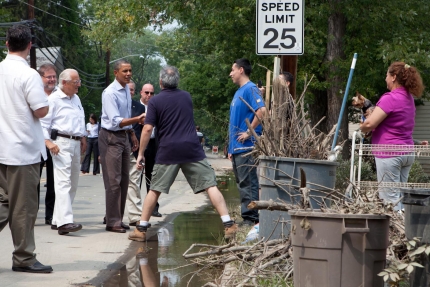
President Obama to Hurricane Irene Victims: The Entire Country is Behind You

Read the Transcript  |  Download Video: mp4 (31MB) | mp3 (3MB)

Today President Obama travelled to Wayne and Paterson, New Jersey to tour areas damaged by Hurricane Irene.  While visiting the Temple Street Bridge in Paterson, the President gave brief remarks reassuring the people of New Jersey and all those affected by Hurricane Irene that the federal, state and local governments would be there to help them rebuild after the devastating storm.  

The main message that I have for all the residents not only of New Jersey but all those communities that have been affected by flooding, by the destruction that occurred as a consequence of Hurricane Irene is that the entire country is behind you and we are going to make sure that we provide all the resources that are necessary in order to help these communities rebuild. 

And I know that there's been some talk about whether there's going to be a slowdown in getting funding out here, emergency relief.  As President of the United States, I want to make it very clear that we are going to meet our federal obligations -- because we're one country, and when one part of the country gets affected, whether it's a tornado in Joplin, Missouri, or a hurricane that affects the Eastern Seaboard, then we come together as one country and we make sure that everybody gets the help that they need.  And the last thing that the residents here of Paterson or the residents of Vermont or the residents of upstate New York need is Washington politics getting in the way of us making sure that we are doing what we can to help communities that have been badly affected.

So, again, I want to thank federal, state, local officials who have been working around the clock to respond to this crisis. We know it could have been worse but we should not underestimate the heartache that's going through a lot of these communities and affecting a lot of these families.  And we want to make sure that we're there to help, and I'm going to make sure that even after the cameras are gone and attention is somewhere else that FEMA and federal officials continue to work with our local officials to make sure we're doing the right thing.

President Barack Obama talks with residents in a neighborhood hit with flooding from Hurricane Irene in Wayne, N.J.

President Barack Obama talks with residents in a neighborhood hit with flooding from Hurricane Irene in Wayne, N.J., Sept. 4, 2011. (Official White House Photo by Chuck Kennedy)

President Barack Obama and New Jersey Gov. Chris Christie look at the swollen Passaic River from the Main Street Bridge in Paterson

President Barack Obama and New Jersey Gov. Chris Christie look at the swollen Passaic River from the Main Street Bridge in Paterson, N.J., Sept. 4,, 2011.(Official White House Photo by Pete Souza)

Related Topics: Missouri, New Jersey, New York, Vermont

The White House

Office of the Press Secretary

Remarks by the President

Temple Street Bridge

Paterson, New Jersey

1:44 P.M. EDT

THE PRESIDENT:  Well, obviously visiting Wayne, visiting Paterson, many of these surrounding communities, gives you a sense of the devastation that's taken place not only here in New Jersey but in upstate New York and Vermont and a whole range of states that were affected by Hurricane Irene.

I want to thank Governor Christie, Mayor Jones, the entire congressional delegation that has coordinated in an unprecedented way to try to deal with this crisis.  And part of what I think has helped to avert even worse tragedies and greater loss of life is because of the extraordinary responsiveness and farsighted thinking of state, local and federal personnel.  I'm very proud of the work that FEMA has done not only from our central agency but, more importantly, the folks locally here on the ground who have been coordinating with the emergency management teams here in New Jersey.

I want to thank the Red Cross for their extraordinary responsiveness.  We've seen a huge outpouring of volunteers; the private sector is getting involved in trying to do what they can to help the communities that have been hard hit.

The main message that I have for all the residents not only of New Jersey but all those communities that have been affected by flooding, by the destruction that occurred as a consequence of Hurricane Irene is that the entire country is behind you and we are going to make sure that we provide all the resources that are necessary in order to help these communities rebuild.

And I know that there's been some talk about whether there's going to be a slowdown in getting funding out here, emergency relief.  As President of the United States, I want to make it very clear that we are going to meet our federal obligations -- because we're one country, and when one part of the country gets affected, whether it's a tornado in Joplin, Missouri, or a hurricane that affects the Eastern Seaboard, then we come together as one country and we make sure that everybody gets the help that they need.  And the last thing that the residents here of Paterson or the residents of Vermont or the residents of upstate New York need is Washington politics getting in the way of us making sure that we are doing what we can to help communities that have been badly affected.

So, again, I want to thank federal, state, local officials who have been working around the clock to respond to this crisis. We know it could have been worse but we should not underestimate the heartache that's going through a lot of these communities and affecting a lot of these families.  And we want to make sure that we're there to help, and I'm going to make sure that even after the cameras are gone and attention is somewhere else that FEMA and federal officials continue to work with our local officials to make sure we're doing the right thing.

So, thank you, guys.

Q    Mr. President, Congressman Cantor has talked about offsetting budget cuts --

THE PRESIDENT:  We're going to make sure resources are here. All right?

END
1:46 P.M. EDT

President Obama Tours Hurricane Damage in Paterson

September 04, 2011 | 3:12 | Public Domain

President Obama travels to Paterson, New Jersey to tour areas damaged by Hurricane Irene and reassures residents affected by the hurricane that the federal, state and local governments will be there to help them rebuild.

Download mp4 (31MB) | mp3 (3MB)

Read the Transcript

Remarks by the President

Paterson, New Jersey

1:44 P.M. EDT

THE PRESIDENT:  Well, obviously visiting Wayne, visiting Paterson, many of these surrounding communities, gives you a sense of the devastation that's taken place not only here in New Jersey but in upstate New York and Vermont and a whole range of states that were affected by Hurricane Irene.

I want to thank Governor Christie, Mayor Jones, the entire congressional delegation that has coordinated in an unprecedented way to try to deal with this crisis.  And part of what I think has helped to avert even worse tragedies and greater loss of life is because of the extraordinary responsiveness and farsighted thinking of state, local and federal personnel.  I'm very proud of the work that FEMA has done not only from our central agency but, more importantly, the folks locally here on the ground who have been coordinating with the emergency management teams here in New Jersey.

I want to thank the Red Cross for their extraordinary responsiveness.  We've seen a huge outpouring of volunteers; the private sector is getting involved in trying to do what they can to help the communities that have been hard hit.

The main message that I have for all the residents not only of New Jersey but all those communities that have been affected by flooding, by the destruction that occurred as a consequence of Hurricane Irene is that the entire country is behind you and we are going to make sure that we provide all the resources that are necessary in order to help these communities rebuild.

And I know that there's been some talk about whether there's going to be a slowdown in getting funding out here, emergency relief.  As President of the United States, I want to make it very clear that we are going to meet our federal obligations -- because we're one country, and when one part of the country gets affected, whether it's a tornado in Joplin, Missouri, or a hurricane that affects the Eastern Seaboard, then we come together as one country and we make sure that everybody gets the help that they need.  And the last thing that the residents here of Paterson or the residents of Vermont or the residents of upstate New York need is Washington politics getting in the way of us making sure that we are doing what we can to help communities that have been badly affected.

So, again, I want to thank federal, state, local officials who have been working around the clock to respond to this crisis. We know it could have been worse but we should not underestimate the heartache that's going through a lot of these communities and affecting a lot of these families.  And we want to make sure that we're there to help, and I'm going to make sure that even after the cameras are gone and attention is somewhere else that FEMA and federal officials continue to work with our local officials to make sure we're doing the right thing.

So, thank you, guys.

Q    Mr. President, Congressman Cantor has talked about offsetting budget cuts --

THE PRESIDENT:  We're going to make sure resources are here. All right?

END
1:46 P.M. EDT

Close Transcript