The White House

Office of the Press Secretary

Remarks by the President at DNC Event in Philadelphia, Pennsylvania

Hyatt at the Bellevue, Philadelphia, Pennsylvania

5:25 P.M. EDT

        THE PRESIDENT:  Hello, Philly!  (Applause.)  Thank you.  Thank you, Philadelphia!  (Applause.)  It is good to be back -- (applause) -- good to be back in the great state of Pennsylvania. (Applause.)  Congratulations, Phillies fans.  (Applause.)  That is quite a rotation.  

        There are a couple of people I want to acknowledge.  First of all, you just heard from somebody who I consider just a dear, dear friend.  This is a guy who stood with me when nobody was sure whether I was going to win or not.  And he didn’t have to do it, but he was just a terrific, terrific supporter, a great friend.  He is a great senator.  Please give it up for Bob Casey. (Applause.)

        Two other outstanding members of your congressional delegation who have been with me and supportive of everything we've been trying to do -- I could not be prouder of the work they do on behalf of their constituents -- Congressman Brady and Congressman Fattah are here.  (Applause.)  Thank you.

        Your outstanding mayor, Mayor Nutter is in the house.  (Applause.)  And one of the great legislators in Congress who also happens to be a pretty good political mind, and that is why we are so proud to have her as the chairwoman of the DNC -- Debbie Wasserman Schultz.  Please give her a big round of applause.  (Applause.)

        Now, I see a lot of new faces out here.  And then I see a few faces I've known for a long time.  (Applause.)  Some of you who are here knew me before I had gray hair.  (Laughter.)  

        AUDIENCE MEMBER:  You're looking good, though!  (Applause.)

        THE PRESIDENT:  Well, thank you.  (Laughter.)  Malia and Sasha say that it makes me look distinguished.  (Laughter.)  Michelle says it just makes me look old.  (Laughter.)  No, she loves me, but she just says it makes me look old.  (Laughter.)  

        Now, being here with all of you, I can't help but think back to the election two and a half years ago, and that night in Grant Park.  It was the culmination of an extraordinary campaign that drew on the hard work and the support of people all across America.  Men and women -- and some children -- I did very well with the eight and under demographic.  (Laughter.)  Men and women who believed that change was possible, who believed that we didn’t have to accept politics as usual, who believed that we could have a country that once again lived up to its finest ideals and its highest aspirations.  And it was a beautiful night.  Everybody was feeling pretty good.

        But what I said that night -- some of you remember this -- I said this is not the end; this is just the beginning; that the road we were on was going to be difficult, that the climb was going to be steep.  We didn’t know how steep it was going to be. We didn’t realize the magnitude of the recession we were facing and the financial crisis.  We didn’t realize we had already lost 4 million jobs by the time I was sworn in.  But we knew it was going to be tough.  

        And that was okay -- because I did not run for President to do easy things.  I ran for President to do hard things.  (Applause.)  I ran for President because it was time to do big things.  (Applause.)  That we couldn’t keep kicking the can down the road anymore, too much was at stake, and that we had to get started tackling the tough issues that families face each and every day.  Even if it would take time -- (audience disruption.)

        THE PRESIDENT:  So -- listen --

        AUDIENCE:  We love you!

        THE PRESIDENT:  Thank you, guys.  (Applause.)  Now, let me tell you why I thought it was so important to run -- even though Michelle, she wasn’t so sure.  (Laughter.)  And why you guys got involved.  I just want everybody to remember.  We ran because we believed in an economy that didn’t just work for those at the top, but worked for everybody -- where prosperity was shared, from the machinist on the line, to the manager on the floor, to the CEO in the boardroom.  

        We ran because we believed our success isn’t just determined by stock prices and corporate profits, but by whether ordinary folks can find a good job that pays for a middle-class life -- where they can pay the mortgage, and take care of their kids, and send their kids to college, and save for retirement, and maybe have a little left over to go to a movie and go to dinner once in a while.  (Laughter and applause.)  

        We ran because for a decade, wages and incomes had flatlined, and costs kept on going up for everybody even though they didn’t have any more income.  That was before the economic crisis hit.  And obviously once the economic crisis did hit, we had to take a series of emergency steps to save this economy from collapse -- not because we wanted to help banks or make sure that the auto companies’ CEOs were making good bonuses, but we did it because we wanted to make sure that families who needed help could still take out a loan to buy a house or start a new business.  We wanted to make sure that the millions of people who depended on the auto industry, that they would still have jobs.  

        And so some of those decisions were tough.  And you remember, we got criticized a lot.  But you take a look at what’s happened.  Some folks didn’t want us getting involved in the auto industry -- I didn’t expect to be the CEO of a car company when I ran for President.  (Laughter.)  But as a consequence of what we did, we saved jobs.  We saved American manufacturing.  (Applause.)  We cut taxes for middle-class families.  We ended subsidies to the banks for student loans, to make college more affordable.  (Applause.)  We made sure -- that’s why I signed a bill to make sure there was equal pay for equal work, because I’ve got two daughters and I want to make sure they’re treated just the same as the boys are.  (Applause.)  That’s why we’re promoting manufacturing and homegrown American energy -- because that’s what will lead to jobs that pay a decent salary.  I want the wind turbines and the solar panels and the electric cars to be built right here in America.  (Applause.)

        That’s why, with the help of these outstanding members of Congress, we’re standing up a new consumer bureau with just one responsibility:  looking out for ordinary people in the financial system so folks aren’t cheated.  Whether you’re getting a credit card or getting a mortgage, you need to know that you’re getting a fair deal.  (Applause.)

        And that’s why we passed health reform, so that nobody in the richest nation on Earth goes bankrupt when they get sick.  (Applause.)  

        We also had a long campaign in 2008 because we believed it was time to end the war in Iraq.  And that’s what we’re doing.  We’ve removed 100,000 troops from Iraq.  We’ve ended combat missions.  We are on track to remove the rest of the troops, bring them home by the end of this year.  (Applause.)  

        I ran for President because I believed we needed to refocus our efforts and our energy in Afghanistan and going after al Qaeda.  And we are going after al Qaeda and we’ve taken out their leadership.  (Applause.)  And because of our progress and the extraordinary sacrifices of our troops, we are fulfilling the commitment I made at the start to reduce our troops, starting this month, so that Afghans can start taking responsibility for their own security -- (applause) -- and we can start rebuilding right here at home.  (Applause.)  It's time to start rebuilding here at home -- time for nation-building right here.

        We live in a world where America is facing stiff competition for good jobs from rapidly growing nations, like China and India and Brazil.  For a long time we were told the best way to win that competition is just to undermine consumer protections and undermine clean air laws and clean water laws and hand out tax breaks to millionaires and billionaires.  That was the idea that held sway for close to a decade.  And let's face it, it didn’t work out very well.  

        In fact, if you look at our history, you'll see that philosophy has never worked out very well -- where people are just asking, "What's in it for me?"  America was built on the hard work and ingenuity of our people and our businesses.  But we also set up a free system of public schools and a generation was sent to college on the G.I. Bill.  (Applause.)  And we constructed roads and highways that spanned a continent.  And through investments and research and technology, we sent a man to the moon.  And we discovered lifesaving medicine.  And we launched the information age and created the Internet and created millions of jobs along the way.  (Applause.)  That's how you build a strong nation.  That's how you build a strong middle class -- by making the investments that are needed and always looking out over the horizon.  (Applause.)

        So we believe in business and we believe in free markets.  But we also believe in making sure that every kid in this country has a chance.  (Applause.)  And we believe that our seniors deserve to retire with dignity and respect and have some semblance of security.  (Applause.)  And we believe in making investments in science and technology.  (Applause.)  And we believe in having the best infrastructure in the world.  And so the same things that worked for us in the past, that's what we need to be doing today.

        There's an important debate in Washington right now about how to cut the deficit.  And let me say it is absolutely critical that we get a handle on our finances.  We've spent a lot of money that we don't have.  And we've made a lot of commitments that are going to be hard to keep if we do nothing.  And like families all across America, government has to live within its means.  

        So I'm prepared to bring our deficit down by trillions of dollars.  That's with a "t" -- trillions.  (Laughter.)  But I will not reduce our deficit by sacrificing our kids' education. (Applause.)  I'm not going to reduce our deficit by eliminating medical research being done by our scientists.  (Applause.)  I won't sacrifice rebuilding our roads and our bridges and our railways and our airports -- I want Philadelphia to have the best, not the worst.      

        Not just roads and bridges and sewer mains and water systems; I want us to have the best broadband -- (applause) -- the best electric grid.  I’m not going to sacrifice clean energy at a time when our dependence on foreign oil is causing so many Americans pain at the pump.  (Applause.)  That’s sacrificing America’s future.

        And that’s what I want to say to all of you, Philadelphia.  There’s more than one way to mortgage our future.  It would be irresponsible, we would be mortgaging our future, if we don’t do anything about the deficit.  But we will also be mortgaging our future and it will be irresponsible if, in the process of reducing our deficit, we sacrifice those very things that allow us to grow and create jobs and succeed and compete in the future.

        What makes America great is not just the height of our skyscrapers or the might of our military or the size of our GDP. What makes us great is the character of our people.  (Applause.) And we are rugged individualists -- that’s part of what makes us American; we like to make up our own minds and we don’t like other people to tell us what to do.  But what also makes us who we are is our faith in the future and our recognition that our future is shared.  

        It’s the belief I am my brother’s keeper and my sister’s keeper; that my life is richer and our country is stronger when everybody participates and everybody has a measure of security and everybody has got a fair shot at the American Dream.  (Applause.)  That’s our vision for America.  Not a vision of a small America, but a vision of a big America and a compassionate America and an optimistic America, and a bold America.  And that’s what we’re fighting for.  (Applause.)  

        And the good news is that America is possible -- an America where we’re living within our means, but we’re still investing in the future.  That’s possible.  Where everybody is making sacrifices, but nobody bears all the burden by themselves.  The idea that no matter what we look like or who we are, no matter whether our ancestors came from Ellis Island or on a slave ship, or across the Rio Grande, that we are all connected to one another, and that we rise and fall together.  (Applause.)  

        That’s the idea at the heart of America.  That’s the idea at the heart of our last campaign.  That’s the idea at the heart of this campaign.  That’s why I’m going to need your help more than ever.  (Applause.)

        This campaign is at its early stages.  I’ve got a day job.  I’ve got other things to do.  (Laughter.)  But while I’m working, there are going to be candidates parading around the country.  (Laughter and applause.)  And they’re going to do what they do, which is they’re going to attack -- here in Philadelphia, they’re going to attack.  They won’t have a plan -- (laughter) -- but they will attack.  And I understand that; that’s politics as we’ve come to know it.

        But what I also understand is, is the American people are a lot less interested in us attacking each other; they’re more interested in us attacking the country’s problems.  (Applause.)  They’re less interested in hearing us exchange insults about the past; they want us to exchange ideas about the future.  (Applause.)  That’s the contest I’m looking forward to, because I know that’s the contest that America needs.  And by the way, that’s the contest that we will win.  (Applause.)

        And, Philadelphia, I know there are some of you who are frustrated because we haven’t gotten everything done that we said we were going to do in two and a half years.  It’s only been two and a half years.  I got five and a half years more to go.  (Applause.)  And there are -- look, there are times where I feel frustrated.  But we knew this wasn’t going to be easy.  We knew a journey like this one, there were going to be setbacks, like there were setbacks during the first campaign.  There are going to be times where we stumble, just we stumbled sometimes during the first campaign.

        But we also knew that at each and every juncture in our history when our future was on the line -- (audience interruption.)

        AUDIENCE:  Obama!  Obama!  Obama!  Obama!  Obama!  (Applause.)  

        THE PRESIDENT:  What we also knew was that whenever the country has been at a crossroads, we’ve always come together to keep the American Dream alive for the next generation.  And now is the time for us to do it again.  Now is the time to finish what we started and keep the dream alive.  

        And I just to want to remind everybody here, this campaign is not about me.  It’s about us.  (Applause.)  It’s about students who are working their way through college, workers heading to factories to build American cars again, small business owners testing new ideas, construction crews laying down roads, families who faced hardship and setbacks but who haven’t stopped believing in this country, and who believe that we can emerge from this challenge stronger than before.  

        That’s the story of progress in America -- the stubborn refusal to accept anything less than the best that this country can be.  And with your help, if you’re willing to keep fighting with me, if you’re willing to knock on doors with me, if you are going to get as much energy going as you got in 2008, then together we are going to write another chapter in that story and leave a new generation a brighter future.

        God bless you, Philadelphia.  God bless you, Pennsylvania.  Yes, we can.  May God bless you, and God bless America.  (Applause.)  

END 5:46 P.M. EDT

The White House

Office of the Press Secretary

Presidential Nominations Sent to the Senate

NOMINATIONS SENT TO THE SENATE:

Deborah A. P. Hersman, of Virginia, to be Chairman of the National Transportation Safety Board for a term of two years.(Reappointment)

Thomas Charles Krajeski, of Virginia, a Career Member of the Senior Foreign Service, Class of Minister-Counselor, to be Ambassador Extraordinary and Plenipotentiary of the United States of America to the Kingdom of Bahrain.

Robert A. Mandell, of Florida, to be Ambassador Extraordinary and Plenipotentiary of the United States of America to Luxembourg.

Armed Services Farewell Tribute for Secretary Gates

June 30, 2011 | 29:17 | Public Domain

President Obama praises Secretary Robert Gates as he steps down as Secretary of Defense in a farewell tribute at the Pentagon.

Download mp4 (280MB) | mp3 (27MB)

Read the Transcript

Remarks by the President and Secretary Gates at Armed Services Farewell Tribute in Honor of Secretary Gates

10:09 A.M. EDT

        THE PRESIDENT:  Thank you very much.  Admiral Mullen, thank you for your eloquent words, but also for your extraordinary service.  As you near a well-deserved retirement, thank you for four decades of incredible service -- to you and Deborah.  

        Members of Congress, Vice President Biden, Deputy Secretary Lynn, members of the Joint Chiefs of Staff, service secretaries and distinguished guests, men and women of the finest military in the world, and, most of all, Secretary Gates, Becky, Brad, and although she could not be here, I also want to acknowledge your daughter Eleanor.

        When I took office, Bob Gates had already served under seven Presidents during an illustrious career that spanned four decades.  He would have been forgiven if he had opted for a private life of comfort and ease.  He had earned it.  And when asked by a reporter whether he might stay on to serve an eighth President, he offered the answer -- “inconceivable.”  (Laughter.)  
        Why did he stay?  I know there are days when Bob asked that himself.  I’m sure Becky asked that also.  But I believe I know the answer, because I’ve seen this man in those moments of debate and decision when a person’s character is revealed —- in the Oval Office, in the Situation Room, in the theaters of war.

        You see, if you look past all of Bob’s flashiness and bravado -- (laughter) -- and his sharp attire, his love for the Washington limelight -- (laughter) -- then what you see is a man that I’ve come to know and respect —- a humble American patriot; a man of common sense and decency; quite simply, one of our nation’s finest public servants.  

        Bob, today you’re not only one of the longest-serving Secretaries of Defense in American history, but it is also clear that you’ve been one of the best.

        Why did Bob Gates serve?  Our nation is at war, and to know Bob is to know his profound sense of duty -- to country, to our security, and most of all, to our men and women who get up every day and put on America’s uniform and put their lives on the line to keep us safe and to keep us free.  

        When the outcome of the war in Iraq was in doubt, Bob Gates presided over the extraordinary efforts that helped restore order.  Over the past two and a half years, we've removed more than 100,000 troops from Iraq, ended our combat mission and are responsibly ending that war.

        When the fight against al Qaeda and our efforts in Afghanistan needed new focus, Bob Gates helped us devise the strategy that has finally put al Qaeda on a path to defeat and ensures that Afghanistan never again becomes a source for attacks against our nation.

        When institutional inertia kept funding systems our troops didn’t need, Bob Gates launched a war on waste -- challenging conventional wisdom with courage and conviction, speaking hard truths and saving hundreds of billions of dollars that can be invested in a 21st century military.

        Bob Gates made it his mission to make sure this department is serving our troops in the field as well as they serve us.  And today we see the lifesaving difference he made -- in the mine-resistant vehicles and the unmanned aircraft, the shorter medevac times in Afghanistan, in our determination to give our wounded warriors the world-class care they deserve.  

        Bob, this may be your greatest legacy of all -- the lives you saved and the confidence you gave our men and woman in battle who knew that there was a Secretary of Defense who had their backs and who loved them and who fought for them and who did everything in his power to bring them home safe.  

        Let me also thank Becky for her extraordinary support of our extraordinary military families.  She’s been there day in and day out.  And in may ways, I know both Bob and Becky consider our troops to be like their own sons and daughters.  And, Bob, your sense of responsibility to them is profound.  

        It’s a responsibility we’ve shared, as leaders who have served every day in a time of war.  We’re the ones who send them into harm’s way.  We visit them in the field, knowing that we are the reason they're there.  We’ve stood in solemn respect at Dover when our fallen heroes have made their final journey home.  We’ve held their families in our arms as they grieve the loved ones they gave to America so that our loved ones can be secure.  We know the heavy wages of war, and we know America’s shared obligations to all who serve.      

        So today we not only pay tribute to a remarkable public servant; we celebrate the principles for which he served and for which our nation stands.  I believe the life of Bob Gates is a lesson, especially to young Americans, a lesson that public service is an honorable calling; that we can pass our country, better and stronger, to those who follow.  

        Our next Secretary of Defense, Leon Panetta, has subscribed to this same life of service, and I'm confident that he, too, will lead this department with clear vision and a steady hand.

        In his willingness to become the first Secretary of Defense to serve under Presidents of both parties, the integrity of Bob Gates is also a reminder, especially to folks here in Washington, that civility and respectful discourse, and citizenship over partisanship are not quaint relics of a bygone era; they are the timeless virtues that we need now more than ever.  For whatever differences of party or ideology we may have, we can only keep America strong if we remember what keeps America great -- our ability to come together and work together, as Americans, for a common purpose.

        Finally, as we face difficult challenges around the world and here at home, let today be a reminder that the United States will meet the tests of our time.  We remain at war, but today fewer Americans are in harm’s way, and we will bring the wars we’re in to a responsible end.  We will make hard fiscal choices, but we’ll do so responsibly.  And as Commander-in-Chief I am determined that our Armed Forces will always -- always -- remain the best-trained, the best-led, the best-equipped fighting force in history.  And in an uncertain world that demands our leadership, the United States of America, and our Armed Forces, will remain the greatest force for freedom and security that the world has ever known.    

        This is the America -- strong and confident -- to which Bob Gates has devoted his life.  And this is the America to which we rededicate ourselves.  

        I can think of no better way to express my appreciation to someone who I have come to admire and who I consider a friend, I can think of no better way to express the gratitude of the nation for Bob Gates, than with a very special recognition.  

        Bob, this is not in the program, but I would ask you to please stand.  

        As President, the highest honor that I can bestow on a civilian is the Presidential Medal of Freedom.  It speaks to the values we cherish as a people and the ideals we strive for as a nation.  And today it is my great privilege to present the Presidential Medal of Freedom to America’s 22nd Secretary of Defense, Robert M. Gates.  

        Will the military aide please read the citation.

        MILITARY AIDE:  The Presidential Medal of Freedom to Robert M. Gates.  

        Our nation’s 22nd Secretary of Defense, Robert M. Gates, has selflessly dedicated his life to ensuring the security of the American people.  He has served eight Presidents of both parties with unwavering patriotism.  As a champion of our men and women in uniform and their families, he has led the Department of Defense with courage and confidence during our nation’s wars in Iraq and Afghanistan, and ensured our Armed Forces are better prepared for the conflicts of today and tomorrow.  The United States honors Robert M. Gates for his extraordinary leadership and for a lifetime of service and devotion to our nation.

        (The Presidential Medal of Freedom is presented.)  (Applause.)  

        SECRETARY GATES:  Thank you, Mr. President, for those kind words and for honoring me and this department by your presence here today.  I'm deeply honored and moved by your presentation of this award.  It is a big surprise.  But we should have known a couple of months ago; you’re getting pretty good at this covert ops stuff.  (Laughter.)  

        Mr. Vice President, distinguished guests, colleagues, friends, thank you for being here this morning.

        First, I’d like to congratulate Leon Panetta on his recent confirmation.  Right after the 2008 election, Leon wrote an op-ed suggesting President-elect Obama retain me as Secretary of Defense.  So when President Obama asked for my recommendation for a successor, I returned the favor.  (Laughter.)  

        Seriously, this department and this country is fortunate that a statesman of Leon Panetta’s caliber and experience has agreed to serve once again, and at such an important time.  My parting advice for Leon is to get his office just the way he likes it -- he may be here longer than he thinks.  

        I’d like to thank the members of Congress with us today.  I appreciate the gracious and supportive treatment accorded to me by senators and representatives of both parties these past four and a half years.  Even when there were disagreements over policies and priorities, the Congress always came through for our men and women in uniform, especially for programs that protect and take care of troops and their families.

        As you may have noticed over the past few weeks, I’ve had my say on some weighty topics.  So on this, the last stop of what has been dubbed “the long goodbye,” I’d like to spend just a few minutes talking about the men and women that I’ve been fortunate to work with in this job.

        I’d like to start with the two Presidents whom I’ve been privileged to serve in this role.  Serving as Secretary of Defense has been the greatest honor and privilege of my life, and for that I will always be grateful.  First, to President Bush for giving me this historic opportunity and for the support he provided during those difficult early months and years on the job.  And then to President Obama for his confidence in taking the historic step of asking me, someone he did not know at all, to stay on, and for his continuing trust ever since.

        The transition from the Bush to the Obama administration was the first of its kind from one political party to another during war in nearly 40 years.  The collegiality, thoroughness, and professionalism of the Bush-Obama transition were of great benefit to the country, and were a tribute to the character and judgment of both Presidents.

        I’ve also been fortunate that both Presidents provided me an excellent team of senior civilian appointees.  When I took this post, the first and best decision I made was to retain every single senior official I inherited from Secretary Rumsfeld, including his personal front office staff, most of whom have been with me to this day.

        Likewise, I’ve been fortunate to receive another first-class roster of senior civilian officials from President Obama.  They've provided me superb counsel and support on a range of difficult institutional issues and strategic initiatives.  

        These and other achievements, indeed anything of consequence achieved in this department, required respectful collaboration between the civilian and military leadership, which has been a source of strength to the country.  I've received wise, forthright, but loyal counsel from the service chiefs and from the leadership of the Joint Staff.  And I’ll always be grateful to them for their candor, cooperation, and friendship.

        Above all, though, I want to recognize and thank first, General Pete Pace, who was Chairman of the Joint Chiefs when I arrived, and whose counsel and friendship got me off to a strong start; and then, of course, my battle buddy of nearly four years, Admiral Mike Mullen.  Without Mike’s advice to me, his effective leadership of the uniform military and our close partnership, the record of the last several years would, I think, have been very different.

        Mike was never shy about disagreeing with me but unfailingly steadfast and loyal to me and to the Presidents he served once a decision was made.  He is the epitome of a military leader and officer, a man of supreme integrity, a great partner, and a good friend.

        A practice in spirit of cooperation is equally important for relationships with other elements of the government, especially those dealing with intelligence, development, and diplomacy.  The blows struck against al Qaeda, culminating in the bin Laden raid, exemplified a remarkable transformation of how we must fuse intelligence and military operations in the 21st century.

        With respect to the State Department, my views have, as they say in this town, evolved over the years.  I started out my inter-agency experience in Washington, D.C. as a staffer on President Nixon's National Security Council.  As you might expect, the Nixon White House was not exactly a hotbed of admiration for the foreign service -- generally thought of as a bunch of guys with last names for first names who occasionally took time out of their busy day to implement the President's foreign policy.  And for much of my professional life, the Secretaries of State and Defense were barely speaking to one another.  

        In the case of Secretaries Rice and Clinton, I've not only been on speaking terms with these two formidable women, we've also become cherished colleagues and good friends.  I suppose that giving a big speech calling for more money for the State Department didn’t exactly hurt.  (Laughter.)  But we should never forget the diplomats and development experts from State and AID are taking risks and making sacrifices in some of the planet's least hospitable places.  And I speak for all our military in appreciating the contributions they are making every day to the success of our missions in Afghanistan, Iraq, and elsewhere around the globe.

        In doing my utmost to support the troops downrange on these missions, I've spent a good deal of time venting frustration with the Pentagon bureaucracy.  However, I did so knowing that the people most often frustrated by the pace of things in this building are the career civilian professionals who strive every day to overcome the obstacles to getting things done.  As someone who worked his way up through the GS ladder, I understand and appreciate the challenges these public servants face and the sacrifices they make.  What they accomplish does not receive the attention and the thanks it deserves.  So know that I leave this post grateful for everything our defense civilians do for our military and our national security.

        During a time of war, the top priority of everyone in this building ultimately must be to get those fighting at the front what they need to survive and succeed on the battlefield and to be properly taken care of when they come home.  I've spent much of the past two months visiting with these troops -- first, in military facilities around the U.S., and then over several days at a number of forward-operating bases in Afghanistan.  Though I was only able to meet a small sample of those who deployed downrange, it was important to me to look them in the eye one last time and let them know how much I care about them and appreciate what they and their families do for our country.

        Looking forward to this moment, I knew it would be very difficult for me to adequately express my feelings for these young men and women -- at least in a way that would allow me to get through this speech.  So, yesterday, a personal message from me to all of our servicemen and women around the world was published and distributed through military channels.  I'll just say here that I will think of these young warriors -- the ones who fought, the ones who keep on fighting, the ones who never made it back -- till the end of my days.

        Finally, as I was contemplating this moment, I thought about something Becky told me in January 2005, when I was asked to be the first director of national intelligence.  I was really wrestling with the decision and finally told her she could make it a lot easier if she just said she didn’t want to go back to D.C.  She thought a moment, and replied, "We have to do what you have to do."

        That is something military spouses have said in one form or another a million times since 9/11 upon learning that their loved one received a deployment notice or is considering another tour of service.  Just under five years ago, when I was approached by the same President again to serve, Becky’s response was the same. As much as she loved Texas A&M and Aggie sports and our home in Washington State, and as much as she could do without another stint in this Washington, she made it easy for me to say yes to this job -- to do what I had to do, to answer the call to serve when so much was at stake for America and her sons and daughters in two wars.

        Well, Becky, we’re really going home this time.  Your love and support has sustained me and kept me grounded since the day we first met on a blind date in Bloomington, Indiana, 45 years ago.  

        Shortly I’ll walk out of my office in the E ring for the last time as Defense Secretary.  It’s empty of all my personal items and mementos, but will still have looming over my desk the portraits of two of my heroes and role models -- Generals Dwight D. Eisenhower and George C. Marshall.  

        It is from Marshall that I take a closing thought, first delivered more than six decades ago in the opening years of the Cold War.  Addressing new university graduates, Marshall extolled what he considered the great “musts” of that generation.  They were, he said, "the development of a sense of responsibility for world order and security, the development of a sense of the overwhelming importance of the country’s acts and failures to act."  

        Now, as when Marshall first uttered those words, a sense of America’s exceptional global responsibilities and the importance of what we do or do not do remain the great "musts" of this dangerous new century.  It is the sacred duty entrusted to all of us privileged to serve in positions of leadership and responsibility; a duty we should never forget or take lightly; a duty I have every confidence you will all continue to fulfill.

        Thank you.  God bless our military and the country they so nobly serve.  (Applause.)  

END 10:33 A.M. EDT

Close Transcript

#AskObama at the First Ever Twitter @Townhall at the White House

The White House is all a-Twitter about an exciting event that's happening next week. On Wednesday, July 6th at 2pm ET, President Obama will answer your questions in the first ever Twitter Town Hall at the White House, and you're invited. Starting today, you can tweet your questions about jobs and the economy using the hashtag #AskObama and follow @townhall for the latest updates. Then, come back to watch the President respond to your questions in a live event moderated by Jack Dorsey, Twitter co-founder and Executive Chairman.

Today, we're also kicking off White House Tweetups (h/t NASA). For our first Tweetup, a portion of the town hall’s live audience will be drawn from people who follow @whitehouse and register online. We look forward to hosting future Tweetups that will give @whitehouse followers the opportunity to attend events, engage with Administration officials, and share their ideas with other @whitehouse followers. Visit WhiteHouse.gov/tweetup to sign up and learn more. (Ed. Note: Registration for the Tweetup has closed.)

The White House uses Twitter to share breaking news, provide updates and engage with the people across the country. Join the 2.25 million @whitehouse followers, and be sure to check out our other official accounts:

Related Topics: Economy

President Obama Honors Secretary Gates

Watch the President's full remarks here.

This morning, President Obama and Vice President Biden travelled to the Pentagon to attend the Armed Services farewell tribute in honor of Defense Secretary Robert Gates, one of the longest serving Secretaries of Defense in U.S. history. The President also presented Secretary Gates with the Medal of Freedom – the highest honor the President can bestow on a civilian.

During his remarks at the ceremony, President Obama reflected on Secretary Gates long history of public service – serving under eight different Presidents – and on his commitment to serving our troops as well as they serve us:

Related Topics: Defense, Virginia

The White House

Office of the Press Secretary

Remarks by the President and Secretary Gates at Armed Services Farewell Tribute in Honor of Secretary Gates

Pentagon

10:09 A.M. EDT

        THE PRESIDENT:  Thank you very much.  Admiral Mullen, thank you for your eloquent words, but also for your extraordinary service.  As you near a well-deserved retirement, thank you for four decades of incredible service -- to you and Deborah.  

        Members of Congress, Vice President Biden, Deputy Secretary Lynn, members of the Joint Chiefs of Staff, service secretaries and distinguished guests, men and women of the finest military in the world, and, most of all, Secretary Gates, Becky, Brad, and although she could not be here, I also want to acknowledge your daughter Eleanor.

        When I took office, Bob Gates had already served under seven Presidents during an illustrious career that spanned four decades.  He would have been forgiven if he had opted for a private life of comfort and ease.  He had earned it.  And when asked by a reporter whether he might stay on to serve an eighth President, he offered the answer -- “inconceivable.”  (Laughter.)  
        Why did he stay?  I know there are days when Bob asked that himself.  I’m sure Becky asked that also.  But I believe I know the answer, because I’ve seen this man in those moments of debate and decision when a person’s character is revealed —- in the Oval Office, in the Situation Room, in the theaters of war.

        You see, if you look past all of Bob’s flashiness and bravado -- (laughter) -- and his sharp attire, his love for the Washington limelight -- (laughter) -- then what you see is a man that I’ve come to know and respect —- a humble American patriot; a man of common sense and decency; quite simply, one of our nation’s finest public servants.  

        Bob, today you’re not only one of the longest-serving Secretaries of Defense in American history, but it is also clear that you’ve been one of the best.

        Why did Bob Gates serve?  Our nation is at war, and to know Bob is to know his profound sense of duty -- to country, to our security, and most of all, to our men and women who get up every day and put on America’s uniform and put their lives on the line to keep us safe and to keep us free.  

        When the outcome of the war in Iraq was in doubt, Bob Gates presided over the extraordinary efforts that helped restore order.  Over the past two and a half years, we've removed more than 100,000 troops from Iraq, ended our combat mission and are responsibly ending that war.

        When the fight against al Qaeda and our efforts in Afghanistan needed new focus, Bob Gates helped us devise the strategy that has finally put al Qaeda on a path to defeat and ensures that Afghanistan never again becomes a source for attacks against our nation.

        When institutional inertia kept funding systems our troops didn’t need, Bob Gates launched a war on waste -- challenging conventional wisdom with courage and conviction, speaking hard truths and saving hundreds of billions of dollars that can be invested in a 21st century military.

        Bob Gates made it his mission to make sure this department is serving our troops in the field as well as they serve us.  And today we see the lifesaving difference he made -- in the mine-resistant vehicles and the unmanned aircraft, the shorter medevac times in Afghanistan, in our determination to give our wounded warriors the world-class care they deserve.  

        Bob, this may be your greatest legacy of all -- the lives you saved and the confidence you gave our men and woman in battle who knew that there was a Secretary of Defense who had their backs and who loved them and who fought for them and who did everything in his power to bring them home safe.  

        Let me also thank Becky for her extraordinary support of our extraordinary military families.  She’s been there day in and day out.  And in may ways, I know both Bob and Becky consider our troops to be like their own sons and daughters.  And, Bob, your sense of responsibility to them is profound.  

        It’s a responsibility we’ve shared, as leaders who have served every day in a time of war.  We’re the ones who send them into harm’s way.  We visit them in the field, knowing that we are the reason they're there.  We’ve stood in solemn respect at Dover when our fallen heroes have made their final journey home.  We’ve held their families in our arms as they grieve the loved ones they gave to America so that our loved ones can be secure.  We know the heavy wages of war, and we know America’s shared obligations to all who serve.      

        So today we not only pay tribute to a remarkable public servant; we celebrate the principles for which he served and for which our nation stands.  I believe the life of Bob Gates is a lesson, especially to young Americans, a lesson that public service is an honorable calling; that we can pass our country, better and stronger, to those who follow.  

        Our next Secretary of Defense, Leon Panetta, has subscribed to this same life of service, and I'm confident that he, too, will lead this department with clear vision and a steady hand.

        In his willingness to become the first Secretary of Defense to serve under Presidents of both parties, the integrity of Bob Gates is also a reminder, especially to folks here in Washington, that civility and respectful discourse, and citizenship over partisanship are not quaint relics of a bygone era; they are the timeless virtues that we need now more than ever.  For whatever differences of party or ideology we may have, we can only keep America strong if we remember what keeps America great -- our ability to come together and work together, as Americans, for a common purpose.

        Finally, as we face difficult challenges around the world and here at home, let today be a reminder that the United States will meet the tests of our time.  We remain at war, but today fewer Americans are in harm’s way, and we will bring the wars we’re in to a responsible end.  We will make hard fiscal choices, but we’ll do so responsibly.  And as Commander-in-Chief I am determined that our Armed Forces will always -- always -- remain the best-trained, the best-led, the best-equipped fighting force in history.  And in an uncertain world that demands our leadership, the United States of America, and our Armed Forces, will remain the greatest force for freedom and security that the world has ever known.    

        This is the America -- strong and confident -- to which Bob Gates has devoted his life.  And this is the America to which we rededicate ourselves.  

        I can think of no better way to express my appreciation to someone who I have come to admire and who I consider a friend, I can think of no better way to express the gratitude of the nation for Bob Gates, than with a very special recognition.  

        Bob, this is not in the program, but I would ask you to please stand.  

        As President, the highest honor that I can bestow on a civilian is the Presidential Medal of Freedom.  It speaks to the values we cherish as a people and the ideals we strive for as a nation.  And today it is my great privilege to present the Presidential Medal of Freedom to America’s 22nd Secretary of Defense, Robert M. Gates.  

        Will the military aide please read the citation.

        MILITARY AIDE:  The Presidential Medal of Freedom to Robert M. Gates.  

        Our nation’s 22nd Secretary of Defense, Robert M. Gates, has selflessly dedicated his life to ensuring the security of the American people.  He has served eight Presidents of both parties with unwavering patriotism.  As a champion of our men and women in uniform and their families, he has led the Department of Defense with courage and confidence during our nation’s wars in Iraq and Afghanistan, and ensured our Armed Forces are better prepared for the conflicts of today and tomorrow.  The United States honors Robert M. Gates for his extraordinary leadership and for a lifetime of service and devotion to our nation.

        (The Presidential Medal of Freedom is presented.)  (Applause.)  

        SECRETARY GATES:  Thank you, Mr. President, for those kind words and for honoring me and this department by your presence here today.  I'm deeply honored and moved by your presentation of this award.  It is a big surprise.  But we should have known a couple of months ago; you’re getting pretty good at this covert ops stuff.  (Laughter.)  

        Mr. Vice President, distinguished guests, colleagues, friends, thank you for being here this morning.

        First, I’d like to congratulate Leon Panetta on his recent confirmation.  Right after the 2008 election, Leon wrote an op-ed suggesting President-elect Obama retain me as Secretary of Defense.  So when President Obama asked for my recommendation for a successor, I returned the favor.  (Laughter.)  

        Seriously, this department and this country is fortunate that a statesman of Leon Panetta’s caliber and experience has agreed to serve once again, and at such an important time.  My parting advice for Leon is to get his office just the way he likes it -- he may be here longer than he thinks.  

        I’d like to thank the members of Congress with us today.  I appreciate the gracious and supportive treatment accorded to me by senators and representatives of both parties these past four and a half years.  Even when there were disagreements over policies and priorities, the Congress always came through for our men and women in uniform, especially for programs that protect and take care of troops and their families.

        As you may have noticed over the past few weeks, I’ve had my say on some weighty topics.  So on this, the last stop of what has been dubbed “the long goodbye,” I’d like to spend just a few minutes talking about the men and women that I’ve been fortunate to work with in this job.

        I’d like to start with the two Presidents whom I’ve been privileged to serve in this role.  Serving as Secretary of Defense has been the greatest honor and privilege of my life, and for that I will always be grateful.  First, to President Bush for giving me this historic opportunity and for the support he provided during those difficult early months and years on the job.  And then to President Obama for his confidence in taking the historic step of asking me, someone he did not know at all, to stay on, and for his continuing trust ever since.

        The transition from the Bush to the Obama administration was the first of its kind from one political party to another during war in nearly 40 years.  The collegiality, thoroughness, and professionalism of the Bush-Obama transition were of great benefit to the country, and were a tribute to the character and judgment of both Presidents.

        I’ve also been fortunate that both Presidents provided me an excellent team of senior civilian appointees.  When I took this post, the first and best decision I made was to retain every single senior official I inherited from Secretary Rumsfeld, including his personal front office staff, most of whom have been with me to this day.

        Likewise, I’ve been fortunate to receive another first-class roster of senior civilian officials from President Obama.  They've provided me superb counsel and support on a range of difficult institutional issues and strategic initiatives.  

        These and other achievements, indeed anything of consequence achieved in this department, required respectful collaboration between the civilian and military leadership, which has been a source of strength to the country.  I've received wise, forthright, but loyal counsel from the service chiefs and from the leadership of the Joint Staff.  And I’ll always be grateful to them for their candor, cooperation, and friendship.

        Above all, though, I want to recognize and thank first, General Pete Pace, who was Chairman of the Joint Chiefs when I arrived, and whose counsel and friendship got me off to a strong start; and then, of course, my battle buddy of nearly four years, Admiral Mike Mullen.  Without Mike’s advice to me, his effective leadership of the uniform military and our close partnership, the record of the last several years would, I think, have been very different.

        Mike was never shy about disagreeing with me but unfailingly steadfast and loyal to me and to the Presidents he served once a decision was made.  He is the epitome of a military leader and officer, a man of supreme integrity, a great partner, and a good friend.

        A practice in spirit of cooperation is equally important for relationships with other elements of the government, especially those dealing with intelligence, development, and diplomacy.  The blows struck against al Qaeda, culminating in the bin Laden raid, exemplified a remarkable transformation of how we must fuse intelligence and military operations in the 21st century.

        With respect to the State Department, my views have, as they say in this town, evolved over the years.  I started out my inter-agency experience in Washington, D.C. as a staffer on President Nixon's National Security Council.  As you might expect, the Nixon White House was not exactly a hotbed of admiration for the foreign service -- generally thought of as a bunch of guys with last names for first names who occasionally took time out of their busy day to implement the President's foreign policy.  And for much of my professional life, the Secretaries of State and Defense were barely speaking to one another.  

        In the case of Secretaries Rice and Clinton, I've not only been on speaking terms with these two formidable women, we've also become cherished colleagues and good friends.  I suppose that giving a big speech calling for more money for the State Department didn’t exactly hurt.  (Laughter.)  But we should never forget the diplomats and development experts from State and AID are taking risks and making sacrifices in some of the planet's least hospitable places.  And I speak for all our military in appreciating the contributions they are making every day to the success of our missions in Afghanistan, Iraq, and elsewhere around the globe.

        In doing my utmost to support the troops downrange on these missions, I've spent a good deal of time venting frustration with the Pentagon bureaucracy.  However, I did so knowing that the people most often frustrated by the pace of things in this building are the career civilian professionals who strive every day to overcome the obstacles to getting things done.  As someone who worked his way up through the GS ladder, I understand and appreciate the challenges these public servants face and the sacrifices they make.  What they accomplish does not receive the attention and the thanks it deserves.  So know that I leave this post grateful for everything our defense civilians do for our military and our national security.

        During a time of war, the top priority of everyone in this building ultimately must be to get those fighting at the front what they need to survive and succeed on the battlefield and to be properly taken care of when they come home.  I've spent much of the past two months visiting with these troops -- first, in military facilities around the U.S., and then over several days at a number of forward-operating bases in Afghanistan.  Though I was only able to meet a small sample of those who deployed downrange, it was important to me to look them in the eye one last time and let them know how much I care about them and appreciate what they and their families do for our country.

        Looking forward to this moment, I knew it would be very difficult for me to adequately express my feelings for these young men and women -- at least in a way that would allow me to get through this speech.  So, yesterday, a personal message from me to all of our servicemen and women around the world was published and distributed through military channels.  I'll just say here that I will think of these young warriors -- the ones who fought, the ones who keep on fighting, the ones who never made it back -- till the end of my days.

        Finally, as I was contemplating this moment, I thought about something Becky told me in January 2005, when I was asked to be the first director of national intelligence.  I was really wrestling with the decision and finally told her she could make it a lot easier if she just said she didn’t want to go back to D.C.  She thought a moment, and replied, "We have to do what you have to do."

        That is something military spouses have said in one form or another a million times since 9/11 upon learning that their loved one received a deployment notice or is considering another tour of service.  Just under five years ago, when I was approached by the same President again to serve, Becky’s response was the same. As much as she loved Texas A&M and Aggie sports and our home in Washington State, and as much as she could do without another stint in this Washington, she made it easy for me to say yes to this job -- to do what I had to do, to answer the call to serve when so much was at stake for America and her sons and daughters in two wars.

        Well, Becky, we’re really going home this time.  Your love and support has sustained me and kept me grounded since the day we first met on a blind date in Bloomington, Indiana, 45 years ago.  

        Shortly I’ll walk out of my office in the E ring for the last time as Defense Secretary.  It’s empty of all my personal items and mementos, but will still have looming over my desk the portraits of two of my heroes and role models -- Generals Dwight D. Eisenhower and George C. Marshall.  

        It is from Marshall that I take a closing thought, first delivered more than six decades ago in the opening years of the Cold War.  Addressing new university graduates, Marshall extolled what he considered the great “musts” of that generation.  They were, he said, "the development of a sense of responsibility for world order and security, the development of a sense of the overwhelming importance of the country’s acts and failures to act."  

        Now, as when Marshall first uttered those words, a sense of America’s exceptional global responsibilities and the importance of what we do or do not do remain the great "musts" of this dangerous new century.  It is the sacred duty entrusted to all of us privileged to serve in positions of leadership and responsibility; a duty we should never forget or take lightly; a duty I have every confidence you will all continue to fulfill.

        Thank you.  God bless our military and the country they so nobly serve.  (Applause.)  

END 10:33 A.M. EDT

WNBA Champion Seattle Storm Visits White House, Shoots Hoops with Local Kids

Read the Transcript  |  Download Video: mp4 (63MB) | mp3 (6MB)

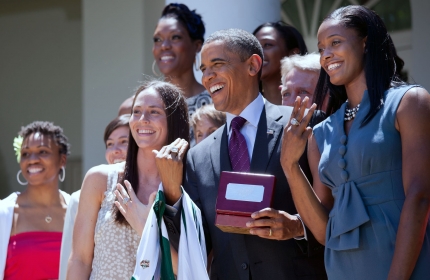
Today President Obama welcomed the WNBA Champion Seattle Storm to the White House. He congratulated the team on its 2010 season and its championship title. The President took the opportunity to pay tribute to the WNBA, which in just fifteen years has become the most successful women’s professional sports league in the world. He also observed that the Storm’s championship was a historic victory: “Three years ago, when this team’s future in Seattle was uncertain, four season ticket holders joined forces to become co-owners. Now they’re also the first all-female ownership group in American history to win a championship.”

In addition to winning basketball games, the Storm is active in a wide variety of service projects. These include promoting childhood literacy, as well as encouraging local organizations to work toward reducing their environmental footprint. During the Storm’s visit to DC, the team held a clinic for young people on the White House basketball court. As the President said today, “the Storm family understands that being a champion doesn’t stop when you step off the court.”

President Barack Obama with the Seattle Storm

President Barack Obama shows the championship ring he received as a gift with Seattle Storm’s Sue Bird, left, and Swin Cash, right, during a ceremony in the Rose Garden of the White House to honor the team’s 2010 championship season, June 29, 2011. (Official White House Photo by Samantha Appleton)

Kyle Lierman is White House Liaison to the Sports Community.

LGBT Pride Month

June 29, 2011 | 8:37 | Public Domain

President Obama makes remarks at an event to observe LGBT Pride Month at the White House.

Download mp4 (82MB) | mp3 (8MB)

Read the Transcript

Remarks by the President at Reception Observing LGBT Pride Month

6:00 P.M. EDT

        THE PRESIDENT:  Hello, everybody!  (Applause.)  Welcome to the White House.  (Applause.)   

        Nothing ruins a good party like a long speech from a politician.  (Laughter.)  So I'm going to make a short set of remarks here.  I appreciate all of you being here.  I have learned a lesson:  Don't follow Potomac Fever -- (laughter) -- because they sounded pretty good.  

        We’ve got community leaders here.  We've got grassroots organizers.  We've got some incredible young people who are just doing great work all across the country -– folks who are standing up against discrimination, and for the rights of parents and children and partners and students --

        AUDIENCE MEMBER:  And spouses.

        THE PRESIDENT:  -- and spouses.  (Applause.)  You’re fighting for the idea that everyone ought to be treated equally and everybody deserves to be able to live and love as they see fit.  (Applause.)

        Now, I don’t have to tell the people in this room we've got a ways to go in the struggle, how many people are still denied their basic rights as Americans, who are still in particular circumstances treated as second-class citizens, or still fearful when they walk down the street or down the hall at school. Many of you have devoted your lives to the cause of equality.  So you all know that we've got more work to do.

        But I think it's important for us to note the progress that's been made just in the last two and a half years.  I just want everybody to think about this.  (Applause.)  It was here, in the East Room, at our first Pride reception, on the 40th anniversary of the Stonewall riots, a few months after I took office, that I made a pledge, I made a commitment.  I said that I would never counsel patience; it wasn’t right for me to tell you to be patient any more than it was right for folks to tell African Americans to be patient in terms of their freedoms.  I said it might take time to get everything we wanted done.  But I also expected to be judged not by the promises I made, but the promises I kept.

        Now, let's just think about it.  I met with Judy Shepard.  I promised her we'd pass an inclusive hate crimes law, named after her son, Matthew.  And with the help of Ted Kennedy and others, we got it done and I signed the bill.  (Applause.)

        I met Janice Lang-ben, who was barred from the bedside of the woman she loved as she lay dying, and I told her we were going to put a stop to that discrimination.  And I issued an order so that any hospital in America that accepts Medicare or Medicaid –- and that means just about every hospital in America  -– has to treat gay partners just as they have to treat straight partners.  Nobody in America should have to produce a legal contract.  (Applause.)

        I said we'd lift the HIV travel ban.  We got that done.  (Applause.)  We put in place the first national strategy to fight HIV/AIDS.  (Applause.)

        A lot of people said we weren’t going to be able to get "don't ask, don't tell" done, including a bunch of people in this room.  (Laughter.)  And I just met Sue Fulton, who was part of the first class of women at West Point, and is an outstanding advocate for gay service members.  It took two years through Congress -– working with Admiral Mullen and Secretary Gates and the Pentagon.  We had to hold together a fragile coalition.  We had to keep up the pressure.  But the bottom line is we got it done.  And in a matter of weeks, not months, I expect to certify the change in policy –- and we will end "don't ask, don't tell" once and for all.  (Applause.)

        I told you I was against the Defense -- so-called Defense of Marriage Act.  I've long supported efforts to pass a repeal through Congress.  And until we reach that day, my administration is no longer defending DOMA in the courts.  The law is discriminatory.  It violates the Constitution.  It’s time for us to bring it to an end.  (Applause.)  

        So bottom line is, I’ve met my commitments to the LGBT community.  I have delivered on what I promised.  Now, that doesn’t mean our work is done.  There are going to be times where you’re still frustrated with me.  (Laughter.)  I know there are going to be times where you’re still frustrated at the pace of change.  I understand that.  I know I can count on you to let me know.  (Laughter and applause.)  This is not a shy group.  (Laughter.)    

        But what I also know is that I will continue to fight alongside you.  And I don’t just mean as an advocate.  You are moms and dads who care about the schools that your children go to.  You’re students who are trying to figure out how to pay for going to college.  You’re folks who are looking for good jobs to pay the bills.  You’re Americans who want this country to prosper.  So those are your fights, too.  And the fact is these are hard days for America.  So we’ve got a lot of work to do to, not only on ending discrimination; we’ve got a lot of work to do to live up to the ideals on which we were founded, and to preserve the American Dream in our time -– for everybody, whether they're gay or straight or lesbian or transgender.  

        But the bottom line is, I am hopeful.  I’m hopeful because of the changes we’ve achieved just in these past two years.  Think about it.  It’s astonishing.  Progress that just a few years ago people would have thought were impossible.  And more than that, what gives me hope is the deeper shift that we’re seeing that’s a transformation not just in our laws but in the hearts and minds of people -- the progress led not by Washington but by ordinary citizens.  

        It’s propelled not by politics but by love and friendship and a sense of mutual regard and mutual respect.  It’s playing out in legislatures like New York.  (Applause.)  It’s playing out in courtrooms.  It’s playing out in the ballot box, as people argue and debate over how to bring about the changes where we are creating a more perfect union.  But it’s also happening around water coolers.  It’s happening at Thanksgiving tables.  It’s happening on Facebook and Twitter, and at PTA meetings and potluck dinners, and church halls and VFW Halls.  

        It happens when a father realizes he doesn’t just love his daughter, but also her partner.  (Applause.)  It happens when a soldier tells his unit that he’s gay, and they say, well, yeah, we knew that –- (laughter) -- but, you know, you’re a good soldier. It happens when a video sparks a movement to let every single young person out there know that they’re not alone.  (Applause.) It happens when people look past their differences to understand our common humanity.

        And that’s not just the story of the gay rights movement.  It is the story of America, and the slow, inexorable march towards a more perfect union.  

        I want thank you for your contribution to that story.  I’m confident we’re going to keep on writing more chapters.

        Thank you very much, everybody.  (Applause.)  

END 6:10 P.M. EDT

Close Transcript

The White House

Office of the Press Secretary

President Obama Nominates Two to the United States District Court

WASHINGTON- Today, President Obama nominated Thomas Owen Rice and Judge David Ogden Nuffer to United States District Court judgeships.
 
“I am honored to nominate these distinguished individuals to serve on the United States District Court bench,” said President Obama.  “They have both demonstrated an unwavering commitment to justice throughout their careers, and I am confident they will continue to serve the American people with integrity.”
 
Judge David Ogden Nuffer:  Nominee for the United States District Court for the District of Utah
Judge David Ogden Nuffer is a United States Magistrate Judge for the District of Utah, a position he has held on a full-time basis since 2003 and held on a part-time basis from 1995 to 2003.  From 1979 to 2002, he was a named partner at Snow Nuffer (formerly known as Snow, Nuffer, Engstrom, Drake, Wade, and Smart), where his practice focused on civil litigation, real estate development, and representation of local municipalities.  Judge Nuffer served as the President of the Utah State Bar from 2000 to 2001.   He received his J.D. cum laude in 1978 from the J. Reuben Clark Law School and his B.A. cum laude in 1975 from Brigham Young University.  
 
Thomas Owen Rice:  Nominee for the United States District Court for the Eastern District of Washington
Thomas Owen Rice serves as an Assistant United States Attorney for the Eastern District of Washington, a position he has held since 1987.  Rice has served as the First Assistant United States Attorney since 2006 and previously was Chief of the Criminal Division from 2003 to 2006 and Deputy Chief of the Criminal Division from 2000 to 2003.  From 1986 to 1987, Rice worked as a Trial Attorney in the Tax Division of the United States Department of Justice.  In 1986, he was a law clerk at the law firm of Delay, Curran, Thompson & Pontarolo.  Rice received his J.D. magna cum laude in 1986 from Gonzaga University School of Law and his B.B.A. in 1983 from Gonzaga University. 

The White House

Office of the Press Secretary

Presidential Nominations sent to the Senate

NOMINATIONS SENT TO THE SENATE

Gregory K. Davis, of Mississippi, to be United States Attorney  for the Southern District of Mississippi for the term of four years,  vice Dunn Lampton, resigned.

David Nuffer, of Utah, to be United States District Judge for  the District of Utah, vice Dale A. Kimball, retired.

Thomas Owen Rice, of Washington, to be United States District  Judge for the Eastern District of Washington, vice Robert H. Whaley, retired.