President Obama Surprises Booker T. Washington Graduates

May 16, 2011 | 3:08 | Public Domain

The President does a surprise drop-in on the graduating class at Booker T. Washington High School in Memphis, TN before he speaks at their graduation ceremony. The school was the winner of the 2011 Commencement Challenge contest.

Download mp4 (30MB) | mp3 (3MB)

Read the Transcript

Remarks by the President in a Surprise Drop-By with Booker T. Washington Class of 2011

11:13 A.M. CDT

     THE PRESIDENT:  How’s everybody doing?  (Applause.)  You’re all excited about graduating, huh?  (Applause.)  Listen, I just had a chance to meet with your principal and these two outstanding classmates of yours, and I just want to say how inspired we were.  We were inspired by the video you sent.  We’re inspired by the stories you told.  We’re inspired by how you’ve turned this school around.  But obviously a lot of that has to do with your outstanding principal.  (Applause.)

     She says you guys know how old she is.  How old is she? 

     STUDENTS:  Twenty-five!

     THE PRESIDENT:  Twenty-five.  She started when she was seven.  (Laughter.)  Teaching high school at seven years old.  (Laughter.)

     Obviously it has a lot to do with great teachers, but this is mainly your day and your success, because a lot of you -- and I’m going to talk about this at the commencement -- a lot of you had to struggle to get here.  Most of you weren’t born with a silver spoon in your mouth.  But what you’ve shown is determination.  What you’ve shown is character.  What you’ve shown is a willingness to work hard and the ability to steer clear of folks that were trying to send you down the wrong path.  And so as a consequence, you’ve now become role models for all the young people coming in behind you.  You’ve become an inspiration to the city and the state of Tennessee and the country.
So I just wanted you all to know, you inspire me.  That’s why I’m here.  I could not be prouder of what you do.  But I’ve still got some big, big expectations for you, so don’t think just because you graduate from high school that that’s it.  You’ve got a lot more work to do, because I expect all of you to be leaders in this community and communities all across the country.  And this is just the beginning.  This is not the end.  All right?
So God bless you guys.  I’m so excited to be here.  (Applause.)  

END 11:17 A.M. CDT

Close Transcript

The White House

Office of the Press Secretary

White House Releases The Small Business Agenda: Growing America's Small Businesses to Win the Future Highlighting Critical Support for Small Businesses Across the Country

WASHINGTON – Today, the President’s National Economic Council released The Small Business Agenda: Growing America’s Small Businesses to Win the Future, a report highlighting the importance of expanding and supporting the growth of entrepreneurs and small businesses across the nation.   The report, which kicks off National Small Business Week, outlines the critical investments this Administration has made to support small businesses, create jobs and strengthen our economy.

“Small businesses are the backbone of our economy and the cornerstones of our communities. They create two of every three new jobs in America, spur economic growth, and spark new industries across the country,” said President Obama.  “We will continue to create new incentives to help small business owners hire new workers, promote growth and do what America does best – invest in the creativity and imagination of our people.”

View the full report, which includes small business success stories from around the country, here:

FACT SHEET: THE SMALL BUSINESS AGENDA: GROWING AMERICA’S SMALL BUSINESSES TO WIN THE FUTURE

Over the past two years, the Obama Administration has taken decisive action in seven critical areas aimed at empowering America’s entrepreneurs and small business owners to create jobs and strengthen the economy.  The Administration will continue to build on these accomplishments.

I.            More tax relief.   The President enacted 17 tax cuts for small businesses, including billions of dollars in tax credits, write-offs, and deductions for Americans who:

  • start a new business
  • invest or buy stock in startups and small businesses
  • hire people who’ve been unemployed to work at their business
  • buy new equipment or machinery for their business
  • provide health insurance for their employees

II.            More access to capital.  After lending froze in 2008, the new Administration implemented critical tools to increase the flow of capital to small businesses.  This included:

  • SBA lending support totaling $53 billion for 113,000 small businesses
  • a Small Business Lending Fund to help community banks increase small business lending
  • a State Small Business Credit Initiative to support up to $15 billion in small business lending through innovative state small business programs
  • billions of dollars in loans and other support to small businesses hit by disasters such as the BP Oil Spill, floods, and tornadoes
  • new SBA programs to increase small-dollar lending to spur business growth among women, minorities, veterans and others in underserved communities

III.            More federal contracting opportunities.  Starting in FY2009, an increasing percentage of federal contracting dollars have gone to small business, totaling about $221 billion by April 2011.  Efforts to augment contracting opportunities for small businesses included:

  • delivering nearly one-third of Recovery Act contracts to small businesses while also exceeding all goals for underserved small business groups with these contracts
  • actions from the President’s Interagency Taskforce on Federal Contracting Opportunities for Small Business to strengthen rules, to create a better-trained acquisition workforce, and to strengthen outreach to more small businesses
  • implementing the woman-owned-small-business contracting program to help women compete in 83 industries where they are underrepresented in the federal contracting arena, building on the $16 billion women-owned firms won in FY 2009
  • reducing the time it takes to pay small businesses who do work for the Department of Defense from 30 to 20 days, potentially impacting more than $60 billion of goods and services

IV.            More exporting support and opportunities.  The President’s National Export Initiative places a strong focus on helping small businesses as they begin or expand exporting.  In its first year, the U.S. exported $1.83 trillion in goods and services supporting 10.3 million jobs.  Efforts to identify, prepare and support small exporters have included:

  • the President’s advocacy with world leaders in India, Korea, Colombia, Panama, and others, including advancing trade agreements that will lower tariffs on U.S. exports
  • 35 trade missions totaling $2 billion in anticipated success, with small businesses representing nearly 80% of participants
  • increasing training and expert-level counseling to create growth plans for manufacturers through the Department of Commerce’s ExportTech program
  • increasing authorizations from $3.2 billion in 2008 to $5 billion in 2010 from Export-Import Bank

V.            More counseling and training.  Over the past two years, agencies that provide or coordinate free counseling have helped serve more than 2 million entrepreneurs and small business owners.  Key efforts have included:

  • launching four new Women’s Business Centers, bringing the total to 110 centers nationwide, building on the momentum in women’s business ownership
  • launching the President’s Interagency Task Force on Veterans Small Business Development which expanded opportunities for veterans, reservists, and their families
  • strengthening SBA’s efforts to inspire and empower the next generation of young entrepreneurs 
  • coordinating multiagency efforts to foster “clustering,” an economic development strategy that maximizes innovation and job creation by building on a region’s existing strengths and assets
  • creating the National Advisory Council on Innovation and Entrepreneurship at Commerce
  • streamlining patent services and providing patent fee reductions for small businesses
  • strengthening education in order to promote small business ownership through the America COMPETES Act, Race to the Top, the Post-9/11 G.I. Bill, and more

VI.            More support for “high-growth” small businesses.  The vast majority of net new jobs created in the U.S. come from startups and small business poised for high-growth and innovation.  The Administration has focused intently on this subset of small businesses, with efforts including:

  • creating the President’s Jobs and Competitiveness Council, led by top U.S. executive business leaders
  • creating Startup America, a set of initiatives that include: $2 billion in growth capital, a mentoring corps, efforts to reduce regulatory barriers and commercialize federal research, and a new Partnership of top U.S. investors, corporations, universities, and foundations committed to fostering entrepreneurial ecosystems which secured $400 million in commitments in April 2011
  • awarding more than $4.5 billion in research funding through the Small Business Innovation Research program during FY 2009 and FY 2010
  • developing two Recovery Act programs through NIH to help early-stage companies catalyze research in new areas and to help more advanced companies bridge the commercialization gap
  • new “challenge” grants from the Commerce that spur commercialization of new technologies
  • increasing the percentage of small companies involved in the National Science Foundation’s Engineering Research Centers from 23% to 44% between 2006 and 2010
  • strengthening USDA commercialization, licensing, and patenting efforts for small businesses involved in agricultural technology transfer and innovation through research partnerships
  • expanding broadband to small businesses in rural and remote areas through nearly $7 billion in grants through the Recovery Act
  • providing women veterans, veterans with disabilities, and reservists with entrepreneurship “boot camps,” in-person training sessions, and online resources through partnerships with universities
  • organizing the White House Women Entrepreneurs Conference and continuing with regional women’s entrepreneurship summits around the country led by SBA and the National Women’s Business Council

VII.            More small business protection.  Providing stability and protections for small businesses in the wake of the recession is critical for future economic growth.  Administration efforts in this area have included:

  • strengthening financial markets and community banking in order to ensure access to conventional credit through the Dodd-Frank Wall Street Report and Consumer Protection Act.
  • protecting small businesses from unfair and deceptive credit card practices through the Credit Card Accountability, Responsibility and Disclosure Act
  • saving small businesses $15 billion in foregone regulatory costs in 2010 through the SBA Office of Advocacy’s efforts to ensure flexibility with regulations that disproportionately affect small businesses.

The White House

Office of the Press Secretary

White House Launches 2011 Citizens Medal Nomination Process

WASHINGTON, DC--In an email sent today, President Obama announced that the American public will once again be invited to nominate candidates for the Citizens Medal, the nation’s second highest civilian award.  For over 40 years, the Presidential Citizens Medal has recognized “citizens of the United States of America who have performed exemplary deeds of service for their country or their fellow citizens.” Past recipients have included some of America’s most respected public figures including Colin Powell, Bob Dole and Muhammad Ali, but also everyday heroes like 2010 recipient Susan Retik Ger, a widow who lost her husband on 9/11 and who found cause in educating and training Afghan widows and their children. The President’s email can be viewed HERE.

By asking the public to submit nominees, President Obama hopes to recognize exemplary citizens and local heroes who have significantly impacted their communities but who may not have garnered national attention. 

“Now I know there are thousands of citizens out there who meet these criteria -- I read their letters every night, and I meet many of them in my travels around the country” said President Obama.  “I also know that many times their contributions go unrecognized.  The 2011 Citizens Medal is a chance to recognize the everyday heroes in your community.”

Public nominations will be reviewed by White House staff. Additional nominees may be identified outside of the public nomination process.  The President will select award recipients and award the 2011 Citizens Medal in a ceremony at the White House.  Last year, the White House received more than 6,000 nominations and invited 13 outstanding Americans to the White House to receive the Medal and be recognized for their service. Learn more about the 2010 Citizens Medal recipients and view a video gallery HERE.

Nominees must be citizens of the United States and fulfill specific criteria posted HERE. All applications must be completed in full and submitted via www.WhiteHouse.gov/citizensmedal by Monday, May 30, 2011 at 11:59 p.m. EST.

BACKGROUND ON THE CITIZENS MEDAL:

The Citizens Medal recognizes “citizens of the United States of America who have performed exemplary deeds of service for their country or their fellow citizens.”  Executive Order 11494 (Nov. 13, 1969).  It is generally recognized as the second highest civilian award of the United States government. 

The 2011 Citizens Medal will recognize citizens who have performed exemplary deeds of service outside of their regular jobs, including individuals:

Who have a demonstrated commitment to service in their own community or in communities farther from home.  Someone who has engaged in activities that have had an impact in their local community, on a community or communities elsewhere in the United States or on fellow citizens living or stationed around the world.

Who have helped their country or their fellow citizens through one or more extraordinary acts.  Individuals who have demonstrated notable skill and grace, selflessly placed themselves in harm’s way, taken unusual risks or steps to protect others, made extraordinary efforts to further a national goal, or otherwise conducted themselves admirably when faced with unusually challenging circumstances.   

Whose service relates to a long-term or persistent problem.  Individuals who have made efforts to combat stubbornly persistent problems that impact entire communities, for example those who have taken innovative steps to address hunger, homelessness, the dropout crisis, lack of access to health care, and other issues that plague too many Americans.

Whose service has had a sustained impact on others’ lives and provided inspiration for others to serve.   The ideal nominee for a Citizens Medal is a person whose work has had a meaningful and lasting impact on the lives of others.

Do You Know Someone Like This?

This morning, President Obama sent the email below to the White House email list asking for nominations for the 2011 Citizens Medal, our nation's second-highest civilian honor.  This year, President Obama is looking for Americans who have performed exemplary deeds of service outside of their regular jobs and provided inspiration for others to serve.  Learn more about the Citizens Medal and submit your nomination.

If you didn't get this email, be sure to sign up for the White House email list.

Related Topics: Service

The White House

Office of the Press Secretary

Weekly Address: President Obama Announces New Plans to Increase Responsible Domestic Oil Production

WASHINGTON – In this week’s address, President Obama laid out his strategy to continue to expand responsible and safe domestic oil production, leveraging existing authorities as part of his long-term plan to reduce our reliance on foreign oil. He is directing the Department of the Interior to conduct annual lease sales in Alaska’s National Petroleum Reserve – while respecting sensitive areas, to speed up the evaluation of oil and gas resources in the mid and south Atlantic, and to create new incentives for industry to develop their unused leases both on and offshore. Also, to give companies more time to meet higher safety standard for exploration and drilling, the administration is extending drilling leases in areas of the Gulf of Mexico that were impacted by the temporary moratorium, as well as certain leases off the coast of Alaska.  And, he is establishing a new interagency working group to ensure that Arctic development projects meet health, safety and environmental standards. The past few months, rising gas prices have put an added strain on American families. While there are no quick fixes to the problem, these are steps, along with eliminating taxpayer subsidies for oil companies and rooting out fraud and manipulation in the markets, that are worth taking. 

Remarks of President Barack Obama
Weekly Address
Saturday, May 14, 2011
Washington D.C.

Recently, there have been signs that the economy is picking up steam.  Last month, we saw the strongest job growth in five years, and have added more than three-quarters of a million private sector jobs in just three months.  But there are still too many Americans who are either looking for work, or struggling to pay the bills and make the mortgage.  Paychecks aren’t getting any bigger, but the cost of everything from groceries to college tuition keeps on rising. 

Without a doubt, one of the biggest burdens over the last few months has been the price of gasoline.  In many places, gas is now more than $4 a gallon, meaning that you could be paying more than $60 to fill up your tank.

These spikes in gas prices are often temporary, and while there are no quick fixes to the problem, there are a few steps we should take that make good sense.

First, we should make sure that no one is taking advantage of consumers at the pump.  That’s why we’ve launched a task force led by the Attorney General that has one job: rooting out cases of fraud or manipulation in the markets that might affect gas prices, including any illegal activity by traders and speculators. 

Second, we should increase safe and responsible oil production here at home.  Last year, America’s oil production reached its highest level since 2003.  But I believe that we should expand oil production in America – even as we increase safety and environmental standards. 

To do this, I am directing the Department of Interior to conduct annual lease sales in Alaska’s National Petroleum Reserve, while respecting sensitive areas, and to speed up the evaluation of oil and gas resources in the mid and south Atlantic.  We plan to lease new areas in the Gulf of Mexico as well, and work to create new incentives for industry to develop their unused leases both on and offshore.

We’re also taking steps to give companies time to meet higher safety standards when it comes to exploration and drilling.  That’s why my Administration is extending drilling leases in areas of the Gulf that were impacted by the temporary moratorium, as well as certain areas off the coast of Alaska.  And to streamline that permitting process, I am establishing a new team to coordinate work on Alaska drilling permits.

Finally, the third step we should take is to eliminate the taxpayer subsidies we give to oil and gas companies.  In the last few months, the biggest oil companies made about $4 billion in profits each week.  And yet, they get $4 billion in taxpayer subsidies each year.  Four billion dollars at a time when Americans can barely fill up their tanks.  Four billion dollars at a time when we’re trying to reduce our deficit. 

This isn’t fair, it makes no sense.  Before I was President, the CEOs of these companies even admitted that the tax subsidies made no sense.  Well, next week, there is a vote in Congress to end these oil company giveaways once and for all.  And I hope Democrats and Republicans come together and get this done. 

The American people shouldn’t be subsidizing oil companies at a time when they’re making near-record profits.  As a nation, we should be investing in the clean, renewable sources of energy that are the ultimate solution to high-gas prices.  That’s why we’re investing in clean energy technology, helping businesses that manufacture solar panels and wind turbines, and making sure that our cars and trucks can go further on a tank of gas – a step that could save families as much as $3,000 at the pump.

These are investments worth making – investments that will save us money, reduce our dependence on foreign oil, and protect the health and safety of our planet.  That’s an energy policy for the future, and it’s what I’ll be fighting for in the weeks and months to come.

Thanks.

Weekly Address: Expanding Responsible Oil Production in America

As part of his long-term plan to reduce our reliance on foreign oil, President Obama lays out his strategy to continue expanding safe and responsible domestic oil production.

Transcript | Download mp4 | Download mp3

Related Topics: Energy and Environment

Weekly Address: Expanding Responsible Oil Production in America

May 14, 2011 | 4:01 | Public Domain

As part of his long-term plan to reduce our reliance on foreign oil, President Obama lays out his strategy to continue expanding safe and responsible domestic oil production.

Download mp4 (142MB) | mp3 (4MB)

Read the Transcript

Weekly Address: President Obama Announces New Plans to Increase Responsible Domestic Oil Production

WASHINGTON – In this week’s address, President Obama laid out his strategy to continue to expand responsible and safe domestic oil production, leveraging existing authorities as part of his long-term plan to reduce our reliance on foreign oil. He is directing the Department of the Interior to conduct annual lease sales in Alaska’s National Petroleum Reserve – while respecting sensitive areas, to speed up the evaluation of oil and gas resources in the mid and south Atlantic, and to create new incentives for industry to develop their unused leases both on and offshore. Also, to give companies more time to meet higher safety standard for exploration and drilling, the administration is extending drilling leases in areas of the Gulf of Mexico that were impacted by the temporary moratorium, as well as certain leases off the coast of Alaska.  And, he is establishing a new interagency working group to ensure that Arctic development projects meet health, safety and environmental standards. The past few months, rising gas prices have put an added strain on American families. While there are no quick fixes to the problem, these are steps, along with eliminating taxpayer subsidies for oil companies and rooting out fraud and manipulation in the markets, that are worth taking. 

Remarks of President Barack Obama
Weekly Address
Saturday, May 14, 2011
Washington D.C.

Recently, there have been signs that the economy is picking up steam.  Last month, we saw the strongest job growth in five years, and have added more than three-quarters of a million private sector jobs in just three months.  But there are still too many Americans who are either looking for work, or struggling to pay the bills and make the mortgage.  Paychecks aren’t getting any bigger, but the cost of everything from groceries to college tuition keeps on rising. 

Without a doubt, one of the biggest burdens over the last few months has been the price of gasoline.  In many places, gas is now more than $4 a gallon, meaning that you could be paying more than $60 to fill up your tank.

These spikes in gas prices are often temporary, and while there are no quick fixes to the problem, there are a few steps we should take that make good sense.

First, we should make sure that no one is taking advantage of consumers at the pump.  That’s why we’ve launched a task force led by the Attorney General that has one job: rooting out cases of fraud or manipulation in the markets that might affect gas prices, including any illegal activity by traders and speculators. 

Second, we should increase safe and responsible oil production here at home.  Last year, America’s oil production reached its highest level since 2003.  But I believe that we should expand oil production in America – even as we increase safety and environmental standards. 

To do this, I am directing the Department of Interior to conduct annual lease sales in Alaska’s National Petroleum Reserve, while respecting sensitive areas, and to speed up the evaluation of oil and gas resources in the mid and south Atlantic.  We plan to lease new areas in the Gulf of Mexico as well, and work to create new incentives for industry to develop their unused leases both on and offshore.

We’re also taking steps to give companies time to meet higher safety standards when it comes to exploration and drilling.  That’s why my Administration is extending drilling leases in areas of the Gulf that were impacted by the temporary moratorium, as well as certain areas off the coast of Alaska.  And to streamline that permitting process, I am establishing a new team to coordinate work on Alaska drilling permits.

Finally, the third step we should take is to eliminate the taxpayer subsidies we give to oil and gas companies.  In the last few months, the biggest oil companies made about $4 billion in profits each week.  And yet, they get $4 billion in taxpayer subsidies each year.  Four billion dollars at a time when Americans can barely fill up their tanks.  Four billion dollars at a time when we’re trying to reduce our deficit. 

This isn’t fair, it makes no sense.  Before I was President, the CEOs of these companies even admitted that the tax subsidies made no sense.  Well, next week, there is a vote in Congress to end these oil company giveaways once and for all.  And I hope Democrats and Republicans come together and get this done. 

The American people shouldn’t be subsidizing oil companies at a time when they’re making near-record profits.  As a nation, we should be investing in the clean, renewable sources of energy that are the ultimate solution to high-gas prices.  That’s why we’re investing in clean energy technology, helping businesses that manufacture solar panels and wind turbines, and making sure that our cars and trucks can go further on a tank of gas – a step that could save families as much as $3,000 at the pump.

These are investments worth making – investments that will save us money, reduce our dependence on foreign oil, and protect the health and safety of our planet.  That’s an energy policy for the future, and it’s what I’ll be fighting for in the weeks and months to come.

Thanks.

Close Transcript

The White House

Office of the Press Secretary

Statement by the President on the Retirement of Senator Herb Kohl

Today, I called Senator Herb Kohl to thank him for his remarkable career in public service.

During his 23 years in the United States Senate, Herb’s invaluable perspective as the long-time head of a family-owned business made him an unwavering voice for working families, small business owners, and seniors.

America’s children will grow up in a better place thanks to his advocacy on behalf of childhood nutrition programs, a strengthened food safety system,  access to affordable health care and childcare, and juvenile crime prevention.

Herb’s dedication to American families and businesses remains evident today in the robust farming and manufacturing sector he helped foster in his home state of Wisconsin. And he has been a constant advocate to ensure that seniors in Wisconsin and across the country have access to affordable prescription drugs.  

Michelle and I extend our thanks to Senator Kohl for his years of service to our nation and offer our best wishes for the future to him and his family.
 

Announcing the 2011 Citizens Medal

May 13, 2011 | :45 | Public Domain

The 2011 Citizens Medal is a chance to recognize extraordinary citizens who have impacted their communities, but who may not have garnered national attention. Now's your chance to nominate an everyday hero in your community. Visit WhiteHouse.gov/citizensmedal and nominate a local hero today.

Download mp4 (8MB)

Read the Transcript

White House Launches 2011 Citizens Medal Nomination Process

WASHINGTON, DC--In an email sent today, President Obama announced that the American public will once again be invited to nominate candidates for the Citizens Medal, the nation’s second highest civilian award.  For over 40 years, the Presidential Citizens Medal has recognized “citizens of the United States of America who have performed exemplary deeds of service for their country or their fellow citizens.” Past recipients have included some of America’s most respected public figures including Colin Powell, Bob Dole and Muhammad Ali, but also everyday heroes like 2010 recipient Susan Retik Ger, a widow who lost her husband on 9/11 and who found cause in educating and training Afghan widows and their children. The President’s email can be viewed HERE.

By asking the public to submit nominees, President Obama hopes to recognize exemplary citizens and local heroes who have significantly impacted their communities but who may not have garnered national attention. 

“Now I know there are thousands of citizens out there who meet these criteria -- I read their letters every night, and I meet many of them in my travels around the country” said President Obama.  “I also know that many times their contributions go unrecognized.  The 2011 Citizens Medal is a chance to recognize the everyday heroes in your community.”

Public nominations will be reviewed by White House staff. Additional nominees may be identified outside of the public nomination process.  The President will select award recipients and award the 2011 Citizens Medal in a ceremony at the White House.  Last year, the White House received more than 6,000 nominations and invited 13 outstanding Americans to the White House to receive the Medal and be recognized for their service. Learn more about the 2010 Citizens Medal recipients and view a video gallery HERE.

Nominees must be citizens of the United States and fulfill specific criteria posted HERE. All applications must be completed in full and submitted via www.WhiteHouse.gov/citizensmedal by Monday, May 30, 2011 at 11:59 p.m. EST.

BACKGROUND ON THE CITIZENS MEDAL:

The Citizens Medal recognizes “citizens of the United States of America who have performed exemplary deeds of service for their country or their fellow citizens.”  Executive Order 11494 (Nov. 13, 1969).  It is generally recognized as the second highest civilian award of the United States government. 

The 2011 Citizens Medal will recognize citizens who have performed exemplary deeds of service outside of their regular jobs, including individuals:

Who have a demonstrated commitment to service in their own community or in communities farther from home.  Someone who has engaged in activities that have had an impact in their local community, on a community or communities elsewhere in the United States or on fellow citizens living or stationed around the world.

Who have helped their country or their fellow citizens through one or more extraordinary acts.  Individuals who have demonstrated notable skill and grace, selflessly placed themselves in harm’s way, taken unusual risks or steps to protect others, made extraordinary efforts to further a national goal, or otherwise conducted themselves admirably when faced with unusually challenging circumstances.   

Whose service relates to a long-term or persistent problem.  Individuals who have made efforts to combat stubbornly persistent problems that impact entire communities, for example those who have taken innovative steps to address hunger, homelessness, the dropout crisis, lack of access to health care, and other issues that plague too many Americans.

Whose service has had a sustained impact on others’ lives and provided inspiration for others to serve.   The ideal nominee for a Citizens Medal is a person whose work has had a meaningful and lasting impact on the lives of others.

Close Transcript

Photostream: Behind the Scenes in April

Ed. Note: Sign up for the Daily Snapshot and we'll send you the Photo of the Day first thing every morning.

We’ve just posted a new series of behind-the-scenes photographs from the last two weeks of April. Many elements go into the making of a successful photograph. A good moment, interesting composition, nice light, etc. 

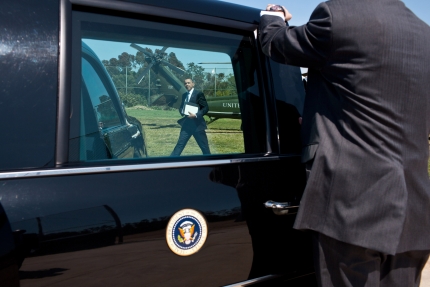
This photograph (below) was unusual in that I framed the composition ahead of time and waited for the President to walk into the frame. After the President’s helicopter had landed in Los Angeles, I anticipated the direction he would walk to his car in the motorcade. Lighting sometimes is the key element in a successful photograph.

President Barack Obama walks to the motorcade from Marine One

President Barack Obama walks to the motorcade from Marine One after arriving at the Barrington Recreation Center landing zone in Los Angeles, Calif., April 21, 2011. (Official White House Photo by Pete Souza)

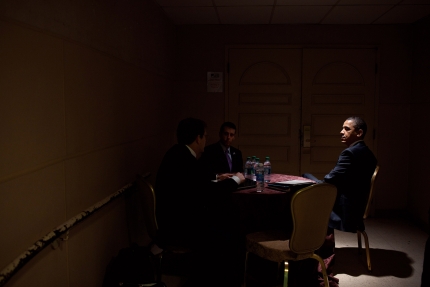
This photograph (below) was taken in a hallway at a Chicago hotel. The President had a briefing with Press Secretary Jay Carney and Senior Advisor David Plouffe. The hallway was very dimly lit, but the President happened to sit underneath the overhead light, illuminating just his face.

President Barack Obama meets with Press Secretary Jay Carney and Senior Advisor David Plouffe

President Barack Obama meets with Press Secretary Jay Carney, left, and Senior Advisor David Plouffe, center, before an interview with Ben Feller of the Associated Press, in Chicago, Ill., April 15, 2011. (Official White House Photo by Pete Souza)

View the full-size slideshow.

Pete Souza is Chief Official White House Photographer and Director of the White House Photography Office.