The White House

Office of the Press Secretary

Press Gaggle by Press Secretary Josh Earnest and Deputy National Security Advisor Ben Rhodes en route New York, NY, 9/23/2014

Aboard Air Force One
En Route New York, New York

10:55 A.M. EDT

MR. EARNEST:  Good morning, everybody.  Welcome aboard Air Force One as we make our way to New York City where the President will spend the next three days or so participating in the meetings at the U.N. General Assembly.

There’s one piece of news that I want to get out of the way and then we'll open it up to your questions.  Obviously, I'm joined here by the Deputy National Security Advisor Ben Rhodes.  He can talk to you about some of the activities from overnight that all of you and your organizations have already reported on. The one piece of news is that this afternoon in New York, the President will drop by a meeting that's been convened by the Secretary of State that will include representatives of the nations who partnered with the United States in the operation in Syria last night. 

So you all saw, there were five partners from Arab nations who participated in the operation.  They’re represented at the UN and they will be participating in this meeting the President will drop by.  There will be an opportunity for you all to see the President’s interaction this afternoon.

Q    What time is that?

MR. EARNEST:  It’s late this afternoon at the Waldorf.  I think the timing is around 4:00 p.m.

Q    Is he going to take questions?

MR. EARNEST:  I don't anticipate that he'll take questions in that context.

So with that piece of news out of the way, we'll open it up to your questions.

Q    What was the imminent threat that prompted the bombings?  Was it Khorasan?

MR. RHODES:  So the Khorasan Group is a group of extremists that is comprised of a number of individuals who we've been tracking for a long time.  It includes some former al Qaeda operatives, core al Qaeda operatives from Afghanistan and Pakistan who made their way to Syria, remain in our view affiliated with al Qaeda.  And we have been monitoring over the course of many months the development of plotting against the United States or Western targets emanating from Syria. 

So for some time now we've been tracking plots to conduct attacks in the United States or Europe.  We believe that that attack plotting was imminent and that they had plans to conduct attacks external to Syria.  And we also believe, of course, that the Syrian regime was not able to take action against that threat.  So, in addition to the strikes against ISIL, we took action against the Khorasan Group to disrupt that plotting against the United States and Western targets.

Q    How imminent, and where were they going to strike?

MR. RHODES:  I'm not going to get into the specific details of plotting other than to say that we saw that they had very clear and concrete ambitions to launch external operations against the United States or Europe.  And so this was actual plotting that was ongoing from Syria, and the strike that we took last night was aimed to disrupt that plotting. 

Q    And this morning was the first time that we heard the President discuss this group or this threat and it was not part of the pitch he made to the American public asking for their support in these strikes in Syria.  So doesn’t this mark a significant expansion of the military campaign that we're carrying out there?

MR. RHODES:  Well, I think when the President gave his speech to the nation about his strategy against the threat from ISIL, he made clear that he’d be taking strikes in both Iraq and Syria --

Q    ISIL, but not against --

MR. RHODES:  Well, okay, so we see this very much as an extension of the threat posed by al Qaeda and their associated forces.  These are individuals who have their origin, their history serving in al Qaeda.  They’re known to people who’ve been following this threat for years.  They were in Afghanistan and Pakistan.  So this, frankly, is a part of the ongoing effort against al Qaeda in which you’ve seen us take strikes in Yemen; you’ve seen us take strikes in Somalia.  When there’s an al Qaeda target we're going to take action against it.

What’s unique about Syria is that the Assad regime was certainly unable to take action against this organization, the Khorasan Group, so therefore we felt the need to take action in our own defense.

MR. EARNEST:  I'll just add that this is entirely consistent with the principle that the President did lay out in the address that Ben obviously worked on a lot, a core principle of this President’s foreign policy that we're going to actively deny a safe haven to individuals or organizations that seek to establish a safe haven and use that safe haven to plot attacks against the U.S. homeland.  So these strikes last night are entirely consistent with that core principle of this presidency.

MR. RHODES:  And, similarly, consistent with the 2001 AUMF, which is the basis under which we take action against al Qaeda and associated forces.

Q    Can you talk about coordination or notification there was to the Syrian government regarding what the U.S. and the other countries did last night?

Q    Because Jen has made it clear from State that there was sort of a vague, open-ended notice.

MR. RHODES:  First of all, the President obviously declared publicly our intention to take military action in Syria.  Subsequent to that, there was a direct contact to the Syrian regime to notify them of the fact that we would take direct action.  That was undertaken at the United Nations by Samantha Power to the Syrian Permanent Representative to the United Nations. 

I want to be very clear, though, that we did not coordinate with them, we did not provide them advance notice of the timing or of targets that the U.S. was going to strike.  In fact, we warned them to not pose a threat to our aircraft.  And again, going forward, there is no plan to have any coordination whatsoever with the Assad regime.  Again, this was simply consistent with what the President had said -- a notification that we would be taking this action; frankly, a warning to not pose a risk to our aircraft.  And it was in no way an effort to coordinate or provide specific information about the types of targets or timing of targets that we would hit.

Q    Did the Syrians give you a green light to do it?

MR. RHODES:  I’m not going to characterize the Syrian response in a private diplomatic communication.  Obviously, we have significant differences with the Syrian regime.  We had been able to communicate with them on issues over the course of the last several years, for instance, when we needed to send a message about our concerns about chemical weapons.  But it’s obviously rare that we have that contact.  This was simply a matter of notifying them that we’d be taking this action.

Q    When did that take place?

MR. RHODES:  I’m not going to provide a specific time.  Obviously, it took place in recent days.

Q    I was wondering about the Arab partners that participated last night, which you all announced the President is going to stop by a meeting.  Is that going to be the partnership we’re going to see continuously through Syria?  Could that change?  Could you add partners?  Will that be sort of decided on per mission, or per week or per day?

MR. RHODES:  I think you will continue to see this coalition work together in Syria.  And again, we were joined by five Arab partners who flew with us last night.  A number of those countries took strikes with us last night.  The Pentagon can give you the specifics of those roles.

I think going forward, we’re looking to build this coalition.  So insofar as it will change, we will grow a coalition of nations to take different actions.  Some nations will take strikes in Syria; some nations will take strikes in Iraq.  Some nations will participate in training and equipping of Iraqis, training and equipping of Syrians.  Some nations will help us in counter financing, stopping the flow of foreign fighters. 

So again, this is the beginning, but part of what the President is going to be doing at the United Nations is consulting with allies and partners about additional contributions that can be made in both Iraq and Syria.

Q    What was the significance of the timing of the strikes -- last night, right before he goes to the UN?

MR. RHODES:  We did not time this related to the UN meetings.  This was based on the development of the strike campaign plan by the Pentagon and by the coalition that we built.  So we wanted to make sure that we had good targets.  We wanted to make sure that we had a coalition in place so that we were acting together with partners, particularly Arab partners.  And I think it’s very significant that -- it’s very unique that you have five Arab countries flying with us, taking direct military action in the Middle East on behalf of our common security.  That’s a powerful message.

And the other thing I’d just say for timing purposes, the President was briefed on the plan that had been developed when he was at CENTCOM by General Austin and other military leadership.  And the following day is when he gave the authorization to move forward with those strikes.  And at that point, it shifted to the discretion of the commander, General Austin, as well as the coalition-building exercise which was still coming together.

Q    Given all the stuff that’s gone on in the last 12 hours or so, can you talk a little bit about his speech to the General Assembly tomorrow?

MR. RHODES:  Yes, I think it’s a very important moment for the President to put everything that we’re doing in the context of U.S. leadership in the world.  We are leading a coalition of countries against ISIL.  We are leading an effort to combat the outbreak of Ebola.  We are leading an effort to impose costs on Russia and to support the Ukrainian people. 

So there are many different issues at play in the world today.  We believe that the constant thread between them is U.S. leadership.  And I think you’ll see the President call upon the world to join us in confronting this threat from ISIL, but also to offer his vision of how U.S. leadership is going to deal with this set of challenges at a moment in the international community when, frankly, nations need to be stepping up to the plate and coming together to deal with threats as diverse as ISIL or the outbreak of Ebola or the type of aggression we’ve seen in Ukraine.

Q    Are you going to still be trying to get the support of countries who may have either a philosophical objection to what the coalition did last night, or maybe just an opposition to using military force to confront these threats?  Are you still going to be trying to get them on board, for example, with interdicting foreign fighters, or the financial or the oil-related issues that work into this situation?

MR. RHODES:  Yes.  It’s a good question.  And we absolutely are going to do that.  I mean, already we’ve seen different nations have a different degree of willingness to conduct military action, but that doesn’t mean that there’s not a significant role for them to play.  For instance, you have a number of European countries like Germany, for instance, that haven't participated in airstrikes but they are providing arms and equipment for Kurdish forces.  That’s critically important.  For this to succeed, it’s not just going to be about airstrikes, it’s going to be about the effectiveness of the Iraqi security forces, Kurdish forces, and Syrian opposition forces.

And then, absolutely, we are going to need the cooperation of many countries to cut off ISIL financing and to stop the flow of foreign fighters.  The President will lead a UN Security Council meeting that is focused specifically on this question of foreign fighters, and that requires cooperation across many countries so that we’re able to have common protocols about how we can track those people who are traveling into and out of this region.  And then we have the ability to interdict foreign fighters before they can pose a threat either by reaching the battlefield in Syria and Iraq, or dangerously coming out of that theater to pose a risk in Europe and the United States. 

So there will be many different roles for nations to play in this coalition.  And frankly, you can’t overstate the importance of some of the non-military roles, given the fact that you’re not going to defeat an organization like ISIL unless you’re able to cut off its financing and stop this flow of foreign fighters that they’ve benefited from.

Q    Were you able to sense if the Khorasan strikes actually have disrupted the plot?

MR. RHODES:  We’re still reviewing the outcome of the strikes.  I think certainly the report from the Pentagon was that they successfully hit the targets that they were aiming at.  As to what impact that had on Khorasan leadership and operatives, that’s something that we’ll have to run down in the coming days.

Q    Were any American forces on the ground helping guide these attacks?

MR. RHODES:  No.  There were no American forces on the ground associated with these attacks in Syria.  Again, these were taken from the air, from military assets in the region, but not involving any U.S. ground forces.

Q    But based on a target list that you formed over the past month since this all started?

MR. RHODES:  Yeah, I think as we’ve been focused increasingly on the threat from ISIL, we have looked at contingency plans for targets in both Iraq and Syria.  Obviously, that accelerated when the President made the decision to take action in Syria, and gave guidance to his military commanders to develop essentially a campaign plan for Syria.  And after that work was done and he was briefed on it at CENTCOM by General Austin, the following day is when he gave his authorization to move forward when the timing was ready and the coalition was ready.

And I should say, part of what is remarkable about our military is CENTCOM’s ability to absorb the contributions of different partner nations very quickly so that we can essentially apportion roles for nations to play, so you can end up with five countries coming together on a fairly quick basis only in a matter of a short number of weeks from the President’s speech.  To have those nations flying with us in the air, conducting airstrikes is a testament both I think to the support for the President’s objective of defeating ISIL, Secretary Kerry’s hard work in the region, and CENTCOM’s ability to put together a coalition like this.

Q    Have these five Arab nations agreed to participate or support airstrikes on an ongoing basis?  Or was this kind of the big action already?

MR. RHODES:  No, we expect that this will be done on an ongoing basis.  We don’t expect to in any way have solved this challenge in one night of airstrikes.  This is clearly going to have to be a sustained campaign.  And we believe that we’ll have a strong coalition with us going forward.  And again, that’s so critically important to the region to see that there are a broad number of Arab partners who are with us.  This is not about the United States and ISIL; this is about the threat that ISIL poses not just to the United States, but to the people of the Arab world who are in closest proximity, to the Muslims who have been killed in far greater numbers than anybody else over the last several months.  

Again, to have on the first night of these strikes in Syria Arab partners with us, that was an absolute priority of the President’s.  And he wanted -- if at all possible -- to get that done.  And frankly, in getting five nations with us, I think we achieved that as well as we possibly could have.

Q    Which Arab partners did what last night?

MR. RHODES:  Again, I think the Pentagon can give you a more specific breakdown.  They're doing an operations briefing now.  All five countries flew with us.  A number of countries conducted airstrikes with us, and the Pentagon can speak to the particulars better than I can.

Q    What does he want to tell the Prime Minister of Iraq when he meets with him?

MR. RHODES:  Well, first of all, we very much supported Prime Minister Abadi, who has put forward a far more inclusive program in Iraq than the previous government.  I think he wants to underscore our support for his leadership, his efforts to bring about an inclusive government.  I think he wants to discuss the nature of our ongoing commitment, not just through airstrikes, but through training and equipping of Iraqi security forces; and discuss the political program within Iraq that addresses the legitimate aspirations of all of Iraq’s different communities. 

So we believe Prime Minister Abadi is off to a very strong start, and we want to discuss how to cooperate going forward, and also, frankly, how to cooperate with this coalition of countries that want to contribute to Iraq’s future as well.

MR. EARNEST:  Thanks very much, everybody.  See you on the ground.

END
11:13 A.M. EDT

The White House

Office of the Press Secretary

Presidential Memorandum -- Civil Society


MEMORANDUM FOR THE HEADS OF EXECUTIVE DEPARTMENTS AND AGENCIES

SUBJECT: Deepening U.S. Government Efforts to Collaborate with and Strengthen Civil Society

The participation of civil society is fundamental to democratic governance. Through civil society, citizens come together to hold their leaders accountable and address challenges that governments cannot tackle alone. Civil society organizations -- such as community groups, non-governmental organizations, labor unions, indigenous groups, charitable organizations, faith-based organizations, professional associations, and foundations -- often drive innovations and develop new ideas and approaches to solve social, economic, and political problems that governments can apply on a larger scale. Moreover, by giving people peaceful avenues to advance their interests and express their convictions, a free and flourishing civil society contributes to stability and helps to counter violent extremism. Countries should ensure that civil society organizations can engage freely in legitimate and peaceful activity, while recognizing the potential for illicit actors to abuse the sector and establishing proportionate and targeted safeguards to prevent that abuse.

The rights to freedom of expression, peaceful assembly, and association that enable civil society to participate fully in social, economic, and political life are enshrined in the Universal Declaration of Human Rights and the International Covenant on Civil and Political Rights. In many parts of the world, however, these rights are in danger. An increasing number of governments are inhibiting the free operation of civil society and cutting off civil society organizations' ability to receive funding from legitimate sources. In some cases, these restrictions arise out of the implementation of laws, regulations, and administrative measures that are being inappropriately applied; in other cases, the laws, regulations, and administrative measures are themselves problematic. Despite concerted efforts by the United States and a growing number of like-minded governments to address this problem, greater, sustained energy and attention is needed worldwide.

On September 23, 2013, during the United Nations General Assembly, the United States convened a High Level Event on Civil Society that included heads of state, representatives of civil society, the philanthropic community, and multilateral organizations to spur coordinated international action to support and defend civil society. Through the issuance of a Joint Statement on the Promotion and Protection of Civil Society, attendees affirmed that the strength and success of nations depend on allowing civil society to function without interference, and on robust engagement between governments and civil society to advance shared goals of peace, prosperity, and the well-being of all people. Attendees also committed to take concrete steps, individually and jointly, and to lead by example to promote laws, policies, and practices that expand the space for civil society to operate in accordance with international law.

To take further steps to fulfill that commitment, this memorandum directs agencies engaged abroad (as defined in section 6 of this memorandum), including those that do not traditionally work with civil society, to take actions that elevate and strengthen the role of civil society; challenge undue restrictions on civil society; and foster constructive engagement between governments and civil society.

Therefore, by the authority vested in me as President by the Constitution and the laws of the United States of America, I hereby direct the following:

Sec. 1. Engaging in Consultation with Civil Society Representatives. (a) In the conduct of U.S. foreign policy, it is in the national interest to build relationships with people, as well as with governments. Therefore, agencies engaged abroad shall consult with representatives of civil society to explain the views of the United States on particular issues, seek their perspectives, utilize their expertise, and build strong partnerships to address joint challenges.

(b) When traveling overseas, senior U.S. officials of agencies engaged abroad shall seek opportunities to meet with representatives of civil society, especially those who face restrictions on their work and who may benefit from international support and solidarity.

(c) Each agency engaged abroad shall incorporate inclusive outreach to civil society into their international engagement.

Sec. 2. Working with Civil Society Organizations. The U.S. Government works with civil society organizations even when local laws restrict the ability of civil society organizations to operate or where local laws restrict the fundamental freedoms of expression, peaceful assembly, and association, with due regard for the safety of civil society interlocutors and their operations. Agencies engaged abroad shall oppose, through appropriate means, efforts by foreign governments to dictate the nature of U.S. assistance to civil society, the selection of individuals or entities to implement U.S. Government programs, or the selection of recipients or beneficiaries of those programs. Additionally, agencies engaged abroad shall review their internal regulations, policies, and procedures to ensure that programmatic requirements do not inadvertently impede civil society operations.

Sec. 3. Opposing Undue Restrictions on Civil Society and Fundamental Freedoms. (a) Agencies engaged abroad shall oppose, through appropriate means, efforts by foreign governments that restrict the freedoms of expression, peaceful assembly, and association in a manner inconsistent with their international obligations and commitments. Such actions may include urging relevant governments or legislatures to reverse course; making high-level statements or delivering messages publicly or privately; working with local and international civil society organizations and stakeholders, like-minded countries, and regional and multilateral organizations and bodies; and, where possible, providing direct assistance to civil society actors engaged in these efforts.

(b) Agencies engaged abroad shall, where possible, expand the provision of advice and other support to governments seeking to institute legal and political reforms to protect civic space, and to civil society organizations where governments are not engaged in such affirmative reform efforts. This may include funding for democracy, human rights, workers' rights, and governance assistance, as well as emergency support to activists and organizations.

(c) Agencies engaged abroad shall seek diplomatic and programmatic opportunities in regional and multilateral organizations and bodies to protect and strengthen civil society. This shall include efforts to enhance support for the work of the U.N. Special Rapporteurs charged with advancing relevant rights, including the rights to freedom of opinion and expression, peaceful assembly and association, and human rights defenders.

Sec. 4. Facilitating Exchanges between Governments and Civil Society. (a) Agencies engaged abroad shall seek to foster improved relations and understanding between governments and civil society, including in the advancement of social, economic, and development priorities. Such efforts may include training for government and civil society representatives; brokering dialogue between government and civil society representatives; identifying affirmative activities around which governments and civil society organizations can engage; providing legal or other assistance to governments and civil society organizations to draft or improve laws, regulations, and administrative measures; and sharing best practices regarding the proper implementation of these laws.

(b) Agencies engaged abroad that organize public, U.S.-hosted international gatherings shall create opportunities for civil society to substantively engage in such events, where appropriate.

Sec. 5. Reporting on Progress. The National Security Advisor shall prepare an annual report for the President on the Federal Government's progress implementing the requirements of this memorandum. Agencies engaged abroad shall provide the National Security Advisor with any requested information on their progress implementing the requirements of this memorandum to include in this annual report.

Sec. 6. Definitions. For the purposes of this memorandum, "agencies engaged abroad" are the Departments of State, the Treasury, Defense, Justice, Agriculture, Commerce, Labor, Health and Human Services, and Homeland Security, the United States Agency for International Development, the Millennium Challenge Corporation, and the Office of the United States Trade Representative.

Sec. 7. General Provisions. (a) This memorandum is not intended to, and does not, create any right or benefit, substantive or procedural, enforceable at law or in equity by any party against the United States, its departments, agencies, or entities, its officers, employees, or agents, or any other person.

(b) Nothing in this memorandum shall be construed to impair or otherwise affect:

(i) the authority granted by law to an executive department, agency, or the head thereof, or the status of that department or agency within the Federal Government; or

(ii) the functions of the Director of the Office of Management and Budget relating to budgetary, administrative, or legislative proposals.

(c) Nothing in this memorandum shall alter the role of the Secretary of State or Chiefs of Mission in the coordination or implementation of U.S. foreign policy, and this memorandum shall be implemented consistent with agencies' respective missions.

(d) This memorandum shall be implemented consistent with applicable law and subject to the availability of appropriations.

(e) The Secretary of State is hereby authorized and directed to publish this memorandum in the Federal Register.

BARACK OBAMA

Inside the White House: The Medal of Honor

September 23, 2014 | 4:44 | Public Domain

The Medal of Honor is the highest military honor awarded by the United States. Take a look behind the scenes at what goes into the award presentation at the White House.

Download mp4 (185MB)

The White House

Office of the Press Secretary

Executive Order -- Climate-Resilient International Development

EXECUTIVE ORDER

- - - - - - -

CLIMATE-RESILIENT INTERNATIONAL DEVELOPMENT

By the authority vested in me as President by the Constitution and the laws of the United States of America, and to safeguard security and economic growth, protect the sustainability and long-term durability of U.S. development work in vulnerable countries, and promote sound decisionmaking and risk management, it is hereby ordered as follows:

Section 1. Policy. The world must reduce greenhouse gas emissions to prevent the most dangerous consequences of climate change. Even with increased efforts to curb these emissions, we must prepare for and adapt to the impacts of climate change. The adverse impacts of climate change, including sea-level rise, increases in temperatures, more frequent extreme precipitation and heat events, more severe droughts, and increased wildfire activity, along with other impacts of greenhouse gas emissions, such as ocean acidification, threaten to roll back decades of progress in reducing poverty and improving economic growth in vulnerable countries, compromise the effectiveness and resilience of U.S. development assistance, degrade security, and risk intranational and international conflict over resources.

Executive Order 13514 of October 5, 2009 (Federal Leadership in Environmental, Energy, and Economic Performance), and Executive Order 13653 of November 1, 2013 (Preparing the United States for the Impacts of Climate Change), established a strong foundation for coordinated and consistent action to incorporate climate-resilience considerations into policies and procedures throughout the Federal Government. Executive departments and agencies (agencies) with international development programs must now build upon the recent progress made pursuant to these orders by systematically factoring climate-resilience considerations into international development strategies, planning, programming, investments, and related funding decisions, including the planning for and management of overseas facilities.

This order requires the integration of climate-resilience considerations into all United States international development work to the extent permitted by law. Dedicated U.S. climate-change adaptation funds are critical to managing the risks posed by climate-change impacts in vulnerable countries. Coping with the magnitude of the consequences of accelerating climate change also requires enhanced efforts across the Federal Government's broader international development work. Consideration of current and future climate-change impacts will improve the resilience of the Federal Government's broader international development programs, projects, investments, overseas facilities, and related funding decisions. The United States will also promote a similar approach among relevant multilateral entities in which it participates.

By taking these steps and more fully considering current and future climate-change impacts, the United States will foster better decision-making processes and risk-management approaches, ensure the effectiveness of U.S. investments, and assist other countries in integrating climate-resilience considerations into their own development planning and implementation. Collectively, these efforts will help to better optimize broader international development work and lead to enhanced global preparedness for and resilience to climate change.

The international climate-resilience actions required by this order complement efforts by the Federal Government to reduce greenhouse gas emissions at home and globally. The more greenhouse gas emissions are reduced, the less need there will be to adapt to the impacts of a changing climate.

Sec. 2. Incorporating Climate Resilience into International Development. (a) Agencies with direct international development programs and investments shall:

(i) incorporate climate-resilience considerations into decisionmaking by:

(A) assessing and evaluating climate-related risks to and vulnerabilities in agency strategies, planning, programs, projects, investments, overseas facilities, and related funding decisions, using best-available climate-change data, tools, and information, including those identified or developed pursuant to sections 3 and 4 of this order; and

(B) as appropriate, adjusting strategies, planning, programs, projects, investments, and related funding decisions, including the planning for and management of overseas facilities, based on such assessments and evaluations;

(ii) collaborate with other agencies to share knowledge, data, tools, information, frameworks, and lessons learned in incorporating climate-resilience considerations into agency strategy, planning, programs, projects, investments, and related funding decisions, including the planning for and management of overseas facilities;

(iii) work with other countries, as appropriate, to identify climate risks and incorporate climate-resilience considerations into their international development assistance efforts;

(iv) when determining how to use resources, support efforts of vulnerable countries to integrate climate-resilience considerations into national, regional, and sectoral development planning and action; and

(v) monitor progress in integrating and promoting climate-resilient development considerations as required by this subsection.

(b) Agencies that participate in multilateral entities and other agencies with representation in multilateral development entities, including multilateral development banks and United Nations organizations, shall, as appropriate:

(i) work to encourage multilateral entities to:

(A) assess and evaluate climate-related risks to and vulnerabilities in their strategies, planning, programs, projects, investments, and related funding decisions, using best-available climate-change data, tools, and information; and

(B) adjust their strategies, planning, programs, projects, investments, and related funding decisions, as appropriate, based on such assessments and evaluations;

(ii) collaborate with multilateral entities and share with agencies and other stakeholders knowledge, data, tools, information, frameworks, and lessons learned from the multilateral entities in incorporating climate-resilience considerations into strategies, planning, programs, projects, investments, and related funding decisions;

(iii) encourage multilateral entities to support efforts of vulnerable countries to integrate climate-resilience considerations into national, regional, and sectoral development planning and action; and

(iv) monitor the efforts of multilateral entities in integrating climate-resilient development considerations as encouraged by this order.

Sec. 3. Enhancing Data, Tools, and Information for Climate-Resilient International Development. Agencies with direct international development programs and investments and those that participate in multilateral entities shall work together with science and security agencies and entities, through the Working Group on Climate-Resilient International Development established in section 4 of this order, to identify and develop, as appropriate, data, decision-support tools, and information to allow the screening for and incorporation of considerations of climate-change risks and vulnerabilities, as appropriate, in strategies, plans, programs, projects, investments, and related funding decisions, including the planning for and management of overseas facilities. In addition, such agencies shall coordinate efforts, including those undertaken pursuant to Executive Order 13653, to deliver information on climate-change impacts and make data, tools, and information available to decisionmakers in other countries, so as to build their capacity as information providers and users. United States participants in relevant multilateral entities shall share this information with the respective multilateral entity, as appropriate.

Sec. 4. Working Group on Climate-Resilient International Development. (a) Establishment. There is established a Working Group on Climate-Resilient International Development (Working Group) of the Council on Climate Preparedness and Resilience (Council) established by Executive Order 13653.

The Secretary of the Treasury and the Administrator of the United States Agency for International Development, or their designees, shall co-chair the Working Group. Agencies with direct international development programs and investments, agencies that participate in multilateral entities, and science and security agencies and entities shall designate a representative from their respective agencies or entities to participate in the Working Group. Representatives from other agencies or entities may participate in the Working Group as determined by the Co-Chairs.

(b) Mission and Function.

(i) The Working Group shall:

(A) develop, for agencies with direct international development programs and investments, guidelines for integrating considerations of climate-change risks and climate resilience into agency strategies, plans, programs, projects, investments, and related funding decisions, including the planning for and management of overseas facilities;

(B) assess and identify, for agencies with direct international development programs and investments, existing climate-change data, tools, and information, as described in section 3 of this order, to help agencies assess climate risks and make decisions that incorporate climate-resilience considerations, such as through project screening. To the extent the Working Group identifies needs for new data, tools, and information, it shall work with relevant science and security agencies and entities to advance their development, as appropriate;

(C) identify approaches for adjusting strategies, planning, programs, projects, investments, and related funding decisions, including the planning for and management of overseas facilities, to respond to the findings of climate-risk assessments;

(D) facilitate the exchange of knowledge, data, tools, information, frameworks, and lessons learned in assessing climate risks to and incorporating climate-resilience considerations into strategies, planning, programs, projects, investments, and related funding decisions, including the planning for and management of overseas facilities, of agencies with direct international development programs and investments, including efforts referenced in section 3 of this order;

(E) work through existing channels to share best practices developed by the Working Group with other donor countries and multilateral entities to facilitate advancement of climate-resilient development policies;

(F) promote interagency collaboration, including through joint training; and

(G) develop, for agencies with direct international development programs and investments, methods for tracking and reporting on Federal Government progress in institutionalizing more climate-resilient development approaches, including performance metrics.

(ii) The Co-Chairs of the Council may designate additional Co-Chairs of the Working Group. The Co-Chairs of the Working Group may establish sub-working groups, as appropriate.

Sec. 5. Implementation and Reporting of Progress. (a) Implementation. To promote sustained focus on implementation, both at agency headquarters and in the field, the Working Group shall:

(i) establish a 2-year timeline, divided into 6-month intervals, to implement section 4(b)(i) of this order, setting forth specific goals to be accomplished and milestones to be achieved; and

(ii) analyze, at least annually, the Federal Government's progress in implementing this order and provide recommendations for priority areas for further implementation to the Council, Office of Management and Budget, National Security Council, Council on Environmental Quality, Office of Science and Technology Policy, and other agencies, offices, and entities, as appropriate.

(b) Reporting.

(i) Agencies with direct international development programs and investments shall report on and track progress in achieving the requirements identified in section 2(a) of this order, including accomplished and planned milestones, through the Federal Agency Planning process set forth in section 5 of Executive Order 13653. Once the Working Group has developed metrics and methodologies as required by section 4(b)(i)(G) of this order, agency reporting shall include an estimation of the proportion of each agency's direct international development programs and investments for which climate-risk assessments have been conducted, as well as an estimation of the proportion of the programs and investments for which climate risk was identified and acted upon.

(ii) Agencies that participate in multilateral entities shall report on the efforts of multilateral entities in integrating climate-resilient development considerations into their operations through the Federal Agency Planning process set forth in section 5 of Executive Order 13653. Where more than one agency is involved in the U.S. Government's participation in a multilateral entity, the lead agency for such participation shall be responsible for reporting, in coordination with the other agencies involved.

Sec. 6. Climate-Change Mitigation. As agencies incorporate climate-resilience considerations into international development work, they shall continue seeking opportunities to help international partners promote sustainable low-emissions development. The Federal Government has greatly increased the number and variety of international development initiatives focused on climate-change mitigation, including programs to promote clean energy, energy efficiency, and sustainable land-use and forestry practices, as well as partnerships with more than two dozen countries to formulate and implement sustainable low-emissions development strategies. Within 1 year of the date of this order, and building on the full range of efforts the United States has undertaken to date, the National Security Council shall convene relevant agencies and entities to explore further mitigation opportunities in broader U.S. international development work and develop recommendations for further action.

Sec. 7. Definitions. As used in this order:

(a) "Adaptation" has the meaning provided in section 8(b) of Executive Order 13653: adjustment in natural or human systems in anticipation of or response to a changing environment in a way that effectively uses beneficial opportunities or reduces negative effects;

(b) "Direct international development programs and investments" refers to:

(i) bilateral, regional, and multilateral international development programs and investments over which agencies have primary programmatic and financial management responsibilities; or

(ii) the extension of official financing by agencies bilaterally to private sector investors to support international development;

(c) "Climate-change mitigation" refers to actions that reduce or enhance removals of greenhouse gas emissions;

(d) "Resilience" has the meaning provided in section 8(c) of Executive Order 13653: the ability to anticipate, prepare for, and adapt to changing conditions and withstand, respond to, and recover rapidly from disruptions;

(e) "Agencies with direct international development programs and investments" means the Department of State, Department of Agriculture, Department of the Interior, United States Agency for International Development, Millennium Challenge Corporation, Overseas Private Investment Corporation, United States Trade and Development Agency, and other relevant agencies and entities, as determined by the Working Group Co-Chairs;

(f) "Science and security agencies and entities" means the Department of the Interior, Department of Energy, Office of Science and Technology Policy, National Oceanic and Atmospheric Administration, National Aeronautics and Space Administration, United States Global Change Research Program, Office of the Director of National Intelligence, and other relevant agencies and entities, as determined by the Working Group Co-Chairs; and

(g) "Agencies that participate in multilateral entities" means the Department of the Treasury, Department of State, and other relevant agencies and entities, as determined by the Working Group Co-Chairs.

Sec. 8. General Provisions. (a) Nothing in this order shall be construed to impair or otherwise affect:

(i) the authority granted by law or Executive Order to an executive department, agency, or head thereof; or

(ii) the functions of the Director of the Office of Management and Budget relating to budgetary, administrative, or legislative proposals.

(b) This order shall be implemented consistent with U.S. obligations under international agreements and applicable U.S. law, and shall be subject to the availability of appropriations.

(c) This order is not intended to, and does not, create any right or benefit, substantive or procedural, enforceable at law or in equity by any party against the United States, its departments, agencies, or entities, its officers, employees, or agents, or any other person.

BARACK OBAMA

THE WHITE HOUSE,
September 23, 2014.

The White House

Office of the Press Secretary

Letter from the President -- War Powers Resolution Regarding Iraq

TEXT OF A LETTER FROM THE PRESIDENT
TO THE SPEAKER OF THE HOUSE OF REPRESENTATIVES
AND THE PRESIDENT PRO TEMPORE OF THE SENATE

September 23, 2014

Dear Mr. Speaker: (Dear Mr. President:)

In my reports of August 8 and 17 and September 1 and 8, 2014, I described a series of discrete military operations in Iraq to stop the advance on Erbil by the Islamic State of Iraq and the Levant (ISIL), support civilians trapped on Mount Sinjar, support operations by Iraqi forces to recapture the Mosul Dam, support an operation to deliver humanitarian assistance to civilians in the town of Amirli, Iraq, and conduct airstrikes in the vicinity of Haditha Dam.

As I noted in my address to the Nation on September 10, with a new Iraqi government in place, and following consultations with allies abroad and the Congress at home, I have ordered implementation of a new comprehensive and sustained counterterrorism strategy to degrade, and ultimately defeat, ISIL. As part of this strategy, I have directed the deployment of 475 additional U.S. Armed Forces personnel to Iraq, and I have determined that it is necessary and appropriate to use the U.S. Armed Forces to conduct coordination with Iraqi forces and to provide training, communications support, intelligence support, and other support, to select elements of the Iraqi security forces, including Kurdish Peshmerga forces. I have also ordered the U.S. Armed Forces to conduct a systematic campaign of airstrikes and other necessary actions against these terrorists in Iraq and Syria. These actions are being undertaken in coordination with and at the request of the Government of Iraq and in conjunction with coalition partners.

It is not possible to know the duration of these deployments and operations. I will continue to direct such additional measures as necessary to protect and secure U.S. citizens and our interests against the threat posed by ISIL.

I have directed these actions, which are in the national security and foreign policy interests of the United States, pursuant to my constitutional and statutory authority as Commander in Chief (including the authority to carry out Public Law 107-40 and Public Law 107-243) and as Chief Executive, as well as my constitutional and statutory authority to conduct the foreign relations of the United States.

I am providing this report as part of my efforts to keep the Congress fully informed, consistent with the War Powers Resolution (Public Law 93-148). I appreciate the support of the Congress in this action.

Sincerely,

BARACK OBAMA

The White House

Office of the Press Secretary

FACT SHEET: President Obama Announces New Actions To Strengthen Global Resilience To Climate Change And Launches Partnerships To Cut Carbon Pollution

The U.S. Continues to Lead International Efforts to Combat Global Climate Change and Prepare for its Impacts

Today, at the United Nations Climate Summit in New York, President Obama announced a new set of tools to harness the unique scientific and technological capabilities of the United States to help vulnerable populations around the world strengthen their climate resilience.  The United States also announced its leadership and participation in more than a dozen new climate change partnerships launched at the Climate Summit. 

The tools for global resilience announced by the President include improved and extended extreme weather risk outlooks to help avoid loss of life and property; data, tools and services to enable countries to better prepare for the impacts of climate change, including a new release of global elevation data; and an announcement of a new public-private partnership to ensure that the climate data, tools, and products made available by U.S. technical agencies are useful to developing countries. The President also announced a new Executive Order requiring Federal agencies to factor climate resilience into the design of their international development programs and investments.

New international climate change partnerships in which the United States has played a key role in launching include the Global Alliance for Climate-Smart Agriculture, the Oil and Gas Methane Partnership, the Pilot Auction Facility for Methane and Climate Change Mitigation, and the Cities Climate Finance Leadership Alliance.

These actions build on the President’s Climate Action Plan, which includes unprecedented efforts by the United States to reduce carbon pollution, promote clean sources of energy that create jobs, and protect American communities from the impacts of climate change.

The Climate Action Plan is working. In 2012, U.S. greenhouse gas emissions fell to the lowest level in nearly two decades. Since the President took office, wind energy production has tripled, and solar energy has increased by a factor of ten. This summer, the Environmental Protection Agency proposed the first carbon pollution standards for existing power plants, which account for a third of U.S. carbon pollution. And the President is empowering state and local leaders to reduce carbon pollution and prepare for the impacts of climate change in their communities through initiatives including a $1 billion National Disaster Resilience Competition and the State, Local, and Tribal Leaders Task Force on Climate Preparedness and Resilience.

Internationally, the United States continues to press for an ambitious, inclusive, and pragmatic global climate agreement in 2015, and intends to put forward a robust post-2020 climate commitment in the context of other major economies doing the same. Through our leadership of the Major Economies Forum and the Clean Energy Ministerial as well as our bilateral relationships, we continue to press the scientific and economic case for strong climate action. U.S. leadership has helped spur international action to address the health and climate impacts of short-lived climate pollutants, to launch free trade talks on environmental goods, and to cut donor country financial support for new coal-fired power plants.  Going forward, the United States will continue to help develop, launch, and implement practical, action-oriented international initiatives such as those announced at today’s U.N. Climate Summit.

New U.S. Actions to Strengthen Global Resilience to Climate Change

Executive Order on Climate-Resilient International Development

President Obama announced an Executive Order on Climate-Resilient International Development, requiring agencies to factor climate-resilience considerations systematically into the U.S. government’s international development work and to promote a similar approach with multilateral entities.   U.S. financial support for adaptation activities in developing countries has increased eightfold since 2009; such dedicated funding is critical.  At the same time, the magnitude of the challenge requires not just dedicated adaptation finance flows but also a broader, integrated approach.  Development investments in areas as diverse as eradicating malaria, building hydropower facilities, improving agricultural yields, and developing transportation systems will not be effective in the long term if they do not account for impacts such as shifting ranges of disease-carrying mosquitoes, changing water availability, or rising sea levels, thereby reducing the effectiveness of taxpayer money.  This new Executive Order will:

  • Improve the resilience of the Federal Government’s international development programs, projects, investments, overseas facilities, and other funding decisions through consideration of current and future climate-change impacts, as appropriate;
  • Share knowledge, data, tools, information, frameworks, and lessons learned in incorporating climate-resilience considerations; and
  • Complement efforts by the Federal Government to reduce greenhouse gas emissions at home and globally.

Releasing Powerful New Data to Enable Planning for Resilience

To empower local authorities to better plan for the impacts of severe environmental changes such as drought, glacial retreat, flooding, landslides, coastal storm surges, agricultural stresses, and challenges concerning public health, today the National Aeronautics and Space Administration (NASA), the National Geospatial-intelligence Agency (NGA), and the U.S. Geological Survey (USGS), as part of an ongoing commitment to open data and international data sharing through the inter-governmental Group on Earth Observations, will release a collection of higher-resolution elevation datasets for Africa. Datasets covering other global regions will be made available within one year, with the next release of data providing more accurate elevation information for Mexico, Central and South America, and the Caribbean. Until now, elevation data for Africa were freely and publicly available only at 90-meter resolution. The datasets being released today, and during the course of the next year—which are based on data collected by sensors designed by an international partnership and carried on the U.S. Space Shuttle—resolve to 30-meters and will be used worldwide to improve environmental monitoring, climate change research including sea-level rise impact assessments, and local decision support. These datasets are being made available via a user-friendly interface on USGS’s Earth Explorer website. With a commitment from the Secure World Foundation, and in collaboration with the Committee on Earth Observation Satellites, USGS, NOAA, and NASA plan to offer online training and regional workshops to further enable users to take advantage of these data resources.

Developing New Outlooks for Extreme-Weather Risk

To reduce harm from extreme-weather events occurring throughout the world, the Obama Administration announced its intent to begin a coordinated U.S. effort, led by NOAA, to develop reliable extreme-weather risk outlooks on time horizons that are currently not available. This effort will initiate the planned development of new extreme-weather outlooks in the 15-30 day range, beyond the 14-day limit of current reliable weather forecasts and will explore producing information products for longer time-scales at which climate change influences risk.  Currently available weather and climate information from NOAA empowers decision-makers, communities, farmers, and business owners to make smart decisions as they plan and prepare for the future. This new effort will seek to increase the information available to these decision makers in the 15-30 day timeframe with new kinds of actionable information to use as they plan and prepare for the future. To kick off the effort this year, NOAA will begin issuing weekly 3-4 week precipitation outlooks and will extend its current extreme-heat index product from the current 6-to-10-days-out to 8-to-14-days-out, giving communities several additional days to prepare for potential life threatening heat waves.

Equipping Meteorologists in Developing Nations with the Latest Tools and Knowledge

To help connect meteorologists in developing nations with the best-available tools, knowledge, and information resources, NOAA will seek to significantly expand the reach of its highly successful international “Training Desk” program, which brings developing-country meteorologists to the United States for state-of-the-art training and education at NOAA’s National Weather Service Climate Prediction Center. Since 1992, more than 300 meteorologists from 35 nations have completed NOAA’s training desk program, helping both to build capacity at meteorological institutions in their home countries for climate prediction, monitoring, and assessments, and to feed local observational climate data back to NOAA upon returning to their home countries. This effort will increase the number of meteorologists from developing countries in Africa, the Caribbean, South America, and Southeast Asia who will participate in the training desks and will expand the curriculum from weather and climate to include the important water challenges (predicting how much, how little and what quality) that are now confronting the global community.

Launching a Public-Private Partnership on Climate Data and Information for Resilient Development

President Obama announced that the United States will develop and launch a new public-private partnership focused on connecting actionable climate science, data, tools, and training to decision-makers in developing countries. This partnership will enhance capacity within developing countries to assess impacts and vulnerabilities associated with climate change, boost resilience, and achieve their own development goals in the context of a changing climate. Building on the skills and investments of USAID’s climate change and development programming, including leveraging the newly announced Global Resilience Partnership, expertise from international and scientific agencies, including the agencies of the U.S. Global Change Research Program; and the innovation of U.S. universities, NGOs, and the private sector, this new partnership will:

  • Make existing climate data, scientific information, outlooks, tools, and services more accessible to decision-makers around the world;
  • Identify and address targeted climate information and capacity gaps, including by providing targeted training opportunities;
  • Create a global community of practice that links climate data, climate change adaptation efforts, and international development; and
  • Commit to the timely development of new products to support decision-making targeted at the needs of specific climate-vulnerable countries.

Multi-Stakeholder Initiatives Launched at the Climate Summit with U.S. Leadership

The Global Alliance for Climate-Smart Agriculture

The United States is joining the Global Alliance for Climate-Smart Agriculture as a founding member.  The Alliance brings together governments, businesses, farmers’ organizations, civil society groups, research bodies and intergovernmental entities to address food security in the face of climate change. The United States will bring its existing food security and climate programs to this multi-stakeholder effort, including:

  • Feed the Future – the U.S. Presidential initiative for food security, invests in technologies to deliver drought tolerant seeds, fertilizer and water efficiency technologies, and other tools to help farmers become more climate-smart in achieving its objectives of inclusive agricultural sector growth and improved nutrition.
  • The Agriculture Initiative of the Climate and Clean Air Coalition (CCAC) – the United States co-chairs CCAC’s Agriculture Initiative, which seeks to reduce methane and black carbon emissions while promoting agricultural livelihoods and advancing broader climate change objectives on adaptation and mitigation.
  • The Department of Agriculture’s Regional Climate Hubs will deliver information to American farmers, ranchers and forest landowners to help them adapt to climate change and weather variability.

Launch of CCAC Oil and Gas Methane Partnership

The United States has played an integral role in launching the Oil and Gas Methane Partnership, an innovative public-private initiative bringing together governments, leading oil and gas companies, and other stakeholders in a partnership focused on cost-effective reduction of methane emissions.  The Partnership, an initiative of the Climate and Clean Air Coalition (CCAC), provides involved companies with a systematic, cost-effective approach for reducing their methane emissions and for credibly demonstrating to stakeholders the impacts of their actions.

Global Green Freight Action Plan

The United States is helping to lead the development and implementation of a Global Green Freight Action Plan together with over 20 countries plus NGOs, international organizations, and companies.  This effort will result in fuel and cost savings for businesses and consumers as well as emission reductions of climate and air pollutants such as black carbon, carbon dioxide, and particulate matter.

Indonesia Palm Oil Pledge

The United States applauded the signing of the landmark Indonesia Palm Oil Pledge by the CEOs of Cargill, Asian Agri, Golden Agri-Resources, Wilmar, and the Indonesian Chamber of Commerce and Industry.  This Pledge includes industry-leading benchmarks such as proactive government engagement on policy reform and a principle of no planting on peat lands, and go beyond the companies’ existing sustainability commitments.  By applying these principles to third-party suppliers and covering the signatories’ operations worldwide, these companies are creating best practices for their industry.  The U.S. Government looks forward to working with the signatories, civil society and the Government of Indonesia to follow and promote implementation of the Pledge.

Pilot Auction Facility (PAF) for Methane and Climate Change Mitigation

The United States will announce the intention to provide a $15 million contribution to the Pilot Auction Facility for Methane and Climate Change Mitigation (PAF), an innovative, World Bank-managed climate finance instrument that will use auctions to maximize the efficiency of public resources for climate change mitigation.  The PAF will pioneer an innovative, results-based climate finance model with potential to support low-carbon investment in ways that provide better value and lower risk for the taxpayer.  The United States drove this concept forward from the time of our G8 presidency in 2012 to its launch by the World Bank this month.

Power Africa Cooperation Agreement with Sustainable Energy for All Initiative

The United States will sign a Cooperation Understanding Agreement with the Sustainable Energy for All (SE4All) Initiative to further strengthen collaboration between the President’s Power Africa Initiative and the UN- and World Bank-led SE4All activities in Africa.  Building on Power Africa’s Beyond the Grid component, the cooperation will focus on expanded energy access, as well as development of renewable energy projects.  At the August 2014 U.S.-Africa Leaders’ Summit, President Obama announced new aggregate goals for Power Africa to add 60 million new electricity connections and 30,000 megawatts of clean energy generation in Africa.  Working with the countries on investment strategies and reducing barriers to project development will be a high priority of the collaboration.

The Cities Climate Finance Leadership Alliance

The United States is a founding member of the Cities Climate Finance Leadership Alliance, a new initiative aimed at helping cities around the world access financial tools for low carbon, climate resilient infrastructure.  The Alliance will bring together cities, national governments, financial institutions, NGOs, and other stakeholders.  The United States will contribute experience, best practice and lessons learned from ongoing efforts such as the National Disaster Resilience Competition and Climate Resilient Transportation System.

National/Subnational Cooperation on Climate Change

Enhanced cooperation and coordination among national and subnational levels of government is essential to forge coherent, effective, and efficient responses to climate change.  The United States has been at the leading edge of efforts to connect these national and subnational efforts through its State, Local and Tribal Leaders Task Force on Climate Preparedness and Resilience and other programs, and announced a range of initiatives at the Climate Summit including:

Climate Action Champions – The Climate Action Champions initiative will recognize local and tribal government entities that are leading emission reductions and climate resilience efforts domestically. The initiative will enhance opportunities for financial and technical assistance, as well as facilitated peer-to-peer networking and mentorship, to support and advance their climate mitigation and resilience objectives.

Public Transportation Resilience Projects – The U.S. Federal Transit Administration announced the awarding of nearly $3.6 billion for climate resilient transportation infrastructure projects in the states impacted by Hurricane Sandy that were competitively selected.

Federal-Tribal Climate Resilience Partnership The Department of the Interior’s Bureau of Indian Affairs launched a new $10 million program for delivering adaptation training.

First Green Guaranties Issued by the Overseas Private Investment Corporation (OPIC)

By providing “Green Guaranties,” OPIC (the U.S. government’s development finance institution) joins other public and private sector institutions in supporting climate-friendly investments.  OPIC’s first Green Guaranties were offered to eligible U.S. investors in the domestic debt capital markets on September 17, 2014.  These U.S. government-guaranteed certificates of participation adhere to the Green Bond Principles of 2014, which have been collaboratively developed with the guidance of leading capital markets issuers, investors, underwriters and environmental groups.  The placement enables OPIC to boost an asset class that is rapidly becoming an attractive investment for generating both social and financial returns.  Proceeds raised under these Green Guaranties will total an initial $47 million to be deployed in the construction of the Luz del Norte solar project in Chile – which, when completed, will be the largest photovoltaic project in Latin America. 

Phasing down Climate-Potent Hydrofluorocarbons

Hydrofluorocarbons (HFCs) are potent greenhouse gases used in refrigerators, air conditioners, and other industrial applications as replacements for ozone-depleting substances.  At the Climate Summit, a large group of governments and civil society partners agreed to support phasing down consumption and production of HFCs through a Montreal Protocol amendment; promoting public procurement of climate-friendly alternatives to high-GWP HFCs; and welcoming new private sector led initiatives aimed at reducing HFC emissions, including a Global Cold Food Chain Council, and a Global Refrigerant Management Initiative.  This summer, EPA proposed two new rules under the Significant New Alternatives Policy (SNAP) program that would smooth transition to climate-friendly alternatives to HFCs in the United States by expanding the list of acceptable alternatives and limiting use of some of the most harmful HFCs where lower risk alternatives are available.  Last week, the Obama Administration also announced new private sector commitments and executive actions that will reduce the equivalent of 700 million metric tons of carbon pollution globally through 2025.  Companies committed to introducing new climate-friendly alternatives, transitioning production lines and cold food chain equipment – the equipment that brings food from farm to market – away from potent HFCs.

City Action to Reduce Methane and Black Carbon from Municipal Solid Waste

The United States, in cooperation with over 60 country, city, non-government, and private sector partners, is taking action to reduce harmful methane and black carbon from municipal solid waste through a global city network that seeks to catalyse action in 1,000 cities by 2020.  The United States is providing direct technical assistance to cities to improve waste and emissions data, design waste policies and programs, and conduct project studies.  American cities like San Diego and San Francisco are also doing their share by building partnerships with cities overseas to help them apply our world-class practices in their own cities. 

U.S. Leadership on Forest Preservation

The United States joined other governments, the private sector, civil society, and indigenous peoples organizations in signing the New York Declaration on Forests.  Supporting the Declaration reaffirms the ongoing commitment of the United States to protecting the world’s forests and restoring degraded lands, including our pledge to restore 15 million hectares (ha) of forest land domestically as our contribution to the Bonn Challenge global goal to restore 150 million ha of forests and degraded lands by 2020.  The United States government has committed over $1.3 billion to support REDD+ (Reducing Emissions from Deforestation and forest Degradation) since 2010.  The United States was a co-founder of the BioCarbon Fund Initiative for Sustainable Forest Landscapes (ISFL), which seeks to promote reduced greenhouse gas emissions from the land sector, from REDD+, and from sustainable agriculture, as well as smarter land-use planning, policies and practices.  The ISFL co-founders announced at the Climate Summit that they have agreed to establish the first two large-scale, public-private programs in the Oromia Regional State of Ethiopia and the Luangwa Valley of Zambia.

New International Energy Partnerships

At the Climate Summit and SE4All events in New York, the United States announced its support for three group initiatives:

  • The Africa Clean Energy Corridor is a regional project in East Africa aimed at accelerating renewable energy development and complements the Administration’s Power Africa initiative; 
  • A coalition of foundations and private companies is launching “energy efficiency accelerators” to pursue policy reforms and commercialization of new technologies in buildings, appliances and lighting, and transport.  The United States will support these accelerators through the Clean Energy Ministerial’s (CEM) Clean Energy Solutions Center and other CEM initiatives; and
  • The SIDS Lighthouse Initiative complements U.S. efforts in Hawaii and the Virgin Islands and the new Caribbean Energy Security Initiative.  

The White House

Office of the Press Secretary

Letter from the President -- War Powers Resolution Regarding Syria

TEXT OF A LETTER FROM THE PRESIDENT
TO THE SPEAKER OF THE HOUSE OF REPRESENTATIVES
AND THE PRESIDENT PRO TEMPORE OF THE SENATE

September 23, 2014

Dear Mr. Speaker: (Dear Mr. President:)

As I have repeatedly reported to the Congress, U.S. Armed Forces continue to conduct operations in a variety of locations against al-Qa'ida and associated forces. In furtherance of these U.S. counterterrorism efforts, on September 22, 2014, at my direction, U.S. military forces began a series of strikes in Syria against elements of al-Qa'ida known as the Khorasan Group. These strikes are necessary to defend the United States and our partners and allies against the threat posed by these elements.

I have directed these actions, which are in the national security and foreign policy interests of the United States, pursuant to my constitutional and statutory authority as Commander in Chief (including the authority to carry out Public Law 107-40) and as Chief Executive, as well as my constitutional and statutory authority to conduct the foreign relations of the United States. I am providing this report as part of my efforts to keep the Congress fully informed, consistent with the War Powers Resolution (Public Law 93-148). I appreciate the support of the Congress in this action.

Sincerely,

BARACK OBAMA

The White House

Office of the Press Secretary

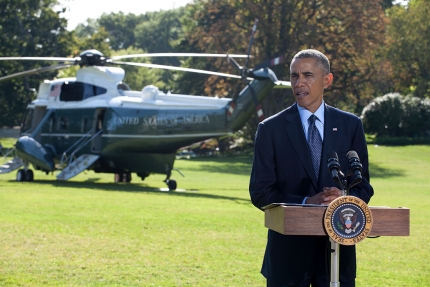
Statement by the President on Airstrikes in Syria

South Lawn

10:11 A.M. EDT

THE PRESIDENT:  Good morning, everybody.  Last night, on my orders, America’s armed forces began strikes against ISIL targets in Syria.  Today, the American people give thanks for the extraordinary service of our men and women in uniform, including the pilots who flew these missions with the courage and professionalism that we've come to expect from the finest military that the world has ever known.

Earlier this month, I outlined for the American people our strategy to confront the threat posed by the terrorist group known as ISIL.  I made clear that as part of this campaign the United States would take action against targets in both Iraq and Syria so that these terrorists can't find safe haven anywhere.  I also made clear that America would act as part of a broad coalition.  And that's exactly what we've done.

We were joined in this action by our friends and partners -- Saudi Arabia, the United Arab Emirates, Jordan, Bahrain, and Qatar.  America is proud to stand shoulder to shoulder with these nations on behalf of our common security. 

The strength of this coalition makes it clear to the world that this is not America’s fight alone.  Above all, the people and governments in the Middle East are rejecting ISIL and standing up for the peace and security that the people of the region and the world deserve. 

Meanwhile, we will move forward with our plans, supported by bipartisan majorities in Congress, to ramp up our effort to train and equip the Syrian opposition, who are the best counterweight to ISIL and the Assad regime.  And more broadly, over 40 nations have offered to help in this comprehensive effort to confront this terrorist threat -- to take out terrorist targets; to train and equip Iraqi and Syrian opposition fighters who are going up against ISIL on the ground; to cut off ISIL’s financing; to counter its hateful ideology; and to stop the flow of fighters into and out of the region.

Last night, we also took strikes to disrupt plotting against the United States and our allies by seasoned al Qaeda operatives in Syria who are known as the Khorasan Group.  And once again, it must be clear to anyone who would plot against America and try to do Americans harm that we will not tolerate safe havens for terrorists who threaten our people. 

I've spoken to leaders in Congress and I'm pleased that there is bipartisan support for the actions we are taking.  America is always stronger when we stand united, and that unity sends a powerful message to the world that we will do what’s necessary to defend our country.

Over the next several days I will have the opportunity to meet with Prime Minister Abadi of Iraq, and with friends and allies at the United Nations to continue building support for the coalition that is confronting this serious threat to our peace and security.  The overall effort will take time.  There will be challenges ahead.  But we're going to do what’s necessary to take the fight to this terrorist group, for the security of the country and the region and for the entire world.

Thanks.  God bless our troops.  God bless America.

END
10:14 A.M. EDT

President Obama Delivers a Statement on Airstrikes in Syria

President Obama Delivers a Statement on Airstrikes in Syria

President Barack Obama delivers a statement on confronting the terrorist group ISIL in Syria, on the South Lawn of the White House prior to departure for New York, N.Y. September 23, 2014. (Official White House Photo by David Lienemann)

Watch on YouTube

Last night, President Obama ordered American armed forces to begin targeted airstrikes against ISIL targets in Syria. Speaking from the White House South Lawn today, the President made it clear that these strikes are part of the U.S. campaign to deliver one message on ISIL: They will find no safe-haven.

The U.S. military actions also included strikes to disrupt plotting against the U.S. and our allies by the Khorasan Group -- seasoned al Qaeda operatives in Syria. 

Wishing You a Sweet, Happy, and Healthy New Year

Shanah Tovah from the White House! On Wednesday evening, Jews in the United States and around the world will begin celebrating Rosh Hashanah, the Jewish New Year.

The High Holidays offer the Jewish community a moment of pause, a time to reflect on the previous year and recommit to the unending task of Tikkun Olam, repairing the world. Together, working with people of all faiths, we can bring greater peace and prosperity to the world in 5775.

In his 2014 video message for the High Holidays, President Obama extends his wishes for a sweet new year and discusses why this time of year is so significant.

Watch on YouTube

Read the remarks: 

Hello. As Jews across America, Israel, and the world gather together for the High Holidays, Michelle and I extend our warmest wishes to you and your families for a sweet and happy new year.

My good friend Elie Wiesel once said that God gave human beings a secret, and that secret was not how to begin but how to begin again. These days of awe are a chance to celebrate that gift, to give thanks for the secret, the miracle of renewal.

In synagogues and homes over the coming days, Jews will reflect on a year that carried its shares of challenges. We’ve been reminded many times that our world still needs repair. So here at home we continue the hard work of rebuilding our economy and restoring our American dream of opportunity for all. Around the world, we continue to stand for the dignity of every human being, and against the scourge of anti-Semitism, and we reaffirm the friendships and bonds that keep us strong, including our unshakeable alliance with the State of Israel.

So let’s approach this new year with new confidence and new hope. Let’s recommit ourselves to living out the values we share as individuals and as a country. Above all, let’s embrace this God-given miracle of renewal, this extraordinary opportunity to begin again in pursuit of justice, prosperity, and peace. From my family to yours, shanah tovah.