The White House

Office of the Press Secretary

Background Conference Call on the President's Trip to Sweden and Russia

Via Telephone

5:07 P.M. EDT

SENIOR ADMINISTRATION OFFICIAL:  Thank you so much.  Hi, everyone.  Thanks for joining us this afternoon.  This conference call is to talk to you about the President's upcoming trip to Sweden and to Russia for the G20.  We've already done a conference call on Syria today, so we'll stick to the substance of the trip. 

The call is on background, attributable to senior administration officials.  And there's no embargo on this call. 

So I'll go ahead and turn it over to our first senior administration official to start the trip in Sweden. 

SENIOR ADMINISTRATION OFFICIAL:  As you know, Sweden is a close friend and partner of the United States.  And the President's visit to Sweden is an opportunity to consult with the Swedes and the other Nordic countries on a number of the items on our shared agenda, including climate change, international military operations, support for democracy and civil society in Europe and the Middle East, and global development. 

He will meet with the Swedish Prime Minster, Prime Minister Reinfeldt.  They will participate in a joint press conference.  Agenda topics will include climate change, defense and security cooperation, global development as well as trade and investment, including the Transatlantic Trade and Investment Partnership.  Of course, they will also have an opportunity to discuss important global issues, including Syria and Egypt. 

The President will then celebrate Raoul Wallenberg at the Great Synagogue.  The President will participate in that celebration of Wallenberg’s life.  And, as you will remember, he is the famed Swedish diplomat who rescued tens of thousands of Jews from Nazi-occupied Hungary.  That event will take place at the Great Synagogue of Stockholm, the heart of Sweden's Jewish community.  September 4th, the day we will be there, is the first day of Rosh Hashanah, the Jewish New Year.

The President will then move on to the Royal Institute of Technology, Sweden's leading technical university.  That institute exemplifies the cutting-edge research being done in Sweden to achieve the country's goal of becoming the world's first fossil fuel-free economy by 2050.  The President will tour three clean-energy exhibits on display at the campus library with researchers and project managers of these innovations serving as guides. 

The President will then participate in a dinner with Nordic leaders.  The Swedish Prime Minister will host that dinner for the President.  And he has invited the President of Finland and the prime ministers of Denmark, Iceland and Norway to that dinner.  The Nordics are small countries that make outsized contributions to protecting the environment, aiding the developing world, and promoting global peace and security.  The leaders will discuss ways we can take our cooperation on these issues to the next level.

Finally, the next day, on September 5, the President will meet with King Carl Gustav and Queen Silvia.  And that will conclude the visit to Stockholm.

SENIOR ADMINISTRATION OFFICIAL:  From there, on to St. Petersburg.  So we'll go to our next senior official who can talk about the G20. 

SENIOR ADMINISTRATION OFFICIAL:  So as you know, the G20 is the group of leaders from around the world, emerging and advanced economy countries that together account for about 80 percent of global GDP.  And as the need for effective international economic coordination is as powerful as ever, this is the premier forum for global discussions amongst leaders on these topics. 

St. Petersburg will be the seventh G20 summit that President Obama attends.  My colleague will talk later about how far we believe the global economy has come from Pittsburgh in 2009 to St. Petersburg in 2013, five years after the financial crisis.  The United States has helped to lead important consensus and discussions right from the beginnings in 2008-2009 to today. 

The economic context for this discussion is very different from last year in Los Cabos.  And indeed, it will be the first one since November 2010 that will not be dominated by urgent measures to resolve the financial crisis, initially in the United States and then in Europe.  We have a much better economy now.  Tensions in financial markets in Europe have eased substantially, although weak growth continues to be a concern.  There are some signs of improving fundamentals. 

Here in the United States, the economy is recovering.  We of course have more work to do, especially to bring down unemployment.  But the President will want to talk about our experience here and his plans to make college more affordable, to strengthen the housing market, to help responsible homeowners to refinance, and to create a better bargain for the middle class by reforming the tax code and making smart, pro-growth investments.

I think in St. Petersburg you will see a united focus around the importance of growth and job creation as the overriding priority for all the leaders when it comes to the global economy.  And that is something that we've worked towards that I believe will be evident this year. 

Turning to a few other initiatives this year, one is work in this forum to prevent tax evasion -- illegal tax evasion and legal tax avoidance, which is when companies use legal loopholes to reduce or avoid taxes.

These issues have been a core element of President Obama’s agenda since he first ran for President in 2008.  And on tax evasion, we have been the leader in passing and now beginning to implement legislation called FACTA that increases disclosure requirements to individuals and financial institutions to crack down on illegal tax evasion.  We hope in the G20 that we’ll make further progress towards having a FACTA-like standard as a single global standard.

We will also be working in St. Petersburg to get support globally for the kinds of measures that we have laid out for countries to close tax loopholes and avoid a race to the bottom where tax competition leads countries to lose revenue and companies to make inefficient decisions when they locate where they pay the lowest tax, rather than where it’s most productive for them to produce.

In some other areas, Russia -- we hope that St. Petersburg will move the ball forward on development, where whilst G20 countries produce, as I said, 28 percent of global GDP, they're also home to more than half of the world’s poor, so that's an important setting to have discussions about financial inclusion, food security, and so on.

We’ll also look forward to making progress on the President’s climate agenda and on work to reduce corruption internationally. 

And finally, let me say that in addition to everything that happens in the formal sessions, the summits are important opportunities for leaders to engage with each other privately on important matters.  So I’m now going to turn over to talk about the finance agenda.

SENIOR ADMINISTRATION OFFICIAL:  As we approach St. Petersburg, the U.S. economy is in the strongest position of any time since the G20 began while also achieving considerable fiscal consolidation.  The economy has now expanded for four years with private demand growth average 3 percent in recent years, and private employers have added more than 7 million jobs.

It is now clear our approach of putting jobs and growth at the center of macroeconomic policy has worked.  The steps we took paved the way to a U.S. recovery that is now a source of strength in the global economy.

In terms of our priorities, first, while global growth is improving, it remains weak.  G20 members need to boost domestic demand and create jobs.  This is our top priority in St. Petersburg.  We need to rededicate ourselves to promoting a lasting rebalancing of global demand.  We welcome signs that Europe’s long recession is ending and their critical steps to restore financial stability.  But important challenges remain, including boosting demand and addressing record-high unemployment levels.

In Japan, while we welcome efforts to escape deflation, it’s critical to see continued adherence to G7 commitments on orienting policy to domestic objectives and not hurting exchange rates.  We look forward to seeing Japan’s plan for structural reform, which will be key to unlocking domestic demand, as well as plans to calibrate fiscal adjustment to ensure an ongoing recovering demand.

The G20 must be attentive to global risks while recognizing these are diverse risks, including volatility in energy markets, weaker growth in China, and vulnerabilities built up in certain emerging markets.  Investors are now more carefully weighing risks based on country-specific factors no less than global factors.

When macroeconomic policy returns to normal it will be because the U.S. economy is gathering strength, and thus is a net positive for the global economy. 

In addition and very importantly, the arc from Pittsburgh to Petersburg has transformed the financial regulatory system.  In Pittsburgh, finance ministers and central bank governors were asked by leaders to develop an agreement on an international framework of reform.  Four years later, we’ve made substantial progress in implementing that internationally consistent framework of reforms in each of our financial systems.  And of course, the U.S. has led the way.

The international coordination on the implementation of these reforms is unprecedented.  In the months ahead, we will press the G20 to finish implementation so that we will be in a position to assess the impact on financial stability at the next G20 meeting following the lead of the U.S. on Dodd-Frank.

SENIOR ADMINISTRATION OFFICIAL:  Okay, thanks.  And quickly, we’ll just give you a sense of the G20 schedule that the President is going to keep.

SENIOR ADMINISTRATION OFFICIAL:  So the first working session that the leaders will have will deal with growth and the global economy.  That will be framed around the near- and medium-term global economic outlook and, as described, the policies to promote growth and stability.  Then leaders will have a working dinner to discuss growth with inclusive development. 

The following day, there will be a working session, and all of the working sessions have leaders but finance ministers are also there.  There will be a working session on investing in growth and job creation that will look at longer-term measures to raise growth and create jobs.  And then, finally, there will be a working lunch discussing growth and trade.

There will be bilaterals, just to anticipate possible questions, but these have not yet been nailed down.

SENIOR ADMINISTRATION OFFICIAL:  Yes, and we will provide more information as we confirm those meetings.  With that, I think that’s the opening from us, Operator.  We’re happy to take some questions.

Q    Hi, guys.  Thanks for doing the call.  Appreciate it.  I guess two questions.  You say bilats are still to come.  Is it fair to say we do not expect one with President Putin, as has been previously said?  Or is that still an open question?  And then, secondly, I know you say you don’t want to talk about Syria, but my guess is Syria probably will come up at the meeting in St. Petersburg.  How do you expect that to come up?  Will there be any kind of formal discussion, or will it only be on the sidelines?

SENIOR ADMINISTRATION OFFICIAL:  In terms of your second question on Syria, yes, of course it will come up in the margins.  These leaders are going to continue to consult about that.  There’s, at this point, no formal session or event that would involve Syria, but we know that leaders will be talking about it.

SENIOR ADMINISTRATION OFFICIAL:  On the first question, this is less a visit to Russia than a trip to the G20, which happens to be hosted by Russia.  And at this time there is no bilateral meeting or pull-aside expected between the Presidents.  Although, as my colleague explained, the President and President Putin are going to have many opportunities to engage during the course of the G20 session.

Q    To follow on what Peter was talking about, I know we’re not talking specifically about Syria on this call, but some of the leaders Obama is going to be encountering in St. Petersburg -- Cameron, Hollande, and Putin -- are the same leaders that he’s tangling with as he’s looking for international support for potential action.  So could you talk a little bit about how you expect that those tensions will play into the President’s interactions with some of his counterparts?

SENIOR ADMINISTRATION OFFICIAL:  Well, I would just remind people that this call is actually not about Syria and that we’re just -- the President is going to continue to consult with partners in the international community, and this is going to be part of the discussions.  But I think there’s a robust agenda of work to be done at the G20, and leaders are going to be focused on that.

How this plays out, I think, in part will depend on where we are several days from now.  There is still quite a bit of time before then.  So I don’t have anything specific for you in terms of exactly how we’re going to characterize those meetings.  But the consultations are going to have to continue, and the President will do that on the margins and in his bilats.  But I don’t really have any more information for you.

Q    Thank you for doing this call.  My question is this: In light of the latest developments in Syria and around Syria, do you believe that you will be able to work constructively with Russia on such issues as Geneva II, arms control issues, Afghanistan, counterterrorism, regardless of what’s going to happen in the next few days?  Thank you.

SENIOR ADMINISTRATION OFFICIAL:  Hi, yes, we do believe we can continue to work productively with Russia on a range of issues.  As the President said in his August 9th press conference, even as we paused on holding the bilateral summit with Russia, we’re absolutely prepared to cooperate pragmatically.  And between Russia and the United States, there are a set of policies that go to the very core of our strategic interests -- whether it’s the Northern Distribution Network, whether it’s cooperation on P5-plus-1 on Iran, and the six-party talks on North Korea. 

So I think we’re going to continue to be driven by our mutual strategic interest, and I don't see that cooperation should halt even as we have differences on tactics.  Russia and the United States have had relations that are often marked by both cooperation and contested policies.  So this is not new for us.

Q    Thank you.  I was wondering, are there any bilats scheduled with Japan or China or others?

SENIOR ADMINISTRATION OFFICIAL:  Hi, Roger.  As we said, the bilats are not yet nailed down.  We do expect the President will hold bilateral meetings.  And as soon as we have more information about those, we’ll get them around to people.  But just nothing confirmed yet.

Q    Yes, hello.  Given the fact that most of the news media focusing on the G20 has had to do with what’s not going to happen, that is the scheduled meeting between Putin and President Obama, is there any significance or symbolism in the fact that he’s talking to all the Scandinavian leaders, including on the issue of defense, as well as today meeting with the Baltic leaders who traditionally have been kind of most anti-Russia?  Is there a symbolic message that he’s sending with all these things?

SENIOR ADMINISTRATION OFFICIAL:  Thanks for that question.  The stop in Sweden is the result of a letter of invitation that came from the Swedish Prime Minister some time ago, so we’ve been thinking about making that trip.  And the cancellation of the Moscow summit is what allowed us to move forward now.  But beyond that scheduling consideration, you should read no larger linkage into the fact that now there’s a stop in Sweden on the way to St. Petersburg.

And, again, the scheduling that today the President met with the three Baltic leaders, that had been actually agreed some time ago.  So again, the timing ended up being what it is.  But it actually allows us to lift up the theme of promoting Nordic-Baltic cooperation, which is important in so many areas from energy to development assistance.

SENIOR ADMINISTRATION OFFICIAL:  I would just add one other dimension.  Cooperation with Russia has not halted.  On August 9th, we had the foreign and defense ministers meet here in Washington.  Since then, our trade representative, Mike Froman, has met with his Russian Minister of Economy counterpart.  We’ve held counterterrorism air exercises with the Russian military.  We’ve held missile defense and strategic stability discussions at the undersecretary level. 

We have a range of initiatives ongoing and conversations ongoing with Russia.  And there should not be the perception that the relationship is at a standstill and that we’re waiting for a conversation between the Presidents to start it up again.  To the contrary -- there are a variety of conversations ongoing.

SENIOR ADMINISTRATION OFFICIAL:  Thanks, very much.  Again, a reminder that this call is on background.  These are senior administration officials.  And thanks very much.

END
5:27 P.M. EDT

The White House

Office of the Press Secretary

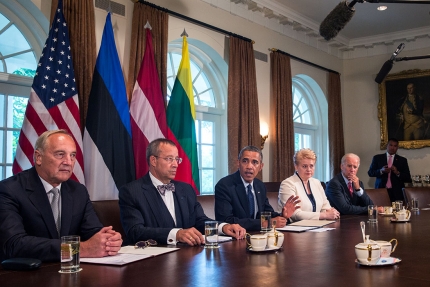
Remarks by President Obama and the Presidents of Estonia, Lithuania, and Latvia

2:22 P.M. EDT

PRESIDENT OBAMA:  Well, obviously, I’m very grateful to have my fellow Presidents here, as well as the Vice President.  Before I begin, I want to say a few words about the situation in Syria. 

As you’ve seen, today we’ve released our unclassified assessment detailing with high confidence that the Syrian regime carried out a chemical weapons attack that killed well over 1,000 people, including hundreds of children.  This follows the horrific images that shocked us all.   

This kind of attack is a challenge to the world.  We cannot accept a world where women and children and innocent civilians are gassed on a terrible scale.  This kind of attack threatens our national security interests by violating well-established international norms against the use of chemical weapons by further threatening friends and allies of ours in the region, like Israel and Turkey and Jordan.  And it increases the risk that chemical weapons will be used in the future and fall into the hands of terrorists who might use them against us.

So I have said before and I meant what I said, that the world has an obligation to make sure that we maintain the norm against the use of chemical weapons.  Now, I have not made a final decision about various actions that might be taken to help enforce that norm.  But as I’ve already said, I have had my military and our team look at a wide range of options.  We have consulted with allies.  We’ve consulted with Congress.  We’ve been in conversations with all the interested parties. 

And in no event are we considering any kind of military action that would involve boots on the ground; that would involve a long-term campaign.  But we are looking at the possibility of a limited, narrow act that would help make sure that not only Syria, but others around the world, understand that the international community cares about maintaining this chemical weapons ban and norm. 

Again, I repeat, we’re not considering any open-ended commitment.  We’re not considering any boots-on-the-ground approach.  What we will do is consider options that meet the narrow concern around chemical weapons, understanding that there’s not going to be a solely military solution to the underlying conflict and tragedy that’s taking place in Syria.  And I will continue to consult closely with Congress. 

In addition to the release of the unclassified document, we are providing a classified briefing to congressional staff today, and we’ll offer that same classified briefing to members of Congress as well as our international partners.  And I will continue to provide updates to the American people as we get more information.

With that, I want to welcome President Ilves, President Grybauskaitė, and President Bērziņš to the White House.  These countries that they represent all share very deep ties to the United States, both as allies and because of the extraordinary people-to-people relations that we have with these countries.

I want to thank all the Presidents who are here, and their nations, for all that they do to promote democracy not only in their own countries but around the world.  The Baltics are among our most reliable allies in NATO, and our commitment to their security is rock-solid.  Our soldiers sacrifice together in Afghanistan, and the Baltics, of course, continue to help support our troops as we transition the NATO mission.

Today we’re going to spend some time talking about shared commitments to the Transatlantic Trade and Investment Partnership negotiations, which will add jobs in the Baltics and the United States.  We’re working on development assistance projects, including building institutions and strengthening civil society in the emerging democracies of Eastern Europe and Central Asia.  We will obviously have discussions about our NATO relationship and the security concerns that we share together. 

So, again, I’ve had occasions to meet with all three Presidents in a wide variety of settings and wide variety of summits.  They have been outstanding friends to the United States of America.  We are very proud of them.  And I want to thank each of them for their leadership.  We know how far Estonia, Latvia, and Lithuania have come in just the past two decades, and I know that we’ll accomplish even more in the decades to come.

So with that, I want to give each of these leaders a chance to say a few words.  We’re going to start with President Ilves.

PRESIDENT ILVES:  Thank you.  I’d actually like to begin by thanking President Obama for inviting us here, and we are quite grateful to the United States and to you personally for your leadership, commitment and support.

The main issue on our agenda today is global and regional security, and the question, of course, on everyone’s mind is the situation in Syria.  For Estonia, the use of chemical weapons is deplorable.  The attack demands a response.  Those responsible must be held accountable.  Violations cannot be overlooked.

When it comes to our security, we appreciate the commitment that the United States has shown to our region and Europe as a whole, and we attach great importance to continued U.S. engagement in European security.

The transatlantic security link is unique and enduring as are the common values that underpin it.  As a NATO ally, Estonia takes its responsibility for our common defense seriously.  We are currently and will maintain committed to NATO’s mission in Afghanistan.  We spend 2 percent of our GDP on defense.

We also believe in maintaining a strong transatlantic link in other areas, such as trade, cyber and energy security.  I look forward to exchanging views on all of these issues, as I also look forward to discussing what we can do together internationally to promote our common values:  democracy, human rights, rule of law.

We already cooperate in countries that lie to the east and the south of us -- Ukraine, Moldova, and Georgia, and Tunisia, as well, just to name a few.  I am sure that this global cooperation aimed at helping countries transition from authoritarian to democratic rule will be expanded in the future.

Recently, we’ve heard a lot of talk about pivots.  Today we are on the verge of a new rebalancing of the U.S. focus, this time to the Nordic-Baltic region.  Our region is one of the most secure, stable, and prosperous in Europe.  We are proud to be part of it.  We are proud of the partnership we have with the United States here, just as we are proud of our alliance and the enduring friendship of the American people.

PRESIDENT OBAMA:  Madam President.

PRESIDENT GRYBAUSKAITÈ:  So adding in line, I would like to emphasize that to go with the matter of security in the region, we are talking about economic security in the region.  And here, especially on energy security, the United States plays a very serious role.

We opened in our region already, in Vilnius, the NATO Center of Excellence for Energy Security, and bilaterally with the United States, the Center for Nuclear Security.  And this is important because we are on the borders of NATO with some other not-so-secure regions, and why this involvement of the United States is so important for all of our region.

And of course, as a country which presides today the European Union’s Council, we are engaged very much in starting negotiations on the free trade agreement between the United States and European Union.  And I’m very happy that we got one meeting, and now we were thinking October for a second one.  And I think that it is a generational challenge and opportunity for all of us -- for United States and Europe -- to move fast these kinds of relations and to have very efficient and resultative outcome.  And I hope that we will be able to do it fast.

So together with the military new challenges, we are trying to battle new economic challenges together with the cyber challenges, which our region all the time receives and receives.  And I want to say that every day, every day practically we see this aggressiveness and new forms of challenges our region is facing, so why I just can also confirm that Baltic and Nordic cooperation is a new phenomena -- I would say unique phenomena in Europe, which is very much reliable and you can find from us as being -- we are strategic partners for the United States.

PRESIDENT OBAMA:  Mr. President.

PRESIDENT BĒRZINŠ:  This week is important for American people, 50th anniversary of March on Washington.  As I say, for us, this is 15 years over when Baltic-American Charter was signed.  This is the right moment to review and to move forward.

For us, we are thankful to you giving your presidential time to the determined goals of the Baltic nation -- U.S.-led military exercise in Baltics strengthen Nordic -- the distribution network to Afghanistan.  British-American Freedom Fund, which helps Baltic students to study in American universities.

Of course, we see -- together, at the same time being very active in Europe -- we will become members of eurozone on the 1st of January.  We are actually working at the same time to become members of OECD.  And of course, our focus is to look for new possibilities in Europe using our past experience.  We are focusing to Central Asia countries and also to Eastern Partnership countries.  And this is particularly important in relations to Afghanistan and to develop this country in a peaceful manner.

Latvia has past crisis, but at the same time, we have to do much, much more.  And having this really good NATO support and such partners as U.S., we can move forward.  And it’s clear that today’s meeting is a reason and demonstration of the stable, long-term interest of the United States and Baltics.  And we are proud, free, and at peace.

Thank you.

PRESIDENT OBAMA:  Thank you so much.

 Q    Mr. President, is your decision on Syria imminent?  And why did you feel like it's appropriate to move forward without formal authorization from either the United Nations or Congress, particularly given that the British Parliament had an opportunity to vote?

PRESIDENT OBAMA:  We are still in the planning process.  And obviously, consultations with Congress as well as the international community are very important.  And my preference obviously would have been that the international community already acted forcefully.  But what we have seen, so far at least, is a incapacity at this point for the Security Council to move forward in the face of a clear violation of international norms.

And I recognize that all of us -- here in the United States, in Great Britain, in many parts of the world there is a certain weariness given Afghanistan; there's a certain suspicion of any military action post-Iraq.  And I very much appreciate that.  On the other hand, it's important for us to recognize that when over a thousand people are killed, including hundreds of innocent children, through the use of a weapon that 98 or 99 percent of humanity says should not be used even in war, and there is no action, then we're sending a signal that that international norm doesn't mean much.  And that is a danger to our national security.

And, obviously, if and when we make a decision to respond, there are a whole host of considerations that I have to take into account, too, in terms of how effective it is.  And given the kind of options that we're looking at, they would be very limited and would not involve a long-term commitment or a major operation. 

We are confident that we can provide Congress all the information and get all the input that they need, and we're very mindful of that.  And we can have serious conversations with our allies and our friends around the world about this.  But, ultimately, we don't want the world to be paralyzed. 

And, frankly, part of the challenge that we end up with here is that a lot of people think something should be done, but nobody wants to do it.  And that's not an unusual situation.  And that's part of what allows over time the erosion of these kinds of international prohibitions, unless somebody says:  No, when the world says we're not going to use chemical weapons, we mean it. 

And it would be tempting to leave it to others to do it.  And I think I've shown consistently and said consistently my strong preference for multilateral action whenever possible.  But it is not in the national security interests of the United States to ignore clear violations of these kinds of international norms. 

And the reason is because there are a whole host of international norms out there that are very important to us.  We have currently rules in place dealing with the proliferation of weapons of mass destruction.  We have international norms that have been violated by certain countries, and the United Nations has put sanctions in place.  But if there's a sense that over time nobody is willing to actually enforce them, then people won't take them seriously.

So I'm very clear that the world generally is war-weary.  Certainly, the United States has gone through over a decade of war.  The American people, understandably, want us to be focused on the business of rebuilding our economy here and putting people back to work.  And I assure you, nobody ends up being more war-weary than me. 

But what I also believe is that part of our obligation as a leader in the world is making sure that when you have a regime that is willing to use weapons that are prohibited by international norms on their own people, including children, that they are held to account.

                        END                2:40 P.M. EDT

President Obama Meets with Baltic Leaders

President Barack Obama, with Vice President Joe Biden, delivers a statement to the press before meeting with Baltic Leaders

President Barack Obama, with Vice President Joe Biden, delivers a statement to the press before meeting with Baltic Leaders in the Cabinet Room of the White House, Aug. 30, 2013. The meeting included, from left, Latvia President Andris Běrzinš, Estonia President Toomas Hendrik Ilves, and Lithuania President Dalia Grybauskaite. (Official White House Photo by Amanda Lucidon)

Today, President Obama hosted Estonian President Toomas Hendrik Ilves, Lithuanian President Dalia Grybauskaitė, and Latvian President Andris Bērziņš for a meeting at the White House.

The visit underscored the close ties between the United States and the Baltic states, which are grounded in our shared values, ideals, and interests.  The leaders highlighted ongoing cooperation on issues including defense and security, trade and investment, energy and the environment, and global development.

President Obama Makes a Statement on Syria

August 30, 2013 | 3:41 | Public Domain

Following a meeting with Baltic leaders at the White House, President Obama makes a statement about the situation in Syria.

Download mp4 (133MB) | mp3 (9MB)

The White House

Office of the Press Secretary

Readout of the President’s Phone Call with President Hollande of France

The President and President Hollande spoke today as part of their continuing consultations regarding the Assad regime’s use of chemical weapons on August 21.  The two leaders agreed that the international community cannot tolerate the use of chemicals weapons and must hold the regime accountable and send a strong message that the use of chemical weapons is not acceptable.  The United States and France are close allies and friends, and we will continue to consult closely with France on Syria and other global security challenges.

The White House

Office of the Press Secretary

Letter from the President -- Regarding Alternate Pay Plan for Members of the Uniformed Services

TEXT OF A LETTER FROM THE PRESIDENT
TO THE SPEAKER OF THE HOUSE OF REPRESENTATIVES
AND THE PRESIDENT OF THE SENATE
 
August 30, 2013
 
Dear Mr. Speaker: (Dear Mr. President:)
 
I am transmitting an alternative plan for monthly basic pay increases for members of the uniformed services for 2014.
 
I am strongly committed to supporting our uniformed service members, who have made such great contributions to our Nation over the past decade of war. As our country continues to recover from serious economic conditions affecting the general welfare, however, we must maintain efforts to keep our Nation on a sustainable fiscal course. This effort requires tough choices, especially in light of budget constraints faced by Federal agencies.
 
Accordingly, I have determined it is appropriate to exercise my authority under section 1009(e) of title 37, United States Code, to set the 2014 monthly basic pay increase at 1.0 percent. This decision is consistent with my fiscal year 2014 Budget and will not materially affect the Federal Government's ability to attract and retain well-qualified members for the uniformed services.
 
The adjustments described above shall take effect on the first applicable pay period beginning on or after January 1, 2014.
 

Sincerely,

BARACK OBAMA

The White House

Office of the Press Secretary

Letter from the President -- Regarding Alternate Pay for Civilian Federal Employees


TEXT OF A LETTER FROM THE PRESIDENT
TO THE SPEAKER OF THE HOUSE OF REPRESENTATIVES
AND THE PRESIDENT OF THE SENATE

August 30, 2013

Dear Mr. Speaker: (Dear Mr. President:)

I am transmitting an alternative plan for pay increases for civilian Federal employees covered by the General Schedule (GS) and certain other pay systems for 2014.

Civilian Federal employees have already made significant sacrifices as a result of a three-year pay freeze. As our country continues to recover from serious economic conditions affecting the general welfare, however, we must maintain efforts to keep our Nation on a sustainable fiscal course.

Accordingly, I have determined that it is appropriate to exercise my statutory alternative plan authority under 5 U.S.C. 5303(b) and 5304a to set alternative 2014 across-the-board and locality pay adjustments. Specifically, I have determined that for 2014, across-the-board pay increases will be 1.0 percent, and the current locality pay percentages shown in Schedule 9 of Executive Order 13641 of April 5, 2013, will remain at their 2013 levels. This decision will not materially affect the Federal Government's ability to attract and retain a well-qualified Federal workforce.

The adjustments described above shall take effect on the first applicable pay period beginning on or after January 1, 2014.

Sincerely,

BARACK OBAMA

The White House

Office of the Press Secretary

Presidential Proclamation -- Labor Day, 2013

LABOR DAY, 2013

- - - - - - -

BY THE PRESIDENT OF THE UNITED STATES OF AMERICA

A PROCLAMATION

On September 5, 1882, in what is thought to be the first Labor Day event, thousands of working Americans gathered to march in a New York City parade. In the 131 years since, America has called on our workers time and again -- to raise and connect our cities; to feed, heal, and educate our Nation; to forge the latest technological revolution. On Labor Day, we celebrate these enduring contributions and honor all the men and women who make up the world's greatest workforce.

America is what it is today because workers began to organize -- to demand fair pay, decent hours, safe working conditions, and the dignity of a secure retirement. Through decades upon decades of struggle, they won many of the rights and benefits we too often take for granted today, from the 40-hour work week and minimum wage to safety standards, workers' compensation, and health insurance. These basic protections allowed the middle class to flourish. They formed the basis of the American dream and offered a better life to anyone willing to work for it.

Yet over the past decades, that promise began to erode. People were working harder for less, and good jobs became more difficult to find. My Administration remains committed to restoring the basic bargain at the heart of the American story. We are bringing good jobs back to the United States. We are expanding programs that train workers in tomorrow's industries, and we eliminated tax breaks that benefited the wealthiest Americans at the expense of the middle class. In the years to come, I will continue to support collective bargaining rights that strengthen the middle class and give voice to workers across our Nation. And I will keep pushing for a higher minimum wage -- because in America, no one who works full-time should have to live in poverty.

Thanks to the grit and resilience of the American worker, we have cleared away the rubble of the worst recession since the Great Depression. Now is the time to reward that hard work. Today, as America celebrates working people everywhere, we unite behind good jobs in growing industries, and we strengthen our resolve to rebuild our economy on a stronger foundation.

NOW, THEREFORE, I, BARACK OBAMA, President of the United States of America, by virtue of the authority vested in me by the Constitution and the laws of the United States, do hereby proclaim September 2, 2013, as Labor Day. I call upon all public officials and people of the United States to observe this day with appropriate programs, ceremonies, and activities that honor the contributions and resilience of working Americans.

IN WITNESS WHEREOF, I have hereunto set my hand this thirtieth day of August, in the year of our Lord two thousand thirteen, and of the Independence of the United States of America the two hundred and thirty-eighth.

BARACK OBAMA

The White House

Office of the Press Secretary

Presidential Proclamation -- National Ovarian Cancer Awareness Month, 2013

NATIONAL OVARIAN CANCER AWARENESS MONTH, 2013
 
- - - - - - - 
 
BY THE PRESIDENT OF THE UNITED STATES OF AMERICA
 
A PROCLAMATION
 
Each September, America calls attention to a deadly disease that affects thousands of women across our country. This year, over 22,000 women will develop ovarian cancer, and more than half that number of women will die of this disease. During National Ovarian Cancer Awareness Month, we lend our support to everyone touched by this disease, we remember those we have lost, and we strengthen our resolve to better prevent, detect, treat, and ultimately defeat ovarian cancer.
 
Because ovarian cancer often goes undetected until advanced stages, increasing awareness of risk factors is critical to fighting this disease. Chances of developing ovarian cancer are greater in women who are middle-aged or older, women with a family history of breast or ovarian cancer, and those who have had certain types of cancer in the past. I encourage all women, especially those at increased risk, to talk to their doctors. For more information, visit www.Cancer.gov.
 
My Administration is investing in research to improve our understanding of ovarian cancer and develop better methods for diagnosis and treatment. As we continue to implement the Affordable Care Act, women with ovarian cancer will receive increased access to health care options, protections, and benefits. Thanks to this law, insurance companies can no longer set lifetime dollar limits on coverage or cancel coverage because of errors on paperwork. By 2014, the health care law will ban insurers from setting restrictive annual caps on benefits and from charging women higher rates simply because of their gender. Additionally, insurance companies will be prohibited from denying coverage or charging higher premiums to patients with pre-existing conditions, including ovarian cancer.
 
This month, we extend a hand to all women battling ovarian cancer. We pledge our support to them, to their families, and to the goal of defeating this disease.
 
NOW, THEREFORE, I, BARACK OBAMA, President of the United States of America, by virtue of the authority vested in me by the Constitution and the laws of the United States, do hereby proclaim September 2013 as National Ovarian Cancer Awareness Month. I call upon citizens, government agencies, organizations, health care providers, and research institutions to raise ovarian cancer awareness and continue helping Americans live longer, healthier lives. I also urge women across our country to talk to their health care providers and learn more about this disease.
 
IN WITNESS WHEREOF, I have hereunto set my hand this thirtieth day of August, in the year of our Lord two thousand thirteen, and of the Independence of the United States of America the two hundred and thirty-eighth.
 
BARACK OBAMA
 

The White House

Office of the Press Secretary

President Obama Announces More Key Administration Posts

WASHINGTON, DC – Today, President Obama announced his intent to appoint the following individuals to key Administration posts:

  • Rear Admiral Gerd F. Glang – Commissioner, Mississippi River Commission
  • Lynnae M. Ruttledge – Member, Commission on Long-Term Care
  • James J. Zogby – Member, United States Commission on International Religious Freedom 

President Obama said, “I am confident that these outstanding individuals will greatly serve the American people in their new roles, and I look forward to working with them in the months and years to come.”

President Obama announced his intent to appoint the following individuals to key Administration posts:

Rear Admiral Gerd F. Glang, Appointee for Commissioner, Mississippi River Commission

Rear Admiral Gerd F. Glang is Director of the Office of Coast Survey for the National Ocean Service at the National Oceanic and Atmospheric Administration (NOAA).  He has held this position since 2012, and also serves as the U.S. National Hydrographer.  His previous positions at NOAA include Chief of the Hydrographic Surveys Division, Chief of the Hydrographic Systems and Technology Programs, and Northeast Regional Navigation Manager.  He has served as Commanding Officer of the NOAA ships Whiting and Ronald H. Brown.  He was a Commissioned Officer of the United States Air Force from 1984 to 1989.  He has received the Silver Medal and two Bronze Medals from the Department of Commerce, the Air Force Commendation medal, the Coast Guard Commendation medal, and two NOAA Corps Commendation Medals.  Rear Admiral Glang received a Bachelor of Engineering in Electrical Engineering and a U.S. Coast Guard Deck Officer License from the State University of New York Maritime College.

Lynnae M. Ruttledge, Appointee for Member, Commission on Long-Term Care
Lynnae M. Ruttledge is a disability policy advisor to Daughters of Charity, Technology Research Into Disability, an international research institute.  Ms. Ruttledge was appointed to be a Member of the National Council on Disability in January 2013, and currently serves as Co-Vice Chair. Ms. Ruttledge served as Commissioner of the Rehabilitation Services Administration with the U.S. Department of Education from 2010 to 2012.  From 2005 to 2009, she served as Director of the Division of Vocational Rehabilitation with the Washington Department of Social and Health Services.  Previously, Ms. Ruttledge held various positions at the Oregon Department of Human Services from 1986 to 2005, starting in the mental health division and ultimately serving as a member of the executive leadership team with the Office of Vocational Rehabilitation Services.  She began her career as a public school teacher in Michigan.  In 2007, she received the Washington Governor’s Award for Leadership in Management.  Ms. Ruttledge received a B.S. from Northern Michigan University.

Dr. James J. Zogby, Appointee for Member, United States Commission on International Religious Freedom

Dr. James J. Zogby is President of the Arab American Institute, which he founded in 1985.  He is also Managing Director of Zogby Research Services, and a Visiting Professor of Social Research and Public Polling at New York University in Abu Dhabi, United Arab Emirates.  In 1982, he co-founded Save Lebanon, Inc., a non-profit relief organization which funds social welfare projects in Lebanon.  Earlier in his career, Dr. Zogby co-founded the Palestine Human Rights Campaign and the American-Arab Anti-Discrimination Committee.  He is the current Chairman of the Editorial Advisory Committee for SkyNewsArabia News.  He has hosted various television programs, including A Capital View on MBC from 1993 to 2001, and Viewpoint with James Zogby on Abu Dhabi Television from 2001 to 2011.  His column, “Washington Watch,” is currently published in 14 Arab and South Asian countries.  He is a member of the Council on Foreign Relations.  Dr. Zogby received a B.A. from Le Moyne College and a Ph.D. in Comparative Religions from Temple University.