President Obama Travels to St. Petersburg for the G-20

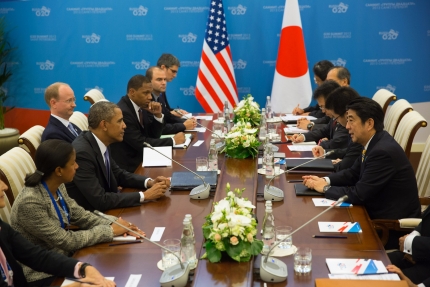
President Barack Obama, left, and Japan's Prime Minister Shinzo Abe, right, during their bilateral meeting at the G20 Summit

President Barack Obama, left, and Japan's Prime Minister Shinzo Abe, right, during their bilateral meeting at the G20 Summit in St. Petersburg, Russia, Sept. 5, 2013 . (Official White House Photo by Lawrence Jackson)

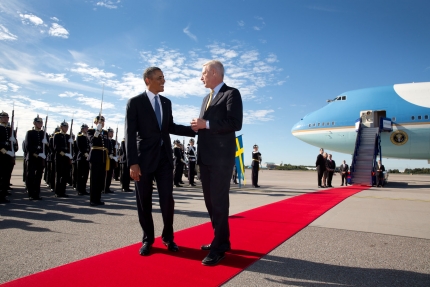
This morning, President Obama met with the King and Queen of Sweden before flying to St. Petersburg for the G-20 Summit.

After arriving in St. Petersburg, President Obama held a bilateral meeting with Prime Minister Abe of Japan. “The U.S.-Japan alliance is one of the cornerstones not just of Japan’s and America’s security, but also a cornerstone for peace and security around the world,” President Obama said before the bilateral meeting.

Here at the G20, our primary purpose is to focus on the economy and how we can improve the world’s prospects for jobs and growth and stability.  And I know that Prime Minister Abe has taken some very bold steps to boost growth and jobs and demand in Japan.

Watch this video on YouTube

The White House

Office of the Press Secretary

Briefing by Ben Rhodes on the Bilateral with Japan

Konstantinovsky Palace
St. Petersburg, Russia

5:50 P.M. MSK

MR. RHODES:  I'm just going to do a readout of the meeting between the President and Prime Minister Abe of Japan, and then can take a few questions on that.

The President and the Prime Minister began with a discussion of the situation in Syria, building on the conversation they had over the phone earlier in the week.  I think the two leaders are in agreement that the use of chemical weapons is unacceptable and demands a strong international response.  They agreed to stay in close coordination on the issue as we move forward.  And I imagine we'll be continuing to discuss Syria on the margins of the summit with Japan and beyond the summit as well.

They discussed a range of alliance issues.  On the economic side, they discussed TPP and the importance of concluding an agreement by the end of the year, and they discussed some of the issues that need to be addressed as a part of the effort to reach that agreement by the end of the year and noted the importance of the APEC Summit next month as a milestone on the way to that process.

On North Korea, the two leaders underscored their commitment to work together towards the denuclearization of the Korean Peninsula.  The President noted the importance of close trilateral cooperation between the United States and Korea and Japan, as well as continued efforts with other members of the six parties, including China and Russia, and the broader international community.

They discussed the Senkakus and the President made clear that he was opposed to any effort to resolve the Senkakus issue through coercion and underscored the importance of diplomacy and dialogue, which Prime Minister Abe referenced as his preferred course of action. 

They also agreed to consult on broader defense issues in the alliance.  They agreed to stay in close contact as Japan reviews its own defense posture going forward, and noted the importance of the upcoming two-plus-two meetings with Secretary Kerry and Secretary Hagel meeting their Japanese counterparts.  And they discussed the need to continue to move forward to implement our shared plan on the Futenma realignment associated with U.S. forces in Japan.

And with that, I can take your questions.

Q    Did the Japanese sign on to the need for a military response to what happened in Syria?

MR. RHODES:  Well, again, I don't want to speak for the Japanese; I'll let them speak to their position.  What I will say is that the U.S. and Japan were in agreement that there needs to be a response, that the international norm surrounding chemical weapons needs to be upheld.  And in the spirit of our alliance, we have -- I think the two leaders have an expectation that we'll be able to reach a shared position on Syria.

So, again, it was a productive discussion in that regard, and we welcome Japan’s continued insistence that there be a response to the use of chemical weapons.

Q    Was there anything that the President was asking Abe for as it relates to Syria?  You had talked in the gaggle earlier about looking for political and diplomatic assistance.  Is that like the kind of thing he was looking for from him?

MR. RHODES:  The question was, was the President asking for anything related to Syria.  I think that there are two aspects to that, Julie.  First, with respect to chemical weapons, I think what we’d like to see are countries coming forward to take the position that we have taken that the use of chemical weapons is unacceptable; that while we have a preference for the U.N. Security Council resolving these issues, the Security Council has been paralyzed, and that, therefore, there needs to be an international response to the use of chemical weapons.  And we’ll continue to discuss with Japan and other countries the type of political support that they can express for that position going forward.

But the broader situation in Syria -- they did discuss Japan’s continued support on the political and humanitarian side. And I think the commitments from other countries to help deal with the humanitarian crisis, including the refugee crisis, is important, and Japan has been a contributor in terms of helping neighboring countries absorb refugee flows and help provide humanitarian support to the Syrian people.  And the Prime Minister expressed his desire to continue to work on those issues with the United States and other countries.

And similarly, on the Geneva process, which provides the ultimate pathway towards a political resolution to Syria’s civil war, Prime Minister Abe expressed his strong support for working on behalf of that process going forward.

Q    A couple on another subject.  Is there anything further on Obama’s interaction with Putin?  And second, did the President get any additional Syria support so far today?

MR. RHODES:  With respect to Mr. Putin, they obviously greeted one other at the beginning of the summit as they were coming in.  Beyond that, I have no updates on any scheduled interactions between the two of them.  I’m sure they’ll be interacting within the context of the summit.

And on your second question, the President hasn’t seen other leaders on the matter of Syria since he’s been here other than Prime Minister Abe.  So I think we had a good meeting with Prime Minister Abe.  We’re encouraged by Japan’s position on Syria.  We’re going to continue to consult closely with them. 

And we’ll let you know -- clearly, the President will have interactions on the margins of the summit that touch on Syria, so we’ll keep you updated on those going forward.  But we’re in the early stages here.

Peter.

Q    Has the President been making personal phone calls to members of Congress on the Hill while he’s here?

MR. RHODES:  It’s my understanding that -- I was asked this morning and I owe you guys a list.  So he is going to be doing outreach on the Hill, and we’ll email you guys those calls as we get them compiled.

Q    A question about Japan.  Did the President specifically talk about the military action?  And, secondly, do you have a sense that you got support for military action from Japan?

MR. RHODES:  The President did update Prime Minister Abe on the type of action that we’re contemplating in Syria and the strength of our views that the Syrian regime must be held accountable.  Again, we had I think a broad expression of support from the Prime Minister on what we’re trying to do in terms of enforcing an international norm around chemical weapons.

Again, I want to let the Japanese government speak to its formal position on these matters, but our general sense was it was a positive meeting and the two leaders will be able to continue to consult closely on these matters going forward.  So again, we felt like we had very positive signal from Japan on its commitment to upholding this international norm and to the notion that there’s need to be international response.  And I’ll let them to speak to any more details associated with their position.

Q    (Inaudible.)

MR. RHODES:  Well, I think, as a general matter, we would like to see public expressions of support from countries that are invested in the international norm prohibiting the use of chemical weapons.  So we would like to see on a political and diplomatic level countries insisting that the international norm against chemical weapons be upheld.  We’d like to see an acknowledgement that, while the U.N. Security Council is the preferred course of action, that we cannot be paralyzed by the inaction of the Security Council either.

And so I think we’ll be working over the course of the next two days on the margins of a summit that is dedicated to economic issues to enlist continued support politically, diplomatically from other countries. 

Again, as I said earlier today, we would never expect to achieve full consensus among the countries here because Russia just takes a different position on the issue of Syria generally. But in terms, in particular, of our friends, our allies, our partners around the world, we believe it’s important for people to raise their voices on behalf of international norms that countries around the world have signed onto for many years.

Q    Just a question about the dinner tonight.  Can you give any preview of what the President hopes to say about Syria?  Putin said in his opening remarks that there would be some discussion over the dinner about Syria, and I’m wondering what the President plans to say and what kind of case he’s going to make to the other world leaders. 

MR. RHODES:  So on Syria, what the President will be saying is the same case he’s been making to the American people he’ll be making here on the world stage when Syria comes up, which is, first of all, that the international norm against the use of chemical weapons is fundamental to global peace and security; that it’s manifested in agreements like the Geneva Protocol and the Chemical Weapons Convention that express a prohibition on the use of chemical weapons; that in order for the prohibition of chemical weapons to mean something, there needs to be enforcement associated with that norm. 

Secondly, I think he’ll reiterate his very strong confidence that the responsible party for the use of chemical weapons was the Assad regime.  We have as high confidence as we can have in terms of the U.S. intelligence community in the evidence that we have seen that points directly to the Assad regime as the responsible party.  We also have sarin samples that confirm through physiological evidence that a chemical attack occurred, in addition to the overwhelming abundance of publicly available information that points to a chemical weapons attack.

And third, I think the President will speak to the notion that the United Nations has a critical role to play but that the United Nations Security Council has been paralyzed on this issue, so that we’re not interested in simply drawing out a process at the U.N. that is not going to lead to a result.  And given the inability to pass any resolution at the Security Council associated with Syria in recent years, including three vetoes and including the inability to even move forward on a resolution that just expressed condemnation generally about the use of chemical weapons, we believe that we can’t use our preferences for the United Nations Security Council as a reason to not take action to enforce this international norm.

And then, lastly, I think the President will make the point that we are dealing with the issue of chemical weapons here.  The military response that we are currently calling for with Congress is focused on degrading Assad’s capabilities and deterring future use of chemical weapons.  But at the same time, we’ve made clear that it’s not intended to resolve all the issues in Syria because, frankly, we don’t think there is a military solution.

So even as there may be differences with a country like Russia on the issue of how we respond to chemical weapons, ultimately we’re going to have to reinvest in a political process through Geneva, which is the existing framework, to bring about an end to the Syrian civil war.  And in our belief there’s no way that a leader who has killed thousands of his people, including gassing many of them to death, will have legitimacy to lead on the other end of that process, which is why we think Assad needs to go.

So I think those are the core points the President has been making and I expect he’ll make the same case here on the international stage.

Q    Ben, just one question.  Most of the allies -- there was a press conference this morning with the European Union and some other leaders in Europe -- are aligned with the U.S. in attacking and criticizing the use of chemical warfare.  The difference is how to respond.  And the general position that we gather from Europe, except from France, was why don’t we try to get sanctions?  Why don’t we try to punish Syria in a different way and so without a military attack?  So should that prevail as a line?   And should Russia support a resolution with very strong sanctions would the U.S. consider not proceeding with a military attack?

MR. RHODES:  We believe that the nature of this chemical weapons attack is such a flagrant violation of the international norm prohibiting the use of chemical weapons that it demands a strong response, and in this instance a military response -- albeit a limited military response.

This is the case we'll be making to our European allies.  We have had political support from them for the notion that the use of chemical weapons is unacceptable and demands a response.  We've had expressions of support from a country like France, which has indicated an interest in potentially being a part of an operation. 

But at the same time, when you talk about sanctions, I think the U.S. and the EU have basically thrown the book at the Assad regime in terms of sanctions.  Early in the conflict we moved in a coordinated fashion to cut off Assad from the European and American economies.  And I will say that the European efforts in that regard have had a significant impact on the revenues that the Assad regime is able to access.

In the past, the United Nations Security Council has failed on several occasions to pass a Chapter 7 resolution imposing any sanctions.  So we simply do not foresee the U.N. Security Council acting any differently in this instance, given Russia’s support for the Assad regime.  And we do believe that the level of violation committed by Syria merits a response that imposes a deterrent military cost on the regime, because if there’s a sense from Assad that he can use these weapons with impunity, that emboldens him to use chemical weapons, that emboldens future dictators and terrorist groups to use chemical weapons.  It risks unraveling the prohibition against the use of chemical weapons, which could put citizens and parties in conflict in the future in far greater harm.  And it’s further destabilizing to a region in which the United States has a number of close allies and partners, such as Turkey, Jordan and Israel.

Q    There is a report that Prime Minister Abe invited officially President Obama to visit Japan.  So what is President Obama’s response?

MR. RHODES:  He did extend that invite, and what the President said -- he always likes to go to Japan.  He’s been there twice as President, obviously traveled before, so he would very much like to go to Japan and accept that invitation.  It’s just a matter of determining at what point in the future it makes sense to go forward with that visit.  So it’s just something that we'll have to work out.

Clearly this year, the President has a full schedule in Asia, so we'll look for opportunities in the future to be able to have the President return to Japan and accept that invitation.

Q    (Inaudible.)

MR. RHODES:  Until our schedule is done it’s still an open question.  I think the President’s intention is to find a time to accept that invitation, though, and that's what he expressed to the Prime Minister.

I'll take one more on Japan and then -- yes.

Q    About economic issue, there is a growing concern among the emerging market economies about the impact by a possible slowdown of U.S. monetary policy, and I think this issue is going to be discussed in the G20 meeting.  So how will the USA respond to such a concern?

MR. RHODES:  Well, I think that what we’ve seen is the U.S. took several steps including our central bank associated with monetary policy as we were seeking to rebound from a grave economic crisis.  As we moved on to a firmer footing in terms of economic growth and job creation, you’ve seen adjustments made in those policies. 

I’d just say a number of things.  First of all, obviously the United States government -- the President doesn’t set the policy of the Federal Reserve, so these are not decisions made by the President.  Secondly, he believes that there are different things that each country can do here within the G20 framework to invest in economic growth.  And what we’ve consistently said is even as we deal with long-term fiscal imbalances, countries can take different types of steps to promote investment or to provide their own investment in growth and job creation.

And so we’ll discuss in the G20 session what types of steps can be taken not just in Europe and the United States, but in the emerging economies to promote growth.  We’ve also said repeatedly that when you look at emerging economies, increasingly they will have to look within their own borders for demand.  That’s part of the rebalancing of global growth that we’ve discussed for four and a half years now, so that there’s steps that can be taken so that emerging economies can find growth not just from consumers in the United States, but from within their borders.

The only last comment I’d make is as a veteran of these G20s, in the past, there was criticism of the U.S. position on issues like quantitative easing.  I think that what has been demonstrated is we’ve pursued a pro-growth policy, and we believe that that ultimately is good for the global economy, because when the U.S. economy is growing it helps provide momentum more broadly.  But, at the same time, we cannot be a substitute for demand that is generated in other countries.

Q    (Inaudible.)

MR. RHODES:  Well, look, I haven’t done any vote counts.  I think any assessment done at the beginning of this was that there was just a lot of undecided members who wanted to receive more information.  We’re very pleased with the trend lines.  I think each day what you’ve seen is different members coming out on a bipartisan basis to support an authorization to use military force.  You’ve seen a resolution reported out of the Senate Foreign Relations Committee with strong bipartisan support, running the spectrum from a Senator McCain to a Senator Boxer.  You’ve seen other important leaders in the House come out in support of an authorization. 

So what we’re seeing each day is an increasing number of members who are convinced that a military response is necessary. But we’re going to continue to make the case to members.  We understand the obligation that we have to provide them with information to explain our thinking, to explain the nature of the military action we’re contemplating.  We’ll keep doing that, and we’re confident that we’ll get a resolution passed.

Just one more from Peter.

Q    Has the President in his meetings in Sweden or today gotten feedback from counterparts about the step that he took to hold off on military action until taking this issue to Congress for authorization?

MR. RHODES:  Not really.  I mean, I think leaders of course are aware.  As a general matter, they’ve expressed support for the President’s efforts in terms of getting a resolution through Congress.  But he hasn’t had detailed discussions with them on our congressional process.

I think that the world looks to the United States to lead on these issues.  And I think the President made an important point in his press conference yesterday, which is that oftentimes it’s the United States that’s looked to to do things when you have terrible circumstances like we’ve seen within Syria and by necessity, we have to be out front in terms of enforcement on international norms.  And were the United States to not play that role, there would be a significant vacuum in the international community.

So one thing for Congress to consider is the message that this debate sends about U.S. leadership around the world -- that the U.S. for decades has played the role of undergirding the global security architecture and enforcing international norms.  And we do not want to send a message that the United States is getting out of that business in any way.

So I think one of the reasons we’re starting to see bipartisan support is that there’s an understanding that this is about the situation in Syria and it’s also about the leadership role that the United States plays in enforcing international norms.  And I think you saw that yesterday with the Prime Minister of Sweden saying that he understood President Obama’s need to react precisely because the obligations of the United States in these matters has always gone beyond the type of actions that other nations have taken.  We want other nations to meet their responsibilities, too, though, and that responsibility is to stay invested in an international norm that has been constructed over many decades.

Thanks, everybody.

Q    The Pope wrote a letter for peace and against an intervention in Syria.  What is the response of the White House on this position?

MR. RHODES:  I haven’t seen that.  I’d have to take a look. Clearly, we always welcome the views of the Catholic Church, which has a longstanding commitment to the promotion of peace.  But I’d have to look at the letter itself. 

Thanks.

Q    Ben, can you take one more from the file?  Can you tell us, has the Brazilian President notified the President or the White House that she is cancelling preparations for a visit to the U.S. over her outrage over the NSA surveillance?

MR. RHODES:  I’m not aware of that.  I know that they’re seeing each other -- I think they’re sitting next to each other, actually, at the G20 session, so I’m sure they’ll have an opportunity to talk.  I addressed this earlier today in terms of our commitment to work with them to understand their concerns around the NSA issue.  That’s what we’ll continue to do.  And we’ll keep you updated on any interaction he has with President Rousseff. 

END
6:15 P.M. MSK

President Obama's Bilateral Meeting with Prime Minister Abe of Japan

September 05, 2013 | 6:08 | Public Domain

President Obama and Prime Minister Shinzo Abe of Japan speak to the press before a bilateral meeting at the G20 Summit in St. Petersburg, Russia.

Download mp4 (223MB) | mp3 (15MB)

Read the Transcript

Remarks by President Obama and Prime Minister Abe of Japan Before Bilateral Meeting at the G20 Summit

Bilateral Meetings Pavilion
St. Petersburg, Russia

3:16 P.M. MSK

PRIME MINISTER ABE:  (As interpreted.)  It is my great pleasure to have a bilateral meeting on the occasion of the G20 today.  Also, it was extremely meaningful for both of us to have a telephone conversation to discuss the situation in Syria.  I certainly look forward to continuously and closely working with you to improve the situation on the ground. 
 
And also, since my last visit to the United States back in February, I have made firm decisions on major issues in our bilateral contacts, including TPP issues. 
 
We had a major victory in the upper house election back in July.  Therefore, we now have the stable foundation as an administration, and I certainly look forward to addressing economic issues such as achieving economic growth and also addressing security issues.
 
And also, with regard to our joint endeavor to address these challenges, I would like to talk about mid- to long-term perspective and also direction of our collaboration.
 
PRESIDENT OBAMA:  Well, it is wonderful to see Prime Minister Abe and his delegation again.  As I’ve said before, the U.S.-Japan alliance is one of the cornerstones not just of Japan’s and America’s security, but also a cornerstone for peace and security around the world.
 
Here at the G20, our primary purpose is to focus on the economy and how we can improve the world’s prospects for jobs and growth and stability.  And I know that Prime Minister Abe has taken some very bold steps to boost growth and jobs and demand in Japan.
 
But I know that Prime Minister Abe is also committed, as we are, to completing this year negotiations around the Trans-Pacific Partnership, which promises to open up markets and to create the kinds of high-standards trade agreements throughout the largest and most dynamic and fastest growing set of markets in the world.
 
During the meeting, we’ll also have an opportunity to discuss a range of security issues, including our continued concern about the nuclearization of the Korean Peninsula and the importance of North Korea abiding by international law.
 
And I also look forward to having an extensive conversation about the situation in Syria and I think our joint recognition that the use of chemical weapons in Syria is not only a tragedy but also a violation of international law that must be addressed.
 
Thank you very much.
 
END
3:22 P.M. MSK

Close Transcript

The White House

Office of the Press Secretary

Remarks by President Obama and Prime Minister Abe of Japan Before Bilateral Meeting at the G20 Summit

Bilateral Meetings Pavilion
St. Petersburg, Russia

3:16 P.M. MSK

PRIME MINISTER ABE:  (As interpreted.)  It is my great pleasure to have a bilateral meeting on the occasion of the G20 today.  Also, it was extremely meaningful for both of us to have a telephone conversation to discuss the situation in Syria.  I certainly look forward to continuously and closely working with you to improve the situation on the ground. 
 
And also, since my last visit to the United States back in February, I have made firm decisions on major issues in our bilateral contacts, including TPP issues. 
 
We had a major victory in the upper house election back in July.  Therefore, we now have the stable foundation as an administration, and I certainly look forward to addressing economic issues such as achieving economic growth and also addressing security issues.
 
And also, with regard to our joint endeavor to address these challenges, I would like to talk about mid- to long-term perspective and also direction of our collaboration.
 
PRESIDENT OBAMA:  Well, it is wonderful to see Prime Minister Abe and his delegation again.  As I’ve said before, the U.S.-Japan alliance is one of the cornerstones not just of Japan’s and America’s security, but also a cornerstone for peace and security around the world.
 
Here at the G20, our primary purpose is to focus on the economy and how we can improve the world’s prospects for jobs and growth and stability.  And I know that Prime Minister Abe has taken some very bold steps to boost growth and jobs and demand in Japan.
 
But I know that Prime Minister Abe is also committed, as we are, to completing this year negotiations around the Trans-Pacific Partnership, which promises to open up markets and to create the kinds of high-standards trade agreements throughout the largest and most dynamic and fastest growing set of markets in the world.
 
During the meeting, we’ll also have an opportunity to discuss a range of security issues, including our continued concern about the nuclearization of the Korean Peninsula and the importance of North Korea abiding by international law.
 
And I also look forward to having an extensive conversation about the situation in Syria and I think our joint recognition that the use of chemical weapons in Syria is not only a tragedy but also a violation of international law that must be addressed.
 
Thank you very much.
 
END
3:22 P.M. MSK

The White House

Office of the Press Secretary

Press Gaggle by Press Secretary Jay Carney and Deputy National Security Advisor for Strategic Communications Ben Rhodes

Aboard Air Force One
En Route St. Petersburg, Russia

11:50 A.M. CEST

MR. CARNEY:  Welcome aboard Air Force One as we make our way from Stockholm, Sweden to St. Petersburg, Russia, where the President will be attending the G20 Summit.  The President very much enjoyed his visit to Sweden, his dinner last night with the Nordic Council and his meeting this morning with the King and Queen.  And he’s looking forward to the G20.

I have no other announcements.  Joining me today is Ben Rhodes, Deputy National Security Advisor, who can walk you through the President’s day -- continuance of his day, rather.  And we can take any questions you might have.

Ben.

MR. RHODES:  Just quickly, when we get to St. Petersburg, the President’s first meeting will be a bilateral meeting with Prime Minister Abe of Japan.  I expect that they’ll discuss the situation in Syria, alliance issues, the situation on the Korean Peninsula, the ongoing TPP negotiations, as well as general Asia Pacific regional issues.

After that, the President goes into the G20 sessions.  The first working session is on global growth in the global economy. Then there is a dinner for the leaders -- a working dinner.  And then there is a cultural program. 

I anticipate the President will have additional interactions with leaders on the margins of the meeting, but the meeting today with Prime Minister Abe is the one scheduled bilateral meeting.

Q    Is the President going to be trying to rally support from these leaders for a strike in Syria on the sidelines of the summit?

MR. RHODES:  Well, the subject of the G20 is the global economy, so the sessions will focus on economic issues.  I think that the past practice at these summits is you do end up having discussions on the margins of the meeting about other global security issues.  We would not anticipate every member of the G20 agreeing about the way forward in Syria, particularly given the Russian position over many, many months now in terms of resisting efforts to hold the Assad regime accountable.

The President will, however, have a chance to speak with allies of the United States and key partners to explain our current thinking on Syria.  And I think we'll continue to work with those countries to see what type of political and diplomatic support they may express for our efforts to hold the Syrian regime accountable. 

I think there was a good statement out of the Nordic Council last night about the need for a strong international response to the use of chemical weapons.  And I think, similarly, the President will talk to allies and partners about their ability to express support for the notion that an international norm that the international community has spent many, many years reinforcing must be upheld in Syria.  And I think we've found common views on that position among some of our key allies and we'll continue to discuss that with them here. 

I'd also just note that tomorrow the President will have a meeting with President Hollande of France, a bilateral meeting.  And of course, France has been a stalwart ally in the notion that there needs to be a response, and has also indicated their potential interest in participating in an effort to hold the Syrian regime accountable.

Q    Do you anticipate a pull-aside with President Putin?

MR. RHODES:  We have nothing formally scheduled with President Putin in terms of a bilateral meeting.  However, it’s always the case at these summits that leaders end up sitting next to each other; they end up having side conversations.  So I certainly anticipate the President will have interactions with President Putin even as we don't have a formal meeting scheduled. And we'll keep you updated on those conversations.

Q    Is he seeking financial support for any activity in Syria, based on his conversations, Ben?

MR. RHODES:  The type of action we're contemplating, again, I think does not come with significant requirements of international participation, even as we welcome those countries that do want to express support for holding the Syrian regime accountable.  However, there is significant needs within Syria in terms of humanitarian assistance.  There is a current U.N. call for additional humanitarian aid into Syria. 

The United States has already provided -- allocated over a billion dollars in that regard, and many other countries who are at the G20 have been contributors of humanitarian assistance.  I think we’ll continue to call on nations to meet the humanitarian needs in Syria, which are considerable and which are exacerbated by chemical weapons attacks, which cause not just enormous humanitarian suffering, loss of life, but also increase the displacement of peoples who are leaving those areas that have been subjected to chemical attacks.

In addition to the humanitarian support, a number of the countries that are -- including some of the G20 -- are providing assistance to the opposition, along with us.  Turkey, for instance; the French have expressed their interest in increased support for the opposition; Saudi Arabia, who will be at the summit, are among some of the countries that are supporting the opposition.  So I think the President will continue to discuss with those countries how we can work on a multilateral basis to provide support for the opposition.

And then, finally, even as we deal with the issue of chemical weapons, and even as we have expressed our belief that there needs to be a military response to the use of chemical weapons, we still believe that the long-term resolution of the Syrian civil war is going to depend on a political process and the Geneva process is still the best way forward in that regard. And that would have to involve many countries, including Russia, investing their efforts in a political process that brings an end to the civil war and we believe must bring an end to Assad leading Syria as the President.

Q    And when President Putin says he just hasn’t seen the absolute proof of chemical weapons uses in Syria, what do you say to that?

MR. RHODES:  We could not be more confident in the evidence that we put forward.  Again, just to reiterate, that includes the fact that there’s an overwhelming amount of open-source material that demonstrates a chemical attack took place.  We have physiological evidence in terms of sarin samples that tested positive from blood and hair.  We have intelligence that shows regime officials preparing to use chemical weapons in the areas that rockets were launched.  We saw and detected the launch of rockets from regime-held areas into 11 different sites that were opposition-controlled or contested areas.  We saw an explosion of social media; reports from hospitals of people coming immediately after those rockets landed -- or shortly after those rockets landed with symptoms of a chemical attack.  And then we’ve declassified intelligence of regime officials and those who were familiar with the attack acknowledging that it took place, expressing concern that the U.N. inspectors would find evidence of chemical attacks, and then bombarding those opposition neighborhoods for days after.

We further assessed that the opposition doesn’t have the capacity to carry the attack that took place.  And we’ve noticed in recent days France and Germany express their belief that the Assad regime was responsible for this as well.  So there’s just a preponderance of evidence and common sense that leads one to believe that not only did a chemical attack take place, but the Assad regime is responsible.

We’ll continue to discuss with the Russians what our evidentiary basis is and what -- our degree of confidence in the fact that the Assad regime carried this out.  But, again, what we do not want to see is some ongoing debate about whether or not a chemical weapons attack took place that everybody saw with their own eyes on August 21st.  And similarly, we don’t want to entertain implausible theories that are simply not likely that somehow the opposition undertook an attack that it doesn’t have the capacity to carry out.

Q    You mentioned Geneva.  Is Geneva actually still on the table?  Because it was supposed to have happened in July, and that came and went, and there hasn’t really been much discussion about it since then.

MR. RHODES:  There is not a meeting scheduled.  However, Geneva continues to provide the framework that we believe is necessary for a political resolution, which is, at the end of the day, there’s not a military solution that will bring an end to Syria’s civil war.  There has to be a political process that brings the regime and the opposition to the table with the backing of the international community.

Q    Is there an active discussion with the Russians about getting that up and running again?

MR. RHODES:  There’s been an ongoing discussion with the Russians about getting that up and running.  There was a meeting that got postponed in recent weeks that would have focused on this Geneva process.  In the current environment with the focus on chemical weapons, we postponed that meeting. 

Again, our focus right now is how on how do we respond to this chemical attack.  But we’re also cognizant of the fact that even as we increase our support for the opposition and even as we aim to deter Assad’s use of chemical weapons and degrade his capabilities, we have to remain invested in some form of political process to brings the Syrian civil war to an end, and we believe brings Assad’s leadership of Syria to an end.

Q    Did the President hear anything in Putin’s interview that indicated any change of posture?  And what will he say to Putin on these pull-asides when he sees him?

MR. RHODES:  Well, President Putin expressed the fact that he’s been able to work with President Obama as interlocutor on some issues, even as we’ve had differences.  That’s essentially the same view we have.  The U.S.-Russian relationship is very broad.  Even with the differences we’ve had -- sharp differences on Syria -- there’s continued cooperation on nuclear security issues, on transit in Afghanistan, on counterterrorism, and on global economic issues.  So we will continue to address areas where we can work with the Russians. 

Syria is an area where, even as we’ve had sharp differences, we believe Russia in the long term can be a part of a political process to bring the Assad regime to the table.  What we are highly skeptical of is the notion that Russia will take a different view at the Security Council -- because for two years what we’ve seen is several Russia vetoes of Security Council resolutions that aimed to express disapproval or hold the Assad regime accountable.  So thus far, we have not seen any evidence that Russia is taking a different approach towards the Syrian issue at the U.N. Security Council. 

Were they to do so, of course it’s our preference always to work through the U.N. Security Council on these issues, but we haven’t seen any change in the Russian position at the U.N. and are skeptical that given the current environment and given their relationship with Assad, we’re skeptical that that change is forthcoming.

Q    Ben, another subject -- Brazil, the spying charges.  How is the President going to react or deal with the President of Brazil when he presumably sees her at some point?

MR. RHODES:  Well, we understand how important this is to the Brazilians.  We understand their strength of feeling on the issue.  What we’re doing in this case, as we’ve done in other cases since the NSA revelations came to light, is take a comprehensive look at what exactly the allegations are, what exactly the facts are in terms of the NSA’s activities.  And we will work with the Brazilians so that they have a better understanding of what we do and don’t do, and so that we have an understanding of their concerns.  So it’s an important discussion, and the President I think will be able to see President Rousseff on the margins of the G20, I’m sure, and to discuss these issues.  And we’re also going to continue to work it in other diplomatic and intelligence channels.

We think the U.S.-Brazil relationship is a very important, emerging relationship not just in the Americas, but in the world. So we’ll aim to take steps to work these issues through on a bilateral basis.

Q    The Foreign Minister said he wanted an apology.

MR. RHODES:  Well, I think -- what we’re focused on is making sure the Brazilians understand exactly what the nature of our intelligence effort is.  We carry out intelligence like just about every other country around the world.  If there are concerns that we can address consistent with our national security requirements, we will aim to do so through our bilateral relationship.

Q    Tell us what the status is of U.S. military aid to Egypt and that review process.

MR. RHODES:  That’s still ongoing.  The President has not made any new decisions with respect to military assistance to Egypt beyond the items that we have announced have been suspended in terms of delivery -- the military exercise, Bright Star, F-16 deliveries.  So there are ongoing discussions about that issue, and we have no additional announcements to make right now.

Q    Has the President been making any calls to lawmakers regarding the Syria resolutions while he’s been on the trip?

MR. RHODES:  We can check that.  I don’t have any read-out for you.  I know he is watching it closely.  We felt that yesterday’s Senate vote in the Foreign Relations Committee was another important step forward in terms of seeing bipartisan support for an authorization to use military force through the Foreign Relations Committee.  So we were grateful for the leadership of Senators Menendez and Corker, and the bipartisan group of senators who supported that resolution. 

We’re continuing to work with leaders in the Senate and the House.  We noted a number of other expressions of support yesterday, including from Carl Levin, who is obviously an important figure as the Chairman of the Armed Services Committee.  And so we’ll continue to work it, but we’ll let you know if he has any calls.

Q    How is it going in the House?

MR. RHODES:  I think in the House -- the Senate is further along in terms of having a resolution out of a committee.  In the House, what we have is expressions of support from the two leaders of the Republican Party, Speaker Boehner and Leader Cantor, and the Democratic Party Leader Pelosi and Steny Hoyer.

And we’re just going to continue to reach as many House members as we can to make the case for why this is in America’s national interest, and urge them to move expeditiously through a debate and discussion of a resolution and a vote.  The President will continue to make his case to Congress and to the American people in that process.  And we had testimony yesterday from Secretary Hagel, Secretary Kerry in the House, and we’ll continue to consult with them going forward.

Q    Is the President going to make an Oval Office address, as Secretary Kerry suggested, or some other high-profile speech on Syria?

MR. RHODES:  We don’t have a particular speech planned at this point, but we certainly do think that the President will be out there making the case to Congress and the American people.  He’ll have multiple opportunities to do so.  Yesterday and today and tomorrow, he’ll be able to make that case on the world stage and I think it’s important for the world to hear the view of the United States on this issue, particularly because our view is rooted in an international norm that has the support of the international community that we believe must be enforced.  But we’ll let you know as we make decisions about his communications back home.

Q    Why is it important for the President to meet with representatives of civil society in Russia?  And how much care and thought went into the selection of these representatives of civil society?

MR. RHODES:  Well, I think the United States supports civil society around the world.  And in countries that we visit, we often go out of our way to express our support for civil society. In Russia, in particular, we’ve seen negative trends in terms of the freedom of action for civil society in recent years, so it’s important for the President I think to demonstrate that the United States and many in the international community believe strongly that a vibrant civil society is a significant asset for all countries.

Saint Petersburg has also been a longstanding location where there’s been a lot of civil society activity.  I’d also note in particular that we wanted to include representatives of the LGBT community in Russia.  Given our serious concerns with some of the recent laws that have been passed and restrictions on activity for gays and lesbians within Russia, we felt it was important to ensure that we were including their voices in a discussion with the President.

Q    Putin said that Kerry was lying when he characterized the Syrian opposition as increasingly moderate.  Does the White House have any response?  And then, secondly, will the President be offering any assurances to countries expressing concern about the nature of the opposition in Syria?

MR. RHODES:  Well, we’ve been very forthcoming about our assessment of the opposition.  We believe that the broad majority of those Syrians who oppose Bashar al-Assad want a better future, want their rights respected, want a government that is responsive to their aspirations.  The opposition that we work with, that we provide assistance to both in terms of the political support, economic support, and military support we believe are more moderate elements who will work for that type of future in Syria, and we have carefully designed our assistance programs to ensure that it’s focused on strengthening a moderate opposition.

We’ve also been very clear that there are extremist elements in the opposition.  In fact, we’ve designated al-Nusra as a terrorist entity within the Syrian opposition.  So we’ve always been very clear that there is a segment of the opposition that are extremists, but that there’s a broader majority who are moderate. 

And frankly, the more we’re engaged and the more we’re able to provide assistance and work with other countries who are providing assistance, the more we’re able to reinforce the more moderate elements of the opposition.  So our policy is aimed at isolating those more extremist elements and empowering those more moderate elements. 

And I think Secretary Kerry had it exactly right when he characterized the extremist elements of the opposition as a minority and, frankly, identified a broader majority of Syrians who simply want a better and more peaceful future.

Q    Any response to Putin’s characterization of Kerry as a liar?

MR. RHODES:  Well, we certainly would side with Secretary Kerry in that back-and-forth.  We think Secretary Kerry was certainly telling the truth.  And he reflects longstanding U.S. policy in terms of saying there’s an element of the opposition that we believe is extremist and we’re not going to work with in al-Nusra, but there’s a broader majority that we believe we can empower in terms of strengthening a more moderate force.

We’ve also said, by the way, to President Putin for some time now that the fact that he has concerns about the opposition is all the more reason to invest in a political process that can bring the conflict to a conclusion, but that in that process, there’s no way to envision Bashar al-Assad staying in power.  A leader who gassed to death well over a thousand citizens and killed many, many more is simply not going to be able to regain legitimacy. 

So those who were concerned about ongoing violence leading to extremists taking root in Syria should invest efforts in finding that type of political solution.

Q    Thanks, Ben.

MR. RHODES: Thanks.

MR. CARNEY:  Thank you all very much. 

END 
12:10 P.M. CEST

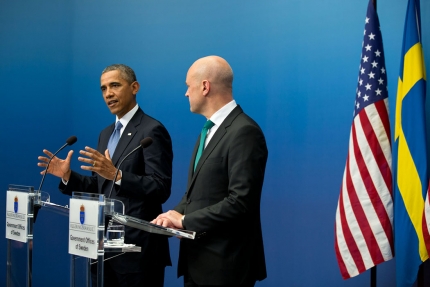
President Obama and Prime Minister Reinfeldt Hold a Press Conference

September 04, 2013 | 52:26 | Public Domain

President Obama and Prime Minister Reinfeldt of Sweden hold a joint press conference.

Download mp4 (1987MB) | mp3 (126MB)

Read the Transcript

Remarks by President Obama and Prime Minister Reinfeldt of Sweden in Joint Press Conference

Rosenbad
Stockholm, Sweden

2:45 P.M. CEST
 
PRIME MINISTER REINFELDT:  It’s a great honor and pleasure for me to welcome President Barack Obama to Sweden.  As you all know, this is a historic event -- the first bilateral visit ever by a President of the United States to Sweden.
 
We have had a very constructive meeting.  There are many reasons why the relationship between the United States and Sweden is special.  Many Swedes emigrated to the United States at the end of the 19th century and somewhere around 4 million Americans today claim Swedish heritage.  Business ties flourish between our two countries.  Sweden is, in fact, one of the largest investors per capita in the U.S., and we have considerable American investments in Sweden.  The United States is the most important foreign employer in our country.
 
Our societies are founded on the same core values -- democracy, respect for human rights, and rule of law.  All these values are at the heart of the deeds of Raoul Wallenberg, and I'm looking forward to the possibility to pay tribute to Raoul Wallenberg this afternoon, a man who chose not to be indifferent and who saved thousands of Hungarian Jews from the Holocaust. 
 
The United States and Sweden also share ambitions when it comes to the opening of global trade flows.  Trade has laid the foundation of Sweden’s wealth and prosperity.  Around 50 percent of our GDP comes from exports, and Sweden strongly support open trade regimes and, in particular, free trade agreements now being negotiated between the European Union and the United States.  This will not only bring more jobs and growth to both our continents, it will also strengthen our political and economic partnership.
 
We also touched upon the economic situation in Europe and in the United States.  I mentioned that the crisis has hit countries in Europe differently -- Sweden being one of those countries that has done relatively well during the crisis.  But the need for structural reforms exists throughout Europe to stay competitive, and at the same time preserving all our welfare ambitions.
 
We have also discussed climate change and its consequences.  It represents one of the most important challenges to our societies.  Sweden has reduced greenhouse gas emissions by 20 percent since 1990, while GDP at the same time has increased by 60 percent.  So there is no contradiction between economic growth and the protection of environment.
 
I welcome President Obama’s ambitious new Climate Action Plan.  U.S. emissions have, in recent years, already fallen substantially, and your new plan will help United States to make even further reductions.  We have agreed to work together in the international climate negotiations to make sure that other countries also are prepared to cut their emissions.  This is the only way that we can protect our environment. 
 
We have discussed a few foreign policy issues as well -- the most topical, of course, being the situation in Syria.  Sweden condemns the use of chemical weapons in Syria in the strongest possible terms.  It’s a clear violation of international law.  Those responsible should be held accountable.  Sweden believes that serious matters concerning international peace and security should be handled by the United Nations.  But I also understand the potential consequences of letting a violation like this go unanswered.  In the long term, I know that we both agree that the situation in Syria needs a political solution. 
 
So thank you once again, Mr. President, for coming to Sweden.  I look forward to our program together this afternoon.
 
Please.
 
THE PRESIDENT:  Thank you so much.  Hej.  (Laughter.)  I’ve just exhausted my Swedish.  (Laughter.) 
 
Thank you, Prime Minister Reinfeldt, for your very kind words and welcoming me today.  I’m proud to be making the first-ever bilateral visit by a U.S. President to Sweden. 
 
I’ve only been here a short time, but I already want to thank all the people here for the warm hospitality that’s been extended to me and my delegation.  This is truly one of the world’s great cities.  It is spectacularly beautiful.  The Prime Minister tells me that the weather is like this year round.  (Laughter.)  And so like so many who’ve come here, I feel Stockholm in my heart, and I’m sure that I’ll want to bring back my family to have a visit some time in the future.
 
I’ve said before that it’s no accident that democracies are America’s closest partners.  And that includes Sweden.  That’s why I’m here today.  As free peoples, we recognize that democracy is the most effective form of government ever devised for delivering progress and opportunity and prosperity and freedom to people.  And as two of the most innovative economies on Earth, we cherish that freedom that allows us to innovate and create, which is why we’re leaders in science and research and development -- those things that pioneers new industries and broaden our horizons.
 
We share a belief in the dignity and equality of every human being; that our daughters deserve the same opportunities as our sons; that our gay and lesbian brothers and sisters must be treated equally under the law; that our societies are strengthened and not weakened by diversity.  And we stand up for universal human rights, not only in America and in Europe, but beyond, because we believe that when these rights are respected, nations are more successful and our world is safer and more just. 
So I want to thank Sweden and the Swedish people for being such strong partners in pursuit of these values that we share.  The partnership is rooted in deep friendship, but as was also mentioned, we have very strong people-to-people ties.  My hometown of Chicago has a lot of people of Swedish descent.  Vice President Biden was honored to welcome King Gustaf and Queen Silvia to the United States earlier this year to mark the 375th anniversary of the first Swedish colony in America, and I’m looking forward to visiting with the King and Queen tomorrow. 
 
I should mention on behalf of hockey fans back home in Chicago, I have to say how grateful our championship Blackhawks are for their several teammates who hail from Sweden.  So that’s been an excellent export that we gladly accept.  (Laughter.)  
 
I had a chance to visit with Prime Minister Reinfeldt in the White House during my first year in office.  And he has always proved to be a thoughtful and deliberative partner on a whole host of international issues, and I’m pleased that we’ve been able to strengthen that partnership in our discussions here today. 
 
We of course discussed the appalling violence being inflicted on the Syrian people by the Assad regime, including the horrific chemical weapons attacks two weeks ago.  I discussed our assessment, which clearly implicates the Syrian government in this outrage.  The Prime Minister and I are in agreement that in the face of such barbarism the international community cannot be silent, and that failing to respond to this attack would only increase the risk of more attacks and the possibility that other countries would use these weapons as well. 
 
I respect -- and I’ve said this to the Prime Minister -- the U.N. process.  Obviously, the U.N. investigation team has done heroic work under very difficult circumstances.  But we believe very strongly, with high confidence, that, in fact, chemical weapons were used and that Mr. Assad was the source.  And we want to join with the international community in an effective response that deters such use in the future.
 
So I updated the Prime Minister on our efforts to secure congressional authorization for taking action as well as our effort to continue to build international support for holding the Assad regime accountable in order to deter these kinds of attacks in the future.   
 
And we also discussed our broader strategy.  The United States and Sweden are both major donors of humanitarian assistance to the Syrian people.  We will continue those efforts.  We’re going to continue to try to strengthen the capabilities of an inclusive and representative opposition, and to support the diplomacy that could bring an end to all the violence and advance a political transition and a future in Syria where all people’s rights are upheld.  Those are goals that we share.  And we will keep working towards those goals. 
 
And more broadly, given Sweden’s close partnership with NATO, we also touched on some of the other security challenges, and I expressed my appreciation for the extraordinary work that the Swedish armed forces has done in a whole range of issues, including Afghanistan, efforts to resolve some of the conflicts in Central Eastern Europe, and the ongoing training that’s also being provided and the good example that’s being provided by the Swedish armed forces here in Europe.  
 
Mindful of the jobs that are supported by trade between our two countries, we discussed ways to partner more, including creating a clean energy partnership that creates jobs and combats climate change effectively.  Sweden is obviously an extraordinary leader when it comes to tackling climate change and increasing energy efficiency, and developing new technologies.  And the goal of achieving a carbon-neutral economy is remarkable, and Sweden is well on its way.  We deeply respect and admire that and think we can learn from it. 
 
In the United States, we’ve taken some historic steps -- doubling our electricity from wind and solar, improving the fuel efficiency of our cars, reducing our carbon pollution to the lowest levels in nearly 20 years -- but we all know we need to do more.  So my new Climate Action Plan -- more clean energy, more energy efficiency, less emissions -- will allow us to do even more in the years to come.  And we look forward to a close partnership with Sweden on what is going to be a global challenge.  And at the Royal Institute of Technology today I look forward to seeing some of the innovative ways that we can cooperate.
 
We also talked about trade and the Transatlantic Trade and Investment Partnership, or T-TIP.  I want to thank Sweden and the Prime Minister for the strong support of these negotiations, and I believe that for the U.S. and the EU to reach a high-standard, comprehensive agreement can create more jobs and opportunity on both sides of the Atlantic. 
 
And as I head into the G-20, I shared my view that here in Europe and around the world, we’ve got to stay focused on creating jobs and growth.  That’s going to be critically important not only for our economies but also to maintain stability in many of our democracies that are under severe stress at this point.  
 
And finally, I want to salute Sweden, along with all the Nordic countries, for your strong support for democracy and development -- strengthening democratic governance in Eastern Europe; global efforts against AIDS, TB, and malaria; responsible development in Africa. 
 
I want to thank in advance the Prime Minister for hosting our meeting tonight with the leaders of all the Nordic countries, and I look forward to our discussions. 
 
So to Prime Minister Reinfeldt, thank you so much for your hospitality.   To the people of Sweden, thank you.  This is a wonderful visit, and I’m looking forward to it producing concrete results that will enhance the lives of both the American people and the people of Sweden.
 
So with that, I think we’ll take some questions.
 
Q    Mr. President, welcome to Sweden.
 
PRESIDENT OBAMA:  Thank you.
 
Q    As you might know, the NSA surveillance affair has stirred up quite a few angry reactions, even here in Sweden.  What do you want to say to those upset, and how do you think the affair affects the relationship between our countries?  And, as a follow-up to that, I know that at home you are sometimes accused of wanting to turn the U.S. into Sweden.  (Laughter.)  Now that you’re here -- you’ve been here for several hours -- what have you seen?  What actually inspires you?  What do you want to import to the U.S. in terms of ideas for society?
 
PRESIDENT OBAMA:  Well, let me take the NSA question first, because this is a question that I’ve received in previous visits to Europe since the stories broke in The Guardian and I suspect I’ll continue to get as I travel through Europe and around the world for quite some time.
 
Like other countries, we have an intelligence operation that tries to improve our understanding of what’s happening around the world.  And in light of 9/11, a lot of energy was focused on improving our intelligence when it came to combating terrorism. 
 
And what I can say with confidence is that when it comes to our domestic operations, the concerns that people have back home in the United States of America that we do not surveil the American people or persons within the United States; that there are a lot of checks and balances in place designed to avoid a surveillance state. 
 
There have been times where the procedures -- because these are human endeavors -- have not worked the way they should and we had to tighten them up.  And I think there are legitimate questions that have been raised about the fact that as technology advances and capabilities grow, it may be that the laws that are currently in place are not sufficient to guard against the dangers of us being able to track so much. 
 
Now, when it comes to intelligence gathering internationally, our focus is on counterterrorism, weapons of mass destruction, cybersecurity -- core national security interests of the United States.  But what is true is, is that the United States has enormous capabilities when it comes to intelligence.  One way to think about it is, in the same way that our military capabilities are significantly greater than in many other countries, the same is true for our intelligence capabilities.  So even though we may have the same goals, our means are significantly greater. 
 
And I can give assurances to the publics in Europe and around the world that we’re not going around snooping at people’s emails or listening to their phone calls.  What we try to do is to target very specifically areas of concern.
 
Having said that, what I’ve said domestically and what I say to international audiences is with changes in technology, with the growth of our capabilities, if our attitude is because we can do it, we should go ahead and do it, then we may not be addressing some of the legitimate concerns and dangers that exist any time we’re talking about intelligence gathering and surveillance.
 
So what I’ve asked my national security team to do, as well as independent persons who are well-known lawyers or civil libertarians or privacy experts to do, is to review everything that we’re doing with the instructions to them that we have to balance the ends with the means.  And just because we can do something, doesn’t mean we should do it.  And there may be situations in which we’re gathering information just because we can that doesn’t help us with national security, but does raise questions in terms of whether we’re tipping over into being too intrusive with respect to the interactions of other governments.
 
And that is something that we are currently reviewing carefully.  We are consulting with the EU in this process.  We are consulting with other countries in this process and finding out from them what are their areas of specific concern, and trying to align what we do in a way that I think alleviates some of the public concerns that people may have.
 
But this is always going to be -- there’s going to be some balancing that takes place on these issues.  Some of the folks who have been most greatly offended publicly we know privately engage in the same activities directed at us, or use information that we’ve obtained to protect their people.  And we recognize that.  But I think all of us have to take a very thoughtful approach to this problem.  And I’m the first one to acknowledge that given advances in technology and the fact that so much of our information flow today is through the Internet, through wireless, that the risks of abuse are greater than they have been in the past.
 
Now, with respect to Sweden, I haven’t had a chance to wander around Stockholm as much as I would like.  It is a gorgeous country.  What I know about Sweden I think offers us some good lessons.  Number one, the work you’ve done on energy I think is something that the United States can, and will, learn from, because every country in the world right now has to recognize that if we’re going to continue to grow, improve our standard of living while maintaining a sustainable planet, then we’re going to have to change our patterns of energy use.  And Sweden I think is far ahead of many other countries.
 
Sweden also has been able to have a robust market economy while recognizing that there are some investments in education or infrastructure or research that are important, and there’s no contradiction between making public investments and being a firm believer in free markets.  And that’s a debate and a discussion that we often have in the United States.
 
I have to say that if I were here in Europe, I’d probably be considered right in the middle, maybe center-left, maybe center-right depending on the country.  In the United States sometimes the names I’m called are quite different.  (Laughter.) 
 
And I think a third observation and final observation I’d make is I know that -- I’m sure Fredrik doesn’t feel this as he’s engaging in difficult debates here -- I do get a sense that the politics in Sweden right now involve both the ruling party and the opposition engaged in a respectful and rational debate that’s based on facts and issues.  And I think that kind of recognition that people can have political differences but -- while trying to achieve the same goals, that’s something that Swedes should be proud of and should try to maintain.
 
Q    Thank you, Mr. President.  Thank you, sir.  Have you made up your mind whether to take action against Syria whether or not you have a congressional resolution approved?  Is a strike needed in order to preserve your credibility for when you set these sort of red lines?  And were you able to enlist the support of the Prime Minister here for support in Syria?
 
PRESIDENT OBAMA:  Let me unpack the question.  First of all, I didn’t set a red line; the world set a red line.  The world set a red line when governments representing 98 percent of the world’s population said the use of chemical weapons are abhorrent and passed a treaty forbidding their use even when countries are engaged in war. 
 
Congress set a red line when it ratified that treaty.  Congress set a red line when it indicated that -- in a piece of legislation titled the Syria Accountability Act -- that some of the horrendous things that are happening on the ground there need to be answered for.
 
And so when I said in a press conference that my calculus about what’s happening in Syria would be altered by the use of the chemical weapons, which the overwhelming consensus of humanity says is wrong, that wasn’t something I just kind of made up.  I didn’t pluck it out of thin air.  There’s a reason for it.  That’s point number one.
 
Point number two -- my credibility is not on the line.  The international community’s credibility is on the line.  And America and Congress’s credibility is on the line because we give lip service to the notion that these international norms are important. 
 
And when those videos first broke and you saw images of over 400 children subjected to gas, everybody expressed outrage:  How can this happen in this modern world?  Well, it happened because a government chose to deploy these deadly weapons on civilian populations.  And so the question is, how credible is the international community when it says this is an international norm that has to be observed?  The question is, how credible is Congress when it passes a treaty saying we have to forbid the use of chemical weapons?
 
And I do think that we have to act, because if we don’t, we are effectively saying that even though we may condemn it and issue resolutions, and so forth and so on, somebody who is not shamed by resolutions can continue to act with impunity.  And those international norms begin to erode.  And other despots and authoritarian regimes can start looking and saying, that’s something we can get away with.  And that, then, calls into question other international norms and laws of war and whether those are going to be enforced.
 
So, as I told the Prime Minister, I am very respectful of the U.N. investigators who went in at great danger to try to gather evidence about what happened.  We want more information, not less.  But when I said that I have high confidence that chemical weapons were used and that the Assad government through their chain of command ordered their use, that was based on both public sourcing, intercepts, evidence that we feel very confident about, including samples that have been tested showing sarin from individuals who were there.
 
And I’m very mindful of the fact that around the world, and here in Europe in particular, there are still memories of Iraq and weapons of mass destruction accusations, and people being concerned about how accurate this information is.  Keep in mind, I’m somebody who opposed the war in Iraq and not interested in repeated mistakes of us basing decisions on faulty intelligence. 
But having done a thoroughgoing evaluation of the information that is currently available, I can say with high confidence chemical weapons were used.  And, by the way, Iran doesn’t deny it.  Even Syria doesn’t actually deny that they were used.  And that is what the U.N. investigators are supposed to be determining.  And, frankly, nobody is really disputing that chemical weapons were used.  The only remaining dispute is who used them, which is outside the parameters of the U.N. investigation.  So the U.N. investigation will not be able to answer that preliminarily; they’re not supposed to.
 
But what we know is, is that the opposition doesn’t have the capability to deliver weapons on this scale.  These weapons are in Assad’s possession.  We have intercepts indicating people in the chain of command, both before and after the attacks, with knowledge of these attacks.  We can show that the rockets that delivered these chemical weapons went from areas controlled by Assad into these areas where the opposition was lodged.  And the accumulation of evidence gives us high confidence that Assad carried this out. 
 
And so the question is, after we’ve gone through all this, are we going to try to find a reason not to act?  And if that’s the case, then I think the world community should admit it.   Because you can always find a reason not to act.  This is a complicated, difficult situation.  And an initial response will not solve the underlying tragedy of the civil war in Syria.  As Fredrik mentioned, that will be solved through, eventually, a political transition. 
 
But we can send a very clear, strong message against the prohibition -- or in favor of the prohibition against using chemical weapons.  We can change Assad’s calculus about using them again.  We can degrade his capabilities so that he does not use them again.  And so what I’m talking about is an action that is limited in time and in scope, targeted at the specific task of degrading his capabilities and deterring the use of those weapons again. 
 
And, in the meantime, we will continue to engage the entire international community in trying to find a solution to the underlying problems, which brings me to the last question.  And that is what happens if Congress doesn’t approve it.  I believe that Congress will approve it.  I believe Congress will approve it because I think America recognizes that, as difficult as it is to take any military action -- even as one as limited as we’re talking about, even one without boots on the ground -- that’s a sober decision.  But I think America also recognizes that if the international community fails to maintain certain norms, standards, laws governing how countries interact and how people are treated, that over time, this world becomes less safe.  It becomes more dangerous not only for those people who are subjected to these horrible crimes, but to all of humanity. 
And we’ve seen that happen again and again in our history.  And the people of Europe are certainly familiar with what happens when the international community finds excuses not to act. 
 
And I would not have taken this before Congress just as a symbolic gesture.  I think it’s very important that Congress say that we mean what we say.  And I think we will be stronger as a country in our response if the President and Congress does it together. 
 
As Commander-in-Chief, I always preserve the right and the responsibility to act on behalf of America’s national security.  I do not believe that I was required to take this to Congress.  But I did not take this to Congress just because it’s an empty exercise; I think it’s important to have Congress’s support on it. 
 
Q    Mr. President, you’ve given very eloquent talks about the moral force of nonviolence.  I was wondering, could you describe the dilemma to be a Nobel Peace Prize winner and getting ready to attack Syria?  And also, in what way did the talk that you had today with Prime Minister Reinfeldt move the world a step closer to resolving the climate crisis?
 
PRESIDENT OBAMA:  I would refer you to the speech that I gave when I received the Nobel Prize.  And I think I started the speech by saying that, compared to previous recipients, I was certainly unworthy.  But what I also described was the challenge that all of us face when we believe in peace but we confront a world that is full of violence and occasional evil.  And the question then becomes, what are our responsibilities?
 
So I’ve made every effort to end the war in Iraq; to wind down the war in Afghanistan; to strengthen our commitment to multilateral action; to promote diplomacy as the solution to problems.  The question, though, that all of us face -- not just me -- our citizens face, not just political leaders -- is at what point do we say we need to confront actions that are violating our common humanity? 
 
And I would argue that when I see 400 children subjected to gas, over 1,400 innocent civilians dying senselessly in an environment in which you already have tens of thousands dying, and we have the opportunity to take some action that is meaningful, even if it doesn’t solve the entire problem may at least mitigate this particular problem, then the moral thing to do is not to stand by and do nothing. 
 
But it’s difficult.  This is the part of my job that I find most challenging every single day.  I would much rather spend my time talking about how to make sure every 3- and 4-year-old gets a good education than I would spending time thinking about how can I prevent 3- and 4-year-olds from being subjected to chemical weapons and nerve gas. 
 
Unfortunately, that’s sometimes the decisions that I’m confronted with as President of the United States.  And, frankly, as President of the United States, I can’t avoid those questions because, as much as we are criticized, when bad stuff happens around the world, the first question is what is the United States going to do about it.  That’s true on every issue.  It’s true in Libya.  It’s true in Rwanda.  It’s true in Sierra Leone.  It’s now true in Syria.  That’s part of the deal. 
 
What was the second question?
 
Q    Climate.
 
PRESIDENT OBAMA:  I think we have great opportunities -- I think this is a good chance for Fredrik to talk about our shared views here, because we have I think a joint belief that developed countries have to make progress, but we have to have an international framework to address where the increases in emissions are now occurring. 
 
PRIME MINISTER REINFELDT:  Okay, well, I totally agreed with that.  I think it’s been a very interesting development after Copenhagen.  I learned to -- we were both present in Copenhagen, but we were saying that U.S. had the highest emissions in the world and that China was catching up.  Now, only a few years later, we have a situation where China is now doubled the emissions of the ones we have in U.S.  This is actually reshaping the situation when it comes to climate protection. 
 
We are both responsible for lowering our emissions, and we are doing so.  But we must also face the fact that we very soon have a situation where 25 percent of the global emissions is from European Union and United States together.  So the world can say: Solve it -- pointing at a quarter.  They need to take in the 75 percent outside of European Union and United States.  That is our problem.  We want to deal with this, but it has to be a global answer.
 
Q    Thank you.  Mr. President, tomorrow you’ll see President Putin at the G-20 with Russia and U.S. relations seriously strained.  Do you see value in trying to persuade him still to drop opposition to a Syrian strike, or are your efforts now in that excluding Russia from the decision?  And looking back at your hopes for a reset, do you believe that you overestimated what you could change, or do you believe that Mr. Putin changed the rules midway?  If you will indulge me, I have one more -- but it’s all related.
 
PRESIDENT OBAMA:  I will indulge you --
 
Q    Thank you.
 
PRESIDENT OBAMA:  -- to let you ask the question.  I may not answer it, but go ahead.
 
Q    Could you take us behind the scenes on that 45-minute walk around the South Lawn where you changed your mind and decided to take this before Congress? 
 
And, Mr. Prime Minister --
 
PRESIDENT OBAMA:  Oh, goodness.  Margaret, you’re really pressing things now.  (Laughter.)  So this is question number four now. 
 
Q    No, this is for the Prime Minister.
 
PRESIDENT OBAMA:  Okay.
 
Q    You have expressed some doubts about military action in Syria, and I’m wondering if you could be a little bit more specific about what your concerned the consequences may be and whether you believe that President Putin has any -- shares any burden of the responsibility for Mr. Assad’s actions.  Thank you.
 
PRESIDENT OBAMA:  Okay.  I mean, I’m going to try to remember all this.  (Laughter.) 
 
First of all, the reset in the Russian relationship was not done on a whim.  There were specific U.S. interests that I believed we could pursue with Russia where interests overlapped that would help us both on our long-term national security and our economy.  And we succeeded.  We succeeded in passing a new START Treaty that reduced nuclear stockpiles for both the United States and Russia.  Russia joined the WTO, which bound them to a set of international rules governing trade, which I think ultimately will be good for the Russian economy, but is also good for its trading partners and potential companies that are investing in Russia, and that includes U.S. companies.
 
We work together on counterterrorism issues.  They have provided us significant assistance in supplying our troops in Afghanistan.  There were a whole host of outcomes from that reset that were valuable to the United States.
 
Now, there’s no doubt that, as I indicated a while back, we’ve kind of hit a wall in terms of additional progress.  But I have not written off the idea that the United States and Russia are going to continue to have common interests even as we have some very profound differences on some other issues.  And where our interests overlap, we should pursue common action.  Where we’ve got differences, we should be candid about them, try to manage those differences but not sugarcoat them. 
 
One area where we’ve got a significant difference right now is the situation in Syria.  Russia has a longstanding relationship with the Assad regime and, as a consequence, it has been very difficult to get Russia, working through the Security Council, to acknowledge some of the terrible behavior of the Assad regime and to try to push towards the kind of political transition that’s needed in order to stabilize Syria. 
 
And I’ve said to Mr. Putin directly, and I continue to believe that even if you have great concerns about elements in the opposition -- and we’ve got some concerns about certain elements of the opposition like al Nusra -- and even if you’re concerned about the territorial integrity of Syria -- and we’re concerned about the territorial integrity of Syria -- if you, in fact, want to end the violence and slaughter inside of Syria, then you’re going to have to have a political transition, because it is not possible for Mr. Assad to regain legitimacy in a country where he’s killed tens of thousands of his own people.  That will not happen.  So far, at least, Mr. Putin has rejected that logic. 
 
As far as security action -- Security Council action -- we have gone repeatedly to the Security Council for even the most modest of resolutions condemning some of the actions that have taken place there, and it has been resisted by Russia. 
 
And do I hold out hope that Mr. Putin may change his position on some of these issues?  I’m always hopeful.  And I will continue to engage him because I think that international action would be much more effective and ultimately we can end deaths much more rapidly if Russia takes a different approach to these problems. 
 
In terms of my decision to take the issue to Congress, this had been brewing in my mind for a while.  Some people have noted -- and I think this is true -- that had I been in the Senate in the midst of this period, I probably would have suggested to a Democratic or a Republican President that Congress should have the ability to weigh in on an issue like this that is not immediate, imminent, time-sensitive.  When the Chairman of the Joint Chiefs, Mr. Dempsey, indicated to me that whether we struck today, tomorrow, or a month from now, we could still do so effectively, then I think that raised the question of why not ask Congress to debate this in a serious way? 
 
Because I do think it raises issues that are going to occur for us and for the international community for many years to come.  The truth of the matter is, is that under international law, Security Council resolution or self-defense or defense of an ally provides a clear basis for action.  But increasingly, what we’re going to be confronted with are situations like Syria, like Kosovo, like Rwanda, in which we may not always have a Security Council that can act -- it may be paralyzed for a whole host of reasons -- and yet we’ve got all these international norms that we’re interested in upholding.  We may not be directly, imminently threatened by what’s taking place in a Kosovo or a Syria or a Rwanda in the short term, but our long-term national security will be impacted in a profound way, and our humanity is impacted in a profound way.
 
And so I think it’s important for us to get out of the habit in those circumstances -- again, I’m not talking about circumstances where our national security is directly impacted, we’ve been attacked, et cetera, where the President has to act quickly -- but in circumstances of the type that I describe, it’s important for us to get out of the habit of just saying, well, we’ll let the President kind of stretch the boundaries of his authority as far as he can; Congress will sit on the sidelines, snipe; if it works, the sniping will be a little less; if it doesn’t, a little more; but either way, the American people and their representatives are not fully invested in what are tough choices. 
 
And we as a country and the world are going to start having to take tough choices.  I do get frustrated -- although I understand how complex this is, and any time you’re involving military action, then people will ask, well, this may do more harm than good.  I understand those arguments; I wrestle with them every day.  But I do have to ask people, well, if, in fact, you’re outraged by the slaughter of innocent people, what are you doing about it? 
 
And if the answer is, well, we should engage diplomatically -- well, we’ve engaged diplomatically.  If the answer is, well, we should shine the spotlight and shame these governments -- well, these governments oftentimes show no shame.  Well, we should act internationally -- well, sometimes because of the various alignments it’s hard to act through a Security Council resolution.
 
And so either we resign ourselves to saying there’s nothing we can do about it and we’ll just shake our heads and go about our business, or we make decisions even when they’re difficult.  And I think this is an example of where we need to make decisions even though they’re difficult.  And I think it’s important for Congress to be involved in that decision.
 
PRIME MINISTER REINFELDT:  I think I should answer the question.  I think you’re right in saying that this is a very difficult decision to take and, as always, it’s a balancing act. And we’ve been discussing this during our talks. 
 
Just to remind you, you’re now in Sweden -- a small country with a deep belief in the United Nations.  You’re also in a country where, I think yesterday or the day before, we took the decision that all the people that are now coming from the war in Syria are allowed to stay permanently in Sweden.  So a lot of the people following this press conference here in Sweden are actually just now coming from Syria and, of course, wondering what is the view of their country.  And they have a lot of their countrymen also in this country, so we have a lot of roots and links to Syria.
 
I think the main problem has been for two and a half years now that we have a war without a clear political solution.  And, that, at the end of the day, must be -- we must get a cease-fire.  We must get a peace process.  We must get people to talk to each other. 
 
I totally understand the complex situation also on the opposition, because we have part of the opposition also here in Sweden, which is now conducted of different groups.  They want to get Assad out of the picture, but what do they want instead?  That is, of course, a question we need to attend to.
 
The weapons inspection that was present in Damascus is headed by a Swede.  So in this country, of course, we are asking for the time to be able to see what were their findings, especially since President Obama has sent the decision also to Congress.  We think that that gives us some more time, and we are welcoming that.
 
Having said that, I also said I understand the absolute problem of not having a reaction to use of chemical weapons and what kind of signal that sends to the world in a time where we are developing our view on international law -- not saying that you’re allowed to do whatever you like to your own people as long as it’s inside your own borders, no.  We have these -- we need to protect people.  We need to look at the interest of each and every one.  So this is the development we are seeing.  That’s the same discussion we are having in Sweden.
 
So I understand, especially the U.S. President needs to react; otherwise he will get another kind of discussion.  But this small country will always say let’s put our hope into the United Nations.  Let us push on some more to get a better situation. 
 
Of course, President Putin has a responsibility in that; of course.  Because everyone understands that Russia and also China has been outside of the decision-making that we would have needed a long time ago to put more clear pressure and more political solution. 
 
So that is what we have been discussing today.  If you balance all these sentences, that shows how difficult this is.
 
PRESIDENT OBAMA:  Thank you.
 
END
3:36 P.M. CEST

Close Transcript

The White House

Office of the Press Secretary

President Obama Signs Arkansas Disaster Declaration

The President today declared a major disaster exists in the State of Arkansas and ordered federal aid to supplement state and local recovery efforts in the area affected by severe storms and flooding during the period of August 8-14, 2013.

Federal funding is available to state and eligible local governments and certain private nonprofit organizations on a cost-sharing basis for emergency work and the repair or replacement of facilities damaged by the severe storms and flooding in the counties of Benton, Boone, Carroll, Madison, Marion, and Newton. 

Federal funding is also available on a cost-sharing basis for hazard mitigation measures statewide.

W. Craig Fugate, Administrator, Federal Emergency Management Agency (FEMA), Department of Homeland Security, named Kenneth K. Suiso as the Federal Coordinating Officer for federal recovery operations in the affected area.

FEMA said additional designations may be made at a later date if requested by the state and warranted by the results of further damage assessments.

President Obama Honors Raoul Wallenberg

September 04, 2013 | 7:09 | Public Domain

President Obama participates in an event at the Great Synagogue in Stockholm honoring Raoul Wallenberg, a Swedish diplomat and honorary U.S. citizen who worked courageously to save lives while serving as Sweden’s special envoy in Budapest during World War II.

Download mp4 (261MB) | mp3 (17MB)

The White House

Office of the Press Secretary

Joint Statement by Kingdom of Denmark, Republic of Finland, Republic of Iceland, Kingdom of Norway, Kingdom of Sweden, and the United States of America

The Kingdom of Denmark, Republic of Finland, Republic of Iceland, Kingdom of Norway, Kingdom of Sweden, and the United States of America reaffirm our deep partnership based on shared fundamental values including our commitment to democracy, human rights, respect for the rule of law, and economic freedom.  We continue to deepen our collaboration on important shared global priorities, including climate change and clean energy, the Arctic, a strong, open multilateral trading system, emerging security challenges, global development and humanitarian assistance, and Europe’s regional economic and security environment.  This evening, we have come together at a defining moment in the transatlantic relationship to discuss our long-term goals in each of these areas and agree to take concrete steps to achieve those goals. 

United on Global Issues

The United States and the Nordic countries share the goal of a stable and peaceful Middle East.  We agree that all relevant parties must work urgently for a just, lasting and comprehensive peace in the Middle East.  We are determined to work together to promote respect for human rights, democracy, and the rule of law in Egypt.  With regard to the situation in Syria, we strongly condemn any and all use of chemical weapons, and we are convinced a strong international reaction is required.  Those responsible for the use of chemical weapons must be held accountable.

We recognize the importance of cooperation between our countries in building comprehensive security and addressing security issues in the 21st century, including terrorism, the proliferation of weapons of mass destruction, illicit international arms trade, and threats to cyber security.  We also recognize that we must address these challenges in a manner that respects our most cherished values and protects universal human rights and fundamental freedoms, which are at the foundation of all flourishing democracies.  We note the need to continue to strengthen our countries’ important contributions to regional, transatlantic, and international forums, including in the EU, NATO, and NATO Partnership context.  We recommit to continuing and expanding our security, recognizing that this cooperation – with and among the Nordic countries, with other regional partners, including especially the Baltic states, and in transatlantic and international fora – will be crucial to our success. 

To complement our already robust bilateral and regional security cooperation, we agree to launch a U.S.-Nordic Security Dialogue, which will meet annually to discuss opportunities for collaboration on global and regional security issues, focusing primarily on issues arising in the United Nations, including an integrated approach to preventive diplomacy, peacebuilding, peacekeeping, and atrocity prevention.  Another stream of work will include joint capacity building efforts to promote stabilization in fragile and conflict affected states – linking up security and development efforts, and civilian and military partners.

Recognizing that we still have work to do closer to home, we agree on our mutual commitment to deepening regional cooperation and continuing to pursue our common vision of a Europe whole, free, and at peace. 

We underscore the importance of actions that can support a global economic recovery, including the Transatlantic Trade and Investment Partnership (T-TIP) currently being negotiated between the European Union and the United States.   T-TIP aims to boost economic growth in the United States and the EU and add to the more than 13 million American and EU jobs already supported by transatlantic trade and investment.  We also look forward to exploring ways we can bolster trade and investment between the United States and Norway and Iceland.  We also emphasize our commitment to achieving significant and substantive outcomes at the 9th World Trade Organization Ministerial.

We agree that the fight against tax avoidance and evasion should be a top priority in all relevant international fora.  We support the work of the Organization for Economic Cooperation and Development’s on base erosion and profit shifting (BEPS) and automatic exchange of information as the new global standard.  The engagement of the G-20 in these issues is important.  The misuse of shell companies can be a severe impediment to sustainable economic growth and sound governance.  We will make a concerted and collective effort to tackle this issue and improve the transparency of companies and legal arrangements.  

Partnering on Climate Change and the Arctic

Climate change is one of the foremost challenges for our future economic growth and well-being.  We underscore the importance of continuing to encourage innovative approaches to promoting energy efficiency and clean energy, including renewables, and of taking action on climate change, domestically and internationally.  This requires mobilizing scaled up climate finance.  We agreed on the importance of reaching an ambitious, comprehensive, fair, and inclusive climate agreement under the United Nations Framework Convention on Climate Change in 2015 that is consistent with science, mindful of the two degree target, and applicable to all.

As part of our commitment to accelerating the transition to low-carbon energy systems worldwide, the leaders of Denmark, Finland, Iceland, Norway, and Sweden will join the United States in ending public financing for new coal-fired power plants overseas, except in rare circumstances.  We will work together to secure the support of other countries and multilateral development banks to adopt similar policies.  The Nordic countries and the United States agreed to continue their work, in all appropriate channels, to reduce the use of domestic fossil fuel subsidies globally.  The United States also agrees to join with the Nordic members of the Friends of Fossil Fuel Subsidy Reform to undertake peer reviews of domestic fossil fuel subsidies.

Recognizing the rapid growth of the Climate and Clean Air Coalition over its first 18 months, we note the potential of the Coalition to catalyze significant global reductions of short-lived climate pollutants, which have major impacts on climate change and public health.  The U.S. and Nordic members of the Coalition agree to intensify our efforts and invite others to join to take full advantage of the Coalition’s potential.

The United States and Nordic members of the Clean Energy Ministerial continue to support various ministerial initiatives, including the 21st Century Power Partnership, which brings together government and private sector actors to help identify and promote successful technical, policy, and financial pathways to cleaner and more efficient power systems in both developed and developing countries.  Additionally, the United States and Nordic countries expressed our support for the “Sustainable Energy for All” initiative of the UN Secretary-General.

We recommit to protecting the Arctic environment, working to improve living conditions and encouraging sustainable development in the Arctic region, particularly with respect to indigenous peoples, and ensuring that the Arctic remains a peaceful region of cooperation.  We will pursue opportunities in future Arctic Council meetings and other international fora to promote prosperity, foster scientific cooperation, and reduce emissions of black carbon in the Arctic region, as agreed upon in the Kiruna Declaration.

Advancing Global Development

As leaders in providing development assistance, we agree on the strategic, economic, and moral imperative of global development and humanitarian aid.  We are committed to aggressive efforts to accelerate achievement of the Millennium Development Goals (MDGs).  The MDGs continue to be a symbol of our common humanity and a statement of the world’s commitment to eradicating extreme poverty and hunger, combating disease, achieving gender equality, free quality education for all,  and environmental sustainability, thus extending hope and opportunity to billions across the world.  We note the opportunities for using trade to boost economic growth and reduce poverty in developing countries, as well as the importance of promoting human rights and gender equality.  In addition, we agree that vaccination through GAVI represents one of the most cost-effective approaches to save children’s lives and that with enhanced efforts, polio can be eradicated within this decade.  Together, we envision a unified post-2015 agenda that addresses poverty, inclusive growth, and sustainability in clear, ambitious, and measurable goals. 

The United States and Nordic countries are critical donors in fight against HIV/AIDS, tuberculosis, and malaria worldwide.  We commend the reforms and results achieved by the Global Fund to Fight AIDS, TB, and Malaria and will work together to ensure a successful replenishment.  In a demonstration of strong leadership, a number of Nordic countries are together pledging $750 million, with over $150 million in increased funds, for the Global Fund replenishment, subject to parliamentary approval.  This funding will leverage $375 million from the U.S. challenge pledge of $1 for every $2 donated.  These historic multilateral investments will work to turn the tide against these three devastating diseases. 

Access to electricity continues to be one of the most significant hurdles to economic growth and development.  In sub-Saharan Africa alone, more than two-thirds of the population is without access to power.  To support a doubling of electricity access in sub-Saharan Africa the United States and Nordic countries have expressed our support for the Power Africa initiative and agree to work together to provide technical assistance, financing, and other support to enable additional investment in energy projects throughout the region.  

In support of the Extractive Industries Transparency Initiative (EITI), we agree to promote transparency and accountability of expenditures and revenues related to the extraction of natural resources, including through support to the multi-donor trust fund for EITI or the EITI Secretariat.  EU member states Denmark, Finland, and Sweden intend to quickly transpose the EU Accounting and Transparency Directive, which requires mandatory disclosures of payments made to governments for extractive and logging projects.

Protecting Human Rights and Strengthening Governance

We will work together to eradicate poverty, promote good governance and human rights, combat all forms of trafficking in persons, and strengthen gender equality and the rights of women and girls, including sexual and reproductive health and rights. 

We agree to make real our respective obligations and commitments to promote and protect women’s human rights and fundamental freedoms as outlined in the Convention on the Elimination of All Forms of Discrimination against Women (CEDAW), the Beijing Platform for Action, the United Nations resolutions on Women, Peace and Security, and other international instruments and agreements on women’s rights.  We note in particular the importance of empowering women as equal partners in preventing conflict and building peace and ensuring their protection from violence, and of our continued bilateral and multilateral engagement to this end in such countries as Afghanistan and Pakistan and in the Middle East.  In Afghanistan, for example, we endorse such flagship initiatives as PROMOTE, UNWomen’s Elimination of Violence against Women Special Fund, the Afghan Reconstruction Trust Fund’s EQUIP, and the National Solidarity Program's Community Development Councils, which together empower a critical mass of Afghan women to fully participate in Afghan society.

We strengthen our commitments to advance equality and dignity for LGBT persons through the Global Equality Fund.  This commitment reflects an increasingly growing global sentiment that all persons should be treated equally and with dignity regardless of who they are or who they love.

The United States and Nordic members of the Open Government Partnership, a multilateral initiative that asks governments to promote transparency, empower citizens, fight corruption, and strengthen governance, agree to redouble our efforts to develop ambitious “Race to the Top” commitments for the October 31 Open Government Partnership Ministerial.

Working together, we have a historic opportunity to make progress on issues of global significance, and we remain steadfast in our dedication to the pursuit of these goals. 

President Obama Visits Sweden

President Barack Obama talks with Foreign Minister Carl Bildt of Sweden during the arrival ceremony at Stockholm-Arlanda International Airport in Sweden

President Barack Obama talks with Foreign Minister Carl Bildt of Sweden during the arrival ceremony at Stockholm-Arlanda International Airport in Sweden, Sept. 4, 2013. (Official White House Photo by Pete Souza)

This morning, President Obama arrived in Stockholm for a brief visit ahead of the G-20 meeting that starts tomorrow in St. Petersburg. His trip marks the first-ever bilateral visit by a U.S. President to Sweden.

After an official arrival ceremony at the airport, President Obama and Prime Minister Reinfeldt held a bilateral meeting and a joint press conference.

President Barack Obama and Swedish Prime Minister Fredrik Reinfeldt participate in a joint press conference

President Barack Obama and Swedish Prime Minister Fredrik Reinfeldt participate in a joint press conference at Rosenbad in Stockholm, Sweden, Sept. 4, 2013. (Official White House Photo by Pete Souza)

 “I’ve said before that it’s no accident that democracies are America’s closest partners. And that includes Sweden,” President Obama explained at the start of the press conference. “That’s why I’m here today.”

As free peoples, we recognize that democracy is the most effective form of government ever devised for delivering progress and opportunity and prosperity and freedom to people. And as two of the most innovative economies on Earth, we cherish that freedom that allows us to innovate and create, which is why we’re leaders in science and research and development -- those things that pioneers new industries and broaden our horizons.

We share a belief in the dignity and equality of every human being; that our daughters deserve the same opportunities as our sons; that our gay and lesbian brothers and sisters must be treated equally under the law; that our societies are strengthened and not weakened by diversity.  And we stand up for universal human rights, not only in America and in Europe, but beyond, because we believe that when these rights are respected, nations are more successful and our world is safer and more just.