The White House

Office of the Press Secretary

Remarks by the President and the Vice President on College Affordability

Lackawanna College
Scranton, Pennsylvania

4:42 P.M. EDT

THE VICE PRESIDENT:  Urica, thank you very much for that introduction. 

Hello, Scranton!  (Applause.)  I tell you, it’s good to be home.  I left you a long time ago, but as a lot of my friends out here know, your heart stays here.  It never leaves.  And it’s a delight to be back.

And I just want you all to know, since so many of you have asked me about my son, things are -- it’s not only good to be here, but things are good at home in Delaware.  My son Beau is fine.  Sends his love.  (Applause.)  He wanted me to say hello to all of you, and he wanted to be with his colleague, Kathleen, the Attorney General of the State of Pennsylvania.  (Applause.)  But he’s doing well.  He’s anxious to get back to work.

Look, it’s great to be at Lackawanna College.  As many of you know, my wife, Jill, a Pennsylvania girl from the southeast corner of Pennsylvania, is a full-time community college professor.  And she knows what most of you know.  She has a great expression -- she says, Joe, community college is the best-kept secret in America.  And the President and I want you to know that we’re going to do everything to keep it from being a secret. 

And let me introduce you -- I know you know my town, Mr. President.  The President is right behind the curtain.  I know you know my native town, Scranton. 

But I’d like to introduce, Mr. President, because you can hear me back there, the community that formed everything I believed:  My absolute conviction that if you gave ordinary folks a fighting chance, they can and do, do extraordinary things.  (Applause.)  My absolute conviction borne out of my being raised about 20 blocks from here, my absolute conviction that the middle class is what made this country great, what built this country and what binds it together.  And my certain knowledge that people who grew up in neighborhoods like this one, the one I grew up in here in Scranton, have dreams just as big, just as expansive and just as accomplishable as anyplace in the world.  (Applause.)

As I said, Mr. President, I grew up not many blocks from here where we are today, and I can tell you there wasn’t a mom or dad in my neighborhood, Green Ridge up by Mary Wood, not a single one -- (applause) -- not a single one that believed their child couldn’t grow up to be anything they wanted to be.  Not a doubt in their mind as they struggled -- but no doubt if they were willing to work hard, we could do whatever we wanted to do. And guess what -- they were absolutely right.

You know, Mr. President, some might think this is a bit of nostalgia on my part, talking about Bobby, talking about my native town like I am.  And by the way, there’s only three women that I know who are close to perfect.  One was perfect -- the Blessed Mother.  The other was my mother, and the other is Bobby’s mom, Ellen Casey, right there.  (Applause.)

So a lot of you ask why I left Scranton when I was a kid -- I went to St. Paul’s and lived in North Washington -- why I left Scranton.  It was simple.  I lived three and a half blocks from the Caseys, and I knew that only one of us was going to be able to make it big, and it wasn’t going to be me.  (Laughter.)  So I had to get out because I knew that Casey would dominate.

But, look, it’s not just me believing this about my native town.  There’s a large new study that's been done by a group of four economists at Harvard and the University of California-Berkeley, and here’s what their study concluded -- and this is just about a month ago.  And I’m quoting from the study:  “Scranton still stands out as one of America’s cities where poor people have among the best odds of climbing to the middle class.” 

Mr. President, the American Dream is alive here in Scranton. (Applause.)  It’s alive here in Scranton.  And I think I know the reason why it’s alive.  The values that have made the middle class possible in America still matter here:  community, hard work, personal responsibility, faith, family.  But most of all, the value that is held most dear by this community, that was held most dear by my mom and dad as they were raising me here, and it’s still held dear by everyone is opportunity. 

That's the reason:  simple opportunity.  That's the value that sets America apart from the rest of the world -- opportunity.  It’s about making sure that folks have the opportunity to reach their God-given potential.  And I’m proud to say my hometown is one of those places where that dream is still working.

And that's why this is a perfect place to talk about education.  You know, Mr. President and I have a bunch of economists that work for us, and they're brilliant.  And they like to tell us that the middle class -- and they give us a number, they’ll say the middle class is $49,870 or $51,000 -- the middle class isn’t a number.  I tell them that it’s about -- it’s about understanding in your bones.  The middle class is about a value set.  It’s about being able to own your home and not just rent it.  It’s about being able to live in a safe neighborhood where your kids can walk the streets.  It’s about the dignity of a job that allows you to support your family; about being able to take care of your parents when the get older and hope your kids will never have to take care of you.  It’s about being able to send your kid to a good school where if he or she does well and qualified to get to college, you have a fighting chance to get them there.  It’s about making sure that if they get there, you can afford it.

And, Mr. President, I’ve never met a mother or father, nor have you, as we’ve campaigned all across this great nation, whether in a poor neighborhood, a middle-class neighborhood, or a wealthy neighborhood, that didn't dream -- didn't dream that their child would have access to a college education. 

And as all you folks know, that's something that's getting harder and harder to do.  And that's why the President and I are here today -- because we can't have the doors of college shut to the kids of the middle class and those aspiring to get there; because we can't let opportunity die.

There are a lot of people who tell you that you have shrink your dreams in this country now; that today’s generation of Americans and tomorrow’s are just not going to be able to aim as high as we did.  That's a bunch of malarkey.  I don't believe -- I don't believe, nor does the President believe, that for a minute.  And we never will.  That has never been the story of this nation.  And the President and I are determined to make sure that it’s never the story. 

So, ladies and gentlemen, it’s my pleasure to introduce to you, my friend, your President, Barack Obama.

THE PRESIDENT:  Hello, Lackawanna!  (Applause.)  Hello, Falcons!  Well, it is good to be back in Scranton.  (Applause.)

AUDIENCE MEMBER:  We love you!

THE PRESIDENT:  I love you back. 

First of all, everybody take a seat.  I want everybody to be comfortable.  Here’s some reasons I'm happy to be back in Scranton.  Reason number one is the first time I came to Scranton I was invited to a St. Patrick’s Day party -- (applause) -- that the ladies were hosting.  And I got to say, Michelle got a little jealous, because they were -- I was getting kisses and I came home and had all this lipstick on my collar -- (laughter) -- and Michelle said, what’s going on there?  (Laughter.)  I said, no, I was just campaigning.  (Laughter.) 

So that makes me like Scranton.  A second reason that I love Scranton is because if it weren’t for Scranton, I wouldn't have Joe Biden.  (Applause.)  And today is a special day for Joe and me because five years ago today, on August 23, 2008, I announced in Springfield, Illinois, my home state, that Joe Biden was going to be my running mate.  (Applause.)  And it was the best decision that I ever made, politically, because I love this guy.  And he’s got heart, and he cares about people and he’s willing to fight for what he believes in -- (applause) -- and he’s got some Scranton in him. 

And there’s not a day that goes by that Joe doesn’t talk about where he comes from, and he doesn’t talk about all of you. And he understands why he got into public service, because he carries with him the values that you taught him and the friendships that he made.  And so I just want all of you to know that I am lucky to have Joe -- not just as a running mate, but more importantly, as a friend.  And we love his family.  And I am so blessed to be here. And, thank you, Joe, for saying yes five years ago.  (Applause.) 

The third reason I love Scranton is because there are a lot of Caseys around here.  (Laughter.)  Now, Joe already talked about Bob Casey’s mom, who is gorgeous and wonderful, and we love her dearly.  (Applause.)  But I’ve got to admit Bob Casey is not bad either.  (Laughter.)  He is a great United States senator and I'm proud to call him a friend.  We love Teresa and we love his family.  (Applause.) 

Back in 2008, when we were campaigning in Pennsylvania and we were having a tough time and getting bad press, Bob Casey was right there with me -- on a train.  And you can judge your friends not by when you’re doing well, but when you’re having a tough time, and that’s the kind of person Bob Casey is.  And so I’m grateful for him.

We’ve got -- Mayor Chris Doherty is here.  Give him a big round of applause.  (Applause.)  The State Attorney General, Kathleen Kane, is here.  (Applause.)  The president of Lackawanna, Mark Volk, is here.  (Applause.) 

I want to say thank you to Urica Carver for the wonderful introduction to Joe.  Good job, Urica.  (Applause.)  And finally, I want to thank all of the students who are here.  (Applause.)  I know that -- looks like we’ve got the Falcons football team here. When’s your first game?

TEAM MEMBER:  31st!

THE PRESIDENT:  The 31st?  You guys going to be ready?

TEAM:  Yeah!

THE PRESIDENT:  Okay, I just want to make sure.  (Laughter.)

I know classes don’t start again until next week, so I appreciate you being inside when the day is so nice outside -- because these last few days of summer vacation I know are precious.  But we’re here to talk about something important, and that is, are we doing right by not just this generation but future generations.

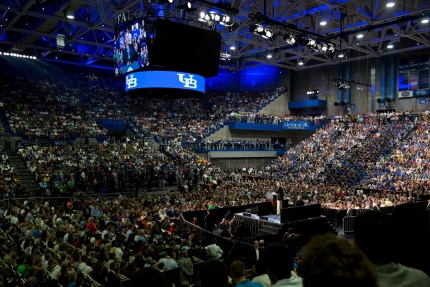
I’m on a road trip.  It started at the University at Buffalo.  (Applause.)  There you go.  Then I went to Syracuse -- (applause) -- talked to some high school students there; then Binghamton University for a town hall earlier today.  Have you -- all you guys have been following me around everywhere?  (Laughter and applause.) 

And we’re ending this bus tour here in Scranton.  (Applause.)  And I wanted to visit Lackawanna College because of the great work that you’re doing here -- giving people a first-class education that doesn’t cost a fortune, with support in place to make sure that students stay on track. 

I’m told that many students here are the first in their families to attend college.  And I know your families are proud of you, but I’m proud of you, because getting a higher education is one of the best things you can do for yourself and for your country.  (Applause.)

But we've got to make sure that we're doing right by you.  That’s what I want to talk about today.  Over the past month, I’ve been visiting towns like Scranton and talking about what we need to do as a country to secure a better bargain for the middle class and everybody who is fighting to get into the middle class. We've got to have a national strategy that grows the economy in a broad-based way so that everybody who works hard has a chance to succeed.  (Applause.)  That's our goal.  That's what we're fighting for.  (Applause.)

Now, for the past four and a half years, we’ve been fighting back from a brutal recession that cost Americans their jobs and homes and savings, in some cases.  And what happened was that recession showed what had been some longer-term trends that were eroding middle-class security.  Folks at the top had been doing very well.  But ordinary Americans hadn't seen their wages go up, hadn't seen their salaries go up.  It was getting harder to save, harder to save for your kids' college education.  Health care was getting harder to obtain.  A lot of manufacturing had gone overseas. 

And so what Joe and I said was our focus is not just to fix the problems created by the crisis.  We've got to change the fundamentals so that we get back to the day when if you want to work hard, if you are willing to be responsible you can make it. You can succeed.  (Applause.)

So we saved an auto industry.  We took on a broken health care system.  We invested in new technologies to achieve energy independence.  We changed our tax code that was tilted too much in favor of folks who were doing very well at the expense of working families.  We started to crack down on some of the practices we had seen in the financial sector that got us into this mess into the first place. 

And because of that work, our businesses today have created 7.3 million new jobs over the last 41 months.  (Applause.)  We're generating more energy than ever before.  We sell more goods made in America to other countries than ever before.  (Applause.)  Manufacturing is starting to come back and in-shore instead of outsource.  Health care costs are growing at the slowest rate in 50 years.  Our deficits are falling at the fastest rate in 60 years.  (Applause.)  

So thanks to the grit and resilience and hard work of the American people -- and some good policies -- we’ve been able to clear away the rubble of the financial crisis.  We're laying the foundation for an economy that works for everybody.  But as I'll bet a lot of families in Scranton will tell you, we're not yet where we need to be.  We've got a lot more work to do.

Like I said, even before the crisis hit, we were living through a decade where almost all the productivity gains, all the benefits of technology were accruing at the very top.  And the average family had seen their incomes and wages flat or actually go down a little bit.  Most families were working harder and harder just to get by.  Costs of everything else were going up, but your wages and your incomes weren't going up. 

So reversing that trend, returning to the days when if you're willing to work hard you can succeed, that should be Washington's highest priority.  (Applause.)  That should be Washington's highest priority.  That's Joe's highest priority.  That's Bob Casey's highest priority.  That's my highest priority. That's what we should be focused on every single day.  (Applause.)

But we do have a problem, which is we've got some of our friends down in Washington who -- and it's not all Republicans, but there's a strong faction -- (laughter) -- who instead of focusing on what's helping middle-class families succeed, they're spending time arguing about whether or not we should be paying the bills for things we already spent money on.  They're threatening to shut down the government and have another financial crisis unless, for example, we get rid of the health care reform that we fought to pass and that’s going to provide millions of people health care security for the first time. 

That won't create jobs.  That’s not going to help our economy.  That doesn’t strengthen the middle class.  (Applause.) I have not seen a policy coming out of them that would actually help ordinary folks.  And we can't afford the usual Washington circus of distractions and political posturing and special interests and phony scandals.  We can't afford that.  We've got too much work to do. 

We've got to build on the cornerstones of what it means to be middle class in America:  A good job with good wages; a good education; a home of your own; affordable health care; secure retirements even if you’re not rich; more ladders of opportunity for everybody who's willing to work for.  That’s what we should be fighting for.  (Applause.)  

And one of the most important things we can do to restore that sense of upward mobility -- the ability to achieve the American Dream, the idea that you can make it if you try -- one of the most important things we can do is make sure every child is getting a good education.  (Applause.) 

And the students who are studying here, they understand that.  That’s why they've made sacrifices.  That’s why their family are making sacrifices.  You understand that in the face of global competition -- when the Germans and the Chinese and the Indians are all putting more money into education and putting more money into research -- that we can't just stand pat.  We can't stand by and do nothing.  You understand that a great education is more important than ever. 

And you don’t have to take my word for it.  Look, the data is clear:  If you get some kind of higher education -- whether it’s a 2-year degree, a 4-year degree, a technical college -- you’re more likely to have a job.  You're more likely to see your income going up.  More than ever before, some form of higher education is the surest path into the middle class, and the surest path that you stay there.  (Applause.) 

Now, here's the challenge:  The soaring cost of higher education has become an increasing burden and barrier for too many young people.  College has never been more necessary, but it's never been more expensive. 

AUDIENCE MEMBER:  I'm with you!

THE PRESIDENT:  It's true.  (Laughter.) 

Over the past -- listen to this statistic, because this is important.  Over the past three decades, past 30 years, the average tuition at a public 4-year college has risen by more than 250 percent.  So it didn’t just double.  It went up 250 percent. The typical family income has only gone up 16 percent.  So you do the math.  I’m not a math major, but there are probably some good math people here.  If you’ve got the cost of college going up like this and incomes going up like that, you start getting that bigger and bigger gap, and that means it’s harder and harder for young people to afford college.

And, meanwhile, states have been cutting back on their higher education budgets.  And let’s face it, here in Pennsylvania there have been brutal cuts to not just higher education, but education, generally.  (Applause.)  Not enough colleges have been able to cut back on their costs.  So what happens if costs are going up, incomes are flat, and the state actually reduces its support for higher education?  Well, what you end up with is students have to pick up the tab, families have to pick up the tab, and taxpayers have to pick up the tab in the form of more and more financial assistance. 

And that’s happened.  The average student who borrows for college now graduates owing more than $26,000, but a lot of folks will owe a lot more than that.  I get letters from people who have $100,000 worth of debt; young people who’ve got $120,000 worth of debt.  And they may be working as teachers.  They may be doing really important work.  They may be working as researchers. But they can’t pay off that kind of debt.  (Applause.) 

So what’s ending up happening is students end up facing a choice that they should never have to make.  Either they say no to college, which means that they’re going to be paying the price the rest of their lifetimes for not getting a degree -- or they go to college, but they’re taking on so much debt that they’re not sure they’re ever going to be able to pay it back. 

And if you come out with huge debt, what does that mean?  It means you can’t get a mortgage on a house right away because you’re paying off your debt.  You may put off starting a family because you’re worried about paying off the debt.  If you’ve got a good idea for starting a business, you’re maybe going to put that off because you’re still servicing your debt.  And that’s bad for the entire economy.  That’s bad for everybody.

That’s a choice we should not accept.  That’s not who we are.  Keep in mind, this is a country that gave my grandfather, when he came back from World War II, the chance to go to college for free on the GI Bill.  (Applause.)  My mother was able to go to a public university and get the support she needed so she could go to school even though she was raising two kids and had to work part time to do it.  (Applause.) 

Michelle and I, we're only where we are today because scholarships and student loans gave us a shot at a great education. And, by the way, we did have to borrow a lot of money.  I didn’t pay off all of my student loans until right before I was elected to the U.S. Senate.  I was in my 40s.  I was supposed to be saving for Malia and Sasha -- I was still paying off my loans.  (Laughter.)  So I know a little bit about this.  

The point is, though, in the past, we've done what was required to support the next generation succeeding, because we understood if they succeed then we'll all succeed.  But we've kind of lost track of that.  So when Joe and I came in, with the help of Bob Casey and others, we took some steps to help make student loans more affordable.  We changed the system where student loans were going through banks, and banks were making billions of dollars; we said let's just give the loans directly to students, save billions of dollars so we can give more help to more students.  That’s what we did.  (Applause.) 

We set up a consumer watchdog to help students and their families navigate through the financial options, make sure that they don’t get taken by shady lenders.  And we gave more tools and resources to students and families to finance college.  And, by the way, young people, if you're still trying to figure out how to finance it, go to studentaid.gov, and it will give you information that you need. 

And then we took action to cap loan repayments at 10 percent of monthly incomes for a lot of borrowers who were going into public service so that they could responsibly manage their debt. And overall, these things made college more affordable, more accessible for millions of students and families.  Using tax credits and grants and student loans, all of this helped.  And then, just a few weeks ago, working with Bob Casey and others, we worked to make sure that student loan rates didn’t double.  And that saves the typical undergraduate more than $1,500 for this year's loans.  (Applause.) 

So we've made some progress.  But it's not enough.  The system is on a trajectory that is unsustainable, because if you keep on seeing the cost of college tuition go up and up and up, then no matter how much money we put in for loans or grants or what have you, it's not going to keep up.  And it means students are going to be even deeper in debt. 

What we have to do is to actually reduce the cost.  (Applause.)  And that means that state legislatures cannot just keep cutting support for public college and universities.  (Applause.)  They've got to prioritize the next generation.  (Applause.)  It means colleges have to work harder to prevent tuition from going up year after year. 

Our economy cannot afford the trillion dollars in outstanding student loan debt.  We can't price the middle class and everybody working to get into the middle class out of a college education.  We're going to have to change how we do business.  Higher education is not a luxury -- it's an economic necessity.  And every American should be able to afford it.  (Applause.)  

So yesterday, I announced some new reforms to shake up the system.  Some will require action from Congress.  (Laughter.)  That will -- that’s always challenging.  But these are ideas that should have bipartisan support.  Of course, so should Obamacare. (Applause.)  It's actually a really good idea.  It's going to work.  (Applause.)  It used to be a Republican idea.  (Laughter.) There was a governor in Massachusetts who set it up -- it's working really well.  (Laughter.) 

But some of the reforms we're proposing we can make on our own.  We're going to work with colleges to keep costs down.  We're going to work with states to make higher education a bigger priority in the budget.  And, by the way, students, we’re going to also ask a little more from you, too, when it comes to you receiving financial aid because you’re going to have responsibilities as well. 

And these reforms won’t be popular with all the institutions out there because some of them are doing okay with the status quo.  Even if their students aren’t graduating, they're still getting the money.  But I’m not concerned with the institutions. I’m concerned with the students.  I want the students to get a good deal.  (Applause.)  The institutions are there to serve the students and educate the young people.

So my plan comes down to three main goals.  Number one, I’m directing my administration to come up with a new, more useful rating system for colleges.  What we’re going to do is not just measure -- right now a lot of these rating systems are based on how selective the school is, how expensive the school is, how nice the dorm rooms are.  What I want is for us to measure the kind of value they're giving students and their families, and are they providing the opportunity that we should be providing.  Are they helping students from all kinds of backgrounds succeed?  Are they graduating students at a good rate?  Are students graduating with manageable debt?  Do they have strong career potential?  Are students getting jobs after they graduate from these places?  That's what we want to focus on.  (Applause.)

So that's information that's useful.  That's news you can use.  It will help students and parents figure out how much value a college truly offers. 

And then down the road, using these ratings, we’re going to work with Congress to change how we allocate federal aid for college.  Because I said this last year, and I meant it, colleges that keep their tuition down while providing a high-quality education, we want to see their taxpayer support go up.  We should not be subsidizing schools that are not getting good results for the young people who attend them.  (Applause.)  We’ve got to do more to reward schools that deliver for students and our future.  So that's number one.

Number two, we’re going to encourage more colleges to innovate, try new things, do things that can provide a great education without breaking the bank.  So, for example, a number of colleges across the country are using online education to save time and money for their students.  Or they may be, for example, seeing if you can get credits faster.  If you can show competency, if you know your subject matter, you shouldn’t -- it shouldn’t matter how many hours in a classroom you work.  The question is do you know the subject.  And if you can accelerate it, you should be able to save money doing it.  (Applause.)

Some schools are trying what you’re doing here in Scranton, and that's creating partnerships between high schools and colleges so students in high school can start accruing some credits.  They can get a jump on their degree.  That saves them money.  (Applause.)

So the bottom line is I want to see schools and states get in the game, try new things, figure out how to maintain high quality while reducing costs.  And we’ll provide incentives to states to do that.

And then the third thing, even if we control costs, some of you are still going to have debt once you graduate.  That's okay. I had debt.  Joe had debt.  Not all of us have parents who, no matter how much they love us and work hard, can afford to pay for all of our college.  But the question is can you manage it and afford it responsibly.  People don't want to take out debt, but they're making a good investment.  Education is something that will pay off in time, but it's got to be managed.  I don't want debt to keep you from getting the job that you want, or getting married, or buying your first home. 

So that's why we already capped repayments at 10 percent of a student income after college for a lot of students.  We call it “pay as you earn.”  (Applause.)  So far it's helping about 2.5 million students.  But there are a lot of students, both current and former students, who aren't eligible.  So we want to work with Congress to fix that and make more students eligible for it. 

And too many students don't know that the program exists.  So we're going to launch a campaign to help borrowers learn more about their options.  Because we should allow every student the chance to pay back their loans in a way that doesn’t stop them from becoming a teacher or becoming a nurse who is working in a needy community.  You may have great skills.  You may choose a profession that doesn't pay a lot of money -- you should be able to do that.  And if you're giving back to the community, we should help you do it. (Applause.) 

So if we do these three things -- increase value, encourage innovation, help people manage their debt after graduation -- then we'll help more students afford college.  We’ll help more students graduate from college.  We’ll help more students keep their debt low and repay it faster.  We can do that. 

AUDIENCE MEMBER:  (Inaudible.)

THE PRESIDENT:  Well, there you go.  (Laughter.) 

Now, this is going to take a lot of work.  But the people of Scranton I think know something about hard work.  The American people know something about hard work.  So just because something is hard doesn't mean that we don't do it.  (Applause.) We can get this done.  We can get college more affordable.  We can have the best-trained workforce in the world if we keep on moving forward.  And Joe and I are going to keep pushing for a better bargain for the middle class, a better bargain for the next generation.  And, Scranton, we're going to need your help to get it done. 

God bless you.  God bless the United States of America. 


END              5:21 P.M. EDT


President Obama Holds a Town Hall on College Affordability

August 23, 2013 | 1:08:54 | Public Domain

President Obama participates in a town hall event at Binghamton University, the State University of New York, to discuss the importance of ensuring that every American has the opportunity to achieve a quality education by reducing cost and improving the value of higher education for middle-class students and their families.

Download mp4 (2611MB) | mp3 (166MB)

The President’s Plan to Tackle College Costs – An Early Look at What Stakeholders are Saying

Yesterday at the University of Buffalo, as part of his plan to offer a better bargain for the middle class, President Obama announced an ambitious new agenda to combat rising college costs, make college more affordable, and improve value for students and their families. As the President said in his speech, just tinkering around the edges won’t be enough. If we’re really serious about making sure that all qualified students have access to a quality and affordable college education, we have to fundamentally rethink how higher education is paid for in this country, shake up the system and build on innovation.

Reaching these goals will be a team effort with Congress, the President, colleges and universities, states and students all doing their part. And while the proposals the President laid out are bold and may not be popular with those who benefit from the status quo – we believe they are achievable. In fact many of the reforms the President put forth are built on innovative efforts already being put in place by university systems and campuses across the country, and many have bipartisan roots in the governors and lawmakers from both sides of the aisle who have been leaders in state efforts to promote competition and increase transparency.

Here’s a look at some of the initial reviews coming in from the higher education community and other stakeholders:

Muriel A. Howard, President of The American Association of State Colleges and Universities: “AASCU is very pleased that President Obama is continuing his commitment to the issue of college affordability, a concern of on-going relevance to us and our members… our goals are the same: to provide students with access to a quality, affordable education and to ensure that they succeed. Their success is America’s future.”

State Higher Education Executive Officers Association: “The Association Of State Higher Education Executive Officers is fully committed to increasing educational attainment in the United States and applauds the aims of the of the Obama Administration’s initiatives  to improve the adequacy and effectiveness of federal student financial assistance programs and to foster innovation to enhance student learning.”

Peter McPherson, President, Association of Public and Land-Grant Universities: “I am pleased to see President Obama continue his commitment to strengthening our higher education system to help ensure that students and families get the best value for their tuition dollars. 

National Council of La Raza President Janet Murguía: “We welcome the positive steps that the president has taken today to help rein in the cost of going to college… we look forward to working with the White House to implement some of the ideas discussed today, and we urge Congress—which also must act—to come to an agreement on legislation that will help mitigate the costs of obtaining higher education for our nation’s young people.”

Cecilia Muñoz is the Director of the Domestic Policy Council

The White House

Office of the Press Secretary

Presidential Proclamation -- 50th Anniversary of the March on Washington for Jobs and Freedom

50TH ANNIVERSARY OF THE MARCH ON WASHINGTON

FOR JOBS AND FREEDOM

- - - - - - -

BY THE PRESIDENT OF THE UNITED STATES OF AMERICA

A PROCLAMATION

On August 28, 1963, hundreds of thousands converged on the National Mall to take part in what the Reverend Dr. Martin Luther King, Jr., called "the greatest demonstration for freedom in the history of our nation." Demonstrators filled the landscape -- from the steps of the Lincoln Memorial, alongside the still waters of the reflecting pool, to the proud base of the Washington Monument. They were men and women; young and old; black, white, Latino, Asian, and Native American -- woven together like a great American tapestry, sharing in the dream that our Nation would one day make real the promise of liberty, equality, and justice for all.

The March on Washington capped off a summer of discontent, a time when the clarion call for civil rights was met with imprisonment, bomb threats, and base brutality. Many of the marchers had endured the smack of a billy club or the blast of a fire hose. Yet they chose to respond with nonviolent resistance, with a fierce dignity that stirred our Nation's conscience and paved the way for two major victories of the Civil Rights Movement -- the Civil Rights Act of 1964 and the Voting Rights Act of 1965.

Today, we remember that the March on Washington was a demonstration for jobs as well as freedom. The coalition that brought about civil rights understood that racial equality and fairness for workers are bound together; when one American gets a raw deal, it jeopardizes justice for everyone. These are lessons we carry forward -- that we cannot march alone, that America flourishes best when we acknowledge our common humanity, that our future is linked to the destiny of every soul on earth.

It is not enough to reflect with pride on the victories of the Civil Rights Movement. In honor of every man, woman, and child who left footprints on the National Mall, we must make progress in our time. Let us guard against prejudice -- whether at the polls or in the workplace, whether on our streets or in our hearts -- and let us pledge that, in the words of Dr. King, "we will not be satisfied until justice rolls down like waters and righteousness like a mighty stream."

NOW, THEREFORE, I, BARACK OBAMA, President of the United States of America, by virtue of the authority vested in me by the Constitution and the laws of the United States, do hereby proclaim August 28, 2013, as the 50th Anniversary of the March on Washington for Jobs and Freedom. I call upon all Americans to observe this day with appropriate programs, ceremonies, and activities that celebrate the March on Washington and advance the great causes of jobs and freedom.

IN WITNESS WHEREOF, I have hereunto set my hand this twenty-third day of August, in the year of our Lord two thousand thirteen, and of the Independence of the United States of America the two hundred and thirty-eighth.

BARACK OBAMA

The White House

Office of the Press Secretary

Remarks by the President in Town Hall at Binghamton University

Binghamton University
Binghamton, New York

12:48 P.M. EDT

THE PRESIDENT:  Hello, Binghamton!  (Applause.)  It is good to see all of you.  Thank you so much.  Now, go ahead and have a seat -- I'm going to be here a while.  (Laughter.) 

Well, first of all, let me thank the university and your president, Harvey Stenger, for having me here today.  Give your president a big round of applause.  (Applause.)  There he is.    A couple other people I want to recognize -- Mayor Matt Ryan is here.  (Applause.)  Two wonderful Congressmen -- Richard Hanna and Paul Tonko.  (Applause.)  Your former Representative, Maurice Hinchey, is here as well.  (Applause.) 

So, first of all, thank you, because it’s really nice outside, so for you to be willing to come inside, I greatly appreciate.  And I'm not going to do a lot of talking at the top because I want to have a conversation with you about a range of issues, but in particular, something that is personal for me. 

A lot of you know that I wasn’t born into a lot of wealth or fame, there wasn’t a long Obama dynasty.  And so the only reason I'm here today, the only reason Michelle and I have been able to accomplish what we accomplished is because we got a great education.  And I think the essence of the American Dream is that anybody who’s willing to work hard is able to get that good education and achieve their dreams.

And central to that is the issue that -- you’ve got a big sign there -- we try to message effectively -- (laughter) -- College Affordability -- making sure that people can afford to go to college.

I’m on a road trip from New York to Pennsylvania.  Yesterday I was at the University of Buffalo.  I visited students at Syracuse.  Later today, I’m going to meet Joe Biden in Scranton, his hometown.  But I decided to stop here for a couple of reasons.  Number one, I've been told that it’s very important for me to get a spiedies while I'm here.  (Laughter and applause.)  So we're going to pick one up and try it on the road.  Number two, I’m excited because of the great work that SUNY campuses like Binghamton are doing to keep costs down for hardworking students like so many of you. 

Chancellor Zimpher is making sure that hundreds of thousands of SUNY students all across the state are getting a world-class higher education but without some of the debt and financial burden that is stopping too many young people from going to college.  And that’s what we want for all of our students and all of our families all across the country.

Over the past month, I’ve been visiting towns throughout America, and I've talked about how do we secure a better bargain for the middle class and everybody who’s trying to work their way into the middle class. 

We've fought our way through a very brutal recession, and now we're at a point where we're creating jobs, the economy is growing, budget deficits are falling, health care inflation has been reduced.  And yet there are still a lot of working families out there who are having a tough time in this competitive global economy that we live in. 

And the fact is even before this last financial crisis, we had increasingly an economy where folks at the top were doing better and better and better, but the average individual or family was seeing their incomes and their wages flat-lining.  And you start getting a tale of two Americas.  And the whole premise of upward mobility in this country, which is central to who we understand ourselves to be, was being diminished for too many people.  So, from my perspective, reversing that trend should be Washington’s highest priority.  It’s certainly my highest priority. 

Unfortunately, what we've seen in Washington all too often is, instead of focusing on how do we bring good middle-class jobs back to America, how do we make sure the economy is growing robustly and that growth is broad-based, we've been spending a lot of time arguing about whether we should be paying our bills that we've already accrued.  Or the discussion has been about slashing spending on education and basic research and science -- all the things that are going to make sure that we remain competitive for the future. 

Most recently, there’s been threats that we would shut down the government unless we agree to roll back the health care reform that's about to provide millions of Americans with health care coverage for the first time.  And that’s not an economic plan.  That's not going to grow the economy.  That's not going to strengthen the middle class and it’s not going to create ladders of opportunity into the middle class. 

What we need to do is focus on the pocketbook, bread-and-butter issues that affect all of you -- making sure we've got good jobs with good wages; a good education; a home of your own; affordable health care; a secure retirement; and a way for people who are currently in poverty to get out of poverty.  That's what we should be spending our time thinking about when it comes to domestic policy.  That’s what’s always made America great.  And nothing is more important to that process than what we're doing in terms of K through 12 education and higher education. 

Now, here’s the challenge:  At the time when higher education has never been more important -- and when I say higher education I mean two-year, four-year, technical colleges -- it doesn’t all have to be four-year, traditional bachelor of arts or sciences -- at a time when that's never been more important, college has never been more expensive. 

And in fact, what you’ve seen is, is that over the last three decades, the cost of higher education has gone up 260 percent, at a time when family incomes have gone up about 18 percent.  So I'm not a math major -- there are probably some here -- but if you’ve got one line going up 260 percent and another line going up 16 percent, you start getting a bigger and bigger gap.  And what’s happened as a consequence is that either college has become out of reach for too many people, or young people are being loaded up with more and more debt. 

Now, we've tried to close that gap.  When I came into office, we reformed our financial aid system, so the student loan programs were being run through banks and banks were making billions of dollars on it, and we said let’s just give the money directly to students, cut out the middleman.  And we then were able to re-funnel billions of dollars to provide more students with more grants and more assistance.  We've done our best to keep interest rates on student loans as low as possible.

But even with all the work that we're doing there, the fact is the average student is still coming out with $26,000 worth of debt when they graduate.  And for a lot of students it's much more than that.  And particularly, for those young people who are choosing careers where -- like teaching, where they may not make a lot of money, if they're burdened with tens of thousands of dollars of debt, in some cases it's impossible for them ever to pay it off -- or they have to put off buying a home, or starting a business, or starting a family.  And that has a depressive effect on our economy overall.  So it's not just bad for the students, it's also bad for the economy as a whole.

The bottom line is this:  We can't price higher education so prohibitively that ordinary families can't afford it.  That will ruin our chances to make sure the 21st century is the American Century just like the 20th century was. 

So what we've done -- and I announced this yesterday -- is propose three basic reforms to try to shake the system up. 

Number one, we want to start rating colleges based on how well they're doing in providing good value and opportunity for students.  I mean, right now you've got a bunch of ranking systems, some of them commercial, and when you look at what's being rated it's typically how selective the schools are, how few students they take in, and how expensive they are and what are their facilities like.  And what we want to do is to start looking at factors like how much debt do students leave with, and do they actually graduate, and do they graduate in four years as opposed to six or eight or 10, and do they find a job after they graduate -- giving some concrete measures that will allow students and families to gauge if I go to this school, am I going to get a good deal. 

And since taxpayers are often providing those families and students assistance, we want to make sure taxpayers are getting a good deal as well.  And that will create an atmosphere in which college presidents and trustees start thinking about affordability and don't just assume that tuition can keep on going up and up and up. 

Now, what we're also going to be doing is putting pressure on state legislatures to rebalance, because part of the reason so many state universities have had to increase tuition is because state legislative priorities have shifted all across the country -- more money into prisons, less money into schools.  That means that costs are passed on to students in the form of higher tuition.  So we've got to do something about that.

And we're also going to ask a little more from students.  What we're going to say to students is you need to actually finish courses before you take out more loans and more grants.  And we want to say that to students not to be punitive, but instead, to prevent a situation where students end up taking out a lot of debt but never actually getting the degree, which puts them in a deeper financial hole than they otherwise would be. 

So that's point number one.  Second, we want to jumpstart competition among colleges and states to think of more innovative ways to reduce costs.  And there are schools that are doing some terrific work in reducing costs while maintaining high-quality education.  So, for example, there are some schools that are experimenting where you can get credits based on your competency, as opposed to how much time you're spending in the classroom. 

There's no law that says you have to graduate -- that for you to be in school for four years rather than three or three and a half somehow automatically gives you a better education.  And so, schools are experimenting with how can we compress the time and thereby reduce the costs.  Are there ways that we can use online learning to improve the educational quality and, at the same time, make things a little cheaper for students?

So we're going to work with states, schools, university presidents to see what's working and what's not.  And let's spread best practices all across the country.

And then the third thing we want to do is to is to expand and better advertise a program that we put in place and expanded when I came into office, and that is a program that says for college graduates who do have debt we're going to cap the monthly payments that you have to make to 10 percent of your income.

And the notion is that that way it’s manageable, and you're not going to have to make career decisions simply based on how much money can I make to pay off those student loans.  If I want to be a teacher, if I want to be a social worker, if I want to go into public service, then I can do that and I’m still going to be able to act responsibly and pay off my debt.

We already have that program in place, but it’s not as widely known as it needs to be, and not as many young people are eligible for it as we want them to be.  So we’re going to work to improve on that front.

Bottom line is we need to stop taking the same business-as-usual approach when it comes to college education.  Not all the reforms that we’re proposing are going to be popular.  There are some who are benefitting from the status quo.  There will be some resistance.  There’s going to have to be a broad-based conversation, but part of our goal here is to stir a conversation because the current path that we’re on is unsustainable.  And it’s my basic belief and I suspect the belief of most people here, higher education shouldn’t be a luxury.  It’s an economic necessity in this knowledge-based economy.  And we want to make sure that every family in America can afford it.  (Applause.)

So I’m interested if you guys have other ideas -- if you have other ideas about things that we should be looking at, we want to hear them.  And that's part of the purpose of this town hall discussion.  I’m interested in hearing your stories, getting your questions.  And this will be a pretty informal affair -- well, as informal as it gets when the President comes -- (laughter) -- and there are a bunch of cameras everywhere.

So with that, I’d just like to start the discussion.  And what I’m going to do is I’m just going to call on folks.  Just raise your hand.  I would ask you to stand up, introduce yourself.  There are people with mics and they’ll bring the mic to you.  And I’m going to go girl, boy, girl, boy, to make sure that it’s fair.  (Laughter.)  All right? 

So we’ll start with this young lady right here in the striped top.

Q    Thank you.  It’s an honor to have you here today.

THE PRESIDENT:  Hold on a second.  I think -- here we go.

Q    Thank you.  It’s an honor to have you here today, Mr. President.  I’m from the Decker School of Nursing here, which is an outstanding school of nursing that has excellent outcomes.

My question today is, because advanced practice nurses, primarily nurse practitioners and nurse midwives, have such an outstanding reputation, we have good outcomes.  And the Affordable Care Act is ready to be rolled out soon.  Nurse practitioners and advanced practice nurses are in an excellent position to really serve vulnerable populations and people who don't have care.  I’m wondering if there’s any provisions within your educational act that would support health care workers and nurse practitioners to create a sustainable workforce that would be able to support caring for people as we roll out the Affordable Care Act.

THE PRESIDENT:  It is a great question.  Now, first of all, let me -- without buttering you up -- I love nurses.  (Laughter.) Michelle and I have been blessed, we haven’t been sick too much, but -- knock on wood.  But every interaction we’ve had at the hospital, the doctors are wonderful and we appreciate them, but I know when Malia and Sasha were being born, we spent 90 percent of the time with the nurses and 10 percent with the OB/GYN.  When my grandmother got sick and was passing away at the end, it was nurses who were caring for her in an incredible compassionate but also professional way.

And you’re absolutely right that one of the keys to reducing our health care costs overall is recognizing the incredible value of advanced practice nurses and giving them more responsibilities because there’s a lot of stuff they can do in a way that, frankly, is cheaper than having a doctor do it, but the outcomes are just as good.

The challenge we have is we still have a nursing shortage in too many parts of the country.  My understanding -- you probably know this better than I do -- part of the problem is, is that too many professors of nursing or instructors in nursing are getting paid less than actual nurses.  So what ends up happening is we don't have enough slots in some of the nursing schools.  That may not be true here, but there are parts of the country where that's true. 

So we have to upgrade a little bit the schools of nursing and make sure that they're properly resourced so that we have enough instructors.  And, in fact, as part of the Affordable Care Act, one of the things that we thought about was how are we going to expand and improve the number of nurses and making sure that they can actually finance their educations.  And so there are some special programs for nurses who are committing themselves -- as well as doctors who are committing themselves -- to serving in underserved communities.  And we will be happy to get that information to the school of nursing here.

One other element to this that I think is really interesting -- we’ve been spending a lot of time thinking about making sure that our veterans coming back from Iraq and Afghanistan are getting the opportunities they need.  So we instituted something called the Post-9/11 GI Bill that provides the same kind of support that my grandfather got when he came back from World War II. 

And the young people who have served in our armed forces just do extraordinary work.  One of the problems, though, is, is that they don’t always get credit for the skills that they already possess when they come home.  So one -- and we've got a gentleman here who's a veteran.  And one great example actually is in the medical profession -- when you get medics coming back who served in the worst possible circumstances, out in theater, having to make life-or-death decisions -- I met a young man up in Minnesota.  He had come back, wanted to continue to pursue his career and become a professional nurse, and he was having to start from scratch, taking the equivalent of Nursing 101. 

And what we're trying to do is to make sure that states and institutions of higher learning recognize some of the skills, because as we bring more and more of our veterans home -- we'll be ending the war in Afghanistan by the end of next year -- we want to make sure that those folks have the opportunity to succeed here in America.  (Applause.)  Great question, though.

All right.  It's a guy's turn.  Right here, yes.  Hold on, let's get a mic all the way to the back.

Q    Hello, Mr. President.  I'm glad for you to come to Binghamton University.  I'm the director of Rainbow Pride Union here, and it's the largest LGBT organization on campus.  And my main concern is that I know a lot of stories of people who are LGBT who come out to their parents, and their parents are supporting them financially for college, and when they come out their parents cut out that support.  I was wondering if maybe in the future part of your affordability for college would be able to include LGBT people.

THE PRESIDENT:  Well, first of all, the programs that we have in place don’t discriminate and shouldn’t discriminate.  And the good news is I think the phenomenon that you just described is likely to happen less and less and less with each successive year.  I mean, think about the incredible changes that have been made just over the last decade,  DOMA is gone.  "Don't ask, don't tell" is gone.  But more importantly, people's hearts and minds have changed.  And I think that’s reflective of parents as well. 

That doesn’t mean that there aren't still going to be struggles internally, but I think, more and more, what we recognize is, is that just as we judge people on -- should judge people on the basis of their character, and not their color or religion or gender, the same is true for their sexual orientation.

So I don’t suspect that we'll have special laws pertaining to young people who are cut off from support by their parents because their parents hadn't gotten to the place I think they should be when it comes to loving and supporting their kids regardless of who they are, but we are going to make sure that all young people get the support that they need so that if their parents aren't willing to provide them support, and they're functionally independent, that they're able to still go to college and succeed.  All right?

Right here, in the Obama t-shirt.  (Laughter.)  You know, so if you -- here's a general rule in the presidential town hall:  If you want to get called on, wear the President's face on your shirt.  (Laughter.) 

Q    Good afternoon, President Obama.  I'm a graduate student in the College of Community and Public Affairs.  I study student affairs administration.  With that being said, as we're all students, we know how vital it is to have a good foundation in our education. How does your administration plan to address the major budget cuts that are happening with Head Start schools around the U.S.?

THE PRESIDENT:  Well, this is a great question.  And this will be a major topic over the next several months.  First of all, I want to expand early childhood education so that it's accessible for every young person in America.  (Applause.) 

And I talked about this in my State of the Union address.  It is just common sense.  We know, study after study has shown that the biggest bang for the buck that we get when it comes to education is to invest early. 

If we get 3-year-olds, 4-year-olds well prepared when they start school that momentum continues.  If they start behind, too often they stay behind.  Kids are resilient and they can make up for some tough stuff early on in life, but it's a lot harder for them than if we get them young. 

In fact, studies have shown that there’s some very smart programs out there where you identify low-income single moms in the maternity ward, and nurses talk to them immediately not just about the health of their child, but also parenting, and create a little packet with some books and some toys, and talk about engagement and expanding vocabulary.  All that can make a difference.  And high-quality early childhood education can continue that process so that by the time the kid starts school, they know their colors, they know their letters.  They're ready to go. 

Now, unfortunately, right now the federal budget generally has been a political football in Washington.  Partly, this came out of the financial crisis.  We had a terrible crisis.  We had to immediately pump money into the system to prevent a great depression.  So we cut taxes for middle-class families.  We initiated programs to rebuild our roads and our bridges.  We helped states so that they wouldn't have to lay off as many teachers and firefighters and police officers.  And that's part of the reason why we avoided a depression, although we still had a terrible recession.

But the combination of increased spending and less revenue meant that the deficit went up.  And by the time the Republicans took over the House in 2011, they had made this a major issue.  And, understandably, a lot of families said, well, we're having to tighten our belts -- the federal government should, too.  Although, part of what you want the federal government to do when everybody else is having a hard time is to make sure that you're providing additional support.

As the economy has improved, the deficit has gone down.  It's now dropped at the fastest rate in 60 years.  I want to repeat that, because a lot of people think that -- if you ask the average person what's happening with the deficit, they'd tell you it's going up.  The deficit has been cut in half since 2009 and is on a downward trajectory.  (Applause.)  And it's gone down faster than any time since World War II. 

So we don't have a problem in terms of spending on education.  We don't have a problem when it comes to spending on research and development.  We do have a long-term problem that has to do with our health care programs, Medicare and Medicaid.  The good news is, is that in part because of the Affordable Care Act -- Obamacare -- costs have actually gone down -- health care inflation has gone down to the slowest rate that we've seen in a long time.

So we're starting to get health care costs under control.  We'll still have to make some modifications when it comes to our long-term entitlement program so that they're there for young people here when they are ready for retirement. 

But we don't have an urgent deficit crisis.  The only crisis we have is one that's manufactured in Washington, and it's ideological.  And the basic notion is, is that we shouldn't be helping people get health care, and we shouldn't be helping kids who can't help themselves and whose parents are under-resourced  -- we shouldn't be helping them get a leg up.  And so some of the proposals we've seen now are talking about even deeper cuts in programs like Head Start; even deeper cuts in education support; even deeper cuts in basic science and research.

And that's like eating your corn seed.  It's like being pennywise and pound-foolish.  Because if young people aren't succeeding, if we're not spending on research and maintaining our technological edge, if we're not upgrading our roads and our bridges and our transportation systems and our infrastructure -- all things that we can afford to do right now and should be doing right now, and would put people to work right now -- if we don’t do those things, then 20 years from now, 30 years from now we will have fallen further and further behind.

So when we get back to Washington -- when Congress gets back to Washington, this is going to be a major debate.  It's the same debate we've been having for the last two years.  The difference is now deficits are already coming down.  And what we should really be thinking about is how do we grow an economy so that we're creating a growing, thriving middle class, and we're creating more ladders of opportunity for people who are willing to work hard to get into the middle class. 

And my position is going to be that we can have a budget that is sensible, that doesn’t spend on programs that don’t work, but does spend wisely on those things that are going to help ordinary people succeed.  All right?  Good.

Let's see.  It is a gentleman's turn.  This gentleman right here.  He's had his hand up for a while. 

AUDIENCE MEMBER:  Yay!  (Laughter.) 

THE PRESIDENT:  Well, that settles it.  You have a little cheering section there.  (Laughter.)

Q    Hello, Mr. President.  I'm a faculty member of the computer science department.  I'm very excited and encouraged by your plan on the affordability reform.  My question is related about the quality of future higher education.  As you know, many universities are trying their best to provide the best value by doing better with less.  But the challenges are real, and they're getting tougher and tougher as the budget cuts are getting tougher and tougher.  So my question is what your administration will do to ensure the best American universities remain to be the best in the world in the 21st century?  Thank you. 

THE PRESIDENT:  Well, first of all, what's really important is to make sure that we're supporting great teachers.  And since you got an applause line, you must be a pretty good one.  (Laughter.)  And I don’t think that there is a conflict between quality and paying attention to costs as it's affecting students.

Now, I mentioned earlier, one of the big problems that we've seen in public universities is a diminished level of support from states, state legislatures.  And part of what we're going to try to do is to provide more incentives to states to boost the support that they're giving to colleges and universities. 

Traditionally, when you think of the great state university systems, it was because those states understood if we invest in our people we'll have a better-trained workforce, which means companies will want to locate here, which creates a virtuous cycle and everybody benefits. 

But starting, let's say, 15 years ago, 20 years ago, you saw a trend in which state legislatures who were trying to balance their budgets kept on cutting support to state education.  What happened was that -- and I don’t know whether this is true, Mr. President, for SUNY, but around the country, on average, what you've seen is a drop from about 46 percent of the revenues of a public college coming from states down to about 25 percent.  It's almost been cut in half.  And essentially, the only way these schools have figured to make it up is to charge higher tuition. 

So states have to do their jobs.  But what is true also, though, is that universities and faculty need to come up with ways to also cut costs while maintaining quality -- because that’s what we’re having to do throughout our economy.  And sometimes when I talk to college professors -- and, keep in mind, I taught in a law school for 10 years, so I’m very sympathetic to the spirit of inquiry and the importance of not just looking at X’s and O’s and numbers when it comes to measuring colleges.  But what I also know is, is that there are ways we can save money that would not diminish quality. 

This is probably controversial to say, but what the heck, I’m in my second term so I can say it.  (Laughter.)  I believe, for example, that law schools would probably be wise to think about being two years instead of three years -- because by the third year -- in the first two years young people are learning in the classroom.  The third year they’d be better off clerking or practicing in a firm, even if they weren’t getting paid that much.  But that step alone would reduce the cost for the student.

Now, the question is can law schools maintain quality and keep good professors and sustain themselves without that third year.  My suspicion is, is that if they thought creatively about it, they probably could.  Now, if that’s true at a graduate level, there are probably some things that we could do at the undergraduate level as well.

That’s not to suggest that there aren’t some real problems. Colleges, for example, they’ve got health care costs like everybody else.  Personnel is one of the most important -- it’s the biggest cost you’ve got.  And if health care costs to provide insurance for your employees is going up as fast as it’s been going up, that affects folks. 

So our idea is not to just have some cookie-cutter approach that doesn’t take quality into account.  The idea is, understanding we’ve got to maintain high quality, are there ways that we can reorganize schools, use technology, think about what works so that, overall, we’re creating a better value for the student. 

And one of the best things that we could do for students is to make sure that they graduate in a more timely fashion.  And unfortunately, too many young people go to schools where they’re not getting the kind of support and advice on the front end that they need and they drift, and four years, five years, six years into it, they’ve got a bunch of credits but it all doesn’t result in actual graduation.  And then they get discouraged.  And that’s an area where we know we can be making improvement as well.

Okay?  And if you’ve got any other ideas, let me know.  (Applause.)

Let’s get a young person in here.  Right there, yes.

Q    Welcome to Binghamton, President Obama.

THE PRESIDENT:  Thanks.

Q    I’m a doctoral student here as well as a writing instructor at Syracuse University.  And I’m interested in the giving of federal funds to students who are going to for-profit colleges -- or colleges I might even call predatory.  And I’m very conflicted about this issue and so I’d like to hear your insight.  Thank you.

THE PRESIDENT:  Well, you probably know more about it than I do since you’ve written about it.  But let me describe for the audience what the challenge is. 

For-profit institutions in a lot of sectors of our lives obviously is the cornerstone of our economy.  And we want to encourage entrepreneurship and new ideas and new approaches and new ways of doing things.  So I’m not against for-profit institutions, generally.  But what you’re absolutely right about is, is that there have been some schools that are notorious for getting students in, getting a bunch of grant money, having those students take out a lot of loans, making big profits, but having really low graduation rates.  Students aren’t getting what they need to be prepared for a particular field.  They get out of these for-profit schools loaded down with enormous debt.  They can’t find a job.  They default.  The taxpayer ends up holding the bag.  Their credit is ruined, and the for-profit institution is making out like a bandit.  That’s a problem.

I was mentioning veterans earlier.  Soldiers and sailors and Marines and Coast Guardsmen, they’ve been preyed upon very badly by some of these for-profit institutions.  And we actually created a special task force inside our consumer advocate protection organization that we set up just to look out for members of the armed forces who were being manipulated.  Because what happened was these for-profit schools saw this Post-9/11 GI Bill, that there was a whole bunch of money that the federal government was committed to making sure that our veterans got a good education, and they started advertising to these young people, signing them up, getting them to take a bunch of loans, but they weren’t delivering a good product.

This goes to, then, the point I made earlier about how we can rate schools.  We’re going to spend some time over the course of the next year talking to everybody -- talking to university professors, talking to faculty members, talking to students, talking to families -- but if we can define some basic parameters of what’s a good value, then it will allow us more effectively to police schools whether they're for-profit or non-for-profit -- because there are some non-for-profit schools, traditional schools that have higher default rates among their graduates than graduation rates -- and be able to say to them, look, either you guys step up and improve, or you’re not going to benefit from federal dollars.  (Applause.)

Because there are a bunch of schools like this one that are doing a good job, and we don't want money being funneled to schools that aren’t doing a good job.  We want to encourage students to be smart shoppers, to be good consumers. 

So there are probably more problems in the for-profit sector on this than there are in the traditional non-for-profit colleges, universities and technical schools, but it’s a problem across the board.  And the way to solve it is to make sure that we’ve got ways to measure what’s happening and we can weed out some of the folks that are engaging in bad practices.

Great question.

All right, this corner of the room has been neglected.  So the gentleman right there, right in the corner there.

Q    Thank you for taking the time to visit Binghamton University.  I’m a sophomore student of Binghamton University.  I am from Turkey and I want to ask something about the international students.  Most of my friends’ families have been facing some hardships to support them financially.  For example, when we consider two Turkish lira equals one American dollar, this situation is getting more important for us.  We think that the most reason of this situation is the high level of payment.  What do you think, and do you have any working about the situation?  Thank you.

THE PRESIDENT:  Well, first of all, we’re glad you're here and we hope you’re having a wonderful experience.  One of the great things about American universities is they are magnets for talent from around the world.  And that has enriched us immeasurably.  It enriches us in part because students who come here and study and excel may end up staying here and working and starting businesses, and that's always been part of the American experience, is smart, striving immigrants coming here and succeeding.  And that makes everybody better off -- which is part of the reason why we‘ve got to get immigration reform done so that if we’re taking the time to train a great computer scientist or engineer or entrepreneur, we’re not, then, just sending them back to their country.  Let’s invite them, if they want to stay, to succeed here and start jobs here and create businesses here.  (Applause.) 

Now, obviously, when it comes to federal grants, loans, supports, subsidies that we provide, those are for our citizens. And a lot of Americans are having a tough time affording college, as we talked about, so we can't spread it too thin.  What we can do, though, is to make sure that if tuition is reasonable for all students who enroll, then it makes it easier for international students to come and study here as well. 

So all the things that I talked about before apply to foreign students as well as American students.  We need to make sure that college is affordable, that it's a good value.  The good news is that there are schools out there that are doing a great job already.  And we just need to make sure that we're duplicating some of those best practices across the country.

All right, who's next?  Let's see, it's a young lady's turn, isn't it?  Okay.  Go ahead, right there in the red -- or orange. 

Q    My name is Anne Bailey, and I am a faculty member in the History and Afrikana Studies department here.  And I teach African American history and African diaspora studies.  And tomorrow, I'm going to the 50th anniversary of the March on Washington.  And I'm going -- and I'm going with my son -- because I'm here, as you said, because of a good education, and that good education became possible because of that faith-inspired movement that really reached such an important milestone 50 years ago. 

And I'm so grateful for the fact that I had that opportunity, and that my son and that these young people will have these opportunities.  But I still kind of wonder where we are now in terms of education and civil rights.  Have we -- where do you think we are?  What do we need to do to kind of make sure that it is education for all, including under-represented groups? That’s just my question.  (Applause.)

THE PRESIDENT:  Well, 50 years after the March on Washington and the "I Have a Dream Speech," obviously we've made enormous strides.  I'm a testament to it.  You're a testament to it.  The diversity of this room and the students who are here is a testimony to it.  And that impulse towards making sure everybody gets a fair shot is one that found expression in the Civil Rights Movement, but then spread to include Latinos and immigrants and gays and lesbians. 

And what's wonderful to watch is that the younger generation seems -- each generation seems wiser in terms of wanting to treat people fairly and do the right thing and not discriminate.  And that’s a great victory that we should all be very proud of. 

On the other hand, I think what we've also seen is that the legacy of discrimination -- slavery, Jim Crow -- has meant that some of the institutional barriers for success for a lot of groups still exist.  African American poverty in this country is still significantly higher than other groups.  Same is true for Latinos.  Same is true for Native Americans. 

And even if there weren't active discrimination taking place right now -- and obviously, we know that some discrimination still exists, although nothing like what existed 50 years ago -- but let's assume that we eliminated all discrimination magically, with a wand, and everybody had goodness in their heart.  You'd still have a situation in which there are a lot of folks who are poor and whose families have become dysfunctional because of a long legacy of poverty, and live in neighborhoods that are run down and schools that are underfunded and don’t have a strong property tax base.  And it would still be harder for young people born into those communities to succeed than those who were born elsewhere.

So if, in fact, that’s the case -- and that is what I believe -- then it's in all of our interests to make sure that we are putting in place smart policies to give those communities a lift, and to create ladders so that young people in those communities can succeed. 

Well, what works?  We've already talked about what works.   Early childhood education works.  We know that can make a difference.  It's not going to solve every problem, but it can help level the playing field for kids early in life so that -- they're still going to have to work hard.  Not everybody is going to succeed, but they'll have a better chance if we put those things in place. 

Making college affordable -- that makes a difference.  Because we know, in part because of the legacy of discrimination, that communities of color have less wealth.  If they have less wealth, it means that mom and dad have a more difficult time financing college.  Well, we should make sure that every young person, regardless of their color, can access a college education. 

I think the biggest challenge we have is not that we don't know what policies work, it’s getting our politics right.  Because part of what’s happened over the last several decades is, because times have been tough, because wages and incomes for everybody have not been going up, everybody is pretty anxious about what’s happening in their lives and what might happen for their kids, and so they get worried that, well, if we’re helping people in poverty, that must be hurting me somehow, it’s taking something away from me.

And part of what I think we have to understand is that America has always been most successful, we’ve always grown fastest, and everybody’s incomes have gone up fastest when our economic growth is broad-based, not just when a few people are doing well at the top, but when everybody is doing well.

And so if working people and folks who are struggling -- whether they're white, black, Hispanic, Asian, Native American, disabled, LGBT -- if working folks join together around common principles and policies that will help lift everybody, then everybody will be better off -- including, by the way, the folks at the top.  Because when the economy is growing and people have jobs and people are seeing better incomes, they go out and they shop more.  And that means businesses are doing better.  And you buy a new iPod and Apple is happy, and shareholders are pleased.

But unfortunately, we’ve got politics sometimes that divides instead of bringing people together.  And we’ve seen that over the last couple of years, the tendency to suggest somehow that government is taking something from you and giving it to somebody else, and your problems will be solved if we just ignore them or don't help them.  And, that, I think is something that we have to constantly struggle against -- whether we’re black or white or whatever color we are. 

All right?  Thank you.  (Applause.) 

How much time do we got?  I want to make sure that I get a couple more questions in here.  Two more.  We’ll make it three.  (Laughter.)  We’ll make it three.  This gentleman right here in the front.  Here, we got a mic right here.

Q    Thank you, Mr. President.  My name is Adam Flint.  I work currently at Cooperative Extension, but I’ve been connected to this institution since 1966.  And I want to tell you about the Broome Energy Conservation Corps where we are educating, training and also employing Binghamton University graduates and current students to really take the vision that, well, Kennedy and others advanced of service to the problems of the community and to the country. 

And at Cooperative Extension, our energy corps students are helping people who could not benefit from energy efficiency, they're helping getting people employed with local home performance contactors.  And we could do so much more if it were possible for programs like ours across the country to be able to know that we’re going to be here in 2014, which we don't right now.

And so I guess we’ve been in discussions with Harvey and with many of the people in this room, with Matt Ryan, with many of the senior Binghamton University folks, and we’d really like to see coming out of Washington some good news about funding for the green economy for the future and for our ability to give a future to our children that right now I’m doubtful about.

You have two girls.  I’ve got two girls.  And this is the last century of fossil fuels, so we’ve got to make it happen.  With this energy corps, we could move to food corps and on and on and on.  I’ve said enough.  I’m afraid it’s one of the family business of the professoriate to say too much.  And I’m going to shut up and listen to the wisdom that I hope you will bring to my question.  (Applause.)

THE PRESIDENT:  Well, as you indicated in your remarks, we are going to have to prepare for a different energy future than the one we have right now.

Now, we’re producing traditional energy -- fossil fuels -- at record levels.  And we’ve actually achieved, or are on the verge of achieving about as close as you can get to energy independence as America is going to see.  I mean, natural gas, oil, all that stuff is going up. 

In some cases, what you’ve seen is that, for example, transitional fuels like natural gas have replaced coal, which temporarily are reducing greenhouse gases.  But the bottom line is those are still finite resources.  Climate change is real.  The planet is getting warmer.  And you’ve got several billion Chinese, Indians, Africans and others who also want cars, refrigerators, electricity.  And as they go through their development cycle, the planet cannot sustain the same kinds of energy use as we have right now.  So we’re going to have to make a shift.

That's why when I came into office, we made record investments in green energy.  And that's why I think it’s critical for us to invest in research and development around clean energy.  And that's why it sounds like programs like yours need to take advantage of technologies that already exist.

We’re going to have to invent some new technologies to solve all of our energy problems.  But we know, for example, the low-hanging fruit of energy efficiency.  We know that if we design our schools, homes, hospitals more efficiently, that as a country we could probably cut our power usage by 20, 25, 30 percent with existing technologies, and without lowering our standard of living. 

And, by the way, we can put a whole bunch of folks to work doing it right now.  We could gather up a whole bunch of young people here in this community, train them for insulation, for energy-efficient construction, and redo a whole bunch of buildings and institutions right here, and eventually it would pay for itself.  So it’s win-win across the board.

Unfortunately, what we’ve seen too often in Congress is that the fossil fuel industries tend to be very influential -- let’s put it that way -- on the energy committees in Congress.  And they tend not to be particularly sympathetic to alternative energy strategies.  And, in some cases, we’ve actually been criticized that it’s a socialist plot that’s restricting your freedom for us to encourage energy-efficient light bulbs, for example.  I never understood that.  (Laughter.)  But you hear those arguments.  I mean, you can go on the Web, and people will be decrying how simple stuff that we’re doing, like trying to set up regulations to make appliances more energy-efficient -- which saves consumers money and is good for our environment -- is somehow restricting America’s liberty and violates the Constitution.

So a lot of our job is to educate the public as to why this can be good for them -- in a very narrow self-interested way.  This is not pie in the sky.  This is not tree-hugging, sprout-eating university professors.  (Laughter.)  This is a practical, hardheaded, smart, business-savvy approach to how we deal with energy.  And we should be investing it and encouraging it and expanding it.  And so I budgeted for it.  I will fight for it. 

But just as I will be advocating and fighting for Head Start or increases in our science and technology funding, the challenge is going to be that my friends in the other party right now in Congress seem less interested in actual governing and taking practical strategies, and seem more interested in trying to placate their base or scoring political points.  Or they’re worried about primaries in the upcoming election.

That can’t be how we run a country.  That’s not responsible leadership.  (Applause.)  And my hope is, is that we’ll see a different attitude when we get back.  But we’ll only see a different attitude if the public pushes folks in a different direction. 

Ultimately, what has an impact on politicians is votes.  And that influence is not -- it can't just come from districts that are strongly Democratic.  We need voices in Republican districts to say this is a smart thing to do.  And we can make -- and, by the way, businesses can make money doing it, and people can get jobs doing it.  And it's just sensible.  And it's good, by the way, for our national security because those countries that control the energy sources of the future, they're the ones that are going to be in a position to succeed economically. 

So, all right.  I've got time for a couple more.  Yes, right here.

Q    Good afternoon, Mr. President.  I'm an integrative neuroscience major --

THE PRESIDENT:  That sounds very impressive.  (Laughter.)  What was that again?

Q    Integrative neuroscience.

THE PRESIDENT:  Okay, so tell me about that.  Explain that to me.  It has something to do with the brain and nerves and --

Q    It's a mix between psychology and biology.

THE PRESIDENT:  Okay.

Q    So it's not as impressive as --

THE PRESIDENT:  No, it's very impressive.  (Laughter.)  Come on.  Absolutely.  Anyway, what's the question?

Q    Well, my question today is about financial aid.  Currently, financial aid eligibility is based on -- or heavily based on students' parents’ income.  Now, there are many middle-class families that send their students to state schools like Binghamton, who live in high-cost regions such as New York City. Now, do you think it's possible for the financial aid formula to include the living costs of the region that applicants live in?  (Applause.) 

THE PRESIDENT:  It's an interesting question, and sounds like it's got some sympathy.  What's absolutely true is that what it means to be middle class in New York is going to be different than what it means to be middle class in Wyoming, just in terms of how far your dollar goes.  And I think it is a relevant question.

It is a challenging problem because if you start getting into calibrating cost of living just in a state like New York, a big state that has such diversity in terms of cost of living, then it might get so complicated that it would be difficult to administer.  But why don’t I just say this:  I think it is a important question, and I'm going to talk to Secretary Arne Duncan about it and find out what kind of research and work we've done on that issue to see if we can potentially make a difference.

Now, one way of handling this would not be at the federal level but potentially at the state level.  So you could manage something at the state level, where people may have a better sense of the differences in cost of living in a state, and say, we'll make some adjustments for students who are coming from higher-cost areas versus lower-cost areas.  That might be easier to do than to try to administer it at the federal level from Washington for all 50 states.

But I'll check with the Department of Education.  And I'll make sure my team gets your email so that you get a personal answer from the Secretary.  (Applause.) 

I’ve got one last question and I want to make sure it's a student.  Are you a student?

Q    Maybe.

THE PRESIDENT:  Maybe?  No, that doesn't count if he said maybe.  (Laughter.)

You are? 

Q    I am.

THE PRESIDENT:  Okay, this young man right here.  (Laughter.)  I just wanted to make sure.  He might have been a young-looking professor.  (Laughter.)

Q    Mr. President, I'm Danny.  I'm from here -- I'm a student here.  I'm from the community college.  My question is -- you spoke about increasing financial aid for college students.  However, I feel that with the competitive job market, a bachelor's will not be enough to secure a job.  My question is will any of these funds go towards grad school programs?  Or will it be strictly limited to undergraduate education?

THE PRESIDENT:  Well, first of all, a good undergraduate education means you are much more employable and you're much more likely to get a job.  Each additional chunk of education that you get -- if done well, if you're getting good value -- is going to enhance your marketability.  And we see that in the statistics.  That's not just talk. 

The fact is that the average American who has more than a college education or greater is a third less likely to be unemployed than somebody who just graduated from high school.  So don't underestimate the power of an undergraduate education.  It can make a difference. 

Now, what's true is that if you, for example, in computer sciences want to get a master's in computer science or a Ph.D. in computer science, presumably that will make you even more marketable.  And we want to make sure that financial aid is also available for graduate students.  And the way programs currently exist, that financial aid does exist, although typically you get fewer subsidies and a less favorable interest rate for graduate education. 

We're probably not going to be able to completely solve that, and here's the reason why.  I got a lot of scholarships and grant money for my undergraduate education, so I didn't have a lot of debt when I got out.  I then decided to go to law school. And I went to a very good law school that was very expensive.  Most of my debt when I graduated was from law school; I had about $60,000 worth of debt.  But the truth was I was able to -- if I wanted to, at least -- earn so much money coming out of law school that I really didn't need a subsidy.  I could pay it back. It took me a little longer to pay it back than some of my friends because I went into public service and I didn't try to maximize my income.  But if I had been a partner at a law firm pulling down half a million dollars a year, there's no reason why I should necessarily have gotten a subsidy for that. 

The one area where I think we can make a big difference goes back to the very first question that was asked of me when it came to schools of nursing.  Across the board in graduate school, what we want to do is to provide incentives for folks who need specialized education but are willing to give back something to the community, to the country -- doctors who are willing to serve in underserved communities, nurses who are willing to serve in underserved communities, lawyers who are willing to work in the State's Attorney's Office or as a public defender. 

So the more we can do around programs for graduate studies where we say to you, if you're willing to commit to five years working in a place that doesn't have a doctor and you're studying to be a doctor, we're going to forgive you a bunch of those loans -- I'd like to see more programs like that.  And I've asked the Secretary of Education to see how we can make those more accessible to more students. 

Well, listen, everybody, this has been a great conversation. (Applause.)  And let me just say that you will be hearing more about this debate over the course of the next year.  We will be talking to your university president.  We'll be talking to the chancellor of the entire system.  We'll be talking to faculty.  We'll be talking to students.  If you have ideas or questions that were not somehow addressed, then we'd like to hear from you. And go to whitehouse.gov.  There's a whole section where we can get comments, ideas.  And I promise you we actually pay attention when you guys raise questions. 

And for those of you who are still sorting out student aid  -- if you're still in high school, for example, and you're thinking about going to college and you don't know exactly what makes sense for you, we do have a website called studentaid.gov that can be very helpful to you in identifying what you should be thinking about when it comes to financing your college education.

But we're going to do everything we can to make sure that not only are you able to succeed without being loaded up with debt, but hopefully, you're going to be able to afford to send your kids to college as well. 

Thank you for your great hospitality.  I appreciate it.  Thank you.  (Applause.)

END
1:55 P.M. EDT

The White House

Office of the Press Secretary

Press Gaggle by Principal Deputy Press Secretary Josh Earnest, 8/23/2013

Binghamton University
Binghamton, New York

12:25 P.M. EDT

MR. EARNEST:  I don’t have anything off the top.  I do have a week ahead at the end.  And then, keep in mind the President is likely to get asked some of these news-of-the-day questions himself in this town hall, where he’ll take questions from the students and parents who are assembled.  But if there are a couple of things we want to try and knock out real quick, we can do that.

Q    Can we just clarify some of what he said on Syria this morning?

MR. EARNEST:  I can try my best.

Q    Okay.  So there was obviously this big meeting at the White House yesterday talking about kind of options going forward.  Is the President -- it’s hard to tell in his interview -- is he actively looking for some type of stepped-up U.S. involvement at this point?  Or is he still in the place where he thinks that the U.S. getting involved may not actually change the situation on the ground?

MR. EARNEST:  I think what the President acknowledged yesterday is that there were reports of widespread civilian deaths in one area in Syria.  There is some evidence to indicate that chemical weapons may have been involved.  The President described that yesterday in the interview as a big event of grave concern. 

And given our interest in ensuring that weapons of mass destruction are not proliferating and the need to protect our allies in the region, the President believes that this is something that requires our attention.  This is also something that requires the attention of the international community.  That’s why you heard from the State Department yesterday that Senator [sic] Kerry has been in touch with some of our allies around the globe on this.

Q    Secretary.

MR. EARNEST:  Secretary Kerry.

Q    But is he actually looking for something that he can proactively do at this point?

MR. EARNEST:  Well, we have said that the assistance that we provide to the opposition is on an upward trajectory.  We’ve described it as expanding in scope and in scale.  And we have long said that all options remain on the table when it comes to Syria.  At the same time, the President has also indicated very clearly that he did not foresee a situation in which American boots on the ground would be in the best interest of American national security. 

But, ultimately, that is the criteria that the President will use as he evaluates the proper course of action in this situation -- that is the best interest of American national security.  But in this situation, when there are weapons of mass destruction involved, it does -- or when there is evidence that weapons of mass destruction may be involved, that would have an impact on the calculus about the impact that this has on our national security.

Q    Josh, you -- military steps short of boots on the ground or short of, say, a no-fly zone that planners are looking at just to draw up some options for the President.  So if he makes a decision that, okay, now our national interests are at stake and we need to do something --

MR. EARNEST:  Well, it was -- we’ve been asked this question before and declined -- at other junctures in this crisis.  And we have declined to describe the kinds of options that are being prepared, other than to say that the Department of Defense is always prepared to provide the Commander-in-Chief with the kind of advice that he may need.  But I don’t have any insight into that planning to share with you.

Q    Can you give us a few more details on who attended this meeting yesterday?  Was it deputies --

MR. EARNEST:  I’d refer you to my colleagues at the NSS.  I wasn’t at the White House yesterday, so I don’t have a good sense of who actually attended the meeting.

Q    Do you have a sense of how often these meetings are going to happen?  Are they happening daily?  Will they be happening over the weekend?

MR. EARNEST:  It’s hard to predict.  It’s hard to predict.  But this is something that the President has asked his team to take a careful look at.  So I would anticipate that there will be additional meetings and consultations as they examine -- as they gather more evidence about what’s happened on the ground.  I would anticipate additional meetings as consultations continue with our allies around the globe.  And this will be an ongoing analysis about the impact that this situation has on our national security.

Q    Josh, I know you might not bite at this, but I want to try.  The President in the interview this morning indicated a kind of shortened timeline for a decision.  Can you give us any sort of sense?  Are we talking weeks or -- how long?

MR. EARNEST:  I'm not in a position to be able to characterize for you exactly what that timeline is.

Q    But it is shortened, the timeline?

MR. EARNEST:  Well, that’s what the President described yesterday.  And the reason for that is because what we saw was  -- because of the nature of the event.  We saw -- it is evident from the videotape and the photos that are pouring out of the region that we're talking about a mass casualty incident. 

It appears that there were -- that many of the victims were children.  It appears that -- I guess the other thing I would add to this is there was that U.N. report, either last night or today, that indicated that there were a million children in Syria who have been forced to flee the country, and another 2 million who are displaced internally within the country.  So we're talking about a large number of people.  And adding to that, the possible use of -- widespread use of chemical weapons is something that gives the President grave concern, as he described yesterday.

Q    And just to follow up, you said boots on the ground are not being -- not under discussion. 

MR. EARNEST:  Well, I think what the President said was that he didn’t envision a scenario in which American boots on the ground in Syria would be in the best interest of American national security.

Q    Did he say anything about a no-fly zone?

MR. EARNEST:  I don’t have anything new on that. 

Q    Is the President going to convene his national security team in the next couple of days to talk about Syria?  Is that something that’s on the calendar or under discussion?

MR. EARNEST:  It's something that’s under discussion.  I don’t have any meetings to preview for you at this point, but if there are additional meetings like that that we can tell you about, then we will.

Q    When the President talks about what we saw in Syria, getting closer to our national interest with regard to nonproliferation and protecting the allies, that sounds like the stakes have been raised for some sort of unilateral action by the United States.  Is that how we should take that?  If you go back to his Nobel Prize speech, he sort of drew a distinction between those conflicts where we have a generic humanitarian interest and those where we feel like our national interests are at stake. 

MR. EARNEST:  Well, the proliferation of weapons of mass destruction -- and in this case, there's some evidence for that -- it's certainly something that the President is very concerned about, and it does have significant implications for our national security.  But at the same time, the President is committed to working with the international community on this.  And we even saw, at least what seems to be, an encouraging statement from the Russians, who articulated their support for allowing the U.N. chemical weapons investigative team that’s currently in Syria access to the site that’s in question here, that they indicated that all parties should cooperate.  That is in line with what we have indicated as well.

And I know that there was a phone call that was read out between Secretary Kerry and the leader of the Syrian opposition where the leader of the Syrian opposition indicated his willingness to cooperate with that investigation, and pledged to allow that investigative team access to the area. 

So right now, we just see the Assad regime that is standing in the way of that investigation, and that’s something that we're quite concerned about and that puts the Assad regime not just at odds with the United States and with the U.N. investigative team that’s there, but with the broader international community.  And the President wants to continue to build international support to address the situation in Syria.

Q    On a separate issue, when can we expect to get the list of people who will be on the NSA panel that the President talked about?

MR. EARNEST:  As I mentioned the other day, this is something that they're actively working on.  And I don’t want to set a timeline for that now because I don’t know when they're going to be done, but it's something that they're actively working on. 

This is an important part of some of the reforms that the President rolled out when he was talking about making the NSA a little bit more transparent and considering some other ideas that would improve oversight into those programs in a way that would strengthen public confidence in these programs. 

Q    But you don’t have a date?

MR. EARNEST:  I don’t have a specific date right now.

Q    Josh, just because I know people are working on preview stories this weekend for the MLK event, is there anything you can say to kind of preview the President's speech, how he's preparing for that event? 

MR. EARNEST:  I don’t have anything on that for you, but let me see if I can get you something. 

Q    Do you have a time when he's speaking?

MR. EARNEST:  I don’t have those logistics.  I'm sorry. 

Q    Do you have a week ahead?

MR. EARNEST:  I do have a week ahead.

Q    -- make sure we all get the MLK --

MR. EARNEST:  Yes, let me see what I can figure out on that.  Okay. 

In the interest of expediting our entry into the room, why don’t I -- can I just give this to somebody on paper who can --

Q    Yes, why don’t you give it to one of the poolers?

MR. EARNEST:  That would be okay? 

Q    That’s the week ahead?

MR. EARNEST:  Yes.

Q    Thank you. 

END
12:34 P.M. EDT

Regional Roundup: College Affordability Bus Tour

President Barack Obama delivers remarks at the University at Buffalo, the State University of New York

President Barack Obama delivers remarks at the University at Buffalo, the State University of New York, during the college affordability bus tour in Buffalo, N.Y., Aug. 22, 2013. (Official White House Photo by Pete Souza)

Yesterday, as part of his plan to deliver a better bargain for the middle class, President Obama kicked off a two-day bus tour across New York and Pennsylvania in which he announced an ambitious agenda to tackle rising college costs, make college more affordable, and improve value for students and families.

In his first stop at the University at Buffalo, the President laid out the three key steps that we need to take to ensure that college remains affordable and a viable ladder of economic opportunity for the middle class and those working to get there. First, connect financial aid to school performance, second support academic innovation and finally, keep the cost of higher education within the reach of all young Americans.

Here is a small sample of the coverage that the President’s plan has received across the country:

AL – The Birmingham News (Underwood): New Obama college affordability plan would tie federal aid to the school’s educational value -- A new plan being proposed by President Barack Obama Thursday would rate the educational value of colleges and tie their value to federal aid offered to students, essentially paying colleges for better performance, the White House revealed Thursday. The plan would address rising college tuition costs have increased over 250 percent in the past three decades. Under the proposal, borrowers would be allowed to cap their student loan payments at 10 percent of their monthly income. The college rating system would tie aid to the college’s affordability, the number of students on Pell grants, and the college’s ability to produce outcomes, such as graduates with degrees, earnings of graduates, and other factors. LINK

The White House

Office of the Press Secretary

Presidential Proclamation -- Women's Equality Day, 2013

WOMEN'S EQUALITY DAY, 2013

- - - - - - -

BY THE PRESIDENT OF THE UNITED STATES OF AMERICA

A PROCLAMATION

On August 26, 1920, after decades of organizing, agitating, and demonstrating, our country achieved a major victory for women's rights and American democracy. The 19th Amendment was certified, extending the vote to women and advancing our Nation's long journey toward full equality for all Americans. The ratification of the 19th Amendment paved the way for more women to participate in American politics -- as leaders, candidates, voters, and volunteers. Today, women make up the majority of the electorate, and last year a record number of women were elected to the United States Congress. On Women's Equality Day, we celebrate the progress that has been made, and renew our commitment to securing equal rights, freedoms, and opportunities for women everywhere.

From the beginning, my Administration has been committed to advancing the historic march toward gender equality. We have fought for equal pay, prohibited gender discrimination in America's healthcare system, and established the White House Council on Women and Girls, which works to ensure fair treatment in all matters of public policy. In March, I signed a reauthorization of the Violence Against Women Act, which provides better tools to law enforcement to reduce domestic and sexual violence, strengthens support systems, and extends protections to even more women. And earlier this year, the Department of Defense announced plans to remove roadblocks that prevent women from serving the country they love at the highest levels their extraordinary valor and talent will take them.

Yet we have more work to do. A fair deal for women is essential to a thriving middle class, but while women graduate college at higher rates than men, they still make less money after graduation and often have fewer opportunities to enter well-paid occupations or receive promotions. On average, women are paid 77 cents for every dollar paid to men. That is why the first bill I signed was the Lilly Ledbetter Fair Pay Act. It is also why I established the National Equal Pay Task Force, which is cracking down on equal pay violations at a record rate. And it is why I issued a Presidential Memorandum calling for a Government-wide strategy to close any gender pay gap within the Federal workforce. To build on this work, I will continue to urge the Congress to pass the Paycheck Fairness Act, a bill that would strengthen the Equal Pay Act and give women more tools to challenge unequal wages. My Administration will also continue our campaign to engage women and girls in science, technology, engineering, and mathematics careers, and we will broaden our efforts to empower women and girls around the world.

As we reflect with pride on decades of progress toward gender equality, we must also resolve to make progress in our time. Today, we honor the pioneers of women's equality by doing our part to realize that great American dream -- the dream of a Nation where all things are possible for all people.

NOW, THEREFORE, I, BARACK OBAMA, President of the United States of America, by virtue of the authority vested in me by the Constitution and the laws of the United States, do hereby proclaim August 26, 2013, as Women's Equality Day. I call upon the people of the United States to celebrate the achievements of women and promote gender equality in our country.

IN WITNESS WHEREOF, I have hereunto set my hand this twenty-third day of August, in the year of our Lord two thousand thirteen, and of the Independence of the United States of America the two hundred and thirty-eighth.

BARACK OBAMA

President Obama Speaks on College Affordability

August 22, 2013 | 26:28 | Public Domain

At Henninger High School, President Obama discusses his plan to make college more affordable, tackle rising costs, and improve value for students and their families.

Download mp4 (976MB) | mp3 (64MB)

Read the Transcript

Remarks by the President on College Affordability, Syracuse NY

Henninger High School
Syracuse, New York

6:25 P.M. EDT

THE PRESIDENT:  Hello, Syracuse!  (Applause.)  It is good to be in Syracuse!  (Applause.) 

Can everybody give Emilio a big round of applause for a great introduction?  (Applause.)  I think Emilio's parents are probably here.  Where are Emilio's parents?  Wave your hands.  There they are right there.  He did pretty good, didn’t he?  We're very proud of him.  We might have to run him for something.

In addition to Emilio, I want to mention a couple other people.  You already heard from Secretary of Education Arne Duncan, who's doing a great job every day.  (Applause.)  You've got Mayor Stephanie Miner here.  (Applause.)  There she is.  Attorney General Eric Schneiderman is here.  (Applause.)  Your Congressman, Dan Maffei, is here.  (Applause.)  The superintendent of the Syracuse City School District, Sharon Contreras, is here.  (Applause.)  Your principal, Robert DiFlorio, is here.  (Applause.)  And most importantly, a bunch of students are here.  (Applause.) 

My understanding is there are students from all five Syracuse high schools here.  You got Corcoran in the house.  (Applause.)  You got Fowler in the house.  (Applause.)  Nottingham.  (Applause.)  The Institute of Technology.  (Applause.)  And our host, Henninger, is here.  (Applause.)  We're all one family.

Now, I especially want to thank the students because I know that you're still on summer vacation.  You've got a few more days.  So taking the time to be here when you've still got a little bit, that last little bit of summer break, that's a big deal, and I'm very honored to be here with you.  

I am on a road trip -- by the way, if people have seats, feel free to take a seat.  I'm going to be talking for a while.  If you've got no seats, then don't sit down -- (laughter) -- because you will fall down.  (Laughter.)

AUDIENCE MEMBER:  We love you!

THE PRESIDENT:  I love you back.  (Applause.) 

So I'm here on a road trip through New York into  Pennsylvania.  This morning, I was at the University at Buffalo. Tomorrow, I'll be at Binghamton University and Lackawanna College in Scranton.  But I wanted to come to Syracuse -- (applause) -- because you're doing something fantastic here, with programs like "Say Yes" -- (applause) -- Smart Scholars Early College High School -- these are programs that are helping Syracuse kids get ready for college, and making sure that they can afford to go. 

And this is a community effort.  All of you are coming together and you have declared that no child in the city of Syracuse should miss out on a college education because they can't pay for it.  (Applause.)  And so we're hoping more cities follow your example, because what you're doing is critical not just to Syracuse's future, but to America's future.  And that's what I want to talk about briefly here today. 

Over the past month, I've been visiting towns across the country, talking about what we need to do to secure a better bargain for the middle class and everybody who's working hard to get into the middle class -- to make sure everybody who works hard has a chance to succeed in the 21st century economy.

And we all understand that for the past four and a half years, we had to fight our way back from a brutal recession, and millions of Americans lost their jobs and their homes and their  savings.  But what the recession also did was it showed this emerging gap in terms of the life prospects of a lot of Americans. 

What used to be taken for granted -- middle-class security

-- has slipped away from too many people.  So, yes, we saved the auto industry.  We took on a broken health care system.  (Applause.)  We reversed our addiction to foreign oil.  We changed our tax code that was tilted too far in favor of the wealthy at the expense of working families.  And so we've made progress.  Our businesses have created 7.3 million new jobs over the last 41 months.  (Applause.)  We've got more renewable energy than ever.  We are importing less oil than in a very long time. 

We sell more goods made in America to the rest of the world than ever before.  Health care costs are growing at the slowest rate in 50 years.  Our deficits are falling at the fastest rate in 60 years.

So there's good news out there.  And thanks to the grit and the resilience of the American people, we've been able to clear away the rubble from the financial crisis, and start laying the foundation for a better economy.  But as any middle-class family will tell you, we are not --

AUDIENCE MEMBER:  (Inaudible.)

THE PRESIDENT:  I hear you.  I got you. 

AUDIENCE:  Booo --

THE PRESIDENT:  No, no, no, that's fine.  Wait, wait, wait, wait, wait.  We're okay.  We're okay.  That's okay.  Hold on a second.  Hold on.  Hold on.  Hello, everybody, hello.  Hold on.  Hold on a minute.  Hold on a minute.  Hold on.  So, now -- hold on a second.  (Applause.)  Can I just say that as hecklers go, that young lady was very polite.  (Laughter.)  She was.  And she brought up an issue of importance, and that's part of what America is all about.  (Applause.) 

But what America is also all about is making sure that middle-class families succeed, and that people who work hard can get into the middle class.  And what I was saying was is that we're not where we need to be yet.  We've still got more work to do.  Because even before the most recent financial crisis, we had gone through a decade where folks at the top were doing better and better; most families were working harder and harder just to get by.  And we've seen growing inequality in our society and less upward mobility in our society.

The idea used to be that here in America anybody could make it.  But part of that was because we put these ladders of opportunity for people.  And, unfortunately, what's happened is it's gotten tougher for a lot of folks.  So we've got to reverse these trends.  This has to be Washington's highest priority -- how do we make sure everybody gets a fair shake.  That's got to be our priority.  (Applause.) 

Unfortunately, you may have noticed that in Washington, rather than focusing on a growing economy and creating good, middle-class jobs, there's a certain faction of my good friends in the other party who've been talking about not paying the bills that they've already run up; who've been talking about shutting down the government if they can't take away health care that we're putting in place for millions of Americans. 

Those are not ideas that will grow our economy.  They're not going to create good jobs.  They're not going to strengthen the middle class -- they’ll weaken the middle class.  So we can’t afford the usual Washington circus of distractions and political posturing.  We don't need that.  What we’ve got to do is to build on the cornerstones of what it means to be middle class in America -- a good job, good wages, a good education, a home, affordable health care, a secure retirement.  That’s what we need to focus on.  (Applause.)

And we’ve got to create as many pathways as possible for people to succeed as long as they’re willing to work hard.  That’s what’s always made America great.  We don't judge ourselves just by how many billionaires we produce.  We’ve got to focus on our ability to make sure that everybody who works hard has a chance to pursue their own measure of happiness.

And in that project, in that work, there aren’t a lot of things that are more important than making sure people get a good education.  That is key to upward mobility.  That is key to a growing economy.  That is key to a strong middle class.  (Applause.) 

AUDIENCE MEMBER:  We love you!

THE PRESIDENT:  Love you back.  (Laughter.) 

Now, everybody here knows that.  That’s why you’re here.  That’s why a lot of your families are making big sacrifices to send kids to college.  You understand that in the face of global competition, a great education is more important than ever.  A higher education is the single best investment you can make in your future.  (Applause.)  Single best.  And I’m proud of all of the students who are working toward that goal. 

And in case any of you are wondering whether it’s a good investment, think about these statistics:  The unemployment rate for Americans with at least a college degree is about a third lower than the national average.  The incomes of people with at least a college degree are more than twice what the incomes are of Americans who don't have a high school diploma.  So more than ever before, some form of higher education -- two year, four year, technical college -- that’s the path into the middle class. 

But the main reason I’m here is to talk about the fact that we’ve seen a barrier and a burden to too many American families, and that’s the soaring cost of higher education.  (Applause.)  The fact is, college has never been more necessary, but it’s also never been more expensive. 

Think about this:  Over the past three decades, the average tuition at a four-year public college has risen by more than 250 percent.  The typical family income has gone up 16 percent.  So I wasn’t a math major, but let’s just think about it -- college costs, 250 percent; incomes, 16 percent.  What that means is, is that more and more, it’s getting harder and harder for students to be able to afford that college education.  And families are making bigger and bigger sacrifices -- including a lot of parents who are putting off their own retirement, their own savings, because they’re trying to help their kids afford a college education.

In the meantime, over the past few years, you’ve got too many states that have been cutting back on their higher education budgets.  Colleges have not been cutting back on their costs, and so what you end up with is taxpayers putting in more money, students and families picking up the tab, but young people are still ending up with more debt.

The average student who borrows for college now graduates owing more than $26,000.  And a lot of young people owe a lot more than that.  I’ve heard from a lot of these young people, and they’re frustrated because they’re saying to themselves, we’ve done everything our society told us we were supposed to do, but crushing debt is crippling our ability to get started in our lives after we graduate.  It’s crippling our self-reliance and the dreams that we had.

At a time when higher education has never been more important or more expensive, too many students face a choice they should not have to make:  Either they say no to college, or they pay the price of going to college and ending up with debt that they’re not sure will pay off.  And that’s not a choice that we should ask young people to make.  That’s not a choice we should accept. 

If you think about what built this country, this is a country that’s always been at the cutting edge of making a good education available to more people.  My grandfather, when he came back from World War II, he went -- he had the chance to go to college on the GI Bill.  My mother got through school while raising two kids because she got some help.  (Applause.) 

Michelle and I, we didn't come from rich folks.  We did not come from privileged backgrounds.  So we’re only where we are today because scholarships and student loans gave us a shot at a good education.  And we know a little bit about paying back student loans, because we each graduated from college and law school with a mountain of debt.  And even with good jobs, I didn't pay it off and she didn't pay off her loans until I was almost a U.S. senator.  I was in my 40s.

So over the past four years, what we’ve done is to try to take some steps to make college more affordable.  First thing we did -- we enacted historic reforms to the student loan system.  What was happening was student loans were going through banks; banks were making billions of dollars.  We said why don't we just give the loans directly to the students, cut out the banks, then we can help more students.  (Applause.) 

Then we set up a consumer watchdog that’s already helping families and students sort through all the financial options so they really understand them and they’re not ripped off by shady lenders.  And we’re providing more tools and resources for students and families trying to finance college.  And, by the way, high school seniors, you guys want to start figuring this stuff out -- go to studentaid.gov.  That’s a website -- studentaid.gov.  And it will give you a sense of what’s available out there.

We took action to cap loan repayments at 10 percent of monthly income for a lot of borrowers who are trying to pay their debt but do so in a responsible way.  (Applause.)   

So, overall, we’ve made college more affordable for millions of students and families through tax credits and grants and student loans.  And just a few weeks ago, Democrats and Republicans worked together to keep student loan rates from doubling, and that saves a typical undergraduate more than $1,500 for this year’s loans.  (Applause.)

So, now, that’s all a good start.  But it’s not enough.  The system we have right now is unsustainable, because if it keeps on going up 250 percent a year, your incomes are only going up 16 percent -- not 250 percent a year -- over a decade -- but your incomes are only going up 16 percent, it’s just at a certain point, it will break the bank.  There won’t be enough federal aid to make up for the difference.  And families, at a certain point, aren’t going to be able to send their kids to school. 

And state legislatures, they can’t just keep cutting support for public college and universities.  Colleges can’t just keep raising tuition year after year, and pushing these state cutbacks on to students and families, and federal taxpayers are not going to be able to make up all the difference.

Our economy can’t afford the trillion dollars -- $1 trillion in outstanding student loan debt.  Because when young people have that much debt, that means they can't buy a home.  It means they can't start the business that maybe they’ve got a great idea for. And we can't price the middle class and everybody working to get into the middle class out of a college education.  (Applause.)    It will put our young generation of workers at a competitive disadvantage for years.

So if a higher education is still the best ticket to upward mobility in America -- and it is -- then we’ve got to make sure it’s within reach.  We’ve got to make sure that we are improving economic mobility, not making it worse.  Higher education should not be a luxury.  It is a necessity, an economic imperative that every family in America should be able to afford.  (Applause.)

So what are we going to do about it?  Today what I’ve done is propose major new reforms that will shake up the current system.  We want to create better incentives for colleges to do more with less and to deliver better value for our students and their families. 

And some of these reforms will require action from Congress, which is always difficult.  (Laughter.)  Some of these changes, though, I can make on my own.  (Applause.)  And we want to work with colleges to keep costs down.  States are going to need to make higher education a higher priority in their budgets.  And by the way, we’re going to ask more from students as well if they're receiving federal aid. 

And some of these reforms won’t be popular for every -- with everybody, because some folks are making out just fine under the status quo.   But my concern is not to look out just for the institutions; I want to look out for the students who these institutions exist to serve.  (Applause.)  And I think -- I’ve got confidence that our country’s colleges and universities will step up to the plate if they're given the right incentives.  They, too, should want to do the right thing for students.

So let me be specific.  Here are three things we’re going to do.  Number one, I’m directing my administration to come up with a new ratings system for colleges that will score colleges on opportunity -– whether they’re helping students from all kinds of backgrounds succeed; and on outcomes -- whether students are graduating with manageable debt; whether they're actually graduating in the first place; whether they have strong career potential when they graduate.  That's the kind of information that will help students and parents figure out how much value a particular college truly offers. 

Right now all these ranking systems, they rank you higher if you charge more and you let in fewer students.  But you should have a better sense of who's actually graduating students and giving you a good deal.  (Applause.)

So down the road we’re going to use these ratings, we hope by working with Congress, to change how we allocate federal aid for colleges.  And we’re going to deliver on a promise that I made last year -- colleges that keep their tuition down are the ones that will see their taxpayer funding go up.  We’ve got to stop subsidizing schools that are not getting good results, start rewarding schools that deliver for the students and deliver for America’s future.  That's our goal.  (Applause.)

Our second goal:  We want to encourage more colleges to embrace innovation, to try new ways of providing a great education without breaking the bank.  A growing number of colleges across the country are testing some new approaches, so they're finding new ways, for example, to use online education to save time and money. 

Some are trying what you’re doing right here in Syracuse -– creating partnerships between high schools and colleges, so students can get an early jump on their degree.  They can graduate faster.  That means they're paying less in tuition.  I want to see more schools and states get in the game, so more students can get an education that costs less but still maintains high quality.  And we know it can be done.  It’s just we got to get everybody doing it, not just a few schools or a few cities around the country.  That's the second goal.  (Applause.)

Somebody screamed, and I thought somebody fell, but they were just excited.  (Laughter.) 

Number three:  We’re going to make sure that if you’ve taken on debt to earn your degree that you can manage and afford it.  Nobody wants to take on debt, but even if we do a good job controlling tuition costs, some young people are still going to have to take out some loans.  But we think of that as a good investment because it pays off in time -– as long as it stays manageable, as long as you can pay it back.

And remember, again, Michelle and I, we went through this.  It took us a long time to pay off our student loans.  But we could always manage it.  It didn't get out of hand.  And I don’t want debt to keep young people -- some of who are here today -- from going into professions like teaching, for example, that may not pay as much money, but are of huge value to the country.  (Applause.) 

And I sure don't want young people not being able to buy a home, or get married, or start a business because they're so loaded down with debt.  So what we’ve done is two years ago, I capped loan repayments at 10 percent of a student’s income after college.  We called it "pay as you earn."  And so far this, along with a few other programs, has helped more than 2.5 million students. 

But right now, a lot of current and former students aren’t eligible, so we want to work with Congress to fix that so that we got a lot more people who are eligible for this program.  And then the problem is a lot of young people don’t know this program exists.  So we’re going to do a better job advertising this program so that you will never have to pay more than 10 percent of your yearly income in servicing your debt.  

And if you’re involved in public service or non-for-profits, then at some point that debt gets forgiven because you’re giving back to society in other ways.  (Applause.)  So we’re going to launch a campaign to help borrowers learn more about their options.  We want every student to have the chance to pay back their loans in a way that doesn’t stop them from pursuing their dreams.

So if we move forward on these three points -- increasing value, making sure that young people and their parents know what they’re getting when they go to college; encouraging innovation so that more colleges are giving better value; and then helping people responsibly manage their debt -- then we’re going to help more students afford college.  We’re going to help more students graduate from college.  We’ll help more students get rid of their debt so they can get started on their lives.  (Applause.)

And it’s going to take some hard work.  But the people of Syracuse know something about hard work.  (Applause.)  The American people know something about hard work.  (Applause.) 

And we’ve come a long way together over these past four years.  I intend to keep us moving forward on this and every other issue.  We’re going to keep pushing to build a better bargain for the middle class and everybody who’s fighting to join the middle class.  And we’re going to keep fighting to make sure that this country remains a country where hard work and studying and responsibility are rewarded.  We’re going to make sure that no matter who you are, or where you come from, or who you love, or what your last name is -- (applause) -- in the United States you can make it if you try.  (Applause.)

Thank you, Syracuse!  God bless you, and God bless America.

END
6:50 P.M. EDT

Close Transcript

The White House

Office of the Press Secretary

Remarks by the President on College Affordability, Syracuse NY

Henninger High School
Syracuse, New York

6:25 P.M. EDT

THE PRESIDENT:  Hello, Syracuse!  (Applause.)  It is good to be in Syracuse!  (Applause.) 

Can everybody give Emilio a big round of applause for a great introduction?  (Applause.)  I think Emilio's parents are probably here.  Where are Emilio's parents?  Wave your hands.  There they are right there.  He did pretty good, didn’t he?  We're very proud of him.  We might have to run him for something.

In addition to Emilio, I want to mention a couple other people.  You already heard from Secretary of Education Arne Duncan, who's doing a great job every day.  (Applause.)  You've got Mayor Stephanie Miner here.  (Applause.)  There she is.  Attorney General Eric Schneiderman is here.  (Applause.)  Your Congressman, Dan Maffei, is here.  (Applause.)  The superintendent of the Syracuse City School District, Sharon Contreras, is here.  (Applause.)  Your principal, Robert DiFlorio, is here.  (Applause.)  And most importantly, a bunch of students are here.  (Applause.) 

My understanding is there are students from all five Syracuse high schools here.  You got Corcoran in the house.  (Applause.)  You got Fowler in the house.  (Applause.)  Nottingham.  (Applause.)  The Institute of Technology.  (Applause.)  And our host, Henninger, is here.  (Applause.)  We're all one family.

Now, I especially want to thank the students because I know that you're still on summer vacation.  You've got a few more days.  So taking the time to be here when you've still got a little bit, that last little bit of summer break, that's a big deal, and I'm very honored to be here with you.  

I am on a road trip -- by the way, if people have seats, feel free to take a seat.  I'm going to be talking for a while.  If you've got no seats, then don't sit down -- (laughter) -- because you will fall down.  (Laughter.)

AUDIENCE MEMBER:  We love you!

THE PRESIDENT:  I love you back.  (Applause.) 

So I'm here on a road trip through New York into  Pennsylvania.  This morning, I was at the University at Buffalo. Tomorrow, I'll be at Binghamton University and Lackawanna College in Scranton.  But I wanted to come to Syracuse -- (applause) -- because you're doing something fantastic here, with programs like "Say Yes" -- (applause) -- Smart Scholars Early College High School -- these are programs that are helping Syracuse kids get ready for college, and making sure that they can afford to go. 

And this is a community effort.  All of you are coming together and you have declared that no child in the city of Syracuse should miss out on a college education because they can't pay for it.  (Applause.)  And so we're hoping more cities follow your example, because what you're doing is critical not just to Syracuse's future, but to America's future.  And that's what I want to talk about briefly here today. 

Over the past month, I've been visiting towns across the country, talking about what we need to do to secure a better bargain for the middle class and everybody who's working hard to get into the middle class -- to make sure everybody who works hard has a chance to succeed in the 21st century economy.

And we all understand that for the past four and a half years, we had to fight our way back from a brutal recession, and millions of Americans lost their jobs and their homes and their  savings.  But what the recession also did was it showed this emerging gap in terms of the life prospects of a lot of Americans. 

What used to be taken for granted -- middle-class security

-- has slipped away from too many people.  So, yes, we saved the auto industry.  We took on a broken health care system.  (Applause.)  We reversed our addiction to foreign oil.  We changed our tax code that was tilted too far in favor of the wealthy at the expense of working families.  And so we've made progress.  Our businesses have created 7.3 million new jobs over the last 41 months.  (Applause.)  We've got more renewable energy than ever.  We are importing less oil than in a very long time. 

We sell more goods made in America to the rest of the world than ever before.  Health care costs are growing at the slowest rate in 50 years.  Our deficits are falling at the fastest rate in 60 years.

So there's good news out there.  And thanks to the grit and the resilience of the American people, we've been able to clear away the rubble from the financial crisis, and start laying the foundation for a better economy.  But as any middle-class family will tell you, we are not --

AUDIENCE MEMBER:  (Inaudible.)

THE PRESIDENT:  I hear you.  I got you. 

AUDIENCE:  Booo --

THE PRESIDENT:  No, no, no, that's fine.  Wait, wait, wait, wait, wait.  We're okay.  We're okay.  That's okay.  Hold on a second.  Hold on.  Hold on.  Hello, everybody, hello.  Hold on.  Hold on a minute.  Hold on a minute.  Hold on.  So, now -- hold on a second.  (Applause.)  Can I just say that as hecklers go, that young lady was very polite.  (Laughter.)  She was.  And she brought up an issue of importance, and that's part of what America is all about.  (Applause.) 

But what America is also all about is making sure that middle-class families succeed, and that people who work hard can get into the middle class.  And what I was saying was is that we're not where we need to be yet.  We've still got more work to do.  Because even before the most recent financial crisis, we had gone through a decade where folks at the top were doing better and better; most families were working harder and harder just to get by.  And we've seen growing inequality in our society and less upward mobility in our society.

The idea used to be that here in America anybody could make it.  But part of that was because we put these ladders of opportunity for people.  And, unfortunately, what's happened is it's gotten tougher for a lot of folks.  So we've got to reverse these trends.  This has to be Washington's highest priority -- how do we make sure everybody gets a fair shake.  That's got to be our priority.  (Applause.) 

Unfortunately, you may have noticed that in Washington, rather than focusing on a growing economy and creating good, middle-class jobs, there's a certain faction of my good friends in the other party who've been talking about not paying the bills that they've already run up; who've been talking about shutting down the government if they can't take away health care that we're putting in place for millions of Americans. 

Those are not ideas that will grow our economy.  They're not going to create good jobs.  They're not going to strengthen the middle class -- they’ll weaken the middle class.  So we can’t afford the usual Washington circus of distractions and political posturing.  We don't need that.  What we’ve got to do is to build on the cornerstones of what it means to be middle class in America -- a good job, good wages, a good education, a home, affordable health care, a secure retirement.  That’s what we need to focus on.  (Applause.)

And we’ve got to create as many pathways as possible for people to succeed as long as they’re willing to work hard.  That’s what’s always made America great.  We don't judge ourselves just by how many billionaires we produce.  We’ve got to focus on our ability to make sure that everybody who works hard has a chance to pursue their own measure of happiness.

And in that project, in that work, there aren’t a lot of things that are more important than making sure people get a good education.  That is key to upward mobility.  That is key to a growing economy.  That is key to a strong middle class.  (Applause.) 

AUDIENCE MEMBER:  We love you!

THE PRESIDENT:  Love you back.  (Laughter.) 

Now, everybody here knows that.  That’s why you’re here.  That’s why a lot of your families are making big sacrifices to send kids to college.  You understand that in the face of global competition, a great education is more important than ever.  A higher education is the single best investment you can make in your future.  (Applause.)  Single best.  And I’m proud of all of the students who are working toward that goal. 

And in case any of you are wondering whether it’s a good investment, think about these statistics:  The unemployment rate for Americans with at least a college degree is about a third lower than the national average.  The incomes of people with at least a college degree are more than twice what the incomes are of Americans who don't have a high school diploma.  So more than ever before, some form of higher education -- two year, four year, technical college -- that’s the path into the middle class. 

But the main reason I’m here is to talk about the fact that we’ve seen a barrier and a burden to too many American families, and that’s the soaring cost of higher education.  (Applause.)  The fact is, college has never been more necessary, but it’s also never been more expensive. 

Think about this:  Over the past three decades, the average tuition at a four-year public college has risen by more than 250 percent.  The typical family income has gone up 16 percent.  So I wasn’t a math major, but let’s just think about it -- college costs, 250 percent; incomes, 16 percent.  What that means is, is that more and more, it’s getting harder and harder for students to be able to afford that college education.  And families are making bigger and bigger sacrifices -- including a lot of parents who are putting off their own retirement, their own savings, because they’re trying to help their kids afford a college education.

In the meantime, over the past few years, you’ve got too many states that have been cutting back on their higher education budgets.  Colleges have not been cutting back on their costs, and so what you end up with is taxpayers putting in more money, students and families picking up the tab, but young people are still ending up with more debt.

The average student who borrows for college now graduates owing more than $26,000.  And a lot of young people owe a lot more than that.  I’ve heard from a lot of these young people, and they’re frustrated because they’re saying to themselves, we’ve done everything our society told us we were supposed to do, but crushing debt is crippling our ability to get started in our lives after we graduate.  It’s crippling our self-reliance and the dreams that we had.

At a time when higher education has never been more important or more expensive, too many students face a choice they should not have to make:  Either they say no to college, or they pay the price of going to college and ending up with debt that they’re not sure will pay off.  And that’s not a choice that we should ask young people to make.  That’s not a choice we should accept. 

If you think about what built this country, this is a country that’s always been at the cutting edge of making a good education available to more people.  My grandfather, when he came back from World War II, he went -- he had the chance to go to college on the GI Bill.  My mother got through school while raising two kids because she got some help.  (Applause.) 

Michelle and I, we didn't come from rich folks.  We did not come from privileged backgrounds.  So we’re only where we are today because scholarships and student loans gave us a shot at a good education.  And we know a little bit about paying back student loans, because we each graduated from college and law school with a mountain of debt.  And even with good jobs, I didn't pay it off and she didn't pay off her loans until I was almost a U.S. senator.  I was in my 40s.

So over the past four years, what we’ve done is to try to take some steps to make college more affordable.  First thing we did -- we enacted historic reforms to the student loan system.  What was happening was student loans were going through banks; banks were making billions of dollars.  We said why don't we just give the loans directly to the students, cut out the banks, then we can help more students.  (Applause.) 

Then we set up a consumer watchdog that’s already helping families and students sort through all the financial options so they really understand them and they’re not ripped off by shady lenders.  And we’re providing more tools and resources for students and families trying to finance college.  And, by the way, high school seniors, you guys want to start figuring this stuff out -- go to studentaid.gov.  That’s a website -- studentaid.gov.  And it will give you a sense of what’s available out there.

We took action to cap loan repayments at 10 percent of monthly income for a lot of borrowers who are trying to pay their debt but do so in a responsible way.  (Applause.)   

So, overall, we’ve made college more affordable for millions of students and families through tax credits and grants and student loans.  And just a few weeks ago, Democrats and Republicans worked together to keep student loan rates from doubling, and that saves a typical undergraduate more than $1,500 for this year’s loans.  (Applause.)

So, now, that’s all a good start.  But it’s not enough.  The system we have right now is unsustainable, because if it keeps on going up 250 percent a year, your incomes are only going up 16 percent -- not 250 percent a year -- over a decade -- but your incomes are only going up 16 percent, it’s just at a certain point, it will break the bank.  There won’t be enough federal aid to make up for the difference.  And families, at a certain point, aren’t going to be able to send their kids to school. 

And state legislatures, they can’t just keep cutting support for public college and universities.  Colleges can’t just keep raising tuition year after year, and pushing these state cutbacks on to students and families, and federal taxpayers are not going to be able to make up all the difference.

Our economy can’t afford the trillion dollars -- $1 trillion in outstanding student loan debt.  Because when young people have that much debt, that means they can't buy a home.  It means they can't start the business that maybe they’ve got a great idea for. And we can't price the middle class and everybody working to get into the middle class out of a college education.  (Applause.)    It will put our young generation of workers at a competitive disadvantage for years.

So if a higher education is still the best ticket to upward mobility in America -- and it is -- then we’ve got to make sure it’s within reach.  We’ve got to make sure that we are improving economic mobility, not making it worse.  Higher education should not be a luxury.  It is a necessity, an economic imperative that every family in America should be able to afford.  (Applause.)

So what are we going to do about it?  Today what I’ve done is propose major new reforms that will shake up the current system.  We want to create better incentives for colleges to do more with less and to deliver better value for our students and their families. 

And some of these reforms will require action from Congress, which is always difficult.  (Laughter.)  Some of these changes, though, I can make on my own.  (Applause.)  And we want to work with colleges to keep costs down.  States are going to need to make higher education a higher priority in their budgets.  And by the way, we’re going to ask more from students as well if they're receiving federal aid. 

And some of these reforms won’t be popular for every -- with everybody, because some folks are making out just fine under the status quo.   But my concern is not to look out just for the institutions; I want to look out for the students who these institutions exist to serve.  (Applause.)  And I think -- I’ve got confidence that our country’s colleges and universities will step up to the plate if they're given the right incentives.  They, too, should want to do the right thing for students.

So let me be specific.  Here are three things we’re going to do.  Number one, I’m directing my administration to come up with a new ratings system for colleges that will score colleges on opportunity -– whether they’re helping students from all kinds of backgrounds succeed; and on outcomes -- whether students are graduating with manageable debt; whether they're actually graduating in the first place; whether they have strong career potential when they graduate.  That's the kind of information that will help students and parents figure out how much value a particular college truly offers. 

Right now all these ranking systems, they rank you higher if you charge more and you let in fewer students.  But you should have a better sense of who's actually graduating students and giving you a good deal.  (Applause.)

So down the road we’re going to use these ratings, we hope by working with Congress, to change how we allocate federal aid for colleges.  And we’re going to deliver on a promise that I made last year -- colleges that keep their tuition down are the ones that will see their taxpayer funding go up.  We’ve got to stop subsidizing schools that are not getting good results, start rewarding schools that deliver for the students and deliver for America’s future.  That's our goal.  (Applause.)

Our second goal:  We want to encourage more colleges to embrace innovation, to try new ways of providing a great education without breaking the bank.  A growing number of colleges across the country are testing some new approaches, so they're finding new ways, for example, to use online education to save time and money. 

Some are trying what you’re doing right here in Syracuse -– creating partnerships between high schools and colleges, so students can get an early jump on their degree.  They can graduate faster.  That means they're paying less in tuition.  I want to see more schools and states get in the game, so more students can get an education that costs less but still maintains high quality.  And we know it can be done.  It’s just we got to get everybody doing it, not just a few schools or a few cities around the country.  That's the second goal.  (Applause.)

Somebody screamed, and I thought somebody fell, but they were just excited.  (Laughter.) 

Number three:  We’re going to make sure that if you’ve taken on debt to earn your degree that you can manage and afford it.  Nobody wants to take on debt, but even if we do a good job controlling tuition costs, some young people are still going to have to take out some loans.  But we think of that as a good investment because it pays off in time -– as long as it stays manageable, as long as you can pay it back.

And remember, again, Michelle and I, we went through this.  It took us a long time to pay off our student loans.  But we could always manage it.  It didn't get out of hand.  And I don’t want debt to keep young people -- some of who are here today -- from going into professions like teaching, for example, that may not pay as much money, but are of huge value to the country.  (Applause.) 

And I sure don't want young people not being able to buy a home, or get married, or start a business because they're so loaded down with debt.  So what we’ve done is two years ago, I capped loan repayments at 10 percent of a student’s income after college.  We called it "pay as you earn."  And so far this, along with a few other programs, has helped more than 2.5 million students. 

But right now, a lot of current and former students aren’t eligible, so we want to work with Congress to fix that so that we got a lot more people who are eligible for this program.  And then the problem is a lot of young people don’t know this program exists.  So we’re going to do a better job advertising this program so that you will never have to pay more than 10 percent of your yearly income in servicing your debt.  

And if you’re involved in public service or non-for-profits, then at some point that debt gets forgiven because you’re giving back to society in other ways.  (Applause.)  So we’re going to launch a campaign to help borrowers learn more about their options.  We want every student to have the chance to pay back their loans in a way that doesn’t stop them from pursuing their dreams.

So if we move forward on these three points -- increasing value, making sure that young people and their parents know what they’re getting when they go to college; encouraging innovation so that more colleges are giving better value; and then helping people responsibly manage their debt -- then we’re going to help more students afford college.  We’re going to help more students graduate from college.  We’ll help more students get rid of their debt so they can get started on their lives.  (Applause.)

And it’s going to take some hard work.  But the people of Syracuse know something about hard work.  (Applause.)  The American people know something about hard work.  (Applause.) 

And we’ve come a long way together over these past four years.  I intend to keep us moving forward on this and every other issue.  We’re going to keep pushing to build a better bargain for the middle class and everybody who’s fighting to join the middle class.  And we’re going to keep fighting to make sure that this country remains a country where hard work and studying and responsibility are rewarded.  We’re going to make sure that no matter who you are, or where you come from, or who you love, or what your last name is -- (applause) -- in the United States you can make it if you try.  (Applause.)

Thank you, Syracuse!  God bless you, and God bless America.

END
6:50 P.M. EDT