The White House

Office of the Press Secretary

Remarks by the President on Responsible Homeownership

Desert Vista High School
Phoenix, Arizona

1:00 P.M. MST

THE PRESIDENT:  Hey!  Hello, Phoenix!  (Applause.)  Hello, Arizona!  (Applause.)  It is --

AUDIENCE MEMBER:  We love you, Obama!

THE PRESIDENT:  I love you back.  It is good to be here.  (Applause.) 

I want to say thank you to the Thunder for hosting us here today.  (Applause.)  Well, we are so glad to be here.  I want you to give it up for somebody who’s been fighting for homeowners and working families every single day, who’s with me today -- Secretary Shaun Donovan, Secretary of HUD.  There he is right there.  Give him a big round of applause.  (Applause.)  We’ve got Congressman Ed Pastor who’s here as well.  (Applause.)  We’ve got your Mayor, Greg Stanton, here.  (Applause.)  Doing an outstanding job.  And to all the mayors and state legislators and tribal leaders who are here today, thank you.  (Applause.) 

Give Jorge a big round of applause for his introduction.  (Applause.)  To your superintendent, Dr. Kenneth Baca.  (Applause.)  Your principal, Dr. Anna Battle.  (Applause.)  And I appreciate everybody at Desert Vista for having me here today.  (Applause.)  It is good to see the students are pretty enthusiastic about being back in school.  (Laughter.)  I’m not sure I would have been that enthusiastic starting on the 6th.  (Laughter.) 

And I know this isn’t your typical school -- second day of school.  So I want to give a special shout-out to the new seniors, class of 2014.  (Applause.)  You are aware that you’re not finished yet.  (Laughter.)  Senior year, that’s sometimes tempting.  I want you all to stay focused.

Over the past couple weeks, I have been --

AUDIENCE MEMBER:  Happy birthday, Mr. President!

THE PRESIDENT:  Thank you very much.  Thank you.  (Applause.)  It was my birthday two days ago.  (Laughter.)  Got some singers here.

AUDIENCE:  Happy birthday to you, happy birthday to you, happy birthday, Mr. President.  (Applause.)

THE PRESIDENT:  Thank you.  Thank you.  Thank you.  (Applause.)  I am now 52, and Michelle says that I don’t look a day over 51.  (Laughter.)

So over the last few weeks, I’ve been visiting towns all across the country, talking about what we need to do to secure a better bargain for the middle class -- a national strategy to make sure that everybody who works hard has a chance to succeed in the 21st century economy.

And I think people in Arizona especially understand the challenges that are out there, because for the past four and a half years, together, we fought our way back from a devastating recession that cost millions of jobs for Americans.  A lot of folks lost their homes; a lot of folks lost their savings.  And what the recession showed was the long erosion of middle-class security that had been taking place for decades. 

But we fought back.  We took on a broken health care system. We took on a housing market that was in free fall.  We invested in new technologies to reverse our addiction to foreign oil.  We changed a tax code that had become tilted a little bit too much in favor of the wealthiest Americans at the expense of working families.  (Applause.)  We saved the auto industry.  We’ve now got GM that plans to hire a thousand new workers right next door in Chandler to make sure we’re building some of the best cars in the world right here in the United States of America.  (Applause.) 

Our businesses have created 7.3 million new jobs over the past 41 months.  We now sell more products made in America to the rest of the world than ever before.  Our exports are way up.  We produce more renewable energy than ever before, more natural gas than anybody else.  Health care costs have been growing at the slowest rate in 50 years.  And our deficits are coming down at the fastest rate in 60 years.  So we’re making progress.  (Applause.)

So thanks to the efforts of a lot of people like you, we’ve cleared away the rubble of the financial crisis.  We’re starting to lay the foundation for more stable, more durable economic growth.  But as any middle-class family will tell you, we’re not yet where we need to be.  Because even before the crisis hit, we had lived through a decade where a few at the top were doing better and better, but most families were working harder and harder just to get by. 

And reversing this trend should be -- must be -- Washington’s highest priority.  It’s my highest priority.  (Applause.)  I want to make sure that in America, it doesn’t matter what you look like, where you come from, who you love -- you should be able to make it when you try.  You should be able to make it.  (Applause.) 

Now, unfortunately, for the last year or so, we’ve had an endless parade of distractions and political posturing and phony scandals that shift focus away from what do we need to do to shore up middle-class families and create ladders of opportunity for folks to get into the middle class.  And as Washington heads towards another budget debate, the stakes could not be higher. 

And that’s why I’m traveling around, laying out my ideas for how we have to build the cornerstones of what it means to be middle class:  a good job with good wages; a home to call your own; a good education;  affordable health care that’s there for you when you get sick; a secure retirement even if you’re not rich; the opportunity -- the ladders of opportunity for people to earn their way into the middle class, to work their way out of poverty.  Those are the elements that I think all of us believe in, but right now we're not delivering as much as we should on those promises.

Now, last Tuesday, I went to Tennessee to talk about the first cornerstone, which is how do we make sure that we're creating good middle-class jobs here in the United States of America.  Today I've come to Phoenix to talk about the second component, which is the most tangible cornerstone that lies at the heart of the American Dream, at the heart of middle-class life -- and that's the chance to own your own home.  (Applause.) The chance to own your own home.   

We've got a lot of young people here who are thinking about college, they're going to get a higher education, they're going to find a job, they're going to find somebody they love, they're going to want to own a home.  And the reason they will is because a home is the ultimate evidence that here in America, hard work pays off, that responsibility is rewarded. 

I think about my grandparents’ generation.  When my grandfather served in World War II, he fought in Patton's Army -- when he got back, this country gave him a chance to go to college on the G.I. Bill, but it also gave him the chance to buy his first home with a loan from the FHA.  To him, and to generations of Americans before and since, a home was more than just a house. It was a source of pride and a source of security.  It was a place to raise kids, to put down roots; a place where you could build up savings for college, or to start a business, or to retire with some security. 

And buying a home required responsibility on everybody’s part.  You had to save up to buy a home.  And then banks were supposed to give you a fair deal, with terms you could understand, and buyers were supposed to live within their means and make sure that they could make their payments.  So in that earlier generation, houses weren’t for flipping around, they weren’t for speculation -- houses were to live in, and to build a life with. 

And unfortunately, over time, responsibility too often gave way to recklessness.  You had reckless lenders who sold loans to people they knew couldn’t afford them.  And let's face it, we also had some reckless buyers who knew they couldn’t afford them and still took out loans.  And all this created a housing bubble. And especially in some places like Arizona, it was devastating  when that bubble finally burst -- triggered a recession.  Millions of Americans who had done everything right were hurt badly by the actions of other people.  Housing prices plummeted.

By the time I took office, home values had fallen almost 20 percent from the year before.  New housing starts had fallen nearly 80 percent from their peak.  Hundreds of thousands of construction workers had lost their jobs.  A record number of people were behind on their mortgage payments.  And a lot of people here in Phoenix, they saw that devastation.  This was part of Ground Zero for the housing bubble bursting.

So less than a month after I took office, I came here to Arizona and I laid out steps to stabilize the housing market and help responsible homeowners get back on their feet.  And the truth is it's been a long, slow process.  The housing market is so big that it was going to take some time to heal when it got hurt that badly.  It's taken longer than any of us would like.  But during that time, we helped millions of Americans save an average of $3,000 each year by refinancing at lower rates.  We helped millions of responsible homeowners stay in their homes, which was good for their neighbors because you don't want a bunch of foreclosure signs in your neighborhood. 

Where Congress wouldn’t act, we went ahead and acted, so over the past few years, we had the Department of Justice stand up for buyers who had been discriminated against or conned by predatory lending.  And we won a settlement that gave more money to victims of discrimination in one year than in the previous 23 years combined.  (Applause.)   

We worked with states to force big banks to repay more than $50 billion to more than 1.5 million families -- largest lending settlement in history.  (Applause.)  We extended the time that folks who had lost their jobs could delay their payment on their mortgages while they kept looking for work.  We cracked down on the bad practices that led to the crisis in the first place.  I mean, you had some loans back there in the bubble that were called “liar’s loan.”  Now, something that's called a liar's loan is probably a bad idea.  (Laughter.) 

So because of all these actions we've been taking, our housing market is beginning to heal.  Home prices are rising at the fastest pace in seven years.  Sales are up nearly 50 percent. Construction is up nearly 75 percent.  New foreclosures are down by nearly two-thirds.  Millions of families have been able to come up for air -- they’re no longer underwater on their mortgages.  (Applause.)   

And just like the crisis hit Phoenix very hard, thanks to some great leadership here locally, Phoenix has also led one of the biggest comebacks in the country.  (Applause.)  So you should be proud of what you've done here.  Home prices in Phoenix have risen by nearly 20 percent over the last year.  New home sales are up by more than 25 percent.

This morning, right before I came here, I visited Erickson Construction -- (applause.)  We've got some Erickson folks here. And they were explaining how right when the bubble hit, Erickson shrank to less than a hundred workers.  Today they're employing 580 people -- and they’re hiring even more people -- (applause)  -- because the housing market is bouncing back.   

So that's one of the things about housing.  It's not just important for the person who owns the house; our economy is so impacted by everything that happens in housing.  Consumers feel better when their home values are in a better place, so they're more willing to spend.  A lot of people who want to start a business, their savings may be locked up in their house.  Construction workers, contractors, suppliers, carpet makers, all these folks are impacted by the housing industry.

So we've made progress, and that's helped to move the economy forward.  But we've got to build on this progress.  We're not where we need to be yet.  We've got to give more hardworking Americans the chance to buy their first home.  (Applause.)  We have to help more responsible homeowners refinance their mortgages, because a lot of them still have a spread between the rates they're paying right now on their mortgage and what they could be getting if they were able to refinance. 

And we’ve got to turn the page on this kind of bubble-and-bust mentality that helped to create this mess in the first place.  (Applause.)  We got to build a housing system that is durable and fair and rewards responsibility for generations to come.  That's what we’ve got to do.  (Applause.)

So I’ve already put forward a bunch of ideas that will help accomplish that.  And, look, the fact of the matter is Congress hasn’t enacted all of them, so I’d like you to encourage members of Congress to take some of these actions.  (Applause.)

But like the other actions that we’ve taken, these will not help the neighbors down the street who bought a house that they couldn’t afford, and then walked away from it and left a foreclosed home behind.  We don't want to help speculators who bought multiple homes just to make a quick buck. 

What we want to do is put forward ideas that will help millions of responsible, middle-class homeowners who still need relief.  And we want to help hardworking Americans who dream of owning their own home fair and square, have a down payment, are willing to make those payments, understand that owning a home requires responsibility.  And there are some immediate actions we could take right now that would help on that front, that would make a difference.  So let me just list a couple of them. 

Number one:  Congress should pass a good, bipartisan idea to allow every homeowner the chance to save thousands of dollars a year by refinancing their mortgage at today’s rates.  (Applause.) We need to get that done.  We’ve been talking about it for a year and a half, two years, three years.  There’s no reason not to do it.  (Applause.) 

Step number two:  Now that we’ve made it harder for reckless buyers to buy homes that they can’t afford, let’s make it a little bit easier for qualified buyers to buy the homes that they can afford.  (Applause.)  So Shaun Donovan has been working with the finance industry to make sure we’re simplifying overlapping regulations; we’re cutting red tape for responsible families who want to get a mortgage but keep getting rejected by the banks.  We need to give well-qualified Americans who lost their jobs during the crisis a fair chance to get a loan if they’ve worked hard to repair their credit.

And step three is something that you don’t always hear about when it comes to the housing market, and that is fixing our broken immigration system.  It would actually help our housing market.  (Applause.)

It’s pretty simple:  When more people buy homes and play by the rules, home values go up for everybody.  And according to one recent study, the average homeowner has already seen the value of their home boosted by thousands of dollars just because of immigration.  And the good news is, with the help of your Senators, John McCain and Jeff Flake, the Senate has already passed a bipartisan immigration bill.  It’s got the support of CEOs and labor and law enforcement.  (Applause.)   This could help homeownership here.

So I want you to encourage Republicans in the House of Representatives to stop dragging their feet.  Let’s go ahead and get this done.     

Step number four:  We should address the uneven recovery by rebuilding the communities hit the hardest by the housing crisis, including many right here in Arizona.  Let’s put construction back -- construction workers back to work repairing rundown homes, tearing down vacant properties so that the value of homes in those surrounding areas start picking up.  We can put people to work right now and improve the remaining housing stock that's out there.  (Applause.)  Places that are facing a longer road back from the crisis should have their country’s help to get back on their feet. 

Step five:  We should make sure families that don’t want to buy a home or can’t yet afford to buy one still have a decent place to rent.  (Applause.)   It’s important for us to encourage homeownership, but a lot of people rent and there’s nothing wrong with renting.  And we got to make sure that we are creating affordable opportunities when it comes to rental properties.

In the run-up to the crisis, banks and governments too often made everybody feel like they had to own a home, even if they weren’t ready and didn't have the payments.  That’s a mistake we should not repeat.  Instead, let’s invest in affordable rental housing.  Let’s bring together cities and states to address local barriers that drive up rents for working families.  (Applause.)  

So if we help more Americans refinance their homes, if we help qualified families get a mortgage, we reform our immigration system, we rebuild the hardest-hit communities, we make sure that folks have a decent place to rent if they're not yet able to buy -- all these steps will give more middle-class families the chance to either buy their own home now or eventually buy their own home.  It's going to give more relief to responsible homeowners.  It gives more options to families who aren’t yet ready to buy.  All that is going to improve the housing market and will improve the economy.

But -- and this is the last key point I want to make -- as home prices rise, we can’t just re-inflate another housing bubble.  I hope everybody here in Arizona learned some hard lessons from what happened.  Housing prices generally don't just keep on going up forever at the kind of pace it was going up.  It was crazy.  So what we want to do is something stable and steady. And that's why I want to lay a rock-solid foundation to make sure the kind of crisis we went through never happens again.  We've got to make sure it doesn't happen again.  (Applause.)  

And one of the key things to make sure it doesn't happen again is to wind down these companies that are not really government, but not really private sector -- they're known as Freddie Mac and Fannie Mae.  For too long, these companies were allowed to make huge profits buying mortgages, knowing that if their bets went bad, taxpayers would be left holding the bag.  It was “heads we win, tails you lose.”  And it was wrong.  And along with what happened on Wall Street, it helped to inflate this bubble in a way that ultimately killed Main Street.

So the good news is, right now there’s a bipartisan group of senators working to end Fannie and Freddie as we know them.  And I support these kinds of reform efforts.  And they're following four core principles for what I believe this reform should look like. 

First, private capital should take a bigger role in the mortgage market.  I know that sounds confusing to folks who call me a socialist -- I think I saw some posters there on the way in. (Laughter.)  But I actually believe in the free market.  And just like the health care law that we put in place, Obamacare -- (applause) -- which, by the way, if you don't have health insurance or you're buying it at exorbitant rates on the individual market, starting on October 1st, you can join a marketplace and be part of a pool that gives you much lower premiums, saves you a lot of money.  (Applause.)

But in the same way that what we did with health care was to set up clear rules for insurance companies to protect consumers, make it more affordable, but still built on the private marketplace, I believe that our housing system should operate where there's a limited government role and private lending should be the backbone of the housing market.  And that includes, by the way, community-based lenders who view their borrowers not as a number, but as a neighbor.  So that's one principle.

A second principle is we can't leave taxpayers on the hook for irresponsibility or bad decisions by some of these lenders or Fannie Mae or Freddie Mac.  (Applause.)  We've got to encourage the pursuit of profit, but the era of expecting a bailout after you pursue your profit and you don't manage your risk well -- well, that puts the whole country at risk.  And we're ending those days.  We're not going to do that anymore.  (Applause.)

The third principle is we should preserve access to safe and simple mortgage products like the 30-year, fixed-rate mortgage.  That’s something families should be able to rely on when they're making the most important purchase of their lives.  (Applause.)  

Number four, we've got to keep housing affordable for first-time homebuyers -- like all these young people.  When they're ready to buy a house, we've got to make sure it's affordable.  Families who are working to climb their way into the middle class, we've got to do what we can to make housing affordable.  And that means we've got to strengthen the FHA so it gives today’s families the same kind of chance it gave my grandparents to buy a home, and it preserves those rungs on the ladder of opportunity. 

And we've got to support, as I said, affordable rental housing.  And, by the way, we've also got to keep up our fight against homelessness.  (Applause.)  The Mayor of Phoenix has been doing a great job here in Phoenix on that front.  We've got to continue to improve it.  (Applause.)   

Since I took office, we helped bring one in four homeless veterans off the streets.  (Applause.)  We should be proud of that.  Here in Phoenix, thanks to the hard work of everyone from Mayor Stanton to the local United Way to US Airways, you’re on track to end chronic homelessness for veterans, period, by 2014. (Applause.) 

But we've got to keep going, because nobody in America, and certainly no veteran, should be left to live on the streets.  (Applause.) 

So here's the bottom line:  Put all these principles together, that's going to protect our entire economy and it will improve the housing market not just here in Phoenix, but throughout the state and throughout the country. 

We're also going to need to make sure, though, that we're protecting individual homeowners.  We've got to give them the tools that they can protect themselves.  So we've got a Consumer Finance Protection Bureau that we created.  (Applause.)  And it's laying down new rules of the road that everybody can count on when they’re shopping for a mortgage.  They’re designing a new, simple mortgage form that will be in plain English, so you can actually read it without a lawyer -- (applause) -- although, you may still want a lawyer obviously.  I'm not saying you don't.  I'm just saying you'll be able to read it.  (Laughter.)  There won't be a lot of fine print.  That way you know before you owe. (Laughter and applause.) 

And the Senate finally confirmed Richard Cordray as the head of this -- head watchdog for the CFPB.  (Applause.)  So he's out there aggressively protecting consumers and homeowners. 

When it comes to some of the other leaders we need to look out for the American people, the Senate still has a job to do.  Months ago, I nominated a man named Mel Watt to be our nation’s top housing regulator.  He is an outstanding member of Congress. And during that time, he was on the Housing Committee -- worked with banks, worked with borrowers to protect consumers, to help responsible lenders provide credit.  He is the right person for the job.  Congress and the Senate should give his nomination an up or down vote without any more obstruction or delay.  We don't have time for those kinds of games.  (Applause.) 

So I want to be honest with you.  No program or policy is going to solve all the problems in a multi-trillion dollar housing market.  The housing bubble went up so high, the heights it reached before it burst were so unsustainable, that we knew it was going to take some time for us to fully recover.  But if we take the steps that I talked about today, then I know we will restore not just our home values, but also our common values.  We’ll make owning a home a symbol of responsibility, not speculation -- a source of security for generations to come, just like it was for my grandparents.  I want it to be just like that for all the young people who are here today and their children and their grandchildren.  (Applause.)

And if we stay focused on middle-class security and opportunities to get into the middle class, if we take the strategy that I'm laying out for the entire economy -- for jobs and housing and education, health care, retirement, creating ladders of opportunity -- then we will secure that better bargain for all Americans, where hard work is once again rewarded with a shot at a middle-class life, which means more Americans will know the pride of that first paycheck.  More Americans will know the satisfaction of flipping the sign to “Open” on their own business.  More Americans will know the joy of scratching the child’s height on the door of their new home -- with pencil, of course.  (Laughter.) 

We can do all this if we work together.  And it won’t be easy.  But if we take just a few bold steps -- and if Washington will just end the gridlock, set aside the slash-and-burn partisanship -- (applause) -- actually try to solve problems instead of scoring political points, our economy will grow stronger a year from now, five years from now, 10 years from now. (Applause.) 

And as long as I've got the privilege to serve as your President, that's what I'm going to be fighting for. 

Thank you very much, everybody.  God bless you.  (Applause.)

                        END           1:35 P.M. MST


Promoting the American Dream of Homeownership

Ed. note: On Wednesday, August 7th at 1:00 p.m. ET, the President is answering questions submitted by homeowners, renters, and prospective buyers in a conversation with Zillow CEO Spencer Rascoff. Find out how you can ask a question here.

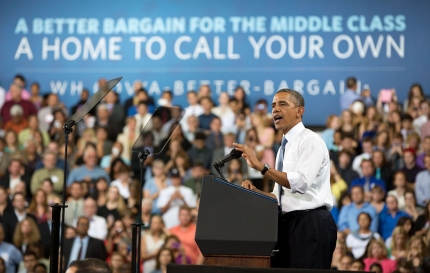
President Barack Obama delivers remarks on housing and home ownership at Desert Vista High School in Phoenix

President Barack Obama delivers remarks on housing and home ownership at Desert Vista High School in Phoenix, Ariz., Aug. 6, 2013. (Official White House Photo by Pete Souza)

Today, I joined President Obama in visiting Phoenix, where he laid out his vision for a housing system that promotes the American dream of homeownership. 

For years, owning a home was a symbol of responsibility and a source of security for millions of middle-class families across the country. But the financial crisis in 2008 put that all at risk, and by the time President Obama took office, the housing market was in free fall. Home values were plummeting and foreclosures were at record highs.

This Administration immediately took a number of steps to heal the market that helped millions of Americans stay in their homes, save money on their mortgages and turn their communities around.

Today, the market is coming back. Thanks to reforms of the financial system that cracked down on the most reckless practices that led to the housing crisis, responsible Americans can feel more confident and secure when they borrow money to purchase their own home. 

President Barack Obama and Housing and Urban Development Secretary Shaun Donovan tour Erickson Construction

President Barack Obama and Housing and Urban Development Secretary Shaun Donovan tour Erickson Construction, a housing construction company, in Chandler, Ariz., Aug. 6, 2013. (Official White House Photo by Pete Souza)

But, as President Obama made clear today, there is more work to do. It’s time to turn the page on an era of housing bubbles and taxpayer bailouts, and build a new housing finance system that will provide secure homeownership for responsible middle class families.

We see this as critically important, not only because housing and home ownership are one of the bedrock cornerstones of the middle class – but also because it is so connected to the other ones.  How do most families pay for their kids to go to college, to start small businesses, to save for retirement? It's through the savings in their homes.  If we can't protect American families from this kind of crisis again, if we can't build safe, stable investment in housing and home ownership, we also cut out the rungs in the ladder to opportunity for so many families in other areas as well. 

Related Topics: Economy, Housing, Urban Policy, Arizona

An Instagram Video Message from President Obama

Before taking the stage in Phoenix today, President Obama took a minute to remind Americans that he’ll be answering your questions about housing tomorrow, August 7th at 1:00 p.m. ET during a live online event moderated by the real estate market place, Zillow. Watch his first Instagram video here and then be sure to submit your housing question to the President through Vine, Instagram, Youtube, Twitter, or Facebook using #AskObamaHousing.

Related Topics: Economy, Housing, Technology, Arizona

The White House

Office of the Press Secretary

Press Gaggle by the Press Secretary and Sec. Shaun Donovan, 08/06/2013

PRESS GAGGLE
BY PRESS SECRETARY JAY CARNEY
AND
SECRETARY OF HOUSING AND URBAN DEVELOPMENT SHAUN DONOVAN


Aboard Air Force One
En Route Phoenix, Arizona

11:52 A.M. EDT

MR. CARNEY:  Welcome aboard Air Force One today as we make our way to Phoenix, Arizona.  As you know, the President will be delivering another of his cornerstone speeches today in Phoenix, this one focused on how far we've come and the road we still need to travel when it comes to reviving our housing market.

Homeownership is a huge part of what we think of when we think of the American Dream, and making sure that middle-class Americans are able to own their homes and to do so with a sense of security is a key priority of the President's.

I have with me Secretary Shaun Donovan, and I would like him to give you a topper, if you will, about the President's remarks today and some of the things he's going to announce.  Then he can take questions from you on this subject.  And if you would, hold and reserve questions on other subjects, which I will then answer after Shaun is done. 

With that, I turn it over to the good Secretary -- Secretary Donovan.

SECRETARY DONOVAN:  Thanks, Jay.  As Jay laid out, housing is a critical cornerstone of the better bargain for the middle class that the President has been laying out over the last few weeks.  And not only is housing itself important, but the savings that Americans build up in homes are also absolutely critical to how most middle-class families pay for their kids to go to college, to pay to start small businesses, to save for retirement.  So it connects to the other cornerstone that the President is talking about as well.

We’re going back to Phoenix because four years ago, Phoenix was one of the hardest-hit places in the country.  Just a few weeks after taking office, the President traveled there to lay out his place for how to revive the housing market.  And as we travel back today, we have, not just in Phoenix but nationally, a housing market that has improved dramatically.  Home prices are rising at the fastest level in seven years.  Construction workers are going back to work building new homes.  We’ve gained $2.8 trillion in home equity in this country since the President traveled to Phoenix that time, and millions of families have been able to come up for air because they’re back above water on their mortgages.

But what the President is going to say is that we need to do two critical things to really build the 21st-century platform that we need for middle-class families.  First, we can and we must accelerate the housing recovery that we’re seeing.  We still have too many families in Arizona and across the country that are hurting, too many communities that are still suffering the effects of the housing crisis.  And so he’s going to lay out five things that we can do in the short run, specific steps that we can take to help accelerate the housing market recovery -- things like helping many more families refinance their mortgages.

We’ve already helped over 2 million families with government-guaranteed mortgages refinance.  It’s been one of the critical things that has helped accelerate our economic recovery.  Those families are saving over $3,000 a year each and every year -- like a major tax cut.  We need to help more families do that, particularly families that don’t have government-guaranteed mortgages. 

He’s going to talk about the fact that it’s too difficult for families that can be successful homeowners to get a mortgage today, and specific steps that we can take to help that.  He’s going to talk about how we helped the hardest-hit communities renovate and rebuild, even demolish in some cases vacant and abandoned homes, and a set of other steps as well.

But he’s also going to focus on the fact that we cannot let a crisis like the one that we saw, which devastated trillions of dollars of savings, wreaked havoc on families and communities around the country, and even put our world economy at risk -- we cannot let a crisis like that happen again.  And that means building a rock-solid foundation for housing going forward.  That means creating a housing finance system, first and foremost, that does not repeat the mistakes of Fannie Mae and Freddie Mac.

So he’s going to lay out four specific principles that any legislation needs to follow.  He’s encouraged by the bipartisan progress that we’re seeing on Capitol Hill.  He believes that that legislation in the Senate Banking Committee that’s being discussed meets his -- broadly meets his four principles that he’s going to lay out today.  He believes they need to go further in certain aspects, particularly in making sure that housing is affordable going forward.  But he’s encouraged by that progress and he wants to make sure that that progress continues.

But he also believes there are things that we can do today with our own authorities that can make our housing finance system safer.  We can make sure that we continue to take steps to wind down the government presence in the housing market -- and he’s going to lay out a series of those steps as well -- and that we can make mortgages safer and simpler in this country.

Before the crisis, families buying a toaster were better protected than making the most important financial decision of their lives.  And so the President will talk about what we can do, whether it’s a three-page simple form that every homeowner should see before they make the decision to buy, rather than the reams of fine print that they see today, and a series of other steps that we can take to make mortgages simpler and safer and better for middle-class families and those striving to be in the middle class.

So with that, let me stop and I’ll take your questions.

Q    Can I ask a question?  You mentioned the Senators Warner and Corker’s bill.  So he won’t support it but he -- he supports it in concept, but he’s not going to endorse it -- is that the right way to say that?

SECRETARY DONOVAN:  Well, we’re waiting to see details of that bill, but we also know that Senators Reid and particularly, most importantly, Chairman Johnson and also Ranking Member Crapo are working themselves.  And so what he’s saying -- and this is, I would say, similar to what we have seen on immigration reform

-- he’s not going to agree with every detail, but broadly speaking, he believes this bill meets his four key principles that he’ll lay out today, but he does want to see them go farther in certain areas, particularly on making housing affordable.

Q    Housing experts say that the situation in Phoenix, while it’s obviously improved since it hit rock bottom, is due in large part to the fact that when the housing prices fell, investors came in, scooped up some of these distressed properties, and are now either selling them for a profit or renting them out at higher prices.  Is that really a strong example of the housing increases and improvements that the government wants to highlight, when it’s largely focused on investors, not sort of an average homeowner?

SECRETARY DONOVAN:  First of all, I would argue with that analysis.  Less than one in five homes in America is being bought by investors.  Close to a third of all new homes are being bought by first-time homebuyers.  And so just in terms of the numbers, while investors have been part of the story, they certainly haven’t driven it, and in a place like Phoenix, that number is actually declining pretty rapidly. 

On the other hand, what I would say -- and this I part of what the President will lay out today -- even though we're seeing more and more first-time home-buyers and others be able to get into the market, we still have millions of families that could be successful homeowners that are having trouble getting a mortgage. And that's why he's going to lay out specific steps that we need to take in the short run from streamlining duplicative regulations, simplifying those; setting clear rules of the road for enforcement going forward.

And one that's particularly important to me that we're going to be undertaking at FHA -- we have millions of families who have been able to go back to work, 7.3 million new private sector jobs over the last 41 months.  We know many of those homeowners -- many of those workers, whether they were former homeowners or continue to be homeowners today, they're folks that had very good credit records before they might have lost a job, or lost hours. They're now getting back to work.  What we're saying is if they've had a full year of being able to show they're back to being able to have very strong credit, pay on their mortgages, we ought to take additional steps to help them be able to buy a home or to refinance or do other things with their mortgage.

So that's an example -- we call it Back To Work -- specific policy that we're undertaking that can help expand the number of first-time buyers or even folks who've been successful homeowners in the past to get into the market. 

Q    Will his calling today for winding down Freddie Mac and Fannie Mae actually lead to it happening?  I mean, this is something that's been discussed since the 2008 campaign and probably before.  What about it is different today that will actually lead to some change on that?

SECRETARY DONOVAN:  Well, first of all, there are two things that are different.  If you'd asked most commentators around D.C. six months ago or even three months ago whether we were going to make any progress on this issue, most would have said no.  But we've seen over the last few months the Bipartisan Policy Center, led by a strong bipartisan group of former senators and housing leaders, put out a proposal.  We've seen now real movement in the Senate towards strongly bipartisan reform.  And so the President is encouraged by that bipartisan cooperation and wants to work closely with the Senate Banking Committee, with Chairman Johnson, Ranking Member Crapo, and all members of Congress to get that legislation done.

But the other thing that he talks about today and that we'll lay out is that there are specific steps we can take short of legislation to move the housing finance system in the right direction, including winding down Fannie Mae and Freddie Mac -- specific steps like making sure their portfolios are shrinking by at least 15 percent a year.  In some ways, Fannie and Freddie operated like hedge funds, buying and selling all kinds of investments that didn’t have to do with their core mission.  We ought to wind down those portfolios as quickly as possible.

He also talked -- in the factsheet that you can review, we lay out specific ideas for making sure that private capital sits in front of taxpayer risk even on current loans that Fannie Mae and Freddie Mac are issuing.  Those are steps that we are undertaking and we can accelerate.  We talk about using our own authorities to wind down loan limits, lower loan limits, not only for Fannie Mae and Freddie Mac, but also for FHA.

So those are just a few examples of the concrete steps that we are taking and we can take to limit taxpayer exposure, to bring more private capital back into the market, and that's one of the core principles that the President will lay out today.  For any housing finance system, private capital has to be at the center of that system, and taxpayers can't be on the hook for risk in the way that they were before.

Essentially, Fannie Mae and Freddie Mac operated with a model -- heads they win; tails taxpayers lose.  And that's got to stop.

Anybody else got other questions?

Q    We're good.

Q    I like that toaster line.  That was a good one.

SECRETARY DONOVAN:  Elizabeth Warren.  I should quote her.

MR. CARNEY:  I want to thank Secretary Donovan for joining us today and answering your questions on the housing market.  And with that, I will take your questions on other issues.

Q    Has the President spoken to former President George W. Bush about his stent?  Has he wished him well?  Give us an update.

MR. CARNEY:  I don't believe the President has spoken with the former President.  He has been briefed informally on former President Bush's medical procedure and obviously wishes him well. And I don't have anything more on that for you.

Q    Is the President involved at all with the decision to evacuate United States personnel from the embassy in Yemen?

MR. CARNEY:  The President has been briefed and updated regularly on the steps that are being taken in response to the potential threat occurring in or emanating from the Arabian Peninsula.  These are decisions that are being made by the State Department and I would refer you to the State Department for specifics about the personnel who left and the personnel who remain.  But certainly the President is briefed in real time on these matters and concurs with the decisions that have been made.

Q    Does he see this step as any type of new threat, new information that's come out in the last 24 hours or so, or is it just another step in responding to what you already knew when you closed the embassies?

MR. CARNEY:  Again, I would refer you to the State Department for details about the specific personnel decisions that are being made.  As I said yesterday, we are responding to the information that we have and, out of an abundance of caution, taking steps to ensure the security of American personnel and of facilities in a variety of countries around the region and the world.

The threat is ongoing and it's real, and we consider it serious.  We believe that it will -- that it is occurring in or emanating from the Arabian Peninsula, but we obviously cannot rule anything out when it comes to how the threat might manifest itself.

Q    Jay, did the President have a reaction to yesterday's news about The Washington Post being sold?

MR. CARNEY:  I don't have a reaction to read out to you.  As somebody who was born in Washington and considers the Post my hometown newspaper, I was I think as surprised as a lot of people were by the news, but certainly wish the institution of The Washington Post, with its storied history and everyone who works there in pursuit of quality journalism, all the best with this transition.

Q    Can I just go back to former President Bush for a minute?  When did he hear about it and how did he hear?

MR. CARNEY:  I haven’t spoken to President Obama in great detail about it.  I’m not sure.

Q    Just real quick on the Bezos purchase of The Washington Post, the President spoke with Bezos last week, I believe.  Did this come up in their conversation at all?

MR. CARNEY:  I don't have a specific readout of that.  I’m not aware that that came up.

Q    Does the President have an iPad or a Kindle?

MR. CARNEY:  I think it’s well known that the President has an iPad.  I’m not sure about his other technology purchases.

Q    You’re opening up the possibility the President has a Kindle?  Is that -- we’re leaving room for that?

MR. CARNEY:  I think I mentioned the other day that I’m on my second Kindle.  I also have an iPhone and a Macbook Air.  So I’m -- 

Q    It’s always about you, isn’t it?

MR. CARNEY:  It’s always about me when it comes to technology.

Yes.

Q    You mentioned yesterday that there would be news in the coming days about the Russia trip.  Can you give us any update on the decision-making process there?

MR. CARNEY:  I can’t.  We’re still looking at the utility of a bilateral summit in Moscow.  I have no updates on that process. We obviously have a range of issues to discuss with the Russians in areas of both conflict and potential progress, and we’re evaluating all of that as we assess the utility of a bilateral summit.

Q    What is the President’s current state of mind about Putin and the Russia relationship at this point?  How does he feel about things?

MR. CARNEY:  As I expressed in the wake of the decision by Russian authorities to grant temporary asylum to Mr. Snowden, we are extremely disappointed by that decision and feel that it was unnecessary in view of our strongly held position that there was legal justification for Mr. Snowden’s expulsion from Russia and return to the United States where he faces three felony counts and will be, upon his return, accorded the full rights and protections of a defendant in this country.


I noted at the time that we’ve had significant law enforcement cooperation with the Russians in the past, and that was especially true and has especially been true in the wake of the Boston bombing.  We felt that it was not necessary for the Snowden situation to do any damage to our relationship with Russia.  That was a view expressed by Russian officials, including President Putin, and that we shared it.

Unfortunately, this decision was made, and we’re assessing, as I said, the utility of a summit in Moscow in light of that and in light of a number of other issues.

Q    Just to go back to the embassy closures for a second.  There was a lot of discussion in the briefing yesterday about the difference between core al Qaeda and al Qaeda affiliates.   And following the briefing, it’s been reported by several news organizations that the actual conversations that were intercepted that led to these closures were conversations between Zawahiri, who is the leader of core al Qaeda, and then the leader of the Al Qaeda affiliate in Yemen.  So does the White House still stand by the assertion that the core al Qaeda has been decimated, is on the run, when this threat is emanating at least in part from core al Qaeda?

MR. CARNEY:  Well, we do stand by that.  There is no question that core al Qaeda in Afghanistan and Pakistan has been severely diminished, its leadership decimated, and there’s no question that it’s on the run.  For many years now it has become -- it has been less organized and less capable of directing attacks on the scale that it was able to do most notably on 9/11. And that remains the case.

And as the President said, I would note, at his speech in NDU, since this was a question yesterday, he noted that core al Qaeda in Afghanistan and Pakistan is on the path to defeat.  Then he also said, “What we’ve seen is the emergence of various al Qaeda affiliates -- from Yemen to Iraq, from Somalia to North Africa.  The threat today is more diffuse, with al Qaeda’s affiliate in the Arabian Peninsula, AQAP, the most active in plotting against our homeland.  While none of AQAP’s efforts approach the scale of 9/11, they have continued to plot attacks of terror, like the attempt to blow up an airplane on Christmas Day in 2009.”

So what the President said then I think is reflected in what we’re seeing now.  And when it comes to al Qaeda core, to the extent that they play a role, it is, in our view, inspirational.

And while I can't address reports about intelligence, I would say that that remains our view.

Q    Jay, does it say anything to this attack -- or should we read anything into it -- the President has maintained a normal schedule through the weekend, doing this event today.  We haven’t heard him make public comments thus far.  Does that give any insight as to exactly what this threat may be?

MR. CARNEY:  Well, we’ve been very clear with the warning that we've issued and with the actions taken by the State Department and obviously with a number of actions that are taken -- seen and unseen -- by Homeland Security and other parts of our national security apparatus that we take this threat very seriously.  And the President has directed his national security team, including Counterterrorism and Homeland Security Advisor Lisa Monaco, as well as other members of that team, to take all steps necessary to ensure the security of American citizens and American personnel abroad. 

As we've said, and I said yesterday, we have been living in a world for some time now where we face an organization in al Qaeda and in its affiliates that aspires to do harm to the United States, aspires to do harm to the American people.  And we have to maintain constant vigilance in the face of those threats to do everything we can to disrupt them, to do everything we can to bring to justice those who would perpetrate them.  And that's what we're doing. 

Q    I don't think you commented yesterday about baseball.  Have you talked to the President about the scandal from yesterday and does he have a response -- reaction?

MR. CARNEY:  The President believes that our professional athletes have an important responsibility as role models, especially to our children.  And his views on performance-enhancing drugs are clear.  But I don't have a specific reaction to the announcement by Major League Baseball yesterday, but he believes it's the duty and responsibility of our athletes to be quality role models for our children.

Q    For the Leno show tonight, can you speak a little bit about what the President thinks and what you think you get specifically out of appearing on The Tonight Show, who you're reaching that you're not reaching otherwise by doing that appearance?

MR. CARNEY:  Well, it's certainly not the first time this President or other Presidents or other political leaders have appeared on The Tonight Show or shows like it.  I think the reason why we've agreed to appear on shows like this is because we're trying to communicate with Americans where they are.  And the viewers of late-night shows are not necessarily the readers of newspapers or wire services, or necessarily viewers of cable or broadcast news shows. 

So the President looks forward to it.  He has done The Tonight Show on a number of occasions.  He has obviously done a variety of other shows.  And as I think was noted sometime on occasion last year, some of his more substantive interviews have appeared in non-traditional settings.  So you never know what you might get.

Q    Is there a kind of viewer that he thinks he wants to reach out to by appearing on The Tonight Show as opposed to the David Letterman Show?

MR. CARNEY:  Well, I'll leave it to the media critics to make those kind of distinctions.  (Laughter.)  But the answer is I think the category is something that, like others, we look at in trying to reach as many Americans as we can and in the ways that we can.  As you know, the President recently gave a lengthy interview to The New York Times, which I guess some would argue would be targeting a different audience.

Q    Could you maybe bring back your esteemed colleague, Dan Pfieffer, to claim on the relative merits of going to The Tonight Show?

MR. CARNEY:  I have Mr. Pfieffer's proxy on that question today.

Q    Thanks, Jay.

END
12:16 P.M. EDT 

The White House

Office of the Press Secretary

Press Briefing by Press Secretary Jay Carney, 08/05/2013

James S. Brady Press Briefing Room
 
2:08 P.M. EDT
 
MR. CARNEY:  Good afternoon, ladies and gentlemen.  Thank you for being here.  Good Monday to you.  Before I take your questions, I just wanted to note that on behalf of all of us in the press office, from the President on down, we want to express our condolences to the NBC family and to the Palmer family at the loss of John Palmer, who was truly one of the greats, in my view -- a wonderful man, a terrific reporter, and someone who was as old-school as you could get, and just decent to the core. 
 
So, with that, I'll go straight to the Associated Press.
 
Q    Thanks, Jay.  A couple of questions on the embassy closures and the threats surrounding that.  Can you be a little more specific about the type of chatter that led to these closures?  Are we talking about intercepts of electronic communications?
 
MR. CARNEY:  Well, Julie, I appreciate the question and I certainly understand the interest.  There’s a great deal of focus and attention on this in the press, in the public, and of course, within our administration.  We take the threat very seriously and have taken action because of that.
 
I'm not in a position to discuss specific intelligence, but we believe that this threat is significant and we are taking it seriously for that reason, and have taken the actions that the State Department announced out of an abundance of caution, and will continue to monitor this and take action as necessary.
 
Q    Is this threat contained just to Americans and American interests overseas, or is there any heightened threat to Americans in the U.S.?
 
MR. CARNEY:  I would say that the threat is emanating from and may be directed towards the Arabian Peninsula, but it is beyond that, potentially.  And that is why we have taken some of the actions we've taken.  And we can't be more specific than that except to say that the embassy closures that we've announced are in reaction to that out of an abundance of caution, and the extension of those closures does not reflect a new stream of threat information but is more a reflection of taking necessary precautions.
 
Q    But I just want to clarify -- you said that this largely contains the Arabian Peninsula but also beyond that.  Does “beyond that” include Americans in the U.S.?
 
MR. CARNEY:  I think that the threat from al Qaeda and affiliated organizations to the United States and to the American people has been a reality that we've talked about for a long time now.  I think --
 
Q    This specific threat --
 
MR. CARNEY:  Again, I'm not going to get into specific intelligence matters.  I can tell you that we have taken the action we've taken out of an abundance of caution and we have issued the warnings that we've issued in order to make sure that the American people are aware of the potential threat, the potential threat that has always been with us but which is heightened at this time.  And we will provide more information as we can, mindful of the need to maintain our security.
 
Q    And word of these embassy closures and this threat followed the President’s meeting with the President of Yemen.  Obviously Yemen is at the center of this.  Is there anything that came from that meeting, anything President Hadi told President Obama that contributed to this decision?
 
MR. CARNEY:  We read out that meeting and I don't have any more detail for you from that meeting.  It is certainly the case that we cooperate on counterterrorism with Yemen and have for some time.  But this specific information reflects what we’ve gathered, broadly speaking, and that’s what we’re reacting to.  The meeting between President Hadi and President Obama centered on a variety of topics, including our counterterrorism cooperation.
 
Yes, Jeff.
 
Q    Jay, should Americans in the U.S. -- to follow up on what Julie asked -- be afraid?
 
MR. CARNEY:  Jeff, what I can tell you is that we face an ongoing threat from al Qaeda and its affiliates.  There are individuals and organizations out there that are focused on doing the United States and the American people harm, as well as doing harm to our people.
 
Now, the statement that we put out has made clear that our current information suggests that al Qaeda and affiliated organizations continue to plan terrorist attacks both in the region and beyond.  And our information suggests that they may focus efforts to conduct attacks in the period between now and the end of August.
 
What we know is that the threat emanates from and may be focused on occurring in the Arabian Peninsula, but it could potentially be beyond that or elsewhere.  And so we cannot be more specific -- which is why we’ve taken some of the actions we’ve taken and made the statements that we’ve made.
 
Q    What does this say more broadly about the strength of al Qaeda in general?
 
MR. CARNEY:  We’ve made clear, as I was saying earlier, that as al Qaeda core has been diminished through the efforts of the United States and our allies, affiliate organizations -- including in particular, al Qaeda in the Arabian Peninsula -- have strengthened.  And we have here in Washington identified AQAP as a particularly dangerous threat for some time now, a number of years.  As you know, from this very podium John Brennan, now the CIA Director, then the President’s Counterterrorism and Homeland Security Advisor, spoke very specifically about the rising threat from AQAP.  And that is something that we’ve seen in some of the foiled attempts that AQAP has been engaged in, and has been a focus of attention of our national security apparatus for some time.
 
Q    And if I could ask you one other question on a separate issue -- some colleagues of our at Reuters reported today that a unit of the DEA, called the Special Operations Division, gives tips to law enforcement across the U.S., and was asked to cover up evidence that is used to launch investigations against Americans.  Can the White House confirm this?  And are there any concerns about the constitutionality of this program?
 
MR. CARNEY:  Well, I’d say two things.  One, I would refer you to the Department of Justice on this.  And beyond that, I can tell you that it’s my understanding, our understanding, that the Department of Justice is looking at some of the issues raised in the story.  But for more, I would refer you to the Department of Justice.
 
Q    Jay, in the past, the President has said that al Qaeda -- and you just mentioned this -- core has been on the path to defeat.  He said this back in May; he said it in December.  And I’m just curious -- with nearly two dozen embassies and consulates being closed, is it fair anymore to say that core al Qaeda is on the path to defeat?
 
MR. CARNEY:  Well, I think as most people who cover these issues understand, al Qaeda core is the Afghanistan/Pakistan-based central organizational core of al Qaeda, once headed by Osama bin Laden.  And there is no question over the past several years al Qaeda core has been greatly diminished, not least because of the elimination of Osama bin Laden.
 
What is also true is that al Qaeda and affiliated organizations represent a continued threat to the United States, to our allies, to Americans stationed abroad, as well as Americans here at home.  And for that reason we have focused a great deal of attention on those affiliated organizations. 
 
And we have made clear over the past several years that AQAP, al Qaeda in the Arabian Peninsula, is of particular concern and has demonstrated both an interest in and a willingness to attempt serious attacks on the United States, our allies and our people.  For that reason, we have to be continually vigilant, and have been.  And the threat that we've made public in recent days reflects the fact that we are vigilant about the willingness of al Qaeda in the Arabian Peninsula and other affiliated organizations with al Qaeda to take action against us and against our allies and our people.  And we are taking all the precautions we can as we gather more information.
 
Q    And what does it say to the rest of the world when you close nearly two dozen embassies and consulates?  Some might say that that is a showing of weakness on the part of the United States that it has to shut its doors.
 
MR. CARNEY:  Well, as I think the State Department has made clear, this is a temporary measure.  It is limited to the diplomatic facilities that have been specifically identified.  And it is done -- in terms of the extension of the closure -- out of an abundance of caution, which I think is the right move given the potential threat that exists. 
 
We are engaged around the world.  And it is absolutely the case that that engagement creates some risk for American personnel around the world.  And decisions like these are designed to reduce that risk in the face of a potential threat.  But the engagement, of course, will continue because it's in the United States' interest to be engaged around the world, including in those areas that are volatile and where the risk is higher than elsewhere.
 
Q    And is there any concern that you've taken your eye off of the ball when it comes to al Qaeda -- stressing for months that its core is on the path to defeat while AQAP gets stronger  -- when you have affiliates like the one in Benghazi where people who might be affiliated with al Qaeda pulling off the attack in Benghazi?  Lindsey Graham yesterday said that al Qaeda is on steroids.  That doesn't sound like it's on the path to defeat.
 
MR. CARNEY:  Well, again, I think you're confusing al Qaeda core with what we have said very clearly about the threat posed in particular by AQAP, but also affiliated organizations around the region and the world.  I think that any evaluation of the actions that we've taken in the fight against al Qaeda and its affiliated organizations over the last several years and over the life of this administration demonstrates a pretty intense focus on the fight against al Qaeda and the effort to degradeal Qaeda's abilities and all the abilities of all the affiliated organizations. 
 
Q    The eye hasn't been taken off the ball?
 
MR. CARNEY:  I think any fair assessment would conclude the opposite. 
 
Jon.
 
Q    Jay, is there any confidence that we have enough information to disrupt whatever plot is potentially underway?
 
MR. CARNEY:  I think we've told you as much as we can at this point about the intelligence that we have.  I'm not in a position to discuss in any more detail our intelligence.  We obviously, as I said earlier, believe that this threat is significant and it is ongoing.  And for that reason, we have taken some of the action that we've taken.  And we are obviously continuing to gather information to work with our partners and allies as we do that to combat this threat and the overall threat posed by terrorist organizations that wish us harm.
 
Q    And on Edward Snowden, you said that the administration was looking at the utility of this summit in Moscow in September. Have you had any further information on that?
 
MR. CARNEY:  I have no new announcement for you today.  As I said the other day, this was not a positive development, and while we have a wide range of interests with the Russians, we are continuing to evaluate the utility of a summit.  I think it’s fair to say that you can expect that we’ll have a decision to announce in coming days about that specific issue.
 
Q    So how can the President go to Moscow and meet with Putin just after this slap in the face?
 
MR. CARNEY:  I think it’s fair to say that we have a range of issues, Jon, of interest with the Russians.  And as I said the other day, it has been true for four and a half years now that we have dealt with the Russians in a very realistic way, in an effort to cooperate where we can and to be very clear and pointed where we disagree.  We obviously disagree with the Russians very strongly about the decision they’ve made on Mr. Snowden.  We disagree with the Russians on a number of other issues, including Syria.  And we have made those disagreements plain, both publicly and privately, in our discussions with the Russians. 
 
So when it comes to the utility of a summit in Moscow, a bilateral summit, we are evaluating that against not just our disagreement over Mr. Snowden, but some of the other issues where we have failed to see, thus far, eye to eye.  And once we have fully assessed the utility of a summit, we’ll make an announcement.
 
Major.
 
Q    A couple of things since we haven’t had a chance to talk to you about this -- there’s been a lot of speculation over the weekend that it’s maybe the President’s birthday, maybe it’s the end of Ramadan, maybe it’s the anniversary or the Kenya/Tanzania bombings, and I’d like to see if you can, in any way, shape or form, communicate something that is non-speculative about what this threat stream seems to be about and if it does have any connection to what has been speculated possible touch points that I just listed.
 
MR. CARNEY:  I cannot shed light on what has generated this particular threat.  We simply act on the information that we have.  We obviously share the information we have with our partners and allies, as we identify and try to take action against those who would do us harm and pose a threat to us, and who may be organizing an attempt to attack either the United States, our allies, or a U.S. facility.  But beyond that I don’t have any specific information to provide to you about this particular threat and what it’s related to.
 
Q    Okay.  As you told us over the weekend, the President was routinely briefed on this.  In the past, when you look at case studies of times when the United States government has announced and not announced, there have been different tactical reasons for that.  And sometimes when there’s an announcement, there’s a change in the information flow, there’s a change in the chatter, there’s a change in the operational communication that potential terrorists go through.  Can you tell us anything about if that’s changed over the weekend, after the announcement on Friday -- the threat stream minimizing, or diverting, or changing in a different way?
 
MR. CARNEY:  I think that’s a good question and I have no new information to provide to you.  We have no new threat stream that is related to our decision to extend the closure of facilities.  And I can say that because, understandably, a new decision like that, coming on the original decision to close some facilities on Sunday, might be read as indicating that we have a new stream of information, and we do not.  We’re simply working off of the information we had coming into the weekend to act prudently in further extending the closures.
 
Q    Okay.  Senator Graham and Senator McCain are in Egypt. I know we talked a little bit about this last week, but was there something -- for example, any conversations between the President or senior administration officials before they arrived in Egypt? Would you expect to hear back from them?  And in the intervening weeks since the last spate of violence, is there anything that you are prepared to say about the direction of Egypt, either pro or con, or helpful or not helpful?
 
MR. CARNEY:  Well, on the visit by Senators McCain and Graham, I can say that we’re continuing to consult closely with Congress, and that includes those two senators, with whom we have had at the highest levels discussions about matters of national security and foreign policy.  As you know, those two senators met with the President not long ago to discuss national security issues.  And we will, of course, consult with them and other members of Congress on developments in Egypt in the days and weeks ahead.
 
More broadly on Egypt, as you know, Deputy Secretary of State Bill Burns was in Cairo this weekend and continued his discussions with a wide range of Egyptians, both yesterday and today, on how they can calm tensions, avoid further violence and facilitate an inclusive democratic process that helps Egypt’s ongoing transition succeed.  Deputy Secretary Burns has extended his trip, as has the EU Special Representative Bernadino León.  The Deputy Secretary continues to consult closely with Egyptians from a range of groups and parties and sectors of society, as well as with the EU and representatives of the UAE and Qatar, who are also in Cairo. 
 
And along with our international friends, our team is in Cairo to offer the Egyptians help as they work to calm tensions and reduce the polarization that we have seen there.  Ultimately, the decisions on the path forward are for Egyptians alone to make, but we are assisting and facilitating this process, as requested by the Egyptians.
 
Q    Before I let you go, I know you don’t want to give away everything tomorrow, but there have been for the last month or so some encouraging signs in the housing market as a part of the overall upward trend of the economy, and I wonder what’s missing that the President is going to address tomorrow that’s needed that he hasn’t already done before.
 
MR. CARNEY:  Well, I think that you’re absolutely true that there has been an important rebound in the housing market.  The data that describe the situation in the housing market in this country on January 20th, 2009 are daunting.  I believe the American people lost roughly $7 trillion in wealth by January 2009. 
 
And what we have seen, through the grit and determination of the American people, and through the decisions made by the administration and the policies put in place both with Congress and through executive action, has been a very positive change in direction in our housing market.  But we are still not where we need to be.  And there is certainly ample room to grow when it comes to providing more homeowners the assurance and the capability to refinance their homes and to further stabilize and grow the housing market across the country.
 
So as part of his plan to offer a better bargain for the middle class, President Obama will be in Phoenix tomorrow to lay out proposals for continuing to help responsible homeowners and those Americans who seek to own their homes. 
 
Following his remarks in Phoenix, on Wednesday at 1 p.m. Eastern and 10 a.m. Pacific time, the President will do an interview with Zillow to answer questions from citizens around the country that will be submitted through a range of social media platforms, including through Twitter, Facebook, Instagram, YouTube and Vine.  Zillow CEO Spencer Rascoff will moderate the discussion in which the President will answer questions submitted by Zillow’s users and social media community, using the hashtag #askobamahousing.
 
So I think what is important to remember about this is that so many Americans across the country view their own economic and financial circumstances through their homes and whether they own a home, whether their home is underwater, whether they feel like they have equity in their homes.  And so that strengthening of the housing market is of vital importance to the strengthening of the middle class.  And that’s why the President has chosen to focus on housing as one of the cornerstones of his economic agenda.
 
Q    Refinancing and access to mortgage is primarily the focus?
 
MR. CARNEY:  Well, again, I don’t want to steal -- as you said at the top -- the President’s thunder, so I encourage you to wait for more specifics from the President tomorrow.
 
Ed.
 
Q    Jay, on Iran, you’ve got a new President in office, and obviously there is still a very grave nuclear threat the administration is concerned about.  But do you feel like he is saying some of the right things?  Do you feel like maybe there is an opportunity here?
 
MR. CARNEY:  Well, I appreciate the question.  I want to mention that we, again, congratulate the Iranian people for making their voices heard during Iran's election.  We note that President Rouhani -- recognize his election represented a call by the Iranian people for change.  And we hope that the new Iranian government will heed the will of the voters by making choices that will lead to a better life for the Iranian people.

The inauguration of the new President presents an opportunity for Iran to act quickly to resolve the international community's deep concerns over Iran's nuclear weapons program.  Should this new government choose to engage substantively and seriously to meet its international obligations and find a peaceful solution to this issue it will find a willing partner in the United States. 
 
Now, as we've said consistently, we are open to discussions with Iran both through the P5-plus-1 and through bilateral talks. The focus of those talks would be, and needs to be, on Iran's willingness to forsake its nuclear weapons ambitions.  And should it be willing to do that in a verifiable way, there's an opportunity for Iran to reenter the international community, to ease the burden of its isolation, and thereby to do what the new leadership in Iran has identified as its goal, which is to improve the lot of the Iranian people.  And that would be both very good news for the Iranian people, as well as for the region and the world.
 
Q    And, finally, on al Qaeda, I want to go back to what Jim was asking you about the President's previous comments.  You're correct that you and other officials have said that there's a difference between al Qaeda core and its affiliates and the threat from each.  But on the campaign trail, the President rarely made that distinction.  October 11th, 2012 -- "I said we'd refocus on the people who actually attacked us on 9/11.  And today, al Qaeda is on the run and Osama bin Laden is dead."  Did he give the full picture to the American people in the campaign about the threat from al Qaeda when that was his talking point again and again?
 
MR. CARNEY:  I think it's indisputable that the elimination of Osama bin Laden was a major accomplishment in the effort against al Qaeda.  We have been clear, and the President has been clear, that the threat from al Qaeda very much remains.  And I think, in answer to Jim's question, I was trying to convey that any fair assessment of the actions this administration takes and this government takes, and our extraordinarily capable men and women in uniform and men and women in the intelligence community -- the actions they take in order to continue the fight against al Qaeda and al Qaeda's affiliates demonstrates how seriously we continue to take the threat. 
 
And nobody should be under any illusion that that threat still exists.  I think that we have numerous conversations in this room and around Washington and around the country about what we need to do continually as a nation to protect ourselves against the threat posed by terrorists who want to do us harm.  And the fact that we continue to do those things demonstrates that the threat is real and we have to be ever vigilant. 
 
So as I said earlier, I don’t think there's any fair reading of the efforts we've made in the fight against AQAP and other al Qaeda affiliates.
 
Q    But he rarely had those caveats that you're adding now.  He said, on the run; he said they've been decimated. 
 
MR. CARNEY:  There's no question that al Qaeda's core --
 
Q    But he didn't say their affiliates might get us.
 
MR. CARNEY:  Well, that's just not true.  But al Qaeda's core leadership, the leadership that attacked the United States on September 11th, 2001, has been decimated.  Al Qaeda core in the AfPak region has been greatly diminished and is on the run.  And we have brought continual pressure to bear on both al Qaeda core and al Qaeda's affiliates.  And we have, for a number of years now, made clear that our attention in terms of the threat presented by al Qaeda has shifted in focus to some of these affiliates, in particular AQAP.  And John Brennan and others have been categorical about that in public.  So I think that represents the full picture.
 
Q    Jay, I want to follow up on that from the other side.  There have actually been numerous drone strikes that have taken place in Yemen, some of which you guys have confirmed, some of which you haven’t -- understandable on that front -- but have been talked about as taking out leaders of AQAP.  And I guess my question is more about -- is the drone strikes not working?  AQAP, we’ve supposedly gone after their leadership, had success in getting -- is this as you get rid of one leader, two more come up?  Is there an explanation of why -- why is AQAP apparently as operational as they are today, with all the effort that you guys have talked about in public -- like I said, some of which you couldn't -- some of it that has been reported behind the scenes  -- why has this not worked?
 
MR. CARNEY:  Well, I don’t think that the fact that there is a continual threat from the most operational of the AQ affiliates suggests that we haven’t brought enormous focus to the effort to degrade those affiliates.  We have.  And we have worked with Yemen and other partners when it comes to AQAP.  We have worked with other international partners around the world in our efforts to degrade al Qaeda and its affiliates in different parts of the region and the world, and will continue to do that. 
 
But as we do that, we have to recognize that we’re talking about an organization and individuals who are singularly focused on doing harm to our interests and our people, and we have to, therefore, be mindful of that threat and take action accordingly.
 
Q    Do you concur with Congressman Adam Schiff, a member of the Intelligence Committee?  He said this morning that he thinks the drone strikes, particularly in Yemen, have been a double-edged sword, that for every success you had, it’s served as a “recruiting tool” for AQAP.
 
MR. CARNEY:  Again, I’m not going to talk about specific means by which we take the fight to al Qaeda or its affiliates.  I will simply say that it is our view that we have to continue to take the fight to those organizations and those individuals that are actively plotting to attack the United States, attack American citizens, attack Americans stationed abroad, attack our allies and their people, for as long as that threat exists. 
 
And that effort extends beyond the kinetic actions that can be taken.  It includes all of the work we do with our partners in the region and around the world through intelligence and other means, to ensure that we are doing everything we can to enhance the security of the American people and our men and women stationed around the world.
 
Q    On the worldwide travel alert, is this an indication that any American tourist, any American businessman traveling overseas is potentially a target?  Or is this worldwide travel alert just an overabundance of caution?
 
MR. CARNEY:  I think in this situation, it was the judgment made by the administration that providing the alert was the right course of action, understanding that it was fairly general.  We are taking actions when it comes to the traveling public through TSA and other organizations to ensure the security of the traveling public and enhance that security.  But as we said earlier, we can’t be specific about -- or I’ve said earlier and others have said earlier -- we can’t be specific about where it is less safe and where it is more safe, so we need to make sure that everyone is aware that there is an existing threat.
 
Q    Two other quick things.  Why is -- are McCain and Lindsey Graham acting on behalf of the White House in this instance?  I know there’s been -- you said that he’s been fully briefed.  Their role as mediator in this situation -- are they basically there on behalf of the administration?
 
MR. CARNEY:  Well, I don’t know that they’re there as mediators.  I think they’re there representing the United States Congress, the United States Senate.  They’re two leaders in the Senate on matters of foreign policy for the Republican Party in particular, but they have certainly been in conversation with the President and others on the President’s national security team.  And I think their efforts in Egypt and the conversations they have represent the broad interests that not just the administration has, but that the Congress has in what’s happening there.  And we’ll work --
 
Q    You’re right.  I mean, they are carrying -- as far as General al-Sisi is concerned, the Muslim Brotherhood, they’re representing the interests of President Obama.
 
MR. CARNEY:  Deputy Secretary Burns is representing the administration in Cairo, as I speak, and has been for several days, and has on his prior visits there.  Senators Graham and McCain are representing themselves, obviously, the U.S. Senate, the U.S. Congress.  But we are all focused together on the very volatile situation in Egypt.  And there is no question that we consult regularly with members of Congress, especially those members like Senators Graham and McCain who have a particularly keen interest in the country and the region. 
 
Q    Is the G20 at all in jeopardy?  Is there a way -- you said you don’t --
 
MR. CARNEY:  I don’t foresee a change in the President’s schedule.
 
Q    -- adding to U.S. prestige by going to St. Petersburg?
 
MR. CARNEY:  I don’t see a change.  There is not a change to announce in the President’s schedule.  The G20 is an international meeting, one the United States was very instrumental in setting up as an annual meeting of 20 nations to discuss international economic policy and other policies.  So the President’s schedule remains as it was, which includes attending that summit.
 
Q    Could he end up not attending, but the U.S. attends?
 
MR. CARNEY:  Well, again, I don’t foresee a change in his participation and I don’t have any further scheduling announcements.
 
Margaret.
 
Q    Thanks, Jay.  The embassy closings come as there is this debate over the NSA’s surveillance programs, and I’m wondering whether the intelligence and the ongoing threat that the U.S. has identified helps bolster the case for the NSA’s activities and programs.
 
MR. CARNEY:  I’m not going to blend those two stories or those two issues together.  We have a threat that we have advised the public about and discussed with you in the media, and we are acting in reaction to that threat.  And we have a separate -- we have a set of issues regarding the unauthorized disclosure of some classified information that has led to a debate about the programs we have in place to protect our security and the balance that we seek and the President seeks in both protecting our security and in maintaining the privacy of the American people. 
 
So we’re focused, when it comes to the threat, on what that threat represents, how we can act against it, and ensure the security and protection of the American people and of our facilities abroad.  I wouldn’t blend the two issues.
 
Q    May I ask you -- I don’t mean this facetiously.  I mean, it’s a real question.  Operationally, what difference does it make if the AQ core is weakened while the AQ branches are strengthened?  Does it make it easier or harder?  Or is it a wash, in terms of al Qaeda’s ability to organize some sort of worldwide thing if there are a bunch of branches without a core?
 
MR. CARNEY:  Well, I think that some counterterrorism experts might be able to address this with greater detail.  Al Qaeda core, headed by Osama bin Laden and Zawahiri and others, took dramatic action on several instances to inflict damage on the American people and take the lives of Americans.  And therefore, the actions we took against, as a nation, al Qaeda core were both the right thing to do and necessary when it came to mitigating the threat that al Qaeda core represented and represents.  It is diminished, but not defeated. 
 
But there’s no question that, as we’ve said for a long time now, some of these affiliate organizations, and in particular AQAP, represent threats as well.  And we have seen in the past from AQAP attempts that have been thwarted, but were serious attempts to inflict damage on the American people and engage in spectacular attacks against U.S. interests and people, and we have to be mindful of that.  And that’s why we are responding to this current threat in the way that we are.
 
I’m going to only be able to take a couple more.  Ari.
 
Q    The President is speaking at Camp Pendleton and then also to disabled American veterans.  Is the focus going to be middle-class jobs and opportunities sort of in civilian life, or is it going to be a foreign policy speech?  Is he going to focus on wars ending?  Can you just give us a framework to think about these two events?
 
MR. CARNEY:  Well, I don’t want to steal his thunder for those events either.  I think when it comes to visiting Camp Pendleton, the President very much looks forward to, as he always does, visiting with our troops both when they’re stationed here in the United States and when they’re stationed abroad.  And I think you can expect those remarks to be focused on the troops themselves.  And then obviously there are a host of issues that this President believes merit the attention of the American people and of Washington when it comes to our veterans, and in particular, our disabled veterans.  So he looks forward to that event as well.
 
Q    So this is not branded as part of the middle-class jobs economic tour?
 
MR. CARNEY:  This is not -- no, neither of those events are one of the cornerstones that we talked about when it came to this series of speeches, building on the original speech in Galesburg. 
Jackie.
 
Q    Jay, from the start, the President is trying to get away from talking about a global war on terror, as the previous administration did.  And yet, if the war on al Qaeda, as he’s preferred to style it, is, in effect, a war against these affiliates as well, wherever they show up, isn’t that, in effect, a global war on terror?
 
MR. CARNEY:  Well, setting aside the nomenclature, I think that the fact is we have a continuing threat from al Qaeda, and in particular some of its affiliate organizations that have sprung up in the last decade.  And we respond to those threats because they represent a real security challenge for the United States, for our allies and for our people. 
 
But what the President has been focused on from the beginning, when he came in, was making sure that we were using our resources to counter the threat against the United States.  That’s why he refocused our attention on al Qaeda in the AfPak region and on the effort in Afghanistan, because that war was launched, justifiably, in response to the attacks on the United States on September 11, 2001. 
 
He ended the war in Iraq, as he promised he would do, and one of the reasons that that was necessary was to ensure that we could continue to focus, as we should, on the threat posed to the United States by al Qaeda and by its affiliates.
 
It is obviously a well-known fact that the President believed as a candidate in 2008 that through the previous years we had, as a nation and in our efforts, lost our focus on the specific threat against the United States, and that the effort in Iraq had contributed to that.  So the President made sure that we would focus again on al Qaeda in Afghanistan and Pakistan, as well as al Qaeda’s affiliates around the world.
 
Last one.  Cheryl.
 
Q    Thanks, Jay.  On a question about health care, a couple months until the exchanges in marketplaces have to go into effect.  Is the President personally meeting with Secretary Sebelius and other Cabinet secretaries about implementing health care at this point? 
 
MR. CARNEY:  Well, the implementation of the Affordable Care Act is very much a high priority of the President’s, and he is engaged in discussions about progress being made on implementation, as you would expect, and certainly the rest of the administration is.  I don’t have specific meetings to read out to you, but this is an important priority.  We need to ensure that implementation continues.  As I’ve said all along from the podium, as others have engaged in repeated attempts -- futile attempts to repeal the Affordable Care Act -- I think the House has just had its 40th vote along those lines -- the administration is focused on implementing a law that was passed by Congress, signed into law by the President, and upheld by the Supreme Court of the United States, a law that is already providing benefits to millions of Americans, to young people on their parents’ insurance policies, to seniors benefiting from discounted prescription drugs, to everyone who will benefit from the inability of insurance companies to deny coverage to those with preexisting conditions.
 
And we’ll go about the business of implementing the law so that those benefits are more widely shared by the American people.  And it would be wonderful if Congress would focus on assisting in that implementation, because everyone’s constituents, no matter what state you’re from or what district you represent, stands to benefit from the greater access to insurance that the Affordable Care Act provides -- the benefits that the Affordable Care Act when it’s implemented fully will provide to Americans across the country. 
 
And when a citizen of district Y in state X wants to know how he or she can benefit from the Affordable Care Act, I would hope that members of Congress and their staff in those districts would provide the information to their constituents that their constituents deserve by law.
 
Thank you very much.
 
Q    Do you have any comment on the baseball suspensions?
 
MR. CARNEY:  No, I don’t have anything.
 
Q    Jay, happy birthday to the President and my best wishes.
 
MR. CARNEY:  I will tell him.
 
END 
2:50 P.M. EDT

Watch Live: A Better Foundation for Middle Class Homeownership; Tuesday, August 6, 2013 at 4:05PM ET

August 05, 2013 | 1:19 | Public Domain

Tune in on Tuesday August 6, 2013 as President Obama will lay out the foundation for a Better Bargain for Middle Class Homeownership in America. Go to http://obamawhitehouse.archives.gov/a-better-bargain to see it live at 4:05PM ET

Download mp4 (91.8MB)

Ask President Obama Your Questions About Housing

President Obama is traveling to Phoenix, Arizona on Tuesday to lay out his plan to continue helping responsible homeowners and those who seek to own their own homes as the next cornerstone of a strong middle class in America. The day after the speech, the President is sitting down to answer your questions about his plan during a live online event hosted by Zillow, the online real estate market place, with media partner Yahoo!. 

Related Topics: Economy, Housing, Urban Policy, Arizona

The White House

Office of the Press Secretary

FACT SHEET: A Better Bargain for the Middle Class: Housing

When President Obama took office, our housing market was in free-fall, leaving many families feeling trapped and anxious about their mortgages.  The President took immediate action to stabilize our housing market and protect the middle class.  These steps helped millions of middle class families stay in their homes, save money on their mortgages, and turn their communities around.

Working together we need to build a more durable and fair system that promotes the American Dream of homeownership, while preventing the nightmare of another crisis.  Today, our housing market is coming back.  Home values are rising, foreclosures are at the lowest levels since 2006, home sales have increased at double digit rates, and American families are on pace to purchase over 5 million homes this year.  In part because of President Obama's tough regulations that cracked down on the most reckless practices from the housing crisis, responsible Americans can feel more confident and secure when they borrow money to purchase their own home.  But the job is not done, and restoring security to homeownership is one of the President’s top economic priorities. 

In today’s speech, the President laid out his ideas to help more responsible homeowners refinance, to cut red tape, to increase home values by fixing our broken immigration system, to help the hardest hit communities rebuild, and to ensure those who rent have decent and affordable options.  The President also made it clear that going back to the same bubble-and-bust housing system that caused the financial crisis is not acceptable. We need a rock-solid foundation for financing homeownership with a bigger role for the private sector, where taxpayers aren’t on the hook for the irresponsible behavior or bad decisions of financial institutions and we finally put an end to an era where Fannie Mae and Freddie Mac could expect a bailout for risky behavior in pursuit of profits. These bipartisan solutions will help build on the progress we’ve made over the last four years, and together we can make owning a home a symbol of responsibility and a source of security for generations to come.

A Better Bargain for the Middle Class: Housing

A Better Bargain for Responsible, Middle Class Homeowners:

  • Help responsible families save $3,000 a year by refinancing while mortgage rates are still low
  • Take executive action to cut red tape so responsible families can get a mortgage
  • Fix our broken immigration system to increase home values
  • Rebuild communities hit hardest by foreclosure
  • Create and preserve affordable rental housing by passing a bipartisan Senate proposal 

Core Principles for Durable, Fair Housing Finance (GSE) Reform:

  • Put private capital at the center of the housing finance system
  • End Fannie Mae and Freddie Mac’s failed business model so taxpayers are never again on the hook for bad loans and bailouts
  • Ensure widespread access to safe, responsible financing like the 30-year fixed rate mortgage
  • Support affordability and access for renters and homeownership for first-time buyers, in part by continuing the historic affordability role of Federal Housing Administration (FHA) 

Making Families’ Most Important Financial Decision Safe and Simple:

  • Ensure all prospective homeowners receive a single, simple three-page mortgage disclosure form
  • Increase incentives for lenders to deliver high quality loans and products
  • Level the playing field for financial institutions of all sizes so borrowers can work with the lender right for them 

Confirming Mel Watt Will Provide Certainty and Leadership During This Key Phase:

  • Congress should swiftly confirm the President’s FHFA Director nominee Mel Watt to further accelerate efforts toward common sense housing finance reform 

A Better Bargain for Responsible, Middle Class Homeowners

There are several additional steps – including legislative proposals – that could immediately work to further strengthen the housing market and ensure that the middle class can secure affordable mortgages, refinance their loans at today’s low rates, and build housing wealth while ensuring that no communities or homeowners are left behind by the housing recovery.

  • Help Responsible Families Save $3,000 a Year by Refinancing While Mortgage Rates are Still Low:  President Obama has set the goal of eliminating all barriers to refinancing for responsible borrowers. The Administration worked with housing regulators to implement key changes to the government’s refinancing program (HARP) that nearly tripled the number of families who received refinancings from 400,000 in 2011 to 1.1 million in 2012, bringing the HARP program total to more than 2.6 million. To complete the task of providing refinancing options for all responsible borrowers, the President has proposed the following three steps:
  • Streamline refinancing for borrowers with government-insured mortgages. 
  • Waive closing costs for borrowers who refinance into shorter term loans to more rapidly rebuild equity in their homes.
  • Expand eligibility for refinancing to many hundreds of thousands of eligible borrowers who do not have government-backed mortgages by creating special programs through the Federal Housing Administration (FHA) or Fannie Mae and Freddie Mac. 

These steps could help a typical family save $3,000 or more per year.

Cut Red Tape so Responsible Families Can Get a Mortgage: There are still millions of families with strong enough credit profiles to qualify for a mortgage but who are nonetheless being denied loans. According to the Federal Reserve, from 2007 to 2012, mortgage lending to borrowers with credit scores above 780 fell by a third, while lending to borrowers with credit scores between 620-680 declined by roughly 90%. For many of these borrowers, they are denied a loan because lenders are unclear of the rules of the road for lending and are protecting themselves by only lending to those with the most pristine credit.  The Administration is continuing to work with housing regulators and stakeholders on reasonable approaches to clarify rules and reduce overlapping regulations, in order to expand access to credit for qualifying families.  The CFPB’s recently finalized Qualified Mortgage (QM) rule is an important step forward in providing certainty while protecting consumers. The FHA is completing its own QM rule to align with the CFPB and ensure access for the wide-range of responsible borrowers that the agency has historically served.  In other cases, temporary unemployment or other hardships that borrowers have overcome still stand in the way of getting a mortgage, even though these borrowers may have strong pay histories and have gotten back on their feet. Going forward:

  • Regulators should implement mortgage related rules in a way that encourages the clarity and certainty that leads to broad access to credit and a safe and sound system.
  • We need to establish more certain, brighter-line rules for when government will rescind its guarantees, to give lenders greater clarity and encourage more lending to creditworthy borrowers. HUD is working to update its rules along these lines, and will work with FHFA and other federal agencies to institute a common framework for government guarantees across the market.
  • FHA is also working on additional lending flexibilities through an initiative called "Back to Work" that will make certain that creditworthy re-employed borrowers with strong recent pay histories are not unfairly excluded from access to FHA lending, while doing so in a responsible manner that protects the FHA Mutual Mortgage Insurance Fund (MMIF).

Fix Our Broken Immigration System to Increase Home Values:  In addition to growing GDP, the common sense immigration reform passed by the United States Senate would substantially increase home values. Between 2000 and 2010, immigrants accounted for almost 40% of new homeowners nationwide. Immigrants accounted for over 80 percent of the growth in homeowners in California and over two-thirds of the growth in homeowners in New York over the past decade. Elsewhere, such as Georgia and North Carolina, they accounted for between one-quarter and one-third of the growth in homeowners.

Help Hard Hit Communities Rebuild: While the housing market has turned a corner, the recovery has been uneven across geographies.  In fact, five states (NV, FL, MI, AZ, & GA) account for 33% of the total negative equity in the U.S., and in twenty-five states, 15% or more of total mortgages are in negative equity. In these communities hit hardest by the foreclosure crisis, the weight of foreclosed and vacant properties will continue to hold back growth and drive down home prices absent additional intervention. To address this problem, the President expanded the Neighborhood Stabilization Program (NSP), which has provided $7 billion to thousands of communities across all 50 states to refurbish vacant properties in areas facing foreclosure and abandonment. But more work remains to be done. That’s why President Obama:

  • Proposed $15 billion for Project Rebuild in the American Jobs Act to help more hard hit communities turn the corner to recovery by getting their construction workers back on the job rehabbing and in some cases demolishing blighted vacant homes, creating jobs and improving communities.
  • Working with states to use their Hardest Hit Funds (HHF) for blight elimination efforts to prevent additional foreclosures and help turn around distressed regions. The Administration worked with Michigan, which recently announced plans to use $100 million of its existing HHF allocation for demolition and greening of blighted properties – with a sizeable amount committed to Detroit. The Administration is also working with Ohio implement a similar blight elimination program using their Hardest Hit Funds. Going forward, the Administration will explore opportunities to work with other HHF states, with the potential to help hundreds of communities rebound.
  • Introduced the Distressed Asset Stabilization Program (DASP) to partner with local communities to find new solutions for thousands of defaulted FHA loans. These solutions will help struggling borrowers stay in their homes and make sure their homes become assets in their communities, not a blight that drags down their neighbors' home values.

Create and Preserve Affordable Rental Housing: While homeownership is recovering, middle class and poor renters are facing unprecedented affordability burdens.   Every two years, HUD has issued a report that measures the scale of critical housing problems facing un-assisted renters.  Based on data from the 2011 American Housing Survey, these “Worst Case Housing Needs” grew to 8.5 million households, a 19 percent increase from the previous record high in 2009 (7.1 million households), and a staggering 43.5 percent increase since 2007. HUD’s report finds that housing needs cut across: all regions of the country; all racial and ethnic groups; cities, suburbs and rural areas; and various household types including families with children, senior citizens, and persons with disabilities.  To fight these challenges, the Obama Administration:

  • Urges Congress to pass a bipartisan budget that invests in decent rental housing and builds our transportation infrastructure
  • Supports incentives like the Low-Income Housing Tax Credit (LIHTC) and the New Market Tax Credit (NMTC), and calls on Congress to continue to fund these priorities.
  • Created the Rental Assistance Demonstration (RAD) and other tools to preserve affordable rental housing for families and seniors. Launched a year ago, RAD is already saving nearly 18,000 units of housing at no cost to taxpayers by generating nearly $800 million in private sector investment which will support about 10,000 local jobs. We will work with Congress and our partners in state and local government to expand these tools to more communities across the nation.
  • Launched the Promise Zones initiative to partner with hard-hit, high-poverty communities to build affordable housing, create jobs, leverage private investment, increase economic activity, enrich educational opportunities, and improve public safety. HUD’s Choice Neighborhoods, a highly competitive grant program that attracts eight dollars of private and other funding for every federal dollar, is a key building block for Promise Zones, and is based on two decades of bipartisan innovation that has developed nearly 100,000 units of mixed-income housing in 260 communities.
  • Announced Opening Doors, the first-ever f ederal strategic plan to prevent and end homelessness in 2010.  Marshaling 19 federal agencies in partnership with state and local community partners, the Plan makes an historic commitment to ending veteran and chronic homelessness by 2015, ending homelessness for families, youth and children by 2020 and setting a path to eradicate all types of homelessness in the United States. Despite encouraging significant progress in lowering veteran and chronic homelessness since the President took office, for the Plan to succeed, Congress must increase smart, proven investments in rental housing that not only get our citizens off the streets, but save taxpayer dollars currently spent on emergency health services and institutional care.

Reduce Local Barriers to Housing Development:  In many productive regions – where companies are flocking to do business – it’s harder for them to find workers because it’s so hard for those workers to find housing.  In some cases, this difficulty is not for lack of developers who are willing to invest, or construction workers wanting to get back to work – it’s because localities have not gotten around to reforming outdated, decades-old rules on housing development.  Overly burdensome barriers to developing new housing reduce the ability of housing supply to respond to demand, and cause higher housing costs for working families.  In the most heavily regulated communities, delays for development approval average ten and a half months, compared to just over three months in less regulated communities.  To resolve these challenges, business coalitions like the Silicon Valley Leadership Group and the Chicago Commercial Club have partnered with their local policymakers to modernize their housing development policies, and ensure their employees are able to find housing. 

Core Principles for Durable, Fair Housing Finance (GSE) Reform

A. New Housing Financing System for Middle Class Families and Economic Stability: Today, the President made clear it is time to turn the page on an era of housing bubbles and taxpayer bailouts, and build a new housing finance system that will provide secure homeownership for responsible middle class families. The President’s plan is centered on four core principles for reform: putting private capital first, ending the failed Fannie/Freddie business model and protecting the taxpayers, ensuring broad access to the 30-year fixed rate mortgage in good times and bad, and preserving the American dream of affordable homeownership for all qualifying borrowers in every community while at the same time ensuring sustainable rental options are widely available. The President stands ready to work with members of Congress in both parties to enact common sense housing finance legislation based on these core principles.

  1. Put Private Capital at the Center of the Housing Finance System. The current housing finance system, where the government guarantees more than 80% of all mortgages through Fannie Mae and Freddie Mac and FHA, is unsustainable.  A reformed system must have a limited government role, encourage a return of private capital, and put the risk and rewards associated with mortgage lending in the hands of private actors, not the taxpayers.
  2. End Fannie Mae and Freddie Mac’s Failed Business Model So Taxpayers Are Never Again on the Hook for Bad Loans and Bailouts. Fannie Mae and Freddie Mac should be wound down through a responsible transition, and the government role during normal times should be no bigger than necessary to achieve the principles laid out here.  One of the failures of the old Fannie Mae and Freddie Mac model is that shareholders and senior managers benefitted from implicit guarantees while taxpayers were on the hook. We must end Fannie Mae and Freddie Mac, and going forward:
  • Private capital must be wiped out before the government pays out on catastrophic guarantees provided through government reinsurance of private-market loans.
  • Private capital should bear the substantial majority of losses, and we will end taxpayer bailouts for good.
  • The government role should be transparent and explicit, where its obligations and liabilities are clearly spelled out.
  • The government should collect explicit and actuarially-fair premiums for the catastrophic guarantee it provides.
  • An independent regulator should be strong enough to implement and enforce rules consistent with these principles.


  1. Ensure Widespread Access to Safe and Responsible Mortgages like the 30-year Fixed Rate Mortgage in Good and Bad Economic Times. Broad access to mortgage credit for qualified borrowers in all communities should be an integral policy objective of housing finance reform, consistent with mortgage rules and capital standards that promote safety and soundness.
  • Reform should include a commitment to ensure confidence of long-term investors in mortgage backed securities to ensure the continuation of the 30 year mortgage in good times and bad. Home ownership remains the primary way that most middle income working families build long-term wealth and provides a foundation for widely shared economic growth.  Consistent access to safe standardized mortgage products, through good times and bad, facilitates growth and mobility.
  • Mortgage lending in the reformed system should reflect a competitive marketplace with a level playing field for all qualified borrowers and market participants. Community banks should be guaranteed the same access to the capital markets as the big banks.
  • Responsible and borrower-friendly innovation in the mortgage market is necessary both to reduce costs and create products that meet the needs of consumers.  Homeowners often pay repeat costs when refinancing their mortgages, many of which can be eliminated through technology and creative new solutions.  New approaches can lower the barriers to homeownership and help families keep their homes during economic downturns.   
  1. Support Affordability and Access to Homeownership for Creditworthy First-Time Buyers and Access to Affordable Rental Housing for Middle Class Families and Those Aspiring to Be. In a reformed system, the government should continue to provide robust, explicit, and targeted support to help ensure access to affordable and sustainable mortgage products for low-wealth, first-time homebuyers, and borrowers in historically underserved communities. Recognizing that affordable rental housing is also an important housing option for many families, the government should help ensure a deep and liquid financing market for the development and rehabilitation of multifamily housing. As part of this commitment:
  • A reformed housing finance system must keep the doors of opportunity open to all responsible families by ensuring that credit is available to underserved communities.   
  • The government should continue to provide direct loan or loan guarantee/insurance for certain underserved borrowers and communities through the FHA, VA, and USDA.  This targeted support must be provided with full commitment to the safety and soundness of the FHA’s MMIF and to ongoing efforts to strengthen FHA programs. 
  • Reform should include a broad and explicit assessment on mortgage backed securities and other appropriate mortgage products. This assessment would be paid for by financial institutions and not borrowers, and would be used to fund targeted support for down payment assistance, preservation or construction of housing for very low income households, or other innovations that bolster the efforts of low wealth working families to improve their prospects for achieving sustainable homeownership or finding affordable housing.
  • The housing finance system must also support liquidity and stability of multifamily rental housing financing throughout economic cycles by making sure that the financing market for multifamily loans is strong enough and flexible enough to support the construction and rehabilitation of all types of multifamily housing, including rental housing for households at or below the median income and households that have had to leave the single family sector over the last few years. Access to rental housing near good jobs and schools helps build stronger families and communities.

B. Intermediate Steps to Transition to a New Housing Finance System: While bi-partisan legislation will be critical to creating a new housing finance system,  non-legislative steps can be taken now to facilitate a gradual transition to the new system and to facilitate the wind down of Fannie Mae and Freddie Mac, including:

  1. Continue to aggressively wind-down Fannie Mae and Freddie Mac’s investment portfolios by at least 15% per year.  This will reduce Fannie Mae and Freddie Mac’s holdings of risky mortgages and related securities to a manageable balance by 2018.
  2. Accelerate a process of systematically reducing the government’s direct credit risk exposure by bringing private capital in front of the Fannie Mae and Freddie Mac guarantee.  The government currently takes direct credit risk on more than 80% of all new mortgage originations, through FHA, VA, USDA, and Fannie Mae and Freddie Mac. There are two key approaches for reducing Fannie Mae and Freddie Mac’s credit loss exposure: 1) a capital markets approach in which private investors take on the risk of the portfolio’s first losses (a “risk syndication model”); and 2) an insurance approach in which well capitalized and regulated private institutions insure a portfolio of mortgages against default and collect insurance premiums (a “mortgage insurance model” or “MI”).  The period of transition before Congress passes comprehensive legislation should be used to continue aggressively piloting these approaches to both reduce the government’s exposure and gain valuable insights about the most efficient ways to encourage private capital back into the housing finance system.
  3. Prioritize the development of a common infrastructure / securitization platform that private actors can leverage.  FHFA has directed Fannie Mae and Freddie Mac to pursue the important work of developing a common securitization infrastructure. This platform can also help facilitate securitizations by private companies by providing essential services and standardization which could help foster competition, better protect consumers, and increase investor comfort in investing in mortgage backed securities.
  4. Reduce loan limits in a manner consistent with our housing finance reform principles and market developments.  In response to the credit crisis, Congress increased the maximum loan limits for government-insured single family properties.  In order to reduce the government’s footprint over several years, we recommend allowing FHA loan limits to fall at the end of 2013 as currently scheduled. Beyond that, HUD and FHFA should closely examine using their existing authorities to reduce loan limits further consistent with the pace of the recovery, market developments, and the Administration’s principles and transition plan for housing finance reform.  Any changes should take into account regional differences in housing prices, and also regional variation in the pace of the housing recovery.
  5. Fannie Mae and Freddie Mac should gradually shrink their multifamily footprint by reducing support of high-end properties, while exploring ways to serve the unmet mortgage needs of smaller multifamily properties and loan sizes. During this transition period, further work should determine how Fannie Mae and Freddie Mac can better support smaller multifamily loans of $1-5 million, especially because these properties often provide affordable rental housing.

C. Strengthen the FHA to Preserve the Important Role it Plays in Providing Access to Mortgage Credit for Many Middle-Class Families, Including First Time Homebuyers: It is important for Congress to preserve the important role that FHA plays in providing mortgage access for many first-time or low wealth home buyers and historically underserved communities, in a range of economic environments. Steps can be taken to strengthen the FHA Mutual Mortgage Insurance Fund (MMIF ) and FHA’s operational effectiveness while still maintaining FHA’s ability to play its intended role. The Administration will work with Congress to adopt these appropriately tailored reforms. Meanwhile, FHA will use its administrative authorities to continue to tailor its programs where necessary to address emerging risks. It will also continue innovating in ways consistent with its Congressional mandate to better serve its borrowers, such as leveraging energy efficiency cost savings to make FHA mortgages more sustainable and the proposed Back to Work flexibilities ensuring creditworthy re-employed borrowers with strong recent pay histories are not unfairly excluded from access to FHA lending. 

Making Families’ Most Important Financial Decision Safe and Simple

For most middle class families, buying a home is the most important financial decision they will ever make. Unfortunately, in the lead-up to the foreclosure crisis, too many borrowers were steered into predatory or unsafe mortgages that they could not afford or understand – often a result of confusing mortgage forms, conflicts of interest in the lending process, hidden fees, and complex products. This is why President Obama took unprecedented steps to strengthen consumer protection and to ensure that mortgages are safe, sustainable and simple to understand. 

The President fought for and signed into law the strongest consumer protections in history with the Dodd-Frank Act.  The Dodd-Frank Act created the Consumer Financial Protection Bureau (CFPB) and tasked it with one job: to protect families when making financial decisions. The first-ever independent consumer watchdog, the CFPB protects middle class families by making it safer and simpler to apply for a mortgage and know that it is sustainable.  To this end, the CFPB has done the following:

  • Required lenders to evaluate a borrower’s ability to repay their loan, so homeownership can once again help families build long-term wealth.
  • Prohibited lenders from paying bonuses for putting borrowers into more expensive loans.
  • Created rules to ensure borrowers understand their current loans and receive timely and useful information about their monthly payments and any upcoming changes to their loan.
  • Set additional protections for those borrowers who are offered riskier, higher cost mortgages.
  • Established a consumer help hotline that has already addressed more than 175,000 complaints and helps keep CFPB informed of new problems facing families so it can better address new challenges. 

While these unprecedented consumer protections are making a big difference, more can be done to protect middle class families.  That is why the President supports the CFPB in finalizing its simplified mortgage disclosure forms, is calling for improved rules that encourage lenders to care more about borrower success, and made clear that any future housing finance system must ensure a level playing field for community-based banks and financial institutions so borrowers can work with the lender that is right for them. 

  • Ensure All Prospective Borrowers Receive a Single, Simple Three-Page Mortgage Disclosure Form.  The CFPB has made significant progress in developing new simplified mortgage disclosures forms that will make it easier for families to make the most informed decisions when purchasing a home.  A form at closing should be short and simple, avoid fine print, and highlight the key facts any potential homeowner should know before they take out a mortgage. If these objectives could be met in a form of no more than 3 pages, the simplification would help millions of middle class families make informed homeownership decisions.  The President strongly supports this important work and encourages CFPB to move with speed at finalizing these forms.
  • Increase Incentives for Lenders to Deliver High Quality Loans and Products. Rules should be established and improved that encourage mortgage lenders to care more about the success of their borrowers.
    • Lenders should be required to have a clear process in place to help borrowers stay in their homes where it is the best economic outcome for the family and lender.
    • The CFPB and other regulators should help track and rate originator and servicer performance to increase transparency and accountability, as well as improve borrower access to information about their lender.
  • Level Playing Field for Community-Based Banks and Financial Institutions so Borrowers Can Work with the Lender That’s Right for Them.  Any future housing finance system must ensure there is a level playing field for small lenders.  Community-based lenders are often best positioned to provide the optimal mortgage product and services to local borrowers.  These community banks and credit unions must be given the same opportunity to compete in any future system to ensure that consumers have the broadest number of options and can work with the lenders that is best for them.   

Confirming Mel Watt will Provide Certainty and Leadership during This Key Phase

  • Calling on Congress to Swiftly Confirm the President’s FHFA Director Nominee Mel Watt to Further Accelerate Efforts toward Common Sense Housing Finance Reform:  Our mortgage finance system needs a confirmed and permanent FHFA Director to help wind down Fannie Mae and Freddie Mac on a responsible timeline and transition towards a safe and sound future system of housing finance.  Over his more than twenty years on the House Financial Services and Judiciary Committees, Watt has developed a proven track record of fighting to rein in deceptive mortgage lenders, protecting consumers from abusive financial practices, and working across the aisle to find common ground on critical issues.  That is why Democrats and Republicans who know him best from his home state of North Carolina, including Senator Richard Burr, Erskine Bowles, and Hugh McColl, strongly support his nomination. Mel Watt is a distinguished member of Congress, an accomplished lawyer, and a supremely qualified candidate to lead the FHFA in these critical times. Confirming him will provide certainty and leadership at FHFA while it plays a critical role in winding down Fannie Mae and Freddie Mac. He deserves a straight up or down vote.

The President’s Policies Helped Stabilize a Housing Market in Free Fall

When President Obama took office, our housing market was in free-fall. The President immediately took unprecedented steps to stabilize our housing market and protect the middle class, and later, when there was a log jam in Congress, the President took a number of significant administrative and enforcement actions that helped heal the housing market. While more work remains, the important actions by the President helped millions of families stay in their homes, save money on their mortgages, and turn their communities around. 

When the President Took Office, Home Values Were Plunging and Foreclosures Were at Record Highs:  

  • Home prices had fallen by 19% since a year earlier by one important measure, the largest one year drop in home prices ever measured.
  • Housing starts had plummeted nearly 80% from their peak to a level below 500,000.
  • Both new and existing home sales were near all-time lows under 500,000 and 4 million respectively
  • Millions of homeowners faced distress, with around three million seriously delinquent borrowers.
  • More than 100,000 construction jobs were being lost each month, with the fall in residential construction reducing GDP by 1% in the prior year.

The Administration Took Immediate Action to Stabilize and Heal Our Housing Market: Within a month of taking office, the President launched a series of housing initiatives to help millions of homeowners stay in their homes or transition into sustainable housing opportunities. This relief was provided through a combination of direct assistance and through setting important industry standards and templates that transformed the way the industry responded to the crisis.

  • Mortgage modification initiatives led to almost 7 million homeowners getting government or private sector relief – nearly twice as many as those who went through foreclosure during the Obama Presidency. The Home Affordable Modification Program (HAMP) has helped over 1.2 million borrowers through permanent loan modifications.  Combined with 1.9 million Federal Housing Administration (FHA) homeowner interventions and the 3.7 million helped through private lender programs largely modeled after the HAMP template, almost 7 million homeowners have been helped in one way or another.
  • Making Home Affordable (MHA) programs have also helped hundreds of thousands of underwater homeowners avoid foreclosure by allowing them to sell their home or reduce payments on or extinguish their second lien.
  • The Hardest Hit Fund (HHF) has committed $7.6 billion in resources to states to develop locally-tailored programs that assist struggling homeowners in their communities, helping over 100,000 borrowers with programs that reduce principal or help them bridge unemployment.
  • HUD’s Neighborhood Stabilization Program (NSP) has allocated $7 billion to thousands of neighborhoods to address foreclosed and abandoned homes.  NSP is projected to support close to 90,000 jobs and treat over 100,000 properties – including those with affordable rental and homeownership units – creating a positive ripple effect throughout communities.  Seventy-five percent of neighborhoods with concentrated NSP investments have seen vacancies decline and 72% have seen home prices increase compared to similarly distressed neighborhoods without the NSP investment.
  • HUD’s Tax Credit Assistance Program and Treasury’s Credit Exchange Program protected the affordable rental housing market during the economic crisis, ensuring that development continued when the credit markets froze and saving tens of thousands of construction jobs in low-income communities. 
  • The Homelessness Prevention and Rapid Rehousing program ensured that 1.3 million Americans who were homeless or at risk of becoming homeless due to the financial crisis were either promptly rehoused or provided assistance to remain housed.  As a consequence of HPRP and investments in affordable rental housing, this economic downturn saw no net increase in families experiencing homelessness. And for our returning heroes, through creative partnerships and evidence based interventions, VA and HUD have reduced the number of veterans experiencing homelessness by 18% from 2010 to 2012.  
  • As part of the Dodd-Frank Act, the Administration pushed for the creation of the Consumer Financial Protection Bureau (CFPB) to better protect borrowers. The CFPB is in turn transforming the consumer lending landscape and developing important new standards and protections to make buying a home a much simpler and safer process.
  • HUD launched an Office of Housing Counseling and worked with HUD- approved housing counselors to assist more than 9 million families in making smart and informed financial decisions.

When Congress Would Not Act, the President Did: When Congress stalled in providing additional needed relief to help stabilize and heal the housing market, the Administration took further administrative and enforcement actions.

  • Extended the minimum time unemployed borrowers can delay payments on their mortgages from 3 months to 12 months while they are looking for a job.
  • Worked with regulators to expand refinancing for underwater borrowers through the Home Affordable Refinancing Program (HARP), nearly tripling the number of families who received refinancings from 400,000 in 2011 to 1.1 million in 2012 and bringing the total to more than 2.6 million through May 2013. 
  • Tripled incentives for principal reduction in HAMP to help underwater homeowners. In recent months, approximately 70% of HAMP modifications for eligible borrowers include principal reduction. Only 1% of all modifications prior to HAMP included principal reduction.
  • Helped responsible families capitalize on low interest rates when refinancing or buying a home by stabilizing Fannie Mae and Freddie Mac and strengthening the Federal Housing Administration. FHA alone has insured more than half of the loans for first-time homebuyers during the recovery. 
  • Continued to help state and local housing finance agencies through the New Issue Bond Program) to extend affordable mortgage credit to more than 135,000 working families and enable the development and rehabilitation of 40,000 affordable rental units.
  • Partnered with 3,000 American Jobs Centers to provide housing counseling to help unemployed homeowners avoid foreclosure.
  • Partnered with NeighborWorks to help homeowners complete and submit applications for assistance through the Making Home Affordable Program, which includes HAMP.
  • Negotiated the National Mortgage Servicing Settlement with 49 state Attorneys General to hold banks accountable and for assisting struggling homeowners. The Settlement has provided over 600,000 homeowners more than $50 billion in committed relief.
  • Worked with states to use HHF for blight elimination. Michigan plans to use $100 million of its existing HHF allocation for demolition and greening of blighted properties, and the Administration is also working with Ohio to implement a similar plan.
  • The Department of Justice (DOJ) has brought over 1,600 mortgage fraud cases against almost 3,000 defendants over the last three fiscal years, due in part to the efforts of the Residential Mortgage-Backed Securities (RMBS) Working Group, a joint federal and state initiative under the President’s Financial Fraud Enforcement Task Force. HUD and DOJ have also pursued and won landmark Fair Housing Act settlements that have put money in the pockets of families that suffered from unfair lending practices. In fact, DOJ collected more money for victims of housing discrimination in the last fiscal year, by over $250 million, than the monetary relief obtained in the previous 23 years combined.

The President’s Policies are Beginning to Work, and the Housing Market is Coming Back: Helped by the Administration’s programs, the housing markets are turning around. Over the past year and a half, prices are rising, foreclosures and distressed sales are declining, non-distressed sales are increasing, and construction jobs are coming back. This is helping bring millions of families out from being underwater and is putting wealth back in the pockets of families.

  • Home prices are rising at the fastest pace in seven years, up more than 12% in the past year. Rising prices have brought 2.4 million families out from being underwater in the last 5 quarters.
  • Home building is coming back, leading to an upswing in construction jobs. Recent housing starts are up roughly 75% from their April 2009 bottom of 478,000, while the number of residential construction jobs is on the rebound.
  • Existing home sales have increased 47.2% from their crisis low and are approaching historical norms of ~5.0 million units.
  • Housing wealth is growing again, with owners’ equity up $2.8 trillion since hitting a low at the beginning of 2009. This in turn has contributed to increased economic activity through consumer spending, small business investment, and more.

Happy 52nd Birthday, President Obama

President Obama celebrates his 52nd birthday today. In honor of the occasion, we’re sharing 52 of our favorite photos of the President taken in the last year.

Check out the slideshow.

  • President Barack Obama visits a pre-kindergarten classroom at Moravia Elementary School
    1 of 52
  • President Barack Obama pauses to look back at the scene before leaving the platform following the inaugural swearing-in ceremony
    2 of 52
  • President Barack Obama runs along the Colonnade of the White House with Deputy National Security Advisor Denis McDonough's children
    3 of 52
  • President Obama And His Daughters Watch The First Lady On Television
    4 of 52
  • President Barack Obama and British Prime Minister David Cameron visit with students while touring Enniskillen Primary School
    5 of 52
  • President Barack Obama and First Lady Michelle Obama, along with daughters Sasha and Malia, stand in former South African President Nelson Mandela's cell
    6 of 52
  • President Obama on Halloween with Spiderman
    7 of 52
  • President Barack Obama greets troops after delivering remarks at Fort Bliss in El Paso, Texas
    8 of 52
  • The President suggested to McKayla Maroney that they recreate her 'not impressed'
    9 of 52
  • President Barack Obama and First Lady Michelle Obama ride in the inaugural parade
    10 of 52
  • President Barack Obama talks with Justin Timberlake in the Blue Room
    11 of 52
  • Bo, the Obama family dog, waits to greet President Barack Obama in the Outer Oval Office
    12 of 52
  • President Barack Obama holds six-month-old Talia Neufeld
    13 of 52
  • President Barack Obama talks with will.i.am, following an event The Ohio State University
    14 of 52
  • President Barack Obama talks with farmers during a tour of the McIntosh family
    15 of 52
  • President Barack Obama laughs with former Presidents Jimmy Carter, Bill Clinton, and George W. Bush
    16 of 52
  • President Barack Obama and First Lady Michelle Obama pause during a memorial service
    17 of 52
  • President Barack Obama helps stain shelves during a National Day of Service
    18 of 52
  • President Barack Obama holds a National Security Council meeting
    19 of 52
  • President Barack Obama views the area near the Treasury
    20 of 52
  • President Barack Obama and First Lady Michelle Obama talk with Vice President Joe Biden and Dr. Jill Biden
    21 of 52
  • President Barack Obama visits a pre-kindergarten classroom
    22 of 52
  • President Barack Obama walks along the Colonnade of the White House
    23 of 52
  • President Barack Obama talks with staff at Massachusetts General Hospital in Boston, Mass
    24 of 52
  • President Barack Obama watches as First Lady Michelle Obama playfully greets him on the Colonnade
    25 of 52
  • President Barack Obama salutes military service members while watching the inaugural parade
    26 of 52
  • President Barack Obama and First Lady Michelle Obama dance together
    27 of 52
  • President Barack Obama participates in a live Twitter question and answer session
    28 of 52
  • President Barack Obama is seen through a door to the pantry near the State Dining Room
    29 of 52
  • President Barack Obama throws a basketball in the air during departure photos with Samantha Power
    30 of 52
  • President Barack Obama acknowledges the crowd during an event at McArthur High School
    31 of 52
  • President Barack Obama poses for a photo in front of the Shwedagon Pagoda
    32 of 52
  • President Barack Obama reaches up to touch a media microphone
    33 of 52
  • President Barack Obama and First Lady Michelle Obama board Air Force One
    34 of 52
  • President Barack Obama and First Lady Michelle Obama look out the "Door of No Return"
    35 of 52
  • President Barack Obama greets Father's Day luncheon guests in the State Dining Room
    36 of 52
  • President Barack Obama and Vice President Joe Biden have lunch
    37 of 52
  • President Barack Obama hugs Donna Vanzant, the owner of North Point Marina
    38 of 52
  • President Barack Obama samples a baked zucchini fry in the Old Family Dining Room
    39 of 52
  • President Barack Obama plays basketball during a visit to the McIntosh family farm in Missouri Valley, Iowa
    40 of 52
  • President Barack Obama talks with troops backstage before participating in a roundtable discussion
    41 of 52
  • President Barack Obama talks with Prime Minister Benjamin Netanyahu of Israel
    42 of 52
  • President Barack Obama delivers the address during The Ohio State University commencement
    43 of 52
  • President Barack Obama stands with Secretary of State Hillary Rodham Clinton during the transfer of remains ceremony at Joint Base Andrews
    44 of 52
  • President Barack Obama stands with Vice President Joe Biden
    45 of 52
  • President Barack Obama greets young hotel guests in Dakar, Senegal
    46 of 52
  • President Barack Obama and daughters Malia and Sasha shop for Christmas presents
    47 of 52
  • President Barack Obama prepares to place a wreath at the Tomb of the Unknowns
    48 of 52
  • President Barack Obama and Vice President Joe Biden look toward the guests in the First Lady's box
    49 of 52
  • President Barack Obama and First Lady Michelle Obama walk with their daughters Sasha and Malia
    50 of 52
  • President Barack Obama talks with residents on Cedar Grove Avenue
    51 of 52
  • President Barack Obama participates in a literacy lesson
    52 of 52
 

Earlier this week, a group visiting the White House sang the President Happy Birthday. Watch below.

The White House

Office of the Press Secretary

Readout of Principals Committee Meeting on Current Threat

Early this week, the President instructed his National Security team to take all appropriate steps to protect the American people in light of a potential threat occurring in or emanating from the Arabian Peninsula. Given the nature of the potential threat, throughout the week, Assistant to the President for Homeland Security and Counterterrorism Lisa Monaco has held regular meetings with relevant members of the interagency to ensure the U.S. Government is taking those appropriate steps. This afternoon, National Security Advisor Rice chaired a meeting with the Principals Committee to further review the situation and follow-up actions. The President has received frequent briefings over the last week on all aspects of the potential threat and our preparedness measures. After today's Principals meeting, the President was again briefed by Amb. Rice and Ms. Monaco.
 
Attendees at today’s meeting included:
 
White House Chief of Staff Denis McDonough
National Security Advisor Susan Rice
Deputy National Security Advisor Tony Blinken
Assistant to the President for Homeland Security and Counterterrorism Lisa Monaco
Deputy National Security Advisor to the Vice President Jeff Prescott
Secretary of State John Kerry
Secretary of Defense Chuck Hagel
Chairman of the Joint Chiefs of Staff Martin Dempsey
U.S. Ambassador to the United Nations Samantha Power
Secretary of Homeland Security Janet Napolitano
Director of National Intelligence James Clapper
Director of the Federal Bureau of Investigation Robert Mueller
Director of the Central Intelligence Agency John Brennan
Director of the National Security Agency Keith Alexander
Director of the National Counterterrorism Center Matthew Olsen
Acting Assistant Attorney General John Carlin