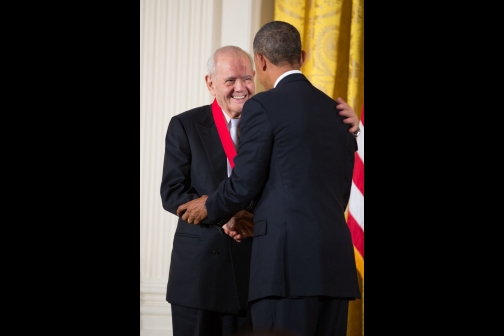
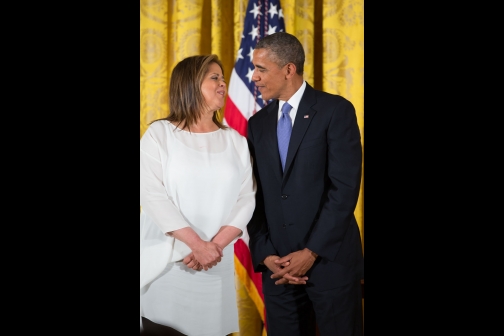
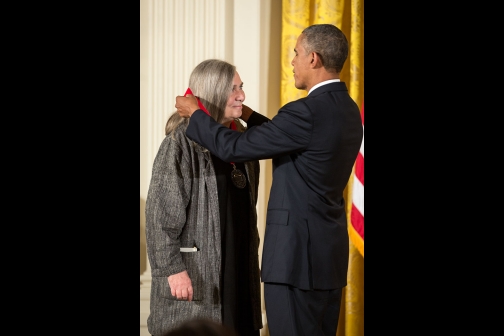
President Obama Presents the 2012 National Medals of Arts and Humanities

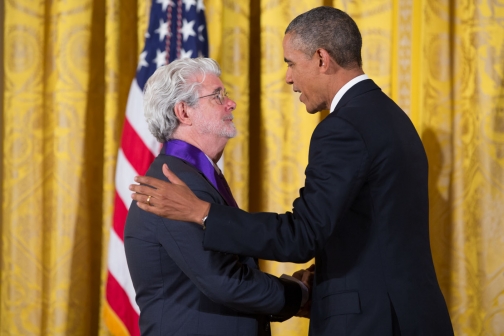
President Obama Awards the National Medal of Arts to George Lucas

President Barack Obama awards the 2012 National Medal of Arts and National Humanities Medal during a ceremony in the East Room of the White House. The President presents the National Medal of Arts to George Lucas. July 10, 2013. (Official White House Photo by Pete Souza)

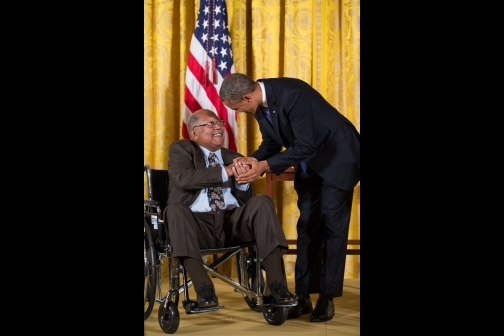
  • President Obama Presents the National Medal of Arts to Herb Alpert

    National Medal of Arts, Herb Alpert

    1 of 24
  • President Obama Awards the National Medal of Arts to Lin Arison

    The President presents the National Medal of Arts to Lin Arison. (Official White House Photo by Chuck Kennedy)

    2 of 24
  • President Obama Presents the National Medal of Arts to Joan Myers Brown

    The President presents the National Medal of Arts to Joan Myers Brown. (Official White House Photo by Pete Souza)

    3 of 24
  • President Obama Awards the National Medal of Arts to Renée Fleming

    The President presents the National Medal of Arts to Renée Fleming. (Official White House Photo by Chuck Kennedy)

    4 of 24
  • President Obama Presents the National Medal of Arts to Ernest J. Gaines

    The President presents the National Medal of Arts to Ernest J. Gaines. (Official White House Photo by Pete Souza)

    5 of 24
  • President Obama Presents the National Medal of Arts to Ellsworth Kelly

    The President presents the National Medal of Arts to Ellsworth Kelly. (Official White House Photo by Chuck Kennedy)

    6 of 24
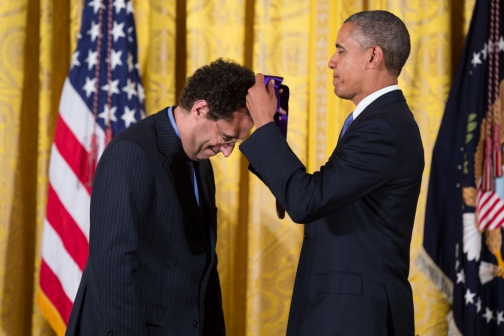
  • President Obama Awards the National Medal of Arts to Tony Kushner

    The President presents the National Medal of Arts to Tony Kushner. (Official White House Photo by Pete Souza)

    7 of 24
  • President Obama Awards the National Medal of Arts to George Lucas

    The President presents the National Medal of Arts to George Lucas. (Official White House Photo by Pete Souza)

    8 of 24
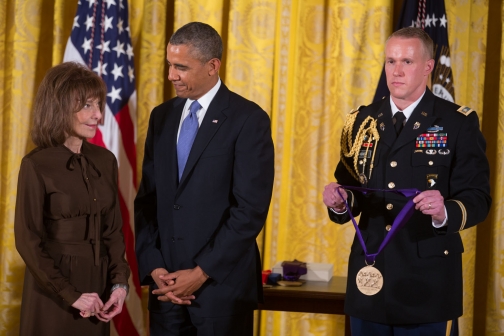
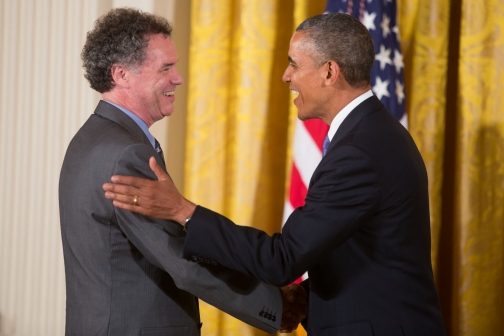
  • President Obama Awards the National Medal of Arts to Elaine May

    The President presents the National Medal of Arts to Elaine May. (Official White House Photo by Chuck Kennedy)

    9 of 24
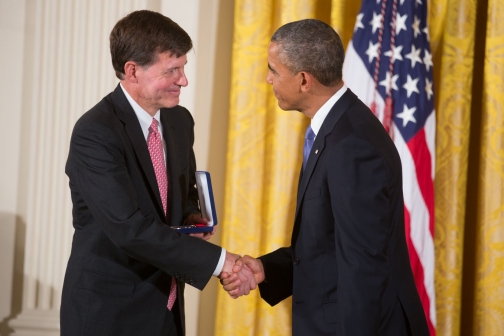
  • President Obama Awards the National Medal of Arts to Laurie Olin

    The President presents the National Medal of Arts to Laurie Olin. (Official White House Photo by Chuck Kennedy)

    10 of 24
  • President Obama Awards the National Medal of Arts to Allen Toussaint

    The President presents the National Medal of Arts to Allen Toussaint. (Official White House Photo by Pete Souza)

    11 of 24
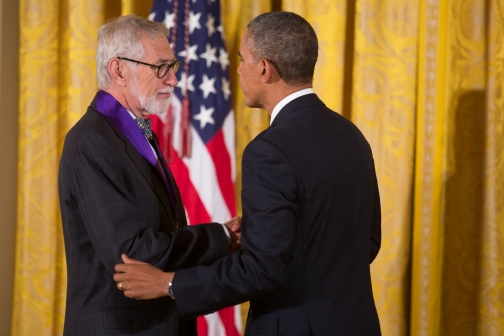
  • President Obama Awards the National Humanities Medal to Edward L. Ayers.

    The President presents the National Humanities Medal to Edward L. Ayers. (Official White House Photo by Chuck Kennedy)

    12 of 24
  • President Obama Awards the National Medal of Arts to Jenny Bilfield, President of the Washington Performing Arts Society

    The President presents the National Medal of Arts to Jenny Bilfieldof the Washington Performing Arts Society. (White House Photo by Pete Souza)

    13 of 24
  • President Obama Awards the National Humanities Medal to William G. Bowen

    The President presents the National Humanities Medal to David Bowen, accepting for his father, William G. Bowen. (White House Photo by Chuck Kennedy)

    14 of 24
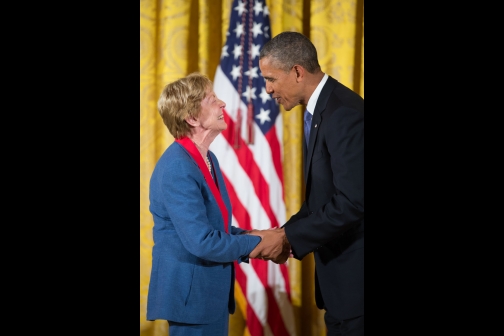
  • President Obama Awards the National Humanities Medal to Jill Ker Conway

    The President presents the National Humanities Medal to Jill Ker Conway. July 10, 2013. (Official White House Photo by Pete Souza)

    15 of 24
  • President Obama Awards the National Humanities Medal to Natalie Zemon Davis

    The President presents the National Humanities Medal to Natalie Zemon Davis. July 10, 2013. (Official White House Photo by Lawrence Jackson)

    16 of 24
  • President Obama Awards the National Humanities Medal to  Frank Deford

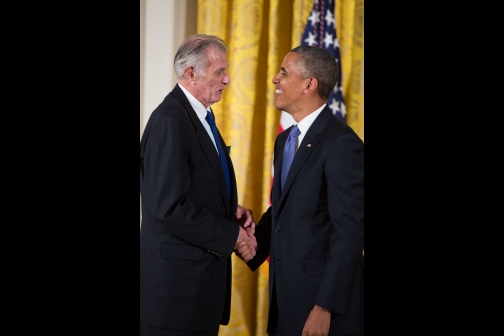
    The President presents the National Humanities Medal to Frank Deford. July 10, 2013. (Official White House Photo by Pete Souza)

    17 of 24
  • President Obama Awards the National Humanities Medal to Joan Didion

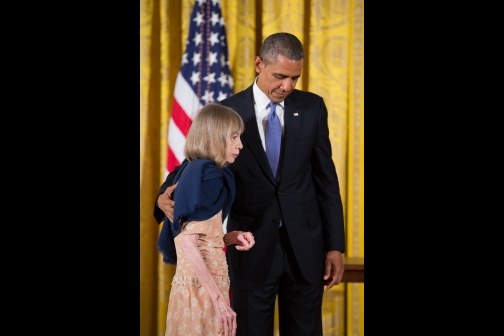
    The President presents the National Humanities Medal to Joan Didion. July 10, 2013. (Official White House Photo by Pete Souza)

    18 of 24
  • President Obama Awards the National Humanities Medal to Robert Putnam

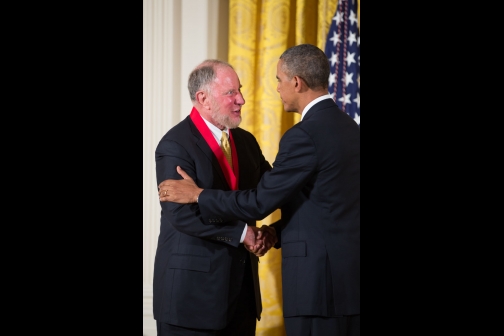
    The President presents the National Humanities Medal to Robert Putnam. July 10, 2013. (Official White House Photo by Pete Souza)

    19 of 24
  • President Obama Awards the National Humanities Medal to Kay Ryan

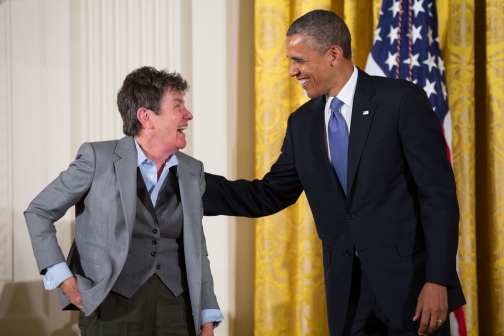
    The President presents the National Humanities Medal to Kay Ryan. July 10, 2013. (Official White House Photo by Pete Souza)

    20 of 24
  • President Obama Awards the National Humanities Medal to Robert B. Silvers

    The President presents the National Humanities Medal to Robert B. Silvers. July 10, 2013. (Official White House Photo by Pete Souza)

    21 of 24
  • President Obama Awards the National Humanities Medal to Anna Deavere Smith

    The President presents the National Humanities Medal to Anna Deavere Smith. July 10, 2013. (Official White House Photo by Pete Souza)

    22 of 24
  • President Obama Awards the National Humanities Medal to Marilynne Robinson

    The President presents the National Humanities Medal to Marilynne Robinson. July 10, 2013. (Official White House Photo by Pete Souza)

    23 of 24
  • President Obama Awards the National Humanities Medal to Camilo José Vergara

    The President presents the National Humanities Medal to Camilo José Vergara. July 10, 2013. (Official White House Photo by Pete Souza)

    24 of 24

What do an acclaimed Opera singer, the director of Star Wars, and a Harvard scholar have in common? Today at the White House, they were all honored by President Obama as recipients of the National Medals of Arts and Humanities.

In a ceremony in the East Room, President Obama presented 24 medals, equally divided between the National Medal of Arts and the National Humanities Medal, to extraordinary individuals who impacted American life. As the President said, the medal recipients "used their talents in the arts and the humanities to open up minds and nourish souls, and help us understand what it means to be human, and what it means to be an American."

And that's no small feat. Today's awardees included screenwriters, dancers, poets, and professors. They made phrases like "Luke, I am your father" familiar, and they challenged our fundamental beliefs about American civic society. Some won a Grammy, Pulitzer or MacArthur Genius Award, but all awardees gave more to the country than their physical prizes can ever represent.

Related Topics: Inside the White House

The White House

Office of the Press Secretary

Readout of the President’s Meeting with Members of the Congressional Hispanic Caucus (CHC)

This morning, President Obama met with members of the Congressional Hispanic Caucus (CHC) at the White House to discuss the Administration’s efforts to urge the House to take action and pass commonsense immigration reform. Last month, the Senate passed historic legislation with a strong bipartisan vote and the President encouraged the CHC to enlist their colleagues in the House to finish the job on immigration reform at the earliest possible opportunity.

The President thanked the CHC for their continued and longstanding leadership on this critical issue and expressed the need to pass immigration reform now to help grow the economy, create jobs and reduce the deficit.  He pointed to a new report released by the White House today, detailing the key benefits to the U.S. that would result from signing commonsense reform into law. The report, titled The Economic Benefits of Fixing Our Broken Immigration System, shows that the economic costs of inaction are simply too high to delay.

The President also emphasized that during the next few weeks, members of his Cabinet and Senior Administration officials will bring this economic argument to key stakeholders, including business leaders, state and local lawmakers, law enforcement officials,  faith and evangelical leaders, and the American people to call upon the House to do the right thing on immigration. The President expressed his willingness to continue working with both parties to make sure that commonsense immigration reform becomes a reality as soon as possible.

The President was pleased to hear from CHC members and noted that they share the same priorities, including that any enacted reform legislation must include a path to earned citizenship. The President said that he looks forward to working with them and other Members of Congress to pass this important legislation. In the meeting, the President and the CHC members also engaged on Affordable Care Act implementation and discussed voting rights.

A photo of the meeting is available HERE.


President Obama Awards the 2012 National Medals of Arts and Humanities

July 10, 2013 | 32:18 | Public Domain

President Obama awards the 2012 National Medals of Arts and National Humanities Medals in a ceremony in the East Room of the White House.

Download mp4 (1219MB) | mp3 (78MB)

Read the Transcript

Remarks by the President in Presentation of the 2012 Medals of Arts and the Medals of Humanities

East Room

2:16 P.M. EDT
 
THE PRESIDENT:  Thank you so much.  (Applause.)  Thank you. (Applause.)  Hey!  Thank you.  Everybody, please have a seat.  See, everybody is cheering because I've bought their books, I've seen their movies, I buy their records.  (Laughter.)  So we're major contributors here.
 
Well, hello, everybody, and welcome to the White House.  Thank you for joining us to celebrate the recipients of the 2012 -- because I guess this is retrospective -- National Medal of Arts and National Humanities Medals.
 
One of the special privileges of this office is getting a chance to honor individuals who’ve played an important role in my life as well as in the nation’s life.  And that’s what today is all about -- celebrating some extraordinary men and women who’ve used their talents in the arts and the humanities to open up minds and nourish souls, and help us understand what it means to be human, and what it means to be an American.
 
I want to give some special thanks to the people who help to preserve and to support that cultural legacy -- the Acting Chairwoman of the National Endowment for the Arts, Joan Shigekawa.  Give Joan a big round of applause.  (Applause.)  Where is she?  There she is.  And her predecessor, the irrepressible Rocco Landesman -- (applause) -- as well as the Acting Chairwoman of the National Endowment for the Humanities, Carole Watson.  (Applause.)  Both organizations do an incredible job lifting up some of today’s best artists and scholars, and helping to cultivate the next generation of talent and intellect.
 
And I’d like to also acknowledge the co-chairs of the President’s Committee on the Arts and Humanities, George Stevens, Jr. -- where’s George?  There he is.  (Applause.)  As well as Margo Lion -- where’s Margo?  Good to see you.  (Applause.)  As well as members of Congress who are here today, all of whom support the arts.
 
But we are primarily here to acknowledge these incredible individuals.  And, frankly, this is just fun for me because I feel like I know you all because I've enjoyed your performances; your writings have fundamentally changed me -- I think for the better, Marilynne.  I believe that.
 
At first glance, this is a pretty diverse group.  We’ve got incredible singers and dancers; we have poets and producers; musicians, playwrights, scholars.   They come from all across the country, all around the world.  And yet, for all their differences, today’s honorees have one thing in common -- and that is they are teachers.  Whether they realize it or not, they’ve taught us about ourselves and about our world.
 
American philosopher Will Durant once wrote, “The aim of art is to represent not the outward appearance of things, but their inward significance.”  And that's an extraordinary skill -- to tell the untold stories of history; to reveal the sculpture that's waiting there in a block of stone; to transform written music into song; to make it look like those planes in space are actually flying like they are.  (Laughter.)  I'm just saying, I remember when I first saw Star Wars.  (Laughter.)  There’s a whole generation that thinks special effects always look like they do today.  (Laughter.)  But it used to be you’d see, like, the string -- (laughter) -- on the little model spaceships.  Anyway, I'm being led astray.  (Laughter.)   
 
Because the arts and the humanities aren’t just a source of entertainment, they challenge us to think and to question and to discover, to seek that inward significance -- and that helps us grow and to change and to reach new heights, and to understand each other at a time when the world is constantly crying for the capacity to bridge that gap and speak to people who aren't like us.
 
And that’s exactly what these artists and these humanists have done -- by working hard, developing their craft, following their dreams, never giving up. 
 
Somebody like Allen Toussaint, who is being honored here for his incredible contributions to the rhythm and blues and jazz music of his beloved New Orleans.  After his hometown was battered by Katrina and Allen was forced to evacuate, he did something even more important for his city -- he went back.  And since then, Allen has devoted his musical talent to lifting up and building up a city.  And today, he’s taking the stage all over the world, with all kinds of incredible talent, doing everything he can to revive the legendary soul of the Big Easy.
 
Somebody like Ernest Gaines, who grew up as the descendent of sharecroppers in the South and farming the same land as his ancestors.  He did not let that define his future.  Instead, he took that experience and used it to help fill in gaps in American literature with the stories of African American life.  And then, Ernest moved back to Louisiana, onto the very same land he and his family had once worked.  And he spent more than 20 years teaching college students to find their own voices and reclaiming some of the stories of their own families and their own lives.
 
Somebody like Joan Didion, who, rightly, has earned distinction as one of most celebrated American writers of her generation.  I’m surprised she hasn’t already gotten this award. (Laughter.)  But in her early years, she was in school only sporadically, basically taught herself how to read while she and her family followed her Army officer father around the country.  She obviously learned quickly.  She won a contest for Vogue in college; gave up her dream of being an oceanographer, writing became her world.  And today, decades into her career, she remains one of our sharpest and most respected observers of American politics and culture.
 
What’s true for those three is true for all the recipients here.  So many of you have touched me and touched Michelle, and now we’re trying to get them to -- Malia and Sasha to see some of Anna’s work, or read “The Iliad*” because we want to share that, because we think it was important to us.
 
And we celebrate people like our honorees here today not just because of their talent, but because they create something new.  They create a new space and that becomes a lasting contribution to American life.  And that’s true for all of these honorees.
 
So together, the men and women with us today have helped us appreciate individual talent, but as I said earlier, they’ve also helped us to bridge our differences -- to recognize all the things we share as Americans, whether it’s arts or humanities or sports. 
 
Frank, I grew up reading Sports Illustrated, and I think it was very good for me.  I don't know about you.  (Laughter.)  Because all these endeavors, they don't discriminate, they don't prejudge -- they speak to all of us equally if we’re open to it. They’re part of all of our common heritage.  They convey all these distinct voices and emotions and stories, and that's us.  That's who we are.  
 
So for more than 200 years that culture has helped shape our views of democracy and freedom and tolerance and progress.  Sometimes the observations or the incredible art or scholarship that’s been done by these honorees are overlooked, but somewhere they’re having an impact.  And like Bobby Kennedy talked about, they create “ripples of hope.”  They’re like stones in a lake, and it emanates, and we never know exactly how, or who, will be touched by it.  But it makes a difference.  And it’s made us better. 
 
And the work that we honor today, the lifetime achievement of these artists and these scholars, reminds us that the human imagination is still the most powerful tool that we have as a people.  That’s why we celebrate their creativity and the fundamental optimism, the notion that if they work that hard somebody will actually pay attention.  That’s why we have to remain committed to the dreamers and the creators and innovators who fuel that progress and help us light the way ahead, because our children, our grandchildren deserve to grow up in a country where their dreams know no bounds and their ambitions extend as far as their talents and hard work can take them.  And it’s important that they have examples -- people who’ve carved out a path for them. 
 
So I want to thank today’s honorees for doing their part to foster that spirit, to enrich our entire nation.  Every one of them has helped us see beyond outward appearances and appreciate the significance of what’s within.  And for that we are incredibly grateful.
 
So it is now my privilege to present these medals to each of them as one of our military aides reads their citations.  (Applause.)
 
(The citations are read and the medals are awarded.)
 
MILITARY AIDE:  National Medal of Arts recipients: 
 
Herb Alpert.  (Applause.)  For his varied contributions to music and the fine arts.  The musician behind Tijuana Brass phenomenon and co-founder of A&M Records, which launched several storied careers, Mr. Alpert is also a philanthropist who shares the power of arts education with young people across our country. (Applause.)
 
Lin Arison.  (Applause.)  For her contributions as a philanthropist and arts education advocate.  Co-founder of the National YoungArts Foundation and the New World Symphony, Ms. Arison’s work celebrates, showcases, and supports the next generation of great American artists.  (Applause.)
 
Joan Myers Brown.  (Applause.)  For her contributions as a dancer, choreographer and artistic director.  Founder of the Philadelphia Dance Company, Ms. Brown carved out an artistic haven for African American dancers and choreographers to innovate, create, and share their unique visions with the national and global dance communities.  (Applause.)
 
Renée Fleming.  (Applause.)  For her contributions to American music.  Known to many as “the people’s diva,” Ms. Fleming has captivated audiences around the world with an adventurous repertoire spanning opera and the classical tradition to jazz and contemporary pop.  (Applause.)
 
Ernest J. Gaines.  (Applause.)  For his contributions as an author and teacher.  Drawing deeply from his childhood in the rural South, his works have shed new light on the African American experience and given voice to those who have endured injustice.  (Applause.)
 
Ellsworth Kelly.  (Applause.)  For his contributions as a painter, sculptor and printmaker.  A careful observer of form, color and the natural world, Mr. Kelly has shaped more than half a century of abstraction and remains a vital influence in American art.  (Applause.)
 
Tony Kushner.  (Applause.)  For his contributions to American theater and film.  Whether for the stage or the silver screen, his scripts have moved audiences worldwide, marrying humor to fury, history to fantasy, and the philosophical to the personal.  (Applause.)
 
George Lucas.  (Applause.)  For his contributions to American cinema.  By combining the art of storytelling with boundless imagination and cutting-edge techniques, Mr. Lucas has transported us to new worlds and created some of the most beloved and iconic films of all time.  (Applause.)
 
Elaine May.  (Applause.)  For her contributions to American comedy.  With groundbreaking wit and a keen understanding of how humor can illuminate our lives, Ms. May has evoked untold joy, challenged expectations, and elevated spirits across our nation. (Applause.)
 
Laurie Olin.  (Applause.)  For his contributions as a preeminent landscape architect.  Renowned for his acute sense of harmony and balance between nature and design, Mr. Olin has dedicated his energy to shaping many iconic spaces around the world and to educating new leaders in his art.  (Applause.)
 
Allen Toussaint.  (Applause.)  For his contributions as a composer, producer and performer.  Born and raised in New Orleans, Mr. Toussaint has built a legendary career alongside America’s finest musicians, sustaining his city’s rich tradition of rhythm and blues, and lifting it to the national stage.  (Applause.)
 
Accepting on behalf of Washington Performing Arts Society, Jenny Bellfield.  (Applause.)  For bringing world-class performances to our Nation’s Capital.  From concert hall premieres to in-school workshops, Washington Performing Arts Society has drawn renowned artists to the Washington community and inspired generations of young performers to follow their passions.  (Applause.)
 
National Humanities Medal recipients:
 
Edward L. Ayers.  (Applause.)  For his commitment to making our history as widely available and accessible as possible.  Dr. Ayers’s innovations in digital humanities extend higher learning beyond campus boundaries and allow broad audiences to discover the past in new ways.  (Applause.)
 
Accepting on behalf of William G. Bowen, David Bowen.  (Applause.)  For his contributions to the study of economics and his probing research on higher education in America.  While his widely discussed publications have scrutinized the effects of policy, Dr. Bowen has used his leadership to put theories into practice and strive for new heights of academic excellence.
 
Jill Ker Conway.  (Applause.)  For her contributions as a historian and trailblazing academic leader.  Dr. Conway has inspired generations of scholars, and her studies of exceptional and empowered women have revealed a common drive that unites women across the globe to create, to lead, and to excel.  (Applause.)
 
Natalie Zemon Davis.  (Applause.)  For her insights into the study of history and her exacting eloquence in bringing the past into focus.  With vivid description and exhaustive research, her works allow us to experience life through our ancestors’ eyes and to engage truly with our history.  (Applause.)
 
Frank Deford.  (Applause.)  For transforming how we think about sports.  A dedicated writer and storyteller, Mr. Deford has offered a consistent, compelling voice in print and on radio, reaching beyond scores and statistics to reveal the humanity woven into the games we love.  (Applause.) 
 
Joan Didion.  (Applause.)  For her mastery of style in writing.  Exploring the culture around us and exposing the depths of sorrow, Ms. Didion has produced works of startling honesty and fierce intellect, rendered personal stories universal, and illuminated the seemingly peripheral details that are central to our lives.  (Applause.) 
 
Robert D. Putnam.  (Applause.)  For deepening our understanding of community in America.  Examining how patterns of engagement divide and unite, Dr. Putnam’s writing and research inspire us to improve institutions that make society worth living in, and his insights challenge us to be better citizens.  (Applause.) 
 
Marilynne Robinson.  (Applause.)  For her grace and intelligence in writing.  With moral strength and lyrical clarity, Dr. Robinson’s novels and nonfiction have traced our ethical connections to people in our lives, explored the world we inhabit, and defined universal truths about what it means to be human.  (Applause.) 
 
Kay Ryan.  (Applause.)  For her contributions as a poet and educator.  A former Poet Laureate of the United States, her witty and compact verse infused with subtle wordplay, reminds us of the power of language to evoke wisdom from the ordinary.  (Applause.)
 
Robert B. Silvers.  (Applause.)  For offering critical perspectives on writing.  As the editor and co-founder of The New York Review of Books, he has invigorated our literature with cultural and political commentary, and elevated the book review to a literary art form.  (Applause.)
 
Anna Deavere Smith.  (Applause.)  For her portrayal of authentic American voices.  Through profound performances and plays that blend theater and journalism, she has informed our understanding of social issues and conveyed a range of disparate characters.  (Applause.)
 
Camilo José Vergara.  (Applause.)  For his stark visual representation of American cities.  By capturing images of urban settings over time, his sequences reflect the vibrant culture of our changing communities and document the enduring spirit that shines through decay.  (Applause.)
 
THE PRESIDENT:  Let’s give our honorees one more big round of applause.  (Applause.) 
 
Well, I could not imagine a more deserving group of honorees.  We are thrilled to have them here. 
 
Fear not, the party is not over.  (Laughter.)  My understanding is the food here at the White House is not bad.  (Laughter.)  And we may get some nice tunes from our Marine Band -- they can play anything, so feel free to make requests.  (Laughter.) 
 
But to all the honorees, thank you, again, for enriching our lives in so many different ways.  We’re going to have an opportunity to see you and your families, and take some pictures with the honorees.  In the meantime, enjoy the reception.  And thank you all.  I hope you’ve enjoyed it.  Thank you.  (Applause.)
 
END
2:47 P.M. EDT

Close Transcript

The White House

Office of the Press Secretary

Presidential Nominations Sent to the Senate

NOMINATIONS SENT TO THE SENATE:

Matthew Winthrop Barzun, of Kentucky, to be Ambassador Extraordinary and Plenipotentiary of the United States of America to the United Kingdom of Great Britain and Northern Ireland.

Margaret Louise Cummisky, of Hawaii, to be an Assistant Secretary of Commerce, vice April S. Boyd, resigned.      

John Hoover, of Massachusetts, a Career Member of the Senior Foreign Service, Class of Counselor, to be Ambassador Extraordinary and Plenipotentiary of the United States of America to the Republic of Sierra Leone.       

Crystal Nix-Hines, of California, for the rank of Ambassador during her tenure of service as the United States Permanent Representative to the United Nations Educational, Scientific, and Cultural Organization.

John R. Phillips, of the District of Columbia, to be Ambassador Extraordinary and Plenipotentiary of the United States of America to the Italian Republic, and to serve concurrently and without additional compensation as Ambassador Extraordinary and Plenipotentiary of the United States of America to the Republic of San Marino.    

Michael Keith Yudin, of the District of Columbia, to be Assistant Secretary for Special Education and Rehabilitative Services, Department of Education, vice Alexa E. Posny.

The White House

Office of the Press Secretary

Readout of the President’s Meeting with Members of the Congressional Hispanic Caucus (CHC)

This morning, President Obama met with members of the Congressional Hispanic Caucus (CHC) at the White House to discuss the Administration’s efforts to urge the House to take action and pass commonsense immigration reform. Last month, the Senate passed historic legislation with a strong bipartisan vote and the President encouraged the CHC to enlist their colleagues in the House to finish the job on immigration reform at the earliest possible opportunity.

The President thanked the CHC for their continued and longstanding leadership on this critical issue and expressed the need to pass immigration reform now to help grow the economy, create jobs and reduce the deficit.  He pointed to a new report released by the White House today, detailing the key benefits to the U.S. that would result from signing commonsense reform into law. The report, titled The Economic Benefits of Fixing Our Broken Immigration System, shows that the economic costs of inaction are simply too high to delay.

The President also emphasized that during the next few weeks, members of his Cabinet and Senior Administration officials will bring this economic argument to key stakeholders, including business leaders, state and local lawmakers, law enforcement officials,  faith and evangelical leaders, and the American people to call upon the House to do the right thing on immigration. The President expressed his willingness to continue working with both parties to make sure that commonsense immigration reform becomes a reality as soon as possible.

The President was pleased to hear from CHC members and noted that they share the same priorities, including that any enacted reform legislation must include a path to earned citizenship. The President said that he looks forward to working with them and other Members of Congress to pass this important legislation. In the meeting, the President and the CHC members also engaged on Affordable Care Act implementation and discussed voting rights.

A photo of the meeting is available HERE.

The White House

Office of the Press Secretary

Press Briefing by Press Secretary Jay Carney, 7/10/2013

James S. Brady Press Briefing Room

12:58 P.M. EDT

MR. CARNEY:  Welcome to the White House and to your daily briefing.  Before I take your questions, I had a couple of things I wanted to draw to your attention. 

First, today, Health and Human Services Secretary Kathleen Sebelius is making an important announcement about the funds and sites, and people who will help the 2 in 10 Americans who will be able to get insurance through the health insurance marketplaces starting on October 1st.

Community health centers are a critical and local resource for Americans, and HHS is ensuring that they will have a key role in the process of enrollment.  1,159 health centers across the nation will receive $150 million in grant awards to help enroll uninsured Americans in new health coverage options made available by the Affordable Care Act.  These centers have committed to hiring an additional 2,900 outreach and eligibility assistance workers.  This means that in every state in the nation there will be people at community health centers available to help -- community health centers, rather, available to help.

Here are a few examples of what this means in communities.  In Florida, a health center is hosting learning sessions at local libraries, churches, and civil organizations.  In Washington State, health centers are coordinating with local schools and libraries to let families know that they may be eligible for new insurance options.  A health center in Michigan is coordinating with a coalition of over 30 African American churches to get the word out and help sign people out.  In New Mexico and South Dakota -- this is my favorite -- health centers will be reaching individuals at summer and fall county fairs and rodeos to make sure they know about and sign up for the opportunities available to them in the new marketplaces.

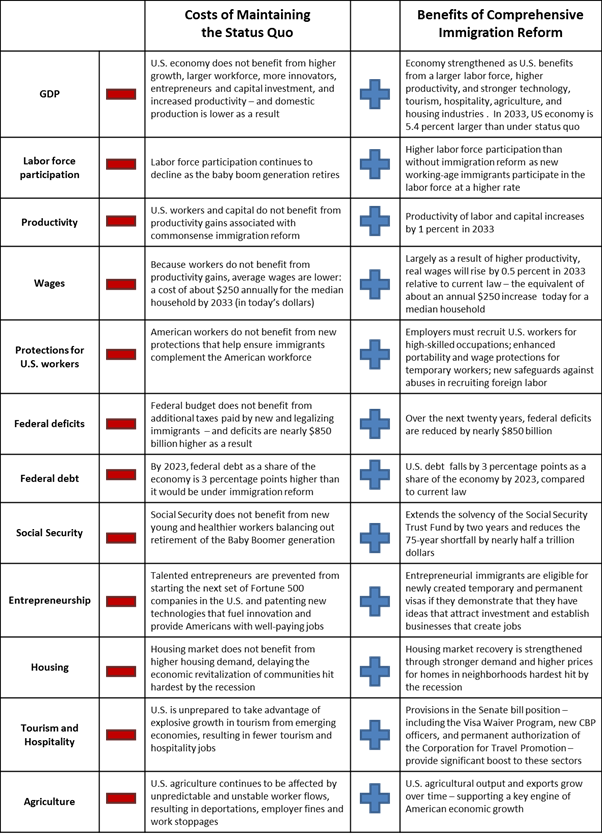
Secondly -- and I think I have a visual aid here to make this even more exciting -- here we go.  As you may have read about or received directly, this morning the White House released a report, “The Economic Benefits of Fixing our Broken Immigration System,” detailing the key benefits to the U.S. economy that would result from signing the Senate bill into law. 

The economic costs of inaction are simply too high to delay.  Common-sense immigration reform would reduce the deficit, grow the economy, increase wages and increase productivity.  It’s time for the House to act.

And with that, I go to the Associated Press.  Josh.

Q    Thanks, Jay.  To start with Egypt, a crackdown on the Muslim Brotherhood appears to be growing, with prosecutors ordering the arrest of their Supreme Leader and other officials.  Do you feel that the U.S.’s call for a refrain from arbitrary arrests and a move towards reconciliation is essentially being ignored?

MR. CARNEY:  We are in regular communication with the authorities in Egypt at a variety of levels.  We are working with our allies in the region to reinforce the message that we have been sending to those in Egypt about the need for Egypt to get off a path of polarization and move forward on a path of reconciliation.  Reconciliation means -- and a process, a democratic process or transition means that for it to work all groups and parties need to be at the table.  We have made clear that we oppose arbitrary arrests, and we continue to make that clear.

But as I’ve been saying all week, this is an extremely difficult and complicated situation.  There is a crisis in Egypt, and the way to move Egypt beyond crisis and towards a better future is for the authorities to embrace a process that is inclusive, that leads to a transition back to a civilian, democratically elected government, and that responds to the hopes and aspirations of the Egyptian people, of all the Egyptian people.

Q    So how’s that working out?  Do you see any indications that those -- (laughter). 

MR. CARNEY:  I think that it is apparent to any observer of the situation in Egypt that it is complex, it is difficult, and it is challenging not least, and perhaps most, for the Egyptian people themselves.

We are under no illusions about the complexity of this challenge, nor are we under any illusions about the importance of this challenge, which is why we are making clear with our partners and allies, and directly, our views about the path that we believe Egypt needs to take moving forward so that it can return to a democratically elected civilian government.

The alternative is chaos.  The alternative is a failure of Egypt to reach its potential, its enormous potential.  The alternative is sustained disappointment among the Egyptian people about the limitations placed on their own futures. 

So we are working with our partners and directly to make our views known; to provide assistance and guidance where we can; to make clear that we do not support any individual or any party or any group, we support a process that is inclusive and democratic; to make clear that we oppose all violence; to make clear that we call on the military to exercise maximum restraint; to make clear that it is unacceptable in our view, and certainly unhelpful, for any group or any party to incite violence.  And we are doing all this amidst an obviously very fluid situation and one that puts Egypt‘s future at stake.

Q    And you’ve been clear that our determination about whether to call this a coup and some of the implications for aid will be dependent in part on how things work out going forward and what we see on the ground there.  So does the ongoing violence and these latest arrests move us closer to a determination that this was a coup d’état?

MR. CARNEY:  Well, we are evaluating how the authorities are responding to and handling the current situation.  We will take our time and the time necessary to make the determinations regarding what happened last week and the change in leadership, the removal of President Morsi from power.  And we remain deeply concerned about the removal of President Morsi from power. 

But what I've said yesterday and I said the day before that remains true today, which is that we do not believe it is in the best interest of the United States to make immediate changes to our assistance programs, and there are consequences that come from the way that -- the manner in which we designate the events that happen in Egypt.  And we are evaluating both what happened and our responsibilities under the law as we consult with Congress about next steps.

Q    And briefly on immigration, with the House Republicans trying to figure out how they're going to move forward on this, will the President be stepping up his effort to urge Congress to -- the House to take up the Senate bill?  Or will he take kind of a more low-profile approach the way he did as the Senate bipartisan group was working their deal out?

MR. CARNEY:  The President is keenly interested in seeing bipartisan legislation emerge from Congress that meets the standards that he laid forth two years ago, standards that are reflected in the bipartisan bill that was passed by the Senate, arrive on his desk for his signature.  And he is directly engaged in the effort to move that process forward and will continue to be.

The release we put out today I think reflects the manner in which we are making clear the enormous benefits and the absolute need for comprehensive immigration reform.  You have a coalition now of support behind us, a consensus of support behind comprehensive immigration reform reflected in the Senate bill that includes business leaders.  It includes faith leaders.  It includes law enforcement leaders, Democrats, Republicans. 

We have demonstrated in today’s report the clear economic benefits of immigration reform, including the fact that the Senate bill would grow the economy by 5.4 percent -- this is all in the document that was over my shoulder and that you have access to -- would grow the economy by 5.4 percent over the next two decades due to a larger labor force, higher productivity, and more investments -- 5.4 percent.

Productivity of labor and capital would increase by 1 percent over the next two decades.  Wages -- largely as a result of higher productivity -- real wages would rise by .5 percent in 2033, relative to current law, the equivalent of about an annual $250 increase today for a median household.

Over the next 20 years -- and this is an issue that should be resonant with conservative Republicans who say they are very concerned about the deficit.  Over the next 20 years, federal deficits would be reduced by nearly $850 billion, just through comprehensive immigration reform -- not through a grand bargain; not through other means by which we are attempting to reduce the deficit, but through comprehensive immigration reform. 

The federal debt would fall by 3 percentage points as a share of the economy by 2023, compared to current law.  And the solvency -- again, an issue that at least they claim, Republicans claim is important to them -- the solvency of the Social Security trust fund would be extended by two years, and the 75-year shortfall would be reduced by nearly half a trillion dollars. 

The benefits are clear.  The fact that there is a broad bipartisan consensus behind this is clear.  It cannot be acceptable broadly and in the long term that immigration reform would be blocked because some minority of House Republicans is concerned about a primary challenge from the far right.  That’s not a good argument.  It's not a good argument politically, it's certainly not a good argument economically.

Q    It seemed like an uphill battle in the House, Jay. 

MR. CARNEY:  It's always been an uphill battle.  Hard things are hard.  This is coming to pass now because there is finally a consensus that has been built around it.  We are now at a point that would have been impossible, frankly, if President Obama hadn't been reelected.  The position held officially by the leader of the Republican Party in 2012 was that the answer to immigration reform was self-deportation.

We've seen enormous progress since then.  We've seen a change in views across the board.  But the work remains.  We've said all along that getting legislation through both houses of Congress would be very difficult.  The road ahead is littered with obstacles, and we have to navigate our way through them and around them and over them -- but we will.

Q    How do you persuade Speaker Boehner to take it up?  How long do you have to do it?  And does this issue instead simply become something for the midterms?

MR. CARNEY:  Look, we believe that there is an enormous amount of momentum behind and consensus behind comprehensive immigration reform.  We are doing everything we can to engage in persuasion, making the arguments.  Stakeholders are making the argument, including stakeholders with very close ties to Republican leaders and Republican rank-and-file members.  The business community has made clear its views on the need for comprehensive immigration reform.  The law enforcement community has made clear its views on the need for comprehensive immigration reform, and those efforts will continue.

But in the end, we can't prevent lawmakers from making bad choices.  We can simply be part of a broad, comprehensive effort of persuasion that makes a case for why passing comprehensive immigration reform is the right thing to do for the economy, for our businesses, for the middle class.  It's the moral thing to do, and we'll keep at it and we'll get it done.

Q    We know the President has been working behind the scenes.  Is he going to launch some high-profile effort, similar to like the health care overhaul, for instance, to try to drum up support?

MR. CARNEY:  The thing about strategy is that it would be strategically foolish to announce it in advance.  So we are on this every day.  We're very much engaged in a process that -- led by the Gang of Eight, that resulted in the successful bipartisan passage of comprehensive immigration reform -- an effort that saw compromise.  It is not a bill that is written word for word the way the President would write it, or probably the way any individual member of the Gang of Eight would have written it.

It contains substantial increases in resources for border enforcement.  As Senator McCain said and I paraphrase, anyone who claims that the reason to vote against this bill now is because it's not strong enough in border enforcement is not serious about border security, because there has never been legislation this strong on border security.  And it comes at a time when we've never -- we haven't made strides as significant as we've made in the last five years in border security. 

You know the statistics -- the doubling of Border Patrol agents.  All the metrics that measure our progress on border security demonstrate the improvements that we've seen.  But the President always made clear that one of the key criteria that he would insist upon when it came to passage of immigration reform would be enhanced and increased border security.  And that is present in abundance in the Senate bill.

So we're just going to keep at this, Steve.  And we believe that there is an overwhelming case for why this is the right thing to do.

Because last time I think we did almost 45 minutes on the front row, I'm going to move it around a little bit.  Yes, Alexis.

Q    Jay, just to follow up on what Steve was asking you, there are House Republicans who say that it annoys them to a great extent when the President goes out and campaigns for immigration reform or some other element of his agenda.  They call it "campaigning," right?

MR. CARNEY:  As opposed to when they go out and advocate for their policy positions.  I know that it annoys them that he is in office.  Let's just accept that and posit that.  But this isn't about him.  The reason why we have the progress that we've seen is in no small measure because of the support the President has put behind comprehensive immigration reform, in no small measure because of the advocacy he engaged in throughout the campaign and throughout his first term. 

But it is not about him.  We wouldn't be where we are with the kind of bill that emerged from the Senate if it weren't for the support of business leaders and law enforcement leaders and faith leaders and Republicans both in office and in the political profession who understand that this is the right thing to do economically, morally and politically.

Q    So just to finish my question --

MR. CARNEY:  Yes.  (Laughter.)  I’m fired up today, Alexis.

Q    So because part of the Senate strategy was -- and members of the President's own party suggested that he stand back and let it proceed on its own, are there limits to the President's bully pulpit on this issue?  Has he discovered that that is the case on this particular issue, both in the Senate and the House?

MR. CARNEY:  No, I think every issue is different.  And, of course, there are limits to the powers of the bully pulpit on every issue.  This is a methodical effort, using all the tools available to us and to him, using all the tools available to advocates and lawmakers who support immigration reform to get this done.  And he is an important part of it, but it's bigger than he is.  And it's the right thing to do for the country.

I mean, this is the irony -- and I hung up my spurs as a political analyst a while ago, but I've seen what, broadly speaking, you have written, you and the press and others about the political stakes here.  And the President's interest is in getting comprehensive immigration reform that a lot of Republicans seem to think is the right thing to do for the future of the Republican Party.  But he is not in it for political reasons.  He’s in it because it's the right thing to do.

And Democrats are supporting this effort because it's the right thing to do.  And, increasingly, we've seen Republicans back this effort, as Senator McCain long has, as former President George W. Bush long has, and the Republican members of the Gang of Eight -- Marco Rubio and Jeff Flake and Lindsey Graham and McCain -- long have, because it's the right thing to do.

Q    Can I ask one quick ACA question?

MR. CARNEY:  Sure. 

Q    To clarify what you were describing earlier about HHS's initiative with community health centers, if I remember correctly there was reporting recently about trying to pull back on the funding to community health centers to find the resources to help do the rollout and implementation.  And I just want to clarify, the $150 million that you're talking about, is that new money or is that just a new task given to the community health centers?

MR. CARNEY:  My guess is that the details on this would best be answered at the Department of HHS.  But this is part of an effort to inform the public about the benefits and opportunities available to them through a law that was passed, signed by the President, and upheld by the Supreme Court.

Now, there is a nihilistic effort going on to undermine a law, the law of the land, that is embodied in the near 40 efforts to repeal it -- futile efforts to repeal it in the House of Representatives.  But it’s the law and it’s going to be implemented.  And those who oppose it, those who try to undermine it at every step need to be made aware of the fact that what they are saying is that the benefits that have already been enjoyed, are already being enjoyed by the American people, they want to take away.  The opportunities and benefits that will become available to millions of Americans, they want to take away in the name of partisan political victory.

But this has been -- they can present legislation to amend it and see how it fares; they can present legislation of their own for health care reform.  But instead, we just see efforts to undermine it.  And that would be one thing if it existed only in a political vacuum, but there are consequences to this.  And those who suffer the consequences are the American people who are being told by opponents that they’re going to lose their benefits if the opponents get there way, that they would rather have insurance companies dictating whether they can take you off your insurance policy, kick you off, or say, I won't give you insurance because you have a preexisting condition.  That's the way the world existed before the Affordable Care Act was passed.

Q    Can I follow on that, Jay?

MR. CARNEY:  You can when I get to you. 

Q    Okay.

Q    Jay, this morning we saw the Senate Health Committee advance the Employment Non-Discrimination Act with the votes of three Republican senators -- Senator Murkowski, Kirk, and Hatch.  I wonder if you could talk a little bit about what role the White House plans to play in the coming weeks and months to help build the --

MR. CARNEY:  Well, I appreciate the question, and I think I put out a statement about this not long before the briefing.  We welcome the passage by the committee of the Employment Non-Discrimination Act, the bipartisan support that it saw, the Republican senators who voted for it -- Senator Kirk, who was a leader in the effort.  This reflects the strategy the President has long believed is the right one when it comes to these matters, and we'll continue to press for broader support in the Senate and then in the House on this issue, as my statement said.

Q    When you refer to strategy, do you still believe -- do you think that the executive order for federal contractors would help or hinder that effort?

MR. CARNEY:  Our position on the executive order hasn’t changed and our position on the executive order has been coupled with our belief that the best way to do this is to pursue legislation that's broad and comprehensive.  And that's what ENDA is.  And we are -- I mean, today is a good day in this narrative.  It’s a good day because the committee passed it, and it passed it with Republican support.  So that's -- we’ll take that and we’ll move forward and hope we can get more progress.

Jon -- I’m sorry, Dan, then Jon.

Q    Back on Egypt.  If the White House ultimately decides to call what happened there a military coup, does that automatically guarantee that the aid, the $1.5 billion in aid will be cut off?

MR. CARNEY:  Well, what I would say is that we are reviewing a legal framework here.  It is certainly an issue that has been noted in questions here and written much about and discussed on television about.  So when I talked yesterday about the elephant in the room, there are serious consequences here to our evaluation of and ultimate decision about the designation we’ll make.

And they go beyond the dollar figure associated with our aid to Egypt because of our longstanding partnership with Egypt, our longstanding support for the Egyptian people, and the role that we play and can play in the region when it comes to offering advice and counsel on a democratic transition.  So all of these matters go into our thought process as we evaluate the legal framework here, our legal obligations, as well as we make our consultations with Congress on this matter.

Q    So the label itself doesn’t necessarily mean that --

MR. CARNEY:  I’m not a lawyer, and I’ve seen others who are opine about the “if this happens, then this happens” aspect of the way the law and rules are written, but I would refer you to them for that.  We’re obviously treating this very cautiously because we believe that's in the best interest of our national security and our support for Egypt’s transition.

Q    Because of the critical role that Egypt has played in the region, strategically, militarily, is there a concern that the longer that there’s instability there, that this is something that could spill over and impact the region as a whole?

MR. CARNEY:  I think as a general matter the answer to that question is, yes.  That has been true with the unrest in general, especially the violent unrest that we’ve seen in different parts of the Middle East during this period of upheaval.

And there are no positive outcomes to a continued violent crisis in Egypt.  That's why we call so strongly for a cessation of violence, why we call so strongly for an inclusive process that is peaceful, and where reconciliation is the goal and compromise is the means to achieving the goal.  That's what we believe is necessary in Egypt.  We believe that the Egyptian people, broadly speaking, support that process. 

And in all the ways that we can, we are trying to impart that message and to be of assistance in the process, understanding all along that this is a process that will be designed and determined and decided by the Egyptian people, including the outcome of that process -- who the leaders are, what the constitution says, what parties are represented. 

But the best way to getting from here to there for the sake of Egypt’s future and the sake of the millions of young Egyptians in that country is one that is inclusive and that allows for participation by all individuals and all parties.

Q    On the Snowden case, any recent effort to put additional pressure on Russia to prevent him from going to Venezuela?

MR. CARNEY:  We have, as I said the other day, engaged with all the countries that might be transit points or endpoints, including Russia, where we believe Mr. Snowden currently remains, about our view that he should not be allowed to engage in further international travel with the exception of the travel necessary to be returned here to the United States where he faces serious felony charges. 

And I have nothing new to report in our communications -- about our communications with Russia.  They are as they were, which is our shared belief that we don't want this issue to disrupt our important and broad relationship with Russia, but that we believe that there is firm legal justification through cooperation along the usual law enforcement channels for his expulsion from Russia and return to the United States.

Q    Are you still communicating with Russia?

MR. CARNEY:  Yes, we communicate with Russia all the time.

Q    About this?

MR. CARNEY:  About this and other -- many other topics.  Yes.

Q    So, Jay, on Egypt you said you were evaluating whether or not this was a coup, and you don't know how long it's going to take.  But help me understand the process here.  At the end of this evaluation, are you going to come out here and say, yes, it was a coup; no, it wasn't a coup?  How is this going to work?

MR. CARNEY:  I think what's happening in Egypt is so serious and compelling in the sense that it is -- it merits extreme attention right now, that jumping ahead to what a process like this will look like when it is decided skips ahead of some very serious days and steps that we can take as a matter of policy, and also that we will see unfold in Egypt as each day passes.  And we can evaluate whether or not the Egyptian authorities are making progress towards a transition to democracy, progress that includes not just asserting that there will be elections or constitutional amendments, but a process that demonstrably reflects an effort to engage all parties and one that reflects an effort to resist violence and instead engage in negotiation.

So I don’t have a timeline for you.  I'm not going to paint a picture of what that looks like, because frankly, we don't know yet what the result of that process will look like.  I think a far more significant development will be what happens actually in Egypt, which will, in part, inform how we make our determinations.

Q    But you will make a determination specifically on that question -- coup or not a coup?

MR. CARNEY:  Well, I expect that, as I've said, that we will take the time necessary to make that evaluation.  And I'm sure there will be an endpoint, but I don't have a timeline for you. 

Q    Okay.  And then on the health care, the issue of the employer mandate being delayed a year, under what authority did the White House decide to implement that law a year later than the law itself calls for?  I mean, it's been a law passed by the Congress. 

MR. CARNEY:  Jon, there are experts a plenty who can provide the specifics for you on this, both inside and outside the government.

Q    Because the Democratic chairman of the Senate Health Committee said you have no authority.

MR. CARNEY:  I highly recommend picking up any issue of the Federal Register and finding in it examples of rules and waivers and that sort of thing.  This is not an unusual process.  And this reflects an effort that the hue and cry, the calamitous hollering that you hear is reflective of a political and partisan effort to undermine --

Q    I’m talking about Tom Harkin.  Are you saying that he’s --

MR. CARNEY:  No, you’re not talking about Tom Harkin.  You're talking about the Republican effort to --

Q    Tom Harkin said you had no authority to do this.

MR. CARNEY:  -- to complain about the -- listening to business -- to postpone a deadline that affects 4 percent of businesses with 50 or more employees, when they’ve done everything they can to undermine the law from day one.  They don't want to see it implemented.  They’ve made that clear. 

So we're listening -- we're being --

Q    Tom Harkin wants this implemented, but on --

MR. CARNEY:  Jon, you can pretend this is about Tom Harkin, but you know it’s not.  And the fact is this is -- we have demonstrated, since the passage of the Affordable Care Act, that we will make improvements where those improvements make sense; we will be flexible in its implementation where being flexible makes sense. 

I mean, everybody recently, to their credit, who’s written about this has noted the comparison here to the passage of Medicare Part D, which was an initiative, a top priority of President George W. Bush when it came to domestic policy.  And it passed, and a lot of Democrats opposed it, but it passed.  And Democrats did not, once it passed, engage in efforts to undermine it every step of the way.  Instead they, once it became law, engaged in an effort to make sure that the American people, the people they represented, enjoyed the benefits of the law.

And I expect that most constituents who potentially would get insurance for the first time in their lives, or the first time in a long time -- if they are made aware of the possibility of enrolling in these marketplaces -- would expect that their representatives, their senators, whether they’re Democratic or Republican, would help them in that process, rather than doing everything they can to prevent their constituents from enjoying the benefits of the Affordable Care Act.

Q    But what do you say to Republicans that say on the issue of immigration that if the White House can simply decide to delay implementation of certain aspects of bills that passed, that you won’t delay implementation of the border security?

MR. CARNEY:  People who suggest that there’s anything unusual about the delaying of a deadline in the implementation of a complex and comprehensive law are deliberately sticking their heads in the sand, or are just willfully ignorant about past precedent.  It’s just not -- it’s not serious. 

And we are going about the business of implementing this law, and we're going about the business of implementing it in a way that maximizes the benefits available to the American people, that minimizes the difficulties in the implementation process for business as well as individuals.  And we're going to keep at it.

Q    You reeled off earlier in this lengthy briefing a long list of things that the Egyptians need to do --

MR. CARNEY:  It’s not lengthy yet.

Q    -- yet there’s no indication that they’re doing them.  And it seems the only leverage that the United States has is the aid.  So are you going to wait for them to do these things before you decide to pull the aid?  Never mind the issue of the coup.

MR. CARNEY:  I understand the sort of --

Q    Never mind the issue of the coup.  How long is it going to take? 

MR. CARNEY:  I commend you for waiting five days until we've declared the end of a process that will be long, indeed, and has been long since this historic transformation began in Egypt, and it has not been, as we've seen recently, without enormous challenges and setbacks and loss of life. 

This is not a matter for political back-and-forth or five-day deadlines alone.  It is a matter for serious and cautious implementation of policy that's in the best interest of the United States and the best interest of the American people, and -- because that is our policy objective -- in the best interest long term of the Egyptian people.

So we're not going to rush to make determinations that could have serious consequences and impacts in our ability to help bring about a positive result here in a very difficult and challenging situation.

Q    You'll just keep telling them what they ought to do?

MR. CARNEY:  Well, Bill, in your view, we either have influence or we don't.  And we are using the influence that we have and the advice that we can offer, and the collaboration with allies and partners that we can bring about, to help the Egyptian people and the Egyptian authorities proceed along a path towards democracy and the restoration of democratically elected civilian government. 

We'll see how that process works out.  But our focus is on reaching a desired result that's in the interest of the United States and in the interest of the Egyptian people.

Q    You also spoke earlier in this briefing about the change in views, the change in momentum on the immigration issue.  And yet, if you look at the Republican caucus, the percentage of Hispanics in those districts is about 10 percent on average, and most of them have at least three-quarters of the population of their voters as white people.  I mean, where are you going to make progress there?

MR. CARNEY:  Well, I certainly -- I assume you're not suggesting that Anglos or that white people don't support immigration reform.  There’s ample evidence to the contrary, A.

Q    I'm suggesting that there is no price to pay for most of those members --

MR. CARNEY:  I'm going to leave the political analysis to others, you, but also to Republican political professionals who have made the analysis about the potential highly negative long-term effect of opposing immigration reform on the Republican Party. 

I think that if you talk to the business community and the law enforcement community and the faith community about immigration reform, communities that have strong relationships with Republican leaders and Republican rank-and-file members in the Republican Party, you will hear support for immigration reform on the merits, the substantive policy merits, as well as when it comes to the political implications. 
 
And that's what I said earlier.  I mean, if, as I've seen, the issue here is whether a handful of Republicans in certain districts are worried about getting challenged from the far right and that that’s going to be the reason why Republicans block comprehensive immigration reform, with all its benefits to the economy, with all its benefits to our businesses and all its benefits to our people across the country, that will be a choice they make.  But we don't believe in the end that that's the choice that will be made.  We believe that comprehensive immigration reform can and will become law.

Wendell, it’s your turn.

Q    What do you make of Senator Harkin’s assertion that the President does not have the authority to delay implementation?

MR. CARNEY:  My understanding is that's obviously not the case.  I would refer --

Q    What is obviously not the case?

MR. CARNEY:  The ability to postpone the deadline is clear and --

Q    Did the President ask for a ruling from counsel -- the White House Counsel?

MR. CARNEY:  Wendell, again, I invite you to read the Federal Register and all the examples of -- I know that would be a lot to ask, but the --

Q    -- to ask of me.

MR. CARNEY:  Yes, exactly.  (Laughter.)  No, but the fact of the matter is this is not unusual, and it is done -- it is evidence of the kind of flexibility and deference to the concerns and interests of, in this case, a small percentage of American businesses with more than 50 employees that you would think Republicans would support.  Because you know and I know that their concern is not that we delay the implementation of an aspect of this law, one provision of it -- it’s that they want to try everything they can to undermine the implementation of this law and the reception by the American people of the benefits that they would gain from this law -- even though it has been passed by both houses of Congress, it has been signed into law by the President, and has been upheld by the Supreme Court.

So the issue here is the ongoing political efforts reflected in the roughly 40 votes to repeal that we've seen in the House of Representatives, as if there were no other issues that they could be working on.  And it’s just not -- it’s not serious and it doesn’t reflect -- what you don't hear from Republicans is, you know what, this is what we should be doing to reform our health care system, to provide security to the American people who worry about getting kicked off their insurance, security to young Americans who want the ability, as the Affordable Care Act affords them, to stay on their parents’ insurance policy.  You don't hear that from Republicans.  All they say is do away with Obamacare because it’s Obamacare.

Q    But I’m asking you about a Democrat who says you cannot delay that provision of the law.

MR. CARNEY:  I know you and Jon are pretending that this is about a Democrat.  I don't -- I have not --

Q    You don’t take Tom Harkin seriously?

MR. CARNEY:  We absolutely do, but I’m -- what I’m saying we --

Q    He expressed concern --

MR. CARNEY:  I’m sure we will have conversations with Senator Harkin, but the fact of the matter is we are confident that the ability to postpone a deadline is available to and clear in the implementation of this law.  And I’m sure we will have conversations with senators who are seriously interested in the implementation of the law.

What we do not take seriously is the ongoing nihilistic efforts by Republicans to undermine a law that has been signed and upheld by the Supreme Court, an effort that has the result of -- if it were to be successful -- of depriving millions and millions of Americans of access to insurance and the benefits that are available to them through the Affordable Care Act. 

Q    Yes, Jay, on the question of trust, a lot of House Republicans are telling us -- Eric Cantor has been talking about this, Tom Cole and others -- that there’s a trust problem.  They do not trust this President to implement border security for a pathway to citizenship.  They want something more concrete.  And they're worried about this health mandate decision, basically saying that why wouldn’t he just suspend the eVerify mandate, for example.  What can you do to -- what can the President do to get that trust gap closed?

MR. CARNEY:  Okay, this is coming from people who have voted 40 times to repeal the entire law, so let’s be clear about that.  There is not an interest in implementing Obamacare among House Republican leaders.  You don't have to take it from me, just listen to what they’ve said, right?  So this is not a serious concern of theirs.  They are trying to make some -- trying to gain some political traction out of the simple deferment of a deadline for one aspect of the Affordable Care Act in response to the concerns of business as we implement the rest of the law.

Q    Well, these Republicans are talking about immigration --

MR. CARNEY:  And you used health care as an example in the broad issue of trust.

Q    They are using it --

MR. CARNEY:  When it comes to immigration reform, true or untrue:  Has by every metric reasonably put forward by experts on this issue border security improved under President Obama?  The answer is true.  Yes, it has.

So the President has demonstrated through deed, not just words, his commitment to enhanced border security.  It’s happened.  And he has demonstrated by his support for the enormous increase in resources for even greater enhancement of border security placed into the Senate immigration reform bill that he supports even further improvements in our border security.  I mean, that's just a fact.  I mean, you can pretend that it’s not because you want to find a way to do the wrong thing, or you can acknowledge the progress that's been made on border security as Senator McCain has said.  Senator McCain has said anybody who is out there claiming that there is not enough border security in the Senate bill is not really concerned about border security because it’s just not true.

Q    Can you ensure that Republicans who are worried about this, who are bringing up the health mandate, that the President would enforce on time the new eVerify mandate, other border security measures?

MR. CARNEY:  The President supports the Senate immigration bill.  He supports -- the bill represents the priorities that he put forward two years ago.  And one of the top four priorities that he insisted be in any comprehensive immigration reform bill was enhanced border security.  So, absolutely, he would do everything he can, as he has for the first four and a half years of his presidency, to enhance our border security.  And he’s got the record to prove it.

Q    Well, they’re also worried about an immigration where he’s not enforcing the law with regard to young immigrants.

MR. CARNEY:  I mean, they either are for immigration reform or they're not.  They're either for it or they're not.  The bipartisan group in the Senate worked extremely hard on this effort through a process of compromise and collaboration.  And what we saw was a piece of legislation, in an environment that is very difficult when it comes to political polarization, clear the Senate with a substantial bipartisan majority.  That doesn't happen every day on these big issues, as you know.  And if they believe that Marco Rubio isn’t serious about border enforcement, and John McCain and Jeff Flake and all the other Republicans who worked on this and voted for it in the Senate, then they ought to say so. 

This is a serious bill that represents bipartisan compromise, the kind of bipartisan compromise that the American people say they want out of Washington.  And it has the backing of business, it has the backing of the faith communities, it has the backing of law enforcement.  It provides enormous economic benefits to the American people, and it’s the right thing to do.

I think I said Anita.  Yes.

Q    I have two issues.  First I wanted to ask you about the insider threat program, which the administration -- which would stem from an executive order in 2011.

MR. CARNEY:  This is one of your things where you ask me, like, it’s a stump the Press Secretary question?  Go ahead.

Q    No.  I mean, it’s been written about.  I asked you about it a couple of weeks ago.  You were unfamiliar.  I assumed that you would familiarize yourself with it.

MR. CARNEY:  I went to Africa, but go ahead.

Q    I went to Africa, too.  (Laughter.)  I wondered if the President would be -- I have a second question.  But on the first, I just wondered if the President believes that having federal workers spy on each other will prevent national security leaks, as this program calls for, particularly when --

MR. CARNEY:  Anita, I confess that I did not go read the McClatchy story.  I promise I will do that and I’ll have some sort of response to you.

Q    It’s not just us.  Others have written --

MR. CARNEY:  Well, I’m sure there is.  I haven’t read those stories.  I just don’t have --

Q    And it doesn’t matter about the story.  Okay, that’s fine.  Skip the story.

MR. CARNEY:  But again, you’re asking me a question based on a program that I haven’t --

Q    I’m asking about --

MR. CARNEY:  But hold on, you’re asking me to respond to -- to comment on a program that I just haven’t spent a lot of time reading about.

Q    But forget the story.  I’m asking you to comment on a program that’s an administration program.

MR. CARNEY:  Right, and I confess, even though you and I both went to Africa, that I haven’t educated myself on it.  So I would rather not respond.

Q    Okay.

Q    She stumped you.

MR. CARNEY:  She stumped me.  She got me.

Q    I stumped you.  Well, now I’m going to ask you a second question. 

Q    Dinner for two.

MR. CARNEY:  Is that what the price is?  (Laughter.)

Q    Usually. 

MR. CARNEY:  All right, I’m going to answer.

Q    I assume I get another question since you didn’t answer that one.

MR. CARNEY:  Okay.  (Laughter.)  I did answer it honestly, which is I don’t have an answer for you right now.  (Laughter.)

Q    Switching gears to immigration, when the President saw President Bush in Africa, I know that they didn’t speak publicly.  But as you know, President Bush spoke today about immigration -- obviously, you probably were in favor of those comments.  He’s now spoken twice in the last week.  I wondered if they had talked about that or if they -- in his interview?  I wondered if they’d spoken about that, or if that was something that they both sort of talked about he might do that.

MR. CARNEY:  President Obama and President Bush did speak before they appeared at the -- for the moment of silence at the embassy in Tanzania.  I don’t have a readout of the contents of that conversation, but they did have a conversation prior to that public appearance. 

Q    Did you know that they were -- he was going to speak about immigration?

MR. CARNEY:  I read about it in the press, so -- yes.

Q    Thanks, Jay. 

Q    Wait a minute.

Q    Jay, just following up quickly on that, does the President think that former President Bush’s comments today may have helped move the needle forward to pressure House Republicans to act on immigration reform?

MR. CARNEY:  Well, President Bush speaks for himself, and his comments today reflect his long support, I believe, for immigration reform done well.  I think he said that the system doesn’t work, the system is broken, and it needs to be fixed.  Well, that’s a position he has long held, to his credit, and that he pushed for as President.  And we’ve long noted in our effort for immigration reform that two of the most prominent Republicans out there -- the former President and the former nominee for President, John McCain and George W. Bush -- are high-profile advocates, and have been, for comprehensive immigration reform. 

So what impact anybody’s comments about it and about the merit of immigration reform will have, I think, remains to be seen or can be evaluated by you and your colleagues.  But we certainly welcome everyone’s comments in support of it.

Q    And I want to go back to ENDA for a moment.  The President is working on immigration reform, the student loan bill.  Where does getting ENDA passed fall on his list of legislative priorities?  How much urgency will he bring to it?

MR. CARNEY:  We have long supported past -- well, I mean, we have long supported comprehensive nondiscrimination legislation that is reflected in what the bill that passed the Senate committee today.  And I think our support is helpful to that process, and we’ll continue to push it forward.

Q    Will we see the type of public statements that we saw, for example, today on immigration reform?  What will he do specifically to get this -- to the Senate?

MR. CARNEY:  Well, I don’t -- again, as I said earlier, if you talk about your strategy in advance, you’re not a very good strategist.  So we have supported it.  We have made our support clear for it.  We’ll continue to work with Congress in the effort to translate that support into law, to work to build on the bipartisan passage out of committee of ENDA legislation, and hopefully that process will result in a law that the President can sign.

Q    And if the President believes in this, why not sign the executive order and put more pressure on Republicans to act?

MR. CARNEY:  We believe, and I’ve said this all along, that the President believes and we believe that as we’ve looked at this, that the best path forward was through comprehensive -- more comprehensive legislation, and that is the path we’ve been on and which we believe has helped achieve the passage with bipartisan support through a committee today.

Q    The people who support the executive order and this legislation would say that in the meantime, while this is going through Congress --

MR. CARNEY:  I understand, and I’ve --

Q    -- members of the LGBT community are being discriminated against.  So --

MR. CARNEY:  Kristen, I know you’ve been here when I’ve answered the question at least a half dozen or a dozen times. 

I mean, we understand that and we have had the position we’ve had.  And that position -- some criticism of that has been, well, there’s not going to be progress on ENDA, but in fact we did see progress today, and we welcome that.  We’re a long way from the end here, but we welcome the progress we’ve seen today.

April, I did say -- yes.

Q    Yes, Jay, the President yesterday and today is basically meeting with his base.  He’s somewhat singing to the choir on immigration reform with the CBC and CHC.  But what is he asking them to do when it comes to this?  Because it seems like the efforts before have not, I guess, garnished any types of passages yet.  What is he asking them to do?

MR. CARNEY:  Well, I think that the -- I think two things.  The contents of the conversations he had yesterday and today are not limited to immigration reform.  But every voice that supports this that’s expressed out there helps the cause.  And he welcomes the efforts of lawmakers in the House who actively support immigration reform and want to see the House act on it and act on it soon.  So that -- I think that reflects what he was asking House members in these meetings to do. 

But I think you’re right, for those who support it, he is preaching to the choir here.  There’s been a lot of helpful advocacy by Democratic House members, and we think that is useful to the cause of getting this done.

Q    So since you said that the meetings were not limited to immigration and you announced the stakeout with the CHC folks, what happened in the CHC meeting?  What was said?

MR. CARNEY:  I was not in the meeting.  I know that this was one of the topics that they discussed.  I’m sure they talked about other issues.  I know yesterday with the CBC they talked about minimum wage and ways to move forward on jobs and the economy, in addition to immigration reform and some other issues.  This was -- these meetings are not limited to one legislative agenda item. 

Q    Well, with the internal readout -- I know some of your people were in the meeting -- did they say that, like the CBC, was it --

MR. CARNEY:  Again, I don't know that we put out an internal readout yet.  But when we do, we'll try to include all the topics that they discussed. 

Q    Well, I just wanted to find out --

MR. CARNEY:  But I wasn't in the meeting.  So I just haven’t gotten -- before I came in here, I didn't get a readout.  Although I'm going to go out on a limb and say that immigration reform was discussed. 

Q    Wow.  (Laughter.)

MR. CARNEY:  Pretty good, right?  Did you -- all right, I'll do the last one. 

Q    Tremendous apprehension in Israel, obviously -- in Israel, over the Egyptian situation.  We've seen the President's conversations with Qatar, with UAE.  We've seen no conversation with Netanyahu.  Can we expect a conversation, high level?

MR. CARNEY:  Look, we have an enormously close and cooperative and collaborative relationship with Israel, both with regards to our bilateral relationship, but we are in constant communication with the Israelis about all the events in the broader region.  And you can be sure that those contacts and those discussions are ongoing.  I don't have a presidential-level communication to preview for you.  But as I think I've said in the past, there is no leader with whom he has met or spoken more often with than Prime Minister Netanyahu since President Obama has been in office.  I certainly expect those conversations to continue. 

Q    Two quick questions if you'd indulge me.

MR. CARNEY:  Yes, last two. 

Q    The first one is the Egyptian Ambassador, the U.S. Ambassador to Egypt, Anne Patterson, has become something of a lightning rod there.  Does she still enjoy the President's full confidence?  Does he believe that she is still an effective advocate for U.S. interests in Egypt?

MR. CARNEY:  Absolutely, yes.  She is an excellent career diplomat, has served admirably in a variety of posts prior to Egypt and Pakistan.  She is doing a great job.  And I think that what some of -- the suggestion that an ambassador to a country by engaging with the government is somehow picking sides misunderstands the function that ambassadors serve.  Of course, Ambassador Patterson engaged with the Egyptian government that was led by President Morsi.  That's part of her job.

And she is engaging with the authorities in power now.  And she'll engage with the authorities in power now.  And she'll engage with what we hope will be the next democratically elected civilian government when that government is in place.  She is an expert in the area and a supremely skilled diplomat. 

Q    And then also on Egypt, you've made the administration’s position on aid very clear.  However, reports are that there are four F-16s that are due to be delivered in the near future to Egypt.  Does the administration believe that you should move ahead with the schedules as they were planned before this upheaval happened, or would you massage schedules at least until you know what kind of government is going to be flying those jets?

MR. CARNEY:  Well, on the broader question of aid, you're correct that it's our view that we should not hastily change our aid programs.  I'm not aware of the schedule for delivery of certain assistance.  I certainly haven't heard of any changes, but I would also ask the Defense Department.  But our general position is that as we evaluate the very fluid situation in Egypt and as we impress upon the Egyptian authorities our belief that they need to make progress towards a transition back to a civilian, democratically elected government, and that they need to do so in an inclusive way that allows for participation by all parties and individuals, we will evaluate those circumstances as we look at designations and their impact on our assistance programs.  But on the specific delivery of specific items, I would ask the Defense Department. 

Q    Have I stumped you on this?  Do I get dinner for two as well?

MR. CARNEY:  Oh, dinner for everyone. 

Q    Thank you, Jay.

MR. CARNEY:  At McDonald's.  (Laughter.)  Take care.

END
1:53 P.M. EDT
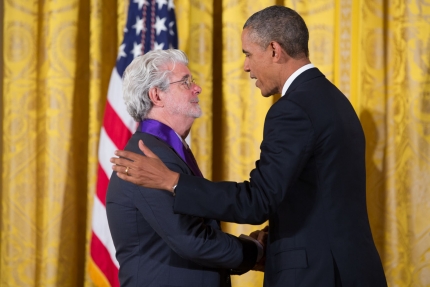
The White House

Office of the Press Secretary

Remarks by the President in Presentation of the 2012 Medals of Arts and the Medals of Humanities

East Room

2:16 P.M. EDT
 
THE PRESIDENT:  Thank you so much.  (Applause.)  Thank you. (Applause.)  Hey!  Thank you.  Everybody, please have a seat.  See, everybody is cheering because I've bought their books, I've seen their movies, I buy their records.  (Laughter.)  So we're major contributors here.
 
Well, hello, everybody, and welcome to the White House.  Thank you for joining us to celebrate the recipients of the 2012 -- because I guess this is retrospective -- National Medal of Arts and National Humanities Medals.
 
One of the special privileges of this office is getting a chance to honor individuals who’ve played an important role in my life as well as in the nation’s life.  And that’s what today is all about -- celebrating some extraordinary men and women who’ve used their talents in the arts and the humanities to open up minds and nourish souls, and help us understand what it means to be human, and what it means to be an American.
 
I want to give some special thanks to the people who help to preserve and to support that cultural legacy -- the Acting Chairwoman of the National Endowment for the Arts, Joan Shigekawa.  Give Joan a big round of applause.  (Applause.)  Where is she?  There she is.  And her predecessor, the irrepressible Rocco Landesman -- (applause) -- as well as the Acting Chairwoman of the National Endowment for the Humanities, Carole Watson.  (Applause.)  Both organizations do an incredible job lifting up some of today’s best artists and scholars, and helping to cultivate the next generation of talent and intellect.
 
And I’d like to also acknowledge the co-chairs of the President’s Committee on the Arts and Humanities, George Stevens, Jr. -- where’s George?  There he is.  (Applause.)  As well as Margo Lion -- where’s Margo?  Good to see you.  (Applause.)  As well as members of Congress who are here today, all of whom support the arts.
 
But we are primarily here to acknowledge these incredible individuals.  And, frankly, this is just fun for me because I feel like I know you all because I've enjoyed your performances; your writings have fundamentally changed me -- I think for the better, Marilynne.  I believe that.
 
At first glance, this is a pretty diverse group.  We’ve got incredible singers and dancers; we have poets and producers; musicians, playwrights, scholars.   They come from all across the country, all around the world.  And yet, for all their differences, today’s honorees have one thing in common -- and that is they are teachers.  Whether they realize it or not, they’ve taught us about ourselves and about our world.
 
American philosopher Will Durant once wrote, “The aim of art is to represent not the outward appearance of things, but their inward significance.”  And that's an extraordinary skill -- to tell the untold stories of history; to reveal the sculpture that's waiting there in a block of stone; to transform written music into song; to make it look like those planes in space are actually flying like they are.  (Laughter.)  I'm just saying, I remember when I first saw Star Wars.  (Laughter.)  There’s a whole generation that thinks special effects always look like they do today.  (Laughter.)  But it used to be you’d see, like, the string -- (laughter) -- on the little model spaceships.  Anyway, I'm being led astray.  (Laughter.)   
 
Because the arts and the humanities aren’t just a source of entertainment, they challenge us to think and to question and to discover, to seek that inward significance -- and that helps us grow and to change and to reach new heights, and to understand each other at a time when the world is constantly crying for the capacity to bridge that gap and speak to people who aren't like us.
 
And that’s exactly what these artists and these humanists have done -- by working hard, developing their craft, following their dreams, never giving up. 
 
Somebody like Allen Toussaint, who is being honored here for his incredible contributions to the rhythm and blues and jazz music of his beloved New Orleans.  After his hometown was battered by Katrina and Allen was forced to evacuate, he did something even more important for his city -- he went back.  And since then, Allen has devoted his musical talent to lifting up and building up a city.  And today, he’s taking the stage all over the world, with all kinds of incredible talent, doing everything he can to revive the legendary soul of the Big Easy.
 
Somebody like Ernest Gaines, who grew up as the descendent of sharecroppers in the South and farming the same land as his ancestors.  He did not let that define his future.  Instead, he took that experience and used it to help fill in gaps in American literature with the stories of African American life.  And then, Ernest moved back to Louisiana, onto the very same land he and his family had once worked.  And he spent more than 20 years teaching college students to find their own voices and reclaiming some of the stories of their own families and their own lives.
 
Somebody like Joan Didion, who, rightly, has earned distinction as one of most celebrated American writers of her generation.  I’m surprised she hasn’t already gotten this award. (Laughter.)  But in her early years, she was in school only sporadically, basically taught herself how to read while she and her family followed her Army officer father around the country.  She obviously learned quickly.  She won a contest for Vogue in college; gave up her dream of being an oceanographer, writing became her world.  And today, decades into her career, she remains one of our sharpest and most respected observers of American politics and culture.
 
What’s true for those three is true for all the recipients here.  So many of you have touched me and touched Michelle, and now we’re trying to get them to -- Malia and Sasha to see some of Anna’s work, or read “The Iliad*” because we want to share that, because we think it was important to us.
 
And we celebrate people like our honorees here today not just because of their talent, but because they create something new.  They create a new space and that becomes a lasting contribution to American life.  And that’s true for all of these honorees.
 
So together, the men and women with us today have helped us appreciate individual talent, but as I said earlier, they’ve also helped us to bridge our differences -- to recognize all the things we share as Americans, whether it’s arts or humanities or sports. 
 
Frank, I grew up reading Sports Illustrated, and I think it was very good for me.  I don't know about you.  (Laughter.)  Because all these endeavors, they don't discriminate, they don't prejudge -- they speak to all of us equally if we’re open to it. They’re part of all of our common heritage.  They convey all these distinct voices and emotions and stories, and that's us.  That's who we are.  
 
So for more than 200 years that culture has helped shape our views of democracy and freedom and tolerance and progress.  Sometimes the observations or the incredible art or scholarship that’s been done by these honorees are overlooked, but somewhere they’re having an impact.  And like Bobby Kennedy talked about, they create “ripples of hope.”  They’re like stones in a lake, and it emanates, and we never know exactly how, or who, will be touched by it.  But it makes a difference.  And it’s made us better. 
 
And the work that we honor today, the lifetime achievement of these artists and these scholars, reminds us that the human imagination is still the most powerful tool that we have as a people.  That’s why we celebrate their creativity and the fundamental optimism, the notion that if they work that hard somebody will actually pay attention.  That’s why we have to remain committed to the dreamers and the creators and innovators who fuel that progress and help us light the way ahead, because our children, our grandchildren deserve to grow up in a country where their dreams know no bounds and their ambitions extend as far as their talents and hard work can take them.  And it’s important that they have examples -- people who’ve carved out a path for them. 
 
So I want to thank today’s honorees for doing their part to foster that spirit, to enrich our entire nation.  Every one of them has helped us see beyond outward appearances and appreciate the significance of what’s within.  And for that we are incredibly grateful.
 
So it is now my privilege to present these medals to each of them as one of our military aides reads their citations.  (Applause.)
 
(The citations are read and the medals are awarded.)
 
MILITARY AIDE:  National Medal of Arts recipients: 
 
Herb Alpert.  (Applause.)  For his varied contributions to music and the fine arts.  The musician behind Tijuana Brass phenomenon and co-founder of A&M Records, which launched several storied careers, Mr. Alpert is also a philanthropist who shares the power of arts education with young people across our country. (Applause.)
 
Lin Arison.  (Applause.)  For her contributions as a philanthropist and arts education advocate.  Co-founder of the National YoungArts Foundation and the New World Symphony, Ms. Arison’s work celebrates, showcases, and supports the next generation of great American artists.  (Applause.)
 
Joan Myers Brown.  (Applause.)  For her contributions as a dancer, choreographer and artistic director.  Founder of the Philadelphia Dance Company, Ms. Brown carved out an artistic haven for African American dancers and choreographers to innovate, create, and share their unique visions with the national and global dance communities.  (Applause.)
 
Renée Fleming.  (Applause.)  For her contributions to American music.  Known to many as “the people’s diva,” Ms. Fleming has captivated audiences around the world with an adventurous repertoire spanning opera and the classical tradition to jazz and contemporary pop.  (Applause.)
 
Ernest J. Gaines.  (Applause.)  For his contributions as an author and teacher.  Drawing deeply from his childhood in the rural South, his works have shed new light on the African American experience and given voice to those who have endured injustice.  (Applause.)
 
Ellsworth Kelly.  (Applause.)  For his contributions as a painter, sculptor and printmaker.  A careful observer of form, color and the natural world, Mr. Kelly has shaped more than half a century of abstraction and remains a vital influence in American art.  (Applause.)
 
Tony Kushner.  (Applause.)  For his contributions to American theater and film.  Whether for the stage or the silver screen, his scripts have moved audiences worldwide, marrying humor to fury, history to fantasy, and the philosophical to the personal.  (Applause.)
 
George Lucas.  (Applause.)  For his contributions to American cinema.  By combining the art of storytelling with boundless imagination and cutting-edge techniques, Mr. Lucas has transported us to new worlds and created some of the most beloved and iconic films of all time.  (Applause.)
 
Elaine May.  (Applause.)  For her contributions to American comedy.  With groundbreaking wit and a keen understanding of how humor can illuminate our lives, Ms. May has evoked untold joy, challenged expectations, and elevated spirits across our nation. (Applause.)
 
Laurie Olin.  (Applause.)  For his contributions as a preeminent landscape architect.  Renowned for his acute sense of harmony and balance between nature and design, Mr. Olin has dedicated his energy to shaping many iconic spaces around the world and to educating new leaders in his art.  (Applause.)
 
Allen Toussaint.  (Applause.)  For his contributions as a composer, producer and performer.  Born and raised in New Orleans, Mr. Toussaint has built a legendary career alongside America’s finest musicians, sustaining his city’s rich tradition of rhythm and blues, and lifting it to the national stage.  (Applause.)
 
Accepting on behalf of Washington Performing Arts Society, Jenny Bellfield.  (Applause.)  For bringing world-class performances to our Nation’s Capital.  From concert hall premieres to in-school workshops, Washington Performing Arts Society has drawn renowned artists to the Washington community and inspired generations of young performers to follow their passions.  (Applause.)
 
National Humanities Medal recipients:
 
Edward L. Ayers.  (Applause.)  For his commitment to making our history as widely available and accessible as possible.  Dr. Ayers’s innovations in digital humanities extend higher learning beyond campus boundaries and allow broad audiences to discover the past in new ways.  (Applause.)
 
Accepting on behalf of William G. Bowen, David Bowen.  (Applause.)  For his contributions to the study of economics and his probing research on higher education in America.  While his widely discussed publications have scrutinized the effects of policy, Dr. Bowen has used his leadership to put theories into practice and strive for new heights of academic excellence.
 
Jill Ker Conway.  (Applause.)  For her contributions as a historian and trailblazing academic leader.  Dr. Conway has inspired generations of scholars, and her studies of exceptional and empowered women have revealed a common drive that unites women across the globe to create, to lead, and to excel.  (Applause.)
 
Natalie Zemon Davis.  (Applause.)  For her insights into the study of history and her exacting eloquence in bringing the past into focus.  With vivid description and exhaustive research, her works allow us to experience life through our ancestors’ eyes and to engage truly with our history.  (Applause.)
 
Frank Deford.  (Applause.)  For transforming how we think about sports.  A dedicated writer and storyteller, Mr. Deford has offered a consistent, compelling voice in print and on radio, reaching beyond scores and statistics to reveal the humanity woven into the games we love.  (Applause.) 
 
Joan Didion.  (Applause.)  For her mastery of style in writing.  Exploring the culture around us and exposing the depths of sorrow, Ms. Didion has produced works of startling honesty and fierce intellect, rendered personal stories universal, and illuminated the seemingly peripheral details that are central to our lives.  (Applause.) 
 
Robert D. Putnam.  (Applause.)  For deepening our understanding of community in America.  Examining how patterns of engagement divide and unite, Dr. Putnam’s writing and research inspire us to improve institutions that make society worth living in, and his insights challenge us to be better citizens.  (Applause.) 
 
Marilynne Robinson.  (Applause.)  For her grace and intelligence in writing.  With moral strength and lyrical clarity, Dr. Robinson’s novels and nonfiction have traced our ethical connections to people in our lives, explored the world we inhabit, and defined universal truths about what it means to be human.  (Applause.) 
 
Kay Ryan.  (Applause.)  For her contributions as a poet and educator.  A former Poet Laureate of the United States, her witty and compact verse infused with subtle wordplay, reminds us of the power of language to evoke wisdom from the ordinary.  (Applause.)
 
Robert B. Silvers.  (Applause.)  For offering critical perspectives on writing.  As the editor and co-founder of The New York Review of Books, he has invigorated our literature with cultural and political commentary, and elevated the book review to a literary art form.  (Applause.)
 
Anna Deavere Smith.  (Applause.)  For her portrayal of authentic American voices.  Through profound performances and plays that blend theater and journalism, she has informed our understanding of social issues and conveyed a range of disparate characters.  (Applause.)
 
Camilo José Vergara.  (Applause.)  For his stark visual representation of American cities.  By capturing images of urban settings over time, his sequences reflect the vibrant culture of our changing communities and document the enduring spirit that shines through decay.  (Applause.)
 
THE PRESIDENT:  Let’s give our honorees one more big round of applause.  (Applause.) 
 
Well, I could not imagine a more deserving group of honorees.  We are thrilled to have them here. 
 
Fear not, the party is not over.  (Laughter.)  My understanding is the food here at the White House is not bad.  (Laughter.)  And we may get some nice tunes from our Marine Band -- they can play anything, so feel free to make requests.  (Laughter.) 
 
But to all the honorees, thank you, again, for enriching our lives in so many different ways.  We’re going to have an opportunity to see you and your families, and take some pictures with the honorees.  In the meantime, enjoy the reception.  And thank you all.  I hope you’ve enjoyed it.  Thank you.  (Applause.)
 
END
2:47 P.M. EDT

The White House

Office of the Press Secretary

President Obama Signs Montana Disaster Declaration

The President today declared a major disaster exists in the State of Montana and ordered federal aid to supplement state and local recovery efforts in the area affected by flooding during the period of May 19 to June 3, 2013.

Federal funding is available to state and eligible local governments and certain private nonprofit organizations on a cost-sharing basis for emergency work and the repair or replacement of facilities damaged by the flooding in the counties of Blaine, Chouteau, Custer, Dawson, Fergus, Garfield, Hill, McCone, Musselshell, Petroleum, Rosebud, and Valley and the Fort Belknap, Fort Peck, and Rocky Boy’s Reservations. 

Federal funding is also available on a cost-sharing basis for hazard mitigation measures for all counties and Tribes within the state.

W. Craig Fugate, Administrator, Federal Emergency Management Agency (FEMA), Department of Homeland Security, named Thomas J. McCool as the Federal Coordinating Officer for federal recovery operations in the affected area.

FEMA said additional designations may be made at a later date if requested by the state and warranted by the results of further damage assessments.

The White House

Office of the Press Secretary

Statement by the Press Secretary on Senate Committee Vote on the Employment Non-Discrimination Act

The President welcomes the bipartisan approval of S. 815, The Employment Non-Discrimination Act (ENDA) of 2013, by the Senate Health, Education, Labor and Pensions Committee today.  He thanks Committee Chairman Harkin, Senator Merkley, and Senator Kirk for their leadership on this important issue.  The President has long supported an inclusive ENDA, which would enshrine into law strong, lasting and comprehensive protections against employment discrimination on the basis of sexual orientation or gender identity.  We look forward to the full Senate’s consideration of ENDA, and continue to urge the House to move forward on this bill that upholds America’s core values of fairness and equality.

The White House

Office of the Press Secretary

White House Report: The Economic Benefits of Fixing Our Broken Immigration System

“So if we’re truly committed to strengthening our middle class and providing more ladders of opportunity to those who are willing to work hard to make it into the middle class, we’ve got to fix the system. We have to make sure that every business and every worker in America is playing by the same set of rules. We have to bring this shadow economy into the light so that everybody is held accountable — businesses for who they hire, and immigrants for getting on the right side of the law. That’s common sense. And that’s why we need comprehensive immigration reform.”

 – President Barack Obama, January 29, 2013

America has always been a nation of immigrants, and throughout the nation’s history, immigrants from around the globe have kept our workforce vibrant, our businesses on the cutting edge, and helped to build the greatest economic engine in the world. However, America’s immigration system is broken and has not kept pace with changing times. Today, too many employers game the system by hiring undocumented workers and there are 11 million people living and working in the shadow economy. Neither is good for the economy or the country. It is time to fix our broken immigration system.

Today, the President’s National Economic Council, Domestic Policy Council, Office of Management and Budget, and the Council of Economic Advisers released a report, The Economic Benefits of Fixing Our Broken Immigration System, detailing the range of benefits to the U.S. economy that would be realized from passage of commonsense immigration reform, and the high costs of inaction.

Specifically, the report finds that the Senate-passed bipartisan immigration reform bill:

Strengthens the overall economy and grows U.S. GDP: Independent studies affirm that commonsense immigration reform will increase economic growth. The Congressional Budget Office (CBO) estimated that enacting the Senate immigration reform bill will increase real GDP relative to current law projections by 3.3 percent in 2023 and 5.4 percent in 2033 – an increase of roughly $700 billion in 2023 and $1.4 trillion in 2033 in today’s dollars. A larger labor force; higher productivity and investment; and stronger technology, tourism, hospitality, agriculture, and housing industries are just some of the key ways that immigration reform strengthens the U.S. economy.

Fosters innovation and encourages more job creation and job growth in the U.S.: Evidence shows that immigrants are highly entrepreneurial. Immigration reform would streamline the process for highly-skilled and highly-educated workers to come to the U.S. and build businesses that create jobs for Americans. In addition, it encourages companies to locate, invest, and expand here in the U.S. Under the recently passed Senate legislation, entrepreneurial immigrants would be eligible for newly created temporary and permanent visas if they demonstrate that they have ideas that attract U.S. investment or revenue and establish businesses that create jobs.

Increases the productivity of workers and adds new protections for American workers: According to CBO and other independent studies, immigration reform will ultimately increase overall U.S. productivity, resulting in higher GDP and higher wages. Part of this gain in productivity comes from immigrants’ creating new inventions and companies, as well as from improvements in U.S. production processes. Bringing undocumented workers out of the shadows and into the legal economy also helps put a stop to practices that undercut wages and worsen working conditions for American workers. This bill also has provisions to protect U.S. workers and ensure that new worksite enforcement and border security measures deter future illegal immigration.

Decreases budget deficits, balances out an aging population, and strengthens Social Security: The CBO found that the enacting Senate immigration reform bill will reduce the federal budget deficit by nearly $850 billion over the next 20 years. In addition, the independent Chief Actuary of the Social Security Administration (SSA) has found that immigration reform will improve the long-term financial standing of Social Security by adding younger workers to the U.S. workforce. The SSA Actuary estimates that the Senate’s immigration reform bill will add nearly $300 billion to the Social Security Trust Fund over the next decade and would improve Social Security’s finances over the long run, extending Social Security solvency by two years.

Commonsense Immigration Reform in Action