The White House

Office of the Press Secretary

Readout of President Obama’s Call with Nawaz Sharif

President Obama spoke by phone today with Nawaz Sharif, President of Pakistan Muslim League-Nawaz, to congratulate him on his party’s success in the May 11 Parliamentary elections.  The President also thanked Mr. Sharif for his role in the historic transfer of power between civilian governments, a significant milestone in Pakistan’s democracy.

President Obama praised the extraordinary voter turnout and courage that Pakistanis displayed in the face of intimidation by violent extremists, which was an inspiration to all who support democracy around the globe.  The two leaders agreed to continue to work together to strengthen U.S.-Pakistan relations and advance our shared interest of a stable, secure, and prosperous Pakistan and region.

The White House

Office of the Press Secretary

Readout of the President's Call with Prime Minister Najib of Malaysia

President Obama called Prime Minister Najib on the evening of May 13 to congratulate him on his victory in parliamentary elections and to reaffirm the strong bonds of friendship between the United States and Malaysia.  The President noted that Malaysians had turned out in record numbers to vote and welcomed the Prime Minister’s efforts to address concerns about election irregularities. The two leaders discussed the importance of continuing to deepen our bilateral cooperation, including on expanding cooperation on trade, regional security, and multilateral cooperation.

The White House

Office of the Press Secretary

Remarks by the President at a DCCC/DSCC Event -- New York, NY

The Waldorf Astoria Hotel

New York, New York

8:29 P.M. EST

THE PRESIDENT:  (Applause.)  Thank you, everybody.  Thank you.  (Applause.)  Thank you so much.  Thank you.  Please, everybody have a seat.

Well, first of all, thank you so much, Steve Israel, not only for the wonderful introduction, but I love the story of your grandparents.  And so often we spend time thinking about how we got into this strange business -- (laughter) -- but so often it traces back to the values that were passed on generation through generation.  And to hear that story I think affirms not only why you’re such an outstanding Congressman but also the kind of man you are.  And so we’re thrilled to have you here, and just the great job you’re doing on behalf of the DCCC.  So give Steve a big round of applause.  (Applause.)

I want to say thank you to somebody who has been a great friend -- if you are in a foxhole, this is the person you want with you -- the soon-to-be-again Speaker of the House, Leader Nancy Pelosi.  We love Nancy.  (Applause.)

And one of my favorite senators -- just a guy who everybody who meets him says, that guy, he’s just solid, sincere, hardworking, a wonderful family and has really helped to transform politics in Colorado -- Michael Bennet.  Give Michael a big round of applause.  (Applause.) 

And of course, I want to acknowledge all the outstanding members of the New York delegation who are here.  But I’ve got to give a special shout-out to somebody who is helping to engineer some of the most important legislative agenda items that we’ve got in my second term; could not be prouder of him -- Chuck Schumer.  Give Chuck a big round of applause.  (Applause.) 

So over the last month, we’ve gone through some tough times in this country.  Obviously, we saw the horrific bombing of the Boston Marathon.  I had traveled down to a tiny town in West, Texas to deal with the aftermath of a terrible explosion there that had such a devastating impact on the city.  It’s hard to find two communities more different than Boston, Massachusetts and West, Texas, I assure you.  (Laughter.)  And yet, what was striking about that very difficult, challenging week was the consistency of spirit from Boston all the way to West, Texas. 

And I remember being in a car with Deval Patrick, the outstanding mayor of -- Governor of Massachusetts, and we were driving to a memorial service and we were talking about the emergency response and how first responders who were actually running in the race all ran to the site of the explosion, and how the hospitals and doctors responded magnificently to sort through who would go where to maximize their ability to care for the victims, and the people who were driving runners to their homes -- complete strangers -- because of everything that had happened.  And what Deval and I agreed on was that in times of tragedy, in the midst of just terrible pain, there’s something about the American spirit that just rises up. 

And it’s not just resilience.  There is a generosity and a sense of neighborliness and an insistence on doing the right thing and thinking about others.  And Deval and I talked about how this is a constant in America, and it’s not just during tragedies, not just during crises.  You can see it out on a Little League field where parents are out there volunteering.  You see it in churches and synagogues and mosques and temples all across the country.  You see it in neighbors helping neighbors, and you see it in workplaces where workers are taking pride of great American products and services that they’re creating, helping to build a nation. 

But the one thing Deval and I agreed on was that we’re not seeing enough of it in our politics, and we’re certainly not seeing enough of it in Washington.  And one of the things that a second term affords you is a little bit of perspective, because I don’t have to run again, as Michelle happily reminds me.  (Laughter.)  And I’ve been through some tough battles over the last four years, and then my time in the Senate before that.  And you’re able to project out a little bit into the future. 

And precisely because of that spirit that was evident in West, Texas and in Boston, I’ve probably never been more optimistic about America.  Having gone through these extraordinary hardships -- worst financial crisis since the Great Depression; the financial system on the verge of meltdown; dealing with two wars and all the losses associated with that and the enormous strains on our budget -- we are now in the process of having cleared out the rubble.   

And although we are nowhere near where we need to be, given everything that we’ve gone through, we have seen job growth for almost three consecutive years now.  We have seen the economy growing.  We have seen people’s 401(k)s and investments on Wall Street restored.  We’ve seen health care costs grow at a slower pace over the last three years than any time in the last 50 years.  We are in the process of implementing and making sure that millions of people all across the country finally get affordable health care that they’ve never had.  (Applause.)

We have doubled the production of clean, renewable energy and our traditional natural gas and oil deposits have been tapped with new technology in ways that will probably lead us to be a net exporter of natural gas within the next five to ten years.  (Applause.) 

And housing, which was probably the biggest drag on our economy, is steadily beginning to recover.  And so across the board, there are all these signs of progress.  And that’s the American spirit at work.  That’s the American people -- through grit and determination and a vision of possibility, just brick by brick, neighborhood by neighborhood, city by city, state by state rebuilding.

And when I travel internationally -- I took a trip down to Mexico -- and met with not only the new Mexican President but also leaders of Central American countries.  What was striking is that in a part of the world where in the past there had been times where there had been suspicions directed at the United States and what our motives were, there’s an enormous hunger to engage in trade and commerce and cooperation to deal with these transnational drug networks, and a genuine sense of not just the desire, but the need for American leadership -- not a leadership that dictates, not a leadership that seeks simply to impose our will on others, but a leadership in which we are convening and collaborating and partnering, based on mutual interest and mutual respect. 

And so the bottom line is, when I canvas the world, there is no nation that we would want to trade hands with.  And there’s no nation that secretly -- they couldn't admit it -- wouldn’t mind having the hand that we’re holding.  And the only thing that’s holding us back -- the only thing that’s holding us back -- is a spirit in Washington that isn't reflective of the spirit of the American people; a spirit in Washington that’s more interested in game-playing than getting things done -- (applause) -- a spirit in Washington that is more concerned about the next election than the next generation.  And that has to change.  And that’s why you’re here tonight -- because you know it has to change.

We’ve got more work to do.  And I spelled out in my inauguration, I spelled out in my State of the Union exactly what we need to do.  We need to continue to build on the tremendous progress we’ve made in reforming our education system and make sure that every child in America is prepared before they start school with universal pre-K for every kid, which can make an enormous difference in achievement levels all across the country.  (Applause.)  Modernize our high schools so they’re adapted to the 21st century.  Make sure that our community colleges are linking up with businesses to prepare our young people for the jobs of tomorrow.  Make college more affordable.  We know that we need to do that.  There’s no credible argument for not doing it.   

We know we’ve got to rebuild our infrastructure.  We’ve got $2 trillion of deferred maintenance.  There was a list a few months back of the top airports in the world -- not one out of the top 25 were in the United States of America.  Not one.  Imagine that.  Roads, bridges, airports, ports, broadband lines, smart grids.  

We know what we’ve got to do.  And, by the way, if we are rebuilding our infrastructure, we’re putting people back to work right now.  So it’s strengthening our economy now and for the future.  We know what we need to do.

We know that we have to control our energy future.  And as promising as these new technologies are to tap into new sources of energy, we also know that climate change is real.  And if we want to leave a world for our children and our grandchildren that is as beautiful as the one that we inherited, then we’re going to have to double down on our investments in basic research and science around clean energy, and discover not just the energy sources of the past, but also the energy sources of the future.  We’ve got to win that race.  We know that.  We know that.

We know we’ve got to get immigration reform done, because we want America to attract the best and the brightest.   (Applause.)   We want the message of the Statue of Liberty to be resonating around the world, that flame to continue to shine as a beacon not just for freedom but also for people who are ambitious and have drive, and who are unconstrained by the past, because they believe in the future.  We know we’ve got to do that. 

And we know that we’ve got to have a sensible budget, a budget that invests in education and invests in research, and is true to our commitment to keeping our seniors out of poverty, and is true to our investment in the infrastructure that’s going to continue to make this a growing, dynamic economy.  And we can do all that.  We don’t have to do anything radical.  We know what the basic plan is. 

And with just some modest steps, with the deficit already coming down quicker than at any time since World War II, at a faster pace, we know that if we just make a few smart decisions both on the revenue side and on the spending side -- not through automatic, mindless spending cuts that are slashing our commitments to research and our investments in our kids, but through smart, targeted spending cuts and revenue -- that we can stabilize our budget for decades to come, just open field running from there on out.   America cannot be stopped if we make some smart decisions.  

Internationally, as I said, people are looking for our leadership.  But what they’re not looking for is us simply seeing every problem as a military problem.  They’re looking for us to be proponents of peace and work on its behalf. (Applause.)  

They are looking for us to show leadership in helping make sure that children around the world aren’t dying of malnutrition and that they get a decent education, and that people in extreme poverty making less than two dollars a day, that they’re put in a position in which they can succeed -- because they understand that if they succeed, then America will succeed as well.   And they don’t understand exactly sometimes what’s holding us back. 

So the promise of America is alive and well, and I could not be more optimistic.   But that spirit that we saw in Boston, that spirit that we saw in West, Texas, we’re going to have to unleash that.  And the only way we unleash that is to make sure that Washington, our elected leadership -- that they start reflecting that spirit as well.  And I can tell you that the Democratic leaders in that room -- in this room, they reflect that spirit because I see them every single day.  I know their values and I know what they care about, and I know what they're working for. 

And truth be told, there are folks on the other side of the aisle who have that spirit as well.  It’s not a Democratic or a Republican spirit.  It’s not a partisan spirit.  It’s an American spirit. 

But what is also true is that the dynamic on the other side of the aisle right now runs contrary to what we need in order to succeed, that they’ve got a different point of view right now, reinforced by some folks around the country that don't share our vision for America as a place where everybody gets a fair shot and everybody is doing their fair share. 

Now, I’m going to do everything I can over the next three and a half years to continue to reach out to my Republican friends on the other side of the aisle because I sure want to do some governing.  I want to get some stuff done.  I don't have a lot of time.  I’ve got three and a half years left, and it goes by like that.  And if any of you doubt that three and a half years goes by quick, try having some teenage or close-to-teenage girls.  (Laughter.)  Because you look up and you don't know what happened.  (Laughter.)  

So I want to get moving.  And any time that the other side is ready and willing and prepared to work on the things that Chuck Schumer has been working on, like immigration and making sure that we’re reducing gun violence in this country; any time that somebody is willing to work on the kinds of things that Michael Bennet has been working on, like improving our education system and making sure that we’ve got world-class research; any time that somebody is willing to cooperate with Nancy Pelosi to make sure that our budget reflects our commitment to not just the folks at the very top, but a broad-based prosperity for all Americans, and that we’re making sure that we’re rebuilding our manufacturing base in this country -- any time those folks want to get to work, we are ready to work. 

But what I also say is that during those two years that Nancy Pelosi was Speaker, man, we got a lot of stuff done.  (Applause.)  And what I also know is that unless we had a Democratic Senate, we would not have ended “don't ask, don't tell.”  Unless we had had a Democratic Senate, we would not have been able to make sure that everybody in this country is able to access affordable health care.  What I know is, is that if we hadn’t had a Democratic House and a Democratic Senate, college would be a lot less affordable for our young people.   

We know that.  So I want to be clear.  I am President of all Americans, not just the leader of a party.  And my top priority is to make sure that when I leave this office I can honestly say that America is in a stronger position and a more secure position and a more promising position than it was before I took office.

But what I also know is that with leaders like Nancy Pelosi and Steve Israel and Michael Bennet and Chuck Schumer and all the New York delegation here, with them as partners, this country will take off like we haven’t seen in a very long time.  That's what you’re investing in.  You're investing in people who share your values and your vision for the future. 

And that's why even though I’ve run my last race, I’m going to be working as hard as I can to make sure that their vision is one that is dominant on Capitol Hill.  It’s that spirit that we saw in West, Texas.  It’s the spirit we saw in Boston.  It’s the spirit that we see here in New York City.  And as I was driving up and saw the new Freedom Tower rising, it reminded me of just what it is that we’re fighting for.  (Applause.)  

So thank you very much, everybody.  God bless you.  God bless America.

END 
8:50 P.M. EDT

The White House

Office of the Press Secretary

Remarks by the President at a DNC Event -- New York, NY

Private Residence
New York, New York

5:52 P.M. EDT
 
THE PRESIDENT:  Well, first of all, I want to make sure everybody has got their food -- (laughter) -- because I don’t want to get in the way of dinner here because it looks delicious.
 
I want to thank Alexandra and Sam for their wonderful hospitality.  It is not easy opening up your house for an event with the President -- between all the tables and then the Secret Service, and this and that.  But you guys have been great friends and this means so much to us, so we are very, very grateful.  (Applause.)  Yes, absolutely. 
 
I see a lot of friends and supporters in the room.  So many of you were active during the course of the campaign.  I could not be more grateful for it and more humbled.  One person I do want to acknowledge, because not only was he active in the campaign, but he has now been volunteered to head up the DNC Finance Committee -- Henry Muñoz is here from the great state of Texas.  (Applause.)  So I want to say thank you to Henry.
 
This is a pretty rambunctious group, so I want to use most of my time for questions and answers.  But let me just make a few comments at the top.  Obviously, this last month, America faced some enormous challenges.  We had the Boston bombing, the explosion in West, Texas.  And I was mentioning at an event before I came here -- I was driving with Deval Patrick to the memorial service in Boston, and we remarked on how when tragedy strikes, when a crisis occurs, there’s something about the American spirit -- the resilience, strength, but most of all that sense of community and neighborliness just shines through.
 
And even in our darkest hours, you can’t help but come away incredibly optimistic about the country.  Now, the question Deval and I asked ourselves is how do we sustain that beyond moments of crisis and tragedy, and how do we translate that into our politics and our institutions -- because, obviously, that spirit isn’t always in evidence in Washington.  (Laughter.)  But, having said that, one of the virtues of a second term is it gives you some perspective.  And I don’t have another race to run.  And what I’ve learned from my first term in office, and probably what I’ve learned during the course of my life is things that are worth doing don’t happen right away.  And it requires persistence and just the steady, constant application of hard work and tenacity and the ability to maintain a vision about where you want to go.
 
So here, domestically, our work is not yet done, and I am absolutely confident that if we stay with it, we are going to be able to get immigration reform done this year.  (Applause.)  We’re going to be able to continue some of the incredible education work that’s being done all around the country, and Randy has been an incredible partner in that process.  We’re going to be able to continue to work to make sure that we’re rebuilding our infrastructure in our country; putting people back to work; helping the housing market continue to recover; putting people all across the country in a position where if they’re willing to work hard they can succeed and achieve their own American Dreams. 
 
So we’ve got a big agenda here at home.  But we also have a big agenda internationally.  Obviously, all of us are deeply concerned about what’s happening in Syria.  And my administration has worked with international partners to mobilize humanitarian aid, nonlethal assistance to the opposition, isolating Assad, and continuing to press for political transition that ends the slaughter and brings about an end to the Assad regime.
 
We also have a lot of unfinished business with respect to Afghanistan.  Our troops are coming home and we're transitioning out.  But it's still a very dangerous place.  And we have to make sure that the gains that have been made are sustained.  And we've got to make sure that we're being vigilant when it comes to dealing with al Qaeda and other terrorist elements.
 
And then, something that so many people in this room are knowledgeable about, the peace process and reinvigorating a sense of hope and possibility for both Israelis and Palestinians.  One of the highlights, obviously, of this early second term was the trip that I was able to take to Israel and to the Palestinian Authority and to the West Bank.  (Applause.)  And what made the trip so incredible was not only the capacity to see the incredible progress that Israel has made on so many fronts -- we looked at science exhibitions and to see how the economy is transforming itself into a high-tech, entrepreneurial center, and to have a chance to talk to young people who are doing so many incredible things.
 
But what was also encouraging was the sense that for all the difficulties, for all the setbacks, for all the false starts, deep down there's still this incredible desire for peace.  It exists in Israel.  It exists among the Palestinians.  And the question is can we create a framework in which to actually finally deliver on that promise, particularly because the window of opportunity is growing smaller by the day.  And in some ways, it's more difficult because of the incredible tumult that's taking place throughout the Middle East. 
 
When change is happening so fast -- and in some cases, so chaotically and sometimes violently -- it makes people tend not to take risks.  On the other hand, precisely because those changes are taking place all around the region, Israel's security and the prospect of Palestinian statehood all requires that those risks are taken and they're taken now. 
 
And in order for us to achieve that, it's going to be important that John Kerry and my administration continue to work this thing very hard.  But part of what's going to be required is also that those who are committed to peace here in this country continue to make their voices heard and continue to speak out.  So many of you already have and are already making a difference, but I urge you to continue.  And it's going to have to happen not just in interactions with the State Department or my administration -- you're going to have to be vocal on Capitol Hill as well.
 
And if we sustain that, then in fits and starts -- it will be difficult, it will be tough, there will be times where it feels like we're going backwards instead of forwards -- I believe that in the end, peace can be achieved.  I am a big believer in a quote that I took from Dr. King, but I think describes my general perspective about both America and our future, but also our role in the world, and that is that, "The arc of the moral universe is long, but it bends towards justice."  It requires persistence, it requires tenacity, but in the end, I think that good overcomes evil, and light overcomes darkness.  And that’s what we have to strive for every single day, and that’s how I intend to spend the three and a half years that I have remaining as President, and I couldn’t have done that without the help of all of you.
 
So thank you very much.  (Applause.) 
   
END
6:00 P.M. EDT

The White House

Office of the Press Secretary

Remarks by the President at a DNC Event -- New York, NY

Private Residence
New York, New York

4:24 P.M. EDT
 
THE PRESIDENT:  Thank you, everybody.  Well, first of all, I have to thank Harvey and Georgina for once again extending incredible hospitality to us.  We are so grateful for their friendship and support, and for the amazing movies that they've made.  And it is wonderful to see all of you.  I see old friends, new friends and people who when I have time to watch movies or TV, I very much appreciate.  So thank you for the great work that you guys do.
 
I'm going to spend most of this time in a conversation with everybody, so I'm not going to give a long speech at the front end.  Over the last three weeks, month, the country has gone through some tough times.  Obviously, we had the Boston bombing and the incredible tragedy that marred what is one of the greatest sporting events in the world, and an iconic event here in America.  We went out to West, Texas to a tiny town that had been devastated by an explosion there. 
 
And I remember, I was with Deval Patrick, a wonderful governor -- the Governor of Massachusetts -- as we were driving to a memorial in Boston shortly after the attack.  And we talked about that in the midst of tragedy, the incredible strength and courage and resolve of the American people just comes out, and the neighborliness, and the sense of willing to support strangers and neighbors and friends during tough times.  And that same spirit, which I would later see when I visited West, Texas -- you can't get two places more different than Boston and West, Texas.  So it's a pretty good representative sampling of America. 
 
And part of what Deval and I talked about was what do we need to do to make sure that that same spirit is reflected in our politics and our government -- because it's there every day for people to see.  It doesn't matter whether people are Democrats or Republicans or independents.  If you go into schools, you go to Little League games, you talk to people at the workplace -- everybody has the same sense that we live in the greatest country on Earth, that we've gone through some tough times, but we're resilient and we can overcome whatever challenges are thrown at us.  And there's a desire to get outside of the constant squabbling and bickering and positioning and gamesmanship, and get to the business of figuring out how do we make sure that the next generation does better than this generation.
 
And as I think about my second term, and people have asked me, what's different about your second term -- well, other than me being grayer -- (laughter) -- and my girls being taller, the main thing about a second term is, A, I don’t have to run for office again; but, B, you also start just thinking about history, and you start thinking about -- in longer sweeps of time, and you start saying to yourself that the three and a half years that I've got is not a lot, and so I've got to make sure that I use everything I've got to make as much of a difference as I can.
 
And more than anything, what I will be striving for over the next three and a half years is to see if that spirit that I saw in Boston and West, Texas, if we can institutionalize that, if we can create a framework where everybody is working together and moving this country forward. 
 
Now, the good news is that if we do that, we've got the best cards of any country on Earth -- and that’s the truth.  Look, there's no American politician, much less American President, who's not going to say that we're not the greatest country on Earth.  So that’s a cliché.  On the other hand, objectively, when you look at where we are right now, we are poised for a 21st century that is as much the American century as the 20th century was.
 
We have recovered from the worst economic crisis since the Great Depression, and yet, the economy is growing; millions of jobs have been created; the stock market has hit record highs; the housing market has begun to recover.  When you look at our companies, innovation, dynamism, inventiveness still take root here in the United States more than anyplace else on Earth. 
 
When it comes to energy, not only have we been able to double our production of clean energy, but even in terms of traditional energy, we will probably be a net exporter of natural gas in somewhere between five and ten years.  And so the idea of the United States being energy independent -- which seemed far-fetched as recently as 10 years ago -- now is actually a possibility.
 
When you travel around the world, people still look to the United States for leadership.  I went down to Mexico and then Costa Rica and I met with Central American leaders down there, and each and every one of them, including Daniel Ortega, who was at one of the meetings -- and some of you are too young to remember I guess Daniel Ortega, and I’m not -- (laughter) -- all of them talked about how can we trade, how can we work more effectively together.  And so the possibilities for us to shape a world that is more peaceful, more prosperous, more innovative, more environmentally conscious, more tolerant, more open -- that opportunity exists, but there are just a few things that we’re going to have to do to make sure that we realize those opportunities, that potential.
 
We’ve got to continue to revamp our education system so it’s meeting the demands of the 21st century.  We’ve got to rebuild our infrastructure so we don’t have the worst airports in the world.  We’ve got to make sure -- and ports and roads and bridges and broadband lines.  We’ve got to make sure that we continue to focus on putting people back to work, because jobs are not just a matter of income, they’re a matter of dignity and stitching the fabric of a community together. 
 
We’ve got to deal with climate change in an honest, realistic way.  We’re not going to reverse the trends overnight, but we have to start now for the sake of our kids and, in fact, the tools are available to us to make huge strides in the coming years if we make the smart investments.  We’ve got to keep on investing in research and development.  And we’ve got to get our fiscal house in order in a way that is sensible so that everybody is paying their fair share; everybody understands that we have to -- if we want a first-class education system, for example, then we’ve got to pay for it.  If we want first-class infrastructure, we’ve got to pay for it.  But we also want a government that is lean and effective and efficient, and not bloated.
 
And these are all things that we can accomplish.  What’s blocking us right now is sort of hyper-partisanship in Washington that, frankly, I was hoping to overcome in 2008.  And in the midst of crisis, I think the other party reacted; rather than saying now is the time for us all to join together, decided to take a different path. 
 
My thinking was after we beat them in 2012, well, that might break the fever -- (laughter) -- and it’s not quite broken yet.  (Laughter.)  But I am persistent.  And I am staying at it.  And I genuinely believe that there are actually Republicans out there who would like to work with us but they’re fearful of their base and they’re concerned about what Rush Limbaugh might say about them, and as a consequence, we get the kind of gridlock that makes people cynical about government and inhibits our progress.
 
So the bottom line is this -- everybody is here to support the DNC, and I very much appreciate that.  But I want everybody to understand that my intentions over the next three and a half years are to govern, because I don’t have another race left.  If we’ve got folks on the other side who are prepared to cooperate, that is great and we are ready to go.  On the other hand, if there are folks who are more interested in winning elections than they are thinking about the next generation, then I want to make sure that there are consequences to that. 
 
And what you all are here today to facilitate is our ability to make sure that the values and concerns that we all have for Dash and all the other babies that are out there -- Steve has got a new one, and I’m starting to feel like the old man around here because mine are this tall and everybody else has these little babies.  But I want to make sure that that generation is getting everything and more that we can give them.  And that’s going to require us to work hard.  It’s going to require persistence.  There are going to be ups and downs in this whole process. 
 
But one of the benefits of a second term is you start taking the long view.  And what I know is, is that as long as we are pointing towards that true North, that eventually we’ll get there.  That’s what this country has always done.  That’s what I expect will happen this time as well.
 
So with that, I’m going to stop and I’m just going to open it up for questions.  (Applause.)
 
END
4:35 P.M. EDT

President Obama Meets with Prime Minister David Cameron

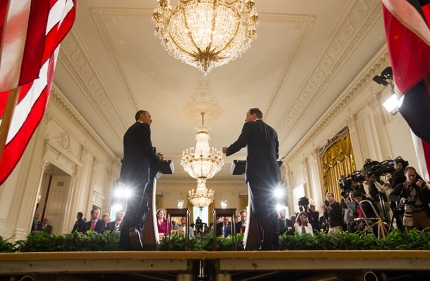
President Obama and Prime Minister David Cameron hold a joint press conference (May 13, 2013)

President Barack Obama and Prime Minister David Cameron of the United Kingdom hold a joint press conference in the East Room of the White House, May 13, 2013. (Official White House Photo by Chuck Kennedy)

Today President Obama welcomed British Prime Minister David Cameron to the White House, where the two leaders discussed issues ranging from economic development to the unfolding conflict in Syria.

"[T]he great alliance between the United States and the United Kingdom is rooted in shared interests and shared values, and it’s indispensable to global security and prosperity," President Obama said. "But as we’ve seen again recently, it's also a partnership of the heart."

The President thanked the people of the United Kingdom for their support in the wake of the bombings in Boston. In London, marathoners observed a moment of silence and dedicated their race to the victims in Massachusetts.

Prime Minister Cameron echoed the President's sentiments on the strength of the alliance between the United States and the United Kingdom.

"[The] relationship between Britain and the United States is a partnership without parallel," the Prime Minister said. "Day in, day out across the world, our diplomats and intelligence agencies work together, our soldiers serve together, and our businesses trade with each other."

In his remarks today, Prime Minister Cameron made a point to focus on three issues under discussion: the economy, the G8, and Syria. The United Kingdom currently holds the presidency of the G8 and will host the group's next summit in June -- in Northern Ireland.

Watch the full video of the press conference here

The White House

Office of the Press Secretary

Presidential Nominations Sent to the Senate

NOMINATIONS SENT TO THE SENATE:

Ryan Clark Crocker, of Washington, to be a Member of the Broadcasting Board of Governors for a term expiring August 13, 2013, vice Victor H. Ashe, term expired.

Ryan Clark Crocker, of Washington, to be a Member of the Broadcasting Board of Governors for a term expiring August 13, 2016.  (Reappointment)

The White House

Office of the Press Secretary

Press Gaggle by Press Secretary Jay Carney en route New York, NY, 5/13/2013

Aboard Air Force One
En Route New York, New York

2:34 P.M. EDT

MR. CARNEY:  Thanks for joining us on this quick trip to New York City.  You heard, obviously, the President today in his press conference with the Prime Minister.  So I hope that you found that helpful and useful, but I am here also to take your questions.  Anybody have anything?

Q    Jay, the President said that he himself was unaware of the IRS targeting.  But was anyone else at the White House aware as early as 2011, when this first came out, or of the testimony in March when an IRS official talked about it?

MR. CARNEY:  No.  My understanding is that the White House Counsel’s Office was alerted in the week of April 22nd of this year, only about the fact that the IG was finishing a review about matters involving the office in Cincinnati.  But that’s all they were informed as a normal sort of heads up.  And we have never -- we don’t have access to, nor should we, the IG’s report or any draft versions of it.

Q    So what are the next steps on this for the White House?  Should we expect the President to be -

MR. CARNEY:  I think that there is -- from my understanding, it’s not about next steps for the White House.  You heard the President’s views on this and his feelings -- very strong sentiment that if the actions that have been reported turn out to be what happened, that he finds it wholly inappropriate and that action needs to be taken to make sure people are held accountable.  But the “if” is important here because this is an independent investigation by the IG, and we, like everyone else, are awaiting its results.

Q    But if the facts do play out that way, would those consequences, would he expect that they would include people losing their jobs?

MR. CARNEY:  Again, I think you’re getting ahead of it.  I think you heard from the President on this today and how he feels about it.  But the “if” is very important, so we’re not going to start predicting outcomes if we don’t know what the conclusions of the IG report are.

Q    But, Jay, as you know, the IRS does not currently have a full commissioner in place.  Do these events increase the timetable for -- spur the timeframe to get a commissioner in place?

MR. CARNEY:  I mean, that’s a fair question.  I don’t know where that stands as a personnel matter.  But you are correct to note that there is not currently a commissioner.  The previous commissioner I believe left office in November of last year.

Q    Is it unusual, if the general counsel, the special counsel knows about this, for the President not to be given a heads up, or is that just typical?

MR. CARNEY:  I think this is, as I understand it, a normal kind of notification as the IG was concluding its report.  And in those circumstances, when something like that would become public, there’s a notification and only the White House Counsel’s Office -- well, the President was certainly not made aware of it and found about it on Friday, as I did, from news reports.

Q    Will there be a specific White House person who’s going to brief the President or who’s going to oversee the liaison with the IRS and update the White House at all?

MR. CARNEY:  Obviously, there’s a White House Counsel’s Office and they monitor these things.  But beyond that, not that I’m aware of.

Q    Jay, there are a number of things going on now that have the White House on the defensive -- IRS, the Benghazi situation.  How does this prevent the President from getting his agenda accomplished?  He has a busy agenda that he wants to do in his second term, but yet now all the attention is focused on what happened, who knew what about Benghazi, the IRS situation.

MR. CARNEY:  Well, I think you heard from the President about his view on Benghazi.  And the fact that this is a political sideshow is an unfortunate distraction from the key issues about Benghazi and the fact that four Americans were killed, and that action needs to be taken and is being taken to ensure that that kind of thing never happens again when it comes to the security that exists for our diplomatic personnel and facilities around the world. 

On the other issue, again, you heard from the President and his feelings about it, but we have to let the IG review be completed, and we certainly await that.  But, broadly speaking, the American people want Washington to focus on the issues that matter most to them, and that generally means focusing on growing the economy, helping it create jobs, strengthening the middle class, expanding opportunity, expanding security for middle-class families and seniors.  And that’s what the President will continue to focus on. 

He’ll continue to focus on those things that he is working with Congress to try to get done, like comprehensive immigration reform.  And he'll continue to focus on the actions he can take, using executive authority to press forward on a range of issues aimed at that North Star, which is a thriving and growing middle class.

Q    A follow-up question to that line of questioning is the President has been making a lot of overtures to Republicans in Congress with the dinners and luncheons and so on.  And he has also talked about trying to create a permission structure for having Republicans allowed to sort of work with him on some of these key issues without having their base immediately sort of run away from that because he’s involved.  Doesn’t this set that back in this idea that you have conservative groups being targeted by a federal government agency, and you have a number of senators who are even working with you on immigration who are now sort of some of the loudest critics on Benghazi and the IRS?

MR. CARNEY:  Well, they have been the loudest critics from the beginning, as I think you'll recall.  And the fact is we fully expect that we'll be able to continue to work with Congress on the bipartisan effort to reform our immigration system in a comprehensive way.  And I think that the key participants in the Senate on that issue continue to work with their counterparts -- both Democrats and Republicans -- as well as with the White House on that issue, as well as on a number of other issues.

Look, I think -- you heard from the President on the IRS situation, and we obviously await the IG's report on the Benghazi situation.  It's a political sideshow and it always has been.  And as the President said, there's no there there.  I  mean, what is the -- you've seen I think an article today that says that John Boehner, the Speaker of the House, is obsessed with Benghazi, and yet he didn't even attend the briefing on the emails that were provided to members of Congress many months ago about which this latest iteration of the Benghazi story has been focused. 

So they’re fundraising off of it.  It really is pure politics.  And that's an unfortunate distraction.

Q    Getting in the way of getting stuff done?

MR. CARNEY:  I don't think so, because I think that there are -- the imperatives to getting things done still exists, whether it's immigration reform, steps we can take to strengthen the economy, the need to find a balanced way to reduce our deficit that requires -- that protects our seniors and middle class, all the steps we need to take to improve our infrastructure, our education system and the like. 

What is always the case is that members of Congress will embrace the opportunity to compromise if they see it as both the right thing to do and in their interest to do it.  And we certainly believe that it should be in the interest of every member of Congress to work together to try to achieve these goals that the middle class wants achieved.

Q    Jay, does the President think it's appropriate for Secretary Sebelius to be raising money from private groups for an outside group for Obamacare implementation?

MR. CARNEY:  I saw that story this morning.  I've been focused on other things, so I don’t know that much about it.  But I can say we are obviously engaged in an effort to implement the Affordable Care Act.  Quoting John Boehner, "Obamacare is the law.”  It has been upheld by the Supreme Court, and we are in the process of implementing it and making sure that the American people know about and are aware of the process for signing up for the exchanges that will help provide health insurance for millions of Americans who don’t have it, and will confer numerous benefits upon millions and millions of Americans -- benefits that in many ways have already been conferred as pieces of the ACA have been implemented.  So we're continuing about that process. 

And again, I don’t have information about that story -- that much information about that story.  I read it, but I think that we're engaged in a process that is about the business of educating the American people about the benefits that are available to them under the law, passed by Congress, signed into law by the President, upheld by the Supreme Court.  And despite the considerable waste of time engaged in by the House of Representatives that we’ll see again this week in an effort to repeal it, going on 40 times, contradicting again the Speaker of the House after the election, it will remain the law and will be implemented.

Q    On immigration, Jay -- a collection of advocates had a conference call today with reporters, and they called on the White House again to stop deportations.  And what they’re saying is different this time is that you have a bipartisan framework that’s being debated in Congress that would allow most of the illegal immigrants to gain citizenship or legal status.  And they're saying anybody who qualifies under that, you should stop the deportations now because it is tearing apart families for those who haven’t committed any other crimes.  Is the President reconsidering that all?  Would he?  And why not, if he’s not?

MR. CARNEY:  Well, I'm not aware of this call that you mentioned.  But I think that -- obviously we enforce the law as is appropriate.  There is prosecutorial discretion when it comes to enforcing immigration laws, and those guidelines are in place. 

And meanwhile, we're continuing working with Congress to try to achieve comprehensive immigration reform that will strengthen the border, hold employers accountable, create a legal pathway to citizenship for the 11 million people living here illegally.  And that’s important work.  But I don’t have anything specific in response to your question.

Q    Jay, can you talk a little bit about the events tonight?  Is there any sensitivity to the fact that the President, at the same time that he's putting his foot down about the perception that the IRS was used to target people politically, he's also going to New York and raising money for a bunch of Democrats to help unseat Republicans?

MR. CARNEY:  That’s an interesting connection you drew in the question, but I think that the President is going to talk to supporters of Democratic candidates through the DNC, DSCC, DCCC, as is traditional and appropriate.  And he looks forward to it. 

END
2:50 P.M. EDT

President Obama and Prime Minister Cameron Hold a Press Conference

May 13, 2013 | 31:45 | Public Domain

President Obama and Prime Minister David Cameron hold a joint press conference in the East Room of the White House.

Download mp4 (1198MB) | mp3 (77MB)

The White House

Office of the Press Secretary

Notice -- Continuation of the National Emergency with Respect to Yemen

NOTICE

- - - - - - -

CONTINUATION OF THE NATIONAL EMERGENCY WITH RESPECT TO YEMEN

On May 16, 2012, by Executive Order 13611, I declared a national emergency pursuant to the International Emergency Economic Powers Act (50 U.S.C. 1701-1706) to deal with the unusual and extraordinary threat to the national security and foreign policy of the United States constituted by the actions and policies of certain members of the Government of Yemen and others that threatened Yemen's peace, security, and stability, including by obstructing the implementation of the agreement of November 23, 2011, between the Government of Yemen and those in opposition to it, which provided for a peaceful transition of power that meets the legitimate demands and aspirations of the Yemeni people for change, and by obstructing the political process in Yemen.

The actions and policies of certain members of the Government of Yemen and others in threatening Yemen's peace, security, and stability continue to pose an unusual and extraordinary threat to the national security and foreign policy of the United States. For this reason, the national emergency declared on May 16, 2012, to deal with that threat must continue in effect beyond May 16, 2013. Therefore, in accordance with section 202(d) of the National Emergencies Act (50 U.S.C. 1622(d)), I am continuing for 1 year the national emergency declared in Executive Order 13611.

This notice shall be published in the Federal Register and transmitted to the Congress.

BARACK OBAMA